Welcome to our Bible Study
Pentecost Sunday
15 May 2016
In preparation for this Sunday’s Liturgy
As aid in focusing our homilies and sharing
Prepared by Fr. Cielo R. Almazan, OFM
1st
Reading: Acts 2,1-11
 1 When the time for Pentecost was fulfilled, they were all in one
place together. 2 And suddenly there came from the sky a noise
like a strong driving wind, and it filled the entire house in which
they were. 3 Then there appeared to them tongues as of fire,
which parted and came to rest on each one of them. 4 And they
were all filled with the holy Spirit and began to speak in different
tongues, as the Spirit enabled them to proclaim. 5 Now there
were devout Jews from every nation under heaven staying in
Jerusalem. 6 At this sound, they gathered in a large crowd, but
they were confused because each one heard them speaking in
his own language. 7 They were astounded, and in amazement
they asked, "Are not all these people who are speaking
Galileans? 8 Then how does each of us hear them in his own
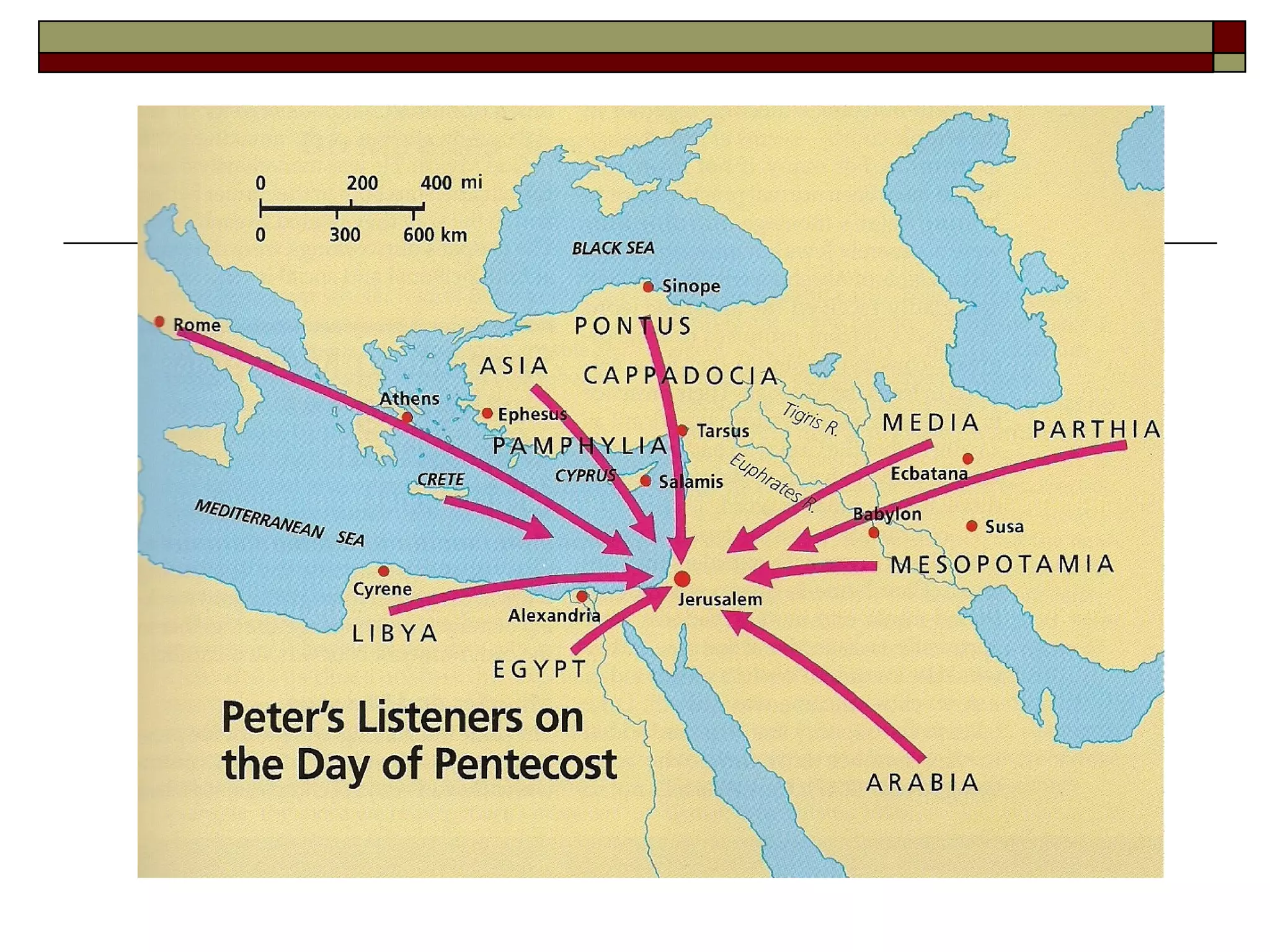
native language? 9 We are Parthians, Medes, and Elamites,
inhabitants of Mesopotamia, Judea and Cappadocia, Pontus and
Asia, 10 Phrygia and Pamphylia, Egypt and the districts of Libya
near Cyrene, as well as travelers from Rome, 11 both Jews and
converts to Judaism, Cretans and Arabs, yet we hear them
speaking in our own tongues of the mighty acts of God."
The focus is the descent of the Holy Spirit.
1st
Reading: Acts 2,1-11
Inside the room
 1 When the time for Pentecost was fulfilled, they were all in one place
together. 2 And suddenly there came from the sky a noise like a strong
driving wind, and it filled the entire house in which they were. 3 Then there
appeared to them tongues as of fire, which parted and came to rest on
each one of them. 4 And they were all filled with the holy Spirit and began
to speak in different tongues, as the Spirit enabled them to proclaim.
Outside the room
 5 Now there were devout Jews from every nation under heaven staying in
Jerusalem. 6 At this sound, they gathered in a large crowd, but they were
confused because each one heard them speaking in his own language. 7
They were astounded, and in amazement they asked, "Are not all these
people who are speaking Galileans? 8 Then how does each of us hear
them in his own native language? 9 We are Parthians, Medes, and
Elamites, inhabitants of Mesopotamia, Judea and Cappadocia, Pontus and
Asia, 10 Phrygia and Pamphylia, Egypt and the districts of Libya near
Cyrene, as well as travelers from Rome, 11 both Jews and converts to
Judaism, Cretans and Arabs, yet we hear them speaking in our own
tongues of the mighty acts of God."
Just a simple outline.
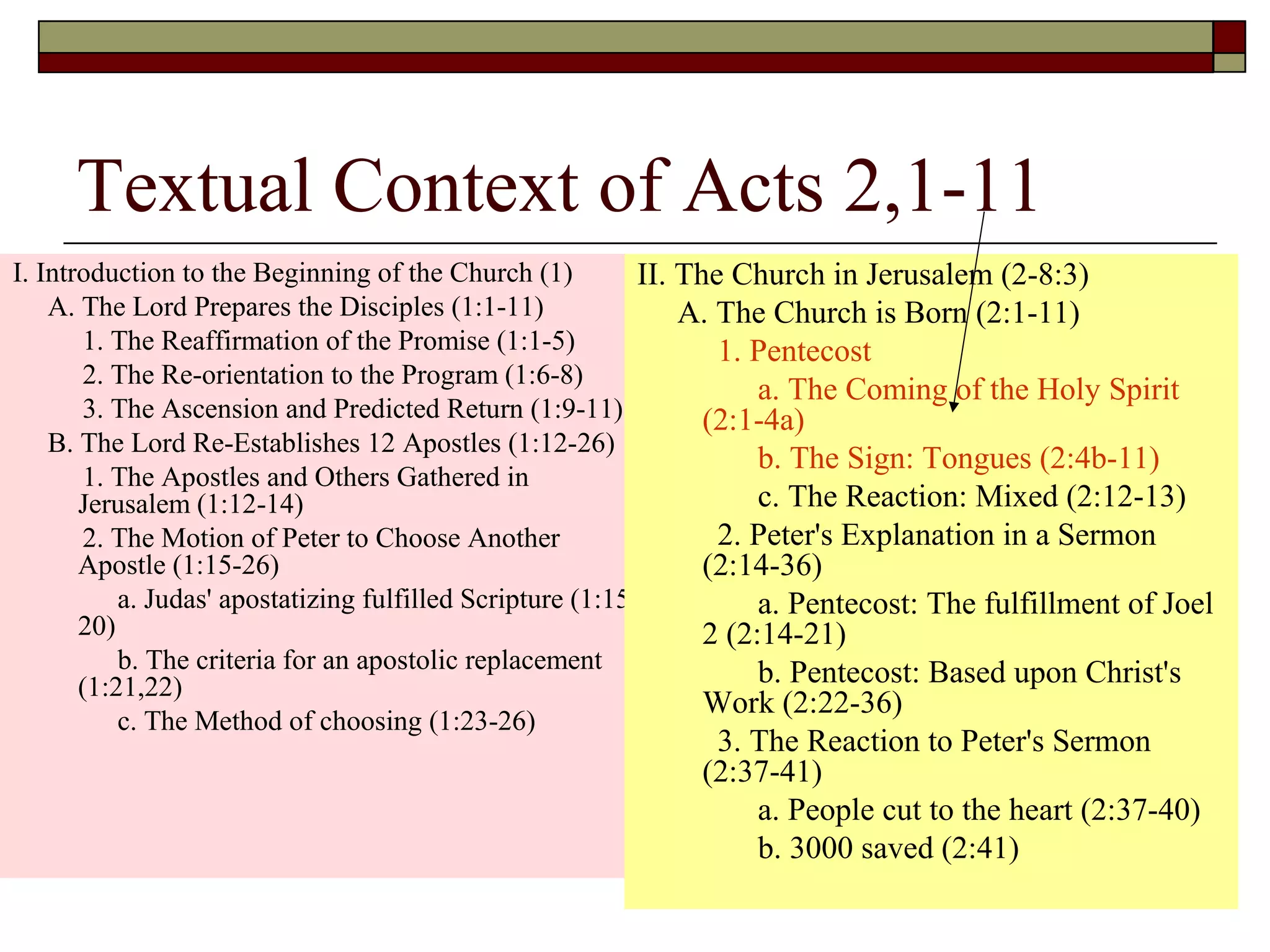
Textual Context of Acts 2,1-11
I. Introduction to the Beginning of the Church (1)
A. The Lord Prepares the Disciples (1:1-11)
1. The Reaffirmation of the Promise (1:1-5)
2. The Re-orientation to the Program (1:6-8)
3. The Ascension and Predicted Return (1:9-11)
B. The Lord Re-Establishes 12 Apostles (1:12-26)
1. The Apostles and Others Gathered in
Jerusalem (1:12-14)
2. The Motion of Peter to Choose Another
Apostle (1:15-26)
a. Judas' apostatizing fulfilled Scripture (1:15-
20)
b. The criteria for an apostolic replacement
(1:21,22)
c. The Method of choosing (1:23-26)
II. The Church in Jerusalem (2-8:3)
A. The Church is Born (2:1-11)
1. Pentecost
a. The Coming of the Holy Spirit
(2:1-4a)
b. The Sign: Tongues (2:4b-11)
c. The Reaction: Mixed (2:12-13)
2. Peter's Explanation in a Sermon
(2:14-36)
a. Pentecost: The fulfillment of Joel
2 (2:14-21)
b. Pentecost: Based upon Christ's
Work (2:22-36)
3. The Reaction to Peter's Sermon
(2:37-41)
a. People cut to the heart (2:37-40)
b. 3000 saved (2:41)
1st
Reading: Acts 2,1-11
Inside the Room
 1 When the time for Pentecost was fulfilled,
they were all in one place together. 2 And
suddenly there came from the sky a noise
like a strong driving wind, and it filled the
entire house in which they were. 3 Then
there appeared to them tongues as of fire,
which parted and came to rest on each one
of them. 4 And they were all filled with the
holy Spirit and began to speak in different
tongues, as the Spirit enabled them to
proclaim.
Outside the Room
 5 Now there were devout Jews from every
nation under heaven staying in Jerusalem.
6 At this sound, they gathered in a large
crowd, but they were confused because
each one heard them speaking in his own
language. 7 They were astounded, and in
amazement they asked, "Are not all these
people who are speaking Galileans? 8
Then how does each of us hear them in his
own native language? 9 We are Parthians,
Medes, and Elamites, inhabitants of
Mesopotamia, Judea and Cappadocia,
Pontus and Asia, 10 Phrygia and
Pamphylia, Egypt and the districts of Libya
near Cyrene, as well as travelers from
Rome, 11 both Jews and converts to
Judaism, Cretans and Arabs, yet we hear
them speaking in our own tongues of the
mighty acts of God."
Commentary
 Pentecost =50 days after the resurrection
 The reading is divided into two parts:
 1st
part: what happens inside the room
 2nd
part: what happens outside the room
 Inside the room are the apostles. The Holy
Spirit comes in the form of a noise (sound)
and tongues of fire.
 Result:
 The apostles speak in different
languages (glossolalia)
 Outside the room are devout Jews from
everywhere. They gather together because
of the sound.
 Their reaction:
 They were confused, astounded,
amazed (they heard them speaking in
his own language).
 They asked the question: How come
these Galileans speak our own
language?
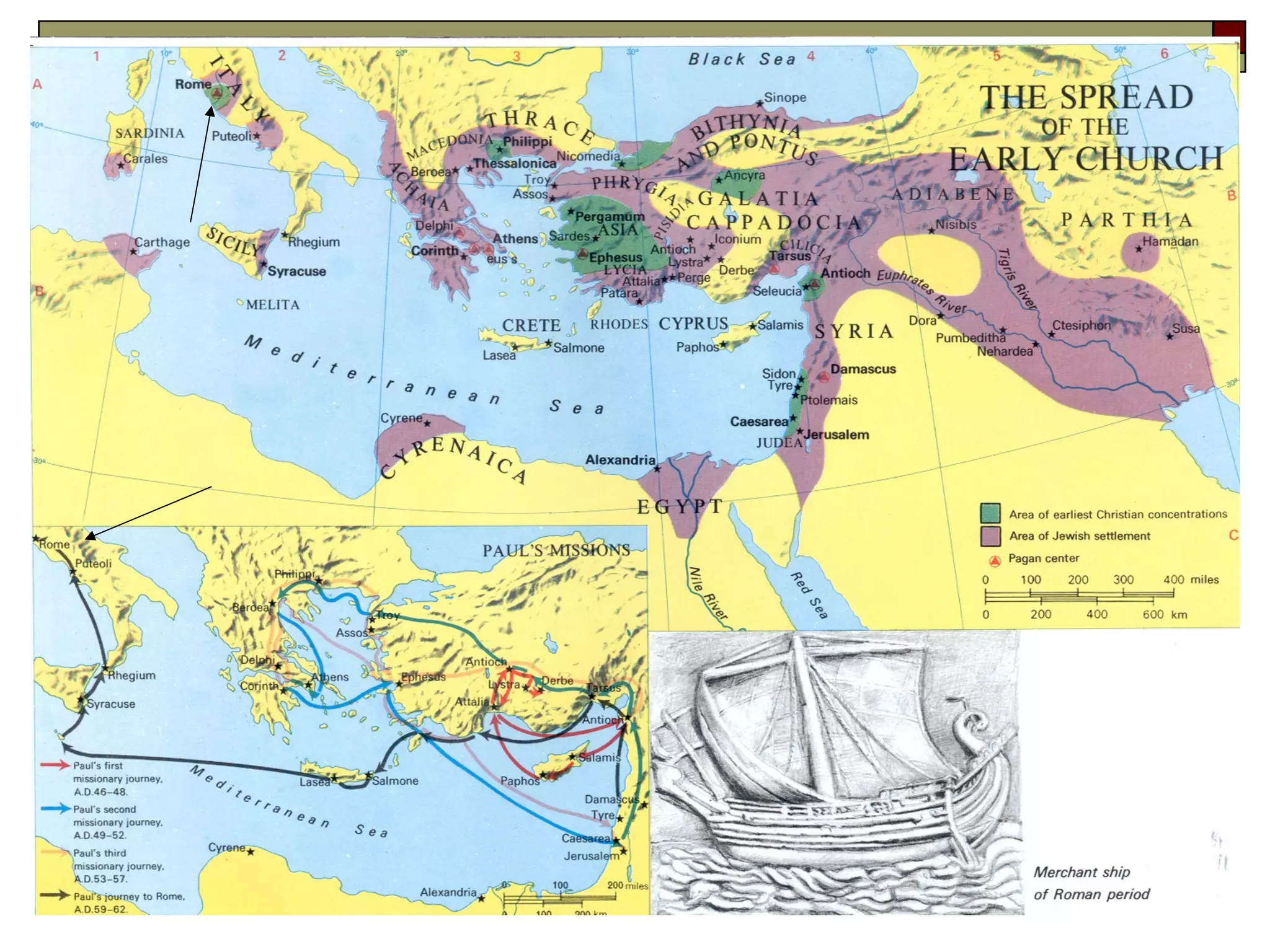
 The people mentioned represent the
international community at that time. They
can be traced in the map in the early
Church.
Reflections on the 1st
reading
 We Christians have long received the Holy
Spirit when we were baptized and confirmed.
 It is not correct to say that we receive the Holy
Spirit only when we become a member of a
charismatic group.
 We, Christians, should make the Holy Spirit
work in us.
 The Holy Spirit is working in us
 when we are able to communicate clearly.
 when we are able to attract people to listen to us,
like, during the Pentecost.
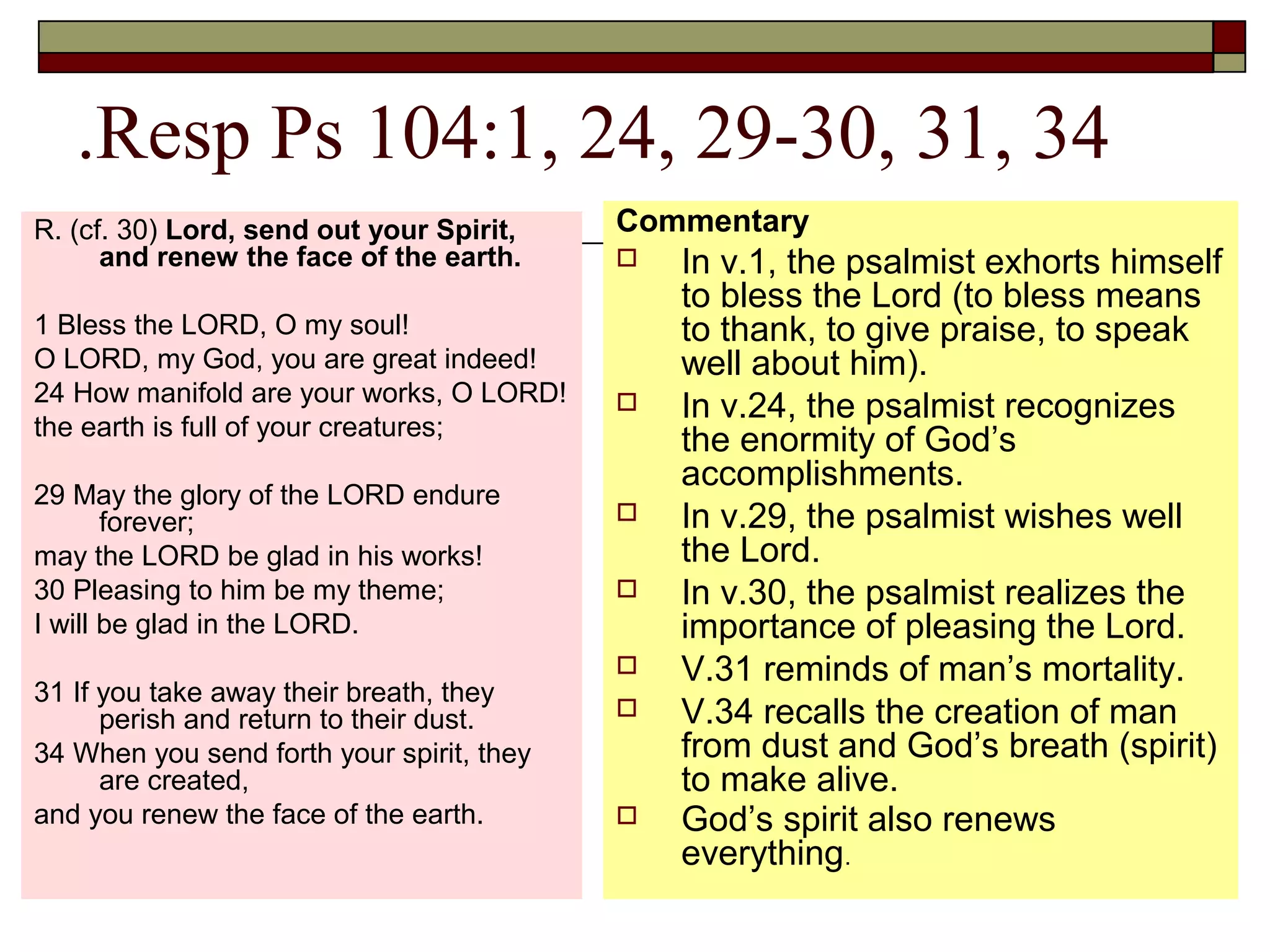
.Resp Ps 104:1, 24, 29-30, 31, 34
R. (cf. 30) Lord, send out your Spirit, and renew the face of the
earth.
1 Bless the LORD, O my soul!
O LORD, my God, you are great indeed!
24 How manifold are your works, O LORD!
the earth is full of your creatures;
29 May the glory of the LORD endure forever;
May the LORD be glad in his works!
30 Pleasing to him be my theme;
I will be glad in the LORD.
31 If you take away their breath, they perish
and return to their dust.
34 When you send forth your spirit, they are created,
and you renew the face of the earth.
.Resp Ps 104:1, 24, 29-30, 31, 34
R. (cf. 30) Lord, send out your Spirit,
and renew the face of the earth.
1 Bless the LORD, O my soul!
O LORD, my God, you are great indeed!
24 How manifold are your works, O LORD!
the earth is full of your creatures;
29 May the glory of the LORD endure
forever;
may the LORD be glad in his works!
30 Pleasing to him be my theme;
I will be glad in the LORD.
31 If you take away their breath, they
perish and return to their dust.
34 When you send forth your spirit, they
are created,
and you renew the face of the earth.
Commentary
 In v.1, the psalmist exhorts himself
to bless the Lord (to bless means
to thank, to give praise, to speak
well about him).
 In v.24, the psalmist recognizes
the enormity of God’s
accomplishments.
 In v.29, the psalmist wishes well
the Lord.
 In v.30, the psalmist realizes the
importance of pleasing the Lord.
 V.31 reminds of man’s mortality.
 V.34 recalls the creation of man
from dust and God’s breath (spirit)
to make alive.
 God’s spirit also renews
everything.
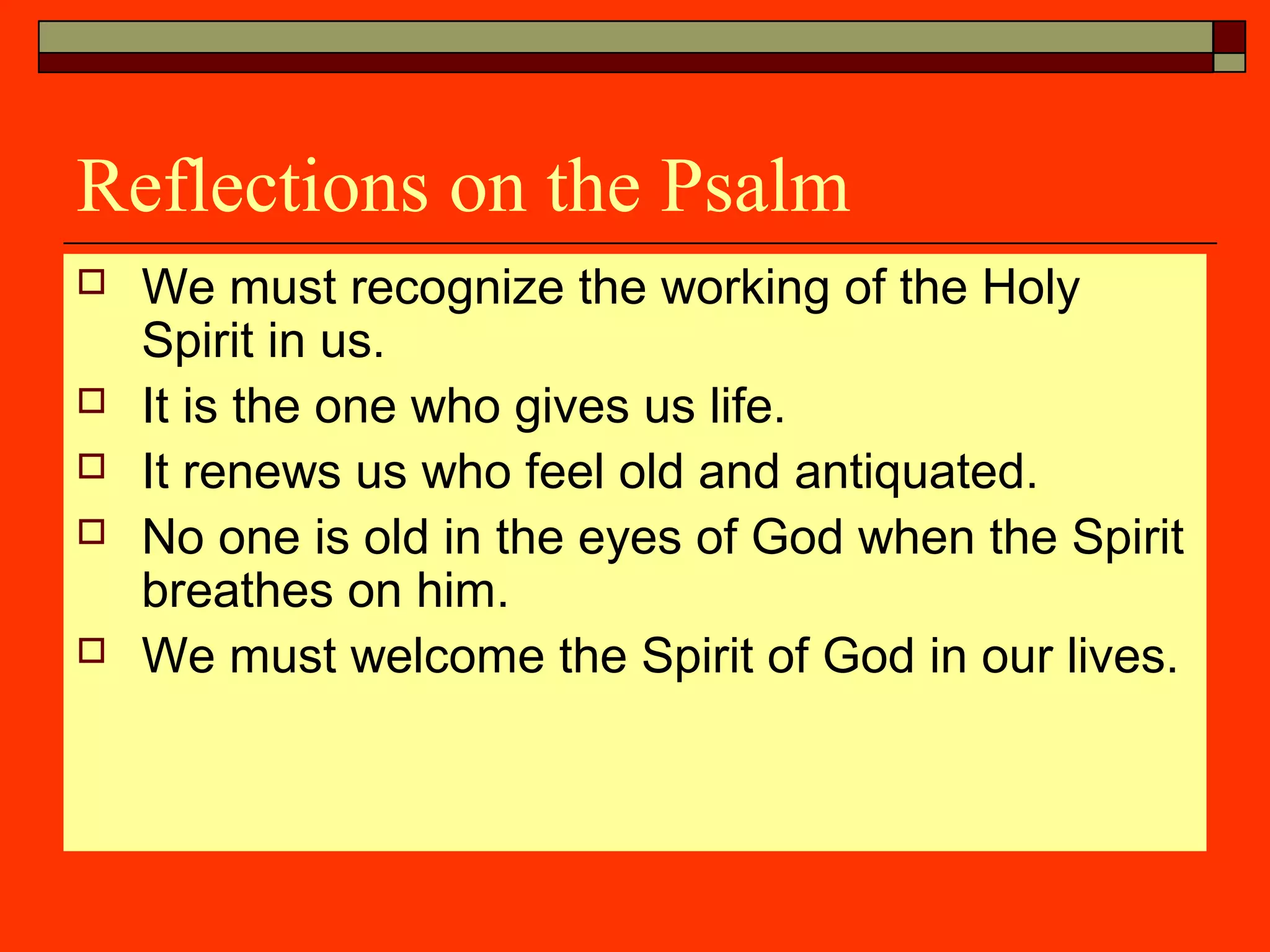
Reflections on the Psalm
 We must recognize the working of the Holy
Spirit in us.
 It is the one who gives us life.
 It renews us who feel old and antiquated.
 No one is old in the eyes of God when the Spirit
breathes on him.
 We must welcome the Spirit of God in our lives.
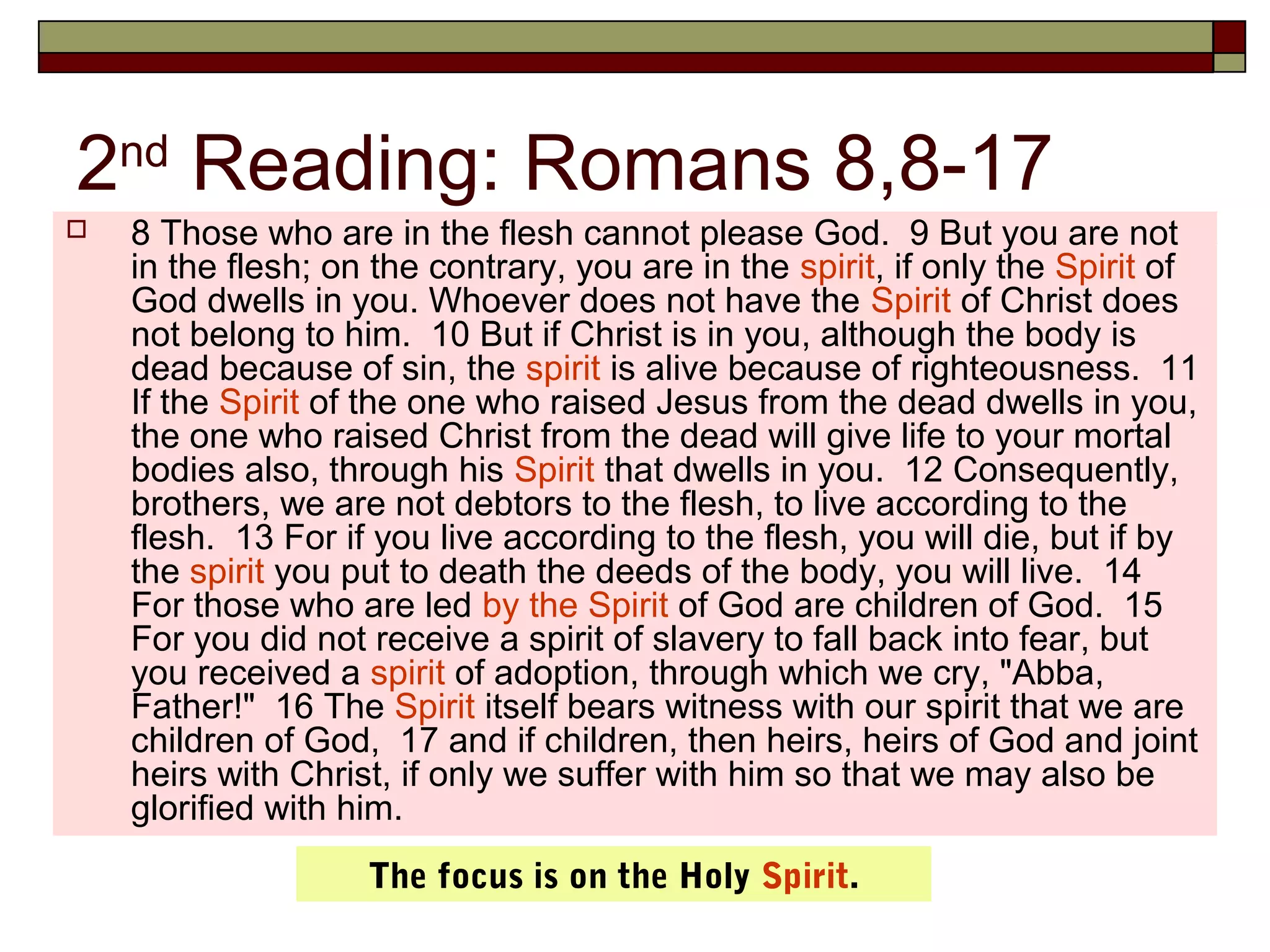
2nd
Reading: Romans 8,8-17
 8 Those who are in the flesh cannot please God. 9 But you are not
in the flesh; on the contrary, you are in the spirit, if only the Spirit of
God dwells in you. Whoever does not have the Spirit of Christ does
not belong to him. 10 But if Christ is in you, although the body is
dead because of sin, the spirit is alive because of righteousness. 11
If the Spirit of the one who raised Jesus from the dead dwells in you,
the one who raised Christ from the dead will give life to your mortal
bodies also, through his Spirit that dwells in you. 12 Consequently,
brothers, we are not debtors to the flesh, to live according to the
flesh. 13 For if you live according to the flesh, you will die, but if by
the spirit you put to death the deeds of the body, you will live. 14
For those who are led by the Spirit of God are children of God. 15
For you did not receive a spirit of slavery to fall back into fear, but
you received a spirit of adoption, through which we cry, "Abba,
Father!" 16 The Spirit itself bears witness with our spirit that we are
children of God, 17 and if children, then heirs, heirs of God and joint
heirs with Christ, if only we suffer with him so that we may also be
glorified with him.
The focus is on the Holy Spirit.
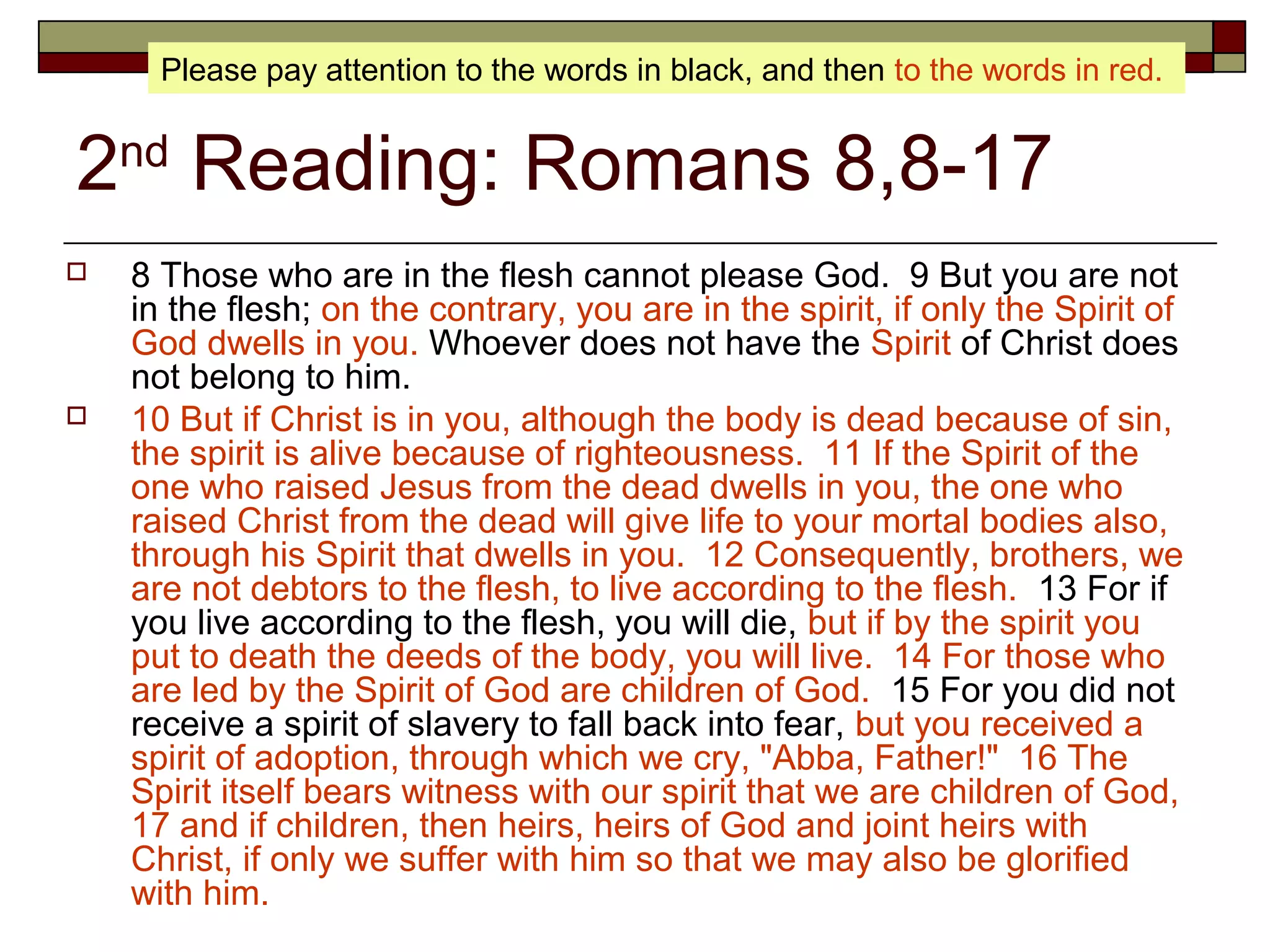
2nd
Reading: Romans 8,8-17
 8 Those who are in the flesh cannot please God. 9 But you are not
in the flesh; on the contrary, you are in the spirit, if only the Spirit of
God dwells in you. Whoever does not have the Spirit of Christ does
not belong to him.
 10 But if Christ is in you, although the body is dead because of sin,
the spirit is alive because of righteousness. 11 If the Spirit of the
one who raised Jesus from the dead dwells in you, the one who
raised Christ from the dead will give life to your mortal bodies also,
through his Spirit that dwells in you. 12 Consequently, brothers, we
are not debtors to the flesh, to live according to the flesh. 13 For if
you live according to the flesh, you will die, but if by the spirit you
put to death the deeds of the body, you will live. 14 For those who
are led by the Spirit of God are children of God. 15 For you did not
receive a spirit of slavery to fall back into fear, but you received a
spirit of adoption, through which we cry, "Abba, Father!" 16 The
Spirit itself bears witness with our spirit that we are children of God,
17 and if children, then heirs, heirs of God and joint heirs with
Christ, if only we suffer with him so that we may also be glorified
with him.
Please pay attention to the words in black, and then to the words in red.
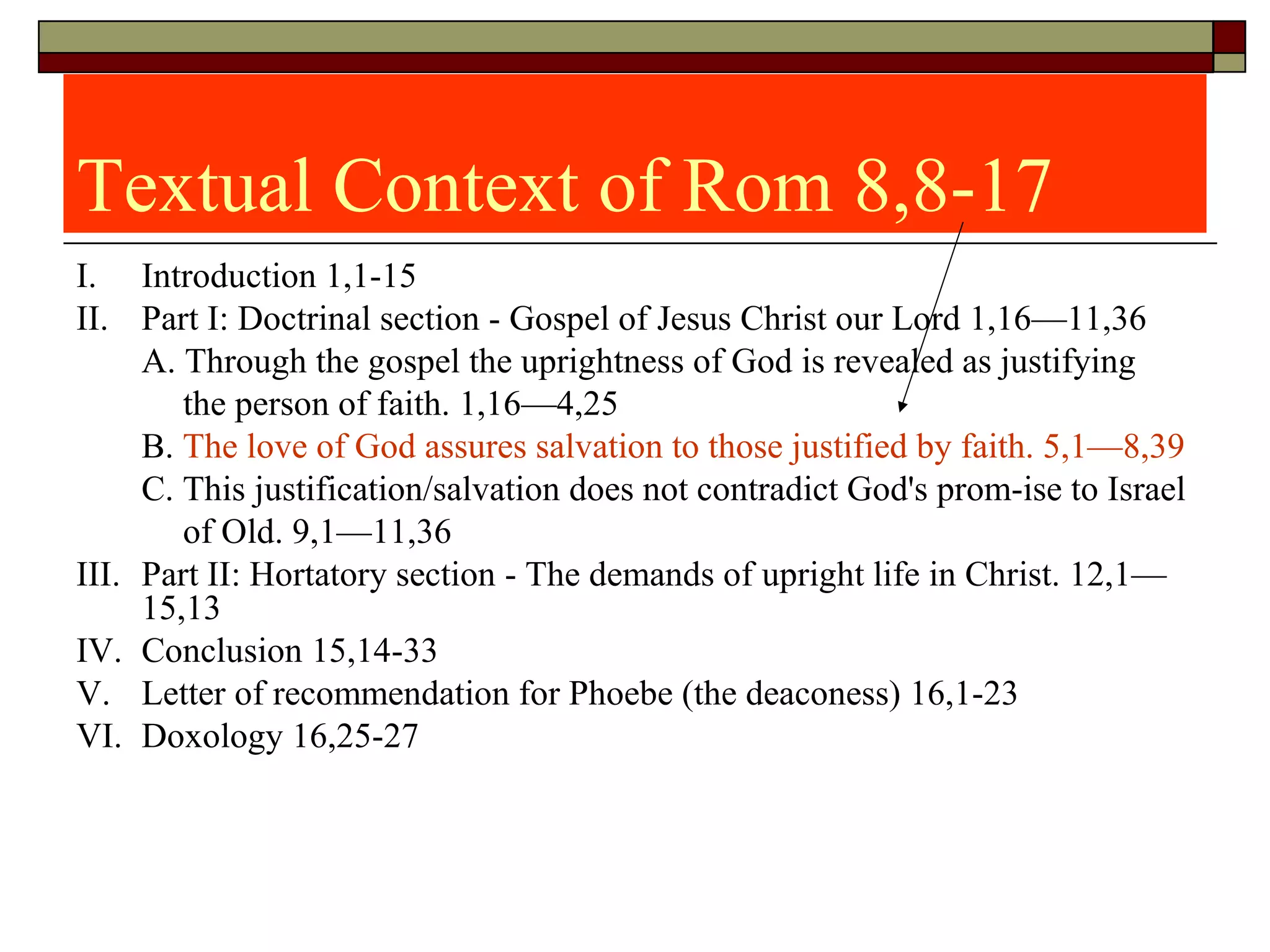
Textual Context of Rom 8,8-17 
I.  Introduction 1,1-15
II.  Part I: Doctrinal section - Gospel of Jesus Christ our Lord 1,16—11,36
A. Through the gospel the uprightness of God is revealed as justifying      
            the person of faith. 1,16—4,25
B. The love of God assures salvation to those justified by faith. 5,1—8,39
C. This justification/salvation does not contradict God's prom-ise to Israel
            of Old. 9,1—11,36
III.  Part II: Hortatory section - The demands of upright life in Christ. 12,1—
15,13
IV.  Conclusion 15,14-33
V.  Letter of recommendation for Phoebe (the deaconess) 16,1-23
VI.  Doxology 16,25-27
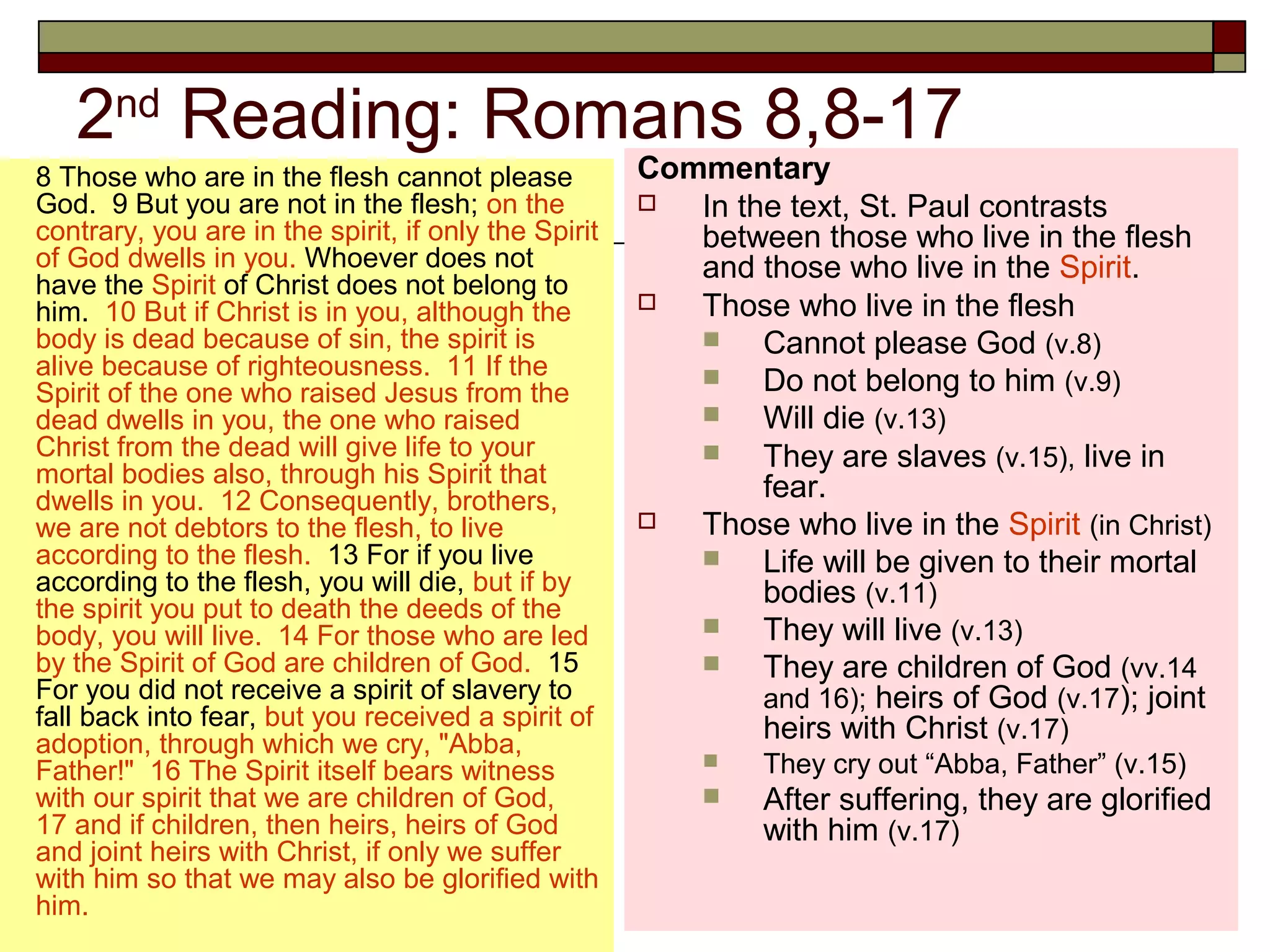
2nd
Reading: Romans 8,8-17
8 Those who are in the flesh cannot please
God. 9 But you are not in the flesh; on the
contrary, you are in the spirit, if only the Spirit
of God dwells in you. Whoever does not
have the Spirit of Christ does not belong to
him. 10 But if Christ is in you, although the
body is dead because of sin, the spirit is
alive because of righteousness. 11 If the
Spirit of the one who raised Jesus from the
dead dwells in you, the one who raised
Christ from the dead will give life to your
mortal bodies also, through his Spirit that
dwells in you. 12 Consequently, brothers,
we are not debtors to the flesh, to live
according to the flesh. 13 For if you live
according to the flesh, you will die, but if by
the spirit you put to death the deeds of the
body, you will live. 14 For those who are led
by the Spirit of God are children of God. 15
For you did not receive a spirit of slavery to
fall back into fear, but you received a spirit of
adoption, through which we cry, "Abba,
Father!" 16 The Spirit itself bears witness
with our spirit that we are children of God,
17 and if children, then heirs, heirs of God
and joint heirs with Christ, if only we suffer
with him so that we may also be glorified with
him.
Commentary
 In the text, St. Paul contrasts
between those who live in the flesh
and those who live in the Spirit.
 Those who live in the flesh
 Cannot please God (v.8)
 Do not belong to him (v.9)
 Will die (v.13)
 They are slaves (v.15), live in
fear.
 Those who live in the Spirit (in Christ)
 Life will be given to their mortal
bodies (v.11)
 They will live (v.13)
 They are children of God (vv.14
and 16); heirs of God (v.17); joint
heirs with Christ (v.17)
 They cry out “Abba, Father” (v.15)
 After suffering, they are glorified
with him (v.17)
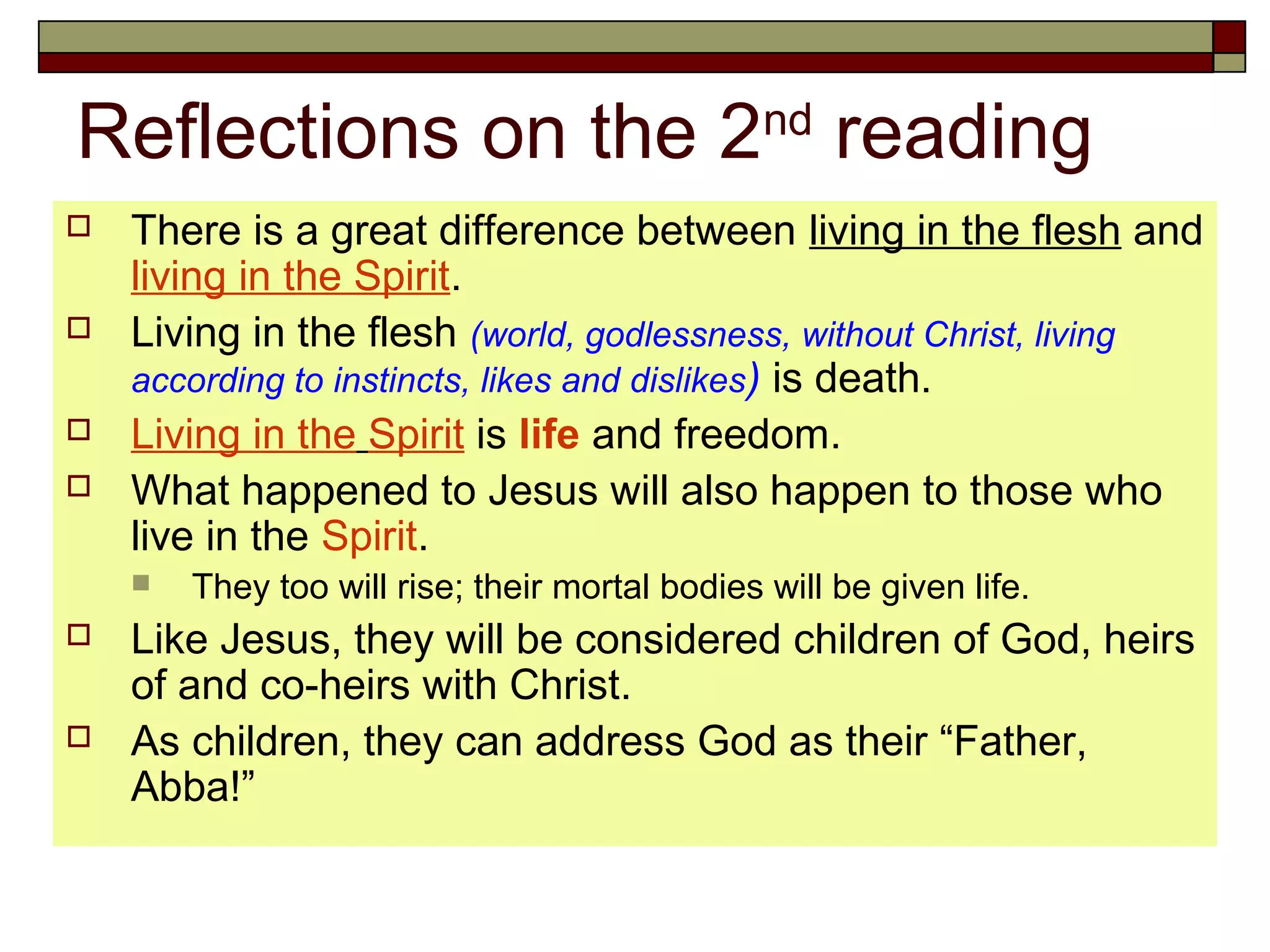
Reflections on the 2nd
reading
 There is a great difference between living in the flesh and
living in the Spirit.
 Living in the flesh (world, godlessness, without Christ, living
according to instincts, likes and dislikes) is death.
 Living in the Spirit is life and freedom.
 What happened to Jesus will also happen to those who
live in the Spirit.
 They too will rise; their mortal bodies will be given life.
 Like Jesus, they will be considered children of God, heirs
of and co-heirs with Christ.
 As children, they can address God as their “Father,
Abba!”
Gospel Reading: John 14:15-16.23-26
 15 Jesus said to his disciples, "If you love me, you will
keep my commandments. 16 And I will ask the Father,
and he will give you another Advocate to be with you
always.
 23 "Whoever loves me will keep my word, and my
Father will love him, and we will come to him and make
our dwelling with him. 24 Whoever does not love me
does not keep my words; yet the word you hear is not
mine but that of the Father who sent me. 25 "I have
told you this while I am with you. 26 The Advocate, the
holy Spirit that the Father will send in my name-- he will
teach you everything and remind you of all that (I) told
you.
The focus is on the Holy Spirit as Advocate.
Gospel Reading: John 14:15-16.23-26
 15 Jesus said to his disciples,
"If you love me, you will keep
my commandments. 16 And I
will ask the Father, and he will
give you another Advocate to
be with you always.
 23 "Whoever loves me will
keep my word, and my Father
will love him, and we will come
to him and make our dwelling
with him. 24 Whoever does
not love me does not keep my
words; yet the word you hear
is not mine but that of the
Father who sent me. 25 "I
have told you this while I am
with you. 26 The Advocate,
the holy Spirit that the Father
will send in my name-- he will
teach you everything and
remind you of all that (I) told
you.
Commentary
 In v.15, Jesus reiterates to those who
love him the need to keep his
commandments.
 In v.16, Jesus promises to intercede for
them, to give them the Holy Spirit
(Advocate, defender).
 V.23 repeats the message of v.15, and
assures each individual of the Father’s
love, and the Father and the Son
dwelling with him.
 V.24 reminds those who don’t listen to
Jesus that his words come from the
Father.
 V.26 mentions the work of the Holy
Spirit:
 To teach
 To remind
Reflections on the gospel reading
 God lavishes those who love him with his love and
presence.
 His gift to us who respond to him is the Holy Spirit who
is not an ordinary gift.
 The Holy Spirit always abides in us, teaches us and
reminds us of all the words and deeds of Jesus Christ.
 The Holy Spirit is important to those who need help and
comfort.
 All of us need help and comfort, especially when we feel
abandoned, helpless, loveless and defeated.
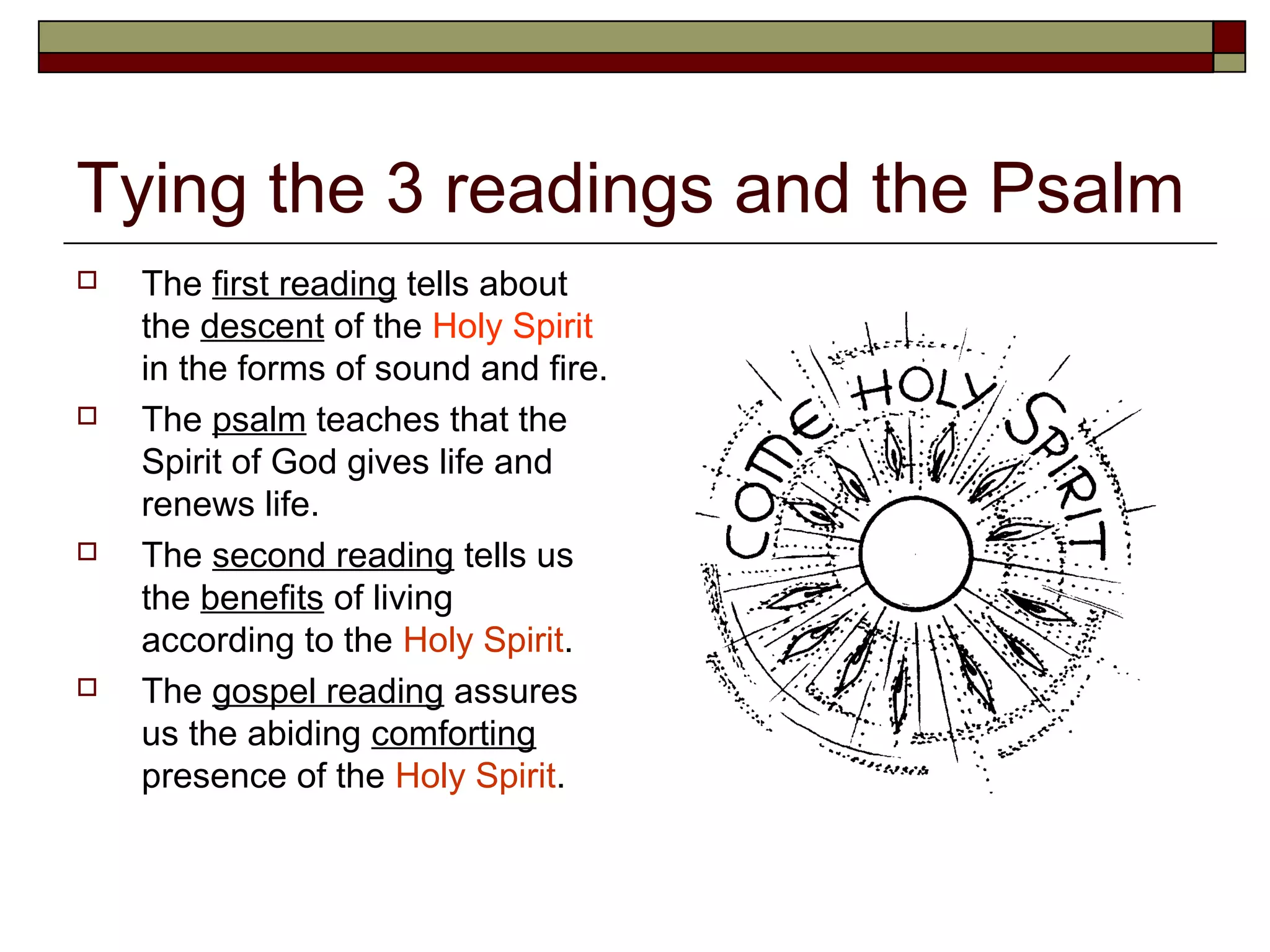
Tying the 3 readings and the Psalm
 The first reading tells about
the descent of the Holy Spirit
in the forms of sound and fire.
 The psalm teaches that the
Spirit of God gives life and
renews life.
 The second reading tells us
the benefits of living
according to the Holy Spirit.
 The gospel reading assures
us the abiding comforting
presence of the Holy Spirit.
How to develop your sharing or homily
 Begin by telling a story about the charismatic groups/
movements. (El Shaddai, Love Flock, Lord’s Flock, Shalom
International, etc.).
 The strength of these groups is their fearless recognition
of the Holy Spirit acting in their lives.
 They set the mood in order to experience the “coming” of
the Holy Spirit (baptism of the Holy Spirit, slain by the Spirit,
prayer warrioring, etc.)
 Now tell what the readings say about the Holy Spirit.
 The first reading tells about the coming of the Holy
Spirit (in a loud sound and in tongues of fire) and how it
transforms the apostles.
 They get out of their fears and go out into the open.
 They become gifted with speech.
 They are understood when they speak. (glossolalia, speaking
in tongues)
 They become missionaries.
 The Holy Spirit should have the same effect on us.
 The psalm recognizes two important acts of the Holy
Spirit, even before the Pentecost.
 It gives life.
 It renews.
 As Christians, we must show that the Spirit lives in us,
by the way we live.
 We must live spirited lives, not dull lives.
 We must show creativity (originality) at all times in
dealing with God and with one another.
 We must use our imagination.
 The second reading informs us what happens when we
live in the Spirit, not according to flesh.
 Our mortal bodies become alive.
 We put to death our bodies that lead to sin.
 We become children of God.
 We become intimate with God.
 We can call God “Abba, Father” (Daddy), without feeling corny.
 To live otherwise (according to flesh) is living in sin and
death.
 We cannot please God.
 The gospel reading reiterates the need to love God and
keep his commandments.
 Loving God and keeping his commandments pave the
way of the Holy Spirit.
 The Holy Spirit cannot work in us (cannot comfort us) if
we have no love for God and if we don’t do his will.
 This feast of the Pentecost reminds us that the Holy
Spirit works in many different ways.
 No one monopolizes the Holy Spirit. We receive the Holy
Spirit in our baptism and confirmation.
 If truly we possess the Holy Spirit, we should have clarity
in our speech and discussions. (1st
reading)
 We don’t blur issues and sow confusion in our meetings
and communities.
 When we open our mouths, something must be clarified.
 A light is lit.
 If truly we possess the Holy Spirit, we are creative in our
dealings with our loved ones. We transform people and
societies.
 Again we use our imagination.
 If truly we possess the Holy Spirit, we live moral /
ethical lives. (2nd
reading)
 We are able to distinguish between good and evil.
 In freedom, we always choose what is intrinsically good.
 Many Catholics tolerate evil (vices, stealing,
uncharitable words, injustice), though they know it is
bad.
 Many catholics are proud to be members of charismatic
groups, but they fail to see that the Holy Spirit works
also in the institutional Church.
 Today, everyone, even the charismatic / renewal groups,
needs to renew.
 Many charismatics are fed up with too much
emotionalism (hysteria) in their ranks, at a loss where the
Spirit is leading them, because of lack of solid formation.
 They lack the guidance of trained spiritual directors and
authorized shepherds (priests).
 They fail to go deep into their hearts and minds, because
they are distracted by their noisy music, networking, and
are bogged down with money and problems with
accountability.
 We should be wary about charismatic or church groups
that teach more about making money uncritically than
leading authentic spirit-led lives.
 The kenosis of Christ does not mean anything to them.
 The eucharist fosters and deepens our spiritual lives.
 In the eucharist, Jesus with the Holy Spirit and the
Father comes to console us.
 Living eucharistic lives is living according to the Spirit.
 In this eucharist, the Holy Spirit teaches and reminds us
that we are God’s children.
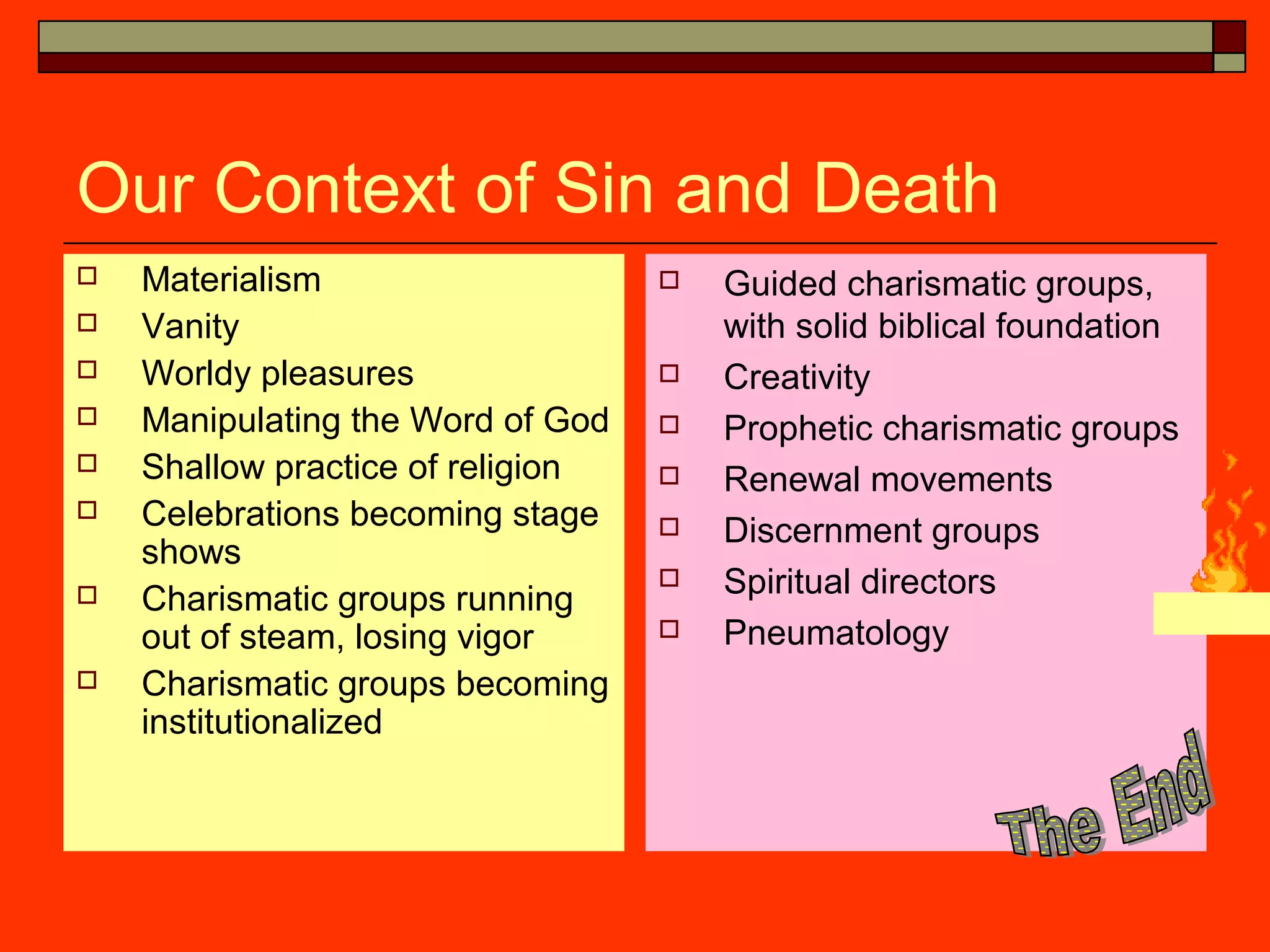
Our Context of Sin and Death
 Materialism
 Vanity
 Worldy pleasures
 Manipulating the Word of God
 Shallow practice of religion
 Celebrations becoming stage
shows
 Charismatic groups running
out of steam, losing vigor
 Charismatic groups becoming
institutionalized
 Guided charismatic groups,
with solid biblical foundation
 Creativity
 Prophetic charismatic groups
 Renewal movements
 Discernment groups
 Spiritual directors
 Pneumatology
Suggested Songs
 Come Holy Ghost
 http://www.youtube.com/watch?v=eltIRT5ZvlM&feature=related
 Veni Creator
 http://www.youtube.com/watch?v=VnUJWDEQDW4&feature=related
 The Spirit of God
 In his time
 Spirit of God by Mirriam Therese
 http://www.youtube.com/watch?v=RiqptMZCg7I
 Dear sisters and brothers,
 Don't extinguish the fire of the Holy Spirit
that is in you.
 Fr. Cielo

Pentecost Sunday C

  • 1.
    Welcome to ourBible Study Pentecost Sunday 15 May 2016 In preparation for this Sunday’s Liturgy As aid in focusing our homilies and sharing Prepared by Fr. Cielo R. Almazan, OFM
  • 2.
    1st Reading: Acts 2,1-11 1 When the time for Pentecost was fulfilled, they were all in one place together. 2 And suddenly there came from the sky a noise like a strong driving wind, and it filled the entire house in which they were. 3 Then there appeared to them tongues as of fire, which parted and came to rest on each one of them. 4 And they were all filled with the holy Spirit and began to speak in different tongues, as the Spirit enabled them to proclaim. 5 Now there were devout Jews from every nation under heaven staying in Jerusalem. 6 At this sound, they gathered in a large crowd, but they were confused because each one heard them speaking in his own language. 7 They were astounded, and in amazement they asked, "Are not all these people who are speaking Galileans? 8 Then how does each of us hear them in his own native language? 9 We are Parthians, Medes, and Elamites, inhabitants of Mesopotamia, Judea and Cappadocia, Pontus and Asia, 10 Phrygia and Pamphylia, Egypt and the districts of Libya near Cyrene, as well as travelers from Rome, 11 both Jews and converts to Judaism, Cretans and Arabs, yet we hear them speaking in our own tongues of the mighty acts of God." The focus is the descent of the Holy Spirit.
  • 3.
    1st Reading: Acts 2,1-11 Insidethe room  1 When the time for Pentecost was fulfilled, they were all in one place together. 2 And suddenly there came from the sky a noise like a strong driving wind, and it filled the entire house in which they were. 3 Then there appeared to them tongues as of fire, which parted and came to rest on each one of them. 4 And they were all filled with the holy Spirit and began to speak in different tongues, as the Spirit enabled them to proclaim. Outside the room  5 Now there were devout Jews from every nation under heaven staying in Jerusalem. 6 At this sound, they gathered in a large crowd, but they were confused because each one heard them speaking in his own language. 7 They were astounded, and in amazement they asked, "Are not all these people who are speaking Galileans? 8 Then how does each of us hear them in his own native language? 9 We are Parthians, Medes, and Elamites, inhabitants of Mesopotamia, Judea and Cappadocia, Pontus and Asia, 10 Phrygia and Pamphylia, Egypt and the districts of Libya near Cyrene, as well as travelers from Rome, 11 both Jews and converts to Judaism, Cretans and Arabs, yet we hear them speaking in our own tongues of the mighty acts of God." Just a simple outline.
  • 4.
    Textual Context ofActs 2,1-11 I. Introduction to the Beginning of the Church (1) A. The Lord Prepares the Disciples (1:1-11) 1. The Reaffirmation of the Promise (1:1-5) 2. The Re-orientation to the Program (1:6-8) 3. The Ascension and Predicted Return (1:9-11) B. The Lord Re-Establishes 12 Apostles (1:12-26) 1. The Apostles and Others Gathered in Jerusalem (1:12-14) 2. The Motion of Peter to Choose Another Apostle (1:15-26) a. Judas' apostatizing fulfilled Scripture (1:15- 20) b. The criteria for an apostolic replacement (1:21,22) c. The Method of choosing (1:23-26) II. The Church in Jerusalem (2-8:3) A. The Church is Born (2:1-11) 1. Pentecost a. The Coming of the Holy Spirit (2:1-4a) b. The Sign: Tongues (2:4b-11) c. The Reaction: Mixed (2:12-13) 2. Peter's Explanation in a Sermon (2:14-36) a. Pentecost: The fulfillment of Joel 2 (2:14-21) b. Pentecost: Based upon Christ's Work (2:22-36) 3. The Reaction to Peter's Sermon (2:37-41) a. People cut to the heart (2:37-40) b. 3000 saved (2:41)
  • 6.
    1st Reading: Acts 2,1-11 Insidethe Room  1 When the time for Pentecost was fulfilled, they were all in one place together. 2 And suddenly there came from the sky a noise like a strong driving wind, and it filled the entire house in which they were. 3 Then there appeared to them tongues as of fire, which parted and came to rest on each one of them. 4 And they were all filled with the holy Spirit and began to speak in different tongues, as the Spirit enabled them to proclaim. Outside the Room  5 Now there were devout Jews from every nation under heaven staying in Jerusalem. 6 At this sound, they gathered in a large crowd, but they were confused because each one heard them speaking in his own language. 7 They were astounded, and in amazement they asked, "Are not all these people who are speaking Galileans? 8 Then how does each of us hear them in his own native language? 9 We are Parthians, Medes, and Elamites, inhabitants of Mesopotamia, Judea and Cappadocia, Pontus and Asia, 10 Phrygia and Pamphylia, Egypt and the districts of Libya near Cyrene, as well as travelers from Rome, 11 both Jews and converts to Judaism, Cretans and Arabs, yet we hear them speaking in our own tongues of the mighty acts of God." Commentary  Pentecost =50 days after the resurrection  The reading is divided into two parts:  1st part: what happens inside the room  2nd part: what happens outside the room  Inside the room are the apostles. The Holy Spirit comes in the form of a noise (sound) and tongues of fire.  Result:  The apostles speak in different languages (glossolalia)  Outside the room are devout Jews from everywhere. They gather together because of the sound.  Their reaction:  They were confused, astounded, amazed (they heard them speaking in his own language).  They asked the question: How come these Galileans speak our own language?  The people mentioned represent the international community at that time. They can be traced in the map in the early Church.
  • 7.
    Reflections on the1st reading  We Christians have long received the Holy Spirit when we were baptized and confirmed.  It is not correct to say that we receive the Holy Spirit only when we become a member of a charismatic group.  We, Christians, should make the Holy Spirit work in us.  The Holy Spirit is working in us  when we are able to communicate clearly.  when we are able to attract people to listen to us, like, during the Pentecost.
  • 8.
    .Resp Ps 104:1,24, 29-30, 31, 34 R. (cf. 30) Lord, send out your Spirit, and renew the face of the earth. 1 Bless the LORD, O my soul! O LORD, my God, you are great indeed! 24 How manifold are your works, O LORD! the earth is full of your creatures; 29 May the glory of the LORD endure forever; May the LORD be glad in his works! 30 Pleasing to him be my theme; I will be glad in the LORD. 31 If you take away their breath, they perish and return to their dust. 34 When you send forth your spirit, they are created, and you renew the face of the earth.
  • 9.
    .Resp Ps 104:1, 24, 29-30, 31, 34 R. (cf. 30)Lord, send out your Spirit, and renew the face of the earth. 1 Bless the LORD, O my soul! O LORD, my God, you are great indeed! 24 How manifold are your works, O LORD! the earth is full of your creatures; 29 May the glory of the LORD endure forever; may the LORD be glad in his works! 30 Pleasing to him be my theme; I will be glad in the LORD. 31 If you take away their breath, they perish and return to their dust. 34 When you send forth your spirit, they are created, and you renew the face of the earth. Commentary  In v.1, the psalmist exhorts himself to bless the Lord (to bless means to thank, to give praise, to speak well about him).  In v.24, the psalmist recognizes the enormity of God’s accomplishments.  In v.29, the psalmist wishes well the Lord.  In v.30, the psalmist realizes the importance of pleasing the Lord.  V.31 reminds of man’s mortality.  V.34 recalls the creation of man from dust and God’s breath (spirit) to make alive.  God’s spirit also renews everything.
  • 10.
    Reflections on the Psalm  We mustrecognize the working of the Holy Spirit in us.  It is the one who gives us life.  It renews us who feel old and antiquated.  No one is old in the eyes of God when the Spirit breathes on him.  We must welcome the Spirit of God in our lives.
  • 11.
    2nd Reading: Romans 8,8-17 8 Those who are in the flesh cannot please God. 9 But you are not in the flesh; on the contrary, you are in the spirit, if only the Spirit of God dwells in you. Whoever does not have the Spirit of Christ does not belong to him. 10 But if Christ is in you, although the body is dead because of sin, the spirit is alive because of righteousness. 11 If the Spirit of the one who raised Jesus from the dead dwells in you, the one who raised Christ from the dead will give life to your mortal bodies also, through his Spirit that dwells in you. 12 Consequently, brothers, we are not debtors to the flesh, to live according to the flesh. 13 For if you live according to the flesh, you will die, but if by the spirit you put to death the deeds of the body, you will live. 14 For those who are led by the Spirit of God are children of God. 15 For you did not receive a spirit of slavery to fall back into fear, but you received a spirit of adoption, through which we cry, "Abba, Father!" 16 The Spirit itself bears witness with our spirit that we are children of God, 17 and if children, then heirs, heirs of God and joint heirs with Christ, if only we suffer with him so that we may also be glorified with him. The focus is on the Holy Spirit.
  • 12.
    2nd Reading: Romans 8,8-17 8 Those who are in the flesh cannot please God. 9 But you are not in the flesh; on the contrary, you are in the spirit, if only the Spirit of God dwells in you. Whoever does not have the Spirit of Christ does not belong to him.  10 But if Christ is in you, although the body is dead because of sin, the spirit is alive because of righteousness. 11 If the Spirit of the one who raised Jesus from the dead dwells in you, the one who raised Christ from the dead will give life to your mortal bodies also, through his Spirit that dwells in you. 12 Consequently, brothers, we are not debtors to the flesh, to live according to the flesh. 13 For if you live according to the flesh, you will die, but if by the spirit you put to death the deeds of the body, you will live. 14 For those who are led by the Spirit of God are children of God. 15 For you did not receive a spirit of slavery to fall back into fear, but you received a spirit of adoption, through which we cry, "Abba, Father!" 16 The Spirit itself bears witness with our spirit that we are children of God, 17 and if children, then heirs, heirs of God and joint heirs with Christ, if only we suffer with him so that we may also be glorified with him. Please pay attention to the words in black, and then to the words in red.
  • 13.
  • 15.
    2nd Reading: Romans 8,8-17 8Those who are in the flesh cannot please God. 9 But you are not in the flesh; on the contrary, you are in the spirit, if only the Spirit of God dwells in you. Whoever does not have the Spirit of Christ does not belong to him. 10 But if Christ is in you, although the body is dead because of sin, the spirit is alive because of righteousness. 11 If the Spirit of the one who raised Jesus from the dead dwells in you, the one who raised Christ from the dead will give life to your mortal bodies also, through his Spirit that dwells in you. 12 Consequently, brothers, we are not debtors to the flesh, to live according to the flesh. 13 For if you live according to the flesh, you will die, but if by the spirit you put to death the deeds of the body, you will live. 14 For those who are led by the Spirit of God are children of God. 15 For you did not receive a spirit of slavery to fall back into fear, but you received a spirit of adoption, through which we cry, "Abba, Father!" 16 The Spirit itself bears witness with our spirit that we are children of God, 17 and if children, then heirs, heirs of God and joint heirs with Christ, if only we suffer with him so that we may also be glorified with him. Commentary  In the text, St. Paul contrasts between those who live in the flesh and those who live in the Spirit.  Those who live in the flesh  Cannot please God (v.8)  Do not belong to him (v.9)  Will die (v.13)  They are slaves (v.15), live in fear.  Those who live in the Spirit (in Christ)  Life will be given to their mortal bodies (v.11)  They will live (v.13)  They are children of God (vv.14 and 16); heirs of God (v.17); joint heirs with Christ (v.17)  They cry out “Abba, Father” (v.15)  After suffering, they are glorified with him (v.17)
  • 16.
    Reflections on the2nd reading  There is a great difference between living in the flesh and living in the Spirit.  Living in the flesh (world, godlessness, without Christ, living according to instincts, likes and dislikes) is death.  Living in the Spirit is life and freedom.  What happened to Jesus will also happen to those who live in the Spirit.  They too will rise; their mortal bodies will be given life.  Like Jesus, they will be considered children of God, heirs of and co-heirs with Christ.  As children, they can address God as their “Father, Abba!”
  • 17.
    Gospel Reading: John14:15-16.23-26  15 Jesus said to his disciples, "If you love me, you will keep my commandments. 16 And I will ask the Father, and he will give you another Advocate to be with you always.  23 "Whoever loves me will keep my word, and my Father will love him, and we will come to him and make our dwelling with him. 24 Whoever does not love me does not keep my words; yet the word you hear is not mine but that of the Father who sent me. 25 "I have told you this while I am with you. 26 The Advocate, the holy Spirit that the Father will send in my name-- he will teach you everything and remind you of all that (I) told you. The focus is on the Holy Spirit as Advocate.
  • 18.
    Gospel Reading: John14:15-16.23-26  15 Jesus said to his disciples, "If you love me, you will keep my commandments. 16 And I will ask the Father, and he will give you another Advocate to be with you always.  23 "Whoever loves me will keep my word, and my Father will love him, and we will come to him and make our dwelling with him. 24 Whoever does not love me does not keep my words; yet the word you hear is not mine but that of the Father who sent me. 25 "I have told you this while I am with you. 26 The Advocate, the holy Spirit that the Father will send in my name-- he will teach you everything and remind you of all that (I) told you. Commentary  In v.15, Jesus reiterates to those who love him the need to keep his commandments.  In v.16, Jesus promises to intercede for them, to give them the Holy Spirit (Advocate, defender).  V.23 repeats the message of v.15, and assures each individual of the Father’s love, and the Father and the Son dwelling with him.  V.24 reminds those who don’t listen to Jesus that his words come from the Father.  V.26 mentions the work of the Holy Spirit:  To teach  To remind
  • 19.
    Reflections on thegospel reading  God lavishes those who love him with his love and presence.  His gift to us who respond to him is the Holy Spirit who is not an ordinary gift.  The Holy Spirit always abides in us, teaches us and reminds us of all the words and deeds of Jesus Christ.  The Holy Spirit is important to those who need help and comfort.  All of us need help and comfort, especially when we feel abandoned, helpless, loveless and defeated.
  • 20.
    Tying the 3readings and the Psalm  The first reading tells about the descent of the Holy Spirit in the forms of sound and fire.  The psalm teaches that the Spirit of God gives life and renews life.  The second reading tells us the benefits of living according to the Holy Spirit.  The gospel reading assures us the abiding comforting presence of the Holy Spirit.
  • 21.
    How to developyour sharing or homily  Begin by telling a story about the charismatic groups/ movements. (El Shaddai, Love Flock, Lord’s Flock, Shalom International, etc.).  The strength of these groups is their fearless recognition of the Holy Spirit acting in their lives.  They set the mood in order to experience the “coming” of the Holy Spirit (baptism of the Holy Spirit, slain by the Spirit, prayer warrioring, etc.)  Now tell what the readings say about the Holy Spirit.
  • 22.
     The firstreading tells about the coming of the Holy Spirit (in a loud sound and in tongues of fire) and how it transforms the apostles.  They get out of their fears and go out into the open.  They become gifted with speech.  They are understood when they speak. (glossolalia, speaking in tongues)  They become missionaries.  The Holy Spirit should have the same effect on us.
  • 23.
     The psalmrecognizes two important acts of the Holy Spirit, even before the Pentecost.  It gives life.  It renews.  As Christians, we must show that the Spirit lives in us, by the way we live.  We must live spirited lives, not dull lives.  We must show creativity (originality) at all times in dealing with God and with one another.  We must use our imagination.
  • 24.
     The secondreading informs us what happens when we live in the Spirit, not according to flesh.  Our mortal bodies become alive.  We put to death our bodies that lead to sin.  We become children of God.  We become intimate with God.  We can call God “Abba, Father” (Daddy), without feeling corny.  To live otherwise (according to flesh) is living in sin and death.  We cannot please God.
  • 25.
     The gospelreading reiterates the need to love God and keep his commandments.  Loving God and keeping his commandments pave the way of the Holy Spirit.  The Holy Spirit cannot work in us (cannot comfort us) if we have no love for God and if we don’t do his will.
  • 26.
     This feastof the Pentecost reminds us that the Holy Spirit works in many different ways.  No one monopolizes the Holy Spirit. We receive the Holy Spirit in our baptism and confirmation.  If truly we possess the Holy Spirit, we should have clarity in our speech and discussions. (1st reading)  We don’t blur issues and sow confusion in our meetings and communities.  When we open our mouths, something must be clarified.  A light is lit.  If truly we possess the Holy Spirit, we are creative in our dealings with our loved ones. We transform people and societies.  Again we use our imagination.
  • 27.
     If trulywe possess the Holy Spirit, we live moral / ethical lives. (2nd reading)  We are able to distinguish between good and evil.  In freedom, we always choose what is intrinsically good.  Many Catholics tolerate evil (vices, stealing, uncharitable words, injustice), though they know it is bad.  Many catholics are proud to be members of charismatic groups, but they fail to see that the Holy Spirit works also in the institutional Church.
  • 28.
     Today, everyone,even the charismatic / renewal groups, needs to renew.  Many charismatics are fed up with too much emotionalism (hysteria) in their ranks, at a loss where the Spirit is leading them, because of lack of solid formation.  They lack the guidance of trained spiritual directors and authorized shepherds (priests).  They fail to go deep into their hearts and minds, because they are distracted by their noisy music, networking, and are bogged down with money and problems with accountability.  We should be wary about charismatic or church groups that teach more about making money uncritically than leading authentic spirit-led lives.  The kenosis of Christ does not mean anything to them.
  • 29.
     The eucharistfosters and deepens our spiritual lives.  In the eucharist, Jesus with the Holy Spirit and the Father comes to console us.  Living eucharistic lives is living according to the Spirit.  In this eucharist, the Holy Spirit teaches and reminds us that we are God’s children.
  • 30.
    Our Context ofSin and Death  Materialism  Vanity  Worldy pleasures  Manipulating the Word of God  Shallow practice of religion  Celebrations becoming stage shows  Charismatic groups running out of steam, losing vigor  Charismatic groups becoming institutionalized  Guided charismatic groups, with solid biblical foundation  Creativity  Prophetic charismatic groups  Renewal movements  Discernment groups  Spiritual directors  Pneumatology
  • 31.
    Suggested Songs  ComeHoly Ghost  http://www.youtube.com/watch?v=eltIRT5ZvlM&feature=related  Veni Creator  http://www.youtube.com/watch?v=VnUJWDEQDW4&feature=related  The Spirit of God  In his time  Spirit of God by Mirriam Therese  http://www.youtube.com/watch?v=RiqptMZCg7I
  • 32.
     Dear sistersand brothers,  Don't extinguish the fire of the Holy Spirit that is in you.  Fr. Cielo