Welcome to our Bible Study
11th
Sunday in Ordinary Time C
12 June 2016
In preparation for this Sunday’s Liturgy
As aid in focusing our homilies and sharing
Prepared by Fr. Cielo R. Almazan, OFM
1st
reading: 2 Sam 12:7-10.13
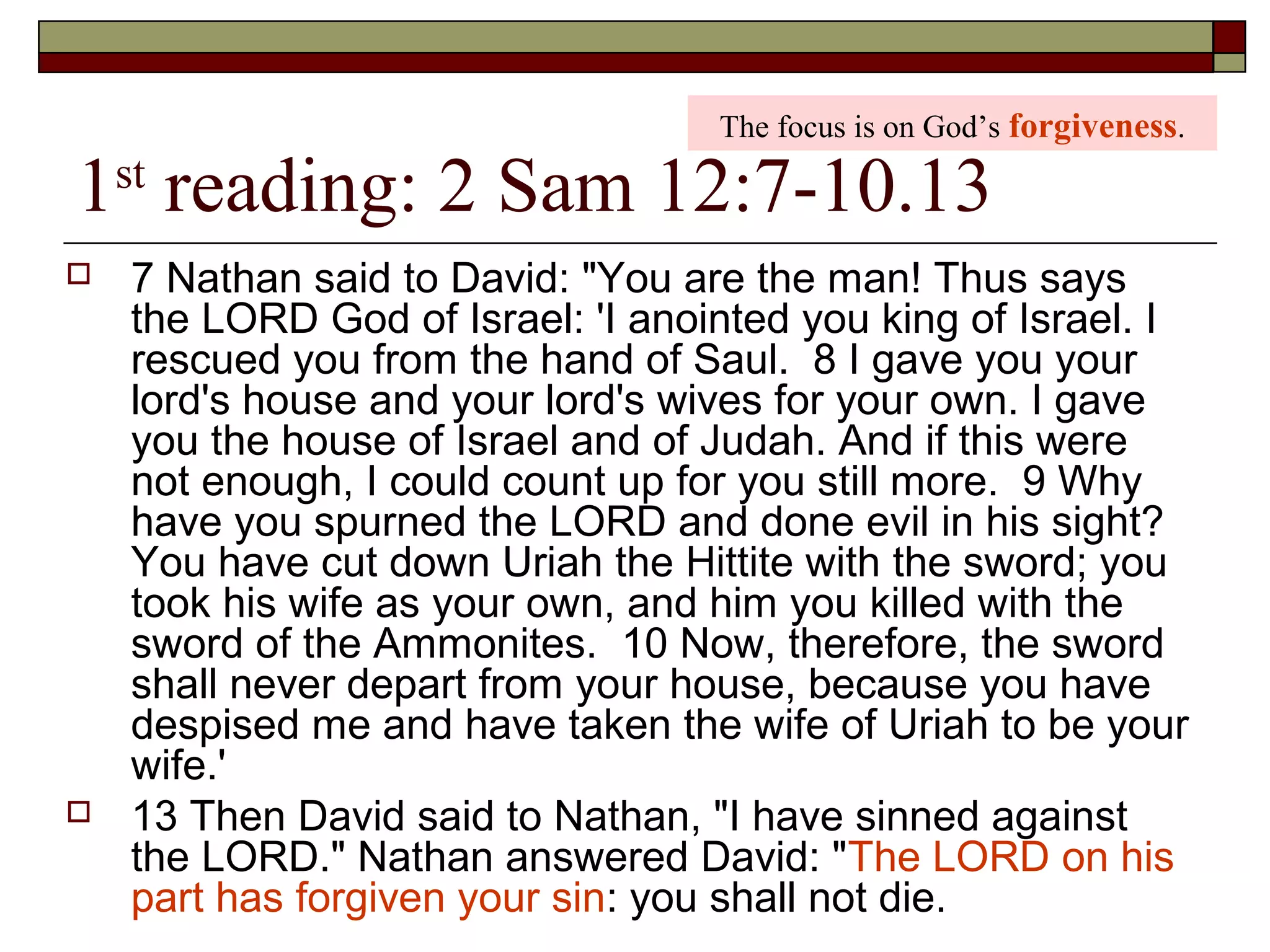
 7 Nathan said to David: "You are the man! Thus says
the LORD God of Israel: 'I anointed you king of Israel. I
rescued you from the hand of Saul. 8 I gave you your
lord's house and your lord's wives for your own. I gave
you the house of Israel and of Judah. And if this were
not enough, I could count up for you still more. 9 Why
have you spurned the LORD and done evil in his sight?
You have cut down Uriah the Hittite with the sword; you
took his wife as your own, and him you killed with the
sword of the Ammonites. 10 Now, therefore, the sword
shall never depart from your house, because you have
despised me and have taken the wife of Uriah to be your
wife.'
 13 Then David said to Nathan, "I have sinned against
the LORD." Nathan answered David: "The LORD on his
part has forgiven your sin: you shall not die.
The focus is on God’s forgiveness.
1st
reading: 2 Sam 12,7-10.13
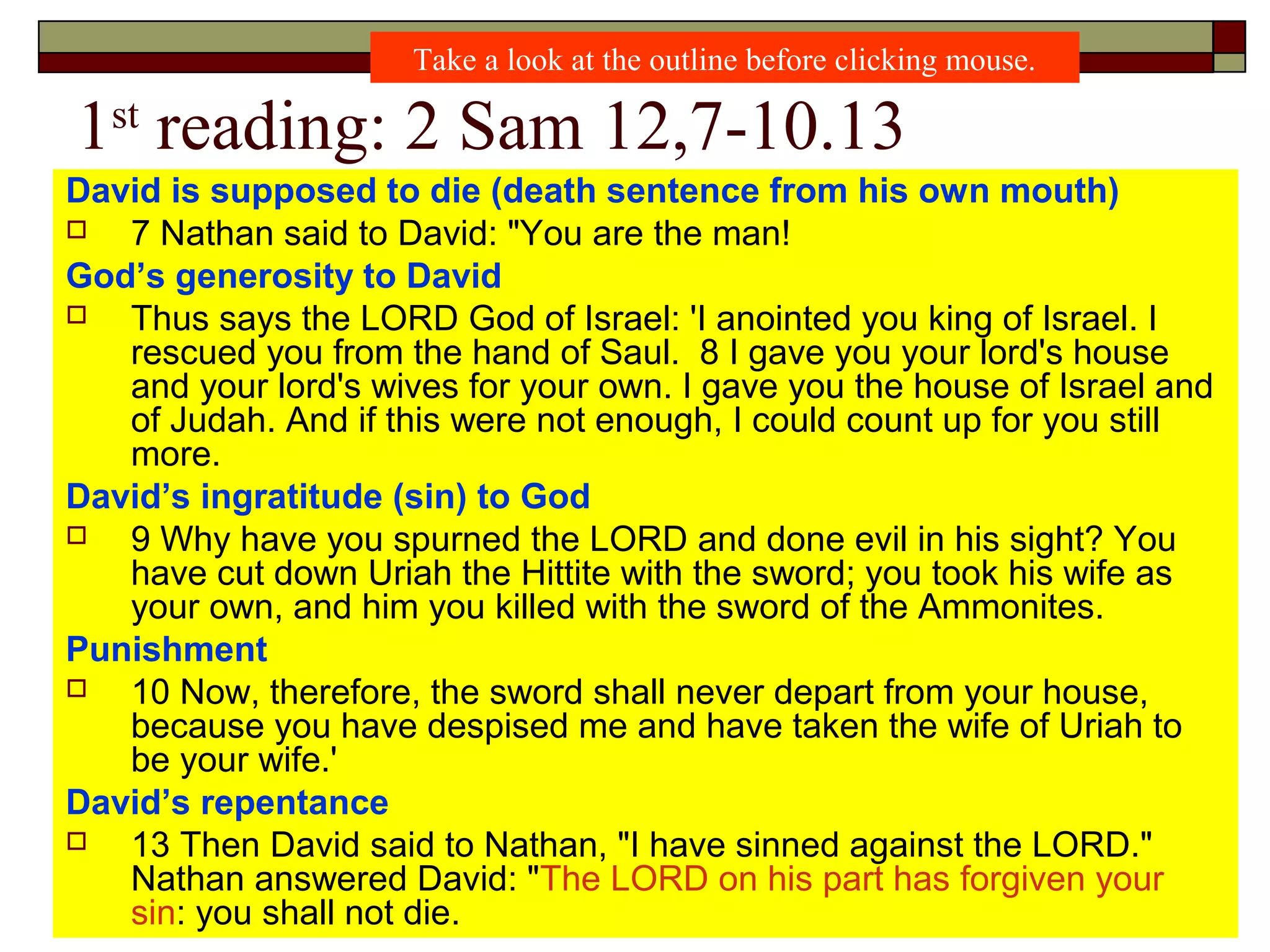
David is supposed to die (death sentence from his own mouth)
 7 Nathan said to David: "You are the man!
God’s generosity to David
 Thus says the LORD God of Israel: 'I anointed you king of Israel. I
rescued you from the hand of Saul. 8 I gave you your lord's house
and your lord's wives for your own. I gave you the house of Israel and
of Judah. And if this were not enough, I could count up for you still
more.
David’s ingratitude (sin) to God
 9 Why have you spurned the LORD and done evil in his sight? You
have cut down Uriah the Hittite with the sword; you took his wife as
your own, and him you killed with the sword of the Ammonites.
Punishment
 10 Now, therefore, the sword shall never depart from your house,
because you have despised me and have taken the wife of Uriah to
be your wife.'
David’s repentance
 13 Then David said to Nathan, "I have sinned against the LORD."
Nathan answered David: "The LORD on his part has forgiven your
sin: you shall not die.
Take a look at the outline before clicking mouse.
1st
reading: 2 Sam 12,7-10.13
David is supposed to die (death sentence from his
own mouth)
 7 Nathan said to David: "You are the man!
God’s generosity to David
 Thus says the LORD God of Israel: 'I anointed
you king of Israel. I rescued you from the hand of
Saul. 8 I gave you your lord's house and your
lord's wives for your own. I gave you the house
of Israel and of Judah. And if this were not
enough, I could count up for you still more.
David’s ingratitude (sin) to God
 9 Why have you spurned the LORD and done
evil in his sight? You have cut down Uriah the
Hittite with the sword; you took his wife as your
own, and him you killed with the sword of the
Ammonites.
Punishment
 10 Now, therefore, the sword shall never depart
from your house, because you have despised me
and have taken the wife of Uriah to be your wife.'
David’s repentance
 13 Then David said to Nathan, "I have sinned
against the LORD." Nathan answered David:
"The LORD on his part has forgiven your sin:
V.10 speaks of the punishment of
David: the sword shall not
depart… (bad omen)
Commentary
The reading comes after the
parable told by Nathan to David,
after he committed a grievous sin.
In vv.7b-8, God expresses his
disappointment over David. He
has lavished him with everything:
Kingship, protection, palace,
wives, kingdoms of Israel/Judah
God is still willing to give more.
V.9 enumerates the sins of David
1) Cut down Uriah (murder)
2) Took his wife (adultery)
V.13 indicates the readiness of
David to repent from his sins and
the readiness of God to forgive.
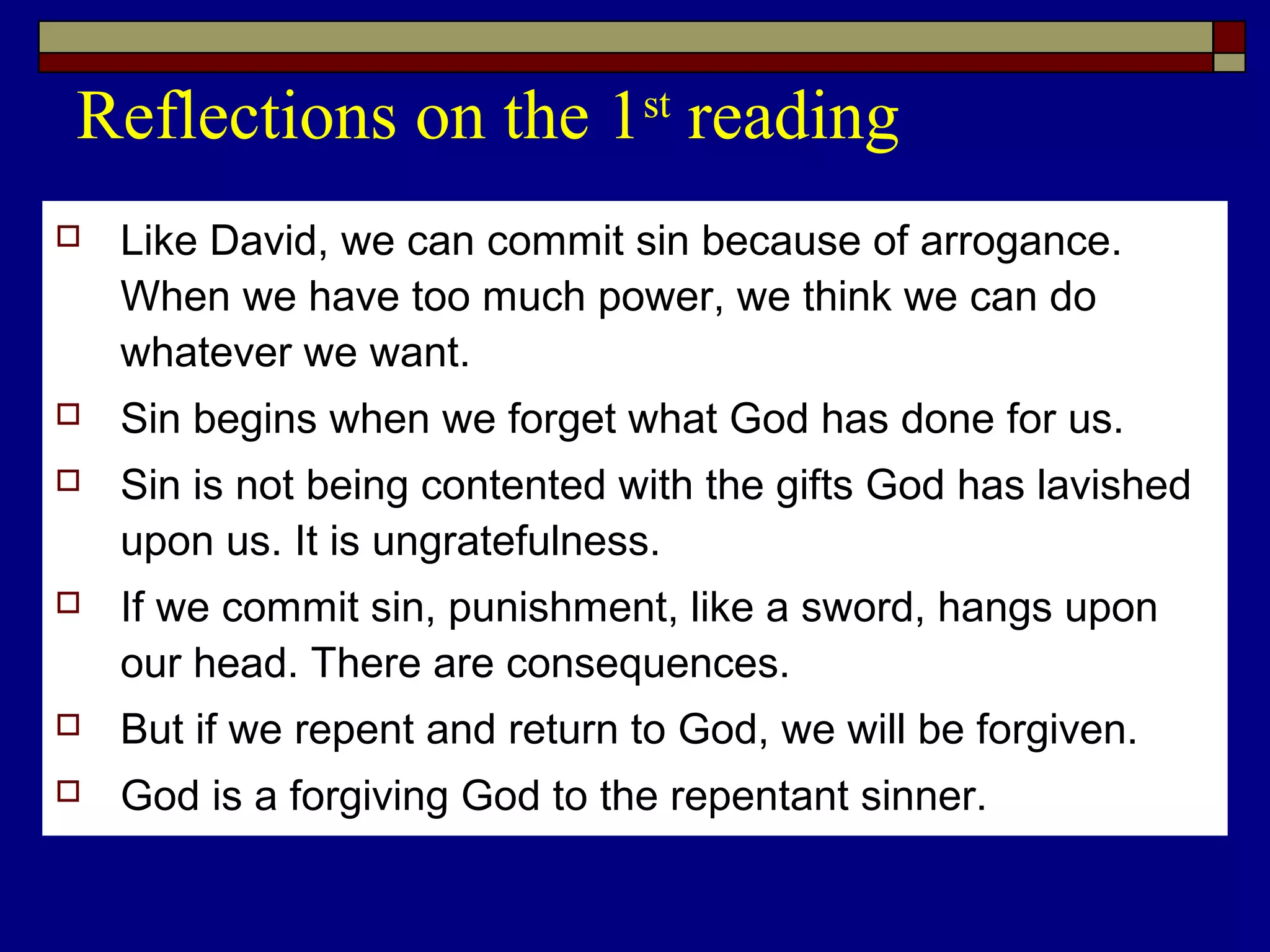
Reflections on the 1st
reading
 Like David, we can commit sin because of arrogance.
When we have too much power, we think we can do
whatever we want.
 Sin begins when we forget what God has done for us.
 Sin is not being contented with the gifts God has lavished
upon us. It is ungratefulness.
 If we commit sin, punishment, like a sword, hangs upon
our head. There are consequences.
 But if we repent and return to God, we will be forgiven.
 God is a forgiving God to the repentant sinner.
Resp. Psalm 32:1-2, 5, 7, 11
 R. (cf. 5c) Lord, forgive the wrong I have done.
 1 Blessed is the one whose fault is taken away,
whose sin is covered.
2 Blessed the man to whom the LORD imputes not guilt,
in whose spirit there is no guile.
 5 I acknowledged my sin to you,
my guilt I covered not.
I said, “I confess my faults to the LORD,”
and you took away the guilt of my sin.
 7 You are my shelter; from distress you will preserve me;
with glad cries of freedom you will ring me round.
 11 Be glad in the LORD and rejoice, you just;
exult, all you upright of heart.
Resp. Psalm 32:1-2, 5, 7, 11
 R. (cf. 5c) Lord, forgive the wrong I
have done.
 1 Blessed is the one whose fault is
taken away, whose sin is covered.
2 Blessed the man to whom the LORD
imputes not guilt,
in whose spirit there is no guile.
 5 I acknowledged my sin to you,
my guilt I covered not.
I said, “I confess my faults to the
LORD,”and you took away the guilt of
my sin.
 7 You are my shelter; from distress you
will preserve me; with glad cries of
freedom you will ring me round.
 11 Be glad in the LORD and rejoice,
you just; exult, all you upright of heart.
Commentary
 The psalm is classified as
didactic psalm or thanksgiving
hymn.
 In vv.1-2, the psalmist articulates
a wisdom saying on forgiveness
which is his own experience.
 In v.5, the psalmist tells us why
he is forgiven:
 He acknowledged his sin
 He did not cover it up
 He confessed his fault
 In v.7, the psalmist
acknowledges God as his
protector from harm and distress
(due to sin).
 In v.11, the psalmist encourages
others who are righteous to exult
in the Lord.
Reflections on the Psalm
 We must strive to be forgiven by God.
 We can be forgiven only when we
acknowledge our sins and failures.
 We should not cover them up or pretend
we have not committed any wrong at all.
 When we are forgiven, let us rejoice.
 We invite others to celebrate the joy of
being forgiven (that they too may seek for
forgiveness) .
2nd
reading: Galatians 2,16.19-21
 16 We know that a person is not justified by works of
the law but through faith in Jesus Christ, even we have
believed in Christ Jesus that we may be justified by faith
in Christ and not by works of the law, because by works
of the law no one will be justified.
 19 For through the law I died to the law, that I might live
for God. I have been crucified with Christ; 20 yet I live,
no longer I, but Christ lives in me; insofar as I now live
in the flesh, I live by faith in the Son of God who has
loved me and given himself up for me. 21 I do not
nullify the grace of God; for if justification comes
through the law, then Christ died for nothing.
The focus is on justification by faith in Christ.
2nd
reading: Galatians 2:16.19-21
Justification by faith not by law
 16 We know that a person is not justified by works of
the law but through faith in Jesus Christ, even we have
believed in Christ Jesus that we may be justified by faith
in Christ and not by works of the law, because by works
of the law no one will be justified.
Living in Christ
 19 For through the law I died to the law, that I might live
for God. I have been crucified with Christ; 20 yet I live,
no longer I, but Christ lives in me; insofar as I now live
in the flesh, I live by faith in the Son of God who has
loved me and given himself up for me. 21 I do not
nullify the grace of God; for if justification comes
through the law, then Christ died for nothing.
A simple outline!
2nd
reading: Galatians 2,16.19-21
Justification by faith not by law
 16 We know that a person is not justified by works of the law
but through faith in Jesus Christ, even we have believed in
Christ Jesus that we may be justified by faith in Christ and
not by works of the law, because by works of the law no one
will be justified.
Living in Christ
 19 For through the law I died to the law, that I might live for
God. I have been crucified with Christ; 20 yet I live, no
longer I, but Christ lives in me; insofar as I now live in the
flesh, I live by faith in the Son of God who has loved me and
given himself up for me. 21 I do not nullify the grace of
God; for if justification comes through the law, then Christ
died for nothing.
Observe what Paul says about the law.
2nd
reading: Galatians 2,16.19-21
Justification by faith not by law
 16 We know that a person is not
justified by works of the law but
through faith in Jesus Christ,
even we have believed in Christ
Jesus that we may be justified by
faith in Christ and not by works
of the law, because by works of
the law no one will be justified.
Living in Christ
 19 For through the law I died to
the law, that I might live for
God. I have been crucified with
Christ; 20 yet I live, no longer I,
but Christ lives in me; insofar as
I now live in the flesh, I live by
faith in the Son of God who has
loved me and given himself up
for me. 21 I do not nullify the
grace of God; for if justification
comes through the law, then
Christ died for nothing.
Commentary
 St. Paul is emphatic about his belief that
we are justified (made right) by the faith in
Jesus Christ (Christian position), not in the
works of the law (Jewish position). V.16
 In v.19, Paul relates his experience when
he rejects the law as a means to salvation:
 Now he lives for God; he is crucified with
Christ.
 In v.20, Paul relates his mystical
experience with Christ.
 It is Christ who lives in him, not he (Paul).
Christ takes over the life of Paul.
 Paul affirms Christ as the Son of God who
has shown love for him and subjected to
death for him.
 In v.21, for Paul, faith in Christ is non-
negotiable otherwise, the death of Christ
loses its meaning.
Reflections on the 2nd
reading
 We, Christians, are taught that we are saved
through faith in Jesus, not through the
prescriptions of the Mosaic law.
 We depart from the Jewish belief that we are
saved through the law (Torah).
 We, Christians, are called to establish deep
relationship with Christ.
 The sign that we have attained this is when
Christ is now calling the shots, not others.
 Christ is totally embedded (living) in us and vice
versa.
Gospel reading: Luke 7:36—8:3
Setting
 36 A Pharisee invited him to dine with him, and he
entered the Pharisee's house and reclined at table.
 Luke presents Jesus eating with the righteous (not only
with sinners). The Pharisees were one of the religious
groups that had a great influence on the spiritual life of
the Jews. They were trained to interpret the law and
were accepted as teachers of the people in the
synagogues, countryside and in the Temple area.
 One may wonder why a Pharisee invites Jesus and
Jesus accepts his invitation. Either one or the other is
courting some trouble. But here the Pharisee had no
qualms about Jesus entering his house and eating with
him; Jesus, too.
The reading with outline and commentary.
The sinful woman
 37 Now there was a sinful woman in the city who
learned that he was at table in the house of the
Pharisee. Bringing an alabaster flask of ointment, 38
she stood behind him at his feet weeping and began to
bathe his feet with her tears. Then she wiped them with
her hair, kissed them, and anointed them with the
ointment.
 The sinful woman is unnamed. The text does not say
she is Mary Magdalene. V.37 repeats the location of the
dinner (house of the Pharisee, v.36). Luke is good in
connecting his sentences.
 The woman quickly acts on Jesus: stood behind,
weeping, began to bathe with tears, wiped with her hair,
kissed, anointed them with ointment.
 Wow, the woman accomplished everything so quickly.
The Pharisee casts doubt on Jesus
 39 When the Pharisee who had invited him saw this he
said to himself, "If this man were a prophet, he would
know who and what sort of woman this is who is
touching him, that she is a sinner."
 In v.39, Luke picks up again his vocabulary in v.36,
“The Pharisee invited him..” To the mind of the
Pharisee, Jesus must not be a prophet. (Should a prophet
know everything? No.)
 The Pharisee speaks out of his ignorance (as if Jesus
does not know the woman).
 Luke presents a little later that he knows the woman.
Seemingly, they have had a previous encounter as can
be seen from the next lines.
Jesus’ parable and the question
 40 Jesus said to him in reply, "Simon, I have something to say to
you." "Tell me, teacher," he said.
 41 "Two people were in debt to a certain creditor; one owed five
hundred days' wages and the other owed fifty. 42 Since they were
unable to repay the debt, he forgave it for both. Which of them will love
him more?“
 In v.40, the Pharisee is identified as Simon. The
Pharisee addresses him as teacher.
 Jesus presents a very short parable that tells something
about him and the woman.
 The two people refers to the Pharisee and the woman
(the latter perceived as the worse sinner, more
indebted).
 Jesus forgives them both.
 The question, “Which of them will love him more?” can
also be understood as which of them will be more
thankful (loving) to him?
Simon’s correct answer
 43 Simon said in reply, "The one, I suppose, whose
larger debt was forgiven." He said to him, "You have
judged rightly."
 The Pharisee answers correctly. And Jesus affirms him.
 This affirmation paves the way to understand the
predicament of the woman sinner (who came to Jesus,
already long forgiven).
 She is just there to show her love, affection and
thanksgiving to Jesus.
Jesus’ evaluation (he contrasts the Pharisee and the woman)
 44 Then he turned to the woman and said to Simon, "Do
you see this woman? When I entered your house, you
did not give me water for my feet, but she has bathed
them with her tears and wiped them with her hair. 45
You did not give me a kiss, but she has not ceased
kissing my feet since the time I entered. 46 You did not
anoint my head with oil, but she anointed my feet with
ointment.
 On three counts, the Pharisee has fallen short in his
responses in contrast to the woman. Look at the
underlined words.
 Jesus appreciates so much the gestures of the woman
(long freed from sins). For Jesus, it is not enough to give
him a party. What Jesus wants is recognition that he
forgives sins.
 Here the Pharisees find difficulty as can be seen in v.49.
 47 So I tell you, her many sins have been forgiven;
hence, she has shown great love. But the one to whom
little is forgiven, loves little.“
 In v.47, Luke picks up again his idea of forgiveness
which he expressed in the parable (vv.41-42).
 Jesus has forgiven her many sins (not just a few). For
this reason, she has spontaneously shown great love
(not just a little gesture of love).
 Without fear of rejection, she has demonstrated her
love.
Jesus to the woman
 48 He said to her, "Your sins are forgiven." 49 The
others at table said to themselves, "Who is this who
even forgives sins?" 50 But he said to the woman,
"Your faith has saved you; go in peace.“
 Jesus states the fact that her sins are forgiven (perfect
passive in Greek), literally, “Your sins have been forgiven.”
 V.49 gives us a little surprise. All the while, we were
thinking there were only 3 of them in the dining hall.
They are many. They begin to speak and express their
awe (or unbelief).
 The number of people inside highlights the tremendous
courage of the forgiven woman who did not tiptoe / did
not feel ashamed or embarrassed in demonstrating her
love to Jesus.
 V.50 brings a message to the Pharisees: faith in Jesus.
The Pharisees in general are known not to have faith in
Jesus.
The focus is on the forgiveness of sins.
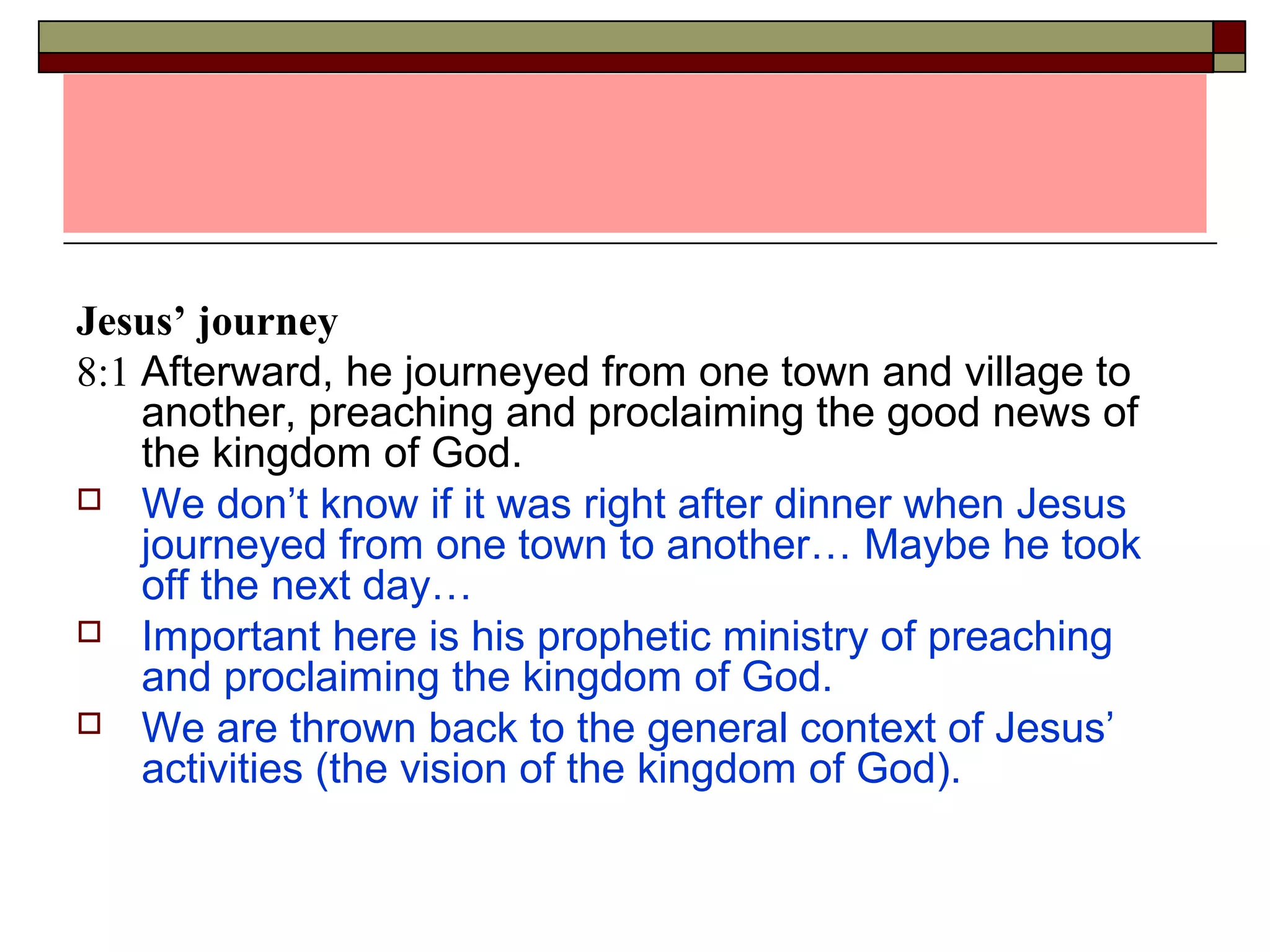
Jesus’ journey
8:1 Afterward, he journeyed from one town and village to
another, preaching and proclaiming the good news of
the kingdom of God.
 We don’t know if it was right after dinner when Jesus
journeyed from one town to another… Maybe he took
off the next day…
 Important here is his prophetic ministry of preaching
and proclaiming the kingdom of God.
 We are thrown back to the general context of Jesus’
activities (the vision of the kingdom of God).
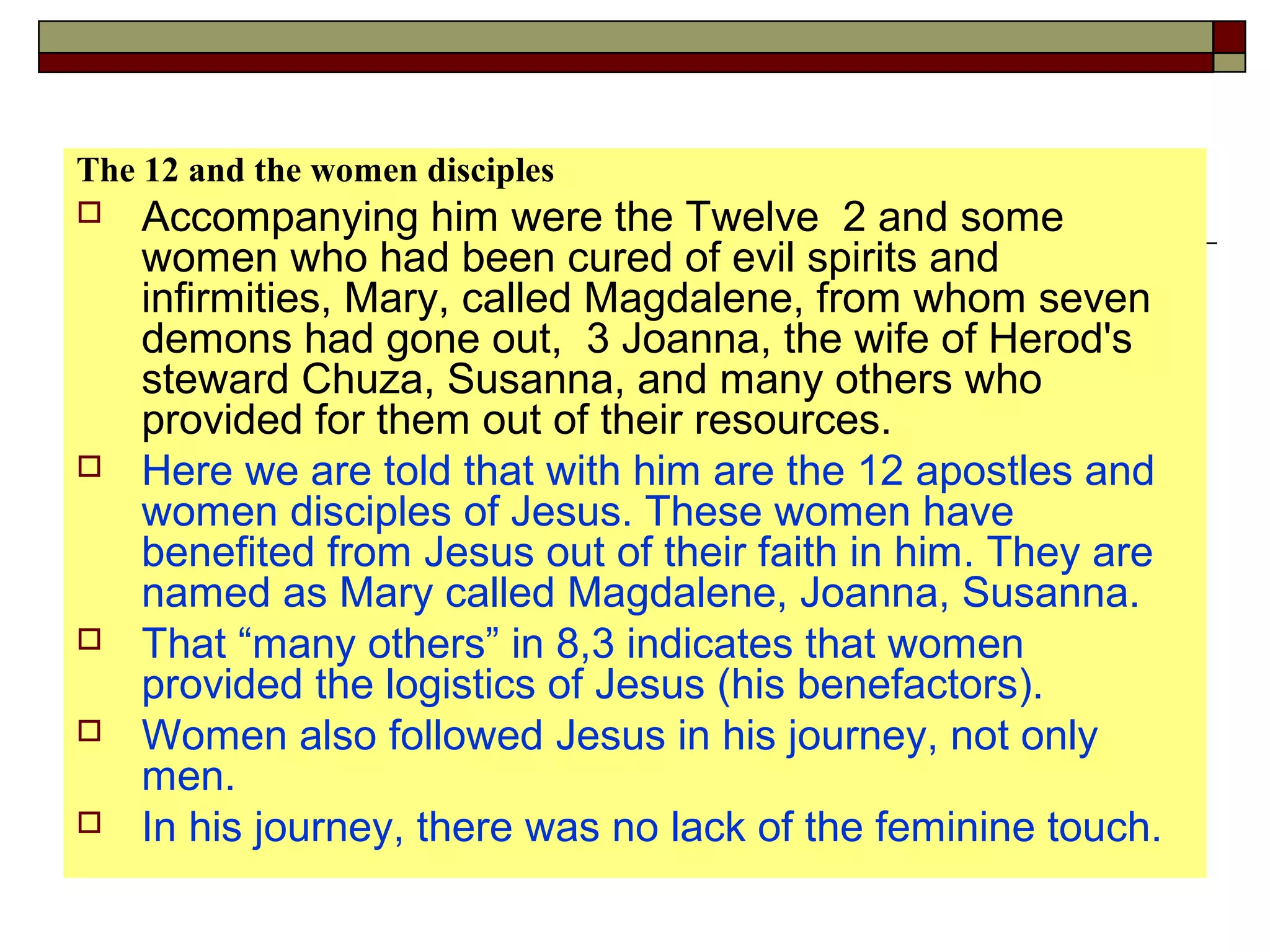
The 12 and the women disciples
 Accompanying him were the Twelve 2 and some
women who had been cured of evil spirits and
infirmities, Mary, called Magdalene, from whom seven
demons had gone out, 3 Joanna, the wife of Herod's
steward Chuza, Susanna, and many others who
provided for them out of their resources.
 Here we are told that with him are the 12 apostles and
women disciples of Jesus. These women have
benefited from Jesus out of their faith in him. They are
named as Mary called Magdalene, Joanna, Susanna.
 That “many others” in 8,3 indicates that women
provided the logistics of Jesus (his benefactors).
 Women also followed Jesus in his journey, not only
men.
 In his journey, there was no lack of the feminine touch.
Reflections on the gospel reading
 We should not hesitate to draw close to Jesus,
no matter what other people say about us.
 We should not be afraid to show our faith and
thanksgiving if we have experienced God’s
loving forgiveness (through his SACRED HEART)
 We follow him who has forgiven us.
 Discipleship is an effect of being forgiven
(loved, given another chance) by God.
Tying the 3 readings and the Psalm
 The first reading speaks of God’s forgiveness to
repentant David.
 The second reading speaks of God’s justification
(forgiveness) brought about by faith in Jesus, not by the
law (espoused by the Pharisees).
 The gospel reading demonstrates Jesus’ magnanimity
to all sinners. He forgives everyone.
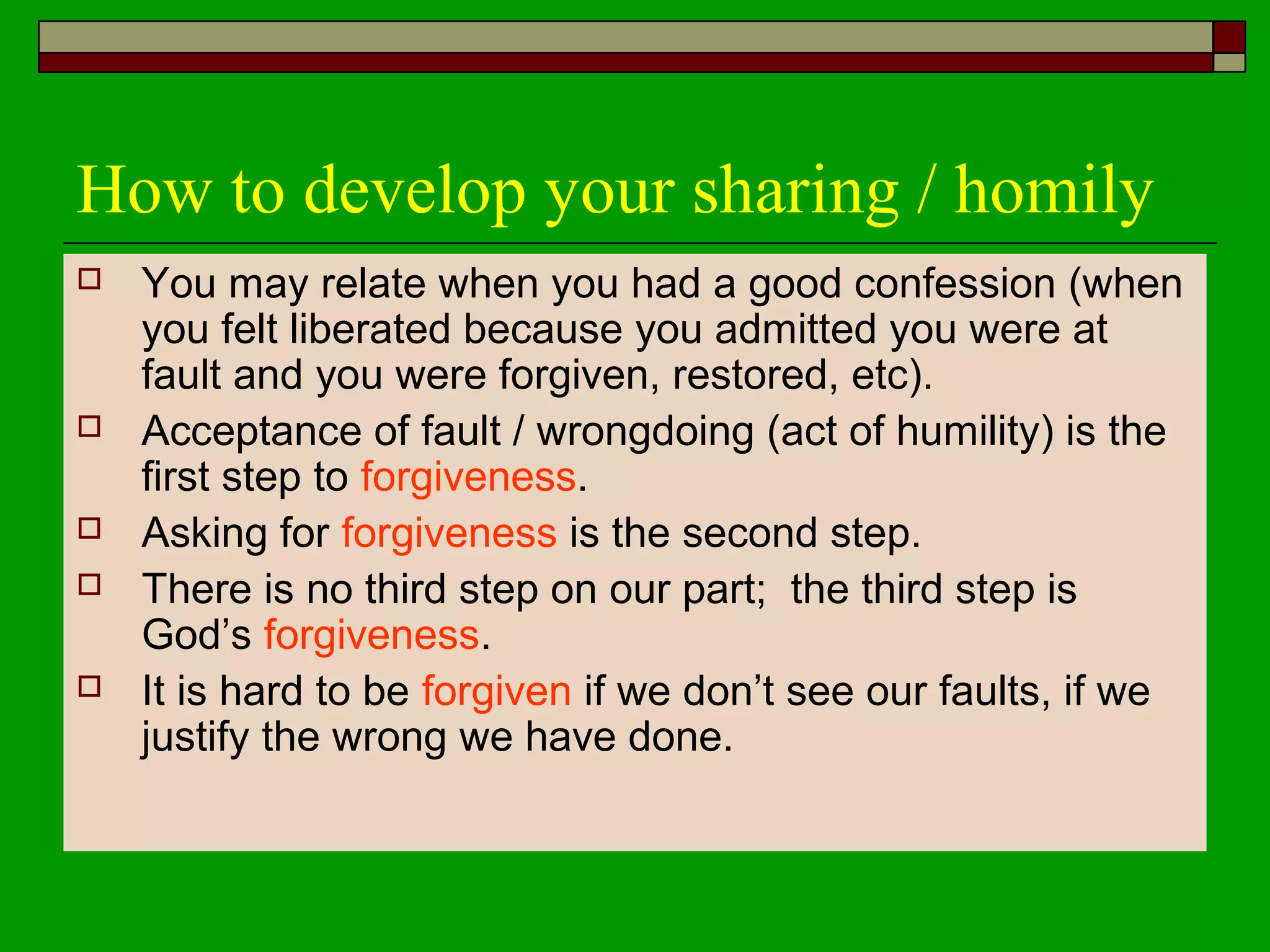
How to develop your sharing / homily
 You may relate when you had a good confession (when
you felt liberated because you admitted you were at
fault and you were forgiven, restored, etc).
 Acceptance of fault / wrongdoing (act of humility) is the
first step to forgiveness.
 Asking for forgiveness is the second step.
 There is no third step on our part; the third step is
God’s forgiveness.
 It is hard to be forgiven if we don’t see our faults, if we
justify the wrong we have done.
 To know whether we are right or wrong, we must
dialogue our values with the gospel values.
 Whatever contradicts gospel values and values of the
kingdom of God is wrong.
 Our criteria for knowing what is right or wrong are the
teachings of Christ.
 As Catholics, we should accept the moral and doctrinal
teachings of the Church.
 The magisterium (official teaching of the church) and
official pronouncements must give us guidance in our
doctrine and behavior.
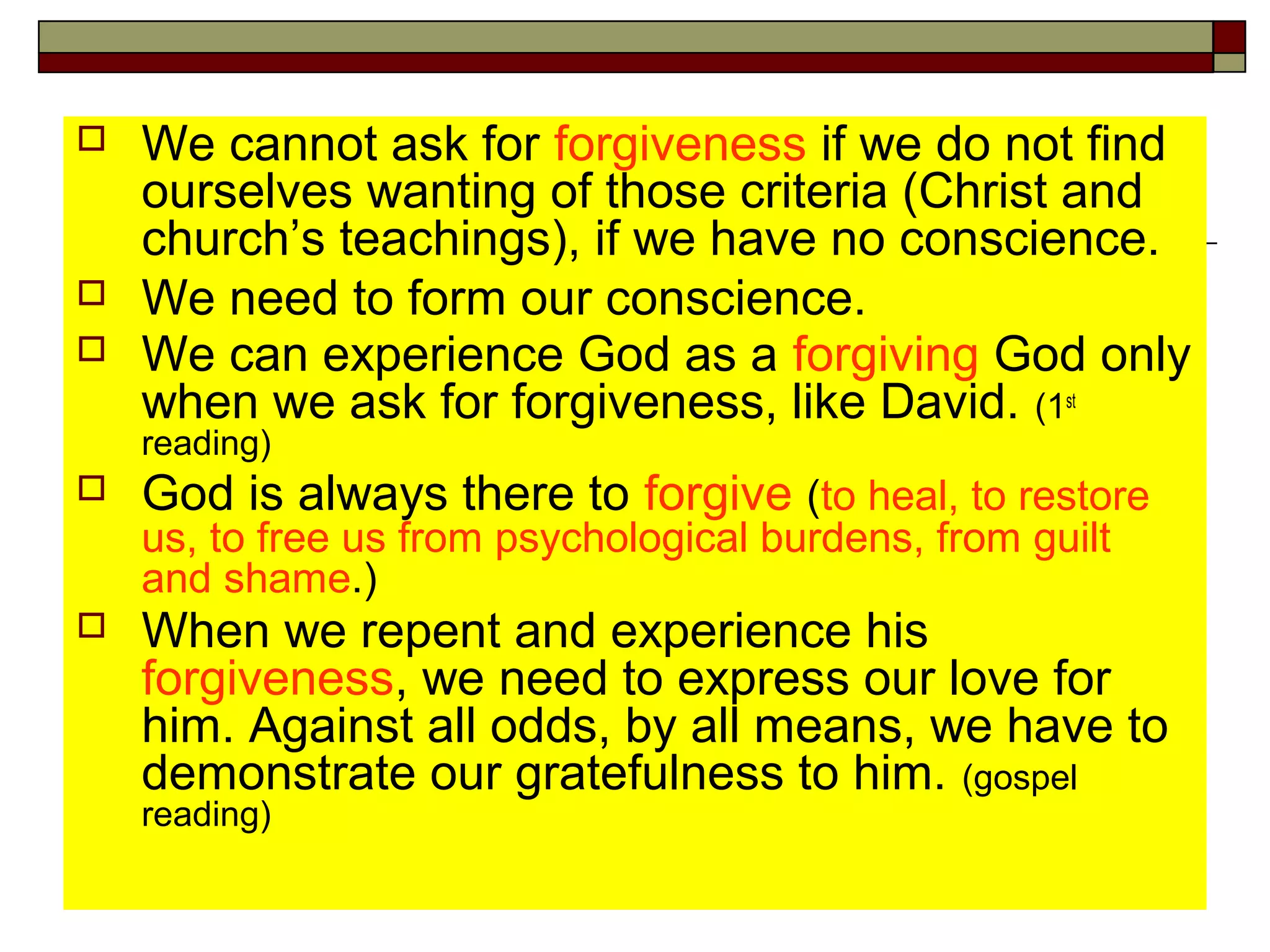
 We cannot ask for forgiveness if we do not find
ourselves wanting of those criteria (Christ and
church’s teachings), if we have no conscience.
 We need to form our conscience.
 We can experience God as a forgiving God only
when we ask for forgiveness, like David. (1st
reading)
 God is always there to forgive (to heal, to restore
us, to free us from psychological burdens, from guilt
and shame.)
 When we repent and experience his
forgiveness, we need to express our love for
him. Against all odds, by all means, we have to
demonstrate our gratefulness to him. (gospel
reading)
 We, sinners, should approach Jesus like the
woman sinner.
 God will forgive us no matter how grievously we
have sinned. (1st
reading)
 We are justified / forgiven if we have faith in
Jesus Christ. (2nd
reading)
 The eucharist is a sacrament of thanksgiving to
those who believe in being forgiven by God.
 The eucharist strengthens our relationship with
God.
 In the eucharist, we show our appreciation to
our forgiving Father.
You may read my article in the missalette SAMBUHAY for
this Sunday.
Our Context of Sin and Grace
 Abuse of power
 Unrepentant
 Unforgiving
 Unable to be reconciled
 Without conscience
 Self-righteous
 Ungrateful
 Repentant
 Apologizes
 Formed conscience
 Expresses one’s faith
and thanksgiving in the
open
 Sacrament of
reconciliation
Suggested Songs
 Paano Namin Masasabi
 http://www.youtube.com/watch?v=9ICZUOf_jNo
 Pardon Peace
 Lost and Found
 http://www.youtube.com/watch?v=XYy2M4dB1iw
 Dear sisters and brothers,

 Let us strive to be forgiven, to be liberated
from heavy burdens.

 Fr. Cielo

11th Sunday C

  • 1.
    Welcome to ourBible Study 11th Sunday in Ordinary Time C 12 June 2016 In preparation for this Sunday’s Liturgy As aid in focusing our homilies and sharing Prepared by Fr. Cielo R. Almazan, OFM
  • 2.
    1st reading: 2 Sam12:7-10.13  7 Nathan said to David: "You are the man! Thus says the LORD God of Israel: 'I anointed you king of Israel. I rescued you from the hand of Saul. 8 I gave you your lord's house and your lord's wives for your own. I gave you the house of Israel and of Judah. And if this were not enough, I could count up for you still more. 9 Why have you spurned the LORD and done evil in his sight? You have cut down Uriah the Hittite with the sword; you took his wife as your own, and him you killed with the sword of the Ammonites. 10 Now, therefore, the sword shall never depart from your house, because you have despised me and have taken the wife of Uriah to be your wife.'  13 Then David said to Nathan, "I have sinned against the LORD." Nathan answered David: "The LORD on his part has forgiven your sin: you shall not die. The focus is on God’s forgiveness.
  • 3.
    1st reading: 2 Sam12,7-10.13 David is supposed to die (death sentence from his own mouth)  7 Nathan said to David: "You are the man! God’s generosity to David  Thus says the LORD God of Israel: 'I anointed you king of Israel. I rescued you from the hand of Saul. 8 I gave you your lord's house and your lord's wives for your own. I gave you the house of Israel and of Judah. And if this were not enough, I could count up for you still more. David’s ingratitude (sin) to God  9 Why have you spurned the LORD and done evil in his sight? You have cut down Uriah the Hittite with the sword; you took his wife as your own, and him you killed with the sword of the Ammonites. Punishment  10 Now, therefore, the sword shall never depart from your house, because you have despised me and have taken the wife of Uriah to be your wife.' David’s repentance  13 Then David said to Nathan, "I have sinned against the LORD." Nathan answered David: "The LORD on his part has forgiven your sin: you shall not die. Take a look at the outline before clicking mouse.
  • 4.
    1st reading: 2 Sam12,7-10.13 David is supposed to die (death sentence from his own mouth)  7 Nathan said to David: "You are the man! God’s generosity to David  Thus says the LORD God of Israel: 'I anointed you king of Israel. I rescued you from the hand of Saul. 8 I gave you your lord's house and your lord's wives for your own. I gave you the house of Israel and of Judah. And if this were not enough, I could count up for you still more. David’s ingratitude (sin) to God  9 Why have you spurned the LORD and done evil in his sight? You have cut down Uriah the Hittite with the sword; you took his wife as your own, and him you killed with the sword of the Ammonites. Punishment  10 Now, therefore, the sword shall never depart from your house, because you have despised me and have taken the wife of Uriah to be your wife.' David’s repentance  13 Then David said to Nathan, "I have sinned against the LORD." Nathan answered David: "The LORD on his part has forgiven your sin: V.10 speaks of the punishment of David: the sword shall not depart… (bad omen) Commentary The reading comes after the parable told by Nathan to David, after he committed a grievous sin. In vv.7b-8, God expresses his disappointment over David. He has lavished him with everything: Kingship, protection, palace, wives, kingdoms of Israel/Judah God is still willing to give more. V.9 enumerates the sins of David 1) Cut down Uriah (murder) 2) Took his wife (adultery) V.13 indicates the readiness of David to repent from his sins and the readiness of God to forgive.
  • 5.
    Reflections on the1st reading  Like David, we can commit sin because of arrogance. When we have too much power, we think we can do whatever we want.  Sin begins when we forget what God has done for us.  Sin is not being contented with the gifts God has lavished upon us. It is ungratefulness.  If we commit sin, punishment, like a sword, hangs upon our head. There are consequences.  But if we repent and return to God, we will be forgiven.  God is a forgiving God to the repentant sinner.
  • 6.
    Resp. Psalm 32:1-2,5, 7, 11  R. (cf. 5c) Lord, forgive the wrong I have done.  1 Blessed is the one whose fault is taken away, whose sin is covered. 2 Blessed the man to whom the LORD imputes not guilt, in whose spirit there is no guile.  5 I acknowledged my sin to you, my guilt I covered not. I said, “I confess my faults to the LORD,” and you took away the guilt of my sin.  7 You are my shelter; from distress you will preserve me; with glad cries of freedom you will ring me round.  11 Be glad in the LORD and rejoice, you just; exult, all you upright of heart.
  • 7.
    Resp. Psalm 32:1-2,5, 7, 11  R. (cf. 5c) Lord, forgive the wrong I have done.  1 Blessed is the one whose fault is taken away, whose sin is covered. 2 Blessed the man to whom the LORD imputes not guilt, in whose spirit there is no guile.  5 I acknowledged my sin to you, my guilt I covered not. I said, “I confess my faults to the LORD,”and you took away the guilt of my sin.  7 You are my shelter; from distress you will preserve me; with glad cries of freedom you will ring me round.  11 Be glad in the LORD and rejoice, you just; exult, all you upright of heart. Commentary  The psalm is classified as didactic psalm or thanksgiving hymn.  In vv.1-2, the psalmist articulates a wisdom saying on forgiveness which is his own experience.  In v.5, the psalmist tells us why he is forgiven:  He acknowledged his sin  He did not cover it up  He confessed his fault  In v.7, the psalmist acknowledges God as his protector from harm and distress (due to sin).  In v.11, the psalmist encourages others who are righteous to exult in the Lord.
  • 8.
    Reflections on thePsalm  We must strive to be forgiven by God.  We can be forgiven only when we acknowledge our sins and failures.  We should not cover them up or pretend we have not committed any wrong at all.  When we are forgiven, let us rejoice.  We invite others to celebrate the joy of being forgiven (that they too may seek for forgiveness) .
  • 9.
    2nd reading: Galatians 2,16.19-21 16 We know that a person is not justified by works of the law but through faith in Jesus Christ, even we have believed in Christ Jesus that we may be justified by faith in Christ and not by works of the law, because by works of the law no one will be justified.  19 For through the law I died to the law, that I might live for God. I have been crucified with Christ; 20 yet I live, no longer I, but Christ lives in me; insofar as I now live in the flesh, I live by faith in the Son of God who has loved me and given himself up for me. 21 I do not nullify the grace of God; for if justification comes through the law, then Christ died for nothing. The focus is on justification by faith in Christ.
  • 10.
    2nd reading: Galatians 2:16.19-21 Justificationby faith not by law  16 We know that a person is not justified by works of the law but through faith in Jesus Christ, even we have believed in Christ Jesus that we may be justified by faith in Christ and not by works of the law, because by works of the law no one will be justified. Living in Christ  19 For through the law I died to the law, that I might live for God. I have been crucified with Christ; 20 yet I live, no longer I, but Christ lives in me; insofar as I now live in the flesh, I live by faith in the Son of God who has loved me and given himself up for me. 21 I do not nullify the grace of God; for if justification comes through the law, then Christ died for nothing. A simple outline!
  • 11.
    2nd reading: Galatians 2,16.19-21 Justificationby faith not by law  16 We know that a person is not justified by works of the law but through faith in Jesus Christ, even we have believed in Christ Jesus that we may be justified by faith in Christ and not by works of the law, because by works of the law no one will be justified. Living in Christ  19 For through the law I died to the law, that I might live for God. I have been crucified with Christ; 20 yet I live, no longer I, but Christ lives in me; insofar as I now live in the flesh, I live by faith in the Son of God who has loved me and given himself up for me. 21 I do not nullify the grace of God; for if justification comes through the law, then Christ died for nothing. Observe what Paul says about the law.
  • 12.
    2nd reading: Galatians 2,16.19-21 Justificationby faith not by law  16 We know that a person is not justified by works of the law but through faith in Jesus Christ, even we have believed in Christ Jesus that we may be justified by faith in Christ and not by works of the law, because by works of the law no one will be justified. Living in Christ  19 For through the law I died to the law, that I might live for God. I have been crucified with Christ; 20 yet I live, no longer I, but Christ lives in me; insofar as I now live in the flesh, I live by faith in the Son of God who has loved me and given himself up for me. 21 I do not nullify the grace of God; for if justification comes through the law, then Christ died for nothing. Commentary  St. Paul is emphatic about his belief that we are justified (made right) by the faith in Jesus Christ (Christian position), not in the works of the law (Jewish position). V.16  In v.19, Paul relates his experience when he rejects the law as a means to salvation:  Now he lives for God; he is crucified with Christ.  In v.20, Paul relates his mystical experience with Christ.  It is Christ who lives in him, not he (Paul). Christ takes over the life of Paul.  Paul affirms Christ as the Son of God who has shown love for him and subjected to death for him.  In v.21, for Paul, faith in Christ is non- negotiable otherwise, the death of Christ loses its meaning.
  • 13.
    Reflections on the2nd reading  We, Christians, are taught that we are saved through faith in Jesus, not through the prescriptions of the Mosaic law.  We depart from the Jewish belief that we are saved through the law (Torah).  We, Christians, are called to establish deep relationship with Christ.  The sign that we have attained this is when Christ is now calling the shots, not others.  Christ is totally embedded (living) in us and vice versa.
  • 14.
    Gospel reading: Luke7:36—8:3 Setting  36 A Pharisee invited him to dine with him, and he entered the Pharisee's house and reclined at table.  Luke presents Jesus eating with the righteous (not only with sinners). The Pharisees were one of the religious groups that had a great influence on the spiritual life of the Jews. They were trained to interpret the law and were accepted as teachers of the people in the synagogues, countryside and in the Temple area.  One may wonder why a Pharisee invites Jesus and Jesus accepts his invitation. Either one or the other is courting some trouble. But here the Pharisee had no qualms about Jesus entering his house and eating with him; Jesus, too. The reading with outline and commentary.
  • 15.
    The sinful woman 37 Now there was a sinful woman in the city who learned that he was at table in the house of the Pharisee. Bringing an alabaster flask of ointment, 38 she stood behind him at his feet weeping and began to bathe his feet with her tears. Then she wiped them with her hair, kissed them, and anointed them with the ointment.  The sinful woman is unnamed. The text does not say she is Mary Magdalene. V.37 repeats the location of the dinner (house of the Pharisee, v.36). Luke is good in connecting his sentences.  The woman quickly acts on Jesus: stood behind, weeping, began to bathe with tears, wiped with her hair, kissed, anointed them with ointment.  Wow, the woman accomplished everything so quickly.
  • 16.
    The Pharisee castsdoubt on Jesus  39 When the Pharisee who had invited him saw this he said to himself, "If this man were a prophet, he would know who and what sort of woman this is who is touching him, that she is a sinner."  In v.39, Luke picks up again his vocabulary in v.36, “The Pharisee invited him..” To the mind of the Pharisee, Jesus must not be a prophet. (Should a prophet know everything? No.)  The Pharisee speaks out of his ignorance (as if Jesus does not know the woman).  Luke presents a little later that he knows the woman. Seemingly, they have had a previous encounter as can be seen from the next lines.
  • 17.
    Jesus’ parable andthe question  40 Jesus said to him in reply, "Simon, I have something to say to you." "Tell me, teacher," he said.  41 "Two people were in debt to a certain creditor; one owed five hundred days' wages and the other owed fifty. 42 Since they were unable to repay the debt, he forgave it for both. Which of them will love him more?“  In v.40, the Pharisee is identified as Simon. The Pharisee addresses him as teacher.  Jesus presents a very short parable that tells something about him and the woman.  The two people refers to the Pharisee and the woman (the latter perceived as the worse sinner, more indebted).  Jesus forgives them both.  The question, “Which of them will love him more?” can also be understood as which of them will be more thankful (loving) to him?
  • 18.
    Simon’s correct answer 43 Simon said in reply, "The one, I suppose, whose larger debt was forgiven." He said to him, "You have judged rightly."  The Pharisee answers correctly. And Jesus affirms him.  This affirmation paves the way to understand the predicament of the woman sinner (who came to Jesus, already long forgiven).  She is just there to show her love, affection and thanksgiving to Jesus.
  • 19.
    Jesus’ evaluation (hecontrasts the Pharisee and the woman)  44 Then he turned to the woman and said to Simon, "Do you see this woman? When I entered your house, you did not give me water for my feet, but she has bathed them with her tears and wiped them with her hair. 45 You did not give me a kiss, but she has not ceased kissing my feet since the time I entered. 46 You did not anoint my head with oil, but she anointed my feet with ointment.  On three counts, the Pharisee has fallen short in his responses in contrast to the woman. Look at the underlined words.  Jesus appreciates so much the gestures of the woman (long freed from sins). For Jesus, it is not enough to give him a party. What Jesus wants is recognition that he forgives sins.  Here the Pharisees find difficulty as can be seen in v.49.
  • 20.
     47 SoI tell you, her many sins have been forgiven; hence, she has shown great love. But the one to whom little is forgiven, loves little.“  In v.47, Luke picks up again his idea of forgiveness which he expressed in the parable (vv.41-42).  Jesus has forgiven her many sins (not just a few). For this reason, she has spontaneously shown great love (not just a little gesture of love).  Without fear of rejection, she has demonstrated her love.
  • 21.
    Jesus to thewoman  48 He said to her, "Your sins are forgiven." 49 The others at table said to themselves, "Who is this who even forgives sins?" 50 But he said to the woman, "Your faith has saved you; go in peace.“  Jesus states the fact that her sins are forgiven (perfect passive in Greek), literally, “Your sins have been forgiven.”  V.49 gives us a little surprise. All the while, we were thinking there were only 3 of them in the dining hall. They are many. They begin to speak and express their awe (or unbelief).  The number of people inside highlights the tremendous courage of the forgiven woman who did not tiptoe / did not feel ashamed or embarrassed in demonstrating her love to Jesus.  V.50 brings a message to the Pharisees: faith in Jesus. The Pharisees in general are known not to have faith in Jesus. The focus is on the forgiveness of sins.
  • 22.
    Jesus’ journey 8:1 Afterward,he journeyed from one town and village to another, preaching and proclaiming the good news of the kingdom of God.  We don’t know if it was right after dinner when Jesus journeyed from one town to another… Maybe he took off the next day…  Important here is his prophetic ministry of preaching and proclaiming the kingdom of God.  We are thrown back to the general context of Jesus’ activities (the vision of the kingdom of God).
  • 23.
    The 12 andthe women disciples  Accompanying him were the Twelve 2 and some women who had been cured of evil spirits and infirmities, Mary, called Magdalene, from whom seven demons had gone out, 3 Joanna, the wife of Herod's steward Chuza, Susanna, and many others who provided for them out of their resources.  Here we are told that with him are the 12 apostles and women disciples of Jesus. These women have benefited from Jesus out of their faith in him. They are named as Mary called Magdalene, Joanna, Susanna.  That “many others” in 8,3 indicates that women provided the logistics of Jesus (his benefactors).  Women also followed Jesus in his journey, not only men.  In his journey, there was no lack of the feminine touch.
  • 24.
    Reflections on thegospel reading  We should not hesitate to draw close to Jesus, no matter what other people say about us.  We should not be afraid to show our faith and thanksgiving if we have experienced God’s loving forgiveness (through his SACRED HEART)  We follow him who has forgiven us.  Discipleship is an effect of being forgiven (loved, given another chance) by God.
  • 25.
    Tying the 3readings and the Psalm  The first reading speaks of God’s forgiveness to repentant David.  The second reading speaks of God’s justification (forgiveness) brought about by faith in Jesus, not by the law (espoused by the Pharisees).  The gospel reading demonstrates Jesus’ magnanimity to all sinners. He forgives everyone.
  • 26.
    How to developyour sharing / homily  You may relate when you had a good confession (when you felt liberated because you admitted you were at fault and you were forgiven, restored, etc).  Acceptance of fault / wrongdoing (act of humility) is the first step to forgiveness.  Asking for forgiveness is the second step.  There is no third step on our part; the third step is God’s forgiveness.  It is hard to be forgiven if we don’t see our faults, if we justify the wrong we have done.
  • 27.
     To knowwhether we are right or wrong, we must dialogue our values with the gospel values.  Whatever contradicts gospel values and values of the kingdom of God is wrong.  Our criteria for knowing what is right or wrong are the teachings of Christ.  As Catholics, we should accept the moral and doctrinal teachings of the Church.  The magisterium (official teaching of the church) and official pronouncements must give us guidance in our doctrine and behavior.
  • 28.
     We cannotask for forgiveness if we do not find ourselves wanting of those criteria (Christ and church’s teachings), if we have no conscience.  We need to form our conscience.  We can experience God as a forgiving God only when we ask for forgiveness, like David. (1st reading)  God is always there to forgive (to heal, to restore us, to free us from psychological burdens, from guilt and shame.)  When we repent and experience his forgiveness, we need to express our love for him. Against all odds, by all means, we have to demonstrate our gratefulness to him. (gospel reading)
  • 29.
     We, sinners,should approach Jesus like the woman sinner.  God will forgive us no matter how grievously we have sinned. (1st reading)  We are justified / forgiven if we have faith in Jesus Christ. (2nd reading)
  • 30.
     The eucharistis a sacrament of thanksgiving to those who believe in being forgiven by God.  The eucharist strengthens our relationship with God.  In the eucharist, we show our appreciation to our forgiving Father. You may read my article in the missalette SAMBUHAY for this Sunday.
  • 31.
    Our Context ofSin and Grace  Abuse of power  Unrepentant  Unforgiving  Unable to be reconciled  Without conscience  Self-righteous  Ungrateful  Repentant  Apologizes  Formed conscience  Expresses one’s faith and thanksgiving in the open  Sacrament of reconciliation
  • 32.
    Suggested Songs  PaanoNamin Masasabi  http://www.youtube.com/watch?v=9ICZUOf_jNo  Pardon Peace  Lost and Found  http://www.youtube.com/watch?v=XYy2M4dB1iw
  • 33.
     Dear sistersand brothers,   Let us strive to be forgiven, to be liberated from heavy burdens.   Fr. Cielo