MARKETS WITH ASYMMETRIC
INFORMATION
ASYMMETRIC INFORMATION
• Situation in which a buyer and a seller possess different
information about a transaction
QUALITY UNCERTAINTY AND
MARKET FOR LEMONS
• The lack of complete information when purchasing a used
car increases the risk of the purchase and lowers the value
of the car
• Markets for insurance, financial credit and employment are
also characterized by asymmetric information about
product quality
• Two kinds of cars – high
quality and low quality
• There will be two markets –
one for high quality and
one for low quality
MARKET FOR USED CARS
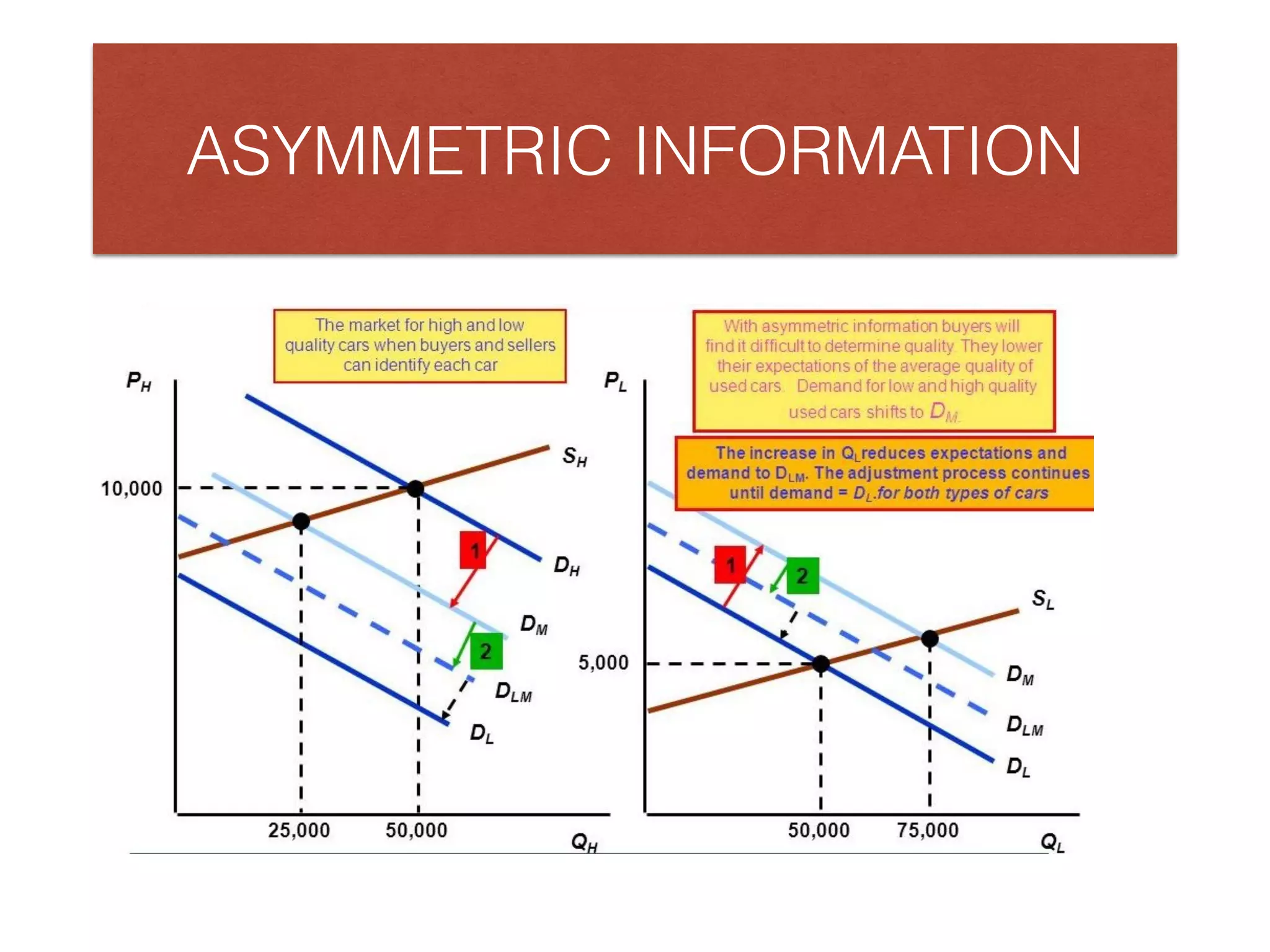
• Sellers know more about the quality of the used car than the buyer
• Initially buyers may think the odds are 50/50 that the car is high
quality
- Buyers will view all cars as medium quality with demand DM
• However, fewer high quality cars (25,000) and more low quality
cars (75,000) will now be sold
• Perceived demand will now shift
ASYMMETRIC INFORMATION
MARKET FOR USED CARS -
Continue…
With asymmetric information:
• Low quality goods drive high quality goods out of the market
- the lemons problem
• The market has failed to produce mutually beneficial trade
• Too many low and too few high quality cars are on the market
• Adverse selection occurs; the only cars on the market will be
low quality cars
ADVERSE SELECTION
Form of market failure resulting when products of different
qualities are sold at a single price because of asymmetric
information, so that too much of the low-quality product and
too little of the high-quality product are sold
• Older individuals have difficulty
purchasing health insurance
• They know more about their health
than the insurance company
• The proportion of unhealthy people
in the pool of insured people rises
• Price of insurance rises so healthy
people with low risk drop out –
proportion of unhealthy people
rises, increasing price more
MARKET FOR INSURANCE
• Auto insurance companies are targeting a certain population – males under 25
• They know some of the males have low probability of getting in an accident
and some have a high probability
• They will base premium on the average experience
• Some with low risk will choose not to insure, which raises the accident
probability and rates
• A possible solution to this problem is to pool risks
- Health insurance – government takes on role as with Medicare program
- Insurance companies will try to avoid risk by offering group health insurance
policies at places of employment and thereby spreading risk over a large pool
MARKET FOR INSURANCE -
Continue
• Owners cannot completely
monitor their employees –
e m p l o y e e s a re b e t t e r
informed than owners.
• This creates a principal-
agent problem which arises
when agents pursue their
own goals, rather than the
goals of the principal.
THE PRINCIPAL-Agent Problem
Continue..
• Company owners are principals
• Workers and managers are agents
• Owners do not have complete knowledge
• Employees may pursue their own goals even at a cost of
reduced profits
THE PRINCIPAL-AGENT
PROBLEM-– Private Enterprises
The Principal – Agent Problem in Private Enterprises:
• Only 16 of 100 largest corporations have individual family or financial
institution ownership exceeding 10%
• Most large firms are controlled by management
• Monitoring management is costly (asymmetric information)
• Managers may pursue their own objectives
• Growth and larger market share to increase cash flow and therefore perks
to the manager
• Utility from job, from profit, and from respect of peers, power to control
corporation, fringe benefits, long job tenure, etc.
Continue..
Limitations to managers’ ability to deviate from objective of owners:
• Stockholders can oust managers Takeover attempts if firm is poorly
managed Market for managers who maximize profits – those that
perform get paid more so incentive to act for the firm
• The problem of limited stockholder control shows up in executive
compensation
• Business Week showed that average CEO earned $13.1 million and
has continued to increase at a double-digit rate
• For the 10 public companies led by the highest paid CEOs, there was
negative correlation between CEO pay and company performance
CEO SALARIES
WORKERS CEO
1970 $32,522 $1.3 Mil.
1999 $35,864 $37.5 Mil.
• Although originally thought
that executive compensation
reflected reward for talent,
recent evidence suggests
managers have been able to
manipulate boards to extract
compensation out of line with
economic contribution
CEO SALARIES
CEO SALARIES - Continue..
How have they been able to do this?
• Boards don’t typically have necessary information and independence to negotiate
effectively
• Managers have introduced forms of compensation that camouflage the extraction
of rents from shareholders
• Stock options (not counted as expenses)
• Rent extraction has increased as consultants are hired to determine appropriate
pay for CEO.
• Firm usually wants to provide at least the average of other companies, so salaries
have been rising rapidly.
• With publicity increasing, CEO salaries seem to be rising less rapidly.
• Observations
• Managers’ goals may deviate
from the agencies’ goals (size)
• Oversight is difficult
(asymmetric information)
• Market forces are lacking
THE PRINCIPAL – Agent Problem –
Public Enterprises
Public Enterprises - Continue..
Limitations to Management Power
• Managers choose a public service position
• Managerial job market
• Legislative and agency oversight (GAO & OMB)
• Competition among agencies
• Observations
• Managers’ goals may deviate
from the agencies’ goals (size)
• Oversight is difficult
(asymmetric information)
• Market forces are lacking
THE MANAGERS OF NON-PROFIT
Hospitals as Agents
HOSPITALS AS AGENTS -
Continue…
Are non-profit organizations more or less efficient than for-
profit firms?
• 725 hospitals from 14 hospital chains
• Return on investment (ROI) and average cost (AC)
measured
RETURN ON INVESTMENT
1977 1981
For-Profit 11.6% 12.7%
Non-Profit 8.8% 7.4%
HOSPITALS AS AGENTS -
Continue…
Hospitals as Agents - Continue…
After adjusting for differences in services:
• AC/patient day in non-profits is 8% greater than profits
• Conclusion
• Profit incentive impacts performance
• Costs and benefits of subsidizing non-profits must be
considered
Designing a reward system to
align the principal’s and agent’s
goals--an example:
• Watch manufacturer
• Uses labor and machinery
• Owners’ goal is to maximize
profit
• Machine repairperson can
influence reliability of
machines and profits
INCENTIVES IN THE PRINCIPAL-
Agent Framework
INCENTIVES IN THE PRINCIPAL-
Agent Framework - Continue
Designing a reward system to align the principal’s and agent’s goals--an
example:
• Revenue also depends, in part, on the quality of parts and the reliability
of labor
• High monitoring costs make it difficult to assess the repairperson’s work
• Small manufacturer uses labor and machinery to produce watches
• Goal is to maximize profits
• High monitoring costs keep owners from measuring the effort of the
repairperson directly
THE REVENUE FROM MAKING
WATCHES
POOR LUCK GOOD LUCK
LOW EFFORT
(a=0)
$10,000 $20,000
HIGH EFFORT
(a=1)
$20,000 $40,000
INCENTIVES IN THE PRINCIPAL-
Agent Framework - Continue
Designing a reward system to align the principal’s and agent’s goals--an
example:
• Repairperson can work with either high or low effort
• Revenues depend on effort relative to the other events (poor or good luck)
• Owners cannot determine a high or low effort when revenue = $20,000
• Repairperson’s goal is to maximize wage net of cost
• Cost = 0 for low effort
• Cost = $10,000 for high effort
• w(R) = repairperson’s wage based only on output
Incentive structure that rewards
the outcome of high levels of effort
can induce agents to aim for the
goals set by the principals
INCENTIVES IN THE PRINCIPAL-
Agent Framework - Conclusion
• Firms with several divisions
each with their own managers
• Horizontally integrated
- Several plants produce the same
or related products
• Vertically integrated
- Firm contains several
divisions, with some producing
parts and components that
others use to produce finished
products
MANAGERIAL INCENTIVES IN AN
INTEGRATED FIRM
MANAGERIAL INCENTIVES IN AN
INTEGRATED FIRM - Continue
• Possible Incentive Plans
1. Give plant managers bonuses based on either total output or operating
profit
- Would encourage managers to maximize output
- Would penalize managers whose plants have higher costs and lower
capacity
- No incentive to obtain and reveal accurate cost and capacity information
MANAGERIAL INCENTIVES IN AN
INTEGRATED FIRM - Continue
• Possible Incentive Plans
2. Ask managers about their costs and capacities and then base bonuses on
how well they do relative to their answers
• Qf = estimate of feasible production level
• B = bonus in dollars
• Q = actual output
• B = 10,000 - .5(Qf - Q)
Incentive to underestimate Qf
• If manager estimates capacity to be 18,000 rather than 20,000, and if the
plant only produces 16,000, her bonus increases from $8000 to $9000
- Don’t get accurate information about capacity and don’t insure efficiency
• Bonus still tied to accuracy of forecast
• Modify scheme by asking managers how much their plants can feasibly
produce and tie bonuses to it
• Bonuses based on more complicated formula to give incentive to reveal
true feasible production and actual output
- If Q > Qf ,B = .3Qf + .2(Q - Qf)
- If Q ≤ Qf ,B = .3Qf - .5(Qf - Q)
MANAGERIAL INCENTIVES IN AN
INTEGRATED FIRM - Continue
• Assume true production limit is Q* = 20,000
- Line for 20,000 is continued for outputs beyond 20,000
to illustrate the bonus scheme but dashed to signify the
infeasibility of such production
- Bonus is maximized when firm produces at its limit of
20,000; the bonus is then $6000
MANAGERIAL INCENTIVES IN AN
INTEGRATED FIRM - Continue
MANAGERIAL INCENTIVES IN AN
INTEGRATED FIRM - Continue
• If workers are paid market clearing wage
w*, they have incentive to shirk
• If they get caught and fired, they can
immediately get a job elsewhere for same
wage
• Firms have to pay a higher wage to make
loss higher from shirking
• Wage at which no shirking occurs is the
efficiency wage
• All firms will offer more than market clearing
wage, w*, say we (efficiency wage)
• In this case, workers fired for shirking face
unemployment because demand for labor
is less than market clearing quantity
EFFICIENCY WAGE THEORY
UNEMPLOYMENT IN A SHIRKING
MODEL
• Labor turnover at Ford
- 1913: 380%
- 1914: 1000%
• Average pay = $2 - $3
• Ford increased pay to $5
• Results
- Productivity increased 51%
- Absenteeism was halved
- Profitability rose from $30 million in
1914 to $60 million in 1916
EFFICIENCY WAGES AT FORD
COMPANY
WHY INFORMATION ASYMMETRY
CAUSES MARKET FAILURE?
• Market failure is a situation in
which the allocation of goods
and services is not efficient.
• In other words Demand and
supply are not equal.
MARKET FAILURE
Wikipedia - Definition
In economics, market failure is a situation in which the
allocation of goods and services is not efficient. That is,
there exists another conceivable outcome where an
individual may be made better-off without making someone
else worse-off. - Wikipedia
MARKET FAILURE - Continue
• The allocation of goods and services is never efficient So all
markets, and all conceivable markets, will be failed
• In a free market the allocation tends to become more efficient then
in Planned Market
• Planned markets will fail simply because the planners make
mistakes
• Asymmetry of information occurs when some people know more
about the changes than other people.
Line between ethical and unethical
use of information asymmetry?
For example
Option A: the Computer expert takes a look and says “you have a broken fan. I
can fix for you for $150.”
Option B: the widget expert says “becoming a computer expert is a difficult
and time consuming process. It will be $100 for me to diagnose the problem
with your computer.” After paying him, he says “You need a new fan. I can
replace it for you for $100.”
Option A was unethical use of information asymmetry, while option B was ethical.

Information Asymmetry

  • 1.
  • 2.
    ASYMMETRIC INFORMATION • Situationin which a buyer and a seller possess different information about a transaction
  • 3.
    QUALITY UNCERTAINTY AND MARKETFOR LEMONS • The lack of complete information when purchasing a used car increases the risk of the purchase and lowers the value of the car • Markets for insurance, financial credit and employment are also characterized by asymmetric information about product quality
  • 4.
    • Two kindsof cars – high quality and low quality • There will be two markets – one for high quality and one for low quality MARKET FOR USED CARS
  • 5.
    MARKET FOR USEDCARS • Sellers know more about the quality of the used car than the buyer • Initially buyers may think the odds are 50/50 that the car is high quality - Buyers will view all cars as medium quality with demand DM • However, fewer high quality cars (25,000) and more low quality cars (75,000) will now be sold • Perceived demand will now shift
  • 6.
  • 7.
    MARKET FOR USEDCARS - Continue… With asymmetric information: • Low quality goods drive high quality goods out of the market - the lemons problem • The market has failed to produce mutually beneficial trade • Too many low and too few high quality cars are on the market • Adverse selection occurs; the only cars on the market will be low quality cars
  • 8.
    ADVERSE SELECTION Form ofmarket failure resulting when products of different qualities are sold at a single price because of asymmetric information, so that too much of the low-quality product and too little of the high-quality product are sold
  • 9.
    • Older individualshave difficulty purchasing health insurance • They know more about their health than the insurance company • The proportion of unhealthy people in the pool of insured people rises • Price of insurance rises so healthy people with low risk drop out – proportion of unhealthy people rises, increasing price more MARKET FOR INSURANCE
  • 10.
    • Auto insurancecompanies are targeting a certain population – males under 25 • They know some of the males have low probability of getting in an accident and some have a high probability • They will base premium on the average experience • Some with low risk will choose not to insure, which raises the accident probability and rates • A possible solution to this problem is to pool risks - Health insurance – government takes on role as with Medicare program - Insurance companies will try to avoid risk by offering group health insurance policies at places of employment and thereby spreading risk over a large pool MARKET FOR INSURANCE - Continue
  • 11.
    • Owners cannotcompletely monitor their employees – e m p l o y e e s a re b e t t e r informed than owners. • This creates a principal- agent problem which arises when agents pursue their own goals, rather than the goals of the principal. THE PRINCIPAL-Agent Problem
  • 12.
    Continue.. • Company ownersare principals • Workers and managers are agents • Owners do not have complete knowledge • Employees may pursue their own goals even at a cost of reduced profits
  • 13.
    THE PRINCIPAL-AGENT PROBLEM-– PrivateEnterprises The Principal – Agent Problem in Private Enterprises: • Only 16 of 100 largest corporations have individual family or financial institution ownership exceeding 10% • Most large firms are controlled by management • Monitoring management is costly (asymmetric information) • Managers may pursue their own objectives • Growth and larger market share to increase cash flow and therefore perks to the manager • Utility from job, from profit, and from respect of peers, power to control corporation, fringe benefits, long job tenure, etc.
  • 14.
    Continue.. Limitations to managers’ability to deviate from objective of owners: • Stockholders can oust managers Takeover attempts if firm is poorly managed Market for managers who maximize profits – those that perform get paid more so incentive to act for the firm • The problem of limited stockholder control shows up in executive compensation • Business Week showed that average CEO earned $13.1 million and has continued to increase at a double-digit rate • For the 10 public companies led by the highest paid CEOs, there was negative correlation between CEO pay and company performance
  • 15.
    CEO SALARIES WORKERS CEO 1970$32,522 $1.3 Mil. 1999 $35,864 $37.5 Mil.
  • 16.
    • Although originallythought that executive compensation reflected reward for talent, recent evidence suggests managers have been able to manipulate boards to extract compensation out of line with economic contribution CEO SALARIES
  • 17.
    CEO SALARIES -Continue.. How have they been able to do this? • Boards don’t typically have necessary information and independence to negotiate effectively • Managers have introduced forms of compensation that camouflage the extraction of rents from shareholders • Stock options (not counted as expenses) • Rent extraction has increased as consultants are hired to determine appropriate pay for CEO. • Firm usually wants to provide at least the average of other companies, so salaries have been rising rapidly. • With publicity increasing, CEO salaries seem to be rising less rapidly.
  • 18.
    • Observations • Managers’goals may deviate from the agencies’ goals (size) • Oversight is difficult (asymmetric information) • Market forces are lacking THE PRINCIPAL – Agent Problem – Public Enterprises
  • 19.
    Public Enterprises -Continue.. Limitations to Management Power • Managers choose a public service position • Managerial job market • Legislative and agency oversight (GAO & OMB) • Competition among agencies
  • 20.
    • Observations • Managers’goals may deviate from the agencies’ goals (size) • Oversight is difficult (asymmetric information) • Market forces are lacking THE MANAGERS OF NON-PROFIT Hospitals as Agents
  • 21.
    HOSPITALS AS AGENTS- Continue… Are non-profit organizations more or less efficient than for- profit firms? • 725 hospitals from 14 hospital chains • Return on investment (ROI) and average cost (AC) measured
  • 22.
    RETURN ON INVESTMENT 19771981 For-Profit 11.6% 12.7% Non-Profit 8.8% 7.4% HOSPITALS AS AGENTS - Continue…
  • 23.
    Hospitals as Agents- Continue… After adjusting for differences in services: • AC/patient day in non-profits is 8% greater than profits • Conclusion • Profit incentive impacts performance • Costs and benefits of subsidizing non-profits must be considered
  • 24.
    Designing a rewardsystem to align the principal’s and agent’s goals--an example: • Watch manufacturer • Uses labor and machinery • Owners’ goal is to maximize profit • Machine repairperson can influence reliability of machines and profits INCENTIVES IN THE PRINCIPAL- Agent Framework
  • 25.
    INCENTIVES IN THEPRINCIPAL- Agent Framework - Continue Designing a reward system to align the principal’s and agent’s goals--an example: • Revenue also depends, in part, on the quality of parts and the reliability of labor • High monitoring costs make it difficult to assess the repairperson’s work • Small manufacturer uses labor and machinery to produce watches • Goal is to maximize profits • High monitoring costs keep owners from measuring the effort of the repairperson directly
  • 26.
    THE REVENUE FROMMAKING WATCHES POOR LUCK GOOD LUCK LOW EFFORT (a=0) $10,000 $20,000 HIGH EFFORT (a=1) $20,000 $40,000
  • 27.
    INCENTIVES IN THEPRINCIPAL- Agent Framework - Continue Designing a reward system to align the principal’s and agent’s goals--an example: • Repairperson can work with either high or low effort • Revenues depend on effort relative to the other events (poor or good luck) • Owners cannot determine a high or low effort when revenue = $20,000 • Repairperson’s goal is to maximize wage net of cost • Cost = 0 for low effort • Cost = $10,000 for high effort • w(R) = repairperson’s wage based only on output
  • 28.
    Incentive structure thatrewards the outcome of high levels of effort can induce agents to aim for the goals set by the principals INCENTIVES IN THE PRINCIPAL- Agent Framework - Conclusion
  • 29.
    • Firms withseveral divisions each with their own managers • Horizontally integrated - Several plants produce the same or related products • Vertically integrated - Firm contains several divisions, with some producing parts and components that others use to produce finished products MANAGERIAL INCENTIVES IN AN INTEGRATED FIRM
  • 30.
    MANAGERIAL INCENTIVES INAN INTEGRATED FIRM - Continue • Possible Incentive Plans 1. Give plant managers bonuses based on either total output or operating profit - Would encourage managers to maximize output - Would penalize managers whose plants have higher costs and lower capacity - No incentive to obtain and reveal accurate cost and capacity information
  • 31.
    MANAGERIAL INCENTIVES INAN INTEGRATED FIRM - Continue • Possible Incentive Plans 2. Ask managers about their costs and capacities and then base bonuses on how well they do relative to their answers • Qf = estimate of feasible production level • B = bonus in dollars • Q = actual output • B = 10,000 - .5(Qf - Q) Incentive to underestimate Qf
  • 32.
    • If managerestimates capacity to be 18,000 rather than 20,000, and if the plant only produces 16,000, her bonus increases from $8000 to $9000 - Don’t get accurate information about capacity and don’t insure efficiency • Bonus still tied to accuracy of forecast • Modify scheme by asking managers how much their plants can feasibly produce and tie bonuses to it • Bonuses based on more complicated formula to give incentive to reveal true feasible production and actual output - If Q > Qf ,B = .3Qf + .2(Q - Qf) - If Q ≤ Qf ,B = .3Qf - .5(Qf - Q) MANAGERIAL INCENTIVES IN AN INTEGRATED FIRM - Continue
  • 33.
    • Assume trueproduction limit is Q* = 20,000 - Line for 20,000 is continued for outputs beyond 20,000 to illustrate the bonus scheme but dashed to signify the infeasibility of such production - Bonus is maximized when firm produces at its limit of 20,000; the bonus is then $6000 MANAGERIAL INCENTIVES IN AN INTEGRATED FIRM - Continue
  • 34.
    MANAGERIAL INCENTIVES INAN INTEGRATED FIRM - Continue
  • 35.
    • If workersare paid market clearing wage w*, they have incentive to shirk • If they get caught and fired, they can immediately get a job elsewhere for same wage • Firms have to pay a higher wage to make loss higher from shirking • Wage at which no shirking occurs is the efficiency wage • All firms will offer more than market clearing wage, w*, say we (efficiency wage) • In this case, workers fired for shirking face unemployment because demand for labor is less than market clearing quantity EFFICIENCY WAGE THEORY
  • 36.
    UNEMPLOYMENT IN ASHIRKING MODEL
  • 37.
    • Labor turnoverat Ford - 1913: 380% - 1914: 1000% • Average pay = $2 - $3 • Ford increased pay to $5 • Results - Productivity increased 51% - Absenteeism was halved - Profitability rose from $30 million in 1914 to $60 million in 1916 EFFICIENCY WAGES AT FORD COMPANY
  • 38.
  • 39.
    • Market failureis a situation in which the allocation of goods and services is not efficient. • In other words Demand and supply are not equal. MARKET FAILURE
  • 40.
    Wikipedia - Definition Ineconomics, market failure is a situation in which the allocation of goods and services is not efficient. That is, there exists another conceivable outcome where an individual may be made better-off without making someone else worse-off. - Wikipedia
  • 41.
    MARKET FAILURE -Continue • The allocation of goods and services is never efficient So all markets, and all conceivable markets, will be failed • In a free market the allocation tends to become more efficient then in Planned Market • Planned markets will fail simply because the planners make mistakes • Asymmetry of information occurs when some people know more about the changes than other people.
  • 42.
    Line between ethicaland unethical use of information asymmetry? For example Option A: the Computer expert takes a look and says “you have a broken fan. I can fix for you for $150.” Option B: the widget expert says “becoming a computer expert is a difficult and time consuming process. It will be $100 for me to diagnose the problem with your computer.” After paying him, he says “You need a new fan. I can replace it for you for $100.” Option A was unethical use of information asymmetry, while option B was ethical.