The Inovo Group
Corporate-Startup Collaboration An
Overview
Five Key Trends are Pushing Corporate Interest in Startup
Collaboration to an All-Time High
1. Large and rapidly expanding startup ecosystem around the world
2. Increasing cash reserves along with ongoing takeover pressure
3. Declining confidence in R&D for innovation outside the core
− Especially in digital technologies for non-digital product companies
4. New modes of collaboration are evolving that don’t require large capital
investments
5. Startups increasingly see the benefits of collaborating with corporations
− VCs are now seeking corporate partners for their portfolio startups
2Copyright © 2019 The Inovo Group, LLC
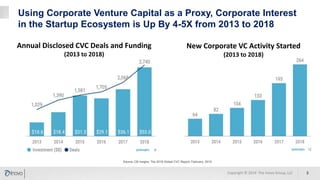
Source: CB Insighs; The 2018 Global CVC Report, February, 2019
Using Corporate Venture Capital as a Proxy, Corporate Interest
in the Startup Ecosystem is Up By 4-5X from 2013 to 2018
3Copyright © 2019 The Inovo Group, LLC
New Corporate VC Activity Started
(2013 to 2018)
Annual Disclosed CVC Deals and Funding
(2013 to 2018)
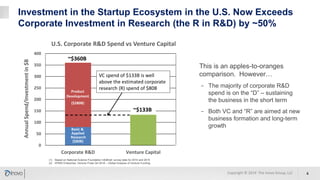
Investment in the Startup Ecosystem in the U.S. Now Exceeds
Corporate Investment in Research (the R in R&D) by ~50%
(1) Based on National Science Foundation InfoBrief; survey data for 2014 and 2015
(2) KPMG Enterprise; Venture Pulse Q4 2018 – Global Analysis of Venture Funding
0
50
100
150
200
250
300
350
400
Corporate R&D Venture Capital
AnnualSpend/Investmentin$B
U.S. Corporate R&D Spend vs Venture Capital
Basic &
Applied
Research
($80B)
Product
Development
($280B)
VC spend of $133B is well
above the estimated corporate
research (R) spend of $80B
This is an apples-to-oranges
comparison. However…
− The majority of corporate R&D
spend is on the “D” – sustaining
the business in the short term
− Both VC and “R” are aimed at new
business formation and long-term
growth
4
~$360B
Copyright © 2019 The Inovo Group, LLC
~$133B
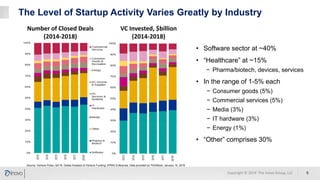
The Level of Startup Activity Varies Greatly by Industry
Source: Venture Pulse, Q4'18. Global Analysis of Venture Funding, KPMG Enterprise. Data provided by PitchBook, January 15, 2019
• Software sector at ~40%
• “Healthcare” at ~15%
− Pharma/biotech, devices, services
• In the range of 1-5% each
− Consumer goods (5%)
− Commercial services (5%)
− Media (3%)
− IT hardware (3%)
− Energy (1%)
• “Other” comprises 30%
Number of Closed Deals
(2014-2018)
VC Invested, $billion
(2014-2018)
5Copyright © 2019 The Inovo Group, LLC
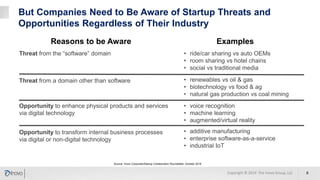
But Companies Need to Be Aware of Startup Threats and
Opportunities Regardless of Their Industry
Source: Inovo Corporate/Startup Collaboration Roundtable; October 2018
Threat from the “software” domain
Threat from a domain other than software
Opportunity to enhance physical products and services
via digital technology
Opportunity to transform internal business processes
via digital or non-digital technology
6
• renewables vs oil & gas
• biotechnology vs food & ag
• natural gas production vs coal mining
• ride/car sharing vs auto OEMs
• room sharing vs hotel chains
• social vs traditional media
• voice recognition
• machine learning
• augmented/virtual reality
• additive manufacturing
• enterprise software-as-a-service
• industrial IoT
ExamplesReasons to be Aware
Copyright © 2019 The Inovo Group, LLC
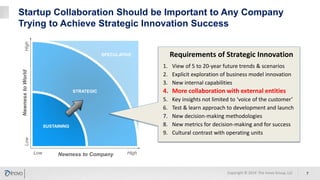
Startup Collaboration Should be Important to Any Company
Trying to Achieve Strategic Innovation Success
7Copyright © 2019 The Inovo Group, LLC
Low HighNewness to Company
SUSTAINING
STRATEGIC
LowHighNewnesstoWorld
1. View of 5 to 20-year future trends & scenarios
2. Explicit exploration of business model innovation
3. New internal capabilities
4. More collaboration with external entities
5. Key insights not limited to ‘voice of the customer’
6. Test & learn approach to development and launch
7. New decision-making methodologies
8. New metrics for decision-making and for success
9. Cultural contrast with operating units
Requirements of Strategic InnovationSPECULATIVE
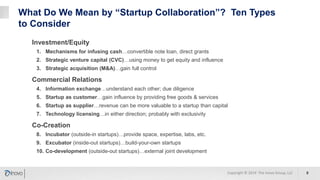
What Do We Mean by “Startup Collaboration”? Ten Types
to Consider
Investment/Equity
1. Mechanisms for infusing cash…convertible note loan, direct grants
2. Strategic venture capital (CVC)…using money to get equity and influence
3. Strategic acquisition (M&A)…gain full control
Commercial Relations
4. Information exchange…understand each other; due diligence
5. Startup as customer…gain influence by providing free goods & services
6. Startup as supplier…revenue can be more valuable to a startup than capital
7. Technology licensing…in either direction; probably with exclusivity
Co-Creation
8. Incubator (outside-in startups)…provide space, expertise, labs, etc.
9. Excubator (inside-out startups)…build-your-own startups
10. Co-development (outside-out startups)…external joint development
8Copyright © 2019 The Inovo Group, LLC
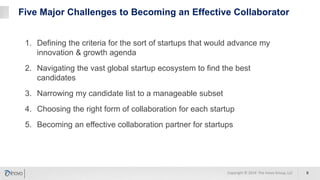
Five Major Challenges to Becoming an Effective Collaborator
1. Defining the criteria for the sort of startups that would advance my
innovation & growth agenda
2. Navigating the vast global startup ecosystem to find the best
candidates
3. Narrowing my candidate list to a manageable subset
4. Choosing the right form of collaboration for each startup
5. Becoming an effective collaboration partner for startups
9Copyright © 2019 The Inovo Group, LLC
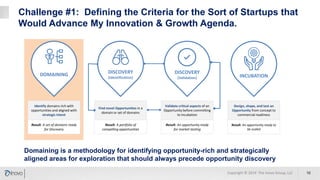
Challenge #1: Defining the Criteria for the Sort of Startups that
Would Advance My Innovation & Growth Agenda.
10
Find novel Opportunities in a
domain or set of domains
Result: A portfolio of
compelling opportunities
DISCOVERY
(Identification)
Validate critical aspects of an
Opportunity before committing
to Incubation
Result: An opportunity ready
for market testing
DISCOVERY
(Validation)
Design, shape, and test an
Opportunity from concept to
commercial readiness
Result: An opportunity ready to
be scaled
INCUBATION
Identify domains rich with
opportunities and aligned with
strategic intent
Result: A set of domains ready
for Discovery
DOMAINING
Domaining is a methodology for identifying opportunity-rich and strategically
aligned areas for exploration that should always precede opportunity discovery
Copyright © 2019 The Inovo Group, LLC
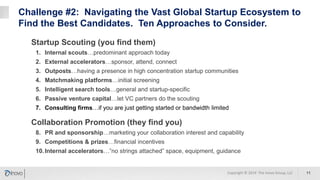
Challenge #2: Navigating the Vast Global Startup Ecosystem to
Find the Best Candidates. Ten Approaches to Consider.
11
Startup Scouting (you find them)
1. Internal scouts…predominant approach today
2. External accelerators…sponsor, attend, connect
3. Outposts…having a presence in high concentration startup communities
4. Matchmaking platforms…initial screening
5. Intelligent search tools…general and startup-specific
6. Passive venture capital…let VC partners do the scouting
7. Consulting firms…if you are just getting started or bandwidth limited
Collaboration Promotion (they find you)
8. PR and sponsorship…marketing your collaboration interest and capability
9. Competitions & prizes…financial incentives
10.Internal accelerators…”no strings attached” space, equipment, guidance
Copyright © 2019 The Inovo Group, LLC
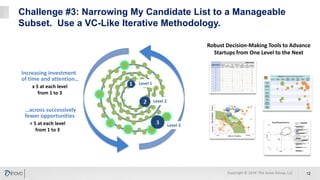
Challenge #3: Narrowing My Candidate List to a Manageable
Subset. Use a VC-Like Iterative Methodology.
Copyright © 2019 The Inovo Group, LLC 12
x 5 at each level
from 1 to 3
…across successively
fewer opportunities
Increasing investment
of time and attention…
Level 1
Level 2
Level 3÷ 5 at each level
from 1 to 3
Robust Decision-Making Tools to Advance
Startups from One Level to the Next
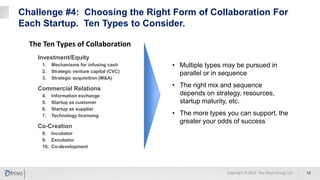
Challenge #4: Choosing the Right Form of Collaboration For
Each Startup. Ten Types to Consider.
13
Investment/Equity
1. Mechanisms for infusing cash
2. Strategic venture capital (CVC)
3. Strategic acquisition (M&A)
Commercial Relations
4. Information exchange
5. Startup as customer
6. Startup as supplier
7. Technology licensing
Co-Creation
8. Incubator
9. Excubator
10. Co-development
The Ten Types of Collaboration
• Multiple types may be pursued in
parallel or in sequence
• The right mix and sequence
depends on strategy, resources,
startup maturity, etc.
• The more types you can support, the
greater your odds of success
Copyright © 2019 The Inovo Group, LLC
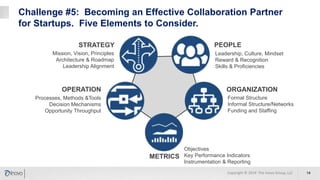
Challenge #5: Becoming an Effective Collaboration Partner
for Startups. Five Elements to Consider.
14
STRATEGY PEOPLE
OPERATION ORGANIZATION
METRICS
− Mission, Vision, Principles
− Architecture & Roadmap
− Leadership Alignment
Formal Structure
Informal Structure/Networks
Funding and Staffing
Processes, Methods &Tools
Decision Mechanisms
Opportunity Throughput
Leadership, Culture, Mindset
Reward & Recognition
Skills & Proficiencies
− Objectives
− Key Performance Indicators
− Instrumentation & Reporting
Copyright © 2019 The Inovo Group, LLC
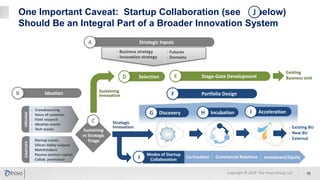
One Important Caveat: Startup Collaboration (see below)
Should Be an Integral Part of a Broader Innovation System
15Copyright © 2019 The Inovo Group, LLC
› Business strategy
› Innovation strategy
› Startup scouts
› Silicon Valley outpost
› Matchmakers
› Passive venture capital
› Collab. promotion
STARTUPS
› Crowdsourcing
› Voice of customer
› Field research
› Ideation events
› Tech scouts
ORGANIC
Sustaining
vs Strategic
Triage
Sustaining
Innovation
Strategic
Innovation
Strategic InputsA
IdeationB Portfolio DesignF
DiscoveryG IncubationH AccelerationI
› Existing BU
› New BU
› External
Modes of Startup
Collaboration Investment/EquityCommercial RelationsCo-Creation
› Futures
› Domains
SelectionD Stage-Gate DevelopmentE
C
J
Existing
Business Unit
J

Corporate - Startup Collaboration: An Overview

  • 1.
    The Inovo Group Corporate-StartupCollaboration An Overview
  • 2.
    Five Key Trendsare Pushing Corporate Interest in Startup Collaboration to an All-Time High 1. Large and rapidly expanding startup ecosystem around the world 2. Increasing cash reserves along with ongoing takeover pressure 3. Declining confidence in R&D for innovation outside the core − Especially in digital technologies for non-digital product companies 4. New modes of collaboration are evolving that don’t require large capital investments 5. Startups increasingly see the benefits of collaborating with corporations − VCs are now seeking corporate partners for their portfolio startups 2Copyright © 2019 The Inovo Group, LLC
  • 3.
    Source: CB Insighs;The 2018 Global CVC Report, February, 2019 Using Corporate Venture Capital as a Proxy, Corporate Interest in the Startup Ecosystem is Up By 4-5X from 2013 to 2018 3Copyright © 2019 The Inovo Group, LLC New Corporate VC Activity Started (2013 to 2018) Annual Disclosed CVC Deals and Funding (2013 to 2018)
  • 4.
    Investment in theStartup Ecosystem in the U.S. Now Exceeds Corporate Investment in Research (the R in R&D) by ~50% (1) Based on National Science Foundation InfoBrief; survey data for 2014 and 2015 (2) KPMG Enterprise; Venture Pulse Q4 2018 – Global Analysis of Venture Funding 0 50 100 150 200 250 300 350 400 Corporate R&D Venture Capital AnnualSpend/Investmentin$B U.S. Corporate R&D Spend vs Venture Capital Basic & Applied Research ($80B) Product Development ($280B) VC spend of $133B is well above the estimated corporate research (R) spend of $80B This is an apples-to-oranges comparison. However… − The majority of corporate R&D spend is on the “D” – sustaining the business in the short term − Both VC and “R” are aimed at new business formation and long-term growth 4 ~$360B Copyright © 2019 The Inovo Group, LLC ~$133B
  • 5.
    The Level ofStartup Activity Varies Greatly by Industry Source: Venture Pulse, Q4'18. Global Analysis of Venture Funding, KPMG Enterprise. Data provided by PitchBook, January 15, 2019 • Software sector at ~40% • “Healthcare” at ~15% − Pharma/biotech, devices, services • In the range of 1-5% each − Consumer goods (5%) − Commercial services (5%) − Media (3%) − IT hardware (3%) − Energy (1%) • “Other” comprises 30% Number of Closed Deals (2014-2018) VC Invested, $billion (2014-2018) 5Copyright © 2019 The Inovo Group, LLC
  • 6.
    But Companies Needto Be Aware of Startup Threats and Opportunities Regardless of Their Industry Source: Inovo Corporate/Startup Collaboration Roundtable; October 2018 Threat from the “software” domain Threat from a domain other than software Opportunity to enhance physical products and services via digital technology Opportunity to transform internal business processes via digital or non-digital technology 6 • renewables vs oil & gas • biotechnology vs food & ag • natural gas production vs coal mining • ride/car sharing vs auto OEMs • room sharing vs hotel chains • social vs traditional media • voice recognition • machine learning • augmented/virtual reality • additive manufacturing • enterprise software-as-a-service • industrial IoT ExamplesReasons to be Aware Copyright © 2019 The Inovo Group, LLC
  • 7.
    Startup Collaboration Shouldbe Important to Any Company Trying to Achieve Strategic Innovation Success 7Copyright © 2019 The Inovo Group, LLC Low HighNewness to Company SUSTAINING STRATEGIC LowHighNewnesstoWorld 1. View of 5 to 20-year future trends & scenarios 2. Explicit exploration of business model innovation 3. New internal capabilities 4. More collaboration with external entities 5. Key insights not limited to ‘voice of the customer’ 6. Test & learn approach to development and launch 7. New decision-making methodologies 8. New metrics for decision-making and for success 9. Cultural contrast with operating units Requirements of Strategic InnovationSPECULATIVE
  • 8.
    What Do WeMean by “Startup Collaboration”? Ten Types to Consider Investment/Equity 1. Mechanisms for infusing cash…convertible note loan, direct grants 2. Strategic venture capital (CVC)…using money to get equity and influence 3. Strategic acquisition (M&A)…gain full control Commercial Relations 4. Information exchange…understand each other; due diligence 5. Startup as customer…gain influence by providing free goods & services 6. Startup as supplier…revenue can be more valuable to a startup than capital 7. Technology licensing…in either direction; probably with exclusivity Co-Creation 8. Incubator (outside-in startups)…provide space, expertise, labs, etc. 9. Excubator (inside-out startups)…build-your-own startups 10. Co-development (outside-out startups)…external joint development 8Copyright © 2019 The Inovo Group, LLC
  • 9.
    Five Major Challengesto Becoming an Effective Collaborator 1. Defining the criteria for the sort of startups that would advance my innovation & growth agenda 2. Navigating the vast global startup ecosystem to find the best candidates 3. Narrowing my candidate list to a manageable subset 4. Choosing the right form of collaboration for each startup 5. Becoming an effective collaboration partner for startups 9Copyright © 2019 The Inovo Group, LLC
  • 10.
    Challenge #1: Definingthe Criteria for the Sort of Startups that Would Advance My Innovation & Growth Agenda. 10 Find novel Opportunities in a domain or set of domains Result: A portfolio of compelling opportunities DISCOVERY (Identification) Validate critical aspects of an Opportunity before committing to Incubation Result: An opportunity ready for market testing DISCOVERY (Validation) Design, shape, and test an Opportunity from concept to commercial readiness Result: An opportunity ready to be scaled INCUBATION Identify domains rich with opportunities and aligned with strategic intent Result: A set of domains ready for Discovery DOMAINING Domaining is a methodology for identifying opportunity-rich and strategically aligned areas for exploration that should always precede opportunity discovery Copyright © 2019 The Inovo Group, LLC
  • 11.
    Challenge #2: Navigatingthe Vast Global Startup Ecosystem to Find the Best Candidates. Ten Approaches to Consider. 11 Startup Scouting (you find them) 1. Internal scouts…predominant approach today 2. External accelerators…sponsor, attend, connect 3. Outposts…having a presence in high concentration startup communities 4. Matchmaking platforms…initial screening 5. Intelligent search tools…general and startup-specific 6. Passive venture capital…let VC partners do the scouting 7. Consulting firms…if you are just getting started or bandwidth limited Collaboration Promotion (they find you) 8. PR and sponsorship…marketing your collaboration interest and capability 9. Competitions & prizes…financial incentives 10.Internal accelerators…”no strings attached” space, equipment, guidance Copyright © 2019 The Inovo Group, LLC
  • 12.
    Challenge #3: NarrowingMy Candidate List to a Manageable Subset. Use a VC-Like Iterative Methodology. Copyright © 2019 The Inovo Group, LLC 12 x 5 at each level from 1 to 3 …across successively fewer opportunities Increasing investment of time and attention… Level 1 Level 2 Level 3÷ 5 at each level from 1 to 3 Robust Decision-Making Tools to Advance Startups from One Level to the Next
  • 13.
    Challenge #4: Choosingthe Right Form of Collaboration For Each Startup. Ten Types to Consider. 13 Investment/Equity 1. Mechanisms for infusing cash 2. Strategic venture capital (CVC) 3. Strategic acquisition (M&A) Commercial Relations 4. Information exchange 5. Startup as customer 6. Startup as supplier 7. Technology licensing Co-Creation 8. Incubator 9. Excubator 10. Co-development The Ten Types of Collaboration • Multiple types may be pursued in parallel or in sequence • The right mix and sequence depends on strategy, resources, startup maturity, etc. • The more types you can support, the greater your odds of success Copyright © 2019 The Inovo Group, LLC
  • 14.
    Challenge #5: Becomingan Effective Collaboration Partner for Startups. Five Elements to Consider. 14 STRATEGY PEOPLE OPERATION ORGANIZATION METRICS − Mission, Vision, Principles − Architecture & Roadmap − Leadership Alignment Formal Structure Informal Structure/Networks Funding and Staffing Processes, Methods &Tools Decision Mechanisms Opportunity Throughput Leadership, Culture, Mindset Reward & Recognition Skills & Proficiencies − Objectives − Key Performance Indicators − Instrumentation & Reporting Copyright © 2019 The Inovo Group, LLC
  • 15.
    One Important Caveat:Startup Collaboration (see below) Should Be an Integral Part of a Broader Innovation System 15Copyright © 2019 The Inovo Group, LLC › Business strategy › Innovation strategy › Startup scouts › Silicon Valley outpost › Matchmakers › Passive venture capital › Collab. promotion STARTUPS › Crowdsourcing › Voice of customer › Field research › Ideation events › Tech scouts ORGANIC Sustaining vs Strategic Triage Sustaining Innovation Strategic Innovation Strategic InputsA IdeationB Portfolio DesignF DiscoveryG IncubationH AccelerationI › Existing BU › New BU › External Modes of Startup Collaboration Investment/EquityCommercial RelationsCo-Creation › Futures › Domains SelectionD Stage-Gate DevelopmentE C J Existing Business Unit J

Editor's Notes

  • #4 The actual amount of Corporate VC investment is hard to find. Fair to say that it is some healthy fraction of the $37B in 2017. Corporate venture capital and private venture capital are being used as bellwethers of the state of the startup ecosystem. The primary message of this presentation is that corporate/startup collaboration goes well beyond corporate venture capital. In fact, it is just one element of a much more complex phenomenon.
  • #5 National Science Foundation data on average annual R&D spend for 2014-2015. This is CORPORATE R&D. It does NOT include government or university research spend. I have gotten some grief for this slide so its important to be clear about what it is and what is not. First, it is NOT an attempt to precisely equate venture capital with corporate R&D spending. However, It IS an attempt to compare the level of money (fuel) pursuing each objective because they are both aimed at growth. It is also true that about 70% of all startup exits are to corporate M&A – so it mostly ends up in the same place as a growth driver for large businesses.
  • #6 If you are in the software business, you are swimming in an endless sea of startups and FOMO runs high. If you are in healthcare, there is a lot going on, especially in pharma/biopharma and med tech. If you are in hardware, consumer products, energy or media, it drops off quite a bit.
  • #9 The inside-in case is an important part of strategic innovation but is not co-creation and is not within the scope of this particular presentation.