Deciding language inclusion problems
using quasiorders
Pierre Ganty IMDEA Software Institute
joint work with Pedro Valero (IMDEA) and Francesco Ranzato (Uni. Padova)
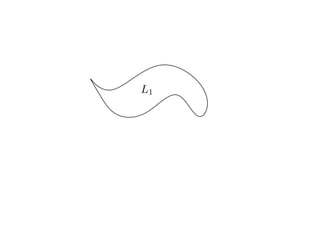
L1
L1
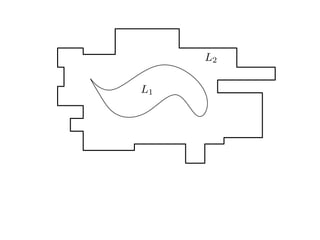
L2
L1
L2
L2
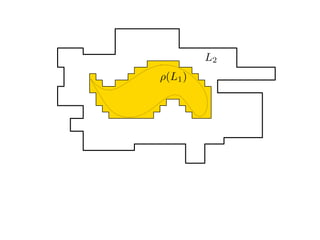
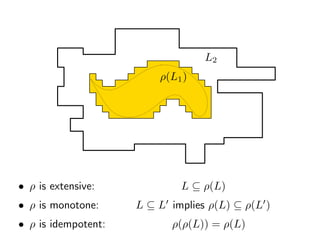
ρ(L1)
L2
ρ(L1)
• ρ is extensive: L ⊆ ρ(L)
• ρ is monotone: L ⊆ L implies ρ(L) ⊆ ρ(L )
• ρ is idempotent: ρ(ρ(L)) = ρ(L)
L2
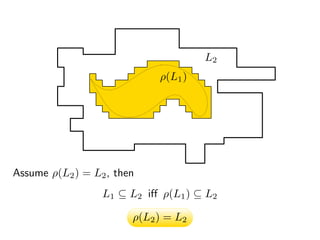
ρ(L1)
L1 ⊆ L2 iff ρ(L1) ⊆ L2
Assume ρ(L2) = L2, then
ρ(L2) = L2
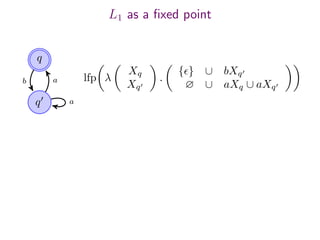
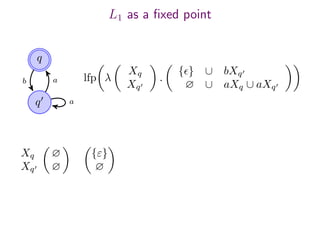
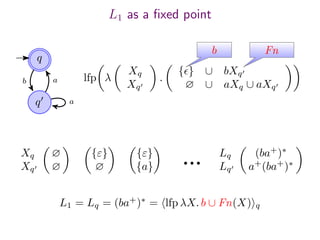
L1 as a fixed point
q
q
b a
a
lfp λ
Xq
Xq
.
{ } ∪ bXq
∅ ∪ aXq ∪ aXq
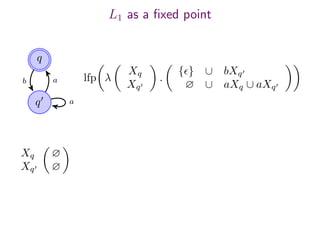
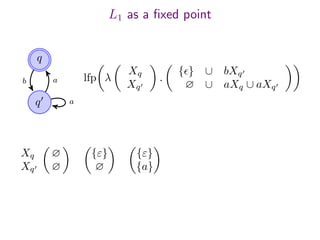
L1 as a fixed point
q
q
b a
a
lfp λ
Xq
Xq
.
{ } ∪ bXq
∅ ∪ aXq ∪ aXq
Xq ∅
Xq ∅
L1 as a fixed point
q
q
b a
a
lfp λ
Xq
Xq
.
{ } ∪ bXq
∅ ∪ aXq ∪ aXq
Xq ∅
Xq ∅
{ε}
∅
L1 as a fixed point
q
q
b a
a
lfp λ
Xq
Xq
.
{ } ∪ bXq
∅ ∪ aXq ∪ aXq
Xq ∅
Xq ∅
{ε}
∅
{ε}
{a}
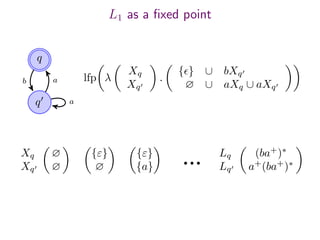
L1 as a fixed point
q
q
b a
a
lfp λ
Xq
Xq
.
{ } ∪ bXq
∅ ∪ aXq ∪ aXq
Lq (ba+
)∗
Lq a+
(ba+
)∗
Xq ∅
Xq ∅
{ε}
∅
{ε}
{a}
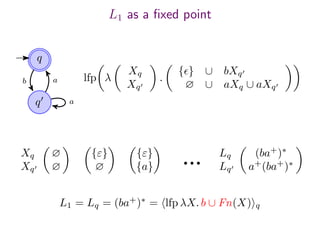
L1 as a fixed point
q
q
b a
a
lfp λ
Xq
Xq
.
{ } ∪ bXq
∅ ∪ aXq ∪ aXq
L1 = Lq = (ba+
)∗
= lfp λX. b ∪ Fn(X) q
Lq (ba+
)∗
Lq a+
(ba+
)∗
Xq ∅
Xq ∅
{ε}
∅
{ε}
{a}
L1 as a fixed point
q
q
b a
a
lfp λ
Xq
Xq
.
{ } ∪ bXq
∅ ∪ aXq ∪ aXq
L1 = Lq = (ba+
)∗
= lfp λX. b ∪ Fn(X) q
Lq (ba+
)∗
Lq a+
(ba+
)∗
Xq ∅
Xq ∅
{ε}
∅
{ε}
{a}
b Fn
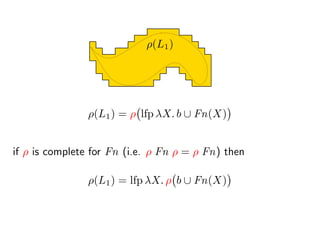
ρ(L1) = ρ lfp λX. b ∪ Fn(X)
ρ(L1)
if ρ is complete for Fn (i.e. ρ Fn ρ = ρ Fn) then
ρ(L1) = lfp λX. ρ b ∪ Fn(X)
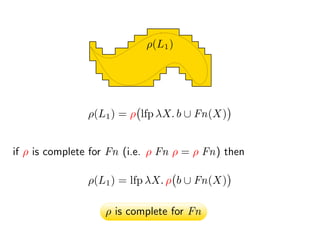
ρ(L1) = ρ lfp λX. b ∪ Fn(X)
ρ(L1)
if ρ is complete for Fn (i.e. ρ Fn ρ = ρ Fn) then
ρ(L1) = lfp λX. ρ b ∪ Fn(X)
ρ is complete for Fn
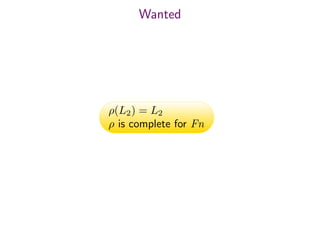
Wanted
ρ(L2) = L2
ρ is complete for Fn
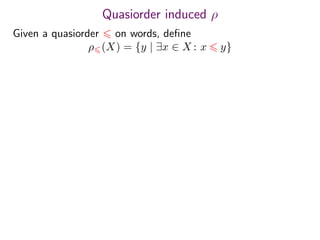
Quasiorder induced ρ
Given a quasiorder on words, define
ρ (X) = {y | ∃x ∈ X : x y}
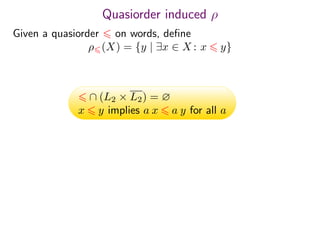
Quasiorder induced ρ
Given a quasiorder on words, define
ρ (X) = {y | ∃x ∈ X : x y}
∩ (L2 × L2) = ∅
x y implies a x a y for all a
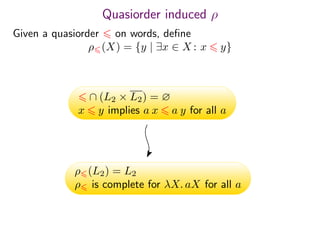
Quasiorder induced ρ
Given a quasiorder on words, define
ρ (X) = {y | ∃x ∈ X : x y}
∩ (L2 × L2) = ∅
x y implies a x a y for all a
ρ (L2) = L2
ρ is complete for λX. aX for all a
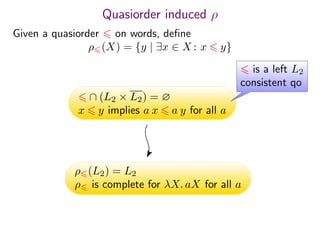
Quasiorder induced ρ
Given a quasiorder on words, define
ρ (X) = {y | ∃x ∈ X : x y}
∩ (L2 × L2) = ∅
x y implies a x a y for all a
ρ (L2) = L2
ρ is complete for λX. aX for all a
is a left L2
consistent qo
Example of quasiorder
Nerode left quasiorder relative to L2 [Varricchio,deLuca’94]
x l
L2
y ⇔ L2 x−1
⊆ L2 y−1
Example of quasiorder
Nerode left quasiorder relative to L2 [Varricchio,deLuca’94]
x l
L2
y ⇔ L2 x−1
⊆ L2 y−1
Lx−1
= {w | wx ∈ L}
Example of quasiorder
Nerode left quasiorder relative to L2 [Varricchio,deLuca’94]
x l
L2
y ⇔ L2 x−1
⊆ L2 y−1
l
L2
is left L2 consistent
Example of quasiorder
Nerode left quasiorder relative to L2 [Varricchio,deLuca’94]
x l
L2
y ⇔ L2 x−1
⊆ L2 y−1
l
L2
is left L2 consistent
l
L2
is a well-quasi order if L2 is regular
Example of quasiorder
Nerode left quasiorder relative to L2 [Varricchio,deLuca’94]
x l
L2
y ⇔ L2 x−1
⊆ L2 y−1
l
L2
is left L2 consistent
l
L2
is a well-quasi order if L2 is regular
l
L2
is decidable if L2 is regular
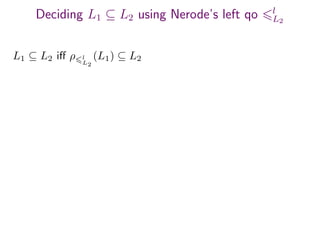
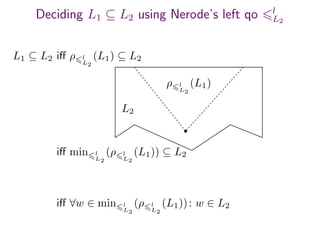
Deciding L1 ⊆ L2 using Nerode’s left qo l
L2
L1 ⊆ L2 iff ρ l
L2
(L1) ⊆ L2
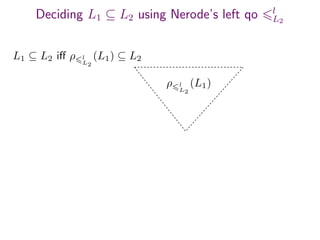
Deciding L1 ⊆ L2 using Nerode’s left qo l
L2
L1 ⊆ L2 iff ρ l
L2
(L1) ⊆ L2
ρ l
L2
(L1)
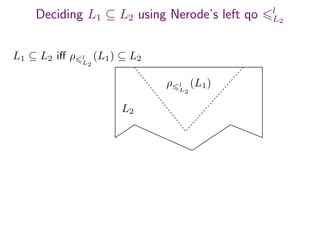
Deciding L1 ⊆ L2 using Nerode’s left qo l
L2
L1 ⊆ L2 iff ρ l
L2
(L1) ⊆ L2
ρ l
L2
(L1)
L2
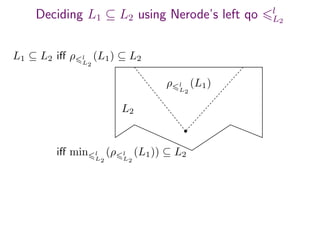
Deciding L1 ⊆ L2 using Nerode’s left qo l
L2
L1 ⊆ L2 iff ρ l
L2
(L1) ⊆ L2
iff min l
L2
(ρ l
L2
(L1)) ⊆ L2
ρ l
L2
(L1)
L2
Deciding L1 ⊆ L2 using Nerode’s left qo l
L2
L1 ⊆ L2 iff ρ l
L2
(L1) ⊆ L2
iff min l
L2
(ρ l
L2
(L1)) ⊆ L2
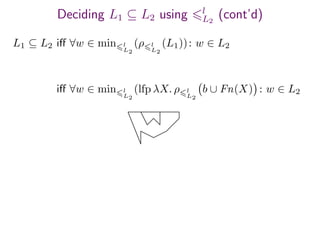
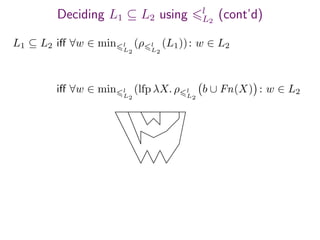
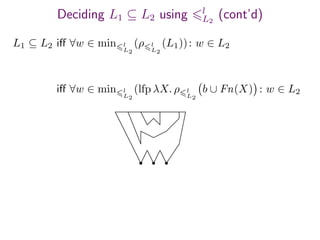
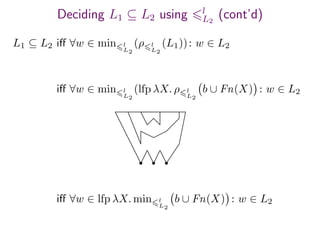
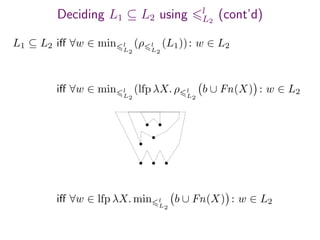
iff ∀w ∈ min l
L2
(ρ l
L2
(L1)): w ∈ L2
ρ l
L2
(L1)
L2
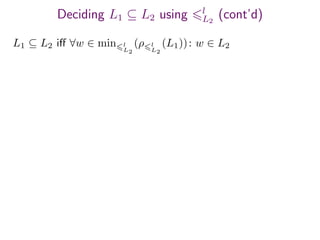
Deciding L1 ⊆ L2 using l
L2
(cont’d)
L1 ⊆ L2 iff ∀w ∈ min l
L2
(ρ l
L2
(L1)): w ∈ L2
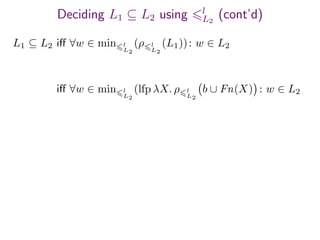
Deciding L1 ⊆ L2 using l
L2
(cont’d)
L1 ⊆ L2 iff ∀w ∈ min l
L2
(ρ l
L2
(L1)): w ∈ L2
iff ∀w ∈ min l
L2
(lfp λX. ρ l
L2
b ∪ Fn(X) : w ∈ L2
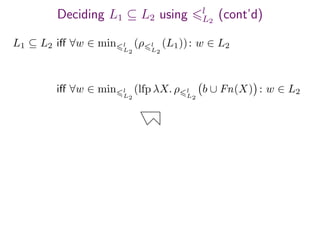
Deciding L1 ⊆ L2 using l
L2
(cont’d)
L1 ⊆ L2 iff ∀w ∈ min l
L2
(ρ l
L2
(L1)): w ∈ L2
iff ∀w ∈ min l
L2
(lfp λX. ρ l
L2
b ∪ Fn(X) : w ∈ L2
Deciding L1 ⊆ L2 using l
L2
(cont’d)
L1 ⊆ L2 iff ∀w ∈ min l
L2
(ρ l
L2
(L1)): w ∈ L2
iff ∀w ∈ min l
L2
(lfp λX. ρ l
L2
b ∪ Fn(X) : w ∈ L2
Deciding L1 ⊆ L2 using l
L2
(cont’d)
L1 ⊆ L2 iff ∀w ∈ min l
L2
(ρ l
L2
(L1)): w ∈ L2
iff ∀w ∈ min l
L2
(lfp λX. ρ l
L2
b ∪ Fn(X) : w ∈ L2
Deciding L1 ⊆ L2 using l
L2
(cont’d)
L1 ⊆ L2 iff ∀w ∈ min l
L2
(ρ l
L2
(L1)): w ∈ L2
iff ∀w ∈ min l
L2
(lfp λX. ρ l
L2
b ∪ Fn(X) : w ∈ L2
Deciding L1 ⊆ L2 using l
L2
(cont’d)
L1 ⊆ L2 iff ∀w ∈ min l
L2
(ρ l
L2
(L1)): w ∈ L2
iff ∀w ∈ lfp λX. min l
L2
b ∪ Fn(X) : w ∈ L2
iff ∀w ∈ min l
L2
(lfp λX. ρ l
L2
b ∪ Fn(X) : w ∈ L2
Deciding L1 ⊆ L2 using l
L2
(cont’d)
L1 ⊆ L2 iff ∀w ∈ min l
L2
(ρ l
L2
(L1)): w ∈ L2
iff ∀w ∈ lfp λX. min l
L2
b ∪ Fn(X) : w ∈ L2
iff ∀w ∈ min l
L2
(lfp λX. ρ l
L2
b ∪ Fn(X) : w ∈ L2
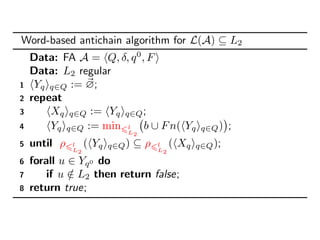
Word-based antichain algorithm for L(A) ⊆ L2
Data: FA A = Q, δ, q0
, F
Data: L2 regular
1 Yq q∈Q := ∅;
2 repeat
3 Xq q∈Q := Yq q∈Q;
4 Yq q∈Q := min l
L2
b ∪ Fn( Yq q∈Q) ;
5 until ρ l
L2
( Yq q∈Q) ⊆ ρ l
L2
( Xq q∈Q);
6 forall u ∈ Yq0 do
7 if u /∈ L2 then return false;
8 return true;
What else?
Nerode left quasiorder relative to L2 [Varricchio,deLuca’94]
x l
L2
y ⇔ L2 x−1
⊆ L2 y−1
What else?
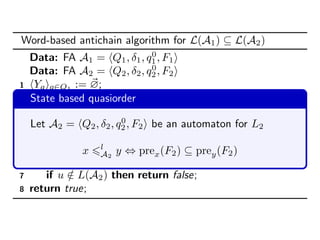
State based quasiorder
Let A2 = Q2, δ2, q0
2, F2 be an automaton for L2
x l
A2
y ⇔ prex(F2) ⊆ prey(F2)
Nerode left quasiorder relative to L2 [Varricchio,deLuca’94]
x l
L2
y ⇔ L2 x−1
⊆ L2 y−1
What else?
State based quasiorder
Let A2 = Q2, δ2, q0
2, F2 be an automaton for L2
x l
A2
y ⇔ prex(F2) ⊆ prey(F2)
Nerode left quasiorder relative to L2 [Varricchio,deLuca’94]
x l
L2
y ⇔ L2 x−1
⊆ L2 y−1
1. l
A2
∩ (L2 × L2) = ∅
2. x l
A2
y implies a x l
A2
a y for all a
3. l
A2
is a well-quasiorder
4. l
A2
is decidable
What else?
State based quasiorder
Let A2 = Q2, δ2, q0
2, F2 be an automaton for L2
x l
A2
y ⇔ prex(F2) ⊆ prey(F2)
Nerode left quasiorder relative to L2 [Varricchio,deLuca’94]
x l
L2
y ⇔ L2 x−1
⊆ L2 y−1
1. l
A2
∩ (L2 × L2) = ∅
2. x l
A2
y implies a x l
A2
a y for all a
3. l
A2
is a well-quasiorder
4. l
A2
is decidable
l
A2
is left L2 consistent
decidable wqo
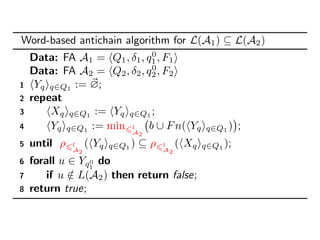
Word-based antichain algorithm for L(A1) ⊆ L(A2)
Data: FA A1 = Q1, δ1, q0
1, F1
Data: FA A2 = Q2, δ2, q0
2, F2
1 Yq q∈Q1
:= ∅;
2 repeat
3 Xq q∈Q1
:= Yq q∈Q1
;
4 Yq q∈Q1
:= min l
A2
b ∪ Fn( Yq q∈Q1
) ;
5 until ρ l
A2
( Yq q∈Q1
) ⊆ ρ l
A2
( Xq q∈Q1
);
6 forall u ∈ Yq0
1
do
7 if u /∈ L(A2) then return false;
8 return true;
Word-based antichain algorithm for L(A1) ⊆ L(A2)
Data: FA A1 = Q1, δ1, q0
1, F1
Data: FA A2 = Q2, δ2, q0
2, F2
1 Yq q∈Q1
:= ∅;
2 repeat
3 Xq q∈Q1
:= Yq q∈Q1
;
4 Yq q∈Q1
:= min l
A2
b ∪ Fn( Yq q∈Q1
) ;
5 until ρ l
A2
( Yq q∈Q1
) ⊆ ρ l
A2
( Xq q∈Q1
);
6 forall u ∈ Yq0
1
do
7 if u /∈ L(A2) then return false;
8 return true;
State based quasiorder
Let A2 = Q2, δ2, q0
2, F2 be an automaton for L2
x l
A2
y ⇔ prex(F2) ⊆ prey(F2)
Ditching words altogether
State-based antichain algorithm for L(A1) ⊆ L(A2)
Data: FA A1 = Q1, δ1, q0
1, F1
Data: FA A2 = Q2, δ2, q0
2, F2
1 Yq q∈Q1
:= ∅;
2 repeat
3 Xq q∈Q1
:= Yq q∈Q1
;
4 Yq q∈Q1 := [. . .];
5 until Yq ⊆∀∃
Xq, for all q ∈ Q1;
6 forall s ∈ Yq0
1
do
7 if q0
2 /∈ s then return false;
8 return true;
[. . .] = min⊆∀∃ {preA2
a (s) | ∃a ∈ Σ, q ∈ δ1(q, a), s ∈ Xq } ∪ F2
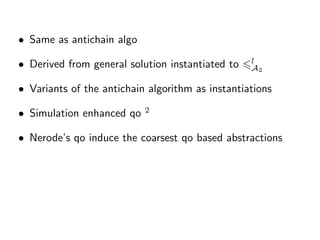
• Same as antichain algo
• Derived from general solution instantiated to l
A2
• Variants of the antichain algorithm as instantiations
• Simulation enhanced qo 2
• Nerode’s qo induce the coarsest qo based abstractions
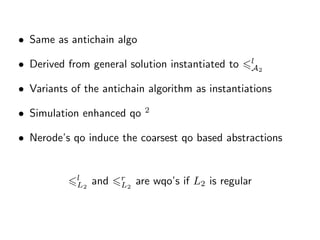
• Same as antichain algo
• Derived from general solution instantiated to l
A2
• Variants of the antichain algorithm as instantiations
• Simulation enhanced qo 2
• Nerode’s qo induce the coarsest qo based abstractions
l
L2
and r
L2
are wqo’s if L2 is regular
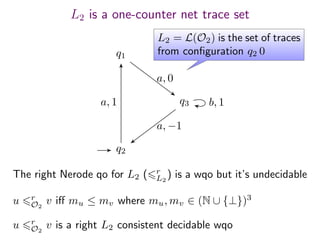
L2 is a one-counter net trace set
q2
q1
q3a, 1
a, 0
a, −1
b, 1
The right Nerode qo for L2 ( r
L2
) is a wqo but it’s undecidable
u r
O2
v is a right L2 consistent decidable wqo
u r
O2
v iff mu ≤ mv where mu, mv ∈ (N ∪ {⊥})3
L2 = L(O2) is the set of traces
from configuration q2 0
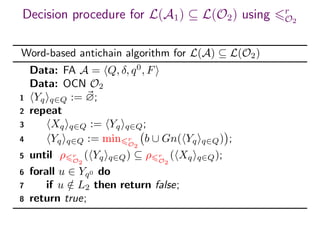
Decision procedure for L(A1) ⊆ L(O2) using r
O2
Word-based antichain algorithm for L(A) ⊆ L(O2)
Data: FA A = Q, δ, q0
, F
Data: OCN O2
1 Yq q∈Q := ∅;
2 repeat
3 Xq q∈Q := Yq q∈Q;
4 Yq q∈Q := min r
O2
b ∪ Gn( Yq q∈Q) ;
5 until ρ r
O2
( Yq q∈Q) ⊆ ρ r
O2
( Xq q∈Q);
6 forall u ∈ Yq0 do
7 if u /∈ L2 then return false;
8 return true;
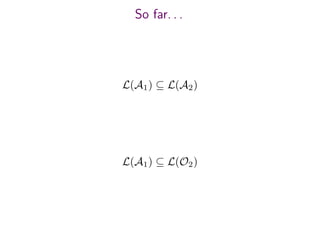
So far. . .
L(A1) ⊆ L(A2)
L(A1) ⊆ L(O2)
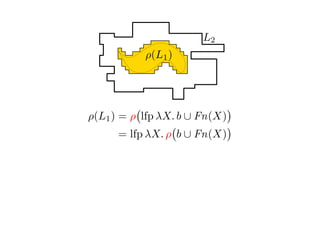
ρ(L1) = ρ lfp λX. b ∪ Fn(X)
= lfp λX. ρ b ∪ Fn(X)
L2
ρ(L1)
ρ(L1) = ρ lfp λX. b ∪ Fn(X)
= lfp λX. ρ b ∪ Fn(X)
L2
ρ(L1)
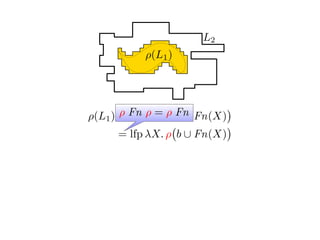
ρ Fn ρ = ρ Fn
ρ(L1) = ρ lfp λX. b ∪ Fn(X)
= lfp λX. ρ b ∪ Fn(X)
L2
ρ(L1)
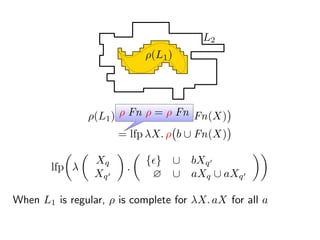
When L1 is regular, ρ is complete for λX. aX for all a
ρ Fn ρ = ρ Fn
lfp λ
Xq
Xq
.
{ } ∪ bXq
∅ ∪ aXq ∪ aXq
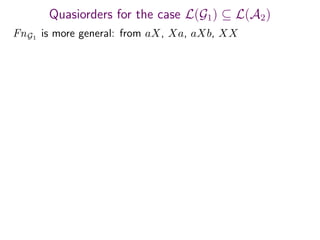
Quasiorders for the case L(G1) ⊆ L(A2)
FnG1
is more general: from aX, Xa, aXb, XX
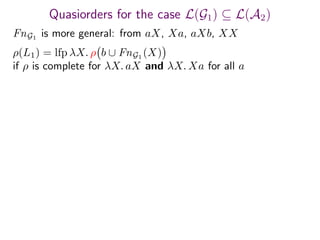
Quasiorders for the case L(G1) ⊆ L(A2)
FnG1
is more general: from aX, Xa, aXb, XX
ρ(L1) = lfp λX. ρ b ∪ FnG1 (X)
if ρ is complete for λX. aX and λX. Xa for all a
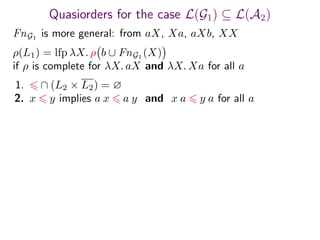
Quasiorders for the case L(G1) ⊆ L(A2)
FnG1
is more general: from aX, Xa, aXb, XX
1. ∩ (L2 × L2) = ∅
2. x y implies a x a y and x a y a for all a
ρ(L1) = lfp λX. ρ b ∪ FnG1 (X)
if ρ is complete for λX. aX and λX. Xa for all a
Quasiorders for the case L(G1) ⊆ L(A2)
Myhill quasiorder relative to L2 [Varricchio, deLuca’94]
x L2
y ⇔ {(u, v) | u x v∈L2} ⊆ {(u, v) | u y v∈L2}
FnG1
is more general: from aX, Xa, aXb, XX
1. ∩ (L2 × L2) = ∅
2. x y implies a x a y and x a y a for all a
ρ(L1) = lfp λX. ρ b ∪ FnG1 (X)
if ρ is complete for λX. aX and λX. Xa for all a
Quasiorders for the case L(G1) ⊆ L(A2)
Myhill quasiorder relative to L2 [Varricchio, deLuca’94]
x L2
y ⇔ {(u, v) | u x v∈L2} ⊆ {(u, v) | u y v∈L2}
State based quasi order [Netys’15]
x A2
y ⇔ {(q, q ) | q
x
q } ⊆ {(q, q ) | q
y
q }
FnG1
is more general: from aX, Xa, aXb, XX
1. ∩ (L2 × L2) = ∅
2. x y implies a x a y and x a y a for all a
ρ(L1) = lfp λX. ρ b ∪ FnG1 (X)
if ρ is complete for λX. aX and λX. Xa for all a
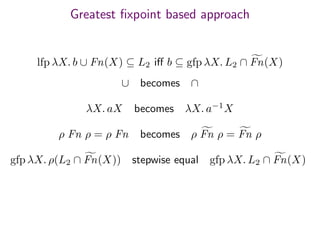
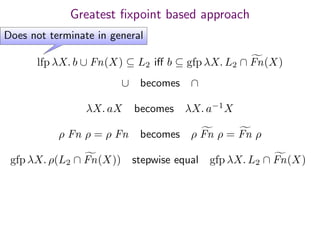
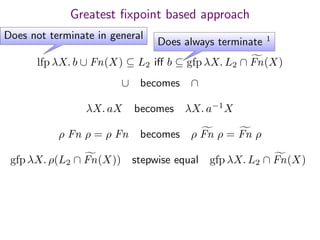
Greatest fixpoint based approach
lfp λX. b ∪ Fn(X) ⊆ L2 iff b ⊆ gfp λX. L2 ∩ Fn(X)
∪ becomes ∩
λX. aX becomes λX. a−1
X
ρ Fn ρ = ρ Fn becomes ρ Fn ρ = Fn ρ
gfp λX. ρ(L2 ∩ Fn(X)) stepwise equal gfp λX. L2 ∩ Fn(X)
Greatest fixpoint based approach
lfp λX. b ∪ Fn(X) ⊆ L2 iff b ⊆ gfp λX. L2 ∩ Fn(X)
∪ becomes ∩
λX. aX becomes λX. a−1
X
ρ Fn ρ = ρ Fn becomes ρ Fn ρ = Fn ρ
gfp λX. ρ(L2 ∩ Fn(X)) stepwise equal gfp λX. L2 ∩ Fn(X)
Does not terminate in general
Greatest fixpoint based approach
lfp λX. b ∪ Fn(X) ⊆ L2 iff b ⊆ gfp λX. L2 ∩ Fn(X)
∪ becomes ∩
λX. aX becomes λX. a−1
X
ρ Fn ρ = ρ Fn becomes ρ Fn ρ = Fn ρ
gfp λX. ρ(L2 ∩ Fn(X)) stepwise equal gfp λX. L2 ∩ Fn(X)
Does not terminate in general
Does always terminate 1
Conclusion
Promising framework for language inclusion
Conclusion
Promising framework for language inclusion
Extension to trees, ω-languages, timed languages,. . .
Conclusion
Promising framework for language inclusion
Extension to trees, ω-languages, timed languages,. . .
Technical Report 1904.01388 on arxiv.org

Deciding language inclusion problems using quasiorders

  • 1.
    Deciding language inclusionproblems using quasiorders Pierre Ganty IMDEA Software Institute joint work with Pedro Valero (IMDEA) and Francesco Ranzato (Uni. Padova)
  • 2.
  • 3.
  • 4.
  • 5.
  • 6.
    L2 ρ(L1) • ρ isextensive: L ⊆ ρ(L) • ρ is monotone: L ⊆ L implies ρ(L) ⊆ ρ(L ) • ρ is idempotent: ρ(ρ(L)) = ρ(L)
  • 7.
    L2 ρ(L1) L1 ⊆ L2iff ρ(L1) ⊆ L2 Assume ρ(L2) = L2, then ρ(L2) = L2
  • 8.
    L1 as afixed point q q b a a lfp λ Xq Xq . { } ∪ bXq ∅ ∪ aXq ∪ aXq
  • 9.
    L1 as afixed point q q b a a lfp λ Xq Xq . { } ∪ bXq ∅ ∪ aXq ∪ aXq Xq ∅ Xq ∅
  • 10.
    L1 as afixed point q q b a a lfp λ Xq Xq . { } ∪ bXq ∅ ∪ aXq ∪ aXq Xq ∅ Xq ∅ {ε} ∅
  • 11.
    L1 as afixed point q q b a a lfp λ Xq Xq . { } ∪ bXq ∅ ∪ aXq ∪ aXq Xq ∅ Xq ∅ {ε} ∅ {ε} {a}
  • 12.
    L1 as afixed point q q b a a lfp λ Xq Xq . { } ∪ bXq ∅ ∪ aXq ∪ aXq Lq (ba+ )∗ Lq a+ (ba+ )∗ Xq ∅ Xq ∅ {ε} ∅ {ε} {a}
  • 13.
    L1 as afixed point q q b a a lfp λ Xq Xq . { } ∪ bXq ∅ ∪ aXq ∪ aXq L1 = Lq = (ba+ )∗ = lfp λX. b ∪ Fn(X) q Lq (ba+ )∗ Lq a+ (ba+ )∗ Xq ∅ Xq ∅ {ε} ∅ {ε} {a}
  • 14.
    L1 as afixed point q q b a a lfp λ Xq Xq . { } ∪ bXq ∅ ∪ aXq ∪ aXq L1 = Lq = (ba+ )∗ = lfp λX. b ∪ Fn(X) q Lq (ba+ )∗ Lq a+ (ba+ )∗ Xq ∅ Xq ∅ {ε} ∅ {ε} {a} b Fn
  • 15.
    ρ(L1) = ρlfp λX. b ∪ Fn(X) ρ(L1) if ρ is complete for Fn (i.e. ρ Fn ρ = ρ Fn) then ρ(L1) = lfp λX. ρ b ∪ Fn(X)
  • 16.
    ρ(L1) = ρlfp λX. b ∪ Fn(X) ρ(L1) if ρ is complete for Fn (i.e. ρ Fn ρ = ρ Fn) then ρ(L1) = lfp λX. ρ b ∪ Fn(X) ρ is complete for Fn
  • 17.
    Wanted ρ(L2) = L2 ρis complete for Fn
  • 18.
    Quasiorder induced ρ Givena quasiorder on words, define ρ (X) = {y | ∃x ∈ X : x y}
  • 19.
    Quasiorder induced ρ Givena quasiorder on words, define ρ (X) = {y | ∃x ∈ X : x y} ∩ (L2 × L2) = ∅ x y implies a x a y for all a
  • 20.
    Quasiorder induced ρ Givena quasiorder on words, define ρ (X) = {y | ∃x ∈ X : x y} ∩ (L2 × L2) = ∅ x y implies a x a y for all a ρ (L2) = L2 ρ is complete for λX. aX for all a
  • 21.
    Quasiorder induced ρ Givena quasiorder on words, define ρ (X) = {y | ∃x ∈ X : x y} ∩ (L2 × L2) = ∅ x y implies a x a y for all a ρ (L2) = L2 ρ is complete for λX. aX for all a is a left L2 consistent qo
  • 22.
    Example of quasiorder Nerodeleft quasiorder relative to L2 [Varricchio,deLuca’94] x l L2 y ⇔ L2 x−1 ⊆ L2 y−1
  • 23.
    Example of quasiorder Nerodeleft quasiorder relative to L2 [Varricchio,deLuca’94] x l L2 y ⇔ L2 x−1 ⊆ L2 y−1 Lx−1 = {w | wx ∈ L}
  • 24.
    Example of quasiorder Nerodeleft quasiorder relative to L2 [Varricchio,deLuca’94] x l L2 y ⇔ L2 x−1 ⊆ L2 y−1 l L2 is left L2 consistent
  • 25.
    Example of quasiorder Nerodeleft quasiorder relative to L2 [Varricchio,deLuca’94] x l L2 y ⇔ L2 x−1 ⊆ L2 y−1 l L2 is left L2 consistent l L2 is a well-quasi order if L2 is regular
  • 26.
    Example of quasiorder Nerodeleft quasiorder relative to L2 [Varricchio,deLuca’94] x l L2 y ⇔ L2 x−1 ⊆ L2 y−1 l L2 is left L2 consistent l L2 is a well-quasi order if L2 is regular l L2 is decidable if L2 is regular
  • 27.
    Deciding L1 ⊆L2 using Nerode’s left qo l L2 L1 ⊆ L2 iff ρ l L2 (L1) ⊆ L2
  • 28.
    Deciding L1 ⊆L2 using Nerode’s left qo l L2 L1 ⊆ L2 iff ρ l L2 (L1) ⊆ L2 ρ l L2 (L1)
  • 29.
    Deciding L1 ⊆L2 using Nerode’s left qo l L2 L1 ⊆ L2 iff ρ l L2 (L1) ⊆ L2 ρ l L2 (L1) L2
  • 30.
    Deciding L1 ⊆L2 using Nerode’s left qo l L2 L1 ⊆ L2 iff ρ l L2 (L1) ⊆ L2 iff min l L2 (ρ l L2 (L1)) ⊆ L2 ρ l L2 (L1) L2
  • 31.
    Deciding L1 ⊆L2 using Nerode’s left qo l L2 L1 ⊆ L2 iff ρ l L2 (L1) ⊆ L2 iff min l L2 (ρ l L2 (L1)) ⊆ L2 iff ∀w ∈ min l L2 (ρ l L2 (L1)): w ∈ L2 ρ l L2 (L1) L2
  • 32.
    Deciding L1 ⊆L2 using l L2 (cont’d) L1 ⊆ L2 iff ∀w ∈ min l L2 (ρ l L2 (L1)): w ∈ L2
  • 33.
    Deciding L1 ⊆L2 using l L2 (cont’d) L1 ⊆ L2 iff ∀w ∈ min l L2 (ρ l L2 (L1)): w ∈ L2 iff ∀w ∈ min l L2 (lfp λX. ρ l L2 b ∪ Fn(X) : w ∈ L2
  • 34.
    Deciding L1 ⊆L2 using l L2 (cont’d) L1 ⊆ L2 iff ∀w ∈ min l L2 (ρ l L2 (L1)): w ∈ L2 iff ∀w ∈ min l L2 (lfp λX. ρ l L2 b ∪ Fn(X) : w ∈ L2
  • 35.
    Deciding L1 ⊆L2 using l L2 (cont’d) L1 ⊆ L2 iff ∀w ∈ min l L2 (ρ l L2 (L1)): w ∈ L2 iff ∀w ∈ min l L2 (lfp λX. ρ l L2 b ∪ Fn(X) : w ∈ L2
  • 36.
    Deciding L1 ⊆L2 using l L2 (cont’d) L1 ⊆ L2 iff ∀w ∈ min l L2 (ρ l L2 (L1)): w ∈ L2 iff ∀w ∈ min l L2 (lfp λX. ρ l L2 b ∪ Fn(X) : w ∈ L2
  • 37.
    Deciding L1 ⊆L2 using l L2 (cont’d) L1 ⊆ L2 iff ∀w ∈ min l L2 (ρ l L2 (L1)): w ∈ L2 iff ∀w ∈ min l L2 (lfp λX. ρ l L2 b ∪ Fn(X) : w ∈ L2
  • 38.
    Deciding L1 ⊆L2 using l L2 (cont’d) L1 ⊆ L2 iff ∀w ∈ min l L2 (ρ l L2 (L1)): w ∈ L2 iff ∀w ∈ lfp λX. min l L2 b ∪ Fn(X) : w ∈ L2 iff ∀w ∈ min l L2 (lfp λX. ρ l L2 b ∪ Fn(X) : w ∈ L2
  • 39.
    Deciding L1 ⊆L2 using l L2 (cont’d) L1 ⊆ L2 iff ∀w ∈ min l L2 (ρ l L2 (L1)): w ∈ L2 iff ∀w ∈ lfp λX. min l L2 b ∪ Fn(X) : w ∈ L2 iff ∀w ∈ min l L2 (lfp λX. ρ l L2 b ∪ Fn(X) : w ∈ L2
  • 40.
    Word-based antichain algorithmfor L(A) ⊆ L2 Data: FA A = Q, δ, q0 , F Data: L2 regular 1 Yq q∈Q := ∅; 2 repeat 3 Xq q∈Q := Yq q∈Q; 4 Yq q∈Q := min l L2 b ∪ Fn( Yq q∈Q) ; 5 until ρ l L2 ( Yq q∈Q) ⊆ ρ l L2 ( Xq q∈Q); 6 forall u ∈ Yq0 do 7 if u /∈ L2 then return false; 8 return true;
  • 41.
    What else? Nerode leftquasiorder relative to L2 [Varricchio,deLuca’94] x l L2 y ⇔ L2 x−1 ⊆ L2 y−1
  • 42.
    What else? State basedquasiorder Let A2 = Q2, δ2, q0 2, F2 be an automaton for L2 x l A2 y ⇔ prex(F2) ⊆ prey(F2) Nerode left quasiorder relative to L2 [Varricchio,deLuca’94] x l L2 y ⇔ L2 x−1 ⊆ L2 y−1
  • 43.
    What else? State basedquasiorder Let A2 = Q2, δ2, q0 2, F2 be an automaton for L2 x l A2 y ⇔ prex(F2) ⊆ prey(F2) Nerode left quasiorder relative to L2 [Varricchio,deLuca’94] x l L2 y ⇔ L2 x−1 ⊆ L2 y−1 1. l A2 ∩ (L2 × L2) = ∅ 2. x l A2 y implies a x l A2 a y for all a 3. l A2 is a well-quasiorder 4. l A2 is decidable
  • 44.
    What else? State basedquasiorder Let A2 = Q2, δ2, q0 2, F2 be an automaton for L2 x l A2 y ⇔ prex(F2) ⊆ prey(F2) Nerode left quasiorder relative to L2 [Varricchio,deLuca’94] x l L2 y ⇔ L2 x−1 ⊆ L2 y−1 1. l A2 ∩ (L2 × L2) = ∅ 2. x l A2 y implies a x l A2 a y for all a 3. l A2 is a well-quasiorder 4. l A2 is decidable l A2 is left L2 consistent decidable wqo
  • 45.
    Word-based antichain algorithmfor L(A1) ⊆ L(A2) Data: FA A1 = Q1, δ1, q0 1, F1 Data: FA A2 = Q2, δ2, q0 2, F2 1 Yq q∈Q1 := ∅; 2 repeat 3 Xq q∈Q1 := Yq q∈Q1 ; 4 Yq q∈Q1 := min l A2 b ∪ Fn( Yq q∈Q1 ) ; 5 until ρ l A2 ( Yq q∈Q1 ) ⊆ ρ l A2 ( Xq q∈Q1 ); 6 forall u ∈ Yq0 1 do 7 if u /∈ L(A2) then return false; 8 return true;
  • 46.
    Word-based antichain algorithmfor L(A1) ⊆ L(A2) Data: FA A1 = Q1, δ1, q0 1, F1 Data: FA A2 = Q2, δ2, q0 2, F2 1 Yq q∈Q1 := ∅; 2 repeat 3 Xq q∈Q1 := Yq q∈Q1 ; 4 Yq q∈Q1 := min l A2 b ∪ Fn( Yq q∈Q1 ) ; 5 until ρ l A2 ( Yq q∈Q1 ) ⊆ ρ l A2 ( Xq q∈Q1 ); 6 forall u ∈ Yq0 1 do 7 if u /∈ L(A2) then return false; 8 return true; State based quasiorder Let A2 = Q2, δ2, q0 2, F2 be an automaton for L2 x l A2 y ⇔ prex(F2) ⊆ prey(F2)
  • 47.
    Ditching words altogether State-basedantichain algorithm for L(A1) ⊆ L(A2) Data: FA A1 = Q1, δ1, q0 1, F1 Data: FA A2 = Q2, δ2, q0 2, F2 1 Yq q∈Q1 := ∅; 2 repeat 3 Xq q∈Q1 := Yq q∈Q1 ; 4 Yq q∈Q1 := [. . .]; 5 until Yq ⊆∀∃ Xq, for all q ∈ Q1; 6 forall s ∈ Yq0 1 do 7 if q0 2 /∈ s then return false; 8 return true; [. . .] = min⊆∀∃ {preA2 a (s) | ∃a ∈ Σ, q ∈ δ1(q, a), s ∈ Xq } ∪ F2
  • 48.
    • Same asantichain algo • Derived from general solution instantiated to l A2 • Variants of the antichain algorithm as instantiations • Simulation enhanced qo 2 • Nerode’s qo induce the coarsest qo based abstractions
  • 49.
    • Same asantichain algo • Derived from general solution instantiated to l A2 • Variants of the antichain algorithm as instantiations • Simulation enhanced qo 2 • Nerode’s qo induce the coarsest qo based abstractions l L2 and r L2 are wqo’s if L2 is regular
  • 50.
    L2 is aone-counter net trace set q2 q1 q3a, 1 a, 0 a, −1 b, 1 The right Nerode qo for L2 ( r L2 ) is a wqo but it’s undecidable u r O2 v is a right L2 consistent decidable wqo u r O2 v iff mu ≤ mv where mu, mv ∈ (N ∪ {⊥})3 L2 = L(O2) is the set of traces from configuration q2 0
  • 51.
    Decision procedure forL(A1) ⊆ L(O2) using r O2 Word-based antichain algorithm for L(A) ⊆ L(O2) Data: FA A = Q, δ, q0 , F Data: OCN O2 1 Yq q∈Q := ∅; 2 repeat 3 Xq q∈Q := Yq q∈Q; 4 Yq q∈Q := min r O2 b ∪ Gn( Yq q∈Q) ; 5 until ρ r O2 ( Yq q∈Q) ⊆ ρ r O2 ( Xq q∈Q); 6 forall u ∈ Yq0 do 7 if u /∈ L2 then return false; 8 return true;
  • 52.
    So far. .. L(A1) ⊆ L(A2) L(A1) ⊆ L(O2)
  • 53.
    ρ(L1) = ρlfp λX. b ∪ Fn(X) = lfp λX. ρ b ∪ Fn(X) L2 ρ(L1)
  • 54.
    ρ(L1) = ρlfp λX. b ∪ Fn(X) = lfp λX. ρ b ∪ Fn(X) L2 ρ(L1) ρ Fn ρ = ρ Fn
  • 55.
    ρ(L1) = ρlfp λX. b ∪ Fn(X) = lfp λX. ρ b ∪ Fn(X) L2 ρ(L1) When L1 is regular, ρ is complete for λX. aX for all a ρ Fn ρ = ρ Fn lfp λ Xq Xq . { } ∪ bXq ∅ ∪ aXq ∪ aXq
  • 56.
    Quasiorders for thecase L(G1) ⊆ L(A2) FnG1 is more general: from aX, Xa, aXb, XX
  • 57.
    Quasiorders for thecase L(G1) ⊆ L(A2) FnG1 is more general: from aX, Xa, aXb, XX ρ(L1) = lfp λX. ρ b ∪ FnG1 (X) if ρ is complete for λX. aX and λX. Xa for all a
  • 58.
    Quasiorders for thecase L(G1) ⊆ L(A2) FnG1 is more general: from aX, Xa, aXb, XX 1. ∩ (L2 × L2) = ∅ 2. x y implies a x a y and x a y a for all a ρ(L1) = lfp λX. ρ b ∪ FnG1 (X) if ρ is complete for λX. aX and λX. Xa for all a
  • 59.
    Quasiorders for thecase L(G1) ⊆ L(A2) Myhill quasiorder relative to L2 [Varricchio, deLuca’94] x L2 y ⇔ {(u, v) | u x v∈L2} ⊆ {(u, v) | u y v∈L2} FnG1 is more general: from aX, Xa, aXb, XX 1. ∩ (L2 × L2) = ∅ 2. x y implies a x a y and x a y a for all a ρ(L1) = lfp λX. ρ b ∪ FnG1 (X) if ρ is complete for λX. aX and λX. Xa for all a
  • 60.
    Quasiorders for thecase L(G1) ⊆ L(A2) Myhill quasiorder relative to L2 [Varricchio, deLuca’94] x L2 y ⇔ {(u, v) | u x v∈L2} ⊆ {(u, v) | u y v∈L2} State based quasi order [Netys’15] x A2 y ⇔ {(q, q ) | q x q } ⊆ {(q, q ) | q y q } FnG1 is more general: from aX, Xa, aXb, XX 1. ∩ (L2 × L2) = ∅ 2. x y implies a x a y and x a y a for all a ρ(L1) = lfp λX. ρ b ∪ FnG1 (X) if ρ is complete for λX. aX and λX. Xa for all a
  • 61.
    Greatest fixpoint basedapproach lfp λX. b ∪ Fn(X) ⊆ L2 iff b ⊆ gfp λX. L2 ∩ Fn(X) ∪ becomes ∩ λX. aX becomes λX. a−1 X ρ Fn ρ = ρ Fn becomes ρ Fn ρ = Fn ρ gfp λX. ρ(L2 ∩ Fn(X)) stepwise equal gfp λX. L2 ∩ Fn(X)
  • 62.
    Greatest fixpoint basedapproach lfp λX. b ∪ Fn(X) ⊆ L2 iff b ⊆ gfp λX. L2 ∩ Fn(X) ∪ becomes ∩ λX. aX becomes λX. a−1 X ρ Fn ρ = ρ Fn becomes ρ Fn ρ = Fn ρ gfp λX. ρ(L2 ∩ Fn(X)) stepwise equal gfp λX. L2 ∩ Fn(X) Does not terminate in general
  • 63.
    Greatest fixpoint basedapproach lfp λX. b ∪ Fn(X) ⊆ L2 iff b ⊆ gfp λX. L2 ∩ Fn(X) ∪ becomes ∩ λX. aX becomes λX. a−1 X ρ Fn ρ = ρ Fn becomes ρ Fn ρ = Fn ρ gfp λX. ρ(L2 ∩ Fn(X)) stepwise equal gfp λX. L2 ∩ Fn(X) Does not terminate in general Does always terminate 1
  • 64.
  • 65.
    Conclusion Promising framework forlanguage inclusion Extension to trees, ω-languages, timed languages,. . .
  • 66.
    Conclusion Promising framework forlanguage inclusion Extension to trees, ω-languages, timed languages,. . . Technical Report 1904.01388 on arxiv.org