DENTISTRY &
BIOMEDICAL
ENGINEERING
Prepared by: Eng. IbrahimTayyan
What is Dentistry
• Dentistry, also referred to as dental medicine, is a branch of medicine that focuses on diagnosis,
treatment, and prevention of conditions, disorders, and diseases of the teeth, gums, mouth, and jaw
• Most people think that a dentist’s only job is treating tooth decays, but this is a false belief
• Like medical occupations, there are general practitioner and sub specialties
• Nowadays, there are dental centers that are increasing in
numbers that have dentists from all specialties
• In few years you will no more find a single practitioner clinic
as people will prefer to go and visit dental centers instead of
the small single clinics
Brief Anatomy and Basic Concept
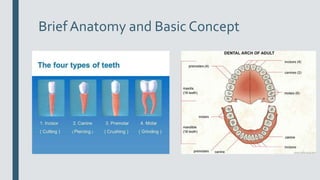
There are 3 main anatomical parts of the tooth:
1. Crown:The visible portion of the tooth,
or the white part that you use to bite
and chew
2. Root: is the invisible part embedded in
the jaw. It anchors the tooth in its bony
socket
3. Cervix: It is the neck of the tooth, or
the area where the enamel and the
cementum meets
Brief Anatomy and Basic Concept
Enamel:The hard outer layer of the crown. It is the
hardest substance in the body and it is the area
where cavities form first
Dentin: the yellowish tissue that makes up the bulk
of all teeth. It is harder than bone but softer than
enamel
Cementum: thin layer of bonelike material
covering the roots
Pulp: Soft tissue containing the blood and nerve
supply to the tooth.The pulp extends from the
crown to the tip of the root
Brief Anatomy and Basic Concept
Main Specialties
Working in the Dental Field as a BME
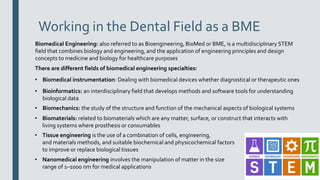
Biomedical Engineering: also referred to as Bioengineering, BioMed or BME, is a multidisciplinary STEM
field that combines biology and engineering, and the application of engineering principles and design
concepts to medicine and biology for healthcare purposes
There are different fields of biomedical engineering specialties:
• Biomedical instrumentation: Dealing with biomedical devices whether diagnostical or therapeutic ones
• Bioinformatics: an interdisciplinary field that develops methods and software tools for understanding
biological data
• Biomechanics: the study of the structure and function of the mechanical aspects of biological systems
• Biomaterials: related to biomaterials which are any matter, surface, or construct that interacts with
living systems where prosthesis or consumables
• Tissue engineering is the use of a combination of cells, engineering,
and materials methods, and suitable biochemical and physicochemical factors
to improve or replace biological tissues
• Nanomedical engineering involves the manipulation of matter in the size
range of 1–1000 nm for medical applications
Working in the Dental Field as a BME
• Despite the wide range of BME specialties and its promising future in Europe and North America, there are
few opportunities for the biomedical engineer to work on in Jordan and the Arab countries
• In fact, BMEs will deal only equipment and/or its consumables. Even biomaterials prosthesis field is the
responsibility of the nurses and other medical sciences
• As previously explained, dentistry is a medicine branch that deals with diagnosing and treating teeth and
its surroundings
• Unfortunately, there is no any course in the BME BSc that discuss dental equipment and devices
principles in most universities throughout the region, the issue that is considered unfair
• It is unfair, because there are many emerging technologies and advancements in the dentistry field in
terms of using modern and sophisticated digital equipment, and using advanced imaging systems that
is beneficial in diagnosing patients, in addition to the promising future of usingCAD/CAM systems for
dental restorations instead of traditional methods
Working in the Dental Field as a BME
• In addition, the number of dental clinics and centers in Jordan is very much higher than for example
neurologists, nephrologists, neurosurgeons and cardiovascular surgeons combined
• As a biomedical engineer working as a sales representative, you will have a very good skills in selling
products and achieve your target easier than working for example as a medical representative for
patient monitors for example
• Range price of materials and equipment found at a dental center may range from 1 up to 100,000s
of JDs
• There are many dental companies in Jordan that are seeking for recruiting biomedical engineers
Skills Needed forWorking as a BME
• Computer Skills: Basic and Advanced Windows, Office (Excel, Powerpoint,Word and Outlook), basic
knowledge of networking and using special software for troubleshooting defected equipment
• English Language: Reading newsletters, sales articles, and service manuals
• Basic Medical and DentalTerminologies
• Self-Learning and Further Reading
• Basic Chemistry, Physics and Biology: For evaluating different biomaterials efficiency
• Diagnosing andTroubleshooting
• Basic Principle of Operation of Equipment

Dentistry & Biomedical Engineering

  • 1.
  • 2.
    What is Dentistry •Dentistry, also referred to as dental medicine, is a branch of medicine that focuses on diagnosis, treatment, and prevention of conditions, disorders, and diseases of the teeth, gums, mouth, and jaw • Most people think that a dentist’s only job is treating tooth decays, but this is a false belief • Like medical occupations, there are general practitioner and sub specialties • Nowadays, there are dental centers that are increasing in numbers that have dentists from all specialties • In few years you will no more find a single practitioner clinic as people will prefer to go and visit dental centers instead of the small single clinics
  • 3.
    Brief Anatomy andBasic Concept There are 3 main anatomical parts of the tooth: 1. Crown:The visible portion of the tooth, or the white part that you use to bite and chew 2. Root: is the invisible part embedded in the jaw. It anchors the tooth in its bony socket 3. Cervix: It is the neck of the tooth, or the area where the enamel and the cementum meets
  • 4.
    Brief Anatomy andBasic Concept Enamel:The hard outer layer of the crown. It is the hardest substance in the body and it is the area where cavities form first Dentin: the yellowish tissue that makes up the bulk of all teeth. It is harder than bone but softer than enamel Cementum: thin layer of bonelike material covering the roots Pulp: Soft tissue containing the blood and nerve supply to the tooth.The pulp extends from the crown to the tip of the root
  • 5.
    Brief Anatomy andBasic Concept
  • 6.
    Brief Anatomy andBasic Concept
  • 7.
    Brief Anatomy andBasic Concept
  • 8.
    Brief Anatomy andBasic Concept
  • 9.
    Brief Anatomy andBasic Concept
  • 10.
  • 13.
    Working in theDental Field as a BME Biomedical Engineering: also referred to as Bioengineering, BioMed or BME, is a multidisciplinary STEM field that combines biology and engineering, and the application of engineering principles and design concepts to medicine and biology for healthcare purposes There are different fields of biomedical engineering specialties: • Biomedical instrumentation: Dealing with biomedical devices whether diagnostical or therapeutic ones • Bioinformatics: an interdisciplinary field that develops methods and software tools for understanding biological data • Biomechanics: the study of the structure and function of the mechanical aspects of biological systems • Biomaterials: related to biomaterials which are any matter, surface, or construct that interacts with living systems where prosthesis or consumables • Tissue engineering is the use of a combination of cells, engineering, and materials methods, and suitable biochemical and physicochemical factors to improve or replace biological tissues • Nanomedical engineering involves the manipulation of matter in the size range of 1–1000 nm for medical applications
  • 14.
    Working in theDental Field as a BME • Despite the wide range of BME specialties and its promising future in Europe and North America, there are few opportunities for the biomedical engineer to work on in Jordan and the Arab countries • In fact, BMEs will deal only equipment and/or its consumables. Even biomaterials prosthesis field is the responsibility of the nurses and other medical sciences • As previously explained, dentistry is a medicine branch that deals with diagnosing and treating teeth and its surroundings • Unfortunately, there is no any course in the BME BSc that discuss dental equipment and devices principles in most universities throughout the region, the issue that is considered unfair • It is unfair, because there are many emerging technologies and advancements in the dentistry field in terms of using modern and sophisticated digital equipment, and using advanced imaging systems that is beneficial in diagnosing patients, in addition to the promising future of usingCAD/CAM systems for dental restorations instead of traditional methods
  • 15.
    Working in theDental Field as a BME • In addition, the number of dental clinics and centers in Jordan is very much higher than for example neurologists, nephrologists, neurosurgeons and cardiovascular surgeons combined • As a biomedical engineer working as a sales representative, you will have a very good skills in selling products and achieve your target easier than working for example as a medical representative for patient monitors for example • Range price of materials and equipment found at a dental center may range from 1 up to 100,000s of JDs • There are many dental companies in Jordan that are seeking for recruiting biomedical engineers
  • 16.
    Skills Needed forWorkingas a BME • Computer Skills: Basic and Advanced Windows, Office (Excel, Powerpoint,Word and Outlook), basic knowledge of networking and using special software for troubleshooting defected equipment • English Language: Reading newsletters, sales articles, and service manuals • Basic Medical and DentalTerminologies • Self-Learning and Further Reading • Basic Chemistry, Physics and Biology: For evaluating different biomaterials efficiency • Diagnosing andTroubleshooting • Basic Principle of Operation of Equipment