
Health literacy:
Effective patient-physician
communication strategies

Dr. Jennifer Adams
Thanks to

   Dr. Jenny Lin
   Dr. Michael.Paasche-Orlow
Learning Objectives

1.   Define health literacy and review national statistics
2.   List at least two ways in which low health literacy
     adversely impacts health
3.   Know the core components of clear health
     communication and be able to use these
4.   Describe at least two communication strategies to
     combat low health literacy
5.   Explore low literacy patient materials for use
Quiz
1.        Approximately what percentage of the
          US population reads at or below a
          basic (8th) grade reading level?
     1.    15%
     2.    25%
     3.    35%
     4.    45%
     5.    55%
Health Literacy Is…
“The degree to which individuals have the capacity to
obtain, process, and understand basic health information
and services needed to make appropriate health
decisions.”
                                 Healthy People 2010
What patients need
health literacy for
Ability to perform essential health care tasks:
   –   Understand appointment slips
   –   Follow instructions on medication labels
   –   Obtain information about an illness
   –   Participate in discussions of informed consent
   –   Enroll in health insurance plan
Health Literacy in America

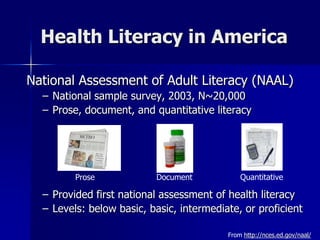
National Assessment of Adult Literacy (NAAL)
  – National sample survey, 2003, N~20,000
  – Prose, document, and quantitative literacy


         Prose            Document            Quantitative

  – Provided first national assessment of health literacy
  – Levels: below basic, basic, intermediate, or proficient

                                          From http://nces.ed.gov/naal/
Health Literacy in America:
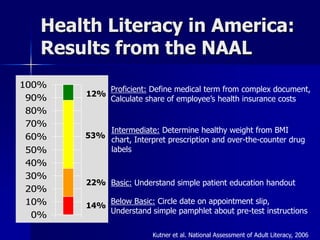
   Results from the NAAL
100%         Proficient: Define medical term from complex document,
       12%
 90%         Calculate share of employee’s health insurance costs
 80%
 70%
             Intermediate: Determine healthy weight from BMI
 60%   53%
             chart, Interpret prescription and over-the-counter drug
 50%         labels
 40%
 30%
       22% Basic: Understand simple patient education handout
 20%
 10%         Below Basic: Circle date on appointment slip,
       14%
             Understand simple pamphlet about pre-test instructions
  0%

                        Kutner et al. National Assessment of Adult Literacy, 2006
Why Is Health Literacy
Important in Patient Care?
   Most patient instructions are written
   Verbal instructions
     – Often complex
     – Delivered rapidly
     – Easy to forget in stressful situation
   Increasingly complex health system
     –   More medications
     –   More tests and procedures
     –   Greater self-care requirements
     –   Participatory/informed decision-making
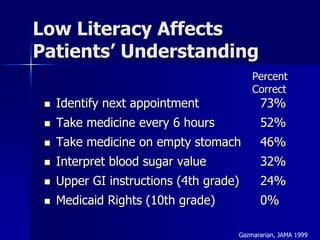
Low Literacy Affects
Patients’ Understanding
                                         Percent
                                         Correct
    Identify next appointment             73%
    Take medicine every 6 hours           52%
    Take medicine on empty stomach        46%
    Interpret blood sugar value           32%
    Upper GI instructions (4th grade)     24%
    Medicaid Rights (10th grade)          0%

                                     Gazmararian, JAMA 1999
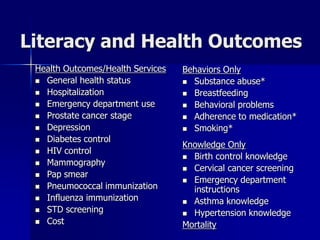
Literacy and Health Outcomes
 Health Outcomes/Health Services   Behaviors Only
  General health status            Substance abuse*
  Hospitalization                  Breastfeeding
  Emergency department use         Behavioral problems
  Prostate cancer stage            Adherence to medication*
  Depression                       Smoking*
  Diabetes control
                                   Knowledge Only
  HIV control
                                    Birth control knowledge
  Mammography
                                    Cervical cancer screening
  Pap smear
                                    Emergency department
  Pneumococcal immunization
                                     instructions
  Influenza immunization
                                    Asthma knowledge
  STD screening
                                    Hypertension knowledge
  Cost
                                   Mortality
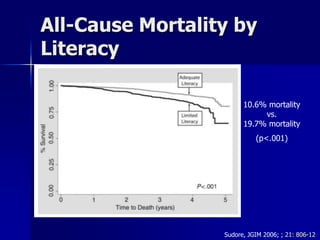
All-Cause Mortality by
Literacy

                        10.6% mortality
                             vs.
                        19.7% mortality
                            (p<.001)


                  Sudore, JGIM 2006; ; 21: 806-12
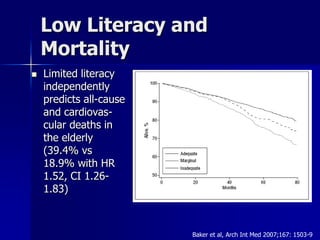
Low Literacy and
    Mortality
   Limited literacy
    independently
    predicts all-cause
    and cardiovas-
    cular deaths in
    the elderly
    (39.4% vs
    18.9% with HR
    1.52, CI 1.26-
    1.83)


                         Baker et al, Arch Int Med 2007;167: 1503-9
Patient Testimonials
Video
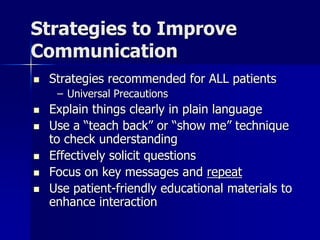
Strategies to Improve
Communication
   Strategies recommended for ALL patients
     – Universal Precautions
   Explain things clearly in plain language
   Use a “teach back” or “show me” technique
    to check understanding
   Effectively solicit questions
   Focus on key messages and repeat
   Use patient-friendly educational materials to
    enhance interaction
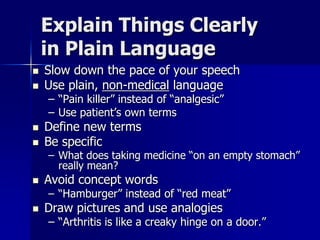
Explain Things Clearly
    in Plain Language
   Slow down the pace of your speech
   Use plain, non-medical language
    – “Pain killer” instead of “analgesic”
    – Use patient’s own terms
   Define new terms
   Be specific
    – What does taking medicine “on an empty stomach”
      really mean?
   Avoid concept words
    – “Hamburger” instead of “red meat”
   Draw pictures and use analogies
    – “Arthritis is like a creaky hinge on a door.”
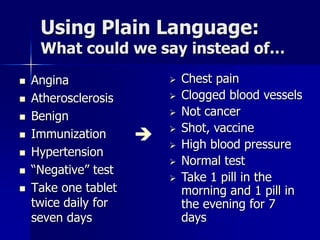
Using Plain Language:
     What could we say instead of…
   Angina                   Chest pain
   Atherosclerosis          Clogged blood vessels
   Benign                   Not cancer
                             Shot, vaccine
   Immunization            High blood pressure
   Hypertension
                             Normal test
   “Negative” test
                             Take 1 pill in the
   Take one tablet           morning and 1 pill in
    twice daily for           the evening for 7
    seven days                days
Teach Back Scripts
   “I want to make sure I explained everything
    clearly. If you were talking to a friend, what
    would you tell her we talked about today?”
   “Let’s review the next steps. Can you tell me
    the 3 things that you need to do before the
    next visit?”
   “Show me how you would...”
   “How would you know if your blood sugar
    was low?”
Effectively solicit
questions
   Don’t say:
    – Do you have any questions?
    – Any questions?


   Instead ask:

       What questions do you have?
What did we learn?

   Limited Health literacy is a barrier to
    optimal health
   All members of the health care team
    must work together to help patients
    with limited health literacy
   Using Clear communications skills will
    help provide optimal care for patients
    with limited literacy skills

Improving Patient Outcomes

  • 1.
  • 2.
    Thanks to  Dr. Jenny Lin  Dr. Michael.Paasche-Orlow
  • 3.
    Learning Objectives 1. Define health literacy and review national statistics 2. List at least two ways in which low health literacy adversely impacts health 3. Know the core components of clear health communication and be able to use these 4. Describe at least two communication strategies to combat low health literacy 5. Explore low literacy patient materials for use
  • 4.
    Quiz 1. Approximately what percentage of the US population reads at or below a basic (8th) grade reading level? 1. 15% 2. 25% 3. 35% 4. 45% 5. 55%
  • 5.
    Health Literacy Is… “Thedegree to which individuals have the capacity to obtain, process, and understand basic health information and services needed to make appropriate health decisions.” Healthy People 2010
  • 6.
    What patients need healthliteracy for Ability to perform essential health care tasks: – Understand appointment slips – Follow instructions on medication labels – Obtain information about an illness – Participate in discussions of informed consent – Enroll in health insurance plan
  • 7.
    Health Literacy inAmerica National Assessment of Adult Literacy (NAAL) – National sample survey, 2003, N~20,000 – Prose, document, and quantitative literacy Prose Document Quantitative – Provided first national assessment of health literacy – Levels: below basic, basic, intermediate, or proficient From http://nces.ed.gov/naal/
  • 8.
    Health Literacy inAmerica: Results from the NAAL 100% Proficient: Define medical term from complex document, 12% 90% Calculate share of employee’s health insurance costs 80% 70% Intermediate: Determine healthy weight from BMI 60% 53% chart, Interpret prescription and over-the-counter drug 50% labels 40% 30% 22% Basic: Understand simple patient education handout 20% 10% Below Basic: Circle date on appointment slip, 14% Understand simple pamphlet about pre-test instructions 0% Kutner et al. National Assessment of Adult Literacy, 2006
  • 9.
    Why Is HealthLiteracy Important in Patient Care?  Most patient instructions are written  Verbal instructions – Often complex – Delivered rapidly – Easy to forget in stressful situation  Increasingly complex health system – More medications – More tests and procedures – Greater self-care requirements – Participatory/informed decision-making
  • 10.
    Low Literacy Affects Patients’Understanding Percent Correct  Identify next appointment 73%  Take medicine every 6 hours 52%  Take medicine on empty stomach 46%  Interpret blood sugar value 32%  Upper GI instructions (4th grade) 24%  Medicaid Rights (10th grade) 0% Gazmararian, JAMA 1999
  • 11.
    Literacy and HealthOutcomes Health Outcomes/Health Services Behaviors Only  General health status  Substance abuse*  Hospitalization  Breastfeeding  Emergency department use  Behavioral problems  Prostate cancer stage  Adherence to medication*  Depression  Smoking*  Diabetes control Knowledge Only  HIV control  Birth control knowledge  Mammography  Cervical cancer screening  Pap smear  Emergency department  Pneumococcal immunization instructions  Influenza immunization  Asthma knowledge  STD screening  Hypertension knowledge  Cost Mortality
  • 12.
    All-Cause Mortality by Literacy 10.6% mortality vs. 19.7% mortality (p<.001) Sudore, JGIM 2006; ; 21: 806-12
  • 13.
    Low Literacy and Mortality  Limited literacy independently predicts all-cause and cardiovas- cular deaths in the elderly (39.4% vs 18.9% with HR 1.52, CI 1.26- 1.83) Baker et al, Arch Int Med 2007;167: 1503-9
  • 14.
  • 15.
    Strategies to Improve Communication  Strategies recommended for ALL patients – Universal Precautions  Explain things clearly in plain language  Use a “teach back” or “show me” technique to check understanding  Effectively solicit questions  Focus on key messages and repeat  Use patient-friendly educational materials to enhance interaction
  • 16.
    Explain Things Clearly in Plain Language  Slow down the pace of your speech  Use plain, non-medical language – “Pain killer” instead of “analgesic” – Use patient’s own terms  Define new terms  Be specific – What does taking medicine “on an empty stomach” really mean?  Avoid concept words – “Hamburger” instead of “red meat”  Draw pictures and use analogies – “Arthritis is like a creaky hinge on a door.”
  • 17.
    Using Plain Language: What could we say instead of…  Angina  Chest pain  Atherosclerosis  Clogged blood vessels  Benign  Not cancer  Shot, vaccine  Immunization   High blood pressure  Hypertension  Normal test  “Negative” test  Take 1 pill in the  Take one tablet morning and 1 pill in twice daily for the evening for 7 seven days days
  • 18.
    Teach Back Scripts  “I want to make sure I explained everything clearly. If you were talking to a friend, what would you tell her we talked about today?”  “Let’s review the next steps. Can you tell me the 3 things that you need to do before the next visit?”  “Show me how you would...”  “How would you know if your blood sugar was low?”
  • 19.
    Effectively solicit questions  Don’t say: – Do you have any questions? – Any questions?  Instead ask: What questions do you have?
  • 20.
    What did welearn?  Limited Health literacy is a barrier to optimal health  All members of the health care team must work together to help patients with limited health literacy  Using Clear communications skills will help provide optimal care for patients with limited literacy skills