Downloaded 39 times
![Supporting Desistance from Crime: Reconfiguring Penal Practice Fergus McNeill Professor of Criminology & Social Work University of Glasgow [email_address]](https://image.slidesharecdn.com/iriss-screencast-mcneill-01-09-2011-110914094330-phpapp01/85/Iriss-screencast-mc-neill-01-09-2011-1-320.jpg)
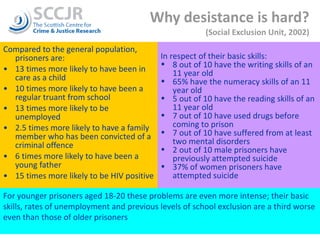
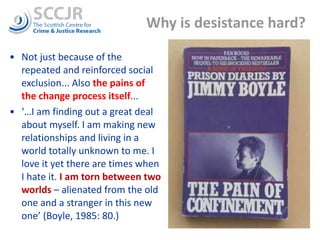
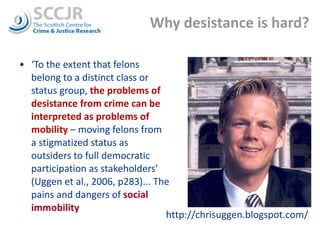
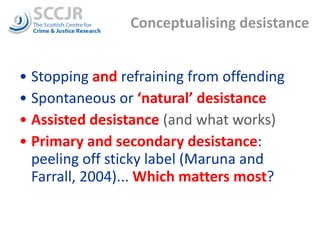
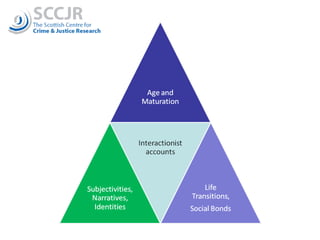
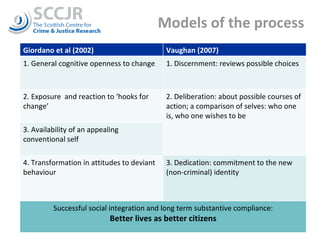
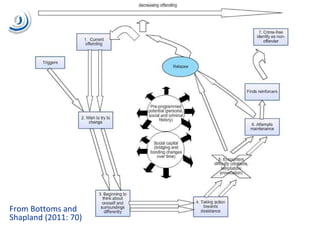
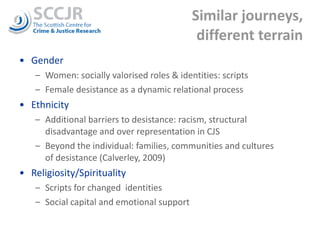
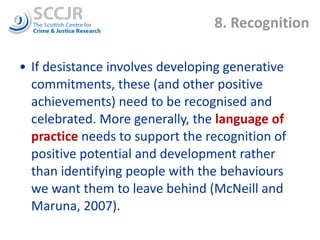
![Key aspects of desistance journeys They are complex processes, not events, characterised by ambivalence and vacillation The involve re-biography (at the time or post hoc) ; changing identities (narratives); more than learning new cognitive skills Prompted by life events, depending on the meaning of those events for the offender; inherently subjective, hence individualised, sensitive to difference/diversity Solicited or sustained by someone ‘believing in’ the offender (or prevented by someone giving up on the offender?)... Hope An active process in which agency is discovered and exercised Requires social capital (opportunities) as well as human capital (capacities/skills) Certified through ‘ redemption ’ or restoration (de-labelling); finding purpose in generative activities [constructive reparation ]](https://image.slidesharecdn.com/iriss-screencast-mcneill-01-09-2011-110914094330-phpapp01/85/Iriss-screencast-mc-neill-01-09-2011-14-320.jpg)
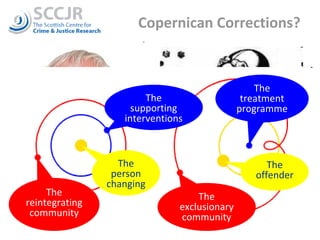
![Motivation [Counsellor] Capacities/ Human capital [Educator] Opportunities/ Social capital [Advocate/Allies] RNR Programmes? Avoidance Goals Good Lives Model? Approach Goals Work with Families Volunteers/Mentors Faith groups Employers COSA? Generativity Integration](https://image.slidesharecdn.com/iriss-screencast-mcneill-01-09-2011-110914094330-phpapp01/85/Iriss-screencast-mc-neill-01-09-2011-24-320.jpg)

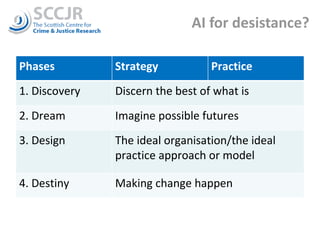
![What next? An Appreciative Inquiry (AI) approach to developing desistance-supporting penal practices: AI differs from other approaches to organisational change in that it ‘focuses on what is good, strong, already working and being achieved… [the] aim [is] to find out ‘what’s right’ and help ‘enhance it’’ (Carter 2006: 50). AI involves a focus on best experiences, strengths, accomplishments, best practices, and “peak moments” in an organisation’s history. It does not start with a problem orientation and then try to ‘fix’ the problems that are found. A bit like in the process of desistance itself, the focus is on strengths and resources....](https://image.slidesharecdn.com/iriss-screencast-mcneill-01-09-2011-110914094330-phpapp01/85/Iriss-screencast-mc-neill-01-09-2011-28-320.jpg)
![For more information, contact: [email_address] Follow the Desistance Knowledge Exchange blog: http://blogs.iriss.org.uk/discoveringdesistance/2011/08/19/filming-desistance/](https://image.slidesharecdn.com/iriss-screencast-mcneill-01-09-2011-110914094330-phpapp01/85/Iriss-screencast-mc-neill-01-09-2011-30-320.jpg)

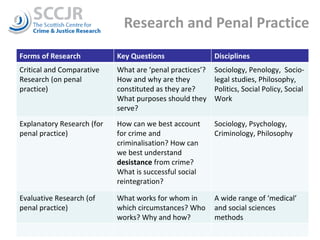
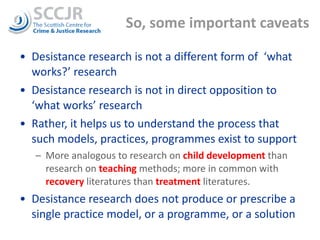
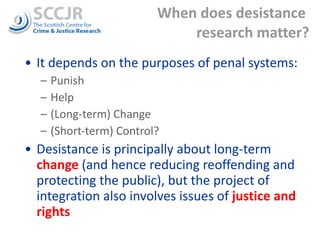
1. The document discusses supporting desistance from crime through reconfiguring penal practices based on research. Desistance research aims to understand the process of stopping offending rather than just evaluating "what works." 2. Desistance is a complex, individual process that involves developing a non-criminal identity. It requires hope, strong relationships, and social reintegration opportunities. Penal practices should recognize this and support strengths, agency, and hope. 3. Eight principles are outlined for supporting desistance through penal practices, including individualization, recognizing progress, building on strengths, and fostering social integration and generative roles. Appreciative inquiry is proposed as an approach.


