Desistance Focused Practice Dutch examples of promoting a crime-freelifeIAFMH Symposium 3.5| Barcelona | June 29, 2011, 14:30-15:45Lecturer-researchers: | Mechtild Höing |Ineke Heemskerk | Marie-José Geenen |Moderator –  professor of probation services and safety policy:| Bas Vogelvang |Centre for Public Safety & CriminalJustice | Breda School of Social StudiesAvans University of Applied SciencesDen Bosch – The Netherlands
Avans lectorate“probation services and safetypolicy”Lectorates combine practice-driven research withboth professional development of universityteachers and curriculum improvement.“Pracademics of appliedsciences”In the Netherlands, > 480 lectorates are active in “expertise research networks”The Avans lectorate “probation services and safetypolicy” is partlyfundedby the Dutch probationorganizations1 professor, 10 teachers in research network, 15-20 projects, primarily in the Brabant regionTwo research themes: Desistance Focused Practice and Innovation & Implemententation in JusticeOrganizations
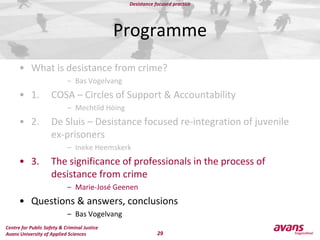
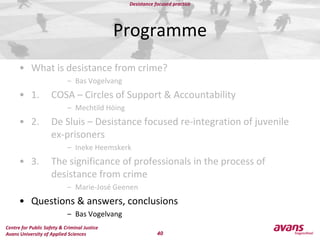
ProgrammeWhat is desistance from crime?Bas Vogelvang1. 	COSA – Circles of Support & AccountabilityMechtild Höing2. 	De Sluis – Desistance focused re-integration of juvenileex-prisonersIneke Heemskerk3. 	The significance of professionals in the process of 	desistance from crimeMarie-José GeenenQuestions & answers, conclusionsBas Vogelvang
What is desistance from crime? | Bas Vogelvang|
Desistance: a process, notan outcomeDecision:
“A criminallifeis no longer becoming of me, I want a different kind of life”
Maruna (2004): It is not a crime-free gap in time (primary desistance) , but the movement (process) from the behaviorof non-offending to the assumption of a roleoridentityof a non-offenderorcrime-freeperson(secondary desistance).
Looking back, the desister re-writes his own history: “That was not the real me”
Maruna (2004): It is a complex processinvolvingnotonly the offenderhimself, butalso the (interactionswith) judicialinstitutions, the social context and material / social-economicalconditions.
Vogelvang (2009): “Desistance: stayingawayfromcriminalbehaviourforanextendedperiod of time, related to bothaninner convictionand activeinvestmentby the ex-offender in hissocial and material context in order to reachprosocial goals, and to anactual,  continuousreinforcement of these effortsby the ex-offender’ssocial context.”
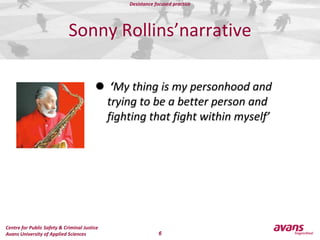
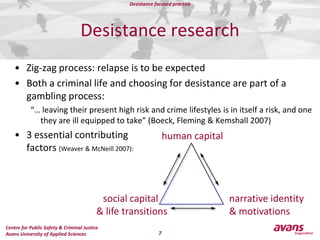
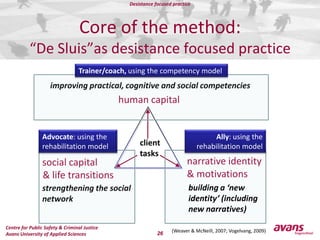
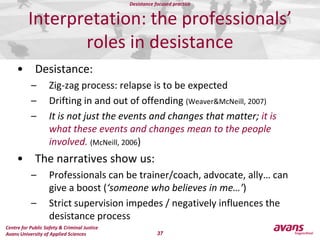
Elements of makinggood: redemption, forgivingandmutualrestorationSonny Rollins’narrative‘My thing is mypersonhood and trying to be a betterperson and fightingthatfightwithinmyself’Desistance researchZig-zag process: relapse is to be expectedBoth a criminal life and choosing for desistance are part of a gambling process:“… leaving their present high risk and crime lifestyles is in itself a risk, and one they are ill equipped to take” (Boeck, Fleming & Kemshall 2007) 3 essential contributing 					       factors (Weaver & McNeill 2007):human capitalnarrative identity & motivationssocial capital & life transitions
COSA:circles of support and accountability| Mechtild Höing|
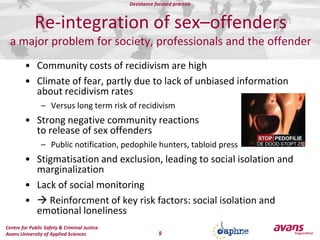
Re-integration of sex–offendersa major problemfor society, professionals and the offenderCommunitycosts of recidivism are highClimate of fear, partlydue to lack of unbiasedinformationaboutrecidivismratesVersus long term risk of recidivismStrong negativecommunityreactions                                              to release of sexoffendersPublic notification, pedophilehunters, tabloid pressStigmatisation and exclusion, leading to socialisolation and marginalizationLack of social monitoring  Reinforcment of key risk factors: socialisolation and emotionalloneliness
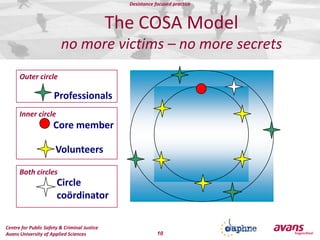
The COSA Modelno more victims – no more secretsOutercircleProfessionalsInner circleCore memberVolunteersBoth circlesCircle coördinator
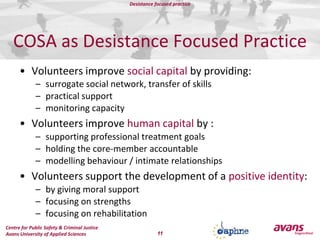
COSA as Desistance Focused PracticeVolunteersimprovesocialcapitalbyproviding:surrogatesocialnetwork, transfer of skillspractical support
monitoring capacityVolunteersimprovehumancapitalby :supporting professional treatment goalsholding the core-memberaccountablemodellingbehaviour / intimaterelationshipsVolunteers support the development of a positiveidentity: bygivingmoral support
focusingonstrengths
focusingonrehabilitationCore members: who can join a circle?Inclusion criteria:
Adult sex offender who admits the offense
Medium/high risk of re-offending
Under a court supervision order (at least for 1 year)
High need for social support
Motivated to prevent new victims
Willing to share information with volunteers
Participating in treatment program
Exclusion criteria:
Reversion of inclusion criteria
Diagnosedpsychopath (e.g. high scores on PCL-R)
Complete denial of the offense
LearningdisabledVolunteers: whocanjoincircles? selection & exclusioncriteria
maturity, diversity, nocriminal record, ex-victimsallowed
selection procedure
includesan intensive and confronting training
supervision
circledynamics, booster training, stayingvigilant and healthy
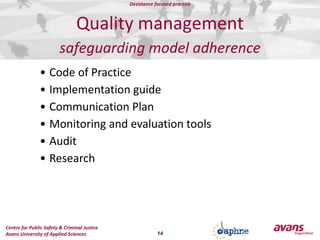
safetyregulationsQuality management safeguarding model adherenceCode of Practice
Implementationguide
Communication Plan
Monitoring and evaluation tools
Audit
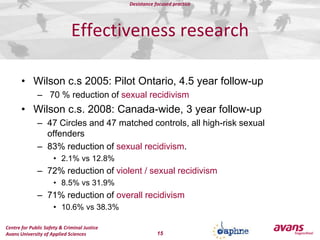
Research Effectiveness researchWilson c.s 2005: Pilot Ontario, 4.5 year follow-up

IAFMH Workshop Barcelona, June 2011

  • 1.
    Desistance Focused PracticeDutch examples of promoting a crime-freelifeIAFMH Symposium 3.5| Barcelona | June 29, 2011, 14:30-15:45Lecturer-researchers: | Mechtild Höing |Ineke Heemskerk | Marie-José Geenen |Moderator – professor of probation services and safety policy:| Bas Vogelvang |Centre for Public Safety & CriminalJustice | Breda School of Social StudiesAvans University of Applied SciencesDen Bosch – The Netherlands
  • 2.
    Avans lectorate“probation servicesand safetypolicy”Lectorates combine practice-driven research withboth professional development of universityteachers and curriculum improvement.“Pracademics of appliedsciences”In the Netherlands, > 480 lectorates are active in “expertise research networks”The Avans lectorate “probation services and safetypolicy” is partlyfundedby the Dutch probationorganizations1 professor, 10 teachers in research network, 15-20 projects, primarily in the Brabant regionTwo research themes: Desistance Focused Practice and Innovation & Implemententation in JusticeOrganizations
  • 3.
    ProgrammeWhat is desistancefrom crime?Bas Vogelvang1. COSA – Circles of Support & AccountabilityMechtild Höing2. De Sluis – Desistance focused re-integration of juvenileex-prisonersIneke Heemskerk3. The significance of professionals in the process of desistance from crimeMarie-José GeenenQuestions & answers, conclusionsBas Vogelvang
  • 4.
    What is desistancefrom crime? | Bas Vogelvang|
  • 5.
    Desistance: a process,notan outcomeDecision:
  • 6.
    “A criminallifeis nolonger becoming of me, I want a different kind of life”
  • 7.
    Maruna (2004): Itis not a crime-free gap in time (primary desistance) , but the movement (process) from the behaviorof non-offending to the assumption of a roleoridentityof a non-offenderorcrime-freeperson(secondary desistance).
  • 8.
    Looking back, thedesister re-writes his own history: “That was not the real me”
  • 9.
    Maruna (2004): Itis a complex processinvolvingnotonly the offenderhimself, butalso the (interactionswith) judicialinstitutions, the social context and material / social-economicalconditions.
  • 10.
    Vogelvang (2009): “Desistance:stayingawayfromcriminalbehaviourforanextendedperiod of time, related to bothaninner convictionand activeinvestmentby the ex-offender in hissocial and material context in order to reachprosocial goals, and to anactual, continuousreinforcement of these effortsby the ex-offender’ssocial context.”
  • 11.
    Elements of makinggood:redemption, forgivingandmutualrestorationSonny Rollins’narrative‘My thing is mypersonhood and trying to be a betterperson and fightingthatfightwithinmyself’Desistance researchZig-zag process: relapse is to be expectedBoth a criminal life and choosing for desistance are part of a gambling process:“… leaving their present high risk and crime lifestyles is in itself a risk, and one they are ill equipped to take” (Boeck, Fleming & Kemshall 2007) 3 essential contributing factors (Weaver & McNeill 2007):human capitalnarrative identity & motivationssocial capital & life transitions
  • 12.
    COSA:circles of supportand accountability| Mechtild Höing|
  • 13.
    Re-integration of sex–offendersamajor problemfor society, professionals and the offenderCommunitycosts of recidivism are highClimate of fear, partlydue to lack of unbiasedinformationaboutrecidivismratesVersus long term risk of recidivismStrong negativecommunityreactions to release of sexoffendersPublic notification, pedophilehunters, tabloid pressStigmatisation and exclusion, leading to socialisolation and marginalizationLack of social monitoring  Reinforcment of key risk factors: socialisolation and emotionalloneliness
  • 14.
    The COSA Modelnomore victims – no more secretsOutercircleProfessionalsInner circleCore memberVolunteersBoth circlesCircle coördinator
  • 15.
    COSA as DesistanceFocused PracticeVolunteersimprovesocialcapitalbyproviding:surrogatesocialnetwork, transfer of skillspractical support
  • 16.
    monitoring capacityVolunteersimprovehumancapitalby :supportingprofessional treatment goalsholding the core-memberaccountablemodellingbehaviour / intimaterelationshipsVolunteers support the development of a positiveidentity: bygivingmoral support
  • 17.
  • 18.
    focusingonrehabilitationCore members: whocan join a circle?Inclusion criteria:
  • 19.
    Adult sex offenderwho admits the offense
  • 20.
  • 21.
    Under a courtsupervision order (at least for 1 year)
  • 22.
    High need forsocial support
  • 23.
  • 24.
    Willing to shareinformation with volunteers
  • 25.
  • 26.
  • 27.
  • 28.
  • 29.
  • 30.
  • 31.
    maturity, diversity, nocriminalrecord, ex-victimsallowed
  • 32.
  • 33.
    includesan intensive andconfronting training
  • 34.
  • 35.
    circledynamics, booster training,stayingvigilant and healthy
  • 36.
  • 37.
  • 38.
  • 39.
  • 40.
  • 41.
    Research Effectiveness researchWilsonc.s 2005: Pilot Ontario, 4.5 year follow-up