

IFAC SMP FORUM
Supporting SME Growth Through
Innovation: SA Companies Act
Bernard Peter Agulhas
Kampala, Uganda
5 June 2013
Innovation ‘in action’
• Financial Reporting Frameworks
– IFRS for SMEs
• Risk-Based Approach to Inspections
– Indirect impact on SMEs
– Changed Basis for Inspections Fees
– ISQC1 Inspections
• Companies Act, 2008
– Direct impact on SMEs
– Impact of Section 90(2)?
Companies Act and Regulations
• Effective from 1 May 2011
• Ultimate goal in repealing the previous Act was to
ensure that the regulatory framework for all types
and sizes of enterprises promotes growth,
employment, innovation, stability, good governance,
and confidence
• Different types of companies must comply with
different rules as set out in the Act
3
The Independent Review
For all financial year ends after 30 April 2011,
independent reviews are required by all companies
which:
• Are not required in terms of the Act to be audited;
and
• Do not choose to be voluntarily audited; and
• Do not meet the exemption criteria set out in the Act
4
Public Interest Score
Is calculated by all companies at financial year end as:
• One point per employee for the average number of
employees during the financial year
• One point for every R1 million or portion thereof in
third party liabilities at financial year end
• One point for every R1 million or portion thereof in
turnover during the financial year
• One point for every individual who at financial year
end has a beneficial interest in issued securities of a
profit company or is a member of a non-profit
company
5
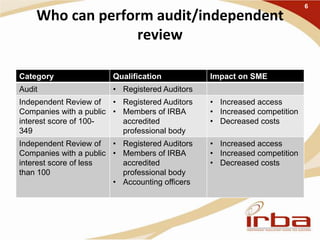
Who can perform audit/independent
review
Category Qualification Impact on SME
Audit • Registered Auditors
Independent Review of
Companies with a public
interest score of 100-
349
• Registered Auditors
• Members of IRBA
accredited
professional body
• Increased access
• Increased competition
• Decreased costs
Independent Review of
Companies with a public
interest score of less
than 100
• Registered Auditors
• Members of IRBA
accredited
professional body
• Accounting officers
• Increased access
• Increased competition
• Decreased costs
6
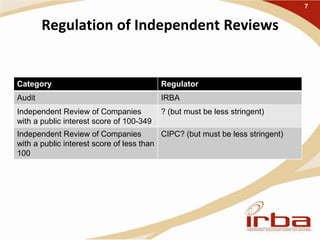
Regulation of Independent Reviews
Category Regulator
Audit IRBA
Independent Review of Companies
with a public interest score of 100-349
? (but must be less stringent)
Independent Review of Companies
with a public interest score of less than
100
CIPC? (but must be less stringent)
7
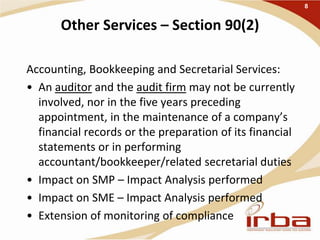
Other Services – Section 90(2)
Accounting, Bookkeeping and Secretarial Services:
• An auditor and the audit firm may not be currently
involved, nor in the five years preceding
appointment, in the maintenance of a company’s
financial records or the preparation of its financial
statements or in performing
accountant/bookkeeper/related secretarial duties
• Impact on SMP – Impact Analysis performed
• Impact on SME – Impact Analysis performed
• Extension of monitoring of compliance
8
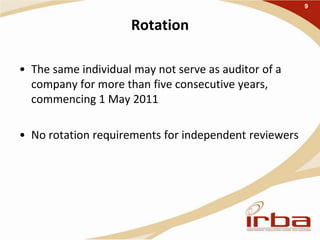
Rotation
• The same individual may not serve as auditor of a
company for more than five consecutive years,
commencing 1 May 2011
• No rotation requirements for independent reviewers
9
Increasing Thresholds
• Already discussed with Companies and
Intellectual Properties Commission
• Could be solution to Section 90 (2)
• Inflationary adjustments for PI Score elements to
be considered
Value of Other Assurance Engagements
• Lower cost to client?
• Procedures followed by auditor in expressing
negative assurance are less?
• Increased access to profession?
• More efficient for client?
• Early days
Other Influences
• Requirements of the Revenue Service and
Banks
• Expectations
– Parliament: IRBA is the Custodian of the Profession
– EU Green Paper
– Responsibility for high quality assurance services
– Response by IRBA
• SMP Support
• Promotion of Protection of the Public
Thank You
Phone: +27879408800
Email: bagulhas@irba.co.za

Supporting SME Growth Through Innovation: SA Companies Act

  • 1.
    IFAC SMP FORUM SupportingSME Growth Through Innovation: SA Companies Act Bernard Peter Agulhas Kampala, Uganda 5 June 2013
  • 2.
    Innovation ‘in action’ •Financial Reporting Frameworks – IFRS for SMEs • Risk-Based Approach to Inspections – Indirect impact on SMEs – Changed Basis for Inspections Fees – ISQC1 Inspections • Companies Act, 2008 – Direct impact on SMEs – Impact of Section 90(2)?
  • 3.
    Companies Act andRegulations • Effective from 1 May 2011 • Ultimate goal in repealing the previous Act was to ensure that the regulatory framework for all types and sizes of enterprises promotes growth, employment, innovation, stability, good governance, and confidence • Different types of companies must comply with different rules as set out in the Act 3
  • 4.
    The Independent Review Forall financial year ends after 30 April 2011, independent reviews are required by all companies which: • Are not required in terms of the Act to be audited; and • Do not choose to be voluntarily audited; and • Do not meet the exemption criteria set out in the Act 4
  • 5.
    Public Interest Score Iscalculated by all companies at financial year end as: • One point per employee for the average number of employees during the financial year • One point for every R1 million or portion thereof in third party liabilities at financial year end • One point for every R1 million or portion thereof in turnover during the financial year • One point for every individual who at financial year end has a beneficial interest in issued securities of a profit company or is a member of a non-profit company 5
  • 6.
    Who can performaudit/independent review Category Qualification Impact on SME Audit • Registered Auditors Independent Review of Companies with a public interest score of 100- 349 • Registered Auditors • Members of IRBA accredited professional body • Increased access • Increased competition • Decreased costs Independent Review of Companies with a public interest score of less than 100 • Registered Auditors • Members of IRBA accredited professional body • Accounting officers • Increased access • Increased competition • Decreased costs 6
  • 7.
    Regulation of IndependentReviews Category Regulator Audit IRBA Independent Review of Companies with a public interest score of 100-349 ? (but must be less stringent) Independent Review of Companies with a public interest score of less than 100 CIPC? (but must be less stringent) 7
  • 8.
    Other Services –Section 90(2) Accounting, Bookkeeping and Secretarial Services: • An auditor and the audit firm may not be currently involved, nor in the five years preceding appointment, in the maintenance of a company’s financial records or the preparation of its financial statements or in performing accountant/bookkeeper/related secretarial duties • Impact on SMP – Impact Analysis performed • Impact on SME – Impact Analysis performed • Extension of monitoring of compliance 8
  • 9.
    Rotation • The sameindividual may not serve as auditor of a company for more than five consecutive years, commencing 1 May 2011 • No rotation requirements for independent reviewers 9
  • 10.
    Increasing Thresholds • Alreadydiscussed with Companies and Intellectual Properties Commission • Could be solution to Section 90 (2) • Inflationary adjustments for PI Score elements to be considered
  • 11.
    Value of OtherAssurance Engagements • Lower cost to client? • Procedures followed by auditor in expressing negative assurance are less? • Increased access to profession? • More efficient for client? • Early days
  • 12.
    Other Influences • Requirementsof the Revenue Service and Banks • Expectations – Parliament: IRBA is the Custodian of the Profession – EU Green Paper – Responsibility for high quality assurance services – Response by IRBA • SMP Support • Promotion of Protection of the Public
  • 13.