YOUR PARTNER IN LEADERSHIP
Presented by: Ritu Kochhar
March 2020
2
PROPRIETARY AND CONFIDENTIAL. ALL RIGHTS RESERVED YOUR PARTNER IN LEADERSHIP
Finance Leadership –
What really matters ?
3
PROPRIETARY AND CONFIDENTIAL. ALL RIGHTS RESERVED YOUR PARTNER IN LEADERSHIP
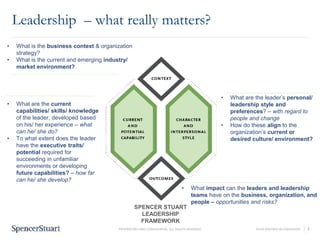
Leadership – what really matters?
SPENCER STUART
LEADERSHIP
FRAMEWORK
• What is the business context & organization
strategy?
• What is the current and emerging industry/
market environment?
• What are the current
capabilities/ skills/ knowledge
of the leader, developed based
on his/ her experience – what
can he/ she do?
• To what extent does the leader
have the executive traits/
potential required for
succeeding in unfamiliar
environments or developing
future capabilities? – how far
can he/ she develop?
• What are the leader’s personal/
leadership style and
preferences? – with regard to
people and change
• How do these align to the
organization’s current or
desired culture/ environment?
• What impact can the leaders and leadership
teams have on the business, organization, and
people – opportunities and risks?
4
PROPRIETARY AND CONFIDENTIAL. ALL RIGHTS RESERVED
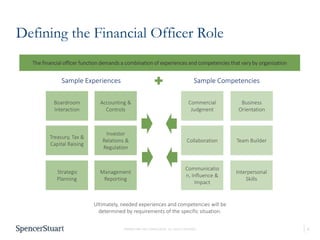
Defining the Financial Officer Role
Treasury, Tax &
Capital Raising
Management
Reporting
Collaboration
Strategic
Planning
Team Builder
Communicatio
n, Influence &
Impact
Investor
Relations &
Regulation
Business
Orientation
Accounting &
Controls
Boardroom
Interaction
Commercial
Judgment
Interpersonal
Skills
The financial officer function demands a combination of experiences and competencies that vary by organization
Sample Experiences Sample Competencies
Ultimately, needed experiences and competencies will be
determined by requirements of the specific situation.
5
PROPRIETARY AND CONFIDENTIAL. ALL RIGHTS RESERVED
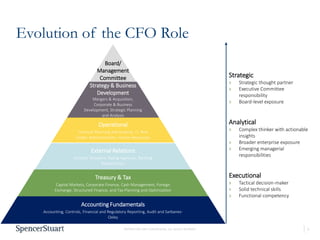
Board/
Management
Committee
Strategy & Business
Development
Mergers & Acquisition,
Corporate & Business
Development, Strategic Planning
and Analysis
Operational
Financial Planning and Analysis, IT, Real
Estate, Administration, Human Resources
External Relations
Investor Relations, Rating Agencies, Banking
Relationships
Treasury & Tax
Capital Markets, Corporate Finance, Cash Management, Foreign
Exchange, Structured Finance, and Tax Planning and Optimization
Accounting Fundamentals
Accounting, Controls, Financial and Regulatory Reporting, Audit and Sarbanes-
Oxley
Strategic
» Strategic thought partner
» Executive Committee
responsibility
» Board-level exposure
Analytical
» Complex thinker with actionable
insights
» Broader enterprise exposure
» Emerging managerial
responsibilities
Executional
» Tactical decision-maker
» Solid technical skills
» Functional competency
Evolution of the CFO Role
6
PROPRIETARY AND CONFIDENTIAL. ALL RIGHTS RESERVED
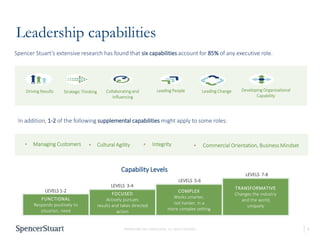
Leadership capabilities
In addition, 1-2 of the following supplemental capabilities might apply to some roles:
Capability Levels
TRANSFORMATIVE
Changes the industry
and the world,
uniquely
COMPLEX
Works smarter,
not harder, in a
more complex setting
FOCUSED
Actively pursues
results and takes directed
action
FUNCTIONAL
Responds positively to
situation, need
LEVELS 1-2
LEVELS 3-4
LEVELS 5-6
LEVELS 7-8
Driving Results Leading People
Collaborating and
Influencing
Strategic Thinking Developing Organizational
Capability
Leading Change
• Integrity
• Managing Customers
Spencer Stuart’s extensive research has found that six capabilities account for 85% of any executive role.
• Cultural Agility • Commercial Orientation, Business Mindset
7
PROPRIETARY AND CONFIDENTIAL. ALL RIGHTS RESERVED
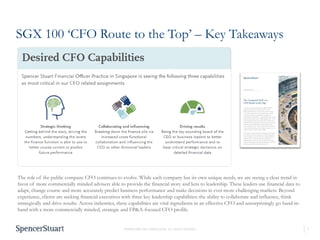
SGX 100 ‘CFO Route to the Top’ – Key Takeaways
The role of the public company CFO continues to evolve. While each company has its own unique needs, we are seeing a clear trend in
favor of more commercially minded advisers able to provide the financial story and lens to leadership. These leaders use financial data to
adapt, change course and more accurately predict business performance and make decisions in ever more challenging markets. Beyond
experience, clients are seeking financial executives with three key leadership capabilities: the ability to collaborate and influence, think
strategically and drive results. Across industries, these capabilities are vital ingredients in an effective CFO and unsurprisingly go hand-in-
hand with a more commercially minded, strategic and FP&A-focused CFO profile.
8
PROPRIETARY AND CONFIDENTIAL. ALL RIGHTS RESERVED
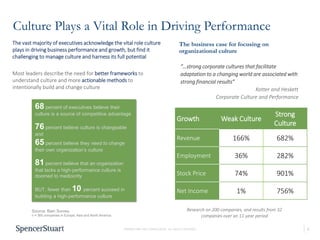
Culture Plays a Vital Role in Driving Performance
The vast majority of executives acknowledge the vital role culture
plays in driving business performance and growth, but find it
challenging to manage culture and harness its full potential
Most leaders describe the need for better frameworks to
understand culture and more actionable methods to
intentionally build and change culture
Source: Bain Survey
n = 365 companies in Europe, Asia and North America
68 percent of executives believe their
culture is a source of competitive advantage
76 percent believe culture is changeable
and
65 percent believe they need to change
their own organization’s culture
81 percent believe that an organization
that lacks a high-performance culture is
doomed to mediocrity
BUT, fewer than 10 percent succeed in
building a high-performance culture
Growth Weak Culture
Strong
Culture
Revenue 166% 682%
Employment 36% 282%
Stock Price 74% 901%
Net Income 1% 756%
Research on 200 companies, and results from 32
companies over an 11-year period
The business case for focusing on
organizational culture
“…strong corporate cultures that facilitate
adaptation to a changing world are associated with
strong financial results”
Kotter and Heskett
Corporate Culture and Performance
9
PROPRIETARY AND CONFIDENTIAL. ALL RIGHTS RESERVED
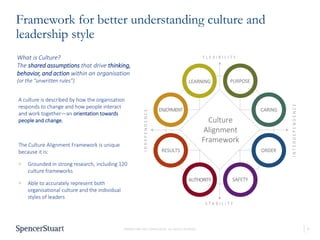
Framework for better understanding culture and
leadership style
A culture is described by how the organisation
responds to change and how people interact
and work together—an orientation towards
people and change.
The Culture Alignment Framework is unique
because it is:
> Grounded in strong research, including 120
culture frameworks
> Able to accurately represent both
organisational culture and the individual
styles of leaders
I
N
D
E
P
E
N
D
E
N
C
E
I
N
T
E
R
D
E
P
E
N
D
E
N
C
E
F L E X I B I L I T Y
S T A B I L I T Y
LEARNING PURPOSE
CARING
ORDER
SAFETY
AUTHORITY
RESULTS
ENJOYMENT
Culture
Alignment
Framework
What is Culture?
The shared assumptions that drive thinking,
behavior, and action within an organisation
(or the “unwritten rules”)
10
PROPRIETARY AND CONFIDENTIAL. ALL RIGHTS RESERVED
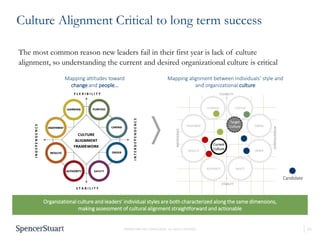
Culture Alignment Critical to long term success
The most common reason new leaders fail in their first year is lack of culture
alignment, so understanding the current and desired organizational culture is critical
Organizational culture and leaders’ individual styles are both characterized along the same dimensions,
making assessment of cultural alignment straightforward and actionable
Mapping attitudes toward
change and people…
I
N
D
E
P
E
N
D
E
N
C
E
I
N
T
E
R
D
E
P
E
N
D
E
N
C
E
F L E X I B I L I T Y
S T A B I L I T Y
Mapping alignment between individuals’ style and
and organizational culture
AUTHORITY
STABILITY
LEARNING
ENJOYMENT
RESULTS
SAFETY
ORDER
CARING
PURPOSE
INDEPENDENCE
INTERDEPENDENCE
FLEXIBILITY
Current
Culture
Target
Culture
Candidate
11
PROPRIETARY AND CONFIDENTIAL. ALL RIGHTS RESERVED
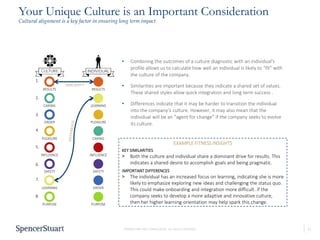
Your Unique Culture is an Important Consideration
Cultural alignment is a key factor in ensuring long term impact
RESULTS
SAFETY
CARING
LEARNING
ORDER
PLEASURE
PURPOSE
INFLUENCE
1.
2.
3.
4.
5.
6.
7.
8.
RESULTS
SAFETY
LEARNING
ORDER
PLEASURE
CARING
PURPOSE
INFLUENCE
• Combining the outcomes of a culture diagnostic with an individual's
profile allows us to calculate how well an individual is likely to “fit” with
the culture of the company.
• Similarities are important because they indicate a shared set of values.
These shared styles allow quick integration and long term success .
• Differences indicate that it may be harder to transition the individual
into the company’s culture. However, it may also mean that the
individual will be an “agent for change” if the company seeks to evolve
its culture.
EXAMPLE FITNESS INSIGHTS
KEY SIMILARITIES
> Both the culture and individual share a dominant drive for results. This
indicates a shared desire to accomplish goals and being pragmatic.
IMPORTANT DIFFERENCES
> The individual has an increased focus on learning, indicating she is more
likely to emphasize exploring new ideas and challenging the status quo.
This could make onboarding and integration more difficult. If the
company seeks to develop a more adaptive and innovative culture,
then her higher learning-orientation may help spark this change.
SIMILARITY
12
PROPRIETARY AND CONFIDENTIAL. ALL RIGHTS RESERVED
Spencer Stuart’s
“CFO - Route to the Top”
Trends & Results
13
PROPRIETARY AND CONFIDENTIAL. ALL RIGHTS RESERVED
Global CFO
Route
to the Top
(RTTT)
Look at the
background and
experience of CFOs at
top listed companies
around the world in
2019.
Spencer Stuart continually analyses the profiles and
backgrounds of CFOs in leading companies.
By combining our detailed knowledge of CFOs and their career
paths with data in the public domain we are in a unique
position to share insights into CFO appointment trends.
We analysed each individual’s career history prior to their appointment as CFO. Any additional
roles or responsibilities assumed following their appointment are not included in this study.
14
PROPRIETARY AND CONFIDENTIAL. ALL RIGHTS RESERVED
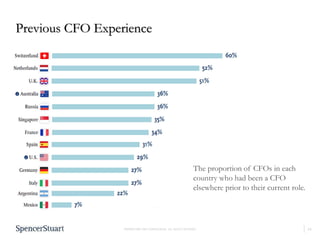
The proportion of CFOs in each
country who had been a CFO
elsewhere prior to their current role.
Previous CFO Experience
15
PROPRIETARY AND CONFIDENTIAL. ALL RIGHTS RESERVED
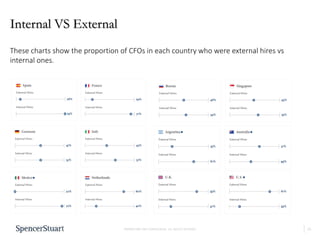
Internal VS External
These charts show the proportion of CFOs in each country who were external hires vs
internal ones.
16
PROPRIETARY AND CONFIDENTIAL. ALL RIGHTS RESERVED
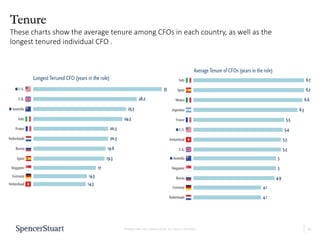
Tenure
These charts show the average tenure among CFOs in each country, as well as the
longest tenured individual CFO .
17
PROPRIETARY AND CONFIDENTIAL. ALL RIGHTS RESERVED
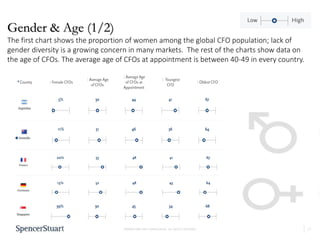
Gender & Age (1/2)
The first chart shows the proportion of women among the global CFO population; lack of
gender diversity is a growing concern in many markets. The rest of the charts show data on
the age of CFOs. The average age of CFOs at appointment is between 40-49 in every country.
18
PROPRIETARY AND CONFIDENTIAL. ALL RIGHTS RESERVED
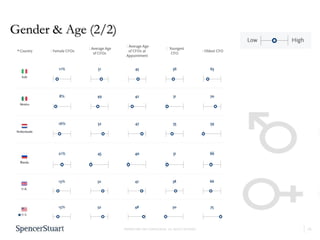
Gender & Age (2/2)
19
PROPRIETARY AND CONFIDENTIAL. ALL RIGHTS RESERVED
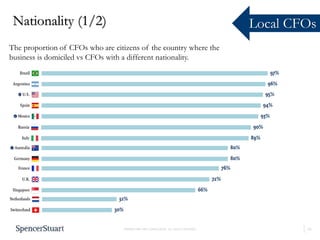
The proportion of CFOs who are citizens of the country where the
business is domiciled vs CFOs with a different nationality.
Nationality (1/2) Local CFOs
20
PROPRIETARY AND CONFIDENTIAL. ALL RIGHTS RESERVED
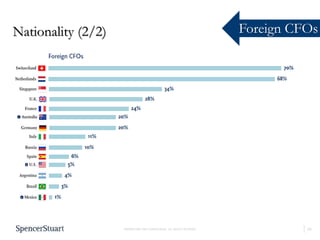
Nationality (2/2) Foreign CFOs
21
PROPRIETARY AND CONFIDENTIAL. ALL RIGHTS RESERVED
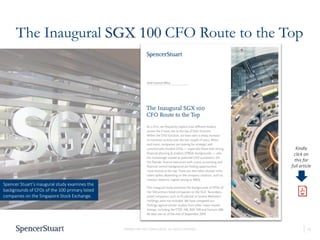
The Inaugural SGX 100 CFO Route to the Top
Kindly
click on
this for
full article
Spencer Stuart’s inaugural study examines the
backgrounds of CFOs of the 100 primary listed
companies on the Singapore Stock Exchange.
22
PROPRIETARY AND CONFIDENTIAL. ALL RIGHTS RESERVED
Trends in Finance
Organizations
and how to prepare
23
PROPRIETARY AND CONFIDENTIAL. ALL RIGHTS RESERVED
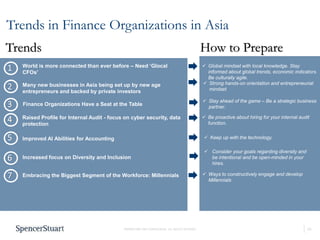
✓ Keep up with the technology.
Improved AI Abilities for Accounting
✓ Consider your goals regarding diversity and
be intentional and be open-minded in your
hires.
Increased focus on Diversity and Inclusion
Raised Profile for Internal Audit - focus on cyber security, data
protection
5
6
Embracing the Biggest Segment of the Workforce: Millennials
Finance Organizations Have a Seat at the Table
World is more connected than ever before – Need ‘Glocal
CFOs’
1
2
4
✓ Global mindset with local knowledge. Stay
informed about global trends, economic indicators.
Be culturally agile.
✓ Ways to constructively engage and develop
Millennials
✓ Stay ahead of the game – Be a strategic business
partner.
3
✓ Be proactive about hiring for your internal audit
function.
Trends in Finance Organizations in Asia
Trends How to Prepare
7
Many new businesses in Asia being set up by new age
entrepreneurs and backed by private investors
✓ Strong hands-on orientation and entrepreneurial
mindset
24
PROPRIETARY AND CONFIDENTIAL. ALL RIGHTS RESERVED
Training & Development
25
PROPRIETARY AND CONFIDENTIAL. ALL RIGHTS RESERVED
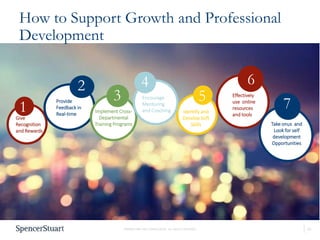
How to Support Growth and Professional
Development
Give
Recognition
and Rewards
Provide
Feedback in
Real-time
Effectively
use online
resources
and tools
Encourage
Mentoring
and Coaching Identify and
Develop Soft
Skills
Implement Cross-
Departmental
Training Programs Take onus and
Look for self
development
Opportunities
1
2
3
4
5
6
7
26
PROPRIETARY AND CONFIDENTIAL. ALL RIGHTS RESERVED

Spencer Stuart IFAC Presentation.pdf

  • 1.
    YOUR PARTNER INLEADERSHIP Presented by: Ritu Kochhar March 2020
  • 2.
    2 PROPRIETARY AND CONFIDENTIAL.ALL RIGHTS RESERVED YOUR PARTNER IN LEADERSHIP Finance Leadership – What really matters ?
  • 3.
    3 PROPRIETARY AND CONFIDENTIAL.ALL RIGHTS RESERVED YOUR PARTNER IN LEADERSHIP Leadership – what really matters? SPENCER STUART LEADERSHIP FRAMEWORK • What is the business context & organization strategy? • What is the current and emerging industry/ market environment? • What are the current capabilities/ skills/ knowledge of the leader, developed based on his/ her experience – what can he/ she do? • To what extent does the leader have the executive traits/ potential required for succeeding in unfamiliar environments or developing future capabilities? – how far can he/ she develop? • What are the leader’s personal/ leadership style and preferences? – with regard to people and change • How do these align to the organization’s current or desired culture/ environment? • What impact can the leaders and leadership teams have on the business, organization, and people – opportunities and risks?
  • 4.
    4 PROPRIETARY AND CONFIDENTIAL.ALL RIGHTS RESERVED Defining the Financial Officer Role Treasury, Tax & Capital Raising Management Reporting Collaboration Strategic Planning Team Builder Communicatio n, Influence & Impact Investor Relations & Regulation Business Orientation Accounting & Controls Boardroom Interaction Commercial Judgment Interpersonal Skills The financial officer function demands a combination of experiences and competencies that vary by organization Sample Experiences Sample Competencies Ultimately, needed experiences and competencies will be determined by requirements of the specific situation.
  • 5.
    5 PROPRIETARY AND CONFIDENTIAL.ALL RIGHTS RESERVED Board/ Management Committee Strategy & Business Development Mergers & Acquisition, Corporate & Business Development, Strategic Planning and Analysis Operational Financial Planning and Analysis, IT, Real Estate, Administration, Human Resources External Relations Investor Relations, Rating Agencies, Banking Relationships Treasury & Tax Capital Markets, Corporate Finance, Cash Management, Foreign Exchange, Structured Finance, and Tax Planning and Optimization Accounting Fundamentals Accounting, Controls, Financial and Regulatory Reporting, Audit and Sarbanes- Oxley Strategic » Strategic thought partner » Executive Committee responsibility » Board-level exposure Analytical » Complex thinker with actionable insights » Broader enterprise exposure » Emerging managerial responsibilities Executional » Tactical decision-maker » Solid technical skills » Functional competency Evolution of the CFO Role
  • 6.
    6 PROPRIETARY AND CONFIDENTIAL.ALL RIGHTS RESERVED Leadership capabilities In addition, 1-2 of the following supplemental capabilities might apply to some roles: Capability Levels TRANSFORMATIVE Changes the industry and the world, uniquely COMPLEX Works smarter, not harder, in a more complex setting FOCUSED Actively pursues results and takes directed action FUNCTIONAL Responds positively to situation, need LEVELS 1-2 LEVELS 3-4 LEVELS 5-6 LEVELS 7-8 Driving Results Leading People Collaborating and Influencing Strategic Thinking Developing Organizational Capability Leading Change • Integrity • Managing Customers Spencer Stuart’s extensive research has found that six capabilities account for 85% of any executive role. • Cultural Agility • Commercial Orientation, Business Mindset
  • 7.
    7 PROPRIETARY AND CONFIDENTIAL.ALL RIGHTS RESERVED SGX 100 ‘CFO Route to the Top’ – Key Takeaways The role of the public company CFO continues to evolve. While each company has its own unique needs, we are seeing a clear trend in favor of more commercially minded advisers able to provide the financial story and lens to leadership. These leaders use financial data to adapt, change course and more accurately predict business performance and make decisions in ever more challenging markets. Beyond experience, clients are seeking financial executives with three key leadership capabilities: the ability to collaborate and influence, think strategically and drive results. Across industries, these capabilities are vital ingredients in an effective CFO and unsurprisingly go hand-in- hand with a more commercially minded, strategic and FP&A-focused CFO profile.
  • 8.
    8 PROPRIETARY AND CONFIDENTIAL.ALL RIGHTS RESERVED Culture Plays a Vital Role in Driving Performance The vast majority of executives acknowledge the vital role culture plays in driving business performance and growth, but find it challenging to manage culture and harness its full potential Most leaders describe the need for better frameworks to understand culture and more actionable methods to intentionally build and change culture Source: Bain Survey n = 365 companies in Europe, Asia and North America 68 percent of executives believe their culture is a source of competitive advantage 76 percent believe culture is changeable and 65 percent believe they need to change their own organization’s culture 81 percent believe that an organization that lacks a high-performance culture is doomed to mediocrity BUT, fewer than 10 percent succeed in building a high-performance culture Growth Weak Culture Strong Culture Revenue 166% 682% Employment 36% 282% Stock Price 74% 901% Net Income 1% 756% Research on 200 companies, and results from 32 companies over an 11-year period The business case for focusing on organizational culture “…strong corporate cultures that facilitate adaptation to a changing world are associated with strong financial results” Kotter and Heskett Corporate Culture and Performance
  • 9.
    9 PROPRIETARY AND CONFIDENTIAL.ALL RIGHTS RESERVED Framework for better understanding culture and leadership style A culture is described by how the organisation responds to change and how people interact and work together—an orientation towards people and change. The Culture Alignment Framework is unique because it is: > Grounded in strong research, including 120 culture frameworks > Able to accurately represent both organisational culture and the individual styles of leaders I N D E P E N D E N C E I N T E R D E P E N D E N C E F L E X I B I L I T Y S T A B I L I T Y LEARNING PURPOSE CARING ORDER SAFETY AUTHORITY RESULTS ENJOYMENT Culture Alignment Framework What is Culture? The shared assumptions that drive thinking, behavior, and action within an organisation (or the “unwritten rules”)
  • 10.
    10 PROPRIETARY AND CONFIDENTIAL.ALL RIGHTS RESERVED Culture Alignment Critical to long term success The most common reason new leaders fail in their first year is lack of culture alignment, so understanding the current and desired organizational culture is critical Organizational culture and leaders’ individual styles are both characterized along the same dimensions, making assessment of cultural alignment straightforward and actionable Mapping attitudes toward change and people… I N D E P E N D E N C E I N T E R D E P E N D E N C E F L E X I B I L I T Y S T A B I L I T Y Mapping alignment between individuals’ style and and organizational culture AUTHORITY STABILITY LEARNING ENJOYMENT RESULTS SAFETY ORDER CARING PURPOSE INDEPENDENCE INTERDEPENDENCE FLEXIBILITY Current Culture Target Culture Candidate
  • 11.
    11 PROPRIETARY AND CONFIDENTIAL.ALL RIGHTS RESERVED Your Unique Culture is an Important Consideration Cultural alignment is a key factor in ensuring long term impact RESULTS SAFETY CARING LEARNING ORDER PLEASURE PURPOSE INFLUENCE 1. 2. 3. 4. 5. 6. 7. 8. RESULTS SAFETY LEARNING ORDER PLEASURE CARING PURPOSE INFLUENCE • Combining the outcomes of a culture diagnostic with an individual's profile allows us to calculate how well an individual is likely to “fit” with the culture of the company. • Similarities are important because they indicate a shared set of values. These shared styles allow quick integration and long term success . • Differences indicate that it may be harder to transition the individual into the company’s culture. However, it may also mean that the individual will be an “agent for change” if the company seeks to evolve its culture. EXAMPLE FITNESS INSIGHTS KEY SIMILARITIES > Both the culture and individual share a dominant drive for results. This indicates a shared desire to accomplish goals and being pragmatic. IMPORTANT DIFFERENCES > The individual has an increased focus on learning, indicating she is more likely to emphasize exploring new ideas and challenging the status quo. This could make onboarding and integration more difficult. If the company seeks to develop a more adaptive and innovative culture, then her higher learning-orientation may help spark this change. SIMILARITY
  • 12.
    12 PROPRIETARY AND CONFIDENTIAL.ALL RIGHTS RESERVED Spencer Stuart’s “CFO - Route to the Top” Trends & Results
  • 13.
    13 PROPRIETARY AND CONFIDENTIAL.ALL RIGHTS RESERVED Global CFO Route to the Top (RTTT) Look at the background and experience of CFOs at top listed companies around the world in 2019. Spencer Stuart continually analyses the profiles and backgrounds of CFOs in leading companies. By combining our detailed knowledge of CFOs and their career paths with data in the public domain we are in a unique position to share insights into CFO appointment trends. We analysed each individual’s career history prior to their appointment as CFO. Any additional roles or responsibilities assumed following their appointment are not included in this study.
  • 14.
    14 PROPRIETARY AND CONFIDENTIAL.ALL RIGHTS RESERVED The proportion of CFOs in each country who had been a CFO elsewhere prior to their current role. Previous CFO Experience
  • 15.
    15 PROPRIETARY AND CONFIDENTIAL.ALL RIGHTS RESERVED Internal VS External These charts show the proportion of CFOs in each country who were external hires vs internal ones.
  • 16.
    16 PROPRIETARY AND CONFIDENTIAL.ALL RIGHTS RESERVED Tenure These charts show the average tenure among CFOs in each country, as well as the longest tenured individual CFO .
  • 17.
    17 PROPRIETARY AND CONFIDENTIAL.ALL RIGHTS RESERVED Gender & Age (1/2) The first chart shows the proportion of women among the global CFO population; lack of gender diversity is a growing concern in many markets. The rest of the charts show data on the age of CFOs. The average age of CFOs at appointment is between 40-49 in every country.
  • 18.
    18 PROPRIETARY AND CONFIDENTIAL.ALL RIGHTS RESERVED Gender & Age (2/2)
  • 19.
    19 PROPRIETARY AND CONFIDENTIAL.ALL RIGHTS RESERVED The proportion of CFOs who are citizens of the country where the business is domiciled vs CFOs with a different nationality. Nationality (1/2) Local CFOs
  • 20.
    20 PROPRIETARY AND CONFIDENTIAL.ALL RIGHTS RESERVED Nationality (2/2) Foreign CFOs
  • 21.
    21 PROPRIETARY AND CONFIDENTIAL.ALL RIGHTS RESERVED The Inaugural SGX 100 CFO Route to the Top Kindly click on this for full article Spencer Stuart’s inaugural study examines the backgrounds of CFOs of the 100 primary listed companies on the Singapore Stock Exchange.
  • 22.
    22 PROPRIETARY AND CONFIDENTIAL.ALL RIGHTS RESERVED Trends in Finance Organizations and how to prepare
  • 23.
    23 PROPRIETARY AND CONFIDENTIAL.ALL RIGHTS RESERVED ✓ Keep up with the technology. Improved AI Abilities for Accounting ✓ Consider your goals regarding diversity and be intentional and be open-minded in your hires. Increased focus on Diversity and Inclusion Raised Profile for Internal Audit - focus on cyber security, data protection 5 6 Embracing the Biggest Segment of the Workforce: Millennials Finance Organizations Have a Seat at the Table World is more connected than ever before – Need ‘Glocal CFOs’ 1 2 4 ✓ Global mindset with local knowledge. Stay informed about global trends, economic indicators. Be culturally agile. ✓ Ways to constructively engage and develop Millennials ✓ Stay ahead of the game – Be a strategic business partner. 3 ✓ Be proactive about hiring for your internal audit function. Trends in Finance Organizations in Asia Trends How to Prepare 7 Many new businesses in Asia being set up by new age entrepreneurs and backed by private investors ✓ Strong hands-on orientation and entrepreneurial mindset
  • 24.
    24 PROPRIETARY AND CONFIDENTIAL.ALL RIGHTS RESERVED Training & Development
  • 25.
    25 PROPRIETARY AND CONFIDENTIAL.ALL RIGHTS RESERVED How to Support Growth and Professional Development Give Recognition and Rewards Provide Feedback in Real-time Effectively use online resources and tools Encourage Mentoring and Coaching Identify and Develop Soft Skills Implement Cross- Departmental Training Programs Take onus and Look for self development Opportunities 1 2 3 4 5 6 7
  • 26.