

IAASB Webinar
Assurance on Sustainability
Reporting
Global Webinar Series
6 September 2023
Diane Larsen
IAASB Board Member
1
Agenda
Materiality, Risk and Response
Key Principles, Concepts and Definitions
Introduction
Misstatements, Other Information, Communication and Reporting
Global Outreach
Introduction
Tom Seidenstein
IAASB Chair &
Co-CEO, International
Foundation for Ethics
and Audit
3
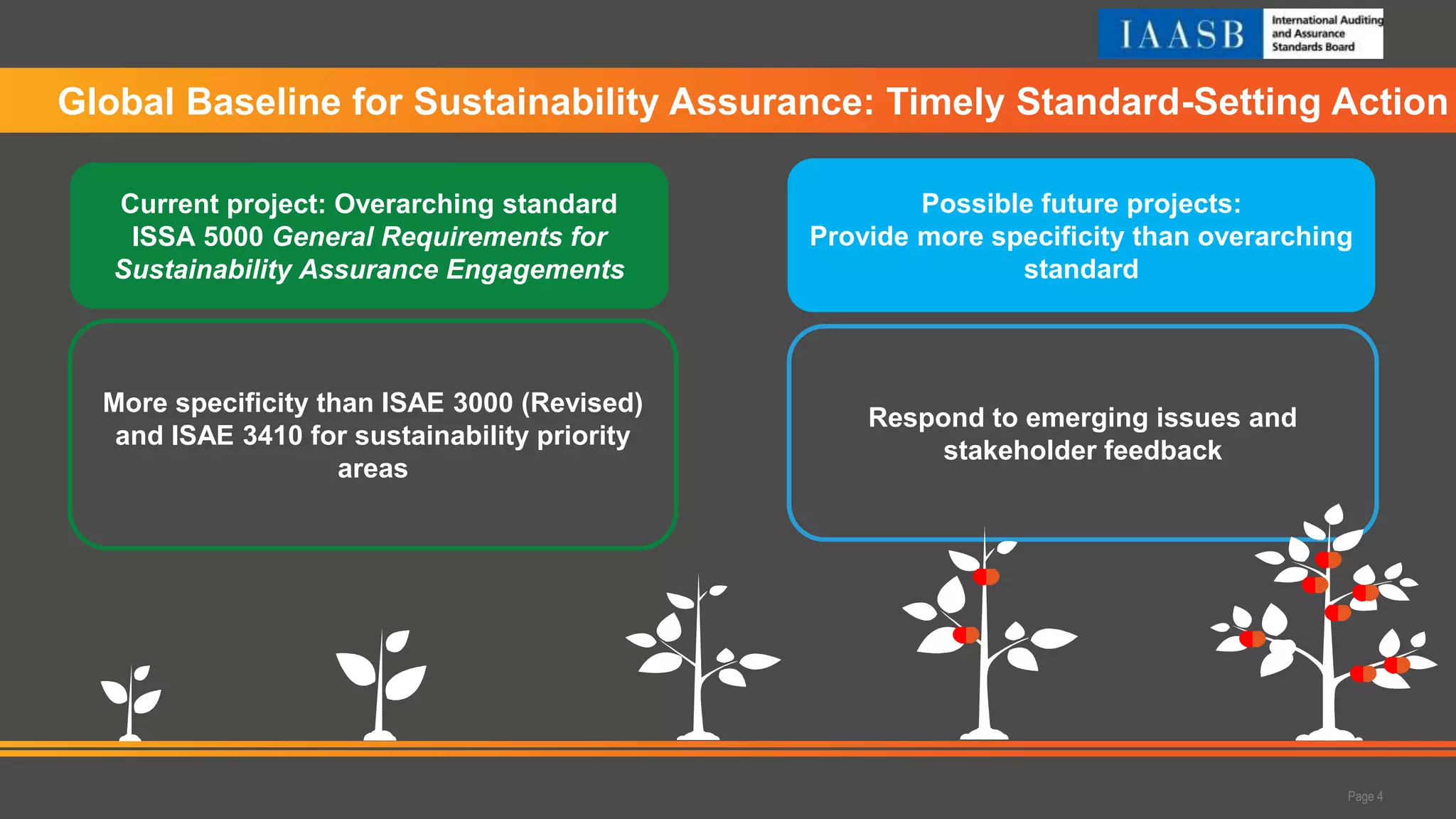
Global Baseline for Sustainability Assurance: Timely Standard-Setting Action
Page 4
Respond to emerging issues and
stakeholder feedback
More specificity than ISAE 3000 (Revised)
and ISAE 3410 for sustainability priority
areas
Possible future projects:
Provide more specificity than overarching
standard
Current project: Overarching standard
ISSA 5000 General Requirements for
Sustainability Assurance Engagements
Scope of Overarching Standard: Proposed ISSA 5000
Page 5
ALL
Information
disclosed
about topics
ALL
Mechanisms
for reporting
ALL
Users /
stakeholders
ALL
Sustainability
topics
ALL
Reporting
standards
Suitable for engagements of all sustainability information;
principles-based requirements that can be applied for
Addresses limited and
reasonable assurance
Stand-alone
Not required to apply ISAE 3000 (Revised)
Page 5
For use by all assurance
practitioners
Relevant quality management
and ethical requirements apply
Key Principles,
Concepts and
Definitions
Dan Montgomery
IAASB Consultant
6
Key Principles, Concepts and Definitions
Page 7
Topics
(e.g., climate, labor
practices, economic
impacts, biodiversity)
Aspects of topics
(e.g., governance, risks and
opportunities, metrics and
key performance indicators)
Sustainability matters
Disclosures
Specific information
about an
aspect of a topic
Sustainability
information
Measure or
evaluate
against
framework
(applicable
criteria )
Key Principles, Concepts and Definitions
Page 8
Criteria
Framework
criteria
Entity –
developed
criteria
Topics
(climate, labor
practices, economic
impacts, biodiversity)
Aspects of topics
(governance, risks and
opportunities, metrics
and key performance
indicators)
Sustainability
matters
Disclosures
Specific information
about an aspect of a
topic
Sustainability
information
Assertions
(e.g., completeness;
occurrence and
responsibility;
accuracy and
quantification; cut-
off; classification and
understandability;
consistency )
Characteristics
E.g., qualitative / quantitative; judgmental /
factual; historical / forward-looking; related to a
point in time / covers a period
“Materiality
process” incl.
double materiality
Key Principles, Concepts and Definitions
Page 9
Criteria
Framework
criteria
Entity –
developed
criteria
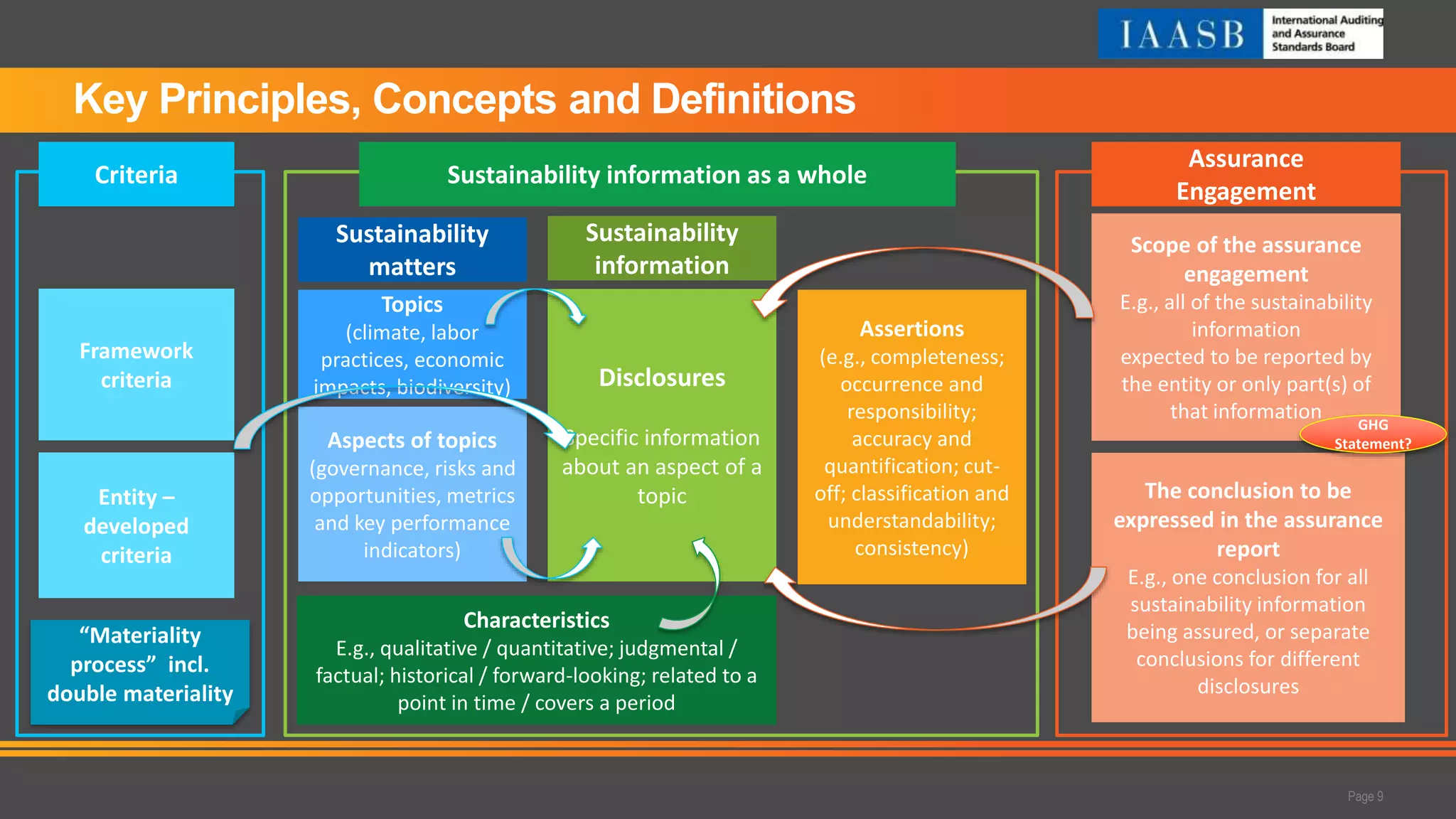
Assurance
Engagement
Scope of the assurance
engagement
E.g., all of the sustainability
information
expected to be reported by
the entity or only part(s) of
that information
The conclusion to be
expressed in the assurance
report
E.g., one conclusion for all
sustainability information
being assured, or separate
conclusions for different
disclosures
Sustainability information as a whole
Topics
(climate, labor
practices, economic
impacts, biodiversity)
Aspects of topics
(governance, risks and
opportunities, metrics
and key performance
indicators)
Sustainability
matters
Disclosures
Specific information
about an aspect of a
topic
Sustainability
information
Assertions
(e.g., completeness;
occurrence and
responsibility;
accuracy and
quantification; cut-
off; classification and
understandability;
consistency)
Characteristics
E.g., qualitative / quantitative; judgmental /
factual; historical / forward-looking; related to a
point in time / covers a period
GHG
Statement?
“Materiality
process” incl.
double materiality
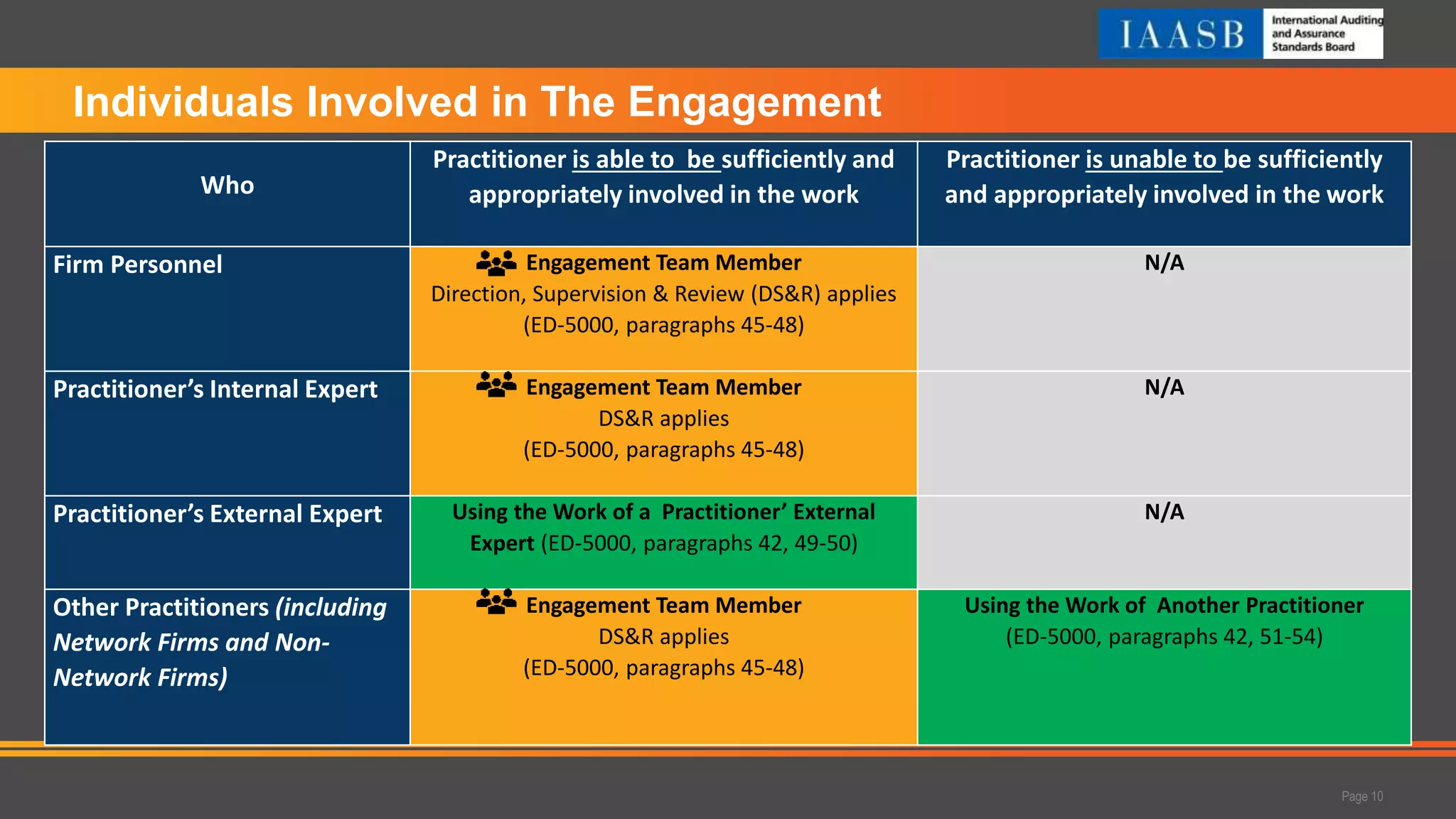
Individuals Involved in The Engagement
Page 10
Who
Practitioner is able to be sufficiently and
appropriately involved in the work
Practitioner is unable to be sufficiently
and appropriately involved in the work
Firm Personnel Engagement Team Member
Direction, Supervision & Review (DS&R) applies
(ED-5000, paragraphs 45-48)
N/A
Practitioner’s Internal Expert Engagement Team Member
DS&R applies
(ED-5000, paragraphs 45-48)
N/A
Practitioner’s External Expert Using the Work of a Practitioner’ External
Expert (ED-5000, paragraphs 42, 49-50)
N/A
Other Practitioners (including
Network Firms and Non-
Network Firms)
Engagement Team Member
DS&R applies
(ED-5000, paragraphs 45-48)
Using the Work of Another Practitioner
(ED-5000, paragraphs 42, 51-54)
Feedback
11
Materiality,
Risk and
Response
Susan Jones
IAASB
Technical Advisor
12
Materiality
Page 13
Consider
materiality for
qualitative
disclosures
Determine
materiality &
performance
materiality for
quantitative
disclosures
Not for SI as a
whole, but for
each disclosure
Professional
judgment
Understand
Understanding
Page 14
• Identify disclosures in the
sustainability information
where material
misstatements are likely to
arise
• Design procedures to focus
on those disclosures
• Identify and assess ROMM at
assertion level for the
disclosures
• Design of further procedures
U
R
L
The entity and its
environment
Applicable criteria
System of Internal
Control
Understand
Understanding the Components of Internal Control
Page 15
15
Understand
The control environment
The information system
The entity’s risk assessment process
Limited
Assurance
Reasonable
Assurance
Understand
& evaluate
Control activities
The entity’s process to monitor the system of internal
control
Only the results
Application material
includes further
specific aspects of
the component for
obtaining an
understanding
(adapted from ISA
315 (Revised 2019))
Reasonable
assurance:
More detailed
requirements that
specify either what
needs to be
understood or
evaluated
Maybe
Designing &
Performing
Further
Procedures
Overall
Responses
Responses
Page 16
Limited Assurance Reasonable Assurance
NTE are focused on the disclosures where material
misstatements are likely to arise
• Tests of controls – ONLY IF – obtaining evidence about
operating effectiveness
• Substantive procedures
Overall responses ONLY IF :
• The practitioner identifies
• Control deficiencies in the control environment that
undermine the other internal control components
• Identified or suspected fraud or NOCLAR
• Material misstatements that are likely to arise
pervasively throughout the SI
NTE responsive to the assessed risks of material
misstatement at the assertion level
• Tests of controls – ONLY IF – obtaining evidence about
operating effectiveness
• Substantive Procedures
Overall responses to address RoMM ONLY IF:
• Practitioner’s evaluation of the control environment
indicates:
• No culture of honesty and ethical behavior
• Control environment does not provide an appropriate
foundation for the other internal control components
• Control deficiencies identified in the control environment
undermine the other components
• The practitioner identifies:
• Identified or suspected fraud or NOCLAR
• Identified RoMM pervasively throughout the SI
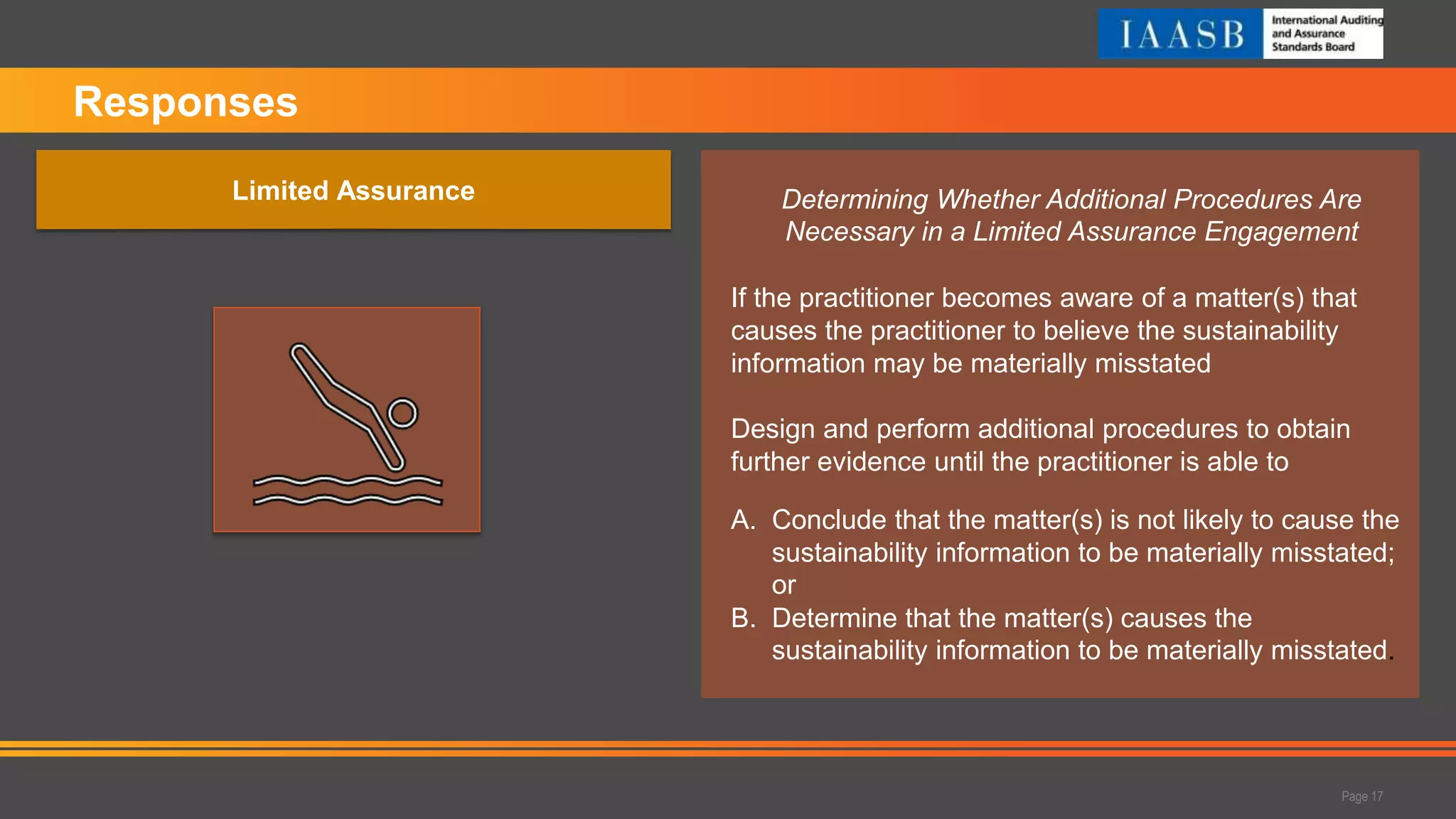
Determining Whether Additional Procedures Are
Necessary in a Limited Assurance Engagement
If the practitioner becomes aware of a matter(s) that
causes the practitioner to believe the sustainability
information may be materially misstated
Design and perform additional procedures to obtain
further evidence until the practitioner is able to
A. Conclude that the matter(s) is not likely to cause the
sustainability information to be materially misstated;
or
B. Determine that the matter(s) causes the
sustainability information to be materially misstated.
Responses
Page 17
Limited Assurance
Response to Risks
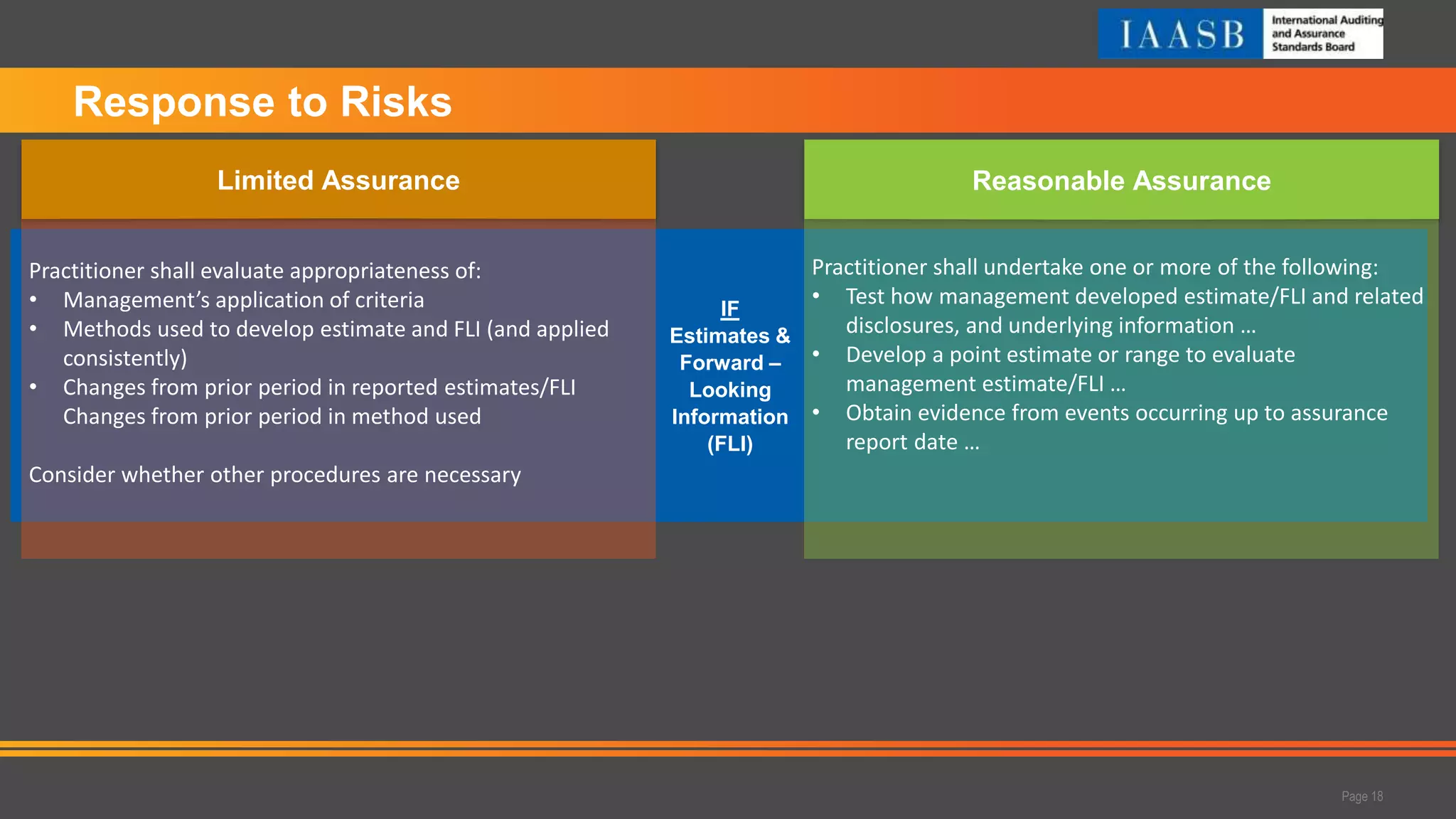
Page 18
IF
Estimates &
Forward –
Looking
Information
(FLI)
Limited Assurance Reasonable Assurance
Practitioner shall evaluate appropriateness of:
• Management’s application of criteria
• Methods used to develop estimate and FLI (and applied
consistently)
• Changes from prior period in reported estimates/FLI
Changes from prior period in method used
Consider whether other procedures are necessary
Practitioner shall undertake one or more of the following:
• Test how management developed estimate/FLI and related
disclosures, and underlying information …
• Develop a point estimate or range to evaluate
management estimate/FLI …
• Obtain evidence from events occurring up to assurance
report date …
Fraud and Professional Skepticism
Page 19
Design and perform procedures
 in an unbiased manner; and
 to meet the intended purpose of performing those procedures
Doubts about relevance and reliability of information
Evaluate whether evidence met intended purpose
Respond appropriately to fraud or suspected fraud
Address inconsistent evidence, respond to management bias
Maintain professional skepticism throughout the engagement
Feedback
20
Misstatements,
Other
Information,
Communication
and Reporting
Claire Grayston
IAASB Staff
21
Material Misstatements and Other Information
Page 22
Example:
Performing
procedures on the
disclosure “work-
related injuries”
Each disclosure
Evaluate individual
and combined effect
of identified
misstatements on
that disclosure
Disclosures in
aggregate
Example:
Conclusion on
“occupational health
and safety”
including work-
related injuries
Evaluate all
misstatements related
to “occupational health
and safety” including
work-related injuries
Material misstatements
Information not subject
to the assurance
engagement
Available at the
date of the
assurance report
Included in a
document(s)
containing the
sustainability
information subject
to the assurances
Misstatement of the other information
Communication with TCWG and Reporting
Page 23
TCWG
Significant matters e.g.
• Identified or suspected fraud or NOCLAR
• Identified deficiencies in internal control
• Management bias in the preparation of the
sustainability information
• Uncorrected material misstatements
Assurance Report
• Based on ISAE 3000 and ISAE 3410
• Practitioner’s opinion to be included first (ISA
700 (Revised))
• Name of the engagement leader (Listed
entity)
• Separate section on other information
Feedback
24
Comprehensive
Global
Outreach
Diane Larson
IAASB Member
25
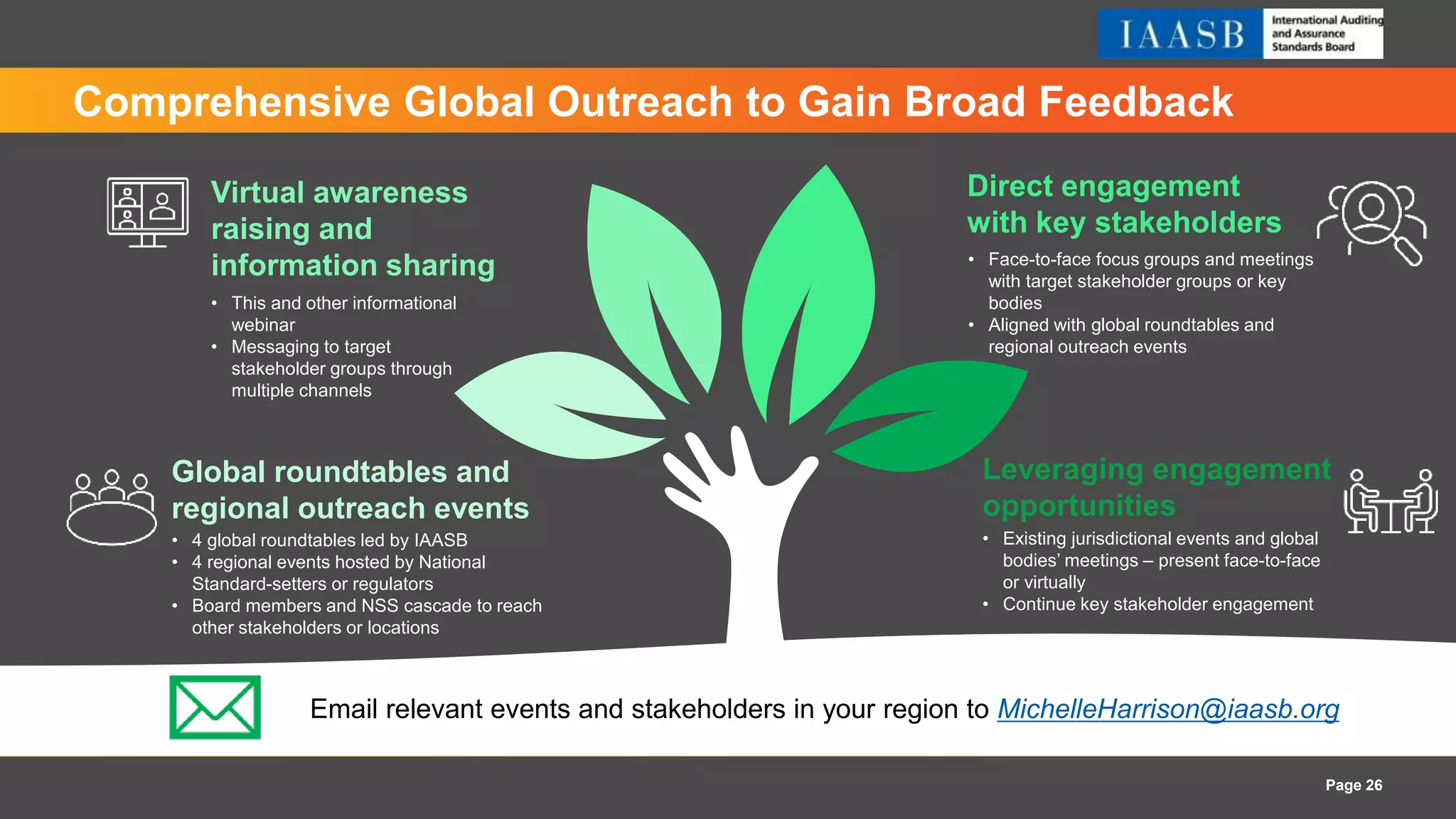
Comprehensive Global Outreach to Gain Broad Feedback
Page 26
Leveraging engagement
opportunities
• Existing jurisdictional events and global
bodies’ meetings – present face-to-face
or virtually
• Continue key stakeholder engagement
Direct engagement
with key stakeholders
• Face-to-face focus groups and meetings
with target stakeholder groups or key
bodies
• Aligned with global roundtables and
regional outreach events
Email relevant events and stakeholders in your region to MichelleHarrison@iaasb.org
Global roundtables and
regional outreach events
• 4 global roundtables led by IAASB
• 4 regional events hosted by National
Standard-setters or regulators
• Board members and NSS cascade to reach
other stakeholders or locations
Virtual awareness
raising and
information sharing
• This and other informational
webinar
• Messaging to target
stakeholder groups through
multiple channels
Register & Subscribe for updates: www.iaasb.org
@International Auditing and Assurance
Standards Board
@IAASB_News
@International Auditing & Assurance
Standards Board
Page 27
Follow Us

IAASB Webinar on Assurance on Sustainability Reporting

  • 1.
    IAASB Webinar Assurance onSustainability Reporting Global Webinar Series 6 September 2023 Diane Larsen IAASB Board Member 1
  • 2.
    Agenda Materiality, Risk andResponse Key Principles, Concepts and Definitions Introduction Misstatements, Other Information, Communication and Reporting Global Outreach
  • 3.
    Introduction Tom Seidenstein IAASB Chair& Co-CEO, International Foundation for Ethics and Audit 3
  • 4.
    Global Baseline forSustainability Assurance: Timely Standard-Setting Action Page 4 Respond to emerging issues and stakeholder feedback More specificity than ISAE 3000 (Revised) and ISAE 3410 for sustainability priority areas Possible future projects: Provide more specificity than overarching standard Current project: Overarching standard ISSA 5000 General Requirements for Sustainability Assurance Engagements
  • 5.
    Scope of OverarchingStandard: Proposed ISSA 5000 Page 5 ALL Information disclosed about topics ALL Mechanisms for reporting ALL Users / stakeholders ALL Sustainability topics ALL Reporting standards Suitable for engagements of all sustainability information; principles-based requirements that can be applied for Addresses limited and reasonable assurance Stand-alone Not required to apply ISAE 3000 (Revised) Page 5 For use by all assurance practitioners Relevant quality management and ethical requirements apply
  • 6.
    Key Principles, Concepts and Definitions DanMontgomery IAASB Consultant 6
  • 7.
    Key Principles, Conceptsand Definitions Page 7 Topics (e.g., climate, labor practices, economic impacts, biodiversity) Aspects of topics (e.g., governance, risks and opportunities, metrics and key performance indicators) Sustainability matters Disclosures Specific information about an aspect of a topic Sustainability information Measure or evaluate against framework (applicable criteria )
  • 8.
    Key Principles, Conceptsand Definitions Page 8 Criteria Framework criteria Entity – developed criteria Topics (climate, labor practices, economic impacts, biodiversity) Aspects of topics (governance, risks and opportunities, metrics and key performance indicators) Sustainability matters Disclosures Specific information about an aspect of a topic Sustainability information Assertions (e.g., completeness; occurrence and responsibility; accuracy and quantification; cut- off; classification and understandability; consistency ) Characteristics E.g., qualitative / quantitative; judgmental / factual; historical / forward-looking; related to a point in time / covers a period “Materiality process” incl. double materiality
  • 9.
    Key Principles, Conceptsand Definitions Page 9 Criteria Framework criteria Entity – developed criteria Assurance Engagement Scope of the assurance engagement E.g., all of the sustainability information expected to be reported by the entity or only part(s) of that information The conclusion to be expressed in the assurance report E.g., one conclusion for all sustainability information being assured, or separate conclusions for different disclosures Sustainability information as a whole Topics (climate, labor practices, economic impacts, biodiversity) Aspects of topics (governance, risks and opportunities, metrics and key performance indicators) Sustainability matters Disclosures Specific information about an aspect of a topic Sustainability information Assertions (e.g., completeness; occurrence and responsibility; accuracy and quantification; cut- off; classification and understandability; consistency) Characteristics E.g., qualitative / quantitative; judgmental / factual; historical / forward-looking; related to a point in time / covers a period GHG Statement? “Materiality process” incl. double materiality
  • 10.
    Individuals Involved inThe Engagement Page 10 Who Practitioner is able to be sufficiently and appropriately involved in the work Practitioner is unable to be sufficiently and appropriately involved in the work Firm Personnel Engagement Team Member Direction, Supervision & Review (DS&R) applies (ED-5000, paragraphs 45-48) N/A Practitioner’s Internal Expert Engagement Team Member DS&R applies (ED-5000, paragraphs 45-48) N/A Practitioner’s External Expert Using the Work of a Practitioner’ External Expert (ED-5000, paragraphs 42, 49-50) N/A Other Practitioners (including Network Firms and Non- Network Firms) Engagement Team Member DS&R applies (ED-5000, paragraphs 45-48) Using the Work of Another Practitioner (ED-5000, paragraphs 42, 51-54)
  • 11.
  • 12.
  • 13.
    Materiality Page 13 Consider materiality for qualitative disclosures Determine materiality& performance materiality for quantitative disclosures Not for SI as a whole, but for each disclosure Professional judgment
  • 14.
    Understand Understanding Page 14 • Identifydisclosures in the sustainability information where material misstatements are likely to arise • Design procedures to focus on those disclosures • Identify and assess ROMM at assertion level for the disclosures • Design of further procedures U R L The entity and its environment Applicable criteria System of Internal Control Understand
  • 15.
    Understanding the Componentsof Internal Control Page 15 15 Understand The control environment The information system The entity’s risk assessment process Limited Assurance Reasonable Assurance Understand & evaluate Control activities The entity’s process to monitor the system of internal control Only the results Application material includes further specific aspects of the component for obtaining an understanding (adapted from ISA 315 (Revised 2019)) Reasonable assurance: More detailed requirements that specify either what needs to be understood or evaluated Maybe
  • 16.
    Designing & Performing Further Procedures Overall Responses Responses Page 16 LimitedAssurance Reasonable Assurance NTE are focused on the disclosures where material misstatements are likely to arise • Tests of controls – ONLY IF – obtaining evidence about operating effectiveness • Substantive procedures Overall responses ONLY IF : • The practitioner identifies • Control deficiencies in the control environment that undermine the other internal control components • Identified or suspected fraud or NOCLAR • Material misstatements that are likely to arise pervasively throughout the SI NTE responsive to the assessed risks of material misstatement at the assertion level • Tests of controls – ONLY IF – obtaining evidence about operating effectiveness • Substantive Procedures Overall responses to address RoMM ONLY IF: • Practitioner’s evaluation of the control environment indicates: • No culture of honesty and ethical behavior • Control environment does not provide an appropriate foundation for the other internal control components • Control deficiencies identified in the control environment undermine the other components • The practitioner identifies: • Identified or suspected fraud or NOCLAR • Identified RoMM pervasively throughout the SI
  • 17.
    Determining Whether AdditionalProcedures Are Necessary in a Limited Assurance Engagement If the practitioner becomes aware of a matter(s) that causes the practitioner to believe the sustainability information may be materially misstated Design and perform additional procedures to obtain further evidence until the practitioner is able to A. Conclude that the matter(s) is not likely to cause the sustainability information to be materially misstated; or B. Determine that the matter(s) causes the sustainability information to be materially misstated. Responses Page 17 Limited Assurance
  • 18.
    Response to Risks Page18 IF Estimates & Forward – Looking Information (FLI) Limited Assurance Reasonable Assurance Practitioner shall evaluate appropriateness of: • Management’s application of criteria • Methods used to develop estimate and FLI (and applied consistently) • Changes from prior period in reported estimates/FLI Changes from prior period in method used Consider whether other procedures are necessary Practitioner shall undertake one or more of the following: • Test how management developed estimate/FLI and related disclosures, and underlying information … • Develop a point estimate or range to evaluate management estimate/FLI … • Obtain evidence from events occurring up to assurance report date …
  • 19.
    Fraud and ProfessionalSkepticism Page 19 Design and perform procedures  in an unbiased manner; and  to meet the intended purpose of performing those procedures Doubts about relevance and reliability of information Evaluate whether evidence met intended purpose Respond appropriately to fraud or suspected fraud Address inconsistent evidence, respond to management bias Maintain professional skepticism throughout the engagement
  • 20.
  • 21.
  • 22.
    Material Misstatements andOther Information Page 22 Example: Performing procedures on the disclosure “work- related injuries” Each disclosure Evaluate individual and combined effect of identified misstatements on that disclosure Disclosures in aggregate Example: Conclusion on “occupational health and safety” including work- related injuries Evaluate all misstatements related to “occupational health and safety” including work-related injuries Material misstatements Information not subject to the assurance engagement Available at the date of the assurance report Included in a document(s) containing the sustainability information subject to the assurances Misstatement of the other information
  • 23.
    Communication with TCWGand Reporting Page 23 TCWG Significant matters e.g. • Identified or suspected fraud or NOCLAR • Identified deficiencies in internal control • Management bias in the preparation of the sustainability information • Uncorrected material misstatements Assurance Report • Based on ISAE 3000 and ISAE 3410 • Practitioner’s opinion to be included first (ISA 700 (Revised)) • Name of the engagement leader (Listed entity) • Separate section on other information
  • 24.
  • 25.
  • 26.
    Comprehensive Global Outreachto Gain Broad Feedback Page 26 Leveraging engagement opportunities • Existing jurisdictional events and global bodies’ meetings – present face-to-face or virtually • Continue key stakeholder engagement Direct engagement with key stakeholders • Face-to-face focus groups and meetings with target stakeholder groups or key bodies • Aligned with global roundtables and regional outreach events Email relevant events and stakeholders in your region to MichelleHarrison@iaasb.org Global roundtables and regional outreach events • 4 global roundtables led by IAASB • 4 regional events hosted by National Standard-setters or regulators • Board members and NSS cascade to reach other stakeholders or locations Virtual awareness raising and information sharing • This and other informational webinar • Messaging to target stakeholder groups through multiple channels
  • 27.
    Register & Subscribefor updates: www.iaasb.org @International Auditing and Assurance Standards Board @IAASB_News @International Auditing & Assurance Standards Board Page 27 Follow Us