STARTUP INCUBATORS -
AS AN OPPORTUNITY FOR ENTREPRENEURSHIP
J,HARIPRIYA
ASSISTANT PROFESSOR
DEPARTMENT OF COMMERCE(HONS)
ETHIRAJ COLLEGE FOR WOMEN
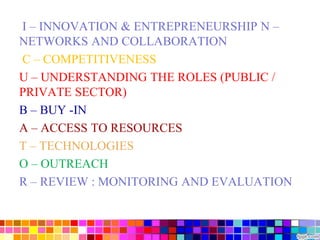
I – INNOVATION & ENTREPRENEURSHIP N –
NETWORKS AND COLLABORATION
C – COMPETITIVENESS
U – UNDERSTANDING THE ROLES (PUBLIC /
PRIVATE SECTOR)
B – BUY -IN
A – ACCESS TO RESOURCES
T – TECHNOLOGIES
O – OUTREACH
R – REVIEW : MONITORING AND EVALUATION
About Business Incubators
• Incubation is a dynamic process of business
development.
• Incubators nurture young firms, helping them to
survive in their early stage.
Incubators provide:
• Infrastructural support i.e. office space, meeting room
• Platform to do networking
• Management assistance
• Other support services, specific to incubators
OBJECTIVES
 To provide focused support to entrepreneurs through
a supportive environment that helps them Establish
their business ideas and develop their concepts into
market ready products,
 Supports the acquisition of business knowledge,
 Facilitates the raising of necessary finance,
 Introduces the entrepreneurs to business networks all
of which should substantially reduce the level of
failure.
 Allow new entrepreneurs to start their business by
reducing the related costs and risk
 Increase their chances of survival and success by
building capacity and networks
 Promotion of new Business Sector, especially in
Innovation and ICT
What Are Business Incubators
• A business incubator is A company that helps new and startup
companies to develop by providing services such as management
training or office space.
• The ultimate goal of incubation is to launch profitable,
sustainable entrepreneurial companies.
• Incubators carefully screen potential businesses because their
space, equipment, and finances are limited, and they want to be
sure they're choosing to nurture businesses with the best possible
chance for success.
• There are approximately 900 business incubators nationwide
Common Incubator Services
Help with business basics
• Networking activities
• Marketing assistance
• High-speed Internet access
• Help with accounting/ financial
management
• Access to bank loans, loan funds
and guarantee programs
• Help with presentation skills
• Links to higher education resources
• Links to strategic partners
• Common Incubator Services
• Access to investors or venture
capital
• Comprehensive business training
programs
• Advisory boards and mentors
• Management team identification
• Help with business etiquette
• Technology commercialization
assistance
• Help with regulatory compliance
• Intellectual property management
Role of Business Incubation
• Business incubation has been identified as a means of meeting a
variety of economic and socioeconomic policy needs, which may
include
• Creating jobs and wealth
• Fostering a community's entrepreneurial climate
• Technology commercialization
• Diversifying local economies
• Building or accelerating growth of local industry clusters
• Business creation and retention
• Encouraging women or minority entrepreneurship
• Identifying potential spin-in or spin-out business opportunities
• Community revitalization
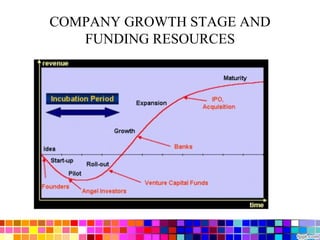
COMPANY GROWTH STAGE AND
FUNDING RESOURCES
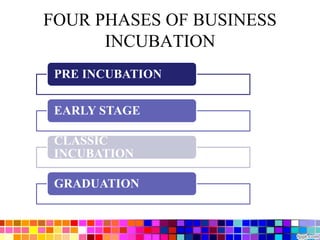
FOUR PHASES OF BUSINESS
INCUBATION
PRE INCUBATION
EARLY STAGE
CLASSIC
INCUBATION
GRADUATION
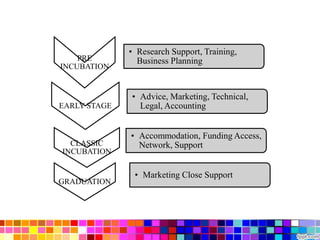
PRE
INCUBATION
• Research Support, Training,
Business Planning
EARLY STAGE
• Advice, Marketing, Technical,
Legal, Accounting
CLASSIC
INCUBATION
• Accommodation, Funding Access,
Network, Support
GRADUATION
• Marketing Close Support
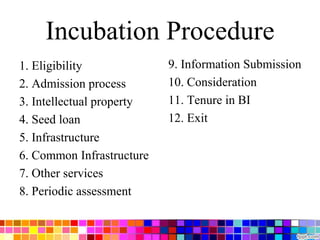
Incubation Procedure
1. Eligibility
2. Admission process
3. Intellectual property
4. Seed loan
5. Infrastructure
6. Common Infrastructure
7. Other services
8. Periodic assessment
9. Information Submission
10. Consideration
11. Tenure in BI
12. Exit
1.Eligibility
 Members, alumni and R&D partners
 Partner universities
 Govt. agencies associated with research and
innovations
 Proposals with social and strategic impact
 Potential for large resource generation, impact value
and visibility
 To be registered in companies Act - 2013
2.Admission Process
 PAQ ( Pre Application Questionnaire)
Business plan
Details of IP/ technology
Screening and Presentation in front of experts
 Decision based on technical, business and
financial viability
3. Intellectual Property
 Any grants from public or private sources has been
used previously
 Applicants right in IP ownership, w.r.t whether his
expertise has been used in product development
 Statement from owners/creators that they are the
“owners/creators” of IP
4.Seed loan
 Based on fund availability
 Only for registered companies
 Based on eligibility criteria
 Disbursements based on milestones
 Preference to companies with strong commitment
and contribution from promoters
 Not entitled to give any reason for rejection
5. Infrastructure
The infrastructural facilities offered to the incubatee company on
an individual basis along with a set of common infrastructure are
:
• Office space
• Internet connection
• Fax machine
• Photocopier
• Scanner
• File server
• Teleconferencing facilities
• Conference room for projection
• Pantry facilities etc.
6.Infrastructure of host/ partner
institution
 Access to departmental laboratories and other
resources
 Access to institutional resources
7.Other services
Apart from the physical infrastructure, BI intends to create other
supports and services which would include:
• Pool of mentors, experts in technology, legal, financial and
related matters
• Organising events
• Meetings with the visitors
• Pool of information and knowledge
• Management education and training programmes
8. Periodic Assessment
 The performance of incubatee companies are
evaluated periodically. The companies will submit the
information on a quarterly basis in a prescribed
format.
 The companies will also be subject to an annual
assessment by a committee comprising of external
experts.
 The companies have to submit there annual reports
each year within a period of 2 months from the date
of annual closing accounts
9.Information Submission
The incubatee companies has to submit about all
material changes or developments taking place in their
companies from time to time.
Also the company has to submit all the information
regarding the changes.
10. Tenure of BI Companies
Tenure of BI Companies will be permitted to stay in BI(
business incubator) for a period of 36 months.
A nominal monthly charge will be levied to the
company for 36 months.
Sometimes the companies can extend their stay for a
maximum of another 24 months
11. Consideration
In lieu of support and services to be provided by incubator, the
incubatee companies will be subject to consideration on
following accounts to the extent applicable: -
Monthly rent/ facilities charge at discounted rate for physical
infrastructure to be paid to SINE. –Society for Innovation
and Entrepreneurship
Consideration in the form of equity and/or revenue sharing of the
respective companies for transfer/ licensing of / permission to use
IP in favour of the incubatee companies and the facilities
provided by BI/ SINE.
The percentage of Equity and revenue sharing will be decided by
SINE and is to be given in favour of SINE. SINE may ask for
additional equity from the companies to whom SINE has supplied
specialised equipments.
12. Exit (Graduation)
Incubatee companies will leave the incubator under the following
circumstances:
• Completion of stay for eighteen months, unless the stay is
extended by SINE
• Irresolvable disputes between promoters/ founders. SINE will
decide the position or point when disputes are deemed to be
irresolvable.
 When the number of employees of the company exceeds 20.
Startup Incubation Centers in India
• Almost every other prestigious B-school today houses an
incubation center so that great ideas can be nurtured from their
very source.
• Currently there are about 100 incubation centers supported by
the ISBA –(Indian step and business incubator Association
)which is the apex Indian professional body supporting business
incubators.
• Private incubators are a handful, but gradually growing.
• These numbers are expected to double within the next two
years.
Top 10 Incubators in India
• Innovation and Entrepreneurship (SINE), IIT Mumbai.
• Technology Business Incubator, IIT Delhi.
• Technopark Technology Business Incubator (T-TBI), Kerala
• Startup Village Kerala.
• Indian Angel Network (IAN)
• Technopark TBI
• Centre for Innovation, Incubation and Entrepreneurship
(CIIE), IIM Ahmedabad
• NSRCEL, IIM Bangalore
• GSF Accelerator
• Angel Prime

Incubation.ppt

  • 1.
    STARTUP INCUBATORS - ASAN OPPORTUNITY FOR ENTREPRENEURSHIP J,HARIPRIYA ASSISTANT PROFESSOR DEPARTMENT OF COMMERCE(HONS) ETHIRAJ COLLEGE FOR WOMEN
  • 2.
    I – INNOVATION& ENTREPRENEURSHIP N – NETWORKS AND COLLABORATION C – COMPETITIVENESS U – UNDERSTANDING THE ROLES (PUBLIC / PRIVATE SECTOR) B – BUY -IN A – ACCESS TO RESOURCES T – TECHNOLOGIES O – OUTREACH R – REVIEW : MONITORING AND EVALUATION
  • 3.
    About Business Incubators •Incubation is a dynamic process of business development. • Incubators nurture young firms, helping them to survive in their early stage. Incubators provide: • Infrastructural support i.e. office space, meeting room • Platform to do networking • Management assistance • Other support services, specific to incubators
  • 4.
    OBJECTIVES  To providefocused support to entrepreneurs through a supportive environment that helps them Establish their business ideas and develop their concepts into market ready products,  Supports the acquisition of business knowledge,  Facilitates the raising of necessary finance,  Introduces the entrepreneurs to business networks all of which should substantially reduce the level of failure.
  • 5.
     Allow newentrepreneurs to start their business by reducing the related costs and risk  Increase their chances of survival and success by building capacity and networks  Promotion of new Business Sector, especially in Innovation and ICT
  • 6.
    What Are BusinessIncubators • A business incubator is A company that helps new and startup companies to develop by providing services such as management training or office space. • The ultimate goal of incubation is to launch profitable, sustainable entrepreneurial companies. • Incubators carefully screen potential businesses because their space, equipment, and finances are limited, and they want to be sure they're choosing to nurture businesses with the best possible chance for success. • There are approximately 900 business incubators nationwide
  • 7.
    Common Incubator Services Helpwith business basics • Networking activities • Marketing assistance • High-speed Internet access • Help with accounting/ financial management • Access to bank loans, loan funds and guarantee programs • Help with presentation skills • Links to higher education resources • Links to strategic partners • Common Incubator Services • Access to investors or venture capital • Comprehensive business training programs • Advisory boards and mentors • Management team identification • Help with business etiquette • Technology commercialization assistance • Help with regulatory compliance • Intellectual property management
  • 8.
    Role of BusinessIncubation • Business incubation has been identified as a means of meeting a variety of economic and socioeconomic policy needs, which may include • Creating jobs and wealth • Fostering a community's entrepreneurial climate • Technology commercialization • Diversifying local economies • Building or accelerating growth of local industry clusters • Business creation and retention • Encouraging women or minority entrepreneurship • Identifying potential spin-in or spin-out business opportunities • Community revitalization
  • 9.
    COMPANY GROWTH STAGEAND FUNDING RESOURCES
  • 10.
    FOUR PHASES OFBUSINESS INCUBATION PRE INCUBATION EARLY STAGE CLASSIC INCUBATION GRADUATION
  • 11.
    PRE INCUBATION • Research Support,Training, Business Planning EARLY STAGE • Advice, Marketing, Technical, Legal, Accounting CLASSIC INCUBATION • Accommodation, Funding Access, Network, Support GRADUATION • Marketing Close Support
  • 12.
    Incubation Procedure 1. Eligibility 2.Admission process 3. Intellectual property 4. Seed loan 5. Infrastructure 6. Common Infrastructure 7. Other services 8. Periodic assessment 9. Information Submission 10. Consideration 11. Tenure in BI 12. Exit
  • 13.
    1.Eligibility  Members, alumniand R&D partners  Partner universities  Govt. agencies associated with research and innovations  Proposals with social and strategic impact  Potential for large resource generation, impact value and visibility  To be registered in companies Act - 2013
  • 14.
    2.Admission Process  PAQ( Pre Application Questionnaire) Business plan Details of IP/ technology Screening and Presentation in front of experts  Decision based on technical, business and financial viability
  • 15.
    3. Intellectual Property Any grants from public or private sources has been used previously  Applicants right in IP ownership, w.r.t whether his expertise has been used in product development  Statement from owners/creators that they are the “owners/creators” of IP
  • 16.
    4.Seed loan  Basedon fund availability  Only for registered companies  Based on eligibility criteria  Disbursements based on milestones  Preference to companies with strong commitment and contribution from promoters  Not entitled to give any reason for rejection
  • 17.
    5. Infrastructure The infrastructuralfacilities offered to the incubatee company on an individual basis along with a set of common infrastructure are : • Office space • Internet connection • Fax machine • Photocopier • Scanner • File server • Teleconferencing facilities • Conference room for projection • Pantry facilities etc.
  • 18.
    6.Infrastructure of host/partner institution  Access to departmental laboratories and other resources  Access to institutional resources
  • 19.
    7.Other services Apart fromthe physical infrastructure, BI intends to create other supports and services which would include: • Pool of mentors, experts in technology, legal, financial and related matters • Organising events • Meetings with the visitors • Pool of information and knowledge • Management education and training programmes
  • 20.
    8. Periodic Assessment The performance of incubatee companies are evaluated periodically. The companies will submit the information on a quarterly basis in a prescribed format.  The companies will also be subject to an annual assessment by a committee comprising of external experts.  The companies have to submit there annual reports each year within a period of 2 months from the date of annual closing accounts
  • 21.
    9.Information Submission The incubateecompanies has to submit about all material changes or developments taking place in their companies from time to time. Also the company has to submit all the information regarding the changes.
  • 22.
    10. Tenure ofBI Companies Tenure of BI Companies will be permitted to stay in BI( business incubator) for a period of 36 months. A nominal monthly charge will be levied to the company for 36 months. Sometimes the companies can extend their stay for a maximum of another 24 months
  • 23.
    11. Consideration In lieuof support and services to be provided by incubator, the incubatee companies will be subject to consideration on following accounts to the extent applicable: - Monthly rent/ facilities charge at discounted rate for physical infrastructure to be paid to SINE. –Society for Innovation and Entrepreneurship Consideration in the form of equity and/or revenue sharing of the respective companies for transfer/ licensing of / permission to use IP in favour of the incubatee companies and the facilities provided by BI/ SINE. The percentage of Equity and revenue sharing will be decided by SINE and is to be given in favour of SINE. SINE may ask for additional equity from the companies to whom SINE has supplied specialised equipments.
  • 24.
    12. Exit (Graduation) Incubateecompanies will leave the incubator under the following circumstances: • Completion of stay for eighteen months, unless the stay is extended by SINE • Irresolvable disputes between promoters/ founders. SINE will decide the position or point when disputes are deemed to be irresolvable.  When the number of employees of the company exceeds 20.
  • 25.
    Startup Incubation Centersin India • Almost every other prestigious B-school today houses an incubation center so that great ideas can be nurtured from their very source. • Currently there are about 100 incubation centers supported by the ISBA –(Indian step and business incubator Association )which is the apex Indian professional body supporting business incubators. • Private incubators are a handful, but gradually growing. • These numbers are expected to double within the next two years.
  • 26.
    Top 10 Incubatorsin India • Innovation and Entrepreneurship (SINE), IIT Mumbai. • Technology Business Incubator, IIT Delhi. • Technopark Technology Business Incubator (T-TBI), Kerala • Startup Village Kerala. • Indian Angel Network (IAN) • Technopark TBI • Centre for Innovation, Incubation and Entrepreneurship (CIIE), IIM Ahmedabad • NSRCEL, IIM Bangalore • GSF Accelerator • Angel Prime