Agri-Business Incubator (ABI) Essentials of Business Plan & Partnership Proposal with  ICAR -BPD Units  under NAIP Component 1
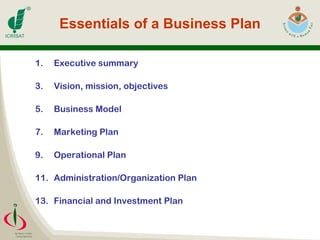
Executive summary Vision, mission, objectives  Business Model Marketing Plan Operational Plan Administration/Organization Plan Financial and Investment Plan Essentials of a Business Plan
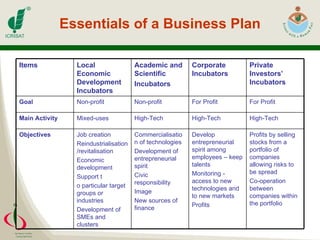
Essentials of a Business Plan Profits by selling stocks from a portfolio of companies allowing risks to be spread  Co-operation between companies within the portfolio  Develop entrepreneurial spirit among employees – keep talents  Monitoring - access to new technologies and to new markets  Profits  Commercialisation of technologies  Development of entrepreneurial spirit  Civic responsibility  Image  New sources of finance  Job creation  Reindustrialisation /revitalisation  Economic development  Support t o particular target groups or industries  Development of SMEs and clusters  Objectives   High-Tech  High-Tech  High-Tech  Mixed-uses  Main Activity   For Profit  For Profit  Non-profit  Non-profit  Goal   Private Investors’ Incubators   Corporate Incubators   Academic and Scientific  Incubators   Local Economic Development Incubators   Items
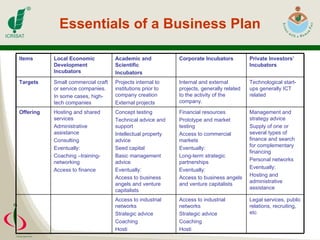
Essentials of a Business Plan Legal services, public relations, recruiting, etc  Access to industrial networks  Strategic advice  Coaching  Hosti  Access to industrial networks  Strategic advice  Coaching  Hosti  Management and strategy advice  Supply of one or several types of finance and search for complementary financing  Personal networks Eventually: Hosting and administrative assistance  Financial resources  Prototype and market testing  Access to commercial markets  Eventually:  Long-term strategic partnerships  Eventually: Access to business angels and venture capitalists  Concept testing  Technical advice and support  Intellectual property advice  Seed capital  Basic management advice Eventually: Access to business angels and venture capitalists  Hosting and shared services  Administrative assistance  Consulting  Eventually:  Coaching –training- networking  Access to finance  Offering   Technological start-ups generally ICT related  Internal and external projects, generally related to the activity of the company.  Projects internal to institutions prior to company creation  External projects  Small commercial craft or service companies.  In some cases, high-tech companies  Targets   Private Investors’ Incubators   Corporate Incubators   Academic and Scientific  Incubators   Local Economic Development Incubators   Items
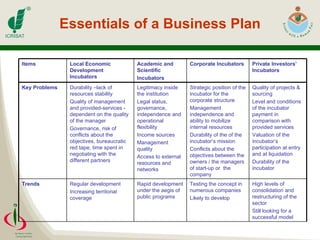
Essentials of a Business Plan High levels of consolidation and restructuring of the sector  Still looking for a successful model  Testing the concept in numerous companies  Likely to develop  Rapid development under the aegis of public programs  Regular development  Increasing territorial coverage  Trends   Quality of projects & sourcing  Level and conditions of the incubator payment in comparison with provided services  Valuation of the incubator’s participation at entry and at liquidation  Durability of the incubator  Strategic position of the incubator for the corporate structure  Management independence and ability to mobilize internal resources  Durability of the of the incubator’s mission  Conflicts about the objectives between the owners / the managers of start-up or  the company  Legitimacy inside the institution  Legal status, governance, independence and operational flexibility  Income sources  Management quality  Access to external resources and networks  Durability –lack of resources stability  Quality of management and provided-services - dependent on the quality of the manager  Governance, risk of conflicts about the objectives, bureaucratic red tape, time spent in negotiating with the different partners  Key Problems   Private Investors’ Incubators   Corporate Incubators   Academic and Scientific  Incubators   Local Economic Development Incubators   Items
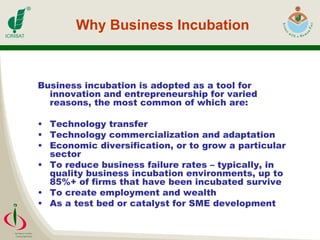
Why Business Incubation Business incubation is adopted as a tool for innovation and entrepreneurship for varied reasons, the most common of which are:  Technology transfer Technology commercialization and adaptation  Economic diversification, or to grow a particular sector  To reduce business failure rates – typically, in  quality business incubation environments, up to 85%+ of firms that have been incubated survive  To create employment and wealth  As a test bed or catalyst for SME development
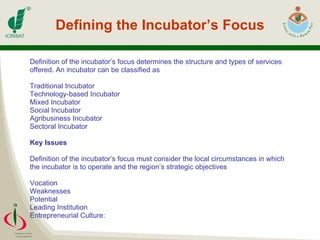
Defining the Incubator’s Focus Definition of the incubator’s focus determines the structure and types of services  offered. An incubator can be classified as Traditional Incubator Technology-based Incubator Mixed Incubator Social Incubator Agribusiness Incubator Sectoral Incubator Key Issues Definition of the incubator’s focus must consider the local circumstances in which  the incubator is to operate and the region’s strategic objectives Vocation  Weaknesses  Potential  Leading Institution  Entrepreneurial Culture:
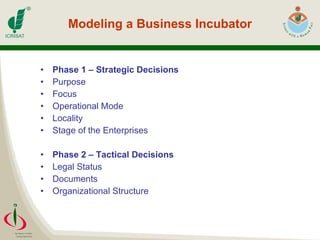
Phase 1 – Strategic Decisions  Purpose Focus Operational Mode Locality Stage of the Enterprises Phase 2 – Tactical Decisions  Legal Status Documents Organizational Structure Modeling a Business Incubator
Defining the Stage of Enterprises to be supported through BPD Units The process of creating and developing Businesses Conception Emerging Growth Consolidation
Defining the services to be provided    in BPD Units I  a. Consultants and Advisers b. mentoring group  c. The advisers II  Management/Strategic Support Programs a. Assistance/Consulting in Specific Areas   – List of Services  Access to databases and networks  Joint purchase of materials  Business diagnostics  Publicity and marketing  Information on lines of incentives and financing  Market information/research  Business guidance and consulting  Legal and accounting guidance  Registration of trademarks and patents  Support for the preparation of business plans Testing services, validation b.  Training   III  Infrastructural services a. Office b. Lab/production space c agricultural land d. equipment access
Defining the Location The best definition of the preferred location is choosing an area that satisfies the incubator’s current and future needs. The location depends on the incubator’s focus, since the companies’ activities may demand characteristics found in few of the region’s localities. Urban Suburban Rural Key Issues Infrastructure Flexibility: Focus: Master Plan
Defining the Organizational Structure of BPD Units To define a structure that makes management of the incubator possible. There are two groups of  activities generally present in an incubator: Those related to operation of the incubator as an independent organization (a business); and  Those related to developing the incubated companies. This normally composed of three managerial levels Board of Directors : Incubator Management Consultant Committee:
Revenue Model for ABI IIAM Revenue from tenants Rents/lease Revenue  from sharing in client success-equity/royalty On-going government or donor funding Membership fee/Franchisee fee Service charge- Consultancy/Testing etc.,
NEXT STEPS Collate, analyze management, Technical & market feed back Develop draft Business model Develop a draft approach & responsibility for detailed plan development Identify the Key resource people in & out  Final proposal submission to NAIP
ABI-ICRISAT ABI-ICRISAT   Partnership Proposal   to   ICAR-BPD Units  through NAIP
What we can offer Technology & Business module package Co-Business Incubation Handholding of the BPD Units/BIs Capacity Building on Mgt, Operations Business Consultancy & Networking Monitoring & Evaluation
Technology & Business module package Identify 5-10 technologies for Business Incubation Assess the market potential & its viability Select 2-3 technologies for commercialization Develop a package to promote the technology through business/technical services
Co-Business Incubation Co-marketing with common brand Website management Entrepreneurship awareness camp Focus media marketing Publicity (press/media/exhibits) Help Desk & Direct marketing
Handholding Incorporation of systems Establishment of BPD/BI units Recruitment of staffs Induction program for staffs & team Mentoring, coordinating & facilitating
Capacity Building & Training on Business Incubation   Sensitizing on Business Incubation & Business Plan preparation for 2 days (Different Modules) Training & Establishment of Incubators  Strategy, Client servicing, operations, establishment, marketing, graduation, funding & financial management Gap identification & Special Training through domestic & International partners (Infodev & NBIA Network)
Monitoring & Evaluation Benchmarking Reporting & evaluation through online software On site monitoring & evaluation Governance meeting (Twice a year) Team building & motivation Best incubatee / Incubator award Get togethers & networking
What is our Background ICRISAT CGIAR PPPP (Public-Private People Partnership) Agri-Science Park (ASP) Agri-Business Incubator (ABI)
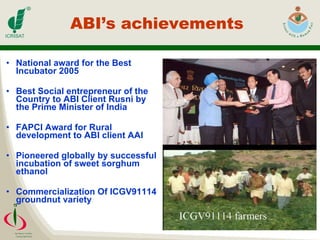
ABI’s achievements  National award for the Best Incubator 2005 Best Social entrepreneur of the Country to ABI Client Rusni by the Prime Minister of India FAPCI Award for Rural development to ABI client AAI Pioneered globally by successful incubation of sweet sorghum ethanol Commercialization Of ICGV91114 groundnut variety
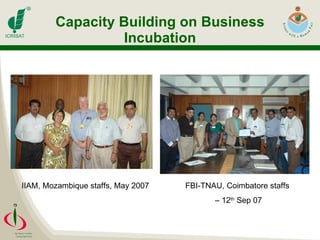
Capacity Building on Business Incubation FBI-TNAU, Coimbatore staffs –  12 th  Sep 07 IIAM, Mozambique staffs, May 2007
Global Outreach ABI at Agricultural Research and Extension Unit (AREU), Mauritius FBI at Institute of International Agriculture (IIAM), Mozambique
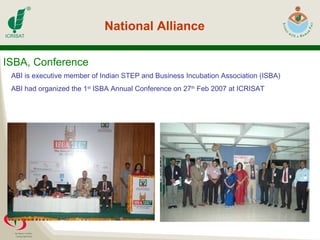
ISBA, Conference National Alliance ABI is executive member of Indian STEP and Business Incubation Association (ISBA) ABI had organized the 1 st  ISBA Annual Conference on 27 th  Feb 2007 at ICRISAT
2 nd  Global Forum for Business Incubation, Nov 6-10 th  2006 International Alliance ABI is a active member of Global Business Incubators Network ABI had organized the 2nd Global Forum for Business Incubation along with World Bank, DST and FICCI in Hyderabad
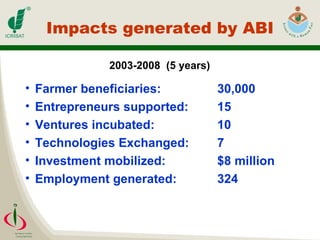
Impacts generated by ABI 2003-2008  (5 years) Farmer beneficiaries: 30,000 Entrepreneurs supported: 15 Ventures incubated: 10 Technologies Exchanged: 7 Investment mobilized: $8 million Employment generated: 324
Thank you

Abi ppt 2008-naip-partnership

  • 1.
    Agri-Business Incubator (ABI)Essentials of Business Plan & Partnership Proposal with ICAR -BPD Units under NAIP Component 1
  • 2.
    Executive summary Vision,mission, objectives Business Model Marketing Plan Operational Plan Administration/Organization Plan Financial and Investment Plan Essentials of a Business Plan
  • 3.
    Essentials of aBusiness Plan Profits by selling stocks from a portfolio of companies allowing risks to be spread Co-operation between companies within the portfolio Develop entrepreneurial spirit among employees – keep talents Monitoring - access to new technologies and to new markets Profits Commercialisation of technologies Development of entrepreneurial spirit Civic responsibility Image New sources of finance Job creation Reindustrialisation /revitalisation Economic development Support t o particular target groups or industries Development of SMEs and clusters Objectives High-Tech High-Tech High-Tech Mixed-uses Main Activity For Profit For Profit Non-profit Non-profit Goal Private Investors’ Incubators Corporate Incubators Academic and Scientific Incubators Local Economic Development Incubators Items
  • 4.
    Essentials of aBusiness Plan Legal services, public relations, recruiting, etc Access to industrial networks Strategic advice Coaching Hosti Access to industrial networks Strategic advice Coaching Hosti Management and strategy advice Supply of one or several types of finance and search for complementary financing Personal networks Eventually: Hosting and administrative assistance Financial resources Prototype and market testing Access to commercial markets Eventually: Long-term strategic partnerships Eventually: Access to business angels and venture capitalists Concept testing Technical advice and support Intellectual property advice Seed capital Basic management advice Eventually: Access to business angels and venture capitalists Hosting and shared services Administrative assistance Consulting Eventually: Coaching –training- networking Access to finance Offering Technological start-ups generally ICT related Internal and external projects, generally related to the activity of the company. Projects internal to institutions prior to company creation External projects Small commercial craft or service companies. In some cases, high-tech companies Targets Private Investors’ Incubators Corporate Incubators Academic and Scientific Incubators Local Economic Development Incubators Items
  • 5.
    Essentials of aBusiness Plan High levels of consolidation and restructuring of the sector Still looking for a successful model Testing the concept in numerous companies Likely to develop Rapid development under the aegis of public programs Regular development Increasing territorial coverage Trends Quality of projects & sourcing Level and conditions of the incubator payment in comparison with provided services Valuation of the incubator’s participation at entry and at liquidation Durability of the incubator Strategic position of the incubator for the corporate structure Management independence and ability to mobilize internal resources Durability of the of the incubator’s mission Conflicts about the objectives between the owners / the managers of start-up or the company Legitimacy inside the institution Legal status, governance, independence and operational flexibility Income sources Management quality Access to external resources and networks Durability –lack of resources stability Quality of management and provided-services - dependent on the quality of the manager Governance, risk of conflicts about the objectives, bureaucratic red tape, time spent in negotiating with the different partners Key Problems Private Investors’ Incubators Corporate Incubators Academic and Scientific Incubators Local Economic Development Incubators Items
  • 6.
    Why Business IncubationBusiness incubation is adopted as a tool for innovation and entrepreneurship for varied reasons, the most common of which are: Technology transfer Technology commercialization and adaptation Economic diversification, or to grow a particular sector To reduce business failure rates – typically, in quality business incubation environments, up to 85%+ of firms that have been incubated survive To create employment and wealth As a test bed or catalyst for SME development
  • 7.
    Defining the Incubator’sFocus Definition of the incubator’s focus determines the structure and types of services offered. An incubator can be classified as Traditional Incubator Technology-based Incubator Mixed Incubator Social Incubator Agribusiness Incubator Sectoral Incubator Key Issues Definition of the incubator’s focus must consider the local circumstances in which the incubator is to operate and the region’s strategic objectives Vocation Weaknesses Potential Leading Institution Entrepreneurial Culture:
  • 8.
    Phase 1 –Strategic Decisions Purpose Focus Operational Mode Locality Stage of the Enterprises Phase 2 – Tactical Decisions Legal Status Documents Organizational Structure Modeling a Business Incubator
  • 9.
    Defining the Stageof Enterprises to be supported through BPD Units The process of creating and developing Businesses Conception Emerging Growth Consolidation
  • 10.
    Defining the servicesto be provided in BPD Units I a. Consultants and Advisers b. mentoring group c. The advisers II Management/Strategic Support Programs a. Assistance/Consulting in Specific Areas – List of Services Access to databases and networks Joint purchase of materials Business diagnostics Publicity and marketing Information on lines of incentives and financing Market information/research Business guidance and consulting Legal and accounting guidance Registration of trademarks and patents Support for the preparation of business plans Testing services, validation b. Training III Infrastructural services a. Office b. Lab/production space c agricultural land d. equipment access
  • 11.
    Defining the LocationThe best definition of the preferred location is choosing an area that satisfies the incubator’s current and future needs. The location depends on the incubator’s focus, since the companies’ activities may demand characteristics found in few of the region’s localities. Urban Suburban Rural Key Issues Infrastructure Flexibility: Focus: Master Plan
  • 12.
    Defining the OrganizationalStructure of BPD Units To define a structure that makes management of the incubator possible. There are two groups of activities generally present in an incubator: Those related to operation of the incubator as an independent organization (a business); and Those related to developing the incubated companies. This normally composed of three managerial levels Board of Directors : Incubator Management Consultant Committee:
  • 13.
    Revenue Model forABI IIAM Revenue from tenants Rents/lease Revenue  from sharing in client success-equity/royalty On-going government or donor funding Membership fee/Franchisee fee Service charge- Consultancy/Testing etc.,
  • 14.
    NEXT STEPS Collate,analyze management, Technical & market feed back Develop draft Business model Develop a draft approach & responsibility for detailed plan development Identify the Key resource people in & out Final proposal submission to NAIP
  • 15.
    ABI-ICRISAT ABI-ICRISAT Partnership Proposal to ICAR-BPD Units through NAIP
  • 16.
    What we canoffer Technology & Business module package Co-Business Incubation Handholding of the BPD Units/BIs Capacity Building on Mgt, Operations Business Consultancy & Networking Monitoring & Evaluation
  • 17.
    Technology & Businessmodule package Identify 5-10 technologies for Business Incubation Assess the market potential & its viability Select 2-3 technologies for commercialization Develop a package to promote the technology through business/technical services
  • 18.
    Co-Business Incubation Co-marketingwith common brand Website management Entrepreneurship awareness camp Focus media marketing Publicity (press/media/exhibits) Help Desk & Direct marketing
  • 19.
    Handholding Incorporation ofsystems Establishment of BPD/BI units Recruitment of staffs Induction program for staffs & team Mentoring, coordinating & facilitating
  • 20.
    Capacity Building &Training on Business Incubation Sensitizing on Business Incubation & Business Plan preparation for 2 days (Different Modules) Training & Establishment of Incubators Strategy, Client servicing, operations, establishment, marketing, graduation, funding & financial management Gap identification & Special Training through domestic & International partners (Infodev & NBIA Network)
  • 21.
    Monitoring & EvaluationBenchmarking Reporting & evaluation through online software On site monitoring & evaluation Governance meeting (Twice a year) Team building & motivation Best incubatee / Incubator award Get togethers & networking
  • 22.
    What is ourBackground ICRISAT CGIAR PPPP (Public-Private People Partnership) Agri-Science Park (ASP) Agri-Business Incubator (ABI)
  • 23.
    ABI’s achievements National award for the Best Incubator 2005 Best Social entrepreneur of the Country to ABI Client Rusni by the Prime Minister of India FAPCI Award for Rural development to ABI client AAI Pioneered globally by successful incubation of sweet sorghum ethanol Commercialization Of ICGV91114 groundnut variety
  • 24.
    Capacity Building onBusiness Incubation FBI-TNAU, Coimbatore staffs – 12 th Sep 07 IIAM, Mozambique staffs, May 2007
  • 25.
    Global Outreach ABIat Agricultural Research and Extension Unit (AREU), Mauritius FBI at Institute of International Agriculture (IIAM), Mozambique
  • 26.
    ISBA, Conference NationalAlliance ABI is executive member of Indian STEP and Business Incubation Association (ISBA) ABI had organized the 1 st ISBA Annual Conference on 27 th Feb 2007 at ICRISAT
  • 27.
    2 nd Global Forum for Business Incubation, Nov 6-10 th 2006 International Alliance ABI is a active member of Global Business Incubators Network ABI had organized the 2nd Global Forum for Business Incubation along with World Bank, DST and FICCI in Hyderabad
  • 28.
    Impacts generated byABI 2003-2008 (5 years) Farmer beneficiaries: 30,000 Entrepreneurs supported: 15 Ventures incubated: 10 Technologies Exchanged: 7 Investment mobilized: $8 million Employment generated: 324
  • 29.

Editor's Notes

  • #2 Mr Juan Miguel Luz, President, International Institute of Rural Reconstruction, guests and dear friends, I thank the International Institute of Rural Reconstruction for giving me this opportunity to speak on “ Making technology pay off for rural enterprises: Managing the human resource requirements for enterprise development in rural areas’. This presentation will be illustrating how the Institute I head, the International Crops Research Institute for the Semi-Arid Tropics, goes about empowering the rural poor with its wide array of technologies that facilitate rural enterprises.