1
New Geographies : New Curriculum
PC (Post Coronavirus) School Geographies
A provocation & some curriculum making
‘Geography, like all dynamic areas of disciplinary thought, is
in a constant state of becoming’.
(Lambert & Morgan, 2010)
Alan Parkinson
V8.0
Late July 2020
Cover image copyright: Tony Cassidy - used with permission
All Alan Parkinson’s text shared under CC license - other material copyrighted.
2
Moments of crisis, such as the one we are living, are deeply painful in ways that
cannot be underestimated. The social and emotional impacts of Covid-19 will be
felt even after we return to normal global health conditions. We will emerge,
albeit more slowly, from the unprecedented economic paralysis. The question is
how we emerge: whether we return to the ways of the past or whether we derive
valuable lessons, to emerge wiser and better equipped to continue to deal with
our longstanding emergency of climate change.
The coronavirus tragedy has shown that we are only as safe as the most
vulnerable among us and that cross-border threats require global, systemic
solutions, as well as individual behaviour changes. Over the past few weeks,
governments and businesses have acted swiftly to mandate drastic, but
necessary measures to stem the coronavirus, keeping people indoors,
grounding air travel, cancelling events and closing borders. Citizens, equally,
are uniting to shift their behaviour en masse, by working and teaching their
children from home, washing their hands more frequently, protecting the
elderly, and helping neighbours shop for food.
The Covid-19 pandemic has unleashed humanity’s instinct to transform itself in
the face of a universal threat and it can help us do the same to create a livable
planet for future generations.
Christiana Figueres, former chair of UNFCCC
Source of the quote:
https://www.carbonbrief.org/coronavirus-what-could-lifestyle-changes-mean-for-
tackling-climate-chanhttpsge
Pestilence is so common, there have been as many plagues in the world
as there have been wars, yet plagues and wars always find people
equally unprepared.
Albert Camus ‘La Peste’ (1947)
“The lesson for people to understand is this is the year of living differently. Not,
‘OK, it’s over’. You haven’t just been let out of school. You have done well. You have really
brought down your numbers. So, now is the moment to celebrate that by being super
careful.”
Dr Margaret Harris, WHO, June 23rd 2020
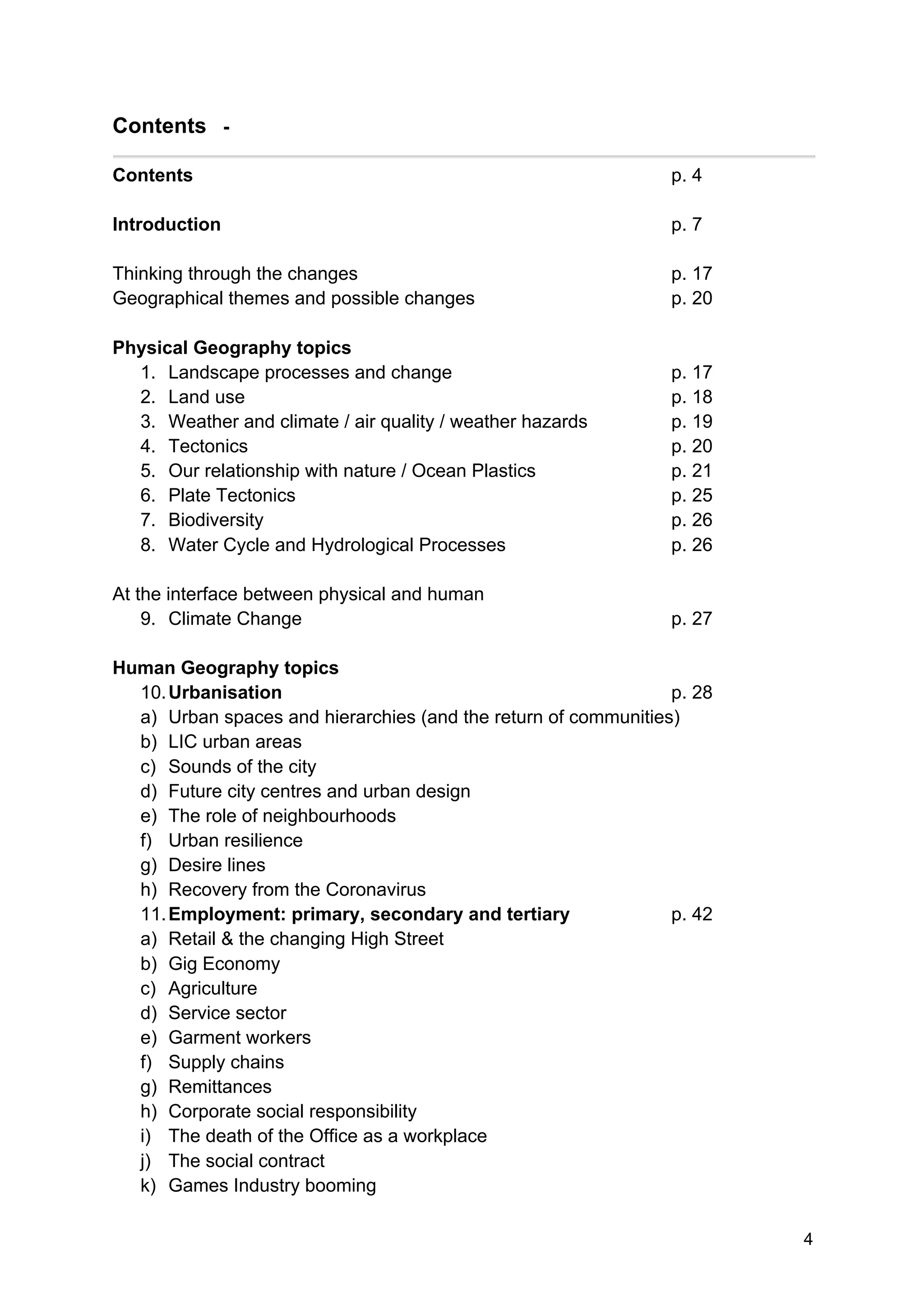
The powerful front cover of the New York Times for 24th May 2020
3
4
Contents -
Contents p. 4
Introduction p. 7
Thinking through the changes p. 17
Geographical themes and possible changes p. 20
Physical Geography topics
1. Landscape processes and change p. 17
2. Land use p. 18
3. Weather and climate / air quality / weather hazards p. 19
4. Tectonics p. 20
5. Our relationship with nature / Ocean Plastics p. 21
6. Plate Tectonics p. 25
7. Biodiversity p. 26
8. Water Cycle and Hydrological Processes p. 26
At the interface between physical and human
9. Climate Change p. 27
Human Geography topics
10.Urbanisation p. 28
a) Urban spaces and hierarchies (and the return of communities)
b) LIC urban areas
c) Sounds of the city
d) Future city centres and urban design
e) The role of neighbourhoods
f) Urban resilience
g) Desire lines
h) Recovery from the Coronavirus
11.Employment: primary, secondary and tertiary p. 42
a) Retail & the changing High Street
b) Gig Economy
c) Agriculture
d) Service sector
e) Garment workers
f) Supply chains
g) Remittances
h) Corporate social responsibility
i) The death of the Office as a workplace
j) The social contract
k) Games Industry booming
5
l) Droning on
m) After the furlough ends...
12.Development and Inequality p.62
including #BlackLivesMatter p.70
13.Changing leisure time and working hours p.71
14.Demographics p.72
a) Natural increase - a baby boom or bust?
b) Migration
c) Non Covid-19 mortality
d) Twentysomething issues
e) Population pyramids
f) Gender issues
15.Globalisation & Geopolitics p.74
16.Carbon footprints p.77
17.Tourism - a changed industry p.79
a) Tourism closing down
b) Tourism reopening again
18.Crime p.86
19.Transport p.87
20.Geographies of Convenience p.91
21.Sustainable Development Goals p.92
22.Food Security, Food Banks & the importance of diet p.93
23.Superpowers: Hard and Soft Power p.97
- The UK as an emerging market?
24.Sense of Place p.99
25.Energy p.99
26.New communities p.100
27.Surveillance (link to D3 Erasmus project) p.100
28.Geography of Disease p.102
29.Borders p.106
30.Van lifers - modern nomads p.106
31.The ultimate ‘postcode lottery’ p.107
32.The island mindset p.108
33.Geographies of the Anthropocene p.109
34.GDP - time for another measure of the economy? p.109
35.Culture p.111
36.The Earth Project p.111
37.Politics p.112
38.Overseas Aid p.112
Geographical Skills and Tools
39.Fieldwork p.113
40.Geographical Information Systems (GIS) p.115
41.Statistical Literacy p.116
6
Pedagogical Approaches and thinking incl. DPSIR p.117
★ DPSIR
★ Erasmus Projects - D3 and GI-Pedagogy
★ Geographical Enquiry
★ Image stimulus
★ Critical Thinking
★ Group Work in Teams - new ways of working
PC Curriculum Making - some early thoughts p.122
★ A curriculum for learning outside the classroom
★ Do we need a curriculum of recovery?
★ Teaching about Covid-19 - GeographyalltheWay
★ International perspectives
★ NEAs
An early update for the Specifications? p.132
A better world ahead? p.134
Profiting from the pandemic? p.141
Reading list and References incl. ‘Slowdown’ p.143
Appendices p.152
- Lockdown Dérive by Claire Kyndt
Testimonials p.155
7
Copyright: Brian Stauffer
https://foreignpolicy.com/2020/03/12/coronavirus-killing-globalization-
nationalism-protectionism-trump
Introduction
Welcome to V8.0 of this document, which has been re-edited and had substantial additional
content blended in during July 2020, as we moved into an unusual summer break, schools
broke up and ongoing discussions over mask usage continued. Some international borders
reopened and tourists headed abroad, shops reopened, beaches were rammed, and we
waited for the 2nd spike.
During this time we passed the grim milestone of ten million cases and half a million
deaths from Covid-19 globally.
I’ve continued to embolden what I think is particularly valuable content, which is feeding into
a final ‘resource’ outcome from this project. Some key trends and areas are starting to emerge
now and this is going to connect with the work the GA are doing on their GEO project.
I’ve been in touch with several people including an Awarding Body, and have been
asked to start to put some ideas down in a form which can be used to ‘update’ teaching
for GCSE Geographers. I’ve also been working on updating my KS3 curriculum for
8
2020-22 and factoring in content from here. To mark the areas I’m developing, I’m making
use of one of the new UNOCHA icons for the Covid-19 response.
When you see this icon, it marks an area of the document which I’m starting to write up as a
new resource.
If you have seen or read earlier versions of the document, you will perhaps notice
several new sections in this version. It’s good to see in the long tradition of
academic geographers informing the school subject that this is also a feature of
the next phase of curriculum development. There’s a continued shift towards
possible contexts for curriculum making and outputs from academic geographers.
Steve Brace led me a George Monbiot article, published in ‘The Guardian’ on May 12th,
where he referred to elements of the Geography curriculum that geography students current
and recent will be very familiar with:
“No one is embarrassed when a “well-educated” person cannot provide even a rough
explanation of the greenhouse effect, the carbon cycle or the water cycle, or of how soils
form.”
Of course, anyone currently learning GCSE geography is familiar with those things and
George was in danger of joining others at this time providing unwanted advice to teachers on
how to do their jobs - something that we are the experts at.
https://www.theguardian.com/commentisfree/2020/may/12/coronavirus-education-pandemic-
natural-world-ecology
The title of the article suggests that we need to rethink everything, starting with education:
This document makes a start on thinking about what that might look like for geography
education at least.
Pandemics may well end up being the mother of invention as with previous global crises:
https://www.1843magazine.com/design/rewind/why-global-crises-are-the-mother-of-
invention
Why did I create this document?
9
The idea to create this document came about from some thinking through the weeks of
lockdown about the eventual return to school and teaching back in the classroom at some
future point. I added a post to the LivingGeography blog on March 13th, with the title ‘The Eve
of the War’ connecting to a section in HG Wells ‘War of the Worlds’ where ordinary life carries
on as normal although the Martians were already here. This was a strange week, and
lockdown happened at the end of it. In my final week at school before I self-isolated in mid-
March, I was teaching what had previously seemed to be ‘important’ topics but was constantly
thinking as each day passed “this doesn’t really matter anymore…” or rather that the context
had changed and meant they were not as significant. This is significant as a choice to teach a
particular topic at KS3 means a decision not to teach something else. It also has a bearing on
the powerful knowledge students are introduced to, and then encouraged to explore further. I
started thinking in particular about what I/we (as a subject community) will be teaching in
Geography when we return in the Autumn term.
While writing a biography of every President on my GA Presidents Blog, which can be read at
http://gapresidents.blogspot.com I’ve encountered numerous occasions where the subject has
changed in response to particular global events or new ways of thinking. The pandemic has
already had an impact on many geographical topics, and places that are studied at all
key stages, and may result in another ‘turn’ in the subject. For the GCSE and ‘A level
(and equivalent) exam specifications, they will remain as they are - there have been no plans
to change them, no consultations on those changes, and probably no desire to either. The
assessment plans for 2021 will also have to change in some way and this may lead to other
longer-term changes to the nature of assessment generally, and not just in geography. We
have just had the closure of an OFQUAL consultation on the removal of fieldwork for the 2020-
21 assessment season, which closed on the 16th of July. The GA’s response to this
consultation is here:
https://www.geography.org.uk/write/MediaUploads/Support%20and%20guidance/Ofqual_20
21_exams_consultation_GA_response_July2020.pdf (PDF download)
Some elements of the geography in the specifications will have changed out of all
recognition by the time we return, as will many of the topics taught lower down the
school. Our own motivation for continuing to select those same subjects to devote
curriculum time to will also change.
To give one example, jobs which we previously thought of as being important to protect in the
garment industry may well be swept away by the cancellation of contracts, and the contraction
of the industry. The close confinement of sweatshop workers would also increase their
vulnerability to the virus, and stories soon started of desperate workers travelling to find work
and having to face impossible decisions: to continue working, or to starve.
It was also a reminder that some people in the UK, who may have voted for political decisions
which tried to stop migrants from making the effort to escape war zones, were now struggling
to cope with the fact that the pubs were shut and they might have to stay at home and read a
book, or were fighting over toilet roll and preventing those who had worked all day to save
lives from buying the basics for themselves. Others moaned about the need to wear a mask
to protect others, including retail workers who faced significant increased risks of contracting
the virus.
10
Here then is a chance to challenge the status quo or press the ‘reset’ button on a few
topics. It may also be a time to explore a stronger connection with the idea of the
Anthropocene. This virus emerged as a result of human lifestyles and was transmitted rapidly
by our globe-trotting lives and access to cheap air travel. The document also shows the impact
of human decisions, political and otherwise on the extent to which certain human-defined
areas of the planet (we’ll call them countries) were impacted. New Zealand returned to ‘normal’
quickly, the USA is seeing a spiralling death toll presided over by Trump.
What we are likely to be teaching when we return will need to be adjusted. I’m already thinking
that I want to ‘firm up’ the geography in what I teach, and reflect the changes that will have
happened during school closure/lockdown and remove some of what could be called the more
‘trivial’ geographies that are in the National Curriculum and other school based curricula which
(I and others) have developed over recent years. John Morgan has previously referred to these
as ‘zombie geographies’ - they refuse to die and are still found in curriculum documents:
https://www.open.edu/openlearn/ocw/pluginfile.php/631194/mod_resource/content/1/geog_t
1_10t_3.pdf
A few themes have emerged since March in the growing number of items I've been reading
for what may also become some ‘new geographies’ or even new theories of the way that
things work in future economies and society. I started to pull together some thoughts and ideas
in the first phase of this work (versions 1-6 ish and now from version 7 onwards I have
started to move towards the creation of some new curriculum materials for the return
to school in some format for a new PC Geography curriculum.
These ideas also fed into a book I wrote during this period on why geography matters.
I am not an academic geographer, and I know that geography academics in their different
geographical specialist areas are thinking about their own area of expertise and how it may
change their teaching too. I’ve come across some of those ideas, but I would love to hear from
you if you have started developing your own ideas in this area and have made a start on the
thinking, or have identified some of these stories emerging in the media, or via your own social
media contacts. There is a free editorial in the RGS’ ‘Transactions’ which has some of these
emergent ideas:
https://rgs-ibg.onlinelibrary.wiley.com/doi/abs/10.1111/tran.12389 - PDF
The climate emergency will require even more concerted global action, and this must be a
major element of the new curriculum. With the cancellation of COP26 which the UK was due
to host, this has built in further delays into the world getting together to solve this crisis which
is far more ‘visible’ and urgent to many. Greta Thunberg completed her 100th climate strike
Friday during July 2020.
Another thought is will we actually want to teach about Coronavirus (preferring to try to
forget it about it, particularly if our family or friends, or members of the wider school community
have been touched by tragedy, and inevitably those of our students and colleagues). Is it too
raw for a good while to be an object of study, or is it something that we just should be
teaching? Just as earthquake drills are taught and practised in earthquake-prone areas,
perhaps we will need to cover pandemics and their spread so that we are ready to act more
promptly if there are further similar events in the future. Lessons are being learned currently,
11
so should these lessons also be learned (and taught) and what role do geography teachers
have in this role?
Just to say that I do not intend teaching about Covid-19 as a topic, at least in the short
term.
What about some of the other topics we’ve traditionally taught which are also potentially
problematic for some students and colleagues. Should we be more empathetic, and focus on
more positives? I’ll explore that idea too and use some of David Alcock’s emergent ideas on
Hopeful geographies. It’s worth remembering that the risk of Pandemic influenza has always
been there. Do we use this to explore topics like resilience, and disaster management - the
Sendai Framework perhaps?
Another thing to consider is the student voice as well.
Will there be students who are happy with the way that they have been learning during
lockdown and want to avoid a return to what they had before? Or will the majority crave a
return to teacher-led instruction and someone telling them what to do - even the rest that
comes from listening to the teacher talking, which means you can sit there and do nothing for
a few minutes. How will our bubbles work?
John Morgan has talked about the NZ situation and the rise of ‘disruptive education’.
https://schoolingcapitalism.wordpress.com/2020/06/20/we-dont-need-no-disruptive-
education/
He quotes Andreas Schleicher:
‘You’re going to have a lot of young people who have experienced different
forms of learning in the crisis, learning that was more fun, more empowering.
They will go back to their teachers and say: can we do things differently?’
But concludes:
A genuinely ‘disruptive’ approach to schooling, I conclude, would pay much more attention to
what students’ learn, rather than where and how they learn.
He talks about the changing nature of the public’s view of teachers and the curriculum and
concludes.
Now, more than ever, we require ‘disciplined understanding of disciplines’: making sense of
Covid 19 – a triple crisis of public health, economy, and social continuity –requires
frameworks for understanding the ‘ways of the world’
These can come from Geography of course.
Well worth reading, and provides a real rationale for continuing with this work.
I was reminded by someone who posted a section of Hans Rosling’s essential ‘Factfulness’
book that Hans had warned us that Pandemics were something we did need to worry about.
What a huge pity it is that Hans is not here to guide our response and work with WHO as he
did during the Ebola outbreak that he helped with in 2015.
However his son Ola came out with some useful thoughts in the last week or so, and they
were included in the 4th version of the document and later. Hear Hans talking so clearly about
the work here:
https://www.youtube.com/watch?v=60H12HUAb6M
12
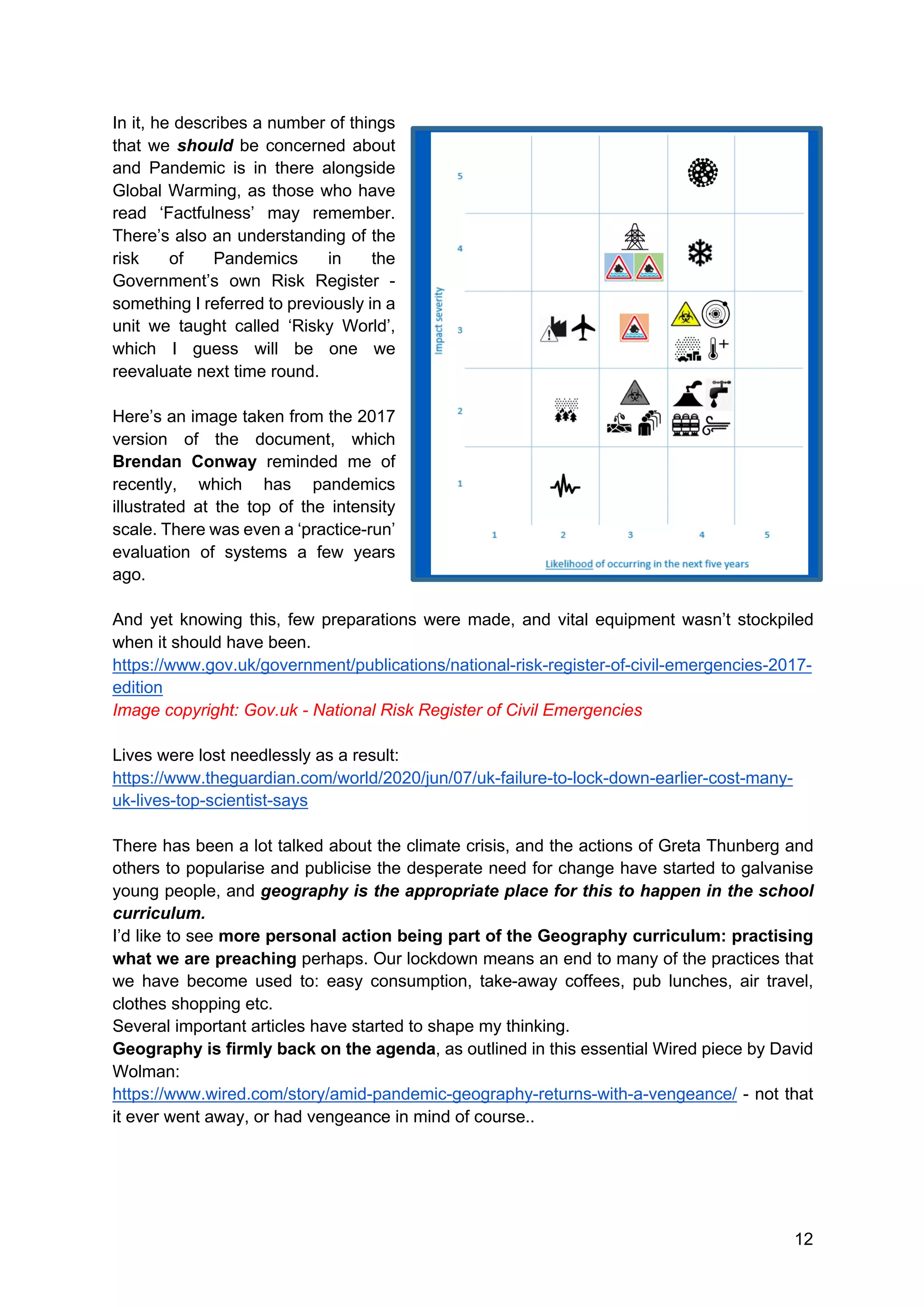
In it, he describes a number of things
that we should be concerned about
and Pandemic is in there alongside
Global Warming, as those who have
read ‘Factfulness’ may remember.
There’s also an understanding of the
risk of Pandemics in the
Government’s own Risk Register -
something I referred to previously in a
unit we taught called ‘Risky World’,
which I guess will be one we
reevaluate next time round.
Here’s an image taken from the 2017
version of the document, which
Brendan Conway reminded me of
recently, which has pandemics
illustrated at the top of the intensity
scale. There was even a ‘practice-run’
evaluation of systems a few years
ago.
And yet knowing this, few preparations were made, and vital equipment wasn’t stockpiled
when it should have been.
https://www.gov.uk/government/publications/national-risk-register-of-civil-emergencies-2017-
edition
Image copyright: Gov.uk - National Risk Register of Civil Emergencies
Lives were lost needlessly as a result:
https://www.theguardian.com/world/2020/jun/07/uk-failure-to-lock-down-earlier-cost-many-
uk-lives-top-scientist-says
There has been a lot talked about the climate crisis, and the actions of Greta Thunberg and
others to popularise and publicise the desperate need for change have started to galvanise
young people, and geography is the appropriate place for this to happen in the school
curriculum.
I’d like to see more personal action being part of the Geography curriculum: practising
what we are preaching perhaps. Our lockdown means an end to many of the practices that
we have become used to: easy consumption, take-away coffees, pub lunches, air travel,
clothes shopping etc.
Several important articles have started to shape my thinking.
Geography is firmly back on the agenda, as outlined in this essential Wired piece by David
Wolman:
https://www.wired.com/story/amid-pandemic-geography-returns-with-a-vengeance/ - not that
it ever went away, or had vengeance in mind of course..
13
Pandemic throws the importance of space back into sharp relief. We’re
thinking about it at the smallest scale, navigating supermarket aisles or
converting closets into serviceable home offices.
Erik Steiner
The theme was also picked up by Marshall Shepherd in Forbes
https://www.forbes.com/sites/marshallshepherd/2020/03/05/why-the-discipline-of-geography-
is-a-key-part-of-the-coronavirus-fight/
Lewis Dartnell, author of ‘Origins’ wrote a piece for the BBC at the start of July on some of
the changes that might be here to stay:
https://www.bbc.com/future/article/20200629-which-lockdown-changes-are-here-to-stay
The curriculum needs to be considered as a process, and a continual work in progress.
My curriculum is always changing from year to year in an iterative fashion. Rosalind Walker
reminds us of this in this well written piece:
https://rosalindwalker.wordpress.com/2020/04/24/curriculum-is-forever-but-not-how-you-
think/
Dylan Wiliam spoke at an event organised by ResearchED about the current overloading in
the curriculum. He said, quoted in the TES:
"There is no doubt that there’s far too much stuff in our curriculum – I’ve
wondered about why this is, and my conclusion is that curriculum developers
cannot bear the thought that any children might have spare time on their
hands. So they actually make sure there’s enough stuff in the curriculum for the
fastest-learning students to be occupied all year. And so there’s far too much
for most students - some teachers just teach the curriculum, they metre it out
and they go from beginning to end and 20 percent of the kids get it and the rest
don’t – I think that’s logically consistent but immoral. When the curriculum’s too
full, you have to make a professional decision about what stuff you’re going to
leave out, and the important point here is that not all content is equally
important.”
So perhaps now is the time to drop some of that ‘trivial’ stuff I mentioned earlier to make space
for greater thinking about futures and a changed world.
At the same time, we are waiting for a vaccine, which may well be the most rapidly
produced in medical history - a good thing. Bill Gates, writing in ‘The Economist’ set out
some important things to consider including the fact that we have a long way to go.
https://www.economist.com/by-invitation/2020/04/23/bill-gates-on-how-to-fight-future-
pandemics
“When historians write the book on the covid-19 pandemic, what we’ve lived
through so far will probably take up only the first third or so.
The bulk of the story will be what happens next.”
There have also been 2 editorials in RGS journals on the Pandemic:
Progress in Human Geography
https://journals.sagepub.com/doi/10.1177/0309132520920094
14
by Noel Castree, Louise Amoore, Alex Hughes, Nina Laurie, David Manley, and Susan
Parnell
There are several questions asked in this document. This one is particularly relevant:
How might attempts to make sense of COVID-19’s geographies affect the way we do
Geography and define ‘progress’ in the discipline? As part of this, are there older
approaches, ideas or methods that might usefully be revisited? Conversely, what
might we need to invent in order to address absences in our cognitive and normative
tool box?
The journal Transactions of the IBG had a different approach.
https://rgs-ibg.onlinelibrary.wiley.com/doi/abs/10.1111/tran.12389
They have a virtual edition from May 2020 which is worth exploring by those who want a higher
level analysis of the geographical connections.
15
Impressively, the Summer 2020
issue of ‘Geography’ - the GA’s key
academic journal - also included an
introductory piece on the impacts of
Covid-19, written by Steve Puttick,
which was very well written and ties
in perfectly with the spirit of this
document’s creation, talking about
the link with the geographical
concept of scale:
The movement between scales is
dizzying, from measurements in
micrometers, through hyper-
connected international travel
infrastructure to millions of
infections, hundreds of
thousands of deaths, and trillions
of dollars. And from the global
dashboards through which we
view the charting of infections,
deaths, recoveries, and forecasts,
back into the space-times of our
homes, where – at the time of
writing, at least – most of us must
stay. COVID-19 has brought the
deeply unequal nature of our world into sharp relief as these experiences of ‘staying
home’ continue to mean wildly different things across all-too-common gendered,
racialised, and classed fault lines
Image copyright: Geographical Association
Download a digital copy here - and don’t forget to join the GA:
https://www.geography.org.uk/Journals/Geography
This has also been described in the Conversation piece here as a ‘sliding doors’ moment:
we can go one way or the other
https://theconversation.com/coronavirus-is-a-sliding-doors-moment-what-we-do-now-could-
change-earths-trajectory-137838
In early July, the OECD published a report on the impact of coronavirus on education.
Thanks to Karl Donert for posting a link to this. It may well have some relevance for the thinking
of many educators, beyond the practical procedural thinking that has gone into preparing for
reopening in August or September 2020 and will no doubt continue over the summer as
government guidance, and the local rate of infection changes.
OECD report is here:
https://read.oecd-ilibrary.org/view/?ref=133_133390-1rtuknc0hi&title=Schooling-disrupted-
schooling-rethought-How-the-Covid-19-pandemic-is-changing-
education&utm_source=Adestra&utm_medium=email&utm_content=Learn%20more&utm_c
16
ampaign=OECD%20Education%20%26%20Skills%20Newsletter:%20June%202020&utm_t
erm=edu&fbclid=IwAR1LBwv99YfI--
xvP2mp5CdAX9LSy7Seewhc9CJIi_oPtx9LGpaR4TVWg8I
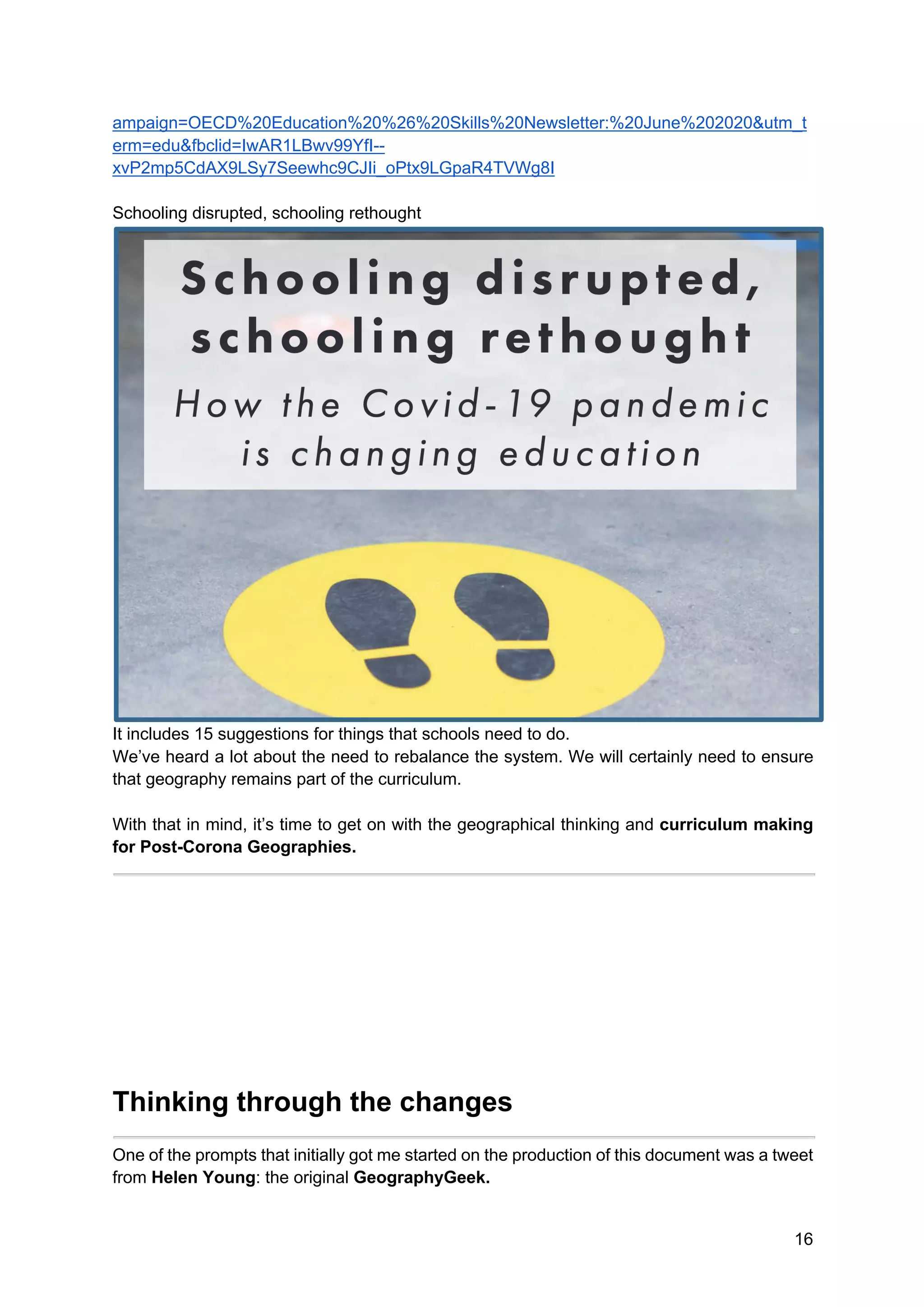
Schooling disrupted, schooling rethought
It includes 15 suggestions for things that schools need to do.
We’ve heard a lot about the need to rebalance the system. We will certainly need to ensure
that geography remains part of the curriculum.
With that in mind, it’s time to get on with the geographical thinking and curriculum making
for Post-Corona Geographies.
Thinking through the changes
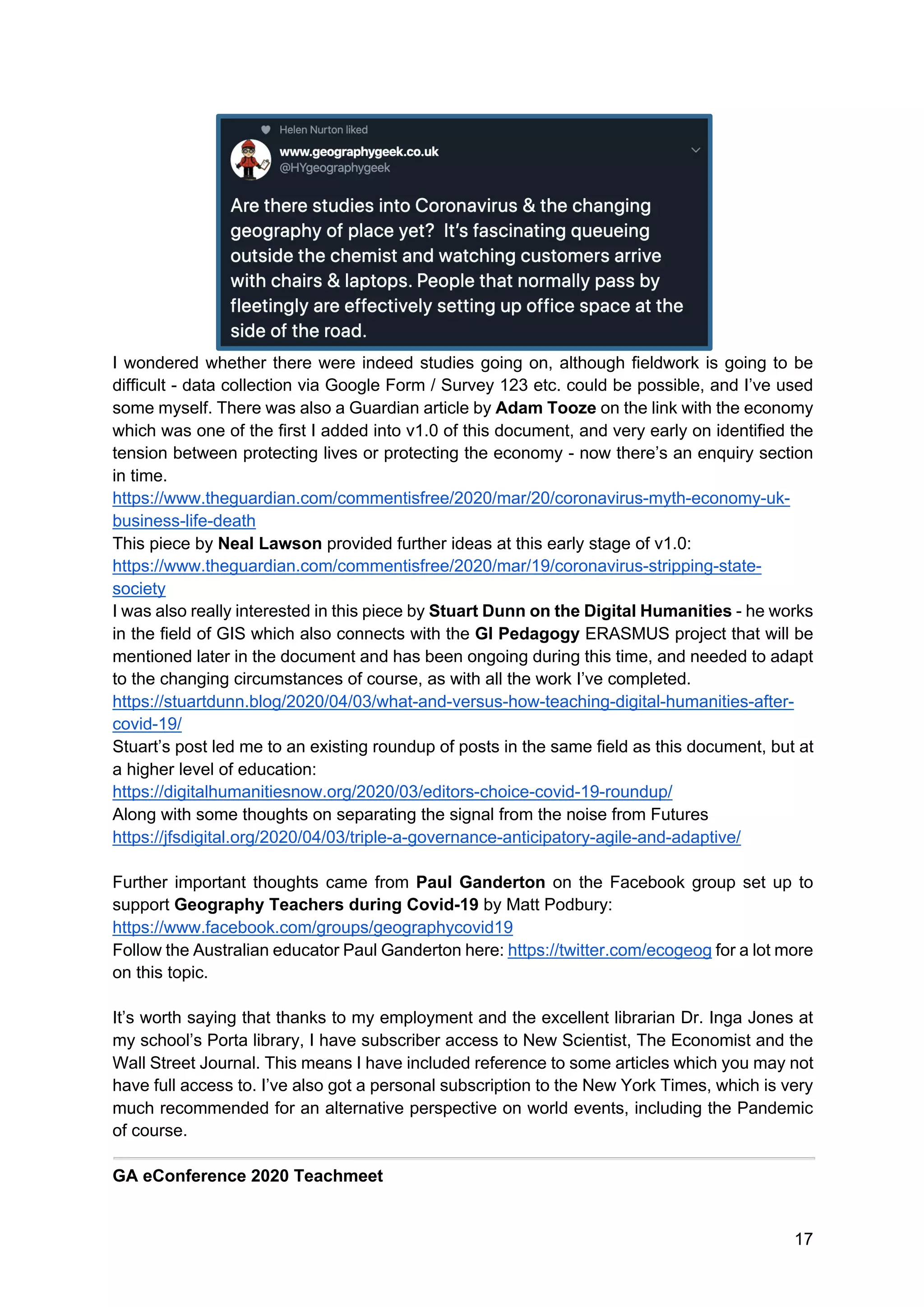
One of the prompts that initially got me started on the production of this document was a tweet
from Helen Young: the original GeographyGeek.
17
I wondered whether there were indeed studies going on, although fieldwork is going to be
difficult - data collection via Google Form / Survey 123 etc. could be possible, and I’ve used
some myself. There was also a Guardian article by Adam Tooze on the link with the economy
which was one of the first I added into v1.0 of this document, and very early on identified the
tension between protecting lives or protecting the economy - now there’s an enquiry section
in time.
https://www.theguardian.com/commentisfree/2020/mar/20/coronavirus-myth-economy-uk-
business-life-death
This piece by Neal Lawson provided further ideas at this early stage of v1.0:
https://www.theguardian.com/commentisfree/2020/mar/19/coronavirus-stripping-state-
society
I was also really interested in this piece by Stuart Dunn on the Digital Humanities - he works
in the field of GIS which also connects with the GI Pedagogy ERASMUS project that will be
mentioned later in the document and has been ongoing during this time, and needed to adapt
to the changing circumstances of course, as with all the work I’ve completed.
https://stuartdunn.blog/2020/04/03/what-and-versus-how-teaching-digital-humanities-after-
covid-19/
Stuart’s post led me to an existing roundup of posts in the same field as this document, but at
a higher level of education:
https://digitalhumanitiesnow.org/2020/03/editors-choice-covid-19-roundup/
Along with some thoughts on separating the signal from the noise from Futures
https://jfsdigital.org/2020/04/03/triple-a-governance-anticipatory-agile-and-adaptive/
Further important thoughts came from Paul Ganderton on the Facebook group set up to
support Geography Teachers during Covid-19 by Matt Podbury:
https://www.facebook.com/groups/geographycovid19
Follow the Australian educator Paul Ganderton here: https://twitter.com/ecogeog for a lot more
on this topic.
It’s worth saying that thanks to my employment and the excellent librarian Dr. Inga Jones at
my school’s Porta library, I have subscriber access to New Scientist, The Economist and the
Wall Street Journal. This means I have included reference to some articles which you may not
have full access to. I’ve also got a personal subscription to the New York Times, which is very
much recommended for an alternative perspective on world events, including the Pandemic
of course.
GA eConference 2020 Teachmeet
18
I used the production of this booklet as my theme for the Teachmeet which formed part of the
GA’s eConference 2020 which replaced the face-to-face event due to take place in Surrey
from 16th-18th of April 2020.
I put together a quick 2 minute LOOM video for use in the event.
You can see the link to the video here and watch if you like:
https://www.loom.com/share/2dad4d5d47a64d2e833d3d3d2e3483dc
Here’s another LOOM video - this time for the Discover the World Education Teachmeet
which was held in early June - a variation on the GA one as a different audience.
https://www.loom.com/share/88d5e3fda2114f69ba902945794ccad1
I also used it at the first GA Sheffield Branch Teachmeet in early July.
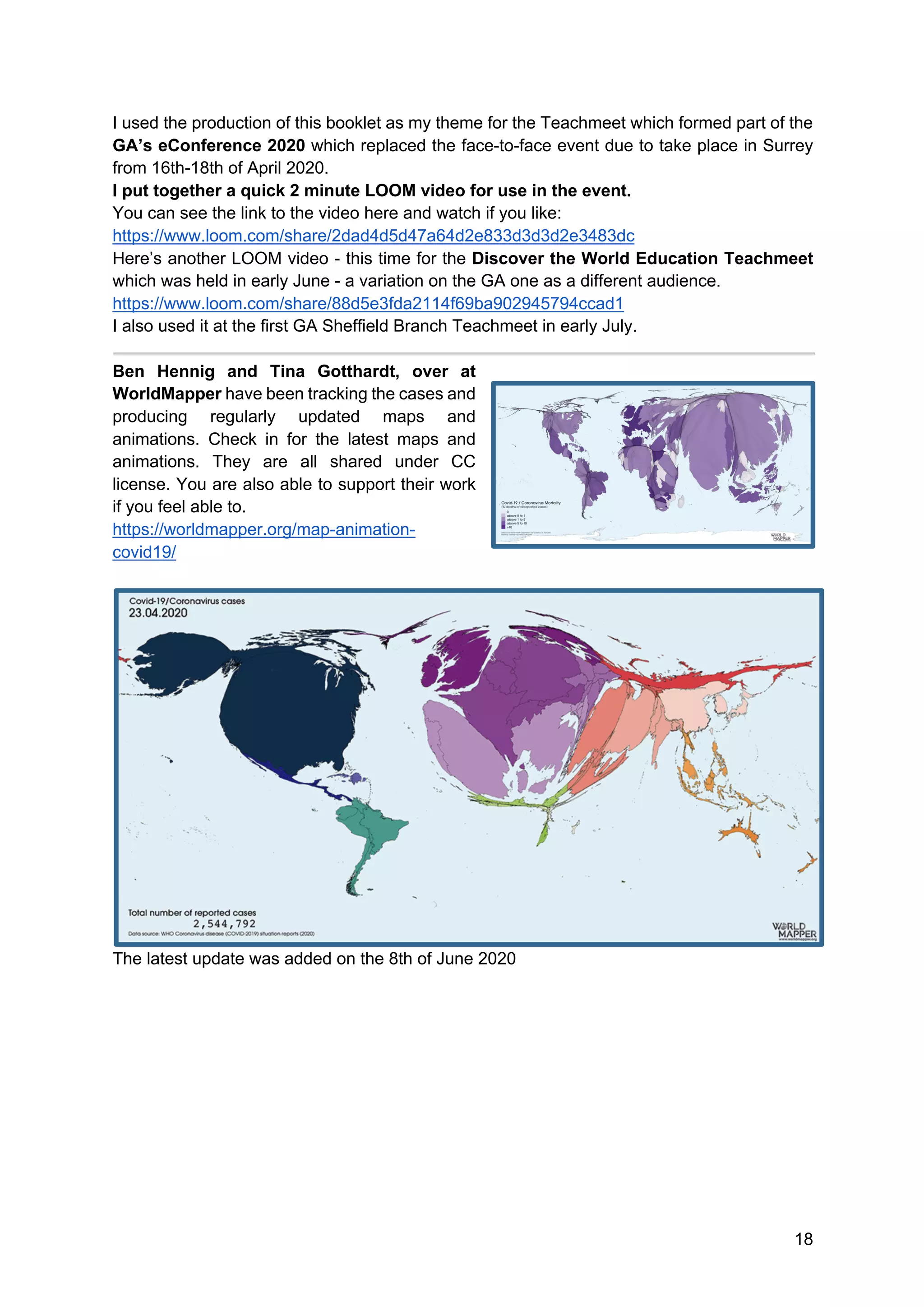
Ben Hennig and Tina Gotthardt, over at
WorldMapper have been tracking the cases and
producing regularly updated maps and
animations. Check in for the latest maps and
animations. They are all shared under CC
license. You are also able to support their work
if you feel able to.
https://worldmapper.org/map-animation-
covid19/
The latest update was added on the 8th of June 2020
19
Images copyright: Worldmapper - shared under CC license
Also check out some aerial images which show the impact:
https://www.weforum.org/agenda/2020/06/coronavirus-covid-19-pictures-aerial-pandemic-
above
Geographical Themes and possible changes
20
These ideas are currently presented separately, but in reality, a piece of work in a classroom
would often need to connect several of these together, and bring in further appropriate
questions, analysis of text and images and some sort of final presentation format and review.
There would be options to create separate elements for GCSE and ‘A’ level units.
From version 7 onwards, there will be a real focus on curriculum making.
A: Physical Geography themes
1. Landscape processes
These will largely be unchanged of course, and may be our refuge with memories of the
landscapes we could visit when we were allowed out sustaining many through the lockdown,
dreaming of mountains we wanted to climb and places we wanted to return to after an
absence. Several of us made lists of the places we intended to visit as soon as we were able.
Rivers have continued to behave as always for the last few months, and waves have reached
the shore as usual. Rivers will still flow downhill, and waves will still hit the coat every few
seconds.
The landscape can be one permanence in our lives, and in the curriculum… I’m working on a
unit on the development of The Fens as a consequence of the pandemic, to encourage people
to get out into this landscape explained so well by Francis Pryor in his recent book on ‘The
Fens’, and using a couple of other relevant books as well.
Watch this space for links to that new unit, which I will share as always.
Landscapes being reclaimed by the wild.
Goats reclaimed the streets of a Welsh village - coming down from the Great Orme into
Llandudno.
https://www.theguardian.com/uk-news/2020/apr/02/llandudno-goes-from-ghost-town-to-
goats-town
Ghost town to goats town - the new kids on the block etc. were the headlines.
https://edition.cnn.com/2020/03/31/europe/wild-goats-wales-streets-lockdown-scli-
gbr/index.html
Spanish officials sprayed a beach with bleach. Not sure if that would speed up chemical
weathering in the area, but worth discussing perhaps.
https://www.theguardian.com/world/2020/apr/28/spanish-official-apologises-for-spraying-
beach-with-bleach-coronavirus
Coastal Management
Many sand dune ecosystems need management including fencing to avoid trampling of the
marram that holds them together. The Maspalomas Dunes on Gran Canaria are apparently
recovering their natural look after years of damage from tourist visitors:
https://www.greenme.it/informarsi/natura-a-biodiversita/dune-maspalomas/
21
Isolation caused by relief
The mountains of Wales may have helped Ceridigion have the lowest rates of infection in
Wales:
https://www.bbc.co.uk/news/uk-wales-53142088
"Ceredigion has at least in part been protected by its geography," agreed Prof
Michael Woods of Aberystwyth University. "We know the coronavirus spreads
primarily through close contact between people and the lower population
density in rural areas makes it more difficult. The relative remoteness also
means fewer people here were travelling back and forth to places with high
numbers of cases like south Wales, the West Midlands and Merseyside."
2. Land Use
I would be interested to see how the landscape is changed
as a result of decisions made during lockdown.
e.g Agricultural use of land.
This Tim Lang book came out March 2020. Has it already
been overtaken by events?
● Forestry land left unmanaged.
● Reduction in construction projects.
● Floodplain development reduced.
● Housing densities questioned.
Would the UK’s land-use as recorded by Daniel Raven
Ellison in his wonderful ‘The UK in 100 seconds’ be different
if he was to remake it in a few years’ time?
https://www.youtube.com/watch?v=0drvdLYGNuc&feature=youtu.be
https://www.youtube.com/watch?v=5i1vuFK7ZQw
A debate started about opening access to golf courses for open space, which connects with
ideas of public and private land ownership, and rights of way.
https://www.thetimes.co.uk/article/fca14214-7bcb-11ea-b535-
542bda4e2a5f?shareToken=c31eca40f84593cdc35621d7b79271f2
Dan mentioned this on his Twitter feed as well, showing how much land was being taken up
by golf courses which were closed at the time. Farm tracks were sometimes closed to prevent
people walking near to the farm houses.
Public space is going to prove valuable as town centres reopen:
https://news.trust.org/item/20200615091609-7dluu/
More on this in the urban section.
22
It will also need to change:
https://www.bloomberg.com/news/features/2020-06-29/what-happens-to-public-space-when-
everything-moves-
outside?utm_content=citylab&utm_source=twitter&utm_medium=social&utm_campaign=soci
alflow-organic
The notion of being in public or the idea of publics is explored here:
https://www.societyandspace.org/articles/spaces-of-publicness
There was a similar theme to many stories regarding people travelling to rural areas. Rights
of Way which run close to farms have been chained off, and some politicians have been forced
to resign for breaking lockdown (whereas some people kept their job).
https://theconversation.com/coronavirus-holidays-stoke-rural-fury-135779 - this also relates to
the use of second homes in rural areas and the impact on rural communities, but gives the
story a different dynamic. Thanks to Claire Kyndt for this story. This I think will become more
significant when the lockdown lifts even more significantly and the school holidays start, as
people will head to places like Devon and Norfolk, for example, bringing the virus with them
into areas with relatively low population density. There were signs that locals weren’t happy
about this in many locations with hand made signs going up early in the lockdown. The loss
of local jobs may once again change the perception here.
3. Weather and Climate / Air Quality / Weather Hazards
We should consider the short term impact in carbon reduction and whether it might help any
country towards meeting carbon emission and air quality targets. Europe’s air was certainly
getting clearer during lockdown: https://twitter.com/i/status/1248669136676425735 (video on
this link)
Skies have emptied of planes - will we (be able to) go back to flying when this is all
over? In late June it emerged that Boeing was scrapping its fleet of 747s ahead of schedule
(they had been due to disappear by 2024)
Will there still be the same number of airlines / competition for flights / cheap flights? It seems
unlikely.
https://www.carbonbrief.org/coronavirus-what-could-lifestyle-changes-mean-for-tackling-
climate-change
Car pollution also briefly halved according to this study:
https://www.breakingnews.ie/ireland/ucc-study-shows-pollution-from-cars-halved-since-start-
of-the-lockdown-laws-1000392.html
In India, there were visual signs that the air was clearing as well:
https://www.sbs.com.au/language/english/audio/himalayas-visible-for-first-time-in-30-years-
as-pollution-levels-in-india-drop
https://www.theguardian.com/environment/2020/apr/11/positively-alpine-disbelief-air-
pollution-falls-lockdown-coronavirus
In early June however, as the lockdown eased and ‘normal’ life resumed, air quality levels
rose back to pre-Covid levels in China very quickly, and Europe will soon follow suit:
https://www.theguardian.com/environment/2020/jun/03/air-pollution-in-china-back-to-pre-
covid-levels-and-europe-may-follow
This was perhaps because people were avoiding public transport so congestion increased.
23
https://www.theguardian.com/environment/2020/jun/11/carbon-emissions-in-surprisingly-
rapid-surge-post-lockdown
Can cities keep their air clean? Some ‘blue-sky thinking’ is needed perhaps:
https://www.theguardian.com/environment/2020/jun/07/blue-sky-thinking-how-cities-can-
keep-air-clean-after-coronavirus
The World Meteorological Organisation (WMO) is concerned about the impact of Covid-19
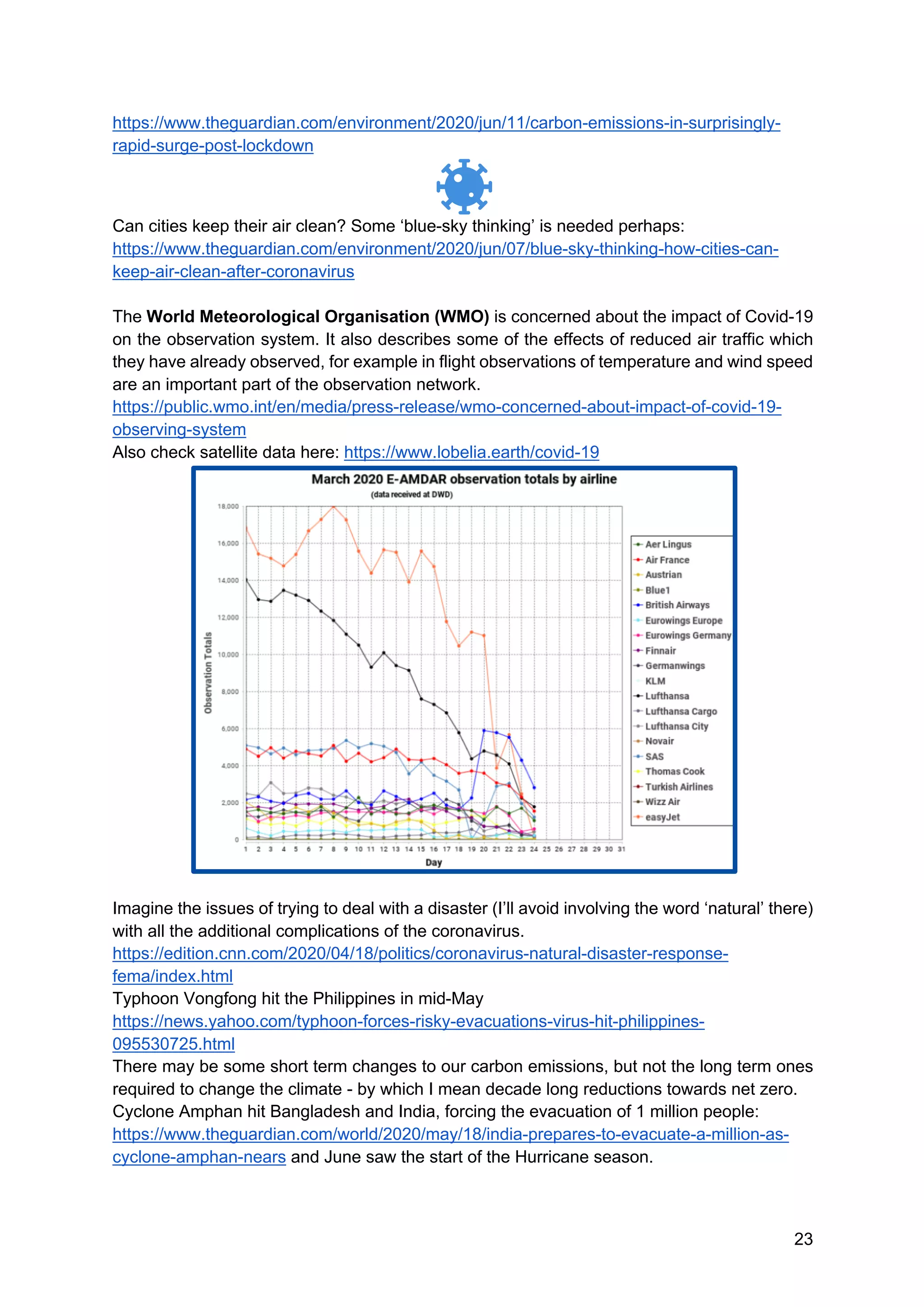
on the observation system. It also describes some of the effects of reduced air traffic which
they have already observed, for example in flight observations of temperature and wind speed
are an important part of the observation network.
https://public.wmo.int/en/media/press-release/wmo-concerned-about-impact-of-covid-19-
observing-system
Also check satellite data here: https://www.lobelia.earth/covid-19
Imagine the issues of trying to deal with a disaster (I’ll avoid involving the word ‘natural’ there)
with all the additional complications of the coronavirus.
https://edition.cnn.com/2020/04/18/politics/coronavirus-natural-disaster-response-
fema/index.html
Typhoon Vongfong hit the Philippines in mid-May
https://news.yahoo.com/typhoon-forces-risky-evacuations-virus-hit-philippines-
095530725.html
There may be some short term changes to our carbon emissions, but not the long term ones
required to change the climate - by which I mean decade long reductions towards net zero.
Cyclone Amphan hit Bangladesh and India, forcing the evacuation of 1 million people:
https://www.theguardian.com/world/2020/may/18/india-prepares-to-evacuate-a-million-as-
cyclone-amphan-nears and June saw the start of the Hurricane season.
24
Sylvia Knight recorded a podcast for the RGS-IBG, which included a section on links between
the weather and Covid-19 - listen here:
https://www.rgs.org/schools/teaching-resources/a-royal-meteorological-society-update-on-
weather,/
https://soundcloud.com/rgsibg/a-royal-meteorological-society-update-on-weather-climate-
and-covid-19-dr-sylvia-knight
4. Tectonics and disasters
The lack of human activity has reduced a lot of the background noise which seismometers
have to be calibrated to ignore / account for
https://www.theguardian.com/science/2020/apr/06/lockdown-has-cut-britains-vibrations-
seismologists-find
https://weather.com/en-IN/india/coronavirus/news/2020-04-05-coronavirus-lockdown-
reduces-earth-seismic-vibrations
https://www.bbc.co.uk/news/science-environment-52509917
There are also fears that other hazards such as earthquakes may happen, and people will be
unable to help each other for risk of infection. This is a real fear as we move into Hurricane
season as mentioned previously, and Cyclone Amphan has battered Kolkata.
Ilan Kelman seminar on his book: Disaster by Choice - recommended reading
https://youtu.be/ITnv52i3S4Q
“A situation requiring outside support for coping” is his definition of a disaster
5. Our relationship with Nature...
The closure of so-called ‘wet-markets’, which are found all over the world and not just in China,
for the sale of ‘bush meat’ and other animals needs to be stopped to avoid another pandemic
emerging in the future. We had another outbreak at a market in China in mid-June as a
reminder of this possibility. At the root of the problem is a social phenomenon called “human-
wildlife conflict”. This is when the interests of humans and the needs of wildlife overlap in a
negative way.
https://theconversation.com/most-laws-ignore-human-wildlife-conflict-this-makes-us-
vulnerable-to-pandemics-
135191?fbclid=IwAR37QneFaWgUeG7KQ3JpEgBjEj_Ub72HTpTmzfDd58qJEf4Z3XqVFx-
SZGM
In terms of food sourcing, cultural norms over bush meat and wildlife markets may now have
to face more legislation if this does turn out to be the source of the outbreak
https://www.theguardian.com/world/2020/apr/06/ban-live-animal-markets-pandemics-un-
biodiversity-chief-age-of-extinction - biodiversity
A food related connection is discussed here:
https://www.barillacfn.com/en/magazine/food-and-society/people-and-nature-lessons-
learned-from-the-covid19-pandemic
There is also a suggestion we may see more wild flowers. Council services are being cut, and
focussing on the vital services, so verge cutting etc. may be stopped.
25
The people with the closest link with nature perhaps are the indigenous peoples such as those
who live in the rainforest areas such as the Amazon Basin, who live in harmony with the
forest - they are its guardians in many respects - and who practice their farming techniques
which many students will have learned about.
This article suggests the virus may lead to the extinction of some of these groups:
https://www.bbc.co.uk/news/world-latin-america-52139875
Worth remembering that tackling some issues with landscapes may also reduce risk of future
pandemics - image from UN
Image copyright: UN
This relationship is explored in this piece from the 7th of May on our ‘promiscuous treatment
of nature’.
https://www.theguardian.com/environment/2020/may/07/promiscuous-treatment-of-nature-
will-lead-to-more-pandemics-scientists
There has also been an increase in fly-tipping as council recycling centres are closed.
https://www.edp24.co.uk/news/environment/lorry-load-of-waste-dumped-in-thetford-forest-1-
6613641
Many people cleared out their houses and wanted to do DIY which has created extra waste.
Some councils are also burning recycling as there are fears over virus contamination of
cardboard etc.
Costing the Earth on BBC Radio 4 had some thoughts in an episode hosted by Tom Heap
https://www.bbc.co.uk/sounds/play/m000h7yb
Tom Heap talks through the environmental issues emerging during the coronavirus pandemic and asks
what the legacy might be. He's joined by climate change expert Dr Tamsin Edwards from King's College,
London to examine the effect of the lockdown.
With millions of people now working from home, planes being grounded and fewer cars on the roads,
what level of environmental improvement has there been, and will that be reversed once our lives return
to normal?
26
With the help of experts from the fields of climate change, remote working, ecology and environmental
standards, we track the changes in air pollution and global temperature.
What will the return to ‘normal' look like? With the UK aiming to be carbon neutral by 2050, Tom asks
whether the pandemic can be seen as a trial run for a zero-carbon world. And, with the international
climate meeting COP26 postponed, Tamsin considers how international climate targets might be
affected.
You can download the programme. I like how Tamsin is introduced as a geographer and Tom
also declares himself as a geographer. It mentions removal of EPA environmental protections
in the USA which may lead to further pollution.
The world’s oceans are now much quieter places because of the reduction in the movements
of shipping with fewer passenger vehicles e.g. cross channel ferries.
https://www.theguardian.com/environment/2020/apr/27/silence-is-golden-for-whales-as-
lockdown-reduces-ocean-noise-coronavirus
Andy Owen shared this link to some satellite imagery showing areas which were paused -
changing human behaviour in certain environments.
https://www.planet.com/gallery/
I was interested in the collapse in price of legal abalones: an unusual ‘crop’:
https://www.hakaimagazine.com/news/south-africas-abalone-black-market-is-being-
squeezed-by-covid-19/
On the plus side, oceans are getting quieter due to fewer vessel movements: good for
cetaceans, and the cleaner water is helping animals such as seahorses in Studland Bay:
https://www.bournemouthecho.co.uk/news/18492172.studland-bay-seahorses-thriving-
lockdown/
Any thoughts that we might have come to love and appreciate nature more during lockdown
were immediately dispelled when guidance meant we could travel as far as we wanted,
following the Dominic Cummings scandal. People flocked to Bournemouth beach several days
running, and left human waste in burger boxes or in RNLI stations. People crowded into
Liverpool when their football team won the Premiership football league.
And signs like this needed to go up in London’s parks:
...and Ocean Plastics
There has also been a dramatic rise in Ocean Plastics with the use of PPE / disposable gloves
/ endless tape and 2m distancing stickers on the floor outside premises which will degrade in
the rain and sun:
27
https://www.theguardian.com/environment/2020/jun/08/more-masks-than-jellyfish-
coronavirus-waste-ends-up-in-ocean - “more masks than jellyfish”
https://www.euronews.com/living/2020/06/08/world-oceans-day-is-pandemic-protection-
worth-the-plastic-pollution
Image from LA Times article here:
https://www.latimes.com/world-nation/story/2020-06-13/coronavirus-pandemic-plastic-waste-
recycling
Image taken on the Soko Islands near Hong Kong.
A sea of troubles and plastic as the “asbestos of the sea” in this article:
https://www.economist.com/international/2020/06/22/covid-19-has-led-to-a-pandemic-of-
plastic-pollution
Single use protective equipment has been sold in hundreds of millions and people won’t want
to keep it around as it is potentially infected (at least in the short term)
Just imagine the plastic and glass to produce test equipment.
What about those swabs… I guess they have plastic in them.
A vaccine if developed would use all the world’s glass and more to store it. Are we starting to
make those vials now? I doubt it…
https://www.economist.com/international/2020/06/22/covid-19-has-led-to-a-pandemic-of-
plastic-pollution
Even discussions over UK vaccine manufacture and Russian hackers in late July 2020
https://news.sky.com/story/coronavirus-any-uk-vaccine-to-be-made-in-britain-for-fear-us-will-
take-it-scientists-say-12030691
Professor Stephen Scoffham wrote a piece on the changing relationship with nature for the
Canterbury Christchurch University’s Expert Comment blog in early June 2020:
https://blogs.canterbury.ac.uk/expertcomment/learning-from-covid-19/
Andrew Mitchell wrote a piece for ‘Geographical’ magazine in mid June
https://geographical.co.uk/opinion/item/3659-coronavirus-nature-s-10-trillion-dollar-wake-up-
call-to-the-finance-sector
28
Economists estimate the economic fallout from the Covid-19 virus pandemic
could approach $10 trillion dollars, or around one eighth of global GDP. To
prevent a recurrence of this crisis, we need to look less into human health, than
into the collective blindness among regulators and within the financial sector
of the huge dependencies the global economy has on biodiversity, and the
devastating impacts on us all when our effect on these dependencies, becomes
increasingly unsustainable. Covid-19 is nature’s $10 trillion dollar bite back, and
this is just the beginning.
Based on this earlier report:
https://www.weforum.org/reports/nature-risk-rising-why-the-crisis-engulfing-nature-matters-
for-business-and-the-economy
Global Risk Report
https://www.weforum.org/reports/the-global-risks-report-2020
Risk is also increasing as a result of contaminated waste.
https://www.politico.eu/article/coronavirus-contaminated-waste-puts-garbage-workers-on-
the-line/
BBC in late June published this piece and introduced the term “anthropause” which is quite
neat.
https://www.bbc.co.uk/news/science-environment-53113896
The UK-led team's aim is to study what they have called the "anthropause" - the global-
scale, temporary slowdown in human activity, which is likely to have a profound impact on
other species.
Michael Batty from CASA UCL has written this important piece here.
In it he references a short story by E.M.Forster called ‘The Machine Stops’ - this has been
discussed by me previously on my blog, and also by fellow Primary geographers Steve
Rawlinson and Tessa Willy at a recent Charney Primary Geography Conference:
http://spatialcomplexity.blogweb.casa.ucl.ac.uk/files/2020/05/The-Post-Pandemic-City.pdf
One to revisit and see the parallels for yourself. You can find the short story online in various
places.
People have paused:
https://www.theguardian.com/books/2020/jun/13/overcoming-fears-discovering-nature-what-
i-have-learned-from-lockdown
Some don’t want to go back to their previous lives.
6. Plate Tectonics
One would expect little change to the layout of countries, although Twitter user Karl Sharro
https://twitter.com/KarlreMarks suggested how the world map would change in this tweeted
image with socially distanced countries:
29
7. Biodiversity
Given the fact tourists weren’t travelling to Thailand, there were benefits to some of the rare
turtles such as the Olive Ridley who weren’t being affected quite as bad as in previous years:.
https://www.theguardian.com/environment/2020/apr/20/coronavirus-lockdown-
boosts-numbers-of-thailands-rare-sea-turtles
There is a connection here to work done previously for TUI with the Better World Detectives.
That has all been placed in perspective now. May be worth writing a little update for the
resources on the impact of the pandemic on the area.
https://www.tui.co.uk/better-world-detectives/
2020 is also the landmark year for biodiversity. That effort has been hampered by the arrival
of the virus.
https://www.bbc.co.uk/news/science-environment-52648577
A fascinating article was published in National Geographic in early July. It referred to
horseshoe crabs, fascinating creatures. They have a primitive look to them.
It seems they are also vital for our search for a vaccine. According to the article:
Every year, pharmaceutical companies roundup half a million Atlantic
horseshoe crabs, bleed them, and return them to the ocean— after which
many will die. This practice, combined with overharvesting of the crabs for
30
fishing bait, has caused a decline in the species in the region in the past few
decades.
Worth reading the whole piece:
https://api.nationalgeographic.com/distribution/public/amp/animals/2020/07/covid-vaccine-
needs-horseshoe-crab-blood
8. Water Cycle and hydrological processes
In many cities, workers were out early spraying disinfectant. Benches, cash points and shop
fronts are among touchable surfaces being sprayed with disinfectant. Councils want to
reassure workers and shoppers that things are clean, but where does this disinfectant go but
into drains and thus into rivers. What impact will it be having on riparian ecosystems in the
long term?
There was also a worrying report regarding potential mass graves in South Africa which would
have an impact on groundwater supply - I suspect this would be an issue for other locations
too:
https://news.trust.org/item/20200515083907-r01e3/
There are also burial plot shortages in many cities
https://news.trust.org/item/20200420071556-8usm5
At the interface between physical and human, we have several other
major issues:
9. Climate Change - the big one!
Climate Change will still need to be at the heart of the curriculum when we
return, perhaps even more so.
The Greenhouse: What We're Learning
I’ve avoided too much on this theme as it’s a whole extra booklet by itself. The reduction in
carbon emissions through industrial closedown and far fewer journeys was obvious.
https://www.theguardian.com/environment/2020/apr/12/global-carbon-emisions-could-fall-by-
record-25bn-tonnes-in-2020
We’re also likely to see changes to school and hospital meals as a result of supply chains, but
also the drive for less meat - one campaign here is the #20percentlessmeat campaign which
has had some significant success.
https://www.theguardian.com/environment/2020/apr/16/school-and-hospital-caterers-vow-to-
cut-meat-served-by-20
About a quarter of the UK’s population eats the food from these caterers
https://www.publicsectorcatering.co.uk/psc100 in a typical working week
http://20percentlessmeat.co.uk/let%E2%80%99s-do-what%E2%80%99s-right
Check out the free Harvard Online courses in this area:
This one explores the health impacts of climate change.
https://online-learning.harvard.edu/course/health-effects-climate-change?delta=0
31
Perhaps we at least will see an end to ‘big oil’
https://www.nytimes.com/2020/04/21/business/energy-environment/coronavirus-oil-prices-
collapse.html?referringSource=articleShare
There was a useful podcast for Earth Day 2020 discussing parallels between Coronavirus and
Climate Change:
https://podcasts.google.com/?feed=aHR0cHM6Ly9mZWVkcy5hZGtuaXQuY29tL2FwcC1zZ
WFyY2gvY25uL2Nvcm9uYXZpcnVzLWZhY3QtdnMtZmljdGlvbi9hbGwvNzIwLzIwMC8&epis
ode=Mjk2YTI0ZmQ2MTNiZTcxOGRhNTQxY2EwOWM1NGZlMDEubXAz&hl=en-
GB&ved=2ahUKEwiSheWK7_7oAhXToXEKHShSCIQQjrkEegQIChAI&ep=6
Don’t forget to take Paul Turner’s Climate Change Ignorance Test
https://docs.google.com/forms/d/e/1FAIpQLSe_ucwzm5MfjprKxYqrr5mX8AVX2sS4SSh-
O4hR9pQAyWaX1Q/viewform
Mark Maslin’s piece too on the reports of warming climates in the future.
https://theconversation.com/will-three-billion-people-really-live-in-temperatures-as-hot-as-
the-sahara-by-2070-137776
https://app.educcateglobal.org/blogs/342403/experts-see-parallels-between-coronavirus-
crisis-and-climate-change?fbclid=IwAR2h7IwBI8L4WCMhCcR4RJYASbuU-zmKGGlhlUNhx-
tbJHZ6asTzJZBMa1A
Also check out the RGS Policy paper on Net Carbon Zero published in early May
https://www.rgs.org/geography/news/briefing-report-financing-net-
zero/?utm_source=Twitter&utm_medium=social&utm_campaign=SocialSignIn
For more on this, Paul Turner and Phil Bell organised the Big Climate Teach In for the 4th
of July. Videos of the event remain online after the event has finished at the YouTube link
here:
https://www.youtube.com/watch?v=Z6Pzzt9d9yY&feature=youtu.be
32
B: Human Geography themes
10. Urbanisation and Urban Spaces
“This was the week our cities died” is the title of this provocative piece which got me going
on some thinking in this regard, and the nature of our teaching on urban models and structure.
https://www.theguardian.com/commentisfree/2020/mar/20/after-coronavirus-well-be-poorer-
and-more-broken-but-we-might-be-more-tender-too
Melbourne is also featured here.
https://www.theage.com.au/national/victoria/it-s-a-tumbleweed-town-with-data-showing-cbd-
getting-emptier-each-day-20200318-p54be7.html#comments
Daniel Whittall suggested we are seeing new iterations of ‘the city’ or ‘urban spaces’ and we
will see another iteration ‘post-covid’. I guess this document is suggesting we will have another
iteration of the geography specifications and agreed powerful knowledge.
a) Urban Spaces and Hierarchies (and the return of communities)
Thanks to Claire Kyndt for this link, which started some thinking about the way we use urban
spaces and how we live within them.
https://theconversation.com/coronavirus-locked-down-italys-changing-urban-space-133827
Those people who live in rural areas have greater options when it comes to social distancing
and finding a safe space to exercise. I am fortunate, in this respect, to live in a small rural
village, eight miles from the nearest town but equally that means longer ambulance response
times.
Where we live is influenced by what we can afford.
Lynsey Hanley has produced an essential piece of writing on the class divide here as a
consequence.
https://www.theguardian.com/commentisfree/2020/apr/07/lockdown-britain-victorian-class-
divide?CMP=share_btn_tw
In it she references another great thinker Joe Moran, in a piece from 2004. She also talks
about the value of public parks and open spaces.
Space – how it’s apportioned, how it’s governed, how it’s made available to some
and denied to others – is always political. The middle classes, accustomed to
constant mobility while valorising the home as a place of comfort and safety,
balk at the thought of being unable to up sticks at will.
We are going to need parks and open spaces more.
New Statesman: Why people need parks
https://www.newstatesman.com/2020/07/why-people-need-parks
33
We will also have to change the relationship we have with public spaces as businesses look
to move outside and perhaps occupy pavements or squares:
https://www.bloomberg.com/news/features/2020-06-29/what-happens-to-public-space-when-
everything-moves-
outside?utm_content=citylab&utm_source=twitter&utm_medium=social&utm_campaign=soci
alflow-organic
It seems that the Bartlett Centre of UCL is also definitely ‘on it’ with some thinking in the sort
of areas that Helen wondered about earlier.
“people survive difficulty by coming together as communities of care, not
pulling apart in a retreat into individualism” OluTimehin Adegbeye, 2020
“Housing is a condition to the right to life” Laia Bonet, 2020
The quotes above are an entry into this piece by Catalina Ortiz and Camillo Boano on housing
as the key infrastructure of care, and the difficulty for many of social distancing in some
housing designs.
https://blogs.ucl.ac.uk/dpublog/2020/04/06/stay-at-home-housing-as-a-pivotal-infrastructure-
of-care/
Check out this piece by Michael Batty of CASA in early July.
http://spatialcomplexity.blogweb.casa.ucl.ac.uk/files/2020/05/The-Post-Pandemic-City.pdf
A must read piece.
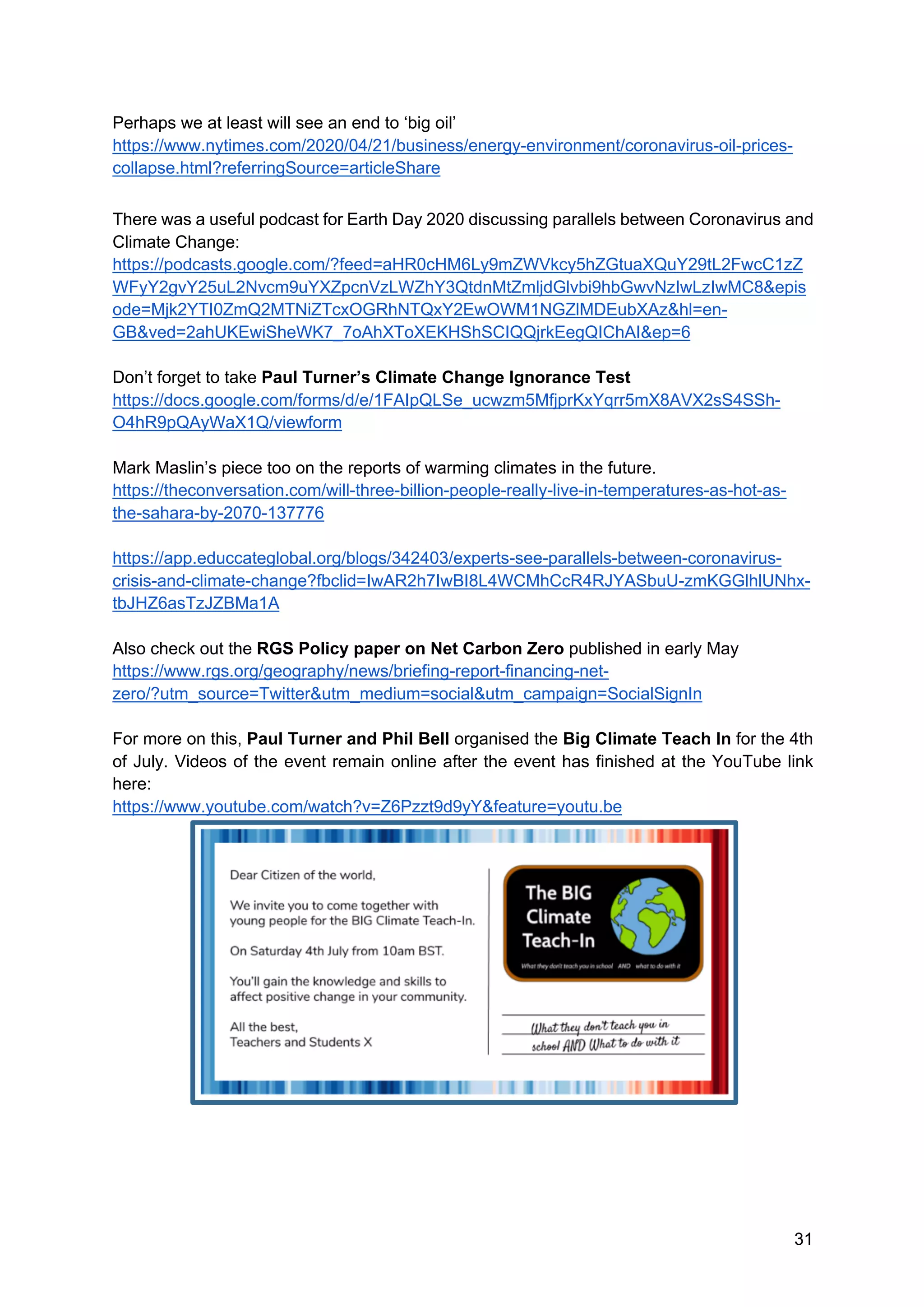
The piece is part of a series on Post Covid 19 Urban Futures put together by UCL - a useful
blog and webinar series which will grow over time.
https://www.ucl.ac.uk/bartlett/development/post-covid-19-urban-futures
The Alexandra Panman blog is also excellent:
https://blogs.ucl.ac.uk/dpublog/2020/04/01/urban-economics-in-the-time-of-covid-19-what-
happens-when-the-thing-that-makes-cities-great-also-makes-them-dangerous/
Inequalities are explored here:
https://news.trust.org/item/20200217002430-yvuj7
This piece by Gaby Hinsliff suggests social pods of people as a future model.
34
https://www.theguardian.com/commentisfree/2020/apr/23/social-distancing-social-pods-
coronavirus-lockdown
One particular urban space which may become at a premium is a space for a burial. Some
cities have limited cemetery space, and that space is running out - I won’t make my usual joke
here about cemeteries being ‘the dead centre of town’:
https://news.trust.org/item/20200420071556-8usm5
I think we may also see a move to the suburbs for space rather than small expensive flats in
city centres: https://news.trust.org/item/20200602091720-utel6/ - for those who can afford to
of course. This will also connect with greater take up of home working - if you don’t need to
commute into the city centre you don’t need to live in the expensive commuter belt.
An exodus from London - counterurbanisation example for UK cities:
https://www.theguardian.com/uk-news/2020/jun/24/covid-19-sparks-exodus-of-middle-class-
londoners-in-search-of-the-good-life
b) LIC Urban areas
Will the virus lead to a growing exodus from cities or will people still want to live close to
services (and each other)?
Here’s a South African waste-picker on life under lockdown and the impossibility of continuing
to work without risk.
https://news.trust.org/item/20200407102057-bcmya/
Diana Mitlin also picked up some of the issues facing cities in the ‘global South’ in this blogpost
https://www.iied.org/dealing-covid-19-towns-cities-global-south
For those in Kibera, no work means no food, and quarantine is not an option:
https://www.aljazeera.com/news/2020/03/work-food-kibera-dwellers-quarantine-option-
200320052738905.html
Follow Faith Taylor’s work as she maps Covid-19 interventions in the slums of Kibera:
https://www.kcl.ac.uk/how-do-you-manage-covid-19-with-a-population-density-of-130000-
people-per-square-kilometre
However, could the climate which has caused issues for countries for decades have been a
factor in low numbers of cases?
https://www.ft.com/content/e9cf5ed0-a590-4bd6-8c00-
b41d0c4ae6e0?fbclid=IwAR0BZXMh8Ab1RnA9bicGHumdK_voINyA1mKCZT-
eftcQ8kOWv6qI7y6TiIk
The Financial Times piece here is definitely worth reading. It is free to read and not
behind the paywall.
The article describes the potential impacts of warmer climate, a lifestyle where people are
outdoors more, measures taken by governments and also the fact that African countries have
the most youthful populations - something we explore with Year 9.
35
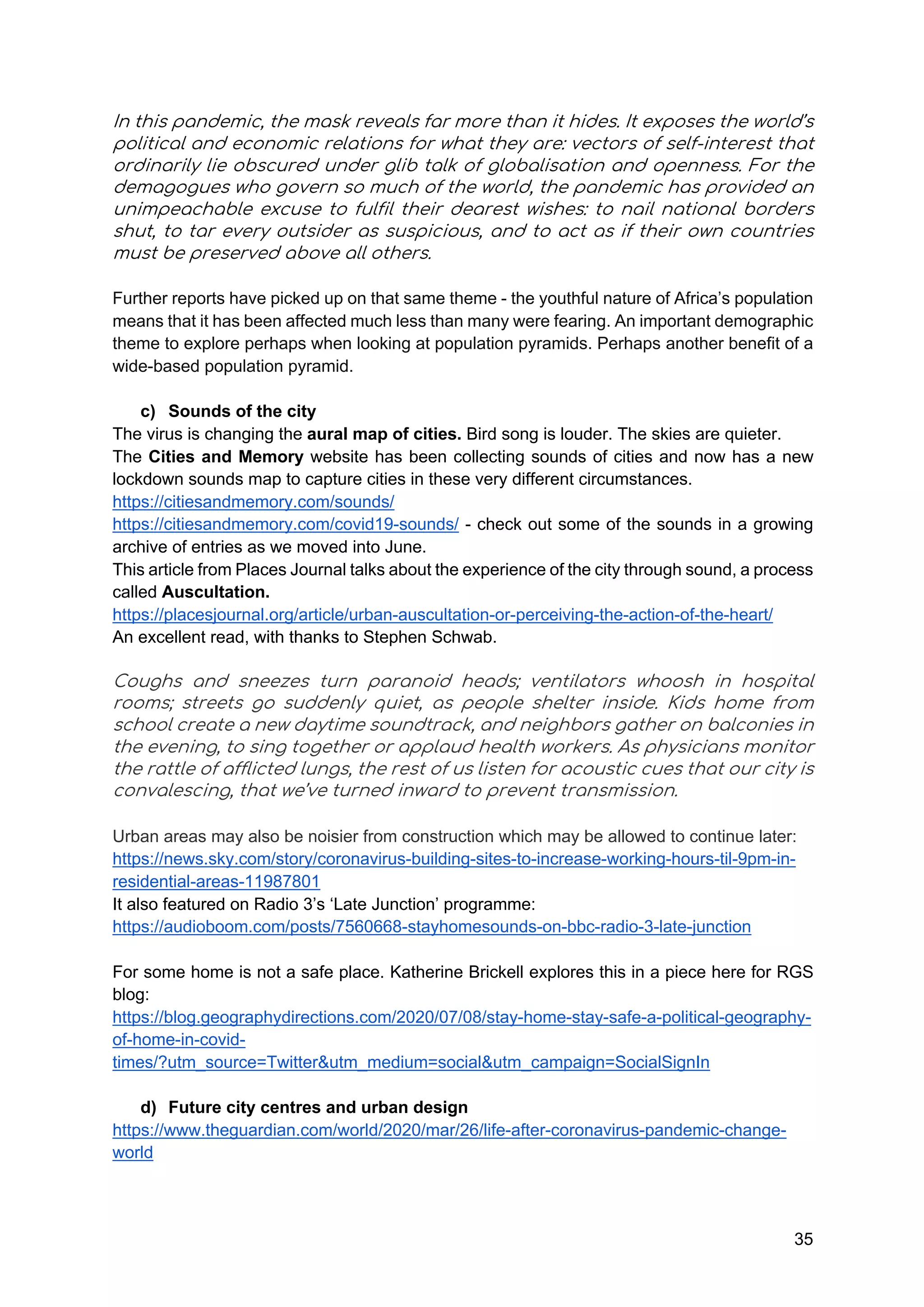
In this pandemic, the mask reveals far more than it hides. It exposes the world’s
political and economic relations for what they are: vectors of self-interest that
ordinarily lie obscured under glib talk of globalisation and openness. For the
demagogues who govern so much of the world, the pandemic has provided an
unimpeachable excuse to fulfil their dearest wishes: to nail national borders
shut, to tar every outsider as suspicious, and to act as if their own countries
must be preserved above all others.
Further reports have picked up on that same theme - the youthful nature of Africa’s population
means that it has been affected much less than many were fearing. An important demographic
theme to explore perhaps when looking at population pyramids. Perhaps another benefit of a
wide-based population pyramid.
c) Sounds of the city
The virus is changing the aural map of cities. Bird song is louder. The skies are quieter.
The Cities and Memory website has been collecting sounds of cities and now has a new
lockdown sounds map to capture cities in these very different circumstances.
https://citiesandmemory.com/sounds/
https://citiesandmemory.com/covid19-sounds/ - check out some of the sounds in a growing
archive of entries as we moved into June.
This article from Places Journal talks about the experience of the city through sound, a process
called Auscultation.
https://placesjournal.org/article/urban-auscultation-or-perceiving-the-action-of-the-heart/
An excellent read, with thanks to Stephen Schwab.
Coughs and sneezes turn paranoid heads; ventilators whoosh in hospital
rooms; streets go suddenly quiet, as people shelter inside. Kids home from
school create a new daytime soundtrack, and neighbors gather on balconies in
the evening, to sing together or applaud health workers. As physicians monitor
the rattle of afflicted lungs, the rest of us listen for acoustic cues that our city is
convalescing, that we’ve turned inward to prevent transmission.
Urban areas may also be noisier from construction which may be allowed to continue later:
https://news.sky.com/story/coronavirus-building-sites-to-increase-working-hours-til-9pm-in-
residential-areas-11987801
It also featured on Radio 3’s ‘Late Junction’ programme:
https://audioboom.com/posts/7560668-stayhomesounds-on-bbc-radio-3-late-junction
For some home is not a safe place. Katherine Brickell explores this in a piece here for RGS
blog:
https://blog.geographydirections.com/2020/07/08/stay-home-stay-safe-a-political-geography-
of-home-in-covid-
times/?utm_source=Twitter&utm_medium=social&utm_campaign=SocialSignIn
d) Future city centres and urban design
https://www.theguardian.com/world/2020/mar/26/life-after-coronavirus-pandemic-change-
world
36
https://blogs.ucl.ac.uk/dpublog/2020/04/01/urban-economics-in-the-time-of-covid-19-what-
happens-when-the-thing-that-makes-cities-great-also-makes-them-dangerous/ - mentions
Edward Glaeser and the importance of density, and the comments thread is also interesting.
Some cities are giving over space to transport other than the car:
https://www.theguardian.com/world/2020/apr/11/world-cities-turn-their-streets-over-to-
walkers-and-cyclists
Rachael Unsworth mused on the potential for improving things as regards transport:
http://www.createstreets.com/moving-on-moving-better/
It included a quote from this Carbon Brief collection of views:
https://www.carbonbrief.org/coronavirus-what-could-lifestyle-changes-mean-for-tackling-
climate-change#5mike
Also efforts to reduce light pollution in future cities:
https://www.citylab.com/life/2019/11/dark-sky-night-stars-netherlands-light-pollution-map-
nacht/601846/?utm_content=citylab&utm_medium=social&utm_source=twitter&utm_campai
gn=socialflow-organic
Paris is planning to give less space to cars to help with the 15 minute city idea, which was
introduced by city Mayor Anne Hidalgo in February, influenced by Carlos Moreno.
“ville du quart d’heure”
https://www.citylab.com/transportation/2020/04/paris-cars-air-pollution-health-public-transit-
bike-lanes/610861/
Melbourne has a similar 20 minute model.
https://www.planning.vic.gov.au/policy-and-strategy/planning-for-melbourne/plan-
melbourne/20-minute-neighbourhoods
I’m investigating the work of Carlos Moreno in this area for an early resource as part of this
document’s impact into the classroom.
https://www.theguardian.com/world/2020/jun/14/cafe-society-spills-on-to-paris-cobbles-as-
drivers-bid-to-reclaim-post-lockdown-streets
https://www.citylab.com/environment/2020/02/paris-election-anne-hidalgo-city-planning-
walks-stores-parks/606325/
Hidalgo’s manifesto promises:
37
https://annehidalgo2020.com/le-programme/
A Paris to live in, a Paris that innovates, a Paris that breathes,
A Paris in common.
This is an area to be further developed. C40 Cities - they have a Knowledge Hub:
https://www.c40knowledgehub.org/s/?language=en_US
https://www.c40.org/
https://twitter.com/c40cities
Financial Times piece: https://www.ft.com/content/c1a53744-90d5-4560-9e3f-17ce06aba69a
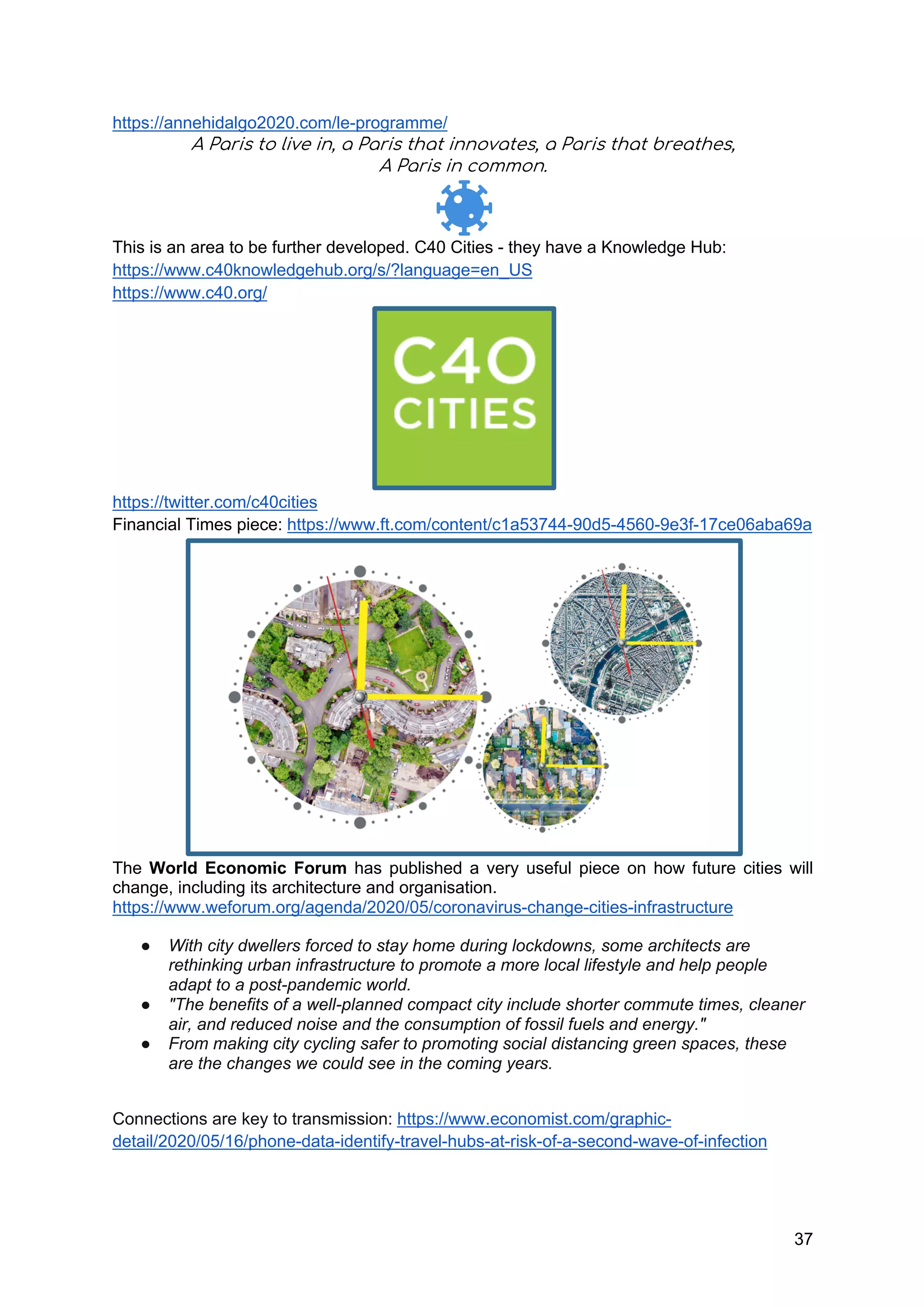
The World Economic Forum has published a very useful piece on how future cities will
change, including its architecture and organisation.
https://www.weforum.org/agenda/2020/05/coronavirus-change-cities-infrastructure
● With city dwellers forced to stay home during lockdowns, some architects are
rethinking urban infrastructure to promote a more local lifestyle and help people
adapt to a post-pandemic world.
● "The benefits of a well-planned compact city include shorter commute times, cleaner
air, and reduced noise and the consumption of fossil fuels and energy."
● From making city cycling safer to promoting social distancing green spaces, these
are the changes we could see in the coming years.
Connections are key to transmission: https://www.economist.com/graphic-
detail/2020/05/16/phone-data-identify-travel-hubs-at-risk-of-a-second-wave-of-infection
38
Image source: The Economist
A reminder of Tobler’s First Law of Geography - “near things are more related than distant
things” - https://en.wikipedia.org/wiki/Tobler%27s_first_law_of_geography
Rowan Moore on how to design better cities:
https://www.theguardian.com/society/2020/may/24/will-covid-19-show-us-how-to-design-
better-cities
Geographers started to be consulted at the end of May, with a BBC piece exploring how
working from home might change the city. Paul Cheshire from the LSE and other experts are
quoted in this piece: https://www.bbc.co.uk/news/uk-52767773 which connects with the idea
of building on Green-belt land. Paul Chatterton from the University of Leeds has written a
very useful blog on how Leeds could become a more sustainable post-Covid-19 city.
https://aboutleeds.blog/2020/05/28/we-can-build-a-more-sustainable-leeds-after-covid-19-
heres-how/ - ideal for OCR B Geographers.
https://www.theguardian.com/world/2020/may/22/coronavirus-will-reshape-our-cities-we-just-
dont-know-how-yet?CMP=share_btn_tw - an excellent piece here with some good links to
explore on urban futures and resilience.
“It’s going to be terrible for a while,” says Sanjoy Chakravorty, a professor of
geography and urban studies at Temple University. “People have to get used
to the idea of sitting closely again. Then they have to have enough job security
and money to blow 100 quid on an evening of interpretative dance.”
But he is among those who are bullish on the prospects of a resurgence of city
life. “The modern city is indestructible,” he says. “Fires, earthquakes, bombings,
39
the blitz of London or the siege of Stalingrad: these cities lost population, but
then they came back.”
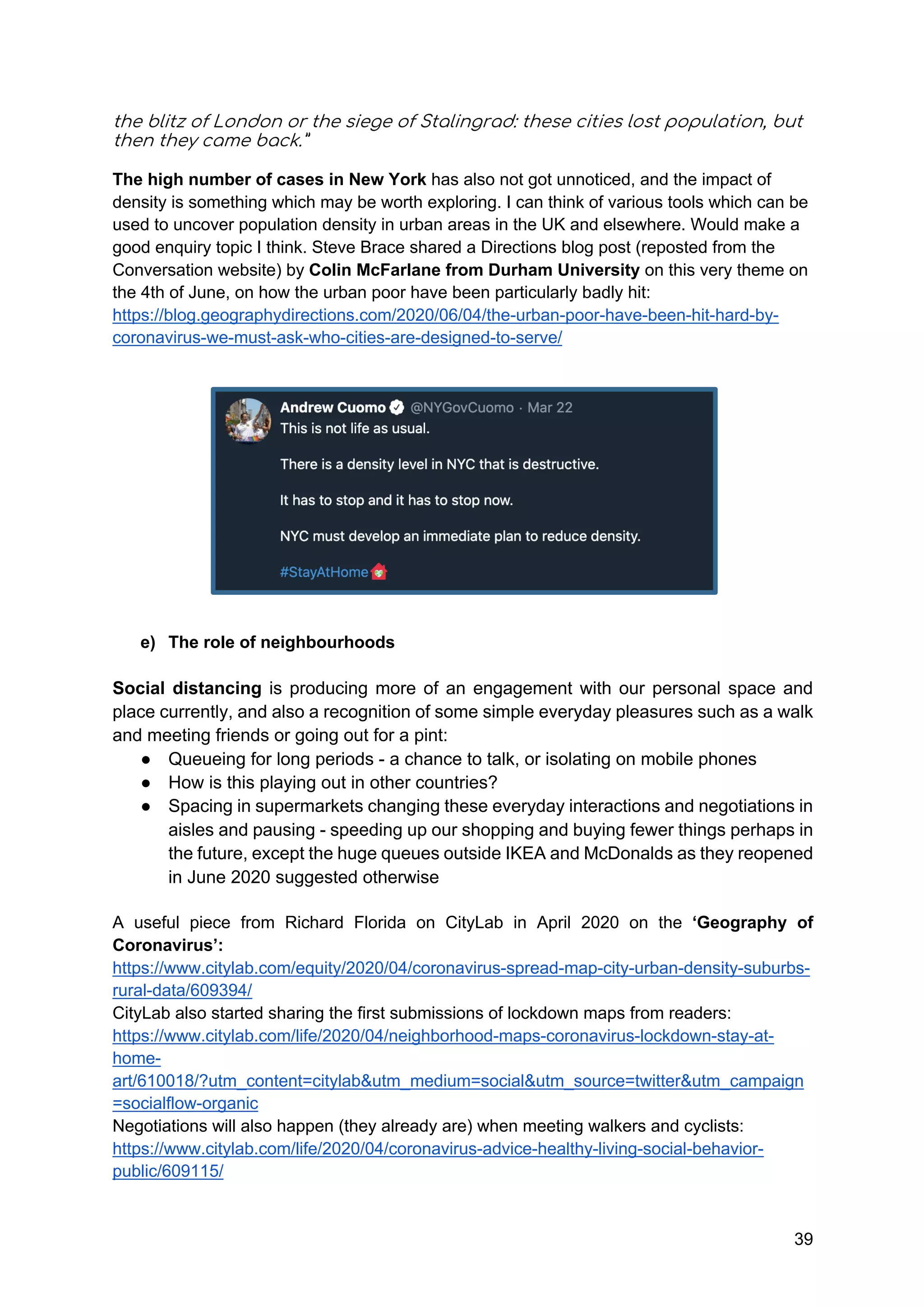
The high number of cases in New York has also not got unnoticed, and the impact of
density is something which may be worth exploring. I can think of various tools which can be
used to uncover population density in urban areas in the UK and elsewhere. Would make a
good enquiry topic I think. Steve Brace shared a Directions blog post (reposted from the
Conversation website) by Colin McFarlane from Durham University on this very theme on
the 4th of June, on how the urban poor have been particularly badly hit:
https://blog.geographydirections.com/2020/06/04/the-urban-poor-have-been-hit-hard-by-
coronavirus-we-must-ask-who-cities-are-designed-to-serve/
e) The role of neighbourhoods
Social distancing is producing more of an engagement with our personal space and
place currently, and also a recognition of some simple everyday pleasures such as a walk
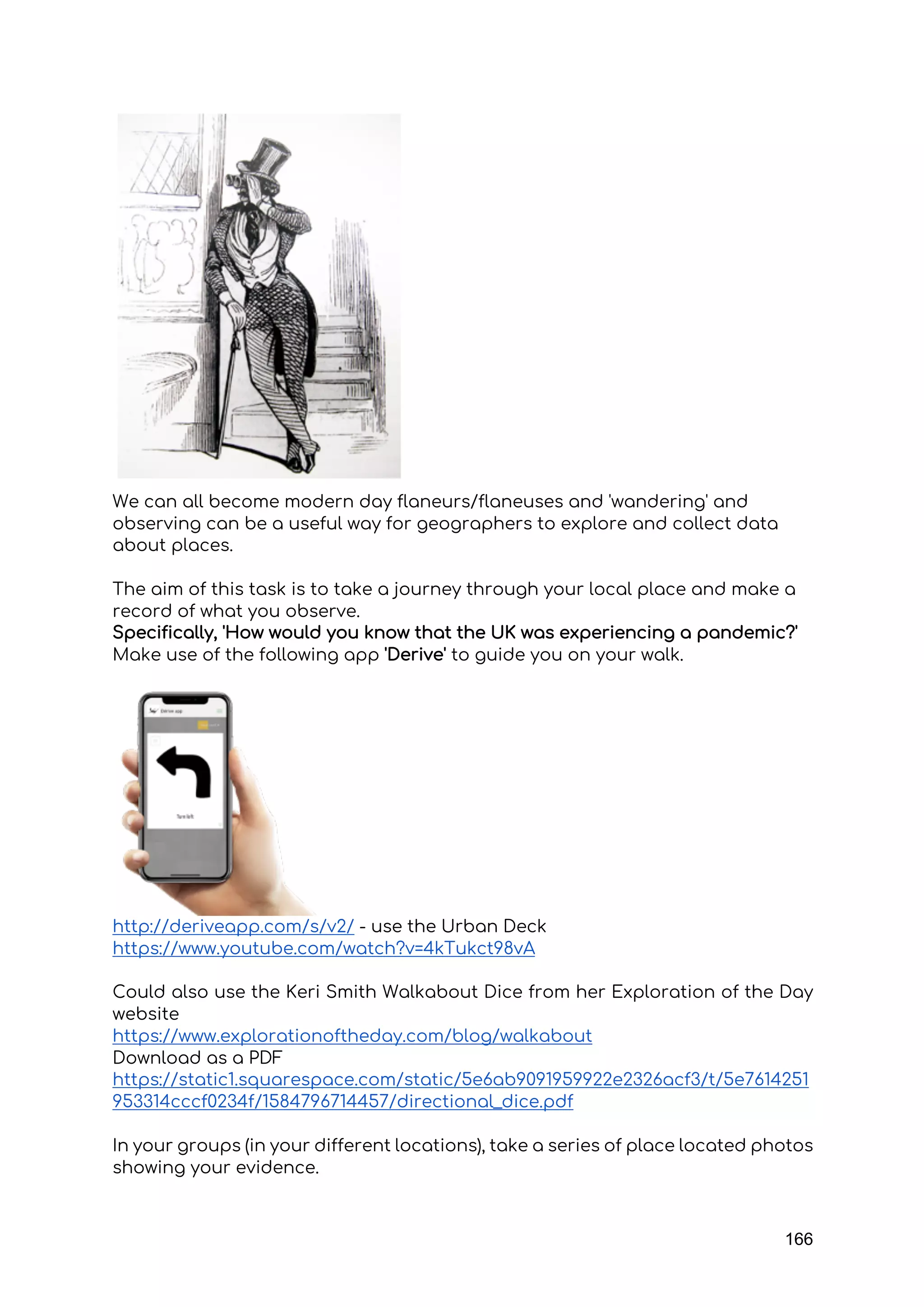
and meeting friends or going out for a pint:
● Queueing for long periods - a chance to talk, or isolating on mobile phones
● How is this playing out in other countries?
● Spacing in supermarkets changing these everyday interactions and negotiations in
aisles and pausing - speeding up our shopping and buying fewer things perhaps in
the future, except the huge queues outside IKEA and McDonalds as they reopened
in June 2020 suggested otherwise
A useful piece from Richard Florida on CityLab in April 2020 on the ‘Geography of
Coronavirus’:
https://www.citylab.com/equity/2020/04/coronavirus-spread-map-city-urban-density-suburbs-
rural-data/609394/
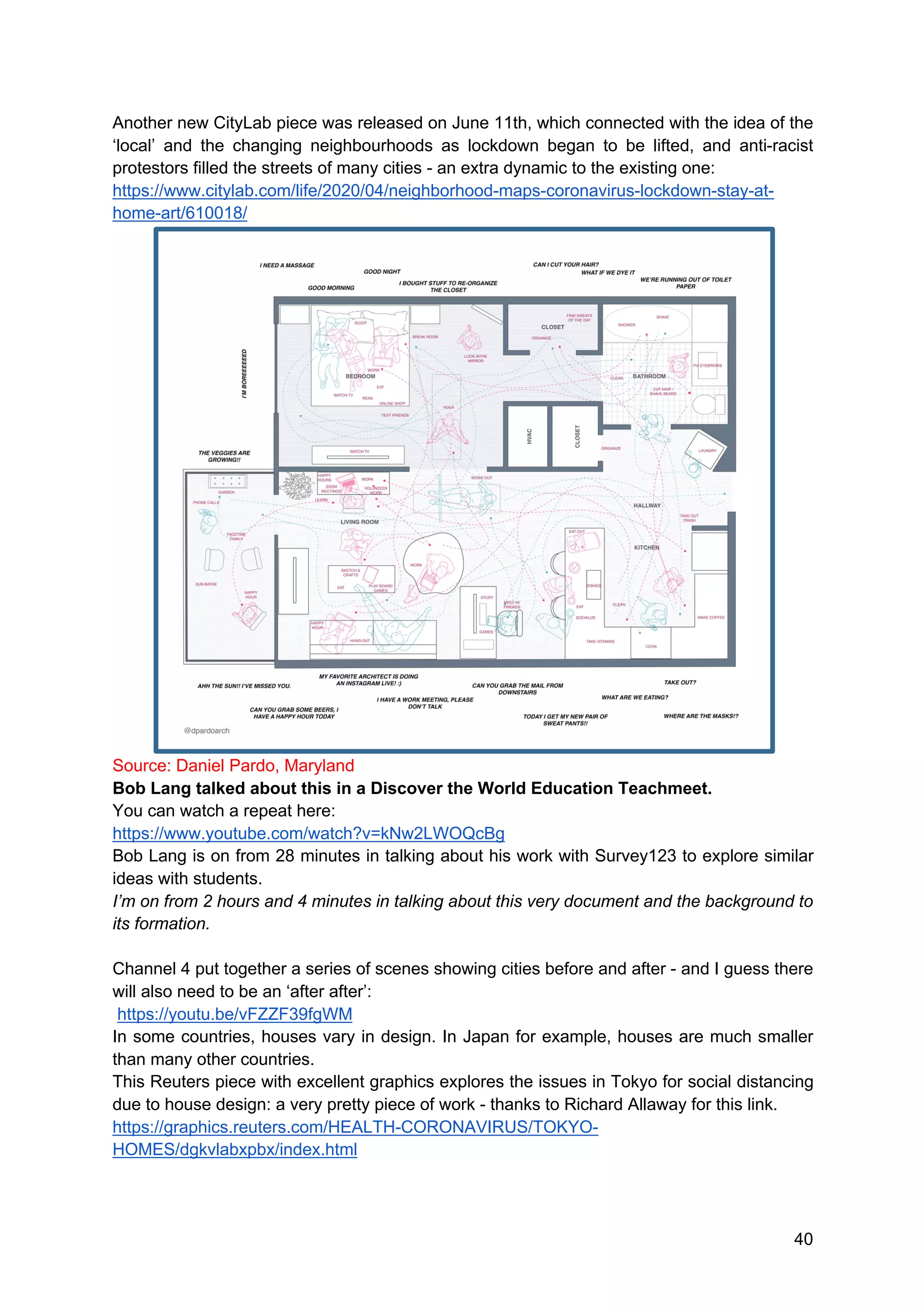
CityLab also started sharing the first submissions of lockdown maps from readers:
https://www.citylab.com/life/2020/04/neighborhood-maps-coronavirus-lockdown-stay-at-
home-
art/610018/?utm_content=citylab&utm_medium=social&utm_source=twitter&utm_campaign
=socialflow-organic
Negotiations will also happen (they already are) when meeting walkers and cyclists:
https://www.citylab.com/life/2020/04/coronavirus-advice-healthy-living-social-behavior-
public/609115/
40
Another new CityLab piece was released on June 11th, which connected with the idea of the
‘local’ and the changing neighbourhoods as lockdown began to be lifted, and anti-racist
protestors filled the streets of many cities - an extra dynamic to the existing one:
https://www.citylab.com/life/2020/04/neighborhood-maps-coronavirus-lockdown-stay-at-
home-art/610018/
Source: Daniel Pardo, Maryland
Bob Lang talked about this in a Discover the World Education Teachmeet.
You can watch a repeat here:
https://www.youtube.com/watch?v=kNw2LWOQcBg
Bob Lang is on from 28 minutes in talking about his work with Survey123 to explore similar
ideas with students.
I’m on from 2 hours and 4 minutes in talking about this very document and the background to
its formation.
Channel 4 put together a series of scenes showing cities before and after - and I guess there
will also need to be an ‘after after’:
https://youtu.be/vFZZF39fgWM
In some countries, houses vary in design. In Japan for example, houses are much smaller
than many other countries.
This Reuters piece with excellent graphics explores the issues in Tokyo for social distancing
due to house design: a very pretty piece of work - thanks to Richard Allaway for this link.
https://graphics.reuters.com/HEALTH-CORONAVIRUS/TOKYO-
HOMES/dgkvlabxpbx/index.html
41
Image copyright: Reuters
Our health may well rely on our homes. We need a Healthy Homes Act this Geography
Directions piece suggests:
https://blog.geographydirections.com/2020/06/24/health-is-made-at-home-why-we-need-a-
healthy-homes-act/
In other urban areas, there are concerns that the closure of public parks is disproportionately
affecting the poorer residents who may not have large gardens to access for exercise,
compared to the more affluent.
Another aspect of urban spaces which has not been obvious to many for some time is the
availability of public toilets. Many people who are able bodied and also able to pay to eat in a
cafe or drink in a pub haven’t had to worry about finding a toilet even as public conveniences
have been closed down in recent years. Now that pubs have been closed, the gaps are
becoming obvious and public urination etc. have grown in recent weeks - again, this is one
of those public/private conflict examples:
https://www.theguardian.com/commentisfree/2020/jun/27/britain-public-toilets-coronavirus-
private-
interests?utm_term=Autofeed&CMP=twt_gu&utm_medium&utm_source=Twitter#Echobox=
1593253845
Also connects with Leslie Kern’s book on the ‘Gendered City’ which I am currently reading.
Community also comes from sport:
https://www.ft.com/content/00ed3676-842c-11ea-b872-8db45d5f6714
Check out how Google and Apple’s social-distancing maps work:
https://www.wired.com/story/apple-google-social-distancing-maps-
privacy/?fbclid=IwAR3F1Y7K1fY0HGv2v48913pq96sSt10gAWW3fOSPsQOTc3onkWEhvVP
jwDI
Compare Apple and Google’s maps. (You can see more of them later in this document)
42
Also check out the Manchester Urban Institute Blog
for a range of useful blog-posts including one on
social distancing and parks, and one on the data
which shows how our cities have changed over the
last few months.
https://blogs.manchester.ac.uk/mui/
https://blogs.manchester.ac.uk/mui/2020/04/21/how-
has-coronavirus-changed-cities-using-urban-data-to-
understand-lockdown/
f) Urban Resilience
Seaside and ex-industrial towns have already had a tough time economically, and they are
now potentially being affected more by the virus. This Sky News piece suggests they may also
be worst hit by these:
https://news.sky.com/story/coronavirus-coastal-and-ex-industrial-towns-most-economically-
at-risk-
11977233?inApp=true&fbclid=IwAR1MUVtSN8Z7D2R1rkrZdf_dhkeHheEZBmWVSgo0_U_
W8w9_wgwAeMkk7cI
A BBC piece from early June on how coastal resorts were faring - badly it seems:
https://www.bbc.co.uk/news/uk-england-52924185
Even the city of LA, bastion of the car is apparently turning into a city of walkers
https://www.nytimes.com/interactive/2020/04/23/magazine/los-angeles-coronavirus-
diary.html
Tim Marshall took a cycle ride around London in mid-May and sent this tweet which could be
useful for a ‘changing places’ topic. I’m collating images like this on a Pinterest board.
We are seeing lots more of these ad-hoc adjustments to the situation:
https://www.bloomberg.com/news/articles/2020-06-23/design-hacks-will-dominate-
coronavirus-recovery?srnd=citylab-design
43
There will definitely be some changes in urban areas.
For this I recommend following the work of Paul Chatterton, who is Professor of Urban
Futures at the University of Leeds. Twitter: @PaulChatterton9
https://environment.leeds.ac.uk/geography/staff/1015/professor-paul-chatterton
https://aboutleeds.blog/2020/05/28/we-can-build-a-more-sustainable-leeds-after-covid-19-
heres-how/
Events such as this Webinar show the groundswell for change in urban areas, with respect to
housing (people in one-bedroom flats while houses remain empty, wealthy politicians in
houses with extensive grounds preventing others from accessing parks etc.
https://climate.leeds.ac.uk/events/net-zero-research-forum-how-to-build-back-better/
Professor Paul Chatterton presented a talk entitled ‘How to build sustainable cities after
COVID-19’.
The power of place.
I referred to this in an IB Webinar I spoke in:
Here’s the presentation (found in v6.0 and later editions)
https://docs.google.com/presentation/d/12YThxAduvEPpOIj0Ivk-
q6f4VLGSuw0k5y18uNp8ez4/edit?usp=sharing
A chance to Build Back Better - here are the principles from:
https://twitter.com/WEAll_Alliance
Thoughts on working from home
44
Image copyright: Weall Alliance
g) Desire Lines
A new addition for mid-June was an article in ‘The Guardian’ on desire lines. Once again
there was a lovely illustration:
Image copyright: Rose Blake / The Guardian
https://www.theguardian.com/lifeandstyle/2020/jun/14/paths-of-desire-lockdown-has-lent-a-
new-twist-to-the-unofficial-trails-we-carve
People are now finding new routes to avoid others - “elective easements” as Robert
MacFarlane calls them.
“In a near future, some of the Covid-19 effects on the urbanscapes will be part
of this narrative, reminding us of the importance of human behaviour in
shaping the city space.”
Finding these routes might form part of a fieldwork activity as well. Explore local parks to see
how they have been changed. Several people got in touch to share some local examples they
had seen on their lockdown exercise routes.
h) Recovery from the Coronavirus
45
On the 15th of June many non-essential shops were able to reopen and the queues started
to form. Picture of Primark prompted many comments, and Bicester village was rammed with
no social distancing evident. Andy Beckett suggested that cities would recover because history
suggests that they always do:
https://www.theguardian.com/commentisfree/2020/jun/15/coronavirus-britain-cities-urban-life
Living in a city is often about sharing, proximity to strangers, and not worrying
too much about hygiene – about who previously sat in your bus seat.
Some areas are going to struggle more than others.
Coastal cities data:
The Centre for Towns published a report on the future for the towns, from which this chart
above is taken. Small coastal towns are not as resilient as other places perhaps if tourist
income dries up this summer:
https://www.centrefortowns.org/reports/covid-19-and-our-towns/viewdocument (PDF
download)
I’m also conscious that most of the links in the document are either UK or US specific so I
am keen to have some other perspectives.
Thanks to Rafael De Miguel González, President of EuroGeo for the link to this Spanish
piece on how cities are likely to recover (translated from Spanish) through their rebirth.
https://www.politicaexterior.com/el-eterno-renacimiento-de-las-ciudades
According to a Deloitte survey, in London half of the construction companies
are planning to reduce their projects in the face of an expected 20-30% drop
in office occupancy rates.
Bloomberg shared an excellent piece on our urban futures, with a nice moving image header:
https://www.bloomberg.com/graphics/2020-coronavirus-transportation-data-cities-traffic-
mobility/
46
11. Employment: Primary, Secondary and Tertiary
The Economy has changed… which jobs will disappear forever?
What will the UK / global unemployment rate be like after this? It is clear that it may be higher
than any point since the 1980s, possibly earlier - the 1970s and the ‘3 day week’ has reared
its head.
For example, ask students to analyse this cartoon and explain what its meaning is - this has
become more relevant actually as the weeks have passed - particularly for those who have
fallen through the cracks of the furlough scheme:
Source: Matt Kenyon/The Guardian
I had an email update in early April from Kate Raworth, author of ‘Doughnut Economics’ (a
speaker at the GA Conference in 2019) giving some suggestions for what they were doing
around this area.
Follow @KateRaworth to see what they are doing with regards to their economic thinking.
They are currently working in Amsterdam to apply their doughnut model to the city.
https://www.theguardian.com/world/2020/apr/08/amsterdam-doughnut-model-mend-post-
coronavirus-economy
This alone would be enough for a whole unit of work based on some of the starting questions
which Kate outlines here:
https://www.kateraworth.com/2020/04/08/amsterdam-city-doughnut/
47
They also recorded a chat on pandemic-resistant economics here which may be of interest.
https://www.pscp.tv/w/1nAJEdVLLmnGL?q=revkin
Check out recent work by Matt Podbury on the circular economy as well.
Is this time for a transition to a green economy - perhaps the final chance and warning:
https://www.theguardian.com/commentisfree/2020/jun/05/world-climate-breakdown-
pandemic
People will also perhaps remember those companies that looked after staff by protecting them
once the lockdown started, and those that didn’t. Furloughing is not going to benefit people
evenly either. The BBC had a piece on which areas had the most people furloughed:
https://www.bbc.co.uk/news/business-53014192
This Australian piece shows how GIS can be used to see which areas of Melbourne have
been worst hit financially - perhaps a model to use for an activity
https://www.theage.com.au/national/victoria/data-shows-melbourne-suburbs-worst-hit-by-
covid-19-financial-impact-20200608-p550kb.html
Oxfam’s campaign also reminds us how many people globally are in danger of being
pushed into poverty.
48
https://www.oxfam.org/en/press-releases/half-billion-people-could-be-pushed-poverty-
coronavirus-warns-oxfam
This piece also points out the gender imbalance in impact as well.
Women are on the front line of the coronavirus response and are likely to be
hardest hit financially. Women make up 70 percent of health workers globally
and provide 75 percent of unpaid care, looking after children, the sick and the
elderly. Women are also more likely to be employed in poorly paid precarious
jobs that are most at risk. More than one million Bangladeshi garment workers
–80 percent of whom are women– have already been laid off or sent home
without pay after orders from western clothing brands were cancelled or
suspended.
The ILO (International Labour Organisation) is the organisation that is particularly interested
in the impact on labour markets and collects statistics in that area. It’s thoughts on the
potential impacts are here, and would be useful going forward to explore the impacts in a
number of industrial areas.
https://ilostat.ilo.org/topics/covid-19/
In mid-June we also had some indicators on the jobs situation, with over 600 000 people going
off the pay-roll. This has a knock-on for tax revenue of course. Perhaps if very rich people paid
more tax, or large companies operating in the UK? Just a thought.
49
What follows are some examples of particular industries which may see
dramatic change.
a. Retail and the changing High Street
Will the High Street survive the virus?
An excellent article to start off the retail section. This is a key area for many discussions:
https://www.esquire.com/uk/life/a31915611/coronavirus-
timeline/?fbclid=IwAR2O_wGutNkiX_mIKDjxqjBqsAQSK7IZw55mmlVieRXAZ6IjagQxw4AuF
8o
Changing retail patterns, with Tim Lang, Professor of Food Policy.
“Supermarkets actually account for only about 60 percent of the food we
[normally] consume,” says Tim Lang, professor of food policy at City University,
London. The rest comes from your Friday fish and chips, your Saturday brunch,
and all those al desko Pret lunches (oh, falafel flatbread, how we miss thee). “If
40 per cent [of the food supply] is cut off, and 60 per cent has to deal with 100
per cent, well, you’ve got stress and strains. It’s inevitable. We need to be thinking
very carefully about renationalising supply chains, out of resilience
preparedness,” says Lang, the food policy expert. “We’ve developed, over 60
years, a culture that says, 'I can eat what I like, when I like, and it’ll be cheap
forever, and I’ll overeat as well.' That culture has got to change.” Tropical fruits
will disappear from shelves and seasonal fruits will become so again, thanks to
hold-ups at borders due to decreased freight flights. That means no more
strawberries in winter. “Coronavirus is going to take a scythe through the
normality of food."
This Economist Article outlines how Coronavirus rewrote our shopping lists, and also
introduced the German word for hoarding: hamsterkauf.
https://www.1843magazine.com/food/panic-at-the-supermarket-how-covid19-rewrote-the-
shopping-list
50
Amazon meanwhile is benefitting (although in France, they are not allowed to deliver anything
other than essential items)
https://www.theguardian.com/technology/2020/apr/15/amazon-jeff-bezos-gains-24bn-
coronavirus-pandemic
The High Street may not recover from this setback and we may end up with Amazon and
similar online retailers growing their monopoly. They are taking on many more staff.
Delivery drivers are bringing our purchases to the door.
An excellent NYT piece suggested that we are going to see the end of the department store,
as many were already struggling before this crisis, and we are not shopping in the same way.
https://www.nytimes.com/2020/04/21/business/coronavirus-department-stores-neiman-
marcus.html?action=click&module=Top%20Stories&pgtype=Homepage
There are limited reads of articles on the New York Times, but I recommend a cheap
subscription to access the pieces (charge it to your departmental budget)
This had an excellent graphic referencing the classic store Macy’s. This was later broken into
during the events following the death of George Floyd, which has caused other large scale
change and reevaluation since early June.
Image copyright: Andrew Sondern/New York Times.
There were also mentions of Hudson Yards, an exclusive shopping mall which I visited while
in New York last year, which is likely to be suffering quite a lot.
“The genre is toast, and looking at the other side of this, there are very few
who are likely to survive.”
Mark A Cohen
The High St of towns and cities across the UK will also be reshaped without some changes to
retail trade / rents:
https://www.theguardian.com/business/2020/apr/30/pandemic-will-vastly-accelerate-decline-
of-uk-high-street-mps-told
51
The Street will still be there, but what will the building use be along it?
Several other chains announced hundreds / thousands of job losses in early July, with over
12 000 jobs lost in a day or so.
Lewis Cotter has shared a resource which shows how High St. names treated their workforce
and suppliers during the lockdown, and it may be that people will decide to support the
companies who treated their workforce the best.
https://www.lewiscotter.com/brands
It’s also worth remembering that in the UK we have a choice of stores, from Aldi and Lidl up
to Waitrose and M&S for food. In most of India, people shop at stores called kirana shops.
https://medium.com/@VaidyRajamani/the-power-of-kirana-stores-transforming-indian-retail-
f5ac198f7bbc
https://www.rediff.com/business/interview/what-if-kirana-shops-run-out-of-
stock/20200329.htm
These have little stock, precarious supply chains and crowded interiors which are difficult to
keep a social distance inside. There are apparently millions of these stores, and 90% of food
is bought in them. This means there are few alternatives for food supplies. People in India
have never seen their cities so quiet, as they are always teeming with people:
https://www.rediff.com/news/report/mumbai-after-the-lockdown/20200322.htm
WIthin a few weeks, in early May they were able to launch an online store offering deliveries
and orders. Remarkable ingenuity.
A growing part of the culture of the High St. was the presence of coffee shops - the
independents such as Ginger in Broomhill, Sheffield or the big chains including Starbucks,
Cafe Nero, Costa and others. The sudden closure of cafes has changed the way that people
consume coffee, but in what ways? Jennifer Ferreira has research coffee for some years, and
is now researching changing coffee consumption following the closure of cafes - one of the
few research projects I’ve seen surrounding the virus:
https://cafespaces.wordpress.com/2020/05/17/new-research-exploring-coffee-consumption-
and-the-impact-of-covid-19-lockdown-restrictions/
Please help Jennifer with her research here:
https://coventry.onlinesurveys.ac.uk/coffee-consumption-and-the-impact-of-covid-19-
lockdown-res-3
One suggestion is that cafes may move outside and use street stalls rather than the previous
layouts. This may be part of a changing retail offering:
https://www.theguardian.com/world/2020/may/17/cafes-in-england-could-sell-food-and-drink-
from-street-stalls
Another concern is that independent coffee outlets may be less financially able to ride this out
and close, leaving us with mostly chain coffee outlets in the future:
https://medium.com/the-little-bicycle-coffee-shop/indie-coffee-shops-covid-19-pandemic-
fb56d5e96738 - this may happen with other sectors of retail as well, reducing the diversity of
offerings that we have in city centres and perhaps making them more of a clone town with
more homogeneity.
52
A Hubbub piece on our changing shopping habits - localism and the “fifteen minute city”
https://www.hubbub.org.uk/blog/how-covid-19-has-changed-uk-shopping-habits
The industry needs Govt. help, which is unlikely to be enough:
https://www.theguardian.com/business/2020/jun/06/pandemic-leisure-retail-jobs-
unemployment-recovery?CMP=Share_iOSApp_Other
Apparently one fifth of all American retail workers have been furloughed:
https://www.economist.com/graphic-detail/2020/06/03/american-retailers-have-laid-off-or-
furloughed-one-fifth-of-their-
workers?fsrc=scn/tw/te/bl/ed/dailychartamericanretailershavelaidofforfurloughedonefifthofthe
irworkersgraphicdetail
One idea for an activity here: Centre for Cities recovery tracker for UK cities - a data dashboard
- one to develop I think:
https://www.centreforcities.org/data/high-streets-recovery-tracker/
Monitor recover over the next few months
May save some data now for local cities such as Cambridge and Norwich.
Of course, there will always be somebody who will find a way to exploit a situation. One
expression of this is a store in Miami, which offers Covid-19 essentials in one place:
https://wsvn.com/entertainment/covid-19-essentials-pop-up-offers-in-demand-supplies-for-
pandemic-in-one-place/
Thanks to Oli Mould for the lead to this story
Shopping malls may become residential developments:
https://www.bloomberg.com/news/articles/2020-06-30/a-case-for-turning-empty-malls-into-
housing
53
There are some obvious links between working from home and the High St. If people head
for the office, there is a greater chance that they will be physically in a town or city. They
may walk from the railway station past other shops towards their place of work. This means
that home workers aren’t buying a coffee, pastry, sandwich or other impulse purchases: the
trays of doughnuts because it’s their birthday etc. are all lost sales. People need to be
persuaded back into city centres if shops are going to survive.
This is a changed High St environment.
https://www.ft.com/content/e39931c0-8a6c-42db-b530-47d6f343df65
Questions from Stephen Schwab
b. Gig Economy
This sector of the economy, which has grown dramatically in recent years, has been
particularly affected by the virus.
Uber has been badly affected - sharing a car is not felt to be safe - black cabs with screens
are perhaps still relatively OK. Not sure if they have been running in London.
Food delivery - most take-aways closed for months, even McDonalds and Nandos - the local
fish and chip shop in the village was still open. A huge queue built up in Wakefield when Costa
reopened.
Uber - released an ad thanking people for staying at home:
https://adage.com/creativity/work/uber-thank-you-not-riding/2249401
https://youtu.be/_e8XLnMiCOE
Airbnb - this has the potential to return some properties to longer term rentals and may see a
change to the dominance of Airbnb in some city centres. We shall see what the appetite is for
short term rents and going into a space that somebody else occupied the day before without
deep cleaning between each tenant?
Apparently, Portuguese owners are
resisting the shift to lower rents for
social housing.
https://news.trust.org/item/20200513094900-s5d3u/
Critics say the rise of Airbnb-style properties has torn the soul out of the centre
of Europe's best-loved tourist cities, from Edinburgh to Barcelona. A 2018 study
54
estimated one in three properties in central Lisbon were holiday lets, pushing
local people to the outskirts as rent prices skyrocketed by 9.3% that year. The
council programmes, due to launch in Lisbon in coming weeks and in Porto in
September, aim to capture some properties back for renters at affordable
prices. "This will increase housing stock in the city centre while also providing
holiday let owners with a stable income in an uncertain time," Lisbon mayor
Fernando Medina said.
Picked up in this CityLab article about the longer time impact on airbnb, which is cutting staff
and key staff salaries, and has continued to slim down as the weeks have gone by:
https://www.citylab.com/life/2020/04/coronavirus-safe-travel-airbnb-rental-business-host-
bailout/608917/
https://www.boston.com/travel/travel/2020/04/01/airbnb-letter-coronavirus-pandemic
More of us will definitely be working from home in the future.
https://www.realcommercial.com.au/news/experts-deliver-verdict-on-workplaces-post-
coronavirus-
future?rsf=ps%3Afacebook%3Arcanews%3Anat&fbclid=IwAR2bOkHIyJCylwXqu9921vBKB9
SV_YjJkHotU_WU3PcAu6VeXmK4141TClI
We see to like it according to this WEF article from early June:
https://www.weforum.org/agenda/2020/06/coronavirus-covid19-remote-working-office-
employees-employers/
Lives vs lives in the Spectator
https://www.spectator.co.uk/article/lives-vs-lives-the-global-cost-of-lockdown
c) Agriculture and the Food System
This is a big one…
There is a need for more workers to pick food in the UK or it will rot in the fields as the season
progresses.
● Will farming be changed in terms of what is grown?
● Will this see a continued need for migrant workers and visas?
● Will we need a Pick for Britain campaign in the same vein as Dig for Victory?
The Fishing industry is suffering with a loss of overseas shellfish sales and closure of
supermarket fish counters:
https://www.theguardian.com/environment/2020/apr/10/scottish-fishermen-turn-to-food-
banks-as-covid-19-devastates-industry?CMP=share_btn_tw
Singapore is almost wholly reliant on food imports (around 90% of its food) as it is so small
and urbanised. It is now bringing forward plans to grow more of its own food on rooftop
gardens.
https://uk.reuters.com/article/us-health-coronavirus-singapore-farming/singapore-ramps-up-
rooftop-farming-plans-as-virus-upends-supply-chains-idUKKBN21Q0QY
Only 1% of Singapore is apparently used for growing food at the moment, but that is set to
increase.
https://www.reuters.com/article/us-singapore-agriculture/from-sky-farms-to-lab-grown-
shrimp-singapore-eyes-food-future-idUSKCN1T00F2
55
Similarly, Australia has taken a fresh look at its own agricultural system to increase their self
sufficiency - Sydney Morning Herald piece here:
https://www.smh.com.au/politics/federal/coronavirus-triggers-australian-self-sufficiency-
push-20200412-p54j5q.html
Consider this very useful model of the Food system from the Centre for Food Policy.
Identify the current stresses that are being placed on elements of this model.
Image source: Centre for Food Policy
The Plant based sector was making good strides before the crisis. This piece is not entirely
without bias but makes a few interesting points with respect to the cost of food..
https://www.sacredcow.info/blog/plant-based-coronavirus
The rural economy will need help to bounce back as well - will there be changes to the
typical English countryside?:
https://www.princescountrysidefund.org.uk/research/recharging-rural-2
There is of course one very important food related link and that is the cultural issues behind
the consumption of animals. In some countries, including the USA, there are so called “wet
markets” where animals are sold live. The presence of these markets has been suggested as
one origin for pandemics due to hygiene and other aspects of the operation of these
markets.Some Chinese cities are now banning the sale of meat from dogs and cats it seems,
and there may well be other cultural changes in what meats are consumed. The consumption
of ‘bush meat’ such as bats was thought to be a source for the Ebola outbreaks of 2015.
https://www.independent.co.uk/environment/coronavirus-china-wet-markets-dog-cat-meat-
stop-the-wildlife-trade-campaign-a9466136.html
56
Food production has been connected with the emergence of new viruses, as well as other
issues. This is an area to develop in the curriculum I would say.
https://www.theguardian.com/commentisfree/2020/apr/20/factory-farms-pandemic-risk-covid-
animal-human-health
In the middle of April we also saw a series of flights bringing Romanian fruit and vegetable
pickers to the UK:
https://metro.co.uk/2020/04/15/fruit-pickers-flown-romania-brits-failed-answer-call-help-
12559562/
Remarkably the Daily Mail had this as its cover, after years of front covers denigrating migrant
workers. All those people who wanted to ‘support their country’ and ‘take back control’ weren’t
up to helping it seems when it really mattered.
.
Some other workers are interviewed here:
https://www.bbc.co.uk/news/business-52504186
One of the areas linked to this was the demand for
food. Some people have been stockpiling for years
in anticipation of some issues of this kind. They are
called ‘Preppers’, and geographer Bradley
Garrett, who is writing a book on this, has
written a good piece in ‘The Atlantic’ -
suggesting that we will all be doing some prepping
next. I think we will be mindful of what we have in
our homes, and be more aware of being ready.
https://www.theatlantic.com/ideas/archive/2020/05/we-should-all-be-preppers/611074/
His book is out in August. It may be of interest to many. It also matches the other book on
the coming Apocalypse in the reading list.
He’s interviewed here:
https://www.theguardian.com/books/2020/mar/27/underground-skyscrapers-and-off-grid-
bunkers-inside-the-world-of-preppers
He cites the French Marxist Paul Virilio, who worried that as space and
distance were compressed by speed and connectivity, we would become more
57
vulnerable to disaster. “In other words, progress and disaster go hand in
hand.”
The Guardian piece ends with another useful quote from Bradley - this book is going to be
excellent:
“disasters aren’t ends, but irreversible transitions … They’re always something
less than an extinction. Catastrophe, by its very nature, falls short of finality.
It’s the end of something but never the end.”
The Food System and how it has coped was also the topic of another excellent piece in
‘The Economist’ made freely available, and with another excellent illustration, this time by
Cristina Spanò.
https://www.economist.com/briefing/2020/05/09/the-worlds-food-system-has-so-far-
weathered-the-challenge-of-covid-19
Keeping it cornucopius...
Illustration: Cristina Spanò
The piece explains that there is plenty of potential for things to go wrong still. It also points out
that 80% of the world’s population relies, at least in part, on imported food, so the movement
of food needs to continue - it’s always something that amazes me in a way. I pick up some
beans from Kenya and think - why aren’t people in Kenya eating these?
Adam Vaughan in the New Scientist warns of a potential food crisis:
https://www.newscientist.com/article/2243692-covid-19-pandemic-risks-worst-global-food-
crisis-in-decades/
The Barilla Centre for Food and Nutrition:
https://www.barillacfn.com/en/magazine/food-and-society/people-and-nature-lessons-
learned-from-the-covid19-pandemic/
Wild animals are hunted or trapped and kept under crowded conditions in
markets, often many wild species, domestic species and people very close to
each other, under appalling conditions of hygiene.This gives the perfect
conditions for the viruses to mutate and jump from its original hosts to new
hosts, including domestic animals and people. The wildlife trade is an excellent
58
vehicle for pathogens to spread around the world. Besides, once a virus can
infect domestic animals, factory farming with its crowded conditions provide
the perfect conditions for further spread and mutation. And, of course, once
the virus acquires the capacity to infect people, with our massive transport of
goods and travellers around the world it can go to one city to the other, from
one continent to the other, extremely quickly.
The UN has published a report on zoonotic diseases and their prevention which gives
recommendations for food policy decisions to be made in the future.
https://www.unenvironment.org/resources/report/preventing-future-zoonotic-disease-
outbreaks-protecting-environment-animals-and
Also made the i newspaper in early July 2020
https://www.independent.co.uk/environment/stop-the-wildlife-trade-coronavirus-disease-
climate-crisis-a9600991.html
Al Jazeera also picked up the report and ran this piece:
https://www.aljazeera.com/news/2020/07/failing-warns-rise-animal-human-diseases-
200707055027985.html
d) Service sector
https://www.ft.com/content/f8e58c8a-de5e-44ac-84c4-dac767e6cfca - the service sector has
been particularly badly affected by the lockdown, and also certain sectors placed at increased
risk of job losses. This is largely because of the greater person to person contact involved, or
the requirement for large groups to gather together in one room. I was due to see Steve
Hackett play live in November but that has been put back to next September now.
59
This includes food services and entertainment too of course, with pubs and music venues
closed along with theatres. In July, £1.5bn was promised for the arts, which may not touch the
sides.
The world’s largest service industry of course is Tourism, and this is unlikely to be back to
anything like normal for at least six months with many countries closing their borders to
international tourists.
A recalculation of the P/S/T employment mix may be needed in a year or so.
See Section 17 of this document for more on Tourism as a changed industry.
A particular part of the service sector is the sex worker industry. They have, of course, been
affected - and the German government is looking at how they might be helped to get to work
- though it will he hard:
https://www.economist.com/europe/2020/06/04/germany-helps-sex-workers-idled-by-covid-
19
e) Garment workers
Various campaign groups were quick off the mark to publicise the plight of garment workers.
https://cleanclothes.org/news/2020/live-blog-on-how-the-coronavirus-influences-workers-in-
supply-
chains?fbclid=IwAR0pfQvjJ4vZM6aLNZImo3N2PtTGsju4NhYljif17sQQZRxSSIApdmn53vQ
Many garment workers feared for their lives with a lack
of social distancing in the factories where they worked.
Fashion Revolution was an important account to follow
in this area as it kept track of stories relating to garment
workers and how they tried to cope.
Also Follow the Things Facebook page is an important
resource here.
https://www.facebook.com/followthethings/
This CNN piece is interesting, connecting fast fashion
with climate change:
https://edition.cnn.com/2020/05/03/business/cheap-
clothing-fast-fashion-climate-change-intl/index.html
Some companies like Primark cancelled crucial orders at a time when the garment workers
needed support and certainty over future payment:
https://www.thedailystar.net/business/news/bangladesh-urges-global-partners-honour-terms-
rmg-purchasing-contracts-1890838
Vietnam’s workers were in debt and worried as well:
https://www.voacambodia.com/a/mounting-debt-and-factory-closures-squeezes-kampong-
speu-garment-workers/5364643.html
Are garment workers being treated in the same disposable way as the clothes they are
making?
https://www.thenation.com/article/world/bangladesh-garment-workers-covid-19/
60
Check our Dana Thomas’ ongoing work to explore how garment workers are being affected
here: https://mailchi.mp/traid/behindtheseamsdec_2020-weekly-2663238
https://www.traid.org.uk/traid-blog/ - excellent interview
https://www.traid.org.uk/education/education_resources/ - education toolkit
The Clean Clothes Campaign have published a report on Garment Worker exploitation in
Japan.
https://cleanclothes.org/news/2020/forced-labour-and-debt-trap-migrant-workers-in-japan-
face-substantial-risks-during-coronavirus-outbreak-
This final article connects sections e) and f)
https://www.thenation.com/article/world/kalpona-akter-interview-bangladesh/
Some companies still haven’t paid invoices.
This article in late June gave some fresh context to the perilous situation of individual workers
and the industry as a whole. Meanwhile the queues built up outside shops selling fast fashion
when they reopened:
https://www.theguardian.com/global-development/2020/jun/21/my-life-became-a-disaster-
movie-the-bangladesh-garment-factory-on-the-brink
“My life became a disaster movie”
It seems we don’t have to go to Bangladesh to find sweatshops as well.
https://www.dailymail.co.uk/news/article-8488859/Leicesters-fast-fashion-die-Cramped-
ragtrade-workshops-pariah-city.html
This may be connected with rising cases which led to Leicester being locked down.
https://www.ft.com/content/0b26ee5d-4f4f-4d57-a700-ef49038de18c - Sarah O Connor piece
in the Financial Times is free to read and useful. This is one I will definitely explore along with
the Government’s 24 page definition of where Leicester began and ended.
Where does Leicester begin and end?
https://www.ft.com/content/5b9ce1f9-35f2-4640-914e-12b8f757b103
Public Health England had to define Leicester for the recent lockdown,
61
http://www.legislation.gov.uk/uksi/2020/685/pdfs/uksi_20200685_en.pdf
At the same time, the garment sector in Leicester came under the spotlight again as a possible
source of the outbreak and increased cases due to ‘slave labour’ in some of the local factories.
One to possibly consider alongside the usual garment worker tasks:
https://www.retailgazette.co.uk/blog/2020/07/boohoo-accused-of-slavery-practices-in-
leicester-factory/
https://www.ft.com/content/b1ff70c6-0da1-4157-802f-47d03f51ccd0
This FT Free to Read piece will form part of my curriculum making in this area:
https://www.ft.com/content/e427327e-5892-11e8-b8b2-d6ceb45fa9d0
f) Supply chains
Just-in-time economies have been disrupted. This has caused issues for many industries
which relied on supplies arriving just when they were needed.
Perhaps we need more teaching about the nature of supply chains perhaps and the
vital work of logistics. This is one area which we always did well at my current school.
I am working with one of the country’s leading logistics companies to put together a
teaching resource on this topic.
62
It will be appearing in the next couple of months.
Or perhaps we recalibrate the idea that we could order one day and get it the next day, and
relearn the act of patience e.g. queueing to walk into a supermarket.
Shipping containers are an important technology here. Mariners on container ships were
relatively safe there and could be tracked on MarineTraffic continuing their global wanderings.
http://www.marinetraffic.com
Will we start manufacturing closer to home if this is possible?
Check out this FT video on how trade and shipping routes may change from mid June:
https://tradesecrets.ft.com/global-
shipping?utm_source=TW&utm_medium=interest&utm_content=image_card
Car manufacturing is certainly suffering:
https://www.theguardian.com/business/2020/jun/05/bentley-to-cut-nearly-a-quarter-of-its-
workforce
3D printers were used by many to start printing PPE: a big well-done to Patrick Carberry, Head
of DT at my school for printing and distributing hundreds of face shields for PPE to local health
care agencies and pharmacies. It seems that quite a few teachers have gone to a similar effort
to support local healthcare workers. Suddenly the face mask is the most important commodity
it seems and delivery is rightly being prioritised for healthcare professionals:
https://www.theguardian.com/world/2020/apr/28/face-masks-coveted-commodity-
coronavirus-pandemic
BBC Radio 4 programme on this theme: https://www.bbc.co.uk/programmes/m000gvd3
In Business Programme - Radio 4
How can companies change their way of working? Some thoughts here
https://eandt.theiet.org/content/articles/2020/03/will-your-supply-chain-thrive-in-a-post-
coronavirus-world/
As China’s supply lockdown passes the six-week mark, we are reaching a tipping
point. With only a slow build-back of supply from China, we are inevitably going
to see shortages of key components across a range of sectors. The type of
exports affected by the lockdown in China’s Hubei province are garments and
textiles; mobile phones; electronics; medical products; small components and
machinery. Therefore, the disruption caused is likely to be seen mainly in
automotive, consumer electronics and pharmaceuticals, meaning the
immediate impact on European consumers will be less directly felt.
To finish the Economies Section, check out Kit Rackley’s GeogRamblings video, released
at the end of March 2020. It explores the potential downward spiral of the de-multiplier effect
which countries find themselves in with people not spending money as they normally do
because of fears over their wages in the medium term producing financial uncertainty. There
is plenty of useful advice here as well as an analysis of the situation.
https://geogramblings.com/2020/03/31/the-downward-spiral-and-the-coronavirus/
63
Image: Kit Rackley of GeogRamblings - used with permission
Here’s the data on the lockdown
https://www.wired.co.uk/article/uk-shopping-travel-data-coronavirus
g) Remittances
Thanks to Paul Ganderton for this article on Remittances to kick off this section.
https://theconversation.com/coronavirus-pandemic-could-hit-the-billions-migrant-workers-
send-home-in-cash-135602
These are the financial flows which head back to countries like the Philippines from those
residents who work in other countries, and often earn more money than they could if they
stayed at home. These payments help support large numbers of families, whose spending is
then ‘multiplied’ in the economy. How will the reduction in flows of people and finances
potentially impact on those families involved. Migrant workers aren’t as well supported during
the pandemic, and also are likely to contemplate a return home if that is possible.
In 2019, an estimated 200 million people in the global migrant workforce sent
home US$715 billion (£571 billion). Of this, it’s estimated US$551 billion supported
up to 800 million households living in low- and middle-income countries.
h) Corporate Social Responsibility
There’s an element of this in the previous work on garment workers / links to globalisation, but
it’s worth considering this as a new topic for discussion when teaching about industry and the
role of TNCs. Some companies are particularly affected. Primark had no sales at all in April or
May for example as it has no online presence:
https://www.itv.com/news/2020-04-21/primark-owner-furloughs-68-000-retail-staff-and-
reveals-248m-stock-hit/
64
i) The death of the Office as a workplace
An excellent piece in the Economist, with wonderful illustrations (this is a golden period for
those to be created) on the death of the office and why we don’t need it anyway…
https://www.1843magazine.com/features/death-of-the-office
Certainly offices will be very different places when we return. Screens and distancing are going
to be part of the range of measures:
https://www.bbc.co.uk/news/av/uk-52635983/coronavirus-what-does-a-covid-secure-office-
look-like
Although having told teachers they need to go back, MPs seem to not be very keen to go back
to the House of Commons:
https://news.sky.com/story/coronavirus-mps-alarmed-by-plans-for-them-to-return-to-
parliament-in-person-1198773
Offices may become ‘motherships’: https://news.trust.org/item/20200527121726-nl00c/ with
home hubs.
j) The social contract
Start with this on the social contract from the Financial Times
https://www.ft.com/content/7eff769a-74dd-11ea-95fe-fcd274e920ca?list=intlhomepage
"Governments will have to accept a more active role in the economy. They must
see public services as investments rather than liabilities, and look for ways to
make labour markets less insecure. As western leaders learnt in the Great
Depression, and after the second world war, to demand collective sacrifice you
must offer a social contract that benefits everyone.”
What is clear is just how awfully the Government handled the pandemic from mid-February
onwards. Their lack of action has massively increased the death toll.
And the last line of that article:
Beyond the public health war, true leaders will mobilise now to win the peace.
And we will need to keep our distance for quite some time.
https://twitter.com/i/status/1248317963566006272
65
This Lancet piece places the clapping in context. It’s simply not good enough.
https://www.thelancet.com/journals/lancet/article/PIIS0140-6736(20)30983-
1/fulltext?fbclid=IwAR2AiQeb38O4UcMewUjXuRz7eRImg-
g8JlaMp8fvqVqq7uMhQP3RSXuC-RE
“Allegiance, after all, has to work two ways; and one can grow weary of an
allegiance which is not reciprocal.”
James Baldwin
k) Gaming Industry booming
As we are all at home, the games industry has boomed. Games have become a way for people
to escape reality and, if they have time to spare and don’t have a hobby or something that
they can do, they are ideal for escapism. Some games have really sold tremendously well, as
they are calm, or allow a world to visit which is away from the cares of our own.
Early on in the lockdown, my daughter asked me to order a copy of the new Nintendo Switch
version of ‘Animal Crossing’ as it was likely to sell out. It certainly did sell out, and quite quickly.
Image source: The Economist
Animal Crossing is mentioned in this piece here:
https://www.economist.com/prospero/2020/04/24/the-lockdown-is-a-boon-for-social-
simulation-games?fsrc=scn/tw/te/bl/ed/
It’s doing well as it’s not got the violence of other games - it’s calming:
https://www.ft.com/content/4531a734-c25d-4f1f-a6b3-6be692dade5c
Sales are estimated at 12 million.
https://www.bbc.co.uk/news/business-52555277
“It’s a kind of endless experience — it’s not something that people can
complete.”
A limited edition “Animal Crossing” Switch console sold out within 10
hours of its launch, according to a spokesperson from Currys PC World.
66
Some games have previously been used to help with collecting data before and changing
society.
https://www.youtube.com/watch?v=dE1DuBesGYM&feature=youtu.be
The book ‘Reality is Broken’ by Jane McGonigal is useful here.
The board game Pandemic is a collaborative game. I wonder how sales have been. It’s also
available as an app.
Jigsaws have also sold out on many sites as another way of passing the time. Board games
are perhaps having a resurgence as well.
VR headsets are also available for extra immersion.
I can see a new unit on the geography of gaming emerging, with a look at the communities
that develop around certain games, placement of servers in cold places e.g. Facebook servers
placed up in Finland, and plans to place them under the oceans as well, as the cooling costs
are otherwise very high.
Also worth remembering that some games consoles have web browsers, so could act as an
extra device option for lockdown learning.
LEGO is also available of course, and doesn't need a charging cable. The creativity it offers is
an escape which we all need. LEGO are also working on new resources to help parents.
l) Droning on
Could the pandemic speed up our adoption of the use of drones for deliveries?
This Economist podcast explores that, and other technologies which may benefit from this
time:
https://www.economist.com/podcasts/2020/04/27/viral-acceleration-tech-in-the-time-of-
coronavirus?fsrc=scn/tw/te/bl/ed/viralaccelerationtechinthetimeofcoronavirustheworldahead
Some police forces were using drones for enforcement early in the pandemic lockdown to spot
people walking in National Parks.
The Conversation continued the conversation on this in early July, where they imagined a
future city with more drones. I’m not convinced that this will happen quite yet. The noise and
congestion in the air would become an issue, and I’m sure they’d be hacked or targeted for
theft. However, here’s some thinking:
https://theconversation.com/how-drones-and-aerial-vehicles-could-change-cities-
140907?utm_medium=Social&utm_source=Twitter#Echobox=1594132844
Thanks to Alan Kinder for the link here.
The difference here is the role that drones may have on the way that cities are built.
Urban geographers have been proactive in calls for papers for journals in city policy. This
comes from work by Paul Cureton of the University of Lancaster.
It includes this Norman Foster designed building:
https://www.normanfosterfoundation.org/project/droneport/
m) After the furlough ends
By the middle of June, people’s minds were turning to the economic downturn to come, and
the large scale unemployment which would result from the end of the furlough. Thousands of
firms suddenly made people redundant. We wait to see what will happen in the coming
months.
67
Source: Daily Mail (June 17th)
12. Development and Inequality
This is becoming a key area to focus on in future geographies, being mindful of the
need for discretion and careful handling.
https://www.ft.com/content/d184fa0a-6904-11ea-800d-da70cff6e4d3?list=intlhomepage
Inequality is as big an issue as ever, and is widening.
The definition of key workers was explored by George Monbiot in a tweet. Some are
reminding us that there is a gap between those of us that can quarantine because of the jobs
that we have, or our ability to work from home.
http://theoreti.ca/?p=7321
Also mentioned in this piece here:
https://www.theguardian.com/commentisfree/2020/apr/05/whether-in-the-uk-or-the-
developing-world-were-not-all-in-coronavirus-together
China points out the digital divide:
https://www.nytimes.com/2020/03/17/technology/china-schools-
coronavirus.html?action=click&module=RelatedLinks&pgtype=Article
The Joseph Rowntree Foundation reminds us that this is also the case in the UK of course:
https://www.jrf.org.uk/blog/coronavirus-response-must-include-digital-access-connect-us-all
Along with this article:
The Food Foundation report is here: https://foodfoundation.org.uk/
68
YouGov Report is here: https://foodfoundation.org.uk/covid-19-latest-impact-on-food-2/
You can browse through all the graphics here:
Social distancing is a dream for many, particularly in Indonesia, refugee camps and other such
places.
e.g.https://theconversation.com/indonesia-was-in-denial-over-coronavirus-now-it-may-be-
facing-a-looming-disaster-135436?fbclid=IwAR2n3VTWJW9LXn7NK3Q6UJIx-
0h41DYiOGE619dVaV0ibgn6UHTWU9Rgfr8
It was also clear that by the time of outbreaks in Nigeria there were some issues with social
distancing in slums.
69
The RioonWatch Twitter feed is worth following
@RioonWatch
This had a series of articles on life in the favelas
of Brazil, under the pandemic: particularly Vila
Nova Vila Nova Jaguaré in the final piece.
These were produced in association with the
Center for Brazilian Studies at San Diego State
University.
Taken together they would provide a useful case study of impacts on a favelas, as well as of
life in the favelas in general.
https://www.rioonwatch.org/?tag=series-coronavirus-in-the-daily-life-of-favelas
A typical quote:
The inequality in the conditions for rent, housing, and food means Covid-19 is
not a democratic disease. “There’s already no money to buy essential goods!
Food is no longer reaching the table. Food consumption with the entire family
at home all day is much higher. Moms are no longer working; dads look away
despondently and see no opportunities; children ask for snacks when there
are none. It’s sad. There are no expectations for when the food situation will
normalize, and also no expectations for when this will all end.”
And residents of a Bogota slum face eviction:
https://news.trust.org/item/20200515214246-jdcol/
And the toll in DRC could be high:
https://www.theguardian.com/global-development/2020/may/18/drc-has-seen-epidemics-
before-but-covid-19s-toll-on-older-people-leaves-me-sleepless?CMP=Share_iOSApp_Other
The World Bank say 60 million people are now at greater risk of extreme poverty:
https://www.bbc.co.uk/news/business-52733706
Lives vs lives was the theme in this Spectator piece:
https://www.spectator.co.uk/article/lives-vs-lives-the-global-cost-of-lockdown
Don’t read this piece if you want to be cheered up…
The United Nations forecasts that even if the world economy rebounds in the
second half of the year, the economic downturn would increase the numbers
in extreme poverty up by anything from 84 million to 132 million. The recession
would reverse years of progress in the fight against child mortality in the
developing world. The UN’s World Food Programme predicts that by the end of
the year, the numbers facing acute hunger will double to 265 million. These are
staggering figures. If this were to be the result of a natural disaster, it would
be worldwide news. Now, it’s just seen as a footnote in the side-effects of
lockdown.
70
A race element to the pandemic began to emerge in the USA too
https://www.nytimes.com/2020/04/07/us/coronavirus-race.html
With this piece from the Washington Times (click for limited free articles each month to read
it)
https://www.washingtonpost.com/nation/2020/04/11/grocery-store-owner-new-orleans-
coronavirus/?arc404=true
A powerful quote:
And this report has images of empty hotels in Las Vegas, and yet the homeless sleep in taped
off boxes in a car park:
https://www.theguardian.com/world/2020/apr/14/las-vegas-strip-closed-coronavirus
Even in London, this is not easy sometimes - interesting use of Datashine here to identify
areas with crowded households and little access to open space without some sort of
intervention...
71
Here’s Emily Maitlis on Newsnight doing a very good job early on of debunking the myth
that this is a ‘great leveller’ - some people are at greater risk, some people are always at
greater risk.
https://twitter.com/i/status/1248113709546975232
Wealth inequality is also visualised here - thanks to Paul Turner for this
https://mkorostoff.github.io/1-pixel-wealth/
This was a theme followed up by Owen Jones, who divides opinion but has much of interest
to add to the debate:
https://www.theguardian.com/commentisfree/2020/apr/09/coronavirus-inequality-managers-
zoom-cleaners-offices?fbclid=IwAR0bdkacNKk-
kgfJIV2HcgxXjsV_un34fRE9NGx6YP2bztPRt3le4Uk7WR4
And a reminder that some will be profiting at this time, including business with
connections to prominent politicians, and hedge funds that benefit from currency fluctuations
although price gouging is presumably still being monitored:
https://www.theguardian.com/business/2020/apr/09/hedge-funds-raking-in-billions-during-
coronavirus-crisis
The link between inequality and pandemics is explored in this Guardian article:
https://www.theguardian.com/commentisfree/2020/apr/12/inequality-pandemic-lockdown
Perhaps the best piece on this that I read in the early part of the outbreak was written by the
remarkable Rebecca Solnit who always seems to get the right tone.
She wrote in a piece in the Guardian which I will be using I’m sure in the future.
https://www.theguardian.com/commentisfree/2020/apr/17/coronavirus-discriminate-humans-
racism-sexism-inequality
Read this.
Nearly everyone on Earth is, or will be, affected by this pandemic but each of
us is affected differently. Some of us are financially devastated, some are
gravely or fatally ill or have already died; some face racism outside the home
or violence within it. The pandemic is a spotlight that illuminates underlying
72
problems – economic inequality, racism, patriarchy. Taking care of each other
begins with understanding the differences. And when the virus has slowed or
stopped, all these problems will still need to be addressed. They are the
chronic illnesses that weaken us as a society, morally, imaginatively, and
otherwise.
It’s also a particular threat to indigenous peoples according to the World Economic Forum
piece here:
https://www.weforum.org/agenda/2020/06/covid-19-presents-an-inordinate-threat-to-
indigenous-
people?fbclid=IwAR1XCt4HOMjyx7GXhcCIUbh96XIppg31E_IaL9AkZ_6HJyXws5Ev4XAMs
Zs
On the 1st of May, we had confirmation of the inequalities within the UK being
reflected in Coronavirus deaths.
It is becoming clear that we acted too late, and without a clue of who was infected because
of no testing and tracing, we had no chance unless we locked ourselves away… and now
they want teachers to be the next profession in line?
https://www.theguardian.com/world/2020/may/01/covid-19-deaths-twice-as-high-in-poorest-
areas-in-england-and-wales
Graph copyright: The Guardian
With 55.1 deaths per 100,000 people in the most deprived places compared with 25.3 in the
least deprived, the King’s Fund health think tank demanded the government focus new
resources to reverse health inequalities as the crisis eases.
Aamna Mohdin wrote about the impact on Brent in late June in the Guardian:
https://www.theguardian.com/uk-news/2020/jun/27/people-were-abandoned-injustices-of-
pandemic-laid-bare-in-brent
Many of the workers in Church End are on the frontline: carers, bus drivers,
cleaners, postal workers, shopkeepers and taxi drivers. Without PPE, some
73
picked up the virus and unwittingly brought it back to their homes, where
parents and grandparents reside and there is no room for vulnerable people
to shield. Others live in multi-occupancy homes where families share toilets or
kitchen facilities with others. Anisa Mohamed’s father, Abdillahi Mohamed, who
runs the organisation Free the Forgotten and has an office in Church Road,
said the severity of the virus did not dawn on the community until it was too
late. “Information wasn’t provided early enough in Somali. People were
abandoned.”
This could be connected to other health factors which are also found in the more deprived
areas of course.
https://theconversation.com/evidence-obesity-is-a-risk-factor-for-serious-illness-with-
coronavirus-is-mounting-even-if-youre-young-137081
Here’s the London borough of Newham, for example:
https://www.theguardian.com/uk-news/2020/may/01/covid-19-coronavirus-newham-london-
uk-worst-affected-area?CMP=Share_iOSApp_Other
NESTA was hoping for a more inclusive Scotland after Covid-19 - this piece is developing
over time:
https://www.nesta.org.uk/feature/scotland-after-covid-19/
Of course, we don’t have the same additional pressures as some people in other parts of the
world, e.g. Brazilians facing deforestation and the virus, or those affected by hazards.
https://www.bbc.co.uk/news/world-latin-america-
52502369?fbclid=IwAR0_rBGVXaXRXSNzg76X7TWcPlwFXBLQBdJidzSoEVjrjCkv0gnaTB8
9e9k
This was a good time to get on with illegal activity while the world’s attention was elsewhere:
https://news.mongabay.com/2020/06/amazon-deforestation-gig-economy-booms-despite-
covid-19-photo-essay/ - worth exploring this theme a little more.
Amazon deforestation has speeded up during the last few months.
There are also the waste collectors of Rio who do a job of recycling the city’s rubbish, but
who are now at increased risk:
https://www.rioonwatch.org/?p=59928
On the 13th of May, there was another excellent piece in the Guardian, this time by Aditya
Chakrabortty
https://www.theguardian.com/commentisfree/2020/may/13/state-collapse-social-order-
coronavirus-britain
This pointed out that the virus was simply shining a light on a society that had already been
broken apart by austerity. He mentioned the Spanish Flu, which disproportionately killed the
poor - the servants and maids of the wealthy - ‘Upstairs Downstairs’.
There was also a quote from Laura Spinney’s history of the Spanish Flu ‘Pale Rider’
“The flu may have been democratic … but the society it struck was not.”
This echoes the writing of Rebecca Solnit earlier in the document.
This piece also had another wonderful illustration - this time by Eva Bee.
74
Illustration copyright: Eva Bee - https://www.evabee.co.uk/
Important also to make use of ONS data as it emerges - authoritative sources always
e.g: 1 in 8 households has no garden
https://www.ons.gov.uk/economy/environmentalaccounts/articles/oneineightbritishhousehold
shasnogarden/2020-05-14
Other inequalities are identified here within the UK.
To finish, here’s the opposite view - that the pandemic will reduce inequality:
https://www.economist.com/finance-and-economics/2020/05/16/why-the-pandemic-could-
eventually-lower-inequality
Poverty for many - more flesh on the Oxfam numbers:
75
Source: Statista / Oxfam
#BlackLivesMatter
May 25th 2020 saw a defining moment following the death of George Floyd. Within days, the
movement had led to marches and protests in cities around the world, and the toppling of the
statue of slaver Edward Colston in Bristol - this led to a wider debate about statues to public
figures. These have formed part of many city’s geography of course.
https://www.bbc.co.uk/news/uk-england-bristol-53083939
This also led to discussions amongst many SLT groups in schools about the curriculum that
was taught, not just in history but in many other subjects. I think that the possible
suggested changes that are taking place in this document should also be tied up with
this work to decolonise the curriculum.
I’ve pre-empted requests from SLT by carrying out a review already for the KS3 geography
that we teach and ordering several books to help me improve my own professional
development in this area.
Bristol’s geography, for example, has been shaped by the money that Edward Colston and
others bequeathed to the city. Laura Cole’s walk here is interesting as it mentions the
controversy over the statue since the 1990s:
https://geographical.co.uk/uk/discovering-britain/item/3000-walking-bristol-s-slave-trade
Other cities will also have controversial figures which may be discussed. The events in
London around Churchill’s statue shows the strength of feeling.
BAME people have been disproportionately affected by Covid-19
76
https://www.amnesty.org.uk/coronavirus/why-covid-19-far-
equaliser?utm_source=google&utm_medium=grant&utm_campaign=AWA_GEN_coronaviru
s-dynamic-search-ads&utm_content=
Government research: https://www.gov.uk/government/publications/covid-19-understanding-
the-impact-on-bame-communities
https://www.theguardian.com/society/2020/jun/19/black-men-england-wales-three-times-
more-likely-die-covid-19-coronavirus
https://thehill.com/opinion/energy-environment/499354-black-people-are-dying-from-
coronavirus-air-pollution-is-one-of
Statement from the GA website: https://www.geography.org.uk/Announcements-and-
updates/black-lives-matter
Statement from the RGS-IBG:
https://www.rgs.org/about/equality,-diversity-and-inclusion/
More to come on this.
Check out the Coronanomics YouTube channel as well with talks from people
including Danny Dorling
https://www.youtube.com/coronanomics
13. Changing relationship with leisure time and working hours
With people adapting to home working, if productivity stays more or less the same, will more
people want to work from home in the future and how will this change the nature of work-life
balance, and also the nature of the ‘separation between work and home’ which commuting
offers along with associated nature of costs / insurance / tax implications. They may also be
encouraged to do so if possible. I spent two years mostly working from home, and found it
77
easy to adapt to - I also saved hundreds of pounds a month by not driving to work, with the
resulting reduction in insurance costs as well in due course:
https://sg.news.yahoo.com/look-workweek-hours-differences-cultures-around-world-
045015679.html
Could we be moving towards a 4-day working week?
Don’t forget the DataShine Commuting map for the UK so that you can see where the flows
of people are for each settlement. Here’s the map for Ely for example, where I work, although
my particular journey isn’t represented on the map as I’m the only one doing it.
https://commute.datashine.org.uk/#mode=allflows&direction=both&msoa=undefined&zoom=
8.686666666666667&lon=-0.2588&lat=52.1461
Use this to see which commuting flows are likely to be quieter in your own home area.
Workers who are clearly the most valuable will hopefully have a large pay rise, particularly
those in the NHS. Let’s also consider the wage rate levels which allow workers to remain in
the UK. And perhaps cancel Brexit while we’re at it. We may need to cooperate with other
countries even more during the recovery or national convalescence we are going to need.
Alex Jackman wrote on the new commuting landscape in the RGS Direction blog post here
and “the geographies of getting back to work”:
https://blog.geographydirections.com/2020/06/23/transport-public-space-and-the-
geographies-of-getting-back-to-work/
Many people are converting spaces in their homes, as people want additional space,
particularly for a home office as they realise they can work from home. Planning applications
are up, and surveyors are busy, my brother in law tells me.
Hopefully we may see an end to celebrity culture as well, although they were desperate to
remain in the public eye by ‘teaching us’ how to do stuff, and even trying their hand at being
teachers of various subjects, some with great success and raising large sums for charity. They
popped up on the news on Zoom telling us they are just like us… and the usual shows that
pander to them continue to Zoom in and ask their banal questions.
https://www.theatlantic.com/culture/archive/2020/03/celebrities-have-never-been-less-
entertaining-coronavirus/608452/
Also Rishi Sunak waded into this area with his meal deal for August, which was not well
received by those who pointed out that yet again the well off would benefit more than the
poorest.
When he launched it he even said that our economy was dependent on consumption.
https://www.independent.co.uk/news/uk/politics/lockdown-uk-pubs-restaurants-rishi-sunak-
economy-coronavirus-a9601071.html
“This is a consumption-driven economy. People used to, three months ago, go
out with their friends or family to go and have a meal, or buy a car, or upgrade
their house, or move house, go camping, come up to the Yorkshire Dales and
go coast to coast. The public has to learn what it’s like to go out again: Eat out
to help out”.
78
However, he added a warning that “the success of these businesses ... and
ultimately the economic health of the whole country is dependent on every
single one of us acting responsibly. We must not let them down.”
The Rich are getting richer it seems
https://www.vice.com/en_us/article/g5pdab/the-rich-just-keep-on-getting-richer
https://www.forbes.com/sites/oliverwilliams1/2020/06/24/post-coronavirus-the-rich-will-get-
richer-from-rising-inequality/#5d19c21b774a
14. Demographics
a) Natural Increase: a baby boom or bust?
One would imagine that if people were in the house together for weeks there would perhaps
be a baby boom nine months later. Will that emerge in January / February 2021?
But will people actually keep their distance within the home as well? There was even a page
on the BBC News website answering questions people were asking about whether sex was
still safe.
From seeing images of people outside carrying on as normal even in late March, one would
suspect that there may be a mini baby boom in December / January - more Capricorns, which
is the best star sign.
These experts think there won’t be a baby boom:
https://edition.cnn.com/2020/04/04/us/baby-boom-coronavirus-demographics/index.html
Could there be a slight change to the population pyramid in some countries if the virus
disproportionately affects older people? Not perhaps immediately, but over time.
"There's no way that the number of births is going to go up," says Kenneth
Johnson, a professor of sociology and demographer at the University of New
Hampshire. "This is not the kind of environment in which people say, 'Let's bring
a child into the world now.'"
Indeed it seemed that we were heading for the opposite in late July:
https://www.bbc.co.uk/news/health-53424290
b) Migration
Where are people heading during this time? Did extra migration happen because resources
were diverted elsewhere which meant they could cross borders without the same scrutiny - or
were borders an area for more attention to avoid the arrival of migrants?
Coronavirus as a reason for migration and as unwanted as other people - this Arctic story was
interesting.
https://www.politico.com/news/2020/03/30/couple-flees-north-arctic-circle-coronavirus-
155878
And another example of Neil Gaiman - the author:
https://www.scotsman.com/news/transport/author-neil-gaiman-defends-new-zealand-skye-
trip-you-are-allowed-go-home-2855934
How were migrants coping? Even social distancing could be argued to be a luxury for many.
Coronavirus is described as the great amplifier.
79
https://www.mideq.org/en/blog/great-amplifier-covid-19-migration-and-inequality/
A Q&A here from the Climate and Migration Coalition may help:
http://climatemigration.org.uk/online-qa-covid-19-climate-change-and-migration-14th-may-at-
3pm-bst/
c) Non Covid-19 Mortality
With cleaner air, there will be fewer deaths as a result of that.
https://www.theguardian.com/environment/2020/apr/30/clean-air-in-europe-during-lockdown-
leads-to-11000-fewer-deaths
“We have seen many fewer patients admitted with exacerbations of asthma and COPD
[chronic obstructive pulmonary disease] over the last month and there is no doubt that a fall
in air pollution is part of the reason,” said Dr LJ Smith, a consultant in respiratory medicine
at King’s College hospital in London.
However, a new phrase to me is used here - the issue of ‘deaths of despair’
https://www.marketwatch.com/story/the-same-number-of-people-could-die-from-deaths-of-
despair-as-have-already-died-in-the-us-from-coronavirus-new-study-finds-2020-05-
08?cx_testId=3&cx_testVariant=cx_2&cx_artPos=6#cxrecs_s
There will also be many extra deaths from those who did not go to their doctor or hospital for
fear of the virus, or because the surgery was closed. This will probably counterbalance the
benefits.
d) Twentysomething issues
By the Bank Holiday weekend in May, there were calls to loosen the lockdown, but there were
already signs that this was happening, particularly among young people. This generation is
hardest hit financially.
https://www.thetimes.co.uk/edition/news/coronavirus-lockdown-calls-grow-for-release-of-
restless-twentysomethings-57pt8qj8z
A Times Leading Article:
https://www.thetimes.co.uk/article/young-adults-are-hurt-most-by-lockdown-time-to-free-
them-90rld9667
About 4.2 million individuals fall in the 20-30 age group and do not live with parents. Of these,
2.6 million work in the private sector and are seeing their jobs and career prospects badly
80
affected by the lockdown. A release of the young, they argue, would lead to “substantial
economic and societal benefits” without significant health costs.
e) Population pyramids
As mentioned earlier:
Further reports have picked up on the theme that the youthful nature of Africa’s population
means that it has been affected much less than many were fearing.
An important demographic aspect to explore perhaps when looking at population pyramids.
Perhaps another benefit of a wide-based population pyramid.
https://www.ispionline.it/en/pubblicazione/how-africas-age-structure-will-affect-impact-covid-
19-25703
https://africacenter.org/spotlight/mapping-risk-factors-spread-covid-19-africa/
f) Gender Issues
https://www.oxfam.org/en/press-releases/half-billion-people-could-be-pushed-poverty-
coronavirus-warns-oxfam
This piece also points out the gender imbalance in impact as well.
Women are on the front line of the coronavirus response and are likely to be hardest hit
financially. Women make up 70 percent of health workers globally and provide 75 percent of
unpaid care, looking after children, the sick and the elderly. Women are also more likely to be
employed in poorly paid precarious jobs that are most at risk. More than one million
Bangladeshi garment workers –80 percent of whom are women– have already been laid off
or sent home without pay after orders from western clothing brands were cancelled or
suspended.
The FT has a piece on the impact of the coronavirus on women and their roles.
https://www.ft.com/content/7e147d57-050e-405c-a334-75a5ea748e2a
It points out how school closures etc. have disproportionately affected women.
Also introduced me to this support group and their work in this area:
https://pregnantthenscrewed.com/
Care workers are also often female and have been affected disproportionately by the virus as
this piece by Leslie Kern points out. She has written about the gendered city in a new book
out in July 2020 which considers the influence on our curriculum and the gendered nature of
cities.
Will get my KS3 pupils onto this.
https://www.versobooks.com/blogs/4698-care-work-in-the-time-of-covid-19
https://www.curbed.com/2020/7/7/21315882/feminist-cities-leslie-kern-book
81
https://news.trust.org/item/20200713170315-zs6xa
15. Globalisation and geopolitics
Our increasingly interconnected world has contributed to the spread of the virus. This was not
the case with previous pandemics such as the Spanish Flu of 1918.
One question which has emerged in many publications over the last month is this:
Will this mean the end of globalisation?
Several commentators have talked about this issue, and it is likely to form part of a future
geography curriculum to explore the unravelling of some of its strands - something I’ll return
to later.
https://www.bbc.co.uk/news/business-52104978
Will this mean an end to Globalisation?
Parag Khanna, who wrote the book ‘Connectography’ comments on this in an interview with
Andrew Keen
Listen to the interview and read the article
https://lithub.com/parag-khanna-on-what-wont-change-about-globalization-after-coronavirus/
In early May he had another conversation which can be watched here:
https://www.facebook.com/watch/live/?v=2681661355448812&ref=watch_permalink
82
In it he says that certain trends were in place anyway, and would accelerate. He refers to these
as secular or irrevocable.
I also liked the phrase that earthquakes have shocks and aftershocks, so we will expect to see
some aftershocks from this.
One is regionalism or regionalisation - regionalisation is the new globalisation, Parag says.
The USA trades with Mexico and Canada more than it does with China, and the EU trades
within itself, so the links can be replaced with more local ones over time.
Travel and migration has paused, so it will be hard for the same processes as before to
continue - countries have retreated into their shells at the moment and borders are closed.
Some aftershocks will affect countries more - the petro-states (oil prices are crashing at the
moment, even petrol has gone down below £1 per litre for the first time in around 4 years.)
Simon Jenkins talks about the need for localism.
https://www.theguardian.com/commentisfree/2020/mar/20/coronavirus-has-exposed-a-
desperate-need-for-localism
A new Beveridge should grasp the gaps in social cohesion that are being
revealed by coronavirus. The components of a “village” matter – be it rural
hamlet, market town or city street – and they are not binary. They are not
conditioned by a corporatist state on the one hand and a capitalist free-
market on the other. An intermediate tier of “association” has been ripped
away, the businesses, the encounters and activities that lubricate community.
As Robert Putnam wrote of the US, Britain now “goes bowling alone”.
It’s also worth keeping an eye on the tweets of Klaus Dodds:
https://twitter.com/klausdodds
This LSE piece is useful and has some relevant quotes:
https://blogs.lse.ac.uk/usappblog/2020/04/21/are-us-and-chinese-leaders-passing-the-
stress-test-posed-by-the-covid-19-crisis/
83
The use of the term, the “Chinese Virus” by President Trump is an example of the geopolitical
theme here (could also relate to ideas of soft power)
The final sentence is useful:
“We are likely entering a new phase of the globalization drama, but it is not at
all certain that it will be one defined by countries around the world building
walls and pulling up drawbridges.”
Emmanuel Macron piece is also relevant here. In the FT which offers limited reads of articles:
https://www.ft.com/content/3ea8d790-7fd1-11ea-8fdb-7ec06edeef84
In terms of approaches to the virus, there’s an interesting piece here on whether different types
of governments handle pandemics better - is authoritarian better than democratic?
https://carnegieendowment.org/2020/03/31/do-authoritarian-or-democratic-countries-handle-
pandemics-better-pub-
81404?fbclid=IwAR3IU7lqD2p0gcR45gscFvHrlZUK2mD1zbTCa1_JOyHeOYEvJj2kPt-xFlE
If a leader is a denier like Jair Bolsonaro this can have major implications:
https://www.bbc.co.uk/news/world-latin-america-52080830
A piece by Madeleine Albright which returns to her previous points about Geography being
particularly important.
https://www.nytimes.com/2020/04/12/opinion/madeleine-albright-coronavirus.html
The Economist has also been pursuing this line. This unravelling was shown in an article on
the 14th of May featured another interesting illustration, this time from Luca D’Urbino.
https://www.economist.com/leaders/2020/05/14/has-covid-19-killed-globalisation
84
Illustration copyright: Luca D’Urbino - a regular contributor to The Economist
http://durbodesign.com/
https://www.economist.com/open-future/2019/06/28/globalisation-is-dead-and-we-need-to-
invent-a-new-world-order
Thanks to Caiti Walter for sharing her thinking in this area:
https://educaiti.com/blog/a-level-coronavirus-amp-globalisation
In early June, Adam Tooze joined in with a useful piece in The Guardian:
https://www.theguardian.com/commentisfree/2020/jun/02/end-globalisation-covid-19-made-
it-real?CMP=Share_iOSApp_Other
This would make a good stimulus / provocation for older students.
Another opinion piece from the first week of June in the Guardian suggests that such de-
globalisation will ‘hurt everyone’:
https://www.theguardian.com/business/2020/jun/04/deglobalisation-will-hurt-growth-
everywhere?CMP=share_btn_tw
The FT have produced a useful video lasting 10 minutes which explores the changing nature
of global trade from the Romans to Coronavirus - thanks to Catrin Treanor for the link to this:
Senior FT trade writer Alan Beattie on the forces behind the surge and collapse of
globalisation, from the Roman and Mongol empires to Donald Trump and Covid-19.
https://youtu.be/EOtBf5U-3d8
In mid June, the Geographical magazine had the latest column from Tim Marshall on
Geopolitics in a PC world.
http://geographical.co.uk/geopolitics/hotspot/item/3729-the-geopolitical-landscape-of-a-
post-coronavirus-world
85
Image copyright: Geographical Magazine
16. Carbon Footprints
During lockdown, we drove a lot less and travelled less generally. Industries were shut down,
and office and shop lights were turned off in millions of retail premises and these producers of
carbon were much reduced. What is the link between the increased streaming of data we are
all using, and the production of carbon? They are not carbon zero.
How much carbon are we creating by staying at home?
Each Google search produces carbon, so how much does Netflix streaming generate?
https://www.carbonbrief.org/factcheck-what-is-the-carbon-footprint-of-streaming-video-on-
netflix
Carbon Brief have tackled this theme as they have other carbon related topics and fact
checked some other claims. It seems the amount of carbon produced is a lot less than some
people estimated, and isn’t counteracting the benefits of staying at home and doing some of
the other activities that we have started to do instead. Others are not so sure.
The BBC has a piece on “dirty streaming”. This was on BBC3 and can be watched on the
iPlayer - it explores the locations of data centres.
https://www.bbc.co.uk/programmes/p083tb16
86
Thanks to Kate Stockings for this idea to use these quotes from Greta’s book to spark
discussion about the continued threat that this poses, not least as we enter the Atlantic
hurricane season into May. We are clearly still producing carbon.This GRIST piece explores
this:
https://grist.org/climate/the-world-is-on-lockdown-so-where-are-all-the-carbon-emissions-
coming-from/
Ola Rosling of the Gapminder Foundation appeared in early May
with a new video exploring the realities of the impact of flight reductions
on carbon dioxide emissions and climate change. Can be viewed on
YouTube: https://www.youtube.com/watch?v=-_asLII6J0k
There were also some new graphics linking with the Factfulness rules
of thumb, and a new updated version of Dollar Street as well. They are
also developing a series of videos to explore misconceptions of the
Coronavirus - keep an eye out for them on the usual channels as they appear:
https://www.gapminder.org/corona/
87
Images copyright: Gapminder Foundation
17. Tourism - a changed industry
a) Tourism closing down
The issues with tourism have been forgotten in those locations which used to have them.
There is a realisation of how many jobs were reliant on the visitors. I’ve seen some tweets
saying how people miss the tourists.
Totnes - Ben King has been sharing images on his morning exercise through this Devon town.
Here’s a view which one would hardly ever see, taken by Ben King.
Image copyright: Ben King - used with permission
They could also be the areas where there are the most job losses:
88
https://www.theguardian.com/society/2020/apr/27/uk-tourism-hotspots-could-face-worst-of-
post-lockdown-job-losses
Will we see more virtual travel? VR is being used by some during lockdown to try to escape
from their reality.
https://www.nationalgeographic.com/travel/2020/04/can-virtual-reality-replace-real-tourism-
during-pandemic-and-beyond/
More on this in the section on gaming.
Travelling to places may also have its issues e.g. seating arrangements on planes, boarding,
disinfecting etc.
https://www.theguardian.com/business/2020/apr/22/ryanair-boss-says-airline-wont-fly-with-
idiotic-social-distancing-rules
Indeed airlines may well be forced to merge or close down:
https://www.irishtimes.com/business/transport-and-tourism/lufthansa-warns-of-10-000-job-
cuts-as-covid-19-bites-1.4237445
I wonder what the impact will be on the price of international travel. Virgin has since pulled out
of Gatwick and is shedding thousands of jobs. Boeing retired its fleet of 747 aircraft.
Air travel is going to be very bad for a long time according to James Fallows in a piece in the
Atlantic in early May.
https://www.theatlantic.com/ideas/archive/2020/05/james-fallows-flying-will-never-be-
same/611413/
As Jon Ostrower, the editor of The Air Current put it to me, “there are only two
things that airlines can do to make people come back.” He explained what they
would be: “One is a vaccine, so people feel safe going to the airport or sitting
with 150 strangers in a plane. The other is people having the wherewithal to
travel. Do you have a job? Do you have enough money that you can think of
taking your family on a vacation? These are things that control the airlines’
future, and that they cannot do anything about.”
Source: Ryanair
89
Air travel will be affected for years according to this piece, on the massive job losses at Virgin
Atlantic, possibly into 2023 before some sort of normality is restored.
https://www.theguardian.com/business/live/2020/may/05/uk-car-sales-tumble-services-pmi-
recession-covid-19-business-live and pulling out of Gatwick airport:
https://www.theguardian.com/business/2020/may/05/virgin-atlantic-to-close-gatwick-
operations-and-lose-3000-workers
There have been thousands of job losses from airlines with many on the verge of collapse.
And in the meantime, it seems unlikely that with 14 day quarantine restrictions in place for
those wanting to enter most countries, that overseas tourism is unlikely to restart in 2020
https://www.reuters.com/article/us-health-coronavirus-germany-tourism/germany-warns-
against-race-to-restart-tourism-idUSKCN22806H
Sarah Rimington gave an excellent Webinar in early June on the issue of ‘To fly or not to Fly’
https://www.youtube.com/watch?v=mR2S9GWcWtA&feature=youtu.be
Part of a series from Discover the World Education
Thousands of Icelanders have lost their jobs including many coach drivers for Gray Line who
serve the schools that visit the island and who I’ve used many times over the years.
Some places are looking at this as an opportunity to reboot, such as the Austrian ski resort of
Ischgl which is planning to ditch its party tourism reputation after it became a cluster for
infections in the early days of the pandemic:
https://www.theguardian.com/world/2020/apr/24/austrian-ibiza-of-the-alps-vows-to-ditch-
party-tourism-after-covid-19-lockdown
One theme has emerged over the last few months in this area.
The real ‘winners’ may be the resorts in the UK as overseas travel is unlikely to be as
easy therefore the STAYCATION is likely to be the norm for a while and some places are
poised to hopefully return to successful trading and a boom in visitors (with the short term
associated risks involved) - the events at Durdle Door over the late May Bank Holiday weekend
shows that we just can’t be trusted to behave properly - endangering lives, irresponsible
behaviour, litter and human waste left behind and fires started by disposable portable
barbeques:
https://digitaleditions.telegraph.co.uk/data/211/reader/reader.html?#!preferred/0/package/21
1/pub/211/page/105/article/37685
Iceland is apparently going to pay every adult something towards holidaying in Iceland this
year and supporting their own tourist industry as overseas tourists and school groups are
unlikely to be returning any time soon. There is a payment which can be claimed in ISK.
On May 10th, this Times piece talked about ‘the death of the summer holiday’
https://www.theguardian.com/commentisfree/2020/may/09/imagine-cities-road-rage-
congestion-exhaust-fumes-britain-coronavirus
“On a single weekend in July last year, a record two million Britons departed
from airports in the UK. We spread around the world, a pleasure-seeking
swarm of happy summer holiday makers. We mobbed the Maldives, we cruised
to Antarctica, we joined queues at the summit of Mount Everest, we took day
trips to Paris for lunch.This year, pleasure is on hold.”
90
Michael Palin picked up on this theme, when interviewed by Andrew Marr on the 3rd of May.
He said:
"I think you can travel less and travel better.
If we have to be confined to travelling in the UK, it's not a bad place to travel -
there are all sorts of wonderful places - and different landscapes and different
sorts of atmospheres - Northern Scotland, Cornwall.
Go to places and learn more about them, enjoy them more….
Look more carefully
Look more thoroughly
Learn to enjoy your own country.”
Global travel will reduce for a while, affecting the many people globally who rely on tourism.
Case Studies on this will have to change as the percentages of people travelling change.
I wonder whether Cruise tourism will be affected by the bad press of events like the
Diamond Princess.
https://www.1843magazine.com/features/the-coronavirus-cruise-on-board-the-diamond-
princess
Thousands of cruise ship crew members are still unsure of when they are going to get home:
https://www.vice.com/en_asia/article/g5pb54/i-really-need-to-go-home-the-cruise-ship-
employees-still-stuck-at-sea?utm_campaign=sharebutton
Also, some destinations are now missing the cruise ships despite concerns about their impact
on the city of mass arrivals of visitors - or are they just missing their cash?
https://www.citylab.com/life/2020/05/cruise-industry-coronavirus-tourism-job-economic-
development/611854/?utm_campaign=socialflow-
organic&utm_medium=social&utm_content=citylab&utm_source=twitter
b) Tourism re-opening
One potential option is something I saw on a tweet,
which is regional agreements on travel between
countries who have few cases e.g. New Zealand and
Australia, who also do a lot of reciprocal trade and
tourism and travel in any case.
This is referred to as a ‘travel bubble’.
After weeks of speculation, Australia and New
Zealand have now formally begun work on setting
up a "COVID-safe travel zone" between the two
countries.
That means Australians and Kiwis might — within
months — be able to get a plane and fly across
the ditch in the "travel bubble" for a rare overseas
holiday.
Keep an eye on this as it develops. Other nearby
nations want to be added to the bubble as well.
91
https://www.abc.net.au/news/2020-05-06/coronavirus-travel-bubble-australia-new-
zealand/12217656
The Economist added something on this over the weekend of the 16th May:
https://www.economist.com/finance-and-economics/2020/05/14/could-travel-bubbles-offer-a-
route-to-economic-
recovery?fsrc=scn/tw/te/bl/ed/agoodkindofbubblecouldtravelbubblesofferaroutetoeconomicre
coveryfinanceeconomics&__twitter_impression=true
By late June, it seemed it was unlikely to happen as originally conceived:
https://www.stuff.co.nz/travel/news/121905826/why-the-transtasman-travel-bubble-is-dead
As reported in Stuff, the trans-Tasman bubble as it was called, relied on Australia being as
effective in its lockdown and controls as New Zealand.
And this article suggests we will also see an end to the issue of overtourism.
https://www.traveller.com.au/will-the-tourist-hordes-return-coronavirus-pandemic-could-be-
the-end-of-overtourism-h1nq3l
A New York Times article suggested some places that may become tourist hotspots.
https://www.nytimes.com/2020/05/08/travel/travel-reopenings-virus.html
Iceland positioned itself for an early return reopening and testing from June 15th and seeing
more demand than they expected for tourism. Some countries are more dependent on tourism
than others:
https://www.visualcapitalist.com/countries-reliant-tourism/ - this is a very useful diagram.
Also seems that the Canary Islands are opening up to tourism:
https://www.theguardian.com/world/2020/may/23/canary-islands-reopen-to-tourists-offering-
sun-sea-sand-and-safety
Quick quiz question I always use - after which animals are the Canary islands named?
Some UK areas are concerned at the impact of tourism on the environment and the local
health of people:
https://www.thetimes.co.uk/article/resentful-locals-are-barrier-to-coronavirus-staycations-
nfv2qxb7q
The activities at the late May Bank Holiday weekend showed the concerns were correct with
the events at Durdle Door with tombstoning people essentially “endangering the life” of
hundreds.
Will people shun the popular places and big cities and try to find their own little bolthole?
https://www.economist.com/international/2020/05/30/what-awaits-tourists-when-they-re-
emerge-from-lockdown
The Daily Mail ironically said we were being isolated from Europe - it’s what you wanted…
92
One question that many are posing is: is this the end of tourism?
A long read article in ‘The Guardian’ on the 18th of June explored this possibility and is well
worth reading.
https://www.theguardian.com/travel/2020/jun/18/end-of-tourism-coronavirus-pandemic-
travel-industry
e.g. on cruise ship tourism:
A sector that until January was worth $150bn, by its own estimate, is shedding
jobs, issuing debt and discounting furiously simply to survive. But even before
the current crisis hit, cruising had become symptomatic of the damage that
tourism wreaks on the world.
These phrases were interesting, and really useful when discussing tourism’s impacts:
Tourism is an unusual industry in that the assets it monetises – a view, a reef, a
cathedral – do not belong to it
We see now what happens to our public goods when tourists aren’t clustering
to exploit them. Shorelines enjoy a respite from the erosion caused by cruise
ships the size of canyons. Walkers stuck at home cannot litter mountainsides.
Intricate culinary cultures are no longer menaced by triangles of defrosted
pizza. It is hard to imagine a better illustration of tourism’s effects than our
current holiday away from it.
On the same day, there is also this Conversation piece on restarting tourism. It quantifies
how much museums and art galleries in New York have lost through having to stay closed.
https://theconversation.com/how-tourist-destinations-can-rebuild-after-coronavirus-140969
https://www.lumsdendesign.com/we-need-to-sanitise-the-museum-not-the-experience/
Some African countries are taking the opportunity to reshape tourism:
https://www.weforum.org/agenda/2020/06/african-tourism-coronavirus-covid19
Italian hilltop villages are also poised to make more of their splendid isolation:
https://www.theguardian.com/travel/2020/jun/22/italy-deserted-villages-ideal-escape-
pandemic-post-lockdown-distancing
British ‘common sense’ seemed to be non-existent:
After Durdle Door, here’s Bournemouth Beach on the 25th of June.
93
https://news.sky.com/story/major-incident-declared-in-bournemouth-as-thousands-of-people-
flock-to-beaches-12014686
And the mess left behind was astonishing.
The strip in Magaluf was also closed down in late July following por behaviour by English
and German tourists, threatening businesses.
In late June, Mountain Rescue teams in the Lake District pointed out the additional risks they
were placed under and that one person heading for the high fells and needing help would
put tens of other people at risk themselves:
https://www.keswickreminder.co.uk/2020/06/16/plea-to-walkers-as-coronavirus-takes-its-toll-
on-keswicks-mountain-rescuers/?mc_cid=68a28c2336&mc_eid=bc26651b7e
The UK has a system for businesses like hotels and bed and breakfasts - they are good to
go.
18. Crime
Smartphones track us wherever we go, often without people realising. Location services tend
to be switched on by most users.
Surveillance has been used to ensure that people don’t break curfews. We have cameras to
check average speeds on roads which tag cars using ANPR, so those who drive when they
are supposed to be at home can be identified as they appear on numerous cameras which
are far from their home area. When I travelled to school during lockdown, which is an almost
50 mile journey I made sure I had my lanyard, ID, teacher union membership card etc. Many
cars also have black-box telematics for insurance purposes, or for safety purposes. Lorries all
have telematics, as do delivery vans. If the TV programme ‘Hunted’ can successfully find
individuals in the whole of the UK, then we can track those who are far from home and
shouldn’t be. Strange that more evidence wasn’t available for certain people’s movements
during lockdown.
94
Yuval Noah Harari mentions this use of surveillance in his piece for the FT, which has
been mentioned elsewhere in the document. This is worth reading.
https://www.ft.com/content/19d90308-6858-11ea-a3c9-1fe6fedcca75
There was a very good report on the
BBC News in mid-April showing the
extremes of surveillance and control in
China, including monitoring of people
leaving apartment blocks in cities with
thermometers to check on fever etc.
Although the temperature checking
may not be as effective as people think,
it is this surveillance and compliance
which some countries are used to, and
others aren’t.
Image: BBC News
A US commentator reminded people
that some of the measures introduced
after 9/11 which was in 2001 are still in place 19 years later, giving the government additional
surveillance powers. Civil liberties need to be balanced against the other regulations. It
showed how mobile phones can be used to trigger warnings when people find themselves in
particular locations which may be more risky.
https://www.bbc.co.uk/news/av/world-asia-52104798/coronavirus-how-china-s-using-
surveillance-to-tackle-outbreak
Several months on, in mid-June it seemed this thinking was correct in that surveillance is here
to stay:
https://www.theguardian.com/world/2020/jun/18/coronavirus-mass-surveillance-could-be-
here-to-stay-tracking
There’s also the phrase “sousveillance” - keeping tracks on everybody…
An RGS podcast explored how surveillance helped South Korea tackle the pandemic:
https://www.rgs.org/schools/teaching-resources/south-korea-is-a-success-story-for-
managing-covid1/
As one would imagine, recorded crime was well down during the lockdown as people stayed
at home.
https://www.theguardian.com/uk-news/2020/mar/26/coronavirus-crisis-leads-to-precipitous-
drop-in-recorded
Anti-social crimes due to pubs and clubs were of course well down, but there were fears for
an increase in domestic crimes in stressful family situations.
Pubs reopening on the 4th of June, and the risk of the virus will be ‘quite high’:
95
https://www.independent.co.uk/news/health/coronavirus-news-uk-live-boris-johnson-speech-
lockdown-rules-update-cases-today-a9580456.html
I imagine car crime is also down as people’s cars are outside their homes / inside garages.
However, with so many businesses closed down and not perhaps checked on for some time,
there may well have been some commercial / business premises which have been targeted
by criminals and not discovered for some time.
Tracking was also being used effectively in South Korea:
https://www.economist.com/international/2020/04/16/governments-are-starting-to-ease-
restrictions?fsrc=scn/tw/te/bl/ed/emergencyexitgovernmentsarestartingtoeaserestrictionsinte
rnational&__twitter_impression=true
A linked resource here (pun intended)
https://www.linkedin.com/feed/update/urn:li:activity:6660905312444383232/
One particular crime that is up is fly-tipping, as reported on Countryfile on the 17th of May.
Tips reopened eventually at the start of June, and charity shops in mid-June.
19. Transport
The key type of transport to be affected by this is air transport of course. Our skies are still
almost empty of aircraft - we used to see a lot of contrails being on the fringes of one of the
high altitude corridors across the UK for aircraft from Europe heading for the USA.
https://www.theguardian.com/world/ng-interactive/2020/apr/03/how-is-the-coronavirus-
affecting-global-air-traffic
https://www.itv.com/news/2020-04-03/uk-air-traffic-down-by-almost-90-compared-with-last-
year/
Heathrow closed one of its runways in early April as it was not required at the moment.
https://www.independent.co.uk/travel/news-and-advice/coronavirus-heathrow-airport-
runway-close-british-airways-latest-news-a9444556.html
Could be the end of the extra runway plans:
https://www.bbc.co.uk/news/business-51658693
96
We will see...
Luc Zwartjes led me to this FlightRadar24 analysis of air traffic - an app many of us have
used in the past to explore the air traffic in the skies above our heads, or track the flight of a
family member.
https://www.flightradar24.com/blog/scraping-along-the-bottom-april-air-traffic-statistics/
An excellent graph showing the sudden decline in traffic.
Road traffic reductions initially took traffic back to 1955 levels apparently, and traffic speeds
were up as a result, particularly when it came to the ‘rush hour’. In London, there was an
increase in speeding, including someone reported doing over 70mph in a 20mph zone.
http://news.met.police.uk/news/police-urge-drivers-to-slow-down-as-extreme-speeding-
enforcement-soars-401835
97
Designing streets that save lives has come into focus, and giving more space to cycles and
encouraging commuting in that way for those who can:
https://www.curbed.com/2020/4/3/21203362/curbed-panel-design-safer-streets
Addition by Helen Young: This article by the BBC considers whether working from home will
be the new norm for many, questioning the need for improvements to transport infrastructure
- although woodland continues to be cleared to make way for HS2.
https://www.bbc.co.uk/news/science-environment-52137968
In early July, Barbados offered a tempting offer: the Barbados Welcome Stamp with a year
long stay for remote workers:
https://news.sky.com/story/coronavirus-working-from-a-holiday-home-barbados-to-offer-
year-long-stays-to-remote-workers-12024543
Tempted by this.
Jo Ward is a transport planner and shared her thoughts here:
https://tps.org.uk/tp-day-2020-announced/read-our-blogs/covid-19-response-by-joanna-ward
Travelling for business - will Zoom replace many meetings in the future as people realise that
they can still meet and make important decisions? How secure are these meetings?
Or will travelling become the preserve of the rich?
https://www.bbc.co.uk/news/science-environment-52064509
And it’s a Boom time for Bikes apparently (7th May) with bike shops busier than ever:
https://www.bbc.co.uk/news/business-52564351
https://www.theguardian.com/lifeandstyle/2020/may/23/two-wheels-good-bike-sales-soar-as-
uk-takes-to-cycling?CMP=Share_AndroidApp_Tweet (23rd May)
Meanwhile CityMapper has a Mobility Index for cities around the world. This was useful as
cities started to shut down. Drag the top banner with 1 week ago, 2 weeks ago etc to see the
figures rise as we go back to before the lockdown.
https://citymapper.com/CMI
This article on the use of Smartphone Data has an image of the Oculus in New York.
https://www.nbcnews.com/tech/tech-news/u-s-wants-smartphone-location-data-fight-
coronavirus-privacy-advocates-n1162821
Compare with my image taken on April 15th 2019 below - in New York, a city which has been
particularly badly affected:
98
Image: Alan Parkinson
Many people are enjoying the reduced traffic flow to be able to enjoy cycling and even walking
more safely.
This is an area that SUSTRANS is supporting - an average commute is apparently around 5
miles, which can be easily cycled in 30 minutes - I’d certainly cycle that distance:
https://www.sustrans.org.uk/our-blog/get-active/2019/everyday-walking-and-
cycling/commute-by-bike-with-confidence/
The associated pollution is not something people are missing.
Daniel Whittall sent me this article on the city of Milan, which is going to expand its cycle
network in the future - Belgian cities have been ahead of the curve on this for years.
https://www.theguardian.com/world/2020/apr/21/milan-seeks-to-prevent-post-crisis-return-of-
traffic-pollution
We could also see more adoption of the banning of cars with older, more polluting engines as
again happens in many European cities, with LEZ (Low Emission Zones)
I can see an activity perhaps where students map where these should go in their own
local home town or city.
Ironically, London has currently suspended the Congestion charge to support key workers
travelling to work, as have cities in other parts of the world. The Congestion Charge in London
is £11.50 per day, Monday to Friday.
https://tfl.gov.uk/modes/driving/congestion-charge
https://urbanaccessregulations.eu/news-and-press/19-latest-news/1362-suspension-of-all-
road-user-charging-schemes-in-london
The death of the car? Probably not:
99
https://www.bbc.com/future/article/20200429-are-we-witnessing-the-death-of-the-
car?fbclid=IwAR36t8mGkpqlltZuVX5K18z_jqS8nj6enhHe_Wi50Q1S-oQ8dkdP-XYZZSc
Although in early July, the Conversation talked about the possible rise of the e-Scooter as a
suitable method of transport for many in cities. This relies on living relatively close to where
you work, and also having decent surface to ride it on - not sure I’d get very far out of my
village without coming a cropper:
https://theconversation.com/e-scooters-could-disrupt-travel-as-we-know-it-expect-the-car-
industry-to-fight-back-
141992?utm_medium=Social&utm_source=Twitter#Echobox=1594194956
A new normal is coming (perhaps) although this would require a lot of people to move house
or change job potentially:
https://www.theguardian.com/environment/2020/may/18/a-new-normal-how-coronavirus-will-
transform-transport-in-britains-cities
Time to promote cycling and walking perhaps:
https://www.theguardian.com/commentisfree/2020/may/09/imagine-cities-road-rage-
congestion-exhaust-fumes-britain-coronavirus
https://citygeographics.org/2020/05/26/planning-a-cycling-revolution-for-post-
lockdown-london/
And the growth of ‘corona cycleways’ has been mentioned a few times:
https://www.nytimes.com/2020/06/12/business/paris-bicycles-commute-
coronavirus.html
In Paris alone, around 10 million people jammed together each day in public
transport before the quarantine; today, to maintain space between passengers,
the system only allows in two million, although the restrictions are gradually
being lifted this month.
20. Geographies of Convenience
Speaking of convenience, public conveniences usually have a supply of toilet paper, which
was more than could be said for supermarkets in the run up to the enforced home isolation for
many, as the shelves were cleared. This later moved on to flour and yeast as everyone started
baking, and other short term shortages remained:
https://www.bbc.co.uk/news/world-australia-51731422
Many people are using local services where possible.
Village shop = higher prices? Or did people find that the local butcher was competitive on price
after all. And the local shop would parcel up groceries and deliver them to the door.
I’ve had in mind a unit on Geographies of Convenience on my KS3 curriculum for some
time - perhaps now is the time for it to make an appearance.
There are some improved community links appearing - will they persist after lockdown? Our
village butchers has a sign in the window already saying “don’t forget us when this is all over”.
21. Sustainable Development Goals (SDGs)
100
Will the pandemic stall progress on the Sustainable Development Goals? It seems very likely.
The United Nations published a report in March 2020
https://www.un.org/sites/un2.un.org/files/sg_report_socio-
economic_impact_of_covid19.pdf
Since then several pieces have talked about the humanitarian tragedy that is going to unfold
in places like India, and others which have an informal economy which is driven by personal
contact.
https://booksandideas.net/The-Covid-19-Crisis-in-India.html
Here’s an image via Koen Timmers showing some connections between SDGs and the
Pandemic.
Thanks to Joe Usher and Anne Dolan for making me aware of a document which was
produced by the Centre for Global Education in Belfast @CGEBelfast
https://www.developmenteducationreview.com/sites/default/files/article-
pdfs/Pol%20%20Pract%20COVID-19%20and%20DE%20PDF%20Final.pdf - PDF download
Also check out a new esri data dashboard on the SDGs, released at the virtual user conference
in July 2020
101
http://sdgstoday.org
22. Food Security, Food Banks and the importance of diet.
The world’s food system is in a
fragile state. Multinational
companies have written to
members of the G7 and G20,
asking them to keep borders open
so that food flows. There are fears
that this might double the number of
people who are malnourished.
Currently this stands at around 820
million people but it could well
double according to some
estimates, and those 110 million
most at risk are in even greater
danger.
The letter ends with this phrase:
Getting the food system right is central to a resilient recovery across the world,
creating the potential for millions of new jobs, less hunger, greater food security
and better management of key natural resources: soil, water, forests and the
oceans.
https://www.theguardian.com/world/2020/apr/09/coronavirus-could-double-number-of-
people-going-
hungry?fbclid=IwAR2MDfzASEWp5MFO7GmCddh_0DhvkKoijnTr6wi9LVHSCBYzG4eDA4S
F5sI
Worth checking out the Twitter discussions around this.
Led me to this useful piece with some quotable quotes:
https://www.project-syndicate.org/commentary/covid19-threatens-to-unleash-global-food-
insecurity-by-thanawat-tiensin-et-al-2020-03
What and how we eat affects our health and wellbeing. We depend on farmers
to continue working their fields, on supermarket cashiers to show up at their
jobs, and on drivers to deliver our food to markets or front doors. But there are
strains. In some places, nutritious food is becoming scarce. Among other
concerns, food is being hoarded, leaving little on shelves for consumers. All of
us must act. We must work together to save lives, meet immediate needs through
emergency responses, and plan for longer-term solutions to support recovery
and build resilience. Governments and responsible leaders need to promote
and protect reliable, safe, and affordable food supplies, especially for the
world’s most vulnerable.
102
Diagram above is from Professor Corinna Hawkes
https://nutritionconnect.org/news-events/healthy-diets-human-resilience-age-covid-19
Interestingly a new WRAP report in the first part of May said that levels of food waste were
down almost a third, so that is a good outcome at least. Perhaps a trend to try to continue:
https://wrap.org.uk/content/citizens-and-food-covid-19-lockdown
Early July saw this excellent piece on food waste and how the pandemic “changed
the way we eat”... although Greggs is now reopen as of the 4th of July:
https://www.theguardian.com/environment/2020/jul/04/reality-bites-how-the-pandemic-
changed-the-way-we-eat?CMP=share_btn_tw
Meanwhile Tescos are squeezing suppliers:
https://www.bbc.co.uk/news/business-53284788
And here’s the FAO on this area:
http://www.fao.org/news/story/en/item/1269721/icode/?utm_source=twitter&utm_medium=so
cial+media&utm_campaign=fao
They followed up this piece with a very important and brief paper - which can be downloaded
as a PDF, which flagged up the importance of diet in how the body responds to Covid-19:
http://www.fao.org/3/ca8380en/ca8380en.pdf
As well as the issues with food shortages there are also examples of food surpluses in some
countries, with Belgians being asked to eat frites twice a week to tackle a potato mountain:
https://www.telegraph.co.uk/news/2020/04/24/belgians-urged-eat-frites-twice-week-deplete-
coronavirus-potato/
Similar potato surpluses happened in the UK too, with many in storage. This may affect
prices in the longer term.
103
In the short term, food security has been helped by allowing access to Food Banks, but
they are being hit because of a shortage of donations and also availability of volunteers. The
usage of food banks is increasing massively. They are also seeing an increased demand
because of the lack of free school meals for many who are entitled to them but can’t go to
school. Vouchers are also not working smoothly for some.
Here’s a statement from the Trussell Trust which operates many food banks.
https://www.trusselltrust.org/coronavirus-food-banks/
Image copyright: The Trussell Trust
People are turning to food banks who have never been before, such as furloughed workers
and those who may have fallen through the cracks:
https://www.bbc.co.uk/news/uk-wales-52447142
https://www.bbc.co.uk/news/uk-wales-52050396
https://www.independent.co.uk/voices/coronavirus-food-banks-help-the-hungry-trussell-trust-
a9432501.html
104
Child malnutrition has dramatically increased - this is shameful:
https://www.theguardian.com/society/2020/jul/12/cases-of-child-malnutrition-double-in-last-
six-months
Government figures were released at the end of June, and the Guardian article here talks
about the millions who went hungry at the start of the lockdown.
https://www.theguardian.com/society/2020/jun/26/millions-went-hungry-during-first-months-
of-uk-lockdown-figures-show-coronavirus
For those teaching about the UK’s Food Security, this needs to get a mention - and of
course tied to austerity and not just the furloughing of workers, although there is a case for
considering financial management.
John Harris added a piece on the same weekend at the very end of June, again with an
excellent and thought-provoking illustration:
https://www.theguardian.com/commentisfree/2020/jun/28/pandemic-britain-hunger-boris-
johnson?utm_term=Autofeed&CMP=twt_gu&utm_medium&utm_source=Twitter#Echobox=1
593354495
Links to the Marcus Rashford campaign for free school meals. This would make a good way
into an investigation of food security in the UK for young people.
Another organisation involved in this area is Sustain.
https://www.sustainweb.org/news/may20_government_offers_crumbs_to_people_running_o
ut_of_food/
https://www.sustainweb.org/
https://impakter.com/how-we-can-use-the-covid-19-disruption-to-improve-food-systems-and-
address-the-climate-emergency/
An Economist Radio podcast explored
the impacts of the virus on the food
supply chain.
“The risk of hunger remains—not for
lack of food, but for lack of money”
This is a short podcast and worth a
listen - it can be downloaded:
https://www.economist.com/podcasts/2020/05/12/the-risk-of-hunger-remains-not-for-lack-of-
food-but-for-lack-of-money-covid-19-and-food-supplies
New Statesman article from the 3rd of July continues the theme of food insecurity with some
powerful statistics
https://www.newstatesman.com/politics/welfare/2020/07/record-numbers-people-britain-can-
t-afford-food-lifting-lockdown-won-t
We are also apparently eating a lot more meat, and using butchers again:
105
https://www.thegrocer.co.uk/meat/the-pandemic-is-the-right-time-for-a-refreshing-debate-on-
meat/645579.article
I’ve certainly made more use of my local butcher.
A useful article here on small scale initiatives which are making a difference in South African
townships: https://nutritionconnect.org/resource-center/blog-32-responding-crisis-south-
african-township-community-innovation-nutritious
The World Food Programme says that global hunger is likely to double.
Image copyright: UN World Food Programme
Wed June 17th - BBC 2 programme which looks worth catching, live or on iPlayer
https://www.bbc.co.uk/food/articles/food_security
An FT piece connecting the situation with Brexit:
https://www.ft.com/content/1db1dfcc-09b4-4c6a-94a8-0442b037d557
Welcome to the return of “the hungry gap”.
We are already seeing some real issues with supply chains and sourcing - imagine the
additional delays and issues with further paperwork and carnets at boundaries in the future,
and with quarantining of visitors etc. which is currently happening. It could also affect the
research towards a vaccine potentially:
https://www.theguardian.com/politics/2020/may/03/no-deal-brexit-could-wreck-uks-chance-
of-leading-covid-19-global-research?fbclid=IwAR1v-
w1N3nqZpHGRVMpbhh4yyDbk6QITYmQ3tAnplA3NjxdxYe_WgNufVuk
And a powerful image on the cover of the NYT magazine at the end of May.
106
And even if the vaccine is found, we don’t have enough glass for the vials or syringes to
dispense the vaccine:
https://www.prospectmagazine.co.uk/science-and-technology/alan-rusbridger-sage-jeremy-
farrar-covid-19-coronavirus-dominic-cummings-herd-immunity
The UK’s food system was tested to the limit by Covid-19. What will the impact of Brexit be?
This piece in Nature Food explored this idea:
https://www.nature.com/articles/s43016-020-0082-1.pdf
Tim Lang actually called for food rationing back in March
https://theconversation.com/coronavirus-rationing-based-on-health-equity-and-decency-now-
needed-food-system-expert-133805
What a topic for a debate.
23. Superpowers: Hard and Soft Power
The changing power dynamics of countries. How will China, Russia and America be changed
economically by the virus - what about soft power? How are power-relationships
changing?
The world’s view of China - how has it been affected?
107
https://www.spectator.co.uk/article/Britain-should-brace-itself-for-a-new-world-order-after-
coronavirus?fbclid=IwAR0qsPC6fe1hWDmOK17EvPJ7eVjyFw31DORjnAgRJIHfbjhx2kR0fs
0D2GQ
https://www.weforum.org/agenda/2020/02/these-are-the-countries-best-prepared-for-health-
emergencies/
Where will Britain be on this table in a year or two’s time? https://softpower30.com/
China’s links with other countries and debt:
https://www.theguardian.com/world/2020/apr/12/coronavirus-chaos-could-strengthen-chinas-
debt-hold-on-struggling-
nations?fbclid=IwAR3MixnZjSkOfOAIEDtMwoDnpAuhjPa1nbfUWr6qh1Cqq_uRFa2N3-
u16Ig
What seems clear is that there has been a real loss of soft power. The UK used to be near the
top of the ‘soft power’ index. This notion of Great Britain has declined and the response to the
virus is causing reputational damage:
https://www.economist.com/podcasts/2020/05/13/the-only-country-britons-think-theyve-
performed-better-than-is-america-a-response-under-
scrutiny?fsrc=scn/tw/te/bl/ed/theintelligencetheonlycountrybritonsthinktheyveperformedbetter
thanisamericaaresponseunderscrutinypodcasts
Lisa Nandy, the Shadow Foreign Secretary at the time of writing spoke about the ‘myth of
British exceptionalism’:
https://www.theguardian.com/politics/2020/may/08/lisa-nandy-uk-faces-serious-reckoning-
about-global-
role?fbclid=IwAR3DepQvQugpXrtH_GIXj3Rw1AYXIumR0Xiu_VxV0BhJ4bqU_Cu8IvNWLvQ
“Britain was in that position, where our government had increasingly taken an
isolationist route, and championed the idea of a small island nation that would
go it alone, and punch above its weight, without stopping to think about how we
were going to exert power and influence in the world, particularly with China
and the US taking the approach that they’ve taken,” Nandy said.
“What we’ve learned in this pandemic is that that global Britain approach that
was supposed to put Britain first, has actually ended up putting us last – and
that in the future we’re going to have a serious reckoning about how Britain
does form alliances across the world, that enable us to not just survive future
pandemics and global shocks, but actually to thrive during some very very
difficult times.”
Trade is affected by distance, as this LSE blog reminds us:
https://blogs.lse.ac.uk/brexit/2018/02/23/why-distance-matters-in-trade/
The USA and China are moving further apart according to this May 9th piece in ‘The
Economist’ - President Trump’s use of the term “Kung Flu” at his Tampa rally will not have
helped matters:
https://www.economist.com/leaders/2020/05/09/the-pandemic-is-driving-america-and-china-
further-apart
108
And while UK is losing its power, China is hardening its approach with a bit of hard power:
threats with ‘wolf warrior’ diplomats:
https://www.ft.com/content/7d500105-4349-4721-b4f5-
179de6a58f08?fbclid=IwAR1Q0d4QCX5u3EU7qo2na-gReTjk7iZlChiouX4E8I2M0-
hPEma9dtxO1jQ
Britain’s soft power was also diminished by the merging of DFID with the FCO:
https://www.ft.com/content/147a1989-6f9e-44b3-8d6b-b56f2d5f680d?segmentID=635a35f9-
12b4-dbf5-9fe6-6b8e6ffb143e
Mr Johnson’s decision to merge the Department for International Development
(DfID) with the Foreign Office will in effect scrap a high-profile British institution
that really does have an enviable international reputation. DfID is widely
recognised as one of the best national aid and development agencies. For Mr
Johnson, however, it has been used as a “great cashpoint in the sky”. So he
intends to turn it into a vehicle for foreign policy. Its reputation and
contribution to Britain’s “soft” power will soon drain away.
In mid-July CNN asked an interesting question.
Given the changing nature of the UK’s relationship with other countries, we are now losing our
soft power and becoming the butt of jokes in other parts of the world.
Read this: https://edition.cnn.com/2020/07/10/business/uk-emerging-market/index.html
Brexit will land the killer blow after Coronavirus has softened up the economy
https://edition.cnn.com/2020/06/11/economy/uk-coronavirus-brexit-business/index.html
We may even turn into an emerging market
https://edition.cnn.com/2020/07/10/business/uk-emerging-market/index.html
We are now being told to prepare for no-deal Brexit, whilst the millionaire MPs who forced it
through are immune from the effects and will even benefit from the lack of scrutiny of imports
- start stockpiling again
Check if you can get citizenship somewhere else. Change your passport from a UK one. Go
and live somewhere decent...
24. Sense of Place
109
Thanks to Paula Owens for the lead to this excellent article which I have now referred to
several times in other work as well. I contacted the author as well, who it turns out majored in
Geography:
https://www.wired.com/story/amid-pandemic-geography-returns-with-a-
vengeance/?fbclid=IwAR22kAWXebfVp3LQc8asO9hBgQ2J9lJJwFwodx6ODkmPzu2-
ynG67wALAio
The pandemic is redefining our relationship with space. Not outer space, but
physical space. Hot spots, distance, spread, scale, proximity. In a word:
geography. Suddenly, we can’t stop thinking about where.
People are engaging in placemaking with their rainbows, painted stones, yarnbombing etc.
There are overlaps here with the sections on urban spaces, and also the ideas on transmission
dynamics. Sense of Place has certainly had an extra dimension added with the pandemic as
a result of social distancing and other measures. The workplace may feel very different, for
example, and I’m grateful I don’t have to use the Tube to commute to work, or indeed other
public transport. Thanks to Tony Cassidy for sending me a series of images of his travelling
and the efforts made to socially distance passengers which I shall make use of in some future
resource.
25. Energy
Before the lockdown it was suggested that we might all be using so much energy there would
be power cuts, but of course we don’t have the industrial and transportation usage of energy
and public buildings are closed.
We now have far more domestic energy use - bills are going to rise for sure.
There are also some peaks through the day, such as lunchtime and early evening.
110
https://www.bbc.co.uk/news/technology-52331534
Remember that you can keep track of how our energy
is being generated on the trackers of the National Grid
and you may be able to see these peaks.
https://www.gridwatch.templar.co.uk/
Might make a good activity I guess if someone wants
to put it together I can add it here.
The lockdown has also seen a major milestone in
terms of coal use. Thanks to Claire Kyndt for this
image on our declining use of coal for our energy - this
has been updated since I originally posted about it,
and we made 67 days without coal.
26. New Communities
A Corporate Social Responsibility piece in the
Geographical Magazine by Mary Martin explores the
potential impact on communities and how they may
change:
http://geographical.co.uk/opinion/item/3651-coronavirus-after-this-crisis-i-hope-to-see-
businesses-aligning-their-goals-with-that-of-local-communities-dr-mary-martin
Also the village of Eyam was back in the news, as an example of one who dealt with a previous
plague. Paul Berry wrote a blogpost about the village and how it dealt with the plague in the
17th century. We haven’t quite resorted to vinegar for the change from the Post Office yet, but
I do wash my hands:
https://devongeography.wordpress.com/2020/04/21/eyam-village-has-been-here-before-
social-isolation-in-the17th-century/
No community in the UK is going to be unaffected. Our village has a range of notice boards
and help for elderly people and people are helping each other where necessary.
One aspect of many communities in picturesque areas is the number of second homes.
While some may have holed up there, many owners will have been unable to visit for a while.
These empty homes are not helping the local services who are needing support at this time.
I’ve spent more in my local butcher than I usually do over
the last few months.
27. Surveillance (link to D3 Erasmus
Project)
This project explores the use of open data in daily life
Google Mobility reports
These are useful documents.
111
https://www.google.com/covid19/mobility/ - available for most countries. I’ve been exploring
these. The 2nd set of reports was published on April the 9th with others coming out at intervals
and sometimes being picked up by local newspapers e.g. the EDP in East Anglia picked up
the 16th of April report.
These were joined by other technology firms to start to trace the movements of 3 billion people.
https://www.bloomberg.com/news/articles/2020-04-10/apple-google-bring-covid-19-contact-
tracing-to-3-billion-people
Apple’s mobility data came out in late April. Here’s the graph for London at the time.
Image copyright: Apple / Google
Contact tracing is the phrase used, also explored by Hannah Fry in her 2018 GA Conference
Keynote lecture at the University of Sheffield.
http://livinggeography.blogspot.com/2018/04/ga-conference-2018-post-6-hannah-fry.html
Here’s how it works in a BBC video:
https://www.bbc.co.uk/news/av/technology-52401049/coronavirus-what-is-contact-tracing-
and-how-does-it-work
Thanks to Michaela Lindner-Fally for the tip off to this piece on the modelling of contact and
spread for the city of Salzburg. Salzburg University is a European centre for the use of GI, and
I’ve been fortunate to visit many times and teach courses there. A translated version of the
article is here:
https://salzburg.orf.at/stories/3045880/?fbclid=IwAR1E0W2XNzqIHyB-
zTrqTqE_rQtAVnnsbBExc3tXZ5FKTGEMJgxxY1JLQA0
A Charlie Warzel piece in the New York Times on technology in March 2020 considered how
it was starting to find a new audience in the lockdown with ‘hermit tech’ in demand:
https://www.nytimes.com/2020/03/05/opinion/coronavirus-quarantine-hermit-tech.html
Sometimes we want to know where we are of course:
112
https://www.linkedin.com/pulse/running-out-data-shouldnt-cost-you-your-life-lyndsey-duff/
This article explores the work of what3words (w3w) at this time as well.
Stephen Schwab also shared a reminder of another piece which showed how the nature of
your Government will influence the level and type of surveillance you are placed under:
https://www.thetimes.co.uk/static/future-authentication-biometrics-covid-facial-recognition-
surveillance-raconteur/?utm_source=nativo
Remember if you have a modern smartphone you’ve already handed over biometric data -
fingerprints, face scans etc to allow you to log in quickly.
28. Geography of Disease
This unit in ‘A’ level specifications will obviously never be taught the same again. There
will be one case study to rule them all…
https://www.geography.org.uk/The-geography-of-coronavirus
https://www.geography.org.uk/Geography-of-Disease
https://www.bbc.co.uk/news/52311014
https://hms.harvard.edu/news/covid-19-context-clues
Pandemics are obvious risks, as mentioned in a previous section.
https://bylinetimes.com/2020/04/11/a-national-scandal-a-timeline-of-the-uk-governments-
woeful-response-to-the-coronavirus-crisis/?fbclid=IwAR31Nz0lxHd-
Vcx9UtLk4vfMxaAlq1PIJq7KJ5r9TJ4r5eJHvJqfHJTOITw
The Government’s advisors in SAGE had warned of the risks of pandemic in 2019, and given
specific guidance on preparations. This is connected with the work that we do when discussing
disasters such as tectonic hazards and the preparation and planning that needs to be put in
by communities at risk - in this case, every community is at risk, and the planning and
preparation was not done. They were distracted by the madness of Brexit instead.
This blog post from the RGS’s Directions blog in 2016 also sounds a warning years ago about
viruses that would emerge, and the need to be ready for them:
https://blog.geographydirections.com/2016/12/14/the-world-needs-to-be-concerned-
pathological-lives/
EUROMOMO is a useful collation of mortality statistics.
The MOMO stands for mortality monitoring https://www.euromomo.eu/
There are graphs and maps showing excess deaths for countries across Europe.
This could also be one occasion where smoking is actually good for you:
https://www.economist.com/science-and-technology/2020/05/02/smokers-seem-less-likely-
than-non-smokers-to-fall-ill-with-covid-
19?fsrc=scn/tw/te/bl/ed/covid19smokersseemlesslikelythannonsmokerstofallillwithcovid19sci
enceandtechnology&__twitter_impression=true
More pandemics are inevitable - we need to ‘pandemic proof the planet’:
113
https://www.economist.com/science-and-technology/2020/06/25/pandemic-proofing-the-
planet
The Lancet’s Covid-19 area: https://www.thelancet.com/coronavirus
Epidemiologists talk about the SEIR model, which is worth considering here.
Source: The Economist
https://www.economist.com/briefing/2020/04/04/the-hard-choices-covid-policymakers-face
The ONS have released an interactive map which includes a wide range of data on fatalities,
down to MSOA on the Census - it says there have been 3 deaths in the area that covers the
local villages where I live. The map can also be embedded into website and VLEs should you
wish to:
https://www.ons.gov.uk/peoplepopulationandcommunity/birthsdeathsandmarriages/deaths/b
ulletins/deathsinvolvingcovid19bylocalareasanddeprivation/deathsoccurringbetween1marcha
nd17april
As the focus shifts to Coronavirus, less effort goes into other diseases, such as Malaria, which
could ‘make a comeback’.
https://www.weforum.org/agenda/2020/04/malaria-treatment-rise-africa-coronavirus
I think a big focus here could be linking designers / architects and others in reshaping
the spaces where we live our lives.
114
Transmission dynamics have a definite geography to them.
Here’s a map with one dot for every death up until 1st of May. A shocking image by @benflan,
with every dot a life and family affected in the worst possible way:
Image copyright: Ben Flanagan / ONS
The driving force behind transmission is human behavior- close contact environments such
as households, social gatherings, workplaces, institutional settings, etc. are where the virus
will be transmitted.
We will pay closer attention to the outside spaces we have:
https://www.theguardian.com/commentisfree/2020/may/09/lockdown-see-natural-world-
anew-not-waste?CMP=share_btn_tw
One key health area that lockdown has brought out in many media stories has been the impact
on mental health - apparently 8 million people live alone, or live in rented households with
people they don’t know particularly well.
Space and Place is vital for mental health (as well as time spent outdoors of course) as this
piece explores, with respect to art and culture:
https://whatworkswellbeing.org/blog/places-spaces-and-loneliness-what-matters-for-
participatory-art-and-sport/
Public Sector Focus piece has useful analysis in this area:
https://flickread.com/edition/html/index.php?pdf=5ef9c726f1c4a#30
One key person to refer to here is Professor David Spiegelhalter. I have used his work for
some years. He is an expert on statistics as regards mortality and health related to lifestyle
115
choices. In a Guardian piece of April, where the columnist Aditya Chakrabortty talks about
the sad death of his mother
Amid the focus on pulling the NHS through this plague, how many people
have had their lives cut short because they couldn’t get hospital treatment for
illnesses other than coronavirus? The leading statistician David Spiegelhalter,
at Cambridge University, told me he sees a “large transfer” in the number of
non-Covid-19 deaths from hospitals to homes and care homes. Some have
been mis-recorded, while others have died in their bed rather than under the
stark lights of a strange ward. But, as he observes, “many could have had their
lives extended had they gone to hospital”.
Late July saw scrutiny over how the statistics were compiled as well, along with contracts for
multi millions given to companies with no apparent expertise in this area.
Check out Professor Spiegelhalter’s work in this area. He has written a book called ‘The
Norm Chronicles’ and other books on understanding statistics.
http://www.statslab.cam.ac.uk/~david/
https://twitter.com/d_spiegel
I liked the title of this piece in the Economist and it could make a good title for a new unit on
risks: “What’s the worst that could happen?”
https://www.economist.com/briefing/2020/06/25/the-world-should-think-better-about-
catastrophic-and-existential-
risks?fsrc=scn/tw/te/bl/ed/whatstheworstthatcouldhappentheworldshouldthinkbetteraboutcat
astrophicandexistentialrisksbriefing&__twitter_impression=true
On 5th of July, he also wrote about the use of the R number:
https://www.theguardian.com/world/2020/jul/05/risks-r-numbers-and-raw-data-how-to-
interpret-coronavirus-statistics?CMP=Share_iOSApp_Other
The virus may also never really go away, according to WHO:
https://news.yahoo.com/coronavirus-may-never-away-181100789.html
And even in Antarctica they are following procedures:
https://www.bbc.co.uk/news/world-
52624208?fbclid=IwAR2az7OjeQD7lZWm9TDJPxdJMhChF40C19wZhO-
zrxL7D2msYTlZpVQifa8
I would anticipate a Geography of Disease unit going back onto quite a few people’s
school based curricula.
In early June, Danny Dorling had a piece on the Conversation explaining why death rates
were unlikely to come down as fast as they rose:
https://theconversation.com/why-coronavirus-death-rates-wont-fall-as-quickly-as-they-rose-
139947
It was accompanied by a header image of Durdle Door, scenes in late May of people
flocking to beaches and being forced to corral together as air ambulances arrived after
people tombstoned off the arch.
116
Danny also contributed a piece to the Digital Edition of Public Sector Focus magazine on the
chance elements of the arrival of Covid-19 in Europe:
https://flickread.com/edition/html/index.php?pdf=5ef9c726f1c4a#14
A new option for those wanting to explore the spread of the pandemic is this playable
simulation resource by Nick Case https://ncase.me/covid-19/
"The only thing to fear is fear itself" was stupid advice.
Sure, don't hoard toilet paper – but if policymakers fear fear itself, they'll downplay
real dangers to avoid "mass panic". Fear's not the problem, it's how we channel our
fear. Fear gives us energy to deal with dangers now, and prepare for dangers
later. Honestly, we (Marcel, epidemiologist + Nicky, art/code) are worried. We bet
you are, too! That's why we've channelled our fear into making these playable
simulations, so that you can channel your fear into understanding:
117
A new RGS podcast in June 2020 had an interview with health geographer Dr Janey Messina
and is well worth a listen:
https://www.rgs.org/geography/online-lectures/dr-janey-messina-health-geographies-and-the-
role/?utm_source=Facebook&utm_medium=social&utm_campaign=SocialSignIn
OCR’s Disease Dilemmas unit will be changed forever of course.
29. Borders
There have been some interesting dynamics as countries re-opened or eased lockdown,
particularly in border areas where one country does something different to another.
There’s an extreme example here, which has featured in a number of textbooks of a
complicated border, between Belgium and the Netherlands.
https://www.bbc.co.uk/news/world-europe-52491210
It’s the area called Baarle Hertog and Baarle Nassau.
There is a clothing shop called Zeeman which straddles the border, and one half is open while
the other half remains closed:
https://www.telegraph.co.uk/news/2020/03/26/clothes-shop-dutch-belgian-border-half-
closed-coronavirus/
https://www.dutchnews.nl/news/2020/03/border-shop-split-in-two-sorry-no-shirts-theyre-in-
belgium/
Will this lead to new negotiations and tensions along borders?
#closetheScottishborder was trending in early June…
Not necessarily Covid related but we’ve seen tensions along the border between India and
China.
There’s also been renewed fighting in Nagorno-Karabakh this week.
30. ‘Van lifers’ - the new nomads
118
A growing number of people live a van life, being modern nomads, travelling where the work
takes them, camping in supermarket car parks or other places. Jessica Bruder’s excellent
book ‘Nomadland’ explored this phenomenon. I read it last year.
Hear her talking about the book in a short news piece
here:
https://www.youtube.com/watch?v=DNdj6Rs3H5g
Many of these people started living this way as part of
the ongoing societal impact of the recession that
officially lasted from December 2007 to June 2009, but
cost many their homes and jobs. The virus has
curtailed the travelling of the ‘van-lifers’ as many of the
places they headed for have closed down.
https://www.c-span.org/video/?438871-3/washington-
journal-jessica-bruder-discusses-book-nomadland - for
a longer in-depth interview.
Many of them work for Amazon, agricultural work or
similar and are nomadic across the states. They are a
modern, poorer, version of the ‘snowbirds’: retired
Americans and Canadians who move down to Florida
for the winter months. There was a concern in March
that their return home would have implications:
https://www.politico.com/news/2020/03/17/canada-
snowbird-coronavirus-133062
This would make an excellent context for studying, bringing in a whole range of elements.
A lovely piece by Carey Biron explores this issue, and was the piece that introduced me to
this implication. The book is also worth getting:
https://news.trust.org/item/20200504101916-b4zys/
There are over 300 000 ‘snowbirds’ so this is a significant demographic movement:
https://nationalpost.com/news/canada/wed-rather-be-home-some-snowbirds-return-as-
others-stay-put-in-florida
A unit on major movements of people e.g. Chinese New Year, Kumbh Mela and similar
festivals etc. would be an interesting one. Kumbh Mela last happened in 2013, and attracted
around 100 million people!
31. The ultimate postcode lottery?
One phrase that is used in these circumstances where local geography really makes a
difference to treatment is a postcode lottery. There is a potential that we may soon see the
ultimate expression of this.
Ray Hudson of Durham University wrote a useful piece on the RGS-IBG directions
website.
https://blog.geographydirections.com/2020/05/04/life-beyond-covid-19-in-a-divided-kingdom/
As Professor Hudson says with tremendous clarity:
119
It surely can’t be right in a civilised society that it’s still a postcode lottery (and
geographers have done a great deal to demand that there needs to be a
‘spatial turn’ in health research and policy development) that determines who
dies of what and when in the uneven geography of life and death let alone
testing . These problems have undoubtedly been exacerbated by a decade of
austerity, which has seen the erosion of the capacity of the NHS to deal with
them despite a major pandemic being high on successive governments’ lists of
major risks.
Given the ONS map of cases, there was a suggestion in one newspaper on the 5th of May
that we may see areas locked down and others with more freedoms depending on the
number of cases. That is fine if everyone both lives and works in the same small area, which
is of course not the case. DataShine Commuting map shows the patterns
https://commute.datashine.org.uk/#mode=allflows&direction=both&msoa=undefined&zoom=
8.686666666666667&lon=-0.2588&lat=52.1461
Image copyright: Daily Mirror
32. An island mindset
This piece from Politico, which was shared by Danny Dorling, got me thinking about another
potential unit in the new curriculum
It’s about the mindset of the British, and a sense of being immune from things that
affect other nations. The ‘stiff upper lip’ and ‘keep calm and carry on’ approach
doesn’t work in these circumstances.
https://www.politico.eu/article/cruel-britannia-coronavirus-lays-waste-to-british-
exceptionalism/
BREXIT FT piece
120
I have a book on my shelf by Barry Smith called ‘The Island: in
imagination and experience’ which has plenty of relevance I think.
I can see something that might be worth developing on the geography
of isolation and separation and even on island mindsets - there’s
plenty in the book to guide thinking in this area.
This was pointed out as we approach VE Day at the time of writing.
This is Victory IN Europe, but it was possible to find the phrase
‘Victory over Europe’ in some newspapers and other places, although
they were changed in the end.
33. Geographies of the Anthropocene
This may now be the time to start transitioning to wider use of the
term Anthropocene within the curriculum, as we are undoubtedly
beyond the time when human influence on the planet is in doubt. It
may even be a useful word to frame much of the new curriculum against.
https://www.uniq.ox.ac.uk/Geography-anthropocene
https://www.nationalgeographic.org/encyclopedia/anthropocene/
We created the Anthropocene and it’s biting back:
https://www.theguardian.com/commentisfree/2020/may/05/we-created-the-anthropocene-
and-the-anthropocene-is-biting-back
https://www.theguardian.com/us-news/2020/may/05/paradise-california-wildfire-book-extract
http://fireinparadisebook.com/ - Fire in Paradise book
David Quammen in his book “Spillover”, which we used in our school several years ago as
part of a unit on disease says:
“When we go into a tropical forest with its great diversity, and we start cutting
down trees, and capturing animals, or killing animals for food” – or sending
them to markets where they can mix with farm animals and humans – “then we
offer those viruses the opportunity to become our viruses, to jump into us and
find a new host, a much more abundant host”.
Not everyone is in favour of using the phrase:
https://www.theatlantic.com/science/archive/2019/08/arrogance-anthropocene/595795/
And an academic perspective:
https://www.aimspress.com/fileOther/PDF/geosciences/geosci-06-01-008.pdf which
describes the pandemic as “a product of the anthropocene”.
34. GDP - time for another measure of the economy?
There have been a number of stories on a replacement for GDP.
121
This is going to be affected by the fiscal measures taken during the lockdown, such as the
UK’s furlough scheme, which has been extended to the end of October.
Perhaps growth is no longer the best measurement of development (if it ever was) and quality
of life needs to be adopted instead, or Gross National Happiness:
https://thecorrespondent.com/357/outgrowing-growth-why-quality-of-life-not-gdp-should-be-
our-measure-of-success/413218170519-b4d036a5
This was picked up by a poll in the Guardian on the 10th of May
https://www.theguardian.com/society/2020/may/10/britons-want-quality-of-life-indicators-
priority-over-economy-coronavirus - we are behind NZ on the curve once again:
https://www.theguardian.com/commentisfree/2019/jun/10/uk-obsessing-gdp-wellbeing-new-
zealand
This is Danny Dorling’s premise in his book ‘Slowdown’, which is a recommended read
at the end of the document.
He has also recorded a podcast on the book with Zoe WIlliams for the Guardian and this is
worth some of your time here:
https://www.lrb.co.uk/podcasts-and-videos/podcasts/at-the-bookshop/danny-dorling-and-
zoe-williams-slowdown?fbclid=IwAR38rwxB-
CAr5rviy0XyWiwXIwFNGH577LfHI7MWYM8__23rCPrQnWC4X7o&referrer=https%3A%2F
%2Fl.facebook.com%2F
There’s also a related one on ‘Lockdownonomics’ - one for the growing dictionary of Covid-
19 terms alongside ‘covidiots’:
https://www.lrb.co.uk/podcasts-and-videos/podcasts/talking-politics/lockdownonomics
In June we had some news of just how much GDP had gone down - over 20%, so perhaps
now was time for a new measure, or we are going to be in recession for quite a while:
https://www.bbc.co.uk/news/business-53019360
And a cartoon from Adams in the Evening Standard
122
What is ‘the economy’ anyway?
https://www.opendemocracy.net/en/oureconomy/the-economy-isnt-about-money-its-about-
putting-food-on-the-table/
And check out this long piece on “the humanisation of globalisation” by Anthony Barnett
https://www.opendemocracy.net/en/opendemocracyuk/out-belly-hell-shutdown-and-
humanisation-globalisation/
(44 page PDF download)
https://drive.google.com/file/d/1Q_3hKjy3ncH26nOOvUkCevmWSVbi0pmz/view
35. Culture
The closure of galleries and museums and cinemas and theatres has meant less access to
culture. Sport is another part of popular culture which has had to shut down as well. Bands
can’t play gigs, but many are streaming concerts or performances instead - Chick Corea has
been doing some wonderful live performances.
The British Progressive band IQ streamed a recording of a recent show live, and also remixed
the album cover of their latest CD to reflect the title Resistance, with the original planet artwork
replaced with a virus - calling the concert an ‘Act of Resistance’. Worth a listen.
Films have gone to home download and streaming on much smaller screens than they were
designed for. This has helped some achieve larger audiences and the return of ‘renting’ a
movie - Blockbusters style.
https://inews.co.uk/news/business/the-trolls-world-tour-showdown-cinemas-universal-future-
entertainment-coronavirus-lockdown-2843885
https://globalnews.ca/news/6887084/trolls-world-tour-streaming-changing-movie-industry-
coronavirus/
123
Here’s the author Amitav Ghosh on the expected wave of Coronavirus novels in the years to
come:
https://www.livemint.com/mint-lounge/features/-i-suspect-there-will-be-a-huge-wave-of-
novels-about-the-pandemic-amitav-ghosh-11589638359319.html
I guess there will also be photography exhibitions, craft projects and other elements of
culture. My local nature reserve at Cley on the Norfolk coast is part of a digital storytelling
project with UEA’s Creative Writing centre for example, with an exhibition due in Spring
2021.
Although formal art is not easily accessible, the street artists have been busy:
https://theconversation.com/coronavirus-murals-inside-the-world-of-pandemic-inspired-
street-art-138487
36. The Earth Project
This emerged in late May 2020, with the involvement of several geographers, notably
Professor Iain Stewart.
Follow the progress on the website:
https://theearthproject.world/pandemic-people-and-planet/
The COVID-19 pandemic is having a significant impact on people and the
planet. Many people are experiencing major disruption to their daily lives,
some facing extreme hardship with limited resources and ill health.
Lockdown has disrupted ingrained habits for transport, social- and working
life, altering behavioural patterns that have become the norm over many
years. The Earth Project team is interested in documenting the impact of
COVID on people’s relationship with the planet, capturing its signature on the
environment and studying what we, as a global community, can learn from this
pandemic that may give us a chance to form a better future for ourselves and
our planet.
37. Politics
I’ve already mentioned that the extent to which politicians are seen to have handled the
outbreak has varied. I don’t think Jacinda Ardern will need to worry about re-election, but all
Conservative MPs should be expecting some voters to think twice next time. The virus
threatens to impact on the US elections later in the year.
124
President Trump held a rally in June 19th and those clicking to register to attend also signed
a disclaimer so that they couldn’t sue if they ended up contracting the virus at the indoor
event:
https://www.nytimes.com/2020/06/11/us/politics/trump-rally-coronavirus.html
38. Overseas Aid
Imagine deciding that there needs to be a stop to
helping others.
Boris Johnson announced during the lockdown that he
was going to merge DFID and the Foreign and
Commonwealth Office. This will affect many people in
some way.
The GA has worked with DFID in the past.
Johnson called an end to what he called, the “giant
cashpoint in the sky”
https://www.mirror.co.uk/news/politics/breaking-boris-johnson-scraps-uks-22200394
C: Geographical Skills and Tools
125
39. Fieldwork
Can we still do fieldwork in times of lockdown? The Geographical Association shared ideas
on its ‘Geography from Home’ page which I helped to put together and is growing over time
with some new content sent this week:
https://www.geography.org.uk/geography-from-home
There are resources here for both Primary (where fieldwork is a great strength) and Secondary
teachers.
And how will fieldwork change afterwards? The Field Studies Council had their fieldwork live
lessons running through the Summer term, which started on the 20th of April:
https://encounteredu.com/live-lessons/fsc-fieldworklive-2020
See the link to my draft Outdoor Curriculum Document in the Pedagogy section of this
document. I intend to teach outdoors as much as possible for the second half of the Summer
term and the first half of the Autumn (Michaelmas) term. It’s a work in progress and all
comments are welcome.
Phil Smith shared an excellent idea for walking in a time of virus - quite psychogeographical
of course.
https://www.plymouth.ac.uk/news/pr-opinion/walking-in-a-time-of-
virus?fbclid=IwAR1339qBEyuORLbvFONZk9qhwuo3JoARpIHFNKWZVJWD5G3JmERt3sB
z2-s
Thanks also to Sharon Witt for the tip off to Gillian Judson’s Walking Curriculum which is
free for Kindle if you are an Amazon Prime subscriber.
http://www.educationthatinspires.ca/walking-curriculum-imaginative-ecological-learning-
activities/
This contains a number of different walks on curriculum themes.
What an opportunity and it can’t really be done at the moment, to explore the impacts of this
on our public places as their usage declines.
Google is doing this through data aggregation.
126
Those with an urban view e.g. overlooking a public place would be ideally judged to do this
sort of work as well. Sophie Raworth, the BBC newsreader shared images from her run
commute to work: https://www.bbc.co.uk/news/in-pictures-52155029
Thanks to David Morgan from the FSC for the lead to a document produced by Deborah
Lupton which provides some guidance on fieldwork during the lockdown, aimed at higher level
students in social studies but useful for guidance nonetheless.
https://docs.google.com/document/d/1clGjGABB2h2qbduTgfqribHmog9B6P0NvMgVuiHZCl8
/preview
My creative colleague Claire Kyndt has produced a lovely idea of an urban dérive to look
for signs of the pandemic: signs, rainbows in windows, painted stones, messages of support,
instructions in shop windows etc. Perhaps the production of an iSpy book as mentioned in the
GA’s Geography from Home section. See this resource in the Appendix of v4.0 and later.
Also consider the impact on the local area and how this might be tackled with Primary students.
Andy Owen has been sharing some free activities on the Geographical Association’s
Geography from Home page, which are similar to the paid-for eBooks he has recently been
creating for the GA, which you can find from the GA shop.
There are 2 virtual fieldwork investigations, including one exploring the impact of Covid-19
on the environment, which is well worth downloading and exploring:
https://www.geography.org.uk/Geographical-Investigations-Virtual-fieldwork
127
Matt Podbury shared his fieldwork planning template - a collaborative project:
https://docs.google.com/document/d/1DqpJkZ55bwewLo1dZjVD7eL_vTM29Axo3z46jklasBE
/edit?fbclid=IwAR0wGaqJqN0-PUOvv40_n4n7C8fGWdhu0pebU2LRryE2tYmIvIQbyYR3RBs
The FSC are gearing up to reopen for business. Check out their website for the precautions
they are planning here:
https://www.field-studies-council.org/fscs-procedures-for-covid-
19/?ref=email&dm_i=65YE,1OI8,N3P8N,6A3P,1
40. Geographical Information Systems (GIS)
This is coming into its own in terms of capturing and mapping the pattern of spread of the
virus, and may now become more mainstream as a result. The ESRI dashboard for example
has been viewed millions of times and the use of GIS to explore aspects of supply chains etc
is also very helpful.
https://gisanddata.maps.arcgis.com/apps/opsdashboard/index.html#/bda7594740fd4029942
3467b48e9ecf6
ESRI have an area of their website dedicated to their response:
https://www.esri.com/en-us/covid-19/overview
https://disasterresponse.maps.arcgis.com/apps/FilterGallery/index.html?appid=8286fd5eb33
74327858225ef31baa019
I was also really interested in this piece by Stuart Dunn on the Digital Humanities - he works
in the field of GIS which also connects with the GI Pedagogy project.
128
https://stuartdunn.blog/2020/04/03/what-and-versus-how-teaching-digital-humanities-after-
covid-19/
Patrick Rickles, one of the Deputy Heads of Geography for the Government talked about the
importance of GIS at the GA Conference 2020. Brendan Conway reminded people that GIS
has previously been used to track the course of a disease with John Snow’s famous Cholera
maps.
https://www.theguardian.com/news/datablog/2013/mar/15/john-snow-cholera-map
Also remember the work of William Farr at the same time - an early epidemiologist in this NY
Times Interactive:
https://www.nytimes.com/interactive/2020/06/10/magazine/covid-data.html
This dashboard explores the link between Covid-19 mortality and the climate - average
temperature.
https://cds.climate.copernicus.eu/apps/c3s/app-c3s-monthly-climate-covid-19-explorer
Care home locations are now in the ESRI Living Atlas layer for those who might find that
useful:
https://www.arcgis.com/home/item.html?id=e4ffa672880a4facaab717dea3cdc404
Also check this map made by the mavellous Joseph Kerski
https://www.youtube.com/watch?v=kpTNC27Mi8o&fbclid=IwAR1aPGXqMPU2HScmDsjRj-
Xf9MV50zgQ0ooQSSy_2MLPgS6HNbQqiUJ8mZA
And a new video from Joseph:
https://youtu.be/MdneamwpEWI
James Cheshire shared a very useful video in late May 2020 on mapping in a pandemic,
where he mentions John Snow’s work:
https://youtu.be/VYe_4-SWIZ4
For a ready made task, Miss Bytheway produced an excellent StoryMap, which was
referenced in Forbes magazine.
129
https://storymaps.arcgis.com/stories/a0d0b43efd984a0ba76ca6a9fdabc5d3
41. Statistical Literacy
There are many types of data visualisations and the nature of data being shared with us needs
to be looked at critically, particularly with respect to the labelling and spacing on the axes of
graphs for example.
https://www.theguardian.com/world/2020/apr/12/coronavirus-statistics-what-can-we-trust-
and-what-should-we-
ignore?fbclid=IwAR2D0UuDKVpoq3mXoTn0jv1uET89VF1kM5j0YD62YNW9jvfEFAIlZ02xy-k
A new vocabulary of Covid-19 related terms has also been developed during this time:
https://www.1843magazine.com/upfront/brave-new-word/do-you-speak-corona-a-guide-to-
covid19-slang
A country comparison tool can be found here:
https://boogheta.github.io/coronavirus-
countries/#deceased&places=Belgium,France,Iran,Italy,Spain,USA,United%20Kingdom&alig
nTo=deceased
Check out this analysis on different infographics:
https://www.ft.com/video/18bce4f1-83a5-4a6a-afff-e477c9b2ba45?playlist-name=editors-
picks&playlist-offset=0
The role of science in future policy-making is important here. We need to start listening
to the experts again. There are signs that this is starting to happen.
In late May, James Cheshire of CASA UCL shared a video that he had originally made for
offer holders at UCL, but decided to share more widely.
https://www.youtube.com/watch?time_continue=76&v=VYe_4-SWIZ4&feature=emb_logo
He said: I thought it would be nice to share more widely as it shares a number of interesting
maps and graphics about the 1850s cholera pandemic in Britain and then brings us up to date
with our recent research into how people are moving around in a time of coronavirus.
Well worth watching.
In late June, the Flourish visualisation studio released a bunch of free visualisations which
could be used in websites and other situations.
You will find them here: https://flourish.studio/covid/ - well worth taking a look at.
130
Also check out the SEDAC Global visualisation tool.
https://sedac.ciesin.columbia.edu/mapping/popest/covid-
19/?fbclid=IwAR3rz9hDdftKkT868Ravy-zhCDVV9YhGZZeqKS78jQA6kION4_nV29YXYDU
This Viewer visualizes data on COVID-19 along with several risk factors. The map shows the
prevalence of COVID-19 cases/deaths. Click on a country to obtain a graph of trends in daily
reported COVID-19 cases/deaths, population pyramids showing the age and sex distribution,
and a figure portraying the degree of urbanization. For selected countries this is available for
subnational units (i.e., states and counties in the United States by zooming in). Draw a circle
or polygons to access the population distributions and degree of urbanization data for custom
areas.
The Viewer enables a better understanding of the magnitude of potential COVID-19 impacts
on populations of different sizes, age structures, and levels of urbanization. Data on age and
sex are included because older populations and males have been shown to be
disproportionately at risk of COVID-19 mortality, and urbanization is linked to higher
transmission risk. Elevation data is potentially linked to the disease mortality, as is air quality
as measured by Aerosol Optical Depth (AOD)—preliminary studies link particulate matter to
increased COVID-19 mortality.
The information on COVID-19 cases is updated once per day; please refresh your browser for
the latest data.
How to Use this Tool
To see recent COVID-19 trends and data for the distribution of total population by age and
sex, and urbanization, for a country, click on the map. To see sub-national data if available,
zoom in using the left menu (+) or (–) tools, then click on the map.
To see regional or subnational data on the distribution of age and sex, and urbanization for a
user-defined area, use the left menu tools to draw a polygon or circle. Or use the buffer tool
to enter lat/long coordinates.
Access data layers for elevation, total population, and Aerosol Optical Depth (AOD) on the
right.
To download presentation-quality charts, scroll down to the end of the popup.
Data Sources
Population: SEDAC’s Gridded Population of the World (GPW) Basic Demographic Characteristics,
v4.11. COVID-19: Johns Hopkins University & Medicine Coronavirus Resource Center. Degree of
Urbanization: Joint Research Centre of the European Commission’s Global Human Settlement Layer
Settlement Model (GHS-SMOD). Elevation: SEDAC’s Altimeter Corrected Elevations, v2 (ACEv2).
Aerosol Optical Depth (AOD): MODIS (Terra and Aqua) Combined Value-Added Aerosol Optical Depth.
Calculations of prevalence and mortality per 100,000 people: these calculations are based on Johns
Hopkins data via GitHub and GPW 2020 UN Adjusted population estimates.
D: Pedagogical approaches and thinking
Most of this document has concerned itself with possible curriculum areas to focus on, and
how what we teach will change. It’s a little like some of the GCSE areas, which still need to
be taught even though the world has moved on e.g. UK in the EU, MDGs rather than SDGs,
plans for HS2 (which may or may not go ahead as planned) and related developments.
This section briefly explores how we might teach these ‘new’ geographies.
For this, I’m grateful to several people who have shared their thinking.
131
The missing link here was some sort of methodology or framework for approaching the
changes.
Paul Ganderton shared a very useful document which will be useful to help frame my thinking
in how to lay out some of the themes in this document. He shared his ideas for his humanities
/ social science subjects in Australia. My usual starting points would be to use geographical
enquiry and to develop narratives. The document Paul created can be found in the Google
Drive I made to start storing further ideas for this unit.
https://drive.google.com/drive/folders/1zJK0YKqReGYYv42DD3k4yS1p8HTf4ZN3?usp=shar
ing
He introduced me to the DPSIR framework.
More details have been provided by Paul in a separate document.
https://www.facebook.com/groups/geographycovid19
Here’s an example for the Oceans so that you can see it in action. I am planning to investigate
this further as a way to shape my thinking, alongside some of the questions that Kate Raworth
posed earlier in the document in the section on the circular economy.
DPSIR stands for:
- Driving Forces
- Pressures
- State
- Impact
- Response
132
Daisy Christodoulou spoke about the possible lasting changes in education in a webinar and
then wrote this blog:
https://daisychristodoulou.com/2020/05/what-will-covid-19-change-in-education-and-
what-will-stay-the-same/
ERASMUS Projects
I am currently involved in 2 ERASMUS projects which have both had to reappraise the work
that is going to be done over the next few years, and potentially delay the outputs, probably
because of the need to work with students and teachers. They are both going to include
elements of Covid-19 in the final outputs, and will be of value to geographers. One is due for
completion in 2021 and one in 2022. Keep an eye on the websites and twitter feeds for all the
latest updates. This is exciting work and bang-up-to-date.
The D3 project
http://d3.youthmetre.eu/about/
@YouthMetre
133
The GI Pedagogy project
https://www.gilearner.ugent.be/
@GIPedagogy
My thinking on both of these is changing too as I work though preparations for virtual meetings.
Follow the projects to see the new outcomes and how that is reflected in the materials
that we create - I’ve chucked out a lot of the original ideas and thinking.
Our literature review for GI Pedagogy was completed during June 2020. Plenty of potential
relevance there.
Also with reference to both projects.
The Geospatial Commission's report on the Government’s Strategy 2020-2025 was published
in June 2020.
https://assets.publishing.service.gov.uk/government/uploads/system/uploads/attachment_da
ta/file/892519/FINAL_-_National_Geospatial_Strategy__160620.pdf (PDF download)
The report identities 9 location data ‘opportunities’
Infrastructure Transport Housing and local planning The environment Public health
Emergency response Ocean economy Retail Finance
I also re-wrote a book I had written nearly half of in the light of these changes. Look out
for it later in the year.
Connections with Pedagogy (and great ideas from Anne Gagne) can be found here:
http://allthingspedagogical.blogspot.com/2020/03/of-continuity-inclusion-and.html
Some possible enquiry questions to start off some thinking
To get the teaching of the themes in this document, we need some big questions: some
enquiry questions which promote geographical thinking.
134
We also need to ensure that there is a knowledge focus to each of the tasks: that students
need to engage with the articles linked to here, which are necessarily quite challenging, in
order to drive their learning forward.
● How will the virus ultimately change the lives of (young/old) people?
● How did the virus amplify existing inequality?
● Why did panic buying show up the fragility within the global food system?
● Will the definition of an ‘essential’ job change, and our celebrity culture
diminish after the virus?
● Is globalisation finished?
● How does the way we live as a species make us more vulnerable?
Suggestions for other enquiry questions welcome.
https://www.citylab.com/perspective/2020/04/coronavirus-cases-urban-density-suburbs-
health-parks-cities/610210 - a good read)
The philosopher Bruno Latour suggests some questions in this piece here
http://www.bruno-latour.fr/node/852.html
E.g. What are some suspended activities that you would like to see not coming back ?
Here are some ideas to use straight away during lockdown in terms of teaching and learning:
https://cirlresearch.com/2020/04/28/lockdown-remote-teaching-and-learning-strategies/
Image Stimulus
I have been putting together a large Pinterest board. There are numerous ideas here for what
could be laminated images to spark discussion, and there are now well over 300 images on
the board. Perhaps an example to use for ‘Flat Chat’ as outlined in the following resource.
https://www.pinterest.co.uk/geoblogs/coronavirus/
Critical Thinking
There are also likely to be some approaches taken from the GA / ASE Critical Thinking for
Achievement courses that were run during 2018-20
The details of those courses and some useful documents including a handbook of tools and
approaches can be downloaded from the GA website.
https://www.geography.org.uk/Critical-thinking-for-achievement
The CTfA programme improved teacher capability by:
● building confidence in curriculum planning and critical pedagogies
● increasing subject knowledge around data, scientific and geographical concepts and
language
● supporting effective teaching of reformed geography and science qualifications and
curricula
It also introduced teaching techniques to help students:
● gain the geographical and scientific knowledge and skills needed for success in
examinations and further study
● tackle complex issues more independently and construct evidenced argument
through social and natural scientific investigation
● make adept use of data, use evidence critically
135
Group Work in Teams - new ways of working
It’s worth listening to Ollie Bray in this TES Scotland Podcast.
https://play.acast.com/s/tes-the-education-podcast/feb8642b-94ff-4a98-bc0d-50443a8cba7c
Ollie Bray, a former secondary head in Scotland (and geographer) who is now the LEGO
Foundation’s director of global programmes, talks about his unusual career trajectory, how
educators have responded to coronavirus, the essentials of digital learning, giving Covid-19
“the boot”, why professional learning is more important than ever just now, why play is
crucial for learners whatever their age, and the most important quality in a teacher.
Within the first 10 minutes he outlines some of the work he was doing at Kingussie High
School around working in Teams. Now that we have Microsoft Teams and OneNote up
and running for most it makes sense to consider using this - perhaps where we have some
students who are in school and some who remain at home due to the capacity in
classrooms. See the article he refers to here: https://www.tes.com/news/5-essentials-high-
quality-learning-during-covid-19
A “fuzzy space” will exist for a while when schools return.
We can strip out some of the elements of the curriculum Ollie reckons and get students
working collaboratively in groupings. Seymour Papert’s term “hard fun”.
Cliff Dennett: “the solution is in the problem”.
Worth 50 minutes of your time.
Also check out the T4 Conference sessions from May 2020.
This would also lead on to pedagogies of play - the ludic pedagogies of ‘Mission:Explore’
for example. PEDAL is a useful resource for this: https://www.pedalhub.org.uk/
Thanks also to Paula Owens for sharing this model as well:
One to unpick over the summer as the next phase of the project takes shape.
E: PC Curriculum Making - early thoughts
So what subjects should be considered for a place on our PC Geography Curriculum?
Those which I have chosen to focus on to begin with are all marked throughout this document
now with this symbol:
136
Thanks go first to Ryan Bate, who serves on the GA’s Secondary Phase Committee. He
has given this some thought, and how it connects with the idea of powerful knowledge.
https://ryanbatedotorg.wordpress.com/2020/04/12/coronavirus-to-a-geographer-an-example-
of-how-subject-disciplines-give-us-powerful-knowledge-and-why-that-matters/
He goes back to the ideas within the GeoCapabilities project, which I was a small part of, and
which introduced the idea of vignettes as a way into exploring a theme. Ryan suggests a
vignette based on some changes in Africa due to coronavirus, and the various strands which
need to be pulled together. This document contains a number of potential vignettes, and the
curriculum making will include some element of vignette construction. A few have emerged in
the last week, such as the ones based on new nomadic communities in the USA.
A GeoCapabilities approach argues that an individual will develop greater potential to do this
if they acquire geographical knowledge, enabling them to think geographically.
Consequently, the project is very interested in the role of knowledge in teaching. The
GeoCapabilities project is underpinned by the idea of ‘powerful disciplinary knowledge’
(PDK). Some more here: https://youtu.be/sk99Kr9zE7s
As Ryan says: Knowledge = power = (positive) change.
That is why we should teach a curriculum rich in powerful knowledge. These new PC
Geographies are going to be particularly important, as is the continued promotion of
thinking like a geographer.
Ryan has written several other new blogs since, which are also worth reading.
What is the new powerful knowledge that students need to navigate our changed
world?
GeoCapabilities will influence my planning, and I intend to build a curriculum based partly
around relevant reading and appropriate artefacts to create vignettes for pupils to engage
with. Some visual organisers to organise thinking would be useful here. I will be sourcing
some of those and suggesting some appropriate ones
137
If you can think of an appropriate curriculum artefact then please let
me know.
For example: a face mask would now have a completely different meaning to the meaning it
would have had in February.
The imagery has been used in many of the cartoons I have saved to the Pinterest board.
We could also connect with narratives around a Sense of Place. Check out Place 2020 which
is a new project of the Centre for Place Writing.
https://www.placewriting.co.uk/
This has a Sense of Place element - how has Coronavirus changed our idea of place.
A curriculum for Learning outside the Classroom
I also plan to do a lot more teaching outside. If the weather is good I’m going to be out there.
I’ve started to put together a plan for this. Thanks to Sharon Witt for the reminder of Gillian
Judson’s walking curriculum.
http://www.educationthatinspires.ca/walking-curriculum-imaginative-ecological-learning-
activities/
I am intending to spend a lot more time outside when we return to school. I’ve started to put
together another document here which will build between now and September when it’ll be
ready to go - still have to sort approval though, and it has to fit with the logistical protocols
which are established within the school:
https://docs.google.com/document/d/1hN1mLvC8n76ZZ19yvxrIP9_0bJV-
MS9R85qCIg8Q3xU/edit?usp=sharing
Another written activity could be based on an idea shared by Rachael Unsworth.
This was an activity being organised by the BBC’s PM programme:
PM@bbc.co.uk invites us to write a 400-word 'Covid Chronicle'.
138
I like Rachael’s suggestion of the term “physical distancing” as we are socialising but in
different ways
.
Simon Ross suggested that it might be possible to use an adapted version of Chris Park’s
Model (1991) to consider the resilience of communities within the curriculum and
consider the idea of a broken world which we need to mend as the main curriculum
thread, with contributions from other curriculum areas. The ‘original’ is shown below - it
usually refers to Tectonic and other hazards which have damaged buildings and infrastructure.
Suggestions for how it could be modified for use here would be gratefully received.
A thought from Paula Owens as to whether we have spent the last few months in our own
bubbles of life interests, work and demographics and are isolating ourselves from others and
are unaware of their experiences.
139
Is there work for Geography to do to reestablish those connections?
Another opportunity might be to look at map comparisons too. For example, some people
suggested that New Zealand did so well because it is small compared to other countries.
Here’s a comparison that was shared as a result.
And this article points out some other differences in the approach and difficulty in comparing
countries:
https://www.linkedin.com/pulse/new-zealand-corona-virus-population-density-comparing-
heazlewood/
Some schools have already made a start on their thinking around Covid-19 in the curriculum
and actually set their students some work during lockdown to think through what the
implications would be for their own local areas.
Phil Humphreys from Wychwood School in Oxford set his students this task, and had some
great responses. Here’s Marisa’s planning for Oxford post Covid-19
140
Image copyright: Marisa Thomas
Will the future of cities be utopia or dystopia?
https://www.theguardian.com/commentisfree/2020/jun/25/dystopia-or-utopia-the-future-of-
cities-could-go-either-way
141
Time Capsule
I’ve seen a few schools who are
collecting ideas for a Time Capsule, My
own school is asking for images and
other suggested artefacts which could
go into a time capsule to be buried at
school once the schools reopen, and
we can have a service again together.
I was thinking of the notion of memorial
as well. I would anticipate a national memorial to those who died in the service of the country,
perhaps even medals for those who were involved from the NHS - some sort of service medal.
Given that there are now more US citizens who died of Covid-19 than in the First World War,
the connection becomes even more profound and tragic.
A curriculum of recovery? Is it needed?
Thanks to Richard Maurice for the lead to this interesting piece of curriculum thinking. It’s from
the Evidence for Learning site: https://www.evidenceforlearning.net/recoverycurriculum/ and
is a resource that schools can presumably pay to access. Thanks to the authors: Barry
Carpenter, CBE, Professor of Mental Health in Education, Oxford Brookes University, UK
Matthew Carpenter, Principal, Baxter College, Kidderminster, Worcestershire, UK
There’s an interesting idea at the core of the work they are doing.
“When the children return to school there needs to be a Recovery Curriculum in
place. Suddenly daily routines have evaporated and with it, any known
curriculum framework. No more rushing to get the school bag ready and
running out of the door to begin the journey to school. For most children their
daily goal in going to school is not just to learn but to see their friends and to
feel a sense of self-worth that only a peer group can offer. You cannot
underestimate the impact of the loss of that social interaction. It is as key to
their holistic development as any lesson. Human beings are fundamentally
social creatures, and the brain grows in the context of meaningful human to
human interaction.”
Copyright 2020: theTeacherCloud
I agree with this, as long as there isn’t a need to ‘catch up on missed learning’. Time has
passed - learning has happened. Let’s move on now and create the new ‘this is what
school is like’ for students who haven’t experienced it before.
Writing about the future
The best-selling author Yuval Noah Harari talks about his thoughts here. Perhaps students
could critique these in time, and write their own thoughts on future changes. Possible,
Probable and Preferred.
https://www.ft.com/content/19d90308-6858-11ea-a3c9-1fe6fedcca75
142
This list of suggestions of new vocabulary from George Monbiot is interesting. There’s a typo
on Climate Sceptic (2nd from bottom) . This is a useful topic for discussions.
This is an area I shall definitely be developing into the future curriculum materials
Visual Capitalist produced an excellent image exploring the next 18 months in a post-Covid
world:
https://www.visualcapitalist.com/whats-at-risk-an-18-month-view-of-a-post-covid-world/
The data actually comes from a World Economic Forum risk impact survey, which runs to 66
pages:
http://www3.weforum.org/docs/WEF_COVID_19_Risks_Outlook_Special_Edition_Pages.pdf
(66 page PDF download)
143
Teaching about Covid-19
144
As I said at the start of this document, I don’t intend to teach about Covid-19 directly. I
think that would not be a good idea at the present time, and when students return.
If you do, however, and want to get involved, then Richard Allaway has produced a set of three
lessons based around debates on IB Geography principles.
https://www.geographyalltheway.com/projects/the-geography-of-covid-19/
Some students will be studying Disease Dilemmas on OCR’s ‘A’ level specification for
example.
Check Richard’s Flipboard here with plenty of relevant articles and reading
https://flipboard.com/@richardallaway/the-geography-of-covid-19-
d7te7li0z?utm_campaign=widgets&utm_medium=web&utm_source=magazine_widget
Sources of data
https://github.com/CSSEGISandData/COVID-19
A free resource on TES from Harriet Skinner:
https://www.tes.com/teaching-resource/ks3-geo-fieldwork-how-has-life-changed-since-the-
covid-19-pandemic-learning-at-home-lesson-1-12286520
National Geographic are offering free access to a range of Coronavirus resources:
https://www.nationalgeographic.com/science/coronavirus-
coverage/?cmpid=org=ngp::mc=crm-
email::src=ngp::cmp=editorial::add=SpecialEdition_20200501&rid=B380CBA51AF71AF74A
348B47A365D09E
My geography colleagues at King’s Ely put together a new Coronavirus Scheme which
included a range of useful activities and ideas. This includes a Dérive to look for evidence of
lockdown - it can be found in the Appendices at the end of the document.
Phil Humphreys said that he is going to be exploring the pandemic with his students as well:
“My yr 9 are designing a new covid proof settlement - urban farms, fewer cars, gardens etc”
which would also lend itself to perhaps thinking through what a post-Corona settlement
might be like. Will there still be a CBD in the middle, or anywhere else for that matter. An
example was shown earlier in this document from Marisa.
145
Dr Maria Van Kerkhove from WHO was interviewed at the weekend on the Andrew Marr
show talked about the need for Contact Tracing:
https://www.bbc.co.uk/news/av/health-52521897/coronavirus-why-are-some-people-testing-
positive-more-than-once?fbclid=IwAR0UM1gFIE4brymLYnR-mvppRjQP9K9BM4IC4Wlr1z-
3geLXu78Kr-fLniE
Why not challenge students to identify what the job description would be, and why
geographers might be suited to the job with their particular skills. This could make a very
good GIS simulation.
Caiti Walter has produced an excellent free resource here on some potential impacts on the
global economy:
https://drive.google.com/drive/folders/1vUsAFn5WOsvSoOMB7zt2GzThtce19IWD
It accompanies a programme on BBC Sounds.
https://www.bbc.co.uk/programmes/m000h1ms
Geoff Manaugh of BLDGBLOG fame http://bldgblog.com/ is also writing a new book on
quarantine: past and future with a NYT writer - worth checking out his blog for plenty of articles
related to the impact on cities and design.
https://www.nytimes.com/2020/05/22/world/live-coronavirus-world-cases.html#link-e5b056d
I’ve also been following the Beijing cartoonist Fuller on his Quarantine mapping project.
https://www.theguardian.com/travel/2020/may/06/artist-fuller-quarantine-pandemic-survival-
map-beijing-global-crisis
Why not use this, and the CityLab maps as a chance to do some hand-made local mapping
of your area and how it has changed.
Whatever the fantasies of getting back to normal, there is nothing
normal about this new world. And it will get stranger yet.
Aditya Chakrabortty
146
Aditya contributed another important piece on care workers and the choices they faced in
early July.
https://www.theguardian.com/commentisfree/2020/jul/09/care-workers-coronavirus-poverty-
sickness-statutory-sick-pay
International Perspectives
If you are reading this in a country other than the UK, it would be interesting to hear some of
your own thoughts and how local contexts may change things in an educational setting.
USA
The AAG is concerned about the possible impact on geography’s position in universities:
http://news.aag.org/2020/05/facing-an-existential-crisis/
Check out the interview with Social Historian Niall Ferguson on Soundcloud.
https://soundcloud.com/world-economic-forum/niall-ferguson-a-historians
Lots of potential for NEAs (non-examined assessments)
As outlined earlier, reports such as this from the Centre for Towns are excellent:
https://www.centrefortowns.org/reports/covid-19-and-our-towns/viewdocument
Also, Egypt has had night time curfews for some time to slow the spread of the
virus.https://news.trust.org/item/20200713094458-
q1qjo/?utm_campaign=trending&utm_medium=trendingWebWidget&utm_source=detailPag
e&utm_content=link3
Here’s a report from Vietnam on the Medium website:
https://medium.com/@stevejacksonHN/covid-19-in-vietnam-the-fear-the-tears-the-pride-and-
the-debt-f0932a71012d
Plenty of international perspectives in this piece by Laurie Roberts on the Directions blog of
the RGS.
https://blog.geographydirections.com/2020/07/15/superstition-and-covid-19-how-the-retreat-
into-belief-opens-fault-lines-in-our-rationality/
Cities worldwide are having localised lockdowns:
https://www.theguardian.com/world/2020/jul/14/global-wrap-cities-worldwide-reimpose-
lockdowns-as-covid-19-cases-surge?fbclid=IwAR2ZSgAbSvWRMmCsv6-
JbICXTU4R49HAvKbCFlvNnPlLiEJELjxP2gnnKGg
India worried about losing progress made previously:
https://nutritionconnect.org/resource-center/blog-37-lower-prices-less-nutritious-food-how-
covid-19-changing-livelihoods-and
Canada is doing quite well:
147
https://www.washingtonpost.com/world/the_americas/coronavirus-canada-united-
states/2020/07/14/0686330a-c14c-11ea-b4f6-cb39cd8940fb_story.html
F: An early update for the Geography
Specifications?
Could it be that the exam specifications will undergo an update, or perhaps guidance
will be coming out from awarding bodies with respect to the answers they will expect /
accept / anticipate. They will be working anyway to consider the implications for the
assessment of students in Years 9-13 for the next couple of years, and the nature of future
assessments with regard to social distancing and other changes to the way that schools will
work.
Alasdair Monteith has suggested the start for what could be some specific areas that will
need to be changed fairly urgently and I have shared his ideas below. The news articles below
are intended to supplement GCSE and A level teaching in particular. It may be that new exam
specifications are not put in place in the short term, but the ones that exist will need to be
taught with significant updates not necessarily covered in the textbook, or perhaps an
additional downloadable document (in the style of this one) might be provided by publishers
to support those who have purchased the books. He has also been providing the Financial
Times with questions to go along with their articles. You may need a school subscription to
access some of these as time passes from their original publication.
a) UK and Global Food security:
To what extent is the UK’s food supply chain secure and able to adapt to current pressures:
https://www.ft.com/content/bcbbc8be-8179-11ea-b872-8db45d5f6714
https://www.ft.com/content/443b74f7-e9f2-412f-b9d6-241168cc1710 - LIDC and EDCs
already concered about access to food and the disruption to the supply chain
b) Inequality:
We are not all in this together - Coronavirus will widen inequality
https://www.ft.com/content/879c60e8-7752-11ea-af44-daa3def9ae03
Inequality in access to education in lockdown
A tricky one to teach perhaps, but important nonetheless to fit into the wider issue of
widening inequalities: With schools now having to teach remotely is there a gap opening up
in the provision of education offered in different regions, or to different social groups e.g.
between Independent schools and state schools?
Some schools are running live ‘teacher led’ lessons with good attendance; tasks set and
monitored remotely via tools such as the Google Classroom suite and Google Meet or
related Microsoft products.
On the other hand some schools may have been issuing work and assuming there will be
independent completion with less support. The issue of completion is dependent on access
to a computer, support received at home by parents and other circumstances. Well-being
and safeguarding are related issues here. It appears that the current situation may only
widen the attainment gap between socio-economic groups. Some of the issues are
148
addressed in this Guardian article:
https://www.theguardian.com/education/2020/apr/21/pupils-begin-studying-at-home-a-
challenge-for-them-parents-and-teachers
c) Rural / urban differences
Parts of northern Scotland (including Grampion) have had far fewer recorded cases of
Coronavirus and are better adapted to lockdown. Is having greater access to their own
space, and access to open spaces a factor? This potentially links to the north/ south divide
that is examined in the GCSE specs : https://www.theguardian.com/uk-
news/2020/apr/24/how-outer-hebrides-scotland-perfectly-primed-tackle-coronavirus
d) Migration
High numbers of refugees in the MIddle East could lead to an explosion of cases in the
region.
https://www.ft.com/content/8e35a6e4-6de3-11ea-89df-41bea055720b
OFQUAL held a consultation on the removal of Fieldwork for 2021 exams. The GA
responded to the consultation.
(PDF download)
https://www.geography.org.uk/write/MediaUploads/Support%20and%20guidance/Ofqual_20
21_exams_consultation_GA_response_July2020.pdf?fbclid=IwAR23lQt-
VXsBiLtezsDuZf_Jrmji7I2SwcGq_EnAkZuKpzLXzVqYVBp_8_Y
Also worth remembering the global impact on education. We have headlines about
lack of laptops… some pupils can only dream of those:
https://www.educationcannotwait.org/statement-by-the-signatories-of-the-pledge-at-the-
global-refugee-forum-to-make-geneva-a-global-hub-for-education-in-emergencies/
G: A better world ahead?
"Man achieves civilization, not as a result of superior biological endowment or
geographical environment, but as a response to a challenge in a situation of
special difficulty which rouses him to make a hitherto unprecedented effort”.
Arnold Toynbee
This is now a time to reboot the system perhaps, although it is more likely that we will want
‘business as usual’ or return to a new normal. Climate Change hasn’t gone away. The record
warmth in the oceans means that come late April we will likely see the first of many Atlantic
Hurricanes this year, and there are likely to be more issues as a result of temperature
anomalies like this. We are producing less greenhouse gases at the moment, but the current
state would need to be maintained for decades to make any difference, and even then the
melting of permafrost and feedback loops there have tied us into further warming.
There was a suggestion that Spain may be considering a permanent move to a universal basic
income:
149
https://www.theguardian.com/commentisfree/2020/apr/02/un-secretary-general-coronavirus-
crisis-world-pandemic-
response?CMP=share_btn_fb&fbclid=IwAR2YFOl_cNUIZEFfBHNxdkHOk3iY5zEc9kolbpGG
3of9FW89EiiiRk9o-0E
The United Nations Secretary General had some important observations:
https://news.un.org/en/story/2020/03/1060702
Ending the pandemic everywhere is both a moral imperative and a matter of
enlightened self-interest. At this unusual moment, we cannot resort to the
usual tools. Extraordinary times demand extraordinary measures.
We face a colossal test which demands decisive, coordinated and innovative
action from all, for all.
Antonio Guterres
Useful World Economic Forum link gives links to some of their relevant activity:
https://intelligence.weforum.org/
Also a quote here from Naomi Klein which may be relevant.
“In moments of crisis, people are willing to hand over a great deal of power to
anyone who claims to have a magic cure.”
Naomi Klein
The Shock Doctrine: The Rise of Disaster Capitalism
We also need some more positives of course
This is an interesting piece on something called “assumption reversal” by Matthew Syed.
https://www.bbc.co.uk/news/world-us-canada-52094332
Also plenty of people may switch employment from employers who didn’t take their safety
seriously or pay them quickly. Will people remember how people responded to help them in
the weeks leading up to lockdown, and the first few months as financial reality started to bite
for many:
https://www.fwi.co.uk/business/business-management/staff/coronavirus-how-to-find-
seasonal-work-on-farms
This article provides thoughts from a number of different people on a range of themes:
https://www.politico.com/news/magazine/2020/03/19/coronavirus-effect-economy-life-
society-analysis-covid-135579#lifestyle
150
The lifestyle link above suggests we may start cooking more, and thinking about the meals we
eat, and not take for granted how we used to live.
The boss of Riverford has also shared his thoughts in company newsletters along similar lines.
Also check out Debra Kidd’s ‘A Curriculum of Hope’ as well as her activities for younger
children ‘Adventures in Learning’.
David Alcock had a piece published in the ‘Yorkshire Post’ on his thoughts about travelling
and whether we should change our lives and travel less when we are able to:
https://www.yorkshirepost.co.uk/news/opinion/columnists/less-air-and-road-travel-will-be-
good-soul-after-covid-19-david-alcock-2536977
He has done a lot of worthwhile work on ‘hope’.
There is more to come in this area as well, and I will share it here.
I’m looking forward to reading Rutger Bregman’s book on humankind and hope.
https://www.theguardian.com/books/2020/may/12/humankind-a-hopeful-history-by-rutger-
bregman-review
https://www.theguardian.com/books/2020/may/09/rutger-bregman-our-secret-superpower-is-
our-ability-to-cooperate
I like the idea of “caremongering” rather than “scaremongering” which has been
developed in Canada.
https://www.bbc.co.uk/news/world-us-canada-51915723
Neighbourliness: https://www.theguardian.com/commentisfree/2020/mar/31/virus-
neighbours-covid-19
The Journal of Future Studies shared an interesting diagram on possible futures as well,
with 4 quadrants.
https://jfsdigital.org/2020/04/08/what-will-a-post-virus-world-look-
like/?fbclid=IwAR2tOrOawSuJ-
geXKVi6evMqFoOaMZ_CjxwjSPFWB8PrBwPg7mO4F5WV5rk
151
Futures-thinking
Something I’ve thought about for a while and used in various projects of mine is the Futures
thinking of David Hicks, which I have used for a number of recent projects. This involves
considering;
- Possible futures
- Probable futures
- Preferred futures
Here’s a message from 2050 for example:
https://jfsdigital.org/2020/04/22/pandemics-lessons-looking-back-from-2050/
Philosopher Bruno Latour has share his thoughts in various languages:
http://www.bruno-latour.fr/node/852.html - includes some useful questions (see earlier
section). We can also learn from those who are used to isolation for various reasons:
https://www.1843magazine.com/people/notes-on-isolation-from-those-who-know-it-well
Perhaps we also need to rethink how we allow builders to add small estates piecemeal without
much thought - see this thread on designing more for cars than for people in many cases:
https://twitter.com/JonnyAnstead/status/1248187028237213701?s=20
A typology of changes on this global dashboard
https://www.globaldashboard.org/2020/04/22/typologies-of-change/
Cadbury’s are one of several firms which have released ads which don’t focus on their
products but the sense of community that is developing. This one has a message about us all
having ‘a glass and a half’ within us - looking for the good in people.
https://www.youtube.com/watch?v=kU9bENZ_0Uc
Dan Raven Ellison’s Slow Ways site is one project which is hopefully going to get people
walking safely when this is possible once again. I’m pleased to have made a small contribution
to the project. It has now got over 5000 routes plotted, connecting up towns and cities across
the UK for when we are able to wander more freely again.
https://www.positive.news/environment/the-plan-to-get-britain-walking-again/
152
Thanks to Jo Norcup for sharing, and allowing me to use this image of a local bus stop ad in
Nottinghamshire
Image: Joanne Norcup - used with permission
Adam Wells, writing on Medium suggests that our new kindnesses to each other, generally
greeting each other and giving each other space is “making us all Northern”
https://medium.com/@adamjwells/coronavirus-has-made-us-all-northern-b70720e6acec
It also includes a nice quote from the late Douglas Adams.
“We live in strange times.
We also live in strange places: each in a universe of our own.”
Douglas Adams.
153
Thanks to the excellent Kate Stockings for the link to this piece on Hope, with some rather
nice ‘Factfulness’ style illustrations, made using data from Gapminder. It’s taken from the
Cambridge University Alumni magazine.
https://magazine.alumni.cam.ac.uk/reasons-to-feel-hopeful/
We also need to work together.
https://www.politico.eu/sponsored-content/eus-future-and-recovery-depends-on-regions-
cities-and-villages/
We need to prioritise funding for companies that offer carbon neutral or similar activity:
https://www.bbc.co.uk/news/science-environment-52547885
Pictures in early May showed rows of cars which nobody wants to buy. New car sales are at
their lowest levels ever. And also do some preparation for the next pandemic…
https://theconversation.com/how-to-prepare-for-a-pandemic-
137116?fbclid=IwAR3hbvWB2TrqYM-
3Kzlm1sivq4w944H6HEYVCSEbwfsmvRnsgg0WICNZCuc
The RSA has a useful article on the options for policy post-crisis.
https://www.thersa.org/discover/publications-and-articles/rsa-blogs/2020/04/counting-on-
recovery
They have a Food, Farming and Countryside Commission which has launched a new
report on steps towards a sustainable food system by 2030.
This is collecting stories from the Road to Recovery.
https://roadtorenewal.co.uk/
Read Charles Eisenstein’s long essay: the Coronation
https://charleseisenstein.org/essays/the-coronation/
It also seems from an RSA / YouGov Poll that people want change and not to go back to how
things were. Thanks to David Alcock for this link:
https://www.thersa.org/about-us/media/2019/brits-see-cleaner-air-stronger-social-bonds-
and-changing-food-habits-amid-lockdown
Key headline stats from that report include:
● 51% say they have noticed cleaner air, and 27% more wildlife, since the lockdown
began
● Social bonds are stronger, with 40% feeling a stronger sense of local community and
39% more in touch with friends and family
● 42% say the outbreak has made them value food more, and one in ten have shared
something like food or shopping with a neighbour for the first time
154
● More than 19 million of us (38%) say they are cooking more from scratch and 17 million
are throwing away less food (33%). 6%, or 3 million people, have tried a veg box
scheme or ordered food from a local farm for the very first time
● But although 9% feel fitter and 27% are getting more exercise, more people (36%) say
they are getting less exercise than before.
Perhaps we need an economy built on wellbeing, and to protect our open spaces and other
opportunities to have a work-life balance - I wonder whether work sharing and reduced working
week will become the norm:
https://www.climatechangenews.com/2020/06/08/coronavirus-shows-need-economy-
designed-wellbeing/
A few additional pieces from Neil Ascherson.
https://www.theguardian.com/commentisfree/2020/apr/19/after-the-crisis-a-new-world-wont-
emerge-as-if-by-magic-we-will-have-to-fight-for-it?CMP=share_btn_tw
And a reminder that normal never was normal
155
Could we also see a surge in VOLUNTEERING in the future?
https://www.yorkshireeveningpost.co.uk/news/people/psychology-behind-pouring-out-
pandemic-kindness-leeds-2669597
Worth reading this piece by Sally Eaves on how everything has changed:
https://www.linkedin.com/pulse/what-does-pandemic-teach-us-sally-eaves/
H: Profiting from the pandemic?
A new section for v5.0 onwards
This was kick-started by a piece from Naomi Klein in ‘The Guardian’.
Who stands to gain from this global catastrophe?
Some financial companies may well benefit financially - big-tech is mentioned here.
https://www.theguardian.com/news/2020/may/13/naomi-klein-how-big-tech-plans-to-
profit-from-coronavirus-pandemic
Consider this concise piece of geography - the new geography to come?:
This is a future in which, for the privileged, almost everything is home
delivered, either virtually via streaming and cloud technology, or physically via
156
driverless vehicle or drone, then screen “shared” on a mediated platform. It’s a
future that employs far fewer teachers, doctors and drivers. It accepts no cash
or credit cards (under guise of virus control), and has skeletal mass transit
and far less live art. It’s a future that claims to be run on “artificial intelligence”,
but is actually held together by tens of millions of anonymous workers tucked
away in warehouses, data centres, content-moderation mills, electronic
sweatshops, lithium mines, industrial farms, meat-processing plants and
prisons, where they are left unprotected from disease and hyper-exploitation.
Here she is on Channel 4 News: https://www.channel4.com/news/naomi-klein-
warns-coronavirus-could-be-used-to-fulfil-wish-list-for-wealthy-corporations
Climate barbarism: https://www.theguardian.com/books/2019/sep/14/crisis-talk-
green-new-deal-naomi-klein?CMP=Share_iOSApp_Other
Drones:
Section 11l) referred to the possibility for drone technologies being adopted more
rapidly than might otherwise have been the case
https://www.economist.com/podcasts/2020/04/27/viral-acceleration-tech-in-the-time-
of-
coronavirus?fsrc=scn/tw/te/bl/ed/viralaccelerationtechinthetimeofcoronavirustheworld
ahead
I’m not sure what I think of this particular invention though - the bed that can be
turned to a coffin:
https://twitter.com/i/status/1260956951455948802
It’s clear that the rich will not suffer as much as the poor:
https://science.sciencemag.org/content/368/6492/700?fbclid=IwAR1laf2GVIz9o0EFU
3V3hVtVCMlEVC00YvdHyBpFi_nP9gGiGxSvkQam238
But one person apparently stands to benefit more than most: Jeff Bezos. Amazon’s
growth:
https://www.cnbc.com/2020/05/15/could-jeff-bezos-really-become-the-worlds-first-
trillionaire-by-2026.html
It’s also possible that criminal activity may be carrying on in other ways e.g. drugs,
although the customs officers were on the news recently showing what they had
seized. Consumer spending on Visual Capitalist:
https://www.visualcapitalist.com/consumer-spending-impacting-industries/
I: Reading List and References
Here are some selected relevant books for these challenging times which I have in my
library (or on order) and will refer to as any new curriculum planning takes place.
157
A short extract from The Future We Choose by Christian Figueres and Tom Rivett-Carnac
The year is 2050. "We have been successful at halving emissions every decade
since 2020. We are heading for a world that will be no more than 1.5 degrees
Celsius warmer by 2100." In stark contrast to the last chapter, the air is fresh. You
can breathe. Trees are everywhere, and they are the ones we should thank.
158
Corporate donations and public money funded the biggest tree-planting
campaign, and not only did these help diminish climate change, but cities have
"never been better places to live." There are far fewer cars, streets and roofs
have been reclaimed for communal gardens and playgrounds. The lower
temperatures raised the standards of living globally. Cities were reconstructed,
and travel reimagined. We have also become masters at renewable sources of
energy: "we no longer burn fossil fuels". All homes produce their own electricity,
and smart tech helps reduce waste. This has been most useful in developing
parts of the world, where people now can fully access basic things such as
electricity and clean water. Communities are growing stronger. You know your
neighbours, and everyone is healthier. Not only that, but everyone is happier.
Animal protein has basically disappeared from our diets, and cancer rates have
gone down. Some countries were already ahead of the curve (Norway with
electric cars, and the Netherlands with their bicycle-friendly nation). But the
biggest transformation was that people and nations realised that if a disaster
occurs in one country, it will likely occur in others.
"It took us a while to realise that if we worked out how to save the Pacific Islands
from rising sea levels this year, then we might find a way to save Rotterdam in
another five years."
Globally, not only did we protect our planet, but we emerged as more mature
members of the community.
The Gaia Vince books are excellent on how we got to where we are now, and on the power
of language and story and community and what makes us human - the idea of stories will form
part of my curriculum thinking. Those characteristics won’t change in a hurry. Her book on the
Anthropocene also contains a great many sections which would make useful ready-made
vignettes. I have included links to various podcasts in the document as well.
Imagine a Country is produced in association with geographer Jo Sharp. This is an interesting
collection of ideas for possible futures which has become more significant because of the
timing.
Richard Bustin’s book gives the full story of the GeoCapabilities approach which this
document supports, by providing a range of possible vignettes for further exploration. It is
expensive, but look out for occasional price reductions. The GeoCapabilities website is also
useful.
I’ve also just started to read Sitopia by Carolyn Steel, which places food at the centre of things.
Food is the most important commodity and most likely to invoke panic if it runs short. Food is
going to be a vital element of any new geography curriculum.
Listen to David Farrier and Gaia Vince here: https://www.bbc.co.uk/programmes/m000h09v
- a useful conversation.
Another key text is Danny Dorling’s new book ‘Slowdown’ As always, Danny has shared a
whole range of media from the book on his website.
http://www.dannydorling.org/books/SLOWDOWN/
159
E.g. all 67 illustrations are here
http://www.dannydorling.org/books/SLOWDOWN/Figures.html
He has also recorded a podcast on the book with Zoe WIlliams for the Guardian and
this is well worth some of your time here:
https://www.lrb.co.uk/podcasts-and-videos/podcasts/at-the-bookshop/danny-dorling-and-
zoe-williams-slowdown?fbclid=IwAR38rwxB-
CAr5rviy0XyWiwXIwFNGH577LfHI7MWYM8__23rCPrQnWC4X7o&referrer=https%3A%2F
%2Fl.facebook.com%2F
Laura Spinney’s ‘Pale Rider’ tells the story of the Spanish Flu of 1918 and how it changed the
world. This is important to consider, as the world changed after this, when tens of millions
died, and there will be more changes to come here. Some things, such as censorship of the
media one might think were no longer the case because of social media, but some countries
may well have under-reported the impact.
Michael O’ Sullivan’s book is described here:
https://www.economist.com/open-future/2019/06/28/globalisation-is-dead-and-we-need-to-
invent-a-new-world-order
He suggests there will be a multi-polar world in the future rather than a bi-polar world.
Further References
The main additional reference, and the inspiration for this document, is the Facebook group
started by Matt Podbury which started all this off. Now up over 1300 members.
Join here: https://www.facebook.com/groups/geographycovid19
https://datapopalliance.org/covid19/#covid19resources - from Data Pop Alliance is a useful
resource as well.
I’ve also started a Pinterest board of Coronavirus images / articles relating to this project
- I’m happy to invite people to share contributions to this board. Images are being added each
day as I encounter them, including posters and news stories.
https://www.pinterest.co.uk/geoblogs/new-emerging-geographies/
This seems to be a time when illustrators are creating the most wonderful responses
to the virus and its implications.
The board currently has well over 300 images including this excellent Ben Jennings cartoon
for the Guardian - he is producing amazing, provocative and challenging artworks.
Follow him on https://twitter.com/BJennings90
160
Image copyright: Ben Jennings
I’ve also resubscribed to the New York Times for 75p per week, and have access to their
excellent reporting on the crisis from the US viewpoint. There are daily articles and ideas which
are a different perspective to those in the UK media.
You should also catch up with this programme on More4 while it is available.
UNOCHA: @UNOCHA released a new set of humanitarian Covid-19 icons to use when
communicating stories relating to the virus. Perfect for those who are fond of their dual coding.
They are extra icons to an existing set of over 250 icons and maps in their Dropbox folder. An
essential download for any student work in this field perhaps, and also beyond:
https://www.unocha.org/story/ocha-releases-humanitarian-icons-help-covid-19-response
Images shared by UNOCHA
161
The OECD is sharing policy responses in different countries: https://stip.oecd.org/Covid.html
http://www.oecd.org/coronavirus/en
OUP has made their journal articles related to Coronavirus free access for a period of time:
https://academic.oup.com/journals/pages/coronavirus
Check Richard Allaway’s growing Flipboard resource here with plenty of relevant articles
and reading on this theme.
https://flipboard.com/@richardallaway/the-geography-of-covid-19-
d7te7li0z?utm_campaign=widgets&utm_medium=web&utm_source=magazine_widget
The RGS Geography Directions blog had a call for submissions, so presumably pieces will
appear there which may provide useful additional context for teachers’ work in curriculum
making. There have been several excellent recent additions:
https://blog.geographydirections.com/2020/04/21/calling-for-contributions/
Check out the Our World in Data website of course for all sorts of data and visualisation:
https://ourworldindata.org/covid-testing
https://www.nytimes.com/2020/04/15/opinion/climate-change-covid-economy.html -
Subscribe to the NYT for a bargain price to read lots of journalism pieces like this.
Check out Stephen Schwab’s resources linked to the FT on the RGS-IBG website:
https://www.rgs.org/schools/teaching-resources/ft-for-schools/
Check out Britain Thinks as well: https://britainthinks.com/
e.g. this climate change document is really useful:
https://britainthinks.com/news/mini-citizens-assembly-on-climate-change-a-report-for-the-
city-of-wolverhampton-council
I also recommend that you follow the growing list of PERSPECTIVES which have been shared
from Penguin authors including Lee Child, Malorie Blackman and Philip Pullman - the Lee
Child piece is rather good, for example.
https://www.penguin.co.uk/penguin-perspectives/
Granta Books is doing similarly, with a piece here as a sample for Poppy Sebag-Montefiore:
https://granta.com/diary-of-a-london-lockdown/
The coronavirus begins to act like the ‘show all formatting’ option on a Word
document, exposing the workings of our society for all of us to see. A gap in
162
life expectancy between rich and poor has been growing in the UK over the
last fifteen years. Now the discrepancy is not just about a future date, decades
from now, a fiction, a statistic, a number with a decimal point inside a bracket
on a category. Now it’s immediate. Today, tomorrow, people working on the
supply chain making and distributing essential goods, working in hospitals,
their lives are potentially threatened three weeks from now while the rest of us
are relatively protected at home, tapping on screens.
June 2020
Bill Gates TED TALK
The Pandemic and the near future
https://www.ted.com/talks/bill_gates_how_the_pandemic_will_shape_the_near_future
Twitter Accounts linked to COVID-19
All the news sources from Twitter feeds I have mentioned in this document are worth following
- here are a few more:
https://twitter.com/NickStripe_ONS - Head of Health Analysis from the ONS
https://twitter.com/V2019N - news digest
ONS have started a new weekly digest of statistics
https://www.ons.gov.uk/visualisations/dvc894/ons-covid19-briefing.pdf - PDF download
Other recommendations for Twitter accounts to follow are welcome.
Recently been introduced to the Byline Times: an independent newspaper and website. They
have published a whole range of useful articles on the theme of Covid-19.
e.g. Britain’s Chernobyl - very good piece
https://bylinetimes.com/2020/05/15/britains-chernobyl-covid-19-and-the-cost-of-lies/
https://bylinetimes.com/columns/the-year-of-living-distantly/
https://bylinetimes.com/2020/04/24/why-every-zombie-apocalypse-movie-was-wrong/
163
The York Festival of Ideas concluded in mid June.
A few of the talks were of particular relevance and thanks to
Kate Stockings for guiding me here:
Roadmap to Recovery: York in a post-Covid world
https://youtu.be/2FecK7Fm4es
Post Covid-19: Building a better society
https://youtu.be/v620OQWMJUk
Creating a Post Covid-19 Neighbourhood - some useful Geog related ideas here
https://youtu.be/tcP-lsN0rgs
Could be linked to an NEA - exploring changes in, or evidence of different forms of capital.
A session run by YorSpace - worth exploring more for their community housing initiatives.
One to develop perhaps as a new unit on Post Covid-19 neighbourhoods and
designing communal spaces etc.
https://yorspace.org/
Also the work of Invisible Cities, who train (former) homeless people to be tour guides of the
cities where they lived
https://youtu.be/c01bmDHZ31w
https://invisible-cities.org/
Will homelessness increase in the future? In the early days many were put up in hostels and
B&Bs but they now want to reopen for other customers perhaps:
https://theconversation.com/homeless-numbers-set-to-rise-but-lockdown-shows-
government-can-solve-this-
141556?utm_medium=Social&utm_source=Twitter#Echobox=1594649886
164
Another area I’m going to think about developing when we return. It was founded in Scotland.
Here’s a ready made sustainable tourism case study, with reference to SDGs and it could
well work with social distancing as the tourism industry reopens and many of us stay in UK
cities rather than travelling abroad.
https://www.joannahaugen.com/resource/case-study-invisible-cities/ - add a name and e-mail
to receive the resource, which is a 9 page PDF.
The Poverty of Covid-19 responses
https://youtu.be/nhjTpUy5p6Y - links to the theme of Inequality mentioned earlier in the
document.
The Economics of Walking About in a Covid World
Distinguished economist David Blanchflower of Dartmouth College, USA, and Martin Sandbu,
European Economics Commentator at The Financial Times, discuss the economic impact of a
world blighted by Covid-19.
https://youtu.be/KOC2C_PwuRo
Also get a copy of the World Economic Forum’s Global Risk Register report
https://www.weforum.org/reports/the-global-risks-report-2020 - link to PDF download
165
Oliver Jeffers
I will be using this amazing new (released April
2020) Oliver Jeffers TED Talk as an introduction
to the new curriculum, and geography’s ‘object of
study’ when we do return with my KS3 groups.
https://www.youtube.com/watch?v=zpn6MCmoK0g
Please watch it.
AND FINALLY….
Remember the message in this cartoon….
Copyright: Mackay Cartoons
Appendices
1. Fieldwork Activity: A dérive developed by Claire Kyndt of King’s Ely
Academic, Walter Benjamin wrote about a figure that would haunt the streets
of 19th century Paris. This romantic stroller, the flâneur, as he became best
known, wandered about the streets, with no clear purpose other than to wander
and observe. He was the first written-about urban explorer. We now also have
the flanuese, the female equal to the flaneur.
But as we grow inexorably busier – due in large part to the influence of
technology – might flânerie be due for a revival?
Paris Review 2013
166
We can all become modern day flaneurs/flaneuses and 'wandering' and
observing can be a useful way for geographers to explore and collect data
about places.
The aim of this task is to take a journey through your local place and make a
record of what you observe.
Specifically, 'How would you know that the UK was experiencing a pandemic?'
Make use of the following app 'Derive' to guide you on your walk.
http://deriveapp.com/s/v2/ - use the Urban Deck
https://www.youtube.com/watch?v=4kTukct98vA
Could also use the Keri Smith Walkabout Dice from her Exploration of the Day
website
https://www.explorationoftheday.com/blog/walkabout
Download as a PDF
https://static1.squarespace.com/static/5e6ab9091959922e2326acf3/t/5e7614251
953314cccf0234f/1584796714457/directional_dice.pdf
In your groups (in your different locations), take a series of place located photos
showing your evidence.
167
Upload and present your photographs and findings using one of the tools here:
1. Create a page on OneNote using the Collaboration Space.
2. Make use of Padlet and create a photo board https://padlet.com/
3. Use a collage maker app like MOLDIV - other apps are available
What can I observe:
1. Community - are there any signs/notices of increased community
cohesion and support networks, and individuals sharing e.g. rainbows
in windows, deliveries to elderly neighbours.
2. Business - is there evidence of closures/adaptations and alternatives
to how the local economy is functioning? Which businesses are thriving?
Which businesses are struggling? How do you know?
3. Nature/environment - are there green spaces that have changed since
Covid-19? Is there any evidence of rewilding? Cleaner air? Lower traffic
levels?
Stay safe everyone.
Document created March 2020 by Alan Parkinson
V8.0
Last edited 17th July 2020
All views in this document are my own personal views and not those of my employer
or any other organisation I am connected or affiliated with.
V1.0 - 50pp, v2.0 - 68pp, v3.0 - 81pp, v4.0 - 99pp, v5.0 - 122pp, v6.0 - 128pp, v7.0 - 157pp,
v8.0 - 172pp
If you have an idea for further content for v9.0 (coming in late August
2020) or any comments on what I’ve included in this document so far, here
are the details for how to get in touch:
168
Contact: a.parkinson@gmail.com
Twitter DM: @GeoBlogs
Blog: http://livinggeography.blogspot.com
I’ll be moving this towards a curriculum resource over the summer, and some of
the contents are already being used to produce a new resource for the GA.
Additional contributions by:
Helen Young - transport section - BBC article and other suggestions.
Claire Kyndt - urban and rural spaces articles, and related ideas, including resources
Paul Ganderton - DPSIR model and related ideas, plus original inspiration and
numerous articles and links over the last month - follow Paul on Twitter
https://twitter.com/ecogeog & check out his own thoughts in this area
Kit Rackley - Multiplier effect diagram from GeogRamblings blog post and other
suggestions
Ryan Bate - blog post on pedagogical implications for curriculum making which is well
worth a read (see the curriculum section)
Caiti Walter - for sharing her thinking on teaching Globalisation
Paula Owens - Wired piece on the Coronavirus and Geography
Stephen Schwab - various recommendations and links for all versions
Sharon Witt - for the reminder of the Walking Curriculum and other assistance
David Alcock for many of the Hopeful contributions
Alasdair Monteith - suggestion of Spec update section and provision of FT links
David Wolman - Wired article and additional personal communication
Steve Brace - Directions blog posts and other materials
Nik Griffith - Times article in disproportionate impacts of public park closures in the NE
of England
Richard Maurice - for pointing me towards the Recovery Curriculum document in early
May
Brendan Conway - for some suggested articles on contact tracing
Clarry Simpson - for kind comments and a number of suggested articles for v5.0 and
later versions of the document
Catrin Treanor - tipoff to FT interactive
Kate Stockings - tipoff to the York Festival of Ideas which had a whole range of relevant
talks on Covid-19 recovery and new ways of living.
TEXT written by Alan Parkinson ONLY
169
“The spatial realities of Covid-19 are changing how we live and forcing us to
see the world through where-tinted glasses. Yet the pandemic’s most valuable
lesson, should we finally be willing to receive it, is that the very concept of
elsewhere is a fiction. It is naive to think of other places as disconnected from
our own geography, our own lives. Where matters—absolutely. But it’s also true
that we all live right here. Together.”
David Wolman
Source: https://www.wired.com/story/amid-pandemic-geography-returns-with-
a-vengeance
TESTIMONIALS
Some comments on V1.0 - V7.0
“So thought provoking!!! What a world of changes we might see! “ - Frances
Billin
“Thanks, Alan. Thought provoking stuff!” - Phil Humphreys
“Excellent reading” - John Cunningham
“I read this yesterday and I thought it was brilliant! so much to inform the A level in
the short term, maybe even to provide a starting point for some of the NEAs?” -
Leela Paul
“What an amazing piece and great to dive into when thinking about planning SOL
and adding into lessons! thank you for taking the time to produce this” - Clarry
Simpson
“Thank you for sharing this, many interesting points and strands that could be woven
into NEAs of the future” - @mistyrocks6
“I just wanted to say thank you for compiling all of this.” - Catrin Treanor
170
Image source: https://www.spectator.co.uk/article/ten-reasons-to-end-the-lockdown-now
Coda - via Private Eye
171

New PC Geographies (Post Coronavirus) v8.0

  • 1.
    1 New Geographies :New Curriculum PC (Post Coronavirus) School Geographies A provocation & some curriculum making ‘Geography, like all dynamic areas of disciplinary thought, is in a constant state of becoming’. (Lambert & Morgan, 2010) Alan Parkinson V8.0 Late July 2020 Cover image copyright: Tony Cassidy - used with permission All Alan Parkinson’s text shared under CC license - other material copyrighted.
  • 2.
    2 Moments of crisis,such as the one we are living, are deeply painful in ways that cannot be underestimated. The social and emotional impacts of Covid-19 will be felt even after we return to normal global health conditions. We will emerge, albeit more slowly, from the unprecedented economic paralysis. The question is how we emerge: whether we return to the ways of the past or whether we derive valuable lessons, to emerge wiser and better equipped to continue to deal with our longstanding emergency of climate change. The coronavirus tragedy has shown that we are only as safe as the most vulnerable among us and that cross-border threats require global, systemic solutions, as well as individual behaviour changes. Over the past few weeks, governments and businesses have acted swiftly to mandate drastic, but necessary measures to stem the coronavirus, keeping people indoors, grounding air travel, cancelling events and closing borders. Citizens, equally, are uniting to shift their behaviour en masse, by working and teaching their children from home, washing their hands more frequently, protecting the elderly, and helping neighbours shop for food. The Covid-19 pandemic has unleashed humanity’s instinct to transform itself in the face of a universal threat and it can help us do the same to create a livable planet for future generations. Christiana Figueres, former chair of UNFCCC Source of the quote: https://www.carbonbrief.org/coronavirus-what-could-lifestyle-changes-mean-for- tackling-climate-chanhttpsge Pestilence is so common, there have been as many plagues in the world as there have been wars, yet plagues and wars always find people equally unprepared. Albert Camus ‘La Peste’ (1947) “The lesson for people to understand is this is the year of living differently. Not, ‘OK, it’s over’. You haven’t just been let out of school. You have done well. You have really brought down your numbers. So, now is the moment to celebrate that by being super careful.” Dr Margaret Harris, WHO, June 23rd 2020 The powerful front cover of the New York Times for 24th May 2020
  • 3.
  • 4.
    4 Contents - Contents p.4 Introduction p. 7 Thinking through the changes p. 17 Geographical themes and possible changes p. 20 Physical Geography topics 1. Landscape processes and change p. 17 2. Land use p. 18 3. Weather and climate / air quality / weather hazards p. 19 4. Tectonics p. 20 5. Our relationship with nature / Ocean Plastics p. 21 6. Plate Tectonics p. 25 7. Biodiversity p. 26 8. Water Cycle and Hydrological Processes p. 26 At the interface between physical and human 9. Climate Change p. 27 Human Geography topics 10.Urbanisation p. 28 a) Urban spaces and hierarchies (and the return of communities) b) LIC urban areas c) Sounds of the city d) Future city centres and urban design e) The role of neighbourhoods f) Urban resilience g) Desire lines h) Recovery from the Coronavirus 11.Employment: primary, secondary and tertiary p. 42 a) Retail & the changing High Street b) Gig Economy c) Agriculture d) Service sector e) Garment workers f) Supply chains g) Remittances h) Corporate social responsibility i) The death of the Office as a workplace j) The social contract k) Games Industry booming
  • 5.
    5 l) Droning on m)After the furlough ends... 12.Development and Inequality p.62 including #BlackLivesMatter p.70 13.Changing leisure time and working hours p.71 14.Demographics p.72 a) Natural increase - a baby boom or bust? b) Migration c) Non Covid-19 mortality d) Twentysomething issues e) Population pyramids f) Gender issues 15.Globalisation & Geopolitics p.74 16.Carbon footprints p.77 17.Tourism - a changed industry p.79 a) Tourism closing down b) Tourism reopening again 18.Crime p.86 19.Transport p.87 20.Geographies of Convenience p.91 21.Sustainable Development Goals p.92 22.Food Security, Food Banks & the importance of diet p.93 23.Superpowers: Hard and Soft Power p.97 - The UK as an emerging market? 24.Sense of Place p.99 25.Energy p.99 26.New communities p.100 27.Surveillance (link to D3 Erasmus project) p.100 28.Geography of Disease p.102 29.Borders p.106 30.Van lifers - modern nomads p.106 31.The ultimate ‘postcode lottery’ p.107 32.The island mindset p.108 33.Geographies of the Anthropocene p.109 34.GDP - time for another measure of the economy? p.109 35.Culture p.111 36.The Earth Project p.111 37.Politics p.112 38.Overseas Aid p.112 Geographical Skills and Tools 39.Fieldwork p.113 40.Geographical Information Systems (GIS) p.115 41.Statistical Literacy p.116
  • 6.
    6 Pedagogical Approaches andthinking incl. DPSIR p.117 ★ DPSIR ★ Erasmus Projects - D3 and GI-Pedagogy ★ Geographical Enquiry ★ Image stimulus ★ Critical Thinking ★ Group Work in Teams - new ways of working PC Curriculum Making - some early thoughts p.122 ★ A curriculum for learning outside the classroom ★ Do we need a curriculum of recovery? ★ Teaching about Covid-19 - GeographyalltheWay ★ International perspectives ★ NEAs An early update for the Specifications? p.132 A better world ahead? p.134 Profiting from the pandemic? p.141 Reading list and References incl. ‘Slowdown’ p.143 Appendices p.152 - Lockdown Dérive by Claire Kyndt Testimonials p.155
  • 7.
    7 Copyright: Brian Stauffer https://foreignpolicy.com/2020/03/12/coronavirus-killing-globalization- nationalism-protectionism-trump Introduction Welcometo V8.0 of this document, which has been re-edited and had substantial additional content blended in during July 2020, as we moved into an unusual summer break, schools broke up and ongoing discussions over mask usage continued. Some international borders reopened and tourists headed abroad, shops reopened, beaches were rammed, and we waited for the 2nd spike. During this time we passed the grim milestone of ten million cases and half a million deaths from Covid-19 globally. I’ve continued to embolden what I think is particularly valuable content, which is feeding into a final ‘resource’ outcome from this project. Some key trends and areas are starting to emerge now and this is going to connect with the work the GA are doing on their GEO project. I’ve been in touch with several people including an Awarding Body, and have been asked to start to put some ideas down in a form which can be used to ‘update’ teaching for GCSE Geographers. I’ve also been working on updating my KS3 curriculum for
  • 8.
    8 2020-22 and factoringin content from here. To mark the areas I’m developing, I’m making use of one of the new UNOCHA icons for the Covid-19 response. When you see this icon, it marks an area of the document which I’m starting to write up as a new resource. If you have seen or read earlier versions of the document, you will perhaps notice several new sections in this version. It’s good to see in the long tradition of academic geographers informing the school subject that this is also a feature of the next phase of curriculum development. There’s a continued shift towards possible contexts for curriculum making and outputs from academic geographers. Steve Brace led me a George Monbiot article, published in ‘The Guardian’ on May 12th, where he referred to elements of the Geography curriculum that geography students current and recent will be very familiar with: “No one is embarrassed when a “well-educated” person cannot provide even a rough explanation of the greenhouse effect, the carbon cycle or the water cycle, or of how soils form.” Of course, anyone currently learning GCSE geography is familiar with those things and George was in danger of joining others at this time providing unwanted advice to teachers on how to do their jobs - something that we are the experts at. https://www.theguardian.com/commentisfree/2020/may/12/coronavirus-education-pandemic- natural-world-ecology The title of the article suggests that we need to rethink everything, starting with education: This document makes a start on thinking about what that might look like for geography education at least. Pandemics may well end up being the mother of invention as with previous global crises: https://www.1843magazine.com/design/rewind/why-global-crises-are-the-mother-of- invention Why did I create this document?
  • 9.
    9 The idea tocreate this document came about from some thinking through the weeks of lockdown about the eventual return to school and teaching back in the classroom at some future point. I added a post to the LivingGeography blog on March 13th, with the title ‘The Eve of the War’ connecting to a section in HG Wells ‘War of the Worlds’ where ordinary life carries on as normal although the Martians were already here. This was a strange week, and lockdown happened at the end of it. In my final week at school before I self-isolated in mid- March, I was teaching what had previously seemed to be ‘important’ topics but was constantly thinking as each day passed “this doesn’t really matter anymore…” or rather that the context had changed and meant they were not as significant. This is significant as a choice to teach a particular topic at KS3 means a decision not to teach something else. It also has a bearing on the powerful knowledge students are introduced to, and then encouraged to explore further. I started thinking in particular about what I/we (as a subject community) will be teaching in Geography when we return in the Autumn term. While writing a biography of every President on my GA Presidents Blog, which can be read at http://gapresidents.blogspot.com I’ve encountered numerous occasions where the subject has changed in response to particular global events or new ways of thinking. The pandemic has already had an impact on many geographical topics, and places that are studied at all key stages, and may result in another ‘turn’ in the subject. For the GCSE and ‘A level (and equivalent) exam specifications, they will remain as they are - there have been no plans to change them, no consultations on those changes, and probably no desire to either. The assessment plans for 2021 will also have to change in some way and this may lead to other longer-term changes to the nature of assessment generally, and not just in geography. We have just had the closure of an OFQUAL consultation on the removal of fieldwork for the 2020- 21 assessment season, which closed on the 16th of July. The GA’s response to this consultation is here: https://www.geography.org.uk/write/MediaUploads/Support%20and%20guidance/Ofqual_20 21_exams_consultation_GA_response_July2020.pdf (PDF download) Some elements of the geography in the specifications will have changed out of all recognition by the time we return, as will many of the topics taught lower down the school. Our own motivation for continuing to select those same subjects to devote curriculum time to will also change. To give one example, jobs which we previously thought of as being important to protect in the garment industry may well be swept away by the cancellation of contracts, and the contraction of the industry. The close confinement of sweatshop workers would also increase their vulnerability to the virus, and stories soon started of desperate workers travelling to find work and having to face impossible decisions: to continue working, or to starve. It was also a reminder that some people in the UK, who may have voted for political decisions which tried to stop migrants from making the effort to escape war zones, were now struggling to cope with the fact that the pubs were shut and they might have to stay at home and read a book, or were fighting over toilet roll and preventing those who had worked all day to save lives from buying the basics for themselves. Others moaned about the need to wear a mask to protect others, including retail workers who faced significant increased risks of contracting the virus.
  • 10.
    10 Here then isa chance to challenge the status quo or press the ‘reset’ button on a few topics. It may also be a time to explore a stronger connection with the idea of the Anthropocene. This virus emerged as a result of human lifestyles and was transmitted rapidly by our globe-trotting lives and access to cheap air travel. The document also shows the impact of human decisions, political and otherwise on the extent to which certain human-defined areas of the planet (we’ll call them countries) were impacted. New Zealand returned to ‘normal’ quickly, the USA is seeing a spiralling death toll presided over by Trump. What we are likely to be teaching when we return will need to be adjusted. I’m already thinking that I want to ‘firm up’ the geography in what I teach, and reflect the changes that will have happened during school closure/lockdown and remove some of what could be called the more ‘trivial’ geographies that are in the National Curriculum and other school based curricula which (I and others) have developed over recent years. John Morgan has previously referred to these as ‘zombie geographies’ - they refuse to die and are still found in curriculum documents: https://www.open.edu/openlearn/ocw/pluginfile.php/631194/mod_resource/content/1/geog_t 1_10t_3.pdf A few themes have emerged since March in the growing number of items I've been reading for what may also become some ‘new geographies’ or even new theories of the way that things work in future economies and society. I started to pull together some thoughts and ideas in the first phase of this work (versions 1-6 ish and now from version 7 onwards I have started to move towards the creation of some new curriculum materials for the return to school in some format for a new PC Geography curriculum. These ideas also fed into a book I wrote during this period on why geography matters. I am not an academic geographer, and I know that geography academics in their different geographical specialist areas are thinking about their own area of expertise and how it may change their teaching too. I’ve come across some of those ideas, but I would love to hear from you if you have started developing your own ideas in this area and have made a start on the thinking, or have identified some of these stories emerging in the media, or via your own social media contacts. There is a free editorial in the RGS’ ‘Transactions’ which has some of these emergent ideas: https://rgs-ibg.onlinelibrary.wiley.com/doi/abs/10.1111/tran.12389 - PDF The climate emergency will require even more concerted global action, and this must be a major element of the new curriculum. With the cancellation of COP26 which the UK was due to host, this has built in further delays into the world getting together to solve this crisis which is far more ‘visible’ and urgent to many. Greta Thunberg completed her 100th climate strike Friday during July 2020. Another thought is will we actually want to teach about Coronavirus (preferring to try to forget it about it, particularly if our family or friends, or members of the wider school community have been touched by tragedy, and inevitably those of our students and colleagues). Is it too raw for a good while to be an object of study, or is it something that we just should be teaching? Just as earthquake drills are taught and practised in earthquake-prone areas, perhaps we will need to cover pandemics and their spread so that we are ready to act more promptly if there are further similar events in the future. Lessons are being learned currently,
  • 11.
    11 so should theselessons also be learned (and taught) and what role do geography teachers have in this role? Just to say that I do not intend teaching about Covid-19 as a topic, at least in the short term. What about some of the other topics we’ve traditionally taught which are also potentially problematic for some students and colleagues. Should we be more empathetic, and focus on more positives? I’ll explore that idea too and use some of David Alcock’s emergent ideas on Hopeful geographies. It’s worth remembering that the risk of Pandemic influenza has always been there. Do we use this to explore topics like resilience, and disaster management - the Sendai Framework perhaps? Another thing to consider is the student voice as well. Will there be students who are happy with the way that they have been learning during lockdown and want to avoid a return to what they had before? Or will the majority crave a return to teacher-led instruction and someone telling them what to do - even the rest that comes from listening to the teacher talking, which means you can sit there and do nothing for a few minutes. How will our bubbles work? John Morgan has talked about the NZ situation and the rise of ‘disruptive education’. https://schoolingcapitalism.wordpress.com/2020/06/20/we-dont-need-no-disruptive- education/ He quotes Andreas Schleicher: ‘You’re going to have a lot of young people who have experienced different forms of learning in the crisis, learning that was more fun, more empowering. They will go back to their teachers and say: can we do things differently?’ But concludes: A genuinely ‘disruptive’ approach to schooling, I conclude, would pay much more attention to what students’ learn, rather than where and how they learn. He talks about the changing nature of the public’s view of teachers and the curriculum and concludes. Now, more than ever, we require ‘disciplined understanding of disciplines’: making sense of Covid 19 – a triple crisis of public health, economy, and social continuity –requires frameworks for understanding the ‘ways of the world’ These can come from Geography of course. Well worth reading, and provides a real rationale for continuing with this work. I was reminded by someone who posted a section of Hans Rosling’s essential ‘Factfulness’ book that Hans had warned us that Pandemics were something we did need to worry about. What a huge pity it is that Hans is not here to guide our response and work with WHO as he did during the Ebola outbreak that he helped with in 2015. However his son Ola came out with some useful thoughts in the last week or so, and they were included in the 4th version of the document and later. Hear Hans talking so clearly about the work here: https://www.youtube.com/watch?v=60H12HUAb6M
  • 12.
    12 In it, hedescribes a number of things that we should be concerned about and Pandemic is in there alongside Global Warming, as those who have read ‘Factfulness’ may remember. There’s also an understanding of the risk of Pandemics in the Government’s own Risk Register - something I referred to previously in a unit we taught called ‘Risky World’, which I guess will be one we reevaluate next time round. Here’s an image taken from the 2017 version of the document, which Brendan Conway reminded me of recently, which has pandemics illustrated at the top of the intensity scale. There was even a ‘practice-run’ evaluation of systems a few years ago. And yet knowing this, few preparations were made, and vital equipment wasn’t stockpiled when it should have been. https://www.gov.uk/government/publications/national-risk-register-of-civil-emergencies-2017- edition Image copyright: Gov.uk - National Risk Register of Civil Emergencies Lives were lost needlessly as a result: https://www.theguardian.com/world/2020/jun/07/uk-failure-to-lock-down-earlier-cost-many- uk-lives-top-scientist-says There has been a lot talked about the climate crisis, and the actions of Greta Thunberg and others to popularise and publicise the desperate need for change have started to galvanise young people, and geography is the appropriate place for this to happen in the school curriculum. I’d like to see more personal action being part of the Geography curriculum: practising what we are preaching perhaps. Our lockdown means an end to many of the practices that we have become used to: easy consumption, take-away coffees, pub lunches, air travel, clothes shopping etc. Several important articles have started to shape my thinking. Geography is firmly back on the agenda, as outlined in this essential Wired piece by David Wolman: https://www.wired.com/story/amid-pandemic-geography-returns-with-a-vengeance/ - not that it ever went away, or had vengeance in mind of course..
  • 13.
    13 Pandemic throws theimportance of space back into sharp relief. We’re thinking about it at the smallest scale, navigating supermarket aisles or converting closets into serviceable home offices. Erik Steiner The theme was also picked up by Marshall Shepherd in Forbes https://www.forbes.com/sites/marshallshepherd/2020/03/05/why-the-discipline-of-geography- is-a-key-part-of-the-coronavirus-fight/ Lewis Dartnell, author of ‘Origins’ wrote a piece for the BBC at the start of July on some of the changes that might be here to stay: https://www.bbc.com/future/article/20200629-which-lockdown-changes-are-here-to-stay The curriculum needs to be considered as a process, and a continual work in progress. My curriculum is always changing from year to year in an iterative fashion. Rosalind Walker reminds us of this in this well written piece: https://rosalindwalker.wordpress.com/2020/04/24/curriculum-is-forever-but-not-how-you- think/ Dylan Wiliam spoke at an event organised by ResearchED about the current overloading in the curriculum. He said, quoted in the TES: "There is no doubt that there’s far too much stuff in our curriculum – I’ve wondered about why this is, and my conclusion is that curriculum developers cannot bear the thought that any children might have spare time on their hands. So they actually make sure there’s enough stuff in the curriculum for the fastest-learning students to be occupied all year. And so there’s far too much for most students - some teachers just teach the curriculum, they metre it out and they go from beginning to end and 20 percent of the kids get it and the rest don’t – I think that’s logically consistent but immoral. When the curriculum’s too full, you have to make a professional decision about what stuff you’re going to leave out, and the important point here is that not all content is equally important.” So perhaps now is the time to drop some of that ‘trivial’ stuff I mentioned earlier to make space for greater thinking about futures and a changed world. At the same time, we are waiting for a vaccine, which may well be the most rapidly produced in medical history - a good thing. Bill Gates, writing in ‘The Economist’ set out some important things to consider including the fact that we have a long way to go. https://www.economist.com/by-invitation/2020/04/23/bill-gates-on-how-to-fight-future- pandemics “When historians write the book on the covid-19 pandemic, what we’ve lived through so far will probably take up only the first third or so. The bulk of the story will be what happens next.” There have also been 2 editorials in RGS journals on the Pandemic: Progress in Human Geography https://journals.sagepub.com/doi/10.1177/0309132520920094
  • 14.
    14 by Noel Castree,Louise Amoore, Alex Hughes, Nina Laurie, David Manley, and Susan Parnell There are several questions asked in this document. This one is particularly relevant: How might attempts to make sense of COVID-19’s geographies affect the way we do Geography and define ‘progress’ in the discipline? As part of this, are there older approaches, ideas or methods that might usefully be revisited? Conversely, what might we need to invent in order to address absences in our cognitive and normative tool box? The journal Transactions of the IBG had a different approach. https://rgs-ibg.onlinelibrary.wiley.com/doi/abs/10.1111/tran.12389 They have a virtual edition from May 2020 which is worth exploring by those who want a higher level analysis of the geographical connections.
  • 15.
    15 Impressively, the Summer2020 issue of ‘Geography’ - the GA’s key academic journal - also included an introductory piece on the impacts of Covid-19, written by Steve Puttick, which was very well written and ties in perfectly with the spirit of this document’s creation, talking about the link with the geographical concept of scale: The movement between scales is dizzying, from measurements in micrometers, through hyper- connected international travel infrastructure to millions of infections, hundreds of thousands of deaths, and trillions of dollars. And from the global dashboards through which we view the charting of infections, deaths, recoveries, and forecasts, back into the space-times of our homes, where – at the time of writing, at least – most of us must stay. COVID-19 has brought the deeply unequal nature of our world into sharp relief as these experiences of ‘staying home’ continue to mean wildly different things across all-too-common gendered, racialised, and classed fault lines Image copyright: Geographical Association Download a digital copy here - and don’t forget to join the GA: https://www.geography.org.uk/Journals/Geography This has also been described in the Conversation piece here as a ‘sliding doors’ moment: we can go one way or the other https://theconversation.com/coronavirus-is-a-sliding-doors-moment-what-we-do-now-could- change-earths-trajectory-137838 In early July, the OECD published a report on the impact of coronavirus on education. Thanks to Karl Donert for posting a link to this. It may well have some relevance for the thinking of many educators, beyond the practical procedural thinking that has gone into preparing for reopening in August or September 2020 and will no doubt continue over the summer as government guidance, and the local rate of infection changes. OECD report is here: https://read.oecd-ilibrary.org/view/?ref=133_133390-1rtuknc0hi&title=Schooling-disrupted- schooling-rethought-How-the-Covid-19-pandemic-is-changing- education&utm_source=Adestra&utm_medium=email&utm_content=Learn%20more&utm_c
  • 16.
    16 ampaign=OECD%20Education%20%26%20Skills%20Newsletter:%20June%202020&utm_t erm=edu&fbclid=IwAR1LBwv99YfI-- xvP2mp5CdAX9LSy7Seewhc9CJIi_oPtx9LGpaR4TVWg8I Schooling disrupted, schoolingrethought It includes 15 suggestions for things that schools need to do. We’ve heard a lot about the need to rebalance the system. We will certainly need to ensure that geography remains part of the curriculum. With that in mind, it’s time to get on with the geographical thinking and curriculum making for Post-Corona Geographies. Thinking through the changes One of the prompts that initially got me started on the production of this document was a tweet from Helen Young: the original GeographyGeek.
  • 17.
    17 I wondered whetherthere were indeed studies going on, although fieldwork is going to be difficult - data collection via Google Form / Survey 123 etc. could be possible, and I’ve used some myself. There was also a Guardian article by Adam Tooze on the link with the economy which was one of the first I added into v1.0 of this document, and very early on identified the tension between protecting lives or protecting the economy - now there’s an enquiry section in time. https://www.theguardian.com/commentisfree/2020/mar/20/coronavirus-myth-economy-uk- business-life-death This piece by Neal Lawson provided further ideas at this early stage of v1.0: https://www.theguardian.com/commentisfree/2020/mar/19/coronavirus-stripping-state- society I was also really interested in this piece by Stuart Dunn on the Digital Humanities - he works in the field of GIS which also connects with the GI Pedagogy ERASMUS project that will be mentioned later in the document and has been ongoing during this time, and needed to adapt to the changing circumstances of course, as with all the work I’ve completed. https://stuartdunn.blog/2020/04/03/what-and-versus-how-teaching-digital-humanities-after- covid-19/ Stuart’s post led me to an existing roundup of posts in the same field as this document, but at a higher level of education: https://digitalhumanitiesnow.org/2020/03/editors-choice-covid-19-roundup/ Along with some thoughts on separating the signal from the noise from Futures https://jfsdigital.org/2020/04/03/triple-a-governance-anticipatory-agile-and-adaptive/ Further important thoughts came from Paul Ganderton on the Facebook group set up to support Geography Teachers during Covid-19 by Matt Podbury: https://www.facebook.com/groups/geographycovid19 Follow the Australian educator Paul Ganderton here: https://twitter.com/ecogeog for a lot more on this topic. It’s worth saying that thanks to my employment and the excellent librarian Dr. Inga Jones at my school’s Porta library, I have subscriber access to New Scientist, The Economist and the Wall Street Journal. This means I have included reference to some articles which you may not have full access to. I’ve also got a personal subscription to the New York Times, which is very much recommended for an alternative perspective on world events, including the Pandemic of course. GA eConference 2020 Teachmeet
  • 18.
    18 I used theproduction of this booklet as my theme for the Teachmeet which formed part of the GA’s eConference 2020 which replaced the face-to-face event due to take place in Surrey from 16th-18th of April 2020. I put together a quick 2 minute LOOM video for use in the event. You can see the link to the video here and watch if you like: https://www.loom.com/share/2dad4d5d47a64d2e833d3d3d2e3483dc Here’s another LOOM video - this time for the Discover the World Education Teachmeet which was held in early June - a variation on the GA one as a different audience. https://www.loom.com/share/88d5e3fda2114f69ba902945794ccad1 I also used it at the first GA Sheffield Branch Teachmeet in early July. Ben Hennig and Tina Gotthardt, over at WorldMapper have been tracking the cases and producing regularly updated maps and animations. Check in for the latest maps and animations. They are all shared under CC license. You are also able to support their work if you feel able to. https://worldmapper.org/map-animation- covid19/ The latest update was added on the 8th of June 2020
  • 19.
    19 Images copyright: Worldmapper- shared under CC license Also check out some aerial images which show the impact: https://www.weforum.org/agenda/2020/06/coronavirus-covid-19-pictures-aerial-pandemic- above Geographical Themes and possible changes
  • 20.
    20 These ideas arecurrently presented separately, but in reality, a piece of work in a classroom would often need to connect several of these together, and bring in further appropriate questions, analysis of text and images and some sort of final presentation format and review. There would be options to create separate elements for GCSE and ‘A’ level units. From version 7 onwards, there will be a real focus on curriculum making. A: Physical Geography themes 1. Landscape processes These will largely be unchanged of course, and may be our refuge with memories of the landscapes we could visit when we were allowed out sustaining many through the lockdown, dreaming of mountains we wanted to climb and places we wanted to return to after an absence. Several of us made lists of the places we intended to visit as soon as we were able. Rivers have continued to behave as always for the last few months, and waves have reached the shore as usual. Rivers will still flow downhill, and waves will still hit the coat every few seconds. The landscape can be one permanence in our lives, and in the curriculum… I’m working on a unit on the development of The Fens as a consequence of the pandemic, to encourage people to get out into this landscape explained so well by Francis Pryor in his recent book on ‘The Fens’, and using a couple of other relevant books as well. Watch this space for links to that new unit, which I will share as always. Landscapes being reclaimed by the wild. Goats reclaimed the streets of a Welsh village - coming down from the Great Orme into Llandudno. https://www.theguardian.com/uk-news/2020/apr/02/llandudno-goes-from-ghost-town-to- goats-town Ghost town to goats town - the new kids on the block etc. were the headlines. https://edition.cnn.com/2020/03/31/europe/wild-goats-wales-streets-lockdown-scli- gbr/index.html Spanish officials sprayed a beach with bleach. Not sure if that would speed up chemical weathering in the area, but worth discussing perhaps. https://www.theguardian.com/world/2020/apr/28/spanish-official-apologises-for-spraying- beach-with-bleach-coronavirus Coastal Management Many sand dune ecosystems need management including fencing to avoid trampling of the marram that holds them together. The Maspalomas Dunes on Gran Canaria are apparently recovering their natural look after years of damage from tourist visitors: https://www.greenme.it/informarsi/natura-a-biodiversita/dune-maspalomas/
  • 21.
    21 Isolation caused byrelief The mountains of Wales may have helped Ceridigion have the lowest rates of infection in Wales: https://www.bbc.co.uk/news/uk-wales-53142088 "Ceredigion has at least in part been protected by its geography," agreed Prof Michael Woods of Aberystwyth University. "We know the coronavirus spreads primarily through close contact between people and the lower population density in rural areas makes it more difficult. The relative remoteness also means fewer people here were travelling back and forth to places with high numbers of cases like south Wales, the West Midlands and Merseyside." 2. Land Use I would be interested to see how the landscape is changed as a result of decisions made during lockdown. e.g Agricultural use of land. This Tim Lang book came out March 2020. Has it already been overtaken by events? ● Forestry land left unmanaged. ● Reduction in construction projects. ● Floodplain development reduced. ● Housing densities questioned. Would the UK’s land-use as recorded by Daniel Raven Ellison in his wonderful ‘The UK in 100 seconds’ be different if he was to remake it in a few years’ time? https://www.youtube.com/watch?v=0drvdLYGNuc&feature=youtu.be https://www.youtube.com/watch?v=5i1vuFK7ZQw A debate started about opening access to golf courses for open space, which connects with ideas of public and private land ownership, and rights of way. https://www.thetimes.co.uk/article/fca14214-7bcb-11ea-b535- 542bda4e2a5f?shareToken=c31eca40f84593cdc35621d7b79271f2 Dan mentioned this on his Twitter feed as well, showing how much land was being taken up by golf courses which were closed at the time. Farm tracks were sometimes closed to prevent people walking near to the farm houses. Public space is going to prove valuable as town centres reopen: https://news.trust.org/item/20200615091609-7dluu/ More on this in the urban section.
  • 22.
    22 It will alsoneed to change: https://www.bloomberg.com/news/features/2020-06-29/what-happens-to-public-space-when- everything-moves- outside?utm_content=citylab&utm_source=twitter&utm_medium=social&utm_campaign=soci alflow-organic The notion of being in public or the idea of publics is explored here: https://www.societyandspace.org/articles/spaces-of-publicness There was a similar theme to many stories regarding people travelling to rural areas. Rights of Way which run close to farms have been chained off, and some politicians have been forced to resign for breaking lockdown (whereas some people kept their job). https://theconversation.com/coronavirus-holidays-stoke-rural-fury-135779 - this also relates to the use of second homes in rural areas and the impact on rural communities, but gives the story a different dynamic. Thanks to Claire Kyndt for this story. This I think will become more significant when the lockdown lifts even more significantly and the school holidays start, as people will head to places like Devon and Norfolk, for example, bringing the virus with them into areas with relatively low population density. There were signs that locals weren’t happy about this in many locations with hand made signs going up early in the lockdown. The loss of local jobs may once again change the perception here. 3. Weather and Climate / Air Quality / Weather Hazards We should consider the short term impact in carbon reduction and whether it might help any country towards meeting carbon emission and air quality targets. Europe’s air was certainly getting clearer during lockdown: https://twitter.com/i/status/1248669136676425735 (video on this link) Skies have emptied of planes - will we (be able to) go back to flying when this is all over? In late June it emerged that Boeing was scrapping its fleet of 747s ahead of schedule (they had been due to disappear by 2024) Will there still be the same number of airlines / competition for flights / cheap flights? It seems unlikely. https://www.carbonbrief.org/coronavirus-what-could-lifestyle-changes-mean-for-tackling- climate-change Car pollution also briefly halved according to this study: https://www.breakingnews.ie/ireland/ucc-study-shows-pollution-from-cars-halved-since-start- of-the-lockdown-laws-1000392.html In India, there were visual signs that the air was clearing as well: https://www.sbs.com.au/language/english/audio/himalayas-visible-for-first-time-in-30-years- as-pollution-levels-in-india-drop https://www.theguardian.com/environment/2020/apr/11/positively-alpine-disbelief-air- pollution-falls-lockdown-coronavirus In early June however, as the lockdown eased and ‘normal’ life resumed, air quality levels rose back to pre-Covid levels in China very quickly, and Europe will soon follow suit: https://www.theguardian.com/environment/2020/jun/03/air-pollution-in-china-back-to-pre- covid-levels-and-europe-may-follow This was perhaps because people were avoiding public transport so congestion increased.
  • 23.
    23 https://www.theguardian.com/environment/2020/jun/11/carbon-emissions-in-surprisingly- rapid-surge-post-lockdown Can cities keeptheir air clean? Some ‘blue-sky thinking’ is needed perhaps: https://www.theguardian.com/environment/2020/jun/07/blue-sky-thinking-how-cities-can- keep-air-clean-after-coronavirus The World Meteorological Organisation (WMO) is concerned about the impact of Covid-19 on the observation system. It also describes some of the effects of reduced air traffic which they have already observed, for example in flight observations of temperature and wind speed are an important part of the observation network. https://public.wmo.int/en/media/press-release/wmo-concerned-about-impact-of-covid-19- observing-system Also check satellite data here: https://www.lobelia.earth/covid-19 Imagine the issues of trying to deal with a disaster (I’ll avoid involving the word ‘natural’ there) with all the additional complications of the coronavirus. https://edition.cnn.com/2020/04/18/politics/coronavirus-natural-disaster-response- fema/index.html Typhoon Vongfong hit the Philippines in mid-May https://news.yahoo.com/typhoon-forces-risky-evacuations-virus-hit-philippines- 095530725.html There may be some short term changes to our carbon emissions, but not the long term ones required to change the climate - by which I mean decade long reductions towards net zero. Cyclone Amphan hit Bangladesh and India, forcing the evacuation of 1 million people: https://www.theguardian.com/world/2020/may/18/india-prepares-to-evacuate-a-million-as- cyclone-amphan-nears and June saw the start of the Hurricane season.
  • 24.
    24 Sylvia Knight recordeda podcast for the RGS-IBG, which included a section on links between the weather and Covid-19 - listen here: https://www.rgs.org/schools/teaching-resources/a-royal-meteorological-society-update-on- weather,/ https://soundcloud.com/rgsibg/a-royal-meteorological-society-update-on-weather-climate- and-covid-19-dr-sylvia-knight 4. Tectonics and disasters The lack of human activity has reduced a lot of the background noise which seismometers have to be calibrated to ignore / account for https://www.theguardian.com/science/2020/apr/06/lockdown-has-cut-britains-vibrations- seismologists-find https://weather.com/en-IN/india/coronavirus/news/2020-04-05-coronavirus-lockdown- reduces-earth-seismic-vibrations https://www.bbc.co.uk/news/science-environment-52509917 There are also fears that other hazards such as earthquakes may happen, and people will be unable to help each other for risk of infection. This is a real fear as we move into Hurricane season as mentioned previously, and Cyclone Amphan has battered Kolkata. Ilan Kelman seminar on his book: Disaster by Choice - recommended reading https://youtu.be/ITnv52i3S4Q “A situation requiring outside support for coping” is his definition of a disaster 5. Our relationship with Nature... The closure of so-called ‘wet-markets’, which are found all over the world and not just in China, for the sale of ‘bush meat’ and other animals needs to be stopped to avoid another pandemic emerging in the future. We had another outbreak at a market in China in mid-June as a reminder of this possibility. At the root of the problem is a social phenomenon called “human- wildlife conflict”. This is when the interests of humans and the needs of wildlife overlap in a negative way. https://theconversation.com/most-laws-ignore-human-wildlife-conflict-this-makes-us- vulnerable-to-pandemics- 135191?fbclid=IwAR37QneFaWgUeG7KQ3JpEgBjEj_Ub72HTpTmzfDd58qJEf4Z3XqVFx- SZGM In terms of food sourcing, cultural norms over bush meat and wildlife markets may now have to face more legislation if this does turn out to be the source of the outbreak https://www.theguardian.com/world/2020/apr/06/ban-live-animal-markets-pandemics-un- biodiversity-chief-age-of-extinction - biodiversity A food related connection is discussed here: https://www.barillacfn.com/en/magazine/food-and-society/people-and-nature-lessons- learned-from-the-covid19-pandemic There is also a suggestion we may see more wild flowers. Council services are being cut, and focussing on the vital services, so verge cutting etc. may be stopped.
  • 25.
    25 The people withthe closest link with nature perhaps are the indigenous peoples such as those who live in the rainforest areas such as the Amazon Basin, who live in harmony with the forest - they are its guardians in many respects - and who practice their farming techniques which many students will have learned about. This article suggests the virus may lead to the extinction of some of these groups: https://www.bbc.co.uk/news/world-latin-america-52139875 Worth remembering that tackling some issues with landscapes may also reduce risk of future pandemics - image from UN Image copyright: UN This relationship is explored in this piece from the 7th of May on our ‘promiscuous treatment of nature’. https://www.theguardian.com/environment/2020/may/07/promiscuous-treatment-of-nature- will-lead-to-more-pandemics-scientists There has also been an increase in fly-tipping as council recycling centres are closed. https://www.edp24.co.uk/news/environment/lorry-load-of-waste-dumped-in-thetford-forest-1- 6613641 Many people cleared out their houses and wanted to do DIY which has created extra waste. Some councils are also burning recycling as there are fears over virus contamination of cardboard etc. Costing the Earth on BBC Radio 4 had some thoughts in an episode hosted by Tom Heap https://www.bbc.co.uk/sounds/play/m000h7yb Tom Heap talks through the environmental issues emerging during the coronavirus pandemic and asks what the legacy might be. He's joined by climate change expert Dr Tamsin Edwards from King's College, London to examine the effect of the lockdown. With millions of people now working from home, planes being grounded and fewer cars on the roads, what level of environmental improvement has there been, and will that be reversed once our lives return to normal?
  • 26.
    26 With the helpof experts from the fields of climate change, remote working, ecology and environmental standards, we track the changes in air pollution and global temperature. What will the return to ‘normal' look like? With the UK aiming to be carbon neutral by 2050, Tom asks whether the pandemic can be seen as a trial run for a zero-carbon world. And, with the international climate meeting COP26 postponed, Tamsin considers how international climate targets might be affected. You can download the programme. I like how Tamsin is introduced as a geographer and Tom also declares himself as a geographer. It mentions removal of EPA environmental protections in the USA which may lead to further pollution. The world’s oceans are now much quieter places because of the reduction in the movements of shipping with fewer passenger vehicles e.g. cross channel ferries. https://www.theguardian.com/environment/2020/apr/27/silence-is-golden-for-whales-as- lockdown-reduces-ocean-noise-coronavirus Andy Owen shared this link to some satellite imagery showing areas which were paused - changing human behaviour in certain environments. https://www.planet.com/gallery/ I was interested in the collapse in price of legal abalones: an unusual ‘crop’: https://www.hakaimagazine.com/news/south-africas-abalone-black-market-is-being- squeezed-by-covid-19/ On the plus side, oceans are getting quieter due to fewer vessel movements: good for cetaceans, and the cleaner water is helping animals such as seahorses in Studland Bay: https://www.bournemouthecho.co.uk/news/18492172.studland-bay-seahorses-thriving- lockdown/ Any thoughts that we might have come to love and appreciate nature more during lockdown were immediately dispelled when guidance meant we could travel as far as we wanted, following the Dominic Cummings scandal. People flocked to Bournemouth beach several days running, and left human waste in burger boxes or in RNLI stations. People crowded into Liverpool when their football team won the Premiership football league. And signs like this needed to go up in London’s parks: ...and Ocean Plastics There has also been a dramatic rise in Ocean Plastics with the use of PPE / disposable gloves / endless tape and 2m distancing stickers on the floor outside premises which will degrade in the rain and sun:
  • 27.
    27 https://www.theguardian.com/environment/2020/jun/08/more-masks-than-jellyfish- coronavirus-waste-ends-up-in-ocean - “moremasks than jellyfish” https://www.euronews.com/living/2020/06/08/world-oceans-day-is-pandemic-protection- worth-the-plastic-pollution Image from LA Times article here: https://www.latimes.com/world-nation/story/2020-06-13/coronavirus-pandemic-plastic-waste- recycling Image taken on the Soko Islands near Hong Kong. A sea of troubles and plastic as the “asbestos of the sea” in this article: https://www.economist.com/international/2020/06/22/covid-19-has-led-to-a-pandemic-of- plastic-pollution Single use protective equipment has been sold in hundreds of millions and people won’t want to keep it around as it is potentially infected (at least in the short term) Just imagine the plastic and glass to produce test equipment. What about those swabs… I guess they have plastic in them. A vaccine if developed would use all the world’s glass and more to store it. Are we starting to make those vials now? I doubt it… https://www.economist.com/international/2020/06/22/covid-19-has-led-to-a-pandemic-of- plastic-pollution Even discussions over UK vaccine manufacture and Russian hackers in late July 2020 https://news.sky.com/story/coronavirus-any-uk-vaccine-to-be-made-in-britain-for-fear-us-will- take-it-scientists-say-12030691 Professor Stephen Scoffham wrote a piece on the changing relationship with nature for the Canterbury Christchurch University’s Expert Comment blog in early June 2020: https://blogs.canterbury.ac.uk/expertcomment/learning-from-covid-19/ Andrew Mitchell wrote a piece for ‘Geographical’ magazine in mid June https://geographical.co.uk/opinion/item/3659-coronavirus-nature-s-10-trillion-dollar-wake-up- call-to-the-finance-sector
  • 28.
    28 Economists estimate theeconomic fallout from the Covid-19 virus pandemic could approach $10 trillion dollars, or around one eighth of global GDP. To prevent a recurrence of this crisis, we need to look less into human health, than into the collective blindness among regulators and within the financial sector of the huge dependencies the global economy has on biodiversity, and the devastating impacts on us all when our effect on these dependencies, becomes increasingly unsustainable. Covid-19 is nature’s $10 trillion dollar bite back, and this is just the beginning. Based on this earlier report: https://www.weforum.org/reports/nature-risk-rising-why-the-crisis-engulfing-nature-matters- for-business-and-the-economy Global Risk Report https://www.weforum.org/reports/the-global-risks-report-2020 Risk is also increasing as a result of contaminated waste. https://www.politico.eu/article/coronavirus-contaminated-waste-puts-garbage-workers-on- the-line/ BBC in late June published this piece and introduced the term “anthropause” which is quite neat. https://www.bbc.co.uk/news/science-environment-53113896 The UK-led team's aim is to study what they have called the "anthropause" - the global- scale, temporary slowdown in human activity, which is likely to have a profound impact on other species. Michael Batty from CASA UCL has written this important piece here. In it he references a short story by E.M.Forster called ‘The Machine Stops’ - this has been discussed by me previously on my blog, and also by fellow Primary geographers Steve Rawlinson and Tessa Willy at a recent Charney Primary Geography Conference: http://spatialcomplexity.blogweb.casa.ucl.ac.uk/files/2020/05/The-Post-Pandemic-City.pdf One to revisit and see the parallels for yourself. You can find the short story online in various places. People have paused: https://www.theguardian.com/books/2020/jun/13/overcoming-fears-discovering-nature-what- i-have-learned-from-lockdown Some don’t want to go back to their previous lives. 6. Plate Tectonics One would expect little change to the layout of countries, although Twitter user Karl Sharro https://twitter.com/KarlreMarks suggested how the world map would change in this tweeted image with socially distanced countries:
  • 29.
    29 7. Biodiversity Given thefact tourists weren’t travelling to Thailand, there were benefits to some of the rare turtles such as the Olive Ridley who weren’t being affected quite as bad as in previous years:. https://www.theguardian.com/environment/2020/apr/20/coronavirus-lockdown- boosts-numbers-of-thailands-rare-sea-turtles There is a connection here to work done previously for TUI with the Better World Detectives. That has all been placed in perspective now. May be worth writing a little update for the resources on the impact of the pandemic on the area. https://www.tui.co.uk/better-world-detectives/ 2020 is also the landmark year for biodiversity. That effort has been hampered by the arrival of the virus. https://www.bbc.co.uk/news/science-environment-52648577 A fascinating article was published in National Geographic in early July. It referred to horseshoe crabs, fascinating creatures. They have a primitive look to them. It seems they are also vital for our search for a vaccine. According to the article: Every year, pharmaceutical companies roundup half a million Atlantic horseshoe crabs, bleed them, and return them to the ocean— after which many will die. This practice, combined with overharvesting of the crabs for
  • 30.
    30 fishing bait, hascaused a decline in the species in the region in the past few decades. Worth reading the whole piece: https://api.nationalgeographic.com/distribution/public/amp/animals/2020/07/covid-vaccine- needs-horseshoe-crab-blood 8. Water Cycle and hydrological processes In many cities, workers were out early spraying disinfectant. Benches, cash points and shop fronts are among touchable surfaces being sprayed with disinfectant. Councils want to reassure workers and shoppers that things are clean, but where does this disinfectant go but into drains and thus into rivers. What impact will it be having on riparian ecosystems in the long term? There was also a worrying report regarding potential mass graves in South Africa which would have an impact on groundwater supply - I suspect this would be an issue for other locations too: https://news.trust.org/item/20200515083907-r01e3/ There are also burial plot shortages in many cities https://news.trust.org/item/20200420071556-8usm5 At the interface between physical and human, we have several other major issues: 9. Climate Change - the big one! Climate Change will still need to be at the heart of the curriculum when we return, perhaps even more so. The Greenhouse: What We're Learning I’ve avoided too much on this theme as it’s a whole extra booklet by itself. The reduction in carbon emissions through industrial closedown and far fewer journeys was obvious. https://www.theguardian.com/environment/2020/apr/12/global-carbon-emisions-could-fall-by- record-25bn-tonnes-in-2020 We’re also likely to see changes to school and hospital meals as a result of supply chains, but also the drive for less meat - one campaign here is the #20percentlessmeat campaign which has had some significant success. https://www.theguardian.com/environment/2020/apr/16/school-and-hospital-caterers-vow-to- cut-meat-served-by-20 About a quarter of the UK’s population eats the food from these caterers https://www.publicsectorcatering.co.uk/psc100 in a typical working week http://20percentlessmeat.co.uk/let%E2%80%99s-do-what%E2%80%99s-right Check out the free Harvard Online courses in this area: This one explores the health impacts of climate change. https://online-learning.harvard.edu/course/health-effects-climate-change?delta=0
  • 31.
    31 Perhaps we atleast will see an end to ‘big oil’ https://www.nytimes.com/2020/04/21/business/energy-environment/coronavirus-oil-prices- collapse.html?referringSource=articleShare There was a useful podcast for Earth Day 2020 discussing parallels between Coronavirus and Climate Change: https://podcasts.google.com/?feed=aHR0cHM6Ly9mZWVkcy5hZGtuaXQuY29tL2FwcC1zZ WFyY2gvY25uL2Nvcm9uYXZpcnVzLWZhY3QtdnMtZmljdGlvbi9hbGwvNzIwLzIwMC8&epis ode=Mjk2YTI0ZmQ2MTNiZTcxOGRhNTQxY2EwOWM1NGZlMDEubXAz&hl=en- GB&ved=2ahUKEwiSheWK7_7oAhXToXEKHShSCIQQjrkEegQIChAI&ep=6 Don’t forget to take Paul Turner’s Climate Change Ignorance Test https://docs.google.com/forms/d/e/1FAIpQLSe_ucwzm5MfjprKxYqrr5mX8AVX2sS4SSh- O4hR9pQAyWaX1Q/viewform Mark Maslin’s piece too on the reports of warming climates in the future. https://theconversation.com/will-three-billion-people-really-live-in-temperatures-as-hot-as- the-sahara-by-2070-137776 https://app.educcateglobal.org/blogs/342403/experts-see-parallels-between-coronavirus- crisis-and-climate-change?fbclid=IwAR2h7IwBI8L4WCMhCcR4RJYASbuU-zmKGGlhlUNhx- tbJHZ6asTzJZBMa1A Also check out the RGS Policy paper on Net Carbon Zero published in early May https://www.rgs.org/geography/news/briefing-report-financing-net- zero/?utm_source=Twitter&utm_medium=social&utm_campaign=SocialSignIn For more on this, Paul Turner and Phil Bell organised the Big Climate Teach In for the 4th of July. Videos of the event remain online after the event has finished at the YouTube link here: https://www.youtube.com/watch?v=Z6Pzzt9d9yY&feature=youtu.be
  • 32.
    32 B: Human Geographythemes 10. Urbanisation and Urban Spaces “This was the week our cities died” is the title of this provocative piece which got me going on some thinking in this regard, and the nature of our teaching on urban models and structure. https://www.theguardian.com/commentisfree/2020/mar/20/after-coronavirus-well-be-poorer- and-more-broken-but-we-might-be-more-tender-too Melbourne is also featured here. https://www.theage.com.au/national/victoria/it-s-a-tumbleweed-town-with-data-showing-cbd- getting-emptier-each-day-20200318-p54be7.html#comments Daniel Whittall suggested we are seeing new iterations of ‘the city’ or ‘urban spaces’ and we will see another iteration ‘post-covid’. I guess this document is suggesting we will have another iteration of the geography specifications and agreed powerful knowledge. a) Urban Spaces and Hierarchies (and the return of communities) Thanks to Claire Kyndt for this link, which started some thinking about the way we use urban spaces and how we live within them. https://theconversation.com/coronavirus-locked-down-italys-changing-urban-space-133827 Those people who live in rural areas have greater options when it comes to social distancing and finding a safe space to exercise. I am fortunate, in this respect, to live in a small rural village, eight miles from the nearest town but equally that means longer ambulance response times. Where we live is influenced by what we can afford. Lynsey Hanley has produced an essential piece of writing on the class divide here as a consequence. https://www.theguardian.com/commentisfree/2020/apr/07/lockdown-britain-victorian-class- divide?CMP=share_btn_tw In it she references another great thinker Joe Moran, in a piece from 2004. She also talks about the value of public parks and open spaces. Space – how it’s apportioned, how it’s governed, how it’s made available to some and denied to others – is always political. The middle classes, accustomed to constant mobility while valorising the home as a place of comfort and safety, balk at the thought of being unable to up sticks at will. We are going to need parks and open spaces more. New Statesman: Why people need parks https://www.newstatesman.com/2020/07/why-people-need-parks
  • 33.
    33 We will alsohave to change the relationship we have with public spaces as businesses look to move outside and perhaps occupy pavements or squares: https://www.bloomberg.com/news/features/2020-06-29/what-happens-to-public-space-when- everything-moves- outside?utm_content=citylab&utm_source=twitter&utm_medium=social&utm_campaign=soci alflow-organic It seems that the Bartlett Centre of UCL is also definitely ‘on it’ with some thinking in the sort of areas that Helen wondered about earlier. “people survive difficulty by coming together as communities of care, not pulling apart in a retreat into individualism” OluTimehin Adegbeye, 2020 “Housing is a condition to the right to life” Laia Bonet, 2020 The quotes above are an entry into this piece by Catalina Ortiz and Camillo Boano on housing as the key infrastructure of care, and the difficulty for many of social distancing in some housing designs. https://blogs.ucl.ac.uk/dpublog/2020/04/06/stay-at-home-housing-as-a-pivotal-infrastructure- of-care/ Check out this piece by Michael Batty of CASA in early July. http://spatialcomplexity.blogweb.casa.ucl.ac.uk/files/2020/05/The-Post-Pandemic-City.pdf A must read piece. The piece is part of a series on Post Covid 19 Urban Futures put together by UCL - a useful blog and webinar series which will grow over time. https://www.ucl.ac.uk/bartlett/development/post-covid-19-urban-futures The Alexandra Panman blog is also excellent: https://blogs.ucl.ac.uk/dpublog/2020/04/01/urban-economics-in-the-time-of-covid-19-what- happens-when-the-thing-that-makes-cities-great-also-makes-them-dangerous/ Inequalities are explored here: https://news.trust.org/item/20200217002430-yvuj7 This piece by Gaby Hinsliff suggests social pods of people as a future model.
  • 34.
    34 https://www.theguardian.com/commentisfree/2020/apr/23/social-distancing-social-pods- coronavirus-lockdown One particular urbanspace which may become at a premium is a space for a burial. Some cities have limited cemetery space, and that space is running out - I won’t make my usual joke here about cemeteries being ‘the dead centre of town’: https://news.trust.org/item/20200420071556-8usm5 I think we may also see a move to the suburbs for space rather than small expensive flats in city centres: https://news.trust.org/item/20200602091720-utel6/ - for those who can afford to of course. This will also connect with greater take up of home working - if you don’t need to commute into the city centre you don’t need to live in the expensive commuter belt. An exodus from London - counterurbanisation example for UK cities: https://www.theguardian.com/uk-news/2020/jun/24/covid-19-sparks-exodus-of-middle-class- londoners-in-search-of-the-good-life b) LIC Urban areas Will the virus lead to a growing exodus from cities or will people still want to live close to services (and each other)? Here’s a South African waste-picker on life under lockdown and the impossibility of continuing to work without risk. https://news.trust.org/item/20200407102057-bcmya/ Diana Mitlin also picked up some of the issues facing cities in the ‘global South’ in this blogpost https://www.iied.org/dealing-covid-19-towns-cities-global-south For those in Kibera, no work means no food, and quarantine is not an option: https://www.aljazeera.com/news/2020/03/work-food-kibera-dwellers-quarantine-option- 200320052738905.html Follow Faith Taylor’s work as she maps Covid-19 interventions in the slums of Kibera: https://www.kcl.ac.uk/how-do-you-manage-covid-19-with-a-population-density-of-130000- people-per-square-kilometre However, could the climate which has caused issues for countries for decades have been a factor in low numbers of cases? https://www.ft.com/content/e9cf5ed0-a590-4bd6-8c00- b41d0c4ae6e0?fbclid=IwAR0BZXMh8Ab1RnA9bicGHumdK_voINyA1mKCZT- eftcQ8kOWv6qI7y6TiIk The Financial Times piece here is definitely worth reading. It is free to read and not behind the paywall. The article describes the potential impacts of warmer climate, a lifestyle where people are outdoors more, measures taken by governments and also the fact that African countries have the most youthful populations - something we explore with Year 9.
  • 35.
    35 In this pandemic,the mask reveals far more than it hides. It exposes the world’s political and economic relations for what they are: vectors of self-interest that ordinarily lie obscured under glib talk of globalisation and openness. For the demagogues who govern so much of the world, the pandemic has provided an unimpeachable excuse to fulfil their dearest wishes: to nail national borders shut, to tar every outsider as suspicious, and to act as if their own countries must be preserved above all others. Further reports have picked up on that same theme - the youthful nature of Africa’s population means that it has been affected much less than many were fearing. An important demographic theme to explore perhaps when looking at population pyramids. Perhaps another benefit of a wide-based population pyramid. c) Sounds of the city The virus is changing the aural map of cities. Bird song is louder. The skies are quieter. The Cities and Memory website has been collecting sounds of cities and now has a new lockdown sounds map to capture cities in these very different circumstances. https://citiesandmemory.com/sounds/ https://citiesandmemory.com/covid19-sounds/ - check out some of the sounds in a growing archive of entries as we moved into June. This article from Places Journal talks about the experience of the city through sound, a process called Auscultation. https://placesjournal.org/article/urban-auscultation-or-perceiving-the-action-of-the-heart/ An excellent read, with thanks to Stephen Schwab. Coughs and sneezes turn paranoid heads; ventilators whoosh in hospital rooms; streets go suddenly quiet, as people shelter inside. Kids home from school create a new daytime soundtrack, and neighbors gather on balconies in the evening, to sing together or applaud health workers. As physicians monitor the rattle of afflicted lungs, the rest of us listen for acoustic cues that our city is convalescing, that we’ve turned inward to prevent transmission. Urban areas may also be noisier from construction which may be allowed to continue later: https://news.sky.com/story/coronavirus-building-sites-to-increase-working-hours-til-9pm-in- residential-areas-11987801 It also featured on Radio 3’s ‘Late Junction’ programme: https://audioboom.com/posts/7560668-stayhomesounds-on-bbc-radio-3-late-junction For some home is not a safe place. Katherine Brickell explores this in a piece here for RGS blog: https://blog.geographydirections.com/2020/07/08/stay-home-stay-safe-a-political-geography- of-home-in-covid- times/?utm_source=Twitter&utm_medium=social&utm_campaign=SocialSignIn d) Future city centres and urban design https://www.theguardian.com/world/2020/mar/26/life-after-coronavirus-pandemic-change- world
  • 36.
    36 https://blogs.ucl.ac.uk/dpublog/2020/04/01/urban-economics-in-the-time-of-covid-19-what- happens-when-the-thing-that-makes-cities-great-also-makes-them-dangerous/ - mentions EdwardGlaeser and the importance of density, and the comments thread is also interesting. Some cities are giving over space to transport other than the car: https://www.theguardian.com/world/2020/apr/11/world-cities-turn-their-streets-over-to- walkers-and-cyclists Rachael Unsworth mused on the potential for improving things as regards transport: http://www.createstreets.com/moving-on-moving-better/ It included a quote from this Carbon Brief collection of views: https://www.carbonbrief.org/coronavirus-what-could-lifestyle-changes-mean-for-tackling- climate-change#5mike Also efforts to reduce light pollution in future cities: https://www.citylab.com/life/2019/11/dark-sky-night-stars-netherlands-light-pollution-map- nacht/601846/?utm_content=citylab&utm_medium=social&utm_source=twitter&utm_campai gn=socialflow-organic Paris is planning to give less space to cars to help with the 15 minute city idea, which was introduced by city Mayor Anne Hidalgo in February, influenced by Carlos Moreno. “ville du quart d’heure” https://www.citylab.com/transportation/2020/04/paris-cars-air-pollution-health-public-transit- bike-lanes/610861/ Melbourne has a similar 20 minute model. https://www.planning.vic.gov.au/policy-and-strategy/planning-for-melbourne/plan- melbourne/20-minute-neighbourhoods I’m investigating the work of Carlos Moreno in this area for an early resource as part of this document’s impact into the classroom. https://www.theguardian.com/world/2020/jun/14/cafe-society-spills-on-to-paris-cobbles-as- drivers-bid-to-reclaim-post-lockdown-streets https://www.citylab.com/environment/2020/02/paris-election-anne-hidalgo-city-planning- walks-stores-parks/606325/ Hidalgo’s manifesto promises:
  • 37.
    37 https://annehidalgo2020.com/le-programme/ A Paris tolive in, a Paris that innovates, a Paris that breathes, A Paris in common. This is an area to be further developed. C40 Cities - they have a Knowledge Hub: https://www.c40knowledgehub.org/s/?language=en_US https://www.c40.org/ https://twitter.com/c40cities Financial Times piece: https://www.ft.com/content/c1a53744-90d5-4560-9e3f-17ce06aba69a The World Economic Forum has published a very useful piece on how future cities will change, including its architecture and organisation. https://www.weforum.org/agenda/2020/05/coronavirus-change-cities-infrastructure ● With city dwellers forced to stay home during lockdowns, some architects are rethinking urban infrastructure to promote a more local lifestyle and help people adapt to a post-pandemic world. ● "The benefits of a well-planned compact city include shorter commute times, cleaner air, and reduced noise and the consumption of fossil fuels and energy." ● From making city cycling safer to promoting social distancing green spaces, these are the changes we could see in the coming years. Connections are key to transmission: https://www.economist.com/graphic- detail/2020/05/16/phone-data-identify-travel-hubs-at-risk-of-a-second-wave-of-infection
  • 38.
    38 Image source: TheEconomist A reminder of Tobler’s First Law of Geography - “near things are more related than distant things” - https://en.wikipedia.org/wiki/Tobler%27s_first_law_of_geography Rowan Moore on how to design better cities: https://www.theguardian.com/society/2020/may/24/will-covid-19-show-us-how-to-design- better-cities Geographers started to be consulted at the end of May, with a BBC piece exploring how working from home might change the city. Paul Cheshire from the LSE and other experts are quoted in this piece: https://www.bbc.co.uk/news/uk-52767773 which connects with the idea of building on Green-belt land. Paul Chatterton from the University of Leeds has written a very useful blog on how Leeds could become a more sustainable post-Covid-19 city. https://aboutleeds.blog/2020/05/28/we-can-build-a-more-sustainable-leeds-after-covid-19- heres-how/ - ideal for OCR B Geographers. https://www.theguardian.com/world/2020/may/22/coronavirus-will-reshape-our-cities-we-just- dont-know-how-yet?CMP=share_btn_tw - an excellent piece here with some good links to explore on urban futures and resilience. “It’s going to be terrible for a while,” says Sanjoy Chakravorty, a professor of geography and urban studies at Temple University. “People have to get used to the idea of sitting closely again. Then they have to have enough job security and money to blow 100 quid on an evening of interpretative dance.” But he is among those who are bullish on the prospects of a resurgence of city life. “The modern city is indestructible,” he says. “Fires, earthquakes, bombings,
  • 39.
    39 the blitz ofLondon or the siege of Stalingrad: these cities lost population, but then they came back.” The high number of cases in New York has also not got unnoticed, and the impact of density is something which may be worth exploring. I can think of various tools which can be used to uncover population density in urban areas in the UK and elsewhere. Would make a good enquiry topic I think. Steve Brace shared a Directions blog post (reposted from the Conversation website) by Colin McFarlane from Durham University on this very theme on the 4th of June, on how the urban poor have been particularly badly hit: https://blog.geographydirections.com/2020/06/04/the-urban-poor-have-been-hit-hard-by- coronavirus-we-must-ask-who-cities-are-designed-to-serve/ e) The role of neighbourhoods Social distancing is producing more of an engagement with our personal space and place currently, and also a recognition of some simple everyday pleasures such as a walk and meeting friends or going out for a pint: ● Queueing for long periods - a chance to talk, or isolating on mobile phones ● How is this playing out in other countries? ● Spacing in supermarkets changing these everyday interactions and negotiations in aisles and pausing - speeding up our shopping and buying fewer things perhaps in the future, except the huge queues outside IKEA and McDonalds as they reopened in June 2020 suggested otherwise A useful piece from Richard Florida on CityLab in April 2020 on the ‘Geography of Coronavirus’: https://www.citylab.com/equity/2020/04/coronavirus-spread-map-city-urban-density-suburbs- rural-data/609394/ CityLab also started sharing the first submissions of lockdown maps from readers: https://www.citylab.com/life/2020/04/neighborhood-maps-coronavirus-lockdown-stay-at- home- art/610018/?utm_content=citylab&utm_medium=social&utm_source=twitter&utm_campaign =socialflow-organic Negotiations will also happen (they already are) when meeting walkers and cyclists: https://www.citylab.com/life/2020/04/coronavirus-advice-healthy-living-social-behavior- public/609115/
  • 40.
    40 Another new CityLabpiece was released on June 11th, which connected with the idea of the ‘local’ and the changing neighbourhoods as lockdown began to be lifted, and anti-racist protestors filled the streets of many cities - an extra dynamic to the existing one: https://www.citylab.com/life/2020/04/neighborhood-maps-coronavirus-lockdown-stay-at- home-art/610018/ Source: Daniel Pardo, Maryland Bob Lang talked about this in a Discover the World Education Teachmeet. You can watch a repeat here: https://www.youtube.com/watch?v=kNw2LWOQcBg Bob Lang is on from 28 minutes in talking about his work with Survey123 to explore similar ideas with students. I’m on from 2 hours and 4 minutes in talking about this very document and the background to its formation. Channel 4 put together a series of scenes showing cities before and after - and I guess there will also need to be an ‘after after’: https://youtu.be/vFZZF39fgWM In some countries, houses vary in design. In Japan for example, houses are much smaller than many other countries. This Reuters piece with excellent graphics explores the issues in Tokyo for social distancing due to house design: a very pretty piece of work - thanks to Richard Allaway for this link. https://graphics.reuters.com/HEALTH-CORONAVIRUS/TOKYO- HOMES/dgkvlabxpbx/index.html
  • 41.
    41 Image copyright: Reuters Ourhealth may well rely on our homes. We need a Healthy Homes Act this Geography Directions piece suggests: https://blog.geographydirections.com/2020/06/24/health-is-made-at-home-why-we-need-a- healthy-homes-act/ In other urban areas, there are concerns that the closure of public parks is disproportionately affecting the poorer residents who may not have large gardens to access for exercise, compared to the more affluent. Another aspect of urban spaces which has not been obvious to many for some time is the availability of public toilets. Many people who are able bodied and also able to pay to eat in a cafe or drink in a pub haven’t had to worry about finding a toilet even as public conveniences have been closed down in recent years. Now that pubs have been closed, the gaps are becoming obvious and public urination etc. have grown in recent weeks - again, this is one of those public/private conflict examples: https://www.theguardian.com/commentisfree/2020/jun/27/britain-public-toilets-coronavirus- private- interests?utm_term=Autofeed&CMP=twt_gu&utm_medium&utm_source=Twitter#Echobox= 1593253845 Also connects with Leslie Kern’s book on the ‘Gendered City’ which I am currently reading. Community also comes from sport: https://www.ft.com/content/00ed3676-842c-11ea-b872-8db45d5f6714 Check out how Google and Apple’s social-distancing maps work: https://www.wired.com/story/apple-google-social-distancing-maps- privacy/?fbclid=IwAR3F1Y7K1fY0HGv2v48913pq96sSt10gAWW3fOSPsQOTc3onkWEhvVP jwDI Compare Apple and Google’s maps. (You can see more of them later in this document)
  • 42.
    42 Also check outthe Manchester Urban Institute Blog for a range of useful blog-posts including one on social distancing and parks, and one on the data which shows how our cities have changed over the last few months. https://blogs.manchester.ac.uk/mui/ https://blogs.manchester.ac.uk/mui/2020/04/21/how- has-coronavirus-changed-cities-using-urban-data-to- understand-lockdown/ f) Urban Resilience Seaside and ex-industrial towns have already had a tough time economically, and they are now potentially being affected more by the virus. This Sky News piece suggests they may also be worst hit by these: https://news.sky.com/story/coronavirus-coastal-and-ex-industrial-towns-most-economically- at-risk- 11977233?inApp=true&fbclid=IwAR1MUVtSN8Z7D2R1rkrZdf_dhkeHheEZBmWVSgo0_U_ W8w9_wgwAeMkk7cI A BBC piece from early June on how coastal resorts were faring - badly it seems: https://www.bbc.co.uk/news/uk-england-52924185 Even the city of LA, bastion of the car is apparently turning into a city of walkers https://www.nytimes.com/interactive/2020/04/23/magazine/los-angeles-coronavirus- diary.html Tim Marshall took a cycle ride around London in mid-May and sent this tweet which could be useful for a ‘changing places’ topic. I’m collating images like this on a Pinterest board. We are seeing lots more of these ad-hoc adjustments to the situation: https://www.bloomberg.com/news/articles/2020-06-23/design-hacks-will-dominate- coronavirus-recovery?srnd=citylab-design
  • 43.
    43 There will definitelybe some changes in urban areas. For this I recommend following the work of Paul Chatterton, who is Professor of Urban Futures at the University of Leeds. Twitter: @PaulChatterton9 https://environment.leeds.ac.uk/geography/staff/1015/professor-paul-chatterton https://aboutleeds.blog/2020/05/28/we-can-build-a-more-sustainable-leeds-after-covid-19- heres-how/ Events such as this Webinar show the groundswell for change in urban areas, with respect to housing (people in one-bedroom flats while houses remain empty, wealthy politicians in houses with extensive grounds preventing others from accessing parks etc. https://climate.leeds.ac.uk/events/net-zero-research-forum-how-to-build-back-better/ Professor Paul Chatterton presented a talk entitled ‘How to build sustainable cities after COVID-19’. The power of place. I referred to this in an IB Webinar I spoke in: Here’s the presentation (found in v6.0 and later editions) https://docs.google.com/presentation/d/12YThxAduvEPpOIj0Ivk- q6f4VLGSuw0k5y18uNp8ez4/edit?usp=sharing A chance to Build Back Better - here are the principles from: https://twitter.com/WEAll_Alliance Thoughts on working from home
  • 44.
    44 Image copyright: WeallAlliance g) Desire Lines A new addition for mid-June was an article in ‘The Guardian’ on desire lines. Once again there was a lovely illustration: Image copyright: Rose Blake / The Guardian https://www.theguardian.com/lifeandstyle/2020/jun/14/paths-of-desire-lockdown-has-lent-a- new-twist-to-the-unofficial-trails-we-carve People are now finding new routes to avoid others - “elective easements” as Robert MacFarlane calls them. “In a near future, some of the Covid-19 effects on the urbanscapes will be part of this narrative, reminding us of the importance of human behaviour in shaping the city space.” Finding these routes might form part of a fieldwork activity as well. Explore local parks to see how they have been changed. Several people got in touch to share some local examples they had seen on their lockdown exercise routes. h) Recovery from the Coronavirus
  • 45.
    45 On the 15thof June many non-essential shops were able to reopen and the queues started to form. Picture of Primark prompted many comments, and Bicester village was rammed with no social distancing evident. Andy Beckett suggested that cities would recover because history suggests that they always do: https://www.theguardian.com/commentisfree/2020/jun/15/coronavirus-britain-cities-urban-life Living in a city is often about sharing, proximity to strangers, and not worrying too much about hygiene – about who previously sat in your bus seat. Some areas are going to struggle more than others. Coastal cities data: The Centre for Towns published a report on the future for the towns, from which this chart above is taken. Small coastal towns are not as resilient as other places perhaps if tourist income dries up this summer: https://www.centrefortowns.org/reports/covid-19-and-our-towns/viewdocument (PDF download) I’m also conscious that most of the links in the document are either UK or US specific so I am keen to have some other perspectives. Thanks to Rafael De Miguel González, President of EuroGeo for the link to this Spanish piece on how cities are likely to recover (translated from Spanish) through their rebirth. https://www.politicaexterior.com/el-eterno-renacimiento-de-las-ciudades According to a Deloitte survey, in London half of the construction companies are planning to reduce their projects in the face of an expected 20-30% drop in office occupancy rates. Bloomberg shared an excellent piece on our urban futures, with a nice moving image header: https://www.bloomberg.com/graphics/2020-coronavirus-transportation-data-cities-traffic- mobility/
  • 46.
    46 11. Employment: Primary,Secondary and Tertiary The Economy has changed… which jobs will disappear forever? What will the UK / global unemployment rate be like after this? It is clear that it may be higher than any point since the 1980s, possibly earlier - the 1970s and the ‘3 day week’ has reared its head. For example, ask students to analyse this cartoon and explain what its meaning is - this has become more relevant actually as the weeks have passed - particularly for those who have fallen through the cracks of the furlough scheme: Source: Matt Kenyon/The Guardian I had an email update in early April from Kate Raworth, author of ‘Doughnut Economics’ (a speaker at the GA Conference in 2019) giving some suggestions for what they were doing around this area. Follow @KateRaworth to see what they are doing with regards to their economic thinking. They are currently working in Amsterdam to apply their doughnut model to the city. https://www.theguardian.com/world/2020/apr/08/amsterdam-doughnut-model-mend-post- coronavirus-economy This alone would be enough for a whole unit of work based on some of the starting questions which Kate outlines here: https://www.kateraworth.com/2020/04/08/amsterdam-city-doughnut/
  • 47.
    47 They also recordeda chat on pandemic-resistant economics here which may be of interest. https://www.pscp.tv/w/1nAJEdVLLmnGL?q=revkin Check out recent work by Matt Podbury on the circular economy as well. Is this time for a transition to a green economy - perhaps the final chance and warning: https://www.theguardian.com/commentisfree/2020/jun/05/world-climate-breakdown- pandemic People will also perhaps remember those companies that looked after staff by protecting them once the lockdown started, and those that didn’t. Furloughing is not going to benefit people evenly either. The BBC had a piece on which areas had the most people furloughed: https://www.bbc.co.uk/news/business-53014192 This Australian piece shows how GIS can be used to see which areas of Melbourne have been worst hit financially - perhaps a model to use for an activity https://www.theage.com.au/national/victoria/data-shows-melbourne-suburbs-worst-hit-by- covid-19-financial-impact-20200608-p550kb.html Oxfam’s campaign also reminds us how many people globally are in danger of being pushed into poverty.
  • 48.
    48 https://www.oxfam.org/en/press-releases/half-billion-people-could-be-pushed-poverty- coronavirus-warns-oxfam This piece alsopoints out the gender imbalance in impact as well. Women are on the front line of the coronavirus response and are likely to be hardest hit financially. Women make up 70 percent of health workers globally and provide 75 percent of unpaid care, looking after children, the sick and the elderly. Women are also more likely to be employed in poorly paid precarious jobs that are most at risk. More than one million Bangladeshi garment workers –80 percent of whom are women– have already been laid off or sent home without pay after orders from western clothing brands were cancelled or suspended. The ILO (International Labour Organisation) is the organisation that is particularly interested in the impact on labour markets and collects statistics in that area. It’s thoughts on the potential impacts are here, and would be useful going forward to explore the impacts in a number of industrial areas. https://ilostat.ilo.org/topics/covid-19/ In mid-June we also had some indicators on the jobs situation, with over 600 000 people going off the pay-roll. This has a knock-on for tax revenue of course. Perhaps if very rich people paid more tax, or large companies operating in the UK? Just a thought.
  • 49.
    49 What follows aresome examples of particular industries which may see dramatic change. a. Retail and the changing High Street Will the High Street survive the virus? An excellent article to start off the retail section. This is a key area for many discussions: https://www.esquire.com/uk/life/a31915611/coronavirus- timeline/?fbclid=IwAR2O_wGutNkiX_mIKDjxqjBqsAQSK7IZw55mmlVieRXAZ6IjagQxw4AuF 8o Changing retail patterns, with Tim Lang, Professor of Food Policy. “Supermarkets actually account for only about 60 percent of the food we [normally] consume,” says Tim Lang, professor of food policy at City University, London. The rest comes from your Friday fish and chips, your Saturday brunch, and all those al desko Pret lunches (oh, falafel flatbread, how we miss thee). “If 40 per cent [of the food supply] is cut off, and 60 per cent has to deal with 100 per cent, well, you’ve got stress and strains. It’s inevitable. We need to be thinking very carefully about renationalising supply chains, out of resilience preparedness,” says Lang, the food policy expert. “We’ve developed, over 60 years, a culture that says, 'I can eat what I like, when I like, and it’ll be cheap forever, and I’ll overeat as well.' That culture has got to change.” Tropical fruits will disappear from shelves and seasonal fruits will become so again, thanks to hold-ups at borders due to decreased freight flights. That means no more strawberries in winter. “Coronavirus is going to take a scythe through the normality of food." This Economist Article outlines how Coronavirus rewrote our shopping lists, and also introduced the German word for hoarding: hamsterkauf. https://www.1843magazine.com/food/panic-at-the-supermarket-how-covid19-rewrote-the- shopping-list
  • 50.
    50 Amazon meanwhile isbenefitting (although in France, they are not allowed to deliver anything other than essential items) https://www.theguardian.com/technology/2020/apr/15/amazon-jeff-bezos-gains-24bn- coronavirus-pandemic The High Street may not recover from this setback and we may end up with Amazon and similar online retailers growing their monopoly. They are taking on many more staff. Delivery drivers are bringing our purchases to the door. An excellent NYT piece suggested that we are going to see the end of the department store, as many were already struggling before this crisis, and we are not shopping in the same way. https://www.nytimes.com/2020/04/21/business/coronavirus-department-stores-neiman- marcus.html?action=click&module=Top%20Stories&pgtype=Homepage There are limited reads of articles on the New York Times, but I recommend a cheap subscription to access the pieces (charge it to your departmental budget) This had an excellent graphic referencing the classic store Macy’s. This was later broken into during the events following the death of George Floyd, which has caused other large scale change and reevaluation since early June. Image copyright: Andrew Sondern/New York Times. There were also mentions of Hudson Yards, an exclusive shopping mall which I visited while in New York last year, which is likely to be suffering quite a lot. “The genre is toast, and looking at the other side of this, there are very few who are likely to survive.” Mark A Cohen The High St of towns and cities across the UK will also be reshaped without some changes to retail trade / rents: https://www.theguardian.com/business/2020/apr/30/pandemic-will-vastly-accelerate-decline- of-uk-high-street-mps-told
  • 51.
    51 The Street willstill be there, but what will the building use be along it? Several other chains announced hundreds / thousands of job losses in early July, with over 12 000 jobs lost in a day or so. Lewis Cotter has shared a resource which shows how High St. names treated their workforce and suppliers during the lockdown, and it may be that people will decide to support the companies who treated their workforce the best. https://www.lewiscotter.com/brands It’s also worth remembering that in the UK we have a choice of stores, from Aldi and Lidl up to Waitrose and M&S for food. In most of India, people shop at stores called kirana shops. https://medium.com/@VaidyRajamani/the-power-of-kirana-stores-transforming-indian-retail- f5ac198f7bbc https://www.rediff.com/business/interview/what-if-kirana-shops-run-out-of- stock/20200329.htm These have little stock, precarious supply chains and crowded interiors which are difficult to keep a social distance inside. There are apparently millions of these stores, and 90% of food is bought in them. This means there are few alternatives for food supplies. People in India have never seen their cities so quiet, as they are always teeming with people: https://www.rediff.com/news/report/mumbai-after-the-lockdown/20200322.htm WIthin a few weeks, in early May they were able to launch an online store offering deliveries and orders. Remarkable ingenuity. A growing part of the culture of the High St. was the presence of coffee shops - the independents such as Ginger in Broomhill, Sheffield or the big chains including Starbucks, Cafe Nero, Costa and others. The sudden closure of cafes has changed the way that people consume coffee, but in what ways? Jennifer Ferreira has research coffee for some years, and is now researching changing coffee consumption following the closure of cafes - one of the few research projects I’ve seen surrounding the virus: https://cafespaces.wordpress.com/2020/05/17/new-research-exploring-coffee-consumption- and-the-impact-of-covid-19-lockdown-restrictions/ Please help Jennifer with her research here: https://coventry.onlinesurveys.ac.uk/coffee-consumption-and-the-impact-of-covid-19- lockdown-res-3 One suggestion is that cafes may move outside and use street stalls rather than the previous layouts. This may be part of a changing retail offering: https://www.theguardian.com/world/2020/may/17/cafes-in-england-could-sell-food-and-drink- from-street-stalls Another concern is that independent coffee outlets may be less financially able to ride this out and close, leaving us with mostly chain coffee outlets in the future: https://medium.com/the-little-bicycle-coffee-shop/indie-coffee-shops-covid-19-pandemic- fb56d5e96738 - this may happen with other sectors of retail as well, reducing the diversity of offerings that we have in city centres and perhaps making them more of a clone town with more homogeneity.
  • 52.
    52 A Hubbub pieceon our changing shopping habits - localism and the “fifteen minute city” https://www.hubbub.org.uk/blog/how-covid-19-has-changed-uk-shopping-habits The industry needs Govt. help, which is unlikely to be enough: https://www.theguardian.com/business/2020/jun/06/pandemic-leisure-retail-jobs- unemployment-recovery?CMP=Share_iOSApp_Other Apparently one fifth of all American retail workers have been furloughed: https://www.economist.com/graphic-detail/2020/06/03/american-retailers-have-laid-off-or- furloughed-one-fifth-of-their- workers?fsrc=scn/tw/te/bl/ed/dailychartamericanretailershavelaidofforfurloughedonefifthofthe irworkersgraphicdetail One idea for an activity here: Centre for Cities recovery tracker for UK cities - a data dashboard - one to develop I think: https://www.centreforcities.org/data/high-streets-recovery-tracker/ Monitor recover over the next few months May save some data now for local cities such as Cambridge and Norwich. Of course, there will always be somebody who will find a way to exploit a situation. One expression of this is a store in Miami, which offers Covid-19 essentials in one place: https://wsvn.com/entertainment/covid-19-essentials-pop-up-offers-in-demand-supplies-for- pandemic-in-one-place/ Thanks to Oli Mould for the lead to this story Shopping malls may become residential developments: https://www.bloomberg.com/news/articles/2020-06-30/a-case-for-turning-empty-malls-into- housing
  • 53.
    53 There are someobvious links between working from home and the High St. If people head for the office, there is a greater chance that they will be physically in a town or city. They may walk from the railway station past other shops towards their place of work. This means that home workers aren’t buying a coffee, pastry, sandwich or other impulse purchases: the trays of doughnuts because it’s their birthday etc. are all lost sales. People need to be persuaded back into city centres if shops are going to survive. This is a changed High St environment. https://www.ft.com/content/e39931c0-8a6c-42db-b530-47d6f343df65 https://www.ft.com/content/e39931c0-8a6c-42db-b530-47d6f343df65 Questions from Stephen Schwab b. Gig Economy This sector of the economy, which has grown dramatically in recent years, has been particularly affected by the virus. Uber has been badly affected - sharing a car is not felt to be safe - black cabs with screens are perhaps still relatively OK. Not sure if they have been running in London. Food delivery - most take-aways closed for months, even McDonalds and Nandos - the local fish and chip shop in the village was still open. A huge queue built up in Wakefield when Costa reopened. Uber - released an ad thanking people for staying at home: https://adage.com/creativity/work/uber-thank-you-not-riding/2249401 https://youtu.be/_e8XLnMiCOE Airbnb - this has the potential to return some properties to longer term rentals and may see a change to the dominance of Airbnb in some city centres. We shall see what the appetite is for short term rents and going into a space that somebody else occupied the day before without deep cleaning between each tenant? Apparently, Portuguese owners are resisting the shift to lower rents for social housing. https://news.trust.org/item/20200513094900-s5d3u/ Critics say the rise of Airbnb-style properties has torn the soul out of the centre of Europe's best-loved tourist cities, from Edinburgh to Barcelona. A 2018 study
  • 54.
    54 estimated one inthree properties in central Lisbon were holiday lets, pushing local people to the outskirts as rent prices skyrocketed by 9.3% that year. The council programmes, due to launch in Lisbon in coming weeks and in Porto in September, aim to capture some properties back for renters at affordable prices. "This will increase housing stock in the city centre while also providing holiday let owners with a stable income in an uncertain time," Lisbon mayor Fernando Medina said. Picked up in this CityLab article about the longer time impact on airbnb, which is cutting staff and key staff salaries, and has continued to slim down as the weeks have gone by: https://www.citylab.com/life/2020/04/coronavirus-safe-travel-airbnb-rental-business-host- bailout/608917/ https://www.boston.com/travel/travel/2020/04/01/airbnb-letter-coronavirus-pandemic More of us will definitely be working from home in the future. https://www.realcommercial.com.au/news/experts-deliver-verdict-on-workplaces-post- coronavirus- future?rsf=ps%3Afacebook%3Arcanews%3Anat&fbclid=IwAR2bOkHIyJCylwXqu9921vBKB9 SV_YjJkHotU_WU3PcAu6VeXmK4141TClI We see to like it according to this WEF article from early June: https://www.weforum.org/agenda/2020/06/coronavirus-covid19-remote-working-office- employees-employers/ Lives vs lives in the Spectator https://www.spectator.co.uk/article/lives-vs-lives-the-global-cost-of-lockdown c) Agriculture and the Food System This is a big one… There is a need for more workers to pick food in the UK or it will rot in the fields as the season progresses. ● Will farming be changed in terms of what is grown? ● Will this see a continued need for migrant workers and visas? ● Will we need a Pick for Britain campaign in the same vein as Dig for Victory? The Fishing industry is suffering with a loss of overseas shellfish sales and closure of supermarket fish counters: https://www.theguardian.com/environment/2020/apr/10/scottish-fishermen-turn-to-food- banks-as-covid-19-devastates-industry?CMP=share_btn_tw Singapore is almost wholly reliant on food imports (around 90% of its food) as it is so small and urbanised. It is now bringing forward plans to grow more of its own food on rooftop gardens. https://uk.reuters.com/article/us-health-coronavirus-singapore-farming/singapore-ramps-up- rooftop-farming-plans-as-virus-upends-supply-chains-idUKKBN21Q0QY Only 1% of Singapore is apparently used for growing food at the moment, but that is set to increase. https://www.reuters.com/article/us-singapore-agriculture/from-sky-farms-to-lab-grown- shrimp-singapore-eyes-food-future-idUSKCN1T00F2
  • 55.
    55 Similarly, Australia hastaken a fresh look at its own agricultural system to increase their self sufficiency - Sydney Morning Herald piece here: https://www.smh.com.au/politics/federal/coronavirus-triggers-australian-self-sufficiency- push-20200412-p54j5q.html Consider this very useful model of the Food system from the Centre for Food Policy. Identify the current stresses that are being placed on elements of this model. Image source: Centre for Food Policy The Plant based sector was making good strides before the crisis. This piece is not entirely without bias but makes a few interesting points with respect to the cost of food.. https://www.sacredcow.info/blog/plant-based-coronavirus The rural economy will need help to bounce back as well - will there be changes to the typical English countryside?: https://www.princescountrysidefund.org.uk/research/recharging-rural-2 There is of course one very important food related link and that is the cultural issues behind the consumption of animals. In some countries, including the USA, there are so called “wet markets” where animals are sold live. The presence of these markets has been suggested as one origin for pandemics due to hygiene and other aspects of the operation of these markets.Some Chinese cities are now banning the sale of meat from dogs and cats it seems, and there may well be other cultural changes in what meats are consumed. The consumption of ‘bush meat’ such as bats was thought to be a source for the Ebola outbreaks of 2015. https://www.independent.co.uk/environment/coronavirus-china-wet-markets-dog-cat-meat- stop-the-wildlife-trade-campaign-a9466136.html
  • 56.
    56 Food production hasbeen connected with the emergence of new viruses, as well as other issues. This is an area to develop in the curriculum I would say. https://www.theguardian.com/commentisfree/2020/apr/20/factory-farms-pandemic-risk-covid- animal-human-health In the middle of April we also saw a series of flights bringing Romanian fruit and vegetable pickers to the UK: https://metro.co.uk/2020/04/15/fruit-pickers-flown-romania-brits-failed-answer-call-help- 12559562/ Remarkably the Daily Mail had this as its cover, after years of front covers denigrating migrant workers. All those people who wanted to ‘support their country’ and ‘take back control’ weren’t up to helping it seems when it really mattered. . Some other workers are interviewed here: https://www.bbc.co.uk/news/business-52504186 One of the areas linked to this was the demand for food. Some people have been stockpiling for years in anticipation of some issues of this kind. They are called ‘Preppers’, and geographer Bradley Garrett, who is writing a book on this, has written a good piece in ‘The Atlantic’ - suggesting that we will all be doing some prepping next. I think we will be mindful of what we have in our homes, and be more aware of being ready. https://www.theatlantic.com/ideas/archive/2020/05/we-should-all-be-preppers/611074/ His book is out in August. It may be of interest to many. It also matches the other book on the coming Apocalypse in the reading list. He’s interviewed here: https://www.theguardian.com/books/2020/mar/27/underground-skyscrapers-and-off-grid- bunkers-inside-the-world-of-preppers He cites the French Marxist Paul Virilio, who worried that as space and distance were compressed by speed and connectivity, we would become more
  • 57.
    57 vulnerable to disaster.“In other words, progress and disaster go hand in hand.” The Guardian piece ends with another useful quote from Bradley - this book is going to be excellent: “disasters aren’t ends, but irreversible transitions … They’re always something less than an extinction. Catastrophe, by its very nature, falls short of finality. It’s the end of something but never the end.” The Food System and how it has coped was also the topic of another excellent piece in ‘The Economist’ made freely available, and with another excellent illustration, this time by Cristina Spanò. https://www.economist.com/briefing/2020/05/09/the-worlds-food-system-has-so-far- weathered-the-challenge-of-covid-19 Keeping it cornucopius... Illustration: Cristina Spanò The piece explains that there is plenty of potential for things to go wrong still. It also points out that 80% of the world’s population relies, at least in part, on imported food, so the movement of food needs to continue - it’s always something that amazes me in a way. I pick up some beans from Kenya and think - why aren’t people in Kenya eating these? Adam Vaughan in the New Scientist warns of a potential food crisis: https://www.newscientist.com/article/2243692-covid-19-pandemic-risks-worst-global-food- crisis-in-decades/ The Barilla Centre for Food and Nutrition: https://www.barillacfn.com/en/magazine/food-and-society/people-and-nature-lessons- learned-from-the-covid19-pandemic/ Wild animals are hunted or trapped and kept under crowded conditions in markets, often many wild species, domestic species and people very close to each other, under appalling conditions of hygiene.This gives the perfect conditions for the viruses to mutate and jump from its original hosts to new hosts, including domestic animals and people. The wildlife trade is an excellent
  • 58.
    58 vehicle for pathogensto spread around the world. Besides, once a virus can infect domestic animals, factory farming with its crowded conditions provide the perfect conditions for further spread and mutation. And, of course, once the virus acquires the capacity to infect people, with our massive transport of goods and travellers around the world it can go to one city to the other, from one continent to the other, extremely quickly. The UN has published a report on zoonotic diseases and their prevention which gives recommendations for food policy decisions to be made in the future. https://www.unenvironment.org/resources/report/preventing-future-zoonotic-disease- outbreaks-protecting-environment-animals-and Also made the i newspaper in early July 2020 https://www.independent.co.uk/environment/stop-the-wildlife-trade-coronavirus-disease- climate-crisis-a9600991.html Al Jazeera also picked up the report and ran this piece: https://www.aljazeera.com/news/2020/07/failing-warns-rise-animal-human-diseases- 200707055027985.html d) Service sector https://www.ft.com/content/f8e58c8a-de5e-44ac-84c4-dac767e6cfca - the service sector has been particularly badly affected by the lockdown, and also certain sectors placed at increased risk of job losses. This is largely because of the greater person to person contact involved, or the requirement for large groups to gather together in one room. I was due to see Steve Hackett play live in November but that has been put back to next September now.
  • 59.
    59 This includes foodservices and entertainment too of course, with pubs and music venues closed along with theatres. In July, £1.5bn was promised for the arts, which may not touch the sides. The world’s largest service industry of course is Tourism, and this is unlikely to be back to anything like normal for at least six months with many countries closing their borders to international tourists. A recalculation of the P/S/T employment mix may be needed in a year or so. See Section 17 of this document for more on Tourism as a changed industry. A particular part of the service sector is the sex worker industry. They have, of course, been affected - and the German government is looking at how they might be helped to get to work - though it will he hard: https://www.economist.com/europe/2020/06/04/germany-helps-sex-workers-idled-by-covid- 19 e) Garment workers Various campaign groups were quick off the mark to publicise the plight of garment workers. https://cleanclothes.org/news/2020/live-blog-on-how-the-coronavirus-influences-workers-in- supply- chains?fbclid=IwAR0pfQvjJ4vZM6aLNZImo3N2PtTGsju4NhYljif17sQQZRxSSIApdmn53vQ Many garment workers feared for their lives with a lack of social distancing in the factories where they worked. Fashion Revolution was an important account to follow in this area as it kept track of stories relating to garment workers and how they tried to cope. Also Follow the Things Facebook page is an important resource here. https://www.facebook.com/followthethings/ This CNN piece is interesting, connecting fast fashion with climate change: https://edition.cnn.com/2020/05/03/business/cheap- clothing-fast-fashion-climate-change-intl/index.html Some companies like Primark cancelled crucial orders at a time when the garment workers needed support and certainty over future payment: https://www.thedailystar.net/business/news/bangladesh-urges-global-partners-honour-terms- rmg-purchasing-contracts-1890838 Vietnam’s workers were in debt and worried as well: https://www.voacambodia.com/a/mounting-debt-and-factory-closures-squeezes-kampong- speu-garment-workers/5364643.html Are garment workers being treated in the same disposable way as the clothes they are making? https://www.thenation.com/article/world/bangladesh-garment-workers-covid-19/
  • 60.
    60 Check our DanaThomas’ ongoing work to explore how garment workers are being affected here: https://mailchi.mp/traid/behindtheseamsdec_2020-weekly-2663238 https://www.traid.org.uk/traid-blog/ - excellent interview https://www.traid.org.uk/education/education_resources/ - education toolkit The Clean Clothes Campaign have published a report on Garment Worker exploitation in Japan. https://cleanclothes.org/news/2020/forced-labour-and-debt-trap-migrant-workers-in-japan- face-substantial-risks-during-coronavirus-outbreak- This final article connects sections e) and f) https://www.thenation.com/article/world/kalpona-akter-interview-bangladesh/ Some companies still haven’t paid invoices. This article in late June gave some fresh context to the perilous situation of individual workers and the industry as a whole. Meanwhile the queues built up outside shops selling fast fashion when they reopened: https://www.theguardian.com/global-development/2020/jun/21/my-life-became-a-disaster- movie-the-bangladesh-garment-factory-on-the-brink “My life became a disaster movie” It seems we don’t have to go to Bangladesh to find sweatshops as well. https://www.dailymail.co.uk/news/article-8488859/Leicesters-fast-fashion-die-Cramped- ragtrade-workshops-pariah-city.html This may be connected with rising cases which led to Leicester being locked down. https://www.ft.com/content/0b26ee5d-4f4f-4d57-a700-ef49038de18c - Sarah O Connor piece in the Financial Times is free to read and useful. This is one I will definitely explore along with the Government’s 24 page definition of where Leicester began and ended. Where does Leicester begin and end? https://www.ft.com/content/5b9ce1f9-35f2-4640-914e-12b8f757b103 Public Health England had to define Leicester for the recent lockdown,
  • 61.
    61 http://www.legislation.gov.uk/uksi/2020/685/pdfs/uksi_20200685_en.pdf At the sametime, the garment sector in Leicester came under the spotlight again as a possible source of the outbreak and increased cases due to ‘slave labour’ in some of the local factories. One to possibly consider alongside the usual garment worker tasks: https://www.retailgazette.co.uk/blog/2020/07/boohoo-accused-of-slavery-practices-in- leicester-factory/ https://www.ft.com/content/b1ff70c6-0da1-4157-802f-47d03f51ccd0 This FT Free to Read piece will form part of my curriculum making in this area: https://www.ft.com/content/e427327e-5892-11e8-b8b2-d6ceb45fa9d0 f) Supply chains Just-in-time economies have been disrupted. This has caused issues for many industries which relied on supplies arriving just when they were needed. Perhaps we need more teaching about the nature of supply chains perhaps and the vital work of logistics. This is one area which we always did well at my current school. I am working with one of the country’s leading logistics companies to put together a teaching resource on this topic.
  • 62.
    62 It will beappearing in the next couple of months. Or perhaps we recalibrate the idea that we could order one day and get it the next day, and relearn the act of patience e.g. queueing to walk into a supermarket. Shipping containers are an important technology here. Mariners on container ships were relatively safe there and could be tracked on MarineTraffic continuing their global wanderings. http://www.marinetraffic.com Will we start manufacturing closer to home if this is possible? Check out this FT video on how trade and shipping routes may change from mid June: https://tradesecrets.ft.com/global- shipping?utm_source=TW&utm_medium=interest&utm_content=image_card Car manufacturing is certainly suffering: https://www.theguardian.com/business/2020/jun/05/bentley-to-cut-nearly-a-quarter-of-its- workforce 3D printers were used by many to start printing PPE: a big well-done to Patrick Carberry, Head of DT at my school for printing and distributing hundreds of face shields for PPE to local health care agencies and pharmacies. It seems that quite a few teachers have gone to a similar effort to support local healthcare workers. Suddenly the face mask is the most important commodity it seems and delivery is rightly being prioritised for healthcare professionals: https://www.theguardian.com/world/2020/apr/28/face-masks-coveted-commodity- coronavirus-pandemic BBC Radio 4 programme on this theme: https://www.bbc.co.uk/programmes/m000gvd3 In Business Programme - Radio 4 How can companies change their way of working? Some thoughts here https://eandt.theiet.org/content/articles/2020/03/will-your-supply-chain-thrive-in-a-post- coronavirus-world/ As China’s supply lockdown passes the six-week mark, we are reaching a tipping point. With only a slow build-back of supply from China, we are inevitably going to see shortages of key components across a range of sectors. The type of exports affected by the lockdown in China’s Hubei province are garments and textiles; mobile phones; electronics; medical products; small components and machinery. Therefore, the disruption caused is likely to be seen mainly in automotive, consumer electronics and pharmaceuticals, meaning the immediate impact on European consumers will be less directly felt. To finish the Economies Section, check out Kit Rackley’s GeogRamblings video, released at the end of March 2020. It explores the potential downward spiral of the de-multiplier effect which countries find themselves in with people not spending money as they normally do because of fears over their wages in the medium term producing financial uncertainty. There is plenty of useful advice here as well as an analysis of the situation. https://geogramblings.com/2020/03/31/the-downward-spiral-and-the-coronavirus/
  • 63.
    63 Image: Kit Rackleyof GeogRamblings - used with permission Here’s the data on the lockdown https://www.wired.co.uk/article/uk-shopping-travel-data-coronavirus g) Remittances Thanks to Paul Ganderton for this article on Remittances to kick off this section. https://theconversation.com/coronavirus-pandemic-could-hit-the-billions-migrant-workers- send-home-in-cash-135602 These are the financial flows which head back to countries like the Philippines from those residents who work in other countries, and often earn more money than they could if they stayed at home. These payments help support large numbers of families, whose spending is then ‘multiplied’ in the economy. How will the reduction in flows of people and finances potentially impact on those families involved. Migrant workers aren’t as well supported during the pandemic, and also are likely to contemplate a return home if that is possible. In 2019, an estimated 200 million people in the global migrant workforce sent home US$715 billion (£571 billion). Of this, it’s estimated US$551 billion supported up to 800 million households living in low- and middle-income countries. h) Corporate Social Responsibility There’s an element of this in the previous work on garment workers / links to globalisation, but it’s worth considering this as a new topic for discussion when teaching about industry and the role of TNCs. Some companies are particularly affected. Primark had no sales at all in April or May for example as it has no online presence: https://www.itv.com/news/2020-04-21/primark-owner-furloughs-68-000-retail-staff-and- reveals-248m-stock-hit/
  • 64.
    64 i) The deathof the Office as a workplace An excellent piece in the Economist, with wonderful illustrations (this is a golden period for those to be created) on the death of the office and why we don’t need it anyway… https://www.1843magazine.com/features/death-of-the-office Certainly offices will be very different places when we return. Screens and distancing are going to be part of the range of measures: https://www.bbc.co.uk/news/av/uk-52635983/coronavirus-what-does-a-covid-secure-office- look-like Although having told teachers they need to go back, MPs seem to not be very keen to go back to the House of Commons: https://news.sky.com/story/coronavirus-mps-alarmed-by-plans-for-them-to-return-to- parliament-in-person-1198773 Offices may become ‘motherships’: https://news.trust.org/item/20200527121726-nl00c/ with home hubs. j) The social contract Start with this on the social contract from the Financial Times https://www.ft.com/content/7eff769a-74dd-11ea-95fe-fcd274e920ca?list=intlhomepage "Governments will have to accept a more active role in the economy. They must see public services as investments rather than liabilities, and look for ways to make labour markets less insecure. As western leaders learnt in the Great Depression, and after the second world war, to demand collective sacrifice you must offer a social contract that benefits everyone.” What is clear is just how awfully the Government handled the pandemic from mid-February onwards. Their lack of action has massively increased the death toll. And the last line of that article: Beyond the public health war, true leaders will mobilise now to win the peace. And we will need to keep our distance for quite some time. https://twitter.com/i/status/1248317963566006272
  • 65.
    65 This Lancet pieceplaces the clapping in context. It’s simply not good enough. https://www.thelancet.com/journals/lancet/article/PIIS0140-6736(20)30983- 1/fulltext?fbclid=IwAR2AiQeb38O4UcMewUjXuRz7eRImg- g8JlaMp8fvqVqq7uMhQP3RSXuC-RE “Allegiance, after all, has to work two ways; and one can grow weary of an allegiance which is not reciprocal.” James Baldwin k) Gaming Industry booming As we are all at home, the games industry has boomed. Games have become a way for people to escape reality and, if they have time to spare and don’t have a hobby or something that they can do, they are ideal for escapism. Some games have really sold tremendously well, as they are calm, or allow a world to visit which is away from the cares of our own. Early on in the lockdown, my daughter asked me to order a copy of the new Nintendo Switch version of ‘Animal Crossing’ as it was likely to sell out. It certainly did sell out, and quite quickly. Image source: The Economist Animal Crossing is mentioned in this piece here: https://www.economist.com/prospero/2020/04/24/the-lockdown-is-a-boon-for-social- simulation-games?fsrc=scn/tw/te/bl/ed/ It’s doing well as it’s not got the violence of other games - it’s calming: https://www.ft.com/content/4531a734-c25d-4f1f-a6b3-6be692dade5c Sales are estimated at 12 million. https://www.bbc.co.uk/news/business-52555277 “It’s a kind of endless experience — it’s not something that people can complete.” A limited edition “Animal Crossing” Switch console sold out within 10 hours of its launch, according to a spokesperson from Currys PC World.
  • 66.
    66 Some games havepreviously been used to help with collecting data before and changing society. https://www.youtube.com/watch?v=dE1DuBesGYM&feature=youtu.be The book ‘Reality is Broken’ by Jane McGonigal is useful here. The board game Pandemic is a collaborative game. I wonder how sales have been. It’s also available as an app. Jigsaws have also sold out on many sites as another way of passing the time. Board games are perhaps having a resurgence as well. VR headsets are also available for extra immersion. I can see a new unit on the geography of gaming emerging, with a look at the communities that develop around certain games, placement of servers in cold places e.g. Facebook servers placed up in Finland, and plans to place them under the oceans as well, as the cooling costs are otherwise very high. Also worth remembering that some games consoles have web browsers, so could act as an extra device option for lockdown learning. LEGO is also available of course, and doesn't need a charging cable. The creativity it offers is an escape which we all need. LEGO are also working on new resources to help parents. l) Droning on Could the pandemic speed up our adoption of the use of drones for deliveries? This Economist podcast explores that, and other technologies which may benefit from this time: https://www.economist.com/podcasts/2020/04/27/viral-acceleration-tech-in-the-time-of- coronavirus?fsrc=scn/tw/te/bl/ed/viralaccelerationtechinthetimeofcoronavirustheworldahead Some police forces were using drones for enforcement early in the pandemic lockdown to spot people walking in National Parks. The Conversation continued the conversation on this in early July, where they imagined a future city with more drones. I’m not convinced that this will happen quite yet. The noise and congestion in the air would become an issue, and I’m sure they’d be hacked or targeted for theft. However, here’s some thinking: https://theconversation.com/how-drones-and-aerial-vehicles-could-change-cities- 140907?utm_medium=Social&utm_source=Twitter#Echobox=1594132844 Thanks to Alan Kinder for the link here. The difference here is the role that drones may have on the way that cities are built. Urban geographers have been proactive in calls for papers for journals in city policy. This comes from work by Paul Cureton of the University of Lancaster. It includes this Norman Foster designed building: https://www.normanfosterfoundation.org/project/droneport/ m) After the furlough ends By the middle of June, people’s minds were turning to the economic downturn to come, and the large scale unemployment which would result from the end of the furlough. Thousands of firms suddenly made people redundant. We wait to see what will happen in the coming months.
  • 67.
    67 Source: Daily Mail(June 17th) 12. Development and Inequality This is becoming a key area to focus on in future geographies, being mindful of the need for discretion and careful handling. https://www.ft.com/content/d184fa0a-6904-11ea-800d-da70cff6e4d3?list=intlhomepage Inequality is as big an issue as ever, and is widening. The definition of key workers was explored by George Monbiot in a tweet. Some are reminding us that there is a gap between those of us that can quarantine because of the jobs that we have, or our ability to work from home. http://theoreti.ca/?p=7321 Also mentioned in this piece here: https://www.theguardian.com/commentisfree/2020/apr/05/whether-in-the-uk-or-the- developing-world-were-not-all-in-coronavirus-together China points out the digital divide: https://www.nytimes.com/2020/03/17/technology/china-schools- coronavirus.html?action=click&module=RelatedLinks&pgtype=Article The Joseph Rowntree Foundation reminds us that this is also the case in the UK of course: https://www.jrf.org.uk/blog/coronavirus-response-must-include-digital-access-connect-us-all Along with this article: The Food Foundation report is here: https://foodfoundation.org.uk/
  • 68.
    68 YouGov Report ishere: https://foodfoundation.org.uk/covid-19-latest-impact-on-food-2/ You can browse through all the graphics here: Social distancing is a dream for many, particularly in Indonesia, refugee camps and other such places. e.g.https://theconversation.com/indonesia-was-in-denial-over-coronavirus-now-it-may-be- facing-a-looming-disaster-135436?fbclid=IwAR2n3VTWJW9LXn7NK3Q6UJIx- 0h41DYiOGE619dVaV0ibgn6UHTWU9Rgfr8 It was also clear that by the time of outbreaks in Nigeria there were some issues with social distancing in slums.
  • 69.
    69 The RioonWatch Twitterfeed is worth following @RioonWatch This had a series of articles on life in the favelas of Brazil, under the pandemic: particularly Vila Nova Vila Nova Jaguaré in the final piece. These were produced in association with the Center for Brazilian Studies at San Diego State University. Taken together they would provide a useful case study of impacts on a favelas, as well as of life in the favelas in general. https://www.rioonwatch.org/?tag=series-coronavirus-in-the-daily-life-of-favelas A typical quote: The inequality in the conditions for rent, housing, and food means Covid-19 is not a democratic disease. “There’s already no money to buy essential goods! Food is no longer reaching the table. Food consumption with the entire family at home all day is much higher. Moms are no longer working; dads look away despondently and see no opportunities; children ask for snacks when there are none. It’s sad. There are no expectations for when the food situation will normalize, and also no expectations for when this will all end.” And residents of a Bogota slum face eviction: https://news.trust.org/item/20200515214246-jdcol/ And the toll in DRC could be high: https://www.theguardian.com/global-development/2020/may/18/drc-has-seen-epidemics- before-but-covid-19s-toll-on-older-people-leaves-me-sleepless?CMP=Share_iOSApp_Other The World Bank say 60 million people are now at greater risk of extreme poverty: https://www.bbc.co.uk/news/business-52733706 Lives vs lives was the theme in this Spectator piece: https://www.spectator.co.uk/article/lives-vs-lives-the-global-cost-of-lockdown Don’t read this piece if you want to be cheered up… The United Nations forecasts that even if the world economy rebounds in the second half of the year, the economic downturn would increase the numbers in extreme poverty up by anything from 84 million to 132 million. The recession would reverse years of progress in the fight against child mortality in the developing world. The UN’s World Food Programme predicts that by the end of the year, the numbers facing acute hunger will double to 265 million. These are staggering figures. If this were to be the result of a natural disaster, it would be worldwide news. Now, it’s just seen as a footnote in the side-effects of lockdown.
  • 70.
    70 A race elementto the pandemic began to emerge in the USA too https://www.nytimes.com/2020/04/07/us/coronavirus-race.html With this piece from the Washington Times (click for limited free articles each month to read it) https://www.washingtonpost.com/nation/2020/04/11/grocery-store-owner-new-orleans- coronavirus/?arc404=true A powerful quote: And this report has images of empty hotels in Las Vegas, and yet the homeless sleep in taped off boxes in a car park: https://www.theguardian.com/world/2020/apr/14/las-vegas-strip-closed-coronavirus Even in London, this is not easy sometimes - interesting use of Datashine here to identify areas with crowded households and little access to open space without some sort of intervention...
  • 71.
    71 Here’s Emily Maitlison Newsnight doing a very good job early on of debunking the myth that this is a ‘great leveller’ - some people are at greater risk, some people are always at greater risk. https://twitter.com/i/status/1248113709546975232 Wealth inequality is also visualised here - thanks to Paul Turner for this https://mkorostoff.github.io/1-pixel-wealth/ This was a theme followed up by Owen Jones, who divides opinion but has much of interest to add to the debate: https://www.theguardian.com/commentisfree/2020/apr/09/coronavirus-inequality-managers- zoom-cleaners-offices?fbclid=IwAR0bdkacNKk- kgfJIV2HcgxXjsV_un34fRE9NGx6YP2bztPRt3le4Uk7WR4 And a reminder that some will be profiting at this time, including business with connections to prominent politicians, and hedge funds that benefit from currency fluctuations although price gouging is presumably still being monitored: https://www.theguardian.com/business/2020/apr/09/hedge-funds-raking-in-billions-during- coronavirus-crisis The link between inequality and pandemics is explored in this Guardian article: https://www.theguardian.com/commentisfree/2020/apr/12/inequality-pandemic-lockdown Perhaps the best piece on this that I read in the early part of the outbreak was written by the remarkable Rebecca Solnit who always seems to get the right tone. She wrote in a piece in the Guardian which I will be using I’m sure in the future. https://www.theguardian.com/commentisfree/2020/apr/17/coronavirus-discriminate-humans- racism-sexism-inequality Read this. Nearly everyone on Earth is, or will be, affected by this pandemic but each of us is affected differently. Some of us are financially devastated, some are gravely or fatally ill or have already died; some face racism outside the home or violence within it. The pandemic is a spotlight that illuminates underlying
  • 72.
    72 problems – economicinequality, racism, patriarchy. Taking care of each other begins with understanding the differences. And when the virus has slowed or stopped, all these problems will still need to be addressed. They are the chronic illnesses that weaken us as a society, morally, imaginatively, and otherwise. It’s also a particular threat to indigenous peoples according to the World Economic Forum piece here: https://www.weforum.org/agenda/2020/06/covid-19-presents-an-inordinate-threat-to- indigenous- people?fbclid=IwAR1XCt4HOMjyx7GXhcCIUbh96XIppg31E_IaL9AkZ_6HJyXws5Ev4XAMs Zs On the 1st of May, we had confirmation of the inequalities within the UK being reflected in Coronavirus deaths. It is becoming clear that we acted too late, and without a clue of who was infected because of no testing and tracing, we had no chance unless we locked ourselves away… and now they want teachers to be the next profession in line? https://www.theguardian.com/world/2020/may/01/covid-19-deaths-twice-as-high-in-poorest- areas-in-england-and-wales Graph copyright: The Guardian With 55.1 deaths per 100,000 people in the most deprived places compared with 25.3 in the least deprived, the King’s Fund health think tank demanded the government focus new resources to reverse health inequalities as the crisis eases. Aamna Mohdin wrote about the impact on Brent in late June in the Guardian: https://www.theguardian.com/uk-news/2020/jun/27/people-were-abandoned-injustices-of- pandemic-laid-bare-in-brent Many of the workers in Church End are on the frontline: carers, bus drivers, cleaners, postal workers, shopkeepers and taxi drivers. Without PPE, some
  • 73.
    73 picked up thevirus and unwittingly brought it back to their homes, where parents and grandparents reside and there is no room for vulnerable people to shield. Others live in multi-occupancy homes where families share toilets or kitchen facilities with others. Anisa Mohamed’s father, Abdillahi Mohamed, who runs the organisation Free the Forgotten and has an office in Church Road, said the severity of the virus did not dawn on the community until it was too late. “Information wasn’t provided early enough in Somali. People were abandoned.” This could be connected to other health factors which are also found in the more deprived areas of course. https://theconversation.com/evidence-obesity-is-a-risk-factor-for-serious-illness-with- coronavirus-is-mounting-even-if-youre-young-137081 Here’s the London borough of Newham, for example: https://www.theguardian.com/uk-news/2020/may/01/covid-19-coronavirus-newham-london- uk-worst-affected-area?CMP=Share_iOSApp_Other NESTA was hoping for a more inclusive Scotland after Covid-19 - this piece is developing over time: https://www.nesta.org.uk/feature/scotland-after-covid-19/ Of course, we don’t have the same additional pressures as some people in other parts of the world, e.g. Brazilians facing deforestation and the virus, or those affected by hazards. https://www.bbc.co.uk/news/world-latin-america- 52502369?fbclid=IwAR0_rBGVXaXRXSNzg76X7TWcPlwFXBLQBdJidzSoEVjrjCkv0gnaTB8 9e9k This was a good time to get on with illegal activity while the world’s attention was elsewhere: https://news.mongabay.com/2020/06/amazon-deforestation-gig-economy-booms-despite- covid-19-photo-essay/ - worth exploring this theme a little more. Amazon deforestation has speeded up during the last few months. There are also the waste collectors of Rio who do a job of recycling the city’s rubbish, but who are now at increased risk: https://www.rioonwatch.org/?p=59928 On the 13th of May, there was another excellent piece in the Guardian, this time by Aditya Chakrabortty https://www.theguardian.com/commentisfree/2020/may/13/state-collapse-social-order- coronavirus-britain This pointed out that the virus was simply shining a light on a society that had already been broken apart by austerity. He mentioned the Spanish Flu, which disproportionately killed the poor - the servants and maids of the wealthy - ‘Upstairs Downstairs’. There was also a quote from Laura Spinney’s history of the Spanish Flu ‘Pale Rider’ “The flu may have been democratic … but the society it struck was not.” This echoes the writing of Rebecca Solnit earlier in the document. This piece also had another wonderful illustration - this time by Eva Bee.
  • 74.
    74 Illustration copyright: EvaBee - https://www.evabee.co.uk/ Important also to make use of ONS data as it emerges - authoritative sources always e.g: 1 in 8 households has no garden https://www.ons.gov.uk/economy/environmentalaccounts/articles/oneineightbritishhousehold shasnogarden/2020-05-14 Other inequalities are identified here within the UK. To finish, here’s the opposite view - that the pandemic will reduce inequality: https://www.economist.com/finance-and-economics/2020/05/16/why-the-pandemic-could- eventually-lower-inequality Poverty for many - more flesh on the Oxfam numbers:
  • 75.
    75 Source: Statista /Oxfam #BlackLivesMatter May 25th 2020 saw a defining moment following the death of George Floyd. Within days, the movement had led to marches and protests in cities around the world, and the toppling of the statue of slaver Edward Colston in Bristol - this led to a wider debate about statues to public figures. These have formed part of many city’s geography of course. https://www.bbc.co.uk/news/uk-england-bristol-53083939 This also led to discussions amongst many SLT groups in schools about the curriculum that was taught, not just in history but in many other subjects. I think that the possible suggested changes that are taking place in this document should also be tied up with this work to decolonise the curriculum. I’ve pre-empted requests from SLT by carrying out a review already for the KS3 geography that we teach and ordering several books to help me improve my own professional development in this area. Bristol’s geography, for example, has been shaped by the money that Edward Colston and others bequeathed to the city. Laura Cole’s walk here is interesting as it mentions the controversy over the statue since the 1990s: https://geographical.co.uk/uk/discovering-britain/item/3000-walking-bristol-s-slave-trade Other cities will also have controversial figures which may be discussed. The events in London around Churchill’s statue shows the strength of feeling. BAME people have been disproportionately affected by Covid-19
  • 76.
    76 https://www.amnesty.org.uk/coronavirus/why-covid-19-far- equaliser?utm_source=google&utm_medium=grant&utm_campaign=AWA_GEN_coronaviru s-dynamic-search-ads&utm_content= Government research: https://www.gov.uk/government/publications/covid-19-understanding- the-impact-on-bame-communities https://www.theguardian.com/society/2020/jun/19/black-men-england-wales-three-times- more-likely-die-covid-19-coronavirus https://thehill.com/opinion/energy-environment/499354-black-people-are-dying-from- coronavirus-air-pollution-is-one-of Statementfrom the GA website: https://www.geography.org.uk/Announcements-and- updates/black-lives-matter Statement from the RGS-IBG: https://www.rgs.org/about/equality,-diversity-and-inclusion/ More to come on this. Check out the Coronanomics YouTube channel as well with talks from people including Danny Dorling https://www.youtube.com/coronanomics 13. Changing relationship with leisure time and working hours With people adapting to home working, if productivity stays more or less the same, will more people want to work from home in the future and how will this change the nature of work-life balance, and also the nature of the ‘separation between work and home’ which commuting offers along with associated nature of costs / insurance / tax implications. They may also be encouraged to do so if possible. I spent two years mostly working from home, and found it
  • 77.
    77 easy to adaptto - I also saved hundreds of pounds a month by not driving to work, with the resulting reduction in insurance costs as well in due course: https://sg.news.yahoo.com/look-workweek-hours-differences-cultures-around-world- 045015679.html Could we be moving towards a 4-day working week? Don’t forget the DataShine Commuting map for the UK so that you can see where the flows of people are for each settlement. Here’s the map for Ely for example, where I work, although my particular journey isn’t represented on the map as I’m the only one doing it. https://commute.datashine.org.uk/#mode=allflows&direction=both&msoa=undefined&zoom= 8.686666666666667&lon=-0.2588&lat=52.1461 Use this to see which commuting flows are likely to be quieter in your own home area. Workers who are clearly the most valuable will hopefully have a large pay rise, particularly those in the NHS. Let’s also consider the wage rate levels which allow workers to remain in the UK. And perhaps cancel Brexit while we’re at it. We may need to cooperate with other countries even more during the recovery or national convalescence we are going to need. Alex Jackman wrote on the new commuting landscape in the RGS Direction blog post here and “the geographies of getting back to work”: https://blog.geographydirections.com/2020/06/23/transport-public-space-and-the- geographies-of-getting-back-to-work/ Many people are converting spaces in their homes, as people want additional space, particularly for a home office as they realise they can work from home. Planning applications are up, and surveyors are busy, my brother in law tells me. Hopefully we may see an end to celebrity culture as well, although they were desperate to remain in the public eye by ‘teaching us’ how to do stuff, and even trying their hand at being teachers of various subjects, some with great success and raising large sums for charity. They popped up on the news on Zoom telling us they are just like us… and the usual shows that pander to them continue to Zoom in and ask their banal questions. https://www.theatlantic.com/culture/archive/2020/03/celebrities-have-never-been-less- entertaining-coronavirus/608452/ Also Rishi Sunak waded into this area with his meal deal for August, which was not well received by those who pointed out that yet again the well off would benefit more than the poorest. When he launched it he even said that our economy was dependent on consumption. https://www.independent.co.uk/news/uk/politics/lockdown-uk-pubs-restaurants-rishi-sunak- economy-coronavirus-a9601071.html “This is a consumption-driven economy. People used to, three months ago, go out with their friends or family to go and have a meal, or buy a car, or upgrade their house, or move house, go camping, come up to the Yorkshire Dales and go coast to coast. The public has to learn what it’s like to go out again: Eat out to help out”.
  • 78.
    78 However, he addeda warning that “the success of these businesses ... and ultimately the economic health of the whole country is dependent on every single one of us acting responsibly. We must not let them down.” The Rich are getting richer it seems https://www.vice.com/en_us/article/g5pdab/the-rich-just-keep-on-getting-richer https://www.forbes.com/sites/oliverwilliams1/2020/06/24/post-coronavirus-the-rich-will-get- richer-from-rising-inequality/#5d19c21b774a 14. Demographics a) Natural Increase: a baby boom or bust? One would imagine that if people were in the house together for weeks there would perhaps be a baby boom nine months later. Will that emerge in January / February 2021? But will people actually keep their distance within the home as well? There was even a page on the BBC News website answering questions people were asking about whether sex was still safe. From seeing images of people outside carrying on as normal even in late March, one would suspect that there may be a mini baby boom in December / January - more Capricorns, which is the best star sign. These experts think there won’t be a baby boom: https://edition.cnn.com/2020/04/04/us/baby-boom-coronavirus-demographics/index.html Could there be a slight change to the population pyramid in some countries if the virus disproportionately affects older people? Not perhaps immediately, but over time. "There's no way that the number of births is going to go up," says Kenneth Johnson, a professor of sociology and demographer at the University of New Hampshire. "This is not the kind of environment in which people say, 'Let's bring a child into the world now.'" Indeed it seemed that we were heading for the opposite in late July: https://www.bbc.co.uk/news/health-53424290 b) Migration Where are people heading during this time? Did extra migration happen because resources were diverted elsewhere which meant they could cross borders without the same scrutiny - or were borders an area for more attention to avoid the arrival of migrants? Coronavirus as a reason for migration and as unwanted as other people - this Arctic story was interesting. https://www.politico.com/news/2020/03/30/couple-flees-north-arctic-circle-coronavirus- 155878 And another example of Neil Gaiman - the author: https://www.scotsman.com/news/transport/author-neil-gaiman-defends-new-zealand-skye- trip-you-are-allowed-go-home-2855934 How were migrants coping? Even social distancing could be argued to be a luxury for many. Coronavirus is described as the great amplifier.
  • 79.
    79 https://www.mideq.org/en/blog/great-amplifier-covid-19-migration-and-inequality/ A Q&A herefrom the Climate and Migration Coalition may help: http://climatemigration.org.uk/online-qa-covid-19-climate-change-and-migration-14th-may-at- 3pm-bst/ c) Non Covid-19 Mortality With cleaner air, there will be fewer deaths as a result of that. https://www.theguardian.com/environment/2020/apr/30/clean-air-in-europe-during-lockdown- leads-to-11000-fewer-deaths “We have seen many fewer patients admitted with exacerbations of asthma and COPD [chronic obstructive pulmonary disease] over the last month and there is no doubt that a fall in air pollution is part of the reason,” said Dr LJ Smith, a consultant in respiratory medicine at King’s College hospital in London. However, a new phrase to me is used here - the issue of ‘deaths of despair’ https://www.marketwatch.com/story/the-same-number-of-people-could-die-from-deaths-of- despair-as-have-already-died-in-the-us-from-coronavirus-new-study-finds-2020-05- 08?cx_testId=3&cx_testVariant=cx_2&cx_artPos=6#cxrecs_s There will also be many extra deaths from those who did not go to their doctor or hospital for fear of the virus, or because the surgery was closed. This will probably counterbalance the benefits. d) Twentysomething issues By the Bank Holiday weekend in May, there were calls to loosen the lockdown, but there were already signs that this was happening, particularly among young people. This generation is hardest hit financially. https://www.thetimes.co.uk/edition/news/coronavirus-lockdown-calls-grow-for-release-of- restless-twentysomethings-57pt8qj8z A Times Leading Article: https://www.thetimes.co.uk/article/young-adults-are-hurt-most-by-lockdown-time-to-free- them-90rld9667 About 4.2 million individuals fall in the 20-30 age group and do not live with parents. Of these, 2.6 million work in the private sector and are seeing their jobs and career prospects badly
  • 80.
    80 affected by thelockdown. A release of the young, they argue, would lead to “substantial economic and societal benefits” without significant health costs. e) Population pyramids As mentioned earlier: Further reports have picked up on the theme that the youthful nature of Africa’s population means that it has been affected much less than many were fearing. An important demographic aspect to explore perhaps when looking at population pyramids. Perhaps another benefit of a wide-based population pyramid. https://www.ispionline.it/en/pubblicazione/how-africas-age-structure-will-affect-impact-covid- 19-25703 https://africacenter.org/spotlight/mapping-risk-factors-spread-covid-19-africa/ f) Gender Issues https://www.oxfam.org/en/press-releases/half-billion-people-could-be-pushed-poverty- coronavirus-warns-oxfam This piece also points out the gender imbalance in impact as well. Women are on the front line of the coronavirus response and are likely to be hardest hit financially. Women make up 70 percent of health workers globally and provide 75 percent of unpaid care, looking after children, the sick and the elderly. Women are also more likely to be employed in poorly paid precarious jobs that are most at risk. More than one million Bangladeshi garment workers –80 percent of whom are women– have already been laid off or sent home without pay after orders from western clothing brands were cancelled or suspended. The FT has a piece on the impact of the coronavirus on women and their roles. https://www.ft.com/content/7e147d57-050e-405c-a334-75a5ea748e2a It points out how school closures etc. have disproportionately affected women. Also introduced me to this support group and their work in this area: https://pregnantthenscrewed.com/ Care workers are also often female and have been affected disproportionately by the virus as this piece by Leslie Kern points out. She has written about the gendered city in a new book out in July 2020 which considers the influence on our curriculum and the gendered nature of cities. Will get my KS3 pupils onto this. https://www.versobooks.com/blogs/4698-care-work-in-the-time-of-covid-19 https://www.curbed.com/2020/7/7/21315882/feminist-cities-leslie-kern-book
  • 81.
    81 https://news.trust.org/item/20200713170315-zs6xa 15. Globalisation andgeopolitics Our increasingly interconnected world has contributed to the spread of the virus. This was not the case with previous pandemics such as the Spanish Flu of 1918. One question which has emerged in many publications over the last month is this: Will this mean the end of globalisation? Several commentators have talked about this issue, and it is likely to form part of a future geography curriculum to explore the unravelling of some of its strands - something I’ll return to later. https://www.bbc.co.uk/news/business-52104978 Will this mean an end to Globalisation? Parag Khanna, who wrote the book ‘Connectography’ comments on this in an interview with Andrew Keen Listen to the interview and read the article https://lithub.com/parag-khanna-on-what-wont-change-about-globalization-after-coronavirus/ In early May he had another conversation which can be watched here: https://www.facebook.com/watch/live/?v=2681661355448812&ref=watch_permalink
  • 82.
    82 In it hesays that certain trends were in place anyway, and would accelerate. He refers to these as secular or irrevocable. I also liked the phrase that earthquakes have shocks and aftershocks, so we will expect to see some aftershocks from this. One is regionalism or regionalisation - regionalisation is the new globalisation, Parag says. The USA trades with Mexico and Canada more than it does with China, and the EU trades within itself, so the links can be replaced with more local ones over time. Travel and migration has paused, so it will be hard for the same processes as before to continue - countries have retreated into their shells at the moment and borders are closed. Some aftershocks will affect countries more - the petro-states (oil prices are crashing at the moment, even petrol has gone down below £1 per litre for the first time in around 4 years.) Simon Jenkins talks about the need for localism. https://www.theguardian.com/commentisfree/2020/mar/20/coronavirus-has-exposed-a- desperate-need-for-localism A new Beveridge should grasp the gaps in social cohesion that are being revealed by coronavirus. The components of a “village” matter – be it rural hamlet, market town or city street – and they are not binary. They are not conditioned by a corporatist state on the one hand and a capitalist free- market on the other. An intermediate tier of “association” has been ripped away, the businesses, the encounters and activities that lubricate community. As Robert Putnam wrote of the US, Britain now “goes bowling alone”. It’s also worth keeping an eye on the tweets of Klaus Dodds: https://twitter.com/klausdodds This LSE piece is useful and has some relevant quotes: https://blogs.lse.ac.uk/usappblog/2020/04/21/are-us-and-chinese-leaders-passing-the- stress-test-posed-by-the-covid-19-crisis/
  • 83.
    83 The use ofthe term, the “Chinese Virus” by President Trump is an example of the geopolitical theme here (could also relate to ideas of soft power) The final sentence is useful: “We are likely entering a new phase of the globalization drama, but it is not at all certain that it will be one defined by countries around the world building walls and pulling up drawbridges.” Emmanuel Macron piece is also relevant here. In the FT which offers limited reads of articles: https://www.ft.com/content/3ea8d790-7fd1-11ea-8fdb-7ec06edeef84 In terms of approaches to the virus, there’s an interesting piece here on whether different types of governments handle pandemics better - is authoritarian better than democratic? https://carnegieendowment.org/2020/03/31/do-authoritarian-or-democratic-countries-handle- pandemics-better-pub- 81404?fbclid=IwAR3IU7lqD2p0gcR45gscFvHrlZUK2mD1zbTCa1_JOyHeOYEvJj2kPt-xFlE If a leader is a denier like Jair Bolsonaro this can have major implications: https://www.bbc.co.uk/news/world-latin-america-52080830 A piece by Madeleine Albright which returns to her previous points about Geography being particularly important. https://www.nytimes.com/2020/04/12/opinion/madeleine-albright-coronavirus.html The Economist has also been pursuing this line. This unravelling was shown in an article on the 14th of May featured another interesting illustration, this time from Luca D’Urbino. https://www.economist.com/leaders/2020/05/14/has-covid-19-killed-globalisation
  • 84.
    84 Illustration copyright: LucaD’Urbino - a regular contributor to The Economist http://durbodesign.com/ https://www.economist.com/open-future/2019/06/28/globalisation-is-dead-and-we-need-to- invent-a-new-world-order Thanks to Caiti Walter for sharing her thinking in this area: https://educaiti.com/blog/a-level-coronavirus-amp-globalisation In early June, Adam Tooze joined in with a useful piece in The Guardian: https://www.theguardian.com/commentisfree/2020/jun/02/end-globalisation-covid-19-made- it-real?CMP=Share_iOSApp_Other This would make a good stimulus / provocation for older students. Another opinion piece from the first week of June in the Guardian suggests that such de- globalisation will ‘hurt everyone’: https://www.theguardian.com/business/2020/jun/04/deglobalisation-will-hurt-growth- everywhere?CMP=share_btn_tw The FT have produced a useful video lasting 10 minutes which explores the changing nature of global trade from the Romans to Coronavirus - thanks to Catrin Treanor for the link to this: Senior FT trade writer Alan Beattie on the forces behind the surge and collapse of globalisation, from the Roman and Mongol empires to Donald Trump and Covid-19. https://youtu.be/EOtBf5U-3d8 In mid June, the Geographical magazine had the latest column from Tim Marshall on Geopolitics in a PC world. http://geographical.co.uk/geopolitics/hotspot/item/3729-the-geopolitical-landscape-of-a- post-coronavirus-world
  • 85.
    85 Image copyright: GeographicalMagazine 16. Carbon Footprints During lockdown, we drove a lot less and travelled less generally. Industries were shut down, and office and shop lights were turned off in millions of retail premises and these producers of carbon were much reduced. What is the link between the increased streaming of data we are all using, and the production of carbon? They are not carbon zero. How much carbon are we creating by staying at home? Each Google search produces carbon, so how much does Netflix streaming generate? https://www.carbonbrief.org/factcheck-what-is-the-carbon-footprint-of-streaming-video-on- netflix Carbon Brief have tackled this theme as they have other carbon related topics and fact checked some other claims. It seems the amount of carbon produced is a lot less than some people estimated, and isn’t counteracting the benefits of staying at home and doing some of the other activities that we have started to do instead. Others are not so sure. The BBC has a piece on “dirty streaming”. This was on BBC3 and can be watched on the iPlayer - it explores the locations of data centres. https://www.bbc.co.uk/programmes/p083tb16
  • 86.
    86 Thanks to KateStockings for this idea to use these quotes from Greta’s book to spark discussion about the continued threat that this poses, not least as we enter the Atlantic hurricane season into May. We are clearly still producing carbon.This GRIST piece explores this: https://grist.org/climate/the-world-is-on-lockdown-so-where-are-all-the-carbon-emissions- coming-from/ Ola Rosling of the Gapminder Foundation appeared in early May with a new video exploring the realities of the impact of flight reductions on carbon dioxide emissions and climate change. Can be viewed on YouTube: https://www.youtube.com/watch?v=-_asLII6J0k There were also some new graphics linking with the Factfulness rules of thumb, and a new updated version of Dollar Street as well. They are also developing a series of videos to explore misconceptions of the Coronavirus - keep an eye out for them on the usual channels as they appear: https://www.gapminder.org/corona/
  • 87.
    87 Images copyright: GapminderFoundation 17. Tourism - a changed industry a) Tourism closing down The issues with tourism have been forgotten in those locations which used to have them. There is a realisation of how many jobs were reliant on the visitors. I’ve seen some tweets saying how people miss the tourists. Totnes - Ben King has been sharing images on his morning exercise through this Devon town. Here’s a view which one would hardly ever see, taken by Ben King. Image copyright: Ben King - used with permission They could also be the areas where there are the most job losses:
  • 88.
    88 https://www.theguardian.com/society/2020/apr/27/uk-tourism-hotspots-could-face-worst-of- post-lockdown-job-losses Will we seemore virtual travel? VR is being used by some during lockdown to try to escape from their reality. https://www.nationalgeographic.com/travel/2020/04/can-virtual-reality-replace-real-tourism- during-pandemic-and-beyond/ More on this in the section on gaming. Travelling to places may also have its issues e.g. seating arrangements on planes, boarding, disinfecting etc. https://www.theguardian.com/business/2020/apr/22/ryanair-boss-says-airline-wont-fly-with- idiotic-social-distancing-rules Indeed airlines may well be forced to merge or close down: https://www.irishtimes.com/business/transport-and-tourism/lufthansa-warns-of-10-000-job- cuts-as-covid-19-bites-1.4237445 I wonder what the impact will be on the price of international travel. Virgin has since pulled out of Gatwick and is shedding thousands of jobs. Boeing retired its fleet of 747 aircraft. Air travel is going to be very bad for a long time according to James Fallows in a piece in the Atlantic in early May. https://www.theatlantic.com/ideas/archive/2020/05/james-fallows-flying-will-never-be- same/611413/ As Jon Ostrower, the editor of The Air Current put it to me, “there are only two things that airlines can do to make people come back.” He explained what they would be: “One is a vaccine, so people feel safe going to the airport or sitting with 150 strangers in a plane. The other is people having the wherewithal to travel. Do you have a job? Do you have enough money that you can think of taking your family on a vacation? These are things that control the airlines’ future, and that they cannot do anything about.” Source: Ryanair
  • 89.
    89 Air travel willbe affected for years according to this piece, on the massive job losses at Virgin Atlantic, possibly into 2023 before some sort of normality is restored. https://www.theguardian.com/business/live/2020/may/05/uk-car-sales-tumble-services-pmi- recession-covid-19-business-live and pulling out of Gatwick airport: https://www.theguardian.com/business/2020/may/05/virgin-atlantic-to-close-gatwick- operations-and-lose-3000-workers There have been thousands of job losses from airlines with many on the verge of collapse. And in the meantime, it seems unlikely that with 14 day quarantine restrictions in place for those wanting to enter most countries, that overseas tourism is unlikely to restart in 2020 https://www.reuters.com/article/us-health-coronavirus-germany-tourism/germany-warns- against-race-to-restart-tourism-idUSKCN22806H Sarah Rimington gave an excellent Webinar in early June on the issue of ‘To fly or not to Fly’ https://www.youtube.com/watch?v=mR2S9GWcWtA&feature=youtu.be Part of a series from Discover the World Education Thousands of Icelanders have lost their jobs including many coach drivers for Gray Line who serve the schools that visit the island and who I’ve used many times over the years. Some places are looking at this as an opportunity to reboot, such as the Austrian ski resort of Ischgl which is planning to ditch its party tourism reputation after it became a cluster for infections in the early days of the pandemic: https://www.theguardian.com/world/2020/apr/24/austrian-ibiza-of-the-alps-vows-to-ditch- party-tourism-after-covid-19-lockdown One theme has emerged over the last few months in this area. The real ‘winners’ may be the resorts in the UK as overseas travel is unlikely to be as easy therefore the STAYCATION is likely to be the norm for a while and some places are poised to hopefully return to successful trading and a boom in visitors (with the short term associated risks involved) - the events at Durdle Door over the late May Bank Holiday weekend shows that we just can’t be trusted to behave properly - endangering lives, irresponsible behaviour, litter and human waste left behind and fires started by disposable portable barbeques: https://digitaleditions.telegraph.co.uk/data/211/reader/reader.html?#!preferred/0/package/21 1/pub/211/page/105/article/37685 Iceland is apparently going to pay every adult something towards holidaying in Iceland this year and supporting their own tourist industry as overseas tourists and school groups are unlikely to be returning any time soon. There is a payment which can be claimed in ISK. On May 10th, this Times piece talked about ‘the death of the summer holiday’ https://www.theguardian.com/commentisfree/2020/may/09/imagine-cities-road-rage- congestion-exhaust-fumes-britain-coronavirus “On a single weekend in July last year, a record two million Britons departed from airports in the UK. We spread around the world, a pleasure-seeking swarm of happy summer holiday makers. We mobbed the Maldives, we cruised to Antarctica, we joined queues at the summit of Mount Everest, we took day trips to Paris for lunch.This year, pleasure is on hold.”
  • 90.
    90 Michael Palin pickedup on this theme, when interviewed by Andrew Marr on the 3rd of May. He said: "I think you can travel less and travel better. If we have to be confined to travelling in the UK, it's not a bad place to travel - there are all sorts of wonderful places - and different landscapes and different sorts of atmospheres - Northern Scotland, Cornwall. Go to places and learn more about them, enjoy them more…. Look more carefully Look more thoroughly Learn to enjoy your own country.” Global travel will reduce for a while, affecting the many people globally who rely on tourism. Case Studies on this will have to change as the percentages of people travelling change. I wonder whether Cruise tourism will be affected by the bad press of events like the Diamond Princess. https://www.1843magazine.com/features/the-coronavirus-cruise-on-board-the-diamond- princess Thousands of cruise ship crew members are still unsure of when they are going to get home: https://www.vice.com/en_asia/article/g5pb54/i-really-need-to-go-home-the-cruise-ship- employees-still-stuck-at-sea?utm_campaign=sharebutton Also, some destinations are now missing the cruise ships despite concerns about their impact on the city of mass arrivals of visitors - or are they just missing their cash? https://www.citylab.com/life/2020/05/cruise-industry-coronavirus-tourism-job-economic- development/611854/?utm_campaign=socialflow- organic&utm_medium=social&utm_content=citylab&utm_source=twitter b) Tourism re-opening One potential option is something I saw on a tweet, which is regional agreements on travel between countries who have few cases e.g. New Zealand and Australia, who also do a lot of reciprocal trade and tourism and travel in any case. This is referred to as a ‘travel bubble’. After weeks of speculation, Australia and New Zealand have now formally begun work on setting up a "COVID-safe travel zone" between the two countries. That means Australians and Kiwis might — within months — be able to get a plane and fly across the ditch in the "travel bubble" for a rare overseas holiday. Keep an eye on this as it develops. Other nearby nations want to be added to the bubble as well.
  • 91.
    91 https://www.abc.net.au/news/2020-05-06/coronavirus-travel-bubble-australia-new- zealand/12217656 The Economist addedsomething on this over the weekend of the 16th May: https://www.economist.com/finance-and-economics/2020/05/14/could-travel-bubbles-offer-a- route-to-economic- recovery?fsrc=scn/tw/te/bl/ed/agoodkindofbubblecouldtravelbubblesofferaroutetoeconomicre coveryfinanceeconomics&__twitter_impression=true By late June, it seemed it was unlikely to happen as originally conceived: https://www.stuff.co.nz/travel/news/121905826/why-the-transtasman-travel-bubble-is-dead As reported in Stuff, the trans-Tasman bubble as it was called, relied on Australia being as effective in its lockdown and controls as New Zealand. And this article suggests we will also see an end to the issue of overtourism. https://www.traveller.com.au/will-the-tourist-hordes-return-coronavirus-pandemic-could-be- the-end-of-overtourism-h1nq3l A New York Times article suggested some places that may become tourist hotspots. https://www.nytimes.com/2020/05/08/travel/travel-reopenings-virus.html Iceland positioned itself for an early return reopening and testing from June 15th and seeing more demand than they expected for tourism. Some countries are more dependent on tourism than others: https://www.visualcapitalist.com/countries-reliant-tourism/ - this is a very useful diagram. Also seems that the Canary Islands are opening up to tourism: https://www.theguardian.com/world/2020/may/23/canary-islands-reopen-to-tourists-offering- sun-sea-sand-and-safety Quick quiz question I always use - after which animals are the Canary islands named? Some UK areas are concerned at the impact of tourism on the environment and the local health of people: https://www.thetimes.co.uk/article/resentful-locals-are-barrier-to-coronavirus-staycations- nfv2qxb7q The activities at the late May Bank Holiday weekend showed the concerns were correct with the events at Durdle Door with tombstoning people essentially “endangering the life” of hundreds. Will people shun the popular places and big cities and try to find their own little bolthole? https://www.economist.com/international/2020/05/30/what-awaits-tourists-when-they-re- emerge-from-lockdown The Daily Mail ironically said we were being isolated from Europe - it’s what you wanted…
  • 92.
    92 One question thatmany are posing is: is this the end of tourism? A long read article in ‘The Guardian’ on the 18th of June explored this possibility and is well worth reading. https://www.theguardian.com/travel/2020/jun/18/end-of-tourism-coronavirus-pandemic- travel-industry e.g. on cruise ship tourism: A sector that until January was worth $150bn, by its own estimate, is shedding jobs, issuing debt and discounting furiously simply to survive. But even before the current crisis hit, cruising had become symptomatic of the damage that tourism wreaks on the world. These phrases were interesting, and really useful when discussing tourism’s impacts: Tourism is an unusual industry in that the assets it monetises – a view, a reef, a cathedral – do not belong to it We see now what happens to our public goods when tourists aren’t clustering to exploit them. Shorelines enjoy a respite from the erosion caused by cruise ships the size of canyons. Walkers stuck at home cannot litter mountainsides. Intricate culinary cultures are no longer menaced by triangles of defrosted pizza. It is hard to imagine a better illustration of tourism’s effects than our current holiday away from it. On the same day, there is also this Conversation piece on restarting tourism. It quantifies how much museums and art galleries in New York have lost through having to stay closed. https://theconversation.com/how-tourist-destinations-can-rebuild-after-coronavirus-140969 https://www.lumsdendesign.com/we-need-to-sanitise-the-museum-not-the-experience/ Some African countries are taking the opportunity to reshape tourism: https://www.weforum.org/agenda/2020/06/african-tourism-coronavirus-covid19 Italian hilltop villages are also poised to make more of their splendid isolation: https://www.theguardian.com/travel/2020/jun/22/italy-deserted-villages-ideal-escape- pandemic-post-lockdown-distancing British ‘common sense’ seemed to be non-existent: After Durdle Door, here’s Bournemouth Beach on the 25th of June.
  • 93.
    93 https://news.sky.com/story/major-incident-declared-in-bournemouth-as-thousands-of-people- flock-to-beaches-12014686 And the messleft behind was astonishing. The strip in Magaluf was also closed down in late July following por behaviour by English and German tourists, threatening businesses. In late June, Mountain Rescue teams in the Lake District pointed out the additional risks they were placed under and that one person heading for the high fells and needing help would put tens of other people at risk themselves: https://www.keswickreminder.co.uk/2020/06/16/plea-to-walkers-as-coronavirus-takes-its-toll- on-keswicks-mountain-rescuers/?mc_cid=68a28c2336&mc_eid=bc26651b7e The UK has a system for businesses like hotels and bed and breakfasts - they are good to go. 18. Crime Smartphones track us wherever we go, often without people realising. Location services tend to be switched on by most users. Surveillance has been used to ensure that people don’t break curfews. We have cameras to check average speeds on roads which tag cars using ANPR, so those who drive when they are supposed to be at home can be identified as they appear on numerous cameras which are far from their home area. When I travelled to school during lockdown, which is an almost 50 mile journey I made sure I had my lanyard, ID, teacher union membership card etc. Many cars also have black-box telematics for insurance purposes, or for safety purposes. Lorries all have telematics, as do delivery vans. If the TV programme ‘Hunted’ can successfully find individuals in the whole of the UK, then we can track those who are far from home and shouldn’t be. Strange that more evidence wasn’t available for certain people’s movements during lockdown.
  • 94.
    94 Yuval Noah Hararimentions this use of surveillance in his piece for the FT, which has been mentioned elsewhere in the document. This is worth reading. https://www.ft.com/content/19d90308-6858-11ea-a3c9-1fe6fedcca75 There was a very good report on the BBC News in mid-April showing the extremes of surveillance and control in China, including monitoring of people leaving apartment blocks in cities with thermometers to check on fever etc. Although the temperature checking may not be as effective as people think, it is this surveillance and compliance which some countries are used to, and others aren’t. Image: BBC News A US commentator reminded people that some of the measures introduced after 9/11 which was in 2001 are still in place 19 years later, giving the government additional surveillance powers. Civil liberties need to be balanced against the other regulations. It showed how mobile phones can be used to trigger warnings when people find themselves in particular locations which may be more risky. https://www.bbc.co.uk/news/av/world-asia-52104798/coronavirus-how-china-s-using- surveillance-to-tackle-outbreak Several months on, in mid-June it seemed this thinking was correct in that surveillance is here to stay: https://www.theguardian.com/world/2020/jun/18/coronavirus-mass-surveillance-could-be- here-to-stay-tracking There’s also the phrase “sousveillance” - keeping tracks on everybody… An RGS podcast explored how surveillance helped South Korea tackle the pandemic: https://www.rgs.org/schools/teaching-resources/south-korea-is-a-success-story-for- managing-covid1/ As one would imagine, recorded crime was well down during the lockdown as people stayed at home. https://www.theguardian.com/uk-news/2020/mar/26/coronavirus-crisis-leads-to-precipitous- drop-in-recorded Anti-social crimes due to pubs and clubs were of course well down, but there were fears for an increase in domestic crimes in stressful family situations. Pubs reopening on the 4th of June, and the risk of the virus will be ‘quite high’:
  • 95.
    95 https://www.independent.co.uk/news/health/coronavirus-news-uk-live-boris-johnson-speech- lockdown-rules-update-cases-today-a9580456.html I imagine carcrime is also down as people’s cars are outside their homes / inside garages. However, with so many businesses closed down and not perhaps checked on for some time, there may well have been some commercial / business premises which have been targeted by criminals and not discovered for some time. Tracking was also being used effectively in South Korea: https://www.economist.com/international/2020/04/16/governments-are-starting-to-ease- restrictions?fsrc=scn/tw/te/bl/ed/emergencyexitgovernmentsarestartingtoeaserestrictionsinte rnational&__twitter_impression=true A linked resource here (pun intended) https://www.linkedin.com/feed/update/urn:li:activity:6660905312444383232/ One particular crime that is up is fly-tipping, as reported on Countryfile on the 17th of May. Tips reopened eventually at the start of June, and charity shops in mid-June. 19. Transport The key type of transport to be affected by this is air transport of course. Our skies are still almost empty of aircraft - we used to see a lot of contrails being on the fringes of one of the high altitude corridors across the UK for aircraft from Europe heading for the USA. https://www.theguardian.com/world/ng-interactive/2020/apr/03/how-is-the-coronavirus- affecting-global-air-traffic https://www.itv.com/news/2020-04-03/uk-air-traffic-down-by-almost-90-compared-with-last- year/ Heathrow closed one of its runways in early April as it was not required at the moment. https://www.independent.co.uk/travel/news-and-advice/coronavirus-heathrow-airport- runway-close-british-airways-latest-news-a9444556.html Could be the end of the extra runway plans: https://www.bbc.co.uk/news/business-51658693
  • 96.
    96 We will see... LucZwartjes led me to this FlightRadar24 analysis of air traffic - an app many of us have used in the past to explore the air traffic in the skies above our heads, or track the flight of a family member. https://www.flightradar24.com/blog/scraping-along-the-bottom-april-air-traffic-statistics/ An excellent graph showing the sudden decline in traffic. Road traffic reductions initially took traffic back to 1955 levels apparently, and traffic speeds were up as a result, particularly when it came to the ‘rush hour’. In London, there was an increase in speeding, including someone reported doing over 70mph in a 20mph zone. http://news.met.police.uk/news/police-urge-drivers-to-slow-down-as-extreme-speeding- enforcement-soars-401835
  • 97.
    97 Designing streets thatsave lives has come into focus, and giving more space to cycles and encouraging commuting in that way for those who can: https://www.curbed.com/2020/4/3/21203362/curbed-panel-design-safer-streets Addition by Helen Young: This article by the BBC considers whether working from home will be the new norm for many, questioning the need for improvements to transport infrastructure - although woodland continues to be cleared to make way for HS2. https://www.bbc.co.uk/news/science-environment-52137968 In early July, Barbados offered a tempting offer: the Barbados Welcome Stamp with a year long stay for remote workers: https://news.sky.com/story/coronavirus-working-from-a-holiday-home-barbados-to-offer- year-long-stays-to-remote-workers-12024543 Tempted by this. Jo Ward is a transport planner and shared her thoughts here: https://tps.org.uk/tp-day-2020-announced/read-our-blogs/covid-19-response-by-joanna-ward Travelling for business - will Zoom replace many meetings in the future as people realise that they can still meet and make important decisions? How secure are these meetings? Or will travelling become the preserve of the rich? https://www.bbc.co.uk/news/science-environment-52064509 And it’s a Boom time for Bikes apparently (7th May) with bike shops busier than ever: https://www.bbc.co.uk/news/business-52564351 https://www.theguardian.com/lifeandstyle/2020/may/23/two-wheels-good-bike-sales-soar-as- uk-takes-to-cycling?CMP=Share_AndroidApp_Tweet (23rd May) Meanwhile CityMapper has a Mobility Index for cities around the world. This was useful as cities started to shut down. Drag the top banner with 1 week ago, 2 weeks ago etc to see the figures rise as we go back to before the lockdown. https://citymapper.com/CMI This article on the use of Smartphone Data has an image of the Oculus in New York. https://www.nbcnews.com/tech/tech-news/u-s-wants-smartphone-location-data-fight- coronavirus-privacy-advocates-n1162821 Compare with my image taken on April 15th 2019 below - in New York, a city which has been particularly badly affected:
  • 98.
    98 Image: Alan Parkinson Manypeople are enjoying the reduced traffic flow to be able to enjoy cycling and even walking more safely. This is an area that SUSTRANS is supporting - an average commute is apparently around 5 miles, which can be easily cycled in 30 minutes - I’d certainly cycle that distance: https://www.sustrans.org.uk/our-blog/get-active/2019/everyday-walking-and- cycling/commute-by-bike-with-confidence/ The associated pollution is not something people are missing. Daniel Whittall sent me this article on the city of Milan, which is going to expand its cycle network in the future - Belgian cities have been ahead of the curve on this for years. https://www.theguardian.com/world/2020/apr/21/milan-seeks-to-prevent-post-crisis-return-of- traffic-pollution We could also see more adoption of the banning of cars with older, more polluting engines as again happens in many European cities, with LEZ (Low Emission Zones) I can see an activity perhaps where students map where these should go in their own local home town or city. Ironically, London has currently suspended the Congestion charge to support key workers travelling to work, as have cities in other parts of the world. The Congestion Charge in London is £11.50 per day, Monday to Friday. https://tfl.gov.uk/modes/driving/congestion-charge https://urbanaccessregulations.eu/news-and-press/19-latest-news/1362-suspension-of-all- road-user-charging-schemes-in-london The death of the car? Probably not:
  • 99.
    99 https://www.bbc.com/future/article/20200429-are-we-witnessing-the-death-of-the- car?fbclid=IwAR36t8mGkpqlltZuVX5K18z_jqS8nj6enhHe_Wi50Q1S-oQ8dkdP-XYZZSc Although in earlyJuly, the Conversation talked about the possible rise of the e-Scooter as a suitable method of transport for many in cities. This relies on living relatively close to where you work, and also having decent surface to ride it on - not sure I’d get very far out of my village without coming a cropper: https://theconversation.com/e-scooters-could-disrupt-travel-as-we-know-it-expect-the-car- industry-to-fight-back- 141992?utm_medium=Social&utm_source=Twitter#Echobox=1594194956 A new normal is coming (perhaps) although this would require a lot of people to move house or change job potentially: https://www.theguardian.com/environment/2020/may/18/a-new-normal-how-coronavirus-will- transform-transport-in-britains-cities Time to promote cycling and walking perhaps: https://www.theguardian.com/commentisfree/2020/may/09/imagine-cities-road-rage- congestion-exhaust-fumes-britain-coronavirus https://citygeographics.org/2020/05/26/planning-a-cycling-revolution-for-post- lockdown-london/ And the growth of ‘corona cycleways’ has been mentioned a few times: https://www.nytimes.com/2020/06/12/business/paris-bicycles-commute- coronavirus.html In Paris alone, around 10 million people jammed together each day in public transport before the quarantine; today, to maintain space between passengers, the system only allows in two million, although the restrictions are gradually being lifted this month. 20. Geographies of Convenience Speaking of convenience, public conveniences usually have a supply of toilet paper, which was more than could be said for supermarkets in the run up to the enforced home isolation for many, as the shelves were cleared. This later moved on to flour and yeast as everyone started baking, and other short term shortages remained: https://www.bbc.co.uk/news/world-australia-51731422 Many people are using local services where possible. Village shop = higher prices? Or did people find that the local butcher was competitive on price after all. And the local shop would parcel up groceries and deliver them to the door. I’ve had in mind a unit on Geographies of Convenience on my KS3 curriculum for some time - perhaps now is the time for it to make an appearance. There are some improved community links appearing - will they persist after lockdown? Our village butchers has a sign in the window already saying “don’t forget us when this is all over”. 21. Sustainable Development Goals (SDGs)
  • 100.
    100 Will the pandemicstall progress on the Sustainable Development Goals? It seems very likely. The United Nations published a report in March 2020 https://www.un.org/sites/un2.un.org/files/sg_report_socio- economic_impact_of_covid19.pdf Since then several pieces have talked about the humanitarian tragedy that is going to unfold in places like India, and others which have an informal economy which is driven by personal contact. https://booksandideas.net/The-Covid-19-Crisis-in-India.html Here’s an image via Koen Timmers showing some connections between SDGs and the Pandemic. Thanks to Joe Usher and Anne Dolan for making me aware of a document which was produced by the Centre for Global Education in Belfast @CGEBelfast https://www.developmenteducationreview.com/sites/default/files/article- pdfs/Pol%20%20Pract%20COVID-19%20and%20DE%20PDF%20Final.pdf - PDF download Also check out a new esri data dashboard on the SDGs, released at the virtual user conference in July 2020
  • 101.
    101 http://sdgstoday.org 22. Food Security,Food Banks and the importance of diet. The world’s food system is in a fragile state. Multinational companies have written to members of the G7 and G20, asking them to keep borders open so that food flows. There are fears that this might double the number of people who are malnourished. Currently this stands at around 820 million people but it could well double according to some estimates, and those 110 million most at risk are in even greater danger. The letter ends with this phrase: Getting the food system right is central to a resilient recovery across the world, creating the potential for millions of new jobs, less hunger, greater food security and better management of key natural resources: soil, water, forests and the oceans. https://www.theguardian.com/world/2020/apr/09/coronavirus-could-double-number-of- people-going- hungry?fbclid=IwAR2MDfzASEWp5MFO7GmCddh_0DhvkKoijnTr6wi9LVHSCBYzG4eDA4S F5sI Worth checking out the Twitter discussions around this. Led me to this useful piece with some quotable quotes: https://www.project-syndicate.org/commentary/covid19-threatens-to-unleash-global-food- insecurity-by-thanawat-tiensin-et-al-2020-03 What and how we eat affects our health and wellbeing. We depend on farmers to continue working their fields, on supermarket cashiers to show up at their jobs, and on drivers to deliver our food to markets or front doors. But there are strains. In some places, nutritious food is becoming scarce. Among other concerns, food is being hoarded, leaving little on shelves for consumers. All of us must act. We must work together to save lives, meet immediate needs through emergency responses, and plan for longer-term solutions to support recovery and build resilience. Governments and responsible leaders need to promote and protect reliable, safe, and affordable food supplies, especially for the world’s most vulnerable.
  • 102.
    102 Diagram above isfrom Professor Corinna Hawkes https://nutritionconnect.org/news-events/healthy-diets-human-resilience-age-covid-19 Interestingly a new WRAP report in the first part of May said that levels of food waste were down almost a third, so that is a good outcome at least. Perhaps a trend to try to continue: https://wrap.org.uk/content/citizens-and-food-covid-19-lockdown Early July saw this excellent piece on food waste and how the pandemic “changed the way we eat”... although Greggs is now reopen as of the 4th of July: https://www.theguardian.com/environment/2020/jul/04/reality-bites-how-the-pandemic- changed-the-way-we-eat?CMP=share_btn_tw Meanwhile Tescos are squeezing suppliers: https://www.bbc.co.uk/news/business-53284788 And here’s the FAO on this area: http://www.fao.org/news/story/en/item/1269721/icode/?utm_source=twitter&utm_medium=so cial+media&utm_campaign=fao They followed up this piece with a very important and brief paper - which can be downloaded as a PDF, which flagged up the importance of diet in how the body responds to Covid-19: http://www.fao.org/3/ca8380en/ca8380en.pdf As well as the issues with food shortages there are also examples of food surpluses in some countries, with Belgians being asked to eat frites twice a week to tackle a potato mountain: https://www.telegraph.co.uk/news/2020/04/24/belgians-urged-eat-frites-twice-week-deplete- coronavirus-potato/ Similar potato surpluses happened in the UK too, with many in storage. This may affect prices in the longer term.
  • 103.
    103 In the shortterm, food security has been helped by allowing access to Food Banks, but they are being hit because of a shortage of donations and also availability of volunteers. The usage of food banks is increasing massively. They are also seeing an increased demand because of the lack of free school meals for many who are entitled to them but can’t go to school. Vouchers are also not working smoothly for some. Here’s a statement from the Trussell Trust which operates many food banks. https://www.trusselltrust.org/coronavirus-food-banks/ Image copyright: The Trussell Trust People are turning to food banks who have never been before, such as furloughed workers and those who may have fallen through the cracks: https://www.bbc.co.uk/news/uk-wales-52447142 https://www.bbc.co.uk/news/uk-wales-52050396 https://www.independent.co.uk/voices/coronavirus-food-banks-help-the-hungry-trussell-trust- a9432501.html
  • 104.
    104 Child malnutrition hasdramatically increased - this is shameful: https://www.theguardian.com/society/2020/jul/12/cases-of-child-malnutrition-double-in-last- six-months Government figures were released at the end of June, and the Guardian article here talks about the millions who went hungry at the start of the lockdown. https://www.theguardian.com/society/2020/jun/26/millions-went-hungry-during-first-months- of-uk-lockdown-figures-show-coronavirus For those teaching about the UK’s Food Security, this needs to get a mention - and of course tied to austerity and not just the furloughing of workers, although there is a case for considering financial management. John Harris added a piece on the same weekend at the very end of June, again with an excellent and thought-provoking illustration: https://www.theguardian.com/commentisfree/2020/jun/28/pandemic-britain-hunger-boris- johnson?utm_term=Autofeed&CMP=twt_gu&utm_medium&utm_source=Twitter#Echobox=1 593354495 Links to the Marcus Rashford campaign for free school meals. This would make a good way into an investigation of food security in the UK for young people. Another organisation involved in this area is Sustain. https://www.sustainweb.org/news/may20_government_offers_crumbs_to_people_running_o ut_of_food/ https://www.sustainweb.org/ https://impakter.com/how-we-can-use-the-covid-19-disruption-to-improve-food-systems-and- address-the-climate-emergency/ An Economist Radio podcast explored the impacts of the virus on the food supply chain. “The risk of hunger remains—not for lack of food, but for lack of money” This is a short podcast and worth a listen - it can be downloaded: https://www.economist.com/podcasts/2020/05/12/the-risk-of-hunger-remains-not-for-lack-of- food-but-for-lack-of-money-covid-19-and-food-supplies New Statesman article from the 3rd of July continues the theme of food insecurity with some powerful statistics https://www.newstatesman.com/politics/welfare/2020/07/record-numbers-people-britain-can- t-afford-food-lifting-lockdown-won-t We are also apparently eating a lot more meat, and using butchers again:
  • 105.
    105 https://www.thegrocer.co.uk/meat/the-pandemic-is-the-right-time-for-a-refreshing-debate-on- meat/645579.article I’ve certainly mademore use of my local butcher. A useful article here on small scale initiatives which are making a difference in South African townships: https://nutritionconnect.org/resource-center/blog-32-responding-crisis-south- african-township-community-innovation-nutritious The World Food Programme says that global hunger is likely to double. Image copyright: UN World Food Programme Wed June 17th - BBC 2 programme which looks worth catching, live or on iPlayer https://www.bbc.co.uk/food/articles/food_security An FT piece connecting the situation with Brexit: https://www.ft.com/content/1db1dfcc-09b4-4c6a-94a8-0442b037d557 Welcome to the return of “the hungry gap”. We are already seeing some real issues with supply chains and sourcing - imagine the additional delays and issues with further paperwork and carnets at boundaries in the future, and with quarantining of visitors etc. which is currently happening. It could also affect the research towards a vaccine potentially: https://www.theguardian.com/politics/2020/may/03/no-deal-brexit-could-wreck-uks-chance- of-leading-covid-19-global-research?fbclid=IwAR1v- w1N3nqZpHGRVMpbhh4yyDbk6QITYmQ3tAnplA3NjxdxYe_WgNufVuk And a powerful image on the cover of the NYT magazine at the end of May.
  • 106.
    106 And even ifthe vaccine is found, we don’t have enough glass for the vials or syringes to dispense the vaccine: https://www.prospectmagazine.co.uk/science-and-technology/alan-rusbridger-sage-jeremy- farrar-covid-19-coronavirus-dominic-cummings-herd-immunity The UK’s food system was tested to the limit by Covid-19. What will the impact of Brexit be? This piece in Nature Food explored this idea: https://www.nature.com/articles/s43016-020-0082-1.pdf Tim Lang actually called for food rationing back in March https://theconversation.com/coronavirus-rationing-based-on-health-equity-and-decency-now- needed-food-system-expert-133805 What a topic for a debate. 23. Superpowers: Hard and Soft Power The changing power dynamics of countries. How will China, Russia and America be changed economically by the virus - what about soft power? How are power-relationships changing? The world’s view of China - how has it been affected?
  • 107.
    107 https://www.spectator.co.uk/article/Britain-should-brace-itself-for-a-new-world-order-after- coronavirus?fbclid=IwAR0qsPC6fe1hWDmOK17EvPJ7eVjyFw31DORjnAgRJIHfbjhx2kR0fs 0D2GQ https://www.weforum.org/agenda/2020/02/these-are-the-countries-best-prepared-for-health- emergencies/ Where will Britainbe on this table in a year or two’s time? https://softpower30.com/ China’s links with other countries and debt: https://www.theguardian.com/world/2020/apr/12/coronavirus-chaos-could-strengthen-chinas- debt-hold-on-struggling- nations?fbclid=IwAR3MixnZjSkOfOAIEDtMwoDnpAuhjPa1nbfUWr6qh1Cqq_uRFa2N3- u16Ig What seems clear is that there has been a real loss of soft power. The UK used to be near the top of the ‘soft power’ index. This notion of Great Britain has declined and the response to the virus is causing reputational damage: https://www.economist.com/podcasts/2020/05/13/the-only-country-britons-think-theyve- performed-better-than-is-america-a-response-under- scrutiny?fsrc=scn/tw/te/bl/ed/theintelligencetheonlycountrybritonsthinktheyveperformedbetter thanisamericaaresponseunderscrutinypodcasts Lisa Nandy, the Shadow Foreign Secretary at the time of writing spoke about the ‘myth of British exceptionalism’: https://www.theguardian.com/politics/2020/may/08/lisa-nandy-uk-faces-serious-reckoning- about-global- role?fbclid=IwAR3DepQvQugpXrtH_GIXj3Rw1AYXIumR0Xiu_VxV0BhJ4bqU_Cu8IvNWLvQ “Britain was in that position, where our government had increasingly taken an isolationist route, and championed the idea of a small island nation that would go it alone, and punch above its weight, without stopping to think about how we were going to exert power and influence in the world, particularly with China and the US taking the approach that they’ve taken,” Nandy said. “What we’ve learned in this pandemic is that that global Britain approach that was supposed to put Britain first, has actually ended up putting us last – and that in the future we’re going to have a serious reckoning about how Britain does form alliances across the world, that enable us to not just survive future pandemics and global shocks, but actually to thrive during some very very difficult times.” Trade is affected by distance, as this LSE blog reminds us: https://blogs.lse.ac.uk/brexit/2018/02/23/why-distance-matters-in-trade/ The USA and China are moving further apart according to this May 9th piece in ‘The Economist’ - President Trump’s use of the term “Kung Flu” at his Tampa rally will not have helped matters: https://www.economist.com/leaders/2020/05/09/the-pandemic-is-driving-america-and-china- further-apart
  • 108.
    108 And while UKis losing its power, China is hardening its approach with a bit of hard power: threats with ‘wolf warrior’ diplomats: https://www.ft.com/content/7d500105-4349-4721-b4f5- 179de6a58f08?fbclid=IwAR1Q0d4QCX5u3EU7qo2na-gReTjk7iZlChiouX4E8I2M0- hPEma9dtxO1jQ Britain’s soft power was also diminished by the merging of DFID with the FCO: https://www.ft.com/content/147a1989-6f9e-44b3-8d6b-b56f2d5f680d?segmentID=635a35f9- 12b4-dbf5-9fe6-6b8e6ffb143e Mr Johnson’s decision to merge the Department for International Development (DfID) with the Foreign Office will in effect scrap a high-profile British institution that really does have an enviable international reputation. DfID is widely recognised as one of the best national aid and development agencies. For Mr Johnson, however, it has been used as a “great cashpoint in the sky”. So he intends to turn it into a vehicle for foreign policy. Its reputation and contribution to Britain’s “soft” power will soon drain away. In mid-July CNN asked an interesting question. Given the changing nature of the UK’s relationship with other countries, we are now losing our soft power and becoming the butt of jokes in other parts of the world. Read this: https://edition.cnn.com/2020/07/10/business/uk-emerging-market/index.html Brexit will land the killer blow after Coronavirus has softened up the economy https://edition.cnn.com/2020/06/11/economy/uk-coronavirus-brexit-business/index.html We may even turn into an emerging market https://edition.cnn.com/2020/07/10/business/uk-emerging-market/index.html We are now being told to prepare for no-deal Brexit, whilst the millionaire MPs who forced it through are immune from the effects and will even benefit from the lack of scrutiny of imports - start stockpiling again Check if you can get citizenship somewhere else. Change your passport from a UK one. Go and live somewhere decent... 24. Sense of Place
  • 109.
    109 Thanks to PaulaOwens for the lead to this excellent article which I have now referred to several times in other work as well. I contacted the author as well, who it turns out majored in Geography: https://www.wired.com/story/amid-pandemic-geography-returns-with-a- vengeance/?fbclid=IwAR22kAWXebfVp3LQc8asO9hBgQ2J9lJJwFwodx6ODkmPzu2- ynG67wALAio The pandemic is redefining our relationship with space. Not outer space, but physical space. Hot spots, distance, spread, scale, proximity. In a word: geography. Suddenly, we can’t stop thinking about where. People are engaging in placemaking with their rainbows, painted stones, yarnbombing etc. There are overlaps here with the sections on urban spaces, and also the ideas on transmission dynamics. Sense of Place has certainly had an extra dimension added with the pandemic as a result of social distancing and other measures. The workplace may feel very different, for example, and I’m grateful I don’t have to use the Tube to commute to work, or indeed other public transport. Thanks to Tony Cassidy for sending me a series of images of his travelling and the efforts made to socially distance passengers which I shall make use of in some future resource. 25. Energy Before the lockdown it was suggested that we might all be using so much energy there would be power cuts, but of course we don’t have the industrial and transportation usage of energy and public buildings are closed. We now have far more domestic energy use - bills are going to rise for sure. There are also some peaks through the day, such as lunchtime and early evening.
  • 110.
    110 https://www.bbc.co.uk/news/technology-52331534 Remember that youcan keep track of how our energy is being generated on the trackers of the National Grid and you may be able to see these peaks. https://www.gridwatch.templar.co.uk/ Might make a good activity I guess if someone wants to put it together I can add it here. The lockdown has also seen a major milestone in terms of coal use. Thanks to Claire Kyndt for this image on our declining use of coal for our energy - this has been updated since I originally posted about it, and we made 67 days without coal. 26. New Communities A Corporate Social Responsibility piece in the Geographical Magazine by Mary Martin explores the potential impact on communities and how they may change: http://geographical.co.uk/opinion/item/3651-coronavirus-after-this-crisis-i-hope-to-see- businesses-aligning-their-goals-with-that-of-local-communities-dr-mary-martin Also the village of Eyam was back in the news, as an example of one who dealt with a previous plague. Paul Berry wrote a blogpost about the village and how it dealt with the plague in the 17th century. We haven’t quite resorted to vinegar for the change from the Post Office yet, but I do wash my hands: https://devongeography.wordpress.com/2020/04/21/eyam-village-has-been-here-before- social-isolation-in-the17th-century/ No community in the UK is going to be unaffected. Our village has a range of notice boards and help for elderly people and people are helping each other where necessary. One aspect of many communities in picturesque areas is the number of second homes. While some may have holed up there, many owners will have been unable to visit for a while. These empty homes are not helping the local services who are needing support at this time. I’ve spent more in my local butcher than I usually do over the last few months. 27. Surveillance (link to D3 Erasmus Project) This project explores the use of open data in daily life Google Mobility reports These are useful documents.
  • 111.
    111 https://www.google.com/covid19/mobility/ - availablefor most countries. I’ve been exploring these. The 2nd set of reports was published on April the 9th with others coming out at intervals and sometimes being picked up by local newspapers e.g. the EDP in East Anglia picked up the 16th of April report. These were joined by other technology firms to start to trace the movements of 3 billion people. https://www.bloomberg.com/news/articles/2020-04-10/apple-google-bring-covid-19-contact- tracing-to-3-billion-people Apple’s mobility data came out in late April. Here’s the graph for London at the time. Image copyright: Apple / Google Contact tracing is the phrase used, also explored by Hannah Fry in her 2018 GA Conference Keynote lecture at the University of Sheffield. http://livinggeography.blogspot.com/2018/04/ga-conference-2018-post-6-hannah-fry.html Here’s how it works in a BBC video: https://www.bbc.co.uk/news/av/technology-52401049/coronavirus-what-is-contact-tracing- and-how-does-it-work Thanks to Michaela Lindner-Fally for the tip off to this piece on the modelling of contact and spread for the city of Salzburg. Salzburg University is a European centre for the use of GI, and I’ve been fortunate to visit many times and teach courses there. A translated version of the article is here: https://salzburg.orf.at/stories/3045880/?fbclid=IwAR1E0W2XNzqIHyB- zTrqTqE_rQtAVnnsbBExc3tXZ5FKTGEMJgxxY1JLQA0 A Charlie Warzel piece in the New York Times on technology in March 2020 considered how it was starting to find a new audience in the lockdown with ‘hermit tech’ in demand: https://www.nytimes.com/2020/03/05/opinion/coronavirus-quarantine-hermit-tech.html Sometimes we want to know where we are of course:
  • 112.
    112 https://www.linkedin.com/pulse/running-out-data-shouldnt-cost-you-your-life-lyndsey-duff/ This article exploresthe work of what3words (w3w) at this time as well. Stephen Schwab also shared a reminder of another piece which showed how the nature of your Government will influence the level and type of surveillance you are placed under: https://www.thetimes.co.uk/static/future-authentication-biometrics-covid-facial-recognition- surveillance-raconteur/?utm_source=nativo Remember if you have a modern smartphone you’ve already handed over biometric data - fingerprints, face scans etc to allow you to log in quickly. 28. Geography of Disease This unit in ‘A’ level specifications will obviously never be taught the same again. There will be one case study to rule them all… https://www.geography.org.uk/The-geography-of-coronavirus https://www.geography.org.uk/Geography-of-Disease https://www.bbc.co.uk/news/52311014 https://hms.harvard.edu/news/covid-19-context-clues Pandemics are obvious risks, as mentioned in a previous section. https://bylinetimes.com/2020/04/11/a-national-scandal-a-timeline-of-the-uk-governments- woeful-response-to-the-coronavirus-crisis/?fbclid=IwAR31Nz0lxHd- Vcx9UtLk4vfMxaAlq1PIJq7KJ5r9TJ4r5eJHvJqfHJTOITw The Government’s advisors in SAGE had warned of the risks of pandemic in 2019, and given specific guidance on preparations. This is connected with the work that we do when discussing disasters such as tectonic hazards and the preparation and planning that needs to be put in by communities at risk - in this case, every community is at risk, and the planning and preparation was not done. They were distracted by the madness of Brexit instead. This blog post from the RGS’s Directions blog in 2016 also sounds a warning years ago about viruses that would emerge, and the need to be ready for them: https://blog.geographydirections.com/2016/12/14/the-world-needs-to-be-concerned- pathological-lives/ EUROMOMO is a useful collation of mortality statistics. The MOMO stands for mortality monitoring https://www.euromomo.eu/ There are graphs and maps showing excess deaths for countries across Europe. This could also be one occasion where smoking is actually good for you: https://www.economist.com/science-and-technology/2020/05/02/smokers-seem-less-likely- than-non-smokers-to-fall-ill-with-covid- 19?fsrc=scn/tw/te/bl/ed/covid19smokersseemlesslikelythannonsmokerstofallillwithcovid19sci enceandtechnology&__twitter_impression=true More pandemics are inevitable - we need to ‘pandemic proof the planet’:
  • 113.
    113 https://www.economist.com/science-and-technology/2020/06/25/pandemic-proofing-the- planet The Lancet’s Covid-19area: https://www.thelancet.com/coronavirus Epidemiologists talk about the SEIR model, which is worth considering here. Source: The Economist https://www.economist.com/briefing/2020/04/04/the-hard-choices-covid-policymakers-face The ONS have released an interactive map which includes a wide range of data on fatalities, down to MSOA on the Census - it says there have been 3 deaths in the area that covers the local villages where I live. The map can also be embedded into website and VLEs should you wish to: https://www.ons.gov.uk/peoplepopulationandcommunity/birthsdeathsandmarriages/deaths/b ulletins/deathsinvolvingcovid19bylocalareasanddeprivation/deathsoccurringbetween1marcha nd17april As the focus shifts to Coronavirus, less effort goes into other diseases, such as Malaria, which could ‘make a comeback’. https://www.weforum.org/agenda/2020/04/malaria-treatment-rise-africa-coronavirus I think a big focus here could be linking designers / architects and others in reshaping the spaces where we live our lives.
  • 114.
    114 Transmission dynamics havea definite geography to them. Here’s a map with one dot for every death up until 1st of May. A shocking image by @benflan, with every dot a life and family affected in the worst possible way: Image copyright: Ben Flanagan / ONS The driving force behind transmission is human behavior- close contact environments such as households, social gatherings, workplaces, institutional settings, etc. are where the virus will be transmitted. We will pay closer attention to the outside spaces we have: https://www.theguardian.com/commentisfree/2020/may/09/lockdown-see-natural-world- anew-not-waste?CMP=share_btn_tw One key health area that lockdown has brought out in many media stories has been the impact on mental health - apparently 8 million people live alone, or live in rented households with people they don’t know particularly well. Space and Place is vital for mental health (as well as time spent outdoors of course) as this piece explores, with respect to art and culture: https://whatworkswellbeing.org/blog/places-spaces-and-loneliness-what-matters-for- participatory-art-and-sport/ Public Sector Focus piece has useful analysis in this area: https://flickread.com/edition/html/index.php?pdf=5ef9c726f1c4a#30 One key person to refer to here is Professor David Spiegelhalter. I have used his work for some years. He is an expert on statistics as regards mortality and health related to lifestyle
  • 115.
    115 choices. In aGuardian piece of April, where the columnist Aditya Chakrabortty talks about the sad death of his mother Amid the focus on pulling the NHS through this plague, how many people have had their lives cut short because they couldn’t get hospital treatment for illnesses other than coronavirus? The leading statistician David Spiegelhalter, at Cambridge University, told me he sees a “large transfer” in the number of non-Covid-19 deaths from hospitals to homes and care homes. Some have been mis-recorded, while others have died in their bed rather than under the stark lights of a strange ward. But, as he observes, “many could have had their lives extended had they gone to hospital”. Late July saw scrutiny over how the statistics were compiled as well, along with contracts for multi millions given to companies with no apparent expertise in this area. Check out Professor Spiegelhalter’s work in this area. He has written a book called ‘The Norm Chronicles’ and other books on understanding statistics. http://www.statslab.cam.ac.uk/~david/ https://twitter.com/d_spiegel I liked the title of this piece in the Economist and it could make a good title for a new unit on risks: “What’s the worst that could happen?” https://www.economist.com/briefing/2020/06/25/the-world-should-think-better-about- catastrophic-and-existential- risks?fsrc=scn/tw/te/bl/ed/whatstheworstthatcouldhappentheworldshouldthinkbetteraboutcat astrophicandexistentialrisksbriefing&__twitter_impression=true On 5th of July, he also wrote about the use of the R number: https://www.theguardian.com/world/2020/jul/05/risks-r-numbers-and-raw-data-how-to- interpret-coronavirus-statistics?CMP=Share_iOSApp_Other The virus may also never really go away, according to WHO: https://news.yahoo.com/coronavirus-may-never-away-181100789.html And even in Antarctica they are following procedures: https://www.bbc.co.uk/news/world- 52624208?fbclid=IwAR2az7OjeQD7lZWm9TDJPxdJMhChF40C19wZhO- zrxL7D2msYTlZpVQifa8 I would anticipate a Geography of Disease unit going back onto quite a few people’s school based curricula. In early June, Danny Dorling had a piece on the Conversation explaining why death rates were unlikely to come down as fast as they rose: https://theconversation.com/why-coronavirus-death-rates-wont-fall-as-quickly-as-they-rose- 139947 It was accompanied by a header image of Durdle Door, scenes in late May of people flocking to beaches and being forced to corral together as air ambulances arrived after people tombstoned off the arch.
  • 116.
    116 Danny also contributeda piece to the Digital Edition of Public Sector Focus magazine on the chance elements of the arrival of Covid-19 in Europe: https://flickread.com/edition/html/index.php?pdf=5ef9c726f1c4a#14 A new option for those wanting to explore the spread of the pandemic is this playable simulation resource by Nick Case https://ncase.me/covid-19/ "The only thing to fear is fear itself" was stupid advice. Sure, don't hoard toilet paper – but if policymakers fear fear itself, they'll downplay real dangers to avoid "mass panic". Fear's not the problem, it's how we channel our fear. Fear gives us energy to deal with dangers now, and prepare for dangers later. Honestly, we (Marcel, epidemiologist + Nicky, art/code) are worried. We bet you are, too! That's why we've channelled our fear into making these playable simulations, so that you can channel your fear into understanding:
  • 117.
    117 A new RGSpodcast in June 2020 had an interview with health geographer Dr Janey Messina and is well worth a listen: https://www.rgs.org/geography/online-lectures/dr-janey-messina-health-geographies-and-the- role/?utm_source=Facebook&utm_medium=social&utm_campaign=SocialSignIn OCR’s Disease Dilemmas unit will be changed forever of course. 29. Borders There have been some interesting dynamics as countries re-opened or eased lockdown, particularly in border areas where one country does something different to another. There’s an extreme example here, which has featured in a number of textbooks of a complicated border, between Belgium and the Netherlands. https://www.bbc.co.uk/news/world-europe-52491210 It’s the area called Baarle Hertog and Baarle Nassau. There is a clothing shop called Zeeman which straddles the border, and one half is open while the other half remains closed: https://www.telegraph.co.uk/news/2020/03/26/clothes-shop-dutch-belgian-border-half- closed-coronavirus/ https://www.dutchnews.nl/news/2020/03/border-shop-split-in-two-sorry-no-shirts-theyre-in- belgium/ Will this lead to new negotiations and tensions along borders? #closetheScottishborder was trending in early June… Not necessarily Covid related but we’ve seen tensions along the border between India and China. There’s also been renewed fighting in Nagorno-Karabakh this week. 30. ‘Van lifers’ - the new nomads
  • 118.
    118 A growing numberof people live a van life, being modern nomads, travelling where the work takes them, camping in supermarket car parks or other places. Jessica Bruder’s excellent book ‘Nomadland’ explored this phenomenon. I read it last year. Hear her talking about the book in a short news piece here: https://www.youtube.com/watch?v=DNdj6Rs3H5g Many of these people started living this way as part of the ongoing societal impact of the recession that officially lasted from December 2007 to June 2009, but cost many their homes and jobs. The virus has curtailed the travelling of the ‘van-lifers’ as many of the places they headed for have closed down. https://www.c-span.org/video/?438871-3/washington- journal-jessica-bruder-discusses-book-nomadland - for a longer in-depth interview. Many of them work for Amazon, agricultural work or similar and are nomadic across the states. They are a modern, poorer, version of the ‘snowbirds’: retired Americans and Canadians who move down to Florida for the winter months. There was a concern in March that their return home would have implications: https://www.politico.com/news/2020/03/17/canada- snowbird-coronavirus-133062 This would make an excellent context for studying, bringing in a whole range of elements. A lovely piece by Carey Biron explores this issue, and was the piece that introduced me to this implication. The book is also worth getting: https://news.trust.org/item/20200504101916-b4zys/ There are over 300 000 ‘snowbirds’ so this is a significant demographic movement: https://nationalpost.com/news/canada/wed-rather-be-home-some-snowbirds-return-as- others-stay-put-in-florida A unit on major movements of people e.g. Chinese New Year, Kumbh Mela and similar festivals etc. would be an interesting one. Kumbh Mela last happened in 2013, and attracted around 100 million people! 31. The ultimate postcode lottery? One phrase that is used in these circumstances where local geography really makes a difference to treatment is a postcode lottery. There is a potential that we may soon see the ultimate expression of this. Ray Hudson of Durham University wrote a useful piece on the RGS-IBG directions website. https://blog.geographydirections.com/2020/05/04/life-beyond-covid-19-in-a-divided-kingdom/ As Professor Hudson says with tremendous clarity:
  • 119.
    119 It surely can’tbe right in a civilised society that it’s still a postcode lottery (and geographers have done a great deal to demand that there needs to be a ‘spatial turn’ in health research and policy development) that determines who dies of what and when in the uneven geography of life and death let alone testing . These problems have undoubtedly been exacerbated by a decade of austerity, which has seen the erosion of the capacity of the NHS to deal with them despite a major pandemic being high on successive governments’ lists of major risks. Given the ONS map of cases, there was a suggestion in one newspaper on the 5th of May that we may see areas locked down and others with more freedoms depending on the number of cases. That is fine if everyone both lives and works in the same small area, which is of course not the case. DataShine Commuting map shows the patterns https://commute.datashine.org.uk/#mode=allflows&direction=both&msoa=undefined&zoom= 8.686666666666667&lon=-0.2588&lat=52.1461 Image copyright: Daily Mirror 32. An island mindset This piece from Politico, which was shared by Danny Dorling, got me thinking about another potential unit in the new curriculum It’s about the mindset of the British, and a sense of being immune from things that affect other nations. The ‘stiff upper lip’ and ‘keep calm and carry on’ approach doesn’t work in these circumstances. https://www.politico.eu/article/cruel-britannia-coronavirus-lays-waste-to-british- exceptionalism/ BREXIT FT piece
  • 120.
    120 I have abook on my shelf by Barry Smith called ‘The Island: in imagination and experience’ which has plenty of relevance I think. I can see something that might be worth developing on the geography of isolation and separation and even on island mindsets - there’s plenty in the book to guide thinking in this area. This was pointed out as we approach VE Day at the time of writing. This is Victory IN Europe, but it was possible to find the phrase ‘Victory over Europe’ in some newspapers and other places, although they were changed in the end. 33. Geographies of the Anthropocene This may now be the time to start transitioning to wider use of the term Anthropocene within the curriculum, as we are undoubtedly beyond the time when human influence on the planet is in doubt. It may even be a useful word to frame much of the new curriculum against. https://www.uniq.ox.ac.uk/Geography-anthropocene https://www.nationalgeographic.org/encyclopedia/anthropocene/ We created the Anthropocene and it’s biting back: https://www.theguardian.com/commentisfree/2020/may/05/we-created-the-anthropocene- and-the-anthropocene-is-biting-back https://www.theguardian.com/us-news/2020/may/05/paradise-california-wildfire-book-extract http://fireinparadisebook.com/ - Fire in Paradise book David Quammen in his book “Spillover”, which we used in our school several years ago as part of a unit on disease says: “When we go into a tropical forest with its great diversity, and we start cutting down trees, and capturing animals, or killing animals for food” – or sending them to markets where they can mix with farm animals and humans – “then we offer those viruses the opportunity to become our viruses, to jump into us and find a new host, a much more abundant host”. Not everyone is in favour of using the phrase: https://www.theatlantic.com/science/archive/2019/08/arrogance-anthropocene/595795/ And an academic perspective: https://www.aimspress.com/fileOther/PDF/geosciences/geosci-06-01-008.pdf which describes the pandemic as “a product of the anthropocene”. 34. GDP - time for another measure of the economy? There have been a number of stories on a replacement for GDP.
  • 121.
    121 This is goingto be affected by the fiscal measures taken during the lockdown, such as the UK’s furlough scheme, which has been extended to the end of October. Perhaps growth is no longer the best measurement of development (if it ever was) and quality of life needs to be adopted instead, or Gross National Happiness: https://thecorrespondent.com/357/outgrowing-growth-why-quality-of-life-not-gdp-should-be- our-measure-of-success/413218170519-b4d036a5 This was picked up by a poll in the Guardian on the 10th of May https://www.theguardian.com/society/2020/may/10/britons-want-quality-of-life-indicators- priority-over-economy-coronavirus - we are behind NZ on the curve once again: https://www.theguardian.com/commentisfree/2019/jun/10/uk-obsessing-gdp-wellbeing-new- zealand This is Danny Dorling’s premise in his book ‘Slowdown’, which is a recommended read at the end of the document. He has also recorded a podcast on the book with Zoe WIlliams for the Guardian and this is worth some of your time here: https://www.lrb.co.uk/podcasts-and-videos/podcasts/at-the-bookshop/danny-dorling-and- zoe-williams-slowdown?fbclid=IwAR38rwxB- CAr5rviy0XyWiwXIwFNGH577LfHI7MWYM8__23rCPrQnWC4X7o&referrer=https%3A%2F %2Fl.facebook.com%2F There’s also a related one on ‘Lockdownonomics’ - one for the growing dictionary of Covid- 19 terms alongside ‘covidiots’: https://www.lrb.co.uk/podcasts-and-videos/podcasts/talking-politics/lockdownonomics In June we had some news of just how much GDP had gone down - over 20%, so perhaps now was time for a new measure, or we are going to be in recession for quite a while: https://www.bbc.co.uk/news/business-53019360 And a cartoon from Adams in the Evening Standard
  • 122.
    122 What is ‘theeconomy’ anyway? https://www.opendemocracy.net/en/oureconomy/the-economy-isnt-about-money-its-about- putting-food-on-the-table/ And check out this long piece on “the humanisation of globalisation” by Anthony Barnett https://www.opendemocracy.net/en/opendemocracyuk/out-belly-hell-shutdown-and- humanisation-globalisation/ (44 page PDF download) https://drive.google.com/file/d/1Q_3hKjy3ncH26nOOvUkCevmWSVbi0pmz/view 35. Culture The closure of galleries and museums and cinemas and theatres has meant less access to culture. Sport is another part of popular culture which has had to shut down as well. Bands can’t play gigs, but many are streaming concerts or performances instead - Chick Corea has been doing some wonderful live performances. The British Progressive band IQ streamed a recording of a recent show live, and also remixed the album cover of their latest CD to reflect the title Resistance, with the original planet artwork replaced with a virus - calling the concert an ‘Act of Resistance’. Worth a listen. Films have gone to home download and streaming on much smaller screens than they were designed for. This has helped some achieve larger audiences and the return of ‘renting’ a movie - Blockbusters style. https://inews.co.uk/news/business/the-trolls-world-tour-showdown-cinemas-universal-future- entertainment-coronavirus-lockdown-2843885 https://globalnews.ca/news/6887084/trolls-world-tour-streaming-changing-movie-industry- coronavirus/
  • 123.
    123 Here’s the authorAmitav Ghosh on the expected wave of Coronavirus novels in the years to come: https://www.livemint.com/mint-lounge/features/-i-suspect-there-will-be-a-huge-wave-of- novels-about-the-pandemic-amitav-ghosh-11589638359319.html I guess there will also be photography exhibitions, craft projects and other elements of culture. My local nature reserve at Cley on the Norfolk coast is part of a digital storytelling project with UEA’s Creative Writing centre for example, with an exhibition due in Spring 2021. Although formal art is not easily accessible, the street artists have been busy: https://theconversation.com/coronavirus-murals-inside-the-world-of-pandemic-inspired- street-art-138487 36. The Earth Project This emerged in late May 2020, with the involvement of several geographers, notably Professor Iain Stewart. Follow the progress on the website: https://theearthproject.world/pandemic-people-and-planet/ The COVID-19 pandemic is having a significant impact on people and the planet. Many people are experiencing major disruption to their daily lives, some facing extreme hardship with limited resources and ill health. Lockdown has disrupted ingrained habits for transport, social- and working life, altering behavioural patterns that have become the norm over many years. The Earth Project team is interested in documenting the impact of COVID on people’s relationship with the planet, capturing its signature on the environment and studying what we, as a global community, can learn from this pandemic that may give us a chance to form a better future for ourselves and our planet. 37. Politics I’ve already mentioned that the extent to which politicians are seen to have handled the outbreak has varied. I don’t think Jacinda Ardern will need to worry about re-election, but all Conservative MPs should be expecting some voters to think twice next time. The virus threatens to impact on the US elections later in the year.
  • 124.
    124 President Trump helda rally in June 19th and those clicking to register to attend also signed a disclaimer so that they couldn’t sue if they ended up contracting the virus at the indoor event: https://www.nytimes.com/2020/06/11/us/politics/trump-rally-coronavirus.html 38. Overseas Aid Imagine deciding that there needs to be a stop to helping others. Boris Johnson announced during the lockdown that he was going to merge DFID and the Foreign and Commonwealth Office. This will affect many people in some way. The GA has worked with DFID in the past. Johnson called an end to what he called, the “giant cashpoint in the sky” https://www.mirror.co.uk/news/politics/breaking-boris-johnson-scraps-uks-22200394 C: Geographical Skills and Tools
  • 125.
    125 39. Fieldwork Can westill do fieldwork in times of lockdown? The Geographical Association shared ideas on its ‘Geography from Home’ page which I helped to put together and is growing over time with some new content sent this week: https://www.geography.org.uk/geography-from-home There are resources here for both Primary (where fieldwork is a great strength) and Secondary teachers. And how will fieldwork change afterwards? The Field Studies Council had their fieldwork live lessons running through the Summer term, which started on the 20th of April: https://encounteredu.com/live-lessons/fsc-fieldworklive-2020 See the link to my draft Outdoor Curriculum Document in the Pedagogy section of this document. I intend to teach outdoors as much as possible for the second half of the Summer term and the first half of the Autumn (Michaelmas) term. It’s a work in progress and all comments are welcome. Phil Smith shared an excellent idea for walking in a time of virus - quite psychogeographical of course. https://www.plymouth.ac.uk/news/pr-opinion/walking-in-a-time-of- virus?fbclid=IwAR1339qBEyuORLbvFONZk9qhwuo3JoARpIHFNKWZVJWD5G3JmERt3sB z2-s Thanks also to Sharon Witt for the tip off to Gillian Judson’s Walking Curriculum which is free for Kindle if you are an Amazon Prime subscriber. http://www.educationthatinspires.ca/walking-curriculum-imaginative-ecological-learning- activities/ This contains a number of different walks on curriculum themes. What an opportunity and it can’t really be done at the moment, to explore the impacts of this on our public places as their usage declines. Google is doing this through data aggregation.
  • 126.
    126 Those with anurban view e.g. overlooking a public place would be ideally judged to do this sort of work as well. Sophie Raworth, the BBC newsreader shared images from her run commute to work: https://www.bbc.co.uk/news/in-pictures-52155029 Thanks to David Morgan from the FSC for the lead to a document produced by Deborah Lupton which provides some guidance on fieldwork during the lockdown, aimed at higher level students in social studies but useful for guidance nonetheless. https://docs.google.com/document/d/1clGjGABB2h2qbduTgfqribHmog9B6P0NvMgVuiHZCl8 /preview My creative colleague Claire Kyndt has produced a lovely idea of an urban dérive to look for signs of the pandemic: signs, rainbows in windows, painted stones, messages of support, instructions in shop windows etc. Perhaps the production of an iSpy book as mentioned in the GA’s Geography from Home section. See this resource in the Appendix of v4.0 and later. Also consider the impact on the local area and how this might be tackled with Primary students. Andy Owen has been sharing some free activities on the Geographical Association’s Geography from Home page, which are similar to the paid-for eBooks he has recently been creating for the GA, which you can find from the GA shop. There are 2 virtual fieldwork investigations, including one exploring the impact of Covid-19 on the environment, which is well worth downloading and exploring: https://www.geography.org.uk/Geographical-Investigations-Virtual-fieldwork
  • 127.
    127 Matt Podbury sharedhis fieldwork planning template - a collaborative project: https://docs.google.com/document/d/1DqpJkZ55bwewLo1dZjVD7eL_vTM29Axo3z46jklasBE /edit?fbclid=IwAR0wGaqJqN0-PUOvv40_n4n7C8fGWdhu0pebU2LRryE2tYmIvIQbyYR3RBs The FSC are gearing up to reopen for business. Check out their website for the precautions they are planning here: https://www.field-studies-council.org/fscs-procedures-for-covid- 19/?ref=email&dm_i=65YE,1OI8,N3P8N,6A3P,1 40. Geographical Information Systems (GIS) This is coming into its own in terms of capturing and mapping the pattern of spread of the virus, and may now become more mainstream as a result. The ESRI dashboard for example has been viewed millions of times and the use of GIS to explore aspects of supply chains etc is also very helpful. https://gisanddata.maps.arcgis.com/apps/opsdashboard/index.html#/bda7594740fd4029942 3467b48e9ecf6 ESRI have an area of their website dedicated to their response: https://www.esri.com/en-us/covid-19/overview https://disasterresponse.maps.arcgis.com/apps/FilterGallery/index.html?appid=8286fd5eb33 74327858225ef31baa019 I was also really interested in this piece by Stuart Dunn on the Digital Humanities - he works in the field of GIS which also connects with the GI Pedagogy project.
  • 128.
    128 https://stuartdunn.blog/2020/04/03/what-and-versus-how-teaching-digital-humanities-after- covid-19/ Patrick Rickles, oneof the Deputy Heads of Geography for the Government talked about the importance of GIS at the GA Conference 2020. Brendan Conway reminded people that GIS has previously been used to track the course of a disease with John Snow’s famous Cholera maps. https://www.theguardian.com/news/datablog/2013/mar/15/john-snow-cholera-map Also remember the work of William Farr at the same time - an early epidemiologist in this NY Times Interactive: https://www.nytimes.com/interactive/2020/06/10/magazine/covid-data.html This dashboard explores the link between Covid-19 mortality and the climate - average temperature. https://cds.climate.copernicus.eu/apps/c3s/app-c3s-monthly-climate-covid-19-explorer Care home locations are now in the ESRI Living Atlas layer for those who might find that useful: https://www.arcgis.com/home/item.html?id=e4ffa672880a4facaab717dea3cdc404 Also check this map made by the mavellous Joseph Kerski https://www.youtube.com/watch?v=kpTNC27Mi8o&fbclid=IwAR1aPGXqMPU2HScmDsjRj- Xf9MV50zgQ0ooQSSy_2MLPgS6HNbQqiUJ8mZA And a new video from Joseph: https://youtu.be/MdneamwpEWI James Cheshire shared a very useful video in late May 2020 on mapping in a pandemic, where he mentions John Snow’s work: https://youtu.be/VYe_4-SWIZ4 For a ready made task, Miss Bytheway produced an excellent StoryMap, which was referenced in Forbes magazine.
  • 129.
    129 https://storymaps.arcgis.com/stories/a0d0b43efd984a0ba76ca6a9fdabc5d3 41. Statistical Literacy Thereare many types of data visualisations and the nature of data being shared with us needs to be looked at critically, particularly with respect to the labelling and spacing on the axes of graphs for example. https://www.theguardian.com/world/2020/apr/12/coronavirus-statistics-what-can-we-trust- and-what-should-we- ignore?fbclid=IwAR2D0UuDKVpoq3mXoTn0jv1uET89VF1kM5j0YD62YNW9jvfEFAIlZ02xy-k A new vocabulary of Covid-19 related terms has also been developed during this time: https://www.1843magazine.com/upfront/brave-new-word/do-you-speak-corona-a-guide-to- covid19-slang A country comparison tool can be found here: https://boogheta.github.io/coronavirus- countries/#deceased&places=Belgium,France,Iran,Italy,Spain,USA,United%20Kingdom&alig nTo=deceased Check out this analysis on different infographics: https://www.ft.com/video/18bce4f1-83a5-4a6a-afff-e477c9b2ba45?playlist-name=editors- picks&playlist-offset=0 The role of science in future policy-making is important here. We need to start listening to the experts again. There are signs that this is starting to happen. In late May, James Cheshire of CASA UCL shared a video that he had originally made for offer holders at UCL, but decided to share more widely. https://www.youtube.com/watch?time_continue=76&v=VYe_4-SWIZ4&feature=emb_logo He said: I thought it would be nice to share more widely as it shares a number of interesting maps and graphics about the 1850s cholera pandemic in Britain and then brings us up to date with our recent research into how people are moving around in a time of coronavirus. Well worth watching. In late June, the Flourish visualisation studio released a bunch of free visualisations which could be used in websites and other situations. You will find them here: https://flourish.studio/covid/ - well worth taking a look at.
  • 130.
    130 Also check outthe SEDAC Global visualisation tool. https://sedac.ciesin.columbia.edu/mapping/popest/covid- 19/?fbclid=IwAR3rz9hDdftKkT868Ravy-zhCDVV9YhGZZeqKS78jQA6kION4_nV29YXYDU This Viewer visualizes data on COVID-19 along with several risk factors. The map shows the prevalence of COVID-19 cases/deaths. Click on a country to obtain a graph of trends in daily reported COVID-19 cases/deaths, population pyramids showing the age and sex distribution, and a figure portraying the degree of urbanization. For selected countries this is available for subnational units (i.e., states and counties in the United States by zooming in). Draw a circle or polygons to access the population distributions and degree of urbanization data for custom areas. The Viewer enables a better understanding of the magnitude of potential COVID-19 impacts on populations of different sizes, age structures, and levels of urbanization. Data on age and sex are included because older populations and males have been shown to be disproportionately at risk of COVID-19 mortality, and urbanization is linked to higher transmission risk. Elevation data is potentially linked to the disease mortality, as is air quality as measured by Aerosol Optical Depth (AOD)—preliminary studies link particulate matter to increased COVID-19 mortality. The information on COVID-19 cases is updated once per day; please refresh your browser for the latest data. How to Use this Tool To see recent COVID-19 trends and data for the distribution of total population by age and sex, and urbanization, for a country, click on the map. To see sub-national data if available, zoom in using the left menu (+) or (–) tools, then click on the map. To see regional or subnational data on the distribution of age and sex, and urbanization for a user-defined area, use the left menu tools to draw a polygon or circle. Or use the buffer tool to enter lat/long coordinates. Access data layers for elevation, total population, and Aerosol Optical Depth (AOD) on the right. To download presentation-quality charts, scroll down to the end of the popup. Data Sources Population: SEDAC’s Gridded Population of the World (GPW) Basic Demographic Characteristics, v4.11. COVID-19: Johns Hopkins University & Medicine Coronavirus Resource Center. Degree of Urbanization: Joint Research Centre of the European Commission’s Global Human Settlement Layer Settlement Model (GHS-SMOD). Elevation: SEDAC’s Altimeter Corrected Elevations, v2 (ACEv2). Aerosol Optical Depth (AOD): MODIS (Terra and Aqua) Combined Value-Added Aerosol Optical Depth. Calculations of prevalence and mortality per 100,000 people: these calculations are based on Johns Hopkins data via GitHub and GPW 2020 UN Adjusted population estimates. D: Pedagogical approaches and thinking Most of this document has concerned itself with possible curriculum areas to focus on, and how what we teach will change. It’s a little like some of the GCSE areas, which still need to be taught even though the world has moved on e.g. UK in the EU, MDGs rather than SDGs, plans for HS2 (which may or may not go ahead as planned) and related developments. This section briefly explores how we might teach these ‘new’ geographies. For this, I’m grateful to several people who have shared their thinking.
  • 131.
    131 The missing linkhere was some sort of methodology or framework for approaching the changes. Paul Ganderton shared a very useful document which will be useful to help frame my thinking in how to lay out some of the themes in this document. He shared his ideas for his humanities / social science subjects in Australia. My usual starting points would be to use geographical enquiry and to develop narratives. The document Paul created can be found in the Google Drive I made to start storing further ideas for this unit. https://drive.google.com/drive/folders/1zJK0YKqReGYYv42DD3k4yS1p8HTf4ZN3?usp=shar ing He introduced me to the DPSIR framework. More details have been provided by Paul in a separate document. https://www.facebook.com/groups/geographycovid19 Here’s an example for the Oceans so that you can see it in action. I am planning to investigate this further as a way to shape my thinking, alongside some of the questions that Kate Raworth posed earlier in the document in the section on the circular economy. DPSIR stands for: - Driving Forces - Pressures - State - Impact - Response
  • 132.
    132 Daisy Christodoulou spokeabout the possible lasting changes in education in a webinar and then wrote this blog: https://daisychristodoulou.com/2020/05/what-will-covid-19-change-in-education-and- what-will-stay-the-same/ ERASMUS Projects I am currently involved in 2 ERASMUS projects which have both had to reappraise the work that is going to be done over the next few years, and potentially delay the outputs, probably because of the need to work with students and teachers. They are both going to include elements of Covid-19 in the final outputs, and will be of value to geographers. One is due for completion in 2021 and one in 2022. Keep an eye on the websites and twitter feeds for all the latest updates. This is exciting work and bang-up-to-date. The D3 project http://d3.youthmetre.eu/about/ @YouthMetre
  • 133.
    133 The GI Pedagogyproject https://www.gilearner.ugent.be/ @GIPedagogy My thinking on both of these is changing too as I work though preparations for virtual meetings. Follow the projects to see the new outcomes and how that is reflected in the materials that we create - I’ve chucked out a lot of the original ideas and thinking. Our literature review for GI Pedagogy was completed during June 2020. Plenty of potential relevance there. Also with reference to both projects. The Geospatial Commission's report on the Government’s Strategy 2020-2025 was published in June 2020. https://assets.publishing.service.gov.uk/government/uploads/system/uploads/attachment_da ta/file/892519/FINAL_-_National_Geospatial_Strategy__160620.pdf (PDF download) The report identities 9 location data ‘opportunities’ Infrastructure Transport Housing and local planning The environment Public health Emergency response Ocean economy Retail Finance I also re-wrote a book I had written nearly half of in the light of these changes. Look out for it later in the year. Connections with Pedagogy (and great ideas from Anne Gagne) can be found here: http://allthingspedagogical.blogspot.com/2020/03/of-continuity-inclusion-and.html Some possible enquiry questions to start off some thinking To get the teaching of the themes in this document, we need some big questions: some enquiry questions which promote geographical thinking.
  • 134.
    134 We also needto ensure that there is a knowledge focus to each of the tasks: that students need to engage with the articles linked to here, which are necessarily quite challenging, in order to drive their learning forward. ● How will the virus ultimately change the lives of (young/old) people? ● How did the virus amplify existing inequality? ● Why did panic buying show up the fragility within the global food system? ● Will the definition of an ‘essential’ job change, and our celebrity culture diminish after the virus? ● Is globalisation finished? ● How does the way we live as a species make us more vulnerable? Suggestions for other enquiry questions welcome. https://www.citylab.com/perspective/2020/04/coronavirus-cases-urban-density-suburbs- health-parks-cities/610210 - a good read) The philosopher Bruno Latour suggests some questions in this piece here http://www.bruno-latour.fr/node/852.html E.g. What are some suspended activities that you would like to see not coming back ? Here are some ideas to use straight away during lockdown in terms of teaching and learning: https://cirlresearch.com/2020/04/28/lockdown-remote-teaching-and-learning-strategies/ Image Stimulus I have been putting together a large Pinterest board. There are numerous ideas here for what could be laminated images to spark discussion, and there are now well over 300 images on the board. Perhaps an example to use for ‘Flat Chat’ as outlined in the following resource. https://www.pinterest.co.uk/geoblogs/coronavirus/ Critical Thinking There are also likely to be some approaches taken from the GA / ASE Critical Thinking for Achievement courses that were run during 2018-20 The details of those courses and some useful documents including a handbook of tools and approaches can be downloaded from the GA website. https://www.geography.org.uk/Critical-thinking-for-achievement The CTfA programme improved teacher capability by: ● building confidence in curriculum planning and critical pedagogies ● increasing subject knowledge around data, scientific and geographical concepts and language ● supporting effective teaching of reformed geography and science qualifications and curricula It also introduced teaching techniques to help students: ● gain the geographical and scientific knowledge and skills needed for success in examinations and further study ● tackle complex issues more independently and construct evidenced argument through social and natural scientific investigation ● make adept use of data, use evidence critically
  • 135.
    135 Group Work inTeams - new ways of working It’s worth listening to Ollie Bray in this TES Scotland Podcast. https://play.acast.com/s/tes-the-education-podcast/feb8642b-94ff-4a98-bc0d-50443a8cba7c Ollie Bray, a former secondary head in Scotland (and geographer) who is now the LEGO Foundation’s director of global programmes, talks about his unusual career trajectory, how educators have responded to coronavirus, the essentials of digital learning, giving Covid-19 “the boot”, why professional learning is more important than ever just now, why play is crucial for learners whatever their age, and the most important quality in a teacher. Within the first 10 minutes he outlines some of the work he was doing at Kingussie High School around working in Teams. Now that we have Microsoft Teams and OneNote up and running for most it makes sense to consider using this - perhaps where we have some students who are in school and some who remain at home due to the capacity in classrooms. See the article he refers to here: https://www.tes.com/news/5-essentials-high- quality-learning-during-covid-19 A “fuzzy space” will exist for a while when schools return. We can strip out some of the elements of the curriculum Ollie reckons and get students working collaboratively in groupings. Seymour Papert’s term “hard fun”. Cliff Dennett: “the solution is in the problem”. Worth 50 minutes of your time. Also check out the T4 Conference sessions from May 2020. This would also lead on to pedagogies of play - the ludic pedagogies of ‘Mission:Explore’ for example. PEDAL is a useful resource for this: https://www.pedalhub.org.uk/ Thanks also to Paula Owens for sharing this model as well: One to unpick over the summer as the next phase of the project takes shape. E: PC Curriculum Making - early thoughts So what subjects should be considered for a place on our PC Geography Curriculum? Those which I have chosen to focus on to begin with are all marked throughout this document now with this symbol:
  • 136.
    136 Thanks go firstto Ryan Bate, who serves on the GA’s Secondary Phase Committee. He has given this some thought, and how it connects with the idea of powerful knowledge. https://ryanbatedotorg.wordpress.com/2020/04/12/coronavirus-to-a-geographer-an-example- of-how-subject-disciplines-give-us-powerful-knowledge-and-why-that-matters/ He goes back to the ideas within the GeoCapabilities project, which I was a small part of, and which introduced the idea of vignettes as a way into exploring a theme. Ryan suggests a vignette based on some changes in Africa due to coronavirus, and the various strands which need to be pulled together. This document contains a number of potential vignettes, and the curriculum making will include some element of vignette construction. A few have emerged in the last week, such as the ones based on new nomadic communities in the USA. A GeoCapabilities approach argues that an individual will develop greater potential to do this if they acquire geographical knowledge, enabling them to think geographically. Consequently, the project is very interested in the role of knowledge in teaching. The GeoCapabilities project is underpinned by the idea of ‘powerful disciplinary knowledge’ (PDK). Some more here: https://youtu.be/sk99Kr9zE7s As Ryan says: Knowledge = power = (positive) change. That is why we should teach a curriculum rich in powerful knowledge. These new PC Geographies are going to be particularly important, as is the continued promotion of thinking like a geographer. Ryan has written several other new blogs since, which are also worth reading. What is the new powerful knowledge that students need to navigate our changed world? GeoCapabilities will influence my planning, and I intend to build a curriculum based partly around relevant reading and appropriate artefacts to create vignettes for pupils to engage with. Some visual organisers to organise thinking would be useful here. I will be sourcing some of those and suggesting some appropriate ones
  • 137.
    137 If you canthink of an appropriate curriculum artefact then please let me know. For example: a face mask would now have a completely different meaning to the meaning it would have had in February. The imagery has been used in many of the cartoons I have saved to the Pinterest board. We could also connect with narratives around a Sense of Place. Check out Place 2020 which is a new project of the Centre for Place Writing. https://www.placewriting.co.uk/ This has a Sense of Place element - how has Coronavirus changed our idea of place. A curriculum for Learning outside the Classroom I also plan to do a lot more teaching outside. If the weather is good I’m going to be out there. I’ve started to put together a plan for this. Thanks to Sharon Witt for the reminder of Gillian Judson’s walking curriculum. http://www.educationthatinspires.ca/walking-curriculum-imaginative-ecological-learning- activities/ I am intending to spend a lot more time outside when we return to school. I’ve started to put together another document here which will build between now and September when it’ll be ready to go - still have to sort approval though, and it has to fit with the logistical protocols which are established within the school: https://docs.google.com/document/d/1hN1mLvC8n76ZZ19yvxrIP9_0bJV- MS9R85qCIg8Q3xU/edit?usp=sharing Another written activity could be based on an idea shared by Rachael Unsworth. This was an activity being organised by the BBC’s PM programme: PM@bbc.co.uk invites us to write a 400-word 'Covid Chronicle'.
  • 138.
    138 I like Rachael’ssuggestion of the term “physical distancing” as we are socialising but in different ways . Simon Ross suggested that it might be possible to use an adapted version of Chris Park’s Model (1991) to consider the resilience of communities within the curriculum and consider the idea of a broken world which we need to mend as the main curriculum thread, with contributions from other curriculum areas. The ‘original’ is shown below - it usually refers to Tectonic and other hazards which have damaged buildings and infrastructure. Suggestions for how it could be modified for use here would be gratefully received. A thought from Paula Owens as to whether we have spent the last few months in our own bubbles of life interests, work and demographics and are isolating ourselves from others and are unaware of their experiences.
  • 139.
    139 Is there workfor Geography to do to reestablish those connections? Another opportunity might be to look at map comparisons too. For example, some people suggested that New Zealand did so well because it is small compared to other countries. Here’s a comparison that was shared as a result. And this article points out some other differences in the approach and difficulty in comparing countries: https://www.linkedin.com/pulse/new-zealand-corona-virus-population-density-comparing- heazlewood/ Some schools have already made a start on their thinking around Covid-19 in the curriculum and actually set their students some work during lockdown to think through what the implications would be for their own local areas. Phil Humphreys from Wychwood School in Oxford set his students this task, and had some great responses. Here’s Marisa’s planning for Oxford post Covid-19
  • 140.
    140 Image copyright: MarisaThomas Will the future of cities be utopia or dystopia? https://www.theguardian.com/commentisfree/2020/jun/25/dystopia-or-utopia-the-future-of- cities-could-go-either-way
  • 141.
    141 Time Capsule I’ve seena few schools who are collecting ideas for a Time Capsule, My own school is asking for images and other suggested artefacts which could go into a time capsule to be buried at school once the schools reopen, and we can have a service again together. I was thinking of the notion of memorial as well. I would anticipate a national memorial to those who died in the service of the country, perhaps even medals for those who were involved from the NHS - some sort of service medal. Given that there are now more US citizens who died of Covid-19 than in the First World War, the connection becomes even more profound and tragic. A curriculum of recovery? Is it needed? Thanks to Richard Maurice for the lead to this interesting piece of curriculum thinking. It’s from the Evidence for Learning site: https://www.evidenceforlearning.net/recoverycurriculum/ and is a resource that schools can presumably pay to access. Thanks to the authors: Barry Carpenter, CBE, Professor of Mental Health in Education, Oxford Brookes University, UK Matthew Carpenter, Principal, Baxter College, Kidderminster, Worcestershire, UK There’s an interesting idea at the core of the work they are doing. “When the children return to school there needs to be a Recovery Curriculum in place. Suddenly daily routines have evaporated and with it, any known curriculum framework. No more rushing to get the school bag ready and running out of the door to begin the journey to school. For most children their daily goal in going to school is not just to learn but to see their friends and to feel a sense of self-worth that only a peer group can offer. You cannot underestimate the impact of the loss of that social interaction. It is as key to their holistic development as any lesson. Human beings are fundamentally social creatures, and the brain grows in the context of meaningful human to human interaction.” Copyright 2020: theTeacherCloud I agree with this, as long as there isn’t a need to ‘catch up on missed learning’. Time has passed - learning has happened. Let’s move on now and create the new ‘this is what school is like’ for students who haven’t experienced it before. Writing about the future The best-selling author Yuval Noah Harari talks about his thoughts here. Perhaps students could critique these in time, and write their own thoughts on future changes. Possible, Probable and Preferred. https://www.ft.com/content/19d90308-6858-11ea-a3c9-1fe6fedcca75
  • 142.
    142 This list ofsuggestions of new vocabulary from George Monbiot is interesting. There’s a typo on Climate Sceptic (2nd from bottom) . This is a useful topic for discussions. This is an area I shall definitely be developing into the future curriculum materials Visual Capitalist produced an excellent image exploring the next 18 months in a post-Covid world: https://www.visualcapitalist.com/whats-at-risk-an-18-month-view-of-a-post-covid-world/ The data actually comes from a World Economic Forum risk impact survey, which runs to 66 pages: http://www3.weforum.org/docs/WEF_COVID_19_Risks_Outlook_Special_Edition_Pages.pdf (66 page PDF download)
  • 143.
  • 144.
    144 As I saidat the start of this document, I don’t intend to teach about Covid-19 directly. I think that would not be a good idea at the present time, and when students return. If you do, however, and want to get involved, then Richard Allaway has produced a set of three lessons based around debates on IB Geography principles. https://www.geographyalltheway.com/projects/the-geography-of-covid-19/ Some students will be studying Disease Dilemmas on OCR’s ‘A’ level specification for example. Check Richard’s Flipboard here with plenty of relevant articles and reading https://flipboard.com/@richardallaway/the-geography-of-covid-19- d7te7li0z?utm_campaign=widgets&utm_medium=web&utm_source=magazine_widget Sources of data https://github.com/CSSEGISandData/COVID-19 A free resource on TES from Harriet Skinner: https://www.tes.com/teaching-resource/ks3-geo-fieldwork-how-has-life-changed-since-the- covid-19-pandemic-learning-at-home-lesson-1-12286520 National Geographic are offering free access to a range of Coronavirus resources: https://www.nationalgeographic.com/science/coronavirus- coverage/?cmpid=org=ngp::mc=crm- email::src=ngp::cmp=editorial::add=SpecialEdition_20200501&rid=B380CBA51AF71AF74A 348B47A365D09E My geography colleagues at King’s Ely put together a new Coronavirus Scheme which included a range of useful activities and ideas. This includes a Dérive to look for evidence of lockdown - it can be found in the Appendices at the end of the document. Phil Humphreys said that he is going to be exploring the pandemic with his students as well: “My yr 9 are designing a new covid proof settlement - urban farms, fewer cars, gardens etc” which would also lend itself to perhaps thinking through what a post-Corona settlement might be like. Will there still be a CBD in the middle, or anywhere else for that matter. An example was shown earlier in this document from Marisa.
  • 145.
    145 Dr Maria VanKerkhove from WHO was interviewed at the weekend on the Andrew Marr show talked about the need for Contact Tracing: https://www.bbc.co.uk/news/av/health-52521897/coronavirus-why-are-some-people-testing- positive-more-than-once?fbclid=IwAR0UM1gFIE4brymLYnR-mvppRjQP9K9BM4IC4Wlr1z- 3geLXu78Kr-fLniE Why not challenge students to identify what the job description would be, and why geographers might be suited to the job with their particular skills. This could make a very good GIS simulation. Caiti Walter has produced an excellent free resource here on some potential impacts on the global economy: https://drive.google.com/drive/folders/1vUsAFn5WOsvSoOMB7zt2GzThtce19IWD It accompanies a programme on BBC Sounds. https://www.bbc.co.uk/programmes/m000h1ms Geoff Manaugh of BLDGBLOG fame http://bldgblog.com/ is also writing a new book on quarantine: past and future with a NYT writer - worth checking out his blog for plenty of articles related to the impact on cities and design. https://www.nytimes.com/2020/05/22/world/live-coronavirus-world-cases.html#link-e5b056d I’ve also been following the Beijing cartoonist Fuller on his Quarantine mapping project. https://www.theguardian.com/travel/2020/may/06/artist-fuller-quarantine-pandemic-survival- map-beijing-global-crisis Why not use this, and the CityLab maps as a chance to do some hand-made local mapping of your area and how it has changed. Whatever the fantasies of getting back to normal, there is nothing normal about this new world. And it will get stranger yet. Aditya Chakrabortty
  • 146.
    146 Aditya contributed anotherimportant piece on care workers and the choices they faced in early July. https://www.theguardian.com/commentisfree/2020/jul/09/care-workers-coronavirus-poverty- sickness-statutory-sick-pay International Perspectives If you are reading this in a country other than the UK, it would be interesting to hear some of your own thoughts and how local contexts may change things in an educational setting. USA The AAG is concerned about the possible impact on geography’s position in universities: http://news.aag.org/2020/05/facing-an-existential-crisis/ Check out the interview with Social Historian Niall Ferguson on Soundcloud. https://soundcloud.com/world-economic-forum/niall-ferguson-a-historians Lots of potential for NEAs (non-examined assessments) As outlined earlier, reports such as this from the Centre for Towns are excellent: https://www.centrefortowns.org/reports/covid-19-and-our-towns/viewdocument Also, Egypt has had night time curfews for some time to slow the spread of the virus.https://news.trust.org/item/20200713094458- q1qjo/?utm_campaign=trending&utm_medium=trendingWebWidget&utm_source=detailPag e&utm_content=link3 Here’s a report from Vietnam on the Medium website: https://medium.com/@stevejacksonHN/covid-19-in-vietnam-the-fear-the-tears-the-pride-and- the-debt-f0932a71012d Plenty of international perspectives in this piece by Laurie Roberts on the Directions blog of the RGS. https://blog.geographydirections.com/2020/07/15/superstition-and-covid-19-how-the-retreat- into-belief-opens-fault-lines-in-our-rationality/ Cities worldwide are having localised lockdowns: https://www.theguardian.com/world/2020/jul/14/global-wrap-cities-worldwide-reimpose- lockdowns-as-covid-19-cases-surge?fbclid=IwAR2ZSgAbSvWRMmCsv6- JbICXTU4R49HAvKbCFlvNnPlLiEJELjxP2gnnKGg India worried about losing progress made previously: https://nutritionconnect.org/resource-center/blog-37-lower-prices-less-nutritious-food-how- covid-19-changing-livelihoods-and Canada is doing quite well:
  • 147.
    147 https://www.washingtonpost.com/world/the_americas/coronavirus-canada-united- states/2020/07/14/0686330a-c14c-11ea-b4f6-cb39cd8940fb_story.html F: An earlyupdate for the Geography Specifications? Could it be that the exam specifications will undergo an update, or perhaps guidance will be coming out from awarding bodies with respect to the answers they will expect / accept / anticipate. They will be working anyway to consider the implications for the assessment of students in Years 9-13 for the next couple of years, and the nature of future assessments with regard to social distancing and other changes to the way that schools will work. Alasdair Monteith has suggested the start for what could be some specific areas that will need to be changed fairly urgently and I have shared his ideas below. The news articles below are intended to supplement GCSE and A level teaching in particular. It may be that new exam specifications are not put in place in the short term, but the ones that exist will need to be taught with significant updates not necessarily covered in the textbook, or perhaps an additional downloadable document (in the style of this one) might be provided by publishers to support those who have purchased the books. He has also been providing the Financial Times with questions to go along with their articles. You may need a school subscription to access some of these as time passes from their original publication. a) UK and Global Food security: To what extent is the UK’s food supply chain secure and able to adapt to current pressures: https://www.ft.com/content/bcbbc8be-8179-11ea-b872-8db45d5f6714 https://www.ft.com/content/443b74f7-e9f2-412f-b9d6-241168cc1710 - LIDC and EDCs already concered about access to food and the disruption to the supply chain b) Inequality: We are not all in this together - Coronavirus will widen inequality https://www.ft.com/content/879c60e8-7752-11ea-af44-daa3def9ae03 Inequality in access to education in lockdown A tricky one to teach perhaps, but important nonetheless to fit into the wider issue of widening inequalities: With schools now having to teach remotely is there a gap opening up in the provision of education offered in different regions, or to different social groups e.g. between Independent schools and state schools? Some schools are running live ‘teacher led’ lessons with good attendance; tasks set and monitored remotely via tools such as the Google Classroom suite and Google Meet or related Microsoft products. On the other hand some schools may have been issuing work and assuming there will be independent completion with less support. The issue of completion is dependent on access to a computer, support received at home by parents and other circumstances. Well-being and safeguarding are related issues here. It appears that the current situation may only widen the attainment gap between socio-economic groups. Some of the issues are
  • 148.
    148 addressed in thisGuardian article: https://www.theguardian.com/education/2020/apr/21/pupils-begin-studying-at-home-a- challenge-for-them-parents-and-teachers c) Rural / urban differences Parts of northern Scotland (including Grampion) have had far fewer recorded cases of Coronavirus and are better adapted to lockdown. Is having greater access to their own space, and access to open spaces a factor? This potentially links to the north/ south divide that is examined in the GCSE specs : https://www.theguardian.com/uk- news/2020/apr/24/how-outer-hebrides-scotland-perfectly-primed-tackle-coronavirus d) Migration High numbers of refugees in the MIddle East could lead to an explosion of cases in the region. https://www.ft.com/content/8e35a6e4-6de3-11ea-89df-41bea055720b OFQUAL held a consultation on the removal of Fieldwork for 2021 exams. The GA responded to the consultation. (PDF download) https://www.geography.org.uk/write/MediaUploads/Support%20and%20guidance/Ofqual_20 21_exams_consultation_GA_response_July2020.pdf?fbclid=IwAR23lQt- VXsBiLtezsDuZf_Jrmji7I2SwcGq_EnAkZuKpzLXzVqYVBp_8_Y Also worth remembering the global impact on education. We have headlines about lack of laptops… some pupils can only dream of those: https://www.educationcannotwait.org/statement-by-the-signatories-of-the-pledge-at-the- global-refugee-forum-to-make-geneva-a-global-hub-for-education-in-emergencies/ G: A better world ahead? "Man achieves civilization, not as a result of superior biological endowment or geographical environment, but as a response to a challenge in a situation of special difficulty which rouses him to make a hitherto unprecedented effort”. Arnold Toynbee This is now a time to reboot the system perhaps, although it is more likely that we will want ‘business as usual’ or return to a new normal. Climate Change hasn’t gone away. The record warmth in the oceans means that come late April we will likely see the first of many Atlantic Hurricanes this year, and there are likely to be more issues as a result of temperature anomalies like this. We are producing less greenhouse gases at the moment, but the current state would need to be maintained for decades to make any difference, and even then the melting of permafrost and feedback loops there have tied us into further warming. There was a suggestion that Spain may be considering a permanent move to a universal basic income:
  • 149.
    149 https://www.theguardian.com/commentisfree/2020/apr/02/un-secretary-general-coronavirus- crisis-world-pandemic- response?CMP=share_btn_fb&fbclid=IwAR2YFOl_cNUIZEFfBHNxdkHOk3iY5zEc9kolbpGG 3of9FW89EiiiRk9o-0E The United NationsSecretary General had some important observations: https://news.un.org/en/story/2020/03/1060702 Ending the pandemic everywhere is both a moral imperative and a matter of enlightened self-interest. At this unusual moment, we cannot resort to the usual tools. Extraordinary times demand extraordinary measures. We face a colossal test which demands decisive, coordinated and innovative action from all, for all. Antonio Guterres Useful World Economic Forum link gives links to some of their relevant activity: https://intelligence.weforum.org/ Also a quote here from Naomi Klein which may be relevant. “In moments of crisis, people are willing to hand over a great deal of power to anyone who claims to have a magic cure.” Naomi Klein The Shock Doctrine: The Rise of Disaster Capitalism We also need some more positives of course This is an interesting piece on something called “assumption reversal” by Matthew Syed. https://www.bbc.co.uk/news/world-us-canada-52094332 Also plenty of people may switch employment from employers who didn’t take their safety seriously or pay them quickly. Will people remember how people responded to help them in the weeks leading up to lockdown, and the first few months as financial reality started to bite for many: https://www.fwi.co.uk/business/business-management/staff/coronavirus-how-to-find- seasonal-work-on-farms This article provides thoughts from a number of different people on a range of themes: https://www.politico.com/news/magazine/2020/03/19/coronavirus-effect-economy-life- society-analysis-covid-135579#lifestyle
  • 150.
    150 The lifestyle linkabove suggests we may start cooking more, and thinking about the meals we eat, and not take for granted how we used to live. The boss of Riverford has also shared his thoughts in company newsletters along similar lines. Also check out Debra Kidd’s ‘A Curriculum of Hope’ as well as her activities for younger children ‘Adventures in Learning’. David Alcock had a piece published in the ‘Yorkshire Post’ on his thoughts about travelling and whether we should change our lives and travel less when we are able to: https://www.yorkshirepost.co.uk/news/opinion/columnists/less-air-and-road-travel-will-be- good-soul-after-covid-19-david-alcock-2536977 He has done a lot of worthwhile work on ‘hope’. There is more to come in this area as well, and I will share it here. I’m looking forward to reading Rutger Bregman’s book on humankind and hope. https://www.theguardian.com/books/2020/may/12/humankind-a-hopeful-history-by-rutger- bregman-review https://www.theguardian.com/books/2020/may/09/rutger-bregman-our-secret-superpower-is- our-ability-to-cooperate I like the idea of “caremongering” rather than “scaremongering” which has been developed in Canada. https://www.bbc.co.uk/news/world-us-canada-51915723 Neighbourliness: https://www.theguardian.com/commentisfree/2020/mar/31/virus- neighbours-covid-19 The Journal of Future Studies shared an interesting diagram on possible futures as well, with 4 quadrants. https://jfsdigital.org/2020/04/08/what-will-a-post-virus-world-look- like/?fbclid=IwAR2tOrOawSuJ- geXKVi6evMqFoOaMZ_CjxwjSPFWB8PrBwPg7mO4F5WV5rk
  • 151.
    151 Futures-thinking Something I’ve thoughtabout for a while and used in various projects of mine is the Futures thinking of David Hicks, which I have used for a number of recent projects. This involves considering; - Possible futures - Probable futures - Preferred futures Here’s a message from 2050 for example: https://jfsdigital.org/2020/04/22/pandemics-lessons-looking-back-from-2050/ Philosopher Bruno Latour has share his thoughts in various languages: http://www.bruno-latour.fr/node/852.html - includes some useful questions (see earlier section). We can also learn from those who are used to isolation for various reasons: https://www.1843magazine.com/people/notes-on-isolation-from-those-who-know-it-well Perhaps we also need to rethink how we allow builders to add small estates piecemeal without much thought - see this thread on designing more for cars than for people in many cases: https://twitter.com/JonnyAnstead/status/1248187028237213701?s=20 A typology of changes on this global dashboard https://www.globaldashboard.org/2020/04/22/typologies-of-change/ Cadbury’s are one of several firms which have released ads which don’t focus on their products but the sense of community that is developing. This one has a message about us all having ‘a glass and a half’ within us - looking for the good in people. https://www.youtube.com/watch?v=kU9bENZ_0Uc Dan Raven Ellison’s Slow Ways site is one project which is hopefully going to get people walking safely when this is possible once again. I’m pleased to have made a small contribution to the project. It has now got over 5000 routes plotted, connecting up towns and cities across the UK for when we are able to wander more freely again. https://www.positive.news/environment/the-plan-to-get-britain-walking-again/
  • 152.
    152 Thanks to JoNorcup for sharing, and allowing me to use this image of a local bus stop ad in Nottinghamshire Image: Joanne Norcup - used with permission Adam Wells, writing on Medium suggests that our new kindnesses to each other, generally greeting each other and giving each other space is “making us all Northern” https://medium.com/@adamjwells/coronavirus-has-made-us-all-northern-b70720e6acec It also includes a nice quote from the late Douglas Adams. “We live in strange times. We also live in strange places: each in a universe of our own.” Douglas Adams.
  • 153.
    153 Thanks to theexcellent Kate Stockings for the link to this piece on Hope, with some rather nice ‘Factfulness’ style illustrations, made using data from Gapminder. It’s taken from the Cambridge University Alumni magazine. https://magazine.alumni.cam.ac.uk/reasons-to-feel-hopeful/ We also need to work together. https://www.politico.eu/sponsored-content/eus-future-and-recovery-depends-on-regions- cities-and-villages/ We need to prioritise funding for companies that offer carbon neutral or similar activity: https://www.bbc.co.uk/news/science-environment-52547885 Pictures in early May showed rows of cars which nobody wants to buy. New car sales are at their lowest levels ever. And also do some preparation for the next pandemic… https://theconversation.com/how-to-prepare-for-a-pandemic- 137116?fbclid=IwAR3hbvWB2TrqYM- 3Kzlm1sivq4w944H6HEYVCSEbwfsmvRnsgg0WICNZCuc The RSA has a useful article on the options for policy post-crisis. https://www.thersa.org/discover/publications-and-articles/rsa-blogs/2020/04/counting-on- recovery They have a Food, Farming and Countryside Commission which has launched a new report on steps towards a sustainable food system by 2030. This is collecting stories from the Road to Recovery. https://roadtorenewal.co.uk/ Read Charles Eisenstein’s long essay: the Coronation https://charleseisenstein.org/essays/the-coronation/ It also seems from an RSA / YouGov Poll that people want change and not to go back to how things were. Thanks to David Alcock for this link: https://www.thersa.org/about-us/media/2019/brits-see-cleaner-air-stronger-social-bonds- and-changing-food-habits-amid-lockdown Key headline stats from that report include: ● 51% say they have noticed cleaner air, and 27% more wildlife, since the lockdown began ● Social bonds are stronger, with 40% feeling a stronger sense of local community and 39% more in touch with friends and family ● 42% say the outbreak has made them value food more, and one in ten have shared something like food or shopping with a neighbour for the first time
  • 154.
    154 ● More than19 million of us (38%) say they are cooking more from scratch and 17 million are throwing away less food (33%). 6%, or 3 million people, have tried a veg box scheme or ordered food from a local farm for the very first time ● But although 9% feel fitter and 27% are getting more exercise, more people (36%) say they are getting less exercise than before. Perhaps we need an economy built on wellbeing, and to protect our open spaces and other opportunities to have a work-life balance - I wonder whether work sharing and reduced working week will become the norm: https://www.climatechangenews.com/2020/06/08/coronavirus-shows-need-economy- designed-wellbeing/ A few additional pieces from Neil Ascherson. https://www.theguardian.com/commentisfree/2020/apr/19/after-the-crisis-a-new-world-wont- emerge-as-if-by-magic-we-will-have-to-fight-for-it?CMP=share_btn_tw And a reminder that normal never was normal
  • 155.
    155 Could we alsosee a surge in VOLUNTEERING in the future? https://www.yorkshireeveningpost.co.uk/news/people/psychology-behind-pouring-out- pandemic-kindness-leeds-2669597 Worth reading this piece by Sally Eaves on how everything has changed: https://www.linkedin.com/pulse/what-does-pandemic-teach-us-sally-eaves/ H: Profiting from the pandemic? A new section for v5.0 onwards This was kick-started by a piece from Naomi Klein in ‘The Guardian’. Who stands to gain from this global catastrophe? Some financial companies may well benefit financially - big-tech is mentioned here. https://www.theguardian.com/news/2020/may/13/naomi-klein-how-big-tech-plans-to- profit-from-coronavirus-pandemic Consider this concise piece of geography - the new geography to come?: This is a future in which, for the privileged, almost everything is home delivered, either virtually via streaming and cloud technology, or physically via
  • 156.
    156 driverless vehicle ordrone, then screen “shared” on a mediated platform. It’s a future that employs far fewer teachers, doctors and drivers. It accepts no cash or credit cards (under guise of virus control), and has skeletal mass transit and far less live art. It’s a future that claims to be run on “artificial intelligence”, but is actually held together by tens of millions of anonymous workers tucked away in warehouses, data centres, content-moderation mills, electronic sweatshops, lithium mines, industrial farms, meat-processing plants and prisons, where they are left unprotected from disease and hyper-exploitation. Here she is on Channel 4 News: https://www.channel4.com/news/naomi-klein- warns-coronavirus-could-be-used-to-fulfil-wish-list-for-wealthy-corporations Climate barbarism: https://www.theguardian.com/books/2019/sep/14/crisis-talk- green-new-deal-naomi-klein?CMP=Share_iOSApp_Other Drones: Section 11l) referred to the possibility for drone technologies being adopted more rapidly than might otherwise have been the case https://www.economist.com/podcasts/2020/04/27/viral-acceleration-tech-in-the-time- of- coronavirus?fsrc=scn/tw/te/bl/ed/viralaccelerationtechinthetimeofcoronavirustheworld ahead I’m not sure what I think of this particular invention though - the bed that can be turned to a coffin: https://twitter.com/i/status/1260956951455948802 It’s clear that the rich will not suffer as much as the poor: https://science.sciencemag.org/content/368/6492/700?fbclid=IwAR1laf2GVIz9o0EFU 3V3hVtVCMlEVC00YvdHyBpFi_nP9gGiGxSvkQam238 But one person apparently stands to benefit more than most: Jeff Bezos. Amazon’s growth: https://www.cnbc.com/2020/05/15/could-jeff-bezos-really-become-the-worlds-first- trillionaire-by-2026.html It’s also possible that criminal activity may be carrying on in other ways e.g. drugs, although the customs officers were on the news recently showing what they had seized. Consumer spending on Visual Capitalist: https://www.visualcapitalist.com/consumer-spending-impacting-industries/ I: Reading List and References Here are some selected relevant books for these challenging times which I have in my library (or on order) and will refer to as any new curriculum planning takes place.
  • 157.
    157 A short extractfrom The Future We Choose by Christian Figueres and Tom Rivett-Carnac The year is 2050. "We have been successful at halving emissions every decade since 2020. We are heading for a world that will be no more than 1.5 degrees Celsius warmer by 2100." In stark contrast to the last chapter, the air is fresh. You can breathe. Trees are everywhere, and they are the ones we should thank.
  • 158.
    158 Corporate donations andpublic money funded the biggest tree-planting campaign, and not only did these help diminish climate change, but cities have "never been better places to live." There are far fewer cars, streets and roofs have been reclaimed for communal gardens and playgrounds. The lower temperatures raised the standards of living globally. Cities were reconstructed, and travel reimagined. We have also become masters at renewable sources of energy: "we no longer burn fossil fuels". All homes produce their own electricity, and smart tech helps reduce waste. This has been most useful in developing parts of the world, where people now can fully access basic things such as electricity and clean water. Communities are growing stronger. You know your neighbours, and everyone is healthier. Not only that, but everyone is happier. Animal protein has basically disappeared from our diets, and cancer rates have gone down. Some countries were already ahead of the curve (Norway with electric cars, and the Netherlands with their bicycle-friendly nation). But the biggest transformation was that people and nations realised that if a disaster occurs in one country, it will likely occur in others. "It took us a while to realise that if we worked out how to save the Pacific Islands from rising sea levels this year, then we might find a way to save Rotterdam in another five years." Globally, not only did we protect our planet, but we emerged as more mature members of the community. The Gaia Vince books are excellent on how we got to where we are now, and on the power of language and story and community and what makes us human - the idea of stories will form part of my curriculum thinking. Those characteristics won’t change in a hurry. Her book on the Anthropocene also contains a great many sections which would make useful ready-made vignettes. I have included links to various podcasts in the document as well. Imagine a Country is produced in association with geographer Jo Sharp. This is an interesting collection of ideas for possible futures which has become more significant because of the timing. Richard Bustin’s book gives the full story of the GeoCapabilities approach which this document supports, by providing a range of possible vignettes for further exploration. It is expensive, but look out for occasional price reductions. The GeoCapabilities website is also useful. I’ve also just started to read Sitopia by Carolyn Steel, which places food at the centre of things. Food is the most important commodity and most likely to invoke panic if it runs short. Food is going to be a vital element of any new geography curriculum. Listen to David Farrier and Gaia Vince here: https://www.bbc.co.uk/programmes/m000h09v - a useful conversation. Another key text is Danny Dorling’s new book ‘Slowdown’ As always, Danny has shared a whole range of media from the book on his website. http://www.dannydorling.org/books/SLOWDOWN/
  • 159.
    159 E.g. all 67illustrations are here http://www.dannydorling.org/books/SLOWDOWN/Figures.html He has also recorded a podcast on the book with Zoe WIlliams for the Guardian and this is well worth some of your time here: https://www.lrb.co.uk/podcasts-and-videos/podcasts/at-the-bookshop/danny-dorling-and- zoe-williams-slowdown?fbclid=IwAR38rwxB- CAr5rviy0XyWiwXIwFNGH577LfHI7MWYM8__23rCPrQnWC4X7o&referrer=https%3A%2F %2Fl.facebook.com%2F Laura Spinney’s ‘Pale Rider’ tells the story of the Spanish Flu of 1918 and how it changed the world. This is important to consider, as the world changed after this, when tens of millions died, and there will be more changes to come here. Some things, such as censorship of the media one might think were no longer the case because of social media, but some countries may well have under-reported the impact. Michael O’ Sullivan’s book is described here: https://www.economist.com/open-future/2019/06/28/globalisation-is-dead-and-we-need-to- invent-a-new-world-order He suggests there will be a multi-polar world in the future rather than a bi-polar world. Further References The main additional reference, and the inspiration for this document, is the Facebook group started by Matt Podbury which started all this off. Now up over 1300 members. Join here: https://www.facebook.com/groups/geographycovid19 https://datapopalliance.org/covid19/#covid19resources - from Data Pop Alliance is a useful resource as well. I’ve also started a Pinterest board of Coronavirus images / articles relating to this project - I’m happy to invite people to share contributions to this board. Images are being added each day as I encounter them, including posters and news stories. https://www.pinterest.co.uk/geoblogs/new-emerging-geographies/ This seems to be a time when illustrators are creating the most wonderful responses to the virus and its implications. The board currently has well over 300 images including this excellent Ben Jennings cartoon for the Guardian - he is producing amazing, provocative and challenging artworks. Follow him on https://twitter.com/BJennings90
  • 160.
    160 Image copyright: BenJennings I’ve also resubscribed to the New York Times for 75p per week, and have access to their excellent reporting on the crisis from the US viewpoint. There are daily articles and ideas which are a different perspective to those in the UK media. You should also catch up with this programme on More4 while it is available. UNOCHA: @UNOCHA released a new set of humanitarian Covid-19 icons to use when communicating stories relating to the virus. Perfect for those who are fond of their dual coding. They are extra icons to an existing set of over 250 icons and maps in their Dropbox folder. An essential download for any student work in this field perhaps, and also beyond: https://www.unocha.org/story/ocha-releases-humanitarian-icons-help-covid-19-response Images shared by UNOCHA
  • 161.
    161 The OECD issharing policy responses in different countries: https://stip.oecd.org/Covid.html http://www.oecd.org/coronavirus/en OUP has made their journal articles related to Coronavirus free access for a period of time: https://academic.oup.com/journals/pages/coronavirus Check Richard Allaway’s growing Flipboard resource here with plenty of relevant articles and reading on this theme. https://flipboard.com/@richardallaway/the-geography-of-covid-19- d7te7li0z?utm_campaign=widgets&utm_medium=web&utm_source=magazine_widget The RGS Geography Directions blog had a call for submissions, so presumably pieces will appear there which may provide useful additional context for teachers’ work in curriculum making. There have been several excellent recent additions: https://blog.geographydirections.com/2020/04/21/calling-for-contributions/ Check out the Our World in Data website of course for all sorts of data and visualisation: https://ourworldindata.org/covid-testing https://www.nytimes.com/2020/04/15/opinion/climate-change-covid-economy.html - Subscribe to the NYT for a bargain price to read lots of journalism pieces like this. Check out Stephen Schwab’s resources linked to the FT on the RGS-IBG website: https://www.rgs.org/schools/teaching-resources/ft-for-schools/ Check out Britain Thinks as well: https://britainthinks.com/ e.g. this climate change document is really useful: https://britainthinks.com/news/mini-citizens-assembly-on-climate-change-a-report-for-the- city-of-wolverhampton-council I also recommend that you follow the growing list of PERSPECTIVES which have been shared from Penguin authors including Lee Child, Malorie Blackman and Philip Pullman - the Lee Child piece is rather good, for example. https://www.penguin.co.uk/penguin-perspectives/ Granta Books is doing similarly, with a piece here as a sample for Poppy Sebag-Montefiore: https://granta.com/diary-of-a-london-lockdown/ The coronavirus begins to act like the ‘show all formatting’ option on a Word document, exposing the workings of our society for all of us to see. A gap in
  • 162.
    162 life expectancy betweenrich and poor has been growing in the UK over the last fifteen years. Now the discrepancy is not just about a future date, decades from now, a fiction, a statistic, a number with a decimal point inside a bracket on a category. Now it’s immediate. Today, tomorrow, people working on the supply chain making and distributing essential goods, working in hospitals, their lives are potentially threatened three weeks from now while the rest of us are relatively protected at home, tapping on screens. June 2020 Bill Gates TED TALK The Pandemic and the near future https://www.ted.com/talks/bill_gates_how_the_pandemic_will_shape_the_near_future Twitter Accounts linked to COVID-19 All the news sources from Twitter feeds I have mentioned in this document are worth following - here are a few more: https://twitter.com/NickStripe_ONS - Head of Health Analysis from the ONS https://twitter.com/V2019N - news digest ONS have started a new weekly digest of statistics https://www.ons.gov.uk/visualisations/dvc894/ons-covid19-briefing.pdf - PDF download Other recommendations for Twitter accounts to follow are welcome. Recently been introduced to the Byline Times: an independent newspaper and website. They have published a whole range of useful articles on the theme of Covid-19. e.g. Britain’s Chernobyl - very good piece https://bylinetimes.com/2020/05/15/britains-chernobyl-covid-19-and-the-cost-of-lies/ https://bylinetimes.com/columns/the-year-of-living-distantly/ https://bylinetimes.com/2020/04/24/why-every-zombie-apocalypse-movie-was-wrong/
  • 163.
    163 The York Festivalof Ideas concluded in mid June. A few of the talks were of particular relevance and thanks to Kate Stockings for guiding me here: Roadmap to Recovery: York in a post-Covid world https://youtu.be/2FecK7Fm4es Post Covid-19: Building a better society https://youtu.be/v620OQWMJUk Creating a Post Covid-19 Neighbourhood - some useful Geog related ideas here https://youtu.be/tcP-lsN0rgs Could be linked to an NEA - exploring changes in, or evidence of different forms of capital. A session run by YorSpace - worth exploring more for their community housing initiatives. One to develop perhaps as a new unit on Post Covid-19 neighbourhoods and designing communal spaces etc. https://yorspace.org/ Also the work of Invisible Cities, who train (former) homeless people to be tour guides of the cities where they lived https://youtu.be/c01bmDHZ31w https://invisible-cities.org/ Will homelessness increase in the future? In the early days many were put up in hostels and B&Bs but they now want to reopen for other customers perhaps: https://theconversation.com/homeless-numbers-set-to-rise-but-lockdown-shows- government-can-solve-this- 141556?utm_medium=Social&utm_source=Twitter#Echobox=1594649886
  • 164.
    164 Another area I’mgoing to think about developing when we return. It was founded in Scotland. Here’s a ready made sustainable tourism case study, with reference to SDGs and it could well work with social distancing as the tourism industry reopens and many of us stay in UK cities rather than travelling abroad. https://www.joannahaugen.com/resource/case-study-invisible-cities/ - add a name and e-mail to receive the resource, which is a 9 page PDF. The Poverty of Covid-19 responses https://youtu.be/nhjTpUy5p6Y - links to the theme of Inequality mentioned earlier in the document. The Economics of Walking About in a Covid World Distinguished economist David Blanchflower of Dartmouth College, USA, and Martin Sandbu, European Economics Commentator at The Financial Times, discuss the economic impact of a world blighted by Covid-19. https://youtu.be/KOC2C_PwuRo Also get a copy of the World Economic Forum’s Global Risk Register report https://www.weforum.org/reports/the-global-risks-report-2020 - link to PDF download
  • 165.
    165 Oliver Jeffers I willbe using this amazing new (released April 2020) Oliver Jeffers TED Talk as an introduction to the new curriculum, and geography’s ‘object of study’ when we do return with my KS3 groups. https://www.youtube.com/watch?v=zpn6MCmoK0g Please watch it. AND FINALLY…. Remember the message in this cartoon…. Copyright: Mackay Cartoons Appendices 1. Fieldwork Activity: A dérive developed by Claire Kyndt of King’s Ely Academic, Walter Benjamin wrote about a figure that would haunt the streets of 19th century Paris. This romantic stroller, the flâneur, as he became best known, wandered about the streets, with no clear purpose other than to wander and observe. He was the first written-about urban explorer. We now also have the flanuese, the female equal to the flaneur. But as we grow inexorably busier – due in large part to the influence of technology – might flânerie be due for a revival? Paris Review 2013
  • 166.
    166 We can allbecome modern day flaneurs/flaneuses and 'wandering' and observing can be a useful way for geographers to explore and collect data about places. The aim of this task is to take a journey through your local place and make a record of what you observe. Specifically, 'How would you know that the UK was experiencing a pandemic?' Make use of the following app 'Derive' to guide you on your walk. http://deriveapp.com/s/v2/ - use the Urban Deck https://www.youtube.com/watch?v=4kTukct98vA Could also use the Keri Smith Walkabout Dice from her Exploration of the Day website https://www.explorationoftheday.com/blog/walkabout Download as a PDF https://static1.squarespace.com/static/5e6ab9091959922e2326acf3/t/5e7614251 953314cccf0234f/1584796714457/directional_dice.pdf In your groups (in your different locations), take a series of place located photos showing your evidence.
  • 167.
    167 Upload and presentyour photographs and findings using one of the tools here: 1. Create a page on OneNote using the Collaboration Space. 2. Make use of Padlet and create a photo board https://padlet.com/ 3. Use a collage maker app like MOLDIV - other apps are available What can I observe: 1. Community - are there any signs/notices of increased community cohesion and support networks, and individuals sharing e.g. rainbows in windows, deliveries to elderly neighbours. 2. Business - is there evidence of closures/adaptations and alternatives to how the local economy is functioning? Which businesses are thriving? Which businesses are struggling? How do you know? 3. Nature/environment - are there green spaces that have changed since Covid-19? Is there any evidence of rewilding? Cleaner air? Lower traffic levels? Stay safe everyone. Document created March 2020 by Alan Parkinson V8.0 Last edited 17th July 2020 All views in this document are my own personal views and not those of my employer or any other organisation I am connected or affiliated with. V1.0 - 50pp, v2.0 - 68pp, v3.0 - 81pp, v4.0 - 99pp, v5.0 - 122pp, v6.0 - 128pp, v7.0 - 157pp, v8.0 - 172pp If you have an idea for further content for v9.0 (coming in late August 2020) or any comments on what I’ve included in this document so far, here are the details for how to get in touch:
  • 168.
    168 Contact: a.parkinson@gmail.com Twitter DM:@GeoBlogs Blog: http://livinggeography.blogspot.com I’ll be moving this towards a curriculum resource over the summer, and some of the contents are already being used to produce a new resource for the GA. Additional contributions by: Helen Young - transport section - BBC article and other suggestions. Claire Kyndt - urban and rural spaces articles, and related ideas, including resources Paul Ganderton - DPSIR model and related ideas, plus original inspiration and numerous articles and links over the last month - follow Paul on Twitter https://twitter.com/ecogeog & check out his own thoughts in this area Kit Rackley - Multiplier effect diagram from GeogRamblings blog post and other suggestions Ryan Bate - blog post on pedagogical implications for curriculum making which is well worth a read (see the curriculum section) Caiti Walter - for sharing her thinking on teaching Globalisation Paula Owens - Wired piece on the Coronavirus and Geography Stephen Schwab - various recommendations and links for all versions Sharon Witt - for the reminder of the Walking Curriculum and other assistance David Alcock for many of the Hopeful contributions Alasdair Monteith - suggestion of Spec update section and provision of FT links David Wolman - Wired article and additional personal communication Steve Brace - Directions blog posts and other materials Nik Griffith - Times article in disproportionate impacts of public park closures in the NE of England Richard Maurice - for pointing me towards the Recovery Curriculum document in early May Brendan Conway - for some suggested articles on contact tracing Clarry Simpson - for kind comments and a number of suggested articles for v5.0 and later versions of the document Catrin Treanor - tipoff to FT interactive Kate Stockings - tipoff to the York Festival of Ideas which had a whole range of relevant talks on Covid-19 recovery and new ways of living. TEXT written by Alan Parkinson ONLY
  • 169.
    169 “The spatial realitiesof Covid-19 are changing how we live and forcing us to see the world through where-tinted glasses. Yet the pandemic’s most valuable lesson, should we finally be willing to receive it, is that the very concept of elsewhere is a fiction. It is naive to think of other places as disconnected from our own geography, our own lives. Where matters—absolutely. But it’s also true that we all live right here. Together.” David Wolman Source: https://www.wired.com/story/amid-pandemic-geography-returns-with- a-vengeance TESTIMONIALS Some comments on V1.0 - V7.0 “So thought provoking!!! What a world of changes we might see! “ - Frances Billin “Thanks, Alan. Thought provoking stuff!” - Phil Humphreys “Excellent reading” - John Cunningham “I read this yesterday and I thought it was brilliant! so much to inform the A level in the short term, maybe even to provide a starting point for some of the NEAs?” - Leela Paul “What an amazing piece and great to dive into when thinking about planning SOL and adding into lessons! thank you for taking the time to produce this” - Clarry Simpson “Thank you for sharing this, many interesting points and strands that could be woven into NEAs of the future” - @mistyrocks6 “I just wanted to say thank you for compiling all of this.” - Catrin Treanor
  • 170.
  • 171.