Outcome focus
support planning
Gary Bye
 2000 –
 1990 –
 1983 –
 1975 –
Who are you? What outcome?
The session
 Outcomes in context
 What are outcomes
 The big outcomes
 Coventry outcome support plans
 Developing your own support plans
 Measuring outcomes
 Reporting on outcomes
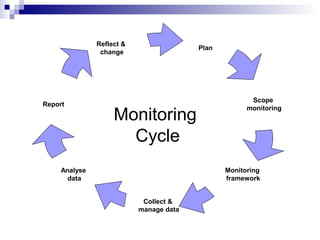
Plan
Scope
monitoring
Monitoring
framework
Collect &
manage data
Analyse
data
Report
Reflect &
change
Monitoring
Cycle
What are outcomes for you
 List outcomes for your project on post it
notes
Focus on
customer
Focus on
organisation
Outcomes place
Input Process Output Outcome Impact
Context
Values
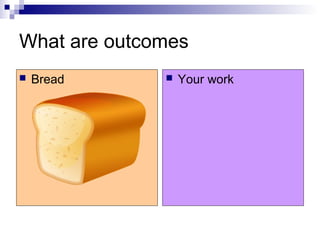
What are outcomes
 Bread  Your work
Maslow’s hierarchy of need
Focus on
customer
Focus on
organisation
Outcomes place
Input Process Output Outcome Impact
Context
Values
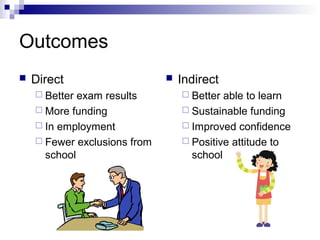
Outcomes
 Direct
 Better exam results
 More funding
 In employment
 Fewer exclusions from
school
 Indirect
 Better able to learn
 Sustainable funding
 Improved confidence
 Positive attitude to
school
Indicators
 Behaviour
 Attitude
 Self reporting
 Observed
By you
By others
 Monitored by 3rd
party
National Outcomes
 Improved Health & Wellbeing
 Improved Quality of Life
 Making a Positive Contribution
 Increased Choice and Control
 Freedom from Discrimination and Harassment
 Economic Wellbeing
 Maintaining Personal Dignity and Respect
Coventry - Big outcomes
 Health & Wellbeing
 Choice & Control
 Economic & Educational participation
 Social & Community participation
Health & Wellbeing
 Physical Health
 Mental Health
 Emotional Wellbeing
 Home Environment
 Safety & Security
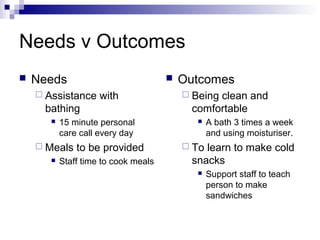
Needs v Outcomes
 Needs
 Assistance with
bathing
 15 minute personal
care call every day
 Meals to be provided
 Staff time to cook meals
 Outcomes
 Being clean and
comfortable
 A bath 3 times a week
and using moisturiser.
 To learn to make cold
snacks
 Support staff to teach
person to make
sandwiches
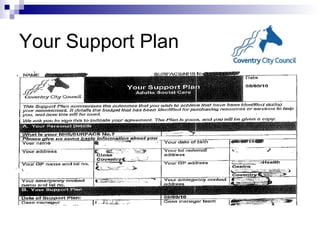
Your Support Plan
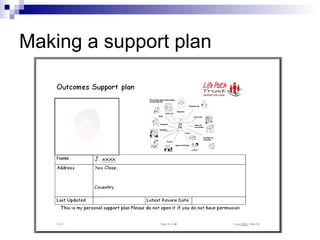
Making a support plan
Measuring outcomes
 Qualitative
 Stories
 Goals
 Comments
 Quantitative
 Scale based
questionnaire
 Distance travelled
 Coding free text
Common tools
Policy
documents
3rd
Party
Info
Case
notes
Official
info
Documents
Structured
forms
Complaints
Suggestion
box
Stories
Observation
Focus Groups
Creative
tools
Diaries
Interviews
Questionnaires
Direct
response
Quantitative tool
Qualitative Tools
 Support Diary
 Stories
 Photo’s
LA Monitoring
Reporting Outcomes
 Reports
Beware
 Measuring effects behaviour
 The researcher can change the outcome
www.life-path.org.uk
Bread is the key to outcomes!

Outcomes focused support planning

Editor's Notes

  • #4 With the person next to you share: Your name Your work The outcomes you personally want from today Write each outcome on a post it note
  • #5 Overview of the agenda
  • #6 Adapted from the monitoring and evaluation capability simlecircle – Charities Evaluation Service.
  • #7 Looking at the work / projects you are involved in list each outcome on a post it note. Need 2 flip chart sheets to put post-its on. Sort on one sheet those which are outcomes and other sheet those which are outputs or other measures.
  • #8 Use the bread example Input – flour etc Process – kneed / bake Output – Bread Outcome – pleasure / satisfaction / removal of hunger Impact – Survival / Obesity / Healthy
  • #9 Look at outcomes more closely Relate to indirect measures / indicators of outcomes
  • #10 A.H. Maslow, A Theory of Human Motivation, Psychological Review 50(4) (1943):370-96. Show how outcomes and impact can differ according to context and values. The place you are on Maslow has a clear effect on them. Bread can be survival if you are at the bottom or a creative experience for those at the top.
  • #11 Reminder about outcomes and the difference of impacts. Impact is often longer term and for a whole population
  • #12 Look at the difference between direct and indirect outcomes. How easy is it to measure outcomes?
  • #13 Outcomes can often be measured by looking at these indicators Eg buying behaviour for bread, asking people with attitude to a product. Outcomes are best framed around these indicators
  • #14 CQC published these high level outcomes which are now supplemented by 28 essential standards which are all call outcomes. Eg outcome 7 – Safeguarding people who use services from abuse.
  • #15 Coventry is using the 4 high level outcomes set by SPRU (Social Policy Research Unit). Each of the 3 have further subdivisions.
  • #16 These are the areas included in Health and Wellbeing
  • #17 Care plans focus on needs outcomes focus on people.
  • #18 Care / Support plans from Social Services are now headed “Your Support Plan – Adult Social Care’
  • #21 Life Path Trust has a support plan that is based on PCP tools It covers each of the key areas for outcomes Plus key issues for support staff.
  • #24 With the support plan from the LA and your own support plan there are outcomes and goals. These now need to be measured. There are clearly 2 main ways Q & Q Ideas please for how you can do these - Record on flip chart
  • #25 3 common ways to measure
  • #26 The outcome star is used to measure peoples changes over time. The My Outcome Star is based on the Mental Health Recovery Star developed by St Mungos
  • #27 To measure where someone is on the star we are looking at how independent people are. This can be a professional assessment, self assessment or an assessment by peoples circle of friends. Show the group tools.
  • #28 These are examples of the way Life Path has presented qualitative data.
  • #29 The Local Authority in contract monitoring are looking at the key outcome areas.
  • #30 Reports that Life Path has produced. Copies are available.
  • #31 Hospital kitchens were set a target to reduce food waste. It was measured by the weight of food being thrown away. One kitchen beat the target by putting all waste food in the ovens and drying it out! Target met – extra cost in using ovens etc.