© OECD
AjointinitiativeoftheOECDandtheEuropeanUnion,
principallyfinancedbytheEU
Zagreb (Croatia) 22-23 May 2014
Elke Löffler & Marcel Guenoun, SIGMA Experts
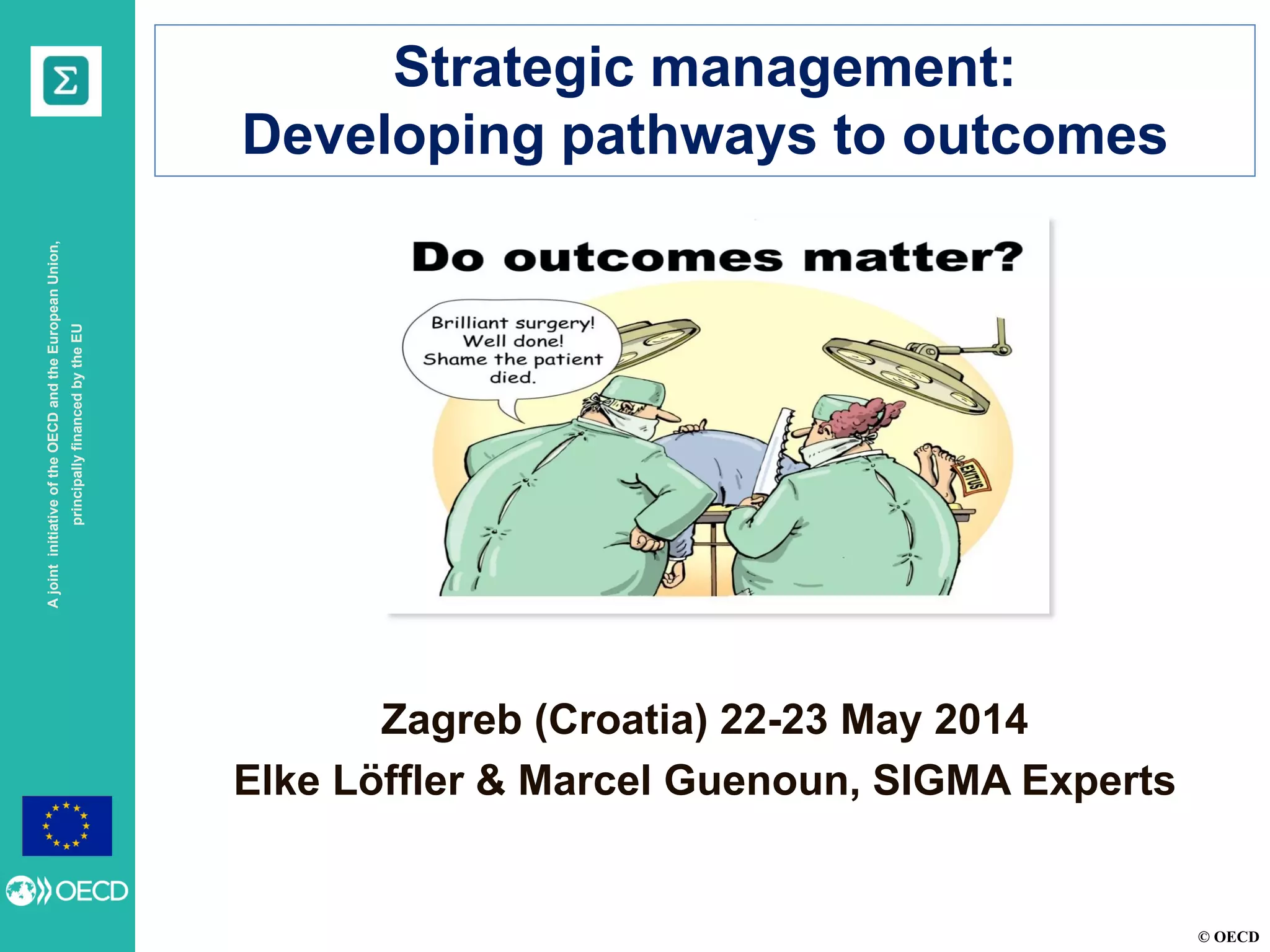
Strategic management:
Developing pathways to outcomes
© OECD
AjointinitiativeoftheOECDandtheEuropeanUnion,
principallyfinancedbytheEU
What’s most important in public services:
Outcomes
“This inquiry saw too many examples
of those in senior positions attempting
to justify their work in terms of
bureaucratic activity, rather than
outcomes for people”.
Source: Department of Health (2003) The Victoria
Climbié Inquiry. Summary Report.p.6.
© OECD
AjointinitiativeoftheOECDandtheEuropeanUnion,
principallyfinancedbytheEU
Outcomes measurement: Early years
From 19th century, concern with outcomes of public
policy, e.g. mortality rates, longevity and the educational
outcomes of schools.
Health-related quality of life measures were developed
and implemented by clinicians from the 1940s, although
often crude and limited to physical functioning
(Donabedian, 1966; Bowling, 1995).
From the 1950s, political interest extended to more
aggregate measures of wellbeing, including the standard
of living (UN, 1954) and quality of life (OECD, 1970).
Frederickson (1971): a central task of the New Public
Administration was to focus on policies which improve
the quality of life for all.
© OECD
AjointinitiativeoftheOECDandtheEuropeanUnion,
principallyfinancedbytheEU
WHAT IS AN OUTCOME?
(with apologies to Superman)
 It it a task?
 Is it a process?
 Is it a service?
 No - it’s a benefit!
Or at least what an
organisation intends to
achieve for individuals,
communities and citizens.
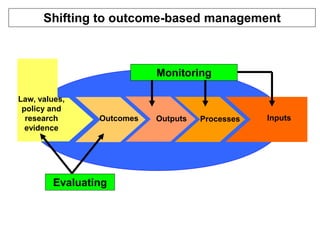
Outcomes Outputs Processes Inputs
Shifting to outcome-based management
Law, values,
policy and
research
evidence
Evaluating
Monitoring
© OECD
AjointinitiativeoftheOECDandtheEuropeanUnion,
principallyfinancedbytheEU
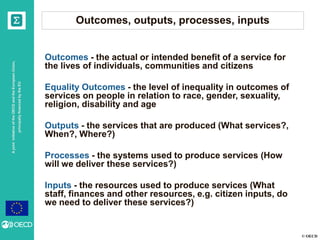
Outcomes, outputs, processes, inputs
Outcomes - the actual or intended benefit of a service for
the lives of individuals, communities and citizens
Equality Outcomes - the level of inequality in outcomes of
services on people in relation to race, gender, sexuality,
religion, disability and age
Outputs - the services that are produced (What services?,
When?, Where?)
Processes - the systems used to produce services (How
will we deliver these services?)
Inputs - the resources used to produce services (What
staff, finances and other resources, e.g. citizen inputs, do
we need to deliver these services?)
© OECD
AjointinitiativeoftheOECDandtheEuropeanUnion,
principallyfinancedbytheEU
The importance of equality outcomes:
“A Tale of Two Cities”
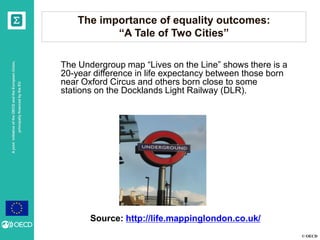
The Undergroup map “Lives on the Line” shows there is a
20-year difference in life expectancy between those born
near Oxford Circus and others born close to some
stations on the Docklands Light Railway (DLR).
Source: http://life.mappinglondon.co.uk/
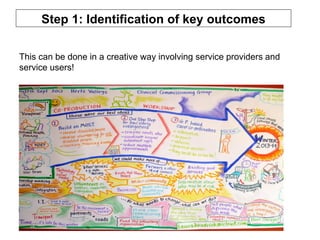
Step 1: Identification of key outcomes
This can be done in a creative way involving service providers and
service users!
© OECD
AjointinitiativeoftheOECDandtheEuropeanUnion,
principallyfinancedbytheEU
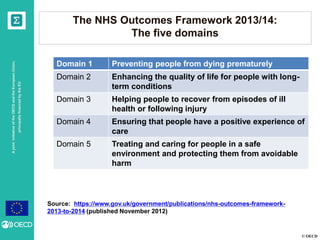
The NHS Outcomes Framework 2013/14:
The five domains
Source: https://www.gov.uk/government/publications/nhs-outcomes-framework-
2013-to-2014 (published November 2012)
Domain 1 Preventing people from dying prematurely
Domain 2 Enhancing the quality of life for people with long-
term conditions
Domain 3 Helping people to recover from episodes of ill
health or following injury
Domain 4 Ensuring that people have a positive experience of
care
Domain 5 Treating and caring for people in a safe
environment and protecting them from avoidable
harm
© OECD
AjointinitiativeoftheOECDandtheEuropeanUnion,
principallyfinancedbytheEU
Group Work:
An assessment of the NHS Outcomes Framework
10
1. Get together in small groups
2. Assess the NHS Outcomes Framework:
Are all these domains outcomes?
If not, what are they?
3. From a Croatian perspective, which
outcomes would you add?
© OECD
AjointinitiativeoftheOECDandtheEuropeanUnion,
principallyfinancedbytheEU
1) Relate your strategic objectives to outcomes
2) Be clear about objectives
3) Relate PIs to objectives
4) Use targets – but they
should be smart!
This requires a logical model!
Some silver rules of
performance management
© OECD
AjointinitiativeoftheOECDandtheEuropeanUnion,
principallyfinancedbytheEU
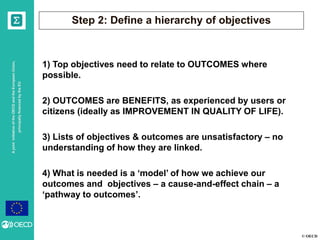
Step 2: Define a hierarchy of objectives
1) Top objectives need to relate to OUTCOMES where
possible.
2) OUTCOMES are BENEFITS, as experienced by users or
citizens (ideally as IMPROVEMENT IN QUALITY OF LIFE).
3) Lists of objectives & outcomes are unsatisfactory – no
understanding of how they are linked.
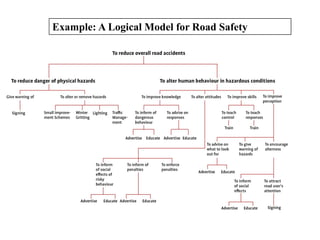
4) What is needed is a ‘model’ of how we achieve our
outcomes and objectives – a cause-and-effect chain – a
‘pathway to outcomes’.
Example: A Logical Model for Road Safety
© OECD
AjointinitiativeoftheOECDandtheEuropeanUnion,
principallyfinancedbytheEU
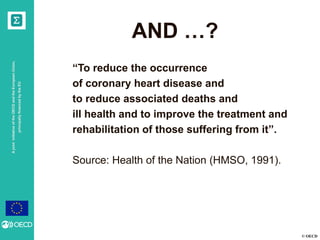
AND …?
“To reduce the occurrence
of coronary heart disease and
to reduce associated deaths and
ill health and to improve the treatment and
rehabilitation of those suffering from it”.
Source: Health of the Nation (HMSO, 1991).
© OECD
AjointinitiativeoftheOECDandtheEuropeanUnion,
principallyfinancedbytheEU
Step 3: Relate your performance indicators and
targets to the logical model
Case study: A logical framework developed by Young
People’s Services in Surrey County Council
(See separate hand-out)
© OECD
AjointinitiativeoftheOECDandtheEuropeanUnion,
principallyfinancedbytheEU
Exercise:
Designing an outcome-based logical model
1) In groups, devise a hierarchy of objectives for a
service or a specific stakeholder.
2) Discuss how you would assess achievement of
outcomes for all of the outcomes in the first three
levels of the hierarchy.
3) Check how your current PIs relate to the
objectives in your logical model.
© OECD
AjointinitiativeoftheOECDandtheEuropeanUnion,
principallyfinancedbytheEU
Do’s and don’ts for developing a logical model
1) Do have more than ONE top objective/outcome,
if appropriate
2) Do test the HOW and WHY logics
3) Do start objectives with a verb (“to ….”)
4) Don’t worry about aims/goals/objective split …
or final/intermediate outcome split
5) Don’t prioritise ‘objectives’ – it’s pathways!

Strategic management and achieving outcomes