RISKS
& Research Ethics
Ghiath Alahmad
Overview
1. What is human research?
2. Why research ethics matters?
3. History of the governance of human research
ethics – Response to international scandals
What is Human Research?
Examples of human research
• Interviews
• Surveys
• Focus Groups
• Observations
• Chat rooms
• Testing
• Identified personal information not on
the public record.
Human research is
conducted with or about
people, or their data or
their tissue.
Examples of human research
Why research ethics matters?
Responsibility to participants
Reputation of the Research Center &University
Requirements of research funding bodies, state, federal and international
Requirements of the University’s insurer of researchers
Future access to populations and sites
Use of public funds carries with it obligations to the community
Professional obligations
Requirements of many journals
Scandals – Deception / Consent
Watch Queen
• Observation of homosexual acts in
public toilets.
• Recorded car licence plates.
• Learned of names and addresses from
friendly policemen while pretending to
be a market researcher.
• As a public health surveyor
interviewed men he had observed.
• Most men married and secretive about
homosexual activity.
Laud Humphreys –
The Watch Queen in
the Tea Room (1967)
Principles of ethical conduct
Merit and integrity
o Genuine search for knowledge
o Based on literature, prior research and / or established problem
o Sufficient expertise and resources
o Any conflicts of interest addressed
Respect for persons
o Intrinsic value of humans, rather than resources
o Welfare, beliefs, perceptions, customs and cultural heritage
o Privacy, confidentiality and cultural sensitivities
o Honour assurances provided
o Respect the capacity for self determination
Beneficence
o Responsibility to minimise harms
o Not non-maleficence
o Not overstating the benefits
o Benefits must justify the risks
o Fair flow of benefits versus burdens
o Genuinely informed consent
Justice
o Fair selection and inclusion
o Distributive justice
o No unfair burden
o Fair flow of / access to benefits
o No exploitation
o Impact on prejudice and discrimination
Principles of ethical conduct
Risks in human research
A common mistake researchers make is to describe a project as involving no risks
When what they actually mean is that there are strategies in place to negate
or minimise the risks
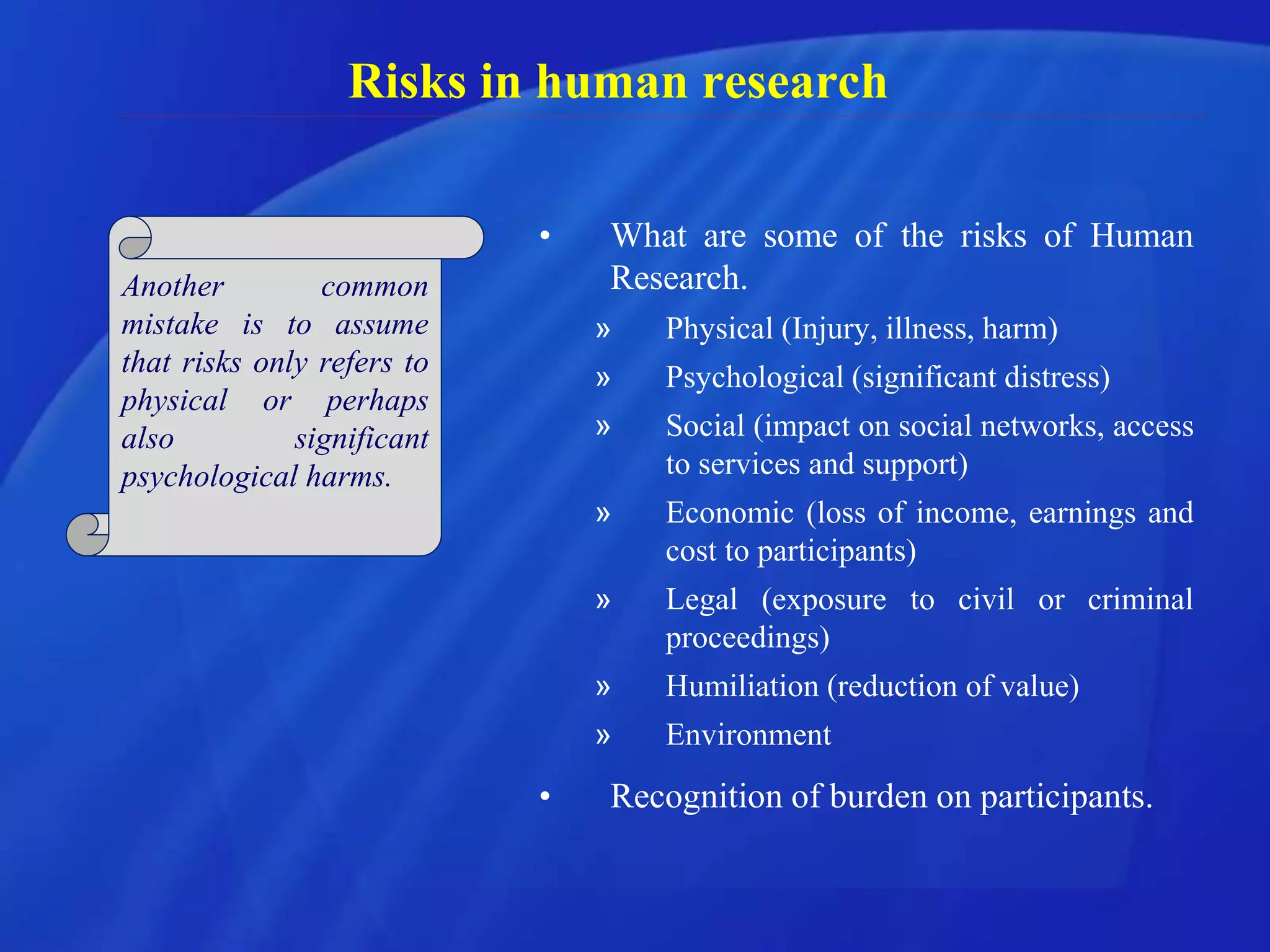
• What are some of the risks of Human
Research.
» Physical (Injury, illness, harm)
» Psychological (significant distress)
» Social (impact on social networks, access
to services and support)
» Economic (loss of income, earnings and
cost to participants)
» Legal (exposure to civil or criminal
proceedings)
» Humiliation (reduction of value)
» Environment
• Recognition of burden on participants.
Another common
mistake is to assume
that risks only refers to
physical or perhaps
also significant
psychological harms.
Risks in human research
Assessing Risks
• To whom do the risks apply?
» Participants, potential participants, third
parties, environment, and / or researchers.
• Addressing risks
» Are there alternatives?
» Can risks be negated or minimised?
» Can risks be managed?
• Can the risks be justified?
• Disclosure to potential participants
Yet another common
mistake is to focus
only on the risks to
the participants.
Risks in human research
Justifying the risks in Human Research
Assessing Benefits
• What are the benefits?
• To whom do the benefits flow?
» Directly to participants and/or participant community (people like the
participants)
» Other stakeholders / wider society
» Sponsors / University
» Researchers
• Recognising uncertainty in research
• Justifying research with minimal benefit
• Describing benefits to potential participants
Have you “Done” ethics yet?
• Research ethics is first and foremost a
personal responsibility
• It is a design, conduct and quality issue
• Researchers should engage with the
ethical principles and review process
• See the process as a continuing
professional responsibility until the
research is completed
• Not form filling – someone else ’ s
problem
• Objective is to help you improve design
and quality of the research
This is not an
expression we like
to hear because…
Limitations
Clinical Research
• Examples and scandals relate primarily to
medical research.
• More easily proven risks
Quantitative Assumptions
• Sample size
• Consent (verbal)
Human Respect Expectations
• Consent
• Attitudes towards personal burdens vs
collective benefits
• Standard of care
It is important to
recognise that the
National Statement
has its limitations

Risks and research ethics

  • 1.
  • 2.
    Overview 1. What ishuman research? 2. Why research ethics matters? 3. History of the governance of human research ethics – Response to international scandals
  • 3.
    What is HumanResearch? Examples of human research • Interviews • Surveys • Focus Groups • Observations • Chat rooms • Testing • Identified personal information not on the public record. Human research is conducted with or about people, or their data or their tissue. Examples of human research
  • 4.
    Why research ethicsmatters? Responsibility to participants Reputation of the Research Center &University Requirements of research funding bodies, state, federal and international Requirements of the University’s insurer of researchers Future access to populations and sites Use of public funds carries with it obligations to the community Professional obligations Requirements of many journals
  • 5.
    Scandals – Deception/ Consent Watch Queen • Observation of homosexual acts in public toilets. • Recorded car licence plates. • Learned of names and addresses from friendly policemen while pretending to be a market researcher. • As a public health surveyor interviewed men he had observed. • Most men married and secretive about homosexual activity. Laud Humphreys – The Watch Queen in the Tea Room (1967)
  • 6.
    Principles of ethicalconduct Merit and integrity o Genuine search for knowledge o Based on literature, prior research and / or established problem o Sufficient expertise and resources o Any conflicts of interest addressed Respect for persons o Intrinsic value of humans, rather than resources o Welfare, beliefs, perceptions, customs and cultural heritage o Privacy, confidentiality and cultural sensitivities o Honour assurances provided o Respect the capacity for self determination
  • 7.
    Beneficence o Responsibility tominimise harms o Not non-maleficence o Not overstating the benefits o Benefits must justify the risks o Fair flow of benefits versus burdens o Genuinely informed consent Justice o Fair selection and inclusion o Distributive justice o No unfair burden o Fair flow of / access to benefits o No exploitation o Impact on prejudice and discrimination Principles of ethical conduct
  • 8.
    Risks in humanresearch A common mistake researchers make is to describe a project as involving no risks When what they actually mean is that there are strategies in place to negate or minimise the risks
  • 9.
    • What aresome of the risks of Human Research. » Physical (Injury, illness, harm) » Psychological (significant distress) » Social (impact on social networks, access to services and support) » Economic (loss of income, earnings and cost to participants) » Legal (exposure to civil or criminal proceedings) » Humiliation (reduction of value) » Environment • Recognition of burden on participants. Another common mistake is to assume that risks only refers to physical or perhaps also significant psychological harms. Risks in human research
  • 10.
    Assessing Risks • Towhom do the risks apply? » Participants, potential participants, third parties, environment, and / or researchers. • Addressing risks » Are there alternatives? » Can risks be negated or minimised? » Can risks be managed? • Can the risks be justified? • Disclosure to potential participants Yet another common mistake is to focus only on the risks to the participants. Risks in human research
  • 11.
    Justifying the risksin Human Research Assessing Benefits • What are the benefits? • To whom do the benefits flow? » Directly to participants and/or participant community (people like the participants) » Other stakeholders / wider society » Sponsors / University » Researchers • Recognising uncertainty in research • Justifying research with minimal benefit • Describing benefits to potential participants
  • 12.
    Have you “Done”ethics yet? • Research ethics is first and foremost a personal responsibility • It is a design, conduct and quality issue • Researchers should engage with the ethical principles and review process • See the process as a continuing professional responsibility until the research is completed • Not form filling – someone else ’ s problem • Objective is to help you improve design and quality of the research This is not an expression we like to hear because…
  • 13.
    Limitations Clinical Research • Examplesand scandals relate primarily to medical research. • More easily proven risks Quantitative Assumptions • Sample size • Consent (verbal) Human Respect Expectations • Consent • Attitudes towards personal burdens vs collective benefits • Standard of care It is important to recognise that the National Statement has its limitations