Working together with the
Queensland Government
Developing drought-adapted sorghum
germplasm for Africa and Australia
University of Queensland
Andrew Borrell & David Jordan
Queensland Government
B. George-Jaeggli & Simon Hamlet
IER, Mali
Sidi Coulibaly & Niaba Teme
INERA, Burkina Faso
Clarisse Barro-Kondombo
ARC, Sudan
Abdalla Mohamad
INRAN, Niger
Soumana Souley
EIAR, Ethiopia
Alemu Tirfessa & Asfaw Adugna
KARI, Kenya
Clement Kamau
Working together with the
Queensland Government
Outline
1. Introduction
2. Highlights from the past year
3. Tangible products created by our project
4. Anticipated impact of products on
downstream beneficiaries
5. How they will these products be
maintained and sustained?
6. Conclusions
Working together with the
Queensland Government
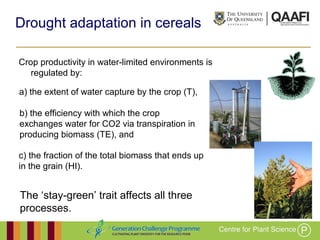
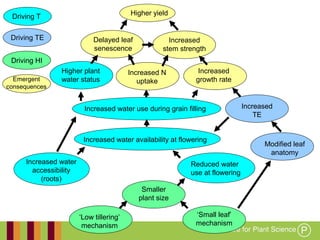
Crop productivity in water-limited environments is
regulated by:
Drought adaptation in cereals
The ‘stay-green’ trait affects all three
processes.
a) the extent of water capture by the crop (T),
b) the efficiency with which the crop
exchanges water for CO2 via transpiration in
producing biomass (TE), and
c) the fraction of the total biomass that ends up
in the grain (HI).
Working together with the
Queensland Government
What is stay-green and why
is it important?
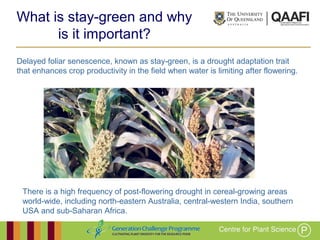
There is a high frequency of post-flowering drought in cereal-growing areas
world-wide, including north-eastern Australia, central-western India, southern
USA and sub-Saharan Africa.
Delayed foliar senescence, known as stay-green, is a drought adaptation trait
that enhances crop productivity in the field when water is limiting after flowering.
Working together with the
Queensland Government
Higher yield
Increased water use during grain filling
Increased water availability at flowering
Increased water
accessibility
(roots)
Reduced water
use at flowering
Higher plant
water status
Increased
growth rate
Increased
TE
Delayed leaf
senescence
Smaller
plant size
‘Low tillering’
mechanism
‘Small leaf’
mechanism
Modified leaf
anatomy
Driving T
Driving TE
Driving HI
Emergent
consequences
Increased N
uptake
Increased
stem strength
Working together with the
Queensland Government
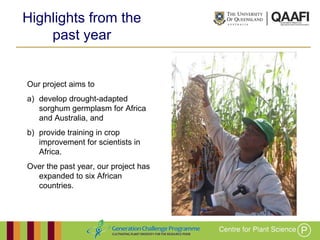
Our project aims to
a) develop drought-adapted
sorghum germplasm for Africa
and Australia, and
b) provide training in crop
improvement for scientists in
Africa.
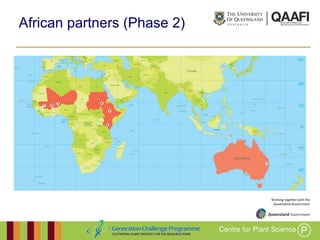
Over the past year, our project has
expanded to six African
countries.
Highlights from the
past year
Working together with the
Queensland Government
African partners (Phase 2)
Working together with the
Queensland Government
Highlights from the past year:
Germplasm development
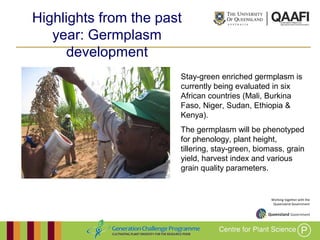
Stay-green enriched germplasm is
currently being evaluated in six
African countries (Mali, Burkina
Faso, Niger, Sudan, Ethiopia &
Kenya).
The germplasm will be phenotyped
for phenology, plant height,
tillering, stay-green, biomass, grain
yield, harvest index and various
grain quality parameters.
Working together with the
Queensland Government
Highlights from the past year:
Training
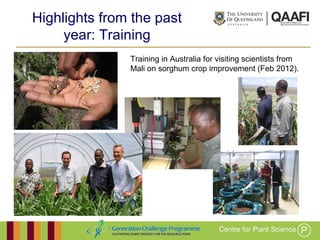
Training in Australia for visiting scientists from
Mali on sorghum crop improvement (Feb 2012).
Working together with the
Queensland Government
Highlights from the past year:
Training
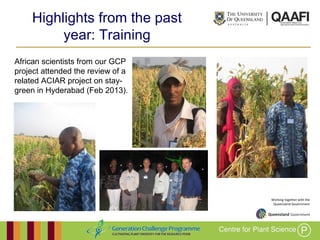
African scientists from our GCP
project attended the review of a
related ACIAR project on stay-
green in Hyderabad (Feb 2013).
Working together with the
Queensland Government
Highlights from the past year:
Training
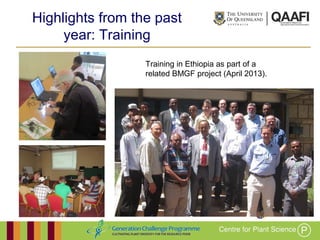
Training in Ethiopia as part of a
related BMGF project (April 2013).
Working together with the
Queensland Government
Highlights from the past year:
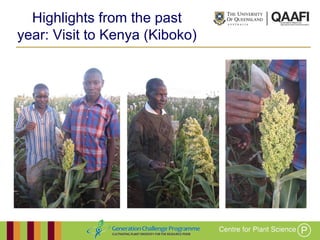
Visit to Kenya (Kiboko)
Working together with the
Queensland Government
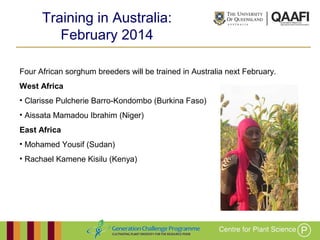
Training in Australia:
February 2014
Four African sorghum breeders will be trained in Australia next February.
West Africa
• Clarisse Pulcherie Barro-Kondombo (Burkina Faso)
• Aissata Mamadou Ibrahim (Niger)
East Africa
• Mohamed Yousif (Sudan)
• Rachael Kamene Kisilu (Kenya)
Working together with the
Queensland Government
Genomics Simulation Modelling
Data management
Phenotypic data
Integrated
information that is
better able to
address complex
quantitative traits
Environmental
characterisation
Enhanced genetic gain
Training on linking breeding,
molecular & physiological aspects
Working together with the
Queensland Government
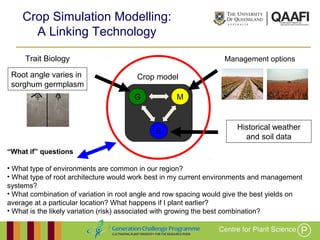
“What if” questions
• What type of environments are common in our region?
• What type of root architecture would work best in my current environments and management
systems?
• What combination of variation in root angle and row spacing would give the best yields on
average at a particular location? What happens if I plant earlier?
• What is the likely variation (risk) associated with growing the best combination?
Root angle varies in
sorghum germplasm
Trait Biology
G
E
M
Crop model
Historical weather
and soil data
Management options
Crop Simulation Modelling:
A Linking Technology
Working together with the
Queensland Government
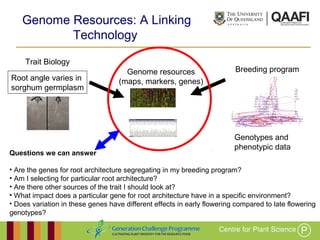
Genome Resources: A Linking
Technology
Root angle varies in
sorghum germplasm
Trait Biology
Genome resources
(maps, markers, genes)
Breeding program
Genotypes and
phenotypic data
Questions we can answer
• Are the genes for root architecture segregating in my breeding program?
• Am I selecting for particular root architecture?
• Are there other sources of the trait I should look at?
• What impact does a particular gene for root architecture have in a specific environment?
• Does variation in these genes have different effects in early flowering compared to late flowering
genotypes?
Working together with the
Queensland Government
Product One
Title: Backcross-derived lines containing
stay-green introgressions.
Description: 15 backcross-derived
introgression lines (13 lines from
F2_R04021-2/PI609084 and 2 lines from
F2_R04003-2/PI585749).
Use: Diverse drought-adapted germplasm
for sorghum breeders to use in Mali, Niger,
Burkina Faso, Ethiopia, Sudan and Kenya.
Tangible products
generated by our project
Working together with the
Queensland Government
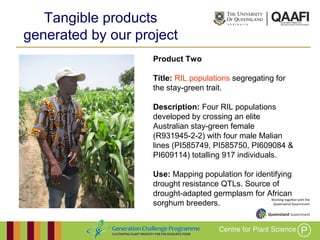
Product Two
Title: RIL populations segregating for
the stay-green trait.
Description: Four RIL populations
developed by crossing an elite
Australian stay-green female
(R931945-2-2) with four male Malian
lines (PI585749, PI585750, PI609084 &
PI609114) totalling 917 individuals.
Use: Mapping population for identifying
drought resistance QTLs. Source of
drought-adapted germplasm for African
sorghum breeders.
Tangible products
generated by our project
Working together with the
Queensland Government
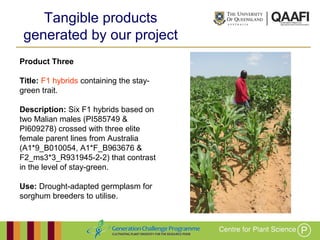
Product Three
Title: F1 hybrids containing the stay-
green trait.
Description: Six F1 hybrids based on
two Malian males (PI585749 &
PI609278) crossed with three elite
female parent lines from Australia
(A1*9_B010054, A1*F_B963676 &
F2_ms3*3_R931945-2-2) that contrast
in the level of stay-green.
Use: Drought-adapted germplasm for
sorghum breeders to utilise.
Tangible products
generated by our project
Working together with the
Queensland Government
Impact of products on
downstream beneficiaries
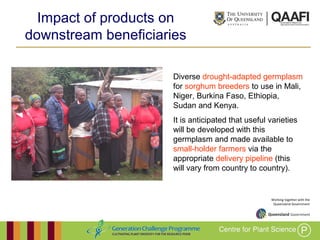
Diverse drought-adapted
germplasm for sorghum breeders to
use in Mali, Niger, Burkina Faso,
Ethiopia, Sudan and Kenya.
It is anticipated that useful varieties
will be developed with this
germplasm and made available to
small-holder farmers via the
appropriate delivery pipeline (this
will vary from country to country).
Working together with the
Queensland Government
How will these products be
maintained and sustained?
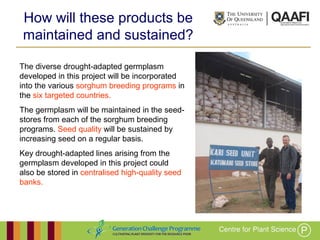
The diverse drought-adapted germplasm
developed in this project will be incorporated
into the various sorghum breeding programs
in the six targeted countries.
The germplasm will be maintained in the
seed-stores from each of the sorghum
breeding programs. Seed quality will be
sustained by increasing seed on a regular
basis.
Key drought-adapted lines arising from the
germplasm developed in this project could
also be stored in centralised high-quality seed
banks.
Working together with the
Queensland Government
Conclusions
Drought-adapted sorghum germplasm has
been developed for Africa and Australia.
It is currently being evaluated in six African
countries: Mali, Burkina Faso, Niger, Sudan,
Ethiopia and Kenya.
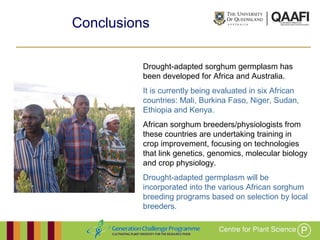
African sorghum breeders/physiologists from
these countries are undertaking training in
crop improvement, focusing on technologies
that link genetics, genomics, molecular biology
and crop physiology.
Drought-adapted germplasm will be
incorporated into the various African sorghum
breeding programs based on selection by
local breeders.
Working together with the
Queensland Government

GRM 2013: Developing drought-adapted sorghum germplasm for Africa and Australia -- A Borrell

  • 1.
    Working together withthe Queensland Government Developing drought-adapted sorghum germplasm for Africa and Australia University of Queensland Andrew Borrell & David Jordan Queensland Government B. George-Jaeggli & Simon Hamlet IER, Mali Sidi Coulibaly & Niaba Teme INERA, Burkina Faso Clarisse Barro-Kondombo ARC, Sudan Abdalla Mohamad INRAN, Niger Soumana Souley EIAR, Ethiopia Alemu Tirfessa & Asfaw Adugna KARI, Kenya Clement Kamau
  • 2.
    Working together withthe Queensland Government Outline 1. Introduction 2. Highlights from the past year 3. Tangible products created by our project 4. Anticipated impact of products on downstream beneficiaries 5. How they will these products be maintained and sustained? 6. Conclusions
  • 3.
    Working together withthe Queensland Government Crop productivity in water-limited environments is regulated by: Drought adaptation in cereals The ‘stay-green’ trait affects all three processes. a) the extent of water capture by the crop (T), b) the efficiency with which the crop exchanges water for CO2 via transpiration in producing biomass (TE), and c) the fraction of the total biomass that ends up in the grain (HI).
  • 4.
    Working together withthe Queensland Government What is stay-green and why is it important? There is a high frequency of post-flowering drought in cereal-growing areas world-wide, including north-eastern Australia, central-western India, southern USA and sub-Saharan Africa. Delayed foliar senescence, known as stay-green, is a drought adaptation trait that enhances crop productivity in the field when water is limiting after flowering.
  • 5.
    Working together withthe Queensland Government Higher yield Increased water use during grain filling Increased water availability at flowering Increased water accessibility (roots) Reduced water use at flowering Higher plant water status Increased growth rate Increased TE Delayed leaf senescence Smaller plant size ‘Low tillering’ mechanism ‘Small leaf’ mechanism Modified leaf anatomy Driving T Driving TE Driving HI Emergent consequences Increased N uptake Increased stem strength
  • 6.
    Working together withthe Queensland Government Our project aims to a) develop drought-adapted sorghum germplasm for Africa and Australia, and b) provide training in crop improvement for scientists in Africa. Over the past year, our project has expanded to six African countries. Highlights from the past year
  • 7.
    Working together withthe Queensland Government African partners (Phase 2)
  • 8.
    Working together withthe Queensland Government Highlights from the past year: Germplasm development Stay-green enriched germplasm is currently being evaluated in six African countries (Mali, Burkina Faso, Niger, Sudan, Ethiopia & Kenya). The germplasm will be phenotyped for phenology, plant height, tillering, stay-green, biomass, grain yield, harvest index and various grain quality parameters.
  • 9.
    Working together withthe Queensland Government Highlights from the past year: Training Training in Australia for visiting scientists from Mali on sorghum crop improvement (Feb 2012).
  • 10.
    Working together withthe Queensland Government Highlights from the past year: Training African scientists from our GCP project attended the review of a related ACIAR project on stay- green in Hyderabad (Feb 2013).
  • 11.
    Working together withthe Queensland Government Highlights from the past year: Training Training in Ethiopia as part of a related BMGF project (April 2013).
  • 12.
    Working together withthe Queensland Government Highlights from the past year: Visit to Kenya (Kiboko)
  • 13.
    Working together withthe Queensland Government Training in Australia: February 2014 Four African sorghum breeders will be trained in Australia next February. West Africa • Clarisse Pulcherie Barro-Kondombo (Burkina Faso) • Aissata Mamadou Ibrahim (Niger) East Africa • Mohamed Yousif (Sudan) • Rachael Kamene Kisilu (Kenya)
  • 14.
    Working together withthe Queensland Government Genomics Simulation Modelling Data management Phenotypic data Integrated information that is better able to address complex quantitative traits Environmental characterisation Enhanced genetic gain Training on linking breeding, molecular & physiological aspects
  • 15.
    Working together withthe Queensland Government “What if” questions • What type of environments are common in our region? • What type of root architecture would work best in my current environments and management systems? • What combination of variation in root angle and row spacing would give the best yields on average at a particular location? What happens if I plant earlier? • What is the likely variation (risk) associated with growing the best combination? Root angle varies in sorghum germplasm Trait Biology G E M Crop model Historical weather and soil data Management options Crop Simulation Modelling: A Linking Technology
  • 16.
    Working together withthe Queensland Government Genome Resources: A Linking Technology Root angle varies in sorghum germplasm Trait Biology Genome resources (maps, markers, genes) Breeding program Genotypes and phenotypic data Questions we can answer • Are the genes for root architecture segregating in my breeding program? • Am I selecting for particular root architecture? • Are there other sources of the trait I should look at? • What impact does a particular gene for root architecture have in a specific environment? • Does variation in these genes have different effects in early flowering compared to late flowering genotypes?
  • 17.
    Working together withthe Queensland Government Product One Title: Backcross-derived lines containing stay-green introgressions. Description: 15 backcross-derived introgression lines (13 lines from F2_R04021-2/PI609084 and 2 lines from F2_R04003-2/PI585749). Use: Diverse drought-adapted germplasm for sorghum breeders to use in Mali, Niger, Burkina Faso, Ethiopia, Sudan and Kenya. Tangible products generated by our project
  • 18.
    Working together withthe Queensland Government Product Two Title: RIL populations segregating for the stay-green trait. Description: Four RIL populations developed by crossing an elite Australian stay-green female (R931945-2-2) with four male Malian lines (PI585749, PI585750, PI609084 & PI609114) totalling 917 individuals. Use: Mapping population for identifying drought resistance QTLs. Source of drought-adapted germplasm for African sorghum breeders. Tangible products generated by our project
  • 19.
    Working together withthe Queensland Government Product Three Title: F1 hybrids containing the stay- green trait. Description: Six F1 hybrids based on two Malian males (PI585749 & PI609278) crossed with three elite female parent lines from Australia (A1*9_B010054, A1*F_B963676 & F2_ms3*3_R931945-2-2) that contrast in the level of stay-green. Use: Drought-adapted germplasm for sorghum breeders to utilise. Tangible products generated by our project
  • 20.
    Working together withthe Queensland Government Impact of products on downstream beneficiaries Diverse drought-adapted germplasm for sorghum breeders to use in Mali, Niger, Burkina Faso, Ethiopia, Sudan and Kenya. It is anticipated that useful varieties will be developed with this germplasm and made available to small-holder farmers via the appropriate delivery pipeline (this will vary from country to country).
  • 21.
    Working together withthe Queensland Government How will these products be maintained and sustained? The diverse drought-adapted germplasm developed in this project will be incorporated into the various sorghum breeding programs in the six targeted countries. The germplasm will be maintained in the seed-stores from each of the sorghum breeding programs. Seed quality will be sustained by increasing seed on a regular basis. Key drought-adapted lines arising from the germplasm developed in this project could also be stored in centralised high-quality seed banks.
  • 22.
    Working together withthe Queensland Government Conclusions Drought-adapted sorghum germplasm has been developed for Africa and Australia. It is currently being evaluated in six African countries: Mali, Burkina Faso, Niger, Sudan, Ethiopia and Kenya. African sorghum breeders/physiologists from these countries are undertaking training in crop improvement, focusing on technologies that link genetics, genomics, molecular biology and crop physiology. Drought-adapted germplasm will be incorporated into the various African sorghum breeding programs based on selection by local breeders.
  • 23.
    Working together withthe Queensland Government