Beyond xUnit example-based testing:
property-based testing with ScalaCheck

              Franklin Chen
        http://franklinchen.com/


          Pittsburgh Scala Meetup
               April 11, 2013
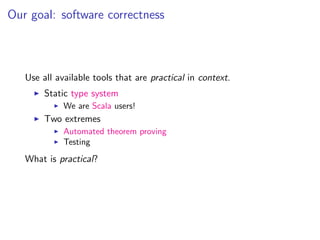
Our goal: software correctness


   Use all available tools that are practical in context.
        Static type system
             We are Scala users!
        Two extremes
             Automated theorem proving
             Testing
   What is practical?
Theorem proving


   Example: list append
   // Given an implementation in ListOps of:
   def append[A](xs: List[A], ys: List[A]): List[A]

   How prove this property without a shadow of a doubt?
   // for all lists xs and ys
   ListOps.append(xs, ys).length == xs.length + y.length

   Not (yet) practical in most contexts.
   (Scala compiler cannot prove this property.)
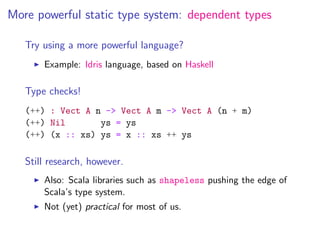
More powerful static type system: dependent types

   Try using a more powerful language?
       Example: Idris language, based on Haskell

   Type checks!
   (++) : Vect A n -> Vect A m -> Vect A (n + m)
   (++) Nil       ys = ys
   (++) (x :: xs) ys = x :: xs ++ ys

   Still research, however.
       Also: Scala libraries such as shapeless pushing the edge of
       Scala’s type system.
       Not (yet) practical for most of us.
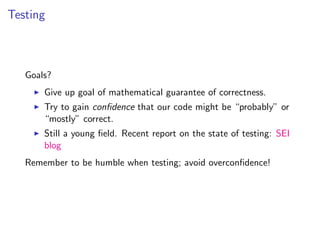
Testing


   Goals?
       Give up goal of mathematical guarantee of correctness.
       Try to gain confidence that our code might be “probably” or
       “mostly” correct.
       Still a young field. Recent report on the state of testing: SEI
       blog
   Remember to be humble when testing; avoid overconfidence!
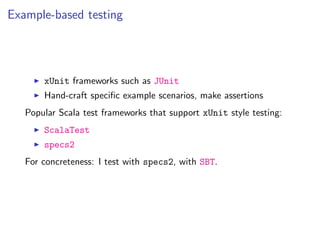
Example-based testing


       xUnit frameworks such as JUnit
       Hand-craft specific example scenarios, make assertions
   Popular Scala test frameworks that support xUnit style testing:
       ScalaTest
       specs2
   For concreteness: I test with specs2, with SBT.
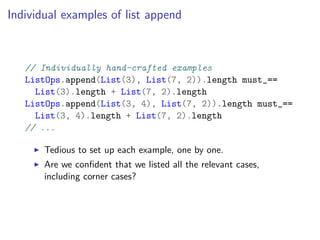
Individual examples of list append


   // Individually hand-crafted examples
   ListOps.append(List(3), List(7, 2)).length must_==
     List(3).length + List(7, 2).length
   ListOps.append(List(3, 4), List(7, 2)).length must_==
     List(3, 4).length + List(7, 2).length
   // ...

       Tedious to set up each example, one by one.
       Are we confident that we listed all the relevant cases,
       including corner cases?
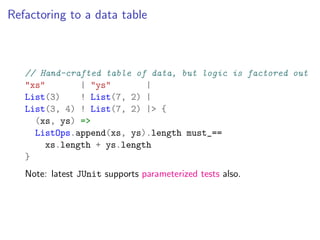
Refactoring to a data table


   // Hand-crafted table of data, but logic is factored out
   "xs"       | "ys"       |
   List(3)    ! List(7, 2) |
   List(3, 4) ! List(7, 2) |> {
     (xs, ys) =>
     ListOps.append(xs, ys).length must_==
       xs.length + ys.length
   }
   Note: latest JUnit supports parameterized tests also.
Property-based testing: introducing ScalaCheck


       ScalaCheck library
           Port of Haskell QuickCheck
           Use standalone, or within ScalaTest or specs2
       Write down what we really intend, a universal property!
   prop {
     (xs: List[Int], ys: List[Int]) =>
     ListOps.append(xs, ys).length must_==
       xs.length + ys.length
   }
   ScalaCheck automatically generates 100 random test cases (the
   default number) and runs them successfully!
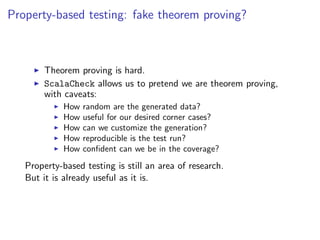
Property-based testing: fake theorem proving?


        Theorem proving is hard.
        ScalaCheck allows us to pretend we are theorem proving,
        with caveats:
             How   random are the generated data?
             How   useful for our desired corner cases?
             How   can we customize the generation?
             How   reproducible is the test run?
             How   confident can we be in the coverage?
   Property-based testing is still an area of research.
   But it is already useful as it is.
A failing test reports a minimal counter-example


   What is wrong with this property about multiplication and division?
   prop {
     (x: Int, y: Int) => (x * y) / y must_== x
   }
   Output:
   > test
   ArithmeticException: A counter-example is [0, 0]:
     java.lang.ArithmeticException: / by zero
   Oops, our test was sloppy!
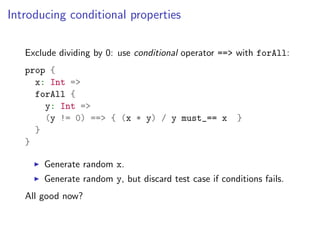
Introducing conditional properties

   Exclude dividing by 0: use conditional operator ==> with forAll:
   prop {
     x: Int =>
     forAll {
       y: Int =>
       (y != 0) ==> { (x * y) / y must_== x             }
     }
   }

       Generate random x.
       Generate random y, but discard test case if conditions fails.
   All good now?
Testing as an iterative process


       Still get a counter-example.
       Int overflow.
   > test
   A counter-example is [2, 1073741824]
     (after 2 tries - shrinked
      (’452994647’ -> ’2’,’-2147483648’ -> ’1073741824’))
   ’-2’ is not equal to ’2’
   Writing and refining a property guides our understanding of the
   problem.
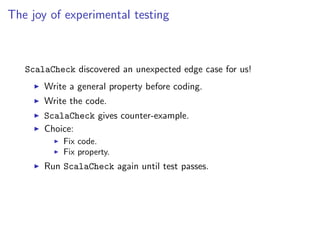
The joy of experimental testing


   ScalaCheck discovered an unexpected edge case for us!
       Write a general property before coding.
       Write the code.
       ScalaCheck gives counter-example.
       Choice:
           Fix code.
           Fix property.
       Run ScalaCheck again until test passes.
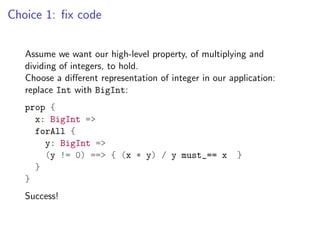
Choice 1: fix code


   Assume we want our high-level property, of multiplying and
   dividing of integers, to hold.
   Choose a different representation of integer in our application:
   replace Int with BigInt:
   prop {
     x: BigInt =>
     forAll {
       y: BigInt =>
       (y != 0) ==> { (x * y) / y must_== x             }
     }
   }
   Success!
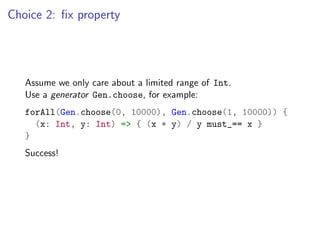
Choice 2: fix property


   Assume we only care about a limited range of Int.
   Use a generator Gen.choose, for example:
   forAll(Gen.choose(0, 10000), Gen.choose(1, 10000)) {
     (x: Int, y: Int) => { (x * y) / y must_== x }
   }
   Success!
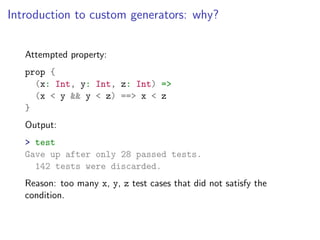
Introduction to custom generators: why?


   Attempted property:
   prop {
     (x: Int, y: Int, z: Int) =>
     (x < y && y < z) ==> x < z
   }
   Output:
   > test
   Gave up after only 28 passed tests.
     142 tests were discarded.
   Reason: too many x, y, z test cases that did not satisfy the
   condition.
Introduction to custom generators: how?

   Try to generate data likely to be useful for the property.
   Use arbitrary generator, Gen.choose generator, and
   for-comprehension:
   val orderedTriples = for {
     x <- arbitrary[Int]
     y <- Gen.choose(x + 1, Int.MaxValue)
     z <- Gen.choose(y + 1, Int.MaxValue)
   } yield (x, y, z)

   forAll(orderedTriples) {
     case (x, y, z) =>
     (x < y && y < z) ==> x < z
   }
   Success!
More complex custom generator: sorted lists


   Assume we want to specify the behavior of a function that inserts
   an integer into a sorted list to return a new sorted list:
   def insert(x: Int, xs: List[Int]): List[Int]
   We first try
   prop {
     (x: Int, xs: List[Int]) =>
     isSorted(xs) ==> isSorted(insert(x, xs))
   }
   where we have already defined
   def isSorted(xs: List[Int]): Boolean
Not constrained enough

   Too many generated lists are not sorted.
   > test-only *ListCheckSpec
   Gave up after only 10 passed tests.
     91 tests were discarded.
   So let’s write a custom generator someSortedLists, to use with
   the property
   forAll(someSortedLists) {
     xs: List[Int] => prop {
       x: Int =>
       isSorted(xs) ==> isSorted(insert(x, xs))
     }
   }
Custom generator for sorted lists


       Choose a list size.
       Choose a starting integer x.
       Choose a list with first element at least x.
   val someSortedLists = for {
     size <- Gen.choose(0, 1000)
     x <- arbitrary[Int]
     xs <- sortedListsFromAtLeast(size, x)
   } yield xs
   Now implement our sortedListsFromAtLeast.
Generating the sorted list
   /**
      @return generator of a sorted list of length size
              with first element >= x
     */
   def sortedListsFromAtLeast(size: Int, x: Int):
        Gen[List[Int]] = {
      if (size == 0) {
        Nil
      }
      else {
        for {
          y <- Gen.choose(x, x+100)
          ys <- sortedListsFromAtLeast(size-1, y)
        } yield y::ys
      }
   }
What is going on? Classifiers
   Gather statistics about the nature of the generated data. One way:
   classifiers.
   forAll(someSortedLists) {
     xs: List[Int] => classify(xs.length < 300,
                               "length 0-299") {
       classify(xs.length >= 300 && xs.length < 800,
                "length 300-799") {
         classify(xs.length >= 800,
                  "length 800+") {
           prop {
             x: Int =>
             isSorted(xs) ==> isSorted(insert(x, xs))
           }
         }
       }
     }
   }
Classifier output


   Output:
   > test-only *ListCheckSpec
   [info] > Collected test data:
   [info] 42% length 300-799
   [info] 31% length 0-299
   [info] 27% length 800+
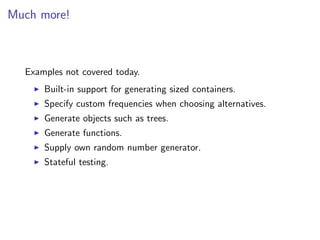
Much more!


  Examples not covered today.
      Built-in support for generating sized containers.
      Specify custom frequencies when choosing alternatives.
      Generate objects such as trees.
      Generate functions.
      Supply own random number generator.
      Stateful testing.
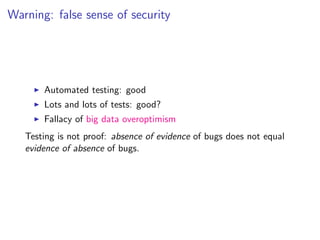
Warning: false sense of security


       Automated testing: good
       Lots and lots of tests: good?
       Fallacy of big data overoptimism
   Testing is not proof: absence of evidence of bugs does not equal
   evidence of absence of bugs.
Other property-based testing tools


   ScalaCheck has known limitations:
       Not always easy to write good generator.
       Random generation does not provide complete coverage.
       Tests do not give the same results when run again.
   Alternatives:
        SmallCheck for Haskell
            Apparently ported to Scala
       Active area of research
The TDD community


     JUnit incorporating some property-based ideas in the new
     feature called Theories
     Many other programming languages gaining property-based
     testing!
     Nat Pryce of Growing Obect-Oriented Software Guided by
     Tests giving workshops on property-based TDD
Conclusion


      Automated testing is good.
      Property-based testing: put into your toolbox.
             If you use Scala: use ScalaCheck.
             If you use Java: use ScalaCheck!
      Be aware of limitations of testing.
      Have fun!
   All materials for this talk available at
   https://github.com/franklinchen/talk-on-scalacheck.

Beyond xUnit example-based testing: property-based testing with ScalaCheck

  • 1.
    Beyond xUnit example-basedtesting: property-based testing with ScalaCheck Franklin Chen http://franklinchen.com/ Pittsburgh Scala Meetup April 11, 2013
  • 2.
    Our goal: softwarecorrectness Use all available tools that are practical in context. Static type system We are Scala users! Two extremes Automated theorem proving Testing What is practical?
  • 3.
    Theorem proving Example: list append // Given an implementation in ListOps of: def append[A](xs: List[A], ys: List[A]): List[A] How prove this property without a shadow of a doubt? // for all lists xs and ys ListOps.append(xs, ys).length == xs.length + y.length Not (yet) practical in most contexts. (Scala compiler cannot prove this property.)
  • 4.
    More powerful statictype system: dependent types Try using a more powerful language? Example: Idris language, based on Haskell Type checks! (++) : Vect A n -> Vect A m -> Vect A (n + m) (++) Nil ys = ys (++) (x :: xs) ys = x :: xs ++ ys Still research, however. Also: Scala libraries such as shapeless pushing the edge of Scala’s type system. Not (yet) practical for most of us.
  • 5.
    Testing Goals? Give up goal of mathematical guarantee of correctness. Try to gain confidence that our code might be “probably” or “mostly” correct. Still a young field. Recent report on the state of testing: SEI blog Remember to be humble when testing; avoid overconfidence!
  • 6.
    Example-based testing xUnit frameworks such as JUnit Hand-craft specific example scenarios, make assertions Popular Scala test frameworks that support xUnit style testing: ScalaTest specs2 For concreteness: I test with specs2, with SBT.
  • 7.
    Individual examples oflist append // Individually hand-crafted examples ListOps.append(List(3), List(7, 2)).length must_== List(3).length + List(7, 2).length ListOps.append(List(3, 4), List(7, 2)).length must_== List(3, 4).length + List(7, 2).length // ... Tedious to set up each example, one by one. Are we confident that we listed all the relevant cases, including corner cases?
  • 8.
    Refactoring to adata table // Hand-crafted table of data, but logic is factored out "xs" | "ys" | List(3) ! List(7, 2) | List(3, 4) ! List(7, 2) |> { (xs, ys) => ListOps.append(xs, ys).length must_== xs.length + ys.length } Note: latest JUnit supports parameterized tests also.
  • 9.
    Property-based testing: introducingScalaCheck ScalaCheck library Port of Haskell QuickCheck Use standalone, or within ScalaTest or specs2 Write down what we really intend, a universal property! prop { (xs: List[Int], ys: List[Int]) => ListOps.append(xs, ys).length must_== xs.length + ys.length } ScalaCheck automatically generates 100 random test cases (the default number) and runs them successfully!
  • 10.
    Property-based testing: faketheorem proving? Theorem proving is hard. ScalaCheck allows us to pretend we are theorem proving, with caveats: How random are the generated data? How useful for our desired corner cases? How can we customize the generation? How reproducible is the test run? How confident can we be in the coverage? Property-based testing is still an area of research. But it is already useful as it is.
  • 11.
    A failing testreports a minimal counter-example What is wrong with this property about multiplication and division? prop { (x: Int, y: Int) => (x * y) / y must_== x } Output: > test ArithmeticException: A counter-example is [0, 0]: java.lang.ArithmeticException: / by zero Oops, our test was sloppy!
  • 12.
    Introducing conditional properties Exclude dividing by 0: use conditional operator ==> with forAll: prop { x: Int => forAll { y: Int => (y != 0) ==> { (x * y) / y must_== x } } } Generate random x. Generate random y, but discard test case if conditions fails. All good now?
  • 13.
    Testing as aniterative process Still get a counter-example. Int overflow. > test A counter-example is [2, 1073741824] (after 2 tries - shrinked (’452994647’ -> ’2’,’-2147483648’ -> ’1073741824’)) ’-2’ is not equal to ’2’ Writing and refining a property guides our understanding of the problem.
  • 14.
    The joy ofexperimental testing ScalaCheck discovered an unexpected edge case for us! Write a general property before coding. Write the code. ScalaCheck gives counter-example. Choice: Fix code. Fix property. Run ScalaCheck again until test passes.
  • 15.
    Choice 1: fixcode Assume we want our high-level property, of multiplying and dividing of integers, to hold. Choose a different representation of integer in our application: replace Int with BigInt: prop { x: BigInt => forAll { y: BigInt => (y != 0) ==> { (x * y) / y must_== x } } } Success!
  • 16.
    Choice 2: fixproperty Assume we only care about a limited range of Int. Use a generator Gen.choose, for example: forAll(Gen.choose(0, 10000), Gen.choose(1, 10000)) { (x: Int, y: Int) => { (x * y) / y must_== x } } Success!
  • 17.
    Introduction to customgenerators: why? Attempted property: prop { (x: Int, y: Int, z: Int) => (x < y && y < z) ==> x < z } Output: > test Gave up after only 28 passed tests. 142 tests were discarded. Reason: too many x, y, z test cases that did not satisfy the condition.
  • 18.
    Introduction to customgenerators: how? Try to generate data likely to be useful for the property. Use arbitrary generator, Gen.choose generator, and for-comprehension: val orderedTriples = for { x <- arbitrary[Int] y <- Gen.choose(x + 1, Int.MaxValue) z <- Gen.choose(y + 1, Int.MaxValue) } yield (x, y, z) forAll(orderedTriples) { case (x, y, z) => (x < y && y < z) ==> x < z } Success!
  • 19.
    More complex customgenerator: sorted lists Assume we want to specify the behavior of a function that inserts an integer into a sorted list to return a new sorted list: def insert(x: Int, xs: List[Int]): List[Int] We first try prop { (x: Int, xs: List[Int]) => isSorted(xs) ==> isSorted(insert(x, xs)) } where we have already defined def isSorted(xs: List[Int]): Boolean
  • 20.
    Not constrained enough Too many generated lists are not sorted. > test-only *ListCheckSpec Gave up after only 10 passed tests. 91 tests were discarded. So let’s write a custom generator someSortedLists, to use with the property forAll(someSortedLists) { xs: List[Int] => prop { x: Int => isSorted(xs) ==> isSorted(insert(x, xs)) } }
  • 21.
    Custom generator forsorted lists Choose a list size. Choose a starting integer x. Choose a list with first element at least x. val someSortedLists = for { size <- Gen.choose(0, 1000) x <- arbitrary[Int] xs <- sortedListsFromAtLeast(size, x) } yield xs Now implement our sortedListsFromAtLeast.
  • 22.
    Generating the sortedlist /** @return generator of a sorted list of length size with first element >= x */ def sortedListsFromAtLeast(size: Int, x: Int): Gen[List[Int]] = { if (size == 0) { Nil } else { for { y <- Gen.choose(x, x+100) ys <- sortedListsFromAtLeast(size-1, y) } yield y::ys } }
  • 23.
    What is goingon? Classifiers Gather statistics about the nature of the generated data. One way: classifiers. forAll(someSortedLists) { xs: List[Int] => classify(xs.length < 300, "length 0-299") { classify(xs.length >= 300 && xs.length < 800, "length 300-799") { classify(xs.length >= 800, "length 800+") { prop { x: Int => isSorted(xs) ==> isSorted(insert(x, xs)) } } } } }
  • 24.
    Classifier output Output: > test-only *ListCheckSpec [info] > Collected test data: [info] 42% length 300-799 [info] 31% length 0-299 [info] 27% length 800+
  • 25.
    Much more! Examples not covered today. Built-in support for generating sized containers. Specify custom frequencies when choosing alternatives. Generate objects such as trees. Generate functions. Supply own random number generator. Stateful testing.
  • 26.
    Warning: false senseof security Automated testing: good Lots and lots of tests: good? Fallacy of big data overoptimism Testing is not proof: absence of evidence of bugs does not equal evidence of absence of bugs.
  • 27.
    Other property-based testingtools ScalaCheck has known limitations: Not always easy to write good generator. Random generation does not provide complete coverage. Tests do not give the same results when run again. Alternatives: SmallCheck for Haskell Apparently ported to Scala Active area of research
  • 28.
    The TDD community JUnit incorporating some property-based ideas in the new feature called Theories Many other programming languages gaining property-based testing! Nat Pryce of Growing Obect-Oriented Software Guided by Tests giving workshops on property-based TDD
  • 29.
    Conclusion Automated testing is good. Property-based testing: put into your toolbox. If you use Scala: use ScalaCheck. If you use Java: use ScalaCheck! Be aware of limitations of testing. Have fun! All materials for this talk available at https://github.com/franklinchen/talk-on-scalacheck.