COMMUNICATIVE
LANGUAGE
TEACHING
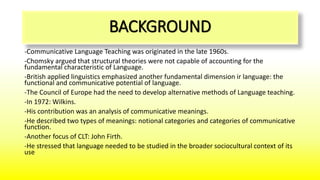
BACKGROUND
-Communicative Language Teaching was originated in the late 1960s.
-Chomsky argued that structural theories were not capable of accounting for the
fundamental characteristic of Language.
-British applied linguistics emphasized another fundamental dimension ir language: the
functional and communicative potential of language.
-The Council of Europe had the need to develop alternative methods of Language teaching.
-In 1972: Wilkins.
-His contribution was an analysis of communicative meanings.
-He described two types of meanings: notional categories and categories of communicative
function.
-Another focus of CLT: John Firth.
-He stressed that language needed to be studied in the broader sociocultural context of its
use
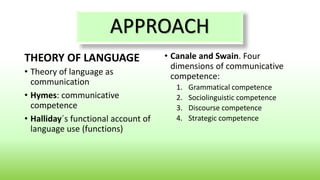
APPROACH
THEORY OF LANGUAGE
• Theory of language as
communication
• Hymes: communicative
competence
• Halliday´s functional account of
language use (functions)
• Canale and Swain. Four
dimensions of communicative
competence:
1. Grammatical competence
2. Sociolinguistic competence
3. Discourse competence
4. Strategic competence
APPROACH
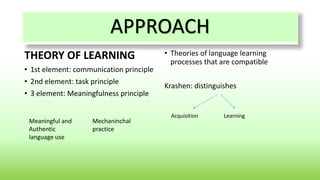
THEORY OF LEARNING
• 1st element: communication principle
• 2nd element: task principle
• 3 element: Meaningfulness principle
• Theories of language learning
processes that are compatible
Krashen: distinguishes
Meaningful and
Authentic
language use
Mechaninchal
practice
Acquisition Learning
DESIGN
 OBJECTIVES
 THE SYLLABUS
 TYPES OF LEARNING AND TEACHING ACTIVITIES
 LEARNER ROLES
 TEACHER ROLES
 THE ROLE OF INSTITUTIONAL MATERIALS
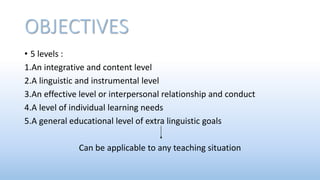
OBJECTIVES
• 5 levels :
1.An integrative and content level
2.A linguistic and instrumental level
3.An effective level or interpersonal relationship and conduct
4.A level of individual learning needs
5.A general educational level of extra linguistic goals
Can be applicable to any teaching situation
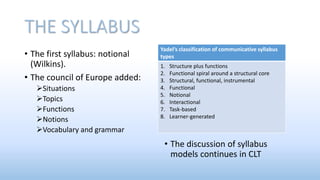
THE SYLLABUS
• The first syllabus: notional
(Wilkins).
• The council of Europe added:
Situations
Topics
Functions
Notions
Vocabulary and grammar
• The discussion of syllabus
models continues in CLT
Yadel’s classification of communicative syllabus
types
1. Structure plus functions
2. Functional spiral around a structural core
3. Structural, functional, instrumental
4. Functional
5. Notional
6. Interactional
7. Task-based
8. Learner-generated
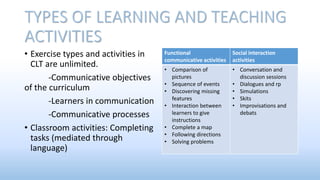
TYPES OF LEARNING AND TEACHING
ACTIVITIES
• Exercise types and activities in
CLT are unlimited.
-Communicative objectives
of the curriculum
-Learners in communication
-Communicative processes
• Classroom activities: Completing
tasks (mediated through
language)
Functional
communicative activities
Social interaction
activities
• Comparison of
pictures
• Sequence of events
• Discovering missing
features
• Interaction between
learners to give
instructions
• Complete a map
• Following directions
• Solving problems
• Conversation and
discussion sessions
• Dialogues and rp
• Simulations
• Skits
• Improvisations and
debats
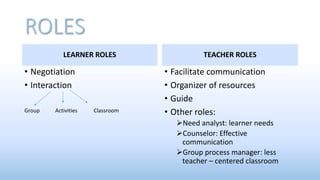
ROLES
LEARNER ROLES
• Negotiation
• Interaction
TEACHER ROLES
• Facilitate communication
• Organizer of resources
• Guide
• Other roles:
Need analyst: learner needs
Counselor: Effective
communication
Group process manager: less
teacher – centered classroom
Group Activities Classroom
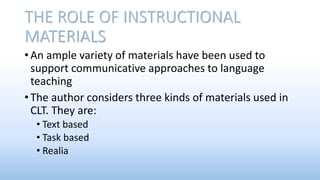
THE ROLE OF INSTRUCTIONAL
MATERIALS
• An ample variety of materials have been used to
support communicative approaches to language
teaching
• The author considers three kinds of materials used in
CLT. They are:
• Text based
• Task based
• Realia
PROCEDURE
CLT principles are not feasible
Finocchiaro and Brumfit : CLT procedures are evolutionary rather than
revolutionary
• Presentation of dialogs / several mini dialogs
• Oral practice
• Questions and answers (topic)
• Q and A (student)
• Communicative expressions / structures
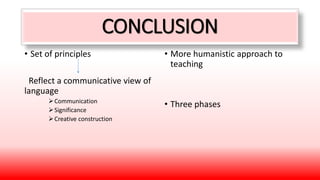
CONCLUSION
• Set of principles
Reflect a communicative view of
language
Communication
Significance
Creative construction
• More humanistic approach to
teaching
• Three phases

Communicative language teaching

  • 1.
  • 2.
    BACKGROUND -Communicative Language Teachingwas originated in the late 1960s. -Chomsky argued that structural theories were not capable of accounting for the fundamental characteristic of Language. -British applied linguistics emphasized another fundamental dimension ir language: the functional and communicative potential of language. -The Council of Europe had the need to develop alternative methods of Language teaching. -In 1972: Wilkins. -His contribution was an analysis of communicative meanings. -He described two types of meanings: notional categories and categories of communicative function. -Another focus of CLT: John Firth. -He stressed that language needed to be studied in the broader sociocultural context of its use
  • 3.
    APPROACH THEORY OF LANGUAGE •Theory of language as communication • Hymes: communicative competence • Halliday´s functional account of language use (functions) • Canale and Swain. Four dimensions of communicative competence: 1. Grammatical competence 2. Sociolinguistic competence 3. Discourse competence 4. Strategic competence
  • 4.
    APPROACH THEORY OF LEARNING •1st element: communication principle • 2nd element: task principle • 3 element: Meaningfulness principle • Theories of language learning processes that are compatible Krashen: distinguishes Meaningful and Authentic language use Mechaninchal practice Acquisition Learning
  • 5.
    DESIGN  OBJECTIVES  THESYLLABUS  TYPES OF LEARNING AND TEACHING ACTIVITIES  LEARNER ROLES  TEACHER ROLES  THE ROLE OF INSTITUTIONAL MATERIALS
  • 6.
    OBJECTIVES • 5 levels: 1.An integrative and content level 2.A linguistic and instrumental level 3.An effective level or interpersonal relationship and conduct 4.A level of individual learning needs 5.A general educational level of extra linguistic goals Can be applicable to any teaching situation
  • 7.
    THE SYLLABUS • Thefirst syllabus: notional (Wilkins). • The council of Europe added: Situations Topics Functions Notions Vocabulary and grammar • The discussion of syllabus models continues in CLT Yadel’s classification of communicative syllabus types 1. Structure plus functions 2. Functional spiral around a structural core 3. Structural, functional, instrumental 4. Functional 5. Notional 6. Interactional 7. Task-based 8. Learner-generated
  • 8.
    TYPES OF LEARNINGAND TEACHING ACTIVITIES • Exercise types and activities in CLT are unlimited. -Communicative objectives of the curriculum -Learners in communication -Communicative processes • Classroom activities: Completing tasks (mediated through language) Functional communicative activities Social interaction activities • Comparison of pictures • Sequence of events • Discovering missing features • Interaction between learners to give instructions • Complete a map • Following directions • Solving problems • Conversation and discussion sessions • Dialogues and rp • Simulations • Skits • Improvisations and debats
  • 9.
    ROLES LEARNER ROLES • Negotiation •Interaction TEACHER ROLES • Facilitate communication • Organizer of resources • Guide • Other roles: Need analyst: learner needs Counselor: Effective communication Group process manager: less teacher – centered classroom Group Activities Classroom
  • 10.
    THE ROLE OFINSTRUCTIONAL MATERIALS • An ample variety of materials have been used to support communicative approaches to language teaching • The author considers three kinds of materials used in CLT. They are: • Text based • Task based • Realia
  • 11.
    PROCEDURE CLT principles arenot feasible Finocchiaro and Brumfit : CLT procedures are evolutionary rather than revolutionary • Presentation of dialogs / several mini dialogs • Oral practice • Questions and answers (topic) • Q and A (student) • Communicative expressions / structures
  • 12.
    CONCLUSION • Set ofprinciples Reflect a communicative view of language Communication Significance Creative construction • More humanistic approach to teaching • Three phases