Objective
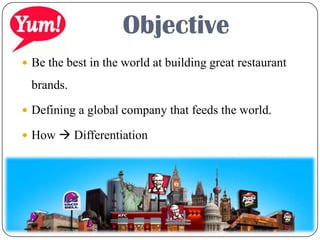
๏‚— Be the best in the world at building great restaurant
brands.
๏‚— Defining a global company that feeds the world.
๏‚— How ๏ƒ  Differentiation
Growth Strategies
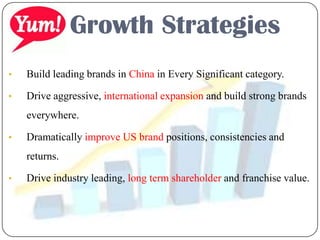
โ€ข Build leading brands in China in Every Significant category.
โ€ข Drive aggressive, international expansion and build strong brands
everywhere.
โ€ข Dramatically improve US brand positions, consistencies and
returns.
โ€ข Drive industry leading, long term shareholder and franchise value.
First Strategy
โ€œBuild leading brands in China in every significant
category.โ€
๏‚— Main goal is to expand and grow regardless of all weaknesses and threats.
๏‚— The strategy will accomplish the expectation because it is specific to
China. Since, it is transitioning to a consumer based economy thus giving
rise to the middle class segment which is the companyโ€™s main customer
base.
๏‚— How?
by opening more branches in China.
Second Strategy
โ€œDrive aggressive, international expansion and build strong
brands everywhere.โ€
๏‚— 4 divisions: YRI (Yum Restaurants International), China Division, US
Division, India Division.
๏‚— To establish a strong brand recognition along with even more branches.
๏‚— Implementation:
India: Treated as a separate division due to expected future forecasts of
India being the largest consumer market in 2030.
Russia: Bought Rostikโ€™s business (Russiaโ€™s leading chicken chain)
Africa: First-mover advantage.
Third Strategy
โ€œDramatically improve US brand positions, consistencies and
returns.โ€
๏‚—Reversed negative same-store sales of KFC by investing in
product innovation and Improving franchise relations.
Implementation:
๏‚—Expand Taco Bell branches from 5,000 to 8,000 units and
Pizza Hut from 6,000 to 8,000 units.
Fourth Strategy
โ€œDrive industry leading, long term shareholder and
franchise value.โ€
๏‚—High Cash from operations
๏‚—High return
๏‚—Consistent dividend yield
๏‚—Implementation:
Reducing ownership in highly penetrated markets (UK & US)
and increasing their ownership in international markets.
Maintain strong social responsibility.
Management Key
Assumptions
๏‚—India will be the highest consumption country in the
world by 2030
๏‚—Applying the same strategy followed for the past 10
years will increase sales
๏‚—More branches means more profit
๏‚—Getting back on their feet under any external threats
such as disease from poultry.
Policy Alternative
๏‚— Fast Grow:
Aggressive growth strategy, pursue larger market
share or a stronger position in untapped markets
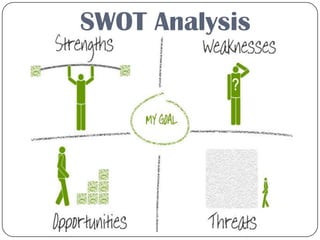
SWOT Analysis
Strengths
๏‚— Management
๏‚— Adapted favorable cost structure
๏‚— Efficient same-store sales.
๏‚— Geographic diversification
๏‚— Quick responds to shifts in demand
๏‚— Strong brand recognition
๏‚— Pending litigation, lawsuits
๏‚— Underperformance and slowing of U.S. sales specifically with KFC
and Pizza Hut brands
๏‚— Suffer a setback in China following an investigation into KFC
Chinaโ€™s poultry supply which resulted in a sharp decline in sales.
๏‚— Relatively small market share in oversaturated U.S. fast food
industry
๏‚— Older U.S. restaurant units losing sales annually
Weaknesses
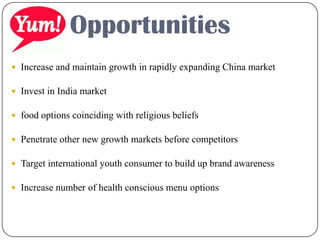
๏‚— Increase and maintain growth in rapidly expanding China market
๏‚— Invest in India market
๏‚— food options coinciding with religious beliefs
๏‚— Penetrate other new growth markets before competitors
๏‚— Target international youth consumer to build up brand awareness
๏‚— Increase number of health conscious menu options
Opportunities
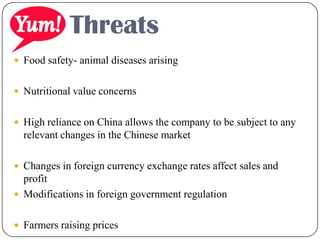
๏‚— Food safety- animal diseases arising
๏‚— Nutritional value concerns
๏‚— High reliance on China allows the company to be subject to any
relevant changes in the Chinese market
๏‚— Changes in foreign currency exchange rates affect sales and
profit
๏‚— Modifications in foreign government regulation
๏‚— Farmers raising prices
Threats
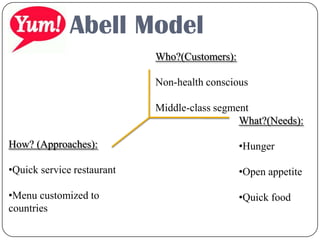
Abell Model
How? (Approaches):
โ€ขQuick service restaurant
โ€ขMenu customized to
countries
Who?(Customers):
Non-health conscious
Middle-class segment
What?(Needs):
โ€ขHunger
โ€ขOpen appetite
โ€ขQuick food
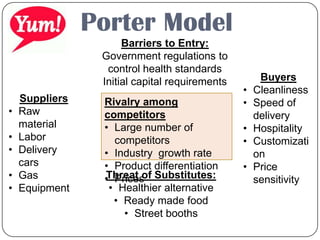
Porter Model
Rivalry among
competitors
โ€ข Large number of
competitors
โ€ข Industry growth rate
โ€ข Product differentiation
โ€ข Prices
Buyers
โ€ข Cleanliness
โ€ข Speed of
delivery
โ€ข Hospitality
โ€ข Customizati
on
โ€ข Price
sensitivity
Suppliers
โ€ข Raw
material
โ€ข Labor
โ€ข Delivery
cars
โ€ข Gas
โ€ข Equipment
Barriers to Entry:
Government regulations to
control health standards
Initial capital requirements
Threat of Substitutes:
โ€ข Healthier alternative
โ€ข Ready made food
โ€ข Street booths
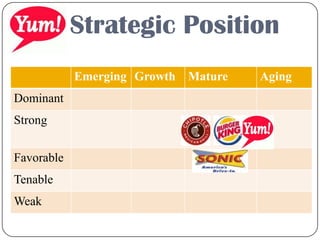
Strategic Position
Emerging Growth Mature Aging
Dominant
Strong
Favorable
Tenable
Weak
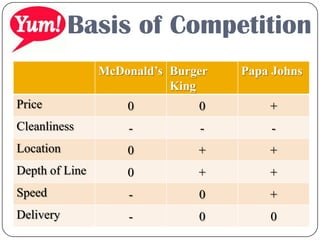
Basis of Competition
McDonaldโ€™s Burger
King
Papa Johns
Price 0 0 +
Cleanliness - - -
Location 0 + +
Depth of Line 0 + +
Speed - 0 +
Delivery - 0 0
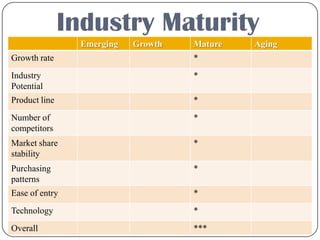
Industry Maturity
Emerging Growth Mature Aging
Growth rate *
Industry
Potential
*
Product line *
Number of
competitors
*
Market share
stability
*
Purchasing
patterns
*
Ease of entry *
Technology *
Overall ***
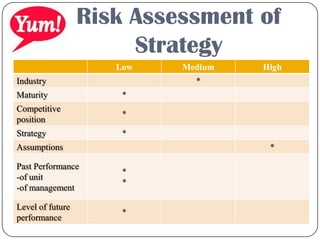
Risk Assessment of
Strategy
Low Medium High
Industry *
Maturity *
Competitive
position
*
Strategy *
Assumptions *
Past Performance
-of unit
-of management
*
*
Level of future
performance
*
Conclusion
Looking forward, Yum! Brands is in a strong position to
maintain foreign expansion and capture a large share of
the international market. Despite certain challenges it
faces in the domestic market, the company is financially
healthy and should be able to sustain a
stable position within the global fast
food industry.

Yum! Brands

  • 2.
    Objective ๏‚— Be thebest in the world at building great restaurant brands. ๏‚— Defining a global company that feeds the world. ๏‚— How ๏ƒ  Differentiation
  • 3.
    Growth Strategies โ€ข Buildleading brands in China in Every Significant category. โ€ข Drive aggressive, international expansion and build strong brands everywhere. โ€ข Dramatically improve US brand positions, consistencies and returns. โ€ข Drive industry leading, long term shareholder and franchise value.
  • 4.
    First Strategy โ€œBuild leadingbrands in China in every significant category.โ€ ๏‚— Main goal is to expand and grow regardless of all weaknesses and threats. ๏‚— The strategy will accomplish the expectation because it is specific to China. Since, it is transitioning to a consumer based economy thus giving rise to the middle class segment which is the companyโ€™s main customer base. ๏‚— How? by opening more branches in China.
  • 5.
    Second Strategy โ€œDrive aggressive,international expansion and build strong brands everywhere.โ€ ๏‚— 4 divisions: YRI (Yum Restaurants International), China Division, US Division, India Division. ๏‚— To establish a strong brand recognition along with even more branches. ๏‚— Implementation: India: Treated as a separate division due to expected future forecasts of India being the largest consumer market in 2030. Russia: Bought Rostikโ€™s business (Russiaโ€™s leading chicken chain) Africa: First-mover advantage.
  • 6.
    Third Strategy โ€œDramatically improveUS brand positions, consistencies and returns.โ€ ๏‚—Reversed negative same-store sales of KFC by investing in product innovation and Improving franchise relations. Implementation: ๏‚—Expand Taco Bell branches from 5,000 to 8,000 units and Pizza Hut from 6,000 to 8,000 units.
  • 7.
    Fourth Strategy โ€œDrive industryleading, long term shareholder and franchise value.โ€ ๏‚—High Cash from operations ๏‚—High return ๏‚—Consistent dividend yield ๏‚—Implementation: Reducing ownership in highly penetrated markets (UK & US) and increasing their ownership in international markets. Maintain strong social responsibility.
  • 8.
    Management Key Assumptions ๏‚—India willbe the highest consumption country in the world by 2030 ๏‚—Applying the same strategy followed for the past 10 years will increase sales ๏‚—More branches means more profit ๏‚—Getting back on their feet under any external threats such as disease from poultry.
  • 9.
    Policy Alternative ๏‚— FastGrow: Aggressive growth strategy, pursue larger market share or a stronger position in untapped markets
  • 10.
  • 11.
    Strengths ๏‚— Management ๏‚— Adaptedfavorable cost structure ๏‚— Efficient same-store sales. ๏‚— Geographic diversification ๏‚— Quick responds to shifts in demand ๏‚— Strong brand recognition
  • 12.
    ๏‚— Pending litigation,lawsuits ๏‚— Underperformance and slowing of U.S. sales specifically with KFC and Pizza Hut brands ๏‚— Suffer a setback in China following an investigation into KFC Chinaโ€™s poultry supply which resulted in a sharp decline in sales. ๏‚— Relatively small market share in oversaturated U.S. fast food industry ๏‚— Older U.S. restaurant units losing sales annually Weaknesses
  • 13.
    ๏‚— Increase andmaintain growth in rapidly expanding China market ๏‚— Invest in India market ๏‚— food options coinciding with religious beliefs ๏‚— Penetrate other new growth markets before competitors ๏‚— Target international youth consumer to build up brand awareness ๏‚— Increase number of health conscious menu options Opportunities
  • 14.
    ๏‚— Food safety-animal diseases arising ๏‚— Nutritional value concerns ๏‚— High reliance on China allows the company to be subject to any relevant changes in the Chinese market ๏‚— Changes in foreign currency exchange rates affect sales and profit ๏‚— Modifications in foreign government regulation ๏‚— Farmers raising prices Threats
  • 15.
    Abell Model How? (Approaches): โ€ขQuickservice restaurant โ€ขMenu customized to countries Who?(Customers): Non-health conscious Middle-class segment What?(Needs): โ€ขHunger โ€ขOpen appetite โ€ขQuick food
  • 16.
    Porter Model Rivalry among competitors โ€ขLarge number of competitors โ€ข Industry growth rate โ€ข Product differentiation โ€ข Prices Buyers โ€ข Cleanliness โ€ข Speed of delivery โ€ข Hospitality โ€ข Customizati on โ€ข Price sensitivity Suppliers โ€ข Raw material โ€ข Labor โ€ข Delivery cars โ€ข Gas โ€ข Equipment Barriers to Entry: Government regulations to control health standards Initial capital requirements Threat of Substitutes: โ€ข Healthier alternative โ€ข Ready made food โ€ข Street booths
  • 17.
    Strategic Position Emerging GrowthMature Aging Dominant Strong Favorable Tenable Weak
  • 18.
    Basis of Competition McDonaldโ€™sBurger King Papa Johns Price 0 0 + Cleanliness - - - Location 0 + + Depth of Line 0 + + Speed - 0 + Delivery - 0 0
  • 19.
    Industry Maturity Emerging GrowthMature Aging Growth rate * Industry Potential * Product line * Number of competitors * Market share stability * Purchasing patterns * Ease of entry * Technology * Overall ***
  • 20.
    Risk Assessment of Strategy LowMedium High Industry * Maturity * Competitive position * Strategy * Assumptions * Past Performance -of unit -of management * * Level of future performance *
  • 21.
    Conclusion Looking forward, Yum!Brands is in a strong position to maintain foreign expansion and capture a large share of the international market. Despite certain challenges it faces in the domestic market, the company is financially healthy and should be able to sustain a stable position within the global fast food industry.

Editor's Notes

  • #5ย Weaknesses: decline in salesThreats: unforeseen extraordinary events such disease outbreaks, pandemic, epidemic and flus.
  • #13ย 1 restaurant for every 10 McDonaldโ€™s stores