HHaammooddiiaa September 27, 20126
DOWN MEMORY LANE
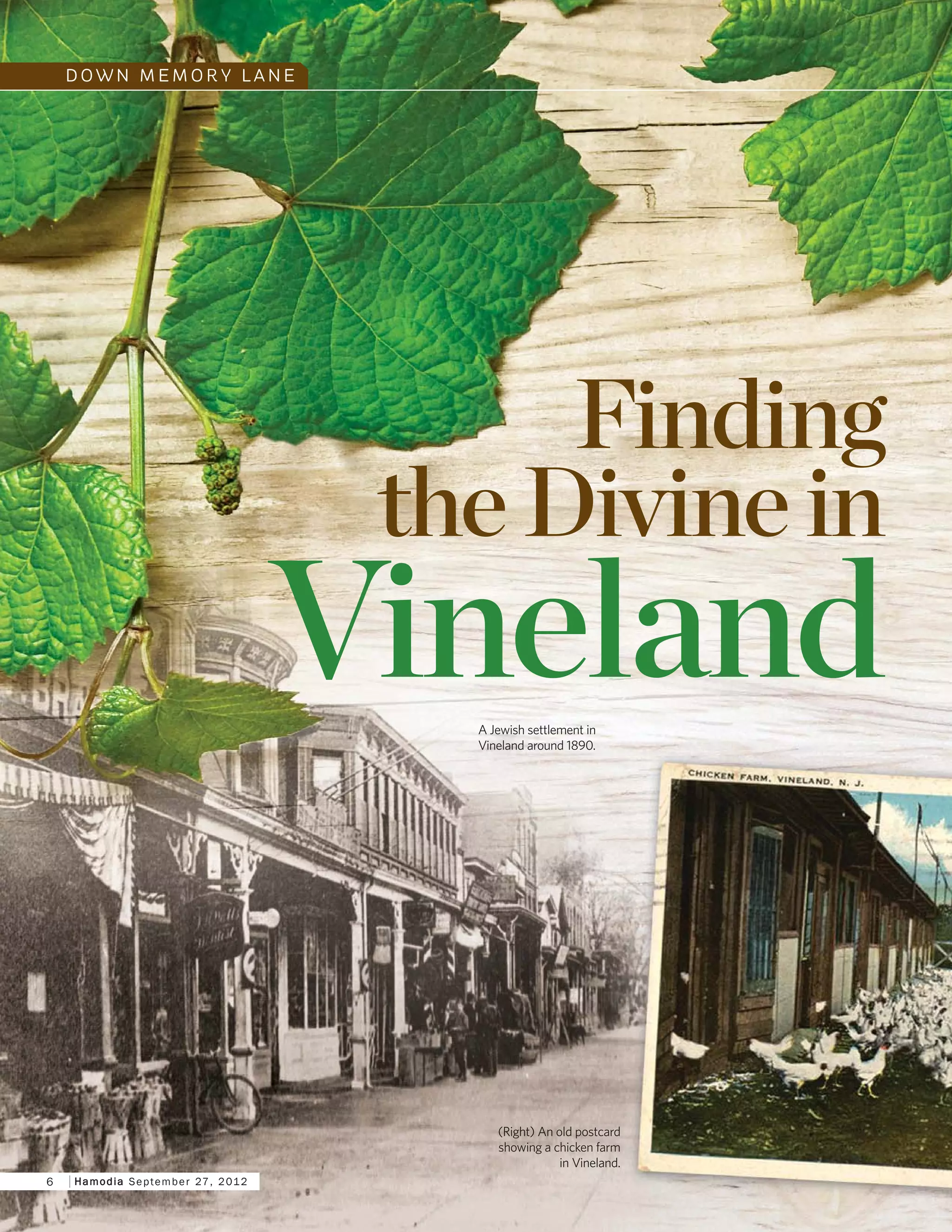
VinelandA Jewish settlement in
Vineland around 1890.
(Right) An old postcard
showing a chicken farm
in Vineland.
Finding
theDivinein
IInnyyaann MMaaggaazziinnee 11 Tishrei 5773 7
BY REBBETZIN FAIGIE HOROWITZ
The Vineland Jewish community has its roots across the Atlantic in late nineteenth-century Europe.
With pogroms sweeping westward across Russia to central Europe, various solutions to the economic,
geographic, and political disenfranchisement of Jews were proposed. Zionism was one reaction to the
harsh realities of the times. Socialists proposed agrarian communities as part of a back-to-the-land
movement; Jews would support themselves through the work of their own hands, free of restrictions on
professions and residence permits. These agrarian communities were envisioned largely in the United
States, where almost a continent’s worth of land was available for purchase and settlement.
Cotopaxi, in Fremont County, Colorado, was marketed to the Hebrew Immigrant Aid Society (HIAS)
in New York City by Emanuel Saltiel, an enterprising Portuguese Jew who bought land out west and
began mining. The proposal to the officers of the organization came in 1881 and was viewed as a
solution to the mounting numbers of Russian refugees reaching American shores. It was the first
experiment in developing an agricultural colony to retrain the immigrants and take advantage of the
cheap land offered through the U.S. Homestead Act. Southern New Jersey was the site of the second
Jewish colonization initiative a year later, outlasting by many decades the two years of the failed
Cotopaxi colony.
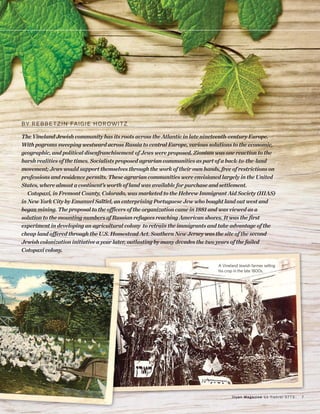
A Vineland Jewish farmer selling
his crop in the late 1800s.
HHaammooddiiaa September 27, 20128
Jewish Colonies
Near the Pine Barrens
Baron Maurice de Hirsch, a member
of a wealthy German-Jewish banking
family with interests in railroads and
mining, was deeply involved in the
search for a solution to the Russian-
Jewish problem of the times. He
donated money for the repatriation of
refugees, gave money to the Russian
government for the secular education
of Jews, and participated in various
colonization schemes for the
resettlement of European Jews in
Canada, Argentina, Palestine, and the
United States. These were mostly
administered by the Alliance Israelite
Universelle, based in Paris, where
Baron de Hirsch lived. In 1882, the New
York Baron de Hirsch Fund selected
forty-three candidates from the
teeming streets of New York who were
deemed fit to be pioneers. One of the
colonies in which the settled them was
on land deep in the New Jersey Pine
Barrens.
The Baron de Hirsch colonies grew
into established towns called Alliance,
Brotmanville, Rosenhayn, Carmel, and
Norma. Each one had its own shul and
all the facilities necessary for Jewish
communal life, including a mikveh, a
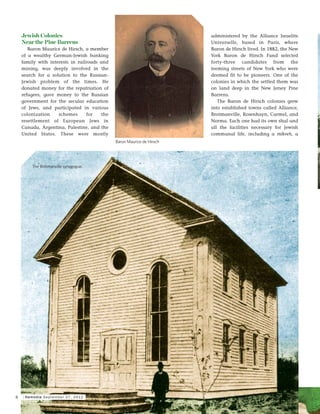
Baron Maurice de Hirsch
The Brotmanville synagogue,
IInnyyaann MMaaggaazziinnee 11 Tishrei 5773 9
cemetery, a chevrah kaddisha, and social
clubs. Because of the problem of techum
Shabbos, each town had its own shul,
but Jewish education did not receive the
same priority; hence the loss of later
generations to assimilation.
Several other towns were established
not far from Alliance and the Baron de
Hirsch towns. The best-known was
Woodbine because of its planned mix of
agriculture and industry. It was only
thirty miles from the earlier colonies,
and it was the first incorporated Jewish
borough in the United States. In 1893,
an agricultural school was set up for
the immigrant boys of
Woodbine, with courses in
English, farming, and the
trades. Ultimately the Jewish
agricultural town of
Woodbine failed, probably
due to its poor soil.
The Jewish colonies in
southern New Jersey were
part of what came to be
called the Am Olam movement — or, by
some historians, the back-to-the-soil
movement, which flourished well into
the 1920s and ’30s. The towns listed
earlier lasted longer than Woodbine;
most of the colonists were poultry
farmers and raised blackberries,
strawberries, blueberries, and other
crops that suited the soil.
The second generation generally
stayed in the colonies, but the
generation after that began leaving.
Tilling the soil and raising poultry was
not an easy life, and the white-collar
professions attracted the grandchildren
of the original settlers. Some migrated
to the nearby community of Vineland,
where they entered various
businesses and professions.
Vineland, New Jersey
Founded by Charles K.
Landis in 1861 along the rail
line to Philadelphia, the town
was planned as a utopian
society in which Landis set the
rules. Each settler who bought
land from him had to commit
to building a home within a year,
farming a minimal amount of acreage,
and leaving space between the homes.
In Their Own Words
The following account was written
in 1932 by Sidney Bailey, one of
the early colonists of Alliance, in
honor of the fiftieth anniversary
of the colony’s founding. His
words reflect the motivation,
mindset, and priorities of its
founders — at the same time
indicating the stresses, dilemmas,
and changing values of Eastern
European Jews. The narrative also
indicates the roots of the colony’s
eventual failure to maintain
Jewish identity among the
residents’ descendants, even
though they had respect for
tradition. Without Torah values
and chinuch, without a strong
connection to the Source of their
success, the result of the “natural
life” was usually assimilation.
I
HAD THE PRIVILEGE of being one
of the three men … who
formulated in Odessa on Shabuoth
of 1881 the Am Olam idea that our
brethren should go to America to
become tillers of the soil and thus shake
off the accusation that they were mere
petty mercenaries, living upon the toil
of others. Our thought was to live in the
open instead of being “shut-ins” who
lived an artificial city life. … We came
here instead of going to Palestine, which
was then under a Turkish regime. Thus,
the exodus of 1882 began rolling en
masse to America, and Alliance was
established in May 1882…
Our wanderers, from various parts of
Russia, came with the purpose of
carrying out the idea of Am Olam — to
settle on land. Our people, being
Talmudists, merchants, and tradesmen,
knew nothing of the significance of
farm life. When they came to New York
and arrived at Castle Garden [the
immigration center before Ellis Island]
and talked very naively with our
Charles K. Landis
Continued on page 11
The Chevrah Kaddisha
chapel in Norma, NJ.
HHaammooddiiaa September 27, 201210
Landis was a brilliant entrepreneur
and urban planner. He determined that
the town’s soil was suitable for growing
grapes and marketed them to Italian
winemakers — hence the name
Vineland. Nonetheless, he insisted that it
remain a temperance town, where the
sale of liquor was forbidden. The local
churches therefore had a problem with
supplying wine for services. Dr. Thomas
Bramwell Welch solved the problem by
coming up with the idea of making
non-alcoholic grape juice from locally
grown crops. Struggling to meet the
demand from temperance towns in the
area, Welch soon formed the Welch’s
Fruit Juice Company.
Vineland proper covers sixty-nine
square miles, making it the largest city
in area in New Jersey. For Vineland’s
Jews, the size of the town was a
blessing as well as a problem. There
was plenty of room for poultry farms,
the business of choice and tradition;
however, the size of the farms kept
families far from one another. By the
1930s, there were two Orthodox
synagogues, the Plum Street shul and
the Pine Street shul. Still, many of the
Orthodox families had to walk forty-
five minutes to reach them on
Shabbos, prompting the formation of
minyanim in some homes.
The Jewish population of Vineland
swelled in the early 1940s and after
World War II. “Greenhorns” who
hated the overcrowding of the large
eastern cities banded together and
resettled in Vineland with their friends
and landsleit. Land could be had
cheap; mortgages were easy to come
by through a Jewish resettlement
organization called the Jewish
Agricultural Society; and hard work
was all that was required. The mostly
traditional but not mitzvah-observant
Jews formed organizations such as the
Poultrymen’s Club for social purposes.
Most had no experience in animal
husbandry, and they needed to learn
all they could from the Jewish and
non-Jewish poultry farms already in
business.
Jersey Jewish Eggs
MANY POLISH AND GERMAN refugee
families settled in the Vineland area
after World War II for a combination of
reasons, including the fact that egg
farming was a viable livelihood.
German Jews in particular had been independent business owners, and the locale
afforded them this option, says Rabbi Josef Loebenstein.
There were thousands of Jewish egg farmers in the Vineland area, and
business was good. In the days before refrigeration, eggs had to be sold within a
certain radius of the egg farm in order to ensure freshness. With the proximity of
New York City, eggs that came from Jersey were fresher than eggs from other
areas. As time went by and refrigeration became available, eggs from the Midwest
became cheaper since labor, land, and grain costs were much lower there. Many
Jewish egg farmers left the business and by the 1970s were no longer living in
Vineland, Lakewood, and Freehold in central Jersey, towns that had been the
center of the egg business.
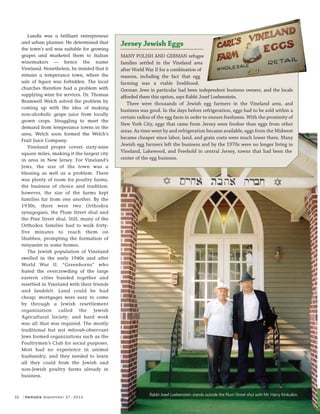
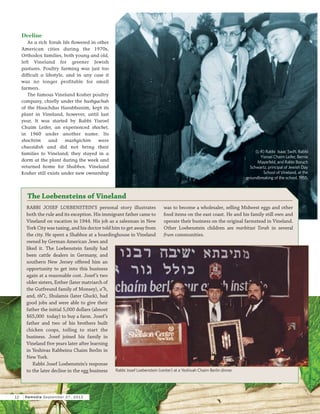
Rabbi Josef Loebenstein stands outside the Plum Street shul with Mr. Harry Kinkulkin.
IInnyyaann MMaaggaazziinnee 11 Tishrei 5773 11
The Heyday
In 1953, a Jewish day school was
established by the mostly German-Jewish
families in Vineland, including the
Loebensteins, the Mayerfelds, the
Blumenthals, the Frohlichs, and the
Weinbergs (later of Philadelphia, Toronto,
and Brooklyn). The Freimarks, a branch
of the Mayerfeld family, sent five girls to
Bais Yaakov High School in Williamsburg,
Brooklyn. They maintained an apartment
there for years as the girls attended school
one after another. The life span of the
Jewish day school in Vineland was short,
not even twenty years. After it closed, the
children were driven to Philadelphia by
older girls who attended the Jewish high
school there. Other parents sent their
children to public school.
Many well-known families were
Vineland residents for a time, among
them the Anisfelds and Zoltys of Toronto,
and the Bistritzkys of New York. Some of
these families built new lives as poultry
farmers in Vineland after surviving the
Holocaust. The community increased with
the arrival of a few Hungarian Jews after
the 1956 revolution, but not all were
observant.
During this postwar period, Rabbi
Moshe Eisemann of Lakewood, who was
of German extraction and a talmid
muvhak of Rav Aharon Kotler, zt"l, started
a yeshivah on the outskirts of Vineland
with about a dozen bachurim. It lasted a
few years and attracted some Washington
Heights students. The Eisemann family
had ten children, all of whom became
marbitzei Torah in various locales. One son
is Rabbi Osher Eisemann of Lakewood,
founder of the famous School for Children
of Hidden Intelligence (SCHI).
Many survivors in the Vineland area
were antagonistic toward Torah as a result
of their suffering during the war. Mrs. Effie
Mayerfeld, who was very active in the
community and conducted many
interviews with survivors for the Spielberg
Foundation, reports that the second- and
third-generation descendants of these
survivors did not stay connected to
Yiddishkeit. As a pillar of the community
for decades and the mother of kiruv
professionals, she attests to the fact that
several fourth-generation Vineland Jews
have returned to observance. Through her
forty-five years in Vineland and her
children’s activism, she has encountered
old folks and young, baalei teshuvah from
the world over, who cite their forebears’
roots in the Vineland area.
Yeshivah Shaarei Torah of Monsey,
New York, conducted a SEED program in
Vineland in the 1990s, during the summer
months. The fruits of that effort and
ongoing outreach have also brought
some progeny of Vineland residents back
to Torah.
German-American brethren who came
to meet us and help us, [the immigrants]
were warned against and advised to give
up the idea of becoming farmers, but
were advised to continue at their trades
or to become peddlers. Thus the Am
Olam broke up. However, a few
remained true to their ideals, and their
ambition was to be realized.
The group consisted of about one
hundred families, and it chose for
its delegates Moses Bayuk,
who was a successful
lawyer in the Russian
city of Bialystok, and
Eli Stavitsky to scout
the country for a
suitable site. This they
did and chose this
territory for one reason
only, that it was located on
the Jersey Central Railroad a little over
one hundred miles from the metropolis
of New York and about forty miles from
Philadelphia.
The vast stretch of land was parceled
out into fourteen-acre farms and
numbered. The streets were named in
honor of the trustees of the Alliance
Land Trust, Judge Isaacs, Eppinger,
Gershell, Henry, Simon Muir, Mendes,
and Jacob Schiff. The farms were chosen
by lot. Our next problem was to clear the
brush land for the homes and to build
the houses, consisting of one room and
garret, which was to “accommodate”
large families.
When berry-picking time arrived, our
men with their wives and children
started out early mornings and walked
for miles in search of farms requiring
pickers. Upon returning, the men would
go to the swamps to cut firewood or
break off limbs of trees and carry them
home upon their shoulders. The women
wouldcook,bake,washtheclothing,and
do other housework. A few of the men
worked in a brickyard in Vineland. ... To
keep the settlers out of “mischief” and to
Continued from page 9
Continued on page 13
Moses Bayuk
Danny Freimark, son of Reverend Ludwig, in front of his home on Plum Street in Vineland.
Decline
As a rich Torah life flowered in other
American cities during the 1970s,
Orthodox families, both young and old,
left Vineland for greener Jewish
pastures. Poultry farming was just too
difficult a lifestyle, and in any case it
was no longer profitable for small
farmers.
The famous Vineland Kosher poultry
company, chiefly under the hashgachah
of the Hisachdus Harabbanim, kept its
plant in Vineland, however, until last
year. It was started by Rabbi Yisroel
Chaim Leifer, an experienced shochet,
in 1960 under another name. Its
shochtim and mashgichim were
chassidish and did not bring their
families to Vineland; they stayed in a
dorm at the plant during the week and
returned home for Shabbos. Vineland
Kosher still exists under new ownership
HHaammooddiiaa September 27, 201212
RABBI JOSEF LOEBENSTEIN’S personal story illustrates
both the rule and its exception. His immigrant father came to
Vineland on vacation in 1944. His job as a salesman in New
York City was taxing, and his doctor told him to get away from
the city. He spent a Shabbos at a boardinghouse in Vineland
owned by German American Jews and
liked it. The Loebenstein family had
been cattle dealers in Germany, and
southern New Jersey offered him an
opportunity to get into this business
again at a reasonable cost. Josef’s two
older sisters, Esther (later matriarch of
the Gutfreund family of Monsey), a”h,
and, tbl”c, Shulamis (later Gluck), had
good jobs and were able to give their
father the initial 5,000 dollars (almost
$65,000 today) to buy a farm. Josef’s
father and two of his brothers built
chicken coops, toiling to start the
business. Josef joined his family in
Vineland five years later after learning
in Yeshivas Rabbeinu Chaim Berlin in
New York.
Rabbi Josef Loebenstein’s response
to the later decline in the egg business
was to become a wholesaler, selling Midwest eggs and other
food items on the east coast. He and his family still own and
operate their business on the original farmstead in Vineland.
Other Loebenstein children are marbitzei Torah in several
frum communities.
Rabbi Josef Loebenstein (center) at a Yeshivah Chaim Berlin dinner.
The Loebensteins of Vineland
(L-R) Rabbi Isaac Swift, Rabbi
Yisroel Chaim Leifer, Bernie
Mayerfeld, and Rabbi Boruch
Schwartz, principal of Jewish Day
School of Vineland, at the
groundbreaking of the school, 1955.
IInnyyaann MMaaggaazziinnee 11 Tishrei 5773 13
in Birdsborough, Pennsylvania, where it
relocated last year after fifty years in the
Vineland community.
Vineland Dressed Beef is owned and
operated by the Bierig family, most of
whom currently live in Margate and
Cherry Hill, New Jersey. Vineland’s
morning minyan is held in their plant
and depends on the shochtim,
mashgichim, owners, and Vineland
baalei batim for its continued existence.
One Orthodox shul, the Sons of Jacob
Congregation, remains alive in
Vineland, offering Minchah and Maariv
minyanim. Its resident leader of twenty
years is Rabbi Yisroel Rapoport, and its
members are mostly old-timers. The
Jewish residents are spread apart in the
large city, making the shul too far for
the elderly to walk to on Shabbos, but
the Shabbos minyan remains resilient.
The summer season sees an influx of
Mayerfelds and others, so a second
Shabbos minyan functions in various
homes or in the century-old Norma
Brotherhood Synagogue, which is
shuttered the rest of the year.
The mesorah and ongoing presence of
furnish means of a livelihood, a cigar
factory was built.
Thus it went on for several years,
inasmuch as the settlers would not
clear the ground until the Alliance
Land Trust would deed the individual
tracts to the farmers. They had merely
sold them to the settlers on contract at
half the actual cost. After much
negotiation the Alliance Land Trust
finally issued deeds to settlers and took
back mortgages for one hundred and
eighty dollars each. …
When the cigar factory was closed,
the tailoring of cheap summer coats and
vests was introduced and proved to be a
boon for the settlement. Mr. Luberoff,
Mr. Opachinsky, and myself contracted
for this work from New York and
Philadelphia and distributed the
garments among the settlers to be made
up at home. There all the family would
“sweat” long hours and earned but little
money. Despite this they did begin to
improve in health, made additions to
the houses, built barns and chicken
coops, and also saved some money to
hire American neighbors to clear and
break up new land.
When the Baron de Hirsch Fund
started to function in New York, the
Alliance Land Trust transferred its
interests, including its mortgages and
loans, to that society. I succeeded in
explaining to the society the need of
building more houses to accommodate
the newcomers. … Additional factories
were opened…
In the meantime our farms were
cleared of stumps and we mastered the
rudiments of farming, some from books
and some from neighbors, but all by
bitter experience. We grew ... berries for
shipment to New York; we raised grapes
to be sold in Vineland to Welch’s Grape
Juice factory. ...
It is our old maxim that “not by bread
alonelivesman,butonthewordofG-d.”
Mr. Stavitsky brought with him a sefer
Continued from page 11
Continued on page 15
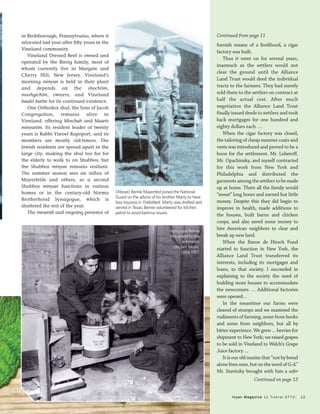
(Above) Bernie Mayerfeld joined the National
Guard on the advice of his brother Marty to have
less nisyonos in Yiddishkeit. Marty was drafted and
served in Texas; Bernie volunteered for kitchen
patrol to avoid kashrus issues.
Henry and Bernie
Mayerfeld fix the
automatic
chicken feeder,
circa 1957.
the Mayerfelds and Loebensteins keep
Vineland’s name circulating in the
Jewish world, but of Norma, Alliance,
Brotmanville, Rosenhayn, and the other
original agricultural colonies there is
almost no Jewish remnant other than in
the cemeteries. As Effie Mayerfeld says,
the Baron de Hirsch Fund provided for
the economic and physical needs of the
Jews fleeing czarist Russia, creating shuls,
cemeteries, and mikva’os, but their
spiritual needs were not addressed.
DIFFERENT FROM THE OTHER SETTLERS were members of the
Mayerfeld clan, who settled settled first in Vineland and later in
Norma. Stemming from the town of Crumstadt near Frankfurt-
am-Main, Manfred was the first to arrive in the 1920s as a single
young man. He brought over his paernts, Uri Shraga and his wife,
and his brothers, Max and Sali, and his two sisters, who thus
escaped the churban in Europe. Each came with spouses and in-
laws, thanks to Manfred’s efforts. At first some of them settled in
Sag Harbor, Long Island, where one sister’s husband, Reverend
Ludwig Freimark, worked as a shochet and Jewish religious
functionary. By the 1940s they had all made their way to
Vineland.
The ability to keep Shabbos was what drew the
whole family to southern New Jersey. Nonreligious
relatives told them that they would not be able to keep
Shabbos in the United States even if they tried to
restart their previous businesses. Sali summed up the
family’s attitude: “The chickens won’t mind if I keep
Shabbos. The hens won’t care if I speak German.”
The Mayerfeld family members worked very hard at
poultry farming but didn’t talk about the hardships. They just
worked. There were no vacations, no visiting with other frum
families in their six-and-a-half-day-a-week schedule. As soon as
Havdalah was over, they went out to the chicken coops and worked
some more. The Shacharis schedule was adjusted according to the
time of year, sometimes before morning egg collection and
sometimes after. They also ran a boarding house to bring in some
extra income.
“All the fun was in our house. We didn’t know what we were
missing,” says Nechama Mayerfeld Katz, Sali’s youngest child, who
now lives in Far Rockaway. “When myparents scraped together the
money to send me to Camp Bais Yaakov for three weeks at age ten,
I was enthralled. A whole roomful of frum girls were bentching! It
was amazing to me [since I had] rarely met other frum girls.”
Manfred, Max, Sali, and their parents were mainstays of the
community, in Vineland and later in Norma. They opened the
Jewish day school with others, established the gemilus chessed
fund, which helped many immigrants get started, and they
ran the chevrah kadisha. Opa Sali Mayerfeld was the first
in their area to put an extension phone in his bedroom;
as president of the chevrah kaddisha, he didn’t want
anyone who called during the night to be unable to get
through to the chevrah. The Mayerfeld name is still
closely connected with Vineland even though only
Henry and his wife remain. The Mayerfelds gave up the
poultry business in 1978 and are now in construction and
building supplies.
The family has stayed connected to K’hal Adath
Jeshurun in Washington Heights and their German-Jewish roots.
Harav Shimon Schwab, zt”l, used to travel to New Jersey to
officiate at family simchos. Mrs. Helen Heidingsfeld Mayerfeld had
beenaclassmateoftheRav’sintheHirschRealschuleinFrankfurt.
The family members stayed connected to one another; the next
generations who married outside of Vineland returned regularly
and made sure that the second and third cousins stayed close. All
of the family members, who live around the world, are frum today,
many working as klei kodesh, kiruv professionals,
and lay leaders. Most of the Mayerfeld boys and
girls went away to yeshivos and schools out of town
since chinuch in town was erratic. Rabbi Uri
Mayerfeld, son of Manfred, is the Rosh Yeshivah in
Yeshivas Ner Israel of Toronto. Another Rabbi
Mayerfeld, Max’s grandson, is the rabbi of an
Persian congregation in Los Angeles. Rabbi Hershel
Newmark, whose wife is a Freimark, is a rabbi in
Brooklyn. Rabbi Eli Mayerfeld is the executive
director of Yeshiva Beth Yehudah in Detroit, and
his brother, Rabbi Moshe Mayerfeld, is one of the
directors of Aish HaTorah in London. These last
two are sons of Bernie, Sali’s son.
The Mayerfelds of Vineland
Reverend.
Ludwig Freimark
Sali Mayerfeld with his grandchildren, Moshe
and Yehoshua Mayerfeld, circa 1978.
HHaammooddiiaa September 27, 201214
IInnyyaann MMaaggaazziinnee 11 Tishrei 5773 15
Neither the fund nor the settlers made
provisions for the chinuch of the children,
and the descendants of the original
settlers were therefore largely lost to Klal
Yisrael.
There is one remaining descendant of
Alliance settlers in the vicinity who is
actually still farming the same land and
is shomer Shabbos. He has children and
grandchildren in Eretz Yisrael who are
also frum. His wife’s family, who were also
farmer colonists brought to till the land
through the Baron de Hirsch Fund at the
end of the nineteenth century, resettled in
Colchester, Connecticut. The fund
selected several New England locations
for colonization by Eastern European
Jews, but only few historical relics of these
failed Am Olam farming ventures remain.
Ninety miles from Lakewood, New
Jersey, America’s Torah capital, Jewish
visitors to the tri-city area of Millville,
Vineland, and Bridgeton come to visit the
Wheaton Glassworks company town,
now restored as a historic site. Some
make a detour to Vineland for a minyan if
they are well informed. Lakewooders
may go to Millville’s Wheaton Village on
Sundays and Chol Hamoed, but little do
they know that the sites of an early
Jewish agricultural experiment are
nearby in Cumberland County and in
Salem County. II
We are grateful to the Cumberland County Jewish
Federation for furnishing some photos for this feature.
Since it is impossible in a magazine feature to
mention every person, shul, and organization that
contributed to the uniqueness of any community, we
invite readers to share additional important
information via letters to the editor.
Torah, Mr. Krassenstein the Talmud,
and [lehavdil, my wife and I] the works
of Schiller and Goethe. ... We petitioned
the Board of Education for greater
school facilities, and in consequence
another school was built in Alliance. In
all, as many as five public schools were
built in our midst. ... We built four
synagogues … [and] inaugurated a
Sabbath school where my wife read
poems in Yiddish from Rosenfeld
and others, and also in German
from Schiller and Goethe, and I
spoke on Jewish current events and
Jewish post-biblical history and on
Jewish ethics generally, from the
Scriptures and the Talmud...
Now, after a lapse of fifty years
from such a meager beginning,
when many a rib was broken as we
ran into a stump while plowing or
cultivating; after learning how to
harness horses to a double plow and
to use tractors, hay loaders, potato
planters, and other farm
machinery, we may feel thankful
and satisfied with our achievement.
Our farms are all paid for, we have a
good name and credit in the bank,
befitting industrious and thrifty
people. We feel prosperous and can
keep our heads up; we are employed
steadily; we are our own bosses. We are
well and fairly comfortable and happy.
Even [the Depression], which played
such havoc in the cities with our
brethren who were gambling in real
estate and in stocks and bonds, didn’t
hurt us very much. We lost neither our
heads nor our homes. Indeed, we have
less temptations, albeit less luxuries.
We lead a natural life.
Continued from page 13
The Alliance cemetery
entranceway exhorts visitors
to remember its past.
(Inset) A stone engraving
lists the year of the Alliance
cemetery’s founding, 1891,
and the members of
its board.

Finding the Divine in Vineland

  • 1.
    HHaammooddiiaa September 27,20126 DOWN MEMORY LANE VinelandA Jewish settlement in Vineland around 1890. (Right) An old postcard showing a chicken farm in Vineland. Finding theDivinein
  • 2.
    IInnyyaann MMaaggaazziinnee 11Tishrei 5773 7 BY REBBETZIN FAIGIE HOROWITZ The Vineland Jewish community has its roots across the Atlantic in late nineteenth-century Europe. With pogroms sweeping westward across Russia to central Europe, various solutions to the economic, geographic, and political disenfranchisement of Jews were proposed. Zionism was one reaction to the harsh realities of the times. Socialists proposed agrarian communities as part of a back-to-the-land movement; Jews would support themselves through the work of their own hands, free of restrictions on professions and residence permits. These agrarian communities were envisioned largely in the United States, where almost a continent’s worth of land was available for purchase and settlement. Cotopaxi, in Fremont County, Colorado, was marketed to the Hebrew Immigrant Aid Society (HIAS) in New York City by Emanuel Saltiel, an enterprising Portuguese Jew who bought land out west and began mining. The proposal to the officers of the organization came in 1881 and was viewed as a solution to the mounting numbers of Russian refugees reaching American shores. It was the first experiment in developing an agricultural colony to retrain the immigrants and take advantage of the cheap land offered through the U.S. Homestead Act. Southern New Jersey was the site of the second Jewish colonization initiative a year later, outlasting by many decades the two years of the failed Cotopaxi colony. A Vineland Jewish farmer selling his crop in the late 1800s.
  • 3.
    HHaammooddiiaa September 27,20128 Jewish Colonies Near the Pine Barrens Baron Maurice de Hirsch, a member of a wealthy German-Jewish banking family with interests in railroads and mining, was deeply involved in the search for a solution to the Russian- Jewish problem of the times. He donated money for the repatriation of refugees, gave money to the Russian government for the secular education of Jews, and participated in various colonization schemes for the resettlement of European Jews in Canada, Argentina, Palestine, and the United States. These were mostly administered by the Alliance Israelite Universelle, based in Paris, where Baron de Hirsch lived. In 1882, the New York Baron de Hirsch Fund selected forty-three candidates from the teeming streets of New York who were deemed fit to be pioneers. One of the colonies in which the settled them was on land deep in the New Jersey Pine Barrens. The Baron de Hirsch colonies grew into established towns called Alliance, Brotmanville, Rosenhayn, Carmel, and Norma. Each one had its own shul and all the facilities necessary for Jewish communal life, including a mikveh, a Baron Maurice de Hirsch The Brotmanville synagogue,
  • 4.
    IInnyyaann MMaaggaazziinnee 11Tishrei 5773 9 cemetery, a chevrah kaddisha, and social clubs. Because of the problem of techum Shabbos, each town had its own shul, but Jewish education did not receive the same priority; hence the loss of later generations to assimilation. Several other towns were established not far from Alliance and the Baron de Hirsch towns. The best-known was Woodbine because of its planned mix of agriculture and industry. It was only thirty miles from the earlier colonies, and it was the first incorporated Jewish borough in the United States. In 1893, an agricultural school was set up for the immigrant boys of Woodbine, with courses in English, farming, and the trades. Ultimately the Jewish agricultural town of Woodbine failed, probably due to its poor soil. The Jewish colonies in southern New Jersey were part of what came to be called the Am Olam movement — or, by some historians, the back-to-the-soil movement, which flourished well into the 1920s and ’30s. The towns listed earlier lasted longer than Woodbine; most of the colonists were poultry farmers and raised blackberries, strawberries, blueberries, and other crops that suited the soil. The second generation generally stayed in the colonies, but the generation after that began leaving. Tilling the soil and raising poultry was not an easy life, and the white-collar professions attracted the grandchildren of the original settlers. Some migrated to the nearby community of Vineland, where they entered various businesses and professions. Vineland, New Jersey Founded by Charles K. Landis in 1861 along the rail line to Philadelphia, the town was planned as a utopian society in which Landis set the rules. Each settler who bought land from him had to commit to building a home within a year, farming a minimal amount of acreage, and leaving space between the homes. In Their Own Words The following account was written in 1932 by Sidney Bailey, one of the early colonists of Alliance, in honor of the fiftieth anniversary of the colony’s founding. His words reflect the motivation, mindset, and priorities of its founders — at the same time indicating the stresses, dilemmas, and changing values of Eastern European Jews. The narrative also indicates the roots of the colony’s eventual failure to maintain Jewish identity among the residents’ descendants, even though they had respect for tradition. Without Torah values and chinuch, without a strong connection to the Source of their success, the result of the “natural life” was usually assimilation. I HAD THE PRIVILEGE of being one of the three men … who formulated in Odessa on Shabuoth of 1881 the Am Olam idea that our brethren should go to America to become tillers of the soil and thus shake off the accusation that they were mere petty mercenaries, living upon the toil of others. Our thought was to live in the open instead of being “shut-ins” who lived an artificial city life. … We came here instead of going to Palestine, which was then under a Turkish regime. Thus, the exodus of 1882 began rolling en masse to America, and Alliance was established in May 1882… Our wanderers, from various parts of Russia, came with the purpose of carrying out the idea of Am Olam — to settle on land. Our people, being Talmudists, merchants, and tradesmen, knew nothing of the significance of farm life. When they came to New York and arrived at Castle Garden [the immigration center before Ellis Island] and talked very naively with our Charles K. Landis Continued on page 11 The Chevrah Kaddisha chapel in Norma, NJ.
  • 5.
    HHaammooddiiaa September 27,201210 Landis was a brilliant entrepreneur and urban planner. He determined that the town’s soil was suitable for growing grapes and marketed them to Italian winemakers — hence the name Vineland. Nonetheless, he insisted that it remain a temperance town, where the sale of liquor was forbidden. The local churches therefore had a problem with supplying wine for services. Dr. Thomas Bramwell Welch solved the problem by coming up with the idea of making non-alcoholic grape juice from locally grown crops. Struggling to meet the demand from temperance towns in the area, Welch soon formed the Welch’s Fruit Juice Company. Vineland proper covers sixty-nine square miles, making it the largest city in area in New Jersey. For Vineland’s Jews, the size of the town was a blessing as well as a problem. There was plenty of room for poultry farms, the business of choice and tradition; however, the size of the farms kept families far from one another. By the 1930s, there were two Orthodox synagogues, the Plum Street shul and the Pine Street shul. Still, many of the Orthodox families had to walk forty- five minutes to reach them on Shabbos, prompting the formation of minyanim in some homes. The Jewish population of Vineland swelled in the early 1940s and after World War II. “Greenhorns” who hated the overcrowding of the large eastern cities banded together and resettled in Vineland with their friends and landsleit. Land could be had cheap; mortgages were easy to come by through a Jewish resettlement organization called the Jewish Agricultural Society; and hard work was all that was required. The mostly traditional but not mitzvah-observant Jews formed organizations such as the Poultrymen’s Club for social purposes. Most had no experience in animal husbandry, and they needed to learn all they could from the Jewish and non-Jewish poultry farms already in business. Jersey Jewish Eggs MANY POLISH AND GERMAN refugee families settled in the Vineland area after World War II for a combination of reasons, including the fact that egg farming was a viable livelihood. German Jews in particular had been independent business owners, and the locale afforded them this option, says Rabbi Josef Loebenstein. There were thousands of Jewish egg farmers in the Vineland area, and business was good. In the days before refrigeration, eggs had to be sold within a certain radius of the egg farm in order to ensure freshness. With the proximity of New York City, eggs that came from Jersey were fresher than eggs from other areas. As time went by and refrigeration became available, eggs from the Midwest became cheaper since labor, land, and grain costs were much lower there. Many Jewish egg farmers left the business and by the 1970s were no longer living in Vineland, Lakewood, and Freehold in central Jersey, towns that had been the center of the egg business. Rabbi Josef Loebenstein stands outside the Plum Street shul with Mr. Harry Kinkulkin.
  • 6.
    IInnyyaann MMaaggaazziinnee 11Tishrei 5773 11 The Heyday In 1953, a Jewish day school was established by the mostly German-Jewish families in Vineland, including the Loebensteins, the Mayerfelds, the Blumenthals, the Frohlichs, and the Weinbergs (later of Philadelphia, Toronto, and Brooklyn). The Freimarks, a branch of the Mayerfeld family, sent five girls to Bais Yaakov High School in Williamsburg, Brooklyn. They maintained an apartment there for years as the girls attended school one after another. The life span of the Jewish day school in Vineland was short, not even twenty years. After it closed, the children were driven to Philadelphia by older girls who attended the Jewish high school there. Other parents sent their children to public school. Many well-known families were Vineland residents for a time, among them the Anisfelds and Zoltys of Toronto, and the Bistritzkys of New York. Some of these families built new lives as poultry farmers in Vineland after surviving the Holocaust. The community increased with the arrival of a few Hungarian Jews after the 1956 revolution, but not all were observant. During this postwar period, Rabbi Moshe Eisemann of Lakewood, who was of German extraction and a talmid muvhak of Rav Aharon Kotler, zt"l, started a yeshivah on the outskirts of Vineland with about a dozen bachurim. It lasted a few years and attracted some Washington Heights students. The Eisemann family had ten children, all of whom became marbitzei Torah in various locales. One son is Rabbi Osher Eisemann of Lakewood, founder of the famous School for Children of Hidden Intelligence (SCHI). Many survivors in the Vineland area were antagonistic toward Torah as a result of their suffering during the war. Mrs. Effie Mayerfeld, who was very active in the community and conducted many interviews with survivors for the Spielberg Foundation, reports that the second- and third-generation descendants of these survivors did not stay connected to Yiddishkeit. As a pillar of the community for decades and the mother of kiruv professionals, she attests to the fact that several fourth-generation Vineland Jews have returned to observance. Through her forty-five years in Vineland and her children’s activism, she has encountered old folks and young, baalei teshuvah from the world over, who cite their forebears’ roots in the Vineland area. Yeshivah Shaarei Torah of Monsey, New York, conducted a SEED program in Vineland in the 1990s, during the summer months. The fruits of that effort and ongoing outreach have also brought some progeny of Vineland residents back to Torah. German-American brethren who came to meet us and help us, [the immigrants] were warned against and advised to give up the idea of becoming farmers, but were advised to continue at their trades or to become peddlers. Thus the Am Olam broke up. However, a few remained true to their ideals, and their ambition was to be realized. The group consisted of about one hundred families, and it chose for its delegates Moses Bayuk, who was a successful lawyer in the Russian city of Bialystok, and Eli Stavitsky to scout the country for a suitable site. This they did and chose this territory for one reason only, that it was located on the Jersey Central Railroad a little over one hundred miles from the metropolis of New York and about forty miles from Philadelphia. The vast stretch of land was parceled out into fourteen-acre farms and numbered. The streets were named in honor of the trustees of the Alliance Land Trust, Judge Isaacs, Eppinger, Gershell, Henry, Simon Muir, Mendes, and Jacob Schiff. The farms were chosen by lot. Our next problem was to clear the brush land for the homes and to build the houses, consisting of one room and garret, which was to “accommodate” large families. When berry-picking time arrived, our men with their wives and children started out early mornings and walked for miles in search of farms requiring pickers. Upon returning, the men would go to the swamps to cut firewood or break off limbs of trees and carry them home upon their shoulders. The women wouldcook,bake,washtheclothing,and do other housework. A few of the men worked in a brickyard in Vineland. ... To keep the settlers out of “mischief” and to Continued from page 9 Continued on page 13 Moses Bayuk Danny Freimark, son of Reverend Ludwig, in front of his home on Plum Street in Vineland.
  • 7.
    Decline As a richTorah life flowered in other American cities during the 1970s, Orthodox families, both young and old, left Vineland for greener Jewish pastures. Poultry farming was just too difficult a lifestyle, and in any case it was no longer profitable for small farmers. The famous Vineland Kosher poultry company, chiefly under the hashgachah of the Hisachdus Harabbanim, kept its plant in Vineland, however, until last year. It was started by Rabbi Yisroel Chaim Leifer, an experienced shochet, in 1960 under another name. Its shochtim and mashgichim were chassidish and did not bring their families to Vineland; they stayed in a dorm at the plant during the week and returned home for Shabbos. Vineland Kosher still exists under new ownership HHaammooddiiaa September 27, 201212 RABBI JOSEF LOEBENSTEIN’S personal story illustrates both the rule and its exception. His immigrant father came to Vineland on vacation in 1944. His job as a salesman in New York City was taxing, and his doctor told him to get away from the city. He spent a Shabbos at a boardinghouse in Vineland owned by German American Jews and liked it. The Loebenstein family had been cattle dealers in Germany, and southern New Jersey offered him an opportunity to get into this business again at a reasonable cost. Josef’s two older sisters, Esther (later matriarch of the Gutfreund family of Monsey), a”h, and, tbl”c, Shulamis (later Gluck), had good jobs and were able to give their father the initial 5,000 dollars (almost $65,000 today) to buy a farm. Josef’s father and two of his brothers built chicken coops, toiling to start the business. Josef joined his family in Vineland five years later after learning in Yeshivas Rabbeinu Chaim Berlin in New York. Rabbi Josef Loebenstein’s response to the later decline in the egg business was to become a wholesaler, selling Midwest eggs and other food items on the east coast. He and his family still own and operate their business on the original farmstead in Vineland. Other Loebenstein children are marbitzei Torah in several frum communities. Rabbi Josef Loebenstein (center) at a Yeshivah Chaim Berlin dinner. The Loebensteins of Vineland (L-R) Rabbi Isaac Swift, Rabbi Yisroel Chaim Leifer, Bernie Mayerfeld, and Rabbi Boruch Schwartz, principal of Jewish Day School of Vineland, at the groundbreaking of the school, 1955.
  • 8.
    IInnyyaann MMaaggaazziinnee 11Tishrei 5773 13 in Birdsborough, Pennsylvania, where it relocated last year after fifty years in the Vineland community. Vineland Dressed Beef is owned and operated by the Bierig family, most of whom currently live in Margate and Cherry Hill, New Jersey. Vineland’s morning minyan is held in their plant and depends on the shochtim, mashgichim, owners, and Vineland baalei batim for its continued existence. One Orthodox shul, the Sons of Jacob Congregation, remains alive in Vineland, offering Minchah and Maariv minyanim. Its resident leader of twenty years is Rabbi Yisroel Rapoport, and its members are mostly old-timers. The Jewish residents are spread apart in the large city, making the shul too far for the elderly to walk to on Shabbos, but the Shabbos minyan remains resilient. The summer season sees an influx of Mayerfelds and others, so a second Shabbos minyan functions in various homes or in the century-old Norma Brotherhood Synagogue, which is shuttered the rest of the year. The mesorah and ongoing presence of furnish means of a livelihood, a cigar factory was built. Thus it went on for several years, inasmuch as the settlers would not clear the ground until the Alliance Land Trust would deed the individual tracts to the farmers. They had merely sold them to the settlers on contract at half the actual cost. After much negotiation the Alliance Land Trust finally issued deeds to settlers and took back mortgages for one hundred and eighty dollars each. … When the cigar factory was closed, the tailoring of cheap summer coats and vests was introduced and proved to be a boon for the settlement. Mr. Luberoff, Mr. Opachinsky, and myself contracted for this work from New York and Philadelphia and distributed the garments among the settlers to be made up at home. There all the family would “sweat” long hours and earned but little money. Despite this they did begin to improve in health, made additions to the houses, built barns and chicken coops, and also saved some money to hire American neighbors to clear and break up new land. When the Baron de Hirsch Fund started to function in New York, the Alliance Land Trust transferred its interests, including its mortgages and loans, to that society. I succeeded in explaining to the society the need of building more houses to accommodate the newcomers. … Additional factories were opened… In the meantime our farms were cleared of stumps and we mastered the rudiments of farming, some from books and some from neighbors, but all by bitter experience. We grew ... berries for shipment to New York; we raised grapes to be sold in Vineland to Welch’s Grape Juice factory. ... It is our old maxim that “not by bread alonelivesman,butonthewordofG-d.” Mr. Stavitsky brought with him a sefer Continued from page 11 Continued on page 15 (Above) Bernie Mayerfeld joined the National Guard on the advice of his brother Marty to have less nisyonos in Yiddishkeit. Marty was drafted and served in Texas; Bernie volunteered for kitchen patrol to avoid kashrus issues. Henry and Bernie Mayerfeld fix the automatic chicken feeder, circa 1957.
  • 9.
    the Mayerfelds andLoebensteins keep Vineland’s name circulating in the Jewish world, but of Norma, Alliance, Brotmanville, Rosenhayn, and the other original agricultural colonies there is almost no Jewish remnant other than in the cemeteries. As Effie Mayerfeld says, the Baron de Hirsch Fund provided for the economic and physical needs of the Jews fleeing czarist Russia, creating shuls, cemeteries, and mikva’os, but their spiritual needs were not addressed. DIFFERENT FROM THE OTHER SETTLERS were members of the Mayerfeld clan, who settled settled first in Vineland and later in Norma. Stemming from the town of Crumstadt near Frankfurt- am-Main, Manfred was the first to arrive in the 1920s as a single young man. He brought over his paernts, Uri Shraga and his wife, and his brothers, Max and Sali, and his two sisters, who thus escaped the churban in Europe. Each came with spouses and in- laws, thanks to Manfred’s efforts. At first some of them settled in Sag Harbor, Long Island, where one sister’s husband, Reverend Ludwig Freimark, worked as a shochet and Jewish religious functionary. By the 1940s they had all made their way to Vineland. The ability to keep Shabbos was what drew the whole family to southern New Jersey. Nonreligious relatives told them that they would not be able to keep Shabbos in the United States even if they tried to restart their previous businesses. Sali summed up the family’s attitude: “The chickens won’t mind if I keep Shabbos. The hens won’t care if I speak German.” The Mayerfeld family members worked very hard at poultry farming but didn’t talk about the hardships. They just worked. There were no vacations, no visiting with other frum families in their six-and-a-half-day-a-week schedule. As soon as Havdalah was over, they went out to the chicken coops and worked some more. The Shacharis schedule was adjusted according to the time of year, sometimes before morning egg collection and sometimes after. They also ran a boarding house to bring in some extra income. “All the fun was in our house. We didn’t know what we were missing,” says Nechama Mayerfeld Katz, Sali’s youngest child, who now lives in Far Rockaway. “When myparents scraped together the money to send me to Camp Bais Yaakov for three weeks at age ten, I was enthralled. A whole roomful of frum girls were bentching! It was amazing to me [since I had] rarely met other frum girls.” Manfred, Max, Sali, and their parents were mainstays of the community, in Vineland and later in Norma. They opened the Jewish day school with others, established the gemilus chessed fund, which helped many immigrants get started, and they ran the chevrah kadisha. Opa Sali Mayerfeld was the first in their area to put an extension phone in his bedroom; as president of the chevrah kaddisha, he didn’t want anyone who called during the night to be unable to get through to the chevrah. The Mayerfeld name is still closely connected with Vineland even though only Henry and his wife remain. The Mayerfelds gave up the poultry business in 1978 and are now in construction and building supplies. The family has stayed connected to K’hal Adath Jeshurun in Washington Heights and their German-Jewish roots. Harav Shimon Schwab, zt”l, used to travel to New Jersey to officiate at family simchos. Mrs. Helen Heidingsfeld Mayerfeld had beenaclassmateoftheRav’sintheHirschRealschuleinFrankfurt. The family members stayed connected to one another; the next generations who married outside of Vineland returned regularly and made sure that the second and third cousins stayed close. All of the family members, who live around the world, are frum today, many working as klei kodesh, kiruv professionals, and lay leaders. Most of the Mayerfeld boys and girls went away to yeshivos and schools out of town since chinuch in town was erratic. Rabbi Uri Mayerfeld, son of Manfred, is the Rosh Yeshivah in Yeshivas Ner Israel of Toronto. Another Rabbi Mayerfeld, Max’s grandson, is the rabbi of an Persian congregation in Los Angeles. Rabbi Hershel Newmark, whose wife is a Freimark, is a rabbi in Brooklyn. Rabbi Eli Mayerfeld is the executive director of Yeshiva Beth Yehudah in Detroit, and his brother, Rabbi Moshe Mayerfeld, is one of the directors of Aish HaTorah in London. These last two are sons of Bernie, Sali’s son. The Mayerfelds of Vineland Reverend. Ludwig Freimark Sali Mayerfeld with his grandchildren, Moshe and Yehoshua Mayerfeld, circa 1978. HHaammooddiiaa September 27, 201214
  • 10.
    IInnyyaann MMaaggaazziinnee 11Tishrei 5773 15 Neither the fund nor the settlers made provisions for the chinuch of the children, and the descendants of the original settlers were therefore largely lost to Klal Yisrael. There is one remaining descendant of Alliance settlers in the vicinity who is actually still farming the same land and is shomer Shabbos. He has children and grandchildren in Eretz Yisrael who are also frum. His wife’s family, who were also farmer colonists brought to till the land through the Baron de Hirsch Fund at the end of the nineteenth century, resettled in Colchester, Connecticut. The fund selected several New England locations for colonization by Eastern European Jews, but only few historical relics of these failed Am Olam farming ventures remain. Ninety miles from Lakewood, New Jersey, America’s Torah capital, Jewish visitors to the tri-city area of Millville, Vineland, and Bridgeton come to visit the Wheaton Glassworks company town, now restored as a historic site. Some make a detour to Vineland for a minyan if they are well informed. Lakewooders may go to Millville’s Wheaton Village on Sundays and Chol Hamoed, but little do they know that the sites of an early Jewish agricultural experiment are nearby in Cumberland County and in Salem County. II We are grateful to the Cumberland County Jewish Federation for furnishing some photos for this feature. Since it is impossible in a magazine feature to mention every person, shul, and organization that contributed to the uniqueness of any community, we invite readers to share additional important information via letters to the editor. Torah, Mr. Krassenstein the Talmud, and [lehavdil, my wife and I] the works of Schiller and Goethe. ... We petitioned the Board of Education for greater school facilities, and in consequence another school was built in Alliance. In all, as many as five public schools were built in our midst. ... We built four synagogues … [and] inaugurated a Sabbath school where my wife read poems in Yiddish from Rosenfeld and others, and also in German from Schiller and Goethe, and I spoke on Jewish current events and Jewish post-biblical history and on Jewish ethics generally, from the Scriptures and the Talmud... Now, after a lapse of fifty years from such a meager beginning, when many a rib was broken as we ran into a stump while plowing or cultivating; after learning how to harness horses to a double plow and to use tractors, hay loaders, potato planters, and other farm machinery, we may feel thankful and satisfied with our achievement. Our farms are all paid for, we have a good name and credit in the bank, befitting industrious and thrifty people. We feel prosperous and can keep our heads up; we are employed steadily; we are our own bosses. We are well and fairly comfortable and happy. Even [the Depression], which played such havoc in the cities with our brethren who were gambling in real estate and in stocks and bonds, didn’t hurt us very much. We lost neither our heads nor our homes. Indeed, we have less temptations, albeit less luxuries. We lead a natural life. Continued from page 13 The Alliance cemetery entranceway exhorts visitors to remember its past. (Inset) A stone engraving lists the year of the Alliance cemetery’s founding, 1891, and the members of its board.