Global Soil Organic
Carbon map
(GSOC map)
Kostiantyn Viatkin
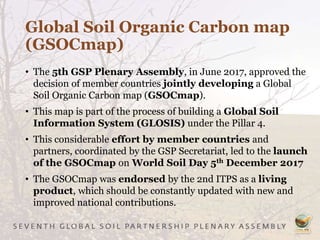
Global Soil Organic Carbon map
(GSOCmap)
• The 5th GSP Plenary Assembly, in June 2017, approved the
decision of member countries jointly developing a Global
Soil Organic Carbon map (GSOCmap).
• This map is part of the process of building a Global Soil
Information System (GLOSIS) under the Pillar 4.
• This considerable effort by member countries and
partners, coordinated by the GSP Secretariat, led to the launch
of the GSOCmap on World Soil Day 5th December 2017
• The GSOCmap was endorsed by the 2nd ITPS as a living
product, which should be constantly updated with new and
improved national contributions.
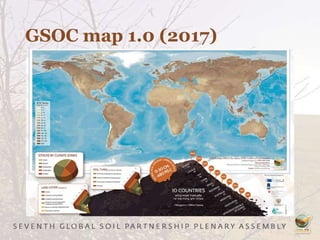
GSOC map 1.0 (2017)
GSOCmap impact
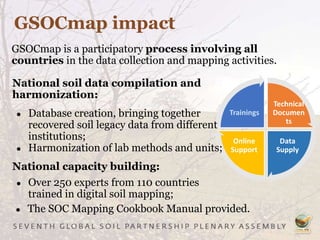
GSOCmap is a participatory process involving all
countries in the data collection and mapping activities.
● The SOC Mapping Cookbook Manual provided.
Technical
Documen
ts
Data
Supply
Online
Support
Trainings
National soil data compilation and
harmonization:
● Database creation, bringing together
recovered soil legacy data from different
institutions;
● Harmonization of lab methods and units;
National capacity building:
● Over 250 experts from 110 countries
trained in digital soil mapping;
GSP capacity development
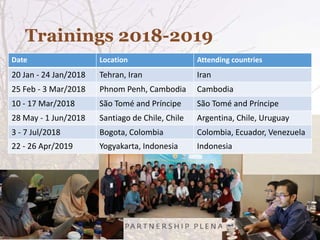
Trainings 2018-2019
Date Location Attending countries
20 Jan - 24 Jan/2018 Tehran, Iran Iran
25 Feb - 3 Mar/2018 Phnom Penh, Cambodia Cambodia
10 - 17 Mar/2018 São Tomé and Príncipe São Tomé and Príncipe
28 May - 1 Jun/2018 Santiago de Chile, Chile Argentina, Chile, Uruguay
3 - 7 Jul/2018 Bogota, Colombia Colombia, Ecuador, Venezuela
22 - 26 Apr/2019 Yogyakarta, Indonesia Indonesia
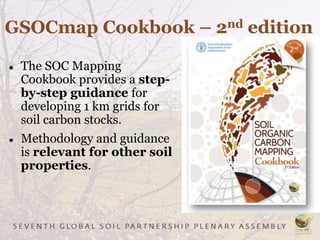
GSOCmap Cookbook – 2nd edition
● The SOC Mapping
Cookbook provides a step-
by-step guidance for
developing 1 km grids for
soil carbon stocks.
● Methodology and guidance
is relevant for other soil
properties.
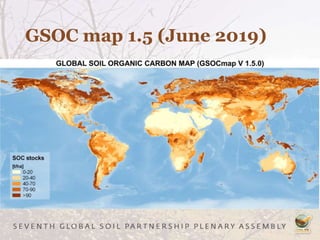
GSOC map 1.5 (June 2019)
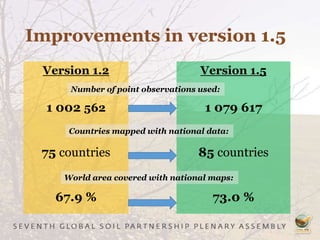
Improvements in version 1.5
Version 1.2
1 002 562
75 countries
67.9 %
Version 1.5
1 079 617
85 countries
73.0 %
Countries mapped with national data:
Number of point observations used:
World area covered with national maps:
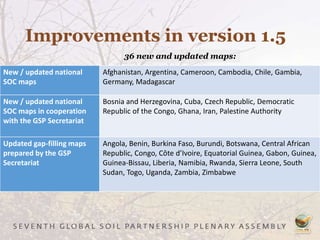
Improvements in version 1.5
New / updated national
SOC maps
Afghanistan, Argentina, Cameroon, Cambodia, Chile, Gambia,
Germany, Madagascar
New / updated national
SOC maps in cooperation
with the GSP Secretariat
Bosnia and Herzegovina, Cuba, Czech Republic, Democratic
Republic of the Congo, Ghana, Iran, Palestine Authority
Updated gap-filling maps
prepared by the GSP
Secretariat
Angola, Benin, Burkina Faso, Burundi, Botswana, Central African
Republic, Congo, Côte d’Ivoire, Equatorial Guinea, Gabon, Guinea,
Guinea-Bissau, Liberia, Namibia, Rwanda, Sierra Leone, South
Sudan, Togo, Uganda, Zambia, Zimbabwe
36 new and updated maps:
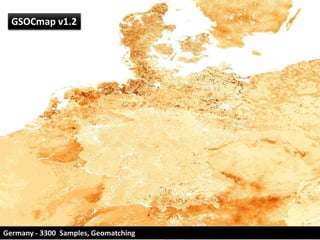
GSOCmap v1.2
Germany - 3300 Samples, Geomatching
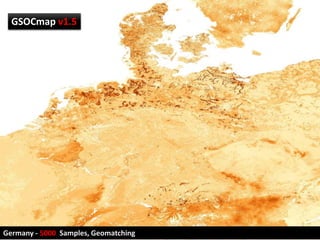
GSOCmap v1.5
Germany - 5000 Samples, Geomatching
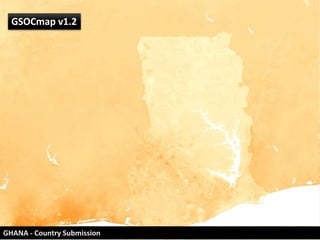
GHANA - Country Submission
GSOCmap v1.2
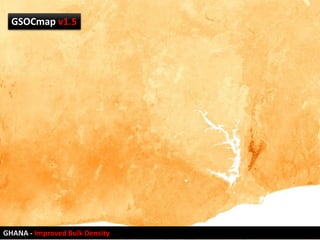
GHANA - Improved Bulk Density
GSOCmap v1.5
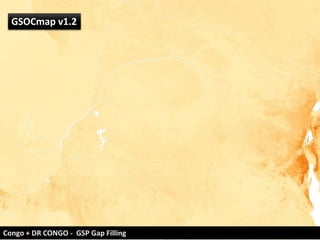
Congo + DR CONGO - GSP Gap Filling
GSOCmap v1.2
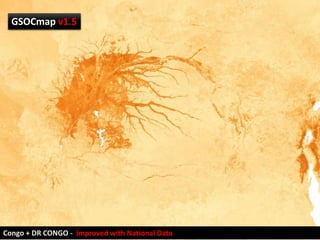
Congo + DR CONGO - Improved with National Data
GSOCmap v1.5
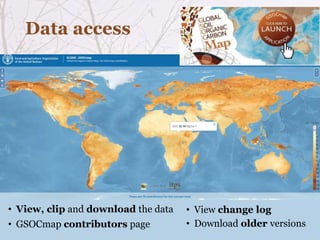
Data access
• View change log
• Download older versions
• View, clip and download the data
• GSOCmap contributors page
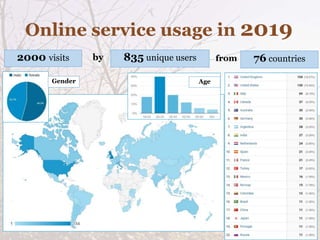
Online service usage in 2019
2000 visits 835 unique usersby 76 countriesfrom
AgeGender
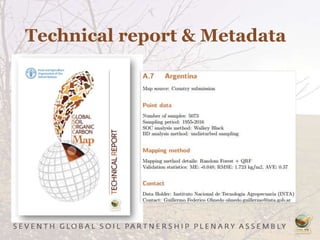
Technical report & Metadata
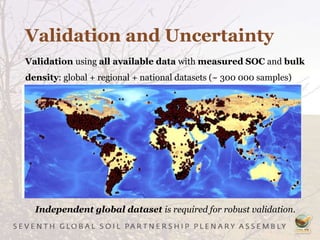
Validation and Uncertainty
Validation using all available data with measured SOC and bulk
density: global + regional + national datasets (~ 300 000 samples)
Independent global dataset is required for robust validation.
Validation and Uncertainty
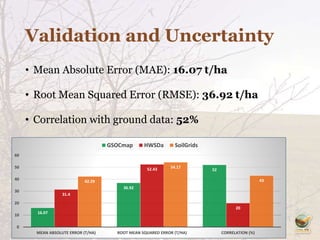
• Mean Absolute Error (MAE): 16.07 t/ha
• Root Mean Squared Error (RMSE): 36.92 t/ha
• Correlation with ground data: 52%
16.07
36.92
52
31.4
52.43
20
42.29
54.17
43
0
10
20
30
40
50
60
MEAN ABSOLUTE ERROR (T/HA) ROOT MEAN SQUARED ERROR (T/HA) CORRELATION (%)
GSOCmap HWSDa SoilGrids
GSOCmap purpose
Provide best available SOC estimation at the
global level, consistent with the national data
GSOCmap is based on over 1 million samples
– 15 times more than any other global estimation
ITPS and GSP Secretariat are working on scientific
peer-reviewed publications
GSOCmap & Climate Change
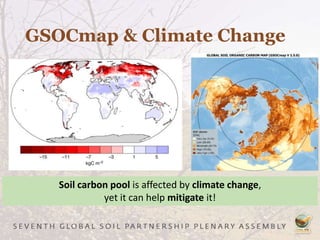
Soil carbon pool is affected by climate change,
yet it can help mitigate it!
GSOCmap & Climate Change
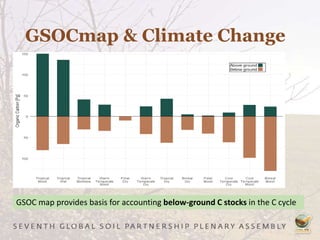
GSOC map provides basis for accounting below-ground C stocks in the C cycle
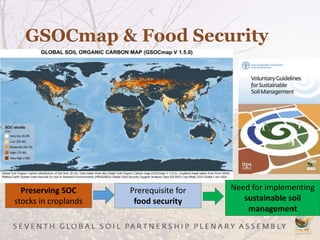
GSOCmap & Food Security
Preserving SOC
stocks in croplands
Prerequisite for
food security
Need for implementing
sustainable soil
management
GSOCmap purpose
Provides countries with the methodology to
assess their SOC stocks for monitoring and
reporting
National maps use all available national data
and local expert knowledge
Validate and use national SOC maps, prepared
for the GSOCmap project
SDG reporting
GSOC map aims at enabling countries to
develop their own SOC stock estimates
for reporting on SDG 15.3.1
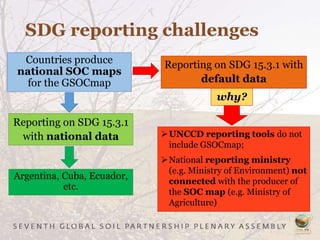
SDG reporting challenges
Countries produce
national SOC maps
for the GSOCmap
Reporting on SDG 15.3.1
with national data
Argentina, Cuba, Ecuador,
etc.
Reporting on SDG 15.3.1 with
default data
UNCCD reporting tools do not
include GSOCmap;
National reporting ministry
(e.g. Ministry of Environment) not
connected with the producer of
the SOC map (e.g. Ministry of
Agriculture)
why?
Actions required
Countries are invited to:
• Contribute to the GSOCmap with national data;
• Update and improve national SOC maps;
• Validate national SOC maps and publish the
results;
• Share national datasets for global validation;
• Use national SOC data for SDG reporting;
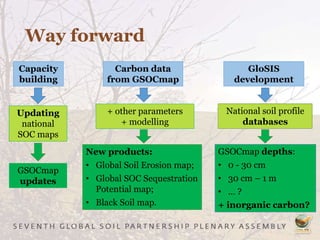
Way forward
Capacity
building
Updating
national
SOC maps
GSOCmap
updates
GloSIS
development
National soil profile
databases
GSOCmap depths:
• 0 - 30 cm
• 30 cm – 1 m
• … ?
+ inorganic carbon?
New products:
• Global Soil Erosion map;
• Global SOC Sequestration
Potential map;
• Black Soil map.
Carbon data
from GSOCmap
+ other parameters
+ modelling
Thank you
for your attention!

Global Soil Organic Carbon map (GSOCmap)

  • 1.
    Global Soil Organic Carbonmap (GSOC map) Kostiantyn Viatkin
  • 2.
    Global Soil OrganicCarbon map (GSOCmap) • The 5th GSP Plenary Assembly, in June 2017, approved the decision of member countries jointly developing a Global Soil Organic Carbon map (GSOCmap). • This map is part of the process of building a Global Soil Information System (GLOSIS) under the Pillar 4. • This considerable effort by member countries and partners, coordinated by the GSP Secretariat, led to the launch of the GSOCmap on World Soil Day 5th December 2017 • The GSOCmap was endorsed by the 2nd ITPS as a living product, which should be constantly updated with new and improved national contributions.
  • 3.
  • 4.
    GSOCmap impact GSOCmap isa participatory process involving all countries in the data collection and mapping activities. ● The SOC Mapping Cookbook Manual provided. Technical Documen ts Data Supply Online Support Trainings National soil data compilation and harmonization: ● Database creation, bringing together recovered soil legacy data from different institutions; ● Harmonization of lab methods and units; National capacity building: ● Over 250 experts from 110 countries trained in digital soil mapping;
  • 5.
  • 6.
    Trainings 2018-2019 Date LocationAttending countries 20 Jan - 24 Jan/2018 Tehran, Iran Iran 25 Feb - 3 Mar/2018 Phnom Penh, Cambodia Cambodia 10 - 17 Mar/2018 São Tomé and Príncipe São Tomé and Príncipe 28 May - 1 Jun/2018 Santiago de Chile, Chile Argentina, Chile, Uruguay 3 - 7 Jul/2018 Bogota, Colombia Colombia, Ecuador, Venezuela 22 - 26 Apr/2019 Yogyakarta, Indonesia Indonesia
  • 7.
    GSOCmap Cookbook –2nd edition ● The SOC Mapping Cookbook provides a step- by-step guidance for developing 1 km grids for soil carbon stocks. ● Methodology and guidance is relevant for other soil properties.
  • 8.
    GSOC map 1.5(June 2019)
  • 9.
    Improvements in version1.5 Version 1.2 1 002 562 75 countries 67.9 % Version 1.5 1 079 617 85 countries 73.0 % Countries mapped with national data: Number of point observations used: World area covered with national maps:
  • 10.
    Improvements in version1.5 New / updated national SOC maps Afghanistan, Argentina, Cameroon, Cambodia, Chile, Gambia, Germany, Madagascar New / updated national SOC maps in cooperation with the GSP Secretariat Bosnia and Herzegovina, Cuba, Czech Republic, Democratic Republic of the Congo, Ghana, Iran, Palestine Authority Updated gap-filling maps prepared by the GSP Secretariat Angola, Benin, Burkina Faso, Burundi, Botswana, Central African Republic, Congo, Côte d’Ivoire, Equatorial Guinea, Gabon, Guinea, Guinea-Bissau, Liberia, Namibia, Rwanda, Sierra Leone, South Sudan, Togo, Uganda, Zambia, Zimbabwe 36 new and updated maps:
  • 11.
    GSOCmap v1.2 Germany -3300 Samples, Geomatching
  • 12.
    GSOCmap v1.5 Germany -5000 Samples, Geomatching
  • 13.
    GHANA - CountrySubmission GSOCmap v1.2
  • 14.
    GHANA - ImprovedBulk Density GSOCmap v1.5
  • 15.
    Congo + DRCONGO - GSP Gap Filling GSOCmap v1.2
  • 16.
    Congo + DRCONGO - Improved with National Data GSOCmap v1.5
  • 17.
    Data access • Viewchange log • Download older versions • View, clip and download the data • GSOCmap contributors page
  • 18.
    Online service usagein 2019 2000 visits 835 unique usersby 76 countriesfrom AgeGender
  • 19.
  • 20.
    Validation and Uncertainty Validationusing all available data with measured SOC and bulk density: global + regional + national datasets (~ 300 000 samples) Independent global dataset is required for robust validation.
  • 21.
    Validation and Uncertainty •Mean Absolute Error (MAE): 16.07 t/ha • Root Mean Squared Error (RMSE): 36.92 t/ha • Correlation with ground data: 52% 16.07 36.92 52 31.4 52.43 20 42.29 54.17 43 0 10 20 30 40 50 60 MEAN ABSOLUTE ERROR (T/HA) ROOT MEAN SQUARED ERROR (T/HA) CORRELATION (%) GSOCmap HWSDa SoilGrids
  • 22.
    GSOCmap purpose Provide bestavailable SOC estimation at the global level, consistent with the national data GSOCmap is based on over 1 million samples – 15 times more than any other global estimation ITPS and GSP Secretariat are working on scientific peer-reviewed publications
  • 23.
    GSOCmap & ClimateChange Soil carbon pool is affected by climate change, yet it can help mitigate it!
  • 24.
    GSOCmap & ClimateChange GSOC map provides basis for accounting below-ground C stocks in the C cycle
  • 25.
    GSOCmap & FoodSecurity Preserving SOC stocks in croplands Prerequisite for food security Need for implementing sustainable soil management
  • 26.
    GSOCmap purpose Provides countrieswith the methodology to assess their SOC stocks for monitoring and reporting National maps use all available national data and local expert knowledge Validate and use national SOC maps, prepared for the GSOCmap project
  • 27.
    SDG reporting GSOC mapaims at enabling countries to develop their own SOC stock estimates for reporting on SDG 15.3.1
  • 28.
    SDG reporting challenges Countriesproduce national SOC maps for the GSOCmap Reporting on SDG 15.3.1 with national data Argentina, Cuba, Ecuador, etc. Reporting on SDG 15.3.1 with default data UNCCD reporting tools do not include GSOCmap; National reporting ministry (e.g. Ministry of Environment) not connected with the producer of the SOC map (e.g. Ministry of Agriculture) why?
  • 29.
    Actions required Countries areinvited to: • Contribute to the GSOCmap with national data; • Update and improve national SOC maps; • Validate national SOC maps and publish the results; • Share national datasets for global validation; • Use national SOC data for SDG reporting;
  • 30.
    Way forward Capacity building Updating national SOC maps GSOCmap updates GloSIS development Nationalsoil profile databases GSOCmap depths: • 0 - 30 cm • 30 cm – 1 m • … ? + inorganic carbon? New products: • Global Soil Erosion map; • Global SOC Sequestration Potential map; • Black Soil map. Carbon data from GSOCmap + other parameters + modelling
  • 31.