Background
 US Army
  Russian Cryptography Interceptor
  ○ 1984 to 1987
  Mandarin Chinese Intelligence Officer
  ○ 1989 to 2001
Sept 11, 2001
World Trade Centers
“Working in security is doing God’s work as
 far as I am concerned. Security work is an
 opportunity to serve fellow man…There is
      nothing greater than saving lives.”

                                                    Dr. Ona Ekhomu, CPP
                            Security Management Magazine, March 2007
                     First Nigerian ASIS Certified Protection Professional
Background
 Antiterrorism/Force    Protection
   2001 – US Corps of Engineers
   2002 – Operation Enduring Freedom
   2003 – Operation Iraqi Freedom
   2004 – Security Management Solutions
    ○ Federal Energy Regulatory Commission
    ○ Association of State Dam Safety Officials
    ○ InterAgency Forum for Infrastructure
      Protection
Post 9/11
A Paradigm Shift
Threat Dimensions
  1. Non-linear/Asymmetrical
  2. Off-the-shelf technology
  3. WMD and mass casualties
       Low Tech vs. High Tech
       Urban vs. Rural fights
  4. Urban fights
  5. Avoid decisive battle


                                W. Foos, SMS
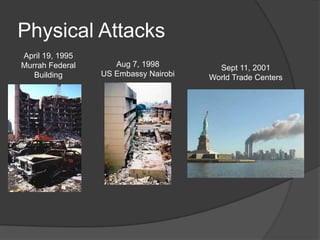
Physical Attacks
April 19, 1995
Murrah Federal      Aug 7, 1998         Sept 11, 2001
   Building      US Embassy Nairobi   World Trade Centers
Physical Attacks
    11 March 2004            Sept 2004
 Madrid Train Bombings:   Chechnya Rebels
         Spain
Cyber Attacks
 2003-2007 - TITAN RAIN
 2006-present - SHADY RAT
 2008- DOD Classified and Unclassified
  Systems-Contaminated thumb drive
 2010 - STUXNET
 2011 - 50 DAYS OF LULZ
Cyber Attacks 2012
 13.37 million recorded compromised
 189 total breaches


 NY Electric and Gas 1.8m
 Global Payments 1.5m
 CA Dept. of Child Support 800k
 Utah Dept. of Technical Services 780k
W. Foos, SMS
Why is a Security Program so
vital?
How does a Security Program Work?
      A Security Program protects assets or
      facilities against:

 1. Theft
 2. Sabotage
 3. Malevolent human attacks
 4. Natural Events
What does a Security Program
Encompass?

 1.   Physical Security
 2.   Cyber Security
 3.   Personnel Security
 4.   Information Security
 5.   Business Continuity
 6.   Crisis Management
Three Components of a
 Education                     Security Program
 1.    R&D                                                              Remediation
 2.    SOPs                                                             1.      Upgrading PPS
 3.    Emergency Response Plan                                          2.      Upgrading Security Program
 4.    Physical Security Plans                    Education             3.      Responding to Incidents
 5.    Define, Establish, & Update                                      4.      Implementing Risk Reduction
       HLS security procedures                                                  Recommendations
 6.    Guard Contracts


                                     Prevention
Prevention                                                        Remediation
1.    Maintenance of Systems
2.    Assessment – Evaluations
3.    SOP Development
4.    Integration of Security
                                          Security Documents:
      Operations
5.    Training & Exercise of
      EAPs                                -Threat Assessments

6.    Implementation of                   - Vulnerability Study
      Heightened Security
      Procedures
                                                                                          W. Foos, SMS
Fundamentals of Security
 Integration
                 Policies


                 People
    Procedures              Equipment


An Effective
Security Program
ties it all together.
Security Program Measures

1.   Preventative measures – Reduce the likelihood
     of an attack, delay the success of the attack, protect
     the assets or make it less vulnerable of being
     compromised.
2.   Detective measures – Discover the attack and
     activate corrective or mitigative action.
3.   Corrective measures – Reduce the effects of an
     attack and restore to normal operations.


                                                     W. Foos, SMS
What are The Steps
Necessary?

      1.   Evaluate

      2.   Establish

      3.   Sustain
Step One: Evaluation

  1.   Mission
  2.   Assets
  3.   Consequences
  4.   Threats
  5.   Security System Effectiveness
Step One: Evaluation
(Mission)
  1. What do I buy?
  2. What do I sell?
  3. How do I produce it?
  4. What components do I need to make
     what I make?
  5. What does it take to get those
     components and deliver the finished
     product?
How Missions lead to Assets
   Company Mission
   Company Vision
   License Requirements
   Shareholder Mandates
   Products of the facility
   Vendors
   Inventory System
   Shipping and Receiving
   Operational involvement & location of
    senior executives


                                            W. Foos, SMS
Step One: Evaluation
(Assets)
1.   Physical
2.   People
3.   Knowledge
4.   Information Technology
5.   Clientele
6.   Any activity that has a
     positive value to its owner
Step One: Evaluation
(Consequences)
  What would it take to disrupt
   operations?
  What would it take to stop operations?
  What would happen to the vendors, your
   company, your customers, if operations
   paused or ceased?
  Who and What would be impacted?
Step One: Evaluation (Threat)

       The Security Program Arch

               THREAT
Step One: Evaluation (Threat)

    Natural

    Intentional

    Unintentional
W. Foos, SMS
Threat Categories
 Terrorists
         (CONUS               Saboteurs
  or OCONUS)                  Criminals
   Ecological                Cyber  Threat
   Militia / Paramilitary    Gangs
   Rogue
                              Other
   Racist
                              Insider(s)
 Extremist    Group
 Vandals

                                                 TM
                                               RAM
Identifying
the Design Basis Threat
       Motivation
       Capability
       History and Behavior
        Patterns
       Current Activity
       Geographic Access
       Organization & Numbers
       Mobility
       Technology/ Tactics
                                   TM
                                 RAM
Design Basis Threat
(Example)
Adversary Type            Militia/Paramilitary Terrorist Group
Motivation                Ideological/Political/Publicity
Group                     Terrorist Cell - 2 to 7 persons – well organized
Tactics                   Large scale sabotage
Equipment                 Hand tools, construction equipment, 2-way radios
Weapons                   Small handguns, rifles, submachine guns
Explosives                Vegan Jell-O, TNT or Equivalent Explosives
Transportation            Sport utility vehicles, all-terrain vehicles, vans, 4x4s, foot
                          access
Intelligence              Surveillance, Internet research, public record review
gathering means
Technical skills and      Sophisticated technical education
knowledge
Financial resources       Assumed unlimited
Potential for collusion   Disgruntled or planted employee or contractor

                                                                                           TM
                                                                                  RAM
Intelligence Methods used by
Adversaries
                   Open Source Research
                   FOIA
                   Internet
                   Public Domain Technical
                    Reports
                   People
                   Informers
                   Intelligence Agents
                   Communications
                   Photographs / Surveillance
                   Trash


                                       W. Foos, SMS
Step One: Evaluation (Security
System Effectiveness)
  Based on analysis of Asset and Threats,
   create Asset-Threat Pairing

  Not every Asset is considered attractive to
   the same Threat

  Every asset’s protection must be evaluated
   against its own Design Basis Threat
Basics of Security
1.   Detect
2.   Assess
3.   Delay
4.   Respond
5.   Integration and Communication
Fundamentals of Security
Protection in Depth & Balanced
           Protection
                        Outer Perimeter

            Intermediate Perimeter

               Inner Perimeter

            Exclusion Zone
                 O
                Asset
What are The Steps
Necessary?
      1.   Evaluate


      2.   Establish

      3.   Sustain
Step Two: Establish

  1.   Fill in the gaps
  2.   Create what wasn’t there
  3.   Accept versus Reject
       Risk
  4.   Risk Reduction
       Measures
Three Components of a
 Education                     Security Program
 1.    R&D                                                              Remediation
 2.    SOPs                                                             1.      Upgrading PPS
 3.    Emergency Response Plan                                          2.      Upgrading Security Program
 4.    Physical Security Plans                    Education             3.      Responding to Incidents
 5.    Define, Establish, & Update                                      4.      Implementing Risk Reduction
       HLS security procedures                                                  Recommendations
 6.    Guard Contracts


                                     Prevention
Prevention                                                        Remediation
1.    Maintenance of Systems
2.    Assessment – Evaluations
3.    SOP Development
4.    Integration of Security
                                          Security Documents:
      Operations
5.    Training & Exercise of
      EAPs                                -Threat Assessments

6.    Implementation of                   - Vulnerability Study
      Heightened Security
      Procedures
                                                                                          W. Foos, SMS
Security Policies and
Procedures
    Establish strategic security objectives and priorities
     for organization

    Identify personnel responsible for security functions

    Identify the employee responsibilities
    Should be aligned with the objectives of the
     organization
    Should cover the following topics

     - People           - Property       - Information
What are The Steps
Necessary?
      1.   Evaluate

      2.   Establish


      3. Sustain
Step Three: Sustain

  1.   Education
  2.   Exercises
  3.   Relationships
  4.   Reevaluation
Keys to a More Successful Physical Security Program

Keys to a More Successful Physical Security Program

  • 2.
    Background  US Army  Russian Cryptography Interceptor ○ 1984 to 1987  Mandarin Chinese Intelligence Officer ○ 1989 to 2001
  • 3.
    Sept 11, 2001 WorldTrade Centers
  • 4.
    “Working in securityis doing God’s work as far as I am concerned. Security work is an opportunity to serve fellow man…There is nothing greater than saving lives.” Dr. Ona Ekhomu, CPP Security Management Magazine, March 2007 First Nigerian ASIS Certified Protection Professional
  • 5.
    Background  Antiterrorism/Force Protection  2001 – US Corps of Engineers  2002 – Operation Enduring Freedom  2003 – Operation Iraqi Freedom  2004 – Security Management Solutions ○ Federal Energy Regulatory Commission ○ Association of State Dam Safety Officials ○ InterAgency Forum for Infrastructure Protection
  • 6.
  • 7.
  • 8.
    Threat Dimensions 1. Non-linear/Asymmetrical 2. Off-the-shelf technology 3. WMD and mass casualties Low Tech vs. High Tech Urban vs. Rural fights 4. Urban fights 5. Avoid decisive battle W. Foos, SMS
  • 9.
    Physical Attacks April 19,1995 Murrah Federal Aug 7, 1998 Sept 11, 2001 Building US Embassy Nairobi World Trade Centers
  • 10.
    Physical Attacks 11 March 2004 Sept 2004 Madrid Train Bombings: Chechnya Rebels Spain
  • 11.
    Cyber Attacks  2003-2007- TITAN RAIN  2006-present - SHADY RAT  2008- DOD Classified and Unclassified Systems-Contaminated thumb drive  2010 - STUXNET  2011 - 50 DAYS OF LULZ
  • 12.
    Cyber Attacks 2012 13.37 million recorded compromised  189 total breaches  NY Electric and Gas 1.8m  Global Payments 1.5m  CA Dept. of Child Support 800k  Utah Dept. of Technical Services 780k
  • 13.
  • 15.
    Why is aSecurity Program so vital?
  • 16.
    How does aSecurity Program Work? A Security Program protects assets or facilities against: 1. Theft 2. Sabotage 3. Malevolent human attacks 4. Natural Events
  • 17.
    What does aSecurity Program Encompass? 1. Physical Security 2. Cyber Security 3. Personnel Security 4. Information Security 5. Business Continuity 6. Crisis Management
  • 18.
    Three Components ofa Education Security Program 1. R&D Remediation 2. SOPs 1. Upgrading PPS 3. Emergency Response Plan 2. Upgrading Security Program 4. Physical Security Plans Education 3. Responding to Incidents 5. Define, Establish, & Update 4. Implementing Risk Reduction HLS security procedures Recommendations 6. Guard Contracts Prevention Prevention Remediation 1. Maintenance of Systems 2. Assessment – Evaluations 3. SOP Development 4. Integration of Security Security Documents: Operations 5. Training & Exercise of EAPs -Threat Assessments 6. Implementation of - Vulnerability Study Heightened Security Procedures W. Foos, SMS
  • 19.
    Fundamentals of Security Integration Policies People Procedures Equipment An Effective Security Program ties it all together.
  • 20.
    Security Program Measures 1. Preventative measures – Reduce the likelihood of an attack, delay the success of the attack, protect the assets or make it less vulnerable of being compromised. 2. Detective measures – Discover the attack and activate corrective or mitigative action. 3. Corrective measures – Reduce the effects of an attack and restore to normal operations. W. Foos, SMS
  • 21.
    What are TheSteps Necessary? 1. Evaluate 2. Establish 3. Sustain
  • 22.
    Step One: Evaluation 1. Mission 2. Assets 3. Consequences 4. Threats 5. Security System Effectiveness
  • 23.
    Step One: Evaluation (Mission) 1. What do I buy? 2. What do I sell? 3. How do I produce it? 4. What components do I need to make what I make? 5. What does it take to get those components and deliver the finished product?
  • 24.
    How Missions leadto Assets  Company Mission  Company Vision  License Requirements  Shareholder Mandates  Products of the facility  Vendors  Inventory System  Shipping and Receiving  Operational involvement & location of senior executives W. Foos, SMS
  • 25.
    Step One: Evaluation (Assets) 1. Physical 2. People 3. Knowledge 4. Information Technology 5. Clientele 6. Any activity that has a positive value to its owner
  • 26.
    Step One: Evaluation (Consequences)  What would it take to disrupt operations?  What would it take to stop operations?  What would happen to the vendors, your company, your customers, if operations paused or ceased?  Who and What would be impacted?
  • 27.
    Step One: Evaluation(Threat) The Security Program Arch THREAT
  • 28.
    Step One: Evaluation(Threat)  Natural  Intentional  Unintentional
  • 29.
  • 30.
    Threat Categories  Terrorists (CONUS  Saboteurs or OCONUS)  Criminals  Ecological  Cyber Threat  Militia / Paramilitary  Gangs  Rogue  Other  Racist  Insider(s)  Extremist Group  Vandals TM RAM
  • 32.
    Identifying the Design BasisThreat  Motivation  Capability  History and Behavior Patterns  Current Activity  Geographic Access  Organization & Numbers  Mobility  Technology/ Tactics TM RAM
  • 33.
    Design Basis Threat (Example) AdversaryType Militia/Paramilitary Terrorist Group Motivation Ideological/Political/Publicity Group Terrorist Cell - 2 to 7 persons – well organized Tactics Large scale sabotage Equipment Hand tools, construction equipment, 2-way radios Weapons Small handguns, rifles, submachine guns Explosives Vegan Jell-O, TNT or Equivalent Explosives Transportation Sport utility vehicles, all-terrain vehicles, vans, 4x4s, foot access Intelligence Surveillance, Internet research, public record review gathering means Technical skills and Sophisticated technical education knowledge Financial resources Assumed unlimited Potential for collusion Disgruntled or planted employee or contractor TM RAM
  • 34.
    Intelligence Methods usedby Adversaries  Open Source Research  FOIA  Internet  Public Domain Technical Reports  People  Informers  Intelligence Agents  Communications  Photographs / Surveillance  Trash W. Foos, SMS
  • 35.
    Step One: Evaluation(Security System Effectiveness)  Based on analysis of Asset and Threats, create Asset-Threat Pairing  Not every Asset is considered attractive to the same Threat  Every asset’s protection must be evaluated against its own Design Basis Threat
  • 36.
    Basics of Security 1. Detect 2. Assess 3. Delay 4. Respond 5. Integration and Communication
  • 37.
    Fundamentals of Security Protectionin Depth & Balanced Protection Outer Perimeter Intermediate Perimeter Inner Perimeter Exclusion Zone O Asset
  • 38.
    What are TheSteps Necessary? 1. Evaluate 2. Establish 3. Sustain
  • 39.
    Step Two: Establish 1. Fill in the gaps 2. Create what wasn’t there 3. Accept versus Reject Risk 4. Risk Reduction Measures
  • 40.
    Three Components ofa Education Security Program 1. R&D Remediation 2. SOPs 1. Upgrading PPS 3. Emergency Response Plan 2. Upgrading Security Program 4. Physical Security Plans Education 3. Responding to Incidents 5. Define, Establish, & Update 4. Implementing Risk Reduction HLS security procedures Recommendations 6. Guard Contracts Prevention Prevention Remediation 1. Maintenance of Systems 2. Assessment – Evaluations 3. SOP Development 4. Integration of Security Security Documents: Operations 5. Training & Exercise of EAPs -Threat Assessments 6. Implementation of - Vulnerability Study Heightened Security Procedures W. Foos, SMS
  • 41.
    Security Policies and Procedures  Establish strategic security objectives and priorities for organization  Identify personnel responsible for security functions  Identify the employee responsibilities  Should be aligned with the objectives of the organization  Should cover the following topics - People - Property - Information
  • 42.
    What are TheSteps Necessary? 1. Evaluate 2. Establish 3. Sustain
  • 43.
    Step Three: Sustain 1. Education 2. Exercises 3. Relationships 4. Reevaluation

Editor's Notes

  • #7 L to Right:Dvorshak Dam, Mica Dam, Bonneville Dam
  • #8 How we look at security has changed. How we look at security MUST change. Sometimes it is a conscious effort, sometimes it is a natural shift.
  • #12 TITAN RAINYears: 2003-2007Alleged source: ChinaFallout: In 2004, U.S. federal investigators discovered an ongoing series of attacks penetrating the networks of the departments of Defense, State, Energy, and Homeland Security, as well as those of defense contractors, and downloading terabytes of data. SHADY RATYears: 2006-presentTarget: DozensAlleged source: ChinaFallout: In 2011, McAfee reported the existence of a five-year-old hacking campaign it calls Shady RAT. It works by sending an email to an employee of a targeted organization, who then installs a “Trojan horse” on the computer after clicking an innocuous-looking attachment. The 49 victims include the International Olympic Committee, the United Nations, the Association of Southeast Asian Nations, companies in Japan, Switzerland, Britain, Indonesia, Denmark, Singapore, Hong Kong, Germany, and India, and the governments of United States, Taiwan, South Korea, Vietnam, and Canada. It has been called the biggest cyberattack of all time.STUXNETYear: 2010Alleged source: IsraelFallout: Discovered in June 2010, the Stuxnet worm exploits a vulnerability in Windows to attack Siemens industrial systems, such as those used in nuclear power plants. While systems in several countries, including the United States, were affected, Iran was the worst hit, with over 16,000 computers infected. 50 DAYS OF LULZYear: 2011Alleged source: LulzSecFallout: In the spring and summer of 2011, a group of hackers calling itself LulzSec, associated with the online collective Anonymous, went on a tear, disabling and defacing a series of prominent websites. The group also took down CIA.gov at one point. In its biggest operation, Lulzsec hacked into Sony PlayStation’s website, compromising the personal information of more than a million users.
  • #16 Greeks built a Horse that the Trojans brought into Troy.A 10 year war..the Trojans were very confident…………………..We can become very comfortable with how we manage securityThe Horse was an emblem of Troy…………………………………….The adversary or threat will often mimic or look familiar to usThe Trojans brought the Horse into the city………………………..Our employees are often the carriers for the adversary
  • #18 There is a number of ways to look at the architecture of a Security Program. A security program is ideally a composite of many specific components. In this example, there are both proactive and reactive components.
  • #21 As a security professional, what do you look for when you assess the quality and quantity of a security program? It should be composed of the following measures.
  • #23 The key to a successful evaluation is a comprehensive, methodical and sequential process. Do not ever assume something. As I learned early in my military career.
  • #24 The very beginning of ANY Risk or Vulnerability Assessment should be to clearly understand the organization’s mission. Unless you understand what the organization makes, sells, brokers, etc. you will not have a starting point for identifying what or who is critical to those acts of making, selling, transporting, brokering, etc.
  • #28 This is an obviously homemade graphic that represents the significance of Threat to all other aspects of Security. In the same way that a keystone holds an arch together, our knowledge of the relevant threat holds our Security Program together. Without that knowledge, the Program, like an arch with the keystone removed, collapse.
  • #38 This can represent a physical security perimeter or it can represent a cyber security perimeter. The theory of layered protection and analysis is the same.
  • #40 We have just completely and with much exhaustion, analyzed our security program and system against the paired threat and have established where the gaps and deficiencies are, if any.Step Two begins with the building up of the existing system based on our findings during Step One: Evaluation.A critical part of establishing a viable security program is obtaining management’s decision on what level of risk they are willing to accept and which they are not.The risk they do NOT want to accept is what we take away and then return with measures designed to reduce that risk. To the chagrin of many security professionals, many decision makers base their accept versus reject decisions based on cost versus benefit versus impact.
  • #42 There are certain key points to keep in mind when an organization sets up and institutes security policies and procedures.Always have an objective or mission in mind when drafting SOPsAlways have a single Point of Contact. SomeBODY needs to be held responsible, not a department or branch or division.Ensure the SOPs cover the full spectrum of operations.
  • #44 Once the program has been evaluated, the gaps and deficiencies filled in and flushed out, the last step is Sustaining the program. The best SOP is only as good and valid and pertinent as it is in date. The best SOP is only as good as it is known and understood by the employeesThe best access control system or alarm system is only as good as the personnel responsible for its operation.Get out there and build relationships with the community, Law Enforcement and task ForcesAnd last, Step three is really NOT the last step. Part of effective sustainment is constant reevaluation. Establish a program to regularly and periodically reassess your organization from Mission to Threat to Sustainment. Keep the program dynamic. Keep the people interested, educated and engaged!