



Using Everyday
Technology to Create
Group Projects
Heba Bakry – Cairo University
Wednesday, 23rd January, 2019
Room CP19 (SSE) – 11 AM
NILETESOL 23 ANNUAL CONFERENCE
American University in Cairo – New Campus
Group Work
• Roman rhetorician Marcus Fabius Quintilian (ca.
35–100) contended that learners derive benefit
from instructing one another.
• Roman philosopher, Seneca (3 BC–65 AD),
promoted a similar practice in the phrase qui docet
discit, meaning ‘He who teaches learns.’
Heba Bakry – Nile TESOL Jan 2019
“
Cooperative group work refers to
individual learners working
together to accomplish individual
objectives, whilst collaborative
group work involves learners
undertaking a shared task with the
aim of fulfilling a shared objective
(Antil et al.1998)
Heba Bakry – Nile TESOL Jan 2019
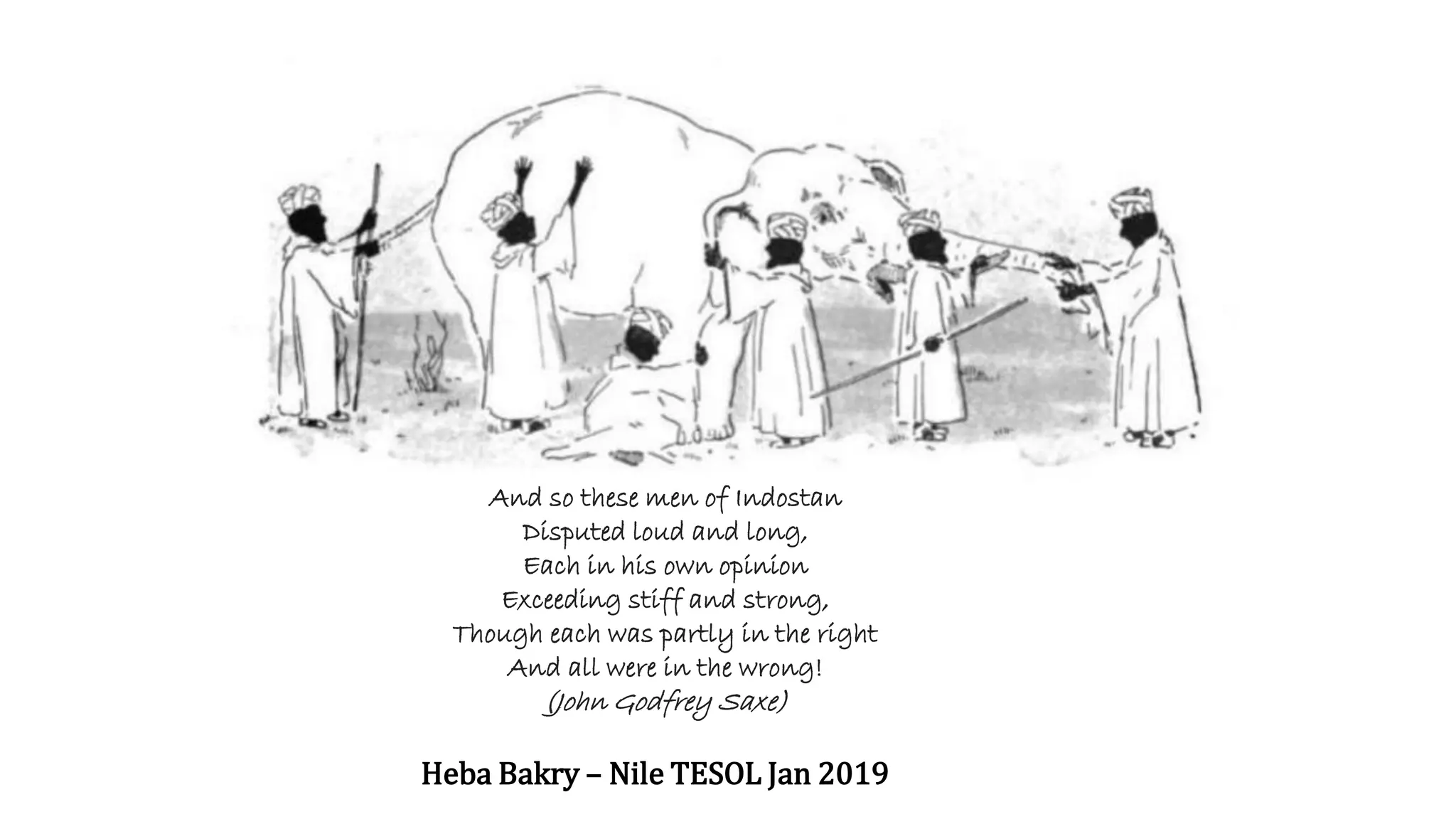
And so these men of Indostan
Disputed loud and long,
Each in his own opinion
Exceeding stiff and strong,
Though each was partly in the right
And all were in the wrong!
(John Godfrey Saxe)
Heba Bakry – Nile TESOL Jan 2019
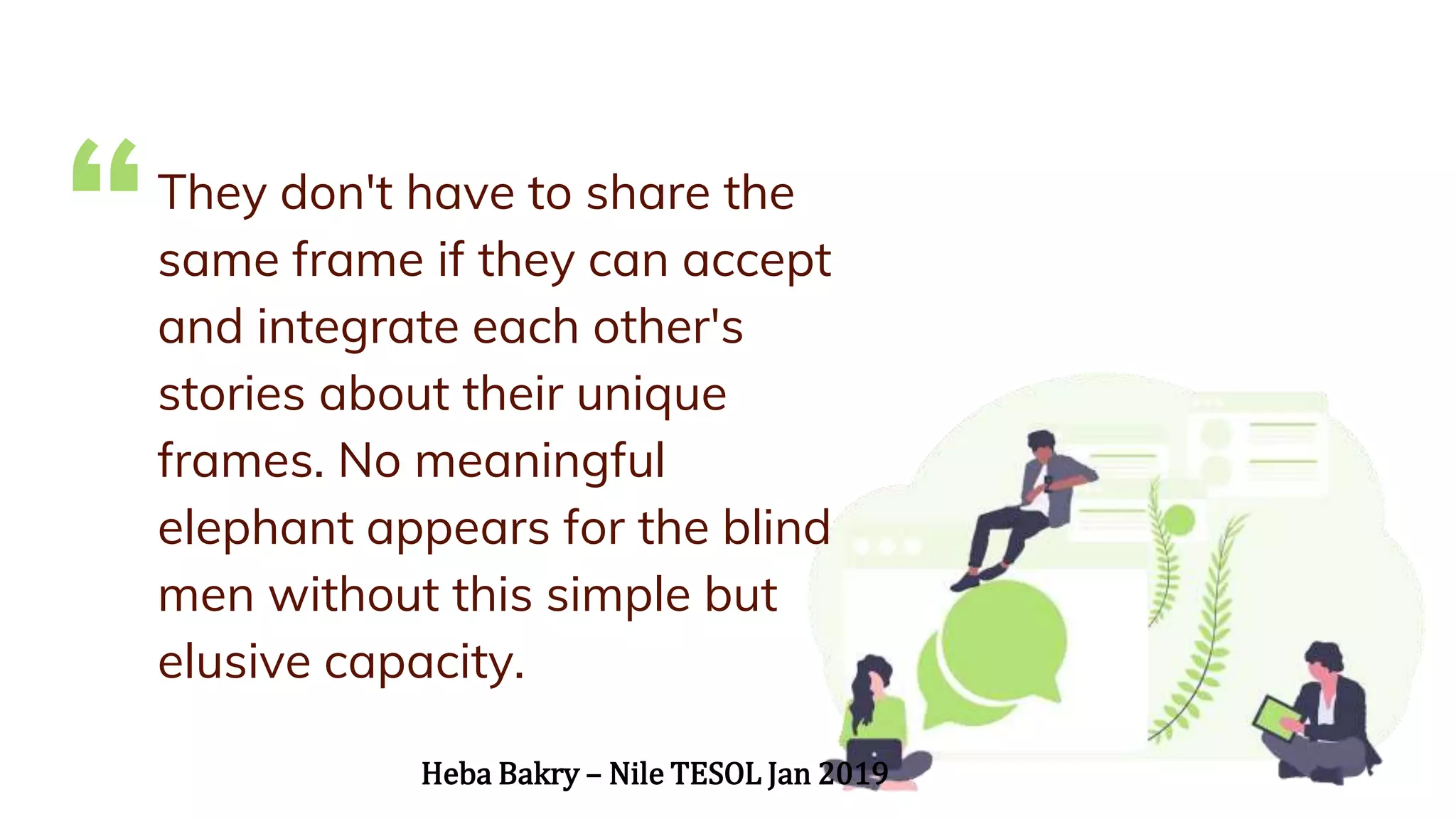
“They don't have to share the
same frame if they can accept
and integrate each other's
stories about their unique
frames. No meaningful
elephant appears for the blind
men without this simple but
elusive capacity.
Heba Bakry – Nile TESOL Jan 2019
“
Some of the most popular project manager frames hold
project managers to be :
Fathers, where they coach and punish
Mothers, where they nurture and instruct
Magicians, where they pull rabbits out of hats
Zookeepers, where they keep the wild animals well fed in cages
Priests, where they exhort and forgive
Comedians, where they entertain
Teachers, where they instruct and grade
Lobbyists, where they influence the support of the powerful
Sheep, where they follow others' orders
Wolves, where they take advantage of sheep to do
Heba Bakry – Nile TESOL Jan 2019
Sink or Swim?
Heba Bakry – Nile TESOL Jan 2019
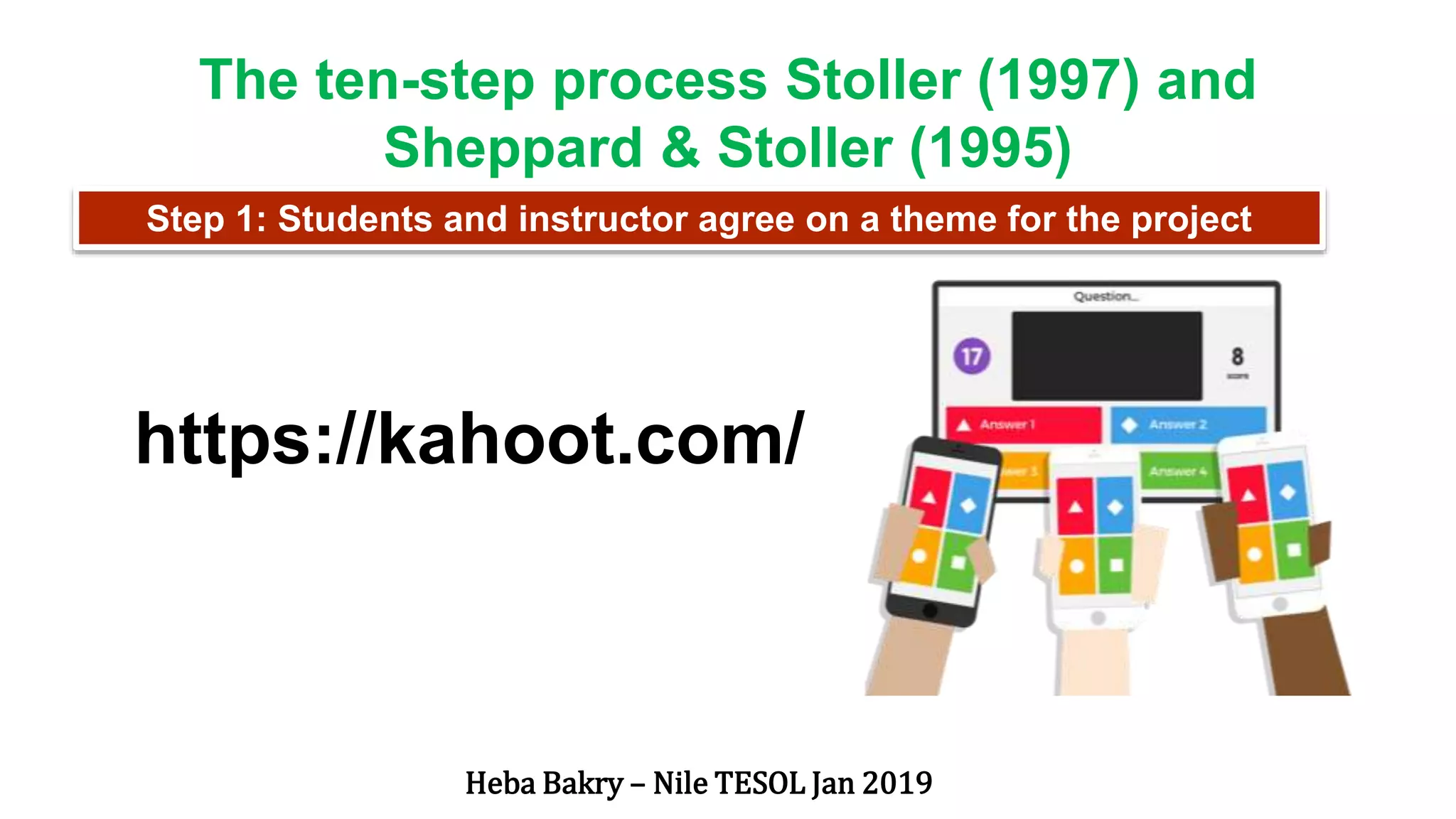
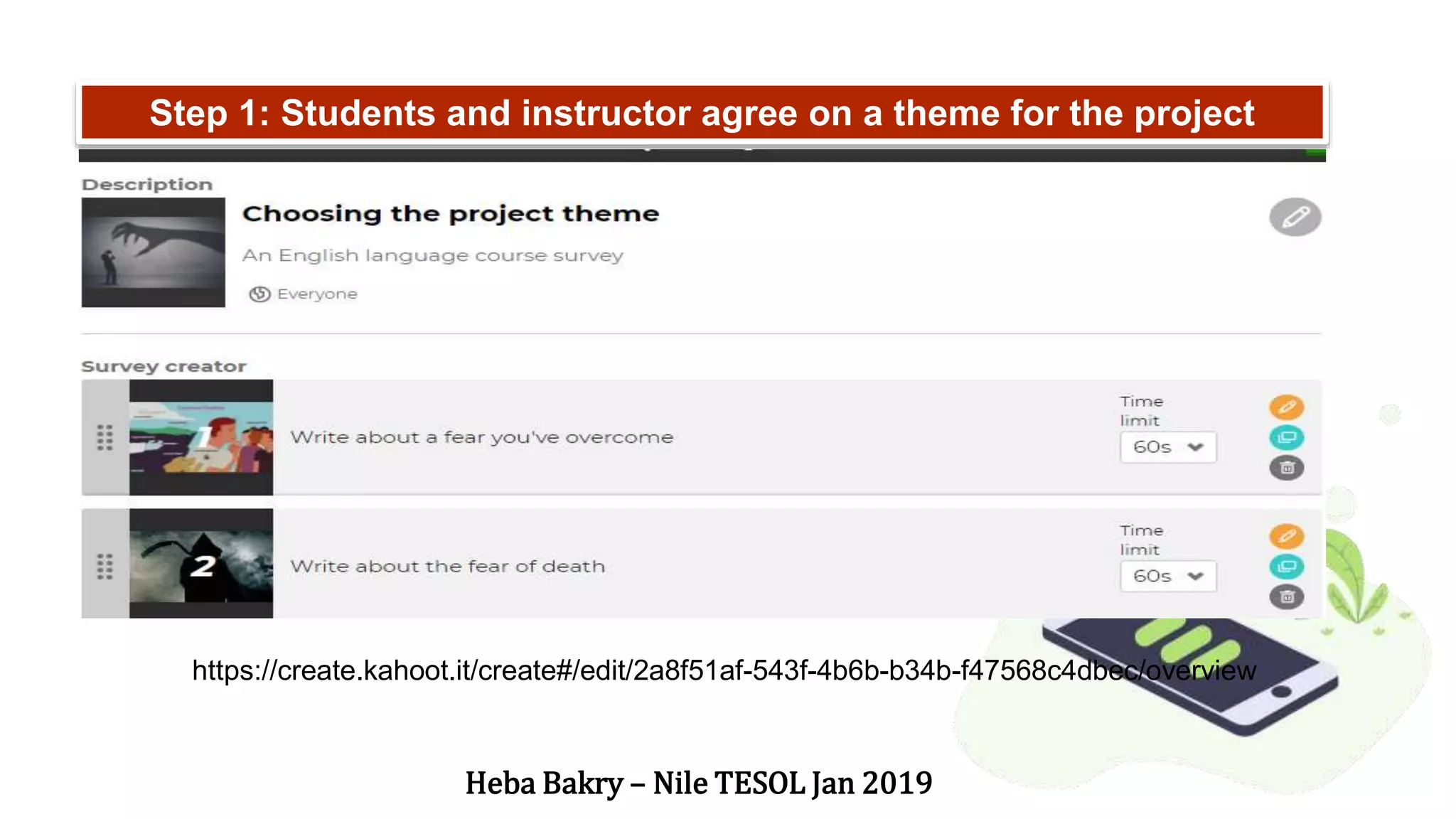
Step 1: Students and instructor agree on a theme for the project
The ten-step process Stoller (1997) and
Sheppard & Stoller (1995)
Heba Bakry – Nile TESOL Jan 2019
https://kahoot.com/
Step 1: Students and instructor agree on a theme for the project
https://create.kahoot.it/create#/edit/2a8f51af-543f-4b6b-b34b-f47568c4dbec/overview
Heba Bakry – Nile TESOL Jan 2019
“
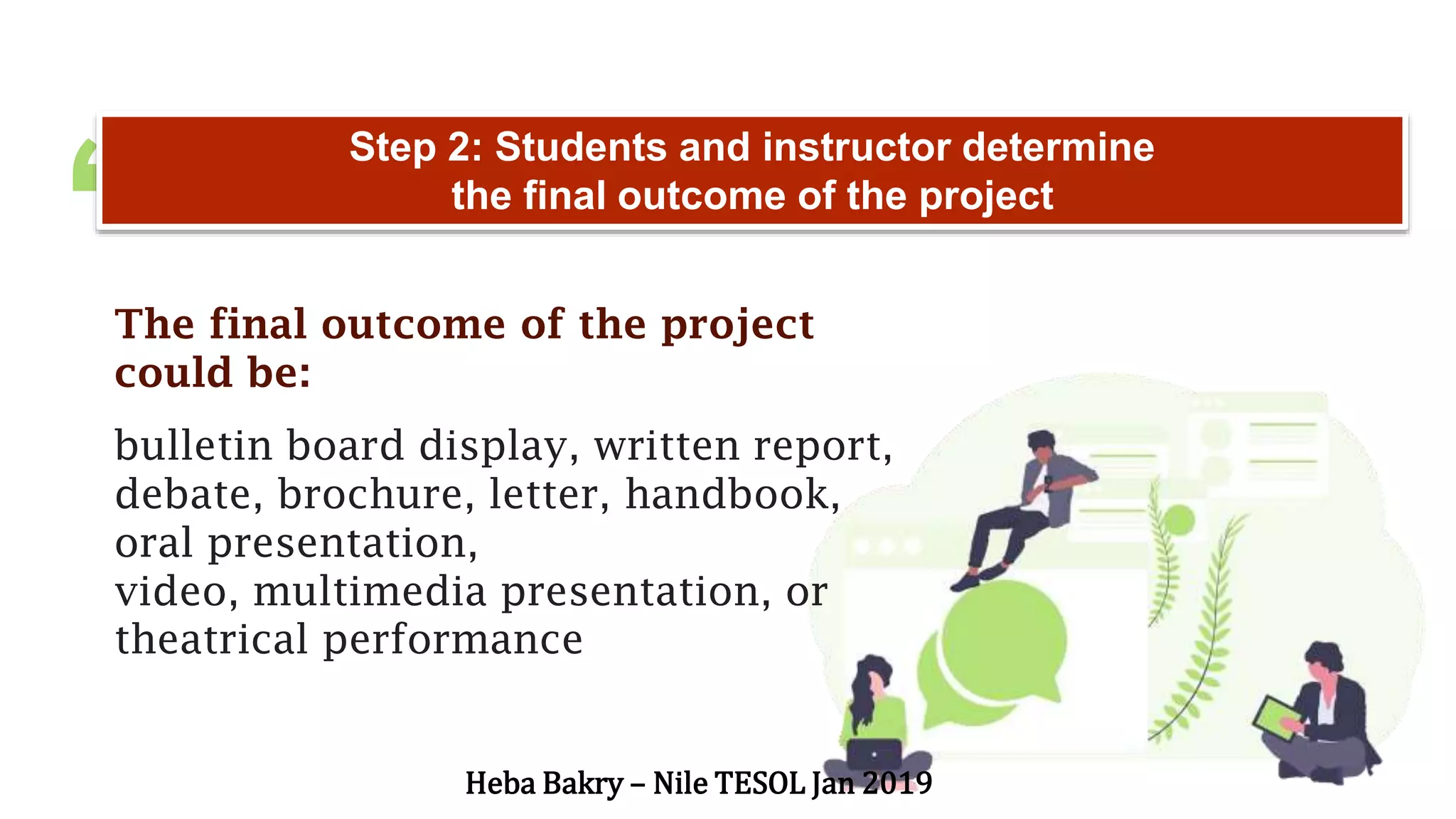
Step 2: Students and instructor determine
the final outcome of the project
The final outcome of the project
could be:
bulletin board display, written report,
debate, brochure, letter, handbook,
oral presentation,
video, multimedia presentation, or
theatrical performance
Heba Bakry – Nile TESOL Jan 2019
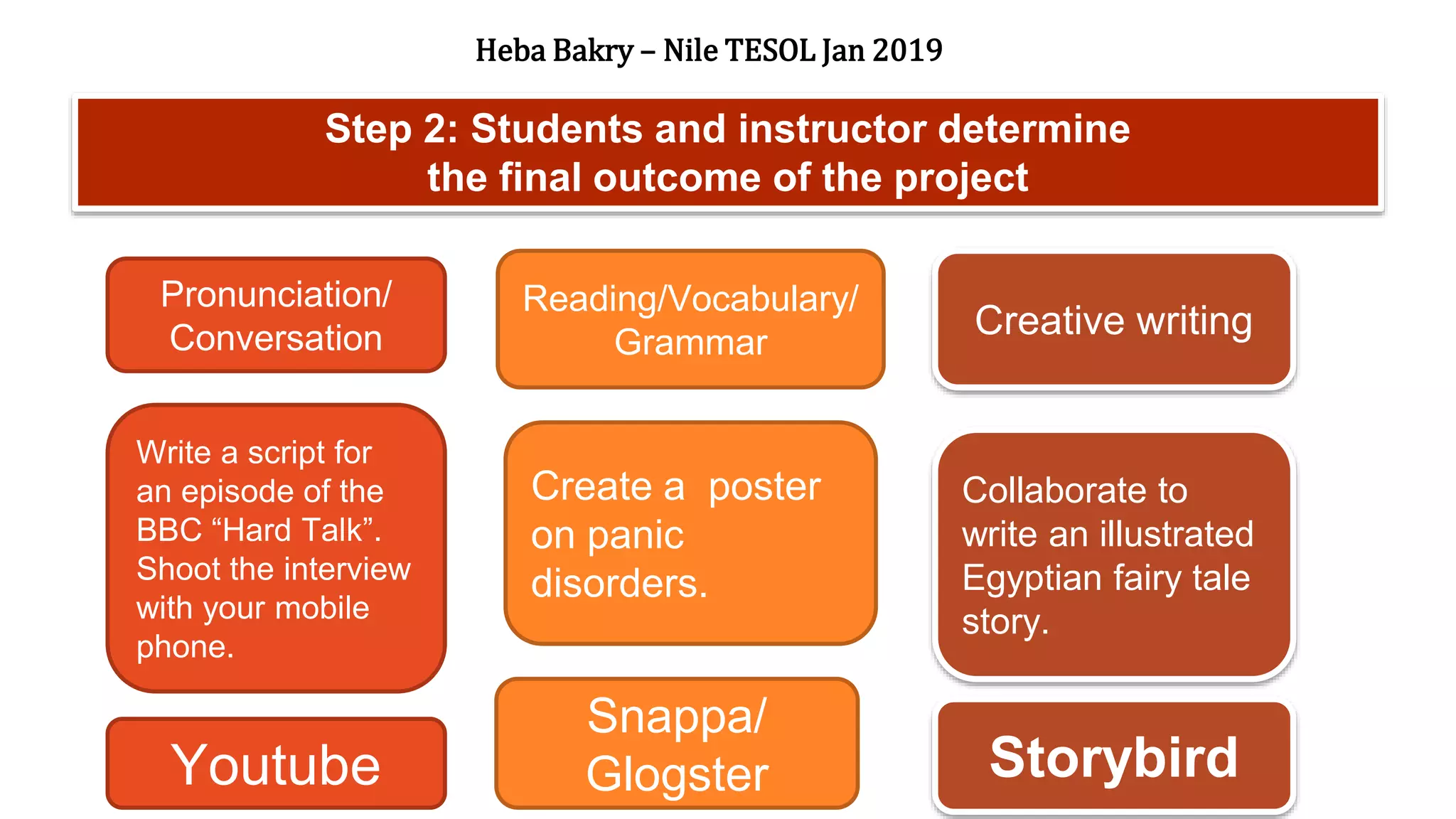
Step 2: Students and instructor determine
the final outcome of the project
Write a script for
an episode of the
BBC “Hard Talk”.
Shoot the interview
with your mobile
phone.
Pronunciation/
Conversation
Create a poster
on panic
disorders.
Reading/Vocabulary/
Grammar
Collaborate to
write an illustrated
Egyptian fairy tale
story.
Creative writing
Youtube
Snappa/
Glogster Storybird
Heba Bakry – Nile TESOL Jan 2019
“
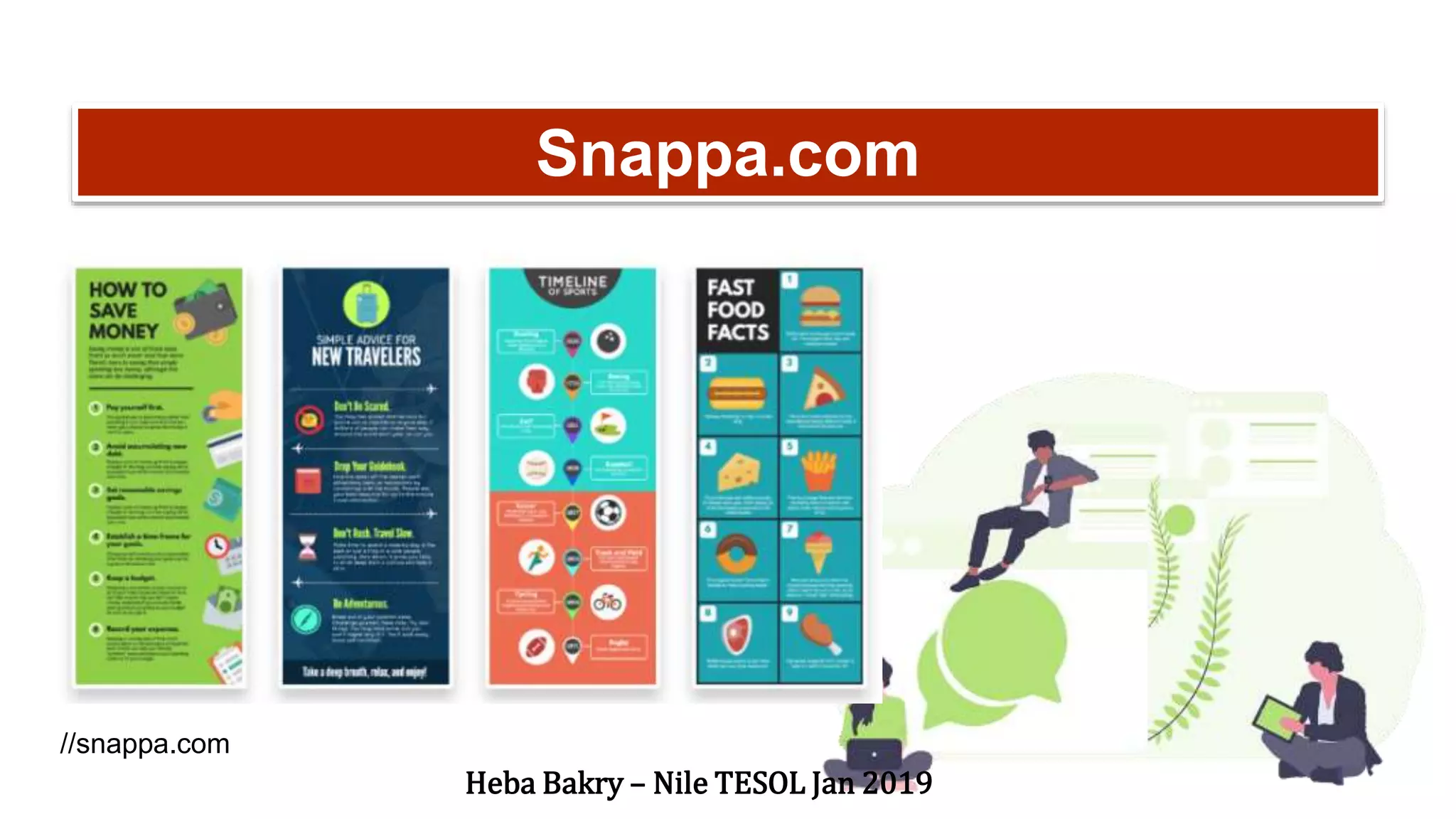
Snappa.com
//snappa.com
Heba Bakry – Nile TESOL Jan 2019
“ Glogster.com
https://edu.glogster.com/glog/panic-
disorder/23dq41io7dw?=glogpedia-source
Heba Bakry – Nile TESOL Jan 2019
“
Storybird.com
https://storybird.com/chapters/plot-twist-1/1/
Heba Bakry – Nile TESOL Jan 2019
“Step3: Students and instructor structure the project
In this step, students consider their
roles, responsibilities, and
collaborative work groups.
After negotiating a deadline for project
completion, students
reach a consensus on the timing for
gathering, sharing, and compiling
information, and then presenting their
final project.
Heba Bakry – Nile TESOL Jan 2019
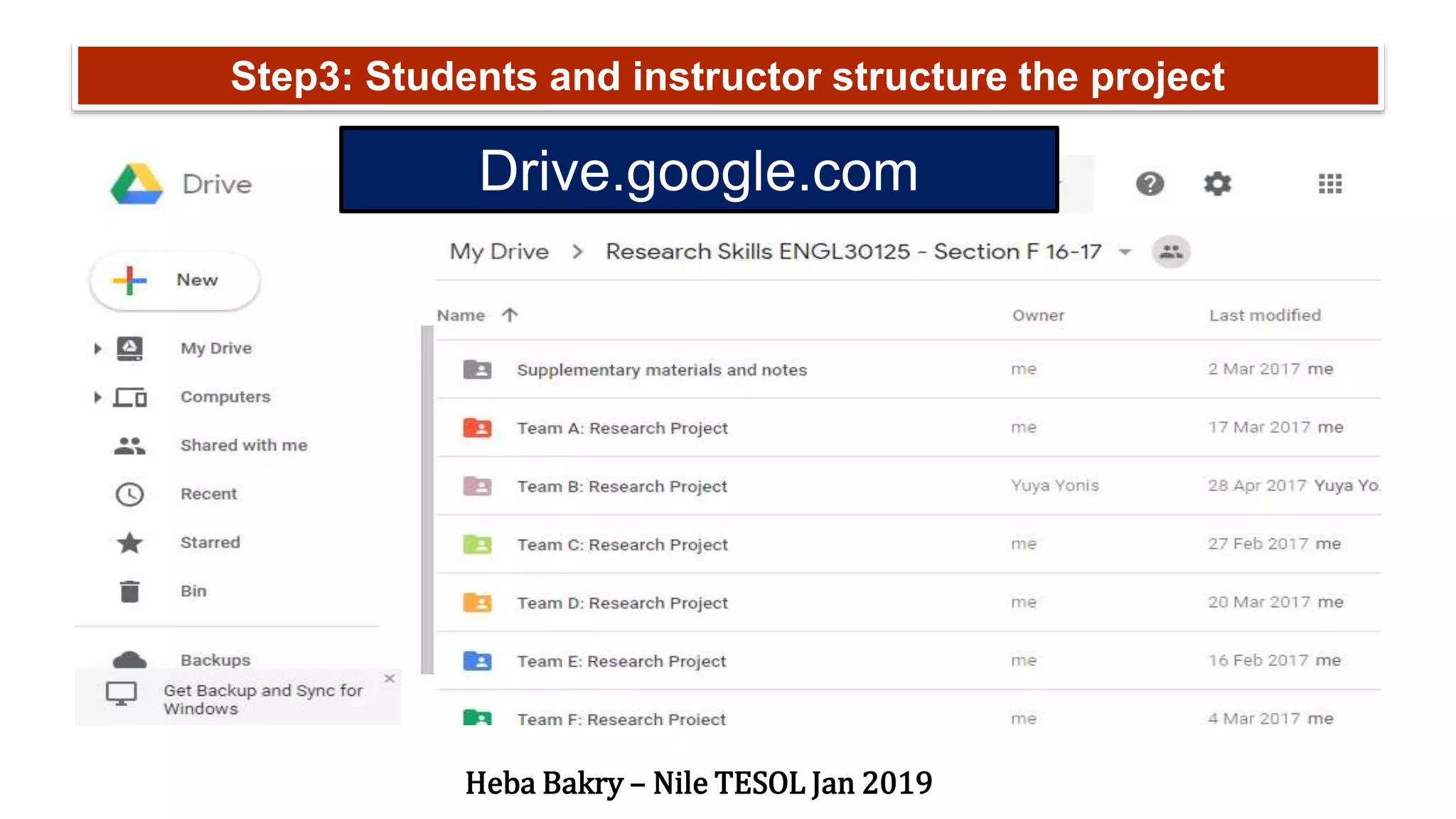
Step3: Students and instructor structure the project
Heba Bakry – Nile TESOL Jan 2019
Drive.google.com
“
Heba Bakry – Nile TESOL Jan 2019
Step 4: Instructor prepares students for the
demands of information gathering
● At this stage, the instructor prepares
students for the language, skill, and
strategy demands associated with
information gathering. With student
ability levels in mind, the instructor
prepares instructional activities for
each of the information-gathering
tasks.
Heba Bakry – Nile TESOL Jan 2019
https://padlet.com/hbakry/EDCUY1SF
In preparation for a research project about consumerism, the
teacher can ask the group to collaboratively write a
commercial paragraph about a product which they should
take a photo of with their phones 
Heba Bakry – Nile TESOL Jan 2019
Padlet.com
After practicing the skills,
strategies, and language needed
for gathering information,
students are left to collect
information using methods such
as interviewing, letter writing,
and library searches.
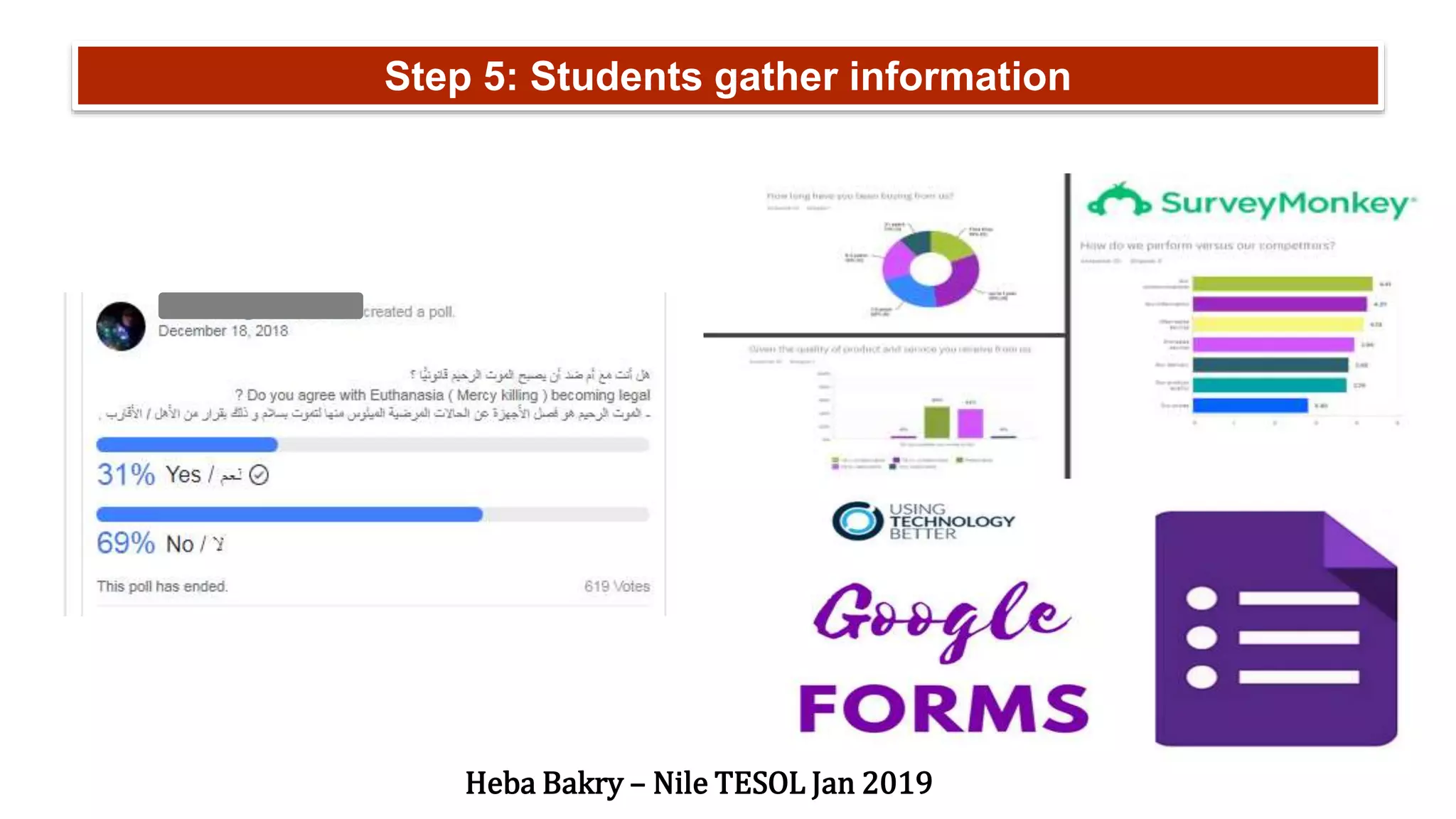
Step 5: Students gather information
Heba Bakry – Nile TESOL Jan 2019
Step 5: Students gather information
Heba Bakry – Nile TESOL Jan 2019
Step 6: Instructor prepares students to compile
and analyze data
• The Instructor shows the students
ways to categorize, make
comparisons, and use graphic
organizers such as charts and time
lines.
Heba Bakry – Nile TESOL Jan 2019
Step 7: Students compile and analyze information
Working in groups, students organize
information and then discuss The value
of the data that they have collected,
keeping some and discarding others. The
Goal Is to identify information that is
critical for the Completion of their
projects.
Heba Bakry – Nile TESOL Jan 2019
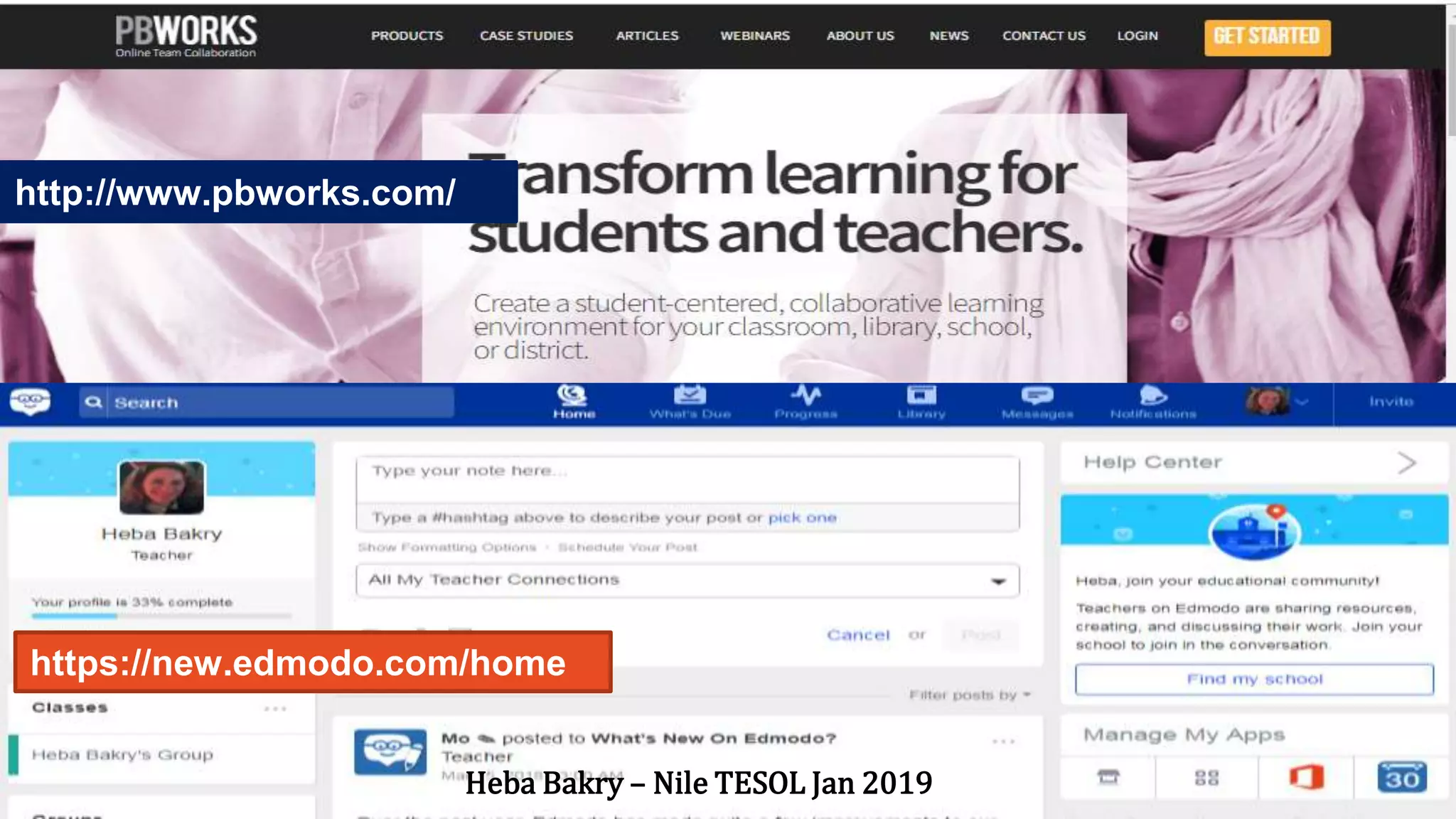
http://www.pbworks.com/
https://new.edmodo.com/home
Heba Bakry – Nile TESOL Jan 2019
Step 8: Instructor prepares students for the
language demands of the final activity
Those activities may focus on skills
for successful oral presentations,
effective written revisions and editing,
persuasive debates, and so forth. Some
focus on form might be greatly
appreciated by students at this point.
Heba Bakry – Nile TESOL Jan 2019
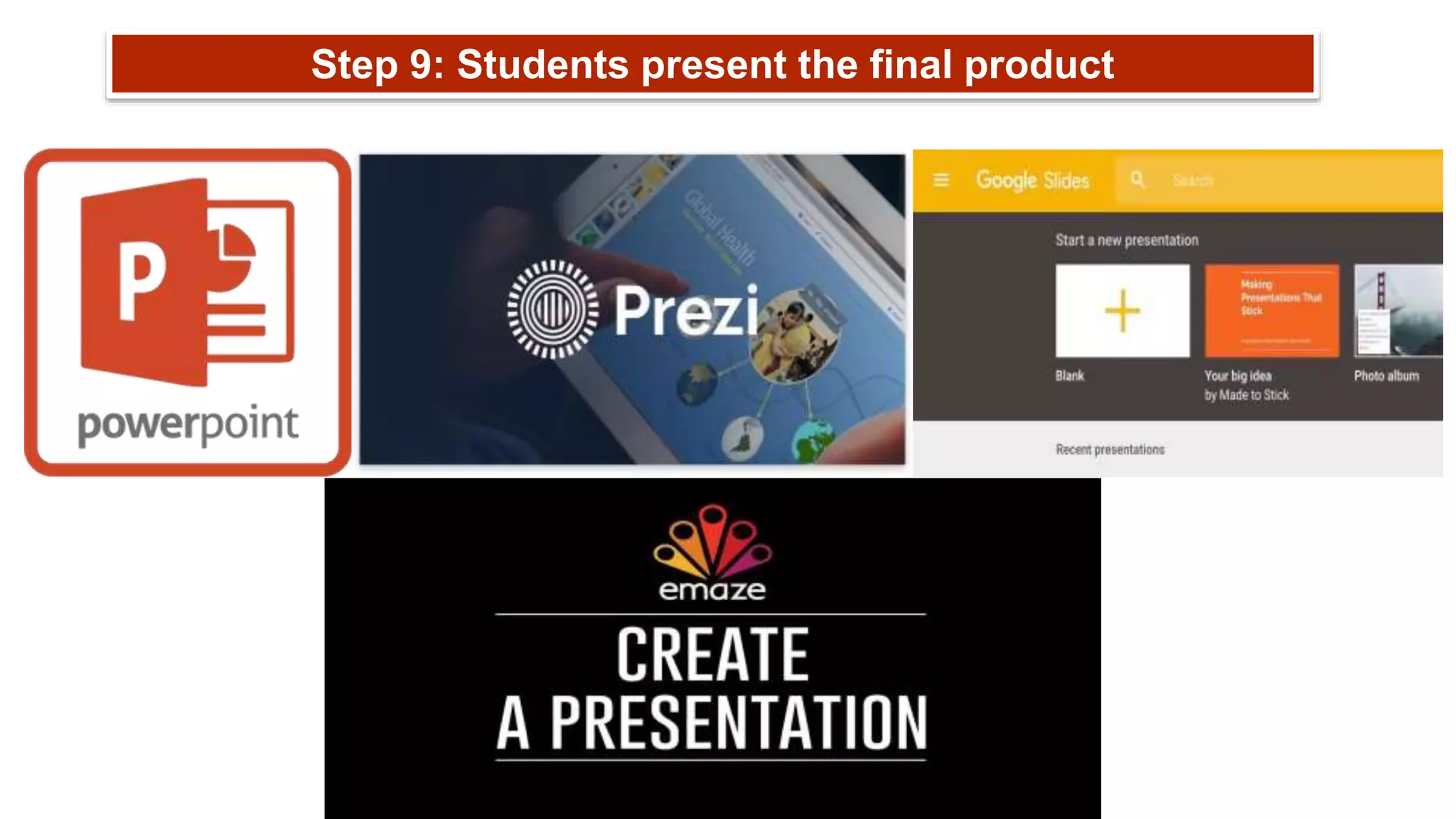
Step 9: Students present the final product
Emaze.com
Step 10: Students evaluate the project
In this last, often neglected stage of
project work, students reflect on the
language mastered and the subject
matter acquired during the project.
In addition, students are asked to
make recommendations that can be
used to enhance similar projects in
the future.
Heba Bakry – Nile TESOL Jan 2019
To Sum up
Step 1: Students and instructor agree on a theme for the project
Step 2: Students and instructor determine
the final outcome of the project
Step3: Students and instructor structure the project
Step 4: Instructor prepares students for the demands of information gathering
Step 5: Students gather information
Step 6: Instructor prepares students to compile and analyze data
Step 7: Students compile and analyze information
Step 8: Instructor prepares students for the language demands of the final activity
Step 9: Students present the final product
Step 10: Students evaluate the project
Heba Bakry – Nile TESOL Jan 2019
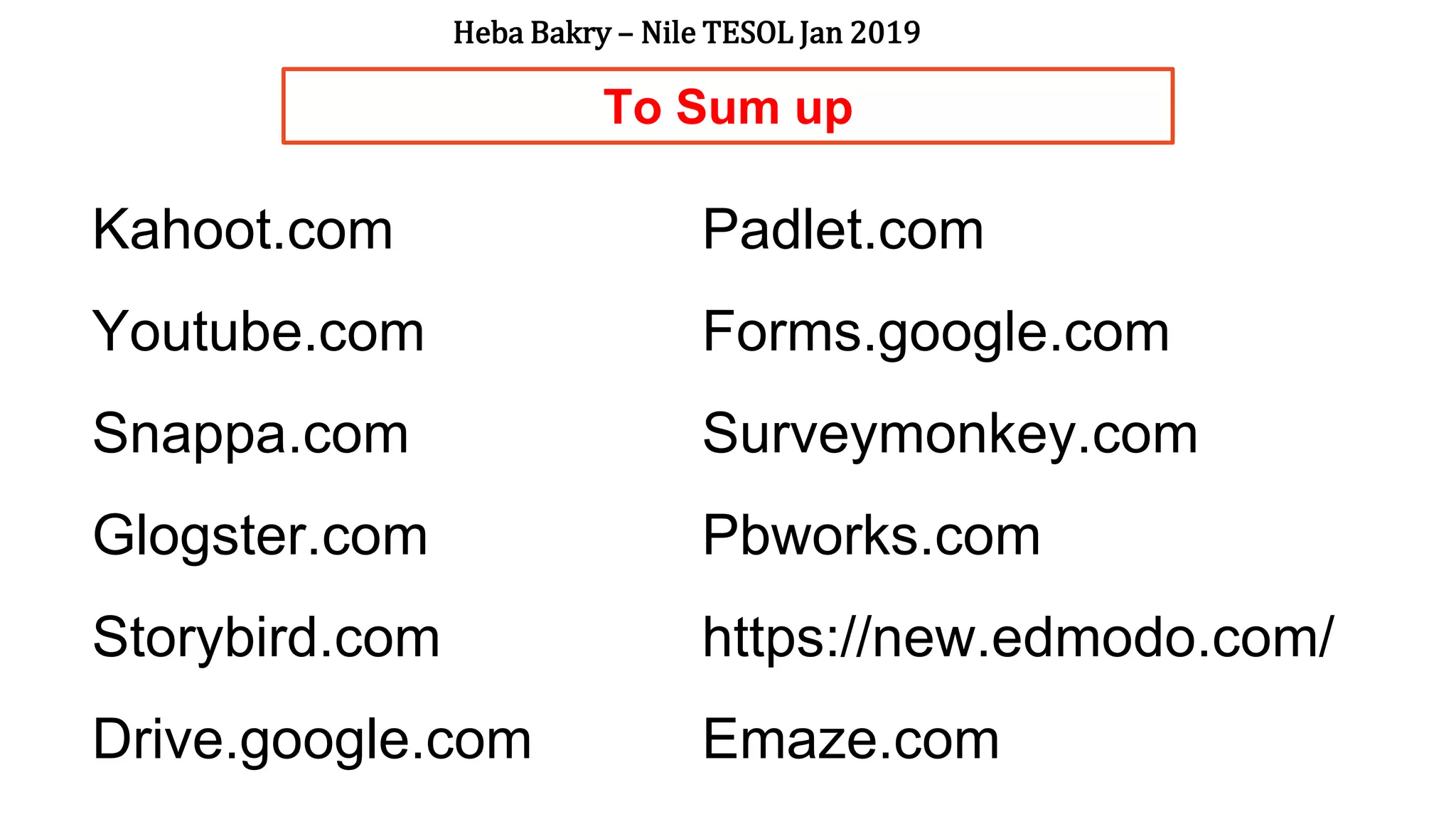
To Sum up
Kahoot.com
Youtube.com
Snappa.com
Glogster.com
Storybird.com
Drive.google.com
Padlet.com
Forms.google.com
Surveymonkey.com
Pbworks.com
https://new.edmodo.com/
Emaze.com
Heba Bakry – Nile TESOL Jan 2019
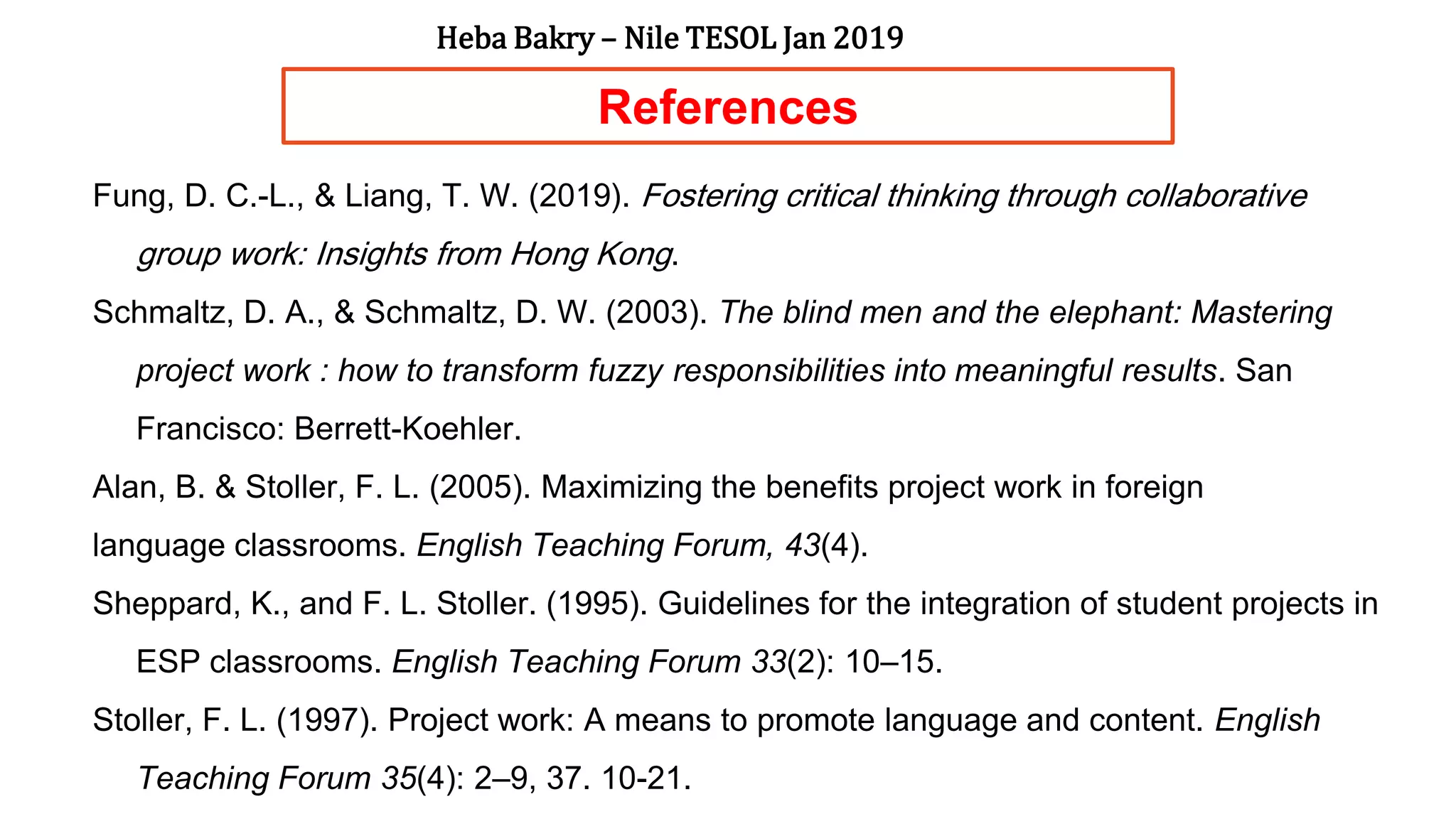
References
Fung, D. C.-L., & Liang, T. W. (2019). Fostering critical thinking through collaborative
group work: Insights from Hong Kong.
Schmaltz, D. A., & Schmaltz, D. W. (2003). The blind men and the elephant: Mastering
project work : how to transform fuzzy responsibilities into meaningful results. San
Francisco: Berrett-Koehler.
Alan, B. & Stoller, F. L. (2005). Maximizing the benefits project work in foreign
language classrooms. English Teaching Forum, 43(4).
Sheppard, K., and F. L. Stoller. (1995). Guidelines for the integration of student projects in
ESP classrooms. English Teaching Forum 33(2): 10–15.
Stoller, F. L. (1997). Project work: A means to promote language and content. English
Teaching Forum 35(4): 2–9, 37. 10-21.
Heba Bakry – Nile TESOL Jan 2019
hbakry@cu.edu.eg

Using Everyday Technology to Create Group Projects by Heba Bakry – Cairo University

  • 1.
    Using Everyday Technology toCreate Group Projects Heba Bakry – Cairo University Wednesday, 23rd January, 2019 Room CP19 (SSE) – 11 AM NILETESOL 23 ANNUAL CONFERENCE American University in Cairo – New Campus
  • 2.
    Group Work • Romanrhetorician Marcus Fabius Quintilian (ca. 35–100) contended that learners derive benefit from instructing one another. • Roman philosopher, Seneca (3 BC–65 AD), promoted a similar practice in the phrase qui docet discit, meaning ‘He who teaches learns.’ Heba Bakry – Nile TESOL Jan 2019
  • 3.
    “ Cooperative group workrefers to individual learners working together to accomplish individual objectives, whilst collaborative group work involves learners undertaking a shared task with the aim of fulfilling a shared objective (Antil et al.1998) Heba Bakry – Nile TESOL Jan 2019
  • 4.
    Heba Bakry –Nile TESOL Jan 2019
  • 5.
    Heba Bakry –Nile TESOL Jan 2019
  • 6.
    And so thesemen of Indostan Disputed loud and long, Each in his own opinion Exceeding stiff and strong, Though each was partly in the right And all were in the wrong! (John Godfrey Saxe) Heba Bakry – Nile TESOL Jan 2019
  • 7.
    “They don't haveto share the same frame if they can accept and integrate each other's stories about their unique frames. No meaningful elephant appears for the blind men without this simple but elusive capacity. Heba Bakry – Nile TESOL Jan 2019
  • 8.
    “ Some of themost popular project manager frames hold project managers to be : Fathers, where they coach and punish Mothers, where they nurture and instruct Magicians, where they pull rabbits out of hats Zookeepers, where they keep the wild animals well fed in cages Priests, where they exhort and forgive Comedians, where they entertain Teachers, where they instruct and grade Lobbyists, where they influence the support of the powerful Sheep, where they follow others' orders Wolves, where they take advantage of sheep to do Heba Bakry – Nile TESOL Jan 2019
  • 9.
    Heba Bakry –Nile TESOL Jan 2019
  • 10.
    Sink or Swim? HebaBakry – Nile TESOL Jan 2019
  • 11.
    Step 1: Studentsand instructor agree on a theme for the project The ten-step process Stoller (1997) and Sheppard & Stoller (1995) Heba Bakry – Nile TESOL Jan 2019 https://kahoot.com/
  • 12.
    Step 1: Studentsand instructor agree on a theme for the project https://create.kahoot.it/create#/edit/2a8f51af-543f-4b6b-b34b-f47568c4dbec/overview Heba Bakry – Nile TESOL Jan 2019
  • 13.
    “ Step 2: Studentsand instructor determine the final outcome of the project The final outcome of the project could be: bulletin board display, written report, debate, brochure, letter, handbook, oral presentation, video, multimedia presentation, or theatrical performance Heba Bakry – Nile TESOL Jan 2019
  • 14.
    Step 2: Studentsand instructor determine the final outcome of the project Write a script for an episode of the BBC “Hard Talk”. Shoot the interview with your mobile phone. Pronunciation/ Conversation Create a poster on panic disorders. Reading/Vocabulary/ Grammar Collaborate to write an illustrated Egyptian fairy tale story. Creative writing Youtube Snappa/ Glogster Storybird Heba Bakry – Nile TESOL Jan 2019
  • 15.
  • 16.
  • 17.
  • 18.
    “Step3: Students andinstructor structure the project In this step, students consider their roles, responsibilities, and collaborative work groups. After negotiating a deadline for project completion, students reach a consensus on the timing for gathering, sharing, and compiling information, and then presenting their final project. Heba Bakry – Nile TESOL Jan 2019
  • 19.
    Step3: Students andinstructor structure the project Heba Bakry – Nile TESOL Jan 2019 Drive.google.com
  • 20.
    “ Heba Bakry –Nile TESOL Jan 2019
  • 21.
    Step 4: Instructorprepares students for the demands of information gathering ● At this stage, the instructor prepares students for the language, skill, and strategy demands associated with information gathering. With student ability levels in mind, the instructor prepares instructional activities for each of the information-gathering tasks. Heba Bakry – Nile TESOL Jan 2019
  • 22.
    https://padlet.com/hbakry/EDCUY1SF In preparation fora research project about consumerism, the teacher can ask the group to collaboratively write a commercial paragraph about a product which they should take a photo of with their phones  Heba Bakry – Nile TESOL Jan 2019 Padlet.com
  • 23.
    After practicing theskills, strategies, and language needed for gathering information, students are left to collect information using methods such as interviewing, letter writing, and library searches. Step 5: Students gather information Heba Bakry – Nile TESOL Jan 2019
  • 24.
    Step 5: Studentsgather information Heba Bakry – Nile TESOL Jan 2019
  • 25.
    Step 6: Instructorprepares students to compile and analyze data • The Instructor shows the students ways to categorize, make comparisons, and use graphic organizers such as charts and time lines. Heba Bakry – Nile TESOL Jan 2019
  • 26.
    Step 7: Studentscompile and analyze information Working in groups, students organize information and then discuss The value of the data that they have collected, keeping some and discarding others. The Goal Is to identify information that is critical for the Completion of their projects. Heba Bakry – Nile TESOL Jan 2019
  • 27.
  • 28.
    Step 8: Instructorprepares students for the language demands of the final activity Those activities may focus on skills for successful oral presentations, effective written revisions and editing, persuasive debates, and so forth. Some focus on form might be greatly appreciated by students at this point. Heba Bakry – Nile TESOL Jan 2019
  • 29.
    Step 9: Studentspresent the final product
  • 30.
  • 31.
    Step 10: Studentsevaluate the project In this last, often neglected stage of project work, students reflect on the language mastered and the subject matter acquired during the project. In addition, students are asked to make recommendations that can be used to enhance similar projects in the future. Heba Bakry – Nile TESOL Jan 2019
  • 32.
    To Sum up Step1: Students and instructor agree on a theme for the project Step 2: Students and instructor determine the final outcome of the project Step3: Students and instructor structure the project Step 4: Instructor prepares students for the demands of information gathering Step 5: Students gather information Step 6: Instructor prepares students to compile and analyze data Step 7: Students compile and analyze information Step 8: Instructor prepares students for the language demands of the final activity Step 9: Students present the final product Step 10: Students evaluate the project Heba Bakry – Nile TESOL Jan 2019
  • 33.
  • 34.
    References Fung, D. C.-L.,& Liang, T. W. (2019). Fostering critical thinking through collaborative group work: Insights from Hong Kong. Schmaltz, D. A., & Schmaltz, D. W. (2003). The blind men and the elephant: Mastering project work : how to transform fuzzy responsibilities into meaningful results. San Francisco: Berrett-Koehler. Alan, B. & Stoller, F. L. (2005). Maximizing the benefits project work in foreign language classrooms. English Teaching Forum, 43(4). Sheppard, K., and F. L. Stoller. (1995). Guidelines for the integration of student projects in ESP classrooms. English Teaching Forum 33(2): 10–15. Stoller, F. L. (1997). Project work: A means to promote language and content. English Teaching Forum 35(4): 2–9, 37. 10-21. Heba Bakry – Nile TESOL Jan 2019
  • 35.

Editor's Notes

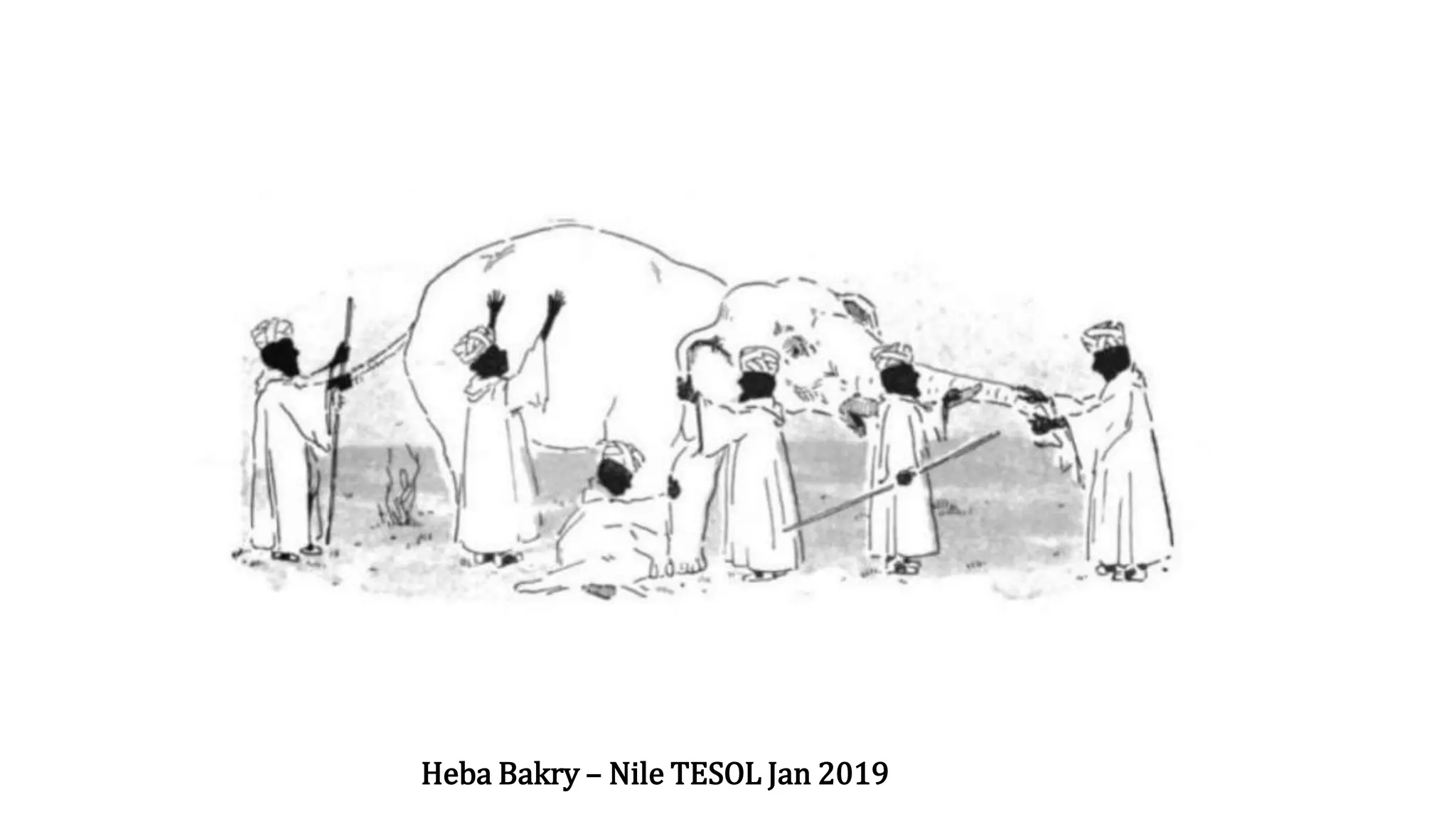
  • #5 It is a story of a group of blind men, who have never come across an elephant before and who learn and conceptualize what the elephant is like by touching it. Each blind man feels a different part of the elephant's body, but only one part, such as the side or the tusk. They then describe the elephant based on their limited experience and their descriptions of the elephant are different from each other. In some versions, they come to suspect that the other person is dishonest and they come to blows. The moral of the parable is that humans have a tendency to claim absolute truth based on their limited, subjective experience as they ignore other people's limited, subjective experiences which may be equally true
  • #7 It is a story of a group of blind men, who have never come across an elephant before and who learn and conceptualize what the elephant is like by touching it. Each blind man feels a different part of the elephant's body, but only one part, such as the side or the tusk. They then describe the elephant based on their limited experience and their descriptions of the elephant are different from each other. In some versions, they come to suspect that the other person is dishonest and they come to blows. The moral of the parable is that humans have a tendency to claim absolute truth based on their limited, subjective experience as they ignore other people's limited, subjective experiences which may be equally true