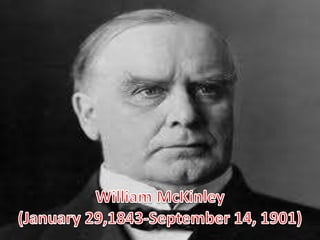
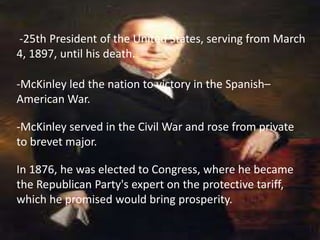
-25th President of the United States, serving from March
4, 1897, until his death.

-McKinley led the nation to victory in the Spanish–
American War.

-McKinley served in the Civil War and rose from private
to brevet major.

In 1876, he was elected to Congress, where he became
the Republican Party's expert on the protective tariff,
which he promised would bring prosperity.
-1891 and 1893, He was elected Ohio's governor

-Rapid economic growth marked McKinley's presidency.
He promoted the 1897 Dingley Tariff to protect
manufacturers and factory workers from foreign
competition, and in 1900, he secured the passage of
the Gold Standard Act.

-McKinley hoped to persuade Spain to grant
independence to rebellious Cuba without conflict, but
when negotiation failed, he led the nation in the Spanish–
American War of 1898
Benevolent assimilation
Dec. 21, 1898, President McKinley issued the BENEVOLENT
ASSIMILATION PROCLAMATION, announced in the Philippines on
Jan. 4, 1899
The U.S. have "come, not as invaders or conquerors, but as
friends, to protect the natives in their homes, in their
employment, and in their personal and religious rights."
U.S. wanted to "win the confidence, respect, and affection of the
inhabitants of the Philippines by assuring them in every possible
way that full measure of individual rights and liberties which is
the heritage of free peoples, and by proving to them that the
mission of the United States is one of benevolent assimilation
substituting the mild sway of justice and right for arbitrary rule."
Benevolent assimilation
 The proclamation reads in part:

Finally, it should be the earnest wish and paramount aim
of the military administration to win the confidence,
respect, and affection of the inhabitants of the
Philippines by assuring them in every possible way that
full measure of individual rights and liberties which is the
heritage of free peoples, and by proving to them that the
mission of the United States is one of benevolent
assimilation substituting the mild sway of justice and
right for arbitrary rule.
-The proclamation was sent to General Elwell Otis (U.S.
military commander in the Philippines)

-Otis sent Emilio Aguinaldo a version of the proclamation
which he bowdlerized by removing the mention of
U.S. sovereignty "to stress our benevolent purpose" and
not "offend Filipino sensibilities" by substituting "free
people" for "supremacy of the United States," and
deleting "to exercise future domination".

 May 24, 1898- Aguinaldo had proclaimed an insurgent
 dictatorial government in the Philippines
June 12, 1898- proclaimed Philippine Independence

June 23, 1898- changed the dictatorial government to a
revolutionary one

 -General Otis had also sent an unaltered copy of the
 proclamation to General Marcus Miller in Iloilo City who,
 unaware that an altered version had been sent to
 Aguinaldo, passed a copy to a Filipino official there.
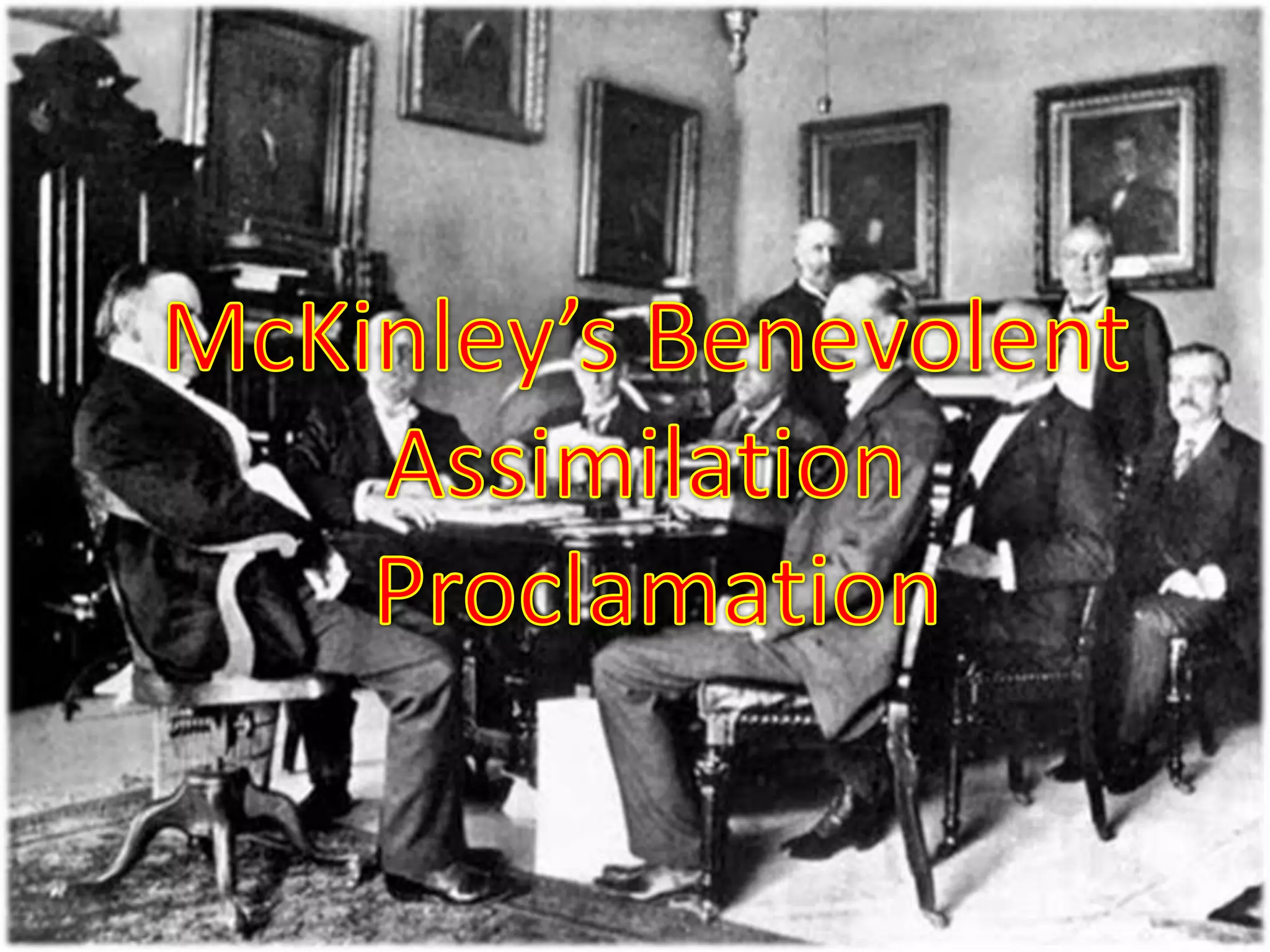
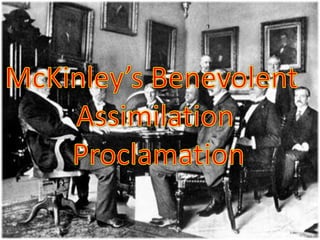
McKinley’s Benevolent  Assimilation  Proclamation

McKinley’s Benevolent Assimilation Proclamation

  • 3.
    -25th President ofthe United States, serving from March 4, 1897, until his death. -McKinley led the nation to victory in the Spanish– American War. -McKinley served in the Civil War and rose from private to brevet major. In 1876, he was elected to Congress, where he became the Republican Party's expert on the protective tariff, which he promised would bring prosperity.
  • 4.
    -1891 and 1893,He was elected Ohio's governor -Rapid economic growth marked McKinley's presidency. He promoted the 1897 Dingley Tariff to protect manufacturers and factory workers from foreign competition, and in 1900, he secured the passage of the Gold Standard Act. -McKinley hoped to persuade Spain to grant independence to rebellious Cuba without conflict, but when negotiation failed, he led the nation in the Spanish– American War of 1898
  • 6.
    Benevolent assimilation Dec. 21,1898, President McKinley issued the BENEVOLENT ASSIMILATION PROCLAMATION, announced in the Philippines on Jan. 4, 1899 The U.S. have "come, not as invaders or conquerors, but as friends, to protect the natives in their homes, in their employment, and in their personal and religious rights." U.S. wanted to "win the confidence, respect, and affection of the inhabitants of the Philippines by assuring them in every possible way that full measure of individual rights and liberties which is the heritage of free peoples, and by proving to them that the mission of the United States is one of benevolent assimilation substituting the mild sway of justice and right for arbitrary rule."
  • 7.
    Benevolent assimilation Theproclamation reads in part: Finally, it should be the earnest wish and paramount aim of the military administration to win the confidence, respect, and affection of the inhabitants of the Philippines by assuring them in every possible way that full measure of individual rights and liberties which is the heritage of free peoples, and by proving to them that the mission of the United States is one of benevolent assimilation substituting the mild sway of justice and right for arbitrary rule.
  • 8.
    -The proclamation wassent to General Elwell Otis (U.S. military commander in the Philippines) -Otis sent Emilio Aguinaldo a version of the proclamation which he bowdlerized by removing the mention of U.S. sovereignty "to stress our benevolent purpose" and not "offend Filipino sensibilities" by substituting "free people" for "supremacy of the United States," and deleting "to exercise future domination". May 24, 1898- Aguinaldo had proclaimed an insurgent dictatorial government in the Philippines
  • 9.
    June 12, 1898-proclaimed Philippine Independence June 23, 1898- changed the dictatorial government to a revolutionary one -General Otis had also sent an unaltered copy of the proclamation to General Marcus Miller in Iloilo City who, unaware that an altered version had been sent to Aguinaldo, passed a copy to a Filipino official there.