
1
Master Dissertation of Jinan University
A Feasibility Study on Community Solar Gardens in China
Author’s Name: Zayn Abdullah King Dollie
Supervisor’s Name: Prof. Wang Guoqing 王国庆
Ph.D. Professor
Master of Business Administration (MBA)
Submission date: 16 April 2015
Date of defense: 11-20 May 2015
Chairman of the defense committee:
Paper Reviewer:
Degree-conferment authority and
2
Originality statement
I declare that the academic paper submitted is the achievements of the research carried out by me under the
guidance of the supervisor. To the best of my knowledge, except for the special annotations and acknowledgements,
the paper does not contain the research outcomes published or written by other people have, nor materials already
used to obtain academic degree or certificate of Jinan University or other educational institutions. Any and
all contributions to this research made by my coworkers have been described and recognized herein.
signature of author: Zayn Abdullah King Dollie Date of signature: March 27, 2015
License of Copyright to Academic Paper
The author of the academic paper fully understand the provisions promulgated by Jinan University for
reservations and use of the academic papers, and is entitled to retain and submit the copy and disk of the paper to the
relevant national departments or agencies concerned and allow access to them. I hereby authorize Jinan
University to incorporate the academic paper in whole or in part into the relevant database for retrieval and to
save and compile the academic paper by photocopy,microprint or scan.
(This license is not applicable to an encrypted academic paper until decryption)
Signature of author: Zayn Abdullah King Dollie Signature of Supervisor:
Signing Date: Signing Date:
Graduation destination of the author:
Employer: Tel:
Mailing address: Zip Code:
3
Abstract
A solar garden is based on a relatively new business model best described as community owned
solar—people within a community enthusiastic about solar, pool their capital, use it to purchase
an array and, via a special purpose entity, have it installed and maintained on a host site which is
either paid rent for the use of its property or enters into a power purchase agreement with the
SPE for purchase of the energy generated by the array. The array is owned by the subscribing
community members (subscribers) throughout the length of the PPA. The PPA contract can be
up to twenty years. Subscriber ROI comes either via the sale of the power generated back to the
grid for the wholesale power rate (feed in tariff); or via the sale of the power generated back to
the host, usually at some discount to the retail rate. After twenty years the subscribers should
have experienced payback and a sufficient IRR, then ownership of the panels flips to the host. A
third alternative involves virtual net metering and the cooperation of the utility to implement
energy (kWh) or monetary ‘bill credits’ which constitute subscriber return. This is the original
solar gardens idea however at the moment it is not feasible in China. Community owned solar
has the potential to work in China via an equity-based crowdfunding model. Pollution and
climate change are both problems that Chinese national government policy is trying to combat
via enormous solar capacity targets and favourable policies for distributed solar developers.
Incentives have been designed so that payback on distributed projects could be as low as 5-8
years and internal rates of return as high as 12-17%. Financing solar arrays is usually
problematic, however ‘the crowd’ in China is a huge source of untapped capital with CNY74
trillion in bank savings. Developing a compelling value proposition for potential investors could
not only lead to a lucrative business opportunity but the chance to contribute to the greening of
China’s energy mix. Before turning to the crowd it will be important to build trust and
credibility via a suitable pilot project such as an array on a university building funded by
students, faculty, departments etc. Successful carrying out of the pilot should attract interest
from the crowd and other investors in future projects.
Key words: distributed solar, solar, crowdfunding, power purchase agreement, energy
performance contracting, renewable energy, impact investing
太阳能花园乃是基于一个相对新的生意模式,最好的形容词是社区所拥有的太阳能(光伏)- 社区里
的人热衷于太阳能,集中他们的资金,用它来购买一个太阳能电池板,并通过一个特定目的的实体
(SPE),让它安装和接受维护于一个主机站,要么是支付租金使用其财产或与特定目的实体 SPE 签订
4
一电力购买协议,购买由太阳能电池板产生的能量。该太阳能电池板由订用的社区成员(用户)在整
个电力购买合同(PPA)的运营过程中所拥有。 PPA 的合同可以长达二十年。用户的投资回报率或者
通过回馈到电网的产生电力之批发价(上网电价)的销售;或经由出售回馈到电力主机站的电力,通常
是一些打折到零售的价格。二十年后,用户应该已经历投资回报和充足的内部收益率 IRR,那么所有
太阳能电池板的所有权就回归到主机站。第三种选项是涉及虚拟净计量和实施能源(千瓦时)效用的
合作,或构成用户回报的货币“账单值”。这是原始的太阳能花园构想,目前在中国是不可行的。社区
拥有的太阳能在中国具有通过股权为基础的众筹基金模式的奏效潜力。污染和气候变化问题都是中国
政府通过巨大的太阳能发电量目标,与分布各地的太阳能开发者的优惠政策,所要试图打击的国家政
策。激励机制已设计出来,使分布项目的回报可低到 5-8 年,内部收益率则高达 12-17%。融资太阳能
电池板通常是有问题的,然而中国民间的‘群众’,乃是人民币 74 万亿银行储蓄的巨大未开发资源。
为潜在投资者开发一个引人注目的价值提议,不仅可以导致一个利润丰厚的商机,同时也有助于中国
能源结构的绿化。转向群众之前,通过合适的试验项目建立信任和信誉很重要,例如在大学建筑物上
面架设一个太阳能电池板,由学生,学系,部门等资助。成功的试点项目应该可以吸引群众的兴趣和
其他投资者投资未来的项目。
关键词:分布式太阳能,太阳能,众筹,购电合同,能源管理合同,可再生能源,影响的投资。
5
Table of contents
Abstract ...........................................................................................................................................3
Table of contents .............................................................................................................................5
List of figures and tables .................................................................................................................7
Section 1..........................................................................................................................................8
1 Introduction...............................................................................................................................8
2 Community solar gardens .......................................................................................................15
2.1 Solar Mosaic Co..................................................................................................................16
2.2 Serving an expanding market niche.......................................................................................17
2.3 First large scale success story...............................................................................................19
2.3.1 Wildwoods Convention Center.......................................................................................19
2.3.2 Roll out.........................................................................................................................20
2.4 Current Chinese business model...........................................................................................21
2.4.1 Energy performance contracting .....................................................................................21
2.4.2 Recent Solar EPC projects in China ................................................................................22
2.4.3 Returns on EPC projects ................................................................................................25
2.5 Proposal for China ...............................................................................................................25
3 China’s green energy industry development and policies ......................................................30
3.1 Environmental Consequences...............................................................................................30
3.2 Coal....................................................................................................................................32
3.3 Government response...........................................................................................................33
3.4 Solar power.........................................................................................................................35
Section 2........................................................................................................................................37
4 Feasibility study......................................................................................................................37
4.1 Purpose...............................................................................................................................37
5 Market Analysis ......................................................................................................................39
5.1 Demographics .....................................................................................................................39
5.2 Market needs.......................................................................................................................42
5.3 Crowdfunding .....................................................................................................................44
5.4 Market trends......................................................................................................................46
5.5 Market growth.....................................................................................................................48
5.6 SWOT analysis ...................................................................................................................49
5.7 Industry Analysis.................................................................................................................51
5.8 Product offering ..................................................................................................................57
5.9 Crowdfunding keys to success..............................................................................................59
6 Marketing strategy ..................................................................................................................62
6.1 Market research...................................................................................................................62
6.2 Segment and positioning ......................................................................................................65
Section 3........................................................................................................................................67
7 Policy analysis.........................................................................................................................67
7.1 Crowdfunding .....................................................................................................................67
7.2 Solar...................................................................................................................................71
7.3 Financial incentives .............................................................................................................72
7.4 Tax incentives .....................................................................................................................74
8 Organizational structure..........................................................................................................75
8.1 Entity choice .......................................................................................................................75
8.2 Start up...............................................................................................................................76
6
8.2.1 Regarding pilot projects .................................................................................................76
8.2.2 Regarding hosts .............................................................................................................77
8.2.3 Technology partner vs. utilising existing platforms ..........................................................77
8.2.4 Costs ............................................................................................................................78
8.2.5 Timeline .......................................................................................................................78
8.3 Solar project approval process..............................................................................................79
8.3.1 Regarding provincial approval........................................................................................80
9 Technical analysis...................................................................................................................81
9.1 Potential sites ......................................................................................................................81
9.2 Host site considerations........................................................................................................84
9.3 Energy usage.......................................................................................................................88
9.3.1 Net metering .................................................................................................................88
10 Financial analysis .................................................................................................................91
10.1 Assumptions and inputs .....................................................................................................91
10.2 Economics and performance...............................................................................................95
11 Issues ....................................................................................................................................97
Section 4......................................................................................................................................101
12 Conclusions and Recommendations...................................................................................101
Notes............................................................................................................................................106
References ...................................................................................................................................107
Appendices..................................................................................................................................112
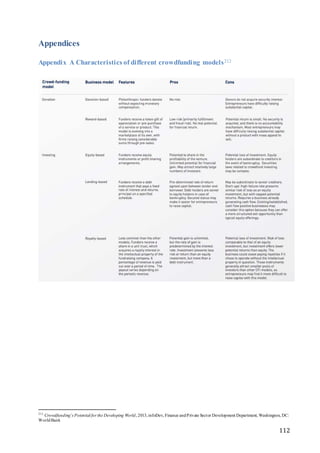
Appendix A Characteristics of different crowdfunding models.......................................................112
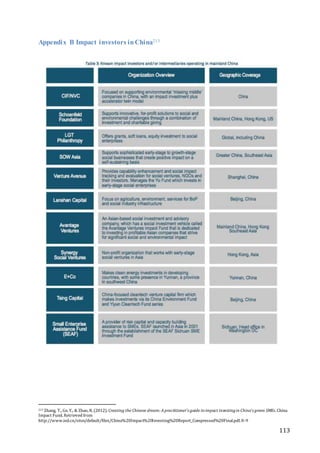
Appendix B Impact investors in China .........................................................................................113
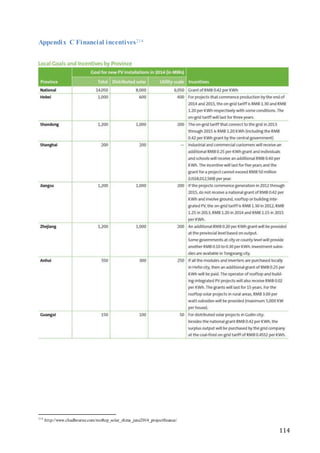
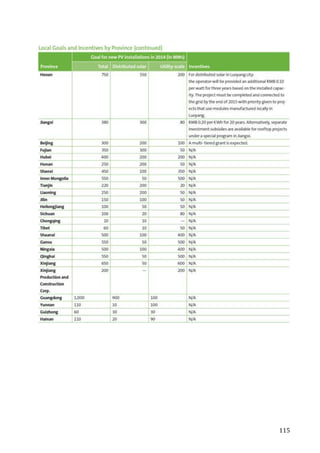
Appendix C Financial incentives..................................................................................................114
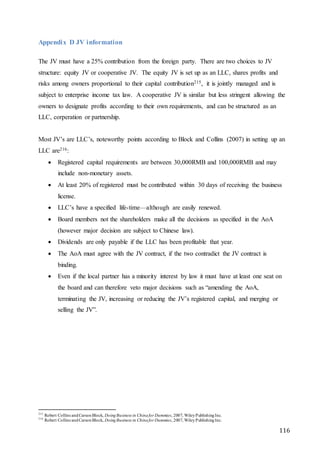
Appendix D JV information.........................................................................................................116
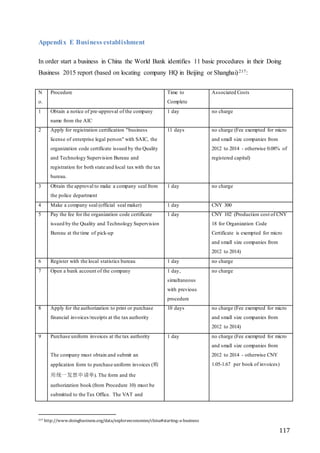
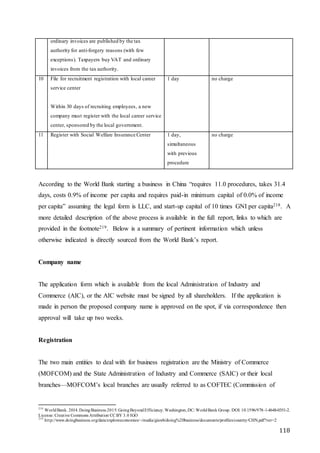
Appendix E Business establishment .............................................................................................117
Acknowledgements .....................................................................................................................121
7
List of figures and tables
Figure 4-1 Investment and return................................................................................................................................8
Figure 4-2 Shared solar cash and energy flow........................................................................................................14
Figure 5-1 Solar Mosaic investment model..............................................................................................................16
Figure 5-2 Solar Mosaic Project Offerings...............................................................................................................18
Figure 5-3 Wildwoods Convention Center NJ........................................................................................................19
Figure 5-4 Wildwoods Convention Center Solar Installation.........................................................................20
Figure 5-5 Solar Mosaic's Wildwood Convention Center ................................................................................21
Figure 5-6 DuPont R&D Centre Shanghai Solar Installation .........................................................................23
Figure 5-7 Turpan Airport Solar Installation...........................................................................................................24
Figure 5-8 Midea Group Shunde Solar Array.........................................................................................................25
Figure 5-9 Proposed EPC model for China..............................................................................................................27
Figure 6-1 Emissions of carbon dioxide from energy, annually and cumulatively..............................31
Figure 6-2 China's installed electricity capacity by fuel 2012 (total 1,145GW) ...................................32
Figure 6-3 Direct carbon dioxide intensities of different Chinese industries (2007) ..........................32
Figure 6-4 PM2.5 AQI scale............................................................................................................................................33
Figure 6-5 Global investment in renewable energy by region 2013 (US$billion) ...............................34
Figure 6-6 China Solar PV Installations to 2015 (GW).....................................................................................36
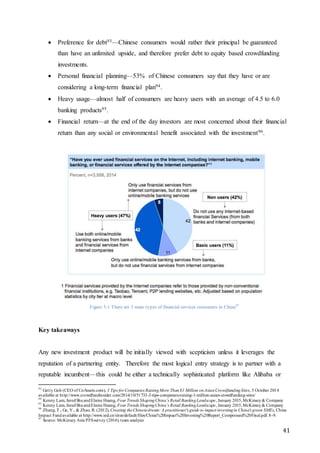
Figure 8-1 There are 3 main types of financial services consumers in China ........................................41
Figure 8-2 Yield comparison: Yu'e Bao vs. Li Cai Tong vs. Chinese banks ..........................................43
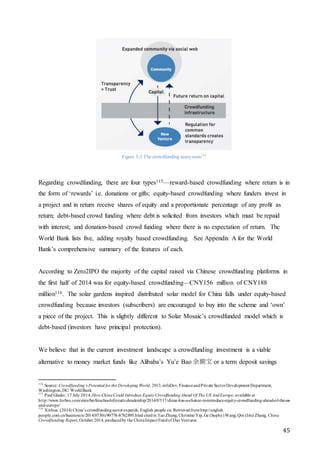
Figure 8-3 The crowdfunding ecosystem..................................................................................................................45
Figure 8-4 Crowdfunding potential by region.........................................................................................................48
Figure 8-5 Market potential for crowdsourcing across the developing world ........................................49
Figure 8-6 Unique product offering .............................................................................................................................58
Figure 8-7 Four elements of a robust crowdfunding investing ecosystem...............................................59
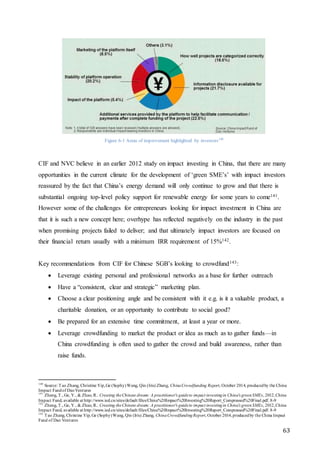
Figure 9-1 Areas of improvement highlighted by investors ............................................................................63
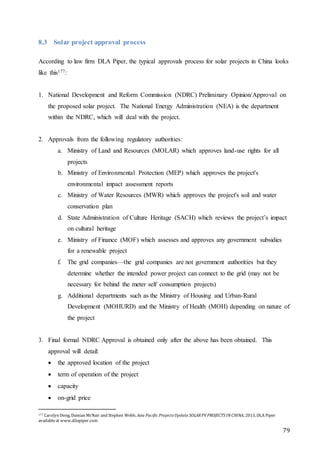
Figure 12-1 Baiyun airport................................................................................................................................................82
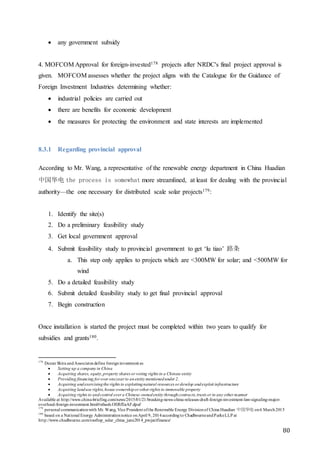
Figure 12-2 Guangzhou South Railway Station.....................................................................................................82
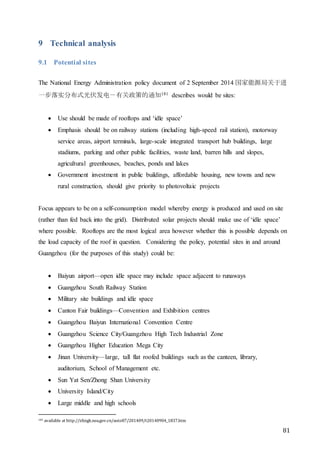
Figure 12-3 Canton Fair Site............................................................................................................................................82
Figure 12-4 Baiyun International Convention Centre.........................................................................................83
Figure 12-5 Guangzhou Library.....................................................................................................................................83
Figure 12-6 Guangzhou Museum..................................................................................................................................83
Figure 12-7 Solar resource in China ............................................................................................................................84
Figure 12-8 In front of the meter vs. behind the meter.......................................................................................89
Figure 13-1 Installed price of residential and commercial over time..........................................................91
Figure 13-2 US estimated installation cost breakdown......................................................................................92
Figure 13-3 International installed cost comparison............................................................................................92
Figure 15-1 Jinan University Library rooftop space .........................................................................................103
Table 6-1 Energy mix of top countries for renewables in 2013.....................................................................35
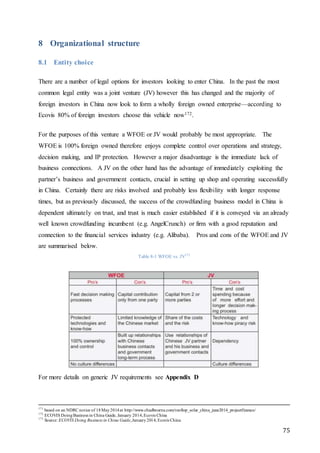
Table 11-1 WFOE vs. JV...................................................................................................................................................75
Table 12-1 PVWatts inputs...............................................................................................................................................85
Table 13-1 Key assumptions............................................................................................................................................93
8
Section 1
1 Introduction
Concept
A solar garden, community solar garden or community shared solar project1, is a renewable
energy project designed, implemented and sold with the specific purpose of providing distributed
solar energy to subscribing members of a local community. The basic idea is that members of a
community buy into a solar array and benefit from its electrical energy output via regular kWh
bill credits on their personal or commercial electricity bills. Additionally subscribers may also
share in any incentives designed to facilitate the development of renewable energy projects in the
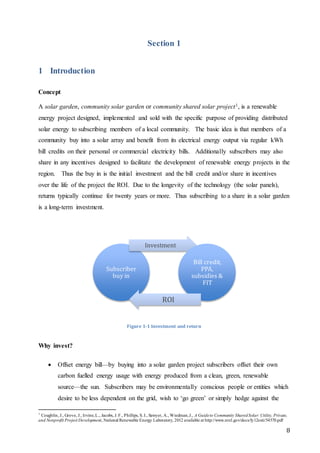
region. Thus the buy in is the initial investment and the bill credit and/or share in incentives
over the life of the project the ROI. Due to the longevity of the technology (the solar panels),
returns typically continue for twenty years or more. Thus subscribing to a share in a solar garden
is a long-term investment.
Figure 1-1 Investment and return
Why invest?
 Offset energy bill—by buying into a solar garden project subscribers offset their own
carbon fuelled energy usage with energy produced from a clean, green, renewable
source—the sun. Subscribers may be environmentally conscious people or entities which
desire to be less dependent on the grid, wish to ‘go green’ or simply hedge against the
1
Coughlin, J., Grove, J., Irvine,L., Jacobs, J. F., Phillips, S. J., Sawyer, A., Wiedman,J., A Guideto Community SharedSolar:Utility, Private,
and Nonprofit Project Development, National Renewable Energy Laboratory, 2012 available at http://www.nrel.gov/docs/fy12osti/54570.pdf
Subscriber
buy in
Investment
Bill credit,
PPA,
subsidies &
FIT
ROI
9
rising electricity rates but for whatever reason are unable to install panels on their own
premises (perhaps it is shaded, there is not enough sun, they are renting, they do not plan
to be in the premises for longer than the life of the panels, red tape, high costs etc.). The
solar garden thus provides these individuals or entities with a solar option by purchasing
capacity in an off-site array and ‘virtually’ using its energy output—the actual energy
output is either sold back to the grid (for a Feed-In-Tariff, FIT) or to the site host
(Power Purchase Agreement, PPA). This process of crediting a subscriber’s bill for
kWh produced off site is called Virtual Net Metering, VNM2.
 Hedge against price rises—a subscriber in a solar garden project hedges against future
energy price rises by virtually producing it’s own energy. If the subscriber receives a
kWh bill credit in direct proportion to the amount of energy the subscriber’s share of the
panel produces, then this not only represents positive cash flow in the form of energy
bills not paid out, but as retail energy rates increase, the monetary value of the kWh bill
credit increases accordingly. In China current retails rates are between CNY0.60 and
CNY0.80/kWh for residential and CNY0.90 to CNY1.20/kWh for commercial3. It is
reasonable to assume that these rates will increase each year (at least to account for
inflation). If energy rates rise faster than inflation, this investment hedges against future
price rises. Since the subscriber is no longer subject to bill payments, it is not longer
subject to rate rises and therefore has hedged against power price increases. If however
the subscriber receives a monetary bill credit then it only hedges against the rising
wholesale price of electricity i.e. the grid’s variable costs—the subscriber would still be
subject to rising fixed costs associated with transmission lines and infrastructure etc.
 Capture financial incentives (return)—what makes this project economically attractive in
China is the combination of the national production incentive and the FIT, which varies
according to the wholesale price of power around the country. This means that,
according to national policies, the local utility is obliged to purchase at the wholesale rate
(the rate it pays for coal fired power for example) energy from any entity feeding power
back into the grid from a distributed solar source. This rate is about CNY0.50/kWh.
Furthermore, there is a national production incentive of CNY0.42/kWh. This means that
regardless of whether the power is consumed onsite or fed back into the grid, Beijing will
2
Huijben, J.C.C.M. & Verbong, G.P.J., Breakthrough without subsidies?PVbusiness model experiments in the Netherlands, 26 December 2012,
Energy Policy
3
Lucia, F., National Policy Initiatives Continue to Fuel Robust Growth in PVmarket for DB Solar Report, 20Jan 2014, available at
http://www.dailyenmoveme.com/en/market/china-national-policy-initiatives-continue-fuel-robust-growth-pv-market-db-solar-report
10
reward any entity this rate for any distributed power it produces. Moreover this is a 20-
year agreement. Thus in China distributed energy generators are effectively being paid to
be self-sufficient. According to Felice Lucia:
“Distributed generation users are awarded a ¥0.42/kwh FIT, which is on top of
the reduction in electricity use inherent in having a distributed system. This
effectively means that the customer is offsetting their cost of electricity and is
being paid ¥0.42/kWh to do so.”4
The FIT and production incentive together serve as a lucrative revenue source. The
combined value of the energy produced from a distributed source is 0.42+0.50=0.92
RMB per kWh at the very least. The FIT is a production-based incentive. In the United
States there are capacity-based incentives, the main one being the 30% federal tax credit,
which effectively reduces the cost of the project by 30% for developers or owners with
sufficient tax appetite to capture it. Under China’s ‘Golden Sun Project’ from 2009-13
there were similar production based incentives in the form of up front subsidies5 however
it seems these have been phased out in favour of production based incentives.
Forecasting the lifetime production of the panels and then calculating the revenue from
the sale of that energy constitutes the free cash flow of the project, which is then used to
determine the it’s IRR and NPV.
 Environmental stewardship—finally subscribers may be motivated by a sense of
environmental concern. Solar gardens provide an opportunity for environmentally aware
citizens and entities to invest in a scheme that aims to offset coal-fired energy usage.
Offsetting up to 100% of an entity’s energy usage with green power sources provides
significant opportunity for positive PR (e.g. a university offsetting 50% of its energy
usage with green sources could label itself ‘the greenest university in the world’ – which
could lead to significant intangible benefit).
4
Lucia, F., National Policy Initiatives Continue to Fuel Robust Growth in PVmarket for DB Solar Report, 20Jan 2014, available at
http://www.dailyenmoveme.com/en/market/china-national-policy-initiatives-continue-fuel-robust-growth-pv-market-db-solar-report
5
Xiupei Liang, Lost in Transmission: DistributedSolar Generationin China,August 2014, WilsonCenterChinaEnvironmental Forum
11
How?
In the United States most solar gardens projects would typically cost no less than USD5 per Watt
installed, however in China due to the lower labour and materials costs, as well as favourable
policies, similar projects could be done for as low as CNY12/W (less than USD2/W) installed6.
Thus a 2MW project (2,000,000 watts) for example could require a capital outlay of about
CNY24 million. Initial investment is typically the biggest barrier in a distributed solar project.
The solar gardens concept is a unique approach, with capital able to be raised a number of ways.
a) Financial commitments from subscribers—subscribers commit their full investment to
the project and the collection of those funds serve as the capital needed for the project to
get underway. It is the job of the Hosting Service Provider (HSP)—the special purpose
entity set up to carry out the project—to ‘sell’ it to investors, collect funds and facilitate
it’s speedy development. Crucially the HSP would also have to facilitate a VNM
agreement with the utility so that subscribers receive their proportional bill credit.
b) Anchor investment—alternatively an anchor subscriber, an investor with a large energy
appetite subscribes to a large percentage of the array (perhaps 50%), and puts up 100% of
the capital needed for the entire project with investors gradually buying in. The anchor’s
investment is returned as subscribers buy in. This allows the project to get underway
immediately. The anchor subscriber is also able buy up shares of subscribers looking to
divest from the project (for example if they leave the region) as well as sell shares to
incoming investors looking to subscribe. Ideally the anchor subscriber can provide the
host site and may benefit from rental income as well.
c) Power purchase agreement—in the event that VNM is not agreed to by the utility, the
project can be scaled down such that a host is found with an energy appetite large enough
to consume all energy produced by the array. The host then enters into a long term PPA
with the HSP. Since the host and the energy consumer are now the same entity rental
expense could be reduced or eliminated. Return to subscribers is delivered, not as a bill
credit, but monetarily after expenses are deducted. In some arrangement, after payback
and a satisfactory IRR is had by subscribers the ownership of the array flips to the host or
is purchased at market rate. The host then enjoys ‘free’ electricity for the rest of the life
of the panels.
6
personal communicationwith JoyHughes, founder andCEO ofSolar Gardens Institute,10 November2014
12
Virtual net metering
In scenarios a) and b) it is crucial that the local utility agrees to virtually net meter subscribers’
electricity usage. In the US in states where the utility agrees to facilitate the process, energy
users’ meters ‘run backwards’ so that they are liable only for their net energy usage i.e. (kWh
used – kWh produced)*retail price of electricity.
Stakeholders
Subscribers—the primary stakeholders in the project with their investment making the project
feasible. Investments can be made either in power capacity increments (e.g. per kW) or by the
panel (panels typically are 200-300W capacity). Subscribers could be any entity or individual
with an energy appetite located within the area served by the array.
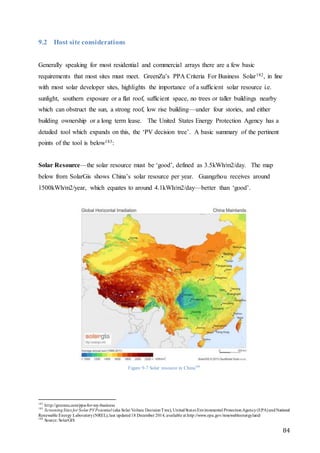
Host—for a 2MW array an area of about 4-6 hectares or about three full sized football fields are
needed. In the US, rental expense is typically no more than US$25,000 per MW per year7. Rent
can be minimized or eliminated if the host is a subscriber and land used for the array is gray-field
(failing or under utilized real estate or land) or brown-field (abandoned, industrialised sites,
water treatment plants, airports, unsuitable farmland etc.). Ensuring green fields aren’t used also
maintains the environmental integrity of the project8. Aside from rental income, intangible
benefits to the host include positive publicity, fulfilling environmental duties, and perhaps
establishing a sense of community pride. Ideal hosts are organizations with large amounts of
under utilized space, otherwise unsuitable for commercial, recreational, or agricultural activities
and in a location relatively close to grid connectivity points.
Anchor investor—the anchor investor is ideally an entity with a government connection that can
make the project happen. The anchor investor also has a large energy appetite like an airport,
university, water treatment plant etc. and could own up to 50% of the array. As subscribers buy
in, the anchor investor is reimbursed (with return). If no anchor investor can be found then the
project could possibly be financed with a commercial loan.
7 personal communication with Joy Hughes, founderandCEO of Solar Gardens Institute, 10November 2014
8
Joy Hughes in a personal communicationwith Elana BulmanforherSenior Thesis, March 20, 2012
13
Hosting Service Provider—the hosting service provider, HSP, is a special purpose entity set up
to design, install, and implement the project and sell it to subscribers. After installation it is also
responsible for ongoing operations and maintenance, acts as an agent to subscribers, and liaison
between them and the utility, with whom it negotiates the FIT and bill credits. It also liaises
with the relevant authorities to ensure payment of any financial incentives.
Utility—national policy in China states that the utility is obligated to purchase power produced
by the array at the rate it otherwise pays the power plant, i.e. the wholesale rate. Apart from
diversifying its power supply and alleviating strain on the grid during times of peak demand
(especially in summer with intensive A/C usage in Guangzhou), the utility has central
government devised obligations to source a certain percentage of its power from renewable
energy sources. In the US, crucially the utility is not only responsible for grid connectivity, but
also virtual net metering subscribers’ energy usage and billing accordingly.
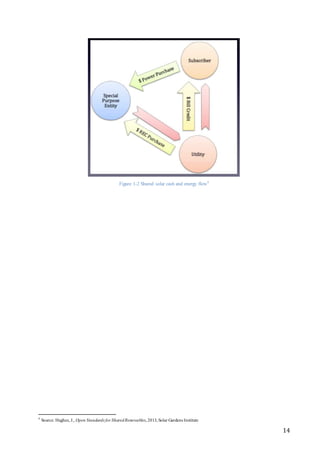
In an ideal scenario all stakeholders are on board. A host is found which will anchor the project
and purchase a good portion of the output, forgoing rent for a discounted power purchase
agreement. Subscribers make up the remainder of the investment and the utility agrees to credit
them for their proportionate share of the power produced by the array. Ideally this is a virtually
net metered kWh bill credit which directly hedges rate rises and equates to positive cash flow
from day 1; second best is monetary compensation at the full retail rate of electricity (unlikely)
or more realistically some negotiated rate between it and the wholesale rate. A special purpose
entity is created, the HSP, which facilitates the process and importantly collects production or
capacity based incentives and distributes them to investors for a fee. Joy Hughes of Solar
Gardens Institute summarises the cash and energy flow below:
14
Figure 1-2 Shared solar cash and energy flow9
9
Source: Hughes, J., Open Standards for SharedRenewables,2013, Solar Gardens Institute
15
2 Community solar gardens
The solar gardens concept was pioneered in the US where attractive returns on investment
largely depend on state and local government capacity and production incentives. A number of
schemes and business models exist whereby a group of investors motivated both by
environmental stewardship and financial gain pool their capital to build a solar array either on
rented land or a host site location, returns coming in the form of either power sales to a host or
FIT (production based incentives), as well as other tax incentives (capacity based). Below are
two examples.
1. University Park Community Solar LLC10 in Maryland was established in May 2010
and up and running by 22 July the same year. 35 community members formed an LLC
collectively investing US$130,315 and facilitated the installation of a 22.77kW system
on the roof of a church, which agreed to purchase the 30,442kWh11 generated by the
array for 20 years with an option to purchase the installation outright before the term
expires12. Apart from PPA revenues, other incentives for subscribers included the federal
tax credit/grant, a state grant, accelerated depreciation and sale of renewable energy
credits with an expected payback of 5-6 years13. Using financial data available at the
website I estimate project IRR at conception of around 12% and simple payback in year
8. However in 2011 market rate for SREC’s was US$350. It has since dropped and
averaged around US$185, significantly lowering IRR to around 4.5% and lengthening
payback to around year 13.
2. Greenbelt Community Solar LLC also in Maryland saw 30 community members come
together to facilitate the installation of a 21.6kW array again on the roof a church. Total
funds raised exceeded US$100,000. The PPA with the church is set at 90% of the utility
rate escalating as rates rise14. The length of the PPA is twenty years and if not purchased
before then ownership flips to the church. With no access to financial data I was unable
to estimate payback and IRR.
10
http://www.universityparksolar.com/index.htm
11
http://www.universityparksolar.com/index.htm
12
Coughlin, J., Grove, J., Irvine,L., Jacobs, J. F., Phillips, S. J., Sawyer, A., Wiedman,J., A Guideto Community SharedSolar:Utility, Private,
and Nonprofit Project Development, National Renewable Energy Laboratory, 2012 available at http://www.nrel.gov/docs/fy12osti/54570.pdf
13
Coughlin, J., Grove, J., Irvine,L., Jacobs, J. F., Phillips, S. J., Sawyer, A., Wiedman,J., A Guideto Community SharedSolar:Utility, Private,
and Nonprofit Project Development, National Renewable Energy Laboratory, 2012 available at http://www.nrel.gov/docs/fy12osti/54570.pdf
14
Dave Konkle, February2014, A Guidebook forCommunitySolar Programs in MichiganCommunities
16
2.1 Solar Mosaic Co.
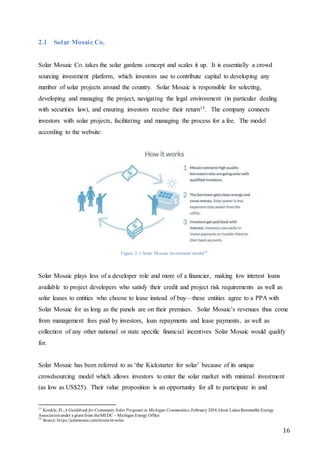
Solar Mosaic Co. takes the solar gardens concept and scales it up. It is essentially a crowd
sourcing investment platform, which investors use to contribute capital to developing any
number of solar projects around the country. Solar Mosaic is responsible for selecting,
developing and managing the project, navigating the legal environment (in particular dealing
with securities law), and ensuring investors receive their return15. The company connects
investors with solar projects, facilitating and managing the process for a fee. The model
according to the website:
Figure 2-1 Solar Mosaic investment model16
Solar Mosaic plays less of a developer role and more of a financier, making low interest loans
available to project developers who satisfy their credit and project risk requirements as well as
solar leases to entities who choose to lease instead of buy—these entities agree to a PPA with
Solar Mosaic for as long as the panels are on their premises. Solar Mosaic’s revenues thus come
from management fees paid by investors, loan repayments and lease payments, as well as
collection of any other national or state specific financial incentives Solar Mosaic would qualify
for.
Solar Mosaic has been referred to as ‘the Kickstarter for solar’ because of its unique
crowdsourcing model which allows investors to enter the solar market with minimal investment
(as low as US$25). Their value proposition is an opportunity for all to participate in and
15
Konkle, D.,A Guidebook for Community Solar Programs in Michigan Communities,February 2014,Great Lakes Renewable Energy
Associationunder a grant from theMEDC – Michigan Energy Office
16
Source: https://joinmosaic.com/invest-in-solar
17
contribute to the development of a growing, environmentally friendly industry while receiving
modest but stable, long-term returns—usually in the 4.5-7% range (but could be up to 10%)17
and payback of 5-10 years18.
Solar Mosaic’s current strategy is to increase focus on the residential market offering low
interest loans and solar leases to homeowners looking to go solar. The competition in the US
residential solar loan/lease market is stiff with a number of incumbents including SolarCity,
Vivint, Sungevity and SunPower all offering similar services19. On the investor side, while
investor returns are modest and only realised over the long term, interest in Solar Mosaic’s solar
backed securities is high. It is not uncommon for Solar Mosaic project offerings to sell out
within 24 hours and since establishment in 2010, according to their website, they have so far
raised over US$10 million in investments and generated almost 28 million kWh in clean solar
energy.
Solar Mosaic’s product is differentiated in that it takes the community shared solar gardens
concept and makes it easy to use, technically sophisticated, and appealing to a young, tech
savvy, environmentally conscious demographic that is adept at using online platforms to manage
money. On top of this subscribers can pick and choose which project they invest in allowing
them to invest in projects visible in their own communities.
2.2 Serving an expanding market niche
Solar Mosaic has taken the community owned solar gardens concept, expanded it and turned it
into an investment opportunity for anyone—not just those that form a community of
geographically close, like minded people as the typical solar gardens project generally requires.
Initially, just like Kickstarter20, Solar Mosaic offered individual ‘tiles’ (shares) in a project after
which a certain number were sold allowed the project to get underway21. A unique selling point
for investors is knowing in exactly what and how much they are investing, as well as their
proportional share in the project (see graphic).
17
Bulman, E., Community Solar Models NationwideandPossibilities for New York City, May 2012,Senior Thesis for UrbanStudies Dep.
Eugene Language College, The NewSchool University
18
Wang, U., Solar StartupMosaic Counts On Former SunPower ExecFor Growth, 24July 2014,available at
http://www.forbes.com/sites/uciliawang/2014/07/24/solar-startup-mosaic-counts-on-former-sunpower-exec-for-growth/
19
Wang, U., Solar StartupMosaic Counts On Former SunPower ExecFor Growth, 24July 2014,available at
http://www.forbes.com/sites/uciliawang/2014/07/24/solar-startup-mosaic-counts-on-former-sunpower-exec-for-growth/
20
https://www.kickstarter.com/
21
Wang, U., 13 Solar Startups to Watch in 2013,9 January2013, https://gigaom.com/2013/01/09/13-solar-startups-to-watch-in-2013/
18
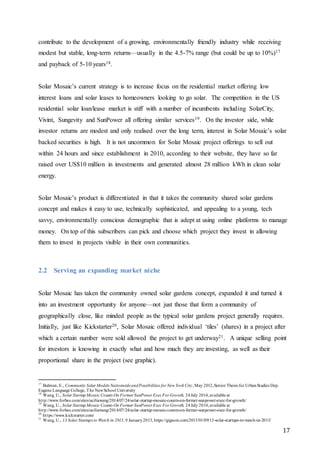
Figure 2-2 Solar Mosaic Project Offerings22
Since kicking off it has evolved into a platform which offers financial products to the online
community comprising prospective solar investors anywhere, and on the solar side allowed for
the development of projects via low interest loans to project developers and homeowners. The
investment is promoted as a safe, low risk, clean and financially attractive vehicle (compared to
savings accounts), thus serving a (steadily) growing niche market that wants access to this solar
asset class23. Even if returns were not competitive it is not an altruistic investment since the
entire community benefits via reduced carbon emissions due to solar users reduced reliance on
the grid.
For organisations, firms and homeowners as well as solar developers Solar Mosaic makes a
source of low interest capital available for their solar projects to get underway. Those who
choose to buy receive instant credit with a low interest loan leading to savings from day 124.
Those who choose to rent simply make their rooftop available for installation and are free of
risk, ongoing transaction and O&M costs, also enjoy savings from day 1. The Solar Mosaic
leasing model is different from other leasing models which generally seek to lock in long term
PPA’s tied to utility rates as compensation.
22
Source: Wang, U., 13 Solar Startups to Watch in 2013, 9 January 2013,https://gigaom.com/2013/01/09/13-solar-startups-to-watch-in-2013/
23
Wang, U., 13 Solar Startups to Watch in 2013,9 January2013, https://gigaom.com/2013/01/09/13-solar-startups-to-watch-in-2013/
24
http://homesolar.joinmosaic.com/partners/
19
2.3 First large scale success story
One of Solar Mosaic’s definitive projects was the raising of a US$698,775 loan to fund the
installation of 447kW worth of panels on the Wildwoods Convention Center in Wildwood, New
Jersey. Having launched a number of successful smaller scale projects up until this point,
mostly on schools and community centres, and under 114kW in size, Solar Mosaic had decided
to scale up and attempt to raise much more substantial funds for a large scale project on the east
coast of the United States.
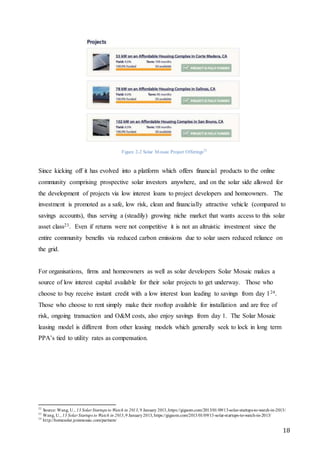
2.3.1 Wildwoods Convention Center
Some months prior to the development of the project the Governor of the state Chris Christie had
“signed legislation to grow New Jersey’s solar industry”25 making this an ideal project to
showcase the state’s commitment to renewable energy. The venue, the Wildwoods Convention
Center in New Jersey, was opened in 2001 and is a modern, state-of-the-art, 260,000-square-foot
facility located on the picturesque New Jersey shore and designed to hold conventions, trade
shows, meetings, concerts and exhibits with a maximum capacity of 10,00026. Plans were that
the centre would eventually host the installation of 447kW of panels, which would produce
550,000 kWh of electricity annually, enough for 24% of its energy needs.
Figure 2-3 Wildwoods Convention Center NJ
25
Wildwood Convention Center unveils solar project, 25July 2012, Shore News Today,available at
http://www.shorenewstoday.com/snt/news/index.php/wildwood-mainmenu/wildwood-leader/27771-convention-center-unveils-solar-project.html
26
http://www.wildwoodsnj.com/cc/
20
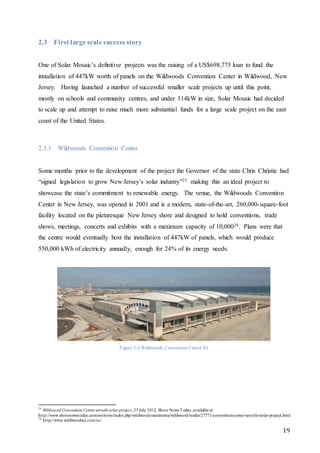
Figure 2-4 Wildwoods Convention Center Solar Installation
2.3.2 Roll out
The project was rolled out in three phases, with Mosaic involved in the final round, which went
online in April 2013 and sought to raise almost US$700,00027. The securities on offer would
mature in 114 months and subscribers would earn an annual return of 4.5%28. In total funds of
over US$1.3m were raised and total of 1,700 panels were installed with Tioga Energy and EPC
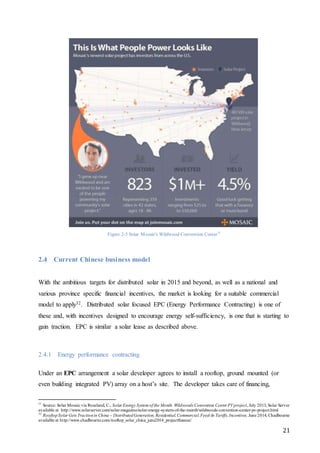
contractor Pro-Tech Energy Solutions involved29. 823 investors from 42 states subscribed to the
project. Their returns consist of revenues from the sale of the output to the state of New Jersey,
the New Jersey Sports and Exposition Authority and the Greater Wildwoods Tourism
Development Authority, as well as proceeds from the sale of the Solar Renewable Energy
Credits (national incentives) to Atlantic City Electric30. Due to the uniqueness of the funding
approach and ambitious size of the project it received Solar Server’s July 2013 Solar Energy
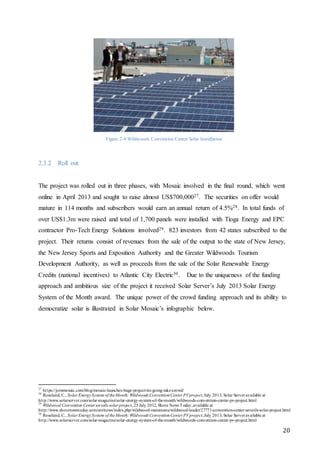
System of the Month award. The unique power of the crowd funding approach and its ability to
democratize solar is illustrated in Solar Mosaic’s infographic below.
27
https://joinmosaic.com/blog/mosaic-launches-huge-project-its-going-take-crowd/
28
Roseland, C., Solar EnergySystem of theMonth: Wildwoods ConventionCenter PVproject,July 2013, Solar Serveravailable at
http://www.solarserver.com/solar-magazine/solar-energy-system-of-the-month/wildwoods-convention-center-pv-project.html
29
Wildwood Convention Center unveils solar project, 25July 2012, Shore News Today,available at
http://www.shorenewstoday.com/snt/news/index.php/wildwood-mainmenu/wildwood-leader/27771-convention-center-unveils-solar-project.html
30
Roseland, C., Solar EnergySystem of theMonth: Wildwoods ConventionCenter PVproject,July 2013, Solar Serveravailable at
http://www.solarserver.com/solar-magazine/solar-energy-system-of-the-month/wildwoods-convention-center-pv-project.html
21
Figure 2-5 Solar Mosaic's Wildwood Convention Center31
2.4 Current Chinese business model
With the ambitious targets for distributed solar in 2015 and beyond, as well as a national and
various province specific financial incentives, the market is looking for a suitable commercial
model to apply32. Distributed solar focused EPC (Energy Performance Contracting) is one of

these and, with incentives designed to encourage energy self-sufficiency, is one that is starting to
gain traction. EPC is similar a solar lease as described above.
2.4.1 Energy performance contracting
Under an EPC arrangement a solar developer agrees to install a rooftop, ground mounted (or
even building integrated PV) array on a host’s site. The developer takes care of financing,
31
Source: Solar Mosaic via Roseland, C., Solar Energy System of the Month: Wildwoods Convention Center PVproject, July 2013, Solar Server
available at http://www.solarserver.com/solar-magazine/solar-energy-system-of-the-month/wildwoods-convention-center-pv-project.html
32
RooftopSolar Gets Tractionin China – DistributedGeneration, Residential,Commercial,Feed-In Tariffs, Incentives, June 2014, Chadbourne
available at http://www.chadbourne.com/rooftop_solar_china_june2014_projectfinance/
22
development and installation of the project as well as ongoing O&M expenses for the life of the
project. In return the host, usually a commercial entity such as an airport, factory etc., agrees to
a long term PPA with the developer, signing a contract obligating it to purchase all the power
produced by the array for the life of the project—at a discounted rate to incentivise the host
which often escalates along with the current utility rate.
The developer essentially bears all the risk but maintains ownership allowing it to capture any
national or provincial incentives. The host benefits from a discounted energy rate over the life of
the project, which means positive cash flows from day 1 and importantly no initial investment.
After the developer experiences payback (perhaps 6 to 7 years) and had sufficient return (ideally
IRR >12%) ownership of the array reverts to the host which then enjoys grid independence with
unfettered access to its own green energy supply for the rest of the life of the panels. The
ownership flip happens after around 20 years in the US but can be sooner depending on the
agreement between owner/developer and host.
Similarities to US ownership flip model
This kind of ownership ‘flip’ model is not uncommon in the US as a means for community solar
gardens projects to get underway with long term benefits to both host and subscribers (although
subscriber returns are usually much lower than 12%). The University Park Community Solar
LLC and Greenbelt Community Solar LLC projects both have ownership flip options—the host
Churches have the option to buy the panels outright before the PPA contract expires33. At
expiration, the ownership flips to the Church anyway.
2.4.2 Recent Solar EPC projects in China
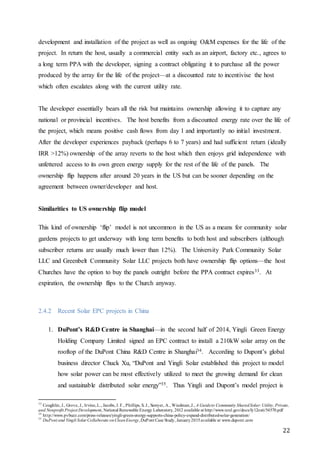
1. DuPont’s R&D Centre in Shanghai—in the second half of 2014, Yingli Green Energy
Holding Company Limited signed an EPC contract to install a 210kW solar array on the
rooftop of the DuPont China R&D Centre in Shanghai34. According to Dupont’s global
business director Chuck Xu, “DuPont and Yingli Solar established this project to model
how solar power can be most effectively utilized to meet the growing demand for clean
and sustainable distributed solar energy”35. Thus Yingli and Dupont’s model project is
33
Coughlin, J., Grove, J., Irvine,L., Jacobs, J. F., Phillips, S. J., Sawyer, A., Wiedman,J., A Guideto Community SharedSolar:Utility, Private,
and Nonprofit Project Development, National Renewable Energy Laboratory, 2012 available at http://www.nrel.gov/docs/fy12osti/54570.pdf
34
http://www.pvbuzz.com/press-releases/yingli-green-energy-supports-china-policy-expand-distributed-solar-generation/
35
DuPont and Yingli Solar Collaborate onCleanEnergy,DuPont Case Study, January2015available at www.dupont.com
23
not just an arms-length commercial transaction but a strategic collaboration intended to
showcase both firm’s core competencies and highlight their commitment to the
development of solar in China—in fact DuPont already has 13 other solar installations at
other sites36. The PPA is a 25 year contract in which DuPont agrees to purchase all
202,000 kWh expected to be produced by the panels37 (presumably at a discount). The
installation is financed, owned and managed by Yingli which expects pay back in
approximately 6 years after which it enjoys free cash flows, after expenses, for the rest of
the life of the project. The panels cover a rooftop space of 2,100 square meters and
according to their case study produce the equivalent energy consumption of 670 Chinese
households per month38. A video summary of the project is available at the website39.
Figure 2-6 DuPont R&D Centre Shanghai Solar Installation
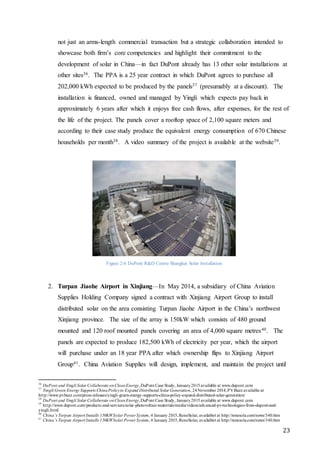
2. Turpan Jiaohe Airport in Xinjiang—In May 2014, a subsidiary of China Aviation
Supplies Holding Company signed a contract with Xinjiang Airport Group to install
distributed solar on the area consisting Turpan Jiaohe Airport in the China’s northwest
Xinjiang province. The size of the array is 150kW which consists of 480 ground
mounted and 120 roof mounted panels covering an area of 4,000 square metres40. The
panels are expected to produce 182,500 kWh of electricity per year, which the airport
will purchase under an 18 year PPA after which ownership flips to Xinjiang Airport
Group41. China Aviation Supplies will design, implement, and maintain the project until
36
DuPont and Yingli Solar Collaborate onCleanEnergy,DuPont Case Study, January2015available at www.dupont.com
37
Yingli Green Energy Supports ChinaPolicyto Expand Distributed Solar Generation, 24November 2014,PVBuzz available at
http://www.pvbuzz.com/press-releases/yingli-green-energy-supports-china-policy-expand-distributed-solar-generation/
38
DuPont and Yingli Solar Collaborate onCleanEnergy,DuPont Case Study, January2015available at www.dupont.com
39
http://www.dupont.com/products-and-services/solar-photovoltaic-materials/media/videos/advanced-pv-technologies-from-dupont-and-
yingli.html
40
China’s Turpan Airport Installs 150KWSolar Power System, 4 January 2015,ReneSolar, availablet at http://renesola.com/news/340.htm
41
China’s Turpan Airport Installs 150KWSolar Power System, 4 January 2015,ReneSolar, availablet at http://renesola.com/news/340.htm
24
payback and sufficient return are received. At the end of the PPA the airport enjoys free,
green, grid independent electricity with the panels expected to last another 7 years or
so42.
Figure 2-7 Turpan Airport Solar Installation
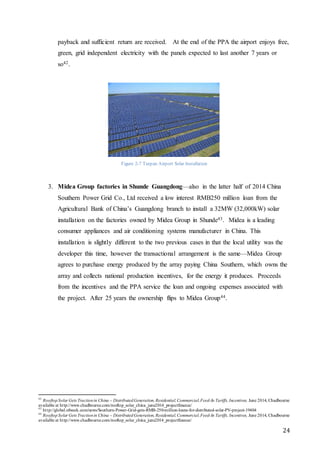
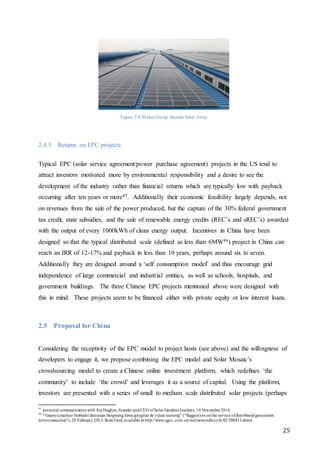
3. Midea Group factories in Shunde Guangdong—also in the latter half of 2014 China
Southern Power Grid Co., Ltd received a low interest RMB250 million loan from the
Agricultural Bank of China’s Guangdong branch to install a 32MW (32,000kW) solar
installation on the factories owned by Midea Group in Shunde43. Midea is a leading
consumer appliances and air conditioning systems manufacturer in China. This
installation is slightly different to the two previous cases in that the local utility was the
developer this time, however the transactional arrangement is the same—Midea Group
agrees to purchase energy produced by the array paying China Southern, which owns the
array and collects national production incentives, for the energy it produces. Proceeds
from the incentives and the PPA service the loan and ongoing expenses associated with
the project. After 25 years the ownership flips to Midea Group44.
42
RooftopSolar Gets Tractionin China – DistributedGeneration, Residential,Commercial,Feed-In Tariffs, Incentives, June 2014, Chadbourne
available at http://www.chadbourne.com/rooftop_solar_china_june2014_projectfinance/
43
http://global.ofweek.com/news/Southern-Power-Grid-gets-RMB-250-million-loans-for-distributed-solar-PV-project-19404
44
RooftopSolar Gets Tractionin China – DistributedGeneration, Residential,Commercial,Feed-In Tariffs, Incentives, June 2014, Chadbourne
available at http://www.chadbourne.com/rooftop_solar_china_june2014_projectfinance/
25
Figure 2-8 Midea Group Shunde Solar Array
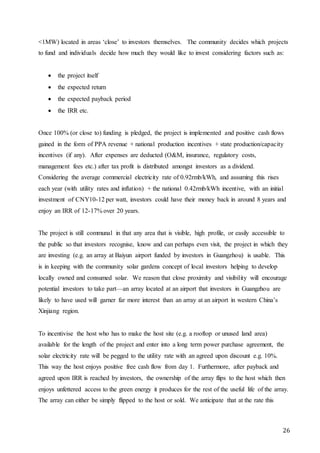
2.4.3 Returns on EPC projects
Typical EPC (solar service agreement/power purchase agreement) projects in the US tend to
attract investors motivated more by environmental responsibility and a desire to see the
development of the industry rather than financial returns which are typically low with payback
occurring after ten years or more45. Additionally their economic feasibility largely depends, not
on revenues from the sale of the power produced, but the capture of the 30% federal government
tax credit, state subsidies, and the sale of renewable energy credits (REC’s and sREC’s) awarded
with the output of every 1000kWh of clean energy output. Incentives in China have been
designed so that the typical distributed scale (defined as less than 6MW46) project in China can
reach an IRR of 12-17% and payback in less than 10 years, perhaps around six to seven.
Additionally they are designed around a ‘self consumption model’ and thus encourage grid
independence of large commercial and industrial entities, as well as schools, hospitals, and
government buildings. The three Chinese EPC projects mentioned above were designed with
this in mind. These projects seem to be financed either with private equity or low interest loans.
2.5 Proposal for China
Considering the receptivity of the EPC model to project hosts (see above) and the willingness of
developers to engage it, we propose combining the EPC model and Solar Mosaic’s
crowdsourcing model to create a Chinese online investment platform, which redefines ‘the
community’ to include ‘the crowd’ and leverages it as a source of capital. Using the platform,
investors are presented with a series of small to medium scale distributed solar projects (perhaps
45
personal communicationwith JoyHughes, founder andCEO ofSolar Gardens Institute,10 November2014
46
“Guanyuzuohao fenbushi dianyuan bingwangfuwugongzuo de yijian neirong” (“Suggestion onthe service ofdistributedgeneration
interconnection”),28 February2013, State Grid, available at http://www.sgcc. com.cn/ztzl/newzndw/cyfz/02/288813.shtml
26
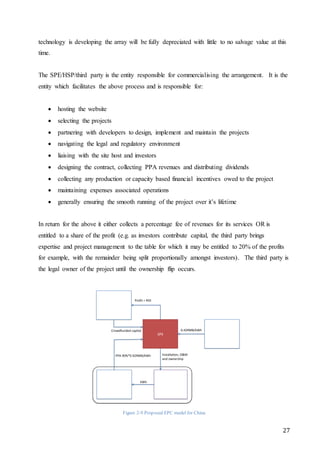
<1MW) located in areas ‘close’ to investors themselves. The community decides which projects
to fund and individuals decide how much they would like to invest considering factors such as:
 the project itself
 the expected return
 the expected payback period
 the IRR etc.
Once 100% (or close to) funding is pledged, the project is implemented and positive cash flows
gained in the form of PPA revenue + national production incentives + state production/capacity
incentives (if any). After expenses are deducted (O&M, insurance, regulatory costs,
management fees etc.) after tax profit is distributed amongst investors as a dividend.
Considering the average commercial electricity rate of 0.92rmb/kWh, and assuming this rises
each year (with utility rates and inflation) + the national 0.42rmb/kWh incentive, with an initial
investment of CNY10-12 per watt, investors could have their money back in around 8 years and
enjoy an IRR of 12-17% over 20 years.
The project is still communal in that any area that is visible, high profile, or easily accessible to
the public so that investors recognise, know and can perhaps even visit, the project in which they
are investing (e.g. an array at Baiyun airport funded by investors in Guangzhou) is usable. This
is in keeping with the community solar gardens concept of local investors helping to develop
locally owned and consumed solar. We reason that close proximity and visibility will encourage
potential investors to take part—an array located at an airport that investors in Guangzhou are
likely to have used will garner far more interest than an array at an airport in western China’s
Xinjiang region.
To incentivise the host who has to make the host site (e.g. a rooftop or unused land area)
available for the length of the project and enter into a long term power purchase agreement, the
solar electricity rate will be pegged to the utility rate with an agreed upon discount e.g. 10%.
This way the host enjoys positive free cash flow from day 1. Furthermore, after payback and
agreed upon IRR is reached by investors, the ownership of the array flips to the host which then
enjoys unfettered access to the green energy it produces for the rest of the useful life of the array.
The array can either be simply flipped to the host or sold. We anticipate that at the rate this
27
technology is developing the array will be fully depreciated with little to no salvage value at this
time.
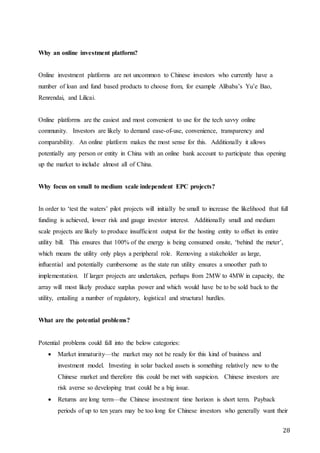
The SPE/HSP/third party is the entity responsible for commercialising the arrangement. It is the
entity which facilitates the above process and is responsible for:
 hosting the website
 selecting the projects
 partnering with developers to design, implement and maintain the projects
 navigating the legal and regulatory environment
 liaising with the site host and investors
 designing the contract, collecting PPA revenues and distributing dividends
 collecting any production or capacity based financial incentives owed to the project
 maintaining expenses associated operations
 generally ensuring the smooth running of the project over it’s lifetime
In return for the above it either collects a percentage fee of revenues for its services OR is
entitled to a share of the profit (e.g. as investors contribute capital, the third party brings
expertise and project management to the table for which it may be entitled to 20% of the profits
for example, with the remainder being split proportionally amongst investors). The third party is
the legal owner of the project until the ownership flip occurs.
Figure 2-9 Proposed EPC model for China
Crowd
SPE
Distributed solar
installa on
e.g. JNU
Management School
roo op
Host
e.g. Jinan University
Beijing
Profit = ROI
0.42RMB/kWhCrowdfunded capital
Installa on, O&M
and ownership
kWh
PPA 90%*0.92RMB/kWh
28
Why an online investment platform?
Online investment platforms are not uncommon to Chinese investors who currently have a
number of loan and fund based products to choose from, for example Alibaba’s Yu’e Bao,
Renrendai, and Lilicai.
Online platforms are the easiest and most convenient to use for the tech savvy online
community. Investors are likely to demand ease-of-use, convenience, transparency and
comparability. An online platform makes the most sense for this. Additionally it allows
potentially any person or entity in China with an online bank account to participate thus opening
up the market to include almost all of China.
Why focus on small to medium scale independent EPC projects?
In order to ‘test the waters’ pilot projects will initially be small to increase the likelihood that full
funding is achieved, lower risk and gauge investor interest. Additionally small and medium
scale projects are likely to produce insufficient output for the hosting entity to offset its entire
utility bill. This ensures that 100% of the energy is being consumed onsite, ‘behind the meter’,
which means the utility only plays a peripheral role. Removing a stakeholder as large,
influential and potentially cumbersome as the state run utility ensures a smoother path to
implementation. If larger projects are undertaken, perhaps from 2MW to 4MW in capacity, the
array will most likely produce surplus power and which would have be to be sold back to the
utility, entailing a number of regulatory, logistical and structural hurdles.
What are the potential problems?
Potential problems could fall into the below categories:
 Market immaturity—the market may not be ready for this kind of business and
investment model. Investing in solar backed assets is something relatively new to the
Chinese market and therefore this could be met with suspicion. Chinese investors are
risk averse so developing trust could be a big issue.
 Returns are long term—the Chinese investment time horizon is short term. Payback
periods of up to ten years may be too long for Chinese investors who generally want their
29
money back as quickly as possible. Since the most attractive IRR is achieved only after
20 years, shortening the investment period to half that considerably drops the IRR to
around 6-8%.
 Logistic and project related—with little to no experience working with Chinese
developers or hosts there are potentially a number of unaccounted for issues that could
come up related to installation and implementation of a distributed solar array.
 Political—we are unsure how a proposal like this would be received by the regulatory
authorities as well as what and how much of a role traditional ‘relationship’ based
business culture practices will play in getting something like this off the ground.
30
3 China’s green energy industry development and policies
Since opening up in 1978 China has achieved much in the proceeding three decades. Rapid
development exemplified by a 10% average annual growth rate has seen 500 million47 48 people
pulled out of poverty and an increase in life expectancy and life quality for Chinese citizens that
could not have been dreamed of at the time of the first reform. Today China is the world’s most
populous nation with approximately 1.4 billion people, the world’s second largest economy with
a nominal GDP of CNY56,900 billion (US$9.4 trillion)49—although may have just passed the
US to become the world’s first. It is the world’s largest manufacturer and exporter making it
effectively the factory of the world; is the world’s largest creditor; boasts two of the word’s
largest banks; has 61 companies in Fortune’s Global 500, has the “world’s second-largest
highway network, the world’s 3 longest sea bridges, and 6 of the world’s 10 largest container
ports”50; and is home to an enormous middle class with significant purchasing power making it
an extremely lucrative consumer market. It goes without saying that China is a highly influential
player on the world stage and wields significant geopolitical and economic power not only in
Asia but globally, typified by its founding in 2015 of the Asian Infrastructure Investment Bank
(AIIB) which a number of countries spanning Europe and Australasia have so far applied to be
members of.
3.1 Environmental Consequences
This rapid development however has come at considerable environmental cost. China recently
exceeded the US to become the world’s largest annual emitter of carbon dioxide (even though
it’s per capital emissions are relatively low). China’s emissions are forecast to continue to rise
as its energy appetite increases, necessary to fuel its growth (despite GDP growth rate targets
reduced to 7% at the recent 两会 National Communist Party meetings).
47
WorldBank andthe Development Research Center of the State Council,P. R. China. 2013. China2030: Buildinga Modern,Harmonious, and
Creative Society. Washington, DC: WorldBank. DOI: 10.1596/978-0-8213-9545-5.License: Creative Commons AttributionCC BY 3.0.
48
Zhang, T., Ge, Y., & Zhao, R., Creating theChinese dream: A practitioner's guideto impact investingin China's greenSMEs.,2012, China
Impact Fundavailable at http://www.ied.cn/sites/default/files/China%20Impact%20Investing%20Report_Compressed%20Final.pdf. 8-9
49
Eco-civilization: China’s Blueprint for a New Era—Interpreting outcomes from China’s latest leaders conference, February2014, Insight
Briefing, TheClimate Group
50
WorldBank andthe Development ResearchCenter of the State Council,P. R. China. 2013. China2030: Buildinga Modern,Harmonious, and
Creative Society. Washington, DC: WorldBank. DOI: 10.1596/978-0-8213-9545-5.License: Creative Commons AttributionCC BY 3.0.
31
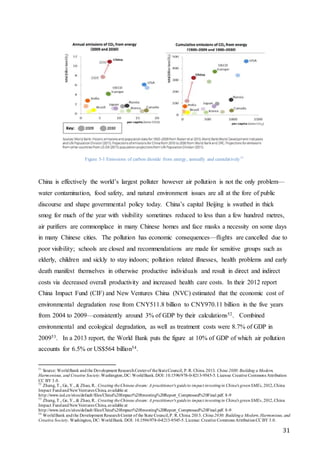
Figure 3-1 Emissions of carbon dioxide from energy, annually and cumulatively51
China is effectively the world’s largest polluter however air pollution is not the only problem—
water contamination, food safety, and natural environment issues are all at the fore of public
discourse and shape governmental policy today. China’s capital Beijing is swathed in thick
smog for much of the year with visibility sometimes reduced to less than a few hundred metres,
air purifiers are commonplace in many Chinese homes and face masks a necessity on some days
in many Chinese cities. The pollution has economic consequences—flights are cancelled due to
poor visibility; schools are closed and recommendations are made for sensitive groups such as
elderly, children and sickly to stay indoors; pollution related illnesses, health problems and early
death manifest themselves in otherwise productive individuals and result in direct and indirect
costs via decreased overall productivity and increased health care costs. In their 2012 report
China Impact Fund (CIF) and New Ventures China (NVC) estimated that the economic cost of
environmental degradation rose from CNY511.8 billion to CNY970.11 billion in the five years
from 2004 to 2009—consistently around 3% of GDP by their calculations52. Combined
environmental and ecological degradation, as well as treatment costs were 8.7% of GDP in
200953. In a 2013 report, the World Bank puts the figure at 10% of GDP of which air pollution
accounts for 6.5% or US$564 billion54.
51
Source: WorldBank andthe Development ResearchCenterof theStateCouncil, P. R. China.2013. China 2030:Building a Modern,
Harmonious, and Creative Society.Washington,DC: WorldBank.DOI: 10.1596/978-0-8213-9545-5. License: Creative Commons Attribution
CC BY 3.0.
52
Zhang, T., Ge, Y., & Zhao, R.. Creating theChinese dream: A practitioner's guideto impact investingin China's greenSMEs, 2012,China
Impact FundandNewVentures China, available at
http://www.ied.cn/sites/default/files/China%20Impact%20Investing%20Report_Compressed%20Final.pdf. 8-9
53
Zhang, T., Ge, Y., & Zhao, R.. Creating theChinese dream: A practitioner's guideto impact investingin China's greenSMEs, 2012,China
Impact FundandNewVentures China, available at
http://www.ied.cn/sites/default/files/China%20Impact%20Investing%20Report_Compressed%20Final.pdf. 8-9
54
WorldBank andthe Development ResearchCenter of the State Council,P. R. China. 2013. China2030: Buildinga Modern,Harmonious, and
Creative Society. Washington, DC: WorldBank. DOI: 10.1596/978-0-8213-9545-5.License: Creative Commons AttributionCC BY 3.0.
32
3.2 Coal
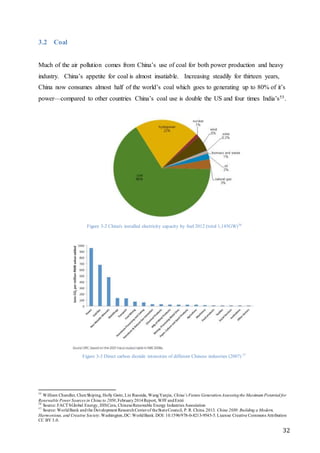
Much of the air pollution comes from China’s use of coal for both power production and heavy
industry. China’s appetite for coal is almost insatiable. Increasing steadily for thirteen years,
China now consumes almost half of the world’s coal which goes to generating up to 80% of it’s
power—compared to other countries China’s coal use is double the US and four times India’s55.
Figure 3-2 China's installed electricity capacity by fuel 2012 (total 1,145GW)56
Figure 3-3 Direct carbon dioxide intensities of different Chinese industries (2007) 57
55
William Chandler, ChenShiping, Holly Gwin, Lin Ruosida, WangYanjia, China’s Future GenerationAssessingthe Maximum Potential for
Renewable Power Sources in China to 2050,February2014Report, WFF andEntri
56
Source: FACTSGlobal Energy, IHSCera, ChineseRenewable Energy Industries Association
57
Source: WorldBank andthe Development ResearchCenterof theStateCouncil, P. R. China.2013. China 2030:Building a Modern,
Harmonious, and Creative Society.Washington,DC: WorldBank.DOI: 10.1596/978-0-8213-9545-5. License: Creative Commons Attribution
CC BY 3.0.
33
WWF and Entri estimate that coal related deaths number about 75,000 per year in China58
(although a quick internet search will show that this is probably a highly conservative figure).
Coal is bad because burning it generates particulate matter, PM. This consists of tiny particles
2.5 micrometres in diameter or less which enter the lungs when breathed in and eventually
become the cause of respiratory problems like asthma, coughing and wheezing and even long
term health problems such as cancer. The PM2.5 scale is what is used in China and around the
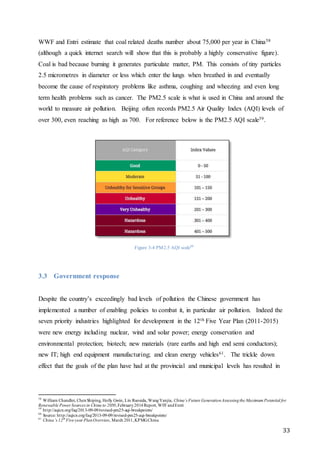
world to measure air pollution. Beijing often records PM2.5 Air Quality Index (AQI) levels of
over 300, even reaching as high as 700. For reference below is the PM2.5 AQI scale59.
Figure 3-4 PM2.5 AQI scale60
3.3 Government response
Despite the country’s exceedingly bad levels of pollution the Chinese government has
implemented a number of enabling policies to combat it, in particular air pollution. Indeed the
seven priority industries highlighted for development in the 12th Five Year Plan (2011-2015)
were new energy including nuclear, wind and solar power; energy conservation and
environmental protection; biotech; new materials (rare earths and high end semi conductors);
new IT; high end equipment manufacturing; and clean energy vehicles61. The trickle down
effect that the goals of the plan have had at the provincial and municipal levels has resulted in
58
William Chandler, ChenShiping, Holly Gwin, Lin Ruosida, WangYanjia, China’s Future GenerationAssessingthe Maximum Potential for
Renewable Power Sources in China to 2050,February2014Report, WFF andEntri
59
http://aqicn.org/faq/2013-09-09/revised-pm25-aqi-breakpoints/
60
Source: http://aqicn.org/faq/2013-09-09/revised-pm25-aqi-breakpoints/
61
China’s 12th
Five-year PlanOverview, March 2011,KPMGChina
34
significant strides in combating pollution and ultimately climate change. From a 2013 report by
China’s National Development and Reform Commission:
“In 2012, CO2 emissions per unit of GDP fell 5.02 percent compared to 2011. By the end
of 2012, the output of China’s energy saving and environmental protection industry
exceeded 2.7 trillion yuan. China’s current capacity in hydropower, nuclear, solar, and
wind power, and plantation areas all rank first in the world…”62
Even outside of China, the country is acknowledged as being at the forefront of renewable
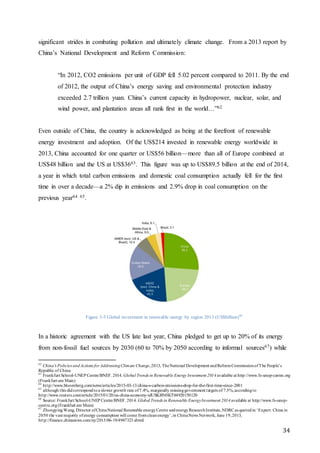
energy investment and adoption. Of the US$214 invested in renewable energy worldwide in
2013, China accounted for one quarter or US$56 billion—more than all of Europe combined at
US$48 billion and the US at US$3663. This figure was up to US$89.5 billion at the end of 2014,
a year in which total carbon emissions and domestic coal consumption actually fell for the first
time in over a decade—a 2% dip in emissions and 2.9% drop in coal consumption on the
previous year64 65.
Figure 3-5 Global investment in renewable energy by region 2013 (US$billion)66
In a historic agreement with the US late last year, China pledged to get up to 20% of its energy
from non-fossil fuel sources by 2030 (60 to 70% by 2050 according to informal sources67) while
62
China's Policies andActions for AddressingClimate Change,2013, TheNational Development andReformCommissionofThe People’s
Republic of China
63
Frankfurt School-UNEP Centre/BNEF. 2014.Global Trends in Renewable Energy Investment 2014 available at http://www.fs-unep-centre.org
(Frankfurt am Main)
64
http://www.bloomberg.com/news/articles/2015-03-13/china-s-carbon-emissions-drop-for-the-first-time-since-2001
65
although this didcorrespondtoa slower growth rate of7.4%, marginally missinggovernment targets of 7.5%,accordingto
http://www.reuters.com/article/2015/01/20/us-china-economy-idUSKBN0KT04920150120
66
Source: Frankfurt School-UNEP Centre/BNEF. 2014. Global Trends in Renewable EnergyInvestment 2014 available at http://www.fs-unep-
centre.org(Frankfurt am Main)
67
ZhongyingWang, Director ofChinaNational Renewable energyCentre andenergyResearchInstitute,NDRC as quotedin ‘Expert: China in
2050 the vast majority ofenergy consumption will come fromcleanenergy’,in ChinaNews Network, June 19,2013,
http://finance.chinanews.com/ny/2013/06-19/4947323.shtml
35
the US will cut emissions levels almost 30% below 2005 levels by 202568. The government is
widely regarded as having some of the most encouraging renewable energy policies in the world
and is far ahead in terms of installed capacity and total production as the graphic below
illustrates. Recently the Chinese Academy of Sciences was ranked the top R&D institution in
the world for renewable energy by KIC InnoEnergy and Questel Consulting of the European
Institute for Innovation and Technology (EIT)69.
Table 3-1 Energy mix of top countries for renewables in 201370
3.4 Solar power
Solar will eventually play a significant role in the energy mix. The central government
recognises its importance and has year on year extended it’s incremental capacity and overall
installed capacity goals over the course of the 12th Five Year Plan.
68
Spross, Jeff., We Have A Deal: The U.S. AndChina Agree To Historic EmissionReductionTargets, 12 November2014, available at
http://thinkprogress.org/climate/2014/11/12/3591284/us-china-climate-deal/
69
Beckman, K.,ChineseAcademy of Sciences Is Top Academic R&D Player In SustainableEnergy,14 March2015, available at
http://www.energypost.eu/meet-worlds-number-1-academic-player-sustainable-energy-chinese-academy-
sciences/http://www.energypost.eu/meet-worlds-number-1-academic-player-sustainable-energy-chinese-academy-sciences/
70
Source: REN21. 2014.Renewables 2014Global Status Report (Paris: REN21Secretariat)
36
Figure 3-6 China Solar PV Installations to 2015 (GW)71
Total installed capacity by the end of 2015 is to be 35GW. This target is likely to be met at the
current rate despite last year’s goals falling short—only 10GW of a 14GW goal was installed last
year (8GW of which was to be distributed). Considering that current installed capacity is around
28.05GW of which 23.38GW is ground mounted (utility scale) and only 4.67GW distributed72
the target of 15GW for 2015 is ambitious and exciting. Most of this will have to be distributed
scale though if the government is to reach its 15GW total installed capacity target by the end of
the Plan (3.15GW of this will be rooftop)73.
These targets along with favourable policy, incentives and practical measures (a nation wide
production incentive of CNY0.42/kWh regardless of whether the electricity is consumed onsite
of fed back into the grid, low cost financing options for distributed projects, monthly billing to
help alleviate cash flow pressure for developers, and free permitting and grid interconnectivity74)
create an environment for distributed solar that is not only financially lucrative for the right
business model, but an opportunity for contributing to the alleviation of China’s air pollution
crisis by taking strain off the largely coal fired grid, evening up the energy mix, and thus
curtailing climate change.
71
Source: Hove, A., Cleantech AdvisoryManager, CAN CHINA DISTRIBUTED SOLAR REACH 20GWBY 2015?, 9 December2013, Azure
International (Azure International analysis andgovernment targets)
72
Shaw, V., China: PVinstalled capacity grows to almost 30GWin 2014, 16February 2015,available at http://www.pv-
magazine.com/news/details/beitrag/china--pv-installed-capacity-grows-to-almost-30-gw-in-2014_100018231/#ixzz3WsjHhbEl
73
Shaw, V. andHall, Max., Chinaunveils 15GWsolar target, 30January2015, PVMagazine available, at http://www.pv-
magazine.com/news/details/beitrag/china-unveils-15-gw-solar-target_100018005/#axzz3T0suDQBJ
74
Hove, A., CleantechAdvisoryManager, CAN CHINA DISTRIBUTED SOLAR REACH 20GWBY 2015?, 9 December 2013, Azure
International
37
Section 2
4 Feasibility study
4.1 Purpose
The purpose of this feasibility study is to explore whether the solar gardens business model
could be adapted to suit China. The model should be in keeping with the basic solar gardens
principles of distributed generation, community buy-in and openness to all, a return, and of
course a net positive effect on the environment. In attempting to maintain these basic principles,
the current distributed solar and crowd-funding environment in China will be examined to see
how the original business model could evolve in order to take advantage of favourable renewable
energy policies and incentives, in particular with regard to distributed solar generation.
Additionally it will be important to explore how the currently hazy regulatory framework
surrounding crowdfunding could be navigated. The question we ask is whether distributed solar
EPC/PPA generation projects could be financed via equity-based crowdfunding in China.
Furthermore it will be important to determine how this investment could be marketed (e.g.
impact investment), what it would involve technically, as well as the potential return to
investors. As far as we know a model like this has not been implemented anywhere yet in
mainland China.
This research was carried out in close collaboration with Joy Hughes of The Solar Gardens
Institute in Colorado, United States. The Solar Gardens Institute (www.solargardens.org) is an
institution devoted to the promotion of the solar gardens concept and community solar in general
through education, training and consulting. Joy Hughes is its founder and CEO and has a strong
interest in promoting the concept in China. Over the course of researching and writing this
thesis I maintained frequent correspondence with her and also had the opportunity to meet with
her in person as she visited China on a number of occasions. This paper aims to be a useful
resource for anyone hoping to develop any kind of community solar model or project in China.
Why crowdfunding?
Numerous studies and reports highlight the potential for crowdfunding to tackle climate change
by making funds available to small and medium sized businesses involved in renewable energy
38
related projects and clean tech in general75 76 77 78. Crowdfunding connects the people with the
business idea, directly to the people with the funds to make it happen, bypassing traditional
financing options like banks and venture capitalists79. This form of funding not only cuts out the
middleman but also democratizes the process i.e. it is the crowd itself which determines which
business or project is worthy of being funded. Additionally, while the crowd at an individual
level holds relatively meagre financial resources, as a whole it represents a significant source of
capital—and in China, as we know, the crowd is huge. The savings deposit base in China is
around CNY74.2 trillion80 and the World Bank values the crowdfunding market here at US$50
billion over the next ten years81. Clearly then there is an opportunity for an impact investment82
type product—like crowdfunded distributed solar—to gain a share of the pie.
75
Crowdfunding’s Potential for the Developing World, 2013,infoDev, Finance andPrivate Sector Development Department, Washington, DC:
WorldBank
76
Tao Zhang, Christine Yip, Ge (Sophy)Wang, Qin (Iris) Zhang, ChinaCrowdfundingReport, October 2014,producedby the China Impact
Fund of Dao Ventures
77
Vellinger, K., Redefiningimpact: case studies in transformative finance, January 2013,Tonic andTransformativeFinance Network
78
CrowdfundingandRenewable Energy: Couldit Revolutionize Large-ScaleRenewable Project Financing?, Energy PolicyInnovationCouncil
79
Tao Zhang, Christine Yip, Ge (Sophy)Wang, Qin (Iris) Zhang, ChinaCrowdfundingReport, October 2014,producedby the China Impact
Fund of Dao Ventures
80
StratforGlobal Intelligence analysis, 3 March2014, available at https://stratfor.com/analysis/new-investment-platforms-raise-questions-chinas-
banking-system
81
Crowdfunding’s Potential for the Developing World, 2013,infoDev, Finance andPrivate Sector Development Department, Washington, DC:
WorldBank
82
“combiningforprofit incentives with social andenvironmental (SE) benefits”accordingto TaoZhang, Christine Yip,Ge (Sophy)Wang, Qin
(Iris) Zhangin ChinaCrowdfundingReport, October 2014,producedby the China Impact Fundof Dao Ventures
39
5 Market Analysis
5.1 Demographics
There are no geographic boundaries. Leveraging the reach of the internet, potentially any person
in China with access to the internet and an online bank account could form part of the market. In
2014 of a population of almost 1.4 billion people, 46%, or 641 million people, were internet
users83. This penetration rate has been steadily rising each year.
Regarding demographics, current draft regulations restrict the crowd to accredited investors who
are high net worth individuals i.e. those worth CNY1 million in assets and an income of at least
CNY300,000. This somewhat limits the demographics to individuals with high net incomes and
by extension individuals likely to have had some tertiary education. It is important to note
however that these are draft regulation (more detail below) and that currently nothing is stopping
anyone with an online bank account from making investments in crowdfunding and P2P lending
schemes. If we are to market this opportunity as an impact investment then the key demographic
is likely to be young people, perhaps under 35 who are educated and employed with a reasonable
income level and some savings.
Behavioural factors are likely to be most important. In 2013, more than 250 million internet
users used the internet for online banking (260 million used platforms like Alipay for online
payments)84 and this figure is only likely to grow along with internet penetration rates. The
typical online financial services user is likely to be young and tech savvy and prefers managing
their money using their smartphone or hand held device rather than physically entering a branch.
Furthermore the typical online investor is likely to be a young person with some savings he or
she is keen to grow. We speculate that an investment in a crowdfunded distributed solar
project—what is essentially a solar backed security—could be viewed in the eyes of the
consumer as a substitute to a term deposit savings accounts or other long term low liquidity
investment vehicle, but with much higher returns and relatively low risk. Chinese online
investors are concerned with or characterised by the following:
83
http://www.internetlivestats.com/internet-users/china/
84
http://www.statista.com/statistics/277352/online-activities-in-china-based-on-number-of-users/
40
 Reputation85—investors are more likely to use a mature platform with a good reputation,
ideally one that is backed by a well-known company within the industry such as Alibaba,
Jindong, or Tencent. This helps to ‘buy trust’, important in Chinese culture, and crucial
to the success of the project or start-up. Lack of reputation and by extension trust is
likely to prove the biggest competitive disadvantage when compared to incumbents.
 Transferrable ownership rights86—investors tend to want a liquid investment. They want
to be able to easily transfer their funds in and out of projects (and presumably between
projects). This helps to reduce their risk. Indeed ‘demand deposit’ is a unique selling
point of Alibaba’s Yu’e Bao 余额宝. This is easy for platforms with a large customer
base but for smaller platforms it is difficult. Building up or inheriting (via partnership) as
extensive a customer base as possible and implementing this feature will therefore be
important.
 Short time horizon87—investors prefer projects with a short time horizon, ideally no more
than one year. The long time horizon associated with payback and ROI of distributed
solar projects may be a hurdle for Chinese investors.
 Small size88—investors prefer projects that are smaller in size, at least initially. Larger
projects should be divided into a series of smaller rounds of funding i.e. instead of one
CNY1 million round, three rounds of CNY333,000 could be offered89. Distributed solar
projects require significant capital outlay—the main barrier actually holding many cash
flow concerned entities from going solar in the first place. Separate but simultaneous
rounds of funding may help to alleviate this issue.
 Risk—Chinese are risk averse. McKinsey found that 70%90 of affluent91 Chinese say
that they are “risk averse” and that “principal protection is their primary investment
consideration” when it comes to personal financial services92. Many of the people I
talked to seconded this view. Solar is a relatively low risk technology however. With
few moving parts and favourable government policy for the next 20 years at least, all that
is needed is for the sun to shine for the array to generate revenue.
85
Personal communicationwith founder of 理理财‘Lilicai’ onThursday5 February2015
86
Personal communicationwith founder of 理理财‘Lilicai’ onThursday5 February2015
87
Personal communicationwith founder of 理理财‘Lilicai’ onThursday5 February2015
88
Personal communicationwith founder of 理理财‘Lilicai’ onThursday5 February2015
89
Interestingly,accordingtothe founder ofLilicai,it seems Chinese investors are not overly concernedwith the kind ofproject they areinvesting
as they lackanymeaningful methodof actuallymeasuringthe risk ofa project, orassessingthequality ofa loan.
90
In 2014 McKinsey andCompanyperformeda personal financial services surveyof 3,558 Chinese consumers across Tier 1,2, 3, and4 cities
91
Affluent segment are those whose pre-tax householdincomeexceeds RMB228,000; mass-affluent between RMB162,000andRMB228,000;
upper mass between RMB88,000and162,000; lower mass between RMB53,000 andRMB88,000(McKinseyandCompany2014)
92
Kenny Lam, JaredShuandElaine Huang, Four Trends ShapingChina’s Retail BankingLandscape, January 2015,McKinsey& Company
41
 Preference for debt93—Chinese consumers would rather their principal be guaranteed
than have an unlimited upside, and therefore prefer debt to equity based crowdfunding
investments.
 Personal financial planning—53% of Chinese consumers say that they have or are
considering a long-term financial plan94.
 Heavy usage—almost half of consumers are heavy users with an average of 4.5 to 6.0
banking products95.
 Financial return—at the end of the day investors are most concerned about their financial
return than any social or environmental benefit associated with the investment96.
Figure 5-1 There are 3 main types of financial services consumers in China97
Key takeaways
Any new investment product will be initially viewed with scepticism unless it leverages the
reputation of a partnering entity. Therefore the most logical entry strategy is to partner with a
reputable incumbent—this could be either a technically sophisticated platform like Alibaba or
93
Getty Goh (CEO of CoAssets.com), 3 Tips for Companies RaisingMore Than$1 Million onAsianCrowdfundingSites, 5 October 2014
available at http://www.crowdfundinsider.com/2014/10/51733-3-tips-companies-raising-1-million-asian-crowdfunding-sites/
94
Kenny Lam, JaredShuandElaine Huang, Four Trends ShapingChina’s Retail BankingLandscape, January 2015,McKinsey& Company
95
Kenny Lam, JaredShuandElaine Huang, Four Trends ShapingChina’s Retail BankingLandscape, January 2015,McKinsey& Company
96
Zhang, T., Ge, Y., & Zhao, R. (2012), Creating theChinesedream: A practitioner's guide to impact investingin China's green SMEs, China
Impact Fundavailable at http://www.ied.cn/sites/default/files/China%20Impact%20Investing%20Report_Compressed%20Final.pdf. 8-9.
97
Source: McKinsey Asia PFSsurvey (2014); team analysis
42
Tencent which would co-develop a devoted distributed solar investment platform; or a popular
and reputable Chinese crowdfunding site which would simply list the distributed solar project(s)
to compete with other new start ups or projects seeking funding from the crowd.
Market education will also be important. Since Chinese are risk averse and have relatively short
investment time horizons, some effort will be required to convince them to invest in a product
which has a long investment horizon (up to ten years for payback) and a lucrative return that is
only realised after even longer. Furthermore, even though the technology is safe it is relatively
unknown, as are the policies surrounding it. Much will need to be done marketing wise to
ensure investors are as familiar with the technology as possible.
Ultimately the selling point will be the attractiveness of the return. Policy and incentives have
been designed so that an IRR of 12-17% over 20 years is feasible, even more if the power is sold
to industrial users. This and the fact that it is a technology which is beneficial to the
environment and reduces pollution, big concerns for young people today since it directly affects
their current and future quality of life, should be sufficient to capture market share.
Key questions
 How can we build trust and reputation?
 How can we attract investors to such long-term projects?
 How can we facilitate information flow to reassure investors their money is safe?
5.2 Market needs
Chinese people like to save. Chinese banks have an estimated CNY74.2 trillion98 in savings
cash deposits. Savers lack investment options for their funds due to China’s centrally controlled
interest rates—around 3% on bank deposits—which would do little more than account for
inflation. The stock market is opaque and too risky for the average Chinese saver. Generally
there is a lack of transparent, understandable and accessible investment options within China.
98
StratforGlobal Intelligence analysis, 3 March2014, available at https://stratfor.com/analysis/new-investment-platforms-raise-questions-chinas-
banking-system
43
As internet penetration deepens, Chinese consumers become increasingly wealthy and the
average Chinese citizen gets more and more comfortable using online services, demand for more
innovative financial products, in particular investment options, will increase.
Platforms such as Alibaba’s Yu’e Bao 余额宝 are therefore gaining in popularity. Technically a
mutual fund, it has many of the characteristics of a checking account—‘demand deposit’ making
it a highly liquid investment, no minimum deposit making it relatively low risk, an attractive
interest rate of up to 6% variable, and it is easy to use and convenient. The fund itself is
managed by Tianhong Asset Management Co. which is 51% owned by Alibaba99. It is the
largest money market fund in China (one of the largest in the world), and since launching in June
2013 has collected an estimated CNY600 billion in assets with over 100 million users. Other
major online mutual fund based investment platforms with similar features include Tencent’s
LiCaiTong which is a mutual fund run by China Asset Management, offers returns of up to 8%,
is accessible via Tencent’s ubiquitous social messaging service WeChat; JD.com’s XiaoJinKu;
and Baidu’s Baifa. All offer substantially better yields than big four bank savings accounts.
Figure 5-2 Yield comparison: Yu'e Bao vs. Li Cai Tong vs. Chinese banks100
99
StratforGlobal Intelligence analysis, 3 March2014, available at https://stratfor.com/analysis/new-investment-platforms-raise-questions-chinas-
banking-system
100
Source: WindInfo Reorient,TheWall Street Journal
44
5.3 Crowdfunding
These aren’t the only online products on offer. In a July 2014 report, McKinsey101 highlights
other business models that are disrupting the financial services landscape in China:
 P2P lending—peer-to-peer lending platforms, which facilitate a kind of ‘debt-based
crowdsourcing’102. For a fee, lenders are connected with high quality borrowers who are
guaranteed principal and a competitive fixed interest rate return. LiliCai is one example,
along with CreditEase 宜信103, Lufax陆金所104, Paipaidai 拍拍袋105 and Renrendai 人人
贷106. These P2P products appear to be mostly short-term loans (less than 12 months),
with various risk levels, sizes (micro loans to large commercial projects in the tens of
millions of RMB), and annualized returns of 6-14%. According to McKinsey107 in 2013
total loans outstanding amounted to CNY14 billion.
 Crowdfunding—usually equity based, an online platform carefully selects projects and
solicits investments from the general public to fund the project’s development. If
sufficient funds are raised the project is initiated. Investors have rights to a proportionate
share of the project’s profits as ROI. Alternatively return may come in the form of non-
monetary rewards or simply be donation based. Notable platforms include
Angelcrunch.com108, Dajiatou.com109, Yuanshihui110, Alibaba’s YuLe Bao (7% ROI)111,
JD.com’s platform Coufenzi JD Finance112; as well as Zhongchou.cn, Demohour.com,
and Dreamore.cn, which are rewards based. A recent World Bank report values the
crowdfunding market in China at USD50 billion over the next ten years113.
101
McKinsey & Company, China’s digital transformation:The Internet’s impact onproductivityandgrowth, July 2014, McKinseyGlobal
Institute
102
Drake, D., Top4 CrowdfundingDevelopments and Predictions forAsia in 2015, 8 January 2015 available at
http://www.entrepreneur.com/article/241389
103
http://www.creditease.com/
104
http://www.lufax.com/
105
http://www.ppdai.com/
106
http://www.renrendai.com/
107
McKinsey & Company, China’s digital transformation:The Internet’s impact onproductivityandgrowth, July 2014, McKinseyGlobal
Institute
108
http://angelcrunch.com/
109
http://www.dajiatou.com/
110
http://www.yuanshihui.com/
111
http://www.crowdfundinsider.com/2014/04/35063-alibaba-enters-crowdfunding-arena-new-entertainment-financing-play/
112
http://z.jd.com/index.html
113
Crowdfunding’s Potential for the Developing World, 2013,infoDev, Finance andPrivate Sector Development Department, Washington, DC:
WorldBank
45
Figure 5-3 The crowdfunding ecosystem114
Regarding crowdfunding, there are four types115—reward-based crowdfunding where return is in
the form of ‘rewards’ i.e. donations or gifts; equity-based crowdfunding where funders invest in
a project and in return receive shares of equity and a proportionate percentage of any profit as
return; debt-based crowd funding where debt is solicited from investors which must be repaid
with interest; and donation-based crowd funding where there is no expectation of return. The
World Bank lists five, adding royalty based crowdfunding. See Appendix A for the World
Bank’s comprehensive summary of the features of each.
According to Zero2IPO the majority of the capital raised via Chinese crowdfunding platforms in
the first half of 2014 was for equity-based crowdfunding—CNY156 million of CNY188
million116. The solar gardens inspired distributed solar model for China falls under equity-based
crowdfunding because investors (subscribers) are encouraged to buy into the scheme and ‘own’
a piece of the project. This is slightly different to Solar Mosaic’s crowdfunded model which is
debt-based (investors have principal protection).
We believe that in the current investment landscape a crowdfunding investment is a viable
alternative to money market funds like Alibaba’s Yu’e Bao 余额宝 or a term deposit savings
114
Source: Crowdfunding’s Potential for the Developing World, 2013,infoDev, FinanceandPrivate SectorDevelopment Department,
Washington,DC: WorldBank
115
Paul Glader, 17 July 2014,How ChinaCould Introduce Equity CrowdfundingAhead Of The US AndEurope, available at
http://www.forbes.com/sites/berlinschoolofcreativeleadership/2014/07/17/china-has-a-chance-to-introduce-equity-crowdfunding-ahead-of-the-us-
and-europe/
116
Xinhua. (2014) China’s crowdfundingsectorexpands. English.people.cn. Retrievedfromhttp://english.
people.com.cn/business/n/2014/0730/c90778-8762895.html citedin TaoZhang, Christine Yip,Ge (Sophy)Wang, Qin (Iris) Zhang, China
Crowdfunding Report, October 2014, producedby the ChinaImpact Fundof DaoVentures
46
account. We believe Chinese savers and would-be investors with limited financial resources are
under served. Considering the huge cash deposits currently sitting in Chinese banks there is
plenty of room for new players to enter the market, even if what they are offering is not
significantly differentiated.
5.4 Market trends
The market for financial services is opening up. With the launch of Yu’er Bao 余额宝 in 2013
and the subsequent entry of other financial products supported by online platforms, centrally
controlled banks no longer have a monopoly on deposits. Although for the time being the
collective value of funds diverted from savings accounts is still miniscule compared to total bank
deposits, this amount is only likely to increase as more platforms with differentiated products
enter the market.
Consumers are increasingly discerning. Savers are starting to view highly liquid investment
platforms as alternatives to savings accounts. It is not uncommon for young savers to hold a
large proportion of their savings in liquid financial products like Yu’er Bao 余额宝. The name
and reputation of Alibaba provides a measure of security and trust. Chinese are therefore
looking away from the banks elsewhere to put their money.
Chinese are increasingly comfortable online. The apps they use are easy to use and
ubiquitous—China is the biggest smartphone market in the world with over 700 million active
smart phones and/or hand held devices including tablets117. Internet and smartphone penetration
is so high that savers can become investors simply because it is so easy. Furthermore Umeng
reports that in 2012-13 the growth rate of active users using Finance related apps was 109%118.
Any new players should therefore ensure that their platforms are as compatible with smaller
screens as they are on regular PCs.
117
UmengInsight Report ChinaMobile Internet Report 2013, 12March2014, Umeng, available at http://techcrunch.com/2014/03/13/china-now-
has-700m-active-smartphone-users-says-umeng/
118
UmengInsight Report ChinaMobile Internet Report 2013, 12March2014, Umeng, available at http://techcrunch.com/2014/03/13/china-now-
has-700m-active-smartphone-users-says-umeng/
47
Hand held devices are becoming the norm. Consumers are using smart phones and tablets to
‘leap frog’ PC and laptop use; and the ubiquity of smartphones is allowing all ages and
demographics, including rural people, to participate119.
Chinese savers are willing to take some risk. Despite many of these platforms being advertised
as low risk, they are not zero risk. Since they often mimic savings accounts with low minimum
investments and high liquidity (demand deposit) but offer attractive yields, many savers are
willing to use them. Additionally and importantly, the ‘newness’ of the business model and
product doesn’t seem to be a problem if consumers recognise and trust the name e.g. Alibaba,
Tencent etc. It also helps that these companies are partnering with professional financial
services firms (like Tianhong Asset Management Co.) to manage the funds.
The size of the pie is expanding. As enterprises become more innovative and take advantage of
the low overheads and ability to quickly scale that a digital platform offers, more consumers will
be drawn into the market—in particular McKinsey’s ‘unbankable’ section of the population, the
‘lower mass’ segment or those with incomes of CNY53,000 to CNY88,000120. Tech companies
therefore have the advantage of being able to access consumers that banks can’t or won’t.
Enterprises are capitalising on their core competencies. Taobao customers using Alipay easily
transfer funds sitting in Alipay accounts across to Yu’er bao; Tencent leverages its WeiXin
(WeChat) platform to allow users to transfer money directly from bank accounts to its
investment product LiCaiTong.
Enterprises themselves are constantly entering and exiting the market121. Despite the growing
popularity of larger platforms, smaller platforms have experienced difficulties due to borrower
defaults122 and are therefore subject to cash flow problems.
Regulation is evolving. As yet there is no real clear regulation regarding P2P lending and
crowdfunding however this is likely to change as the China Securities Regulatory Commission
(CSRC) in 2014 announced its intentions to pass laws on equity based crowdfunding in 2015123.
119
StratforGlobal Intelligence analysis, 3 March2014, available at https://stratfor.com/analysis/new-investment-platforms-raise-questions-
chinas-banking-system
120
Kenny Lam, JaredShuandElaine Huang, Four Trends ShapingChina’s Retail BankingLandscape, January 2015,McKinsey& Company
121
personal communicationwith founderof 理理财 ‘Lilicai’on Thursday 5 February 2015
122
StratforGlobal Intelligence analysis, 3 March2014, available at https://stratfor.com/analysis/new-investment-platforms-raise-questions-
chinas-banking-system
123
DavidDrake, Top4 CrowdfundingDevelopments andPredictions forAsia in 2015, 8 January2015 available at
http://www.entrepreneur.com/article/241389
48
5.5 Market growth
The World Bank estimates the crowdfunding market in the developing world to be worth around
US$96 billion over the next ten years, up to US$50 billion of which is China—this market
consists of between 240 and 344 million households with incomes of US$10,000 or more and
three months of savings capable of being deployed in crowdfunding investments124.
Furthermore this market is growing—worldwide crowdfunding campaigns exhibited a CAGR of
63% between 2009 and 2012, with equity-based crowdfunding in particular experiencing a
CAGR of 114% during this period125.
Figure 5-4 Crowdfunding potential by region126
This ten year US$50 billion (CNY312.5 billion) figure for China is just a fraction though
compared to the overall size of the online investment market of which it forms apart, currently
estimated to be worth anywhere from CNY742 billion127 to CNY2 trillion128. The money market
fund category itself could be worth up to 8% of total bank deposits (currently it is less than 1%)
in around three years129—almost CNY6 trillion if current deposits remained the same. Clearly
then whichever way you look at it the market is huge and there is much potential for new
124
Crowdfunding’s Potential for the Developing World, 2013,infoDev, Finance andPrivate Sector Development Department, Washington, DC:
WorldBank
125
Crowdfunding’s Potential for the Developing World, 2013,infoDev, Finance andPrivate Sector Development Department, Washington, DC:
WorldBank
126
Source: Crowdfunding’s Potential for the Developing World, 2013,infoDev, FinanceandPrivate SectorDevelopment Department,
Washington,DC: WorldBank
127
StratforGlobal Intelligence analysis, 3 March2014, available at https://stratfor.com/analysis/new-investment-platforms-raise-questions-
chinas-banking-system
128
Ana Swanson quoting BCG’s ZhangYue in her article, Internet Finance in China:Will it Disrupt Traditional Banking?31 March2014,
available at http://knowledge.ckgsb.edu.cn/2014/03/31/finance-and-investment/internet-finance-in-china-will-it-disrupt-traditional-banking/
129
Usman W. Chohan, Financial Innovationin China:Alibaba’s Leftover Treasure,20 March2014, available at
https://www.mcgill.ca/channels/news/financial-innovation-china-alibaba%E2%80%99s-leftover-treasure-
%E4%BD%99%E9%A2%9D%E5%AE%9D-234236
49
innovative investment products to develop, including crowdfunding models, especially
compared with the rest of the developing world.
Figure 5-5 Market potential for crowdsourcing across the developing world130
5.6 SWOT analysis
Strengths
 First mover—no other firms is doing Chinese solar backed securities at the moment or
crowdfunding solar (as far as we know)
 Solar gardens and community solar models are tried and proven in the US
 China has extensive experience with energy performance contracting (EPC), the concept
is not new here and therefore there are many successful case studies to emulate
 Can offer investors significantly higher than bank term deposit or money market fund
yields—policies and incentives have been designed to yield IRR of 12-17% over 20 years
Weaknesses
 Community funded solar is a business model, so far untried and untested in China
130
Source: Crowdfunding’s Potential for the Developing World, 2013,infoDev, FinanceandPrivate Sector Development Department,
Washington,DC: WorldBank
50
 Since it is so new there is no trust, recognition or reputation for the product or any entity
doing it amongst potential investors—no benchmarks to compare it to
 Market education—the wider public does not really know much about solar apart from
that it is an alternative energy form, much less that investing in it could be profitable
 Even though yields are much higher than generally what is available with current
Chinese investment vehicles, the time horizon for payback and ROI is long—at least 6-8
years for payback
 Even though the technology is low risk and will generate revenue as long as the sun
shines, the investing public does not necessarily know this—still perceived (possibly) as
high risk investment
 No 关系 ‘guanxi’—political or business—which may prove crucial for setting up a
project like this
Opportunities
 Ongoing top down support and encouraging policy from Beijing to develop distributed
solar industry and market; renewable energy is a strategic goal industry in the current and
to come Five Year Plans
 Huge targets—17GW for 2015 to complete the quota of 35GW for the current Five Year
Plan
 Attractive national production incentives—CNY0.42/kWh produced of distributed solar
produced and numerous provincial production incentives
 Feed in tariff (FIT)—grid companies are obliged to connect distributed solar arrays to the
grid and purchase the power for the wholesale power rate in the region
 Tax breaks/incentives if project is completed in partnership with a qualified ESCO
(Energy Service Company)
 Growing public discourse on importance of environmental protection and development of
clean energy, therefore the market is ripe for this kind of ‘impact investment’
 Savers are clamouring for investment opportunities with yields >6% (money market
funds)
 Energy demand is only going to increase as China develops and smart CEO’s will be
open to immediate reductions in their energy bill with zero money down
Threats
51
 On the money supply side, incumbents are large, formidable and well established (e.g.
Alibaba)—a crowdfunded impact investment would have to differentiate itself as much
as possible from these money market funds against which it would compare unfavourably
in terms of liquidity
 Potentially high transaction costs in navigating regulatory and political environment
 Regulation is unclear at the moment, there are draft regulations in place but it is unclear
how and when final legislation will be implemented
 Even though the government is encouraging of solar it is suspicious of crowdfunding
which has been viewed negatively and likened to illegal fundraising in China
 The crowdfunding and P2P lending markets themselves have been burned by bad
projects and companies in the past, these memories/reputations may be generalised to our
project
 Holdup—if host does not honour PPA contract legal action would be costly and time
consuming, as would attempting to remove panels installed on their premises; once the
panels are installed the host has significant power
5.7 Industry Analysis
Since the capital for the solar projects is coming from the general public likely to participate in
crowdfunding, the industry is not actually downstream distributed solar customers. In fact
whatever entity decides to participate in this project as host is totally arbitrary—it could be a
commercial entity with considerable rooftop space; a public building like a library or exhibition
hall; or industry. Whatever the case the entity has no capital invested, all risk rests on the crowd.
Within China the industry is the crowdfunding industry and the US$50billion figure the World
Bank uses it’s market potential. Within this figure lies the ‘impact leaning’ crowd, the segment
most likely to be attracted to crowdfunded solar. That being said, since this concept is new
here, there is much potential for new investors to be drawn in with it’s unique value proposition
of high return, social impact, and low risk. Therefore potential investors may come from outside
of the crowdfunding market and the product may end up competing with the likes of Yu’er Bao
and other platforms for money supply. The following is a Five Forces analysis and a sixth force,
Government, is added because of the notably influential role that it plays in the Chinese market.
1. Threat of internal rivalry i.e. incumbent competition
52
There are no crowdfunded distributed solar projects currently online that we are aware of in
China. Direct competition will however come from projects that are perceived to have similar
social or environmental impact listed on P2P lending platforms and other equity and debt based
crowdfunding platforms currently operating in China. These platforms include: LiliCai 理理财,
CreditEase 宜信, Lufax陆金所, Paipaidai 拍拍袋 and Renrendai 人人贷 which are mostly short
term P2P lending platforms; and Angelcrunch.com, Dajiatou.com, Alibaba’s Yu Le Bao, and
JD.com’s Coufenzi JD Finance which are crowdfunding platforms.
Most projects seem to be relatively short term, less than 24 months, with varying levels of risk
and return. The platforms on which they are offered are somewhat differentiated in terms of the
types of projects they offer however the main selling point appears to be the return itself.
Therefore, all social and environmental impact being ‘equal’, individual projects currently
compete on the basis of price i.e. highest ROI.
Crowdfunding platforms backed by the larger, well known firms like Alibaba’s Yu Le Bao, and
JD.com’s Coufenzi may have a competitive advantage because their parent firms are established
which immediately conveys trust. Since crowdfunding by its very nature is differentiated
however, name may not be such a big deal since customers choose their investments not just
according to individual risk and return, but preference for a specific industry, project, startup,
product or location.
Despite a number of platforms offering a very large variety of projects, competition does not
seem particularly intense. Furthermore as already stated no platform appears be offering a
crowdfunded solar project yet. The industry is still nascent in China and the deposit base it
targets is enormous. Therefore there is plenty of room for entry.
Arguably the main competitor is still the banking industry which holds a monopoly on saver’s
deposits. Easy to use online investment platforms like Yu’er Bao are viewed as substitute
products in the eyes of the saver so banks should be the first to suffer if these platforms become
ubiquitous.
As far as dedicated platforms are concerned we know of no crowdfunding platform similar to
Solar Mosaic’s that focuses exclusively on renewable energy projects, solar in particular,
whether debt or equity based, so it is unclear how incumbents will react to the entry of one.
53
2. Threat of new entrants
Regarding copycat projects: this would actually be a good thing. We have no intention of
monopolising crowdfunded distributed solar projects in China, if anything we want to encourage
the model for the good of the industry and environment. Furthermore the appearance of more
distributed solar projects on crowdfunded platforms would be beneficial as it would lend
legitimacy to the business model, increase standards and provide a basis for comparison between
projects of different size, type, location, return, investment etc.
Regarding building a dedicated platform: just about anyone can build an online platform and
most platforms currently online appear to have similar, easily replicable user interfaces and
experience. Establishing an online presence does not take much at all these days therefore
technological barriers to entry are low.
The regulatory environment in China is still unclear regarding crowdfunding with legislation still
in draft stage. In the meantime crowdfunding platforms continue to operate unencumbered.
Chinese business practice and culture usually require some strategic relationships however so for
new entrants this could pose a problem. Getting the actual solar project up and running however
should not be problem since these are encouraged from the top level of government down to the
municipality.
Regarding both pilot projects and pilot platforms, new entrants are at a disadvantage because of
the Chinese trust issue. They are unknown, have no reputation and the general public knows
little of solar or solar regulation. A successful entry strategy therefore would probably be to
initially list a pilot project on a reputable crowdfunding site known for equity-based
crowdfunding. After a few more pilot projects to ‘test the waters’, reputational development and
‘happy customer’ testimonials, the possibility of then partnering with a technology partner to
develop a dedicated site can be explored.
According to founder of LiliCa 理理财 the P2P landscape in China is constantly in flux with
new platforms constantly launching and shutting down. He suggests that there are perhaps up to
a thousand platforms active in the Chinese market at the moment131. New projects and start-ups
131
personal communicationwith founderof 理理财 ‘lilicai’ onThursday 5 February2015
54
tend to suffer from cash flow problems. With this particular revenue stream however this should
not be a problem since as long as the sun shines and the host pays its electricity bills, operations
can continue and investors will receive a return.
Since the business model is replicable threat of new entrants is relatively high, however this is a
good thing in terms of the development of the industry. Exit barriers are high however as project
lifetimes are up to 20 years; on top of this setting up a dedicated site with a series of projects of
this length would require significant investment of time, trouble and resources. A successful exit
strategy would therefore be to set up the project, platform or business, demonstrate its
profitability and then sell it.
3. Threat of substitutes products
We assume that substitute products are any investment that offers a relatively safe, better than
the bank’s 3% annualized ROI. Uniquely we are selling equity in a solar project, the rights to
it’s profits, but products that compete to take money away from our offering may include:
 Money market/mutual fund based products such as Yu’er Bao etc. since they are
competitive, liquid and safe
 P2P lending sites since they are guarantee principal
 Private banks and other wealth management products
 Stock market since the upside is unlimited but in China it is high risk
If return is not the investor’s main motivation, any chance to pour funds into a venture that has a
social and environmental impact can be considered a substitute product—whether that be
funding some community initiative, contributing to charity, investing in wind etc. To state the
obvious however, again this is not a bad thing and in the end fulfils our ultimate purpose.
Generally speaking though, at least from a financial perspective, substitute products are not a
threat since the industry is attractive right because of a distinct lack of them.
4. Bargaining power of buyers/customers
Since a relatively small number of financial investment products serve the entire market, buyers
should have little power. Before the popularity of Yu’er Bao and the entry of other players, state
55
owned banks had a monopoly on savers deposits enjoying a wide spread between interest rates
paid to savers and interest rates charged to other banks. Savers now have options for their
deposits and can shop around. Overall however, compared to the size of the population and the
size of the deposit base, the financial services industry still enjoys a high degree of
concentration, therefore until bank interest rates are liberalized, current platforms being in low
supply should enjoy high demand from Chinese consumers.
When it comes to crowdfunding specifically customers can shop around for projects and returns
that most interest them. Buyers can discriminate between platforms but differences between
competing platforms can be as large as differences between two projects offered on the same
platform. Projects are highly differentiated so price discriminating buyers are not necessarily
comparing apples with apples when they decide to choose one platform over another.
Regarding solar projects in particular, again we are not aware of any existing projects on any
platform, therefore customers have no choice but to invest in our project if they decide they want
to invest in crowdfunded distributed solar.
5. Bargaining power of suppliers
Suppliers are the hosts that agree to make a site available for the installation of an array, entering
into a long term energy performance contract/power purchase agreement with the SPE to
purchase all the power that is supplied by the panels installed on their premises. The rate they
pay is tied to the current utility rate with a discount ensuring that they are incentivised to
maintain the contract (they also benefit from the ownership flip after the contract expires).
Despite this ‘win-win’ situation there is a potential hold up issue due to such a relationship
specific investment—once the panels are installed on the host’s premises the SPE is basically
subject to the whims of the host. If the host does not pay the electricity bill, attempts to
renegotiate for a larger discount, or refuses to grant the entity access to the array then there is not
much the entity can do—panels are not easily uninstalled and if they could be are not necessarily
compatible with another host site. The panels belong to the entity before the flip and proceeds
from their output the crowd, but with China’s weak contract law if a host decided to back out
and break contract, cash flow would end, the project would fail and investors would lose out.
56
Compounding the above is the long-term nature of the project for payback and ROI to occur.
Many businesses in China are lucky if they last 6 years—the minimum time needed for payback
to occur. In this regard, the supply of suitable hosts is even fewer.
The other cash flow supply comes from the government’s production incentive. The FIT is a 20
agreement to pay an array owner CNY0.42 for each kWh produced from a distributed array.
This payment should be secure as it is a national incentive but it is not uncommon for projects to
experience cash flow problems because of bureaucratic holdup. Furthermore this agreement
could be subject to policy changes further down the line (although this is unlikely).
6. Government—the sixth force in China
The regulatory and political environment in China is a notorious ongoing hurdle that business
must negotiate to be successful. At the moment regulations surrounding crowdfunding in China
are still evolving. The industry is new, demand is plentiful with as many customers as there are
smart phones, and new platforms are coming online all the time. In the past crowdfunding has
been associated with illegal fundraising.
The reason government could be a force regarding crowdfunding is that online investment
platforms remove money supply from central banks and therefore could drive up the cost of
capital, slowing development. Yu’er Bao for example was initially labelled a ‘blood sucking
vampire’ and China’s Securities Regulatory Commission (SRC) was rumoured to be raising the
money market fund reserve requirements upwards from 10% to lower yields making these
products less attractive; encouraging signs were shown however recently with both President Xi
Jinping and Vice President Li Yuanchao echoing the sentiments that financial innovation should
be encouraged but properly regulated132. These are positive signs for new investment products
like crowdfunding platforms.
Regarding solar however government should be a positive force. Huge GW scale national
installed solar capacity targets have gone unmet leaving a great opportunity for developers.
Additionally there is a national production incentive of CNY0.42/kWh as well as numerous other
132
Usman W. Chohan, Financial Innovationin China:Alibaba’s Leftover Treasure,20 March2014, available at
https://www.mcgill.ca/channels/news/financial-innovation-china-alibaba%E2%80%99s-leftover-treasure-
%E4%BD%99%E9%A2%9D%E5%AE%9D-234236
57
state specific production incentives. As long as national interests align with those at the local or
provincial level then any solar project should receive favourable treatment.
5.8 Product offering
Currently the market needs more investment options that:
 Guard against inflation
 Have a more competitive yield than term deposits or money market funds
 Are secure and relatively low risk
These investment options should be online services that are:
 Easy to use, convenient and accessible with a hand held device
 Easy to understand, secure and encourage information flow
 Innovative and differentiated products
 Accessible to the ‘bottom of the pyramid’—the largest percentage of society with meagre
or modest resources per head but collectively represent substantial value
A dedicated community solar crowdfunding platform or the chance to invest in a crowdfunded
distributed solar project will meet the market demand for more sound investment options which
are safe and attractive. It will target investors who are looking for a longer term investment and
for whom liquidity is not an express requirement.
Additionally an opportunity exists to target the growing number of Chinese citizens engaged in
the discourse on environmental pollution. As Chinese citizens become more environmentally
aware there will be a growing number who want to take a pro-active step toward engaging the
issue of air quality and pollution in some way. The opportunity to invest in green would
empower them. These people represent a segment likely to be educated and open minded and
willing to invest in renewables, in particular the solar industry.
58
Figure 5-6 Unique product offering
There is therefore room for a differentiated ‘green’ investment product to enter the market. This
product’s unique value proposition is that it offers attractive returns, is low risk and has
environmental impact i.e. an impact investment. Impact investing is defined as:
“... investments made into companies, organizations, and funds with the intention to
generate social and environmental impact alongside a financial return.” 133
Impact investing is still mostly unknown in China. Despite its nascence, China Impact Fund
(CIF) believes that crowdfunding can help spread impact investing in China because it directly
addresses the social and environmental good and is linked to the Chinese concept of仁 i.e.
benevolence illustrated in the proverb 穷则独善其身,达则兼济天下 which translates to “the
underprivileged should maintain integrity; the wealthy should contribute to societal well-
being”134.
This product could therefore be marketed as an impact investment but could also stand alone as a
financial product with attractive ROI of >10% and low risk. The environmental impact though is
potentially the product’s unique selling point and therefore it’s competitive advantage. Investors
are further reassured by long term government support in the form of 20 year production
incentives and ever increasing national renewable energy capacity targets.
The unique aspect of the crowd is that it democratizes the development process—the crowd itself
will decide if this is a worthy business model and if so then which projects are worth funding.
This empowers Chinese citizens by giving them a direct say in the greening of their country.
133
What is Impact Investing? In ‘About Impact Investing’, GIIN, available at http://www.thegiin.org/cgi-bin/iowa/resources/about/index.html
134
Tao Zhang, Christine Yip, Ge (Sophy)Wang, Qin (Iris) Zhang, ChinaCrowdfundingReport, October 2014,producedby the China Impact
Fund of Dao Ventures
Chinese
investors
Environmentally
aware citizens
59
Since this product meets the real and growing demand for 1) more attractive investment options
and 2) effective environmental solutions, we believe that there will be sufficient receptivity in
the Chinese market for crowdfunded distributed solar projects to get off the ground. With a
17GW solar target for 2015, the potential is huge.
5.9 Crowdfunding keys to success
The World Bank describes four elements of a “robust crowdfunding ecosystem”—enabling
policy and regulations, technological support i.e. internet and device penetration, an
entrepreneurial culture and community engagement (facilitated by social media platforms like
WeiXin and Weibo)135. These factors interact to create an atmosphere of trust, the key element
needed for crowdfunding to be successful. Risks associated with business failure and poor
execution can also be mitigated via these areas—adequate government regulation should protect
investors but not be so burdensome lest it stifle innovation and capital flow; technology should
facilitate the flow of information between project developer and investors; and social networks
should encourage people to talk and discuss projects amongst themselves enabling a “crowd
wisdom to emerge”136.
Figure 5-7 Four elements of a robust crowdfunding investing ecosystem137
135
Crowdfunding’s Potential for the Developing World, 2013,infoDev, Finance andPrivate Sector Development Department, Washington, DC:
WorldBank
136
Crowdfunding’s Potential for the Developing World, 2013,infoDev, Finance andPrivate Sector Development Department, Washington, DC:
WorldBank
137
Source: Crowdfunding’s Potential for the Developing World, 2013,infoDev, FinanceandPrivate SectorDevelopment Department,
Washington,DC: WorldBank
60
China appears to have at least two of these healthy ecosystem elements already. With 700
million smart phone users and a growing internet penetration rate of 46%, China’s obvious
strength is technology use allowing almost half the population access to online investment
portals. Complementing this is social media use which allows community engagement to
develop online—just about everyone with a smartphone uses WeiXin 微信, QQ is also extremely
popular as is China’s Twitter equivalent, Weibo. This creates fertile grounds for crowdfunding
buzz to grow. Furthermore Chinese culture values networks and places a great deal of trust in
personal connections, a characteristic that is likely to work in crowdfunding’s favour—the
chances are if one Chinese investor is on board, he or she is likely to recommend the same
investment to his or her own friends, family and contacts. The reverse also applies however, if a
crowdfunding platform or project fails to deliver, negative publicity is likely exacerbated via the
online and offline crowd.
The main unknown at the moment is regulation and the government stance on crowdfunding.
As already mentioned in the past it has been viewed negatively and associated with illegal
fundraising, and as we will explore later, definitive regulation is still evolving. On the other
distributed solar policy is favourable. No one has used a crowdfunding business model to raise
capital for distributed solar however so in a sense we are breaking new ground with this
proposition.
Whatever the project it is important for the crowdsourcer to be transparent to investors and the
wider public, offering as much information as possible. According to the World Bank, for
equity based crowdfunding platforms, basic hygiene factors are138:
 Information about the project such as plan and intended use of proceeds
 Type of equity security being offered
 Percent of the company being sold in the offering
 Amount of time remaining in the offering
 Progress made toward meeting funding target
 Log in option to access detailed or private information
 Ability to post questions to project team/issuer
 Updates with regard to both funding campaign and project implementation and execution
138
Crowdfunding’s Potential for the Developing World, 2013,infoDev, Finance andPrivate Sector Development Department, Washington, DC:
WorldBank
61
 Investors and issuers share the same exit strategy (sale, merger, IPO) and risks (dilution
and illiquidity)
62
6 Marketing strategy
6.1 Market research
We had originally planned to do a survey to determine the receptivity of the market to the
business idea. However due to time and feasibility constraints, my own limited expertise and the
existence of market research performed by China Impact Fund (CIF) on crowdfunding and a
detailed report from CIF and New Ventures China (NVC) on impact investing, this step seemed
unnecessary. Below is a summary of the pertinent market information taken from both reports.
CIF independently conducted a series of surveys with Small and Growing Business owners
(SGB’s), ‘impact-leaning individual investors’, and Chinese diaspora in 2014. For the
following findings the number of respondents varied from 55 to 129. Regarding individual
investors key points are139:
 Around 60% of investors are willing to make investments of CNY50,000 to
CNY500,000.
 Over 90% had never used crowdfunding platforms before and 30% had never even heard
of it.
 Demohour, Zhongchou, Dreamore and Angelcrunch appear to be the most popular
plaforms.
 Motivation for using crowdfunding platforms likely falls into one of the three categories:
‘innovative financing mechanism’, ‘creative product’, and ‘interesting project/activities’.
 Additional ‘after successful funding’ services, information disclosure, platform stability
(safety), and appropriate project categorization seem to be the biggest areas for
improvement for investors.
139
Tao Zhang, Christine Yip, Ge (Sophy)Wang, Qin (Iris) Zhang, ChinaCrowdfundingReport, October 2014,producedby the China Impact
Fund of Dao Ventures
63
Figure 6-1 Areas of improvement highlighted by investors140
CIF and NVC believe in an earlier 2012 study on impact investing in China, that there are many
opportunities in the current climate for the development of ‘green SME’s’ with impact investors
reassured by the fact that China’s energy demand will only continue to grow and that there is
substantial ongoing top-level policy support for renewable energy for some years to come141.
However some of the challenges for entrepreneurs looking for impact investment in China are
that it is such a new concept here; overhype has reflected negatively on the industry in the past
when promising projects failed to deliver; and that ultimately impact investors are focused on
their financial return usually with a minimum IRR requirement of 15%142.
Key recommendations from CIF for Chinese SGB’s looking to crowdfund143:
 Leverage existing personal and professional networks as a base for further outreach
 Have a “consistent, clear and strategic” marketing plan.
 Choose a clear positioning angle and be consistent with it e.g. is it a valuable product, a
charitable donation, or an opportunity to contribute to social good?
 Be prepared for an extensive time commitment, at least a year or more.
 Leverage crowdfunding to market the product or idea as much as to gather funds—in
China crowdfunding is often used to gather the crowd and build awareness, rather than
raise funds.
140
Source: Tao Zhang, Christine Yip,Ge (Sophy)Wang, Qin (Iris) Zhang, ChinaCrowdfunding Report, October 2014, producedby the China
Impact Fundof DaoVentures
141
Zhang, T., Ge, Y., & Zhao, R.. Creating theChinese dream: A practitioner's guideto impact investingin China's greenSMEs, 2012,China
Impact Fund, available at http://www.ied.cn/sites/default/files/China%20Impact%20Investing%20Report_Compressed%20Final.pdf. 8-9
142
Zhang, T., Ge, Y., & Zhao, R.. Creating theChinese dream: A practitioner's guideto impact investingin China's greenSMEs, 2012,China
Impact Fund, available at http://www.ied.cn/sites/default/files/China%20Impact%20Investing%20Report_Compressed%20Final.pdf. 8-9
143
Tao Zhang, Christine Yip, Ge (Sophy)Wang, Qin (Iris) Zhang, ChinaCrowdfundingReport, October 2014,producedby the China Impact
Fund of Dao Ventures
64
 Consider combining crowdfunding ‘types’ i.e. mixing and matching features of different
forms of crowdfunding to suit the specific product or service being pitched.
 Loans based crowdfunding is popular with investors and able to raise large sums; equity
based crowdfunding is more efficient, can also raise large sums, and may attract later
VC, angel investors and banks because crowd receptivity to the project serves as proof of
concept and business value.
 Make information flow a top priority reflected in responsive and transparent management
practises.
 Stay abreast of updated regulations as much as possible and anticipate changes (be
familiar with the US’s Jumpstart Our Business Startups Act [JOBS Act] of 2011 which
may serve as a future template for regulation in China).
 Encourage investor suggestions and feedback to “quickly validate…ideas and products,
and target…[the] market accordingly”.
 Go the US and utilise Kickstarter and Indiegogo (among other platforms) if it is apparent
that the market in China is not yet ripe.
Regarding impact investment marketed products specifically144:
 Target ‘bottom of the pyramid’ (BoP) investors with an attractive value proposition
(similar to McKinsey’s recommendations above).
 Present impact investment as a stand-alone product— not something related to
philanthropy.
 Target ‘impact first’ (rather than ‘finance first’) investors.
Key takeaways:
 Investors are willing to invest relatively large sums of money
 Market education and therefore marketing will be important
 Investors find the ‘newness’ of the financing vehicle appealing
 Investors are attracted to interesting and innovative projects and proposals
 Information disclosure, transparency and stability are important to investors
 Be flexible and responsive regarding investor needs
 Be flexible, responsive and anticipatory regarding regulations
 Be open to leveraging US platforms
 There is substantial untapped potential at the ‘bottom of the pyramid’
144
Zhang, T., Ge, Y., & Zhao, R., Creating theChinese dream: A practitioner's guideto impact investingin China's greenSMEs, 2012,China
Impact Fund,available at http://www.ied.cn/sites/default/files/China%20Impact%20Investing%20Report_Compressed%20Final.pdf. 8-9
65
 Ensure that return is attractive (aim for 15%) but market ‘impact investment’ point
aggressively
See Appendix B for a list of impact investors in China or with a China focus.
6.2 Segment and positioning
Target market
The impact leaning crowd and environmentally aware and concerned citizens who are potentially
impact investors. These people are likely to be young (under 35), educated, employed, have
modest to moderate financial resources, are concerned with pollution, environmental protection
and the general development of society. Like the rest of their demographic they are concerned
about their economic future and are keen to grow their savings, however they are distinguished
from their peers by their concern for the environment and sense of responsibility and initiative
when it comes to China’s pollution levels.
Positioning
The target market is interested in this product because of the unique value proposition of
attractive ROI (up to 17% IRR), relatively low risk, and social and environmental impact,
fulfilling higher order goals in their psyche. The product is not comparable to money market
funds as it is generally speaking an illiquid investment. It is comparable to bank term deposits as
it is a long term investment, perhaps up to twenty years, but has a highly competitive yearly
return and is as equally safe as a bank deposit. Within the crowdfunding universe it’s points of
parity are that it is a new and innovative idea, has the potential to ‘change the world’, has an
unlimited upside (since it is equity based); while its points of difference are that it has ‘impact’
with social and environmental benefit, and that its revenue stream is not dependent on sales
strategy, management decisions or efficiency in operations but simply the shining of the sun.
Marketing and sales strategy
Sales strategy initially will be to list pilot project(s) on an existing crowdfunding platform with a
good reputation, known for raising large, equity sums. Much information will be offered to
66
communicate transparency and build trust (business model and technology demo, case studies,
management videos, constant feedback, photos etc.) and ideally management will also have an
ownership stake in the project, which will be communicated to the crowd. From a technical
view, strategic partnerships will be formed with a Chinese ESCO to reassure investors of quality
of the installation and competency of the developer. All communication will take place with the
crowd online. Investors will receive a return as soon as the panels start producing power and the
host starts to pay energy bills. If pilot projects prove successful, options for a dedicated platform
can be explored. Marketing buzz can be created via social media e.g. weixin, weibo etc. and can
even be on the ground with members of the crowd invited to ‘visit’ the installation at the host
site which will benefit from positive PR.
67
Section 3
7 Policy analysis
7.1 Crowdfunding
From a press release of 30 May 2014 from the China Securities Regulatory Commission
(CSRC)145:
“It has been reported that the CSRC has carried out multiple research and surveys
regarding the domestic equity crowd funding industry. Could the CSRC give an update
on the making of relevant regulatory rules? What are the general guidelines in this
aspect?”
“Equity crowd funding is an emerging internet-based financing method which
supplements conventional financing approaches and mainly serves micro enterprises and
SMEs. The new approach is practically relevant to expanding financing channels for
micro enterprises and SMEs, facilitating capital formation, supporting innovation and
entrepreneurship, and developing a sound multi-layered capital market system. Lately,
we at the Commission have carried out in-depth research and survey regarding the equity
crowd funding industry. At present, based on overseas regulatory experience and the
results of the research and survey, we are dedicated to developing a set of regulatory
rules for crowdfunding financing.”
“With regard to the guidelines for the regulation of the equity crowd funding industry ,
the Commission will, taking into account the current stage of development and
characteristics of China’s equity crowdfunding industry, as well as the general
requirements of “encouraging innovation, preventing risks, pursuing interests while
avoiding damages, ensuring sound development” and complying with existing laws and
regulations, and principles of appropriate and innovation supervision, strengthen the self-
regulation of the industry, promote the sound and regulated development of the equity
crowdfunding industry, protect the lawful interests of investors, prevent financial risks,
and highlight the role of the financial industry in serving the real economy.”
145
http://www.csrc.gov.cn/pub/csrc_en/newsfacts/PressConference/201406/t20140611_255944.html
68
On 18 December 2014, the Securities Association of China (SAC) published draft regulations
concerning equity based crowdfunding, 关于就[私募股权众筹融资管理办法(试行)(征求意见
稿)] 公开征求意见的通知,中证协发 [2014]236 号 accessible from the SAC site146. Unofficial
translation was provided by BOP Consulting147:
“Regulation on equity crowdfunding (EC), a draft for comment and discussion.”
“These regulations give guidance for the following areas:
 EC is only legal under an accredited investment model
 definition of an EC platform
 requirements for an eligible investor and
 responsibilities for entrepreneurs”
“An EC platform provides an online finance solution service between entrepreneurs and
investors. The service includes publication of information, business matching, and
assistance in financial transactions.
An EC platform needs to register at the Securities Association of China (SAC) and apply
to be a member.
An EC platform has to be a legal Chinese company or a partnership enterprise.
This company has to have net assets of RMB 5 million or greater.
The platform must have a specialist in EC and at least two senior management staff with
work experience in finance or IT of over three years.
The platform must have legal support and the appropriate technology facilities.
The platform must have appropriate project management standards.
The platform must have real-name authentication and perform due diligence on both the
entrepreneurs and investors.
The platform has the responsibility to keep a record of all investments and transactions
for at least 10 years.
The platform CANNOT offer its own company or other related companies as an
investment opportunity on the platform.
The platform CANNOT provide guarantee or be a shareholding nominee for projects on
the platform.
146
available at http://www.sac.net.cn/tzgg/201412/t20141218_113326.html
147
BOP Consulting, Unofficial English translationof draft equitycrowdfundingregulations in China, 29January2015, available at
http://bop.co.uk/blog/culture-and-creative-industries/major-progress-towards-equity-crowdfunding-in-china
69
The platform CANNOT offer shares for resale.
The platform CANNOT publish investment information to unaccredited users.
The platform CANNOT offer underwriting securities services, investment advice, asset
management, unless the company has a relevant license.
The platform CANNOT offer online P2P lending services at the same time.
Entrepreneurs CANNOTissue securities.
The number of investors per project is limited to less then 200.
Entrepreneurs CANNOTpromise zero loss or guarantee a minimum return.
Entrepreneurs CAN only promote a project for investment on an EC platform but not
through any other public venues or platforms, and CAN only showcase one project on
one EC platform at a time.
An accredited investor must
1. invest at least RMB 1 million in a single project or
2. possess net assets of RMB 10 million or
3. possess financial assets of RMB 3 million and have an annual income of at least
RMB 500,000 for the past 3 years”
The guidelines appear somewhat restrictive and not reflective of the participatory spirit of
crowdfunding. Participation seems limited to high net worth individuals, ‘accredited investors’,
and only 200 at that, defeating the purpose of designing a platform that can reach the masses at
the bottom of the pyramid. In a recent press release of 26 December 2014, the CSRC
commented on the restricting nature of the draft policy148:
“The Securities Association of China has recently released the “Measures for the
Administration of Private Equity Crowd Funding (for Trial Implementation)
(Consultation Draft)”, which imposes eligibility criteria on participating investors. Some
media believe the wealth requirement set in the criteria to be too high, and therefore is at
odds with the nature of crowdfunding. What is the CSRC’s take on this?”
“Based on whether the offering is open to the general public, equity crowdfunding can be
categorized into private placement to qualified investors and public offering to the
general public. The “Measures (Consultation Draft)” recently released by the SAC is a
set of self-regulatory rules that applies exclusively to private equity crowdfunding
148
available at http://www.csrc.gov.cn/pub/csrc_en/newsfacts/PressConference/201501/t20150113_266540.html
70
platforms; it aims to regulate and guide the sound development of China’s private equity
crowdfunding industry. According to regulatory practices both home and abroad, the
qualified investors regime is fundamental to private equity market. In line with
conventional wisdom and common practice in the regulation of private equity markets,
market entry and suitability criteria for potential investors not only help prevent and
control market risks, but also promote innovation and development of the industry. At
present, the CSRC is formulating relevant regulatory rules for equity crowdfunding and
actively exploring policies for equity crowdfunding through public offering.”
These regulations are evolving however. As recently January 2015, the 18 December 2014 draft
regulations were revised. China Daily149 reports that:
“China will lower the threshold for investors participating in private equity funds through
crowdfunding, an online financing platform, to expand fundraising channels for small-
and medium-sized enterprises, Chinese media reported on Monday.”
“The minimum investment in one particular project will be reduced from one million
yuan ($162,910) to 100,000 yuan, according to a report citing a revised regulation issued
by the Securities Association of China.”
“The regulation also requires investors to have a minimum of one million yuan in
financial assets, down from the previous limit of three million yuan.”
“Meanwhile, the requirement for individual investors' annual income over the past three
years will be cut from 500,000 yuan to 300,000 yuan. The regulator also scrapped its rule
that institutional investors should have net assets of at least 10 million yuan.”
It would not be unreasonable to expect these draft regulations to continue to evolve until a
satisfactory framework is achieved—one more in keeping with the democratic spirit of
crowdfunding. In the meantime both debt and equity based crowdfunding platforms continue to
operate within the hazy legal framework that currently exists. CIF states that the Chinese
government essentially treats P2P lending and debt based crowdfunding the same, that both are
viewed somewhat negatively, and that equity-based crowdfunding has been associated with
149
Li Xiang, Regulator lowers PE crowdfunding threshold,26 January 2015 available at http://www.chinadaily.com.cn/business/2015-
01/26/content_19409025.htm
71
illegal fundraising150. This is probably changing however with a considerable number of articles
on the internet framing the government’s approach as positive yet cautionary, wary of risk yet
encouraging of financial innovation, protective of investors yet understanding of the capital
needs of entrepreneurs151. In the meantime crowdfunding and P2P lending platforms continue to
operate in the space created by legal loopholes152 and unclear regulation. Thus it would not be
unreasonable to assume a ‘wait and see’ approach with regards to policy. Additionally since at
this stage these regulations are draft and open to discussion, it can be assumed that for the time
being they are not legally binding and new and current platforms can continue to operate until
specifically instructed to cease153.
7.2 Solar
National solar policy is highly favourable for distributed solar projects. According to the
National Energy Administration policy document of 2 September 2014154 on the further
implementation of distributed PV 国家能源局关于进一步落实分布式光伏发电-有关政策的
通知:
 All regions should attach great importance to the strategic development of distributed PV
power
 Local governments should develop supporting financial subsidies and policies
 Use should be made of rooftops and ‘idle space’
 Emphasis should be on railway stations (including high-speed rail station), motorway
service areas, airport terminals, large-scale integrated transport hub buildings, large
stadiums, parking and other public facilities, waste land, barren hills and slopes,
agricultural greenhouses, beaches, ponds and lakes
 Government investment in public buildings, affordable housing, new towns and new
rural construction, should give priority to photovoltaic projects
150
Tao Zhang, Christine Yip, Ge (Sophy)Wang, Qin (Iris) Zhang, ChinaCrowdfundingReport, October 2014,produced by the China Impact
Fund of Dao Ventures
151
http://en.ce.cn/subject/efinance/efinancep/index.shtml
152
for example Insight Legal Asia notes that “SeedAsiaallows investors to buy shares in a special purpose vehicle (“SPV”), whichin turn
invests in a startup company. The interest in thestartupis held by the SPV, rather thanproviding investors in the SPVto take a direct interest in
the underlyingstartup. Start-upcompanies cansell securities, includingshares or convertiblenotes privately in this way to the SPVwithout
triggering an offeringto the public” quotedat http://www.insightlegalasia.com/blog/crowdfunding-equity-based-asia-pacific-legal-and-
regulatory-ambiguities-without-analogous-us
153
Tao Zhang, Christine Yip, Ge (Sophy)Wang, Qin (Iris) Zhang, ChinaCrowdfundingReport, October 2014,producedby the China Impact
Fund of Dao Ventures
154
available at http://zfxxgk.nea.gov.cn/auto87/201409/t20140904_1837.htm
72
 New financial structures include loans, loan guarantees, and leasing models, and strategic
partnerships between banks and PV installers should be encouraged
 Any project less than 20MW (20,000kW) in capacity and grid voltage of lower than 35
kilovolts is considered distributed scale
Five year plan
The Chinese government’s goal is for 15% of the energy mix to come from renewable energy by
2020155. The total installed capacity goal for solar for the 12th Five Year Plan (2011-2015) is
35GW. This target was revised upward five times over the course of the plan from 5GW
initially in March 2011 to 35GW finally in January 2013156. Of this target 20GW is to be utility
scale and 15GW distributed. Currently China has approximately 28.05GW of installed capacity
of which 23.38GW is ground mounted (utility scale) and 4.67 GW distributed157. While the
country is on track to meet its overall target, distributed scale projects are falling well short of
targets.
Yearly goals
The national target for 2014 was 14GW—6GW utility scale and 8GW distributed. The utility
scale target was exceeded with 7.7GW installed while distributed fell short with 2.7GW. The
target for 2015 is 15GW158 more than half of which is likely to be distributed (at least 3.15GW
of that distributed goal will be rooftop)159.
7.3 Financial incentives
The national production incentive is CNY0.42/kWh for 20 years160 for distributed projects. This
means that any project under 20MW will be paid a 0.42RMB grant for each kWh of energy it
produces, regardless of whether it is self consumed or sold back to the grid. On top of the
155
Maverick,T., China Brings Renewable Energy Growth Back, 28February2015, Wall Street Daily, available at
http://www.wallstreetdaily.com/2015/02/27/china-renewable-energy-growth/
156
Haugwitz, F., China Solar Development BriefingPaper,September 2014,Asia Europe Clean Energy (Solar)Advisory Co. Ltd. (AECEA)
157
Shaw, V., China: PVinstalled capacity grows to almost 30GWin 2014, 16February 2015,available at http://www.pv-
magazine.com/news/details/beitrag/china--pv-installed-capacity-grows-to-almost-30-gw-in-2014_100018231/#ixzz3WsjHhbEl
158
Shaw, V., China: PVinstalled capacity grows to almost 30GWin 2014, 16February 2015,available at http://www.pv-
magazine.com/news/details/beitrag/china--pv-installed-capacity-grows-to-almost-30-gw-in-2014_100018231/#ixzz3WsjHhbEl
159
Shaw, V. andHall, M., China unveils 15GWsolar target, 30January2015, PVMagazine available, at http://www.pv-
magazine.com/news/details/beitrag/china-unveils-15-gw-solar-target_100018005/#axzz3T0suDQBJ
160
http://www.pv-tech.org/tariff_watch/list
73
national grant there are other province specific grants and feed in tariffs (FIT’s). Some of the
more attractive provinces for solar are161:
 Hebei—FIT of CNY1.2/kWh for 3 years (includes the national incentive)
 Shandong—see Hebei
 Shanghai—additional CNY0.25/kWh production incentive for industrial and commercial
projects; additional CNY0.4/kWh for schools and individual projects for five years, with
a maximum payout of CNY50 million per year
 Jiangsu – does not qualify for national incentive; CNY1.15/kWh FIT
 Zhejiang – additional CNY0.1-0.3/kWh production incentive depending on municipality
 Anhui – additional CNY0.25/kWh production incentive if materials are purchased in
Hefei City; building integrated and rooftop PV projects will receive an additional
CNY0.02/kWh for 15 years; capacity incentive of CNY3/Watt installed for maximum of
5000kW.
 Guangxi—CNY0.8752/kWh FIT (includes national incentive)
 Henan—capacity incentive for Luoyang City of CNY0.1/Watt installed for 3 years if
installed in 2015
 Jiangxi—additional CNY0.2/kWh production incentive for 20 years
 Guangdong—additional CNY0.1/kWh production incentive for 10 years for Guangzhou
only162
Shanghai, Zhejiang, Anhui and Jiangxi provinces are the most attractive in terms of added
production incentives. For full details see reproduced charts from Chadbourne and Parke LLP in
Appendix C.
Other incentives
There are also capacity based incentives which tend to be provincial or municipality specific. In
Guangzhou, along with the CNY0.1 per kWh municipal production incentive there is a one time
capacity based incentive of CNY0.2 per Watt163 which effectively reduces the installed cost by
2% (if we assume installed costs of CNY10 per Watt). There are likely to be other capacity
161
http://www.chadbourne.com/rooftop_solar_china_june2014_projectfinance/
162
personal communicationwith Mr. Wang, Vice President ofthe Renewable Energy Divisionof China Huadian 中国华电 on6 March2015
163
Guangzhousolar photovoltaic power generation projects Special fund management approach 广州市太阳能光伏发电项目建设专项次金管
理办法(送审稿), 2013, Municipal EnergyLeadingGroup
74
based incentives at provincial or municipality levels which are worth taking the time to
investigate since they could significantly reduce capital outlay164.
7.4 Tax incentives
The normal corporate income tax rate is 25%, however projects operating within the
‘encouraged’ category of the Catalogue for the Guidance of Foreign Investment Industries (外
商投资产业指导目录) are eligible for preferential treatment. Generally preferential treatment
and exemptions apply to “agriculture, forestry, animal husbandry and fishery sectors, software
and integrated circuit industry, major infrastructure projects, certain environmental projects, and
certain transfers of technology"165. Preferential treatment and exemptions include:
 A special 15% corporate income tax (CIT) rate166.
 10% initial investment credit against CIT for the current year with unutilized amounts
able to be carried forward for five years if the investment includes qualified equipment—
“equipment related to environmental protection, energy, or water conservation and
production safety”167.
 Energy performance contracting (EPC) projects undertaken with a qualified energy
service company (ESCO) are exempt from CIT for the first three years of operation and
then qualify for a halved CIT rate of 12.5% for next three years168 (thereafter it is
assumed they qualify for the special CIT rate of 15%).
 ESCO’s are provisionally exempt from business tax and VAT on revenues from the
project169.
 Full depreciation/amortization to zero of assets related to the project when the ownership
flips to the host170.
Chadbourne and Parke LLC also note that in an NDRC notice of 18 May 2014 private local and
foreign investment is encouraged in 30 specially designated zones for distributed solar
infrastructure. These zones could be worth exploring when considering project host sites171.
164
Apparently there is a policydocument fromthe Development andReform Bureau(Guangzhoueconomic technical development district
Guangzhouadvancednewtech) that describes subsidies of up to 30% of initial investment andno more thanCNY1 million; at themunicipal
level 50% capital support up toCNY500,000; at the provincial level 70% capital support up to CNY1,000,000; andat the national level 100%
capital support up to CNY2,000,000—although we haven’t been able toreliablysource this information.
165
Taxation andInvestment in China2014, Deloitte ToucheTohmatsuLimited
166
Taxation andInvestment in China2014, Deloitte ToucheTohmatsuLimited
167
Tax and Incentives for Renewable Energy, September2013, KPMGInternational,kpmg.com/energytax
168
There are2,330registeredESCOs in China, with minimumregisteredcapital of RMB 5 million; 72% ofthese were registeredin the last five
years; andtotal registeredcapital is about RMB 37.95billion accordingto a recent study by EMCA andthe International Finance Corporation
(WorldBank Group) called ChinaEnergy Service Company (ESCO) MarketStudy
169
Tax and Incentives for Renewable Energy, September2013, KPMGInternational,kpmg.com/energytax
170
Tax and Incentives for Renewable Energy, September2013, KPMGInternational,kpmg.com/energytax
75
8 Organizational structure
8.1 Entity choice
There are a number of legal options for investors looking to enter China. In the past the most
common legal entity was a joint venture (JV) however this has changed and the majority of
foreign investors in China now look to form a wholly foreign owned enterprise—according to
Ecovis 80% of foreign investors choose this vehicle now172.
For the purposes of this venture a WFOE or JV would probably be most appropriate. The
WFOE is 100% foreign owned therefore enjoys complete control over operations and strategy,
decision making, and IP protection. However a major disadvantage is the immediate lack of
business connections. A JV on the other hand has the advantage of immediately exploiting the
partner’s business and government contacts, crucial in setting up shop and operating successfully
in China. Certainly there are risks involved and probably less flexibility with longer response
times, but as previously discussed, the success of the crowdfunding business model in China is
dependent ultimately on trust, and trust is much easier established if it is conveyed via an already
well known crowdfunding incumbent (e.g. AngelCrunch) or firm with a good reputation and
connection to the financial services industry (e.g. Alibaba). Pros and cons of the WFOE and JV
are summarised below.
Table 8-1 WFOE vs. JV173
For more details on generic JV requirements see Appendix D
171
based on an NDRC notice of 18May2014at http://www.chadbourne.com/rooftop_solar_china_june2014_projectfinance/
172
ECOVIS DoingBusiness in China Guide, January 2014,Ecovis China
173
Source: ECOVIS Doing Business in China Guide,January2014, Ecovis China
76
8.2 Start up
To set up a dedicated platform the founder of LiliCai 理理财 recommends setting up a joint
venture with a local partner, summarising the process as follows:
1. Find a local partner(s) who is high profile, has a good reputation (Alibaba, Renrendai),
and is willing to work together and cooperate in developing a pilot project(s) e.g. ‘Jinan
University Management Building Community Solar Array’. It is most crucial that the
partner shares the vision.
2. Leverage the partner’s domestic knowledge and capabilities to address key policy, legal
and market issues.
3. Work with the partner to define and refine the product to better suit investor tastes.
4. Determine potential pilot project and decide on the best size and scale to ensure that it
attracts full funding. It is best to start small and list a project with a short payback
horizon. Promote the quality of the lease as much as possible e.g. Jinan University is a
well known institution which is likely to honour a long term PPA contract174.
5. Develop a business plan and calculate how much capital is needed in the first six months
if starting from scratch (for engineers, designers, registration, rent, NWC etc.).
Determine the size of initial investment needed to start up and operate without positive
cash flow for half a year.
6. Obtain funding from angel investors (or self fund) and construct a demo website.
7. Begin business registration process below (see below)
8. Hire staff (final step)
8.2.1 Regarding pilot projects
It is a good idea to start with some ‘test’ projects which are high profile and visible, for example
a solar array on the rooftop of Jinan University’s management building. The key is to choose a
project easily accessible to the public so that it is obvious where the crowd’s funds are going.
An institution such as a university has prestige, conveys security, and although open to the
public, the crowd can be refined and the project targeted at residents within the campus, teachers,
and students make achieving the target much more feasible.
174 Although accordingto LiliCai’s founder common investorsdon’t really careabout theactual project behind theinvestment –they just
want their money back
77
8.2.2 Regarding hosts
When talking to potential hosts for the pilot or future projects it is important to make sure they
are willing to work together and share the vision i.e. that they are really on board. The more
visible the project the better but its best to start small. The process:
a. Identify and leverage the partner’s business contacts and connections to identify target
organisations
b. Talk to key persons in the target organisations
c. If key persons respond positively, sign an MOU! A simple verbal agreement is not
enough as interested parties may back out later
d. While talking to organisations glean as much insight as possible into legal issues, talk to
those doing similar projects/in the industry to gain a basic understanding
e. If you and your partner have enough capital, begin funding the first pilot project
8.2.3 Technology partner vs. utilising existing platforms
The ideal scenario lies in developing a very attractive project or series of projects, and then
approaching existing platforms or entities familiar with the technology to co-develop a platform
from scratch. Partnering with a big current player will have the advantage of immediate market
recognition and access to technical know how.
If it proves difficult finding a partner to build a dedicated platform, an existing crowdfunding
platform could simply be used to list the first pilot projects (just like CloudSolar175 in the US).
This method has the advantage of minimising start up costs, is fairly immediate in terms of
actually getting a project up and running, cuts out the technology partner and importantly could
prove a good test of receptivity of whether the crowd is interested in this sort of project or not.
The only drawbacks are obviously the obligatory fees involved and perhaps more information
and product disclosure than would otherwise be necessary on a dedicated self-maintained site.
In China possible suitable platforms according to CIF are176:
175
https://www.indiegogo.com/projects/cloudsolar-own-solar-panels-no-roof-required--4
176
Tao Zhang, Christine Yip, Ge (Sophy)Wang, Qin (Iris) Zhang, ChinaCrowdfundingReport, October 2014,producedby the China Impact
Fund of Dao Ventures
78
 Angelcrunch—specialises access to initial capital; requires company to be ‘for-profit’;
takes a “5% service fee of amount financed” and a “5% transaction fee of benefit that
investors gain from investments”
 Dajiatou—lists ‘clean energy’ as one of it’s categories; can raise funds of up to 10
million RMB; apparently only takes a 5% service fee of amount financed
 Yuanshihui—appears to have specialise in raising large sums of equity financing in the
tens of millions of renminbi
 Fundator—not China based but Asia focused; projects must be Asia based; apparent not
application fees; donations are only in USD which may limit access of Chinese investors
 SeedAsia—not China based for Asia focused; likes “social entrepreneurs”; “5%
distribution fee of proceeds received by the Special Purpose Vehicle + $250
administration fee”; projects must be pre-screened.
8.2.4 Costs
If building a platform from scratch a minimum initial investment of at least CNY500,000 is
needed which should cover website hosting, personnel (engineers, designers etc.), legal work,
hardware, rent and online fees for the first six months. This is a conservative estimate
however—LiliCai began with an initial angel investment of CNY2 million and eventually raised
CNY3 million. Listing a pilot project on an existing platform would make most if not all of
these costs negligible. Startup capital should be quite low and would involve costs associated
with securing and designing a suitable pilot project, as well as the legal fees around permitting,
securing financial incentives etc. We speculate that these would be more time intensive than
resource intensive costs. With regards to the project itself, the beauty of crowdfunding is that it
will only get underway once the crowd has successfully funded it.
8.2.5 Timeline
Starting from scratch, the estimated timeline for platform construction is three months six
months and operational within a year. Again listing a pilot project on an existing platform would
be much faster up and running.
For detailed generic information regarding business establishment in China see Appendix E
79
8.3 Solar project approval process
According to law firm DLA Piper, the typical approvals process for solar projects in China looks
like this177:
1. National Development and Reform Commission (NDRC) Preliminary Opinion/Approval on
the proposed solar project. The National Energy Administration (NEA) is the department
within the NDRC, which will deal with the project.
2. Approvals from the following regulatory authorities:
a. Ministry of Land and Resources (MOLAR) which approves land-use rights for all
projects
b. Ministry of Environmental Protection (MEP) which approves the project's
environmental impact assessment reports
c. Ministry of Water Resources (MWR) which approves the project's soil and water
conservation plan
d. State Administration of Culture Heritage (SACH) which reviews the project’s impact
on cultural heritage
e. Ministry of Finance (MOF) which assesses and approves any government subsidies
for a renewable project
f. The grid companies—the grid companies are not government authorities but they
determine whether the intended power project can connect to the grid (may not be
necessary for behind the meter self consumption projects)
g. Additional departments such as the Ministry of Housing and Urban-Rural
Development (MOHURD) and the Ministry of Health (MOH) depending on nature of
the project
3. Final formal NDRC Approval is obtained only after the above has been obtained. This
approval will detail:
 the approved location of the project
 term of operation of the project
 capacity
 on-grid price
177 Carolyn Dong, Damian McNair and Stephen Webb, Asia Pacific Projects Update SOLARPV PROJECTS INCHINA, 2013, DLA Piper
availableat www.dilapiper.com
80
 any government subsidy
4. MOFCOM Approval for foreign-invested178 projects after NRDC's final project approval is
given. MOFCOM assesses whether the project aligns with the Catalogue for the Guidance of
Foreign Investment Industries determining whether:
 industrial policies are carried out
 there are benefits for economic development
 the measures for protecting the environment and state interests are implemented
8.3.1 Regarding provincial approval
According to Mr. Wang, a representative of the renewable energy department in China Huadian
中国华电 the process is somewhat more streamlined, at least for dealing with the provincial
authority—the one necessary for distributed scale solar projects179:
1. Identify the site(s)
2. Do a preliminary feasibility study
3. Get local government approval
4. Submit feasibility study to provincial government to get ‘lu tiao’ 路条
a. This step only applies to projects which are <300MW for solar; and <500MW for
wind
5. Do a detailed feasibility study
6. Submit detailed feasibility study to get final provincial approval
7. Begin construction
Once installation is started the project must be completed within two years to qualify for
subsidies and grants180.
178
Dezan Shira andAssociates define foreigninvestment as
 Setting up a company in China
 Acquiring shares, equity,property shares or voting rights in a Chinese entity
 Providing financing for over oneyear to anentity mentionedunder 2.
 Acquiring andexercisingthe rights to exploitingnatural resources or develop andexploit infrastructure
 Acquiring landuse rights,house ownershipor other rights to immovable property
 Acquiring rights to andcontrol over a Chinese-ownedentity throughcontracts,trusts or in any other manner
Available at http://www.china-briefing.com/news/2015/01/21/breaking-news-china-releases-draft-foreign-investment-law-signaling-major-
overhaul-foreign-investment.html#sthash.OERfEaAF.dpuf
179
personal communicationwith Mr. Wang, Vice President ofthe Renewable Energy Divisionof China Huadian 中国华电 on6 March2015
180
based on a National Energy Administrationnotice onApril 9, 2014accordingto ChadbourneandParkeLLP at
http://www.chadbourne.com/rooftop_solar_china_june2014_projectfinance/
81
9 Technical analysis
9.1 Potential sites
The National Energy Administration policy document of 2 September 2014 国家能源局关于进
一步落实分布式光伏发电-有关政策的通知181 describes would be sites:
 Use should be made of rooftops and ‘idle space’
 Emphasis should be on railway stations (including high-speed rail station), motorway
service areas, airport terminals, large-scale integrated transport hub buildings, large
stadiums, parking and other public facilities, waste land, barren hills and slopes,
agricultural greenhouses, beaches, ponds and lakes
 Government investment in public buildings, affordable housing, new towns and new
rural construction, should give priority to photovoltaic projects
Focus appears to be on a self-consumption model whereby energy is produced and used on site
(rather than fed back into the grid). Distributed solar projects should make use of ‘idle space’
where possible. Rooftops are the most logical area however whether this is possible depends on
the load capacity of the roof in question. Considering the policy, potential sites in and around
Guangzhou (for the purposes of this study) could be:
 Baiyun airport—open idle space may include space adjacent to runaways
 Guangzhou South Railway Station
 Military site buildings and idle space
 Canton Fair buildings—Convention and Exhibition centres
 Guangzhou Baiyun International Convention Centre
 Guangzhou Science City/Guangzhou High Tech Industrial Zone
 Guangzhou Higher Education Mega City
 Jinan University—large, tall flat roofed buildings such as the canteen, library,
auditorium, School of Management etc.
 Sun Yat Sen/Zhong Shan University
 University Island/City
 Large middle and high schools
181 available at http://zfxxgk.nea.gov.cn/auto87/201409/t20140904_1837.htm
82
Figure 9-1 Baiyun airport
Figure 9-2 Guangzhou South Railway Station
Figure 9-3 Canton Fair Site
83
Figure 9-4 Baiyun International Convention Centre
Figure 9-5 Guangzhou Library
Figure 9-6 Guangzhou Museum
84
9.2 Host site considerations
Generally speaking for most residential and commercial arrays there are a few basic
requirements that most sites must meet. GreenZu’s PPA Criteria For Business Solar182, in line
with most solar developer sites, highlights the importance of a sufficient solar resource i.e.
sunlight, southern exposure or a flat roof, sufficient space, no trees or taller buildings nearby
which can obstruct the sun, a strong roof, low rise building—under four stories, and either
building ownership or a long term lease. The United States Energy Protection Agency has a
detailed tool which expands on this, the ‘PV decision tree’. A basic summary of the pertinent
points of the tool is below183:
Solar Resource—the solar resource must be ‘good’, defined as 3.5kWh/m2/day. The map
below from SolarGis shows China’s solar resource per year. Guangzhou receives around
1500kWh/m2/year, which equates to around 4.1kWh/m2/day—better than ‘good’.
Figure 9-7 Solar resource in China184
182
http://greenzu.com/ppa-for-my-business
183
ScreeningSites for Solar PVPotential (aka Solar Voltaic DecisionTree), UnitedStates Environmental ProtectionAgency(EPA)andNational
Renewable Energy Laboratory(NREL),last updated18 December 2014, available at http://www.epa.gov/renewableenergyland/
184
Source: SolarGIS
85
Using the National Renewable Energy Laboratory’s (NREL) PV Watt’s Calculator185 a
hypothetical 1kW (1000 watts) system in Guangzhou would produce 1,204kWh per year for a
ground-mounted system and 1,191kWh per year for a roof mounted system using a fixed axis i.e.
no movement. The following inputs were used in determining these figures for Guangzhou.
Table 9-1 PVWatts inputs
Location and Station Identification
Requested Location Guangzhou China
Weather Data Source (INTL) SHENZHEN, CHINA 67 mi
Latitude 22.55° N
Longitude 114.1° E
PV System Specifications (Commercial)
DC SystemSize 1 kW
Module Type Standard
Array Type Fixed (open rack)
Fixed (roof mount)
Array Tilt 20°
Array Azimuth 180°
System Losses 14%
Inverter Efficiency 96%
DC to AC Size Ratio 1.1
Initial Economic Comparison
Average Cost of Electricity Purchased
from Utility
0.92 RMB/kWh
Initial Cost 10.00 RMB/Watt dc
Cost of Electricity Generated by System
0.49RMB/kWh open rack
0.50 RMB/kWh roof mount
Useable space—this refers to the size of the area where the array is to be installed. Whether a
rooftop or ground mounted system this should be at least 2 acres or 30,000 sq. feet which is large
enough to install a 300kW system. EPA’s186 general rule is to allow around 5 acres (or 2
hectares) per MW (1 acre=0.4 hectares).
185
http://pvwatts.nrel.gov/pvwatts.php
186
ScreeningSites for Solar PVPotential (aka Solar Voltaic DecisionTree), UnitedStates Environmental ProtectionAgency(EPA)andNational
Renewable Energy Laboratory(NREL),last updated18 December 2014, available at http://www.epa.gov/renewableenergyland/
86
Distance to transmission line and grid tie-in—since a PPA is generally for a behind the metre
system it removes the grid and so this should not be an issue. However during periods when the
host is unlikely to be using the power the array is producing, for example during Chinese New
Year, excess power can be fed back into the grid and the local FIT can be collected (which
should be at least the price of coal, around CNY0.50/kWh). Distance should be less than half a
mile (less than 800m). If the array is ground mounted and on a brown- or grey-field site it is
important to ensure there is an onsite load nearby so that the power is used. Without this the
electricity will need to be fed entirely into the grid for the much lower FIT rate which would
negatively affect the economics of the project. In China grid tie-in for distributed projects is free
and supposed to be facilitated by the grid company.
Land slope, roof direction and pitch—slope of the land should be less than 6 degrees or be
easily graded. Rooftops should be flat or south facing. The Energy Bible on ‘Solar Energy’
regarding roof direction and pitch recommends 30 optimal degree angle (7:12 roof pitch) but
notes that roof angles are fairly robust when it comes to the tilt’s ultimate effect on solar output.
Panels should be south facing if they installed in the northern hemisphere and the closer to
equator the more they should tilt.
Obstacles—obviously there should be no or a minimal number tall buildings or obstacles in the
vicinity which can obstruct the sun light hitting the panels. Additionally the area itself should be
as free of obstacles as possible e.g. air conditioning units on rooftops; vegetation and rocky,
uneven or difficult terrain on ground sites, can reduce the useable space or if removed/altered
make the project financially unviable. EPA notes that effects on “erosion control, vegetative
covers, and storm water management (drainage)” should be taken into account when considering
altering the land187.
Redevelopment considerations and Land Use Exclusions—these include considerations
related to preserving environmentally sensitive spots, scenery, wilderness areas and cultural
spots, artefacts etc. which could be important in China. Additionally there may be
redevelopment considerations related to building and zonal regulations. It is also important to
consider whether the project suits the community’s vision for the area, whether it is appropriate
considering existing projects, infrastructure, look and feel of the existing environment etc.
187
ScreeningSites for Solar PVPotential (aka Solar Voltaic DecisionTree), UnitedStates Environmental ProtectionAgency(EPA)andNational
Renewable Energy Laboratory(NREL),last updated18 December 2014, available at http://www.epa.gov/renewableenergyland/
87
Finally is a solar project the best use of the land or site itself? Could it be used for something
else more beneficial or of greater value?
Height of the building—for rooftop arrays EPA points out that low rise buildings of three to
four stories are most ideal considering taller buildings’ susceptibility to wind and the likely
“presence of competing equipment, issues with access for lifting materials, or inability to
sufficiently offset energy consumption given available space”188. This could be an issue for
university and school campus buildings but for the types of public infrastructure listed in the
NEA’s 2 September 2014189 policy this may not be a significant concern, especially for transport
infrastructure. Additionally an array would seek to offset a portion of a building’s energy usage,
not necessarily 100% of it so a small rooftop area compared to the relative size of the building
itself is not a problem. In connection with the previous point however there may be building
height regulations to consider.
Condition of the roof—in China this may prove an issue with older buildings in that bearing
capacity of the roof is insufficient or that the roof is not structurally sound. Targeting newly
developed public infrastructure, or yet to be developed sites, however should remove this
problem. EPA recommends that the building be less than 10 years old and that it be assessed by
a structural engineer to determine whether it can bear a load as heavy as the project’s size190.
Additionally since the panels are likely to last for up to 25 years and the PPA is long term—up to
20, it is important the roof structure itself not only be strong but not needing of replacement for
up to 25 years.
Condition of the terrain—the 2 September 2014 policy letter also describes using waste land,
barren hills and slopes191. Utilising waste land and idle space i.e. brownfield and greyfield sites
is ideal, but it means proper site assessment for issues like contamination, structural soundness
and suitability etc. needs to be carried out and adequate measures taken to adapt the site if
necessary especially for sites like landfills. As with altering the condition of the roof, any
potential expenses related to altering the terrain should be accounted for in the economic analysis
to ensure financial feasibility of the entire project.
188
ScreeningSites for Solar PVPotential (aka Solar Voltaic DecisionTree), UnitedStates Environmental ProtectionAgency(EPA)andNational
Renewable Energy Laboratory(NREL),last updated18 December 2014, available at http://www.epa.gov/renewableenergyland/
189
“On the further implementation ofdistributedPV” 国家能源局关于进一步落实分布式光伏发电-有关政策的通知 available at
http://zfxxgk.nea.gov.cn/auto87/201409/t20140904_1837.htm
190
ScreeningSites for Solar PVPotential (aka Solar Voltaic DecisionTree), UnitedStates Environmental ProtectionAgency(EPA)andNational
Renewable Energy Laboratory(NREL),last updated18 December 2014, available at http://www.epa.gov/renewableenergyland/
191
“On the further implementation ofdistributedPV” 国家能源局关于进一步落实分布式光伏发电-有关政策的通知 available at
http://zfxxgk.nea.gov.cn/auto87/201409/t20140904_1837.htm
88
9.3 Energy usage
Obviously for a PPA to work there has to be a site-load to consume the electricity i.e. an energy
user. For the project to be economically attractive this user has to have a large enough energy
appetite to consume all or most of the electricity (with the remainder being fed back into the grid
via the grid-tie in point). As previously mentioned buildings above four stories in height are
unlikely to have a sufficiently large roof space to offset 100% of their energy usage with rooftop
solar panels. This is not a problem however since the purpose of the array is not to go 100%
green but simply to offset grid-reliance as much as possible to save money and to gain positive
publicity e.g. ‘Jinan University’s Library is 50% green’.
Logically then in order to determine the size of the array needed it would be important to assess
the building’s current energy usage—the number of kWh on average it uses per year, as well as
the average price it pays for this electricity. In Guangzhou the average commercial energy rate
is CNY0.92/kWh and the average industrial energy rate is CNY1.20/kWh. The wholesale rate
(the rate paid by the utility to the power plant) is CNY0.50/kWh and is the rate a solar project
can be expected to be compensated by if there is no on-site load and all electricity is fed back
into the grid.
To give some idea of typical energy usage, the Open University Library in Sri Lanka consumes
9000MWh of energy per month, which is used for “lighting, cooling, operating computers and
other ICT equipment, operating lift and other machinery etc.” 192 A recent rooftop solar proposal
estimated that the 1200 m^2 of roof space could be used to generate up to 7145MWh of
electricity per month, enough to offset up to 80% of the library’s current usage193.
9.3.1 Net metering
Regarding net metering: this is the process whereby an energy user not only pays for the energy
it uses but is credited by the utility for the energy it produces. As stipulated in the PPA energy
demand of the host is first met by the supply of the panels at the pre-determined rate—this
192
J. Liyanagama, W. Seneviratne andA.H.K. Balasooriya,2013, GreenLibraryProject (GLP):a strategic energy savingsolutionfor the
library, Open University of Sri Lanka usingsolar power
193
J. Liyanagama, W. Seneviratne andA.H.K. Balasooriya,2013, GreenLibraryProject (GLP):a strategic energy savingsolutionfor the
library, Open University of Sri Lanka usingsolar power
89
agreement is independent of the utility and is thus a behind-the-meter system (i.e. behind the
utility’s metre on the side of the host). Any excess is fed back into the grid for the reward of the
FIT rate. Importantly, since solar power is intermittent, when energy supply produced by the
array falls short of demand the host will draw on the grid. Thus it is important the host remain
connected to the grid despite the presence of the panels and the PPA. The rate the host pays in
this circumstance is subject to the utility and likely to be retail rate.
Figure 9-8 In front of the meter vs. behind the meter194
In the United States there is much debate surrounding net metering and what the appropriate
compensation rate should be for distributed solar users feeding electricity back into the grid. The
crux of the argument is whether this should be a retail rate i.e. the rate the end user would have
otherwise paid, or wholesale rate, which is the rate the utility itself pays for the electricity.
Awarding retail rate encourages distributed solar generation however perhaps unfairly penalises
the utility which is forced to pay retail rates for energy it could have otherwise sourced for
cheaper from the power plant. Moreover, since the difference lies in the fixed costs associated
with distribution i.e. power lines, transformers etc., these costs will eventually be distributed
amongst a now smaller end user base thus increasing prices for everyone else. Arguably
distributed solar users while ‘off-grid’ are actually even more dependent on it since they now
rely on it as back up to their solar array and as a distribution channel for the sale of their excess
power. This debate seems a non-issue in China as national policy is currently designed to
encourage distributed solar generation with favourable grid tie and permitting regulations.
194
Source: http://www.sunwindandwater.org/Behind_meter_settlement.html
90
Additionally, as already stated the FIT awarded for excess energy fed back into the grid is the
wholesale rate of CNY0.50/kWh i.e. the rate that utilities pay to the power plants.
Virtual net metering, a crucial component of the original solar gardens model, is unnecessary in
the above arrangement. Additionally considering the relative nascence of the distributed market
here a virtual net metering arrangement would prove extremely difficult to implement.
91
10 Financial analysis
10.1 Assumptions and inputs
For solar panels, installation costs are quoted as dollar or RMB amount per Watt and are
generally all inclusive i.e. hardware costs such as the panels themselves, inverters and other
installation materials (racks etc.), and soft costs such as installation, permitting and marketing
etc.
A graphic from Tracking the Sun VII An Historical Summary of the Installed Price of
Photovoltaics in the United States from 1998 to 2013 shows how installed costs for residential
and commercial solar have steadily decreased over the last 15 years in the US195.
Figure 10-1 Installed price of residential and commercial over time196
Much of the reduction in prices comes from dropping module/panel costs. Deutsche Bank notes
that Chinese module costs decreased 60% in the last three years from $1.31 per watt in 2011 to
around $0.50 per watt in 2014 and are predicted to continue to drop by up to 40% in the next few
years197. A breakdown of installation costs and their forecasts reductions in the US is provided
below.
195
Barbose, G., Weaver, S., & Darghouth., N, Trackingthe Sun VII An HistoricalSummaryof the InstalledPrice of Photovoltaics in the United
States from 1998to 2013, September2014, Environmental Energy Technologies Division, Lawrence Berkeley National LaboratoryandSunShot
US Department ofEnergy
196
Source: Barbose, G., Weaver, S., & Darghouth.,N, Tracking theSunVII An Historical Summary of theInstalledPrice of Photovoltaics in the
United States from 1998to 2013, September 2014, Environmental EnergyTechnologies Division, LawrenceBerkeleyNational Laboratoryand
SunShot US Department ofEnergy
197
Shah, V., Solar 2015Outlook, 8 January 2015,Deutsche BankMarkets Research
92
Figure 10-2 US estimated installation cost breakdown198
Compared to other mature solar markets around the world, the US still has some of the most
expensive solar PV installation costs today. Germany is the most competitive market and also
has the highest installed capacity.
Figure 10-3 International installed cost comparison199
With regards to China considering favourable policy, a supply glut, lower labour costs, and an
emerging market pushed by huge central government driven targets, estimated installation costs
for distributed solar in 2014 were $1.45 to $1.61 or CNY8.99 to CNY9.98 per watt200 (1USD =
CNY6.2). These estimates will probably dip even further in the near future. For the purposes of
198
Source: Shah, V., Solar 2015Outlook,8 January2015, Deutsche BankMarkets Research
199
Barbose, G., Weaver, S., & Darghouth., N, Trackingthe Sun VII An HistoricalSummaryof the InstalledPrice of Photovoltaics in the United
States from 1998to 2013, September2014, Environmental Energy Technologies Division, Lawrence Berkeley National LaboratoryandSunShot
US Department ofEnergy
200
Xiupei Liang, Lost in Transmission: DistributedSolar Generationin China,August 2014, WilsonCenterChinaEnvironmental Forum
quotingEnergy, 14May2014, “Wudingziyuan ji guangfurongzi: fenbushi guangfuruhe tupo?” (“Roofresources andsolar finance: howcould
distributedsolar generation breakthrough the dilemma?”),available at http://news.solarbe.com/201405/14/52797.html
93
this study we will assume a conservative installation cost of CNY10/watt201—a figure also used
in the Guangdong Province distributed PV market prospects analysis 广东省分布式光伏市场
发展前景分析 202. Other key assumptions are summarised below.
Table 10-1 Key assumptions
Retail price of electricity in Guangzhou (China Southern Power Grid)203
Commercial 0.92 RMB/kWh
Industrial 1.20 RMB/kWh
Analysis period 20 years
Inflation rate 2.5%
Taxes
Regular corporate income tax rate 25%
Tax rate with ESCO 0% years 1-3; 12.5% years 4-6
Tax rate for environmental projects 15%
Tax credit 10% investment tax credit carried forward for first five years
Depreciation Straight line to zero over twenty years
Production and capacity incentives
Municipal production incentive (Guangzhou) 0.10 RMB/kWh for 10 years
National production incentive 0.42 RMB/kWh for 20 years
Wholesale price of electricity (FIT rate) 0.50 RMB/kWh
Capacity incentive (Guangzhou) 0.20 RMB/Watt, maximum of 2,000,000 RMB
Costs
Installed cost (fixed axes per watt) 10 RMB/W
Insurance (as % of installed cost) 0.5%
PPA price as % of retail price 90%
Operations and Maintenance (O&M) 90 RMB/kW204
Degradation 0.5% per year
Location and Station Identification Available weather data source of (INTL) SHENZHEN, CHINA 67
mi 22.55° N 114.1° E is representative of Guangzhou, China
Technical Commercial PV System Specifications from PVWatts Calculator205
DC SystemSize 500kW
Module Type Standard
Array Type Fixed (open rack)
201
In a personal meetingof 6 March2015, Mr. Wangthe DeputyGM 副总经理 of theRenewable Energy divisionof Chinese SOE China
Huadian 中国华电 suggestedthat in fact installation costs ofaround1000RMB/kWor1RMB perwatt are possible
202
GuangdongProvincedistributedPVmarket prospects analysis 广东省分布式光伏市场发展前景分析, 11July 2014,OFweek Industry
Research Center OFweek 行业研究中心
203
see http://global-climatescope.org/en/country/china/guangdong/ fora detailedlist of average spot, residential,commercial andindustrial prices
for Guangdongprovince between2008and2013
204
Personal communicationwith Rosie Pidcock, Business Development Managerat UrbanGreenEnergy in Beijing, on19March 2015
205
http://pvwatts.nrel.gov/pvwatts.php
94
Fixed (roof mount)
Array Tilt 20°
Array Azimuth 180°
System Losses 14%
Inverter Efficiency 96%
DC to AC Size Ratio 1.1
We will assume that the pilot project will be developed with/by a qualified ESCO under an EPC
in order to exploit beneficial tax treatment (described under Tax Incentives above)—0% in the
first three years, 12.5% for the three years thereafter, and then a special 15% CIT rate for the life
of the project. We also assume that within the first five years, the years where the system does
have a taxable income, it qualifies for the 10% tax credit. Depreciation is straightline to zero,
startup capital is assumed to be 100,000RMB (since pilot projects will simply be listed on an
existing crowdfunding site).
We use a base system size of 500kW capacity for comparison since this is likely to fit on most
roof tops of reasonable size (like a public library or hospital), and assume a production factor of
1190.775 per kW per year for a roof mounted array (this is the reading that PV watts
calculator206 returns for Shenzhen which we will assume is representative of Guangzhou).
System size is easily altered in the model and there are two options for array type—roof top and
ground mounted (ground mounted has a slightly better production factor of 1203.88). System
size, array type, and PPA type (commercial, industrial and wholesale FIT) are the three main
variables in the model, altered to suit the type of project being explored. For this simulation we
will assume the PPA is tied to the retail electricity rate with a 10% discount to incentivise the
host.
For the full model and cash flow analysis see the attached Excel file. A summary of financial
results is below.
206
http://pvwatts.nrel.gov/pvwatts.php
95
10.2 Economics and performance
FIT Commercial PPA Industrial PPA
Roof top systemsize (kW) 500 500 500
Cost (RMB) 5,000,000 5,000,000 5,000,000
Annual output (kWh/year) 595,387.50 595,387.50 595,387.50
Retail price (RMB/kWh) 0.50 0.92 1.20
Sales price (RMB/kWh) 0.50 (no discount) 0.83 1.08
Power sales revenues (RMB) 297,693.75 492,980.85 643,018.50
Savings to host (RMB) n/a 54,775.65 71,446.50
Total revenues (includ. prod. incentives, RMB) 607,295.25 802,582.35 952,620.00
Net cash flow (RMB) 637,295.25 832,582.35 982,620.00
ROI (year1) 12.50% 16.33% 19.27%
Payback year 10 8 6
NPV (discounted at 5%) 1,385,916.43 3,916,236.69 5,856,604.69
IRR (20 years) 8.13% 13.07% 16.51%
Clearly the industrial PPA is the most lucrative arrangement. In China solar scales up well so if
an industrial rate can be secured on a large scale project, perhaps in the MW size, then
installation costs of less than CNY10/Watt could be possible and initial outlay would be even
less. Securing a 20-year industrial PPA though is unlikely, which is why commercial entities
and public infrastructure are the strategic focus—airports, universities, hospitals, stadiums, even
military bases—the sorts of buildings that are likely to be in operation for this length of time.
Alternative scenario: host purchases array outright after year 10
Of course the investors/project owners could choose to divest of the project earlier by selling the
array to the host perhaps at year 10, instead of gifting it at year 20. At year 10 the future
negative cash flows (years 11-20) of the PPA are CNY6,568,321.25 to the host. However if it
chooses to purchase the array, as the owner, not only will it save this energy expenditure, it will
also qualify for collection of the national incentive of CNY0.42/kWh for the next ten years.
Assuming it is subject to the same expense, depreciation and tax schedule as the investors (which
it should be more or less) then purchasing the array outright after year 10 would see it benefit
from a total of CNY7,173,750.43 in future positive cash flows until year 20. At year ten the IRR
that the host requires on the purchase would determine the price of the ownership sale. If for
example the host required an IRR of 12% then the purchase price would be CNY4,008,836.16
96
and investors would have received an IRR of 13.27% over 10 years, better than the 13.07% over
20 years above. It is worth noting however that determining the purchase price before the 20
years is up may not be as simple as this since solar panels are not only continuously decreasing
in price, but advances in technology are making them more efficient and likely to last even
longer. As such at a future time it may prove more cost effective for the host to simply purchase
a new array. Even still this is an option worth exploring with the host when negotiating the PPA.
The Excel file attached also has a tab exploring this scenario (‘Alternative 10 year purchase’)
however it should be noted that the model does not account for taxes payable on the sale of the
second hand array back to the host after year 10. Since the projected returns are so similar,
doing so may reduce the IRR to below that of the 20 year schedule.
Sam Advisor Model
We used Excel to do the cash flow analysis in forecasting profitability of this project, however a
considerably more advanced tool exists in the System Advisor Model (SAM) available at the
NREL website where the tool is described as a “performance and financial model designed to
facilitate decision making for people involved in the renewable energy industry”207. We
recommend using this tool when seriously considering the economics of a given project.
207
https://sam.nrel.gov/
97
11 Issues
Market education
Regarding the opportunity to invest in a solar backed security/crowdfunded solar project, there is
likely to be quite a bit of scepticism and uncertainty regarding the product simply because it is so
new (as far as we can tell). EPC/PPA contracts are common in China however these are usually
financed via commercial loans, the developer or project owner etc. Asking the crowd to be
involved in financing projects with a revenue stream coming from the sun might seem far
fetched to the average Chinese saver or investor. At the very least they would want to see
evidence that the business model is tried, tested and works before contributing funds.
Trust
As outlined in considerable detail by the World Bank, CIF and NVC, when it comes to
crowdfunding, trust is huge. Not only that but Chinese culture, both business and life in general,
is built on trust and relationships. True, this could be advantageous in crowdfunding projects but
could also work to it’s detriment for new players and as yet untested projects and business
models. The issue of trust could therefore make or break this project. Considerable effort will
be needed to either build and develop trust—or buy it. The negatives of successfully raising
funds and then failing to deliver with either the project or the returns of the project will lead to
loss of face, reputation and decreased likelihood of raising funds for future projects. Therefore
we cannot make any promises we cannot keep.
Competitiveness
Are returns high enough? We argue that they are competitive with current investment products
on the market like money market funds but CIF mentions that the minimum IRR sought by
impact investors alone (not even regular investors) is 15%208! Our projected returns are around
13% and approach 17% with industrial PPA’s so it may simply be that while the business model
208 Zhang, T., Ge, Y., & Zhao, R.. Creating the Chinese dream:Apractitioner's guide toimpactinvestingin China's greenSMEs, 2012, China
Impact Fund, availableat http://www.ied.cn/sites/default/files/China%20Impact%20Investing%20Report_Compressed%20Final.pdf.
8-9
98
is solid, the returns are simply not high enough for investor expectations. Walter Ge, one of the
authors of CIF’s impact investing report, supports this view. In a personal communication with
him he mentioned that, even as a crowdfunded investment where investors are typically more
forgiving when it comes to returns, he did not see anything “attractive enough” to make him
want to invest209. To add value to our proposition we argue that it is a relatively risk free
investment, however this is more theory than fact at the moment. Additionally our investment
product is somewhat illiquid and long term. These are both factors that do not sit well with
Chinese investors who require liquidity and easily transferrable ownership rights, as well as short
investment horizons. The product is potentially transferrable as long as there is a buyer for the
share/right—in fact the original solar gardens model made a point of having transferrable
ownership shares to accommodate subscribers who move out of the geographic region etc. Since
returns are not as competitive as we at first thought, how the product is marketed will contribute
considerably to how competitive it is in the eyes of the investor.
Finding a partner
Joy Hughes of Solar Gardens asserts that this business model and her institution are ‘B-
corporations’ i.e. not only for profit but for (environmental) benefit. Finding a partner in China
that can not only assist with initial financing, crowdfunding, legal and technical aspects of the
project will not nearly be as important as finding a partner that shares the vision. The whole idea
of Solar Gardens and distributed solar in general is to alleviate strain on the environment by
creating a long term alternative to electricity sourced from the burning of fossil fuels. Any
organisations formed for the purpose of carrying out this project, or any partnerships formed
with this intent, must be characterised by a long term vision and commitment to sustainability
and environmental stewardship, otherwise this simply doesn’t work.
Regulation
This may prove more of a problem in future than currently. As already explored in the policy
analysis, regulation surrounding distributed solar is extremely encouraging however that
surrounding crowdfunding is currently unclear. Nevertheless this hasn’t stopped incumbents
209 personal communication with WalterGe, Director of New Ventures ChinaProgram and Institutefor Environmentand Development,
on 10 April 2015
99
from operating and until regulation becomes binding this probably is not a huge issue. It seems
that regulation is moving away from associating crowdfunding with the issuance of securities
therefore securities law should not pose a problem (as long as returns are not guaranteed etc.) but
it would be wise to keep an eye on the future with regards to decisions made in the present.
Host
The value proposition for the host is compelling—no money down, guaranteed savings from day
1 and it’s own source of power from year 20 (or whenever the PPA is contracted to end).
Furthermore there should not be any shortage of host sites with China’s considerable number of
infrastructure projects—both public and private, rapid rate of development, and adequate solar
resource in most parts of the country. However the host could get greedy and become difficult if
it so chooses since it has considerable power with the panels installed on it’s property. Attention
and care therefore will have to be given to choosing 1) a suitable host, and then 2) assessing
whether it hosts a suitable site.
Stakeholder management
Walter Ge highlights this as a potential problem when it comes to a project with a considerable
number of stakeholders as this is likely to have. As the “platform/service provider” we will need
to be able to handle the potential competing interests of the suppliers, the host e.g. the university,
developer/installer, operations and maintenance people, the grid etc. because doing so and
demonstrating the strength of our relationships between them will bode well for our ability to
successfully fund raise from the crowd—basically the crowd wants to see that we know what we
are doing and that we are capable of doing it. This is critical according to Ge. Additionally the
crowd itself being made up of so many stakeholders could potentially limit our creative control
and decision-making.
Plagiarism
This seems to be a notable concern amongst the crowdfunding community worldwide since the
success of the medium itself requires significant disclosure of business model detail, intended
100
operations, finances etc. in order to reassure and build trust in investors. Uploading all this the
argument goes leaves the business model, plan and product open to plagiarism, especially in
China, where this is a common practice (and contract law is weak so there is not much you can
do about it). Upon reflection however, regarding this project anyway, this is not a problem since
the goal of this project and distributed solar in general is to encourage it’s wide spread adoption
and use, whatever the method, for the greater good. Quite frankly the more people that adopt
this model, some variation of it, or want to use this study as a resource, the better.
Collection of subsidies
Delayed subsidy payments is a problem mentioned by Anders Hove in talking about
Greenpeace’s Shunyi project outside Beijing210, something that we anticipated as well in dealing
with Chinese government institutions, potentially crippling project cash flow. Funnily enough
however, bringing this point up with Mr. Wang of China Huadian, this did not seem a problem at
all. As far as his experience goes, collecting the subsidies is relatively easy once the project is
approved, installed and producing. This leads us to believe that perhaps the successful
facilitation of this process is dependent upon the choice of partner. A partner with strategic
connections (China Huadian is an SOE) or experience in navigating the regulatory environment
in China may be crucial in the timely collection of subsidies that make this project attractive.
The partner may also prove it’s worth in permitting, dealing with the grid, getting connected etc.
210
Anders Hove “BloodhoundGangTracks Source Of ChinaDistributedSolar Fail” http://cleantechnica.com/2014/07/18/bloodhound-gang-
tracks-source-china-distributed-solar-fail/
101
Section 4
12 Conclusions and Recommendations
To conclude there is potential for a product such as crowdfunded solar to work in China,
especially considering the favourable government regulations and financial incentives
surrounding distributed solar in particular and renewable energy in general. Despite the
negativity surrounding equity-based crowdfunding in the past, lack of clear regulation and
newness of the crowdfunding concept there are a number of incumbents successfully operating
apparently unencumbered in the crowdfunding landscape today. As far as we know however
none are doing distributed solar with a PPA/EPC model.
Success or failure however will hinge on how it is done. In China trust is key. Chinese culture
tends to place great emphasis on networks and relationships as it is within these existing
connections that trust can be found. Any new project therefore will need to leverage the existing
network surrounding it ensure its success. Added to this is the fact that new investment products
in China tend to be met with a great deal of scepticism. Asking people to part with their hard
earned savings takes some convincing in any context but this is especially the case in China
where shady investment schemes are rife, the stock market is opaque and laws protecting
investors are weak. Therefore asking investors to invest in a crowdfunded distributed solar
scheme, something they are unlikely to be familiar with or know much about, will be difficult.
What will be important, and something consistently mentioned by experts consulted in the
development of this study, is the success of a pilot project in building familiarity and developing
trust.
Taking into account the opinions of all the people we spoke to it the development of this study,
extensive market research and personal experience and knowledge of China, the
recommendation is therefore to develop a pilot project on a smaller, more localised scale, which
leverages an existing network of people naturally surrounding it to give it a greater chance of
success. Details of this recommendation are below.
Start with a pilot project
102
Experts we spoke to suggested first doing a pilot project both to serve as a test for the market’s
receptivity and also to develop a compelling first successful case study. Starting with a smaller
scale pilot project should be a relatively low risk, low cost test. However the founder of LiliCai
and director of NVC and IED warn that the pilot may need to be self funded.
Choose a strategic host site
Importantly the test project should be developed with a host likely to be around for some time.
Most preferably twenty years. Not only will the longevity of the host be important but selecting
a host with a reputable name will reassure investors and provide the opportunity to leverage the
name for marketing purposes. Visibility and transparency are critical therefore public
infrastructure or institutions familiar to the public or community are strategic choice. Again
experts we spoke to in the development of this survey insist on leveraging existing contacts as
much as possible. Therefore a pilot project such as a distributed solar project on Jinan
University’s library rooftop (developed by one of it’s students) could be a good start. The
university has an extensive history dating back to around 1906, is likely to be around for quite
sometime, the library and the university are well known in the area and being an institution of
learning the library carries an air of familiarity and trust. Libraries typically use a vast amount of
electricity. The panels installed on Jinan University’s library are likely to offset only part of it’s
energy usage, nevertheless the library will benefit from immediate savings on it’s energy bill and
the positive publicity that comes from being x% green. Using PVWatts Calculator, a roughly
500kW sized system could potentially fit onto the roof of Jinan University’s library. This would
cost about CNY5 million to install and would equate to about a 13% return to investors over 20
years. Savings to the library would be CNY1,329,248.91 over the lifetime of the project
(assuming it pays CNY0.92/kWh for it’s electricity) if the PPA is 90% of retail rate.
103
Figure 12-1 Jinan University Library rooftop space211
Funding
Success of the pilot will reinforce confidence in the crowd for future projects. But how to fund
the pilot? Self-finance is not an option and it may prove difficult to find angels. We suggest
testing the crowd by reducing it to the community surrounding Jinan University. Again
following on the principal of leveraging existing networks and connections and returning to the
original solar gardens community concept, market the opportunity to the existing community
within and around Jinan University—students, alumni, faculty, residents, departments, and
businesses located within and around campus. The student crowd at least is not insubstantial
with more than 50,000 enrolled students. Even if each of those students contributed CNY100
each, the total would be sufficient to fund a 500kW installation, at an installed cost of CNY10
per watt. The project itself, instead of being listed online, could be listed on the school’s intranet
with a dedicated site being set up at relatively low cost if outsourced to JNU students with
relevant majors.
Anchor investor
Again returning to the original solar gardens concept, the presence of an anchor investor would
not only get the project off the ground much sooner but would also serve to reassure individual
investors—students who are unlikely to be experienced investors. We propose convincing an
211
Source: PVWatts Calculator http://pvwatts.nrel.gov/pvwatts.php
104
anchor investor, such as the School of Management, to fund at least 20% of the project. An
entity such as a department within the university would be a strategic choice as again it is
familiar and builds confidence. Not only would it benefit from returns, it would also benefit
from the positive publicity associated with funding green projects within the school. Its presence
may even do more to convince it’s own students and faculty to participate. The anchor investor
would also buy and sell shares in the project as investors invest or divest (although this is
probably unnecessary with small amounts).
Marketing
Focus will obviously be on the community in and surrounding the university. Why would they
invest? They know the library, they know the university, and since they studied, are studying or
working here, they trust it. Additionally they may be motivated by a sense of university pride,
enthusiasm to see a building they use frequently ‘go green’, a sense of community if they see
that their colleagues are investing (crowd buzz) etc. Marketing opportunities within the
community are limitless and again could be outsourced to interested students as a creditable
project. The presence of the anchor investor, the School of Management, should be emphasized
at this would really reassure the crowd.
Manage and monitor
Keep close track of startup costs and time, operations, and chart cash flows etc. for the first five
years. Use the data to develop a compelling case study if returns are as forecast (or better), or
make improvements to the business model so that future projects run smoother or are more
profitable. The first few years after startup will be crucial in terms of testing processes and
ironing out problems with regards to cash flow, incentive collection, disbursement of returns,
maintenance and operations, technical, marketing and legal aspects, and general stakeholder
management etc. It is important to remember that this is the testing phase and will determine
whether the business model and implementation of the project are compatible with, and
palatable to the crowd.
105
Developa case and market the opportunity
If the pilot works out then identify potential successive projects. Identify host sites and draw up
preliminary plans and legal work involving all stakeholders from host to developer. Develop the
case and refine the original value proposition for marketing purposes. A number of different
avenues are possible from this point: 1) projects could be listed on a generic crowdsourcing
platform such as AngelCrunch, 2) a dedicated platform could be developed with a tech or solar
partner or 3) the business idea could be pitched and sold to a big player e.g. Alibaba (Alibaba
could scale the model up and using its name, reach, and resources either sell/crowdfund equity
shares in a solar fund OR sell solar backed securities which could finance a large number of
distributed projects around the country, with PPA profits pooled and returned to investors).
106
Notes
Notes appear as footnotes on relevant pages.
107
References
1. “On the further implementation of distributed PV” 国家能源局关于进一步落实分布式光伏发电-有关
政策的通知 available at http://zfxxgk.nea.gov.cn/auto87/201409/t20140904_1837.htm
2. “Suggestion on the service of distributed generation interconnection”,“Guanyu zuohao fenbushidianyuan
bingwang fuwu gongzuo de yijian neirong”, 28 February 2013, State Grid, available at
http://www.sgcc.com.cn/ztzl/newzndw/cyfz/02/288813.shtml
3. Barbose, G., Weaver, S., & Darghouth., N, Tracking the Sun VII An Historical Summary of the Installed
Price of Photovoltaicsin the United States from 1998 to 2013, September 2014, Environmental Energy
Technologies Division, Lawrence Berkeley National Laboratory and SunShot US Department of Energy
4. Beckman, K., Chinese Academy of Sciences Is Top Academic R&D Player In Sustainable Energy,14
March 2015, available at http://www.energypost.eu/meet-worlds-number-1-academic-player-sustainable-
energy-chinese-academy-sciences/http://www.energypost.eu/meet-worlds-number-1-academic-player-
sustainable-energy-chinese-academy-sciences/
5. BOP Consulting, Unofficial English translation of draft equity crowdfunding regulations in China,29
January 2015, available at http://bop.co.uk/blog/culture-and-creative-industries/major-progress-towards-
equity-crowdfunding-in-china
6. Bulman, E., Community SolarModels Nationwide and Possibilities for New York City, May 2012, Senior
Thesis for Urban Studies Dep. Eugene Language College, The New School University
7. Bulman, E., in a personal communication with Joy Hughes March 20, 2012 in Community Solar Models
Nationwide and Possibilitiesfor New York City, May 2012, Senior Thesis for Urban Studies Dep. Eugene
Language College, The New School University
8. Carolyn Dong, Damian McNair and Stephen Webb, Asia Pacific Projects Update SOLAR PV PROJECTS
IN CHINA, 2013, DLA Piper available at www.dilapiper.com
9. Chandler, W., Shiping, Chen., Gwin, H., Ruosida, L., & Yanjia, W., China’s Future Generation Assessing
the Maximum Potential for Renewable Power Sources in China to 2050, February 2014 Report, WFF and
Entri
10. China News Network, ‘Expert: China in 2050 the vast majority of energy cons umption will come from
clean energy’, June 19, 2013, quoting Zhongying Wang, Director of China National Renewable energy
Centre and energy Research Institute, NDRC, available at http://finance.chinanews.com/ny/2013/06-
19/4947323.shtml
11. China'sPoliciesand Actionsfor Addressing Climate Change,2013, The National Development and
Reform Commission of The People’s Republic of China
12. China’s 12th Five-year Plan Overview, March 2011, KPMG China
13. China’s Turpan Airport Installs150KW Solar Power System, 4 January 2015, ReneSolar, availablet at
http://renesola.com/news/340.htm
14. Chohan, U. W., Financial Innovation in China:Alibaba’s Leftover Treasure, 20 March 2014, available at
https://www.mcgill.ca/channels/news/financial-innovation-china-alibaba%E2%80%99s-leftover-treasure-
%E4%BD%99%E9%A2%9D%E5%AE%9D-234236
15. Collins, R. and Block, C., Doing Business in China for Dummies, 2007, Wiley Publishing Inc.
108
16. Coughlin, J., Grove, J., Irvine, L., Jacobs, J. F., Phillips, S. J., Sawyer, A., Wiedman, J., A Guide to
Community Shared Solar: Utility,Private, and Nonprofit Project Development, National Renewable
Energy Laboratory, 2012 available at http://www.nrel.gov/docs/fy12osti/54570.pdf
17. Crowdfunding and Renewable Energy: Could it Revolutionize Large-Scale Renewable Project Financing?
Energy Policy Innovation Council
18. Crowdfunding’sPotential for the Developing World, 2013, infoDev, Finance and Private Sector
Development Department, Washington,DC: World Bank
19. Drake, D., Top 4 Crowdfunding Developments and Predictions for Asia in 2015, 8 January 2015 available
at http://www.entrepreneur.com/article/241389
20. DuPont and Yingli Solar Collaborate on Clean Energy, DuPont Case Study, January 2015 available at
www.dupont.com
21. Eco-civilization:China’sBlueprint for a New Era—Interpreting outcomes from China’s latest leaders
conference, February 2014, Insight Briefing, The Climate Group
22. ECOVIS Doing Business in China Guide, January 2014, Ecovis China
23. Frankfurt School-UNEP Centre/BNEF. 2014. Global Trends in Renewable Energy Investment 2014
available at http://www.fs-unep-centre.org (Frankfurt am Main)
24. Glader, P., How China Could Introduce Equity Crowdfunding Ahead Of The US And Europe, 17 July 2014,
available at http://www.forbes.com/sites/berlinschoolofcreativeleadership/2014/07/17/china-has-a-chance-
to-introduce-equity-crowdfunding-ahead-of-the-us-and-europe/
25. Goh, G., (CEO of CoAssets.com), 3 Tips for Companies Raising More Than $1 Million on Asian
Crowdfunding Sites,5 October 2014 available at http://www.crowdfundinsider.com/2014/10/51733-3-tips-
companies-raising-1-million-asian-crowdfunding-sites/
26. Guangdong Province distributed PV market prospects analysis 广东省分布式光伏市场发展前景分析,11
July 2014, OFweek Industry Research Center OFweek 行业研究中心
27. Guangzhou solar photovoltaic power generation projects Special fund management approach 广州市太阳
能光伏发电项目建设专项次金管理办法(送审稿),2013, Municipal Energy Leading Group
28. Haugwitz, F., China SolarDevelopment Briefing Paper, September 2014, Asia Europe Clean Energy
(Solar) Advisory Co. Ltd. (AECEA)
29. Hove, A., Bloodhound Gang TracksSource Of China Distributed Solar Fail, available at
http://cleantechnica.com/2014/07/18/bloodhound-gang-tracks-source-china-distributed-solar-fail/
30. Hove, A., Cleantech Advisory Manager, CAN CHINA DISTRIBUTED SOLAR REACH 20 GW BY 2015? 9
December 2013, Azure International
31. Huijben, J.C.C.M. & Verbong, G.P.J., Breakthrough without subsidies? PV business model experiments in
the Netherlands, 26 December 2012, Energy Policy
32. J. Liyanagama, W. Seneviratne and A.H.K. Balasooriya, 2013, Green Library Project (GLP): a strategic
energy saving solution for the library, Open University of Sri Lanka using solar power
33. Konkle, D., A Guidebook for Community Solar Programs in Michigan Communities, February 2014, Great
Lakes Renewable Energy Association undera grant from the MEDC – Michigan Energy Office
34. Konkle, D., February 2014, A Guidebook for Community Solar Programs in Michigan Communities
35. Lam, K., Shu, J., and Huang, E., Four Trends Shaping China’s Retail Banking Landscape,January 2015,
McKinsey & Company
109
36. Lapowski, I., 10 Steps to Starting a Business in China,12 July 2010, Inc.com available at
http://www.inc.com/guides/2010/07/how-to-start-a-business-in-china.html
37. Liang, X., Lost in Transmission: Distributed Solar Generation in China, August 2014, Wilson Center
China Environmental Forum
38. Liang, X., Lost in Transmission: Distributed Solar Generation in China, August 2014, Wilson Center
China Environmental Forum quoting Energy, 14 May 2014, “Wuding ziyuan ji guangfu rongzi: fenbushi
guangfu ruhe tupo?” (“Roof resources and solar finance: how could distributed solar generation break
through the dilemma?”), available at http://news.solarbe.com/201405/14/52797.html
39. Lucia, F., National Policy Initiatives Continue to Fuel Robust Growth in PV market for DB Solar Report,
20 Jan 2014, available at http://www.dailyenmoveme.com/en/market/china-national-policy-initiatives-
continue-fuel-robust-growth-pv-market-db-solar-report
40. Luzar, C., Alibaba Enters Entertainment Crowdfunding Arena With New Financing Play, 2 April 2014,
Crowdfund Insider, available at http://www.crowdfundinsider.com/2014/04/35063-alibaba-enters-
crowdfunding-arena-new-entertainment-financing-play/
41. Maverick, T., China Brings Renewable Energy Growth Back ,28 February 2015, Wall Street Daily,
available at http://www.wallstreetdaily.com/2015/02/27/china-renewable-energy-growth/
42. McKinsey & Company, China’s digital transformation: The Internet’s impact on productivity and growth,
July 2014, McKinsey Global Institute
43. personal communication with founder of ‘Lilicai’ 理理财 on Thursday 5 February 2015
44. personal communication with Joy Hughes,founder and CEO of Solar Gardens Institute, 10 November
2014
45. personal communication with Rosie Pidcock, Business Development Manager at Urban Green Energy in
Beijing, on 19 March 2015
46. personal communication with Walter Ge, Director of New Ventures China Program and Institute for
Environment and Development, on 10 April 2015
47. personal meeting with Mr. Wang the Deputy GM 副总经理 of the Renewable Energy division of Chinese
SOE China Huadian 中国华电, 6 March 2015
48. Rooftop SolarGets Traction in China – Distributed Generation,Residential,Commercial, Feed-In Tariffs,
Incentives, June 2014, Chadbourne and Parke LLP available at
http://www.chadbourne.com/rooftop_solar_china_june2014_projectfinance/
49. Roseland, C., SolarEnergy System of the Month: Wildwoods Convention Center PV project, July 2013,
Solar Server available at http://www.solarserver.com/solar-magazine/solar-energy-system-of-the-
month/wildwoods-convention-center-pv-project.html
50. Screening Sitesfor SolarPV Potential (aka Solar Voltaic Decision Tree), United States Environmental
Protection Agency (EPA) and National Renewable Energy Laboratory (NREL), last updated 18 December
2014, available at http://www.epa.gov/renewableenergyland/
51. Shah, V., Solar2015 Outlook,8 January 2015, Deutsche Bank Markets Research
52. Shaw, V. and Hall, M., China unveils 15 GW solar target, 30 January 2015, PV Magazine available, at
http://www.pv-magazine.com/news/details/beitrag/china-unveils-15-gw-solar-
target_100018005/#axzz3T0suDQBJ
110
53. Shaw, V., China:PV installed capacity grows to almost 30 GW in 2014,16 February 2015, available at
http://www.pv-magazine.com/news/details/beitrag/china--pv-installed-capacity-grows-to-almost-30-gw-in-
2014_100018231/#ixzz3WsjHhbEl
54. Southern Power Grid gets RMB 250 million loans for distributed solar PV project, 13 October 2014,
OFWeek, available at http://global.ofweek.com/news/Southern-Power-Grid-gets-RMB-250-million-loans-
for-distributed-solar-PV-project-19404
55. Spross,Jeff., We Have A Deal: The U.S. And China Agree To Historic Emission Reduction Targets, 12
November 2014, available at http://thinkprogress.org/climate/2014/11/12/3591284/us -china-climate-deal/
56. Stratfor Global Intelligence analysis,3 March 2014, available at https://stratfor.com/analysis/new-
investment-platforms-raise-questions-chinas-banking-system
57. Swanson, A., quoting BCG’s Zhang Yue in her article, Internet Finance in China: Will it Disrupt
Traditional Banking? 31March 2014, available at http://knowledge.ckgsb.edu.cn/2014/03/31/finance-and-
investment/internet-finance-in-china-will-it-disrupt-traditional-banking/
58. Tax and Incentivesfor Renewable Energy, September 2013, KPMG International, kpmg.com/energytax
59. Taxation and Investment in China 2014, Deloitte Touche Tohmatsu Limited
60. Umeng Insight Report China Mobile Internet Report 2013, 12 March 2014, Umeng, available at
http://techcrunch.com/2014/03/13/china-now-has-700m-active-smartphone-users-says-umeng/
61. Vellinger, K., Redefining impact: case studies in transformative finance, January 2013, Tonic and
Transformative Finance Network
62. Wang, U., 13 SolarStartupsto Watch in 2013,9 January 2013, https://gigaom.com/2013/01/09/13-solar-
startups-to-watch-in-2013/
63. Wang, U., SolarStartup Mosaic Counts On Former SunPower Exec For Growth, 24 July 2014, available at
http://www.forbes.com/sites/uciliawang/2014/07/24/solar-startup-mosaic-counts-on-former-sunpower-
exec-for-growth/
64. What is Impact Investing? In ‘About Impact Investing’, GIIN, available at http://www.thegiin.org/cgi-
bin/iowa/resources/about/index.html
65. Wildwood Convention Centerunveils solar project, 25 July 2012, Shore News Today, available at
http://www.shorenewstoday.com/snt/news/index.php/wildwood-mainmenu/wildwood-leader/27771-
convention-center-unveils-solar-project.html
66. World Bank and the Development Research Center of the State Council, P. R. China. 2013. China 2030:
Building a Modern, Harmonious, and Creative Society.Washington,DC: World Bank. DOI: 10.1596/978-
0-8213-9545-5. License: Creative Commons Attribution CC BY 3.0.
67. World Bank. 2014. Doing Business 2015: Going Beyond Efficiency. Washington,DC: World Bank Group.
DOI: 10.1596/978-1-4648-0351-2. License: Creative Commons Attribution CC BY 3.0 IGO
68. Xiang, L., Regulatorlowers PE crowdfunding threshold,26 January 2015 available at
http://www.chinadaily.com.cn/business/2015-01/26/content_19409025.htm
69. Yingli Green Energy SupportsChina Policy To Expand Distributed Solar Generation,24 November 2014,
PV Buzz, available at http://www.pvbuzz.com/press-releases/yingli-green-energy-supports-china-policy-
expand-distributed-solar-generation/
111
70. Yingli Green Energy SupportsChina Policy to Expand Distributed Solar Generation,24 November 2014,
PV Buzz available at http://www.pvbuzz.com/press-releases/yingli-green-energy-supports-china-policy-
expand-distributed-solar-generation/
71. Zhang, T., Ge, Y., & Zhao, R., Creating the Chinese dream: A practitioner's guide to impact investing in
China'sgreen SMEs, 2012, China Impact Fund and New Ventures China, available at
http://www.ied.cn/sites/default/files/China%20Impact%20Investing%20Report_Compressed%20Final.pdf.
8-9
72. Zhang, T., Yip, C., Wang, G. (Sophy) & Zhang, Q. (Iris), in China Crowdfunding Report, October 2014,
produced by the China Impact Fund of Dao Ventures
73. Zhang, T., Yip, C., Wang, G. (Sophy), and Zhang,Q. (Iris), China Crowdfunding Report,October 2014,
produced by the China Impact Fund of Dao Ventures citing Xinhua. (2014) China’s crowdfunding sector
expands. English.people.cn. Retrieved from http://english.people.com.cn/business/n/2014/0730/c90778-
8762895.html
112
Appendices
Appendix A Characteristics of different crowdfunding models212
212
Crowdfunding’s Potential for the Developing World, 2013,infoDev, Finance andPrivate Sector Development Department, Washington, DC:
WorldBank
113
Appendix B Impact investors inChina213
213 Zhang, T., Ge, Y., & Zhao, R. (2012). Creating the Chinese dream: Apractitioner's guide toimpact investingin China's green SMEs. China
Impact Fund. Retrieved from
http://www.ied.cn/sites/default/files/China%20Impact%20Investing%20Report_Compressed%20Final.pdf. 8-9
114
Appendix C Financial incentives214
214
http://www.chadbourne.com/rooftop_solar_china_june2014_projectfinance/
115
116
Appendix D JV information
The JV must have a 25% contribution from the foreign party. There are two choices to JV
structure: equity JV or cooperative JV. The equity JV is set up as an LLC, shares profits and
risks among owners proportional to their capital contribution215, it is jointly managed and is
subject to enterprise income tax law. A cooperative JV is similar but less stringent allowing the
owners to designate profits according to their own requirements, and can be structured as an
LLC, corperation or partnership.
Most JV’s are LLC’s, noteworthy points according to Block and Collins (2007) in setting up an
LLC are216:
 Registered capital requirements are between 30,000RMB and 100,000RMB and may
include non-monetary assets.
 At least 20% of registered must be contributed within 30 days of receiving the business
license.
 LLC’s have a specified life-time—although are easily renewed.
 Board members not the shareholders make all the decisions as specified in the AoA
(however major decision are subject to Chinese law).
 Dividends are only payable if the LLC has been profitable that year.
 The AoA must agree with the JV contract, if the two contradict the JV contract is
binding.
 Even if the local partner has a minority interest by law it must have at least one seat on
the board and can therefore veto major decisions such as “amending the AoA,
terminating the JV, increasing or reducing the JV’s registered capital, and merging or
selling the JV”.
215
Robert Collins andCarsonBlock, DoingBusiness in Chinafor Dummies, 2007, WileyPublishingInc.
216
Robert Collins andCarsonBlock, DoingBusiness in Chinafor Dummies, 2007, WileyPublishingInc.
117
Appendix E Business establishment
In order start a business in China the World Bank identifies 11 basic procedures in their Doing
Business 2015 report (based on locating company HQ in Beijing or Shanghai)217:
N
o.
Procedure Time to
Complete
Associated Costs
1 Obtain a notice of pre-approval of the company
name from the AIC
1 day no charge
2 Apply for registration certification "business
license of enterprise legal person" with SAIC, the
organization code certificate issued by the Quality
and Technology Supervision Bureau and
registration for both state and local tax with the tax
bureau.
11 days no charge (Fee exempted for micro
and small size companies from
2012 to 2014 - otherwise 0.08% of
registered capital)
3 Obtain the approval to make a company seal from
the police department
1 day no charge
4 Make a company seal (official seal maker) 1 day CNY 300
5 Pay the fee for the organization code certificate
issued by the Quality and Technology Supervision
Bureau at the time of pick-up
1 day CNY 102 (Production cost of CNY
18 for Organization Code
Certificate is exempted for micro
and small size companies from
2012 to 2014)
6 Register with the local statistics bureau 1 day no charge
7 Open a bank account of the company 1 day,
simultaneous
with previous
procedure
no charge
8 Apply for the authorization to print or purchase
financial invoices/receipts at the tax authority
10 days no charge (Fee exempted for micro
and small size companies from
2012 to 2014)
9 Purchase uniform invoices at the tax authority
The company must obtain and submit an
application form to purchase uniform invoices (购
用统一发票申请单). The form and the
authorization book (from Procedure 10) must be
submitted to the Tax Office. The VAT and
1 day no charge (Fee exempted for micro
and small size companies from
2012 to 2014 - otherwise CNY
1.05-1.67 per book of invoices)
217 http://www.doingbusiness.org/data/exploreeconomies/china#starting-a-business
118
ordinary invoices are published by the tax
authority for anti-forgery reasons (with few
exceptions). Taxpayers buy VAT and ordinary
invoices from the tax authority.
10 File for recruitment registration with local career
service center
Within 30 days of recruiting employees, a new
company must register with the local career service
center, sponsored by the local government.
1 day no charge
11 Register with Social Welfare Insurance Center 1 day,
simultaneous
with previous
procedure
no charge
According to the World Bank starting a business in China “requires 11.0 procedures, takes 31.4
days, costs 0.9% of income per capita and requires paid-in minimum capital of 0.0% of income
per capita” assuming the legal form is LLC, and start-up capital of 10 times GNI per capita218. A
more detailed description of the above process is available in the full report, links to which are
provided in the footnote219. Below is a summary of pertinent information which unless
otherwise indicated is directly sourced from the World Bank’s report.
Company name
The application form which is available from the local Administration of Industry and
Commerce (AIC), or the AIC website must be signed by all shareholders. If the application is
made in person the proposed company name is approved on the spot, if via correspondence then
approval will take up two weeks.
Registration
The two main entities to deal with for business registration are the Ministry of Commerce
(MOFCOM) and the State Administration of Industry and Commerce (SAIC) or their local
branches—MOFCOM’s local branches are usually referred to as COFTEC (Commission of
218
WorldBank. 2014.DoingBusiness 2015: GoingBeyondEfficiency.Washington,DC: WorldBank Group. DOI: 10.1596/978-1-4648-0351-2.
License: Creative Commons Attribution CC BY 3.0 IGO
219
http://www.doingbusiness.org/data/exploreeconomies/~/media/giawb/doing%20business/documents/profiles/country/CHN.pdf?ver=2
119
Foreign Trade and Economic Cooperation) and SAIC’s local branches as [city or province name]
AIC220.
All application forms are available at the SAIC (State Administration of Industry and
Commerce) website. This is a ‘single window’ registration for three items. The business license
is approved first with the Quality and Technology Supervision Bureau and tax bureau giving
their approvals thereafter. A comprehensive list of all required documents is available in the
World Bank’s report. Notable inclusions are an office lease, which means that before this step
the enterprise must take up office space and sign a rental agreement221, information on directors,
shareholders, and finances, feasibility study and Articles of Association (AOA). Inc.com
recommends submitting a broad but detailed business plan “specifying location, projected
revenues, product or service description, expected number of employees and budget
requirements” – and strategically tailoring it to match the goals of the current Five-year plan222.
The AoA, which lists the scope of the business, should be checked against MOFCOM’s
Catalogue for the Guidance of Foreign Investment Industries (外商投资产业指导目录) since it
will be scrutinized closely by both MOFCOM and the AIC to see whether it lines up or not—
according to Block and Collins (2007) MOFCOM “approves the scope of business as it is, but
the AIC rewrites or rejects it” 223. The catalogue is a comprehensive list of encouraged,
restricted and forbidden industries for foreign direct investment in China. Any sector not
expressly listed is considered permitted. A link to the most recently updated draft catalogue
released on 4 November 2014 is available in the footnote224. The original catalogue amended in
February 2011 is available online as well225 (in English). Block and Collins (2007) warn against
deviating from the approved scope of the business, which can lead to the revocation of the
business license226.
Positively, solar relevant sectors in which foreign investment is encouraged include “projects
related to construction and the operation of energy sources; projects using new or advanced
technology, including those that can save energy and raw materials, increase economic
220
Robert Collins andCarsonBlock, DoingBusiness in Chinafor Dummies, 2007, WileyPublishingInc.
221
Issie Lapowski, 10 Steps to Startinga Business in China, 12July 2010, Inc.comavailable at http://www.inc.com/guides/2010/07/how-to-start-
a-business-in-china.html
222
Issie Lapowski, 10 Steps to Startinga Business in China, 12July 2010, Inc.comavailable at http://www.inc.com/guides/2010/07/how-to-start-
a-business-in-china.html
223
Robert Collins andCarsonBlock, DoingBusiness in Chinafor Dummies, 2007, WileyPublishingInc.
224
http://www.sdpc.gov.cn/gzdt/201411/W020141104642736074302.pdf (Chinese version)
225
http://english.mofcom.gov.cn/article/policyrelease/aaa/201203/20120308027837.shtml (original 2011Englishversion)
226
Robert Collins andCarsonBlock, DoingBusiness in Chinafor Dummies, 2007, WileyPublishingInc.
120
efficiency; projects that involve the integrated use of China’s resources or renewable resources,
new technology or equipment for preventing and controlling environmental pollution”227.
Attaining the business license obviously constitutes the bulk of the registration process and is the
most important step. Sources suggest being prepared for the ‘reality on the ground’ i.e.
responding to requests for additional documentation, even product samples228.
The World Bank suggests approval time should be less than 11 days but this process could take
up to 90. Block and Collins (2007) state that additional approval is sometimes needed from the
State Development and Reform Commission (SDRC) so it pays to be prepared for this—the
exact law is unclear however229.
Company seal
If approval is granted then the company receives permission to make the company seal by the
Police Department at an officially sanctioned seal maker i.e. have an official company chop
made.
Legal liaison
In order to facilitate all of the above, finding a legal representative as early as possibly, fluent in
Chinese and familiar with these procedures is highly recommend. Whether foreign or Chinese
the entity must be experienced and trustworthy. Their job is to know and inform the enterprise
of what needs to be done, when and with who as well as to do the talking, negotiating, and
translating—much of the above documentation must be submitted in Chinese. Successful
registration often hinges on the professionalism of the legal representative therefore it is
important to conduct background checks or better yet receive a recommendation from peers230.
227
Taxation andInvestment in China2014, Deloitte ToucheTohmatsuLimited
228
Issie Lapowski, 10 Steps to Startinga Business in China, 12July 2010, Inc.comavailable at http://www.inc.com/guides/2010/07/how-to-start-
a-business-in-china.html
229
Robert Collins andCarsonBlock, DoingBusiness in Chinafor Dummies, 2007, WileyPublishingInc.
230
Issie Lapowski, 10 Steps to Startinga Business in China, 12July 2010, Inc.comavailable at http://www.inc.com/guides/2010/07/how-to-start-
a-business-in-china.html
121
Acknowledgements
In putting together this feasibility study for my thesis I would like to acknowledge the
contributions made by a number of people in assisting me with input, offering advice,
suggestions and industry expertise. Not only where many of these people forthcoming in their
initial input, they were also available for follow up questions I had, promptly replying to text
messages and emails. In no specific order, these people include the founder of LiliCai 理理财,
‘Lester’; Rosie Pidcock, Business Development Manager at Urban Green Energy in Beijing;
‘Mr. Wang’, Deputy GM 副总经理 of the Renewable Energy division of Chinese SOE China
Huadian 中国华电; Walter Ge, Director of New Ventures China Program and Institute for
Environment and Development; ‘Pepper’ Masters degree Law student at Sun Yat Set University;
Bobak Tavangar, CEO of Infograf (infograf.com); my helpful Professor at Jinan University’s
School of Management, Dr. Wang GuoQing王国庆, and of course Joy Hughes of Solar Gardens
for whom I hope this report serves as a useful resource. Without their personal expertise and
experience this report would have been somewhat limited to a compilation of useful but
otherwise publicly available information on what it would take to theoretically set up a project
like this. Their input lends the report a certain degree of real world credibility.

Crowdfunded solar feasiblity study

  • 1.
    1 Master Dissertation ofJinan University A Feasibility Study on Community Solar Gardens in China Author’s Name: Zayn Abdullah King Dollie Supervisor’s Name: Prof. Wang Guoqing 王国庆 Ph.D. Professor Master of Business Administration (MBA) Submission date: 16 April 2015 Date of defense: 11-20 May 2015 Chairman of the defense committee: Paper Reviewer: Degree-conferment authority and
  • 2.
    2 Originality statement I declarethat the academic paper submitted is the achievements of the research carried out by me under the guidance of the supervisor. To the best of my knowledge, except for the special annotations and acknowledgements, the paper does not contain the research outcomes published or written by other people have, nor materials already used to obtain academic degree or certificate of Jinan University or other educational institutions. Any and all contributions to this research made by my coworkers have been described and recognized herein. signature of author: Zayn Abdullah King Dollie Date of signature: March 27, 2015 License of Copyright to Academic Paper The author of the academic paper fully understand the provisions promulgated by Jinan University for reservations and use of the academic papers, and is entitled to retain and submit the copy and disk of the paper to the relevant national departments or agencies concerned and allow access to them. I hereby authorize Jinan University to incorporate the academic paper in whole or in part into the relevant database for retrieval and to save and compile the academic paper by photocopy,microprint or scan. (This license is not applicable to an encrypted academic paper until decryption) Signature of author: Zayn Abdullah King Dollie Signature of Supervisor: Signing Date: Signing Date: Graduation destination of the author: Employer: Tel: Mailing address: Zip Code:
  • 3.
    3 Abstract A solar gardenis based on a relatively new business model best described as community owned solar—people within a community enthusiastic about solar, pool their capital, use it to purchase an array and, via a special purpose entity, have it installed and maintained on a host site which is either paid rent for the use of its property or enters into a power purchase agreement with the SPE for purchase of the energy generated by the array. The array is owned by the subscribing community members (subscribers) throughout the length of the PPA. The PPA contract can be up to twenty years. Subscriber ROI comes either via the sale of the power generated back to the grid for the wholesale power rate (feed in tariff); or via the sale of the power generated back to the host, usually at some discount to the retail rate. After twenty years the subscribers should have experienced payback and a sufficient IRR, then ownership of the panels flips to the host. A third alternative involves virtual net metering and the cooperation of the utility to implement energy (kWh) or monetary ‘bill credits’ which constitute subscriber return. This is the original solar gardens idea however at the moment it is not feasible in China. Community owned solar has the potential to work in China via an equity-based crowdfunding model. Pollution and climate change are both problems that Chinese national government policy is trying to combat via enormous solar capacity targets and favourable policies for distributed solar developers. Incentives have been designed so that payback on distributed projects could be as low as 5-8 years and internal rates of return as high as 12-17%. Financing solar arrays is usually problematic, however ‘the crowd’ in China is a huge source of untapped capital with CNY74 trillion in bank savings. Developing a compelling value proposition for potential investors could not only lead to a lucrative business opportunity but the chance to contribute to the greening of China’s energy mix. Before turning to the crowd it will be important to build trust and credibility via a suitable pilot project such as an array on a university building funded by students, faculty, departments etc. Successful carrying out of the pilot should attract interest from the crowd and other investors in future projects. Key words: distributed solar, solar, crowdfunding, power purchase agreement, energy performance contracting, renewable energy, impact investing 太阳能花园乃是基于一个相对新的生意模式,最好的形容词是社区所拥有的太阳能(光伏)- 社区里 的人热衷于太阳能,集中他们的资金,用它来购买一个太阳能电池板,并通过一个特定目的的实体 (SPE),让它安装和接受维护于一个主机站,要么是支付租金使用其财产或与特定目的实体 SPE 签订
  • 4.
    4 一电力购买协议,购买由太阳能电池板产生的能量。该太阳能电池板由订用的社区成员(用户)在整 个电力购买合同(PPA)的运营过程中所拥有。 PPA 的合同可以长达二十年。用户的投资回报率或者 通过回馈到电网的产生电力之批发价(上网电价)的销售;或经由出售回馈到电力主机站的电力,通常 是一些打折到零售的价格。二十年后,用户应该已经历投资回报和充足的内部收益率IRR,那么所有 太阳能电池板的所有权就回归到主机站。第三种选项是涉及虚拟净计量和实施能源(千瓦时)效用的 合作,或构成用户回报的货币“账单值”。这是原始的太阳能花园构想,目前在中国是不可行的。社区 拥有的太阳能在中国具有通过股权为基础的众筹基金模式的奏效潜力。污染和气候变化问题都是中国 政府通过巨大的太阳能发电量目标,与分布各地的太阳能开发者的优惠政策,所要试图打击的国家政 策。激励机制已设计出来,使分布项目的回报可低到 5-8 年,内部收益率则高达 12-17%。融资太阳能 电池板通常是有问题的,然而中国民间的‘群众’,乃是人民币 74 万亿银行储蓄的巨大未开发资源。 为潜在投资者开发一个引人注目的价值提议,不仅可以导致一个利润丰厚的商机,同时也有助于中国 能源结构的绿化。转向群众之前,通过合适的试验项目建立信任和信誉很重要,例如在大学建筑物上 面架设一个太阳能电池板,由学生,学系,部门等资助。成功的试点项目应该可以吸引群众的兴趣和 其他投资者投资未来的项目。 关键词:分布式太阳能,太阳能,众筹,购电合同,能源管理合同,可再生能源,影响的投资。
  • 5.
    5 Table of contents Abstract...........................................................................................................................................3 Table of contents .............................................................................................................................5 List of figures and tables .................................................................................................................7 Section 1..........................................................................................................................................8 1 Introduction...............................................................................................................................8 2 Community solar gardens .......................................................................................................15 2.1 Solar Mosaic Co..................................................................................................................16 2.2 Serving an expanding market niche.......................................................................................17 2.3 First large scale success story...............................................................................................19 2.3.1 Wildwoods Convention Center.......................................................................................19 2.3.2 Roll out.........................................................................................................................20 2.4 Current Chinese business model...........................................................................................21 2.4.1 Energy performance contracting .....................................................................................21 2.4.2 Recent Solar EPC projects in China ................................................................................22 2.4.3 Returns on EPC projects ................................................................................................25 2.5 Proposal for China ...............................................................................................................25 3 China’s green energy industry development and policies ......................................................30 3.1 Environmental Consequences...............................................................................................30 3.2 Coal....................................................................................................................................32 3.3 Government response...........................................................................................................33 3.4 Solar power.........................................................................................................................35 Section 2........................................................................................................................................37 4 Feasibility study......................................................................................................................37 4.1 Purpose...............................................................................................................................37 5 Market Analysis ......................................................................................................................39 5.1 Demographics .....................................................................................................................39 5.2 Market needs.......................................................................................................................42 5.3 Crowdfunding .....................................................................................................................44 5.4 Market trends......................................................................................................................46 5.5 Market growth.....................................................................................................................48 5.6 SWOT analysis ...................................................................................................................49 5.7 Industry Analysis.................................................................................................................51 5.8 Product offering ..................................................................................................................57 5.9 Crowdfunding keys to success..............................................................................................59 6 Marketing strategy ..................................................................................................................62 6.1 Market research...................................................................................................................62 6.2 Segment and positioning ......................................................................................................65 Section 3........................................................................................................................................67 7 Policy analysis.........................................................................................................................67 7.1 Crowdfunding .....................................................................................................................67 7.2 Solar...................................................................................................................................71 7.3 Financial incentives .............................................................................................................72 7.4 Tax incentives .....................................................................................................................74 8 Organizational structure..........................................................................................................75 8.1 Entity choice .......................................................................................................................75 8.2 Start up...............................................................................................................................76
  • 6.
    6 8.2.1 Regarding pilotprojects .................................................................................................76 8.2.2 Regarding hosts .............................................................................................................77 8.2.3 Technology partner vs. utilising existing platforms ..........................................................77 8.2.4 Costs ............................................................................................................................78 8.2.5 Timeline .......................................................................................................................78 8.3 Solar project approval process..............................................................................................79 8.3.1 Regarding provincial approval........................................................................................80 9 Technical analysis...................................................................................................................81 9.1 Potential sites ......................................................................................................................81 9.2 Host site considerations........................................................................................................84 9.3 Energy usage.......................................................................................................................88 9.3.1 Net metering .................................................................................................................88 10 Financial analysis .................................................................................................................91 10.1 Assumptions and inputs .....................................................................................................91 10.2 Economics and performance...............................................................................................95 11 Issues ....................................................................................................................................97 Section 4......................................................................................................................................101 12 Conclusions and Recommendations...................................................................................101 Notes............................................................................................................................................106 References ...................................................................................................................................107 Appendices..................................................................................................................................112 Appendix A Characteristics of different crowdfunding models.......................................................112 Appendix B Impact investors in China .........................................................................................113 Appendix C Financial incentives..................................................................................................114 Appendix D JV information.........................................................................................................116 Appendix E Business establishment .............................................................................................117 Acknowledgements .....................................................................................................................121
  • 7.
    7 List of figuresand tables Figure 4-1 Investment and return................................................................................................................................8 Figure 4-2 Shared solar cash and energy flow........................................................................................................14 Figure 5-1 Solar Mosaic investment model..............................................................................................................16 Figure 5-2 Solar Mosaic Project Offerings...............................................................................................................18 Figure 5-3 Wildwoods Convention Center NJ........................................................................................................19 Figure 5-4 Wildwoods Convention Center Solar Installation.........................................................................20 Figure 5-5 Solar Mosaic's Wildwood Convention Center ................................................................................21 Figure 5-6 DuPont R&D Centre Shanghai Solar Installation .........................................................................23 Figure 5-7 Turpan Airport Solar Installation...........................................................................................................24 Figure 5-8 Midea Group Shunde Solar Array.........................................................................................................25 Figure 5-9 Proposed EPC model for China..............................................................................................................27 Figure 6-1 Emissions of carbon dioxide from energy, annually and cumulatively..............................31 Figure 6-2 China's installed electricity capacity by fuel 2012 (total 1,145GW) ...................................32 Figure 6-3 Direct carbon dioxide intensities of different Chinese industries (2007) ..........................32 Figure 6-4 PM2.5 AQI scale............................................................................................................................................33 Figure 6-5 Global investment in renewable energy by region 2013 (US$billion) ...............................34 Figure 6-6 China Solar PV Installations to 2015 (GW).....................................................................................36 Figure 8-1 There are 3 main types of financial services consumers in China ........................................41 Figure 8-2 Yield comparison: Yu'e Bao vs. Li Cai Tong vs. Chinese banks ..........................................43 Figure 8-3 The crowdfunding ecosystem..................................................................................................................45 Figure 8-4 Crowdfunding potential by region.........................................................................................................48 Figure 8-5 Market potential for crowdsourcing across the developing world ........................................49 Figure 8-6 Unique product offering .............................................................................................................................58 Figure 8-7 Four elements of a robust crowdfunding investing ecosystem...............................................59 Figure 9-1 Areas of improvement highlighted by investors ............................................................................63 Figure 12-1 Baiyun airport................................................................................................................................................82 Figure 12-2 Guangzhou South Railway Station.....................................................................................................82 Figure 12-3 Canton Fair Site............................................................................................................................................82 Figure 12-4 Baiyun International Convention Centre.........................................................................................83 Figure 12-5 Guangzhou Library.....................................................................................................................................83 Figure 12-6 Guangzhou Museum..................................................................................................................................83 Figure 12-7 Solar resource in China ............................................................................................................................84 Figure 12-8 In front of the meter vs. behind the meter.......................................................................................89 Figure 13-1 Installed price of residential and commercial over time..........................................................91 Figure 13-2 US estimated installation cost breakdown......................................................................................92 Figure 13-3 International installed cost comparison............................................................................................92 Figure 15-1 Jinan University Library rooftop space .........................................................................................103 Table 6-1 Energy mix of top countries for renewables in 2013.....................................................................35 Table 11-1 WFOE vs. JV...................................................................................................................................................75 Table 12-1 PVWatts inputs...............................................................................................................................................85 Table 13-1 Key assumptions............................................................................................................................................93
  • 8.
    8 Section 1 1 Introduction Concept Asolar garden, community solar garden or community shared solar project1, is a renewable energy project designed, implemented and sold with the specific purpose of providing distributed solar energy to subscribing members of a local community. The basic idea is that members of a community buy into a solar array and benefit from its electrical energy output via regular kWh bill credits on their personal or commercial electricity bills. Additionally subscribers may also share in any incentives designed to facilitate the development of renewable energy projects in the region. Thus the buy in is the initial investment and the bill credit and/or share in incentives over the life of the project the ROI. Due to the longevity of the technology (the solar panels), returns typically continue for twenty years or more. Thus subscribing to a share in a solar garden is a long-term investment. Figure 1-1 Investment and return Why invest?  Offset energy bill—by buying into a solar garden project subscribers offset their own carbon fuelled energy usage with energy produced from a clean, green, renewable source—the sun. Subscribers may be environmentally conscious people or entities which desire to be less dependent on the grid, wish to ‘go green’ or simply hedge against the 1 Coughlin, J., Grove, J., Irvine,L., Jacobs, J. F., Phillips, S. J., Sawyer, A., Wiedman,J., A Guideto Community SharedSolar:Utility, Private, and Nonprofit Project Development, National Renewable Energy Laboratory, 2012 available at http://www.nrel.gov/docs/fy12osti/54570.pdf Subscriber buy in Investment Bill credit, PPA, subsidies & FIT ROI
  • 9.
    9 rising electricity ratesbut for whatever reason are unable to install panels on their own premises (perhaps it is shaded, there is not enough sun, they are renting, they do not plan to be in the premises for longer than the life of the panels, red tape, high costs etc.). The solar garden thus provides these individuals or entities with a solar option by purchasing capacity in an off-site array and ‘virtually’ using its energy output—the actual energy output is either sold back to the grid (for a Feed-In-Tariff, FIT) or to the site host (Power Purchase Agreement, PPA). This process of crediting a subscriber’s bill for kWh produced off site is called Virtual Net Metering, VNM2.  Hedge against price rises—a subscriber in a solar garden project hedges against future energy price rises by virtually producing it’s own energy. If the subscriber receives a kWh bill credit in direct proportion to the amount of energy the subscriber’s share of the panel produces, then this not only represents positive cash flow in the form of energy bills not paid out, but as retail energy rates increase, the monetary value of the kWh bill credit increases accordingly. In China current retails rates are between CNY0.60 and CNY0.80/kWh for residential and CNY0.90 to CNY1.20/kWh for commercial3. It is reasonable to assume that these rates will increase each year (at least to account for inflation). If energy rates rise faster than inflation, this investment hedges against future price rises. Since the subscriber is no longer subject to bill payments, it is not longer subject to rate rises and therefore has hedged against power price increases. If however the subscriber receives a monetary bill credit then it only hedges against the rising wholesale price of electricity i.e. the grid’s variable costs—the subscriber would still be subject to rising fixed costs associated with transmission lines and infrastructure etc.  Capture financial incentives (return)—what makes this project economically attractive in China is the combination of the national production incentive and the FIT, which varies according to the wholesale price of power around the country. This means that, according to national policies, the local utility is obliged to purchase at the wholesale rate (the rate it pays for coal fired power for example) energy from any entity feeding power back into the grid from a distributed solar source. This rate is about CNY0.50/kWh. Furthermore, there is a national production incentive of CNY0.42/kWh. This means that regardless of whether the power is consumed onsite or fed back into the grid, Beijing will 2 Huijben, J.C.C.M. & Verbong, G.P.J., Breakthrough without subsidies?PVbusiness model experiments in the Netherlands, 26 December 2012, Energy Policy 3 Lucia, F., National Policy Initiatives Continue to Fuel Robust Growth in PVmarket for DB Solar Report, 20Jan 2014, available at http://www.dailyenmoveme.com/en/market/china-national-policy-initiatives-continue-fuel-robust-growth-pv-market-db-solar-report
  • 10.
    10 reward any entitythis rate for any distributed power it produces. Moreover this is a 20- year agreement. Thus in China distributed energy generators are effectively being paid to be self-sufficient. According to Felice Lucia: “Distributed generation users are awarded a ¥0.42/kwh FIT, which is on top of the reduction in electricity use inherent in having a distributed system. This effectively means that the customer is offsetting their cost of electricity and is being paid ¥0.42/kWh to do so.”4 The FIT and production incentive together serve as a lucrative revenue source. The combined value of the energy produced from a distributed source is 0.42+0.50=0.92 RMB per kWh at the very least. The FIT is a production-based incentive. In the United States there are capacity-based incentives, the main one being the 30% federal tax credit, which effectively reduces the cost of the project by 30% for developers or owners with sufficient tax appetite to capture it. Under China’s ‘Golden Sun Project’ from 2009-13 there were similar production based incentives in the form of up front subsidies5 however it seems these have been phased out in favour of production based incentives. Forecasting the lifetime production of the panels and then calculating the revenue from the sale of that energy constitutes the free cash flow of the project, which is then used to determine the it’s IRR and NPV.  Environmental stewardship—finally subscribers may be motivated by a sense of environmental concern. Solar gardens provide an opportunity for environmentally aware citizens and entities to invest in a scheme that aims to offset coal-fired energy usage. Offsetting up to 100% of an entity’s energy usage with green power sources provides significant opportunity for positive PR (e.g. a university offsetting 50% of its energy usage with green sources could label itself ‘the greenest university in the world’ – which could lead to significant intangible benefit). 4 Lucia, F., National Policy Initiatives Continue to Fuel Robust Growth in PVmarket for DB Solar Report, 20Jan 2014, available at http://www.dailyenmoveme.com/en/market/china-national-policy-initiatives-continue-fuel-robust-growth-pv-market-db-solar-report 5 Xiupei Liang, Lost in Transmission: DistributedSolar Generationin China,August 2014, WilsonCenterChinaEnvironmental Forum
  • 11.
    11 How? In the UnitedStates most solar gardens projects would typically cost no less than USD5 per Watt installed, however in China due to the lower labour and materials costs, as well as favourable policies, similar projects could be done for as low as CNY12/W (less than USD2/W) installed6. Thus a 2MW project (2,000,000 watts) for example could require a capital outlay of about CNY24 million. Initial investment is typically the biggest barrier in a distributed solar project. The solar gardens concept is a unique approach, with capital able to be raised a number of ways. a) Financial commitments from subscribers—subscribers commit their full investment to the project and the collection of those funds serve as the capital needed for the project to get underway. It is the job of the Hosting Service Provider (HSP)—the special purpose entity set up to carry out the project—to ‘sell’ it to investors, collect funds and facilitate it’s speedy development. Crucially the HSP would also have to facilitate a VNM agreement with the utility so that subscribers receive their proportional bill credit. b) Anchor investment—alternatively an anchor subscriber, an investor with a large energy appetite subscribes to a large percentage of the array (perhaps 50%), and puts up 100% of the capital needed for the entire project with investors gradually buying in. The anchor’s investment is returned as subscribers buy in. This allows the project to get underway immediately. The anchor subscriber is also able buy up shares of subscribers looking to divest from the project (for example if they leave the region) as well as sell shares to incoming investors looking to subscribe. Ideally the anchor subscriber can provide the host site and may benefit from rental income as well. c) Power purchase agreement—in the event that VNM is not agreed to by the utility, the project can be scaled down such that a host is found with an energy appetite large enough to consume all energy produced by the array. The host then enters into a long term PPA with the HSP. Since the host and the energy consumer are now the same entity rental expense could be reduced or eliminated. Return to subscribers is delivered, not as a bill credit, but monetarily after expenses are deducted. In some arrangement, after payback and a satisfactory IRR is had by subscribers the ownership of the array flips to the host or is purchased at market rate. The host then enjoys ‘free’ electricity for the rest of the life of the panels. 6 personal communicationwith JoyHughes, founder andCEO ofSolar Gardens Institute,10 November2014
  • 12.
    12 Virtual net metering Inscenarios a) and b) it is crucial that the local utility agrees to virtually net meter subscribers’ electricity usage. In the US in states where the utility agrees to facilitate the process, energy users’ meters ‘run backwards’ so that they are liable only for their net energy usage i.e. (kWh used – kWh produced)*retail price of electricity. Stakeholders Subscribers—the primary stakeholders in the project with their investment making the project feasible. Investments can be made either in power capacity increments (e.g. per kW) or by the panel (panels typically are 200-300W capacity). Subscribers could be any entity or individual with an energy appetite located within the area served by the array. Host—for a 2MW array an area of about 4-6 hectares or about three full sized football fields are needed. In the US, rental expense is typically no more than US$25,000 per MW per year7. Rent can be minimized or eliminated if the host is a subscriber and land used for the array is gray-field (failing or under utilized real estate or land) or brown-field (abandoned, industrialised sites, water treatment plants, airports, unsuitable farmland etc.). Ensuring green fields aren’t used also maintains the environmental integrity of the project8. Aside from rental income, intangible benefits to the host include positive publicity, fulfilling environmental duties, and perhaps establishing a sense of community pride. Ideal hosts are organizations with large amounts of under utilized space, otherwise unsuitable for commercial, recreational, or agricultural activities and in a location relatively close to grid connectivity points. Anchor investor—the anchor investor is ideally an entity with a government connection that can make the project happen. The anchor investor also has a large energy appetite like an airport, university, water treatment plant etc. and could own up to 50% of the array. As subscribers buy in, the anchor investor is reimbursed (with return). If no anchor investor can be found then the project could possibly be financed with a commercial loan. 7 personal communication with Joy Hughes, founderandCEO of Solar Gardens Institute, 10November 2014 8 Joy Hughes in a personal communicationwith Elana BulmanforherSenior Thesis, March 20, 2012
  • 13.
    13 Hosting Service Provider—thehosting service provider, HSP, is a special purpose entity set up to design, install, and implement the project and sell it to subscribers. After installation it is also responsible for ongoing operations and maintenance, acts as an agent to subscribers, and liaison between them and the utility, with whom it negotiates the FIT and bill credits. It also liaises with the relevant authorities to ensure payment of any financial incentives. Utility—national policy in China states that the utility is obligated to purchase power produced by the array at the rate it otherwise pays the power plant, i.e. the wholesale rate. Apart from diversifying its power supply and alleviating strain on the grid during times of peak demand (especially in summer with intensive A/C usage in Guangzhou), the utility has central government devised obligations to source a certain percentage of its power from renewable energy sources. In the US, crucially the utility is not only responsible for grid connectivity, but also virtual net metering subscribers’ energy usage and billing accordingly. In an ideal scenario all stakeholders are on board. A host is found which will anchor the project and purchase a good portion of the output, forgoing rent for a discounted power purchase agreement. Subscribers make up the remainder of the investment and the utility agrees to credit them for their proportionate share of the power produced by the array. Ideally this is a virtually net metered kWh bill credit which directly hedges rate rises and equates to positive cash flow from day 1; second best is monetary compensation at the full retail rate of electricity (unlikely) or more realistically some negotiated rate between it and the wholesale rate. A special purpose entity is created, the HSP, which facilitates the process and importantly collects production or capacity based incentives and distributes them to investors for a fee. Joy Hughes of Solar Gardens Institute summarises the cash and energy flow below:
  • 14.
    14 Figure 1-2 Sharedsolar cash and energy flow9 9 Source: Hughes, J., Open Standards for SharedRenewables,2013, Solar Gardens Institute
  • 15.
    15 2 Community solargardens The solar gardens concept was pioneered in the US where attractive returns on investment largely depend on state and local government capacity and production incentives. A number of schemes and business models exist whereby a group of investors motivated both by environmental stewardship and financial gain pool their capital to build a solar array either on rented land or a host site location, returns coming in the form of either power sales to a host or FIT (production based incentives), as well as other tax incentives (capacity based). Below are two examples. 1. University Park Community Solar LLC10 in Maryland was established in May 2010 and up and running by 22 July the same year. 35 community members formed an LLC collectively investing US$130,315 and facilitated the installation of a 22.77kW system on the roof of a church, which agreed to purchase the 30,442kWh11 generated by the array for 20 years with an option to purchase the installation outright before the term expires12. Apart from PPA revenues, other incentives for subscribers included the federal tax credit/grant, a state grant, accelerated depreciation and sale of renewable energy credits with an expected payback of 5-6 years13. Using financial data available at the website I estimate project IRR at conception of around 12% and simple payback in year 8. However in 2011 market rate for SREC’s was US$350. It has since dropped and averaged around US$185, significantly lowering IRR to around 4.5% and lengthening payback to around year 13. 2. Greenbelt Community Solar LLC also in Maryland saw 30 community members come together to facilitate the installation of a 21.6kW array again on the roof a church. Total funds raised exceeded US$100,000. The PPA with the church is set at 90% of the utility rate escalating as rates rise14. The length of the PPA is twenty years and if not purchased before then ownership flips to the church. With no access to financial data I was unable to estimate payback and IRR. 10 http://www.universityparksolar.com/index.htm 11 http://www.universityparksolar.com/index.htm 12 Coughlin, J., Grove, J., Irvine,L., Jacobs, J. F., Phillips, S. J., Sawyer, A., Wiedman,J., A Guideto Community SharedSolar:Utility, Private, and Nonprofit Project Development, National Renewable Energy Laboratory, 2012 available at http://www.nrel.gov/docs/fy12osti/54570.pdf 13 Coughlin, J., Grove, J., Irvine,L., Jacobs, J. F., Phillips, S. J., Sawyer, A., Wiedman,J., A Guideto Community SharedSolar:Utility, Private, and Nonprofit Project Development, National Renewable Energy Laboratory, 2012 available at http://www.nrel.gov/docs/fy12osti/54570.pdf 14 Dave Konkle, February2014, A Guidebook forCommunitySolar Programs in MichiganCommunities
  • 16.
    16 2.1 Solar MosaicCo. Solar Mosaic Co. takes the solar gardens concept and scales it up. It is essentially a crowd sourcing investment platform, which investors use to contribute capital to developing any number of solar projects around the country. Solar Mosaic is responsible for selecting, developing and managing the project, navigating the legal environment (in particular dealing with securities law), and ensuring investors receive their return15. The company connects investors with solar projects, facilitating and managing the process for a fee. The model according to the website: Figure 2-1 Solar Mosaic investment model16 Solar Mosaic plays less of a developer role and more of a financier, making low interest loans available to project developers who satisfy their credit and project risk requirements as well as solar leases to entities who choose to lease instead of buy—these entities agree to a PPA with Solar Mosaic for as long as the panels are on their premises. Solar Mosaic’s revenues thus come from management fees paid by investors, loan repayments and lease payments, as well as collection of any other national or state specific financial incentives Solar Mosaic would qualify for. Solar Mosaic has been referred to as ‘the Kickstarter for solar’ because of its unique crowdsourcing model which allows investors to enter the solar market with minimal investment (as low as US$25). Their value proposition is an opportunity for all to participate in and 15 Konkle, D.,A Guidebook for Community Solar Programs in Michigan Communities,February 2014,Great Lakes Renewable Energy Associationunder a grant from theMEDC – Michigan Energy Office 16 Source: https://joinmosaic.com/invest-in-solar
  • 17.
    17 contribute to thedevelopment of a growing, environmentally friendly industry while receiving modest but stable, long-term returns—usually in the 4.5-7% range (but could be up to 10%)17 and payback of 5-10 years18. Solar Mosaic’s current strategy is to increase focus on the residential market offering low interest loans and solar leases to homeowners looking to go solar. The competition in the US residential solar loan/lease market is stiff with a number of incumbents including SolarCity, Vivint, Sungevity and SunPower all offering similar services19. On the investor side, while investor returns are modest and only realised over the long term, interest in Solar Mosaic’s solar backed securities is high. It is not uncommon for Solar Mosaic project offerings to sell out within 24 hours and since establishment in 2010, according to their website, they have so far raised over US$10 million in investments and generated almost 28 million kWh in clean solar energy. Solar Mosaic’s product is differentiated in that it takes the community shared solar gardens concept and makes it easy to use, technically sophisticated, and appealing to a young, tech savvy, environmentally conscious demographic that is adept at using online platforms to manage money. On top of this subscribers can pick and choose which project they invest in allowing them to invest in projects visible in their own communities. 2.2 Serving an expanding market niche Solar Mosaic has taken the community owned solar gardens concept, expanded it and turned it into an investment opportunity for anyone—not just those that form a community of geographically close, like minded people as the typical solar gardens project generally requires. Initially, just like Kickstarter20, Solar Mosaic offered individual ‘tiles’ (shares) in a project after which a certain number were sold allowed the project to get underway21. A unique selling point for investors is knowing in exactly what and how much they are investing, as well as their proportional share in the project (see graphic). 17 Bulman, E., Community Solar Models NationwideandPossibilities for New York City, May 2012,Senior Thesis for UrbanStudies Dep. Eugene Language College, The NewSchool University 18 Wang, U., Solar StartupMosaic Counts On Former SunPower ExecFor Growth, 24July 2014,available at http://www.forbes.com/sites/uciliawang/2014/07/24/solar-startup-mosaic-counts-on-former-sunpower-exec-for-growth/ 19 Wang, U., Solar StartupMosaic Counts On Former SunPower ExecFor Growth, 24July 2014,available at http://www.forbes.com/sites/uciliawang/2014/07/24/solar-startup-mosaic-counts-on-former-sunpower-exec-for-growth/ 20 https://www.kickstarter.com/ 21 Wang, U., 13 Solar Startups to Watch in 2013,9 January2013, https://gigaom.com/2013/01/09/13-solar-startups-to-watch-in-2013/
  • 18.
    18 Figure 2-2 SolarMosaic Project Offerings22 Since kicking off it has evolved into a platform which offers financial products to the online community comprising prospective solar investors anywhere, and on the solar side allowed for the development of projects via low interest loans to project developers and homeowners. The investment is promoted as a safe, low risk, clean and financially attractive vehicle (compared to savings accounts), thus serving a (steadily) growing niche market that wants access to this solar asset class23. Even if returns were not competitive it is not an altruistic investment since the entire community benefits via reduced carbon emissions due to solar users reduced reliance on the grid. For organisations, firms and homeowners as well as solar developers Solar Mosaic makes a source of low interest capital available for their solar projects to get underway. Those who choose to buy receive instant credit with a low interest loan leading to savings from day 124. Those who choose to rent simply make their rooftop available for installation and are free of risk, ongoing transaction and O&M costs, also enjoy savings from day 1. The Solar Mosaic leasing model is different from other leasing models which generally seek to lock in long term PPA’s tied to utility rates as compensation. 22 Source: Wang, U., 13 Solar Startups to Watch in 2013, 9 January 2013,https://gigaom.com/2013/01/09/13-solar-startups-to-watch-in-2013/ 23 Wang, U., 13 Solar Startups to Watch in 2013,9 January2013, https://gigaom.com/2013/01/09/13-solar-startups-to-watch-in-2013/ 24 http://homesolar.joinmosaic.com/partners/
  • 19.
    19 2.3 First largescale success story One of Solar Mosaic’s definitive projects was the raising of a US$698,775 loan to fund the installation of 447kW worth of panels on the Wildwoods Convention Center in Wildwood, New Jersey. Having launched a number of successful smaller scale projects up until this point, mostly on schools and community centres, and under 114kW in size, Solar Mosaic had decided to scale up and attempt to raise much more substantial funds for a large scale project on the east coast of the United States. 2.3.1 Wildwoods Convention Center Some months prior to the development of the project the Governor of the state Chris Christie had “signed legislation to grow New Jersey’s solar industry”25 making this an ideal project to showcase the state’s commitment to renewable energy. The venue, the Wildwoods Convention Center in New Jersey, was opened in 2001 and is a modern, state-of-the-art, 260,000-square-foot facility located on the picturesque New Jersey shore and designed to hold conventions, trade shows, meetings, concerts and exhibits with a maximum capacity of 10,00026. Plans were that the centre would eventually host the installation of 447kW of panels, which would produce 550,000 kWh of electricity annually, enough for 24% of its energy needs. Figure 2-3 Wildwoods Convention Center NJ 25 Wildwood Convention Center unveils solar project, 25July 2012, Shore News Today,available at http://www.shorenewstoday.com/snt/news/index.php/wildwood-mainmenu/wildwood-leader/27771-convention-center-unveils-solar-project.html 26 http://www.wildwoodsnj.com/cc/
  • 20.
    20 Figure 2-4 WildwoodsConvention Center Solar Installation 2.3.2 Roll out The project was rolled out in three phases, with Mosaic involved in the final round, which went online in April 2013 and sought to raise almost US$700,00027. The securities on offer would mature in 114 months and subscribers would earn an annual return of 4.5%28. In total funds of over US$1.3m were raised and total of 1,700 panels were installed with Tioga Energy and EPC contractor Pro-Tech Energy Solutions involved29. 823 investors from 42 states subscribed to the project. Their returns consist of revenues from the sale of the output to the state of New Jersey, the New Jersey Sports and Exposition Authority and the Greater Wildwoods Tourism Development Authority, as well as proceeds from the sale of the Solar Renewable Energy Credits (national incentives) to Atlantic City Electric30. Due to the uniqueness of the funding approach and ambitious size of the project it received Solar Server’s July 2013 Solar Energy System of the Month award. The unique power of the crowd funding approach and its ability to democratize solar is illustrated in Solar Mosaic’s infographic below. 27 https://joinmosaic.com/blog/mosaic-launches-huge-project-its-going-take-crowd/ 28 Roseland, C., Solar EnergySystem of theMonth: Wildwoods ConventionCenter PVproject,July 2013, Solar Serveravailable at http://www.solarserver.com/solar-magazine/solar-energy-system-of-the-month/wildwoods-convention-center-pv-project.html 29 Wildwood Convention Center unveils solar project, 25July 2012, Shore News Today,available at http://www.shorenewstoday.com/snt/news/index.php/wildwood-mainmenu/wildwood-leader/27771-convention-center-unveils-solar-project.html 30 Roseland, C., Solar EnergySystem of theMonth: Wildwoods ConventionCenter PVproject,July 2013, Solar Serveravailable at http://www.solarserver.com/solar-magazine/solar-energy-system-of-the-month/wildwoods-convention-center-pv-project.html
  • 21.
    21 Figure 2-5 SolarMosaic's Wildwood Convention Center31 2.4 Current Chinese business model With the ambitious targets for distributed solar in 2015 and beyond, as well as a national and various province specific financial incentives, the market is looking for a suitable commercial model to apply32. Distributed solar focused EPC (Energy Performance Contracting) is one of these and, with incentives designed to encourage energy self-sufficiency, is one that is starting to gain traction. EPC is similar a solar lease as described above. 2.4.1 Energy performance contracting Under an EPC arrangement a solar developer agrees to install a rooftop, ground mounted (or even building integrated PV) array on a host’s site. The developer takes care of financing, 31 Source: Solar Mosaic via Roseland, C., Solar Energy System of the Month: Wildwoods Convention Center PVproject, July 2013, Solar Server available at http://www.solarserver.com/solar-magazine/solar-energy-system-of-the-month/wildwoods-convention-center-pv-project.html 32 RooftopSolar Gets Tractionin China – DistributedGeneration, Residential,Commercial,Feed-In Tariffs, Incentives, June 2014, Chadbourne available at http://www.chadbourne.com/rooftop_solar_china_june2014_projectfinance/
  • 22.
    22 development and installationof the project as well as ongoing O&M expenses for the life of the project. In return the host, usually a commercial entity such as an airport, factory etc., agrees to a long term PPA with the developer, signing a contract obligating it to purchase all the power produced by the array for the life of the project—at a discounted rate to incentivise the host which often escalates along with the current utility rate. The developer essentially bears all the risk but maintains ownership allowing it to capture any national or provincial incentives. The host benefits from a discounted energy rate over the life of the project, which means positive cash flows from day 1 and importantly no initial investment. After the developer experiences payback (perhaps 6 to 7 years) and had sufficient return (ideally IRR >12%) ownership of the array reverts to the host which then enjoys grid independence with unfettered access to its own green energy supply for the rest of the life of the panels. The ownership flip happens after around 20 years in the US but can be sooner depending on the agreement between owner/developer and host. Similarities to US ownership flip model This kind of ownership ‘flip’ model is not uncommon in the US as a means for community solar gardens projects to get underway with long term benefits to both host and subscribers (although subscriber returns are usually much lower than 12%). The University Park Community Solar LLC and Greenbelt Community Solar LLC projects both have ownership flip options—the host Churches have the option to buy the panels outright before the PPA contract expires33. At expiration, the ownership flips to the Church anyway. 2.4.2 Recent Solar EPC projects in China 1. DuPont’s R&D Centre in Shanghai—in the second half of 2014, Yingli Green Energy Holding Company Limited signed an EPC contract to install a 210kW solar array on the rooftop of the DuPont China R&D Centre in Shanghai34. According to Dupont’s global business director Chuck Xu, “DuPont and Yingli Solar established this project to model how solar power can be most effectively utilized to meet the growing demand for clean and sustainable distributed solar energy”35. Thus Yingli and Dupont’s model project is 33 Coughlin, J., Grove, J., Irvine,L., Jacobs, J. F., Phillips, S. J., Sawyer, A., Wiedman,J., A Guideto Community SharedSolar:Utility, Private, and Nonprofit Project Development, National Renewable Energy Laboratory, 2012 available at http://www.nrel.gov/docs/fy12osti/54570.pdf 34 http://www.pvbuzz.com/press-releases/yingli-green-energy-supports-china-policy-expand-distributed-solar-generation/ 35 DuPont and Yingli Solar Collaborate onCleanEnergy,DuPont Case Study, January2015available at www.dupont.com
  • 23.
    23 not just anarms-length commercial transaction but a strategic collaboration intended to showcase both firm’s core competencies and highlight their commitment to the development of solar in China—in fact DuPont already has 13 other solar installations at other sites36. The PPA is a 25 year contract in which DuPont agrees to purchase all 202,000 kWh expected to be produced by the panels37 (presumably at a discount). The installation is financed, owned and managed by Yingli which expects pay back in approximately 6 years after which it enjoys free cash flows, after expenses, for the rest of the life of the project. The panels cover a rooftop space of 2,100 square meters and according to their case study produce the equivalent energy consumption of 670 Chinese households per month38. A video summary of the project is available at the website39. Figure 2-6 DuPont R&D Centre Shanghai Solar Installation 2. Turpan Jiaohe Airport in Xinjiang—In May 2014, a subsidiary of China Aviation Supplies Holding Company signed a contract with Xinjiang Airport Group to install distributed solar on the area consisting Turpan Jiaohe Airport in the China’s northwest Xinjiang province. The size of the array is 150kW which consists of 480 ground mounted and 120 roof mounted panels covering an area of 4,000 square metres40. The panels are expected to produce 182,500 kWh of electricity per year, which the airport will purchase under an 18 year PPA after which ownership flips to Xinjiang Airport Group41. China Aviation Supplies will design, implement, and maintain the project until 36 DuPont and Yingli Solar Collaborate onCleanEnergy,DuPont Case Study, January2015available at www.dupont.com 37 Yingli Green Energy Supports ChinaPolicyto Expand Distributed Solar Generation, 24November 2014,PVBuzz available at http://www.pvbuzz.com/press-releases/yingli-green-energy-supports-china-policy-expand-distributed-solar-generation/ 38 DuPont and Yingli Solar Collaborate onCleanEnergy,DuPont Case Study, January2015available at www.dupont.com 39 http://www.dupont.com/products-and-services/solar-photovoltaic-materials/media/videos/advanced-pv-technologies-from-dupont-and- yingli.html 40 China’s Turpan Airport Installs 150KWSolar Power System, 4 January 2015,ReneSolar, availablet at http://renesola.com/news/340.htm 41 China’s Turpan Airport Installs 150KWSolar Power System, 4 January 2015,ReneSolar, availablet at http://renesola.com/news/340.htm
  • 24.
    24 payback and sufficientreturn are received. At the end of the PPA the airport enjoys free, green, grid independent electricity with the panels expected to last another 7 years or so42. Figure 2-7 Turpan Airport Solar Installation 3. Midea Group factories in Shunde Guangdong—also in the latter half of 2014 China Southern Power Grid Co., Ltd received a low interest RMB250 million loan from the Agricultural Bank of China’s Guangdong branch to install a 32MW (32,000kW) solar installation on the factories owned by Midea Group in Shunde43. Midea is a leading consumer appliances and air conditioning systems manufacturer in China. This installation is slightly different to the two previous cases in that the local utility was the developer this time, however the transactional arrangement is the same—Midea Group agrees to purchase energy produced by the array paying China Southern, which owns the array and collects national production incentives, for the energy it produces. Proceeds from the incentives and the PPA service the loan and ongoing expenses associated with the project. After 25 years the ownership flips to Midea Group44. 42 RooftopSolar Gets Tractionin China – DistributedGeneration, Residential,Commercial,Feed-In Tariffs, Incentives, June 2014, Chadbourne available at http://www.chadbourne.com/rooftop_solar_china_june2014_projectfinance/ 43 http://global.ofweek.com/news/Southern-Power-Grid-gets-RMB-250-million-loans-for-distributed-solar-PV-project-19404 44 RooftopSolar Gets Tractionin China – DistributedGeneration, Residential,Commercial,Feed-In Tariffs, Incentives, June 2014, Chadbourne available at http://www.chadbourne.com/rooftop_solar_china_june2014_projectfinance/
  • 25.
    25 Figure 2-8 MideaGroup Shunde Solar Array 2.4.3 Returns on EPC projects Typical EPC (solar service agreement/power purchase agreement) projects in the US tend to attract investors motivated more by environmental responsibility and a desire to see the development of the industry rather than financial returns which are typically low with payback occurring after ten years or more45. Additionally their economic feasibility largely depends, not on revenues from the sale of the power produced, but the capture of the 30% federal government tax credit, state subsidies, and the sale of renewable energy credits (REC’s and sREC’s) awarded with the output of every 1000kWh of clean energy output. Incentives in China have been designed so that the typical distributed scale (defined as less than 6MW46) project in China can reach an IRR of 12-17% and payback in less than 10 years, perhaps around six to seven. Additionally they are designed around a ‘self consumption model’ and thus encourage grid independence of large commercial and industrial entities, as well as schools, hospitals, and government buildings. The three Chinese EPC projects mentioned above were designed with this in mind. These projects seem to be financed either with private equity or low interest loans. 2.5 Proposal for China Considering the receptivity of the EPC model to project hosts (see above) and the willingness of developers to engage it, we propose combining the EPC model and Solar Mosaic’s crowdsourcing model to create a Chinese online investment platform, which redefines ‘the community’ to include ‘the crowd’ and leverages it as a source of capital. Using the platform, investors are presented with a series of small to medium scale distributed solar projects (perhaps 45 personal communicationwith JoyHughes, founder andCEO ofSolar Gardens Institute,10 November2014 46 “Guanyuzuohao fenbushi dianyuan bingwangfuwugongzuo de yijian neirong” (“Suggestion onthe service ofdistributedgeneration interconnection”),28 February2013, State Grid, available at http://www.sgcc. com.cn/ztzl/newzndw/cyfz/02/288813.shtml
  • 26.
    26 <1MW) located inareas ‘close’ to investors themselves. The community decides which projects to fund and individuals decide how much they would like to invest considering factors such as:  the project itself  the expected return  the expected payback period  the IRR etc. Once 100% (or close to) funding is pledged, the project is implemented and positive cash flows gained in the form of PPA revenue + national production incentives + state production/capacity incentives (if any). After expenses are deducted (O&M, insurance, regulatory costs, management fees etc.) after tax profit is distributed amongst investors as a dividend. Considering the average commercial electricity rate of 0.92rmb/kWh, and assuming this rises each year (with utility rates and inflation) + the national 0.42rmb/kWh incentive, with an initial investment of CNY10-12 per watt, investors could have their money back in around 8 years and enjoy an IRR of 12-17% over 20 years. The project is still communal in that any area that is visible, high profile, or easily accessible to the public so that investors recognise, know and can perhaps even visit, the project in which they are investing (e.g. an array at Baiyun airport funded by investors in Guangzhou) is usable. This is in keeping with the community solar gardens concept of local investors helping to develop locally owned and consumed solar. We reason that close proximity and visibility will encourage potential investors to take part—an array located at an airport that investors in Guangzhou are likely to have used will garner far more interest than an array at an airport in western China’s Xinjiang region. To incentivise the host who has to make the host site (e.g. a rooftop or unused land area) available for the length of the project and enter into a long term power purchase agreement, the solar electricity rate will be pegged to the utility rate with an agreed upon discount e.g. 10%. This way the host enjoys positive free cash flow from day 1. Furthermore, after payback and agreed upon IRR is reached by investors, the ownership of the array flips to the host which then enjoys unfettered access to the green energy it produces for the rest of the useful life of the array. The array can either be simply flipped to the host or sold. We anticipate that at the rate this
  • 27.
    27 technology is developingthe array will be fully depreciated with little to no salvage value at this time. The SPE/HSP/third party is the entity responsible for commercialising the arrangement. It is the entity which facilitates the above process and is responsible for:  hosting the website  selecting the projects  partnering with developers to design, implement and maintain the projects  navigating the legal and regulatory environment  liaising with the site host and investors  designing the contract, collecting PPA revenues and distributing dividends  collecting any production or capacity based financial incentives owed to the project  maintaining expenses associated operations  generally ensuring the smooth running of the project over it’s lifetime In return for the above it either collects a percentage fee of revenues for its services OR is entitled to a share of the profit (e.g. as investors contribute capital, the third party brings expertise and project management to the table for which it may be entitled to 20% of the profits for example, with the remainder being split proportionally amongst investors). The third party is the legal owner of the project until the ownership flip occurs. Figure 2-9 Proposed EPC model for China Crowd SPE Distributed solar installa on e.g. JNU Management School roo op Host e.g. Jinan University Beijing Profit = ROI 0.42RMB/kWhCrowdfunded capital Installa on, O&M and ownership kWh PPA 90%*0.92RMB/kWh
  • 28.
    28 Why an onlineinvestment platform? Online investment platforms are not uncommon to Chinese investors who currently have a number of loan and fund based products to choose from, for example Alibaba’s Yu’e Bao, Renrendai, and Lilicai. Online platforms are the easiest and most convenient to use for the tech savvy online community. Investors are likely to demand ease-of-use, convenience, transparency and comparability. An online platform makes the most sense for this. Additionally it allows potentially any person or entity in China with an online bank account to participate thus opening up the market to include almost all of China. Why focus on small to medium scale independent EPC projects? In order to ‘test the waters’ pilot projects will initially be small to increase the likelihood that full funding is achieved, lower risk and gauge investor interest. Additionally small and medium scale projects are likely to produce insufficient output for the hosting entity to offset its entire utility bill. This ensures that 100% of the energy is being consumed onsite, ‘behind the meter’, which means the utility only plays a peripheral role. Removing a stakeholder as large, influential and potentially cumbersome as the state run utility ensures a smoother path to implementation. If larger projects are undertaken, perhaps from 2MW to 4MW in capacity, the array will most likely produce surplus power and which would have be to be sold back to the utility, entailing a number of regulatory, logistical and structural hurdles. What are the potential problems? Potential problems could fall into the below categories:  Market immaturity—the market may not be ready for this kind of business and investment model. Investing in solar backed assets is something relatively new to the Chinese market and therefore this could be met with suspicion. Chinese investors are risk averse so developing trust could be a big issue.  Returns are long term—the Chinese investment time horizon is short term. Payback periods of up to ten years may be too long for Chinese investors who generally want their
  • 29.
    29 money back asquickly as possible. Since the most attractive IRR is achieved only after 20 years, shortening the investment period to half that considerably drops the IRR to around 6-8%.  Logistic and project related—with little to no experience working with Chinese developers or hosts there are potentially a number of unaccounted for issues that could come up related to installation and implementation of a distributed solar array.  Political—we are unsure how a proposal like this would be received by the regulatory authorities as well as what and how much of a role traditional ‘relationship’ based business culture practices will play in getting something like this off the ground.
  • 30.
    30 3 China’s greenenergy industry development and policies Since opening up in 1978 China has achieved much in the proceeding three decades. Rapid development exemplified by a 10% average annual growth rate has seen 500 million47 48 people pulled out of poverty and an increase in life expectancy and life quality for Chinese citizens that could not have been dreamed of at the time of the first reform. Today China is the world’s most populous nation with approximately 1.4 billion people, the world’s second largest economy with a nominal GDP of CNY56,900 billion (US$9.4 trillion)49—although may have just passed the US to become the world’s first. It is the world’s largest manufacturer and exporter making it effectively the factory of the world; is the world’s largest creditor; boasts two of the word’s largest banks; has 61 companies in Fortune’s Global 500, has the “world’s second-largest highway network, the world’s 3 longest sea bridges, and 6 of the world’s 10 largest container ports”50; and is home to an enormous middle class with significant purchasing power making it an extremely lucrative consumer market. It goes without saying that China is a highly influential player on the world stage and wields significant geopolitical and economic power not only in Asia but globally, typified by its founding in 2015 of the Asian Infrastructure Investment Bank (AIIB) which a number of countries spanning Europe and Australasia have so far applied to be members of. 3.1 Environmental Consequences This rapid development however has come at considerable environmental cost. China recently exceeded the US to become the world’s largest annual emitter of carbon dioxide (even though it’s per capital emissions are relatively low). China’s emissions are forecast to continue to rise as its energy appetite increases, necessary to fuel its growth (despite GDP growth rate targets reduced to 7% at the recent 两会 National Communist Party meetings). 47 WorldBank andthe Development Research Center of the State Council,P. R. China. 2013. China2030: Buildinga Modern,Harmonious, and Creative Society. Washington, DC: WorldBank. DOI: 10.1596/978-0-8213-9545-5.License: Creative Commons AttributionCC BY 3.0. 48 Zhang, T., Ge, Y., & Zhao, R., Creating theChinese dream: A practitioner's guideto impact investingin China's greenSMEs.,2012, China Impact Fundavailable at http://www.ied.cn/sites/default/files/China%20Impact%20Investing%20Report_Compressed%20Final.pdf. 8-9 49 Eco-civilization: China’s Blueprint for a New Era—Interpreting outcomes from China’s latest leaders conference, February2014, Insight Briefing, TheClimate Group 50 WorldBank andthe Development ResearchCenter of the State Council,P. R. China. 2013. China2030: Buildinga Modern,Harmonious, and Creative Society. Washington, DC: WorldBank. DOI: 10.1596/978-0-8213-9545-5.License: Creative Commons AttributionCC BY 3.0.
  • 31.
    31 Figure 3-1 Emissionsof carbon dioxide from energy, annually and cumulatively51 China is effectively the world’s largest polluter however air pollution is not the only problem— water contamination, food safety, and natural environment issues are all at the fore of public discourse and shape governmental policy today. China’s capital Beijing is swathed in thick smog for much of the year with visibility sometimes reduced to less than a few hundred metres, air purifiers are commonplace in many Chinese homes and face masks a necessity on some days in many Chinese cities. The pollution has economic consequences—flights are cancelled due to poor visibility; schools are closed and recommendations are made for sensitive groups such as elderly, children and sickly to stay indoors; pollution related illnesses, health problems and early death manifest themselves in otherwise productive individuals and result in direct and indirect costs via decreased overall productivity and increased health care costs. In their 2012 report China Impact Fund (CIF) and New Ventures China (NVC) estimated that the economic cost of environmental degradation rose from CNY511.8 billion to CNY970.11 billion in the five years from 2004 to 2009—consistently around 3% of GDP by their calculations52. Combined environmental and ecological degradation, as well as treatment costs were 8.7% of GDP in 200953. In a 2013 report, the World Bank puts the figure at 10% of GDP of which air pollution accounts for 6.5% or US$564 billion54. 51 Source: WorldBank andthe Development ResearchCenterof theStateCouncil, P. R. China.2013. China 2030:Building a Modern, Harmonious, and Creative Society.Washington,DC: WorldBank.DOI: 10.1596/978-0-8213-9545-5. License: Creative Commons Attribution CC BY 3.0. 52 Zhang, T., Ge, Y., & Zhao, R.. Creating theChinese dream: A practitioner's guideto impact investingin China's greenSMEs, 2012,China Impact FundandNewVentures China, available at http://www.ied.cn/sites/default/files/China%20Impact%20Investing%20Report_Compressed%20Final.pdf. 8-9 53 Zhang, T., Ge, Y., & Zhao, R.. Creating theChinese dream: A practitioner's guideto impact investingin China's greenSMEs, 2012,China Impact FundandNewVentures China, available at http://www.ied.cn/sites/default/files/China%20Impact%20Investing%20Report_Compressed%20Final.pdf. 8-9 54 WorldBank andthe Development ResearchCenter of the State Council,P. R. China. 2013. China2030: Buildinga Modern,Harmonious, and Creative Society. Washington, DC: WorldBank. DOI: 10.1596/978-0-8213-9545-5.License: Creative Commons AttributionCC BY 3.0.
  • 32.
    32 3.2 Coal Much ofthe air pollution comes from China’s use of coal for both power production and heavy industry. China’s appetite for coal is almost insatiable. Increasing steadily for thirteen years, China now consumes almost half of the world’s coal which goes to generating up to 80% of it’s power—compared to other countries China’s coal use is double the US and four times India’s55. Figure 3-2 China's installed electricity capacity by fuel 2012 (total 1,145GW)56 Figure 3-3 Direct carbon dioxide intensities of different Chinese industries (2007) 57 55 William Chandler, ChenShiping, Holly Gwin, Lin Ruosida, WangYanjia, China’s Future GenerationAssessingthe Maximum Potential for Renewable Power Sources in China to 2050,February2014Report, WFF andEntri 56 Source: FACTSGlobal Energy, IHSCera, ChineseRenewable Energy Industries Association 57 Source: WorldBank andthe Development ResearchCenterof theStateCouncil, P. R. China.2013. China 2030:Building a Modern, Harmonious, and Creative Society.Washington,DC: WorldBank.DOI: 10.1596/978-0-8213-9545-5. License: Creative Commons Attribution CC BY 3.0.
  • 33.
    33 WWF and Entriestimate that coal related deaths number about 75,000 per year in China58 (although a quick internet search will show that this is probably a highly conservative figure). Coal is bad because burning it generates particulate matter, PM. This consists of tiny particles 2.5 micrometres in diameter or less which enter the lungs when breathed in and eventually become the cause of respiratory problems like asthma, coughing and wheezing and even long term health problems such as cancer. The PM2.5 scale is what is used in China and around the world to measure air pollution. Beijing often records PM2.5 Air Quality Index (AQI) levels of over 300, even reaching as high as 700. For reference below is the PM2.5 AQI scale59. Figure 3-4 PM2.5 AQI scale60 3.3 Government response Despite the country’s exceedingly bad levels of pollution the Chinese government has implemented a number of enabling policies to combat it, in particular air pollution. Indeed the seven priority industries highlighted for development in the 12th Five Year Plan (2011-2015) were new energy including nuclear, wind and solar power; energy conservation and environmental protection; biotech; new materials (rare earths and high end semi conductors); new IT; high end equipment manufacturing; and clean energy vehicles61. The trickle down effect that the goals of the plan have had at the provincial and municipal levels has resulted in 58 William Chandler, ChenShiping, Holly Gwin, Lin Ruosida, WangYanjia, China’s Future GenerationAssessingthe Maximum Potential for Renewable Power Sources in China to 2050,February2014Report, WFF andEntri 59 http://aqicn.org/faq/2013-09-09/revised-pm25-aqi-breakpoints/ 60 Source: http://aqicn.org/faq/2013-09-09/revised-pm25-aqi-breakpoints/ 61 China’s 12th Five-year PlanOverview, March 2011,KPMGChina
  • 34.
    34 significant strides incombating pollution and ultimately climate change. From a 2013 report by China’s National Development and Reform Commission: “In 2012, CO2 emissions per unit of GDP fell 5.02 percent compared to 2011. By the end of 2012, the output of China’s energy saving and environmental protection industry exceeded 2.7 trillion yuan. China’s current capacity in hydropower, nuclear, solar, and wind power, and plantation areas all rank first in the world…”62 Even outside of China, the country is acknowledged as being at the forefront of renewable energy investment and adoption. Of the US$214 invested in renewable energy worldwide in 2013, China accounted for one quarter or US$56 billion—more than all of Europe combined at US$48 billion and the US at US$3663. This figure was up to US$89.5 billion at the end of 2014, a year in which total carbon emissions and domestic coal consumption actually fell for the first time in over a decade—a 2% dip in emissions and 2.9% drop in coal consumption on the previous year64 65. Figure 3-5 Global investment in renewable energy by region 2013 (US$billion)66 In a historic agreement with the US late last year, China pledged to get up to 20% of its energy from non-fossil fuel sources by 2030 (60 to 70% by 2050 according to informal sources67) while 62 China's Policies andActions for AddressingClimate Change,2013, TheNational Development andReformCommissionofThe People’s Republic of China 63 Frankfurt School-UNEP Centre/BNEF. 2014.Global Trends in Renewable Energy Investment 2014 available at http://www.fs-unep-centre.org (Frankfurt am Main) 64 http://www.bloomberg.com/news/articles/2015-03-13/china-s-carbon-emissions-drop-for-the-first-time-since-2001 65 although this didcorrespondtoa slower growth rate of7.4%, marginally missinggovernment targets of 7.5%,accordingto http://www.reuters.com/article/2015/01/20/us-china-economy-idUSKBN0KT04920150120 66 Source: Frankfurt School-UNEP Centre/BNEF. 2014. Global Trends in Renewable EnergyInvestment 2014 available at http://www.fs-unep- centre.org(Frankfurt am Main) 67 ZhongyingWang, Director ofChinaNational Renewable energyCentre andenergyResearchInstitute,NDRC as quotedin ‘Expert: China in 2050 the vast majority ofenergy consumption will come fromcleanenergy’,in ChinaNews Network, June 19,2013, http://finance.chinanews.com/ny/2013/06-19/4947323.shtml
  • 35.
    35 the US willcut emissions levels almost 30% below 2005 levels by 202568. The government is widely regarded as having some of the most encouraging renewable energy policies in the world and is far ahead in terms of installed capacity and total production as the graphic below illustrates. Recently the Chinese Academy of Sciences was ranked the top R&D institution in the world for renewable energy by KIC InnoEnergy and Questel Consulting of the European Institute for Innovation and Technology (EIT)69. Table 3-1 Energy mix of top countries for renewables in 201370 3.4 Solar power Solar will eventually play a significant role in the energy mix. The central government recognises its importance and has year on year extended it’s incremental capacity and overall installed capacity goals over the course of the 12th Five Year Plan. 68 Spross, Jeff., We Have A Deal: The U.S. AndChina Agree To Historic EmissionReductionTargets, 12 November2014, available at http://thinkprogress.org/climate/2014/11/12/3591284/us-china-climate-deal/ 69 Beckman, K.,ChineseAcademy of Sciences Is Top Academic R&D Player In SustainableEnergy,14 March2015, available at http://www.energypost.eu/meet-worlds-number-1-academic-player-sustainable-energy-chinese-academy- sciences/http://www.energypost.eu/meet-worlds-number-1-academic-player-sustainable-energy-chinese-academy-sciences/ 70 Source: REN21. 2014.Renewables 2014Global Status Report (Paris: REN21Secretariat)
  • 36.
    36 Figure 3-6 ChinaSolar PV Installations to 2015 (GW)71 Total installed capacity by the end of 2015 is to be 35GW. This target is likely to be met at the current rate despite last year’s goals falling short—only 10GW of a 14GW goal was installed last year (8GW of which was to be distributed). Considering that current installed capacity is around 28.05GW of which 23.38GW is ground mounted (utility scale) and only 4.67GW distributed72 the target of 15GW for 2015 is ambitious and exciting. Most of this will have to be distributed scale though if the government is to reach its 15GW total installed capacity target by the end of the Plan (3.15GW of this will be rooftop)73. These targets along with favourable policy, incentives and practical measures (a nation wide production incentive of CNY0.42/kWh regardless of whether the electricity is consumed onsite of fed back into the grid, low cost financing options for distributed projects, monthly billing to help alleviate cash flow pressure for developers, and free permitting and grid interconnectivity74) create an environment for distributed solar that is not only financially lucrative for the right business model, but an opportunity for contributing to the alleviation of China’s air pollution crisis by taking strain off the largely coal fired grid, evening up the energy mix, and thus curtailing climate change. 71 Source: Hove, A., Cleantech AdvisoryManager, CAN CHINA DISTRIBUTED SOLAR REACH 20GWBY 2015?, 9 December2013, Azure International (Azure International analysis andgovernment targets) 72 Shaw, V., China: PVinstalled capacity grows to almost 30GWin 2014, 16February 2015,available at http://www.pv- magazine.com/news/details/beitrag/china--pv-installed-capacity-grows-to-almost-30-gw-in-2014_100018231/#ixzz3WsjHhbEl 73 Shaw, V. andHall, Max., Chinaunveils 15GWsolar target, 30January2015, PVMagazine available, at http://www.pv- magazine.com/news/details/beitrag/china-unveils-15-gw-solar-target_100018005/#axzz3T0suDQBJ 74 Hove, A., CleantechAdvisoryManager, CAN CHINA DISTRIBUTED SOLAR REACH 20GWBY 2015?, 9 December 2013, Azure International
  • 37.
    37 Section 2 4 Feasibilitystudy 4.1 Purpose The purpose of this feasibility study is to explore whether the solar gardens business model could be adapted to suit China. The model should be in keeping with the basic solar gardens principles of distributed generation, community buy-in and openness to all, a return, and of course a net positive effect on the environment. In attempting to maintain these basic principles, the current distributed solar and crowd-funding environment in China will be examined to see how the original business model could evolve in order to take advantage of favourable renewable energy policies and incentives, in particular with regard to distributed solar generation. Additionally it will be important to explore how the currently hazy regulatory framework surrounding crowdfunding could be navigated. The question we ask is whether distributed solar EPC/PPA generation projects could be financed via equity-based crowdfunding in China. Furthermore it will be important to determine how this investment could be marketed (e.g. impact investment), what it would involve technically, as well as the potential return to investors. As far as we know a model like this has not been implemented anywhere yet in mainland China. This research was carried out in close collaboration with Joy Hughes of The Solar Gardens Institute in Colorado, United States. The Solar Gardens Institute (www.solargardens.org) is an institution devoted to the promotion of the solar gardens concept and community solar in general through education, training and consulting. Joy Hughes is its founder and CEO and has a strong interest in promoting the concept in China. Over the course of researching and writing this thesis I maintained frequent correspondence with her and also had the opportunity to meet with her in person as she visited China on a number of occasions. This paper aims to be a useful resource for anyone hoping to develop any kind of community solar model or project in China. Why crowdfunding? Numerous studies and reports highlight the potential for crowdfunding to tackle climate change by making funds available to small and medium sized businesses involved in renewable energy
  • 38.
    38 related projects andclean tech in general75 76 77 78. Crowdfunding connects the people with the business idea, directly to the people with the funds to make it happen, bypassing traditional financing options like banks and venture capitalists79. This form of funding not only cuts out the middleman but also democratizes the process i.e. it is the crowd itself which determines which business or project is worthy of being funded. Additionally, while the crowd at an individual level holds relatively meagre financial resources, as a whole it represents a significant source of capital—and in China, as we know, the crowd is huge. The savings deposit base in China is around CNY74.2 trillion80 and the World Bank values the crowdfunding market here at US$50 billion over the next ten years81. Clearly then there is an opportunity for an impact investment82 type product—like crowdfunded distributed solar—to gain a share of the pie. 75 Crowdfunding’s Potential for the Developing World, 2013,infoDev, Finance andPrivate Sector Development Department, Washington, DC: WorldBank 76 Tao Zhang, Christine Yip, Ge (Sophy)Wang, Qin (Iris) Zhang, ChinaCrowdfundingReport, October 2014,producedby the China Impact Fund of Dao Ventures 77 Vellinger, K., Redefiningimpact: case studies in transformative finance, January 2013,Tonic andTransformativeFinance Network 78 CrowdfundingandRenewable Energy: Couldit Revolutionize Large-ScaleRenewable Project Financing?, Energy PolicyInnovationCouncil 79 Tao Zhang, Christine Yip, Ge (Sophy)Wang, Qin (Iris) Zhang, ChinaCrowdfundingReport, October 2014,producedby the China Impact Fund of Dao Ventures 80 StratforGlobal Intelligence analysis, 3 March2014, available at https://stratfor.com/analysis/new-investment-platforms-raise-questions-chinas- banking-system 81 Crowdfunding’s Potential for the Developing World, 2013,infoDev, Finance andPrivate Sector Development Department, Washington, DC: WorldBank 82 “combiningforprofit incentives with social andenvironmental (SE) benefits”accordingto TaoZhang, Christine Yip,Ge (Sophy)Wang, Qin (Iris) Zhangin ChinaCrowdfundingReport, October 2014,producedby the China Impact Fundof Dao Ventures
  • 39.
    39 5 Market Analysis 5.1Demographics There are no geographic boundaries. Leveraging the reach of the internet, potentially any person in China with access to the internet and an online bank account could form part of the market. In 2014 of a population of almost 1.4 billion people, 46%, or 641 million people, were internet users83. This penetration rate has been steadily rising each year. Regarding demographics, current draft regulations restrict the crowd to accredited investors who are high net worth individuals i.e. those worth CNY1 million in assets and an income of at least CNY300,000. This somewhat limits the demographics to individuals with high net incomes and by extension individuals likely to have had some tertiary education. It is important to note however that these are draft regulation (more detail below) and that currently nothing is stopping anyone with an online bank account from making investments in crowdfunding and P2P lending schemes. If we are to market this opportunity as an impact investment then the key demographic is likely to be young people, perhaps under 35 who are educated and employed with a reasonable income level and some savings. Behavioural factors are likely to be most important. In 2013, more than 250 million internet users used the internet for online banking (260 million used platforms like Alipay for online payments)84 and this figure is only likely to grow along with internet penetration rates. The typical online financial services user is likely to be young and tech savvy and prefers managing their money using their smartphone or hand held device rather than physically entering a branch. Furthermore the typical online investor is likely to be a young person with some savings he or she is keen to grow. We speculate that an investment in a crowdfunded distributed solar project—what is essentially a solar backed security—could be viewed in the eyes of the consumer as a substitute to a term deposit savings accounts or other long term low liquidity investment vehicle, but with much higher returns and relatively low risk. Chinese online investors are concerned with or characterised by the following: 83 http://www.internetlivestats.com/internet-users/china/ 84 http://www.statista.com/statistics/277352/online-activities-in-china-based-on-number-of-users/
  • 40.
    40  Reputation85—investors aremore likely to use a mature platform with a good reputation, ideally one that is backed by a well-known company within the industry such as Alibaba, Jindong, or Tencent. This helps to ‘buy trust’, important in Chinese culture, and crucial to the success of the project or start-up. Lack of reputation and by extension trust is likely to prove the biggest competitive disadvantage when compared to incumbents.  Transferrable ownership rights86—investors tend to want a liquid investment. They want to be able to easily transfer their funds in and out of projects (and presumably between projects). This helps to reduce their risk. Indeed ‘demand deposit’ is a unique selling point of Alibaba’s Yu’e Bao 余额宝. This is easy for platforms with a large customer base but for smaller platforms it is difficult. Building up or inheriting (via partnership) as extensive a customer base as possible and implementing this feature will therefore be important.  Short time horizon87—investors prefer projects with a short time horizon, ideally no more than one year. The long time horizon associated with payback and ROI of distributed solar projects may be a hurdle for Chinese investors.  Small size88—investors prefer projects that are smaller in size, at least initially. Larger projects should be divided into a series of smaller rounds of funding i.e. instead of one CNY1 million round, three rounds of CNY333,000 could be offered89. Distributed solar projects require significant capital outlay—the main barrier actually holding many cash flow concerned entities from going solar in the first place. Separate but simultaneous rounds of funding may help to alleviate this issue.  Risk—Chinese are risk averse. McKinsey found that 70%90 of affluent91 Chinese say that they are “risk averse” and that “principal protection is their primary investment consideration” when it comes to personal financial services92. Many of the people I talked to seconded this view. Solar is a relatively low risk technology however. With few moving parts and favourable government policy for the next 20 years at least, all that is needed is for the sun to shine for the array to generate revenue. 85 Personal communicationwith founder of 理理财‘Lilicai’ onThursday5 February2015 86 Personal communicationwith founder of 理理财‘Lilicai’ onThursday5 February2015 87 Personal communicationwith founder of 理理财‘Lilicai’ onThursday5 February2015 88 Personal communicationwith founder of 理理财‘Lilicai’ onThursday5 February2015 89 Interestingly,accordingtothe founder ofLilicai,it seems Chinese investors are not overly concernedwith the kind ofproject they areinvesting as they lackanymeaningful methodof actuallymeasuringthe risk ofa project, orassessingthequality ofa loan. 90 In 2014 McKinsey andCompanyperformeda personal financial services surveyof 3,558 Chinese consumers across Tier 1,2, 3, and4 cities 91 Affluent segment are those whose pre-tax householdincomeexceeds RMB228,000; mass-affluent between RMB162,000andRMB228,000; upper mass between RMB88,000and162,000; lower mass between RMB53,000 andRMB88,000(McKinseyandCompany2014) 92 Kenny Lam, JaredShuandElaine Huang, Four Trends ShapingChina’s Retail BankingLandscape, January 2015,McKinsey& Company
  • 41.
    41  Preference fordebt93—Chinese consumers would rather their principal be guaranteed than have an unlimited upside, and therefore prefer debt to equity based crowdfunding investments.  Personal financial planning—53% of Chinese consumers say that they have or are considering a long-term financial plan94.  Heavy usage—almost half of consumers are heavy users with an average of 4.5 to 6.0 banking products95.  Financial return—at the end of the day investors are most concerned about their financial return than any social or environmental benefit associated with the investment96. Figure 5-1 There are 3 main types of financial services consumers in China97 Key takeaways Any new investment product will be initially viewed with scepticism unless it leverages the reputation of a partnering entity. Therefore the most logical entry strategy is to partner with a reputable incumbent—this could be either a technically sophisticated platform like Alibaba or 93 Getty Goh (CEO of CoAssets.com), 3 Tips for Companies RaisingMore Than$1 Million onAsianCrowdfundingSites, 5 October 2014 available at http://www.crowdfundinsider.com/2014/10/51733-3-tips-companies-raising-1-million-asian-crowdfunding-sites/ 94 Kenny Lam, JaredShuandElaine Huang, Four Trends ShapingChina’s Retail BankingLandscape, January 2015,McKinsey& Company 95 Kenny Lam, JaredShuandElaine Huang, Four Trends ShapingChina’s Retail BankingLandscape, January 2015,McKinsey& Company 96 Zhang, T., Ge, Y., & Zhao, R. (2012), Creating theChinesedream: A practitioner's guide to impact investingin China's green SMEs, China Impact Fundavailable at http://www.ied.cn/sites/default/files/China%20Impact%20Investing%20Report_Compressed%20Final.pdf. 8-9. 97 Source: McKinsey Asia PFSsurvey (2014); team analysis
  • 42.
    42 Tencent which wouldco-develop a devoted distributed solar investment platform; or a popular and reputable Chinese crowdfunding site which would simply list the distributed solar project(s) to compete with other new start ups or projects seeking funding from the crowd. Market education will also be important. Since Chinese are risk averse and have relatively short investment time horizons, some effort will be required to convince them to invest in a product which has a long investment horizon (up to ten years for payback) and a lucrative return that is only realised after even longer. Furthermore, even though the technology is safe it is relatively unknown, as are the policies surrounding it. Much will need to be done marketing wise to ensure investors are as familiar with the technology as possible. Ultimately the selling point will be the attractiveness of the return. Policy and incentives have been designed so that an IRR of 12-17% over 20 years is feasible, even more if the power is sold to industrial users. This and the fact that it is a technology which is beneficial to the environment and reduces pollution, big concerns for young people today since it directly affects their current and future quality of life, should be sufficient to capture market share. Key questions  How can we build trust and reputation?  How can we attract investors to such long-term projects?  How can we facilitate information flow to reassure investors their money is safe? 5.2 Market needs Chinese people like to save. Chinese banks have an estimated CNY74.2 trillion98 in savings cash deposits. Savers lack investment options for their funds due to China’s centrally controlled interest rates—around 3% on bank deposits—which would do little more than account for inflation. The stock market is opaque and too risky for the average Chinese saver. Generally there is a lack of transparent, understandable and accessible investment options within China. 98 StratforGlobal Intelligence analysis, 3 March2014, available at https://stratfor.com/analysis/new-investment-platforms-raise-questions-chinas- banking-system
  • 43.
    43 As internet penetrationdeepens, Chinese consumers become increasingly wealthy and the average Chinese citizen gets more and more comfortable using online services, demand for more innovative financial products, in particular investment options, will increase. Platforms such as Alibaba’s Yu’e Bao 余额宝 are therefore gaining in popularity. Technically a mutual fund, it has many of the characteristics of a checking account—‘demand deposit’ making it a highly liquid investment, no minimum deposit making it relatively low risk, an attractive interest rate of up to 6% variable, and it is easy to use and convenient. The fund itself is managed by Tianhong Asset Management Co. which is 51% owned by Alibaba99. It is the largest money market fund in China (one of the largest in the world), and since launching in June 2013 has collected an estimated CNY600 billion in assets with over 100 million users. Other major online mutual fund based investment platforms with similar features include Tencent’s LiCaiTong which is a mutual fund run by China Asset Management, offers returns of up to 8%, is accessible via Tencent’s ubiquitous social messaging service WeChat; JD.com’s XiaoJinKu; and Baidu’s Baifa. All offer substantially better yields than big four bank savings accounts. Figure 5-2 Yield comparison: Yu'e Bao vs. Li Cai Tong vs. Chinese banks100 99 StratforGlobal Intelligence analysis, 3 March2014, available at https://stratfor.com/analysis/new-investment-platforms-raise-questions-chinas- banking-system 100 Source: WindInfo Reorient,TheWall Street Journal
  • 44.
    44 5.3 Crowdfunding These aren’tthe only online products on offer. In a July 2014 report, McKinsey101 highlights other business models that are disrupting the financial services landscape in China:  P2P lending—peer-to-peer lending platforms, which facilitate a kind of ‘debt-based crowdsourcing’102. For a fee, lenders are connected with high quality borrowers who are guaranteed principal and a competitive fixed interest rate return. LiliCai is one example, along with CreditEase 宜信103, Lufax陆金所104, Paipaidai 拍拍袋105 and Renrendai 人人 贷106. These P2P products appear to be mostly short-term loans (less than 12 months), with various risk levels, sizes (micro loans to large commercial projects in the tens of millions of RMB), and annualized returns of 6-14%. According to McKinsey107 in 2013 total loans outstanding amounted to CNY14 billion.  Crowdfunding—usually equity based, an online platform carefully selects projects and solicits investments from the general public to fund the project’s development. If sufficient funds are raised the project is initiated. Investors have rights to a proportionate share of the project’s profits as ROI. Alternatively return may come in the form of non- monetary rewards or simply be donation based. Notable platforms include Angelcrunch.com108, Dajiatou.com109, Yuanshihui110, Alibaba’s YuLe Bao (7% ROI)111, JD.com’s platform Coufenzi JD Finance112; as well as Zhongchou.cn, Demohour.com, and Dreamore.cn, which are rewards based. A recent World Bank report values the crowdfunding market in China at USD50 billion over the next ten years113. 101 McKinsey & Company, China’s digital transformation:The Internet’s impact onproductivityandgrowth, July 2014, McKinseyGlobal Institute 102 Drake, D., Top4 CrowdfundingDevelopments and Predictions forAsia in 2015, 8 January 2015 available at http://www.entrepreneur.com/article/241389 103 http://www.creditease.com/ 104 http://www.lufax.com/ 105 http://www.ppdai.com/ 106 http://www.renrendai.com/ 107 McKinsey & Company, China’s digital transformation:The Internet’s impact onproductivityandgrowth, July 2014, McKinseyGlobal Institute 108 http://angelcrunch.com/ 109 http://www.dajiatou.com/ 110 http://www.yuanshihui.com/ 111 http://www.crowdfundinsider.com/2014/04/35063-alibaba-enters-crowdfunding-arena-new-entertainment-financing-play/ 112 http://z.jd.com/index.html 113 Crowdfunding’s Potential for the Developing World, 2013,infoDev, Finance andPrivate Sector Development Department, Washington, DC: WorldBank
  • 45.
    45 Figure 5-3 Thecrowdfunding ecosystem114 Regarding crowdfunding, there are four types115—reward-based crowdfunding where return is in the form of ‘rewards’ i.e. donations or gifts; equity-based crowdfunding where funders invest in a project and in return receive shares of equity and a proportionate percentage of any profit as return; debt-based crowd funding where debt is solicited from investors which must be repaid with interest; and donation-based crowd funding where there is no expectation of return. The World Bank lists five, adding royalty based crowdfunding. See Appendix A for the World Bank’s comprehensive summary of the features of each. According to Zero2IPO the majority of the capital raised via Chinese crowdfunding platforms in the first half of 2014 was for equity-based crowdfunding—CNY156 million of CNY188 million116. The solar gardens inspired distributed solar model for China falls under equity-based crowdfunding because investors (subscribers) are encouraged to buy into the scheme and ‘own’ a piece of the project. This is slightly different to Solar Mosaic’s crowdfunded model which is debt-based (investors have principal protection). We believe that in the current investment landscape a crowdfunding investment is a viable alternative to money market funds like Alibaba’s Yu’e Bao 余额宝 or a term deposit savings 114 Source: Crowdfunding’s Potential for the Developing World, 2013,infoDev, FinanceandPrivate SectorDevelopment Department, Washington,DC: WorldBank 115 Paul Glader, 17 July 2014,How ChinaCould Introduce Equity CrowdfundingAhead Of The US AndEurope, available at http://www.forbes.com/sites/berlinschoolofcreativeleadership/2014/07/17/china-has-a-chance-to-introduce-equity-crowdfunding-ahead-of-the-us- and-europe/ 116 Xinhua. (2014) China’s crowdfundingsectorexpands. English.people.cn. Retrievedfromhttp://english. people.com.cn/business/n/2014/0730/c90778-8762895.html citedin TaoZhang, Christine Yip,Ge (Sophy)Wang, Qin (Iris) Zhang, China Crowdfunding Report, October 2014, producedby the ChinaImpact Fundof DaoVentures
  • 46.
    46 account. We believeChinese savers and would-be investors with limited financial resources are under served. Considering the huge cash deposits currently sitting in Chinese banks there is plenty of room for new players to enter the market, even if what they are offering is not significantly differentiated. 5.4 Market trends The market for financial services is opening up. With the launch of Yu’er Bao 余额宝 in 2013 and the subsequent entry of other financial products supported by online platforms, centrally controlled banks no longer have a monopoly on deposits. Although for the time being the collective value of funds diverted from savings accounts is still miniscule compared to total bank deposits, this amount is only likely to increase as more platforms with differentiated products enter the market. Consumers are increasingly discerning. Savers are starting to view highly liquid investment platforms as alternatives to savings accounts. It is not uncommon for young savers to hold a large proportion of their savings in liquid financial products like Yu’er Bao 余额宝. The name and reputation of Alibaba provides a measure of security and trust. Chinese are therefore looking away from the banks elsewhere to put their money. Chinese are increasingly comfortable online. The apps they use are easy to use and ubiquitous—China is the biggest smartphone market in the world with over 700 million active smart phones and/or hand held devices including tablets117. Internet and smartphone penetration is so high that savers can become investors simply because it is so easy. Furthermore Umeng reports that in 2012-13 the growth rate of active users using Finance related apps was 109%118. Any new players should therefore ensure that their platforms are as compatible with smaller screens as they are on regular PCs. 117 UmengInsight Report ChinaMobile Internet Report 2013, 12March2014, Umeng, available at http://techcrunch.com/2014/03/13/china-now- has-700m-active-smartphone-users-says-umeng/ 118 UmengInsight Report ChinaMobile Internet Report 2013, 12March2014, Umeng, available at http://techcrunch.com/2014/03/13/china-now- has-700m-active-smartphone-users-says-umeng/
  • 47.
    47 Hand held devicesare becoming the norm. Consumers are using smart phones and tablets to ‘leap frog’ PC and laptop use; and the ubiquity of smartphones is allowing all ages and demographics, including rural people, to participate119. Chinese savers are willing to take some risk. Despite many of these platforms being advertised as low risk, they are not zero risk. Since they often mimic savings accounts with low minimum investments and high liquidity (demand deposit) but offer attractive yields, many savers are willing to use them. Additionally and importantly, the ‘newness’ of the business model and product doesn’t seem to be a problem if consumers recognise and trust the name e.g. Alibaba, Tencent etc. It also helps that these companies are partnering with professional financial services firms (like Tianhong Asset Management Co.) to manage the funds. The size of the pie is expanding. As enterprises become more innovative and take advantage of the low overheads and ability to quickly scale that a digital platform offers, more consumers will be drawn into the market—in particular McKinsey’s ‘unbankable’ section of the population, the ‘lower mass’ segment or those with incomes of CNY53,000 to CNY88,000120. Tech companies therefore have the advantage of being able to access consumers that banks can’t or won’t. Enterprises are capitalising on their core competencies. Taobao customers using Alipay easily transfer funds sitting in Alipay accounts across to Yu’er bao; Tencent leverages its WeiXin (WeChat) platform to allow users to transfer money directly from bank accounts to its investment product LiCaiTong. Enterprises themselves are constantly entering and exiting the market121. Despite the growing popularity of larger platforms, smaller platforms have experienced difficulties due to borrower defaults122 and are therefore subject to cash flow problems. Regulation is evolving. As yet there is no real clear regulation regarding P2P lending and crowdfunding however this is likely to change as the China Securities Regulatory Commission (CSRC) in 2014 announced its intentions to pass laws on equity based crowdfunding in 2015123. 119 StratforGlobal Intelligence analysis, 3 March2014, available at https://stratfor.com/analysis/new-investment-platforms-raise-questions- chinas-banking-system 120 Kenny Lam, JaredShuandElaine Huang, Four Trends ShapingChina’s Retail BankingLandscape, January 2015,McKinsey& Company 121 personal communicationwith founderof 理理财 ‘Lilicai’on Thursday 5 February 2015 122 StratforGlobal Intelligence analysis, 3 March2014, available at https://stratfor.com/analysis/new-investment-platforms-raise-questions- chinas-banking-system 123 DavidDrake, Top4 CrowdfundingDevelopments andPredictions forAsia in 2015, 8 January2015 available at http://www.entrepreneur.com/article/241389
  • 48.
    48 5.5 Market growth TheWorld Bank estimates the crowdfunding market in the developing world to be worth around US$96 billion over the next ten years, up to US$50 billion of which is China—this market consists of between 240 and 344 million households with incomes of US$10,000 or more and three months of savings capable of being deployed in crowdfunding investments124. Furthermore this market is growing—worldwide crowdfunding campaigns exhibited a CAGR of 63% between 2009 and 2012, with equity-based crowdfunding in particular experiencing a CAGR of 114% during this period125. Figure 5-4 Crowdfunding potential by region126 This ten year US$50 billion (CNY312.5 billion) figure for China is just a fraction though compared to the overall size of the online investment market of which it forms apart, currently estimated to be worth anywhere from CNY742 billion127 to CNY2 trillion128. The money market fund category itself could be worth up to 8% of total bank deposits (currently it is less than 1%) in around three years129—almost CNY6 trillion if current deposits remained the same. Clearly then whichever way you look at it the market is huge and there is much potential for new 124 Crowdfunding’s Potential for the Developing World, 2013,infoDev, Finance andPrivate Sector Development Department, Washington, DC: WorldBank 125 Crowdfunding’s Potential for the Developing World, 2013,infoDev, Finance andPrivate Sector Development Department, Washington, DC: WorldBank 126 Source: Crowdfunding’s Potential for the Developing World, 2013,infoDev, FinanceandPrivate SectorDevelopment Department, Washington,DC: WorldBank 127 StratforGlobal Intelligence analysis, 3 March2014, available at https://stratfor.com/analysis/new-investment-platforms-raise-questions- chinas-banking-system 128 Ana Swanson quoting BCG’s ZhangYue in her article, Internet Finance in China:Will it Disrupt Traditional Banking?31 March2014, available at http://knowledge.ckgsb.edu.cn/2014/03/31/finance-and-investment/internet-finance-in-china-will-it-disrupt-traditional-banking/ 129 Usman W. Chohan, Financial Innovationin China:Alibaba’s Leftover Treasure,20 March2014, available at https://www.mcgill.ca/channels/news/financial-innovation-china-alibaba%E2%80%99s-leftover-treasure- %E4%BD%99%E9%A2%9D%E5%AE%9D-234236
  • 49.
    49 innovative investment productsto develop, including crowdfunding models, especially compared with the rest of the developing world. Figure 5-5 Market potential for crowdsourcing across the developing world130 5.6 SWOT analysis Strengths  First mover—no other firms is doing Chinese solar backed securities at the moment or crowdfunding solar (as far as we know)  Solar gardens and community solar models are tried and proven in the US  China has extensive experience with energy performance contracting (EPC), the concept is not new here and therefore there are many successful case studies to emulate  Can offer investors significantly higher than bank term deposit or money market fund yields—policies and incentives have been designed to yield IRR of 12-17% over 20 years Weaknesses  Community funded solar is a business model, so far untried and untested in China 130 Source: Crowdfunding’s Potential for the Developing World, 2013,infoDev, FinanceandPrivate Sector Development Department, Washington,DC: WorldBank
  • 50.
    50  Since itis so new there is no trust, recognition or reputation for the product or any entity doing it amongst potential investors—no benchmarks to compare it to  Market education—the wider public does not really know much about solar apart from that it is an alternative energy form, much less that investing in it could be profitable  Even though yields are much higher than generally what is available with current Chinese investment vehicles, the time horizon for payback and ROI is long—at least 6-8 years for payback  Even though the technology is low risk and will generate revenue as long as the sun shines, the investing public does not necessarily know this—still perceived (possibly) as high risk investment  No 关系 ‘guanxi’—political or business—which may prove crucial for setting up a project like this Opportunities  Ongoing top down support and encouraging policy from Beijing to develop distributed solar industry and market; renewable energy is a strategic goal industry in the current and to come Five Year Plans  Huge targets—17GW for 2015 to complete the quota of 35GW for the current Five Year Plan  Attractive national production incentives—CNY0.42/kWh produced of distributed solar produced and numerous provincial production incentives  Feed in tariff (FIT)—grid companies are obliged to connect distributed solar arrays to the grid and purchase the power for the wholesale power rate in the region  Tax breaks/incentives if project is completed in partnership with a qualified ESCO (Energy Service Company)  Growing public discourse on importance of environmental protection and development of clean energy, therefore the market is ripe for this kind of ‘impact investment’  Savers are clamouring for investment opportunities with yields >6% (money market funds)  Energy demand is only going to increase as China develops and smart CEO’s will be open to immediate reductions in their energy bill with zero money down Threats
  • 51.
    51  On themoney supply side, incumbents are large, formidable and well established (e.g. Alibaba)—a crowdfunded impact investment would have to differentiate itself as much as possible from these money market funds against which it would compare unfavourably in terms of liquidity  Potentially high transaction costs in navigating regulatory and political environment  Regulation is unclear at the moment, there are draft regulations in place but it is unclear how and when final legislation will be implemented  Even though the government is encouraging of solar it is suspicious of crowdfunding which has been viewed negatively and likened to illegal fundraising in China  The crowdfunding and P2P lending markets themselves have been burned by bad projects and companies in the past, these memories/reputations may be generalised to our project  Holdup—if host does not honour PPA contract legal action would be costly and time consuming, as would attempting to remove panels installed on their premises; once the panels are installed the host has significant power 5.7 Industry Analysis Since the capital for the solar projects is coming from the general public likely to participate in crowdfunding, the industry is not actually downstream distributed solar customers. In fact whatever entity decides to participate in this project as host is totally arbitrary—it could be a commercial entity with considerable rooftop space; a public building like a library or exhibition hall; or industry. Whatever the case the entity has no capital invested, all risk rests on the crowd. Within China the industry is the crowdfunding industry and the US$50billion figure the World Bank uses it’s market potential. Within this figure lies the ‘impact leaning’ crowd, the segment most likely to be attracted to crowdfunded solar. That being said, since this concept is new here, there is much potential for new investors to be drawn in with it’s unique value proposition of high return, social impact, and low risk. Therefore potential investors may come from outside of the crowdfunding market and the product may end up competing with the likes of Yu’er Bao and other platforms for money supply. The following is a Five Forces analysis and a sixth force, Government, is added because of the notably influential role that it plays in the Chinese market. 1. Threat of internal rivalry i.e. incumbent competition
  • 52.
    52 There are nocrowdfunded distributed solar projects currently online that we are aware of in China. Direct competition will however come from projects that are perceived to have similar social or environmental impact listed on P2P lending platforms and other equity and debt based crowdfunding platforms currently operating in China. These platforms include: LiliCai 理理财, CreditEase 宜信, Lufax陆金所, Paipaidai 拍拍袋 and Renrendai 人人贷 which are mostly short term P2P lending platforms; and Angelcrunch.com, Dajiatou.com, Alibaba’s Yu Le Bao, and JD.com’s Coufenzi JD Finance which are crowdfunding platforms. Most projects seem to be relatively short term, less than 24 months, with varying levels of risk and return. The platforms on which they are offered are somewhat differentiated in terms of the types of projects they offer however the main selling point appears to be the return itself. Therefore, all social and environmental impact being ‘equal’, individual projects currently compete on the basis of price i.e. highest ROI. Crowdfunding platforms backed by the larger, well known firms like Alibaba’s Yu Le Bao, and JD.com’s Coufenzi may have a competitive advantage because their parent firms are established which immediately conveys trust. Since crowdfunding by its very nature is differentiated however, name may not be such a big deal since customers choose their investments not just according to individual risk and return, but preference for a specific industry, project, startup, product or location. Despite a number of platforms offering a very large variety of projects, competition does not seem particularly intense. Furthermore as already stated no platform appears be offering a crowdfunded solar project yet. The industry is still nascent in China and the deposit base it targets is enormous. Therefore there is plenty of room for entry. Arguably the main competitor is still the banking industry which holds a monopoly on saver’s deposits. Easy to use online investment platforms like Yu’er Bao are viewed as substitute products in the eyes of the saver so banks should be the first to suffer if these platforms become ubiquitous. As far as dedicated platforms are concerned we know of no crowdfunding platform similar to Solar Mosaic’s that focuses exclusively on renewable energy projects, solar in particular, whether debt or equity based, so it is unclear how incumbents will react to the entry of one.
  • 53.
    53 2. Threat ofnew entrants Regarding copycat projects: this would actually be a good thing. We have no intention of monopolising crowdfunded distributed solar projects in China, if anything we want to encourage the model for the good of the industry and environment. Furthermore the appearance of more distributed solar projects on crowdfunded platforms would be beneficial as it would lend legitimacy to the business model, increase standards and provide a basis for comparison between projects of different size, type, location, return, investment etc. Regarding building a dedicated platform: just about anyone can build an online platform and most platforms currently online appear to have similar, easily replicable user interfaces and experience. Establishing an online presence does not take much at all these days therefore technological barriers to entry are low. The regulatory environment in China is still unclear regarding crowdfunding with legislation still in draft stage. In the meantime crowdfunding platforms continue to operate unencumbered. Chinese business practice and culture usually require some strategic relationships however so for new entrants this could pose a problem. Getting the actual solar project up and running however should not be problem since these are encouraged from the top level of government down to the municipality. Regarding both pilot projects and pilot platforms, new entrants are at a disadvantage because of the Chinese trust issue. They are unknown, have no reputation and the general public knows little of solar or solar regulation. A successful entry strategy therefore would probably be to initially list a pilot project on a reputable crowdfunding site known for equity-based crowdfunding. After a few more pilot projects to ‘test the waters’, reputational development and ‘happy customer’ testimonials, the possibility of then partnering with a technology partner to develop a dedicated site can be explored. According to founder of LiliCa 理理财 the P2P landscape in China is constantly in flux with new platforms constantly launching and shutting down. He suggests that there are perhaps up to a thousand platforms active in the Chinese market at the moment131. New projects and start-ups 131 personal communicationwith founderof 理理财 ‘lilicai’ onThursday 5 February2015
  • 54.
    54 tend to sufferfrom cash flow problems. With this particular revenue stream however this should not be a problem since as long as the sun shines and the host pays its electricity bills, operations can continue and investors will receive a return. Since the business model is replicable threat of new entrants is relatively high, however this is a good thing in terms of the development of the industry. Exit barriers are high however as project lifetimes are up to 20 years; on top of this setting up a dedicated site with a series of projects of this length would require significant investment of time, trouble and resources. A successful exit strategy would therefore be to set up the project, platform or business, demonstrate its profitability and then sell it. 3. Threat of substitutes products We assume that substitute products are any investment that offers a relatively safe, better than the bank’s 3% annualized ROI. Uniquely we are selling equity in a solar project, the rights to it’s profits, but products that compete to take money away from our offering may include:  Money market/mutual fund based products such as Yu’er Bao etc. since they are competitive, liquid and safe  P2P lending sites since they are guarantee principal  Private banks and other wealth management products  Stock market since the upside is unlimited but in China it is high risk If return is not the investor’s main motivation, any chance to pour funds into a venture that has a social and environmental impact can be considered a substitute product—whether that be funding some community initiative, contributing to charity, investing in wind etc. To state the obvious however, again this is not a bad thing and in the end fulfils our ultimate purpose. Generally speaking though, at least from a financial perspective, substitute products are not a threat since the industry is attractive right because of a distinct lack of them. 4. Bargaining power of buyers/customers Since a relatively small number of financial investment products serve the entire market, buyers should have little power. Before the popularity of Yu’er Bao and the entry of other players, state
  • 55.
    55 owned banks hada monopoly on savers deposits enjoying a wide spread between interest rates paid to savers and interest rates charged to other banks. Savers now have options for their deposits and can shop around. Overall however, compared to the size of the population and the size of the deposit base, the financial services industry still enjoys a high degree of concentration, therefore until bank interest rates are liberalized, current platforms being in low supply should enjoy high demand from Chinese consumers. When it comes to crowdfunding specifically customers can shop around for projects and returns that most interest them. Buyers can discriminate between platforms but differences between competing platforms can be as large as differences between two projects offered on the same platform. Projects are highly differentiated so price discriminating buyers are not necessarily comparing apples with apples when they decide to choose one platform over another. Regarding solar projects in particular, again we are not aware of any existing projects on any platform, therefore customers have no choice but to invest in our project if they decide they want to invest in crowdfunded distributed solar. 5. Bargaining power of suppliers Suppliers are the hosts that agree to make a site available for the installation of an array, entering into a long term energy performance contract/power purchase agreement with the SPE to purchase all the power that is supplied by the panels installed on their premises. The rate they pay is tied to the current utility rate with a discount ensuring that they are incentivised to maintain the contract (they also benefit from the ownership flip after the contract expires). Despite this ‘win-win’ situation there is a potential hold up issue due to such a relationship specific investment—once the panels are installed on the host’s premises the SPE is basically subject to the whims of the host. If the host does not pay the electricity bill, attempts to renegotiate for a larger discount, or refuses to grant the entity access to the array then there is not much the entity can do—panels are not easily uninstalled and if they could be are not necessarily compatible with another host site. The panels belong to the entity before the flip and proceeds from their output the crowd, but with China’s weak contract law if a host decided to back out and break contract, cash flow would end, the project would fail and investors would lose out.
  • 56.
    56 Compounding the aboveis the long-term nature of the project for payback and ROI to occur. Many businesses in China are lucky if they last 6 years—the minimum time needed for payback to occur. In this regard, the supply of suitable hosts is even fewer. The other cash flow supply comes from the government’s production incentive. The FIT is a 20 agreement to pay an array owner CNY0.42 for each kWh produced from a distributed array. This payment should be secure as it is a national incentive but it is not uncommon for projects to experience cash flow problems because of bureaucratic holdup. Furthermore this agreement could be subject to policy changes further down the line (although this is unlikely). 6. Government—the sixth force in China The regulatory and political environment in China is a notorious ongoing hurdle that business must negotiate to be successful. At the moment regulations surrounding crowdfunding in China are still evolving. The industry is new, demand is plentiful with as many customers as there are smart phones, and new platforms are coming online all the time. In the past crowdfunding has been associated with illegal fundraising. The reason government could be a force regarding crowdfunding is that online investment platforms remove money supply from central banks and therefore could drive up the cost of capital, slowing development. Yu’er Bao for example was initially labelled a ‘blood sucking vampire’ and China’s Securities Regulatory Commission (SRC) was rumoured to be raising the money market fund reserve requirements upwards from 10% to lower yields making these products less attractive; encouraging signs were shown however recently with both President Xi Jinping and Vice President Li Yuanchao echoing the sentiments that financial innovation should be encouraged but properly regulated132. These are positive signs for new investment products like crowdfunding platforms. Regarding solar however government should be a positive force. Huge GW scale national installed solar capacity targets have gone unmet leaving a great opportunity for developers. Additionally there is a national production incentive of CNY0.42/kWh as well as numerous other 132 Usman W. Chohan, Financial Innovationin China:Alibaba’s Leftover Treasure,20 March2014, available at https://www.mcgill.ca/channels/news/financial-innovation-china-alibaba%E2%80%99s-leftover-treasure- %E4%BD%99%E9%A2%9D%E5%AE%9D-234236
  • 57.
    57 state specific productionincentives. As long as national interests align with those at the local or provincial level then any solar project should receive favourable treatment. 5.8 Product offering Currently the market needs more investment options that:  Guard against inflation  Have a more competitive yield than term deposits or money market funds  Are secure and relatively low risk These investment options should be online services that are:  Easy to use, convenient and accessible with a hand held device  Easy to understand, secure and encourage information flow  Innovative and differentiated products  Accessible to the ‘bottom of the pyramid’—the largest percentage of society with meagre or modest resources per head but collectively represent substantial value A dedicated community solar crowdfunding platform or the chance to invest in a crowdfunded distributed solar project will meet the market demand for more sound investment options which are safe and attractive. It will target investors who are looking for a longer term investment and for whom liquidity is not an express requirement. Additionally an opportunity exists to target the growing number of Chinese citizens engaged in the discourse on environmental pollution. As Chinese citizens become more environmentally aware there will be a growing number who want to take a pro-active step toward engaging the issue of air quality and pollution in some way. The opportunity to invest in green would empower them. These people represent a segment likely to be educated and open minded and willing to invest in renewables, in particular the solar industry.
  • 58.
    58 Figure 5-6 Uniqueproduct offering There is therefore room for a differentiated ‘green’ investment product to enter the market. This product’s unique value proposition is that it offers attractive returns, is low risk and has environmental impact i.e. an impact investment. Impact investing is defined as: “... investments made into companies, organizations, and funds with the intention to generate social and environmental impact alongside a financial return.” 133 Impact investing is still mostly unknown in China. Despite its nascence, China Impact Fund (CIF) believes that crowdfunding can help spread impact investing in China because it directly addresses the social and environmental good and is linked to the Chinese concept of仁 i.e. benevolence illustrated in the proverb 穷则独善其身,达则兼济天下 which translates to “the underprivileged should maintain integrity; the wealthy should contribute to societal well- being”134. This product could therefore be marketed as an impact investment but could also stand alone as a financial product with attractive ROI of >10% and low risk. The environmental impact though is potentially the product’s unique selling point and therefore it’s competitive advantage. Investors are further reassured by long term government support in the form of 20 year production incentives and ever increasing national renewable energy capacity targets. The unique aspect of the crowd is that it democratizes the development process—the crowd itself will decide if this is a worthy business model and if so then which projects are worth funding. This empowers Chinese citizens by giving them a direct say in the greening of their country. 133 What is Impact Investing? In ‘About Impact Investing’, GIIN, available at http://www.thegiin.org/cgi-bin/iowa/resources/about/index.html 134 Tao Zhang, Christine Yip, Ge (Sophy)Wang, Qin (Iris) Zhang, ChinaCrowdfundingReport, October 2014,producedby the China Impact Fund of Dao Ventures Chinese investors Environmentally aware citizens
  • 59.
    59 Since this productmeets the real and growing demand for 1) more attractive investment options and 2) effective environmental solutions, we believe that there will be sufficient receptivity in the Chinese market for crowdfunded distributed solar projects to get off the ground. With a 17GW solar target for 2015, the potential is huge. 5.9 Crowdfunding keys to success The World Bank describes four elements of a “robust crowdfunding ecosystem”—enabling policy and regulations, technological support i.e. internet and device penetration, an entrepreneurial culture and community engagement (facilitated by social media platforms like WeiXin and Weibo)135. These factors interact to create an atmosphere of trust, the key element needed for crowdfunding to be successful. Risks associated with business failure and poor execution can also be mitigated via these areas—adequate government regulation should protect investors but not be so burdensome lest it stifle innovation and capital flow; technology should facilitate the flow of information between project developer and investors; and social networks should encourage people to talk and discuss projects amongst themselves enabling a “crowd wisdom to emerge”136. Figure 5-7 Four elements of a robust crowdfunding investing ecosystem137 135 Crowdfunding’s Potential for the Developing World, 2013,infoDev, Finance andPrivate Sector Development Department, Washington, DC: WorldBank 136 Crowdfunding’s Potential for the Developing World, 2013,infoDev, Finance andPrivate Sector Development Department, Washington, DC: WorldBank 137 Source: Crowdfunding’s Potential for the Developing World, 2013,infoDev, FinanceandPrivate SectorDevelopment Department, Washington,DC: WorldBank
  • 60.
    60 China appears tohave at least two of these healthy ecosystem elements already. With 700 million smart phone users and a growing internet penetration rate of 46%, China’s obvious strength is technology use allowing almost half the population access to online investment portals. Complementing this is social media use which allows community engagement to develop online—just about everyone with a smartphone uses WeiXin 微信, QQ is also extremely popular as is China’s Twitter equivalent, Weibo. This creates fertile grounds for crowdfunding buzz to grow. Furthermore Chinese culture values networks and places a great deal of trust in personal connections, a characteristic that is likely to work in crowdfunding’s favour—the chances are if one Chinese investor is on board, he or she is likely to recommend the same investment to his or her own friends, family and contacts. The reverse also applies however, if a crowdfunding platform or project fails to deliver, negative publicity is likely exacerbated via the online and offline crowd. The main unknown at the moment is regulation and the government stance on crowdfunding. As already mentioned in the past it has been viewed negatively and associated with illegal fundraising, and as we will explore later, definitive regulation is still evolving. On the other distributed solar policy is favourable. No one has used a crowdfunding business model to raise capital for distributed solar however so in a sense we are breaking new ground with this proposition. Whatever the project it is important for the crowdsourcer to be transparent to investors and the wider public, offering as much information as possible. According to the World Bank, for equity based crowdfunding platforms, basic hygiene factors are138:  Information about the project such as plan and intended use of proceeds  Type of equity security being offered  Percent of the company being sold in the offering  Amount of time remaining in the offering  Progress made toward meeting funding target  Log in option to access detailed or private information  Ability to post questions to project team/issuer  Updates with regard to both funding campaign and project implementation and execution 138 Crowdfunding’s Potential for the Developing World, 2013,infoDev, Finance andPrivate Sector Development Department, Washington, DC: WorldBank
  • 61.
    61  Investors andissuers share the same exit strategy (sale, merger, IPO) and risks (dilution and illiquidity)
  • 62.
    62 6 Marketing strategy 6.1Market research We had originally planned to do a survey to determine the receptivity of the market to the business idea. However due to time and feasibility constraints, my own limited expertise and the existence of market research performed by China Impact Fund (CIF) on crowdfunding and a detailed report from CIF and New Ventures China (NVC) on impact investing, this step seemed unnecessary. Below is a summary of the pertinent market information taken from both reports. CIF independently conducted a series of surveys with Small and Growing Business owners (SGB’s), ‘impact-leaning individual investors’, and Chinese diaspora in 2014. For the following findings the number of respondents varied from 55 to 129. Regarding individual investors key points are139:  Around 60% of investors are willing to make investments of CNY50,000 to CNY500,000.  Over 90% had never used crowdfunding platforms before and 30% had never even heard of it.  Demohour, Zhongchou, Dreamore and Angelcrunch appear to be the most popular plaforms.  Motivation for using crowdfunding platforms likely falls into one of the three categories: ‘innovative financing mechanism’, ‘creative product’, and ‘interesting project/activities’.  Additional ‘after successful funding’ services, information disclosure, platform stability (safety), and appropriate project categorization seem to be the biggest areas for improvement for investors. 139 Tao Zhang, Christine Yip, Ge (Sophy)Wang, Qin (Iris) Zhang, ChinaCrowdfundingReport, October 2014,producedby the China Impact Fund of Dao Ventures
  • 63.
    63 Figure 6-1 Areasof improvement highlighted by investors140 CIF and NVC believe in an earlier 2012 study on impact investing in China, that there are many opportunities in the current climate for the development of ‘green SME’s’ with impact investors reassured by the fact that China’s energy demand will only continue to grow and that there is substantial ongoing top-level policy support for renewable energy for some years to come141. However some of the challenges for entrepreneurs looking for impact investment in China are that it is such a new concept here; overhype has reflected negatively on the industry in the past when promising projects failed to deliver; and that ultimately impact investors are focused on their financial return usually with a minimum IRR requirement of 15%142. Key recommendations from CIF for Chinese SGB’s looking to crowdfund143:  Leverage existing personal and professional networks as a base for further outreach  Have a “consistent, clear and strategic” marketing plan.  Choose a clear positioning angle and be consistent with it e.g. is it a valuable product, a charitable donation, or an opportunity to contribute to social good?  Be prepared for an extensive time commitment, at least a year or more.  Leverage crowdfunding to market the product or idea as much as to gather funds—in China crowdfunding is often used to gather the crowd and build awareness, rather than raise funds. 140 Source: Tao Zhang, Christine Yip,Ge (Sophy)Wang, Qin (Iris) Zhang, ChinaCrowdfunding Report, October 2014, producedby the China Impact Fundof DaoVentures 141 Zhang, T., Ge, Y., & Zhao, R.. Creating theChinese dream: A practitioner's guideto impact investingin China's greenSMEs, 2012,China Impact Fund, available at http://www.ied.cn/sites/default/files/China%20Impact%20Investing%20Report_Compressed%20Final.pdf. 8-9 142 Zhang, T., Ge, Y., & Zhao, R.. Creating theChinese dream: A practitioner's guideto impact investingin China's greenSMEs, 2012,China Impact Fund, available at http://www.ied.cn/sites/default/files/China%20Impact%20Investing%20Report_Compressed%20Final.pdf. 8-9 143 Tao Zhang, Christine Yip, Ge (Sophy)Wang, Qin (Iris) Zhang, ChinaCrowdfundingReport, October 2014,producedby the China Impact Fund of Dao Ventures
  • 64.
    64  Consider combiningcrowdfunding ‘types’ i.e. mixing and matching features of different forms of crowdfunding to suit the specific product or service being pitched.  Loans based crowdfunding is popular with investors and able to raise large sums; equity based crowdfunding is more efficient, can also raise large sums, and may attract later VC, angel investors and banks because crowd receptivity to the project serves as proof of concept and business value.  Make information flow a top priority reflected in responsive and transparent management practises.  Stay abreast of updated regulations as much as possible and anticipate changes (be familiar with the US’s Jumpstart Our Business Startups Act [JOBS Act] of 2011 which may serve as a future template for regulation in China).  Encourage investor suggestions and feedback to “quickly validate…ideas and products, and target…[the] market accordingly”.  Go the US and utilise Kickstarter and Indiegogo (among other platforms) if it is apparent that the market in China is not yet ripe. Regarding impact investment marketed products specifically144:  Target ‘bottom of the pyramid’ (BoP) investors with an attractive value proposition (similar to McKinsey’s recommendations above).  Present impact investment as a stand-alone product— not something related to philanthropy.  Target ‘impact first’ (rather than ‘finance first’) investors. Key takeaways:  Investors are willing to invest relatively large sums of money  Market education and therefore marketing will be important  Investors find the ‘newness’ of the financing vehicle appealing  Investors are attracted to interesting and innovative projects and proposals  Information disclosure, transparency and stability are important to investors  Be flexible and responsive regarding investor needs  Be flexible, responsive and anticipatory regarding regulations  Be open to leveraging US platforms  There is substantial untapped potential at the ‘bottom of the pyramid’ 144 Zhang, T., Ge, Y., & Zhao, R., Creating theChinese dream: A practitioner's guideto impact investingin China's greenSMEs, 2012,China Impact Fund,available at http://www.ied.cn/sites/default/files/China%20Impact%20Investing%20Report_Compressed%20Final.pdf. 8-9
  • 65.
    65  Ensure thatreturn is attractive (aim for 15%) but market ‘impact investment’ point aggressively See Appendix B for a list of impact investors in China or with a China focus. 6.2 Segment and positioning Target market The impact leaning crowd and environmentally aware and concerned citizens who are potentially impact investors. These people are likely to be young (under 35), educated, employed, have modest to moderate financial resources, are concerned with pollution, environmental protection and the general development of society. Like the rest of their demographic they are concerned about their economic future and are keen to grow their savings, however they are distinguished from their peers by their concern for the environment and sense of responsibility and initiative when it comes to China’s pollution levels. Positioning The target market is interested in this product because of the unique value proposition of attractive ROI (up to 17% IRR), relatively low risk, and social and environmental impact, fulfilling higher order goals in their psyche. The product is not comparable to money market funds as it is generally speaking an illiquid investment. It is comparable to bank term deposits as it is a long term investment, perhaps up to twenty years, but has a highly competitive yearly return and is as equally safe as a bank deposit. Within the crowdfunding universe it’s points of parity are that it is a new and innovative idea, has the potential to ‘change the world’, has an unlimited upside (since it is equity based); while its points of difference are that it has ‘impact’ with social and environmental benefit, and that its revenue stream is not dependent on sales strategy, management decisions or efficiency in operations but simply the shining of the sun. Marketing and sales strategy Sales strategy initially will be to list pilot project(s) on an existing crowdfunding platform with a good reputation, known for raising large, equity sums. Much information will be offered to
  • 66.
    66 communicate transparency andbuild trust (business model and technology demo, case studies, management videos, constant feedback, photos etc.) and ideally management will also have an ownership stake in the project, which will be communicated to the crowd. From a technical view, strategic partnerships will be formed with a Chinese ESCO to reassure investors of quality of the installation and competency of the developer. All communication will take place with the crowd online. Investors will receive a return as soon as the panels start producing power and the host starts to pay energy bills. If pilot projects prove successful, options for a dedicated platform can be explored. Marketing buzz can be created via social media e.g. weixin, weibo etc. and can even be on the ground with members of the crowd invited to ‘visit’ the installation at the host site which will benefit from positive PR.
  • 67.
    67 Section 3 7 Policyanalysis 7.1 Crowdfunding From a press release of 30 May 2014 from the China Securities Regulatory Commission (CSRC)145: “It has been reported that the CSRC has carried out multiple research and surveys regarding the domestic equity crowd funding industry. Could the CSRC give an update on the making of relevant regulatory rules? What are the general guidelines in this aspect?” “Equity crowd funding is an emerging internet-based financing method which supplements conventional financing approaches and mainly serves micro enterprises and SMEs. The new approach is practically relevant to expanding financing channels for micro enterprises and SMEs, facilitating capital formation, supporting innovation and entrepreneurship, and developing a sound multi-layered capital market system. Lately, we at the Commission have carried out in-depth research and survey regarding the equity crowd funding industry. At present, based on overseas regulatory experience and the results of the research and survey, we are dedicated to developing a set of regulatory rules for crowdfunding financing.” “With regard to the guidelines for the regulation of the equity crowd funding industry , the Commission will, taking into account the current stage of development and characteristics of China’s equity crowdfunding industry, as well as the general requirements of “encouraging innovation, preventing risks, pursuing interests while avoiding damages, ensuring sound development” and complying with existing laws and regulations, and principles of appropriate and innovation supervision, strengthen the self- regulation of the industry, promote the sound and regulated development of the equity crowdfunding industry, protect the lawful interests of investors, prevent financial risks, and highlight the role of the financial industry in serving the real economy.” 145 http://www.csrc.gov.cn/pub/csrc_en/newsfacts/PressConference/201406/t20140611_255944.html
  • 68.
    68 On 18 December2014, the Securities Association of China (SAC) published draft regulations concerning equity based crowdfunding, 关于就[私募股权众筹融资管理办法(试行)(征求意见 稿)] 公开征求意见的通知,中证协发 [2014]236 号 accessible from the SAC site146. Unofficial translation was provided by BOP Consulting147: “Regulation on equity crowdfunding (EC), a draft for comment and discussion.” “These regulations give guidance for the following areas:  EC is only legal under an accredited investment model  definition of an EC platform  requirements for an eligible investor and  responsibilities for entrepreneurs” “An EC platform provides an online finance solution service between entrepreneurs and investors. The service includes publication of information, business matching, and assistance in financial transactions. An EC platform needs to register at the Securities Association of China (SAC) and apply to be a member. An EC platform has to be a legal Chinese company or a partnership enterprise. This company has to have net assets of RMB 5 million or greater. The platform must have a specialist in EC and at least two senior management staff with work experience in finance or IT of over three years. The platform must have legal support and the appropriate technology facilities. The platform must have appropriate project management standards. The platform must have real-name authentication and perform due diligence on both the entrepreneurs and investors. The platform has the responsibility to keep a record of all investments and transactions for at least 10 years. The platform CANNOT offer its own company or other related companies as an investment opportunity on the platform. The platform CANNOT provide guarantee or be a shareholding nominee for projects on the platform. 146 available at http://www.sac.net.cn/tzgg/201412/t20141218_113326.html 147 BOP Consulting, Unofficial English translationof draft equitycrowdfundingregulations in China, 29January2015, available at http://bop.co.uk/blog/culture-and-creative-industries/major-progress-towards-equity-crowdfunding-in-china
  • 69.
    69 The platform CANNOToffer shares for resale. The platform CANNOT publish investment information to unaccredited users. The platform CANNOT offer underwriting securities services, investment advice, asset management, unless the company has a relevant license. The platform CANNOT offer online P2P lending services at the same time. Entrepreneurs CANNOTissue securities. The number of investors per project is limited to less then 200. Entrepreneurs CANNOTpromise zero loss or guarantee a minimum return. Entrepreneurs CAN only promote a project for investment on an EC platform but not through any other public venues or platforms, and CAN only showcase one project on one EC platform at a time. An accredited investor must 1. invest at least RMB 1 million in a single project or 2. possess net assets of RMB 10 million or 3. possess financial assets of RMB 3 million and have an annual income of at least RMB 500,000 for the past 3 years” The guidelines appear somewhat restrictive and not reflective of the participatory spirit of crowdfunding. Participation seems limited to high net worth individuals, ‘accredited investors’, and only 200 at that, defeating the purpose of designing a platform that can reach the masses at the bottom of the pyramid. In a recent press release of 26 December 2014, the CSRC commented on the restricting nature of the draft policy148: “The Securities Association of China has recently released the “Measures for the Administration of Private Equity Crowd Funding (for Trial Implementation) (Consultation Draft)”, which imposes eligibility criteria on participating investors. Some media believe the wealth requirement set in the criteria to be too high, and therefore is at odds with the nature of crowdfunding. What is the CSRC’s take on this?” “Based on whether the offering is open to the general public, equity crowdfunding can be categorized into private placement to qualified investors and public offering to the general public. The “Measures (Consultation Draft)” recently released by the SAC is a set of self-regulatory rules that applies exclusively to private equity crowdfunding 148 available at http://www.csrc.gov.cn/pub/csrc_en/newsfacts/PressConference/201501/t20150113_266540.html
  • 70.
    70 platforms; it aimsto regulate and guide the sound development of China’s private equity crowdfunding industry. According to regulatory practices both home and abroad, the qualified investors regime is fundamental to private equity market. In line with conventional wisdom and common practice in the regulation of private equity markets, market entry and suitability criteria for potential investors not only help prevent and control market risks, but also promote innovation and development of the industry. At present, the CSRC is formulating relevant regulatory rules for equity crowdfunding and actively exploring policies for equity crowdfunding through public offering.” These regulations are evolving however. As recently January 2015, the 18 December 2014 draft regulations were revised. China Daily149 reports that: “China will lower the threshold for investors participating in private equity funds through crowdfunding, an online financing platform, to expand fundraising channels for small- and medium-sized enterprises, Chinese media reported on Monday.” “The minimum investment in one particular project will be reduced from one million yuan ($162,910) to 100,000 yuan, according to a report citing a revised regulation issued by the Securities Association of China.” “The regulation also requires investors to have a minimum of one million yuan in financial assets, down from the previous limit of three million yuan.” “Meanwhile, the requirement for individual investors' annual income over the past three years will be cut from 500,000 yuan to 300,000 yuan. The regulator also scrapped its rule that institutional investors should have net assets of at least 10 million yuan.” It would not be unreasonable to expect these draft regulations to continue to evolve until a satisfactory framework is achieved—one more in keeping with the democratic spirit of crowdfunding. In the meantime both debt and equity based crowdfunding platforms continue to operate within the hazy legal framework that currently exists. CIF states that the Chinese government essentially treats P2P lending and debt based crowdfunding the same, that both are viewed somewhat negatively, and that equity-based crowdfunding has been associated with 149 Li Xiang, Regulator lowers PE crowdfunding threshold,26 January 2015 available at http://www.chinadaily.com.cn/business/2015- 01/26/content_19409025.htm
  • 71.
    71 illegal fundraising150. Thisis probably changing however with a considerable number of articles on the internet framing the government’s approach as positive yet cautionary, wary of risk yet encouraging of financial innovation, protective of investors yet understanding of the capital needs of entrepreneurs151. In the meantime crowdfunding and P2P lending platforms continue to operate in the space created by legal loopholes152 and unclear regulation. Thus it would not be unreasonable to assume a ‘wait and see’ approach with regards to policy. Additionally since at this stage these regulations are draft and open to discussion, it can be assumed that for the time being they are not legally binding and new and current platforms can continue to operate until specifically instructed to cease153. 7.2 Solar National solar policy is highly favourable for distributed solar projects. According to the National Energy Administration policy document of 2 September 2014154 on the further implementation of distributed PV 国家能源局关于进一步落实分布式光伏发电-有关政策的 通知:  All regions should attach great importance to the strategic development of distributed PV power  Local governments should develop supporting financial subsidies and policies  Use should be made of rooftops and ‘idle space’  Emphasis should be on railway stations (including high-speed rail station), motorway service areas, airport terminals, large-scale integrated transport hub buildings, large stadiums, parking and other public facilities, waste land, barren hills and slopes, agricultural greenhouses, beaches, ponds and lakes  Government investment in public buildings, affordable housing, new towns and new rural construction, should give priority to photovoltaic projects 150 Tao Zhang, Christine Yip, Ge (Sophy)Wang, Qin (Iris) Zhang, ChinaCrowdfundingReport, October 2014,produced by the China Impact Fund of Dao Ventures 151 http://en.ce.cn/subject/efinance/efinancep/index.shtml 152 for example Insight Legal Asia notes that “SeedAsiaallows investors to buy shares in a special purpose vehicle (“SPV”), whichin turn invests in a startup company. The interest in thestartupis held by the SPV, rather thanproviding investors in the SPVto take a direct interest in the underlyingstartup. Start-upcompanies cansell securities, includingshares or convertiblenotes privately in this way to the SPVwithout triggering an offeringto the public” quotedat http://www.insightlegalasia.com/blog/crowdfunding-equity-based-asia-pacific-legal-and- regulatory-ambiguities-without-analogous-us 153 Tao Zhang, Christine Yip, Ge (Sophy)Wang, Qin (Iris) Zhang, ChinaCrowdfundingReport, October 2014,producedby the China Impact Fund of Dao Ventures 154 available at http://zfxxgk.nea.gov.cn/auto87/201409/t20140904_1837.htm
  • 72.
    72  New financialstructures include loans, loan guarantees, and leasing models, and strategic partnerships between banks and PV installers should be encouraged  Any project less than 20MW (20,000kW) in capacity and grid voltage of lower than 35 kilovolts is considered distributed scale Five year plan The Chinese government’s goal is for 15% of the energy mix to come from renewable energy by 2020155. The total installed capacity goal for solar for the 12th Five Year Plan (2011-2015) is 35GW. This target was revised upward five times over the course of the plan from 5GW initially in March 2011 to 35GW finally in January 2013156. Of this target 20GW is to be utility scale and 15GW distributed. Currently China has approximately 28.05GW of installed capacity of which 23.38GW is ground mounted (utility scale) and 4.67 GW distributed157. While the country is on track to meet its overall target, distributed scale projects are falling well short of targets. Yearly goals The national target for 2014 was 14GW—6GW utility scale and 8GW distributed. The utility scale target was exceeded with 7.7GW installed while distributed fell short with 2.7GW. The target for 2015 is 15GW158 more than half of which is likely to be distributed (at least 3.15GW of that distributed goal will be rooftop)159. 7.3 Financial incentives The national production incentive is CNY0.42/kWh for 20 years160 for distributed projects. This means that any project under 20MW will be paid a 0.42RMB grant for each kWh of energy it produces, regardless of whether it is self consumed or sold back to the grid. On top of the 155 Maverick,T., China Brings Renewable Energy Growth Back, 28February2015, Wall Street Daily, available at http://www.wallstreetdaily.com/2015/02/27/china-renewable-energy-growth/ 156 Haugwitz, F., China Solar Development BriefingPaper,September 2014,Asia Europe Clean Energy (Solar)Advisory Co. Ltd. (AECEA) 157 Shaw, V., China: PVinstalled capacity grows to almost 30GWin 2014, 16February 2015,available at http://www.pv- magazine.com/news/details/beitrag/china--pv-installed-capacity-grows-to-almost-30-gw-in-2014_100018231/#ixzz3WsjHhbEl 158 Shaw, V., China: PVinstalled capacity grows to almost 30GWin 2014, 16February 2015,available at http://www.pv- magazine.com/news/details/beitrag/china--pv-installed-capacity-grows-to-almost-30-gw-in-2014_100018231/#ixzz3WsjHhbEl 159 Shaw, V. andHall, M., China unveils 15GWsolar target, 30January2015, PVMagazine available, at http://www.pv- magazine.com/news/details/beitrag/china-unveils-15-gw-solar-target_100018005/#axzz3T0suDQBJ 160 http://www.pv-tech.org/tariff_watch/list
  • 73.
    73 national grant thereare other province specific grants and feed in tariffs (FIT’s). Some of the more attractive provinces for solar are161:  Hebei—FIT of CNY1.2/kWh for 3 years (includes the national incentive)  Shandong—see Hebei  Shanghai—additional CNY0.25/kWh production incentive for industrial and commercial projects; additional CNY0.4/kWh for schools and individual projects for five years, with a maximum payout of CNY50 million per year  Jiangsu – does not qualify for national incentive; CNY1.15/kWh FIT  Zhejiang – additional CNY0.1-0.3/kWh production incentive depending on municipality  Anhui – additional CNY0.25/kWh production incentive if materials are purchased in Hefei City; building integrated and rooftop PV projects will receive an additional CNY0.02/kWh for 15 years; capacity incentive of CNY3/Watt installed for maximum of 5000kW.  Guangxi—CNY0.8752/kWh FIT (includes national incentive)  Henan—capacity incentive for Luoyang City of CNY0.1/Watt installed for 3 years if installed in 2015  Jiangxi—additional CNY0.2/kWh production incentive for 20 years  Guangdong—additional CNY0.1/kWh production incentive for 10 years for Guangzhou only162 Shanghai, Zhejiang, Anhui and Jiangxi provinces are the most attractive in terms of added production incentives. For full details see reproduced charts from Chadbourne and Parke LLP in Appendix C. Other incentives There are also capacity based incentives which tend to be provincial or municipality specific. In Guangzhou, along with the CNY0.1 per kWh municipal production incentive there is a one time capacity based incentive of CNY0.2 per Watt163 which effectively reduces the installed cost by 2% (if we assume installed costs of CNY10 per Watt). There are likely to be other capacity 161 http://www.chadbourne.com/rooftop_solar_china_june2014_projectfinance/ 162 personal communicationwith Mr. Wang, Vice President ofthe Renewable Energy Divisionof China Huadian 中国华电 on6 March2015 163 Guangzhousolar photovoltaic power generation projects Special fund management approach 广州市太阳能光伏发电项目建设专项次金管 理办法(送审稿), 2013, Municipal EnergyLeadingGroup
  • 74.
    74 based incentives atprovincial or municipality levels which are worth taking the time to investigate since they could significantly reduce capital outlay164. 7.4 Tax incentives The normal corporate income tax rate is 25%, however projects operating within the ‘encouraged’ category of the Catalogue for the Guidance of Foreign Investment Industries (外 商投资产业指导目录) are eligible for preferential treatment. Generally preferential treatment and exemptions apply to “agriculture, forestry, animal husbandry and fishery sectors, software and integrated circuit industry, major infrastructure projects, certain environmental projects, and certain transfers of technology"165. Preferential treatment and exemptions include:  A special 15% corporate income tax (CIT) rate166.  10% initial investment credit against CIT for the current year with unutilized amounts able to be carried forward for five years if the investment includes qualified equipment— “equipment related to environmental protection, energy, or water conservation and production safety”167.  Energy performance contracting (EPC) projects undertaken with a qualified energy service company (ESCO) are exempt from CIT for the first three years of operation and then qualify for a halved CIT rate of 12.5% for next three years168 (thereafter it is assumed they qualify for the special CIT rate of 15%).  ESCO’s are provisionally exempt from business tax and VAT on revenues from the project169.  Full depreciation/amortization to zero of assets related to the project when the ownership flips to the host170. Chadbourne and Parke LLC also note that in an NDRC notice of 18 May 2014 private local and foreign investment is encouraged in 30 specially designated zones for distributed solar infrastructure. These zones could be worth exploring when considering project host sites171. 164 Apparently there is a policydocument fromthe Development andReform Bureau(Guangzhoueconomic technical development district Guangzhouadvancednewtech) that describes subsidies of up to 30% of initial investment andno more thanCNY1 million; at themunicipal level 50% capital support up toCNY500,000; at the provincial level 70% capital support up to CNY1,000,000; andat the national level 100% capital support up to CNY2,000,000—although we haven’t been able toreliablysource this information. 165 Taxation andInvestment in China2014, Deloitte ToucheTohmatsuLimited 166 Taxation andInvestment in China2014, Deloitte ToucheTohmatsuLimited 167 Tax and Incentives for Renewable Energy, September2013, KPMGInternational,kpmg.com/energytax 168 There are2,330registeredESCOs in China, with minimumregisteredcapital of RMB 5 million; 72% ofthese were registeredin the last five years; andtotal registeredcapital is about RMB 37.95billion accordingto a recent study by EMCA andthe International Finance Corporation (WorldBank Group) called ChinaEnergy Service Company (ESCO) MarketStudy 169 Tax and Incentives for Renewable Energy, September2013, KPMGInternational,kpmg.com/energytax 170 Tax and Incentives for Renewable Energy, September2013, KPMGInternational,kpmg.com/energytax
  • 75.
    75 8 Organizational structure 8.1Entity choice There are a number of legal options for investors looking to enter China. In the past the most common legal entity was a joint venture (JV) however this has changed and the majority of foreign investors in China now look to form a wholly foreign owned enterprise—according to Ecovis 80% of foreign investors choose this vehicle now172. For the purposes of this venture a WFOE or JV would probably be most appropriate. The WFOE is 100% foreign owned therefore enjoys complete control over operations and strategy, decision making, and IP protection. However a major disadvantage is the immediate lack of business connections. A JV on the other hand has the advantage of immediately exploiting the partner’s business and government contacts, crucial in setting up shop and operating successfully in China. Certainly there are risks involved and probably less flexibility with longer response times, but as previously discussed, the success of the crowdfunding business model in China is dependent ultimately on trust, and trust is much easier established if it is conveyed via an already well known crowdfunding incumbent (e.g. AngelCrunch) or firm with a good reputation and connection to the financial services industry (e.g. Alibaba). Pros and cons of the WFOE and JV are summarised below. Table 8-1 WFOE vs. JV173 For more details on generic JV requirements see Appendix D 171 based on an NDRC notice of 18May2014at http://www.chadbourne.com/rooftop_solar_china_june2014_projectfinance/ 172 ECOVIS DoingBusiness in China Guide, January 2014,Ecovis China 173 Source: ECOVIS Doing Business in China Guide,January2014, Ecovis China
  • 76.
    76 8.2 Start up Toset up a dedicated platform the founder of LiliCai 理理财 recommends setting up a joint venture with a local partner, summarising the process as follows: 1. Find a local partner(s) who is high profile, has a good reputation (Alibaba, Renrendai), and is willing to work together and cooperate in developing a pilot project(s) e.g. ‘Jinan University Management Building Community Solar Array’. It is most crucial that the partner shares the vision. 2. Leverage the partner’s domestic knowledge and capabilities to address key policy, legal and market issues. 3. Work with the partner to define and refine the product to better suit investor tastes. 4. Determine potential pilot project and decide on the best size and scale to ensure that it attracts full funding. It is best to start small and list a project with a short payback horizon. Promote the quality of the lease as much as possible e.g. Jinan University is a well known institution which is likely to honour a long term PPA contract174. 5. Develop a business plan and calculate how much capital is needed in the first six months if starting from scratch (for engineers, designers, registration, rent, NWC etc.). Determine the size of initial investment needed to start up and operate without positive cash flow for half a year. 6. Obtain funding from angel investors (or self fund) and construct a demo website. 7. Begin business registration process below (see below) 8. Hire staff (final step) 8.2.1 Regarding pilot projects It is a good idea to start with some ‘test’ projects which are high profile and visible, for example a solar array on the rooftop of Jinan University’s management building. The key is to choose a project easily accessible to the public so that it is obvious where the crowd’s funds are going. An institution such as a university has prestige, conveys security, and although open to the public, the crowd can be refined and the project targeted at residents within the campus, teachers, and students make achieving the target much more feasible. 174 Although accordingto LiliCai’s founder common investorsdon’t really careabout theactual project behind theinvestment –they just want their money back
  • 77.
    77 8.2.2 Regarding hosts Whentalking to potential hosts for the pilot or future projects it is important to make sure they are willing to work together and share the vision i.e. that they are really on board. The more visible the project the better but its best to start small. The process: a. Identify and leverage the partner’s business contacts and connections to identify target organisations b. Talk to key persons in the target organisations c. If key persons respond positively, sign an MOU! A simple verbal agreement is not enough as interested parties may back out later d. While talking to organisations glean as much insight as possible into legal issues, talk to those doing similar projects/in the industry to gain a basic understanding e. If you and your partner have enough capital, begin funding the first pilot project 8.2.3 Technology partner vs. utilising existing platforms The ideal scenario lies in developing a very attractive project or series of projects, and then approaching existing platforms or entities familiar with the technology to co-develop a platform from scratch. Partnering with a big current player will have the advantage of immediate market recognition and access to technical know how. If it proves difficult finding a partner to build a dedicated platform, an existing crowdfunding platform could simply be used to list the first pilot projects (just like CloudSolar175 in the US). This method has the advantage of minimising start up costs, is fairly immediate in terms of actually getting a project up and running, cuts out the technology partner and importantly could prove a good test of receptivity of whether the crowd is interested in this sort of project or not. The only drawbacks are obviously the obligatory fees involved and perhaps more information and product disclosure than would otherwise be necessary on a dedicated self-maintained site. In China possible suitable platforms according to CIF are176: 175 https://www.indiegogo.com/projects/cloudsolar-own-solar-panels-no-roof-required--4 176 Tao Zhang, Christine Yip, Ge (Sophy)Wang, Qin (Iris) Zhang, ChinaCrowdfundingReport, October 2014,producedby the China Impact Fund of Dao Ventures
  • 78.
    78  Angelcrunch—specialises accessto initial capital; requires company to be ‘for-profit’; takes a “5% service fee of amount financed” and a “5% transaction fee of benefit that investors gain from investments”  Dajiatou—lists ‘clean energy’ as one of it’s categories; can raise funds of up to 10 million RMB; apparently only takes a 5% service fee of amount financed  Yuanshihui—appears to have specialise in raising large sums of equity financing in the tens of millions of renminbi  Fundator—not China based but Asia focused; projects must be Asia based; apparent not application fees; donations are only in USD which may limit access of Chinese investors  SeedAsia—not China based for Asia focused; likes “social entrepreneurs”; “5% distribution fee of proceeds received by the Special Purpose Vehicle + $250 administration fee”; projects must be pre-screened. 8.2.4 Costs If building a platform from scratch a minimum initial investment of at least CNY500,000 is needed which should cover website hosting, personnel (engineers, designers etc.), legal work, hardware, rent and online fees for the first six months. This is a conservative estimate however—LiliCai began with an initial angel investment of CNY2 million and eventually raised CNY3 million. Listing a pilot project on an existing platform would make most if not all of these costs negligible. Startup capital should be quite low and would involve costs associated with securing and designing a suitable pilot project, as well as the legal fees around permitting, securing financial incentives etc. We speculate that these would be more time intensive than resource intensive costs. With regards to the project itself, the beauty of crowdfunding is that it will only get underway once the crowd has successfully funded it. 8.2.5 Timeline Starting from scratch, the estimated timeline for platform construction is three months six months and operational within a year. Again listing a pilot project on an existing platform would be much faster up and running. For detailed generic information regarding business establishment in China see Appendix E
  • 79.
    79 8.3 Solar projectapproval process According to law firm DLA Piper, the typical approvals process for solar projects in China looks like this177: 1. National Development and Reform Commission (NDRC) Preliminary Opinion/Approval on the proposed solar project. The National Energy Administration (NEA) is the department within the NDRC, which will deal with the project. 2. Approvals from the following regulatory authorities: a. Ministry of Land and Resources (MOLAR) which approves land-use rights for all projects b. Ministry of Environmental Protection (MEP) which approves the project's environmental impact assessment reports c. Ministry of Water Resources (MWR) which approves the project's soil and water conservation plan d. State Administration of Culture Heritage (SACH) which reviews the project’s impact on cultural heritage e. Ministry of Finance (MOF) which assesses and approves any government subsidies for a renewable project f. The grid companies—the grid companies are not government authorities but they determine whether the intended power project can connect to the grid (may not be necessary for behind the meter self consumption projects) g. Additional departments such as the Ministry of Housing and Urban-Rural Development (MOHURD) and the Ministry of Health (MOH) depending on nature of the project 3. Final formal NDRC Approval is obtained only after the above has been obtained. This approval will detail:  the approved location of the project  term of operation of the project  capacity  on-grid price 177 Carolyn Dong, Damian McNair and Stephen Webb, Asia Pacific Projects Update SOLARPV PROJECTS INCHINA, 2013, DLA Piper availableat www.dilapiper.com
  • 80.
    80  any governmentsubsidy 4. MOFCOM Approval for foreign-invested178 projects after NRDC's final project approval is given. MOFCOM assesses whether the project aligns with the Catalogue for the Guidance of Foreign Investment Industries determining whether:  industrial policies are carried out  there are benefits for economic development  the measures for protecting the environment and state interests are implemented 8.3.1 Regarding provincial approval According to Mr. Wang, a representative of the renewable energy department in China Huadian 中国华电 the process is somewhat more streamlined, at least for dealing with the provincial authority—the one necessary for distributed scale solar projects179: 1. Identify the site(s) 2. Do a preliminary feasibility study 3. Get local government approval 4. Submit feasibility study to provincial government to get ‘lu tiao’ 路条 a. This step only applies to projects which are <300MW for solar; and <500MW for wind 5. Do a detailed feasibility study 6. Submit detailed feasibility study to get final provincial approval 7. Begin construction Once installation is started the project must be completed within two years to qualify for subsidies and grants180. 178 Dezan Shira andAssociates define foreigninvestment as  Setting up a company in China  Acquiring shares, equity,property shares or voting rights in a Chinese entity  Providing financing for over oneyear to anentity mentionedunder 2.  Acquiring andexercisingthe rights to exploitingnatural resources or develop andexploit infrastructure  Acquiring landuse rights,house ownershipor other rights to immovable property  Acquiring rights to andcontrol over a Chinese-ownedentity throughcontracts,trusts or in any other manner Available at http://www.china-briefing.com/news/2015/01/21/breaking-news-china-releases-draft-foreign-investment-law-signaling-major- overhaul-foreign-investment.html#sthash.OERfEaAF.dpuf 179 personal communicationwith Mr. Wang, Vice President ofthe Renewable Energy Divisionof China Huadian 中国华电 on6 March2015 180 based on a National Energy Administrationnotice onApril 9, 2014accordingto ChadbourneandParkeLLP at http://www.chadbourne.com/rooftop_solar_china_june2014_projectfinance/
  • 81.
    81 9 Technical analysis 9.1Potential sites The National Energy Administration policy document of 2 September 2014 国家能源局关于进 一步落实分布式光伏发电-有关政策的通知181 describes would be sites:  Use should be made of rooftops and ‘idle space’  Emphasis should be on railway stations (including high-speed rail station), motorway service areas, airport terminals, large-scale integrated transport hub buildings, large stadiums, parking and other public facilities, waste land, barren hills and slopes, agricultural greenhouses, beaches, ponds and lakes  Government investment in public buildings, affordable housing, new towns and new rural construction, should give priority to photovoltaic projects Focus appears to be on a self-consumption model whereby energy is produced and used on site (rather than fed back into the grid). Distributed solar projects should make use of ‘idle space’ where possible. Rooftops are the most logical area however whether this is possible depends on the load capacity of the roof in question. Considering the policy, potential sites in and around Guangzhou (for the purposes of this study) could be:  Baiyun airport—open idle space may include space adjacent to runaways  Guangzhou South Railway Station  Military site buildings and idle space  Canton Fair buildings—Convention and Exhibition centres  Guangzhou Baiyun International Convention Centre  Guangzhou Science City/Guangzhou High Tech Industrial Zone  Guangzhou Higher Education Mega City  Jinan University—large, tall flat roofed buildings such as the canteen, library, auditorium, School of Management etc.  Sun Yat Sen/Zhong Shan University  University Island/City  Large middle and high schools 181 available at http://zfxxgk.nea.gov.cn/auto87/201409/t20140904_1837.htm
  • 82.
    82 Figure 9-1 Baiyunairport Figure 9-2 Guangzhou South Railway Station Figure 9-3 Canton Fair Site
  • 83.
    83 Figure 9-4 BaiyunInternational Convention Centre Figure 9-5 Guangzhou Library Figure 9-6 Guangzhou Museum
  • 84.
    84 9.2 Host siteconsiderations Generally speaking for most residential and commercial arrays there are a few basic requirements that most sites must meet. GreenZu’s PPA Criteria For Business Solar182, in line with most solar developer sites, highlights the importance of a sufficient solar resource i.e. sunlight, southern exposure or a flat roof, sufficient space, no trees or taller buildings nearby which can obstruct the sun, a strong roof, low rise building—under four stories, and either building ownership or a long term lease. The United States Energy Protection Agency has a detailed tool which expands on this, the ‘PV decision tree’. A basic summary of the pertinent points of the tool is below183: Solar Resource—the solar resource must be ‘good’, defined as 3.5kWh/m2/day. The map below from SolarGis shows China’s solar resource per year. Guangzhou receives around 1500kWh/m2/year, which equates to around 4.1kWh/m2/day—better than ‘good’. Figure 9-7 Solar resource in China184 182 http://greenzu.com/ppa-for-my-business 183 ScreeningSites for Solar PVPotential (aka Solar Voltaic DecisionTree), UnitedStates Environmental ProtectionAgency(EPA)andNational Renewable Energy Laboratory(NREL),last updated18 December 2014, available at http://www.epa.gov/renewableenergyland/ 184 Source: SolarGIS
  • 85.
    85 Using the NationalRenewable Energy Laboratory’s (NREL) PV Watt’s Calculator185 a hypothetical 1kW (1000 watts) system in Guangzhou would produce 1,204kWh per year for a ground-mounted system and 1,191kWh per year for a roof mounted system using a fixed axis i.e. no movement. The following inputs were used in determining these figures for Guangzhou. Table 9-1 PVWatts inputs Location and Station Identification Requested Location Guangzhou China Weather Data Source (INTL) SHENZHEN, CHINA 67 mi Latitude 22.55° N Longitude 114.1° E PV System Specifications (Commercial) DC SystemSize 1 kW Module Type Standard Array Type Fixed (open rack) Fixed (roof mount) Array Tilt 20° Array Azimuth 180° System Losses 14% Inverter Efficiency 96% DC to AC Size Ratio 1.1 Initial Economic Comparison Average Cost of Electricity Purchased from Utility 0.92 RMB/kWh Initial Cost 10.00 RMB/Watt dc Cost of Electricity Generated by System 0.49RMB/kWh open rack 0.50 RMB/kWh roof mount Useable space—this refers to the size of the area where the array is to be installed. Whether a rooftop or ground mounted system this should be at least 2 acres or 30,000 sq. feet which is large enough to install a 300kW system. EPA’s186 general rule is to allow around 5 acres (or 2 hectares) per MW (1 acre=0.4 hectares). 185 http://pvwatts.nrel.gov/pvwatts.php 186 ScreeningSites for Solar PVPotential (aka Solar Voltaic DecisionTree), UnitedStates Environmental ProtectionAgency(EPA)andNational Renewable Energy Laboratory(NREL),last updated18 December 2014, available at http://www.epa.gov/renewableenergyland/
  • 86.
    86 Distance to transmissionline and grid tie-in—since a PPA is generally for a behind the metre system it removes the grid and so this should not be an issue. However during periods when the host is unlikely to be using the power the array is producing, for example during Chinese New Year, excess power can be fed back into the grid and the local FIT can be collected (which should be at least the price of coal, around CNY0.50/kWh). Distance should be less than half a mile (less than 800m). If the array is ground mounted and on a brown- or grey-field site it is important to ensure there is an onsite load nearby so that the power is used. Without this the electricity will need to be fed entirely into the grid for the much lower FIT rate which would negatively affect the economics of the project. In China grid tie-in for distributed projects is free and supposed to be facilitated by the grid company. Land slope, roof direction and pitch—slope of the land should be less than 6 degrees or be easily graded. Rooftops should be flat or south facing. The Energy Bible on ‘Solar Energy’ regarding roof direction and pitch recommends 30 optimal degree angle (7:12 roof pitch) but notes that roof angles are fairly robust when it comes to the tilt’s ultimate effect on solar output. Panels should be south facing if they installed in the northern hemisphere and the closer to equator the more they should tilt. Obstacles—obviously there should be no or a minimal number tall buildings or obstacles in the vicinity which can obstruct the sun light hitting the panels. Additionally the area itself should be as free of obstacles as possible e.g. air conditioning units on rooftops; vegetation and rocky, uneven or difficult terrain on ground sites, can reduce the useable space or if removed/altered make the project financially unviable. EPA notes that effects on “erosion control, vegetative covers, and storm water management (drainage)” should be taken into account when considering altering the land187. Redevelopment considerations and Land Use Exclusions—these include considerations related to preserving environmentally sensitive spots, scenery, wilderness areas and cultural spots, artefacts etc. which could be important in China. Additionally there may be redevelopment considerations related to building and zonal regulations. It is also important to consider whether the project suits the community’s vision for the area, whether it is appropriate considering existing projects, infrastructure, look and feel of the existing environment etc. 187 ScreeningSites for Solar PVPotential (aka Solar Voltaic DecisionTree), UnitedStates Environmental ProtectionAgency(EPA)andNational Renewable Energy Laboratory(NREL),last updated18 December 2014, available at http://www.epa.gov/renewableenergyland/
  • 87.
    87 Finally is asolar project the best use of the land or site itself? Could it be used for something else more beneficial or of greater value? Height of the building—for rooftop arrays EPA points out that low rise buildings of three to four stories are most ideal considering taller buildings’ susceptibility to wind and the likely “presence of competing equipment, issues with access for lifting materials, or inability to sufficiently offset energy consumption given available space”188. This could be an issue for university and school campus buildings but for the types of public infrastructure listed in the NEA’s 2 September 2014189 policy this may not be a significant concern, especially for transport infrastructure. Additionally an array would seek to offset a portion of a building’s energy usage, not necessarily 100% of it so a small rooftop area compared to the relative size of the building itself is not a problem. In connection with the previous point however there may be building height regulations to consider. Condition of the roof—in China this may prove an issue with older buildings in that bearing capacity of the roof is insufficient or that the roof is not structurally sound. Targeting newly developed public infrastructure, or yet to be developed sites, however should remove this problem. EPA recommends that the building be less than 10 years old and that it be assessed by a structural engineer to determine whether it can bear a load as heavy as the project’s size190. Additionally since the panels are likely to last for up to 25 years and the PPA is long term—up to 20, it is important the roof structure itself not only be strong but not needing of replacement for up to 25 years. Condition of the terrain—the 2 September 2014 policy letter also describes using waste land, barren hills and slopes191. Utilising waste land and idle space i.e. brownfield and greyfield sites is ideal, but it means proper site assessment for issues like contamination, structural soundness and suitability etc. needs to be carried out and adequate measures taken to adapt the site if necessary especially for sites like landfills. As with altering the condition of the roof, any potential expenses related to altering the terrain should be accounted for in the economic analysis to ensure financial feasibility of the entire project. 188 ScreeningSites for Solar PVPotential (aka Solar Voltaic DecisionTree), UnitedStates Environmental ProtectionAgency(EPA)andNational Renewable Energy Laboratory(NREL),last updated18 December 2014, available at http://www.epa.gov/renewableenergyland/ 189 “On the further implementation ofdistributedPV” 国家能源局关于进一步落实分布式光伏发电-有关政策的通知 available at http://zfxxgk.nea.gov.cn/auto87/201409/t20140904_1837.htm 190 ScreeningSites for Solar PVPotential (aka Solar Voltaic DecisionTree), UnitedStates Environmental ProtectionAgency(EPA)andNational Renewable Energy Laboratory(NREL),last updated18 December 2014, available at http://www.epa.gov/renewableenergyland/ 191 “On the further implementation ofdistributedPV” 国家能源局关于进一步落实分布式光伏发电-有关政策的通知 available at http://zfxxgk.nea.gov.cn/auto87/201409/t20140904_1837.htm
  • 88.
    88 9.3 Energy usage Obviouslyfor a PPA to work there has to be a site-load to consume the electricity i.e. an energy user. For the project to be economically attractive this user has to have a large enough energy appetite to consume all or most of the electricity (with the remainder being fed back into the grid via the grid-tie in point). As previously mentioned buildings above four stories in height are unlikely to have a sufficiently large roof space to offset 100% of their energy usage with rooftop solar panels. This is not a problem however since the purpose of the array is not to go 100% green but simply to offset grid-reliance as much as possible to save money and to gain positive publicity e.g. ‘Jinan University’s Library is 50% green’. Logically then in order to determine the size of the array needed it would be important to assess the building’s current energy usage—the number of kWh on average it uses per year, as well as the average price it pays for this electricity. In Guangzhou the average commercial energy rate is CNY0.92/kWh and the average industrial energy rate is CNY1.20/kWh. The wholesale rate (the rate paid by the utility to the power plant) is CNY0.50/kWh and is the rate a solar project can be expected to be compensated by if there is no on-site load and all electricity is fed back into the grid. To give some idea of typical energy usage, the Open University Library in Sri Lanka consumes 9000MWh of energy per month, which is used for “lighting, cooling, operating computers and other ICT equipment, operating lift and other machinery etc.” 192 A recent rooftop solar proposal estimated that the 1200 m^2 of roof space could be used to generate up to 7145MWh of electricity per month, enough to offset up to 80% of the library’s current usage193. 9.3.1 Net metering Regarding net metering: this is the process whereby an energy user not only pays for the energy it uses but is credited by the utility for the energy it produces. As stipulated in the PPA energy demand of the host is first met by the supply of the panels at the pre-determined rate—this 192 J. Liyanagama, W. Seneviratne andA.H.K. Balasooriya,2013, GreenLibraryProject (GLP):a strategic energy savingsolutionfor the library, Open University of Sri Lanka usingsolar power 193 J. Liyanagama, W. Seneviratne andA.H.K. Balasooriya,2013, GreenLibraryProject (GLP):a strategic energy savingsolutionfor the library, Open University of Sri Lanka usingsolar power
  • 89.
    89 agreement is independentof the utility and is thus a behind-the-meter system (i.e. behind the utility’s metre on the side of the host). Any excess is fed back into the grid for the reward of the FIT rate. Importantly, since solar power is intermittent, when energy supply produced by the array falls short of demand the host will draw on the grid. Thus it is important the host remain connected to the grid despite the presence of the panels and the PPA. The rate the host pays in this circumstance is subject to the utility and likely to be retail rate. Figure 9-8 In front of the meter vs. behind the meter194 In the United States there is much debate surrounding net metering and what the appropriate compensation rate should be for distributed solar users feeding electricity back into the grid. The crux of the argument is whether this should be a retail rate i.e. the rate the end user would have otherwise paid, or wholesale rate, which is the rate the utility itself pays for the electricity. Awarding retail rate encourages distributed solar generation however perhaps unfairly penalises the utility which is forced to pay retail rates for energy it could have otherwise sourced for cheaper from the power plant. Moreover, since the difference lies in the fixed costs associated with distribution i.e. power lines, transformers etc., these costs will eventually be distributed amongst a now smaller end user base thus increasing prices for everyone else. Arguably distributed solar users while ‘off-grid’ are actually even more dependent on it since they now rely on it as back up to their solar array and as a distribution channel for the sale of their excess power. This debate seems a non-issue in China as national policy is currently designed to encourage distributed solar generation with favourable grid tie and permitting regulations. 194 Source: http://www.sunwindandwater.org/Behind_meter_settlement.html
  • 90.
    90 Additionally, as alreadystated the FIT awarded for excess energy fed back into the grid is the wholesale rate of CNY0.50/kWh i.e. the rate that utilities pay to the power plants. Virtual net metering, a crucial component of the original solar gardens model, is unnecessary in the above arrangement. Additionally considering the relative nascence of the distributed market here a virtual net metering arrangement would prove extremely difficult to implement.
  • 91.
    91 10 Financial analysis 10.1Assumptions and inputs For solar panels, installation costs are quoted as dollar or RMB amount per Watt and are generally all inclusive i.e. hardware costs such as the panels themselves, inverters and other installation materials (racks etc.), and soft costs such as installation, permitting and marketing etc. A graphic from Tracking the Sun VII An Historical Summary of the Installed Price of Photovoltaics in the United States from 1998 to 2013 shows how installed costs for residential and commercial solar have steadily decreased over the last 15 years in the US195. Figure 10-1 Installed price of residential and commercial over time196 Much of the reduction in prices comes from dropping module/panel costs. Deutsche Bank notes that Chinese module costs decreased 60% in the last three years from $1.31 per watt in 2011 to around $0.50 per watt in 2014 and are predicted to continue to drop by up to 40% in the next few years197. A breakdown of installation costs and their forecasts reductions in the US is provided below. 195 Barbose, G., Weaver, S., & Darghouth., N, Trackingthe Sun VII An HistoricalSummaryof the InstalledPrice of Photovoltaics in the United States from 1998to 2013, September2014, Environmental Energy Technologies Division, Lawrence Berkeley National LaboratoryandSunShot US Department ofEnergy 196 Source: Barbose, G., Weaver, S., & Darghouth.,N, Tracking theSunVII An Historical Summary of theInstalledPrice of Photovoltaics in the United States from 1998to 2013, September 2014, Environmental EnergyTechnologies Division, LawrenceBerkeleyNational Laboratoryand SunShot US Department ofEnergy 197 Shah, V., Solar 2015Outlook, 8 January 2015,Deutsche BankMarkets Research
  • 92.
    92 Figure 10-2 USestimated installation cost breakdown198 Compared to other mature solar markets around the world, the US still has some of the most expensive solar PV installation costs today. Germany is the most competitive market and also has the highest installed capacity. Figure 10-3 International installed cost comparison199 With regards to China considering favourable policy, a supply glut, lower labour costs, and an emerging market pushed by huge central government driven targets, estimated installation costs for distributed solar in 2014 were $1.45 to $1.61 or CNY8.99 to CNY9.98 per watt200 (1USD = CNY6.2). These estimates will probably dip even further in the near future. For the purposes of 198 Source: Shah, V., Solar 2015Outlook,8 January2015, Deutsche BankMarkets Research 199 Barbose, G., Weaver, S., & Darghouth., N, Trackingthe Sun VII An HistoricalSummaryof the InstalledPrice of Photovoltaics in the United States from 1998to 2013, September2014, Environmental Energy Technologies Division, Lawrence Berkeley National LaboratoryandSunShot US Department ofEnergy 200 Xiupei Liang, Lost in Transmission: DistributedSolar Generationin China,August 2014, WilsonCenterChinaEnvironmental Forum quotingEnergy, 14May2014, “Wudingziyuan ji guangfurongzi: fenbushi guangfuruhe tupo?” (“Roofresources andsolar finance: howcould distributedsolar generation breakthrough the dilemma?”),available at http://news.solarbe.com/201405/14/52797.html
  • 93.
    93 this study wewill assume a conservative installation cost of CNY10/watt201—a figure also used in the Guangdong Province distributed PV market prospects analysis 广东省分布式光伏市场 发展前景分析 202. Other key assumptions are summarised below. Table 10-1 Key assumptions Retail price of electricity in Guangzhou (China Southern Power Grid)203 Commercial 0.92 RMB/kWh Industrial 1.20 RMB/kWh Analysis period 20 years Inflation rate 2.5% Taxes Regular corporate income tax rate 25% Tax rate with ESCO 0% years 1-3; 12.5% years 4-6 Tax rate for environmental projects 15% Tax credit 10% investment tax credit carried forward for first five years Depreciation Straight line to zero over twenty years Production and capacity incentives Municipal production incentive (Guangzhou) 0.10 RMB/kWh for 10 years National production incentive 0.42 RMB/kWh for 20 years Wholesale price of electricity (FIT rate) 0.50 RMB/kWh Capacity incentive (Guangzhou) 0.20 RMB/Watt, maximum of 2,000,000 RMB Costs Installed cost (fixed axes per watt) 10 RMB/W Insurance (as % of installed cost) 0.5% PPA price as % of retail price 90% Operations and Maintenance (O&M) 90 RMB/kW204 Degradation 0.5% per year Location and Station Identification Available weather data source of (INTL) SHENZHEN, CHINA 67 mi 22.55° N 114.1° E is representative of Guangzhou, China Technical Commercial PV System Specifications from PVWatts Calculator205 DC SystemSize 500kW Module Type Standard Array Type Fixed (open rack) 201 In a personal meetingof 6 March2015, Mr. Wangthe DeputyGM 副总经理 of theRenewable Energy divisionof Chinese SOE China Huadian 中国华电 suggestedthat in fact installation costs ofaround1000RMB/kWor1RMB perwatt are possible 202 GuangdongProvincedistributedPVmarket prospects analysis 广东省分布式光伏市场发展前景分析, 11July 2014,OFweek Industry Research Center OFweek 行业研究中心 203 see http://global-climatescope.org/en/country/china/guangdong/ fora detailedlist of average spot, residential,commercial andindustrial prices for Guangdongprovince between2008and2013 204 Personal communicationwith Rosie Pidcock, Business Development Managerat UrbanGreenEnergy in Beijing, on19March 2015 205 http://pvwatts.nrel.gov/pvwatts.php
  • 94.
    94 Fixed (roof mount) ArrayTilt 20° Array Azimuth 180° System Losses 14% Inverter Efficiency 96% DC to AC Size Ratio 1.1 We will assume that the pilot project will be developed with/by a qualified ESCO under an EPC in order to exploit beneficial tax treatment (described under Tax Incentives above)—0% in the first three years, 12.5% for the three years thereafter, and then a special 15% CIT rate for the life of the project. We also assume that within the first five years, the years where the system does have a taxable income, it qualifies for the 10% tax credit. Depreciation is straightline to zero, startup capital is assumed to be 100,000RMB (since pilot projects will simply be listed on an existing crowdfunding site). We use a base system size of 500kW capacity for comparison since this is likely to fit on most roof tops of reasonable size (like a public library or hospital), and assume a production factor of 1190.775 per kW per year for a roof mounted array (this is the reading that PV watts calculator206 returns for Shenzhen which we will assume is representative of Guangzhou). System size is easily altered in the model and there are two options for array type—roof top and ground mounted (ground mounted has a slightly better production factor of 1203.88). System size, array type, and PPA type (commercial, industrial and wholesale FIT) are the three main variables in the model, altered to suit the type of project being explored. For this simulation we will assume the PPA is tied to the retail electricity rate with a 10% discount to incentivise the host. For the full model and cash flow analysis see the attached Excel file. A summary of financial results is below. 206 http://pvwatts.nrel.gov/pvwatts.php
  • 95.
    95 10.2 Economics andperformance FIT Commercial PPA Industrial PPA Roof top systemsize (kW) 500 500 500 Cost (RMB) 5,000,000 5,000,000 5,000,000 Annual output (kWh/year) 595,387.50 595,387.50 595,387.50 Retail price (RMB/kWh) 0.50 0.92 1.20 Sales price (RMB/kWh) 0.50 (no discount) 0.83 1.08 Power sales revenues (RMB) 297,693.75 492,980.85 643,018.50 Savings to host (RMB) n/a 54,775.65 71,446.50 Total revenues (includ. prod. incentives, RMB) 607,295.25 802,582.35 952,620.00 Net cash flow (RMB) 637,295.25 832,582.35 982,620.00 ROI (year1) 12.50% 16.33% 19.27% Payback year 10 8 6 NPV (discounted at 5%) 1,385,916.43 3,916,236.69 5,856,604.69 IRR (20 years) 8.13% 13.07% 16.51% Clearly the industrial PPA is the most lucrative arrangement. In China solar scales up well so if an industrial rate can be secured on a large scale project, perhaps in the MW size, then installation costs of less than CNY10/Watt could be possible and initial outlay would be even less. Securing a 20-year industrial PPA though is unlikely, which is why commercial entities and public infrastructure are the strategic focus—airports, universities, hospitals, stadiums, even military bases—the sorts of buildings that are likely to be in operation for this length of time. Alternative scenario: host purchases array outright after year 10 Of course the investors/project owners could choose to divest of the project earlier by selling the array to the host perhaps at year 10, instead of gifting it at year 20. At year 10 the future negative cash flows (years 11-20) of the PPA are CNY6,568,321.25 to the host. However if it chooses to purchase the array, as the owner, not only will it save this energy expenditure, it will also qualify for collection of the national incentive of CNY0.42/kWh for the next ten years. Assuming it is subject to the same expense, depreciation and tax schedule as the investors (which it should be more or less) then purchasing the array outright after year 10 would see it benefit from a total of CNY7,173,750.43 in future positive cash flows until year 20. At year ten the IRR that the host requires on the purchase would determine the price of the ownership sale. If for example the host required an IRR of 12% then the purchase price would be CNY4,008,836.16
  • 96.
    96 and investors wouldhave received an IRR of 13.27% over 10 years, better than the 13.07% over 20 years above. It is worth noting however that determining the purchase price before the 20 years is up may not be as simple as this since solar panels are not only continuously decreasing in price, but advances in technology are making them more efficient and likely to last even longer. As such at a future time it may prove more cost effective for the host to simply purchase a new array. Even still this is an option worth exploring with the host when negotiating the PPA. The Excel file attached also has a tab exploring this scenario (‘Alternative 10 year purchase’) however it should be noted that the model does not account for taxes payable on the sale of the second hand array back to the host after year 10. Since the projected returns are so similar, doing so may reduce the IRR to below that of the 20 year schedule. Sam Advisor Model We used Excel to do the cash flow analysis in forecasting profitability of this project, however a considerably more advanced tool exists in the System Advisor Model (SAM) available at the NREL website where the tool is described as a “performance and financial model designed to facilitate decision making for people involved in the renewable energy industry”207. We recommend using this tool when seriously considering the economics of a given project. 207 https://sam.nrel.gov/
  • 97.
    97 11 Issues Market education Regardingthe opportunity to invest in a solar backed security/crowdfunded solar project, there is likely to be quite a bit of scepticism and uncertainty regarding the product simply because it is so new (as far as we can tell). EPC/PPA contracts are common in China however these are usually financed via commercial loans, the developer or project owner etc. Asking the crowd to be involved in financing projects with a revenue stream coming from the sun might seem far fetched to the average Chinese saver or investor. At the very least they would want to see evidence that the business model is tried, tested and works before contributing funds. Trust As outlined in considerable detail by the World Bank, CIF and NVC, when it comes to crowdfunding, trust is huge. Not only that but Chinese culture, both business and life in general, is built on trust and relationships. True, this could be advantageous in crowdfunding projects but could also work to it’s detriment for new players and as yet untested projects and business models. The issue of trust could therefore make or break this project. Considerable effort will be needed to either build and develop trust—or buy it. The negatives of successfully raising funds and then failing to deliver with either the project or the returns of the project will lead to loss of face, reputation and decreased likelihood of raising funds for future projects. Therefore we cannot make any promises we cannot keep. Competitiveness Are returns high enough? We argue that they are competitive with current investment products on the market like money market funds but CIF mentions that the minimum IRR sought by impact investors alone (not even regular investors) is 15%208! Our projected returns are around 13% and approach 17% with industrial PPA’s so it may simply be that while the business model 208 Zhang, T., Ge, Y., & Zhao, R.. Creating the Chinese dream:Apractitioner's guide toimpactinvestingin China's greenSMEs, 2012, China Impact Fund, availableat http://www.ied.cn/sites/default/files/China%20Impact%20Investing%20Report_Compressed%20Final.pdf. 8-9
  • 98.
    98 is solid, thereturns are simply not high enough for investor expectations. Walter Ge, one of the authors of CIF’s impact investing report, supports this view. In a personal communication with him he mentioned that, even as a crowdfunded investment where investors are typically more forgiving when it comes to returns, he did not see anything “attractive enough” to make him want to invest209. To add value to our proposition we argue that it is a relatively risk free investment, however this is more theory than fact at the moment. Additionally our investment product is somewhat illiquid and long term. These are both factors that do not sit well with Chinese investors who require liquidity and easily transferrable ownership rights, as well as short investment horizons. The product is potentially transferrable as long as there is a buyer for the share/right—in fact the original solar gardens model made a point of having transferrable ownership shares to accommodate subscribers who move out of the geographic region etc. Since returns are not as competitive as we at first thought, how the product is marketed will contribute considerably to how competitive it is in the eyes of the investor. Finding a partner Joy Hughes of Solar Gardens asserts that this business model and her institution are ‘B- corporations’ i.e. not only for profit but for (environmental) benefit. Finding a partner in China that can not only assist with initial financing, crowdfunding, legal and technical aspects of the project will not nearly be as important as finding a partner that shares the vision. The whole idea of Solar Gardens and distributed solar in general is to alleviate strain on the environment by creating a long term alternative to electricity sourced from the burning of fossil fuels. Any organisations formed for the purpose of carrying out this project, or any partnerships formed with this intent, must be characterised by a long term vision and commitment to sustainability and environmental stewardship, otherwise this simply doesn’t work. Regulation This may prove more of a problem in future than currently. As already explored in the policy analysis, regulation surrounding distributed solar is extremely encouraging however that surrounding crowdfunding is currently unclear. Nevertheless this hasn’t stopped incumbents 209 personal communication with WalterGe, Director of New Ventures ChinaProgram and Institutefor Environmentand Development, on 10 April 2015
  • 99.
    99 from operating anduntil regulation becomes binding this probably is not a huge issue. It seems that regulation is moving away from associating crowdfunding with the issuance of securities therefore securities law should not pose a problem (as long as returns are not guaranteed etc.) but it would be wise to keep an eye on the future with regards to decisions made in the present. Host The value proposition for the host is compelling—no money down, guaranteed savings from day 1 and it’s own source of power from year 20 (or whenever the PPA is contracted to end). Furthermore there should not be any shortage of host sites with China’s considerable number of infrastructure projects—both public and private, rapid rate of development, and adequate solar resource in most parts of the country. However the host could get greedy and become difficult if it so chooses since it has considerable power with the panels installed on it’s property. Attention and care therefore will have to be given to choosing 1) a suitable host, and then 2) assessing whether it hosts a suitable site. Stakeholder management Walter Ge highlights this as a potential problem when it comes to a project with a considerable number of stakeholders as this is likely to have. As the “platform/service provider” we will need to be able to handle the potential competing interests of the suppliers, the host e.g. the university, developer/installer, operations and maintenance people, the grid etc. because doing so and demonstrating the strength of our relationships between them will bode well for our ability to successfully fund raise from the crowd—basically the crowd wants to see that we know what we are doing and that we are capable of doing it. This is critical according to Ge. Additionally the crowd itself being made up of so many stakeholders could potentially limit our creative control and decision-making. Plagiarism This seems to be a notable concern amongst the crowdfunding community worldwide since the success of the medium itself requires significant disclosure of business model detail, intended
  • 100.
    100 operations, finances etc.in order to reassure and build trust in investors. Uploading all this the argument goes leaves the business model, plan and product open to plagiarism, especially in China, where this is a common practice (and contract law is weak so there is not much you can do about it). Upon reflection however, regarding this project anyway, this is not a problem since the goal of this project and distributed solar in general is to encourage it’s wide spread adoption and use, whatever the method, for the greater good. Quite frankly the more people that adopt this model, some variation of it, or want to use this study as a resource, the better. Collection of subsidies Delayed subsidy payments is a problem mentioned by Anders Hove in talking about Greenpeace’s Shunyi project outside Beijing210, something that we anticipated as well in dealing with Chinese government institutions, potentially crippling project cash flow. Funnily enough however, bringing this point up with Mr. Wang of China Huadian, this did not seem a problem at all. As far as his experience goes, collecting the subsidies is relatively easy once the project is approved, installed and producing. This leads us to believe that perhaps the successful facilitation of this process is dependent upon the choice of partner. A partner with strategic connections (China Huadian is an SOE) or experience in navigating the regulatory environment in China may be crucial in the timely collection of subsidies that make this project attractive. The partner may also prove it’s worth in permitting, dealing with the grid, getting connected etc. 210 Anders Hove “BloodhoundGangTracks Source Of ChinaDistributedSolar Fail” http://cleantechnica.com/2014/07/18/bloodhound-gang- tracks-source-china-distributed-solar-fail/
  • 101.
    101 Section 4 12 Conclusionsand Recommendations To conclude there is potential for a product such as crowdfunded solar to work in China, especially considering the favourable government regulations and financial incentives surrounding distributed solar in particular and renewable energy in general. Despite the negativity surrounding equity-based crowdfunding in the past, lack of clear regulation and newness of the crowdfunding concept there are a number of incumbents successfully operating apparently unencumbered in the crowdfunding landscape today. As far as we know however none are doing distributed solar with a PPA/EPC model. Success or failure however will hinge on how it is done. In China trust is key. Chinese culture tends to place great emphasis on networks and relationships as it is within these existing connections that trust can be found. Any new project therefore will need to leverage the existing network surrounding it ensure its success. Added to this is the fact that new investment products in China tend to be met with a great deal of scepticism. Asking people to part with their hard earned savings takes some convincing in any context but this is especially the case in China where shady investment schemes are rife, the stock market is opaque and laws protecting investors are weak. Therefore asking investors to invest in a crowdfunded distributed solar scheme, something they are unlikely to be familiar with or know much about, will be difficult. What will be important, and something consistently mentioned by experts consulted in the development of this study, is the success of a pilot project in building familiarity and developing trust. Taking into account the opinions of all the people we spoke to it the development of this study, extensive market research and personal experience and knowledge of China, the recommendation is therefore to develop a pilot project on a smaller, more localised scale, which leverages an existing network of people naturally surrounding it to give it a greater chance of success. Details of this recommendation are below. Start with a pilot project
  • 102.
    102 Experts we spoketo suggested first doing a pilot project both to serve as a test for the market’s receptivity and also to develop a compelling first successful case study. Starting with a smaller scale pilot project should be a relatively low risk, low cost test. However the founder of LiliCai and director of NVC and IED warn that the pilot may need to be self funded. Choose a strategic host site Importantly the test project should be developed with a host likely to be around for some time. Most preferably twenty years. Not only will the longevity of the host be important but selecting a host with a reputable name will reassure investors and provide the opportunity to leverage the name for marketing purposes. Visibility and transparency are critical therefore public infrastructure or institutions familiar to the public or community are strategic choice. Again experts we spoke to in the development of this survey insist on leveraging existing contacts as much as possible. Therefore a pilot project such as a distributed solar project on Jinan University’s library rooftop (developed by one of it’s students) could be a good start. The university has an extensive history dating back to around 1906, is likely to be around for quite sometime, the library and the university are well known in the area and being an institution of learning the library carries an air of familiarity and trust. Libraries typically use a vast amount of electricity. The panels installed on Jinan University’s library are likely to offset only part of it’s energy usage, nevertheless the library will benefit from immediate savings on it’s energy bill and the positive publicity that comes from being x% green. Using PVWatts Calculator, a roughly 500kW sized system could potentially fit onto the roof of Jinan University’s library. This would cost about CNY5 million to install and would equate to about a 13% return to investors over 20 years. Savings to the library would be CNY1,329,248.91 over the lifetime of the project (assuming it pays CNY0.92/kWh for it’s electricity) if the PPA is 90% of retail rate.
  • 103.
    103 Figure 12-1 JinanUniversity Library rooftop space211 Funding Success of the pilot will reinforce confidence in the crowd for future projects. But how to fund the pilot? Self-finance is not an option and it may prove difficult to find angels. We suggest testing the crowd by reducing it to the community surrounding Jinan University. Again following on the principal of leveraging existing networks and connections and returning to the original solar gardens community concept, market the opportunity to the existing community within and around Jinan University—students, alumni, faculty, residents, departments, and businesses located within and around campus. The student crowd at least is not insubstantial with more than 50,000 enrolled students. Even if each of those students contributed CNY100 each, the total would be sufficient to fund a 500kW installation, at an installed cost of CNY10 per watt. The project itself, instead of being listed online, could be listed on the school’s intranet with a dedicated site being set up at relatively low cost if outsourced to JNU students with relevant majors. Anchor investor Again returning to the original solar gardens concept, the presence of an anchor investor would not only get the project off the ground much sooner but would also serve to reassure individual investors—students who are unlikely to be experienced investors. We propose convincing an 211 Source: PVWatts Calculator http://pvwatts.nrel.gov/pvwatts.php
  • 104.
    104 anchor investor, suchas the School of Management, to fund at least 20% of the project. An entity such as a department within the university would be a strategic choice as again it is familiar and builds confidence. Not only would it benefit from returns, it would also benefit from the positive publicity associated with funding green projects within the school. Its presence may even do more to convince it’s own students and faculty to participate. The anchor investor would also buy and sell shares in the project as investors invest or divest (although this is probably unnecessary with small amounts). Marketing Focus will obviously be on the community in and surrounding the university. Why would they invest? They know the library, they know the university, and since they studied, are studying or working here, they trust it. Additionally they may be motivated by a sense of university pride, enthusiasm to see a building they use frequently ‘go green’, a sense of community if they see that their colleagues are investing (crowd buzz) etc. Marketing opportunities within the community are limitless and again could be outsourced to interested students as a creditable project. The presence of the anchor investor, the School of Management, should be emphasized at this would really reassure the crowd. Manage and monitor Keep close track of startup costs and time, operations, and chart cash flows etc. for the first five years. Use the data to develop a compelling case study if returns are as forecast (or better), or make improvements to the business model so that future projects run smoother or are more profitable. The first few years after startup will be crucial in terms of testing processes and ironing out problems with regards to cash flow, incentive collection, disbursement of returns, maintenance and operations, technical, marketing and legal aspects, and general stakeholder management etc. It is important to remember that this is the testing phase and will determine whether the business model and implementation of the project are compatible with, and palatable to the crowd.
  • 105.
    105 Developa case andmarket the opportunity If the pilot works out then identify potential successive projects. Identify host sites and draw up preliminary plans and legal work involving all stakeholders from host to developer. Develop the case and refine the original value proposition for marketing purposes. A number of different avenues are possible from this point: 1) projects could be listed on a generic crowdsourcing platform such as AngelCrunch, 2) a dedicated platform could be developed with a tech or solar partner or 3) the business idea could be pitched and sold to a big player e.g. Alibaba (Alibaba could scale the model up and using its name, reach, and resources either sell/crowdfund equity shares in a solar fund OR sell solar backed securities which could finance a large number of distributed projects around the country, with PPA profits pooled and returned to investors).
  • 106.
    106 Notes Notes appear asfootnotes on relevant pages.
  • 107.
    107 References 1. “On thefurther implementation of distributed PV” 国家能源局关于进一步落实分布式光伏发电-有关 政策的通知 available at http://zfxxgk.nea.gov.cn/auto87/201409/t20140904_1837.htm 2. “Suggestion on the service of distributed generation interconnection”,“Guanyu zuohao fenbushidianyuan bingwang fuwu gongzuo de yijian neirong”, 28 February 2013, State Grid, available at http://www.sgcc.com.cn/ztzl/newzndw/cyfz/02/288813.shtml 3. Barbose, G., Weaver, S., & Darghouth., N, Tracking the Sun VII An Historical Summary of the Installed Price of Photovoltaicsin the United States from 1998 to 2013, September 2014, Environmental Energy Technologies Division, Lawrence Berkeley National Laboratory and SunShot US Department of Energy 4. Beckman, K., Chinese Academy of Sciences Is Top Academic R&D Player In Sustainable Energy,14 March 2015, available at http://www.energypost.eu/meet-worlds-number-1-academic-player-sustainable- energy-chinese-academy-sciences/http://www.energypost.eu/meet-worlds-number-1-academic-player- sustainable-energy-chinese-academy-sciences/ 5. BOP Consulting, Unofficial English translation of draft equity crowdfunding regulations in China,29 January 2015, available at http://bop.co.uk/blog/culture-and-creative-industries/major-progress-towards- equity-crowdfunding-in-china 6. Bulman, E., Community SolarModels Nationwide and Possibilities for New York City, May 2012, Senior Thesis for Urban Studies Dep. Eugene Language College, The New School University 7. Bulman, E., in a personal communication with Joy Hughes March 20, 2012 in Community Solar Models Nationwide and Possibilitiesfor New York City, May 2012, Senior Thesis for Urban Studies Dep. Eugene Language College, The New School University 8. Carolyn Dong, Damian McNair and Stephen Webb, Asia Pacific Projects Update SOLAR PV PROJECTS IN CHINA, 2013, DLA Piper available at www.dilapiper.com 9. Chandler, W., Shiping, Chen., Gwin, H., Ruosida, L., & Yanjia, W., China’s Future Generation Assessing the Maximum Potential for Renewable Power Sources in China to 2050, February 2014 Report, WFF and Entri 10. China News Network, ‘Expert: China in 2050 the vast majority of energy cons umption will come from clean energy’, June 19, 2013, quoting Zhongying Wang, Director of China National Renewable energy Centre and energy Research Institute, NDRC, available at http://finance.chinanews.com/ny/2013/06- 19/4947323.shtml 11. China'sPoliciesand Actionsfor Addressing Climate Change,2013, The National Development and Reform Commission of The People’s Republic of China 12. China’s 12th Five-year Plan Overview, March 2011, KPMG China 13. China’s Turpan Airport Installs150KW Solar Power System, 4 January 2015, ReneSolar, availablet at http://renesola.com/news/340.htm 14. Chohan, U. W., Financial Innovation in China:Alibaba’s Leftover Treasure, 20 March 2014, available at https://www.mcgill.ca/channels/news/financial-innovation-china-alibaba%E2%80%99s-leftover-treasure- %E4%BD%99%E9%A2%9D%E5%AE%9D-234236 15. Collins, R. and Block, C., Doing Business in China for Dummies, 2007, Wiley Publishing Inc.
  • 108.
    108 16. Coughlin, J.,Grove, J., Irvine, L., Jacobs, J. F., Phillips, S. J., Sawyer, A., Wiedman, J., A Guide to Community Shared Solar: Utility,Private, and Nonprofit Project Development, National Renewable Energy Laboratory, 2012 available at http://www.nrel.gov/docs/fy12osti/54570.pdf 17. Crowdfunding and Renewable Energy: Could it Revolutionize Large-Scale Renewable Project Financing? Energy Policy Innovation Council 18. Crowdfunding’sPotential for the Developing World, 2013, infoDev, Finance and Private Sector Development Department, Washington,DC: World Bank 19. Drake, D., Top 4 Crowdfunding Developments and Predictions for Asia in 2015, 8 January 2015 available at http://www.entrepreneur.com/article/241389 20. DuPont and Yingli Solar Collaborate on Clean Energy, DuPont Case Study, January 2015 available at www.dupont.com 21. Eco-civilization:China’sBlueprint for a New Era—Interpreting outcomes from China’s latest leaders conference, February 2014, Insight Briefing, The Climate Group 22. ECOVIS Doing Business in China Guide, January 2014, Ecovis China 23. Frankfurt School-UNEP Centre/BNEF. 2014. Global Trends in Renewable Energy Investment 2014 available at http://www.fs-unep-centre.org (Frankfurt am Main) 24. Glader, P., How China Could Introduce Equity Crowdfunding Ahead Of The US And Europe, 17 July 2014, available at http://www.forbes.com/sites/berlinschoolofcreativeleadership/2014/07/17/china-has-a-chance- to-introduce-equity-crowdfunding-ahead-of-the-us-and-europe/ 25. Goh, G., (CEO of CoAssets.com), 3 Tips for Companies Raising More Than $1 Million on Asian Crowdfunding Sites,5 October 2014 available at http://www.crowdfundinsider.com/2014/10/51733-3-tips- companies-raising-1-million-asian-crowdfunding-sites/ 26. Guangdong Province distributed PV market prospects analysis 广东省分布式光伏市场发展前景分析,11 July 2014, OFweek Industry Research Center OFweek 行业研究中心 27. Guangzhou solar photovoltaic power generation projects Special fund management approach 广州市太阳 能光伏发电项目建设专项次金管理办法(送审稿),2013, Municipal Energy Leading Group 28. Haugwitz, F., China SolarDevelopment Briefing Paper, September 2014, Asia Europe Clean Energy (Solar) Advisory Co. Ltd. (AECEA) 29. Hove, A., Bloodhound Gang TracksSource Of China Distributed Solar Fail, available at http://cleantechnica.com/2014/07/18/bloodhound-gang-tracks-source-china-distributed-solar-fail/ 30. Hove, A., Cleantech Advisory Manager, CAN CHINA DISTRIBUTED SOLAR REACH 20 GW BY 2015? 9 December 2013, Azure International 31. Huijben, J.C.C.M. & Verbong, G.P.J., Breakthrough without subsidies? PV business model experiments in the Netherlands, 26 December 2012, Energy Policy 32. J. Liyanagama, W. Seneviratne and A.H.K. Balasooriya, 2013, Green Library Project (GLP): a strategic energy saving solution for the library, Open University of Sri Lanka using solar power 33. Konkle, D., A Guidebook for Community Solar Programs in Michigan Communities, February 2014, Great Lakes Renewable Energy Association undera grant from the MEDC – Michigan Energy Office 34. Konkle, D., February 2014, A Guidebook for Community Solar Programs in Michigan Communities 35. Lam, K., Shu, J., and Huang, E., Four Trends Shaping China’s Retail Banking Landscape,January 2015, McKinsey & Company
  • 109.
    109 36. Lapowski, I.,10 Steps to Starting a Business in China,12 July 2010, Inc.com available at http://www.inc.com/guides/2010/07/how-to-start-a-business-in-china.html 37. Liang, X., Lost in Transmission: Distributed Solar Generation in China, August 2014, Wilson Center China Environmental Forum 38. Liang, X., Lost in Transmission: Distributed Solar Generation in China, August 2014, Wilson Center China Environmental Forum quoting Energy, 14 May 2014, “Wuding ziyuan ji guangfu rongzi: fenbushi guangfu ruhe tupo?” (“Roof resources and solar finance: how could distributed solar generation break through the dilemma?”), available at http://news.solarbe.com/201405/14/52797.html 39. Lucia, F., National Policy Initiatives Continue to Fuel Robust Growth in PV market for DB Solar Report, 20 Jan 2014, available at http://www.dailyenmoveme.com/en/market/china-national-policy-initiatives- continue-fuel-robust-growth-pv-market-db-solar-report 40. Luzar, C., Alibaba Enters Entertainment Crowdfunding Arena With New Financing Play, 2 April 2014, Crowdfund Insider, available at http://www.crowdfundinsider.com/2014/04/35063-alibaba-enters- crowdfunding-arena-new-entertainment-financing-play/ 41. Maverick, T., China Brings Renewable Energy Growth Back ,28 February 2015, Wall Street Daily, available at http://www.wallstreetdaily.com/2015/02/27/china-renewable-energy-growth/ 42. McKinsey & Company, China’s digital transformation: The Internet’s impact on productivity and growth, July 2014, McKinsey Global Institute 43. personal communication with founder of ‘Lilicai’ 理理财 on Thursday 5 February 2015 44. personal communication with Joy Hughes,founder and CEO of Solar Gardens Institute, 10 November 2014 45. personal communication with Rosie Pidcock, Business Development Manager at Urban Green Energy in Beijing, on 19 March 2015 46. personal communication with Walter Ge, Director of New Ventures China Program and Institute for Environment and Development, on 10 April 2015 47. personal meeting with Mr. Wang the Deputy GM 副总经理 of the Renewable Energy division of Chinese SOE China Huadian 中国华电, 6 March 2015 48. Rooftop SolarGets Traction in China – Distributed Generation,Residential,Commercial, Feed-In Tariffs, Incentives, June 2014, Chadbourne and Parke LLP available at http://www.chadbourne.com/rooftop_solar_china_june2014_projectfinance/ 49. Roseland, C., SolarEnergy System of the Month: Wildwoods Convention Center PV project, July 2013, Solar Server available at http://www.solarserver.com/solar-magazine/solar-energy-system-of-the- month/wildwoods-convention-center-pv-project.html 50. Screening Sitesfor SolarPV Potential (aka Solar Voltaic Decision Tree), United States Environmental Protection Agency (EPA) and National Renewable Energy Laboratory (NREL), last updated 18 December 2014, available at http://www.epa.gov/renewableenergyland/ 51. Shah, V., Solar2015 Outlook,8 January 2015, Deutsche Bank Markets Research 52. Shaw, V. and Hall, M., China unveils 15 GW solar target, 30 January 2015, PV Magazine available, at http://www.pv-magazine.com/news/details/beitrag/china-unveils-15-gw-solar- target_100018005/#axzz3T0suDQBJ
  • 110.
    110 53. Shaw, V.,China:PV installed capacity grows to almost 30 GW in 2014,16 February 2015, available at http://www.pv-magazine.com/news/details/beitrag/china--pv-installed-capacity-grows-to-almost-30-gw-in- 2014_100018231/#ixzz3WsjHhbEl 54. Southern Power Grid gets RMB 250 million loans for distributed solar PV project, 13 October 2014, OFWeek, available at http://global.ofweek.com/news/Southern-Power-Grid-gets-RMB-250-million-loans- for-distributed-solar-PV-project-19404 55. Spross,Jeff., We Have A Deal: The U.S. And China Agree To Historic Emission Reduction Targets, 12 November 2014, available at http://thinkprogress.org/climate/2014/11/12/3591284/us -china-climate-deal/ 56. Stratfor Global Intelligence analysis,3 March 2014, available at https://stratfor.com/analysis/new- investment-platforms-raise-questions-chinas-banking-system 57. Swanson, A., quoting BCG’s Zhang Yue in her article, Internet Finance in China: Will it Disrupt Traditional Banking? 31March 2014, available at http://knowledge.ckgsb.edu.cn/2014/03/31/finance-and- investment/internet-finance-in-china-will-it-disrupt-traditional-banking/ 58. Tax and Incentivesfor Renewable Energy, September 2013, KPMG International, kpmg.com/energytax 59. Taxation and Investment in China 2014, Deloitte Touche Tohmatsu Limited 60. Umeng Insight Report China Mobile Internet Report 2013, 12 March 2014, Umeng, available at http://techcrunch.com/2014/03/13/china-now-has-700m-active-smartphone-users-says-umeng/ 61. Vellinger, K., Redefining impact: case studies in transformative finance, January 2013, Tonic and Transformative Finance Network 62. Wang, U., 13 SolarStartupsto Watch in 2013,9 January 2013, https://gigaom.com/2013/01/09/13-solar- startups-to-watch-in-2013/ 63. Wang, U., SolarStartup Mosaic Counts On Former SunPower Exec For Growth, 24 July 2014, available at http://www.forbes.com/sites/uciliawang/2014/07/24/solar-startup-mosaic-counts-on-former-sunpower- exec-for-growth/ 64. What is Impact Investing? In ‘About Impact Investing’, GIIN, available at http://www.thegiin.org/cgi- bin/iowa/resources/about/index.html 65. Wildwood Convention Centerunveils solar project, 25 July 2012, Shore News Today, available at http://www.shorenewstoday.com/snt/news/index.php/wildwood-mainmenu/wildwood-leader/27771- convention-center-unveils-solar-project.html 66. World Bank and the Development Research Center of the State Council, P. R. China. 2013. China 2030: Building a Modern, Harmonious, and Creative Society.Washington,DC: World Bank. DOI: 10.1596/978- 0-8213-9545-5. License: Creative Commons Attribution CC BY 3.0. 67. World Bank. 2014. Doing Business 2015: Going Beyond Efficiency. Washington,DC: World Bank Group. DOI: 10.1596/978-1-4648-0351-2. License: Creative Commons Attribution CC BY 3.0 IGO 68. Xiang, L., Regulatorlowers PE crowdfunding threshold,26 January 2015 available at http://www.chinadaily.com.cn/business/2015-01/26/content_19409025.htm 69. Yingli Green Energy SupportsChina Policy To Expand Distributed Solar Generation,24 November 2014, PV Buzz, available at http://www.pvbuzz.com/press-releases/yingli-green-energy-supports-china-policy- expand-distributed-solar-generation/
  • 111.
    111 70. Yingli GreenEnergy SupportsChina Policy to Expand Distributed Solar Generation,24 November 2014, PV Buzz available at http://www.pvbuzz.com/press-releases/yingli-green-energy-supports-china-policy- expand-distributed-solar-generation/ 71. Zhang, T., Ge, Y., & Zhao, R., Creating the Chinese dream: A practitioner's guide to impact investing in China'sgreen SMEs, 2012, China Impact Fund and New Ventures China, available at http://www.ied.cn/sites/default/files/China%20Impact%20Investing%20Report_Compressed%20Final.pdf. 8-9 72. Zhang, T., Yip, C., Wang, G. (Sophy) & Zhang, Q. (Iris), in China Crowdfunding Report, October 2014, produced by the China Impact Fund of Dao Ventures 73. Zhang, T., Yip, C., Wang, G. (Sophy), and Zhang,Q. (Iris), China Crowdfunding Report,October 2014, produced by the China Impact Fund of Dao Ventures citing Xinhua. (2014) China’s crowdfunding sector expands. English.people.cn. Retrieved from http://english.people.com.cn/business/n/2014/0730/c90778- 8762895.html
  • 112.
    112 Appendices Appendix A Characteristicsof different crowdfunding models212 212 Crowdfunding’s Potential for the Developing World, 2013,infoDev, Finance andPrivate Sector Development Department, Washington, DC: WorldBank
  • 113.
    113 Appendix B Impactinvestors inChina213 213 Zhang, T., Ge, Y., & Zhao, R. (2012). Creating the Chinese dream: Apractitioner's guide toimpact investingin China's green SMEs. China Impact Fund. Retrieved from http://www.ied.cn/sites/default/files/China%20Impact%20Investing%20Report_Compressed%20Final.pdf. 8-9
  • 114.
    114 Appendix C Financialincentives214 214 http://www.chadbourne.com/rooftop_solar_china_june2014_projectfinance/
  • 115.
  • 116.
    116 Appendix D JVinformation The JV must have a 25% contribution from the foreign party. There are two choices to JV structure: equity JV or cooperative JV. The equity JV is set up as an LLC, shares profits and risks among owners proportional to their capital contribution215, it is jointly managed and is subject to enterprise income tax law. A cooperative JV is similar but less stringent allowing the owners to designate profits according to their own requirements, and can be structured as an LLC, corperation or partnership. Most JV’s are LLC’s, noteworthy points according to Block and Collins (2007) in setting up an LLC are216:  Registered capital requirements are between 30,000RMB and 100,000RMB and may include non-monetary assets.  At least 20% of registered must be contributed within 30 days of receiving the business license.  LLC’s have a specified life-time—although are easily renewed.  Board members not the shareholders make all the decisions as specified in the AoA (however major decision are subject to Chinese law).  Dividends are only payable if the LLC has been profitable that year.  The AoA must agree with the JV contract, if the two contradict the JV contract is binding.  Even if the local partner has a minority interest by law it must have at least one seat on the board and can therefore veto major decisions such as “amending the AoA, terminating the JV, increasing or reducing the JV’s registered capital, and merging or selling the JV”. 215 Robert Collins andCarsonBlock, DoingBusiness in Chinafor Dummies, 2007, WileyPublishingInc. 216 Robert Collins andCarsonBlock, DoingBusiness in Chinafor Dummies, 2007, WileyPublishingInc.
  • 117.
    117 Appendix E Businessestablishment In order start a business in China the World Bank identifies 11 basic procedures in their Doing Business 2015 report (based on locating company HQ in Beijing or Shanghai)217: N o. Procedure Time to Complete Associated Costs 1 Obtain a notice of pre-approval of the company name from the AIC 1 day no charge 2 Apply for registration certification "business license of enterprise legal person" with SAIC, the organization code certificate issued by the Quality and Technology Supervision Bureau and registration for both state and local tax with the tax bureau. 11 days no charge (Fee exempted for micro and small size companies from 2012 to 2014 - otherwise 0.08% of registered capital) 3 Obtain the approval to make a company seal from the police department 1 day no charge 4 Make a company seal (official seal maker) 1 day CNY 300 5 Pay the fee for the organization code certificate issued by the Quality and Technology Supervision Bureau at the time of pick-up 1 day CNY 102 (Production cost of CNY 18 for Organization Code Certificate is exempted for micro and small size companies from 2012 to 2014) 6 Register with the local statistics bureau 1 day no charge 7 Open a bank account of the company 1 day, simultaneous with previous procedure no charge 8 Apply for the authorization to print or purchase financial invoices/receipts at the tax authority 10 days no charge (Fee exempted for micro and small size companies from 2012 to 2014) 9 Purchase uniform invoices at the tax authority The company must obtain and submit an application form to purchase uniform invoices (购 用统一发票申请单). The form and the authorization book (from Procedure 10) must be submitted to the Tax Office. The VAT and 1 day no charge (Fee exempted for micro and small size companies from 2012 to 2014 - otherwise CNY 1.05-1.67 per book of invoices) 217 http://www.doingbusiness.org/data/exploreeconomies/china#starting-a-business
  • 118.
    118 ordinary invoices arepublished by the tax authority for anti-forgery reasons (with few exceptions). Taxpayers buy VAT and ordinary invoices from the tax authority. 10 File for recruitment registration with local career service center Within 30 days of recruiting employees, a new company must register with the local career service center, sponsored by the local government. 1 day no charge 11 Register with Social Welfare Insurance Center 1 day, simultaneous with previous procedure no charge According to the World Bank starting a business in China “requires 11.0 procedures, takes 31.4 days, costs 0.9% of income per capita and requires paid-in minimum capital of 0.0% of income per capita” assuming the legal form is LLC, and start-up capital of 10 times GNI per capita218. A more detailed description of the above process is available in the full report, links to which are provided in the footnote219. Below is a summary of pertinent information which unless otherwise indicated is directly sourced from the World Bank’s report. Company name The application form which is available from the local Administration of Industry and Commerce (AIC), or the AIC website must be signed by all shareholders. If the application is made in person the proposed company name is approved on the spot, if via correspondence then approval will take up two weeks. Registration The two main entities to deal with for business registration are the Ministry of Commerce (MOFCOM) and the State Administration of Industry and Commerce (SAIC) or their local branches—MOFCOM’s local branches are usually referred to as COFTEC (Commission of 218 WorldBank. 2014.DoingBusiness 2015: GoingBeyondEfficiency.Washington,DC: WorldBank Group. DOI: 10.1596/978-1-4648-0351-2. License: Creative Commons Attribution CC BY 3.0 IGO 219 http://www.doingbusiness.org/data/exploreeconomies/~/media/giawb/doing%20business/documents/profiles/country/CHN.pdf?ver=2
  • 119.
    119 Foreign Trade andEconomic Cooperation) and SAIC’s local branches as [city or province name] AIC220. All application forms are available at the SAIC (State Administration of Industry and Commerce) website. This is a ‘single window’ registration for three items. The business license is approved first with the Quality and Technology Supervision Bureau and tax bureau giving their approvals thereafter. A comprehensive list of all required documents is available in the World Bank’s report. Notable inclusions are an office lease, which means that before this step the enterprise must take up office space and sign a rental agreement221, information on directors, shareholders, and finances, feasibility study and Articles of Association (AOA). Inc.com recommends submitting a broad but detailed business plan “specifying location, projected revenues, product or service description, expected number of employees and budget requirements” – and strategically tailoring it to match the goals of the current Five-year plan222. The AoA, which lists the scope of the business, should be checked against MOFCOM’s Catalogue for the Guidance of Foreign Investment Industries (外商投资产业指导目录) since it will be scrutinized closely by both MOFCOM and the AIC to see whether it lines up or not— according to Block and Collins (2007) MOFCOM “approves the scope of business as it is, but the AIC rewrites or rejects it” 223. The catalogue is a comprehensive list of encouraged, restricted and forbidden industries for foreign direct investment in China. Any sector not expressly listed is considered permitted. A link to the most recently updated draft catalogue released on 4 November 2014 is available in the footnote224. The original catalogue amended in February 2011 is available online as well225 (in English). Block and Collins (2007) warn against deviating from the approved scope of the business, which can lead to the revocation of the business license226. Positively, solar relevant sectors in which foreign investment is encouraged include “projects related to construction and the operation of energy sources; projects using new or advanced technology, including those that can save energy and raw materials, increase economic 220 Robert Collins andCarsonBlock, DoingBusiness in Chinafor Dummies, 2007, WileyPublishingInc. 221 Issie Lapowski, 10 Steps to Startinga Business in China, 12July 2010, Inc.comavailable at http://www.inc.com/guides/2010/07/how-to-start- a-business-in-china.html 222 Issie Lapowski, 10 Steps to Startinga Business in China, 12July 2010, Inc.comavailable at http://www.inc.com/guides/2010/07/how-to-start- a-business-in-china.html 223 Robert Collins andCarsonBlock, DoingBusiness in Chinafor Dummies, 2007, WileyPublishingInc. 224 http://www.sdpc.gov.cn/gzdt/201411/W020141104642736074302.pdf (Chinese version) 225 http://english.mofcom.gov.cn/article/policyrelease/aaa/201203/20120308027837.shtml (original 2011Englishversion) 226 Robert Collins andCarsonBlock, DoingBusiness in Chinafor Dummies, 2007, WileyPublishingInc.
  • 120.
    120 efficiency; projects thatinvolve the integrated use of China’s resources or renewable resources, new technology or equipment for preventing and controlling environmental pollution”227. Attaining the business license obviously constitutes the bulk of the registration process and is the most important step. Sources suggest being prepared for the ‘reality on the ground’ i.e. responding to requests for additional documentation, even product samples228. The World Bank suggests approval time should be less than 11 days but this process could take up to 90. Block and Collins (2007) state that additional approval is sometimes needed from the State Development and Reform Commission (SDRC) so it pays to be prepared for this—the exact law is unclear however229. Company seal If approval is granted then the company receives permission to make the company seal by the Police Department at an officially sanctioned seal maker i.e. have an official company chop made. Legal liaison In order to facilitate all of the above, finding a legal representative as early as possibly, fluent in Chinese and familiar with these procedures is highly recommend. Whether foreign or Chinese the entity must be experienced and trustworthy. Their job is to know and inform the enterprise of what needs to be done, when and with who as well as to do the talking, negotiating, and translating—much of the above documentation must be submitted in Chinese. Successful registration often hinges on the professionalism of the legal representative therefore it is important to conduct background checks or better yet receive a recommendation from peers230. 227 Taxation andInvestment in China2014, Deloitte ToucheTohmatsuLimited 228 Issie Lapowski, 10 Steps to Startinga Business in China, 12July 2010, Inc.comavailable at http://www.inc.com/guides/2010/07/how-to-start- a-business-in-china.html 229 Robert Collins andCarsonBlock, DoingBusiness in Chinafor Dummies, 2007, WileyPublishingInc. 230 Issie Lapowski, 10 Steps to Startinga Business in China, 12July 2010, Inc.comavailable at http://www.inc.com/guides/2010/07/how-to-start- a-business-in-china.html
  • 121.
    121 Acknowledgements In putting togetherthis feasibility study for my thesis I would like to acknowledge the contributions made by a number of people in assisting me with input, offering advice, suggestions and industry expertise. Not only where many of these people forthcoming in their initial input, they were also available for follow up questions I had, promptly replying to text messages and emails. In no specific order, these people include the founder of LiliCai 理理财, ‘Lester’; Rosie Pidcock, Business Development Manager at Urban Green Energy in Beijing; ‘Mr. Wang’, Deputy GM 副总经理 of the Renewable Energy division of Chinese SOE China Huadian 中国华电; Walter Ge, Director of New Ventures China Program and Institute for Environment and Development; ‘Pepper’ Masters degree Law student at Sun Yat Set University; Bobak Tavangar, CEO of Infograf (infograf.com); my helpful Professor at Jinan University’s School of Management, Dr. Wang GuoQing王国庆, and of course Joy Hughes of Solar Gardens for whom I hope this report serves as a useful resource. Without their personal expertise and experience this report would have been somewhat limited to a compilation of useful but otherwise publicly available information on what it would take to theoretically set up a project like this. Their input lends the report a certain degree of real world credibility.