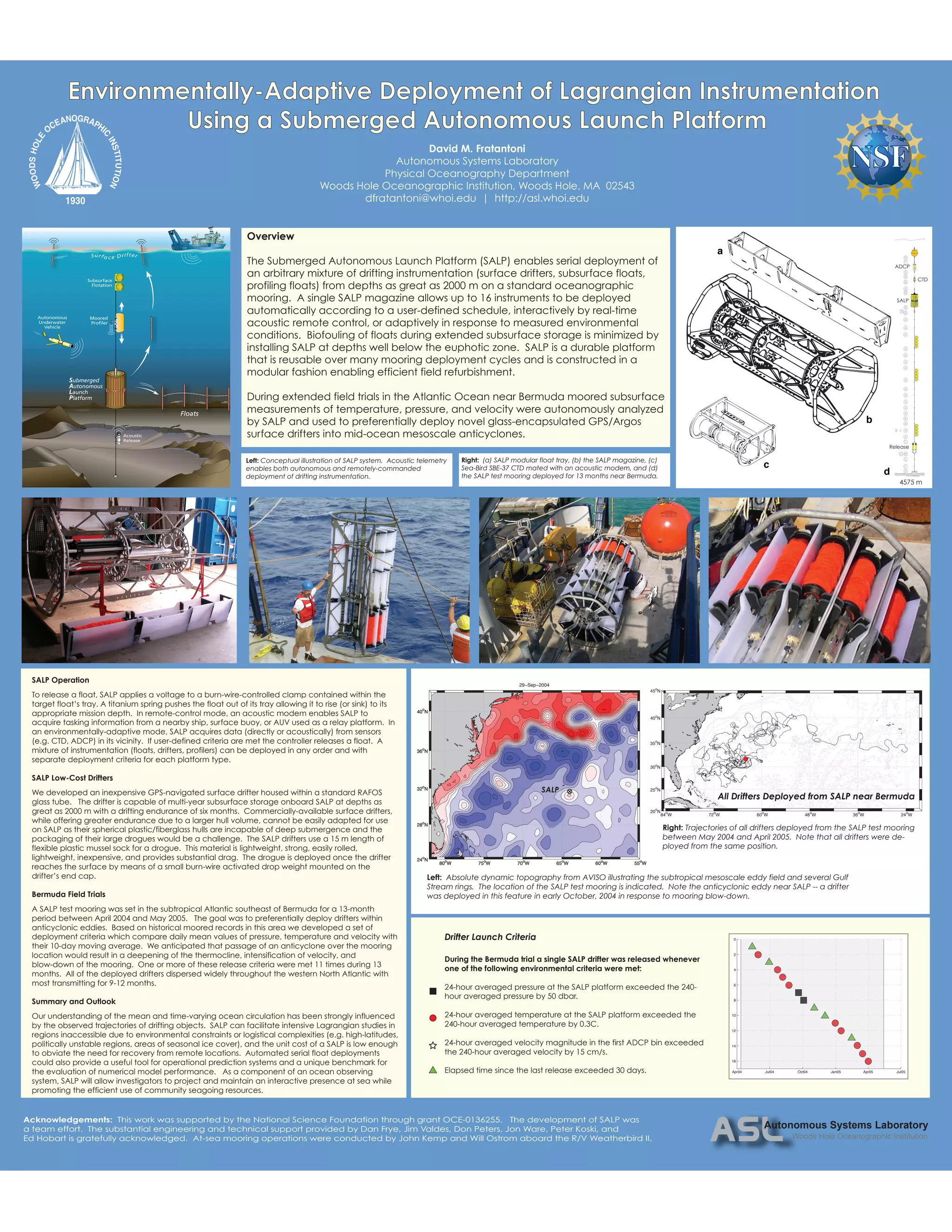
Environmentally-Adaptive Deployment of Lagrangian Instrumentation
Using a Submerged Autonomous Launch Platform
David M. Fratantoni
Autonomous Systems Laboratory
Physical Oceanography Department
Woods Hole Oceanographic Institution, Woods Hole, MA 02543
dfratantoni@whoi.edu | http://asl.whoi.edu
Acknowledgements: This work was supported by the National Science Foundation through grant OCE-0136255. The development of SALP was
a team effort. The substantial engineering and technical support provided by Dan Frye, Jim Valdes, Don Peters, Jon Ware, Peter Koski, and
Ed Hobart is gratefully acknowledged. At-sea mooring operations were conducted by John Kemp and Will Ostrom aboard the R/V Weatherbird II. aSLaSLAutonomous Systems Laboratory
Woods Hole Oceanographic Institution
Overview
The Submerged Autonomous Launch Platform (SALP) enables serial deployment of
an arbitrary mixture of drifting instrumentation (surface drifters, subsurface floats,
profiling floats) from depths as great as 2000 m on a standard oceanographic
mooring. A single SALP magazine allows up to 16 instruments to be deployed
automatically according to a user-defined schedule, interactively by real-time
acoustic remote control, or adaptively in response to measured environmental
conditions. Biofouling of floats during extended subsurface storage is minimized by
installing SALP at depths well below the euphotic zone. SALP is a durable platform
that is reusable over many mooring deployment cycles and is constructed in a
modular fashion enabling efficient field refurbishment.
During extended field trials in the Atlantic Ocean near Bermuda moored subsurface
measurements of temperature, pressure, and velocity were autonomously analyzed
by SALP and used to preferentially deploy novel glass-encapsulated GPS/Argos
surface drifters into mid-ocean mesoscale anticyclones.
SALP Operation
To release a float, SALP applies a voltage to a burn-wire-controlled clamp contained within the
target float’s tray. A titanium spring pushes the float out of its tray allowing it to rise (or sink) to its
appropriate mission depth. In remote-control mode, an acoustic modem enables SALP to
acquire tasking information from a nearby ship, surface buoy, or AUV used as a relay platform. In
an environmentally-adaptive mode, SALP acquires data (directly or acoustically) from sensors
(e.g. CTD, ADCP) in its vicinity. If user-defined criteria are met the controller releases a float. A
mixture of instrumentation (floats, drifters, profilers) can be deployed in any order and with
separate deployment criteria for each platform type.
SALP Low-Cost Drifters
We developed an inexpensive GPS-navigated surface drifter housed within a standard RAFOS
glass tube. The drifter is capable of multi-year subsurface storage onboard SALP at depths as
great as 2000 m with a drifting endurance of six months. Commercially-available surface drifters,
while offering greater endurance due to a larger hull volume, cannot be easily adapted for use
on SALP as their spherical plastic/fiberglass hulls are incapable of deep submergence and the
packaging of their large drogues would be a challenge. The SALP drifters use a 15 m length of
flexible plastic mussel sock for a drogue. This material is lightweight, strong, easily rolled,
lightweight, inexpensive, and provides substantial drag. The drogue is deployed once the drifter
reaches the surface by means of a small burn-wire activated drop weight mounted on the
drifter’s end cap.
Bermuda Field Trials
A SALP test mooring was set in the subtropical Atlantic southeast of Bermuda for a 13-month
period between April 2004 and May 2005. The goal was to preferentially deploy drifters within
anticyclonic eddies. Based on historical moored records in this area we developed a set of
deployment criteria which compare daily mean values of pressure, temperature and velocity with
their 10-day moving average. We anticipated that passage of an anticyclone over the mooring
location would result in a deepening of the thermocline, intensification of velocity, and
blow-down of the mooring. One or more of these release criteria were met 11 times during 13
months. All of the deployed drifters dispersed widely throughout the western North Atlantic with
most transmitting for 9-12 months.
Summary and Outlook
Our understanding of the mean and time-varying ocean circulation has been strongly influenced
by the observed trajectories of drifting objects. SALP can facilitate intensive Lagrangian studies in
regions inaccessible due to environmental constraints or logistical complexities (e.g. high-latitudes,
politically unstable regions, areas of seasonal ice cover), and the unit cost of a SALP is low enough
to obviate the need for recovery from remote locations. Automated serial float deployments
could also provide a useful tool for operational prediction systems and a unique benchmark for
the evaluation of numerical model performance. As a component of an ocean observing
system, SALP will allow investigators to project and maintain an interactive presence at sea while
promoting the efficient use of community seagoing resources.
Left: Conceptual illustration of SALP system. Acoustic telemetry
enables both autonomous and remotely-commanded
deployment of drifting instrumentation.
Right: (a) SALP modular float tray, (b) the SALP magazine, (c)
Sea-Bird SBE-37 CTD mated with an acoustic modem, and (d)
the SALP test mooring deployed for 13 months near Bermuda.
Apr04 Jul04 Oct04 Jan05 Apr05 Jul05
0
2
4
6
8
10
12
14
16
During the Bermuda trial a single SALP drifter was released whenever
one of the following environmental criteria were met:
24-hour averaged pressure at the SALP platform exceeded the 240-
hour averaged pressure by 50 dbar.
24-hour averaged temperature at the SALP platform exceeded the
240-hour averaged temperature by 0.3C.
24-hour averaged velocity magnitude in the first ADCP bin exceeded
the 240-hour averaged velocity by 15 cm/s.
Elapsed time since the last release exceeded 30 days.
80
o
W 75
o
W 70
o
W 65
o
W 60
o
W 55
o
W
24o
N
28o
N
32
o
N
36
o
N
40
o
N
80
o
W 75
o
W 70
o
W 65
o
W 60
o
W 55
o
W
24o
N
28o
N
32
o
N
36
o
N
40
o
N
29−Sep−2004
Right: Trajectories of all drifters deployed from the SALP test mooring
between May 2004 and April 2005. Note that all drifters were de-
ployed from the same position.
84o
W 72o
W 60o
W 48o
W 36o
W 24o
W
20
o
N
25o
N
30
o
N
35o
N
40
o
N
45o
N
All Drifters Deployed from SALP near Bermuda
SALP
Drifter Launch Criteria
Left: Absolute dynamic topography from AVISO illustrating the subtropical mesoscale eddy field and several Gulf
Stream rings. The location of the SALP test mooring is indicated. Note the anticyclonic eddy near SALP -- a drifter
was deployed in this feature in early October, 2004 in response to mooring blow-down.
a
b
c
d
4575 m
SALP
ADCP
CTD
Release

Environmentally-Adaptive Deployment of Lagrangian Instrumentation using a Submerged Autonomous Launch Platform

  • 1.
    Environmentally-Adaptive Deployment ofLagrangian Instrumentation Using a Submerged Autonomous Launch Platform David M. Fratantoni Autonomous Systems Laboratory Physical Oceanography Department Woods Hole Oceanographic Institution, Woods Hole, MA 02543 dfratantoni@whoi.edu | http://asl.whoi.edu Acknowledgements: This work was supported by the National Science Foundation through grant OCE-0136255. The development of SALP was a team effort. The substantial engineering and technical support provided by Dan Frye, Jim Valdes, Don Peters, Jon Ware, Peter Koski, and Ed Hobart is gratefully acknowledged. At-sea mooring operations were conducted by John Kemp and Will Ostrom aboard the R/V Weatherbird II. aSLaSLAutonomous Systems Laboratory Woods Hole Oceanographic Institution Overview The Submerged Autonomous Launch Platform (SALP) enables serial deployment of an arbitrary mixture of drifting instrumentation (surface drifters, subsurface floats, profiling floats) from depths as great as 2000 m on a standard oceanographic mooring. A single SALP magazine allows up to 16 instruments to be deployed automatically according to a user-defined schedule, interactively by real-time acoustic remote control, or adaptively in response to measured environmental conditions. Biofouling of floats during extended subsurface storage is minimized by installing SALP at depths well below the euphotic zone. SALP is a durable platform that is reusable over many mooring deployment cycles and is constructed in a modular fashion enabling efficient field refurbishment. During extended field trials in the Atlantic Ocean near Bermuda moored subsurface measurements of temperature, pressure, and velocity were autonomously analyzed by SALP and used to preferentially deploy novel glass-encapsulated GPS/Argos surface drifters into mid-ocean mesoscale anticyclones. SALP Operation To release a float, SALP applies a voltage to a burn-wire-controlled clamp contained within the target float’s tray. A titanium spring pushes the float out of its tray allowing it to rise (or sink) to its appropriate mission depth. In remote-control mode, an acoustic modem enables SALP to acquire tasking information from a nearby ship, surface buoy, or AUV used as a relay platform. In an environmentally-adaptive mode, SALP acquires data (directly or acoustically) from sensors (e.g. CTD, ADCP) in its vicinity. If user-defined criteria are met the controller releases a float. A mixture of instrumentation (floats, drifters, profilers) can be deployed in any order and with separate deployment criteria for each platform type. SALP Low-Cost Drifters We developed an inexpensive GPS-navigated surface drifter housed within a standard RAFOS glass tube. The drifter is capable of multi-year subsurface storage onboard SALP at depths as great as 2000 m with a drifting endurance of six months. Commercially-available surface drifters, while offering greater endurance due to a larger hull volume, cannot be easily adapted for use on SALP as their spherical plastic/fiberglass hulls are incapable of deep submergence and the packaging of their large drogues would be a challenge. The SALP drifters use a 15 m length of flexible plastic mussel sock for a drogue. This material is lightweight, strong, easily rolled, lightweight, inexpensive, and provides substantial drag. The drogue is deployed once the drifter reaches the surface by means of a small burn-wire activated drop weight mounted on the drifter’s end cap. Bermuda Field Trials A SALP test mooring was set in the subtropical Atlantic southeast of Bermuda for a 13-month period between April 2004 and May 2005. The goal was to preferentially deploy drifters within anticyclonic eddies. Based on historical moored records in this area we developed a set of deployment criteria which compare daily mean values of pressure, temperature and velocity with their 10-day moving average. We anticipated that passage of an anticyclone over the mooring location would result in a deepening of the thermocline, intensification of velocity, and blow-down of the mooring. One or more of these release criteria were met 11 times during 13 months. All of the deployed drifters dispersed widely throughout the western North Atlantic with most transmitting for 9-12 months. Summary and Outlook Our understanding of the mean and time-varying ocean circulation has been strongly influenced by the observed trajectories of drifting objects. SALP can facilitate intensive Lagrangian studies in regions inaccessible due to environmental constraints or logistical complexities (e.g. high-latitudes, politically unstable regions, areas of seasonal ice cover), and the unit cost of a SALP is low enough to obviate the need for recovery from remote locations. Automated serial float deployments could also provide a useful tool for operational prediction systems and a unique benchmark for the evaluation of numerical model performance. As a component of an ocean observing system, SALP will allow investigators to project and maintain an interactive presence at sea while promoting the efficient use of community seagoing resources. Left: Conceptual illustration of SALP system. Acoustic telemetry enables both autonomous and remotely-commanded deployment of drifting instrumentation. Right: (a) SALP modular float tray, (b) the SALP magazine, (c) Sea-Bird SBE-37 CTD mated with an acoustic modem, and (d) the SALP test mooring deployed for 13 months near Bermuda. Apr04 Jul04 Oct04 Jan05 Apr05 Jul05 0 2 4 6 8 10 12 14 16 During the Bermuda trial a single SALP drifter was released whenever one of the following environmental criteria were met: 24-hour averaged pressure at the SALP platform exceeded the 240- hour averaged pressure by 50 dbar. 24-hour averaged temperature at the SALP platform exceeded the 240-hour averaged temperature by 0.3C. 24-hour averaged velocity magnitude in the first ADCP bin exceeded the 240-hour averaged velocity by 15 cm/s. Elapsed time since the last release exceeded 30 days. 80 o W 75 o W 70 o W 65 o W 60 o W 55 o W 24o N 28o N 32 o N 36 o N 40 o N 80 o W 75 o W 70 o W 65 o W 60 o W 55 o W 24o N 28o N 32 o N 36 o N 40 o N 29−Sep−2004 Right: Trajectories of all drifters deployed from the SALP test mooring between May 2004 and April 2005. Note that all drifters were de- ployed from the same position. 84o W 72o W 60o W 48o W 36o W 24o W 20 o N 25o N 30 o N 35o N 40 o N 45o N All Drifters Deployed from SALP near Bermuda SALP Drifter Launch Criteria Left: Absolute dynamic topography from AVISO illustrating the subtropical mesoscale eddy field and several Gulf Stream rings. The location of the SALP test mooring is indicated. Note the anticyclonic eddy near SALP -- a drifter was deployed in this feature in early October, 2004 in response to mooring blow-down. a b c d 4575 m SALP ADCP CTD Release