CHROMATOGRAPHY Gel filtration
chromatography
CHROMATOGRAPHY
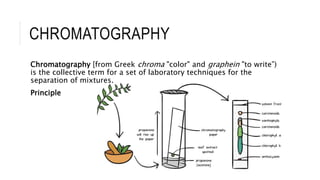
Chromatography [from Greek chroma "color" and graphein "to write”)
is the collective term for a set of laboratory techniques for the
separation of mixtures.
Principle
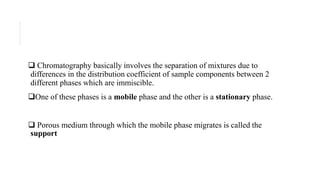
 Chromatography basically involves the separation of mixtures due to
differences in the distribution coefficient of sample components between 2
different phases which are immiscible.
One of these phases is a mobile phase and the other is a stationary phase.
 Porous medium through which the mobile phase migrates is called the
support
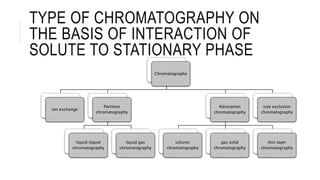
TYPE OF CHROMATOGRAPHY ON
THE BASIS OF INTERACTION OF
SOLUTE TO STATIONARY PHASE
Chromatography
ion exchange
Partition
chromatography
liquid-liquid
chromatography
liquid gas
chromatography
Adsorption
chromatography
column
chromatography
gas solid
chromatography
thin layer
chromatography
size exclusion
chromatography
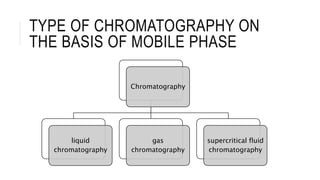
TYPE OF CHROMATOGRAPHY ON
THE BASIS OF MOBILE PHASE
Chromatography
liquid
chromatography
gas
chromatography
supercritical fluid
chromatography
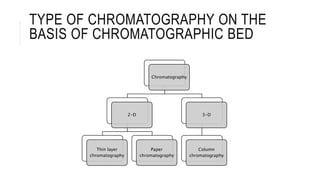
TYPE OF CHROMATOGRAPHY ON THE
BASIS OF CHROMATOGRAPHIC BED
Chromatography
2-D
Thin layer
chromatography
Paper
chromatography
3-D
Column
chromatography
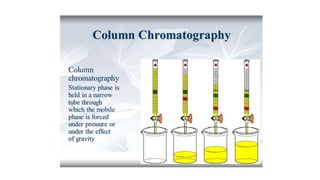
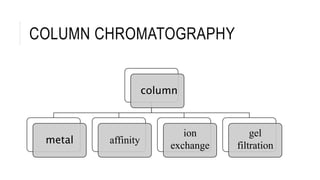
COLUMN CHROMATOGRAPHY
column
metal affinity
ion
exchange
gel
filtration
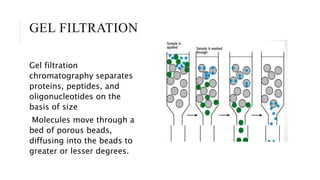
GEL FILTRATION
Gel filtration
chromatography separates
proteins, peptides, and
oligonucleotides on the
basis of size
Molecules move through a
bed of porous beads,
diffusing into the beads to
greater or lesser degrees.
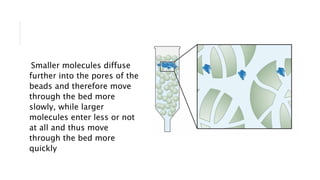
Smaller molecules diffuse
further into the pores of the
beads and therefore move
through the bed more
slowly, while larger
molecules enter less or not
at all and thus move
through the bed more
quickly
TYPE OF RESIN
•Sephacryl
•Sephadex®
•Sepharose®
•Superdex®
•Superose®
•Toyopearl® HW
•DEXTRAN
•Agarose
Sephacryl
Cross-linked co-polymer of allyl dextran and N,N’-
methylenebisacrylamide. The HR grades are smaller particle sizes
with narrower size distributions optimized for more efficient
separations with faster flow.
Sephadex
Beads are prepared by cross-linking dextan with epichlorohydrin.
Widely used in industrial processes. Also useful in desalting and
buffer exchange
Sepharose
Beaded agarose for fractionation molecules of high molecular
weight.
Superdex
Composite of cross-linked agarose and dextran.
FACTORS EFFECTING RESOLUTION
Column length
80 standard (not to long not to short )
Column diameter
2.5 standard (surface area increase time taken increase)
Flow rate
20m/hr (not too high ) 3ml/hr (not too low)
Column packing
No air should be packed ,even packing
Stationary phase
Depend on resin grading
Sample size
80mg
PROPERTIES OF RESIN
• Fractionation range
• Size exclusion limit
• Operating pressure
• Flow rate
• Sample viscosity
• pH range
• Autoclavability
• Tolerance for water-miscible organic solvents; some samples may be more
soluble in a water-organic mix
• Tolerance for detergents, chaotropic agents, formamide, etc.
• Operating temperature
• An important criterion for gel filtration chromatography media is that media is
inert and that nothing in the sample or any buffer binds to the media.
BUFFER SAMPLE SELECTION
Sample Buffer Concentration
The pH, ionic strength and composition will not significantly affect resolution as long
as they do not alter the size and stability of the protein or nucleic acid to be
separated. The sample buffer does not have to be the same buffer as the column. The
sample is exchanged into the running buffer during separation. Prior to using all
buffers should be filter through either a 0.45µm or a 0.22µm filter to eliminate debris.
Buffer Composition
The buffer composition will not directly influence the resolution unless it effects the
shape or activity of the molecule. Extreme pH and ionic strength, denaturing agents
and detergents can cause conformational changes, dissociation or association of
protein complexes. To reduce dissociation avoid extreme pH changes and chaotropic
agents and detergents, although detergents may help with sample recovery.
Sample Concentration and Viscosity
The viscosity of a sample can limit the sample concentration that can be used. The
viscosity of the sample relative to the running buffer. High viscosity causes instability
during the separation and an irregular flow pattern reducing resolution
ADVANTAGE
Fractionation of molecules and complexes within a predetermined
size range
Size analysis and determination
Removal of large proteins and complexes
Buffer exchange
Desalting
Removal of small molecules such as nucleotides, primers, dyes, and
contaminants
Assessment of sample purity
Separation of bound from unbound radioisotopes

Gel filtration chromatography

  • 1.
  • 2.
    CHROMATOGRAPHY Chromatography [from Greekchroma "color" and graphein "to write”) is the collective term for a set of laboratory techniques for the separation of mixtures. Principle
  • 3.
     Chromatography basicallyinvolves the separation of mixtures due to differences in the distribution coefficient of sample components between 2 different phases which are immiscible. One of these phases is a mobile phase and the other is a stationary phase.  Porous medium through which the mobile phase migrates is called the support
  • 4.
    TYPE OF CHROMATOGRAPHYON THE BASIS OF INTERACTION OF SOLUTE TO STATIONARY PHASE Chromatography ion exchange Partition chromatography liquid-liquid chromatography liquid gas chromatography Adsorption chromatography column chromatography gas solid chromatography thin layer chromatography size exclusion chromatography
  • 5.
    TYPE OF CHROMATOGRAPHYON THE BASIS OF MOBILE PHASE Chromatography liquid chromatography gas chromatography supercritical fluid chromatography
  • 6.
    TYPE OF CHROMATOGRAPHYON THE BASIS OF CHROMATOGRAPHIC BED Chromatography 2-D Thin layer chromatography Paper chromatography 3-D Column chromatography
  • 8.
  • 9.
    GEL FILTRATION Gel filtration chromatographyseparates proteins, peptides, and oligonucleotides on the basis of size Molecules move through a bed of porous beads, diffusing into the beads to greater or lesser degrees.
  • 10.
    Smaller molecules diffuse furtherinto the pores of the beads and therefore move through the bed more slowly, while larger molecules enter less or not at all and thus move through the bed more quickly
  • 11.
  • 12.
    Sephacryl Cross-linked co-polymer ofallyl dextran and N,N’- methylenebisacrylamide. The HR grades are smaller particle sizes with narrower size distributions optimized for more efficient separations with faster flow. Sephadex Beads are prepared by cross-linking dextan with epichlorohydrin. Widely used in industrial processes. Also useful in desalting and buffer exchange Sepharose Beaded agarose for fractionation molecules of high molecular weight. Superdex Composite of cross-linked agarose and dextran.
  • 13.
    FACTORS EFFECTING RESOLUTION Columnlength 80 standard (not to long not to short ) Column diameter 2.5 standard (surface area increase time taken increase) Flow rate 20m/hr (not too high ) 3ml/hr (not too low) Column packing No air should be packed ,even packing Stationary phase Depend on resin grading Sample size 80mg
  • 14.
    PROPERTIES OF RESIN •Fractionation range • Size exclusion limit • Operating pressure • Flow rate • Sample viscosity • pH range • Autoclavability • Tolerance for water-miscible organic solvents; some samples may be more soluble in a water-organic mix • Tolerance for detergents, chaotropic agents, formamide, etc. • Operating temperature • An important criterion for gel filtration chromatography media is that media is inert and that nothing in the sample or any buffer binds to the media.
  • 15.
    BUFFER SAMPLE SELECTION SampleBuffer Concentration The pH, ionic strength and composition will not significantly affect resolution as long as they do not alter the size and stability of the protein or nucleic acid to be separated. The sample buffer does not have to be the same buffer as the column. The sample is exchanged into the running buffer during separation. Prior to using all buffers should be filter through either a 0.45µm or a 0.22µm filter to eliminate debris. Buffer Composition The buffer composition will not directly influence the resolution unless it effects the shape or activity of the molecule. Extreme pH and ionic strength, denaturing agents and detergents can cause conformational changes, dissociation or association of protein complexes. To reduce dissociation avoid extreme pH changes and chaotropic agents and detergents, although detergents may help with sample recovery. Sample Concentration and Viscosity The viscosity of a sample can limit the sample concentration that can be used. The viscosity of the sample relative to the running buffer. High viscosity causes instability during the separation and an irregular flow pattern reducing resolution
  • 16.
    ADVANTAGE Fractionation of moleculesand complexes within a predetermined size range Size analysis and determination Removal of large proteins and complexes Buffer exchange Desalting Removal of small molecules such as nucleotides, primers, dyes, and contaminants Assessment of sample purity Separation of bound from unbound radioisotopes