Media Studies A2
Coursework- ‘Intrusion’ -
The Evaluation
BY ASHLEY BANGER
In what ways does your media product use, develop or
challenge forms and conventions of real media products?
 One way my media product, such as my short film I produced, uses conventions of real media products is through the
use of low–key lighting and slower paced editing, which is a very common feature amongst thrillers in the psychological
sub-genre like my short film is in. Since my short film was intended to be a mysterious, more ominous thriller like I
planned for, I had to match certain elements of the production like the lighting and editing to meet regular conventions of
such other thriller films belonging to the same genre/form. Such as, a film which provided a fair amount of inspiration for
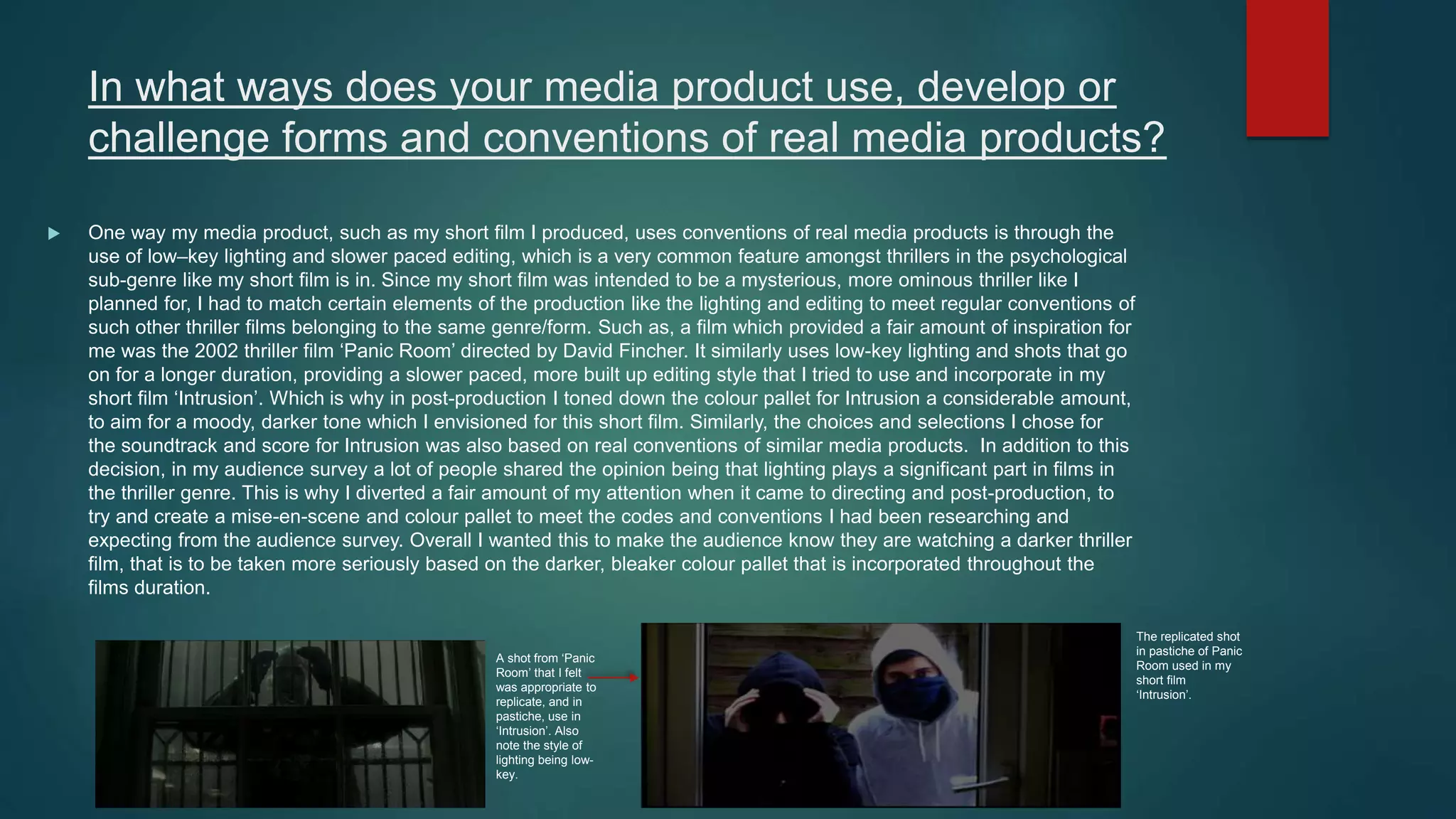
me was the 2002 thriller film ‘Panic Room’ directed by David Fincher. It similarly uses low-key lighting and shots that go
on for a longer duration, providing a slower paced, more built up editing style that I tried to use and incorporate in my
short film ‘Intrusion’. Which is why in post-production I toned down the colour pallet for Intrusion a considerable amount,
to aim for a moody, darker tone which I envisioned for this short film. Similarly, the choices and selections I chose for
the soundtrack and score for Intrusion was also based on real conventions of similar media products. In addition to this
decision, in my audience survey a lot of people shared the opinion being that lighting plays a significant part in films in
the thriller genre. This is why I diverted a fair amount of my attention when it came to directing and post-production, to
try and create a mise-en-scene and colour pallet to meet the codes and conventions I had been researching and
expecting from the audience survey. Overall I wanted this to make the audience know they are watching a darker thriller
film, that is to be taken more seriously based on the darker, bleaker colour pallet that is incorporated throughout the
films duration.
A shot from ‘Panic
Room’ that I felt
was appropriate to
replicate, and in
pastiche, use in
‘Intrusion’. Also
note the style of
lighting being low-
key.
The replicated shot
in pastiche of Panic
Room used in my
short film
‘Intrusion’.
In what ways does your media product use, develop or
challenge forms and conventions of real media products?
(Cont.)
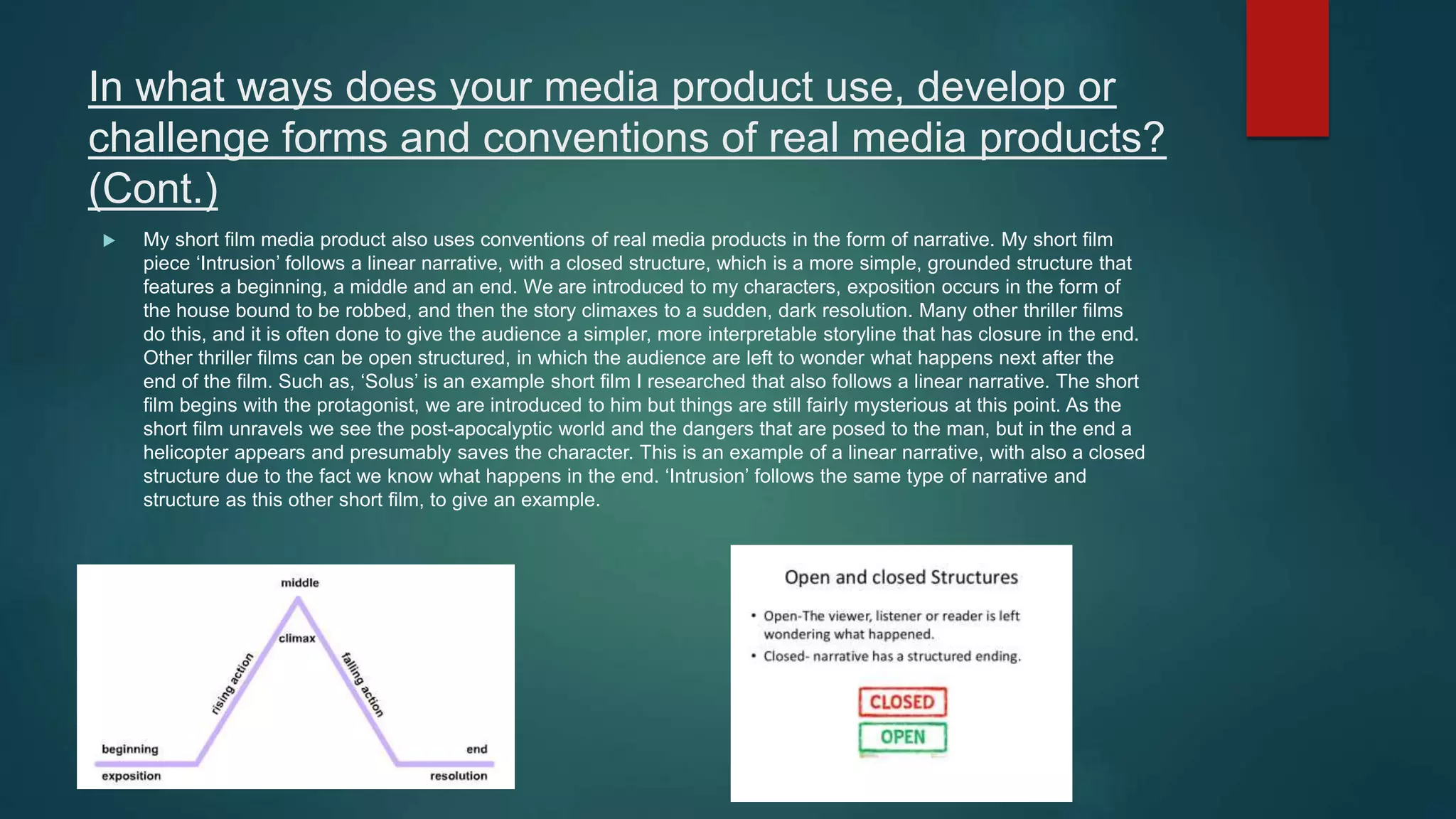
 My short film media product also uses conventions of real media products in the form of narrative. My short film
piece ‘Intrusion’ follows a linear narrative, with a closed structure, which is a more simple, grounded structure that
features a beginning, a middle and an end. We are introduced to my characters, exposition occurs in the form of
the house bound to be robbed, and then the story climaxes to a sudden, dark resolution. Many other thriller films
do this, and it is often done to give the audience a simpler, more interpretable storyline that has closure in the end.
Other thriller films can be open structured, in which the audience are left to wonder what happens next after the
end of the film. Such as, ‘Solus’ is an example short film I researched that also follows a linear narrative. The short
film begins with the protagonist, we are introduced to him but things are still fairly mysterious at this point. As the
short film unravels we see the post-apocalyptic world and the dangers that are posed to the man, but in the end a
helicopter appears and presumably saves the character. This is an example of a linear narrative, with also a closed
structure due to the fact we know what happens in the end. ‘Intrusion’ follows the same type of narrative and
structure as this other short film, to give an example.
In what ways does your media product use, develop or
challenge forms and conventions of real media products?
(Cont.)
 Another media product I produced was my poster for my short film ‘Intrusion’. I believe my poster
developed real conventions of other psychological-thriller posters in the way I had the overall colour
scheme of my poster in black and white, whilst incorporating striking red fonts throughout the poster as
well. This was something quite a lot of psychological-thriller posters I researched didn’t do, so I thought it
would be good to combine features such as having contrasting black and white images along with red
fonts, to create a more visually striking and sleek poster. As a result of this, the poster for Intrusion remains
mysterious and vague, whilst still definitely conveying meaning and tone through the use of black and white
imagery, which connote the abrupt, harsh themes in the film, whilst also the bold red fonts connote themes
of danger and warning to the audiences. My poster also used conventions of real media products through
the layout of my texts and credits. I researched posters for films and found out all the common and
essential places that certain texts and credits need to be, so when it came to designing the poster for
Intrusion, I knew just where to insert text and knew how it can add to the poster overall. To link with the
audience, I wanted them to feel a certain way when they saw my poster. As stated previously, the black and
white image I intended them to feel ambiguity and mystery, and the overall red typography I wanted them to
associate with danger, horror and a thriller piece-genre.
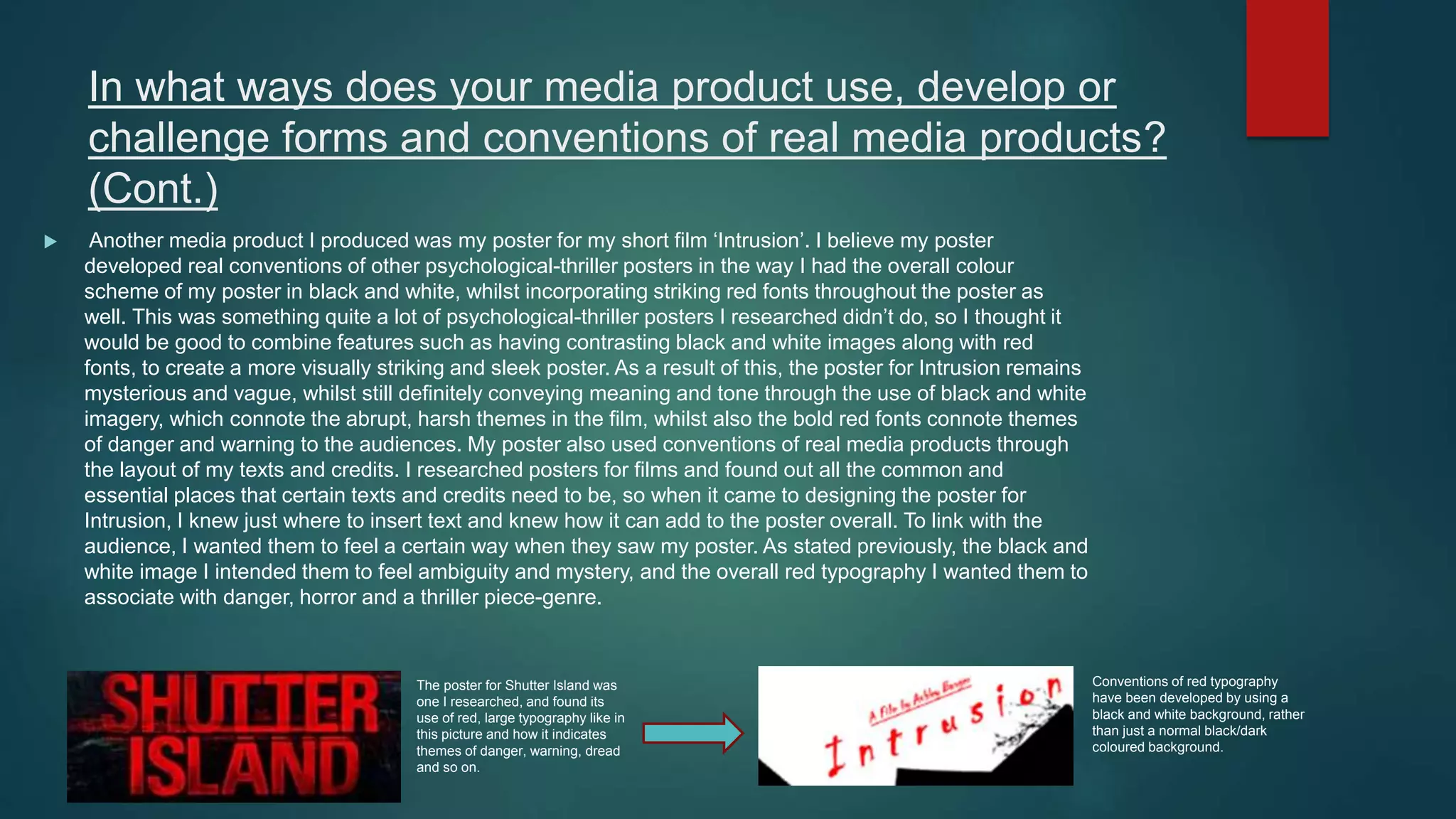
The poster for Shutter Island was
one I researched, and found its
use of red, large typography like in
this picture and how it indicates
themes of danger, warning, dread
and so on.
Conventions of red typography
have been developed by using a
black and white background, rather
than just a normal black/dark
coloured background.
In what ways does your media product use, develop or
challenge forms and conventions of real media products?
(Cont.)
 Lastly, I believe my 2nd ancillary
task being my film review
challenges conventions of
other real film reviews. I
believe that one way I have
done this is by using imagery
for my film review, that keeps
the review and plot details still
ambiguous and mysterious.
Whilst some film reviews use
images and pictures on the
review that help showcase the
films plot or storyline, I chose
to use images that keep the
plot and overall story
ambiguous, so that when the
audience came to watch my
Intrusion, that level of mystery
was still there and they don’t
fully know what my film will be
like, content wise.
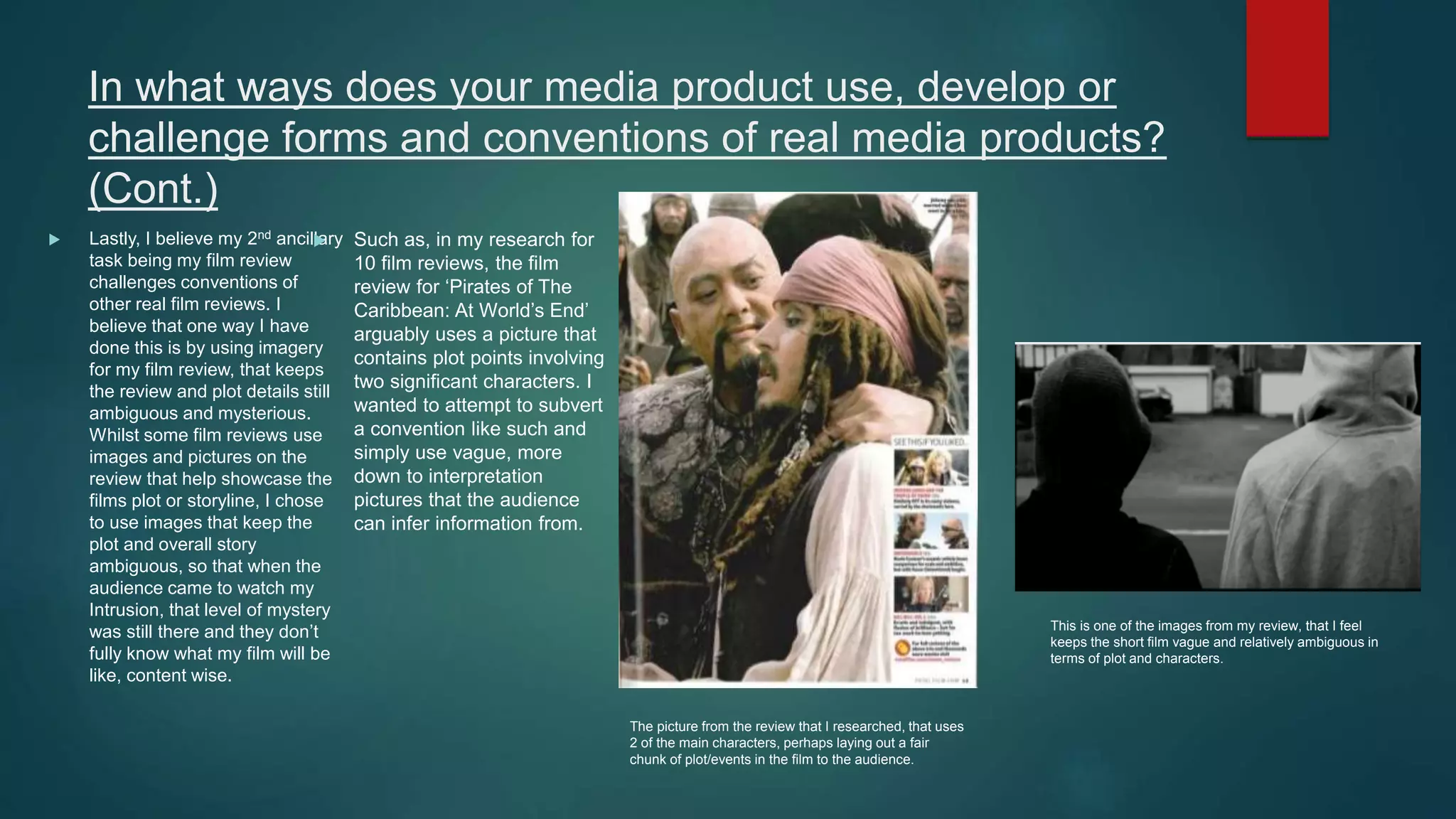
 Such as, in my research for
10 film reviews, the film
review for ‘Pirates of The
Caribbean: At World’s End’
arguably uses a picture that
contains plot points involving
two significant characters. I
wanted to attempt to subvert
a convention like such and
simply use vague, more
down to interpretation
pictures that the audience
can infer information from.
The picture from the review that I researched, that uses
2 of the main characters, perhaps laying out a fair
chunk of plot/events in the film to the audience.
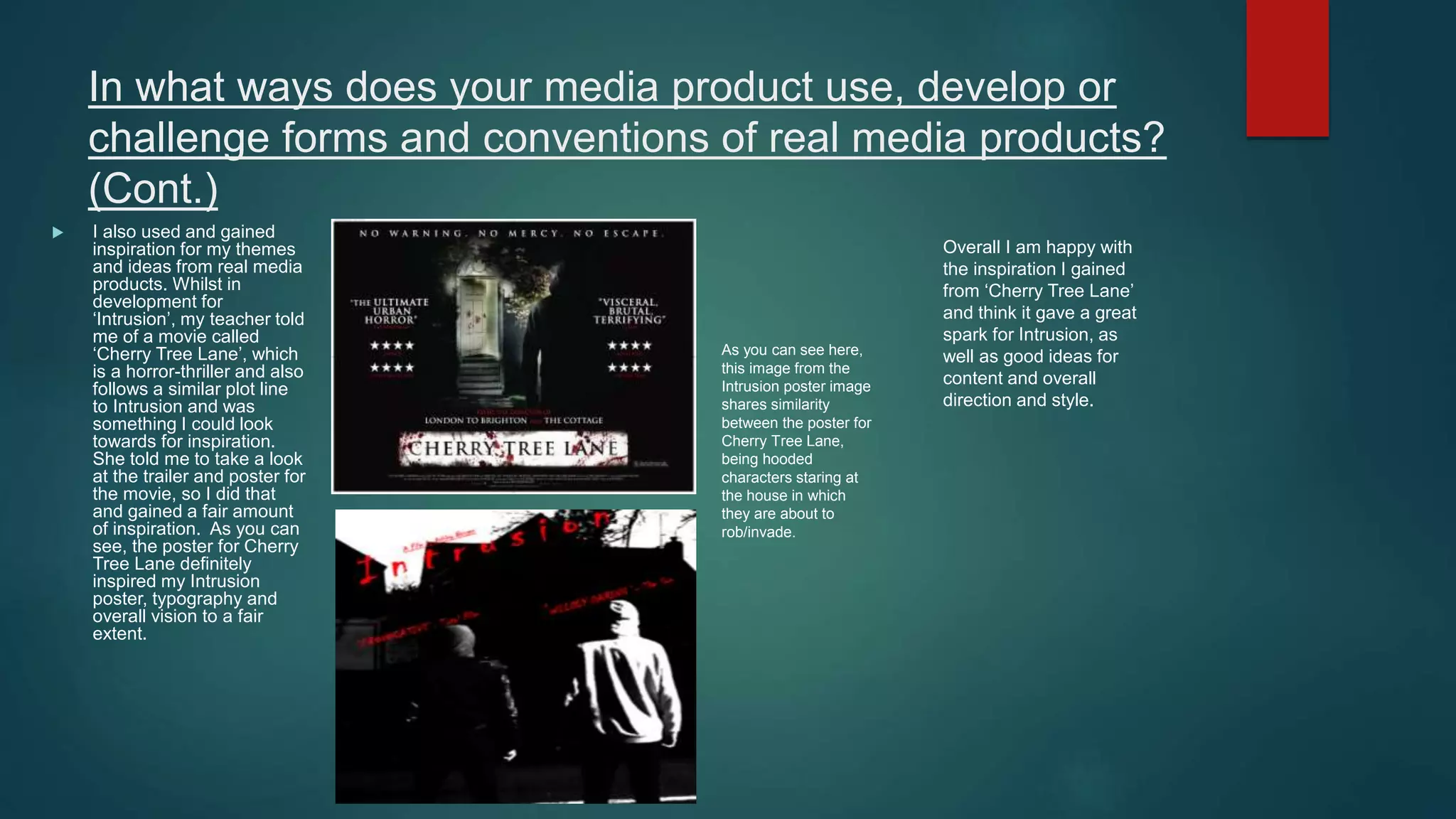
This is one of the images from my review, that I feel
keeps the short film vague and relatively ambiguous in
terms of plot and characters.
In what ways does your media product use, develop or
challenge forms and conventions of real media products?
(Cont.)
 I also used and gained
inspiration for my themes
and ideas from real media
products. Whilst in
development for
‘Intrusion’, my teacher told
me of a movie called
‘Cherry Tree Lane’, which
is a horror-thriller and also
follows a similar plot line
to Intrusion and was
something I could look
towards for inspiration.
She told me to take a look
at the trailer and poster for
the movie, so I did that
and gained a fair amount
of inspiration. As you can
see, the poster for Cherry
Tree Lane definitely
inspired my Intrusion
poster, typography and
overall vision to a fair
extent.
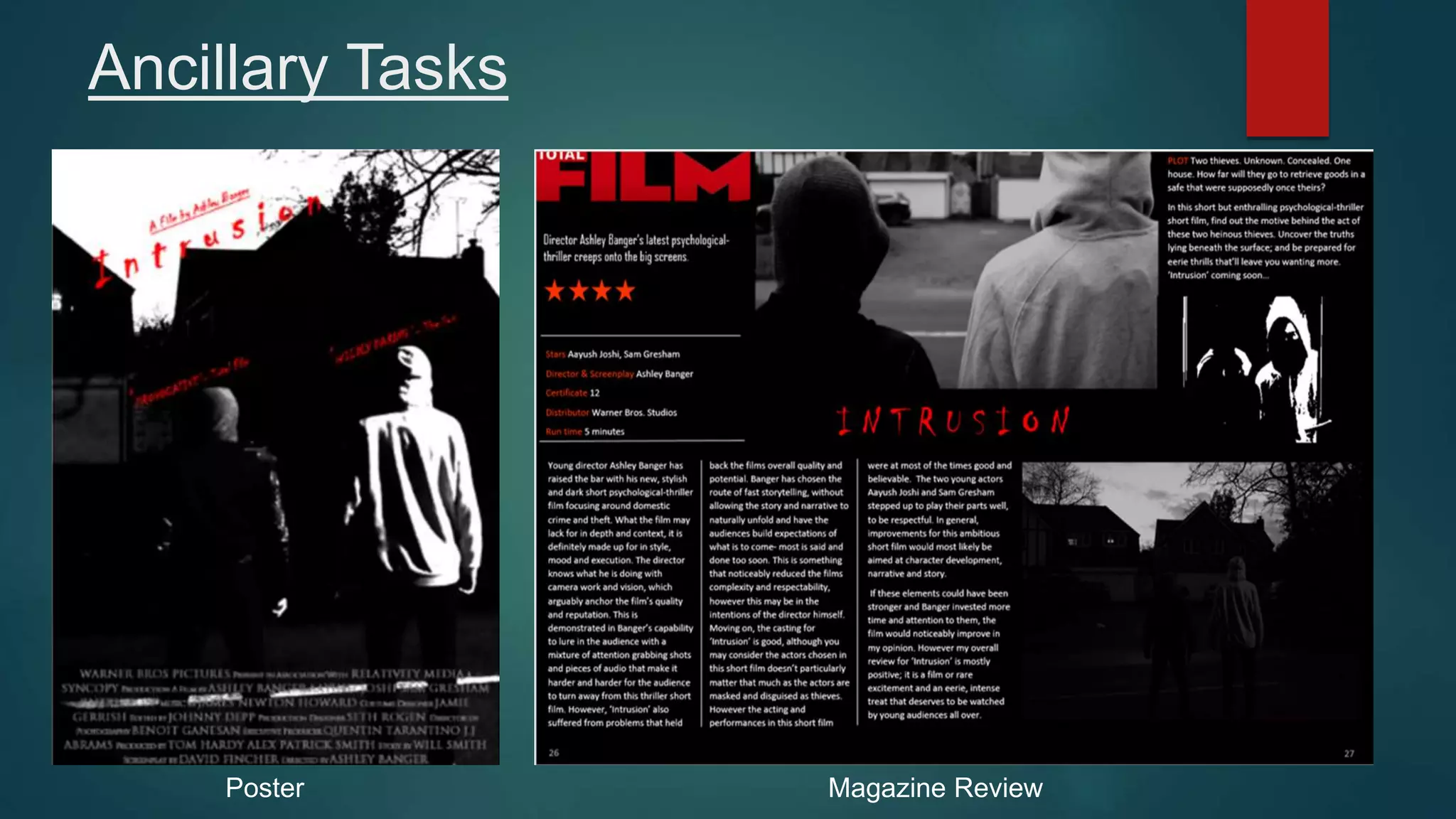
As you can see here,
this image from the
Intrusion poster image
shares similarity
between the poster for
Cherry Tree Lane,
being hooded
characters staring at
the house in which
they are about to
rob/invade.
Overall I am happy with
the inspiration I gained
from ‘Cherry Tree Lane’
and think it gave a great
spark for Intrusion, as
well as good ideas for
content and overall
direction and style.
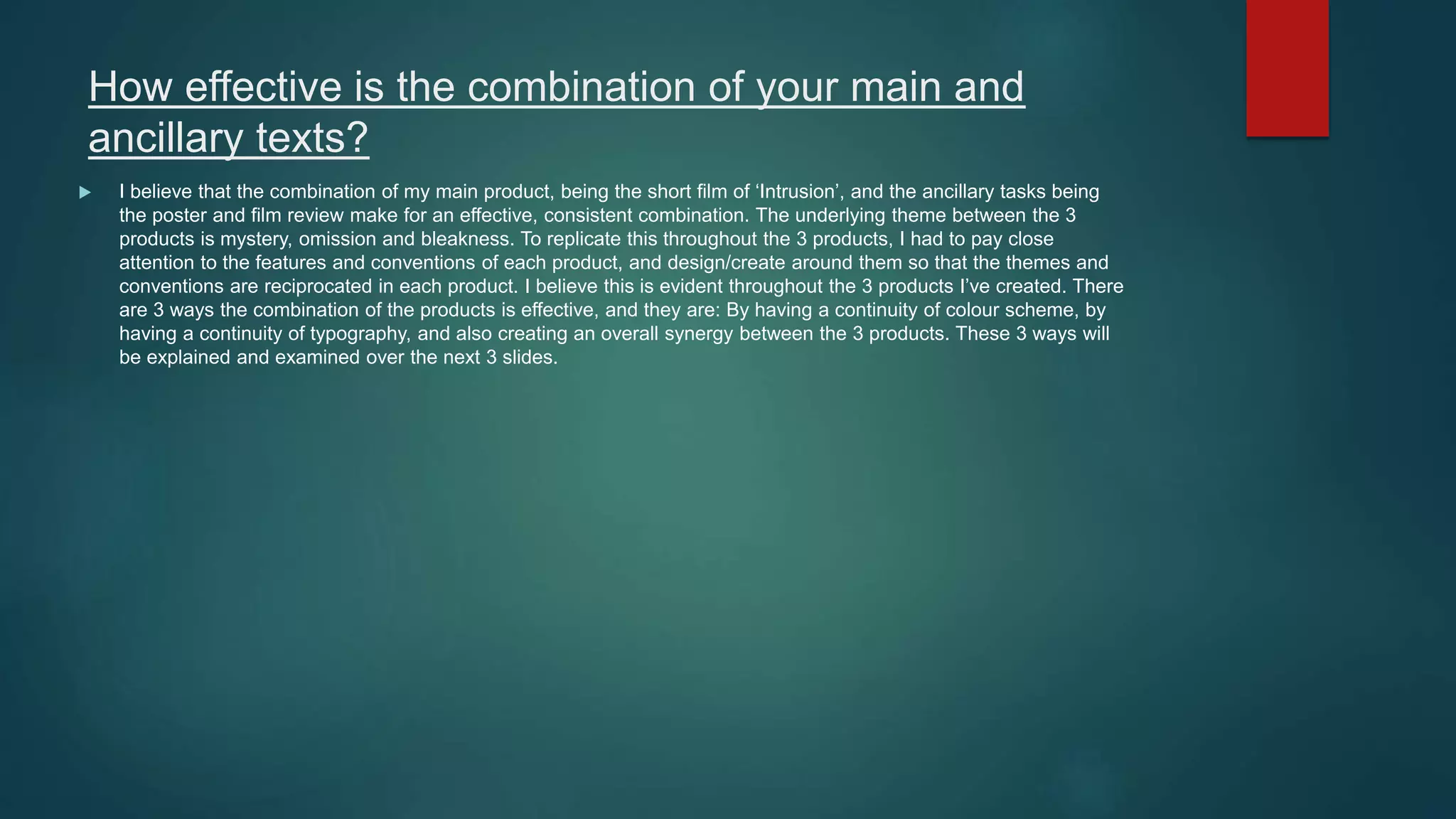
Ancillary Tasks
Poster Magazine Review
How effective is the combination of your main and
ancillary texts?
 I believe that the combination of my main product, being the short film of ‘Intrusion’, and the ancillary tasks being
the poster and film review make for an effective, consistent combination. The underlying theme between the 3
products is mystery, omission and bleakness. To replicate this throughout the 3 products, I had to pay close
attention to the features and conventions of each product, and design/create around them so that the themes and
conventions are reciprocated in each product. I believe this is evident throughout the 3 products I’ve created. There
are 3 ways the combination of the products is effective, and they are: By having a continuity of colour scheme, by
having a continuity of typography, and also creating an overall synergy between the 3 products. These 3 ways will
be explained and examined over the next 3 slides.
How effective is the combination of your main and
ancillary texts? (Cont.)
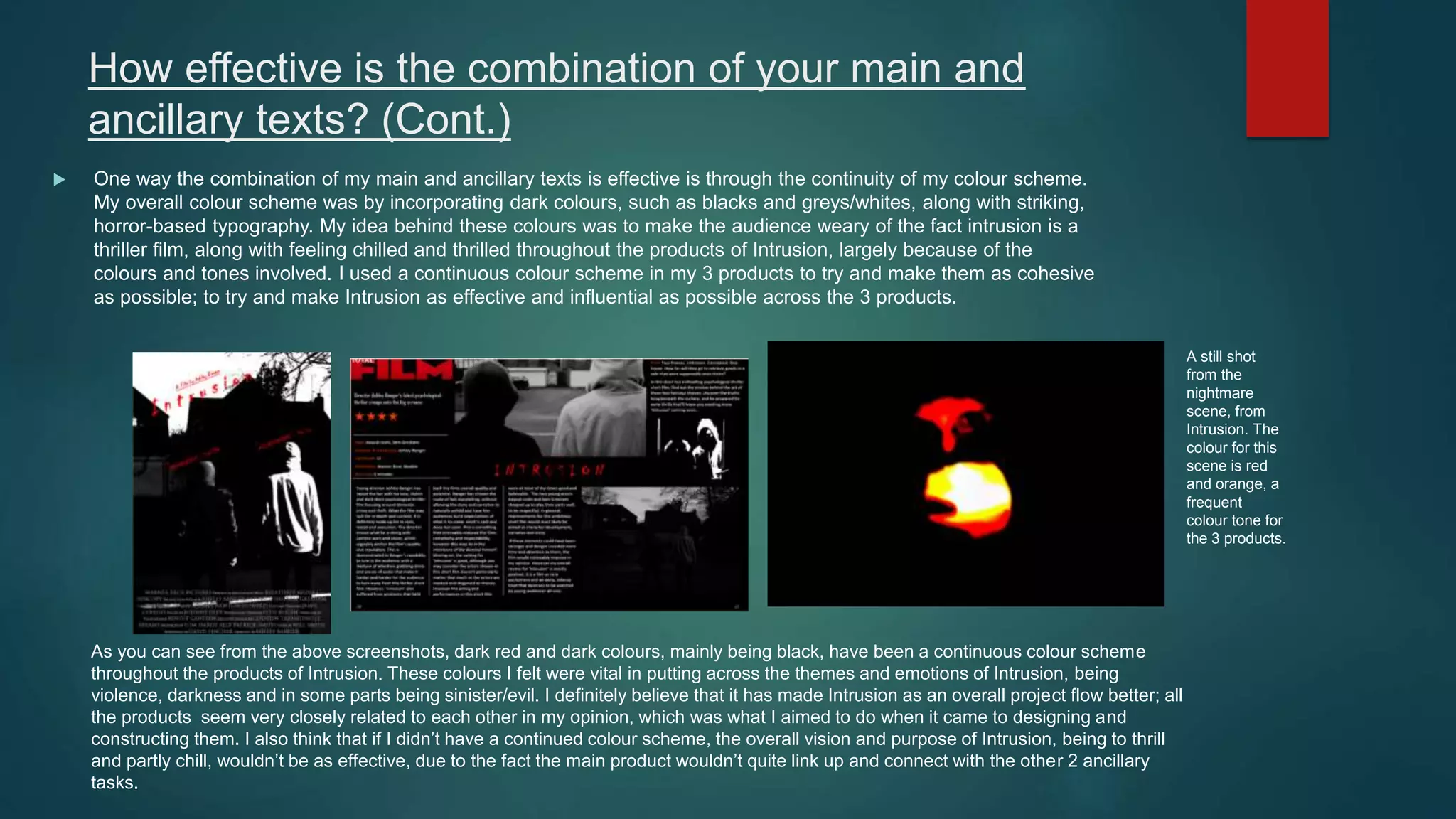
 One way the combination of my main and ancillary texts is effective is through the continuity of my colour scheme.
My overall colour scheme was by incorporating dark colours, such as blacks and greys/whites, along with striking,
horror-based typography. My idea behind these colours was to make the audience weary of the fact intrusion is a
thriller film, along with feeling chilled and thrilled throughout the products of Intrusion, largely because of the
colours and tones involved. I used a continuous colour scheme in my 3 products to try and make them as cohesive
as possible; to try and make Intrusion as effective and influential as possible across the 3 products.
As you can see from the above screenshots, dark red and dark colours, mainly being black, have been a continuous colour scheme
throughout the products of Intrusion. These colours I felt were vital in putting across the themes and emotions of Intrusion, being
violence, darkness and in some parts being sinister/evil. I definitely believe that it has made Intrusion as an overall project flow better; all
the products seem very closely related to each other in my opinion, which was what I aimed to do when it came to designing and
constructing them. I also think that if I didn’t have a continued colour scheme, the overall vision and purpose of Intrusion, being to thrill
and partly chill, wouldn’t be as effective, due to the fact the main product wouldn’t quite link up and connect with the other 2 ancillary
tasks.
A still shot
from the
nightmare
scene, from
Intrusion. The
colour for this
scene is red
and orange, a
frequent
colour tone for
the 3 products.
How effective is the combination of your main and
ancillary texts? (Cont.)
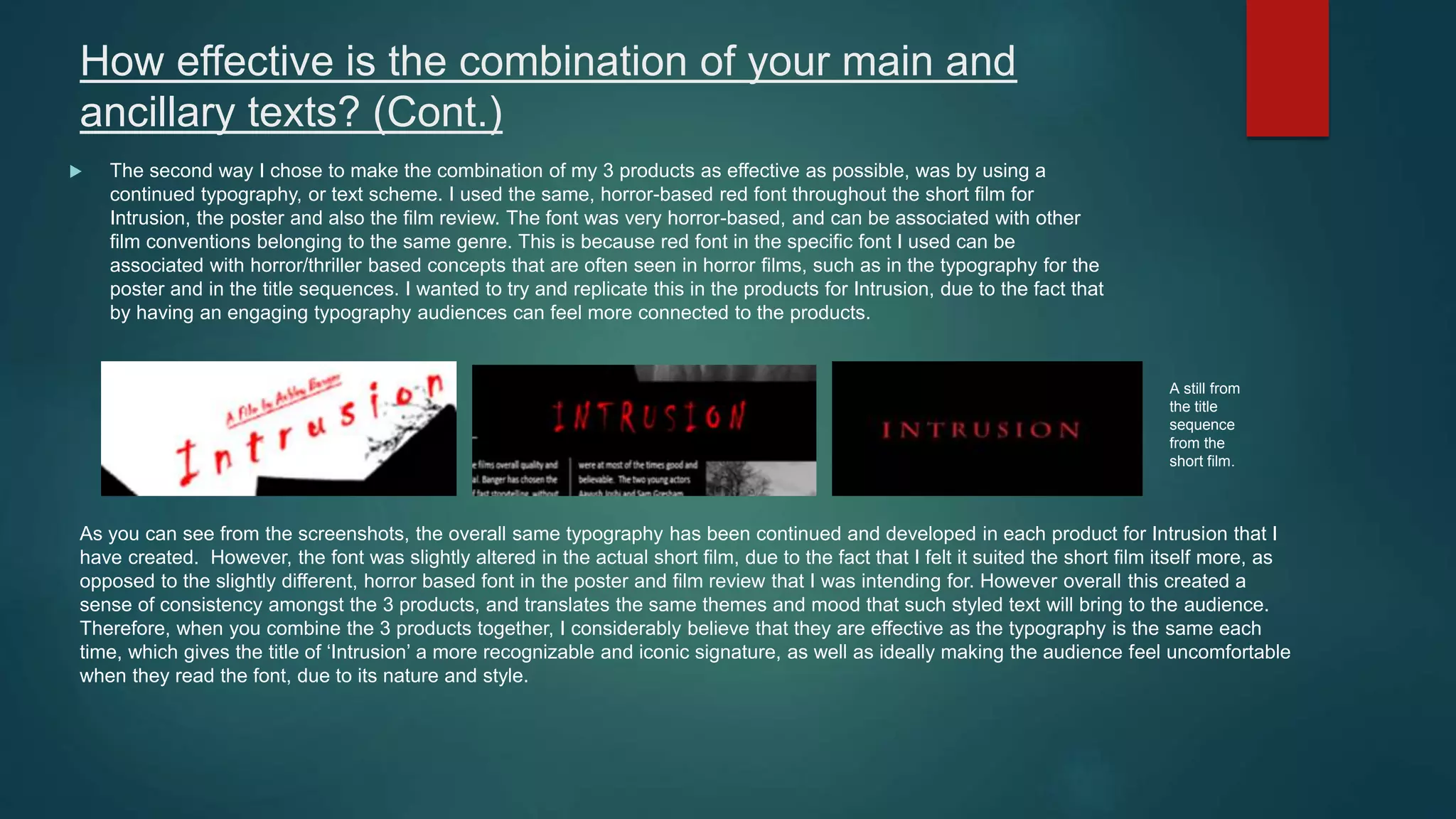
 The second way I chose to make the combination of my 3 products as effective as possible, was by using a
continued typography, or text scheme. I used the same, horror-based red font throughout the short film for
Intrusion, the poster and also the film review. The font was very horror-based, and can be associated with other
film conventions belonging to the same genre. This is because red font in the specific font I used can be
associated with horror/thriller based concepts that are often seen in horror films, such as in the typography for the
poster and in the title sequences. I wanted to try and replicate this in the products for Intrusion, due to the fact that
by having an engaging typography audiences can feel more connected to the products.
A still from
the title
sequence
from the
short film.
As you can see from the screenshots, the overall same typography has been continued and developed in each product for Intrusion that I
have created. However, the font was slightly altered in the actual short film, due to the fact that I felt it suited the short film itself more, as
opposed to the slightly different, horror based font in the poster and film review that I was intending for. However overall this created a
sense of consistency amongst the 3 products, and translates the same themes and mood that such styled text will bring to the audience.
Therefore, when you combine the 3 products together, I considerably believe that they are effective as the typography is the same each
time, which gives the title of ‘Intrusion’ a more recognizable and iconic signature, as well as ideally making the audience feel uncomfortable
when they read the font, due to its nature and style.
How effective is the combination of your main and
ancillary texts? (Cont.)
 Overall, a fair extent of synergy has been created amongst my 3 product I’ve created, for reasons in which I have
stated and developed from the previous slides. I created an audience feedback survey, which had the objective of
gaining some insight and understanding of what audiences thought of the final draft of Intrusion. One of the
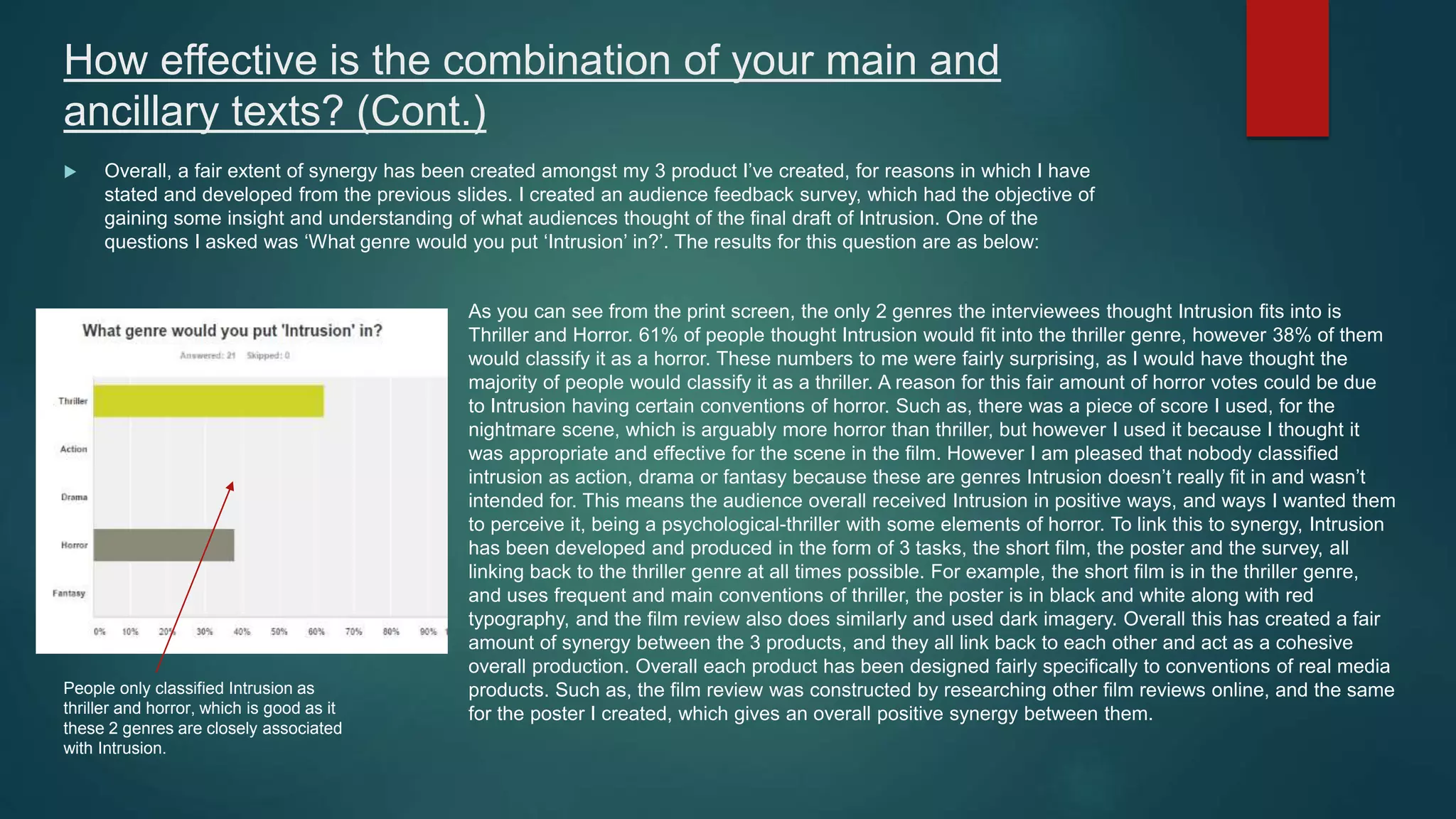
questions I asked was ‘What genre would you put ‘Intrusion’ in?’. The results for this question are as below:
As you can see from the print screen, the only 2 genres the interviewees thought Intrusion fits into is
Thriller and Horror. 61% of people thought Intrusion would fit into the thriller genre, however 38% of them
would classify it as a horror. These numbers to me were fairly surprising, as I would have thought the
majority of people would classify it as a thriller. A reason for this fair amount of horror votes could be due
to Intrusion having certain conventions of horror. Such as, there was a piece of score I used, for the
nightmare scene, which is arguably more horror than thriller, but however I used it because I thought it
was appropriate and effective for the scene in the film. However I am pleased that nobody classified
intrusion as action, drama or fantasy because these are genres Intrusion doesn’t really fit in and wasn’t
intended for. This means the audience overall received Intrusion in positive ways, and ways I wanted them
to perceive it, being a psychological-thriller with some elements of horror. To link this to synergy, Intrusion
has been developed and produced in the form of 3 tasks, the short film, the poster and the survey, all
linking back to the thriller genre at all times possible. For example, the short film is in the thriller genre,
and uses frequent and main conventions of thriller, the poster is in black and white along with red
typography, and the film review also does similarly and used dark imagery. Overall this has created a fair
amount of synergy between the 3 products, and they all link back to each other and act as a cohesive
overall production. Overall each product has been designed fairly specifically to conventions of real media
products. Such as, the film review was constructed by researching other film reviews online, and the same
for the poster I created, which gives an overall positive synergy between them.
People only classified Intrusion as
thriller and horror, which is good as it
these 2 genres are closely associated
with Intrusion.
How effective is the combination of your main and
ancillary texts? (Cont.)
 Overall I wouldn’t in particularly say I have broken the synergy between my main and ancillary tasks. I have carried
and continued the underlying themes and overall tone between the main tasks and 2 ancillary tasks. I have also
carried on and continued the colour scheme, along with the typography across the 3 different products I produced.
This was done purposefully to keep the audience intact with the themes and intentions of Intrusion, to chill and
entertain the audience in this short, escalating thriller short film. I’m relatively happy with the 3 products in terms of
their synergy and relation to each other, in terms of visual aesthetics and overall tone.
What have you learned from your audience feedback?
 Several months ago now marks the first and initial screening and feedback session I did in my class for Intrusion. I
showed them my first draft of Intrusion, and in which I received some necessary and beneficial feedback. They told
me some of the initial strengths with the cut, and then also some of the weaknesses. Since I now knew what need
improving with intrusion, this influenced on what I would change in later drafts. Such as, an early piece of feedback
I got in this screening was to include a lot more diegetic sound- in order to change up the soundtrack, which was
seen as repetitive. This was one of the main early improvements for Intrusion that made me considerably
change/alter the drafts after this one. I made the decision to reduce the sound of the non-diegetic score over some
footage, and have the real diegetic sound brought back to volume to give the audience a mixture of audio types.
Doing do will also keep it more interesting for the audience as they’re not only listening to one piece of score for
roughly 2 minutes. This was something they found to be a good improvement and it made draft 2 more interesting
and engaging for the audience.
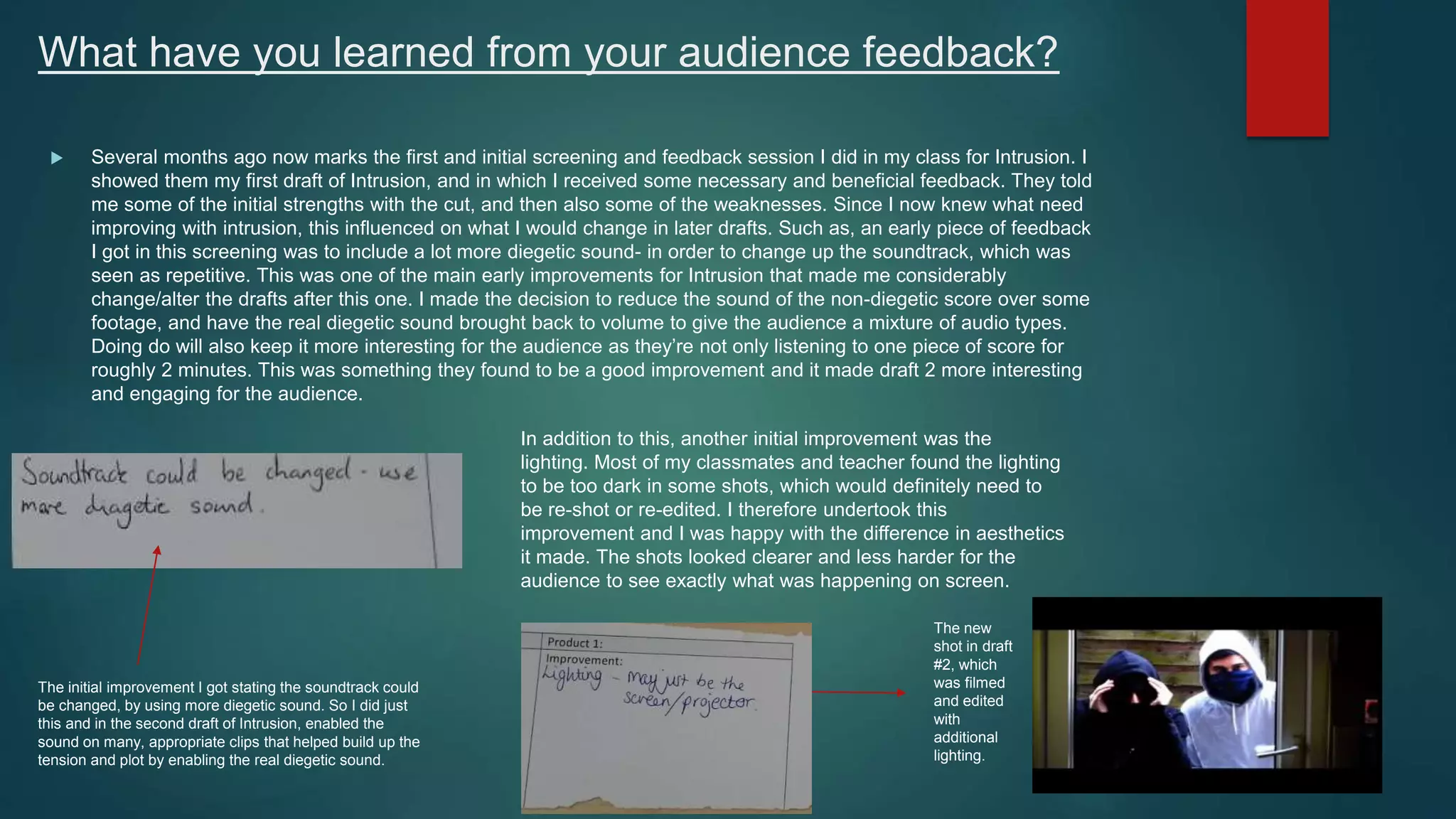
The initial improvement I got stating the soundtrack could
be changed, by using more diegetic sound. So I did just
this and in the second draft of Intrusion, enabled the
sound on many, appropriate clips that helped build up the
tension and plot by enabling the real diegetic sound.
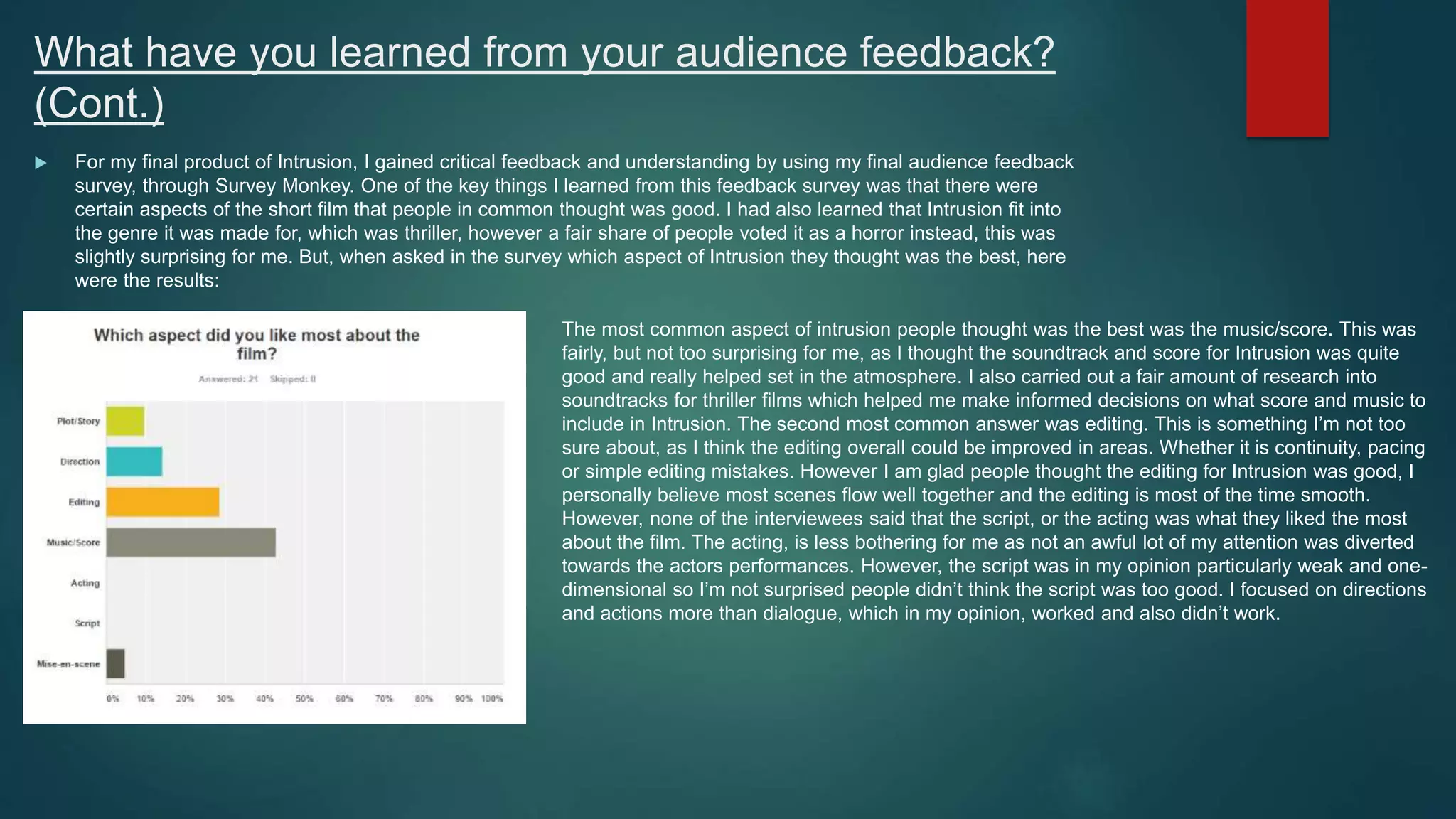
In addition to this, another initial improvement was the
lighting. Most of my classmates and teacher found the lighting
to be too dark in some shots, which would definitely need to
be re-shot or re-edited. I therefore undertook this
improvement and I was happy with the difference in aesthetics
it made. The shots looked clearer and less harder for the
audience to see exactly what was happening on screen.
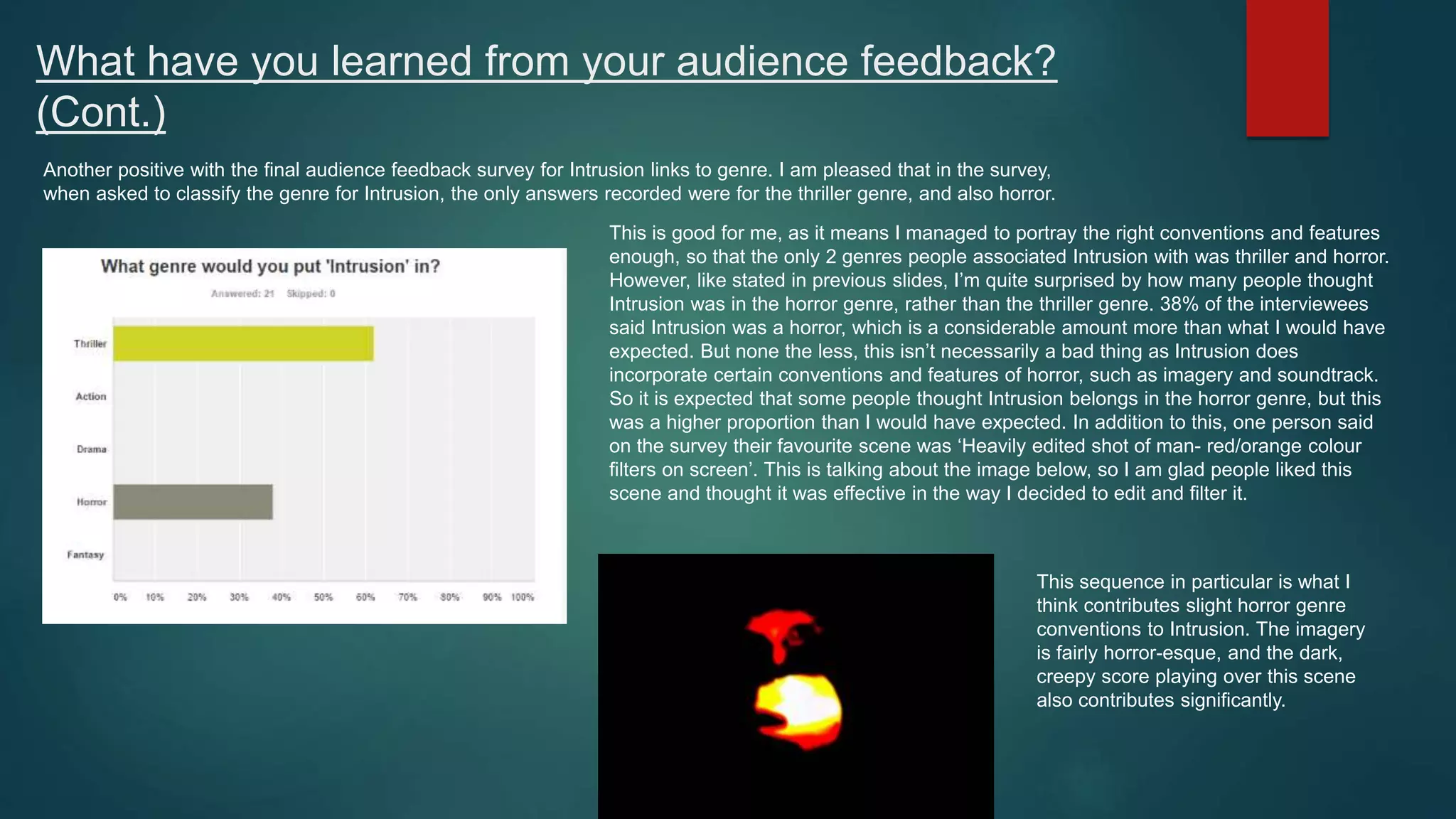
The new
shot in draft
#2, which
was filmed
and edited
with
additional
lighting.
What have you learned from your audience feedback?
(Cont.)
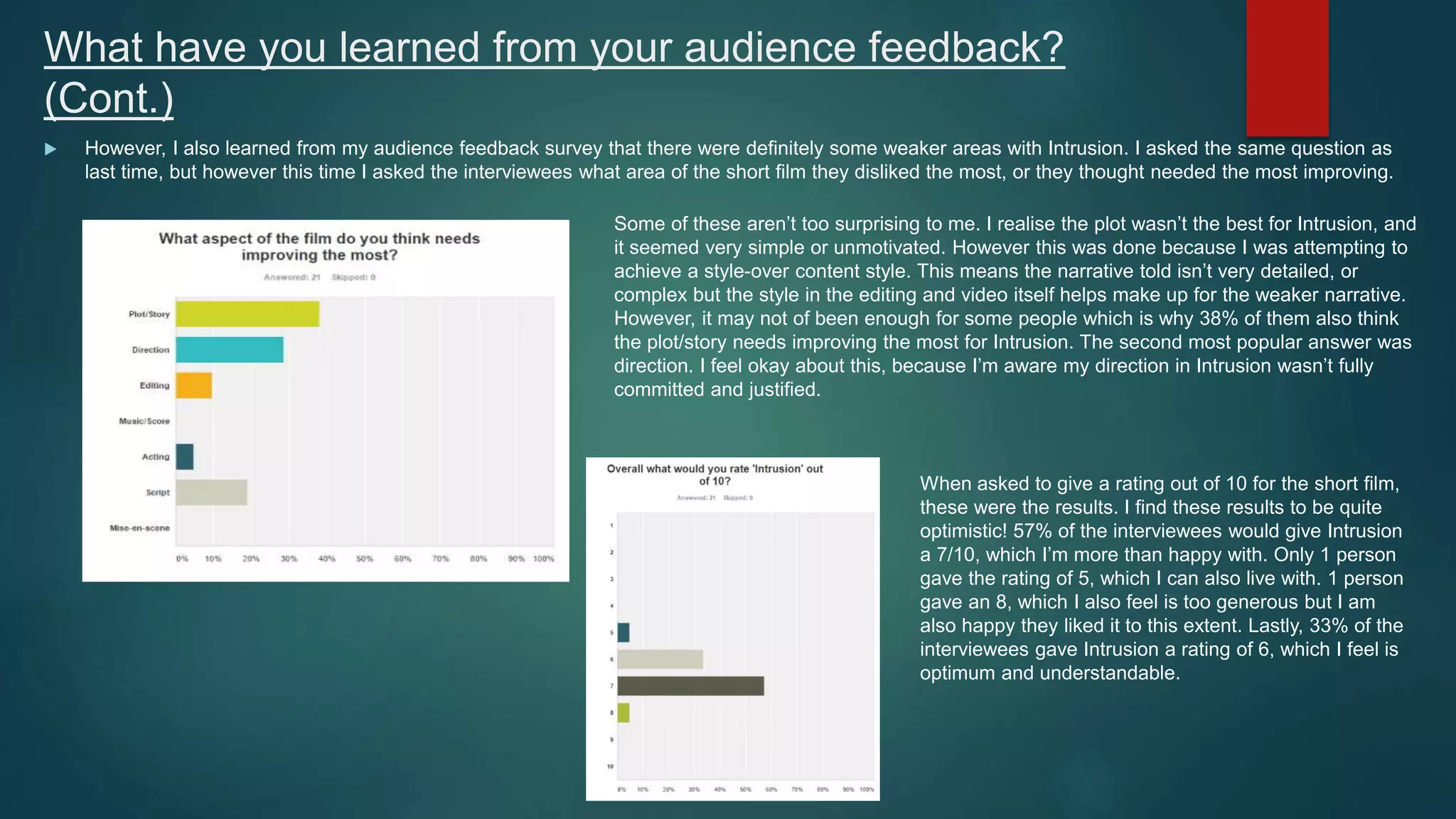
 For my final product of Intrusion, I gained critical feedback and understanding by using my final audience feedback
survey, through Survey Monkey. One of the key things I learned from this feedback survey was that there were
certain aspects of the short film that people in common thought was good. I had also learned that Intrusion fit into
the genre it was made for, which was thriller, however a fair share of people voted it as a horror instead, this was
slightly surprising for me. But, when asked in the survey which aspect of Intrusion they thought was the best, here
were the results:
The most common aspect of intrusion people thought was the best was the music/score. This was
fairly, but not too surprising for me, as I thought the soundtrack and score for Intrusion was quite
good and really helped set in the atmosphere. I also carried out a fair amount of research into
soundtracks for thriller films which helped me make informed decisions on what score and music to
include in Intrusion. The second most common answer was editing. This is something I’m not too
sure about, as I think the editing overall could be improved in areas. Whether it is continuity, pacing
or simple editing mistakes. However I am glad people thought the editing for Intrusion was good, I
personally believe most scenes flow well together and the editing is most of the time smooth.
However, none of the interviewees said that the script, or the acting was what they liked the most
about the film. The acting, is less bothering for me as not an awful lot of my attention was diverted
towards the actors performances. However, the script was in my opinion particularly weak and one-
dimensional so I’m not surprised people didn’t think the script was too good. I focused on directions
and actions more than dialogue, which in my opinion, worked and also didn’t work.
What have you learned from your audience feedback?
(Cont.)
Another positive with the final audience feedback survey for Intrusion links to genre. I am pleased that in the survey,
when asked to classify the genre for Intrusion, the only answers recorded were for the thriller genre, and also horror.
This is good for me, as it means I managed to portray the right conventions and features
enough, so that the only 2 genres people associated Intrusion with was thriller and horror.
However, like stated in previous slides, I’m quite surprised by how many people thought
Intrusion was in the horror genre, rather than the thriller genre. 38% of the interviewees
said Intrusion was a horror, which is a considerable amount more than what I would have
expected. But none the less, this isn’t necessarily a bad thing as Intrusion does
incorporate certain conventions and features of horror, such as imagery and soundtrack.
So it is expected that some people thought Intrusion belongs in the horror genre, but this
was a higher proportion than I would have expected. In addition to this, one person said
on the survey their favourite scene was ‘Heavily edited shot of man- red/orange colour
filters on screen’. This is talking about the image below, so I am glad people liked this
scene and thought it was effective in the way I decided to edit and filter it.
This sequence in particular is what I
think contributes slight horror genre
conventions to Intrusion. The imagery
is fairly horror-esque, and the dark,
creepy score playing over this scene
also contributes significantly.
What have you learned from your audience feedback?
(Cont.)
 However, I also learned from my audience feedback survey that there were definitely some weaker areas with Intrusion. I asked the same question as
last time, but however this time I asked the interviewees what area of the short film they disliked the most, or they thought needed the most improving.
Some of these aren’t too surprising to me. I realise the plot wasn’t the best for Intrusion, and
it seemed very simple or unmotivated. However this was done because I was attempting to
achieve a style-over content style. This means the narrative told isn’t very detailed, or
complex but the style in the editing and video itself helps make up for the weaker narrative.
However, it may not of been enough for some people which is why 38% of them also think
the plot/story needs improving the most for Intrusion. The second most popular answer was
direction. I feel okay about this, because I’m aware my direction in Intrusion wasn’t fully
committed and justified.
When asked to give a rating out of 10 for the short film,
these were the results. I find these results to be quite
optimistic! 57% of the interviewees would give Intrusion
a 7/10, which I’m more than happy with. Only 1 person
gave the rating of 5, which I can also live with. 1 person
gave an 8, which I also feel is too generous but I am
also happy they liked it to this extent. Lastly, 33% of the
interviewees gave Intrusion a rating of 6, which I feel is
optimum and understandable.
What have you learned from your audience feedback?
(Cont.)
 If I were to return to the project of Intrusion in the future, I now have the knowledge and understanding regarding
how to do it differently and change things around. I would adjust and develop the plot and story line firstly. Since
this was deemed as the biggest problem with Intrusion, and was the aspect that needed improving the most, if I
were to do it again I would develop the story. Such as, I would give more of a background on the two thieves, since
they are considerably one dimensional characters that don’t have a true character that defines their motives and
surface characteristics. I would also add more story line to why the thieves are robbing the house- I would try and
create a more meaningful approach to it that serves a greater sense of realism and understanding.
 In addition to this, I would make significant changes to the script. By this I mean having a lot more dialogue
between the characters, so that actions and events are much more justified and don’t seem so spontaneous. Also
since the script was one of the aspects that needed improving the most, based on my audience feedback survey. I
definitely feel this would have a positive impact on the short film, as characters will be more developed, events will
have more explanation, and narrative will become clearer and so the audience can interpret the film more
efficiently.
 Lastly, I would aim to have the best possible planning documents for the short film. During pre-production, my
original planning documents weren’t up to standards and were also either incomplete or too basic, which held me
back when it came to production. So, if I did it again in the future, I would divert a lot more care and effort into
planning the short film so that when it comes to shooting, I’m a lot more prepared and planned, which will make me
more confident during the shoots and also a lot more efficient.
How did you use new media technologies in the
construction and research, planning and evaluation
stages?
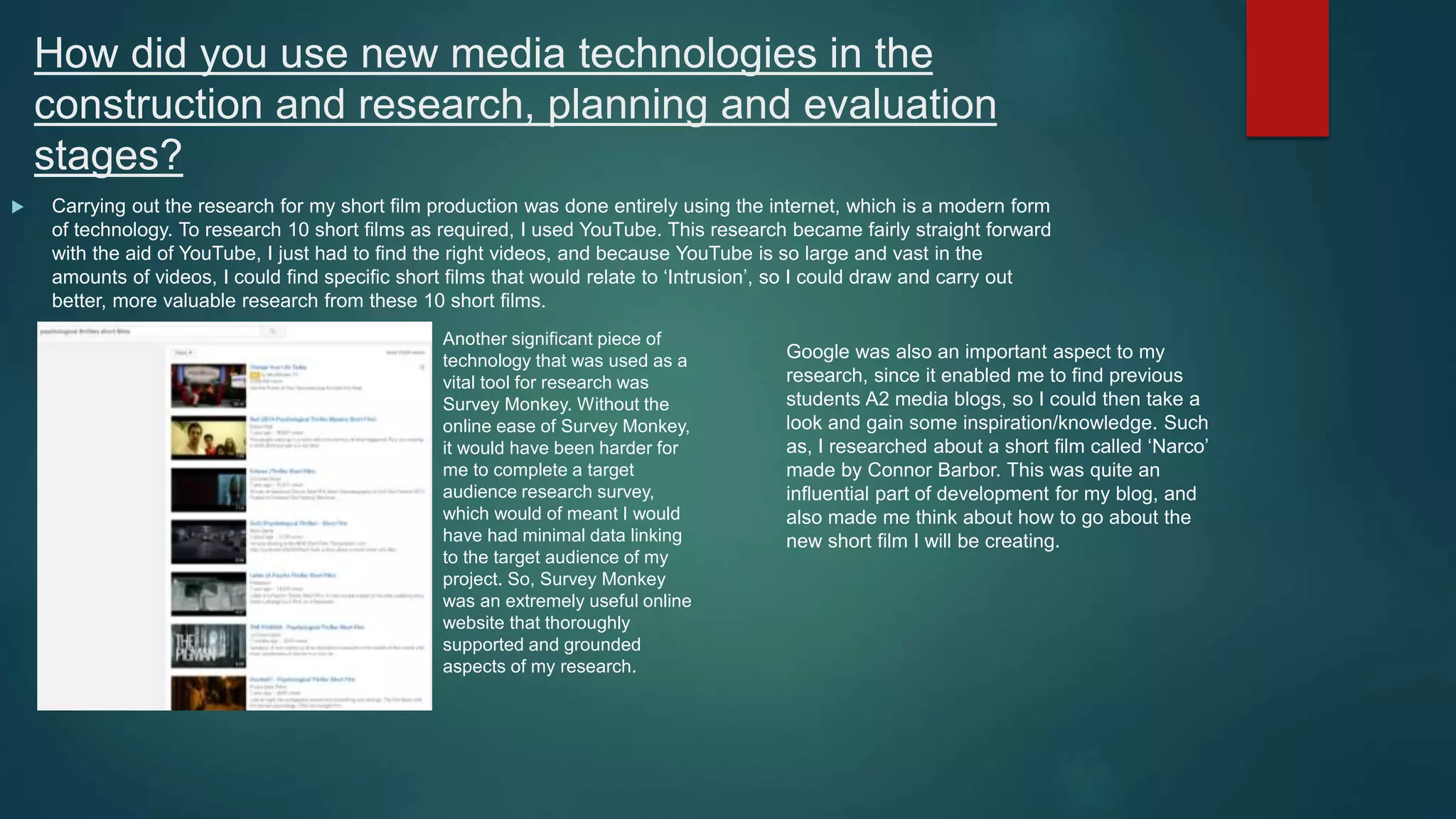
 Carrying out the research for my short film production was done entirely using the internet, which is a modern form
of technology. To research 10 short films as required, I used YouTube. This research became fairly straight forward
with the aid of YouTube, I just had to find the right videos, and because YouTube is so large and vast in the
amounts of videos, I could find specific short films that would relate to ‘Intrusion’, so I could draw and carry out
better, more valuable research from these 10 short films.
Another significant piece of
technology that was used as a
vital tool for research was
Survey Monkey. Without the
online ease of Survey Monkey,
it would have been harder for
me to complete a target
audience research survey,
which would of meant I would
have had minimal data linking
to the target audience of my
project. So, Survey Monkey
was an extremely useful online
website that thoroughly
supported and grounded
aspects of my research.
Google was also an important aspect to my
research, since it enabled me to find previous
students A2 media blogs, so I could then take a
look and gain some inspiration/knowledge. Such
as, I researched about a short film called ‘Narco’
made by Connor Barbor. This was quite an
influential part of development for my blog, and
also made me think about how to go about the
new short film I will be creating.
How did you use new media technologies in the
construction and research, planning and evaluation
stages? (Cont.)
 I also used media technologies in the form of equipment. To shoot Intrusion, I used my friends Nikon D3300 DSLR
camera. This was a considerably good camera, as well as expensive, which allowed me to shoot Intrusion just the
way I wanted to.
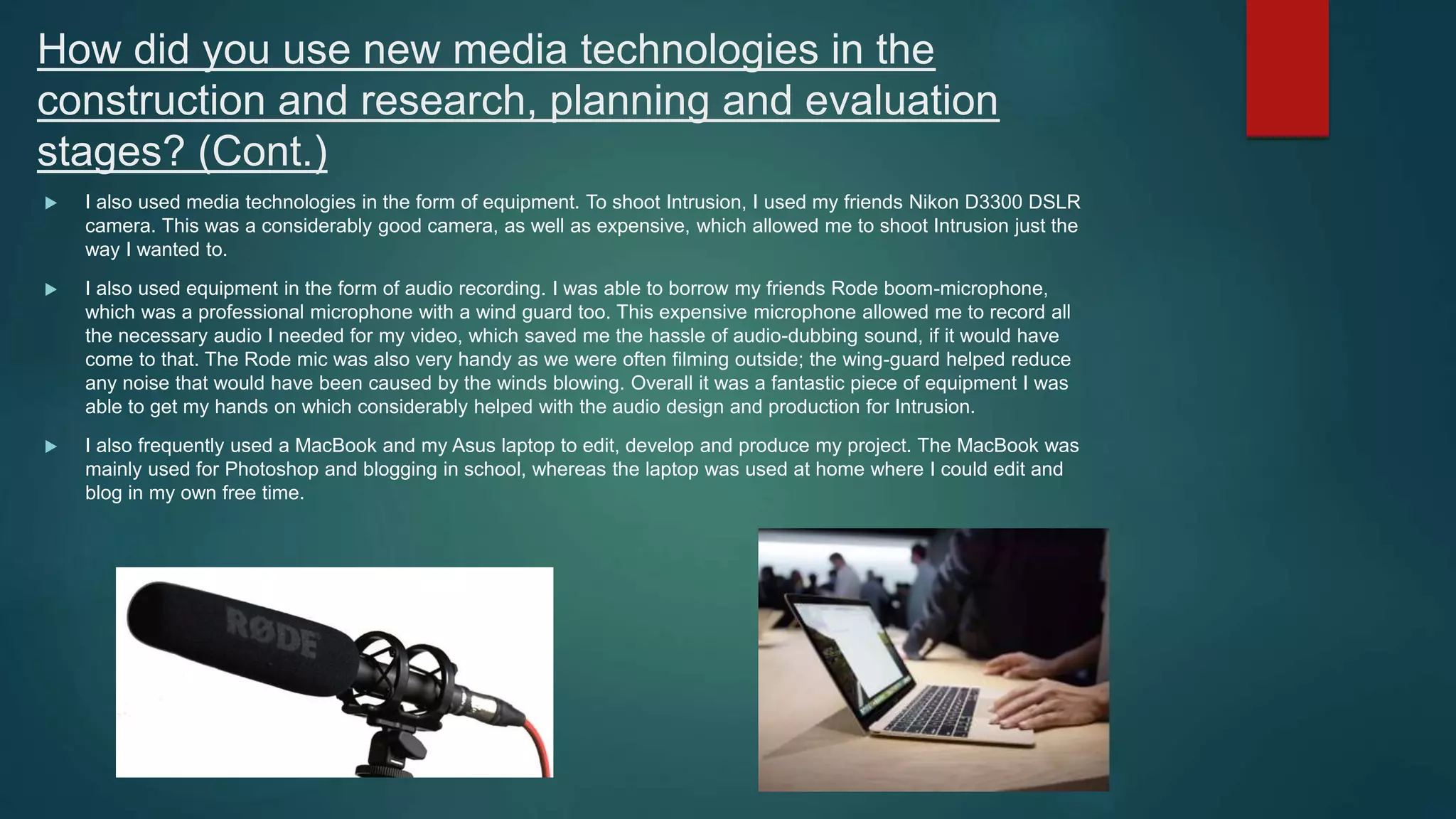
 I also used equipment in the form of audio recording. I was able to borrow my friends Rode boom-microphone,
which was a professional microphone with a wind guard too. This expensive microphone allowed me to record all
the necessary audio I needed for my video, which saved me the hassle of audio-dubbing sound, if it would have
come to that. The Rode mic was also very handy as we were often filming outside; the wing-guard helped reduce
any noise that would have been caused by the winds blowing. Overall it was a fantastic piece of equipment I was
able to get my hands on which considerably helped with the audio design and production for Intrusion.
 I also frequently used a MacBook and my Asus laptop to edit, develop and produce my project. The MacBook was
mainly used for Photoshop and blogging in school, whereas the laptop was used at home where I could edit and
blog in my own free time.
How did you use new media technologies in the
construction and research, planning and evaluation
stages? (Cont.)
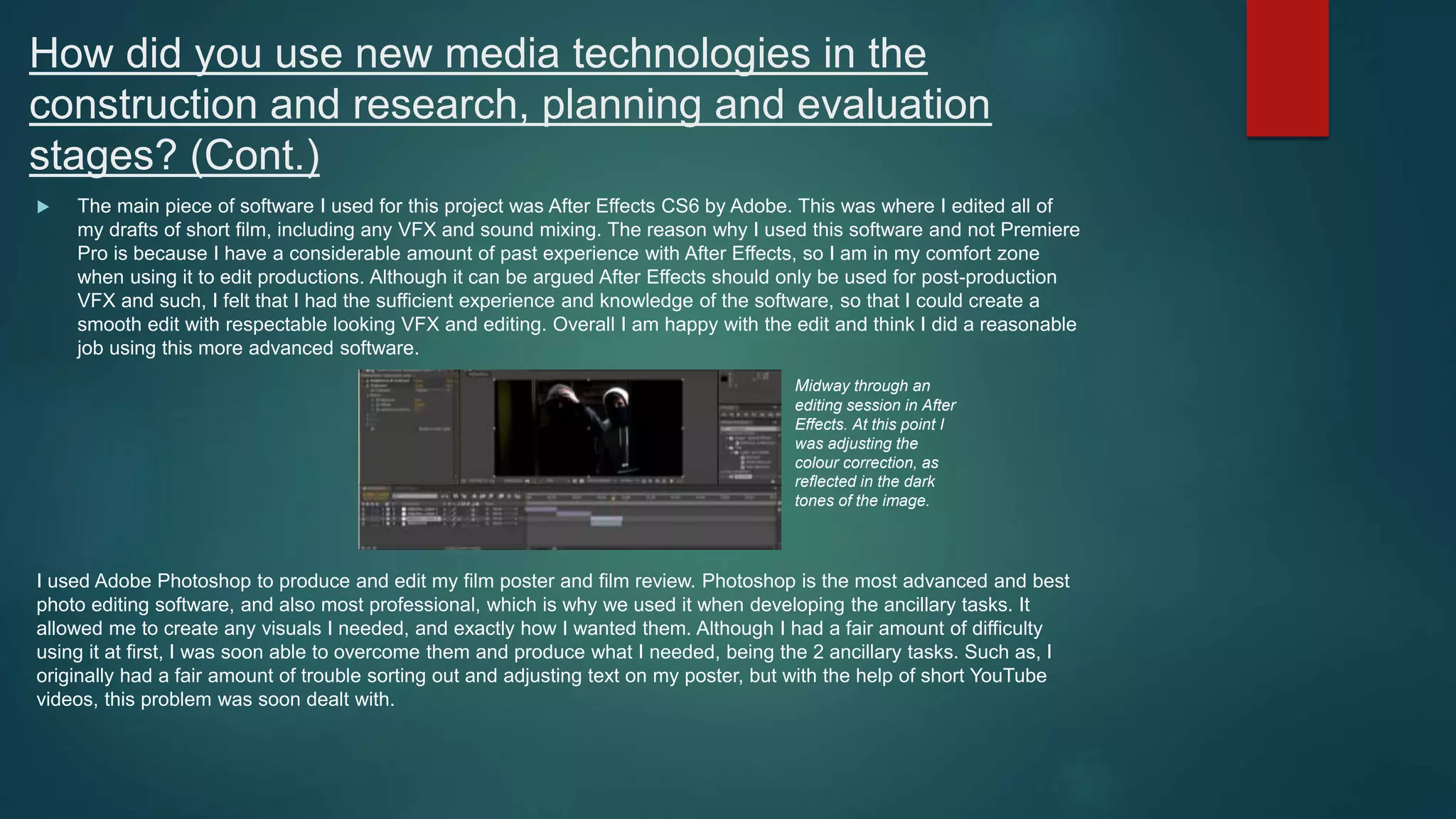
 The main piece of software I used for this project was After Effects CS6 by Adobe. This was where I edited all of
my drafts of short film, including any VFX and sound mixing. The reason why I used this software and not Premiere
Pro is because I have a considerable amount of past experience with After Effects, so I am in my comfort zone
when using it to edit productions. Although it can be argued After Effects should only be used for post-production
VFX and such, I felt that I had the sufficient experience and knowledge of the software, so that I could create a
smooth edit with respectable looking VFX and editing. Overall I am happy with the edit and think I did a reasonable
job using this more advanced software.
I used Adobe Photoshop to produce and edit my film poster and film review. Photoshop is the most advanced and best
photo editing software, and also most professional, which is why we used it when developing the ancillary tasks. It
allowed me to create any visuals I needed, and exactly how I wanted them. Although I had a fair amount of difficulty
using it at first, I was soon able to overcome them and produce what I needed, being the 2 ancillary tasks. Such as, I
originally had a fair amount of trouble sorting out and adjusting text on my poster, but with the help of short YouTube
videos, this problem was soon dealt with.
Midway through an
editing session in After
Effects. At this point I
was adjusting the
colour correction, as
reflected in the dark
tones of the image.
How did you use new media technologies in the
construction and research, planning and evaluation
stages? (Cont.)
 For the planning and creation stage, I mixed practical work, such as storyboarding and mood-boarding, with
technical aspects such as Blogger, YouTube etc. The practical aspects were necessary so I had the right forms of
planning, being the storyboard, and also the script and animatic. However, the script was written in Word and my
animatic was put together in After Effects, which are both technologies. I used A4 paper and storyboarded the films
plot, and then took pictures of it using my Sony Xperia Z3 phone and edited the photos together in After Effects to
form my animatic. I would then upload the animatic to my blog, meaning one of the aspects of planning had been
completed.
 For creation, I would have used the Nikon D3300 DSLR camera to shoot Intrusion. I would of then used SD cards
and conversion systems to convert footage into different formats that make them easier to work with on a
computer. I would of then got the footage together in After Effects and begin to make an edit of the draft. This is
always the longest stage and required most of my time and attention. Once the edit was completed, a draft of
Intrusion would have been created and ready for uploading on my blog, to be justified and reviewed.
How did you use new media technologies in the
construction and research, planning and evaluation
stages? (Cont.)
 For the evaluation stage of my project, I used Microsoft PowerPoint to physically create the evaluation, and I also
used Survey Monkey to create the final piece of audience feedback. PowerPoint is a very good piece of technology
as it is extremely easy to use, and creates a good looking evaluation PowerPoint with very little technical
difficulties.
 Survey Monkey was again a very important aspect of technology, which helped me get the critical feedback
needed to fuel my evaluation and provide a basis of evidence. Without it my evaluation would not be as good and
not as reliable, because I don’t have the physical evidence to support my claims, along with the evidence needed
to make the argument put forward in this evaluation.
How did you use new media technologies in the
construction and research, planning and evaluation
stages? (Cont.)
 Overall I think I used new technologies consistently, and to a good degree of understanding and effectiveness. My
time spent in After Effects was proficient and consistent, in my opinion. I didn’t really ever struggle or face any real
problems whilst doing it, which I think is good. Overall I think I used this technology rather effectively which I’m
pleased with.
 One technology I wasn’t so proficient and effective in was Photoshop. I found it harder to grasp and take control of,
so I needed some help from my friends and my teacher, which was fine in the end.
 I also think I used Survey Monkey well and effectively to get back good surveys, with reliable and responsible data.

Media studies a2 coursework the evaluation

  • 1.
    Media Studies A2 Coursework-‘Intrusion’ - The Evaluation BY ASHLEY BANGER
  • 2.
    In what waysdoes your media product use, develop or challenge forms and conventions of real media products?  One way my media product, such as my short film I produced, uses conventions of real media products is through the use of low–key lighting and slower paced editing, which is a very common feature amongst thrillers in the psychological sub-genre like my short film is in. Since my short film was intended to be a mysterious, more ominous thriller like I planned for, I had to match certain elements of the production like the lighting and editing to meet regular conventions of such other thriller films belonging to the same genre/form. Such as, a film which provided a fair amount of inspiration for me was the 2002 thriller film ‘Panic Room’ directed by David Fincher. It similarly uses low-key lighting and shots that go on for a longer duration, providing a slower paced, more built up editing style that I tried to use and incorporate in my short film ‘Intrusion’. Which is why in post-production I toned down the colour pallet for Intrusion a considerable amount, to aim for a moody, darker tone which I envisioned for this short film. Similarly, the choices and selections I chose for the soundtrack and score for Intrusion was also based on real conventions of similar media products. In addition to this decision, in my audience survey a lot of people shared the opinion being that lighting plays a significant part in films in the thriller genre. This is why I diverted a fair amount of my attention when it came to directing and post-production, to try and create a mise-en-scene and colour pallet to meet the codes and conventions I had been researching and expecting from the audience survey. Overall I wanted this to make the audience know they are watching a darker thriller film, that is to be taken more seriously based on the darker, bleaker colour pallet that is incorporated throughout the films duration. A shot from ‘Panic Room’ that I felt was appropriate to replicate, and in pastiche, use in ‘Intrusion’. Also note the style of lighting being low- key. The replicated shot in pastiche of Panic Room used in my short film ‘Intrusion’.
  • 3.
    In what waysdoes your media product use, develop or challenge forms and conventions of real media products? (Cont.)  My short film media product also uses conventions of real media products in the form of narrative. My short film piece ‘Intrusion’ follows a linear narrative, with a closed structure, which is a more simple, grounded structure that features a beginning, a middle and an end. We are introduced to my characters, exposition occurs in the form of the house bound to be robbed, and then the story climaxes to a sudden, dark resolution. Many other thriller films do this, and it is often done to give the audience a simpler, more interpretable storyline that has closure in the end. Other thriller films can be open structured, in which the audience are left to wonder what happens next after the end of the film. Such as, ‘Solus’ is an example short film I researched that also follows a linear narrative. The short film begins with the protagonist, we are introduced to him but things are still fairly mysterious at this point. As the short film unravels we see the post-apocalyptic world and the dangers that are posed to the man, but in the end a helicopter appears and presumably saves the character. This is an example of a linear narrative, with also a closed structure due to the fact we know what happens in the end. ‘Intrusion’ follows the same type of narrative and structure as this other short film, to give an example.
  • 4.
    In what waysdoes your media product use, develop or challenge forms and conventions of real media products? (Cont.)  Another media product I produced was my poster for my short film ‘Intrusion’. I believe my poster developed real conventions of other psychological-thriller posters in the way I had the overall colour scheme of my poster in black and white, whilst incorporating striking red fonts throughout the poster as well. This was something quite a lot of psychological-thriller posters I researched didn’t do, so I thought it would be good to combine features such as having contrasting black and white images along with red fonts, to create a more visually striking and sleek poster. As a result of this, the poster for Intrusion remains mysterious and vague, whilst still definitely conveying meaning and tone through the use of black and white imagery, which connote the abrupt, harsh themes in the film, whilst also the bold red fonts connote themes of danger and warning to the audiences. My poster also used conventions of real media products through the layout of my texts and credits. I researched posters for films and found out all the common and essential places that certain texts and credits need to be, so when it came to designing the poster for Intrusion, I knew just where to insert text and knew how it can add to the poster overall. To link with the audience, I wanted them to feel a certain way when they saw my poster. As stated previously, the black and white image I intended them to feel ambiguity and mystery, and the overall red typography I wanted them to associate with danger, horror and a thriller piece-genre. The poster for Shutter Island was one I researched, and found its use of red, large typography like in this picture and how it indicates themes of danger, warning, dread and so on. Conventions of red typography have been developed by using a black and white background, rather than just a normal black/dark coloured background.
  • 5.
    In what waysdoes your media product use, develop or challenge forms and conventions of real media products? (Cont.)  Lastly, I believe my 2nd ancillary task being my film review challenges conventions of other real film reviews. I believe that one way I have done this is by using imagery for my film review, that keeps the review and plot details still ambiguous and mysterious. Whilst some film reviews use images and pictures on the review that help showcase the films plot or storyline, I chose to use images that keep the plot and overall story ambiguous, so that when the audience came to watch my Intrusion, that level of mystery was still there and they don’t fully know what my film will be like, content wise.  Such as, in my research for 10 film reviews, the film review for ‘Pirates of The Caribbean: At World’s End’ arguably uses a picture that contains plot points involving two significant characters. I wanted to attempt to subvert a convention like such and simply use vague, more down to interpretation pictures that the audience can infer information from. The picture from the review that I researched, that uses 2 of the main characters, perhaps laying out a fair chunk of plot/events in the film to the audience. This is one of the images from my review, that I feel keeps the short film vague and relatively ambiguous in terms of plot and characters.
  • 6.
    In what waysdoes your media product use, develop or challenge forms and conventions of real media products? (Cont.)  I also used and gained inspiration for my themes and ideas from real media products. Whilst in development for ‘Intrusion’, my teacher told me of a movie called ‘Cherry Tree Lane’, which is a horror-thriller and also follows a similar plot line to Intrusion and was something I could look towards for inspiration. She told me to take a look at the trailer and poster for the movie, so I did that and gained a fair amount of inspiration. As you can see, the poster for Cherry Tree Lane definitely inspired my Intrusion poster, typography and overall vision to a fair extent. As you can see here, this image from the Intrusion poster image shares similarity between the poster for Cherry Tree Lane, being hooded characters staring at the house in which they are about to rob/invade. Overall I am happy with the inspiration I gained from ‘Cherry Tree Lane’ and think it gave a great spark for Intrusion, as well as good ideas for content and overall direction and style.
  • 7.
  • 8.
    How effective isthe combination of your main and ancillary texts?  I believe that the combination of my main product, being the short film of ‘Intrusion’, and the ancillary tasks being the poster and film review make for an effective, consistent combination. The underlying theme between the 3 products is mystery, omission and bleakness. To replicate this throughout the 3 products, I had to pay close attention to the features and conventions of each product, and design/create around them so that the themes and conventions are reciprocated in each product. I believe this is evident throughout the 3 products I’ve created. There are 3 ways the combination of the products is effective, and they are: By having a continuity of colour scheme, by having a continuity of typography, and also creating an overall synergy between the 3 products. These 3 ways will be explained and examined over the next 3 slides.
  • 9.
    How effective isthe combination of your main and ancillary texts? (Cont.)  One way the combination of my main and ancillary texts is effective is through the continuity of my colour scheme. My overall colour scheme was by incorporating dark colours, such as blacks and greys/whites, along with striking, horror-based typography. My idea behind these colours was to make the audience weary of the fact intrusion is a thriller film, along with feeling chilled and thrilled throughout the products of Intrusion, largely because of the colours and tones involved. I used a continuous colour scheme in my 3 products to try and make them as cohesive as possible; to try and make Intrusion as effective and influential as possible across the 3 products. As you can see from the above screenshots, dark red and dark colours, mainly being black, have been a continuous colour scheme throughout the products of Intrusion. These colours I felt were vital in putting across the themes and emotions of Intrusion, being violence, darkness and in some parts being sinister/evil. I definitely believe that it has made Intrusion as an overall project flow better; all the products seem very closely related to each other in my opinion, which was what I aimed to do when it came to designing and constructing them. I also think that if I didn’t have a continued colour scheme, the overall vision and purpose of Intrusion, being to thrill and partly chill, wouldn’t be as effective, due to the fact the main product wouldn’t quite link up and connect with the other 2 ancillary tasks. A still shot from the nightmare scene, from Intrusion. The colour for this scene is red and orange, a frequent colour tone for the 3 products.
  • 10.
    How effective isthe combination of your main and ancillary texts? (Cont.)  The second way I chose to make the combination of my 3 products as effective as possible, was by using a continued typography, or text scheme. I used the same, horror-based red font throughout the short film for Intrusion, the poster and also the film review. The font was very horror-based, and can be associated with other film conventions belonging to the same genre. This is because red font in the specific font I used can be associated with horror/thriller based concepts that are often seen in horror films, such as in the typography for the poster and in the title sequences. I wanted to try and replicate this in the products for Intrusion, due to the fact that by having an engaging typography audiences can feel more connected to the products. A still from the title sequence from the short film. As you can see from the screenshots, the overall same typography has been continued and developed in each product for Intrusion that I have created. However, the font was slightly altered in the actual short film, due to the fact that I felt it suited the short film itself more, as opposed to the slightly different, horror based font in the poster and film review that I was intending for. However overall this created a sense of consistency amongst the 3 products, and translates the same themes and mood that such styled text will bring to the audience. Therefore, when you combine the 3 products together, I considerably believe that they are effective as the typography is the same each time, which gives the title of ‘Intrusion’ a more recognizable and iconic signature, as well as ideally making the audience feel uncomfortable when they read the font, due to its nature and style.
  • 11.
    How effective isthe combination of your main and ancillary texts? (Cont.)  Overall, a fair extent of synergy has been created amongst my 3 product I’ve created, for reasons in which I have stated and developed from the previous slides. I created an audience feedback survey, which had the objective of gaining some insight and understanding of what audiences thought of the final draft of Intrusion. One of the questions I asked was ‘What genre would you put ‘Intrusion’ in?’. The results for this question are as below: As you can see from the print screen, the only 2 genres the interviewees thought Intrusion fits into is Thriller and Horror. 61% of people thought Intrusion would fit into the thriller genre, however 38% of them would classify it as a horror. These numbers to me were fairly surprising, as I would have thought the majority of people would classify it as a thriller. A reason for this fair amount of horror votes could be due to Intrusion having certain conventions of horror. Such as, there was a piece of score I used, for the nightmare scene, which is arguably more horror than thriller, but however I used it because I thought it was appropriate and effective for the scene in the film. However I am pleased that nobody classified intrusion as action, drama or fantasy because these are genres Intrusion doesn’t really fit in and wasn’t intended for. This means the audience overall received Intrusion in positive ways, and ways I wanted them to perceive it, being a psychological-thriller with some elements of horror. To link this to synergy, Intrusion has been developed and produced in the form of 3 tasks, the short film, the poster and the survey, all linking back to the thriller genre at all times possible. For example, the short film is in the thriller genre, and uses frequent and main conventions of thriller, the poster is in black and white along with red typography, and the film review also does similarly and used dark imagery. Overall this has created a fair amount of synergy between the 3 products, and they all link back to each other and act as a cohesive overall production. Overall each product has been designed fairly specifically to conventions of real media products. Such as, the film review was constructed by researching other film reviews online, and the same for the poster I created, which gives an overall positive synergy between them. People only classified Intrusion as thriller and horror, which is good as it these 2 genres are closely associated with Intrusion.
  • 12.
    How effective isthe combination of your main and ancillary texts? (Cont.)  Overall I wouldn’t in particularly say I have broken the synergy between my main and ancillary tasks. I have carried and continued the underlying themes and overall tone between the main tasks and 2 ancillary tasks. I have also carried on and continued the colour scheme, along with the typography across the 3 different products I produced. This was done purposefully to keep the audience intact with the themes and intentions of Intrusion, to chill and entertain the audience in this short, escalating thriller short film. I’m relatively happy with the 3 products in terms of their synergy and relation to each other, in terms of visual aesthetics and overall tone.
  • 13.
    What have youlearned from your audience feedback?  Several months ago now marks the first and initial screening and feedback session I did in my class for Intrusion. I showed them my first draft of Intrusion, and in which I received some necessary and beneficial feedback. They told me some of the initial strengths with the cut, and then also some of the weaknesses. Since I now knew what need improving with intrusion, this influenced on what I would change in later drafts. Such as, an early piece of feedback I got in this screening was to include a lot more diegetic sound- in order to change up the soundtrack, which was seen as repetitive. This was one of the main early improvements for Intrusion that made me considerably change/alter the drafts after this one. I made the decision to reduce the sound of the non-diegetic score over some footage, and have the real diegetic sound brought back to volume to give the audience a mixture of audio types. Doing do will also keep it more interesting for the audience as they’re not only listening to one piece of score for roughly 2 minutes. This was something they found to be a good improvement and it made draft 2 more interesting and engaging for the audience. The initial improvement I got stating the soundtrack could be changed, by using more diegetic sound. So I did just this and in the second draft of Intrusion, enabled the sound on many, appropriate clips that helped build up the tension and plot by enabling the real diegetic sound. In addition to this, another initial improvement was the lighting. Most of my classmates and teacher found the lighting to be too dark in some shots, which would definitely need to be re-shot or re-edited. I therefore undertook this improvement and I was happy with the difference in aesthetics it made. The shots looked clearer and less harder for the audience to see exactly what was happening on screen. The new shot in draft #2, which was filmed and edited with additional lighting.
  • 14.
    What have youlearned from your audience feedback? (Cont.)  For my final product of Intrusion, I gained critical feedback and understanding by using my final audience feedback survey, through Survey Monkey. One of the key things I learned from this feedback survey was that there were certain aspects of the short film that people in common thought was good. I had also learned that Intrusion fit into the genre it was made for, which was thriller, however a fair share of people voted it as a horror instead, this was slightly surprising for me. But, when asked in the survey which aspect of Intrusion they thought was the best, here were the results: The most common aspect of intrusion people thought was the best was the music/score. This was fairly, but not too surprising for me, as I thought the soundtrack and score for Intrusion was quite good and really helped set in the atmosphere. I also carried out a fair amount of research into soundtracks for thriller films which helped me make informed decisions on what score and music to include in Intrusion. The second most common answer was editing. This is something I’m not too sure about, as I think the editing overall could be improved in areas. Whether it is continuity, pacing or simple editing mistakes. However I am glad people thought the editing for Intrusion was good, I personally believe most scenes flow well together and the editing is most of the time smooth. However, none of the interviewees said that the script, or the acting was what they liked the most about the film. The acting, is less bothering for me as not an awful lot of my attention was diverted towards the actors performances. However, the script was in my opinion particularly weak and one- dimensional so I’m not surprised people didn’t think the script was too good. I focused on directions and actions more than dialogue, which in my opinion, worked and also didn’t work.
  • 15.
    What have youlearned from your audience feedback? (Cont.) Another positive with the final audience feedback survey for Intrusion links to genre. I am pleased that in the survey, when asked to classify the genre for Intrusion, the only answers recorded were for the thriller genre, and also horror. This is good for me, as it means I managed to portray the right conventions and features enough, so that the only 2 genres people associated Intrusion with was thriller and horror. However, like stated in previous slides, I’m quite surprised by how many people thought Intrusion was in the horror genre, rather than the thriller genre. 38% of the interviewees said Intrusion was a horror, which is a considerable amount more than what I would have expected. But none the less, this isn’t necessarily a bad thing as Intrusion does incorporate certain conventions and features of horror, such as imagery and soundtrack. So it is expected that some people thought Intrusion belongs in the horror genre, but this was a higher proportion than I would have expected. In addition to this, one person said on the survey their favourite scene was ‘Heavily edited shot of man- red/orange colour filters on screen’. This is talking about the image below, so I am glad people liked this scene and thought it was effective in the way I decided to edit and filter it. This sequence in particular is what I think contributes slight horror genre conventions to Intrusion. The imagery is fairly horror-esque, and the dark, creepy score playing over this scene also contributes significantly.
  • 16.
    What have youlearned from your audience feedback? (Cont.)  However, I also learned from my audience feedback survey that there were definitely some weaker areas with Intrusion. I asked the same question as last time, but however this time I asked the interviewees what area of the short film they disliked the most, or they thought needed the most improving. Some of these aren’t too surprising to me. I realise the plot wasn’t the best for Intrusion, and it seemed very simple or unmotivated. However this was done because I was attempting to achieve a style-over content style. This means the narrative told isn’t very detailed, or complex but the style in the editing and video itself helps make up for the weaker narrative. However, it may not of been enough for some people which is why 38% of them also think the plot/story needs improving the most for Intrusion. The second most popular answer was direction. I feel okay about this, because I’m aware my direction in Intrusion wasn’t fully committed and justified. When asked to give a rating out of 10 for the short film, these were the results. I find these results to be quite optimistic! 57% of the interviewees would give Intrusion a 7/10, which I’m more than happy with. Only 1 person gave the rating of 5, which I can also live with. 1 person gave an 8, which I also feel is too generous but I am also happy they liked it to this extent. Lastly, 33% of the interviewees gave Intrusion a rating of 6, which I feel is optimum and understandable.
  • 17.
    What have youlearned from your audience feedback? (Cont.)  If I were to return to the project of Intrusion in the future, I now have the knowledge and understanding regarding how to do it differently and change things around. I would adjust and develop the plot and story line firstly. Since this was deemed as the biggest problem with Intrusion, and was the aspect that needed improving the most, if I were to do it again I would develop the story. Such as, I would give more of a background on the two thieves, since they are considerably one dimensional characters that don’t have a true character that defines their motives and surface characteristics. I would also add more story line to why the thieves are robbing the house- I would try and create a more meaningful approach to it that serves a greater sense of realism and understanding.  In addition to this, I would make significant changes to the script. By this I mean having a lot more dialogue between the characters, so that actions and events are much more justified and don’t seem so spontaneous. Also since the script was one of the aspects that needed improving the most, based on my audience feedback survey. I definitely feel this would have a positive impact on the short film, as characters will be more developed, events will have more explanation, and narrative will become clearer and so the audience can interpret the film more efficiently.  Lastly, I would aim to have the best possible planning documents for the short film. During pre-production, my original planning documents weren’t up to standards and were also either incomplete or too basic, which held me back when it came to production. So, if I did it again in the future, I would divert a lot more care and effort into planning the short film so that when it comes to shooting, I’m a lot more prepared and planned, which will make me more confident during the shoots and also a lot more efficient.
  • 18.
    How did youuse new media technologies in the construction and research, planning and evaluation stages?  Carrying out the research for my short film production was done entirely using the internet, which is a modern form of technology. To research 10 short films as required, I used YouTube. This research became fairly straight forward with the aid of YouTube, I just had to find the right videos, and because YouTube is so large and vast in the amounts of videos, I could find specific short films that would relate to ‘Intrusion’, so I could draw and carry out better, more valuable research from these 10 short films. Another significant piece of technology that was used as a vital tool for research was Survey Monkey. Without the online ease of Survey Monkey, it would have been harder for me to complete a target audience research survey, which would of meant I would have had minimal data linking to the target audience of my project. So, Survey Monkey was an extremely useful online website that thoroughly supported and grounded aspects of my research. Google was also an important aspect to my research, since it enabled me to find previous students A2 media blogs, so I could then take a look and gain some inspiration/knowledge. Such as, I researched about a short film called ‘Narco’ made by Connor Barbor. This was quite an influential part of development for my blog, and also made me think about how to go about the new short film I will be creating.
  • 19.
    How did youuse new media technologies in the construction and research, planning and evaluation stages? (Cont.)  I also used media technologies in the form of equipment. To shoot Intrusion, I used my friends Nikon D3300 DSLR camera. This was a considerably good camera, as well as expensive, which allowed me to shoot Intrusion just the way I wanted to.  I also used equipment in the form of audio recording. I was able to borrow my friends Rode boom-microphone, which was a professional microphone with a wind guard too. This expensive microphone allowed me to record all the necessary audio I needed for my video, which saved me the hassle of audio-dubbing sound, if it would have come to that. The Rode mic was also very handy as we were often filming outside; the wing-guard helped reduce any noise that would have been caused by the winds blowing. Overall it was a fantastic piece of equipment I was able to get my hands on which considerably helped with the audio design and production for Intrusion.  I also frequently used a MacBook and my Asus laptop to edit, develop and produce my project. The MacBook was mainly used for Photoshop and blogging in school, whereas the laptop was used at home where I could edit and blog in my own free time.
  • 20.
    How did youuse new media technologies in the construction and research, planning and evaluation stages? (Cont.)  The main piece of software I used for this project was After Effects CS6 by Adobe. This was where I edited all of my drafts of short film, including any VFX and sound mixing. The reason why I used this software and not Premiere Pro is because I have a considerable amount of past experience with After Effects, so I am in my comfort zone when using it to edit productions. Although it can be argued After Effects should only be used for post-production VFX and such, I felt that I had the sufficient experience and knowledge of the software, so that I could create a smooth edit with respectable looking VFX and editing. Overall I am happy with the edit and think I did a reasonable job using this more advanced software. I used Adobe Photoshop to produce and edit my film poster and film review. Photoshop is the most advanced and best photo editing software, and also most professional, which is why we used it when developing the ancillary tasks. It allowed me to create any visuals I needed, and exactly how I wanted them. Although I had a fair amount of difficulty using it at first, I was soon able to overcome them and produce what I needed, being the 2 ancillary tasks. Such as, I originally had a fair amount of trouble sorting out and adjusting text on my poster, but with the help of short YouTube videos, this problem was soon dealt with. Midway through an editing session in After Effects. At this point I was adjusting the colour correction, as reflected in the dark tones of the image.
  • 21.
    How did youuse new media technologies in the construction and research, planning and evaluation stages? (Cont.)  For the planning and creation stage, I mixed practical work, such as storyboarding and mood-boarding, with technical aspects such as Blogger, YouTube etc. The practical aspects were necessary so I had the right forms of planning, being the storyboard, and also the script and animatic. However, the script was written in Word and my animatic was put together in After Effects, which are both technologies. I used A4 paper and storyboarded the films plot, and then took pictures of it using my Sony Xperia Z3 phone and edited the photos together in After Effects to form my animatic. I would then upload the animatic to my blog, meaning one of the aspects of planning had been completed.  For creation, I would have used the Nikon D3300 DSLR camera to shoot Intrusion. I would of then used SD cards and conversion systems to convert footage into different formats that make them easier to work with on a computer. I would of then got the footage together in After Effects and begin to make an edit of the draft. This is always the longest stage and required most of my time and attention. Once the edit was completed, a draft of Intrusion would have been created and ready for uploading on my blog, to be justified and reviewed.
  • 22.
    How did youuse new media technologies in the construction and research, planning and evaluation stages? (Cont.)  For the evaluation stage of my project, I used Microsoft PowerPoint to physically create the evaluation, and I also used Survey Monkey to create the final piece of audience feedback. PowerPoint is a very good piece of technology as it is extremely easy to use, and creates a good looking evaluation PowerPoint with very little technical difficulties.  Survey Monkey was again a very important aspect of technology, which helped me get the critical feedback needed to fuel my evaluation and provide a basis of evidence. Without it my evaluation would not be as good and not as reliable, because I don’t have the physical evidence to support my claims, along with the evidence needed to make the argument put forward in this evaluation.
  • 23.
    How did youuse new media technologies in the construction and research, planning and evaluation stages? (Cont.)  Overall I think I used new technologies consistently, and to a good degree of understanding and effectiveness. My time spent in After Effects was proficient and consistent, in my opinion. I didn’t really ever struggle or face any real problems whilst doing it, which I think is good. Overall I think I used this technology rather effectively which I’m pleased with.  One technology I wasn’t so proficient and effective in was Photoshop. I found it harder to grasp and take control of, so I needed some help from my friends and my teacher, which was fine in the end.  I also think I used Survey Monkey well and effectively to get back good surveys, with reliable and responsible data.