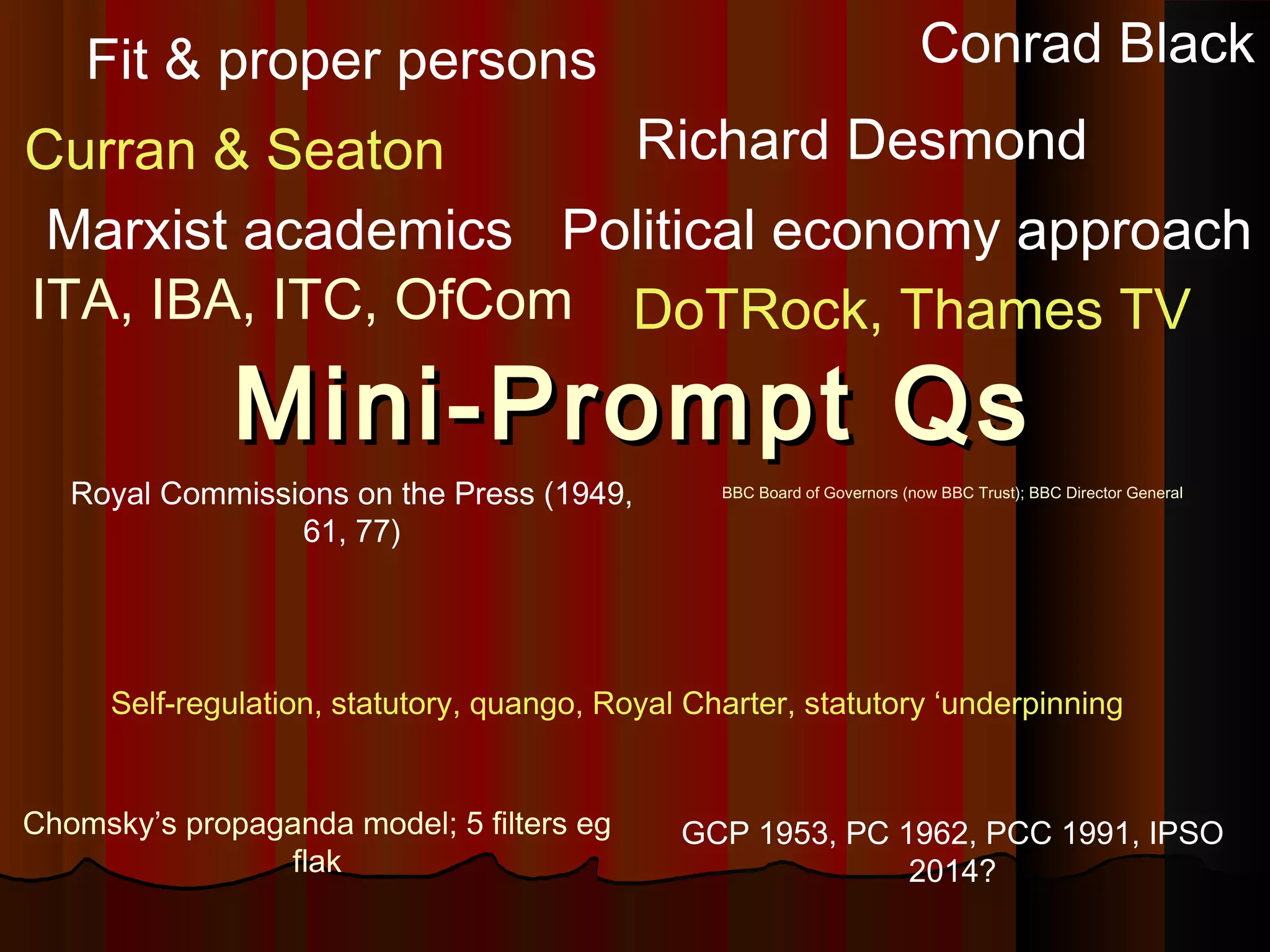
Mini-Prompt QsMini-Prompt Qs
Fit & proper persons
Curran & Seaton
Conrad Black
Richard Desmond
Marxist academics Political economy approach
Chomsky’s propaganda model; 5 filters eg
flak
Royal Commissions on the Press (1949,
61, 77)
GCP 1953, PC 1962, PCC 1991, IPSO
2014?
BBC Board of Governors (now BBC Trust); BBC Director General
Self-regulation, statutory, quango, Royal Charter, statutory ‘underpinning
ITA, IBA, ITC, OfCom DoTRock, Thames TV
Mini-PromptsMini-Prompts
Try using these, and creating your own, to see
if you can take a few bullet points and
talk/write around them
How many of the 4 main prompt Qs can you
address in doing so?
Can you provide EAA, EX and T?
Can you make comparisons to other media?
Any theory/ists you can raise here?
Can the EAA be put more than one way? Is
there an opportunity to say ‘on the one hand…
but on the other…’?
The 4 Prompt QsThe 4 Prompt Qs
What is the nature of contemporary media
regulation compared with previous practices?
What are the arguments for and against
specific forms* of contemporary media
regulation? *especially statutory v self-regulation; powers; funding
How effective are regulatory practices?
What are the wider social issues** relating to
media regulation?
**Eg right to privacy, right to offend/freedom of speech, social representation +
discrimination (influencing social attitudes), diversity/pluralism (different
views/ideologies represented; balance between left-/right-wing voices?)
democracy (informing citizenry, holding politicians and powerful to account)
Protection of children will be the core example/theme we’ll focus on
Mini-Prompt 1Mini-Prompt 1
Robert Maxwell, Mirror pensions fund theft
1980s
Conrad Black, jailed in 2000s for theft from
Telegraph
Richard Desmond, pornographer who told
Leveson he “doesn’t understand the word
ethics”
James Murdoch, News Int. chairman, accused
of misleading MPs on Culture Select
Committee (2011), a criminal offence
‘fit & proper persons test’
Mini-Prompt 2Mini-Prompt 2
 Chomsky’s propaganda model: 5 filters include
advertiser power, ownership, sourcing, flak, anti-
communism
 Fellow Marxists Curran & Seaton’s take on ending
of stamp duty
 Gramsci’s hegemony
 RCP1-3 (1949, 1961, 1977), espec RCP3
 83% v 17% circulation share (2014 UK press)
 Legal requirement for neutrality of broadcast news
+ current affairs (…convergence tho’?)
 OfCom recently removed Iranian-owned Press TV’s
license for repeatedly breaching this requirement
Mini-Prompt 3Mini-Prompt 3
 Political appointments + thus power?
 Hegemony = power exercised but invisible
 BBC Dir. Gen. Greg Dyke (Lab donor); BBC Chair Lord
Patten (ex-Thatcher minister), now Lord Coe (ex-Tory
MP)?
 Thatcher: Peacock Ctee + John Birt as Dir Gen
 OfCom: Chief Exec Ed Richards (2003-, was Blair’s
Media ‘Spad’ [special advisor]); Tory policy in 2010 to
scrap OfCom as part of “bonfire of the quangos”
 PCC ex-Thatcher ministers Lords Wakeham (1995) +
Hunt (2011-)
Mini-Prompt 4Mini-Prompt 4
Toploader guitarist; ex-wife model/presenter
Gail Porter; 8 year-old daughter
Daily Star
2011
PCC powerless?
Used lawyers, not PCC
Editor’s Code Article 6: Children
Mini-Prompt 5Mini-Prompt 5
 Jan Moir’s 2009 Daily Mail Stephen Gately death column
 Record number of PCC complaints: 25,000
 Stephen Fry’s angry tweet saw it trend
 Upside of digitisation – or Twitter a more effective regulator?
Advertisers on the Mail’s web page bombarded with threats of
boycott until Mail pulled all ads from the article page
 Marxists Curran & Seaton + Chomsky argue that advertisers have a
regulatory, pseudo-licensing (filtering) power
 PCC, as usual (condemned for this by 2010 Culture Select Ctee
report) to answer ‘third party’ complaints (it can, ‘in exceptional
circumstances)
 PCC ruled only when Gately’s partner complained
 No consideration of Clause 5: Intrusion into Grief
 PCC cleared Mail on breaching Clause 1: Accuracy, 12:
Discrimination. Context as opinion piece crucial: freedom of
expression.
 PCC poor record on homophobia? Iain Dale, Clare Balding, Julie Burchill
Mini-Prompt 6Mini-Prompt 6
 The Sun’s Hillsborough coverage helped lead to Calcutt:
‘THE TRUTH’ (Liverpool fans hooligans, NOT police fault)
and the threatening of grieving gran to get child pictures
which they ran with this story
 Sun STILL boycotted across Merseyside; 20m special free
editions printed for 2014 World Cup, given out across UK …
except Merseyside
 The Sun front page headline, 1989:
 ‘The Worst Brat in Britain’
 Family fled Britain
 Made history as 1st
child to win libel damages
 Typical failures of the PC
 29th
May 2014: Hacked off and Hillsborough campaigners
condemn IPSO appointment of William Newman, Sun exec
Mini-Prompt 7Mini-Prompt 7
 Toploader guitarist used lawyers because an apology
“would likely end up on page 80”
 IPSO won’t have the power to fine that Leveson and
Hacked Off recommended
 Frequent breaches of new code could lead to paying
tax Leveson suggested; IPSO said no
 2012: Lord Prescott ignores PCC, tweets that
S.Times made up quotes from him; within hours they
pulled the story
 2008: OfCom fines ITV record £6.5m for phone-in
fake comps
 2013: Noor TV and Psychic TV amongst several fined
 Recent license removals include Press TV
Mini-Prompt 8Mini-Prompt 8
 Press bully govs/MPs?
 David Mellor: press ‘drinking in last chance saloon’; resigns in sex scandal
 Gordon Brown testified to Leveson that NoTW ed Rebecca Brooks rang
him when PM + threatened him with worse story if didn’t co-operate with
story on his sick child. His wife STILL had her over for sleepover in No.10
 Tom Watson MP, like the Guardian, stood alone in trying to publicise phone
hacking; he testified he was threatened with career ruin by News Int. At
Select Ctee hearing, asked JamesM what it was like running “a Mafia-like
organisation”
 Blairs embarrassed over stories about their kids choice of school + results
 BBC Board of Governors (1985, Real Lives) + IBA (1988, DoTRock) both
refused to bow to press flak and intense gov (Thatcher) pressure to ban
docs on NI highly critical of British Army. DoTR proved Army illegally ‘shoot
to kill’ from the back. ITC also refused same press/gov pressure to ban
Brass Eye (2001)
 MrsT not amused: 1988-94 Broadcasting Ban denied “terrorists” the
“oxygen of publicity”. Once more the TV co’s refused to take it, and hired
actors to get round and make a mockery of the ban, also, suitably, satirised
on Chris Morris’ The Day Today. IBA scrapped tho’; ThamesTV lose
Mini-Prompt 9Mini-Prompt 9
 Following RCP2 in 1961, a law passed to make it a legal
requirement for sale of newspaper title to be signed off by gov –
ZERO takeovers of national titles refused in nearly 50 years,
including Murdoch’s basically illegal takeover of S.Times.
 Ownership by the “right sort of people”?
 Curran & Seaton quote parliamentary debates from 1851 on stamp
duty repeal where ministers are clear that this will reduce the spread
of radical press, make it more difficult for poor to afford any
newspapers, & ensure that the right sort of people own the press:
the rich, landowners, with a stake in maintaining the status quo
(hegemony)
 83% v 17% in 2014
 Pornographer billionaire Desmond and global mogul Murdoch each
own two titles (+ Sunday sister papers)
 Murdoch has >1/3 share of circulation
 Deregulation + reduction of PSB from ‘light touch’ ITC to
‘deregulatory’ OfCom: single ITV company (except UTV). See
Mini-Prompt 10Mini-Prompt 10 Gov get round disobedient regulator, failing to reflect gov wishes (whilst
avoiding gov blame for censorship) by passing new laws or simply replacing the
regulator + re-writing its guidelines
 1985: BBC Board of Governors stand up to furious Thatcher over Real Lives
(NI Troubles) doc; free marketeer Lord Peacock was expected to deliver report
suggesting BBC privitasiation – instead stunned MrsT + argued that this would
lead to dumbing down
 1987: free market ideologue John Birt appointed Deputy Dir Gen of BBC,
became Dir Gen in 1992. Infamous for insisting all internal BBC transactions
done as if within free market: the ‘internal market’. Critics claim he nearly ruined
BBC, but certainly brought the so-called free market ideology MrsT wanted
 1988: IBA stood up furious Thatcher over DoTR; Broadcast Act bans Sinn Fein
voices
 2001: ITC resists press flak (moral panic) + (Labour) gov demands to ban
Brass Eye Paedogeddon Special. Replaced by OfCom in 2003.
 2003: BBC Dir Gen and Chair of Bd of Govs both refuse to back down to
intense Lab gov demands to apologise for report on ‘dodgy dossier’ Blair used
to (as proved by 2014) mislead into war. Both resign after dubious 2004 Hutton
Report. In 2007 new Board of Trustees replaces Bd of Govs; specific change:
no longer to ‘champion’ BBC
Mini-Prompt 11Mini-Prompt 11
 Effective but unfair, inconsistent, subjective; press influence?
 BBFC, Indies v studios, unproven audience effects theories (Adorno’s
hypodermic syringe model, the copycat theory)
 Gerard Lemos (VP of BBFC): “absence of evidence is not evidence of
absence”
 2014 mass murder by Brit 22 yr-old Elliot Rodger blamed on Hunger
Games copycatting by Fox News’ Rush Limbaugh; reported by most of UK
press
 1980s ‘video nasty’ moral panic v effective: led to 1984 Video Recordings
Act which gave BBFC statutory status
 1993: myth that Bulger child killers had watched Child’s Play 3 established
through fresh moral panic
 1996: despite a Mail-led moral panic of epic proportions, BBFC resists calls
to ban Crash; had press power peaked?
 2011: Human Centipede II initially refused a rating (so basically banned),
but after appealing and proposing cuts gets an 18 on a split decision.
Critics ask why similarly ultra-violent and disturbing The Serbian had no
such trouble in 2010. Another Mail-led moral panic doesn’t quite work out
Mini-Prompt 12Mini-Prompt 12
 Drawing on Stanley Cohen’s 1972 study, Kenneth
Thompson (1998, p.8) notes the classic definition of a
moral panic as following this model:
 ‘1 Something or someone is defined as a threat to values
or interests.
 2 This threat is depicted in an easily recognizable form by
the media.
 3 There is a build-up of public concern.
 4 There is a response from authorities or opinion-makers.
 5 The panic recedes or results in social changes.’
 He notes that we have to question whether there is
always exaggeration; + whether this might be, as Stuart
Hall suggested, to distract from more important social and
political issues, such as the causes of poverty
Mini-Prompt 13Mini-Prompt 13
 Challenges of digitisation
 Web 2.0 theorists relevant here
 Are BBFC ratings (a de facto licensing system) actually
enforceable? The BBFC admits they’re not, but argues the
importance of providing clear ‘guidance’ remains as important
as ever
 With timeshifting, DVD boxsets, and mass illegal downloads of
entire TV series, is the watershed a sustainable concept?
 Is it fair to put the cost and burden of press regulation on
struggling UK newspapers but not blogs or foreign titles
available online here?
 Although Lord MacAlpine successfully sued many of those
who libelled him on Twitter, is policing mass libel really
feasible? Ryan Giggs’ superinjunction was flouted by over
75,000 tweeters
Mini-Prompt 14Mini-Prompt 14
 Opportunities/upsides from digitisation
 PCC’s Editor’s Code viewable by all, ditto their rulings through an
excellent online database
 Likewise, ‘BBFC Insight’ is a specific online service for parental
guidance in particular, and rulings/guidelines are searchable and
viewable
 OfCom likewise
 2012: John Prescott (ex-Lab gov Mtr) tweets that S.Times has made up
quotes from him; within hours the story is taken down. He made no
contact with the PCC
 Prescott argues that the press has moved from watchdog protecting a
democracy’s citizens from government or big business abuse to being
part of the threat to liberty that needs to be monitored, and what David
Gauntlett calls ‘citizen journalism’ can carry out this role
 While the PCC simply ignores the routine flouting of Clause 1:
Accuracy, there are various excellent blogs that track and record these:
MailWatch, TabloidWatch, The Murdoch Empire and his Nest of Vipers
Mini-Prompt 15Mini-Prompt 15
 What they don’t regulate is at least as important as what they do…
 Concentration of ownership is partially regulated by OfCom, though it
was quick to initially OK Murdoch’s BSkyB bid, but clear limits on
cross-media ownership still haven’t been defined
 The PCC simply ignore ownership
 In theory, ditto the BBFC, tho’ they appear to show bias towards
studios. They have nothing to say about the struggles of Brit Indies v
the big 6 though; like PCC, only dealing with cases presented to them +
then applying their code
 MrsT scrapped UK cinema quotas in 1984; in 2014 China still allows
only 34 foreign film productions a year in Chinese cinemas, while
France is one of many EU nations to maintain a quota to protect its film
industry. The UKFC role in helping develop the UK film industry has
been passed to the BFI on a reduced budget
 TV ownership/PSB deregulation through ‘light touch’ ITC and
‘deregulatory’ OfCom
 2003 Communication Act’s “Murdoch clause”
 Chomsky and Curran & Seaton
Mini-Prompt 16Mini-Prompt 16
 Advertisers are as much regulators of media as PCC or
OfCom
 Chomsky, Curran + Seaton again
 2011: NoTW swiftly closed once major advertisers start
announcing they will no longer advertise in it due to public rage
over Milly Dowler phone hacking
 The Sun pre-Murdoch was a left-wing, union owned paper that
struggled to win advertisers; the right-wing Murdoch relaunch,
admittedly with Murdoch’s skilled marketing, never struggled,
even with the controversy over launching page 3 in the 70s
 The 60s Times won a fresh new working class, or C2DE
audience … but its advertisers, interested only in high income
ABC1s refused to pay a penny more for these readers. Cover
price doesn’t actually cover production and distribution costs;
the paper took on ever more right-wing views to successfully
Mini-Prompt 17Mini-Prompt 17
1694/1851-1949 … then 4 year wait?!
RCP3 1977 … then 14 year wait?!
Calcutt review 1993 … 2 year wait then
rejected!
PCC Nov 2011: we will scrap ourselves. 2014:
PCC still the functioning regulator
Leveson reports 2012: still waiting for the new
regulator that Hacked Off claim represents
barely any of Leveson’s key points
What’s the story/theme/moral?
Mini-Prompt 18Mini-Prompt 18
OfCom £100m+ state funding + fines/fees
BBC license fee
PCC levy (but Desmond refused)
IPSO levy but Guardian, Indie, FT not signed
up
ASA levy
BBFC fees
Which of these are most vulnerable to
government pressure? Is ‘independence’ from
government automatically a good thing?
Mini-Prompt 19Mini-Prompt 19
 OfCom ‘quango’ but statutory
 BBC Trust (previously Bd of Govs) self-reg but statutory –
likely to pass to OfCom after 2015 election with all recent
issues around pay, Saville, IT waste etc?
 PCC/IPSO self-reg. Leveson suggested ‘statutory
underpinning’ through a Royal Charter; press refused (any
possibility of parliamentary oversight = overturning centuries of
press freedom) and got their way
 Simply NON-regulation of Star/Express under PCC, and
maybe Guardian, Indie, FT under IPSO?
 BBFC self-reg but on statutory basis since 1984 VRA (tho
actually 2010?!)
 Which of these models is most effective?
Mini-Prompt 20Mini-Prompt 20
Now try your own!
Bring together some linked points and see if
you can develop a paragraph or more under 1
or more of the 4 prompt Qs
Remember, your choice of two Qs can each
combine more than one prompt Q
To finish off, see which of these you can detail:
Some key facts/figuresSome key facts/figures
 Chomsky; Curran & Seaton; Gramsci – all Marxists – what are their main
arguments?
 What links Lords Wakeham/Hunt and Lords Patten/Coe? Ed Richards +
more relevant here
 What power do advertisers have?
 How can governments get round regulators failing to reflect their view?
 Does media ownership matter, and is it regulated?
 Why is John Prescott tweeting a good eg of digitisation’s upside, and how
does this fit in with web 2.0 enthusiast David Gauntlett?
 Maxwell, Black, Desmond; James Murdoch: link?
 Dodgy dossiers, Real Lives/Death on the Rock, Paedogeddon: what do
these tell us about the strengths and weaknesses of seemingly
independent TV regulators? Anything here to back the press’ extreme
hostility to any state involvement in press regulation?
 Press + TV have had ‘alphabet soups’ of regulators: name them
 RCPs, Calcutt, Leveson: what/when, + do they show any real change?
 Define terms: free market; statutory underpinning; cross-media;

Mini prompts bullets as qs

  • 1.
    Mini-Prompt QsMini-Prompt Qs Fit& proper persons Curran & Seaton Conrad Black Richard Desmond Marxist academics Political economy approach Chomsky’s propaganda model; 5 filters eg flak Royal Commissions on the Press (1949, 61, 77) GCP 1953, PC 1962, PCC 1991, IPSO 2014? BBC Board of Governors (now BBC Trust); BBC Director General Self-regulation, statutory, quango, Royal Charter, statutory ‘underpinning ITA, IBA, ITC, OfCom DoTRock, Thames TV
  • 2.
    Mini-PromptsMini-Prompts Try using these,and creating your own, to see if you can take a few bullet points and talk/write around them How many of the 4 main prompt Qs can you address in doing so? Can you provide EAA, EX and T? Can you make comparisons to other media? Any theory/ists you can raise here? Can the EAA be put more than one way? Is there an opportunity to say ‘on the one hand… but on the other…’?
  • 3.
    The 4 PromptQsThe 4 Prompt Qs What is the nature of contemporary media regulation compared with previous practices? What are the arguments for and against specific forms* of contemporary media regulation? *especially statutory v self-regulation; powers; funding How effective are regulatory practices? What are the wider social issues** relating to media regulation? **Eg right to privacy, right to offend/freedom of speech, social representation + discrimination (influencing social attitudes), diversity/pluralism (different views/ideologies represented; balance between left-/right-wing voices?) democracy (informing citizenry, holding politicians and powerful to account) Protection of children will be the core example/theme we’ll focus on
  • 4.
    Mini-Prompt 1Mini-Prompt 1 RobertMaxwell, Mirror pensions fund theft 1980s Conrad Black, jailed in 2000s for theft from Telegraph Richard Desmond, pornographer who told Leveson he “doesn’t understand the word ethics” James Murdoch, News Int. chairman, accused of misleading MPs on Culture Select Committee (2011), a criminal offence ‘fit & proper persons test’
  • 5.
    Mini-Prompt 2Mini-Prompt 2 Chomsky’s propaganda model: 5 filters include advertiser power, ownership, sourcing, flak, anti- communism  Fellow Marxists Curran & Seaton’s take on ending of stamp duty  Gramsci’s hegemony  RCP1-3 (1949, 1961, 1977), espec RCP3  83% v 17% circulation share (2014 UK press)  Legal requirement for neutrality of broadcast news + current affairs (…convergence tho’?)  OfCom recently removed Iranian-owned Press TV’s license for repeatedly breaching this requirement
  • 6.
    Mini-Prompt 3Mini-Prompt 3 Political appointments + thus power?  Hegemony = power exercised but invisible  BBC Dir. Gen. Greg Dyke (Lab donor); BBC Chair Lord Patten (ex-Thatcher minister), now Lord Coe (ex-Tory MP)?  Thatcher: Peacock Ctee + John Birt as Dir Gen  OfCom: Chief Exec Ed Richards (2003-, was Blair’s Media ‘Spad’ [special advisor]); Tory policy in 2010 to scrap OfCom as part of “bonfire of the quangos”  PCC ex-Thatcher ministers Lords Wakeham (1995) + Hunt (2011-)
  • 7.
    Mini-Prompt 4Mini-Prompt 4 Toploaderguitarist; ex-wife model/presenter Gail Porter; 8 year-old daughter Daily Star 2011 PCC powerless? Used lawyers, not PCC Editor’s Code Article 6: Children
  • 8.
    Mini-Prompt 5Mini-Prompt 5 Jan Moir’s 2009 Daily Mail Stephen Gately death column  Record number of PCC complaints: 25,000  Stephen Fry’s angry tweet saw it trend  Upside of digitisation – or Twitter a more effective regulator? Advertisers on the Mail’s web page bombarded with threats of boycott until Mail pulled all ads from the article page  Marxists Curran & Seaton + Chomsky argue that advertisers have a regulatory, pseudo-licensing (filtering) power  PCC, as usual (condemned for this by 2010 Culture Select Ctee report) to answer ‘third party’ complaints (it can, ‘in exceptional circumstances)  PCC ruled only when Gately’s partner complained  No consideration of Clause 5: Intrusion into Grief  PCC cleared Mail on breaching Clause 1: Accuracy, 12: Discrimination. Context as opinion piece crucial: freedom of expression.  PCC poor record on homophobia? Iain Dale, Clare Balding, Julie Burchill
  • 9.
    Mini-Prompt 6Mini-Prompt 6 The Sun’s Hillsborough coverage helped lead to Calcutt: ‘THE TRUTH’ (Liverpool fans hooligans, NOT police fault) and the threatening of grieving gran to get child pictures which they ran with this story  Sun STILL boycotted across Merseyside; 20m special free editions printed for 2014 World Cup, given out across UK … except Merseyside  The Sun front page headline, 1989:  ‘The Worst Brat in Britain’  Family fled Britain  Made history as 1st child to win libel damages  Typical failures of the PC  29th May 2014: Hacked off and Hillsborough campaigners condemn IPSO appointment of William Newman, Sun exec
  • 10.
    Mini-Prompt 7Mini-Prompt 7 Toploader guitarist used lawyers because an apology “would likely end up on page 80”  IPSO won’t have the power to fine that Leveson and Hacked Off recommended  Frequent breaches of new code could lead to paying tax Leveson suggested; IPSO said no  2012: Lord Prescott ignores PCC, tweets that S.Times made up quotes from him; within hours they pulled the story  2008: OfCom fines ITV record £6.5m for phone-in fake comps  2013: Noor TV and Psychic TV amongst several fined  Recent license removals include Press TV
  • 11.
    Mini-Prompt 8Mini-Prompt 8 Press bully govs/MPs?  David Mellor: press ‘drinking in last chance saloon’; resigns in sex scandal  Gordon Brown testified to Leveson that NoTW ed Rebecca Brooks rang him when PM + threatened him with worse story if didn’t co-operate with story on his sick child. His wife STILL had her over for sleepover in No.10  Tom Watson MP, like the Guardian, stood alone in trying to publicise phone hacking; he testified he was threatened with career ruin by News Int. At Select Ctee hearing, asked JamesM what it was like running “a Mafia-like organisation”  Blairs embarrassed over stories about their kids choice of school + results  BBC Board of Governors (1985, Real Lives) + IBA (1988, DoTRock) both refused to bow to press flak and intense gov (Thatcher) pressure to ban docs on NI highly critical of British Army. DoTR proved Army illegally ‘shoot to kill’ from the back. ITC also refused same press/gov pressure to ban Brass Eye (2001)  MrsT not amused: 1988-94 Broadcasting Ban denied “terrorists” the “oxygen of publicity”. Once more the TV co’s refused to take it, and hired actors to get round and make a mockery of the ban, also, suitably, satirised on Chris Morris’ The Day Today. IBA scrapped tho’; ThamesTV lose
  • 12.
    Mini-Prompt 9Mini-Prompt 9 Following RCP2 in 1961, a law passed to make it a legal requirement for sale of newspaper title to be signed off by gov – ZERO takeovers of national titles refused in nearly 50 years, including Murdoch’s basically illegal takeover of S.Times.  Ownership by the “right sort of people”?  Curran & Seaton quote parliamentary debates from 1851 on stamp duty repeal where ministers are clear that this will reduce the spread of radical press, make it more difficult for poor to afford any newspapers, & ensure that the right sort of people own the press: the rich, landowners, with a stake in maintaining the status quo (hegemony)  83% v 17% in 2014  Pornographer billionaire Desmond and global mogul Murdoch each own two titles (+ Sunday sister papers)  Murdoch has >1/3 share of circulation  Deregulation + reduction of PSB from ‘light touch’ ITC to ‘deregulatory’ OfCom: single ITV company (except UTV). See
  • 13.
    Mini-Prompt 10Mini-Prompt 10Gov get round disobedient regulator, failing to reflect gov wishes (whilst avoiding gov blame for censorship) by passing new laws or simply replacing the regulator + re-writing its guidelines  1985: BBC Board of Governors stand up to furious Thatcher over Real Lives (NI Troubles) doc; free marketeer Lord Peacock was expected to deliver report suggesting BBC privitasiation – instead stunned MrsT + argued that this would lead to dumbing down  1987: free market ideologue John Birt appointed Deputy Dir Gen of BBC, became Dir Gen in 1992. Infamous for insisting all internal BBC transactions done as if within free market: the ‘internal market’. Critics claim he nearly ruined BBC, but certainly brought the so-called free market ideology MrsT wanted  1988: IBA stood up furious Thatcher over DoTR; Broadcast Act bans Sinn Fein voices  2001: ITC resists press flak (moral panic) + (Labour) gov demands to ban Brass Eye Paedogeddon Special. Replaced by OfCom in 2003.  2003: BBC Dir Gen and Chair of Bd of Govs both refuse to back down to intense Lab gov demands to apologise for report on ‘dodgy dossier’ Blair used to (as proved by 2014) mislead into war. Both resign after dubious 2004 Hutton Report. In 2007 new Board of Trustees replaces Bd of Govs; specific change: no longer to ‘champion’ BBC
  • 14.
    Mini-Prompt 11Mini-Prompt 11 Effective but unfair, inconsistent, subjective; press influence?  BBFC, Indies v studios, unproven audience effects theories (Adorno’s hypodermic syringe model, the copycat theory)  Gerard Lemos (VP of BBFC): “absence of evidence is not evidence of absence”  2014 mass murder by Brit 22 yr-old Elliot Rodger blamed on Hunger Games copycatting by Fox News’ Rush Limbaugh; reported by most of UK press  1980s ‘video nasty’ moral panic v effective: led to 1984 Video Recordings Act which gave BBFC statutory status  1993: myth that Bulger child killers had watched Child’s Play 3 established through fresh moral panic  1996: despite a Mail-led moral panic of epic proportions, BBFC resists calls to ban Crash; had press power peaked?  2011: Human Centipede II initially refused a rating (so basically banned), but after appealing and proposing cuts gets an 18 on a split decision. Critics ask why similarly ultra-violent and disturbing The Serbian had no such trouble in 2010. Another Mail-led moral panic doesn’t quite work out
  • 15.
    Mini-Prompt 12Mini-Prompt 12 Drawing on Stanley Cohen’s 1972 study, Kenneth Thompson (1998, p.8) notes the classic definition of a moral panic as following this model:  ‘1 Something or someone is defined as a threat to values or interests.  2 This threat is depicted in an easily recognizable form by the media.  3 There is a build-up of public concern.  4 There is a response from authorities or opinion-makers.  5 The panic recedes or results in social changes.’  He notes that we have to question whether there is always exaggeration; + whether this might be, as Stuart Hall suggested, to distract from more important social and political issues, such as the causes of poverty
  • 16.
    Mini-Prompt 13Mini-Prompt 13 Challenges of digitisation  Web 2.0 theorists relevant here  Are BBFC ratings (a de facto licensing system) actually enforceable? The BBFC admits they’re not, but argues the importance of providing clear ‘guidance’ remains as important as ever  With timeshifting, DVD boxsets, and mass illegal downloads of entire TV series, is the watershed a sustainable concept?  Is it fair to put the cost and burden of press regulation on struggling UK newspapers but not blogs or foreign titles available online here?  Although Lord MacAlpine successfully sued many of those who libelled him on Twitter, is policing mass libel really feasible? Ryan Giggs’ superinjunction was flouted by over 75,000 tweeters
  • 17.
    Mini-Prompt 14Mini-Prompt 14 Opportunities/upsides from digitisation  PCC’s Editor’s Code viewable by all, ditto their rulings through an excellent online database  Likewise, ‘BBFC Insight’ is a specific online service for parental guidance in particular, and rulings/guidelines are searchable and viewable  OfCom likewise  2012: John Prescott (ex-Lab gov Mtr) tweets that S.Times has made up quotes from him; within hours the story is taken down. He made no contact with the PCC  Prescott argues that the press has moved from watchdog protecting a democracy’s citizens from government or big business abuse to being part of the threat to liberty that needs to be monitored, and what David Gauntlett calls ‘citizen journalism’ can carry out this role  While the PCC simply ignores the routine flouting of Clause 1: Accuracy, there are various excellent blogs that track and record these: MailWatch, TabloidWatch, The Murdoch Empire and his Nest of Vipers
  • 18.
    Mini-Prompt 15Mini-Prompt 15 What they don’t regulate is at least as important as what they do…  Concentration of ownership is partially regulated by OfCom, though it was quick to initially OK Murdoch’s BSkyB bid, but clear limits on cross-media ownership still haven’t been defined  The PCC simply ignore ownership  In theory, ditto the BBFC, tho’ they appear to show bias towards studios. They have nothing to say about the struggles of Brit Indies v the big 6 though; like PCC, only dealing with cases presented to them + then applying their code  MrsT scrapped UK cinema quotas in 1984; in 2014 China still allows only 34 foreign film productions a year in Chinese cinemas, while France is one of many EU nations to maintain a quota to protect its film industry. The UKFC role in helping develop the UK film industry has been passed to the BFI on a reduced budget  TV ownership/PSB deregulation through ‘light touch’ ITC and ‘deregulatory’ OfCom  2003 Communication Act’s “Murdoch clause”  Chomsky and Curran & Seaton
  • 19.
    Mini-Prompt 16Mini-Prompt 16 Advertisers are as much regulators of media as PCC or OfCom  Chomsky, Curran + Seaton again  2011: NoTW swiftly closed once major advertisers start announcing they will no longer advertise in it due to public rage over Milly Dowler phone hacking  The Sun pre-Murdoch was a left-wing, union owned paper that struggled to win advertisers; the right-wing Murdoch relaunch, admittedly with Murdoch’s skilled marketing, never struggled, even with the controversy over launching page 3 in the 70s  The 60s Times won a fresh new working class, or C2DE audience … but its advertisers, interested only in high income ABC1s refused to pay a penny more for these readers. Cover price doesn’t actually cover production and distribution costs; the paper took on ever more right-wing views to successfully
  • 20.
    Mini-Prompt 17Mini-Prompt 17 1694/1851-1949… then 4 year wait?! RCP3 1977 … then 14 year wait?! Calcutt review 1993 … 2 year wait then rejected! PCC Nov 2011: we will scrap ourselves. 2014: PCC still the functioning regulator Leveson reports 2012: still waiting for the new regulator that Hacked Off claim represents barely any of Leveson’s key points What’s the story/theme/moral?
  • 21.
    Mini-Prompt 18Mini-Prompt 18 OfCom£100m+ state funding + fines/fees BBC license fee PCC levy (but Desmond refused) IPSO levy but Guardian, Indie, FT not signed up ASA levy BBFC fees Which of these are most vulnerable to government pressure? Is ‘independence’ from government automatically a good thing?
  • 22.
    Mini-Prompt 19Mini-Prompt 19 OfCom ‘quango’ but statutory  BBC Trust (previously Bd of Govs) self-reg but statutory – likely to pass to OfCom after 2015 election with all recent issues around pay, Saville, IT waste etc?  PCC/IPSO self-reg. Leveson suggested ‘statutory underpinning’ through a Royal Charter; press refused (any possibility of parliamentary oversight = overturning centuries of press freedom) and got their way  Simply NON-regulation of Star/Express under PCC, and maybe Guardian, Indie, FT under IPSO?  BBFC self-reg but on statutory basis since 1984 VRA (tho actually 2010?!)  Which of these models is most effective?
  • 23.
    Mini-Prompt 20Mini-Prompt 20 Nowtry your own! Bring together some linked points and see if you can develop a paragraph or more under 1 or more of the 4 prompt Qs Remember, your choice of two Qs can each combine more than one prompt Q To finish off, see which of these you can detail:
  • 24.
    Some key facts/figuresSomekey facts/figures  Chomsky; Curran & Seaton; Gramsci – all Marxists – what are their main arguments?  What links Lords Wakeham/Hunt and Lords Patten/Coe? Ed Richards + more relevant here  What power do advertisers have?  How can governments get round regulators failing to reflect their view?  Does media ownership matter, and is it regulated?  Why is John Prescott tweeting a good eg of digitisation’s upside, and how does this fit in with web 2.0 enthusiast David Gauntlett?  Maxwell, Black, Desmond; James Murdoch: link?  Dodgy dossiers, Real Lives/Death on the Rock, Paedogeddon: what do these tell us about the strengths and weaknesses of seemingly independent TV regulators? Anything here to back the press’ extreme hostility to any state involvement in press regulation?  Press + TV have had ‘alphabet soups’ of regulators: name them  RCPs, Calcutt, Leveson: what/when, + do they show any real change?  Define terms: free market; statutory underpinning; cross-media;