Learning Objective
To explain the characteristics
of meanders
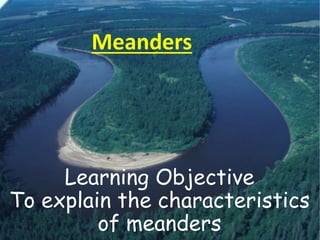
Meanders
• To understand meanders & ox-bows, we need to recall
these 3 key processes: EROSION, TRANSPORTATION,
DEPOSITION…
• A reminder of the 3 key processes at work:
EROSION, TRANSPORTATION, DEPOSITION…
• A reminder of the 3 key processes at work:
EROSION, TRANSPORTATION, DEPOSITION…
• WHAT IS WEATHERING?
I’ve added a post on this on my blog; the definition
above is from a simpler resource, the pics below from
a 31 slide PowerPoint (both hyperlinked on my post)
• A reminder of the 3 key processes at work:
EROSION, TRANSPORTATION, DEPOSITION…
• A reminder of the 3 key processes at work:
EROSION, TRANSPORTATION, DEPOSITION…
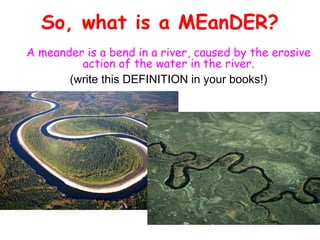
So, what is a MEanDER?
A meander is a bend in a river, caused by the erosive
action of the water in the river.
(write this DEFINITION in your books!)
Bank robbers?
The words bank + deposit are important for understanding this
process.
If you put money into an account, you are depositing into a bank.
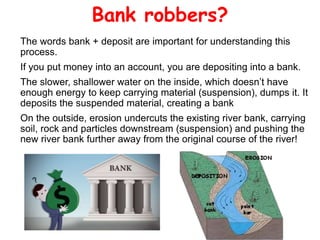
The slower, shallower water on the inside, which doesn’t have
enough energy to keep carrying material (suspension), dumps it. It
deposits the suspended material, creating a bank
On the outside, erosion undercuts the existing river bank, carrying
soil, rock and particles downstream (suspension) and pushing the
new river bank further away from the original course of the river!
Meanders explained.
As you follow the video you will need to fill in some blanks…
This is what you should have…
NEXT: fill in the cross-section blanks, then draw your labelled version of the
plan view AFTER we’ve checked your answers – pay close attention to
these next 2 slides!
Write INSIDE and OUTSIDE on 2 sides of your book. Sum up the features of each in
turn: water depth; flow rate or speed; suspension + undercutting or deposition;
scouring/erosion or friction (friction is less active, forceful than the other 2 terms)
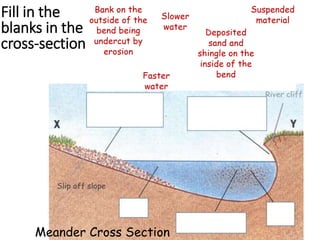
Meander Cross Section
Fill in the
blanks in the
cross-section
Bank on the outside
of the bend being
undercut by erosion
Suspended
material
Faster
water
Deposited sand and
shingle on the inside
of the bend
Slower
water
Meander Cross Section
X
Y
X
Y Plan view
Plan view – draw your labelled version
X
Y
X
Y
Once everyone is finished, we’ll get a volunteer to
talk us through what this diagram shows
High speed cornering
X
Y
X
Y
Why is speed so important as a factor? If you’re in a car taking
a corner at high speed, what happens to your body mass?
Would you want someone sat beside you holding a sheet of
glass? What might happen to that sheet of glass?
The high forces we see in this clip are just like the water, and
the shingles, sand (etc) suspended in this flung violently
against the river bank… Think too about an athletics track…
Written explanations
Now go back and write up your detailed, specific
explanations of the 3 shots from the earlier video
Small • On the inner bank the
water is travelling slowly
(less distance).
• Less energy so deposition
occurs creating a gentle
Slip off slope (point bar).
• Both banks are moving so
the meander migrates,
sideways & downstream
with time (Meander
Migration).
Meanders vary in scale…
Medium sized
Large
A steep river cliff
Well developed meanders with
slip off slopes
Erosion – the wearing away of
rock by the power of water
Deposition – the dropping of
material when water loses
energy
Why does the water flow
faster on the outside of the
bend?
Question
Where does deposition occur and
why?
What characteristics will the
water have if it is erosive?
How do you think the water
erodes the river bed and banks?
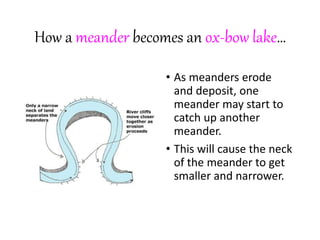
How a meander becomes an ox-bow lake…
• As meanders erode
and deposit, one
meander may start to
catch up another
meander.
• This will cause the neck
of the meander to get
smaller and narrower.
How a meander becomes an ox-bow lake…
• Eventually, during a
flood, the river erodes
a new straighter
channel.
• The old meander is
abandoned as an Ox
bow lake
• Through time the lake
slowly infills with
sediment & eventually
disappears
Re-arrange the sentences
• Eventually, during a flood, the river erodes a new
straighter channel.
• Through time the lake slowly infills with sediment &
eventually disappears
• This will cause the neck of the meander to get
smaller and narrower.
• As meanders erode and deposit, one meander may
start to catch up another meander.
• The old meander is abandoned as an Ox bow lake
Re-arrange the sentences
• As meanders erode and deposit, one meander may
start to catch up another meander.
• This will cause the neck of the meander to get
smaller and narrower.
• Eventually, during a flood, the river erodes a new
straighter channel.
• The old meander is abandoned as an Ox bow lake
• Through time the lake slowly infills with sediment &
eventually disappears
How a meander becomes an ox-bow lake…
• This animation [play in IE] takes us through the process
of transitioning from meander to ox-bow lake
• After we go through this, write EITHER a detailed
paragraph OR a flow-chart explaining how a
meander becomes an ox-bow lake – using
appropriate technical terms!
• You can use the diagram provided to help with this.
Ox Bow Lakes & Cut offs
• Here a meander has
been cut off (Abandoned
Meander)
• A new straighter channel
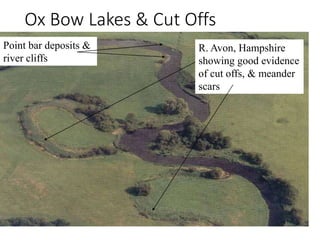
Ox Bow Lakes & Cut Offs
R. Avon, Hampshire
showing good evidence
of cut offs, & meander
scars
Point bar deposits &
river cliffs
R. Mississippi
How a meander becomes an ox-bow lake…
• This animation [play in IE] takes us through the
process of transitioning from meander to ox-
bow lake
• After we watch the animation, you will put the
cards into the correct order
• You will then explain what is happening at each
stage
• Make sure you label erosion and deposition at
each stage on the diagram
Question
What is an ox-bow lake?
How does an ox-bow lake form?
Why does the water follow the straight
channel instead of the curved channel?
You can find this Ppt + more in my
stgeog.blogspot.com blog post.

Meanders to ox bow db

  • 1.
    Learning Objective To explainthe characteristics of meanders Meanders
  • 2.
    • To understandmeanders & ox-bows, we need to recall these 3 key processes: EROSION, TRANSPORTATION, DEPOSITION…
  • 3.
    • A reminderof the 3 key processes at work: EROSION, TRANSPORTATION, DEPOSITION…
  • 4.
    • A reminderof the 3 key processes at work: EROSION, TRANSPORTATION, DEPOSITION… • WHAT IS WEATHERING? I’ve added a post on this on my blog; the definition above is from a simpler resource, the pics below from a 31 slide PowerPoint (both hyperlinked on my post)
  • 6.
    • A reminderof the 3 key processes at work: EROSION, TRANSPORTATION, DEPOSITION…
  • 7.
    • A reminderof the 3 key processes at work: EROSION, TRANSPORTATION, DEPOSITION…
  • 8.
    So, what isa MEanDER? A meander is a bend in a river, caused by the erosive action of the water in the river. (write this DEFINITION in your books!)
  • 9.
    Bank robbers? The wordsbank + deposit are important for understanding this process. If you put money into an account, you are depositing into a bank. The slower, shallower water on the inside, which doesn’t have enough energy to keep carrying material (suspension), dumps it. It deposits the suspended material, creating a bank On the outside, erosion undercuts the existing river bank, carrying soil, rock and particles downstream (suspension) and pushing the new river bank further away from the original course of the river!
  • 10.
    Meanders explained. As youfollow the video you will need to fill in some blanks… This is what you should have… NEXT: fill in the cross-section blanks, then draw your labelled version of the plan view AFTER we’ve checked your answers – pay close attention to these next 2 slides! Write INSIDE and OUTSIDE on 2 sides of your book. Sum up the features of each in turn: water depth; flow rate or speed; suspension + undercutting or deposition; scouring/erosion or friction (friction is less active, forceful than the other 2 terms)
  • 11.
    Meander Cross Section Fillin the blanks in the cross-section
  • 12.
    Bank on theoutside of the bend being undercut by erosion Suspended material Faster water Deposited sand and shingle on the inside of the bend Slower water Meander Cross Section X Y X Y Plan view
  • 13.
    Plan view –draw your labelled version X Y X Y Once everyone is finished, we’ll get a volunteer to talk us through what this diagram shows
  • 14.
    High speed cornering X Y X Y Whyis speed so important as a factor? If you’re in a car taking a corner at high speed, what happens to your body mass? Would you want someone sat beside you holding a sheet of glass? What might happen to that sheet of glass? The high forces we see in this clip are just like the water, and the shingles, sand (etc) suspended in this flung violently against the river bank… Think too about an athletics track…
  • 15.
    Written explanations Now goback and write up your detailed, specific explanations of the 3 shots from the earlier video
  • 16.
    Small • Onthe inner bank the water is travelling slowly (less distance). • Less energy so deposition occurs creating a gentle Slip off slope (point bar). • Both banks are moving so the meander migrates, sideways & downstream with time (Meander Migration). Meanders vary in scale…
  • 17.
  • 18.
    Large A steep rivercliff Well developed meanders with slip off slopes
  • 19.
    Erosion – thewearing away of rock by the power of water Deposition – the dropping of material when water loses energy Why does the water flow faster on the outside of the bend?
  • 20.
    Question Where does depositionoccur and why? What characteristics will the water have if it is erosive? How do you think the water erodes the river bed and banks?
  • 22.
    How a meanderbecomes an ox-bow lake… • As meanders erode and deposit, one meander may start to catch up another meander. • This will cause the neck of the meander to get smaller and narrower.
  • 23.
    How a meanderbecomes an ox-bow lake… • Eventually, during a flood, the river erodes a new straighter channel. • The old meander is abandoned as an Ox bow lake • Through time the lake slowly infills with sediment & eventually disappears
  • 24.
    Re-arrange the sentences •Eventually, during a flood, the river erodes a new straighter channel. • Through time the lake slowly infills with sediment & eventually disappears • This will cause the neck of the meander to get smaller and narrower. • As meanders erode and deposit, one meander may start to catch up another meander. • The old meander is abandoned as an Ox bow lake
  • 25.
    Re-arrange the sentences •As meanders erode and deposit, one meander may start to catch up another meander. • This will cause the neck of the meander to get smaller and narrower. • Eventually, during a flood, the river erodes a new straighter channel. • The old meander is abandoned as an Ox bow lake • Through time the lake slowly infills with sediment & eventually disappears
  • 26.
    How a meanderbecomes an ox-bow lake… • This animation [play in IE] takes us through the process of transitioning from meander to ox-bow lake • After we go through this, write EITHER a detailed paragraph OR a flow-chart explaining how a meander becomes an ox-bow lake – using appropriate technical terms! • You can use the diagram provided to help with this.
  • 27.
    Ox Bow Lakes& Cut offs • Here a meander has been cut off (Abandoned Meander) • A new straighter channel
  • 28.
    Ox Bow Lakes& Cut Offs R. Avon, Hampshire showing good evidence of cut offs, & meander scars Point bar deposits & river cliffs
  • 29.
  • 30.
    How a meanderbecomes an ox-bow lake… • This animation [play in IE] takes us through the process of transitioning from meander to ox- bow lake • After we watch the animation, you will put the cards into the correct order • You will then explain what is happening at each stage • Make sure you label erosion and deposition at each stage on the diagram
  • 31.
    Question What is anox-bow lake? How does an ox-bow lake form? Why does the water follow the straight channel instead of the curved channel? You can find this Ppt + more in my stgeog.blogspot.com blog post.