Research – Production –Research – Production –
Reflection – Key ConceptsReflection – Key Concepts
10 steps to evidence within each10 steps to evidence within each
coursework assignmentcoursework assignment
10 Steps to…10 Steps to…
1.1. List your own initial understanding of theList your own initial understanding of the
conventions for the media format you willconventions for the media format you will
be working inbe working in
2.2. Research these conventions, havingResearch these conventions, having
clear evidence for every point you think isclear evidence for every point you think is
a conventiona convention
3.3. Key Concepts: class case studiesKey Concepts: class case studies
4.4. Key Concepts: individual detailedKey Concepts: individual detailed
analysis of one textanalysis of one text
10 Steps to…10 Steps to…
5.5. Key Concepts through detailedKey Concepts through detailed
comparison of TWO textscomparison of TWO texts
6.6. Brainstorm initial ideas for textBrainstorm initial ideas for text
7.7. Research genre + genre examplesResearch genre + genre examples
8.8. Pitch and refine your own idea ---- pre-Pitch and refine your own idea ---- pre-
production evidence is keyproduction evidence is key
9.9. Produce, edit and gather audienceProduce, edit and gather audience
feedbackfeedback
10.10. Critical reflection, applying Key Concepts.Critical reflection, applying Key Concepts.
Now review your presentation of evidence!Now review your presentation of evidence!
Presentation of Evidence, EvaluationPresentation of Evidence, Evaluation
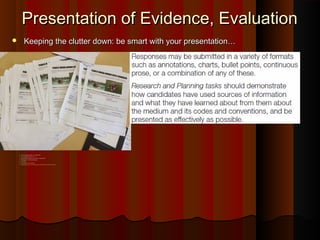
 Keeping the clutter down: be smart with your presentation…Keeping the clutter down: be smart with your presentation…
 Combine multiple images on a single sheetCombine multiple images on a single sheet
 Use a cropped part of a coverUse a cropped part of a cover
 Screenshot planning lists to combine in a single sheetScreenshot planning lists to combine in a single sheet
 Photograph + combine draft layoutsPhotograph + combine draft layouts
 Use chartsUse charts
 About 500 words for researchAbout 500 words for research
 Evaluation should be an annotated copy of the final cover (about 150 words)Evaluation should be an annotated copy of the final cover (about 150 words)
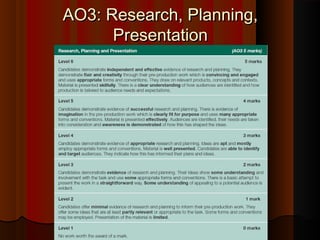
AO3: Research, Planning,AO3: Research, Planning,
PresentationPresentation
Presentation of Evidence, A-Presentation of Evidence, A-
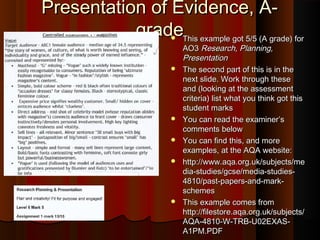
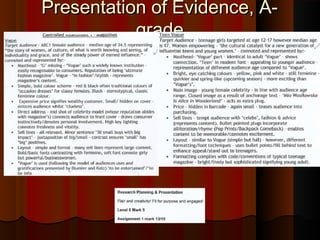
gradegrade This example got 5/5 (A grade) forThis example got 5/5 (A grade) for
AO3AO3 Research, Planning,Research, Planning,
PresentationPresentation
 The second part of this is in theThe second part of this is in the
next slide. Work through thesenext slide. Work through these
and (looking at the assessmentand (looking at the assessment
criteria) list what you think got thiscriteria) list what you think got this
student marksstudent marks
 You can read the examiner’sYou can read the examiner’s
comments belowcomments below
 You can find this, and moreYou can find this, and more
examples, at the AQA website:examples, at the AQA website:
 http://www.aqa.org.uk/subjects/mehttp://www.aqa.org.uk/subjects/me
dia-studies/gcse/media-studies-dia-studies/gcse/media-studies-
4810/past-papers-and-mark-4810/past-papers-and-mark-
schemesschemes
 This example comes fromThis example comes from
http://filestore.aqa.org.uk/subjects/http://filestore.aqa.org.uk/subjects/
AQA-4810-W-TRB-U02EXAS-AQA-4810-W-TRB-U02EXAS-
A1PM.PDFA1PM.PDF
Presentation of Evidence, A-Presentation of Evidence, A-
gradegrade
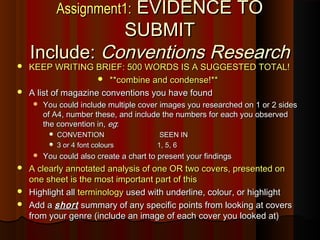
Assignment1:Assignment1: EVIDENCE TOEVIDENCE TO
SUBMITSUBMIT
Include:Include: ConventionsConventions ResearchResearch
 KEEP WRITING BRIEF: 500 WORDS IS A SUGGESTED TOTAL!KEEP WRITING BRIEF: 500 WORDS IS A SUGGESTED TOTAL!
 **combine and condense!****combine and condense!**
 A list of magazine conventions you have foundA list of magazine conventions you have found
 You could include multiple cover images you researched on 1 or 2 sidesYou could include multiple cover images you researched on 1 or 2 sides
of A4, number these, and include the numbers for each you observedof A4, number these, and include the numbers for each you observed
the convention in,the convention in, egeg::
 CONVENTION SEEN INCONVENTION SEEN IN
 3 or 4 font colours 1, 5, 63 or 4 font colours 1, 5, 6
 You could also create a chart to present your findingsYou could also create a chart to present your findings
 A clearly annotated analysis of one OR two covers, presented onA clearly annotated analysis of one OR two covers, presented on
one sheet is the most important part of thisone sheet is the most important part of this
 Highlight allHighlight all terminologyterminology used with underline, colour, or highlightused with underline, colour, or highlight
 Add aAdd a shortshort summary of any specific points from looking at coverssummary of any specific points from looking at covers
from your genre (include an image of each cover you looked at)from your genre (include an image of each cover you looked at)
Exam board suggestions on whatExam board suggestions on what
to addressto address
 Analytical responses might involve some of theAnalytical responses might involve some of the
following activities:following activities:
 applying media terminology; considering the effect ofapplying media terminology; considering the effect of
media languagemedia language
 applying analytical techniques such as denotation andapplying analytical techniques such as denotation and
connotationconnotation
 identifying how genre is establishedidentifying how genre is established
 discussing how narrative is suggesteddiscussing how narrative is suggested
 making judgements about who the target audience mightmaking judgements about who the target audience might
bebe
 identifying a possible secondary audience or consideringidentifying a possible secondary audience or considering
how the product might be consumed.how the product might be consumed.
Include:Include: PlanningPlanning
 audience research + analysis of findings **do NOT include everyaudience research + analysis of findings **do NOT include every
questionnaire; photograph them as a fanned out pile with ONE copy clearlyquestionnaire; photograph them as a fanned out pile with ONE copy clearly
readable**readable**
 A clear statement of your intendedA clear statement of your intended PRIMARYPRIMARY andand SECONDARYSECONDARY targettarget
audiencesaudiences
 layout sketches (youlayout sketches (you mustmust have 1have 1 or moreor more that isthat is NOT computer-generatedNOT computer-generated::
art skills are irrelevant, you are giving a sense of the elements to include +art skills are irrelevant, you are giving a sense of the elements to include +
positioning of thesepositioning of these
 font sheets (fonts you’ve tried,font sheets (fonts you’ve tried, egeg for masthead: show title in different fonts)for masthead: show title in different fonts)
 brainstorm list of possible stories – try to includebrainstorm list of possible stories – try to include somesome you rejected: storiesyou rejected: stories
notnot included in final productionincluded in final production
 list of alternative headlines + sub-headings for cover storieslist of alternative headlines + sub-headings for cover stories
 list of possible mag./brand descriptorslist of possible mag./brand descriptors
 list of possible images (its helpful to have a sheet with thumbnails of multiplelist of possible images (its helpful to have a sheet with thumbnails of multiple
images)images)
 For all of the above: clearly, specifically link to audience where you can: stateFor all of the above: clearly, specifically link to audience where you can: state
WHY you made choices, HOW this might appeal to your stated audience(s) –WHY you made choices, HOW this might appeal to your stated audience(s) –
egeg on any list highlight the actual choice/s + BRIEFLY state why you thinkon any list highlight the actual choice/s + BRIEFLY state why you think
these will work better than others for YOUR audience(s)these will work better than others for YOUR audience(s)
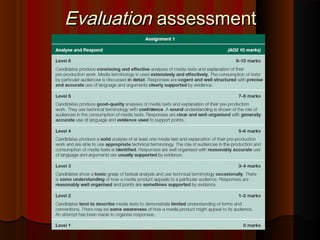
EvaluationEvaluation assessmentassessment
Include:Include: EvaluationEvaluation
 BE SUCCINCT (BRIEF): 150 WORDS IS A SUGGESTEDBE SUCCINCT (BRIEF): 150 WORDS IS A SUGGESTED
TOTAL!TOTAL!
 Screenshots, showing draftingScreenshots, showing drafting
 Annotated texts, in which you evidenceAnnotated texts, in which you evidence
 Research into conventions but alsoResearch into conventions but also specific terminologyspecific terminology – it is– it is
worth highlighting this (a colour, or highlighter for example). Iworth highlighting this (a colour, or highlighter for example). I
use bold+pink when I’m blogging so this always stands outuse bold+pink when I’m blogging so this always stands out
 This includesThis includes semioticsemiotic terms (terms (signifiersignifier,, connotationconnotation etcetc), and), and
shot type/angle/movementshot type/angle/movement ((etcetc) [) [Media LanguageMedia Language!]!]
 Clear engagement with audience (all 3!): definition of yourClear engagement with audience (all 3!): definition of your
target audience/s (primary, secondary?) and how your mediatarget audience/s (primary, secondary?) and how your media
language choices (which may also link to Representation +language choices (which may also link to Representation +
Institution)Institution)
 Sources: state the source for any information (full URL if anSources: state the source for any information (full URL if an
article, but if budget, cast, box office then the name of thearticle, but if budget, cast, box office then the name of the
website would do (IMDBwebsite would do (IMDB etcetc))
Include:Include: EvaluationEvaluation
 BE SUCCINCT (BRIEF): 150 WORDS IS A SUGGESTEDBE SUCCINCT (BRIEF): 150 WORDS IS A SUGGESTED
TOTAL!TOTAL!
 You are marked on the following:You are marked on the following:
 Analyses of media texts + explanation of your pre-productionAnalyses of media texts + explanation of your pre-production
workwork
 Use of media terminologyUse of media terminology
 Audience: how an audience might read/interpret/respond toAudience: how an audience might read/interpret/respond to
your textyour text
 Clarity and structure of your analysisClarity and structure of your analysis
 Supporting your points with specific evidenceSupporting your points with specific evidence
Presentation of Evidence, EvaluationPresentation of Evidence, Evaluation
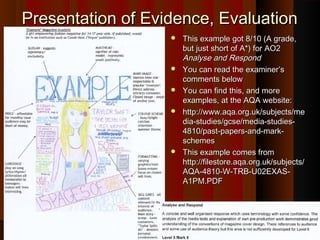
 This example got 8/10 (A grade,This example got 8/10 (A grade,
but just short of A*) for AO2but just short of A*) for AO2
Analyse and RespondAnalyse and Respond
 You can read the examiner’sYou can read the examiner’s
comments belowcomments below
 You can find this, and moreYou can find this, and more
examples, at the AQA website:examples, at the AQA website:
 http://www.aqa.org.uk/subjects/mehttp://www.aqa.org.uk/subjects/me
dia-studies/gcse/media-studies-dia-studies/gcse/media-studies-
4810/past-papers-and-mark-4810/past-papers-and-mark-
schemesschemes
 This example comes fromThis example comes from
http://filestore.aqa.org.uk/subjects/http://filestore.aqa.org.uk/subjects/
AQA-4810-W-TRB-U02EXAS-AQA-4810-W-TRB-U02EXAS-
A1PM.PDFA1PM.PDF
How to improve this Evaluation:
Audience Theory
The examiner noted a lack of audience
theory. See if you can use any of the
following to push this even higher…
Audience Theory 1: Uses and
Gratifications
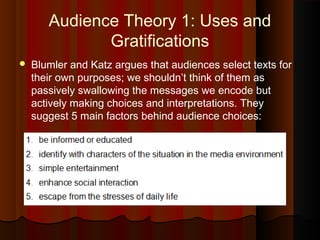
 Blumler and Katz argues that audiences select texts for
their own purposes; we shouldn’t think of them as
passively swallowing the messages we encode but
actively making choices and interpretations. They
suggest 5 main factors behind audience choices:
Audience Theory 2: Stuart Hall and
‘readings’
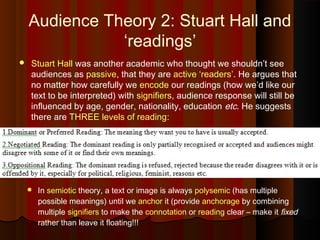
 Stuart Hall was another academic who thought we shouldn’t see
audiences as passive, that they are active ‘readers’. He argues that
no matter how carefully we encode our readings (how we’d like our
text to be interpreted) with signifiers, audience response will still be
influenced by age, gender, nationality, education etc. He suggests
there are THREE levels of reading:
 In semiotic theory, a text or image is always polysemic (has multiple
possible meanings) until we anchor it (provide anchorage by combining
multiple signifiers to make the connotation or reading clear – make it fixed
rather than leave it floating!!!
Audience Theory 3: Web 2.0 and ‘the
former audience’
 Dan Gillmor goes even further than Blumler and Katz or Hall. He
argues that because of digital, online media and technology we can
no longer clearly distinguish the audience and producer! He claims
that ‘web 2.0’ (internet that allows audience interaction: YouTube,
Facebook etc) means we should now write of “the former audience”!
Audiences can now create media products themselves!
 Have you included anything that might link to or illustrate this
theory?
Key terms and concepts
 You should be using most of the following in your written work; ask if
you’re unclear on any of these:
 Primary and secondary audience; semiotics: signifier, denotation
(detail, description) – connotation, signified (interpretation, symbolic
meaning); polysemic (multiple possible meanings) – anchorage (1
clear meaning through combining signifiers); coverline, masthead,
sell line

Gcse evidence research steps assgmt1

  • 1.
    Research – Production–Research – Production – Reflection – Key ConceptsReflection – Key Concepts 10 steps to evidence within each10 steps to evidence within each coursework assignmentcoursework assignment
  • 2.
    10 Steps to…10Steps to… 1.1. List your own initial understanding of theList your own initial understanding of the conventions for the media format you willconventions for the media format you will be working inbe working in 2.2. Research these conventions, havingResearch these conventions, having clear evidence for every point you think isclear evidence for every point you think is a conventiona convention 3.3. Key Concepts: class case studiesKey Concepts: class case studies 4.4. Key Concepts: individual detailedKey Concepts: individual detailed analysis of one textanalysis of one text
  • 3.
    10 Steps to…10Steps to… 5.5. Key Concepts through detailedKey Concepts through detailed comparison of TWO textscomparison of TWO texts 6.6. Brainstorm initial ideas for textBrainstorm initial ideas for text 7.7. Research genre + genre examplesResearch genre + genre examples 8.8. Pitch and refine your own idea ---- pre-Pitch and refine your own idea ---- pre- production evidence is keyproduction evidence is key 9.9. Produce, edit and gather audienceProduce, edit and gather audience feedbackfeedback 10.10. Critical reflection, applying Key Concepts.Critical reflection, applying Key Concepts. Now review your presentation of evidence!Now review your presentation of evidence!
  • 4.
    Presentation of Evidence,EvaluationPresentation of Evidence, Evaluation  Keeping the clutter down: be smart with your presentation…Keeping the clutter down: be smart with your presentation…  Combine multiple images on a single sheetCombine multiple images on a single sheet  Use a cropped part of a coverUse a cropped part of a cover  Screenshot planning lists to combine in a single sheetScreenshot planning lists to combine in a single sheet  Photograph + combine draft layoutsPhotograph + combine draft layouts  Use chartsUse charts  About 500 words for researchAbout 500 words for research  Evaluation should be an annotated copy of the final cover (about 150 words)Evaluation should be an annotated copy of the final cover (about 150 words)
  • 5.
    AO3: Research, Planning,AO3:Research, Planning, PresentationPresentation
  • 6.
    Presentation of Evidence,A-Presentation of Evidence, A- gradegrade This example got 5/5 (A grade) forThis example got 5/5 (A grade) for AO3AO3 Research, Planning,Research, Planning, PresentationPresentation  The second part of this is in theThe second part of this is in the next slide. Work through thesenext slide. Work through these and (looking at the assessmentand (looking at the assessment criteria) list what you think got thiscriteria) list what you think got this student marksstudent marks  You can read the examiner’sYou can read the examiner’s comments belowcomments below  You can find this, and moreYou can find this, and more examples, at the AQA website:examples, at the AQA website:  http://www.aqa.org.uk/subjects/mehttp://www.aqa.org.uk/subjects/me dia-studies/gcse/media-studies-dia-studies/gcse/media-studies- 4810/past-papers-and-mark-4810/past-papers-and-mark- schemesschemes  This example comes fromThis example comes from http://filestore.aqa.org.uk/subjects/http://filestore.aqa.org.uk/subjects/ AQA-4810-W-TRB-U02EXAS-AQA-4810-W-TRB-U02EXAS- A1PM.PDFA1PM.PDF
  • 7.
    Presentation of Evidence,A-Presentation of Evidence, A- gradegrade
  • 8.
    Assignment1:Assignment1: EVIDENCE TOEVIDENCETO SUBMITSUBMIT Include:Include: ConventionsConventions ResearchResearch  KEEP WRITING BRIEF: 500 WORDS IS A SUGGESTED TOTAL!KEEP WRITING BRIEF: 500 WORDS IS A SUGGESTED TOTAL!  **combine and condense!****combine and condense!**  A list of magazine conventions you have foundA list of magazine conventions you have found  You could include multiple cover images you researched on 1 or 2 sidesYou could include multiple cover images you researched on 1 or 2 sides of A4, number these, and include the numbers for each you observedof A4, number these, and include the numbers for each you observed the convention in,the convention in, egeg::  CONVENTION SEEN INCONVENTION SEEN IN  3 or 4 font colours 1, 5, 63 or 4 font colours 1, 5, 6  You could also create a chart to present your findingsYou could also create a chart to present your findings  A clearly annotated analysis of one OR two covers, presented onA clearly annotated analysis of one OR two covers, presented on one sheet is the most important part of thisone sheet is the most important part of this  Highlight allHighlight all terminologyterminology used with underline, colour, or highlightused with underline, colour, or highlight  Add aAdd a shortshort summary of any specific points from looking at coverssummary of any specific points from looking at covers from your genre (include an image of each cover you looked at)from your genre (include an image of each cover you looked at)
  • 9.
    Exam board suggestionson whatExam board suggestions on what to addressto address  Analytical responses might involve some of theAnalytical responses might involve some of the following activities:following activities:  applying media terminology; considering the effect ofapplying media terminology; considering the effect of media languagemedia language  applying analytical techniques such as denotation andapplying analytical techniques such as denotation and connotationconnotation  identifying how genre is establishedidentifying how genre is established  discussing how narrative is suggesteddiscussing how narrative is suggested  making judgements about who the target audience mightmaking judgements about who the target audience might bebe  identifying a possible secondary audience or consideringidentifying a possible secondary audience or considering how the product might be consumed.how the product might be consumed.
  • 10.
    Include:Include: PlanningPlanning  audienceresearch + analysis of findings **do NOT include everyaudience research + analysis of findings **do NOT include every questionnaire; photograph them as a fanned out pile with ONE copy clearlyquestionnaire; photograph them as a fanned out pile with ONE copy clearly readable**readable**  A clear statement of your intendedA clear statement of your intended PRIMARYPRIMARY andand SECONDARYSECONDARY targettarget audiencesaudiences  layout sketches (youlayout sketches (you mustmust have 1have 1 or moreor more that isthat is NOT computer-generatedNOT computer-generated:: art skills are irrelevant, you are giving a sense of the elements to include +art skills are irrelevant, you are giving a sense of the elements to include + positioning of thesepositioning of these  font sheets (fonts you’ve tried,font sheets (fonts you’ve tried, egeg for masthead: show title in different fonts)for masthead: show title in different fonts)  brainstorm list of possible stories – try to includebrainstorm list of possible stories – try to include somesome you rejected: storiesyou rejected: stories notnot included in final productionincluded in final production  list of alternative headlines + sub-headings for cover storieslist of alternative headlines + sub-headings for cover stories  list of possible mag./brand descriptorslist of possible mag./brand descriptors  list of possible images (its helpful to have a sheet with thumbnails of multiplelist of possible images (its helpful to have a sheet with thumbnails of multiple images)images)  For all of the above: clearly, specifically link to audience where you can: stateFor all of the above: clearly, specifically link to audience where you can: state WHY you made choices, HOW this might appeal to your stated audience(s) –WHY you made choices, HOW this might appeal to your stated audience(s) – egeg on any list highlight the actual choice/s + BRIEFLY state why you thinkon any list highlight the actual choice/s + BRIEFLY state why you think these will work better than others for YOUR audience(s)these will work better than others for YOUR audience(s)
  • 11.
  • 12.
    Include:Include: EvaluationEvaluation  BESUCCINCT (BRIEF): 150 WORDS IS A SUGGESTEDBE SUCCINCT (BRIEF): 150 WORDS IS A SUGGESTED TOTAL!TOTAL!  Screenshots, showing draftingScreenshots, showing drafting  Annotated texts, in which you evidenceAnnotated texts, in which you evidence  Research into conventions but alsoResearch into conventions but also specific terminologyspecific terminology – it is– it is worth highlighting this (a colour, or highlighter for example). Iworth highlighting this (a colour, or highlighter for example). I use bold+pink when I’m blogging so this always stands outuse bold+pink when I’m blogging so this always stands out  This includesThis includes semioticsemiotic terms (terms (signifiersignifier,, connotationconnotation etcetc), and), and shot type/angle/movementshot type/angle/movement ((etcetc) [) [Media LanguageMedia Language!]!]  Clear engagement with audience (all 3!): definition of yourClear engagement with audience (all 3!): definition of your target audience/s (primary, secondary?) and how your mediatarget audience/s (primary, secondary?) and how your media language choices (which may also link to Representation +language choices (which may also link to Representation + Institution)Institution)  Sources: state the source for any information (full URL if anSources: state the source for any information (full URL if an article, but if budget, cast, box office then the name of thearticle, but if budget, cast, box office then the name of the website would do (IMDBwebsite would do (IMDB etcetc))
  • 13.
    Include:Include: EvaluationEvaluation  BESUCCINCT (BRIEF): 150 WORDS IS A SUGGESTEDBE SUCCINCT (BRIEF): 150 WORDS IS A SUGGESTED TOTAL!TOTAL!  You are marked on the following:You are marked on the following:  Analyses of media texts + explanation of your pre-productionAnalyses of media texts + explanation of your pre-production workwork  Use of media terminologyUse of media terminology  Audience: how an audience might read/interpret/respond toAudience: how an audience might read/interpret/respond to your textyour text  Clarity and structure of your analysisClarity and structure of your analysis  Supporting your points with specific evidenceSupporting your points with specific evidence
  • 14.
    Presentation of Evidence,EvaluationPresentation of Evidence, Evaluation  This example got 8/10 (A grade,This example got 8/10 (A grade, but just short of A*) for AO2but just short of A*) for AO2 Analyse and RespondAnalyse and Respond  You can read the examiner’sYou can read the examiner’s comments belowcomments below  You can find this, and moreYou can find this, and more examples, at the AQA website:examples, at the AQA website:  http://www.aqa.org.uk/subjects/mehttp://www.aqa.org.uk/subjects/me dia-studies/gcse/media-studies-dia-studies/gcse/media-studies- 4810/past-papers-and-mark-4810/past-papers-and-mark- schemesschemes  This example comes fromThis example comes from http://filestore.aqa.org.uk/subjects/http://filestore.aqa.org.uk/subjects/ AQA-4810-W-TRB-U02EXAS-AQA-4810-W-TRB-U02EXAS- A1PM.PDFA1PM.PDF
  • 15.
    How to improvethis Evaluation: Audience Theory The examiner noted a lack of audience theory. See if you can use any of the following to push this even higher…
  • 16.
    Audience Theory 1:Uses and Gratifications  Blumler and Katz argues that audiences select texts for their own purposes; we shouldn’t think of them as passively swallowing the messages we encode but actively making choices and interpretations. They suggest 5 main factors behind audience choices:
  • 17.
    Audience Theory 2:Stuart Hall and ‘readings’  Stuart Hall was another academic who thought we shouldn’t see audiences as passive, that they are active ‘readers’. He argues that no matter how carefully we encode our readings (how we’d like our text to be interpreted) with signifiers, audience response will still be influenced by age, gender, nationality, education etc. He suggests there are THREE levels of reading:  In semiotic theory, a text or image is always polysemic (has multiple possible meanings) until we anchor it (provide anchorage by combining multiple signifiers to make the connotation or reading clear – make it fixed rather than leave it floating!!!
  • 18.
    Audience Theory 3:Web 2.0 and ‘the former audience’  Dan Gillmor goes even further than Blumler and Katz or Hall. He argues that because of digital, online media and technology we can no longer clearly distinguish the audience and producer! He claims that ‘web 2.0’ (internet that allows audience interaction: YouTube, Facebook etc) means we should now write of “the former audience”! Audiences can now create media products themselves!  Have you included anything that might link to or illustrate this theory?
  • 19.
    Key terms andconcepts  You should be using most of the following in your written work; ask if you’re unclear on any of these:  Primary and secondary audience; semiotics: signifier, denotation (detail, description) – connotation, signified (interpretation, symbolic meaning); polysemic (multiple possible meanings) – anchorage (1 clear meaning through combining signifiers); coverline, masthead, sell line