
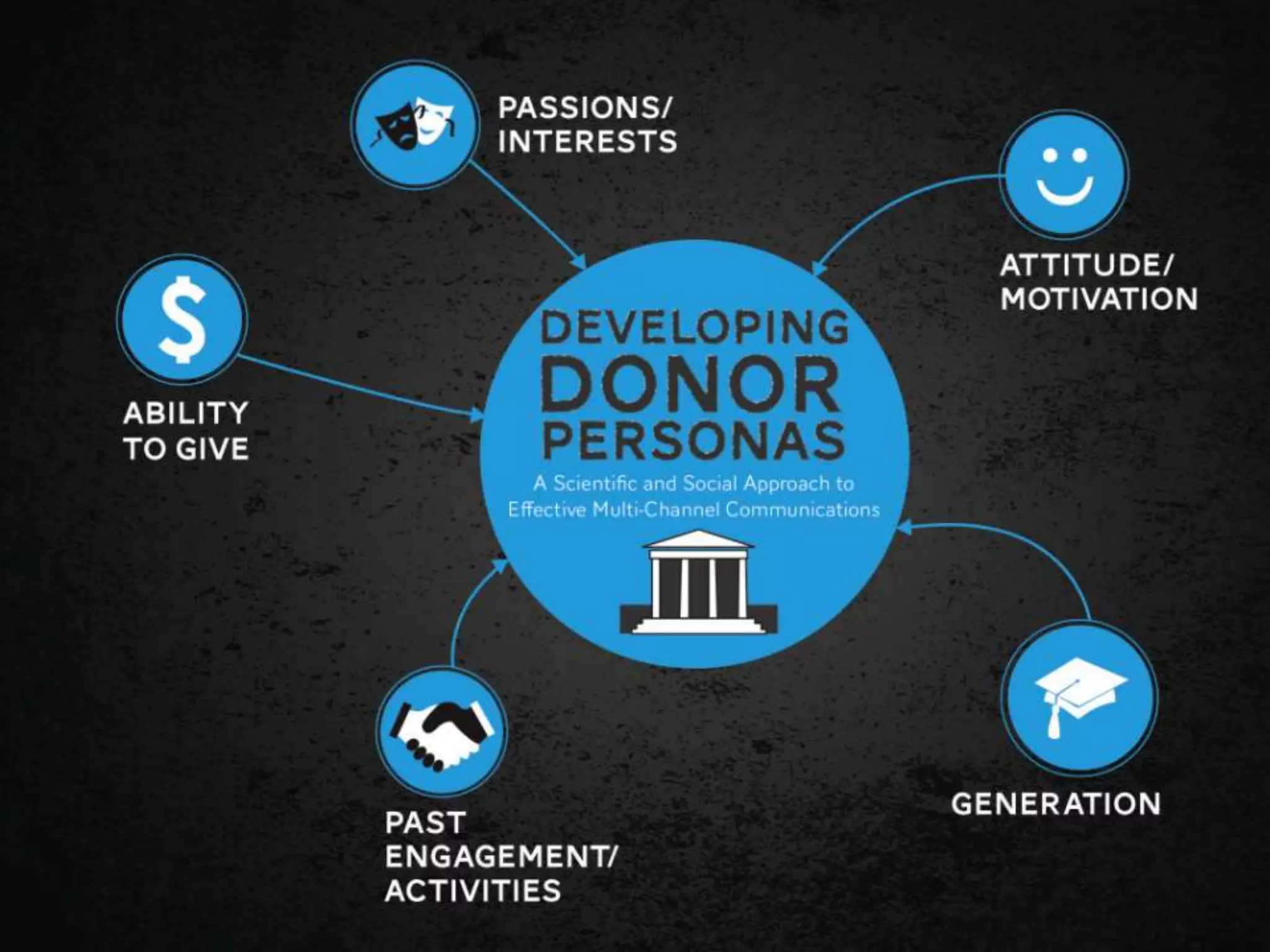
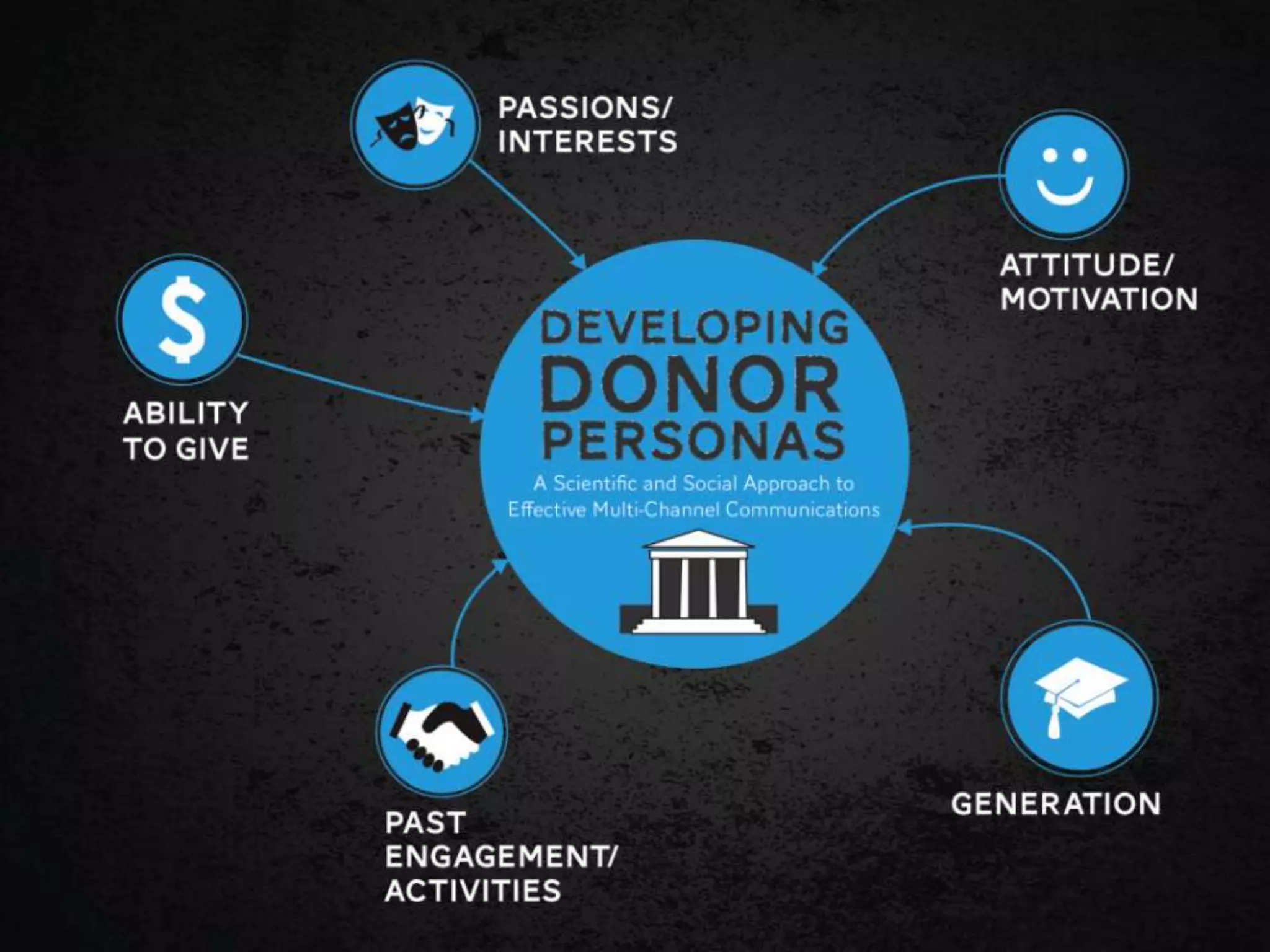
Developing Donor Personas:
A Scientific and Social Approach to
      Effective Multi-Channel
         Communications
         Presented by
         Ann Oleson, Founder Converge Consulting
Someone sleeping in class
Our Time Together

• The top findings from the
  donor motivation study

• A model for crafting effective
  communications/personas

• Examples of relevant
  communications

• Application of findings to your
  alumni/donor communications
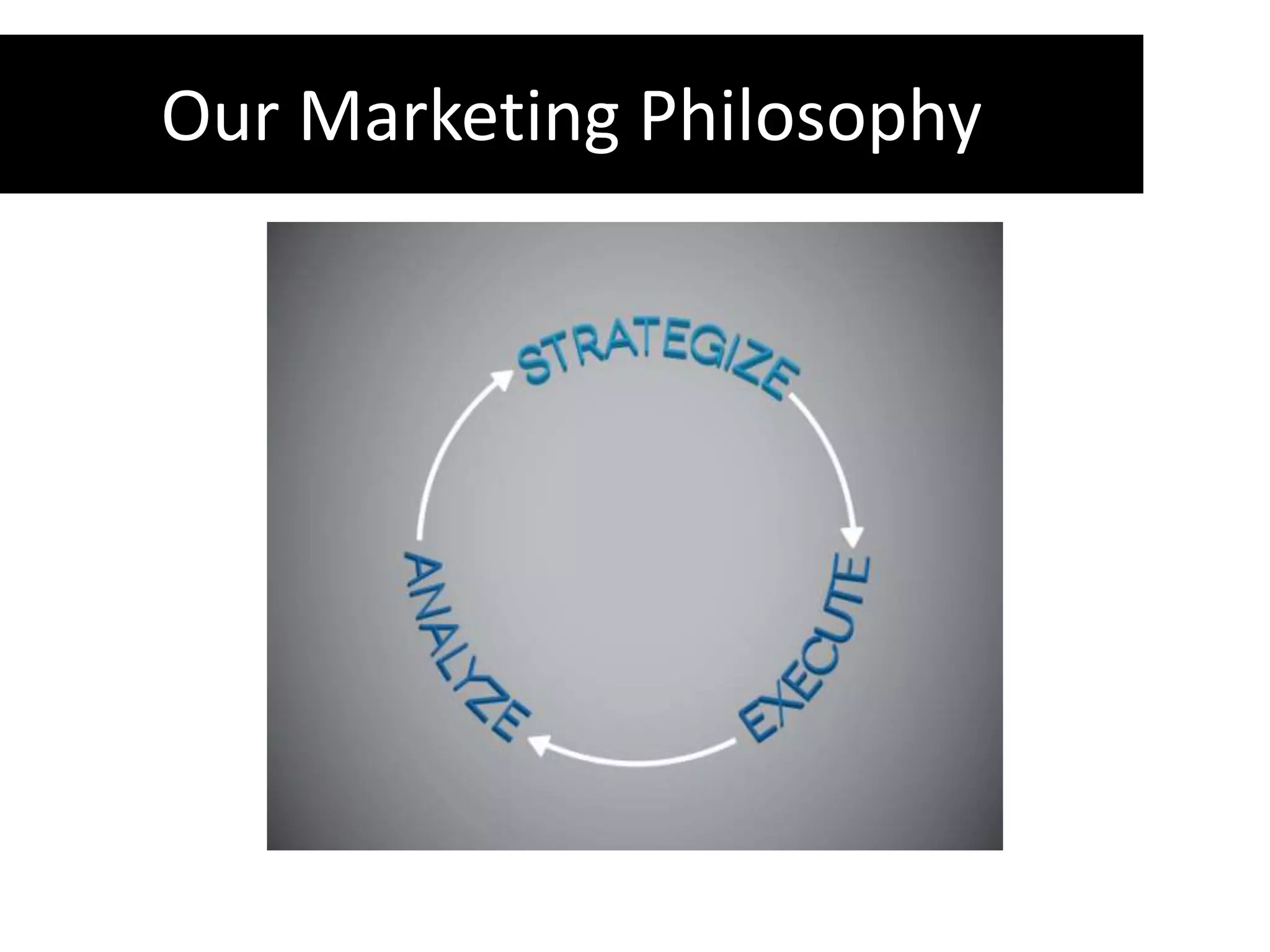
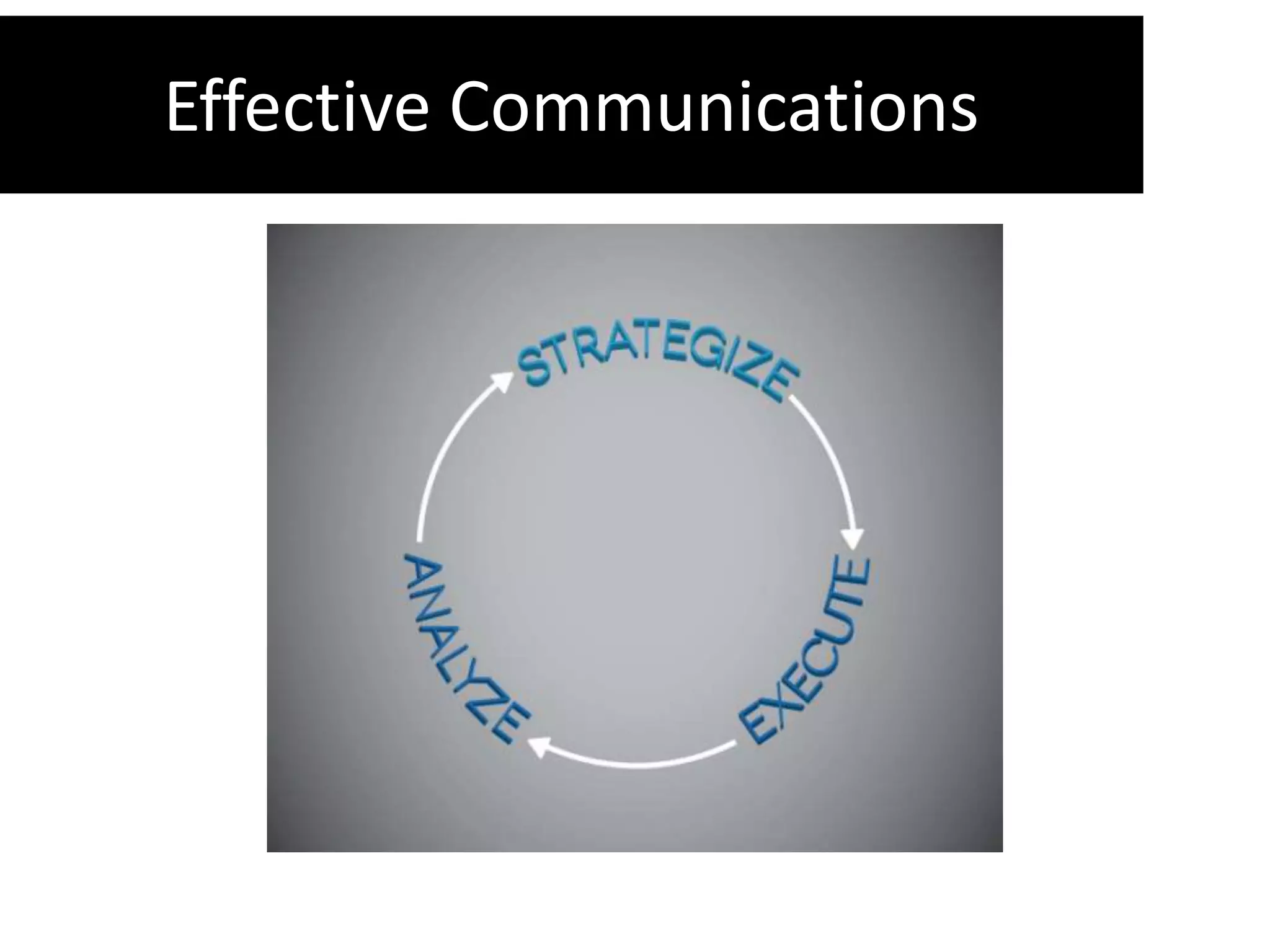
Our Marketing Philosophy
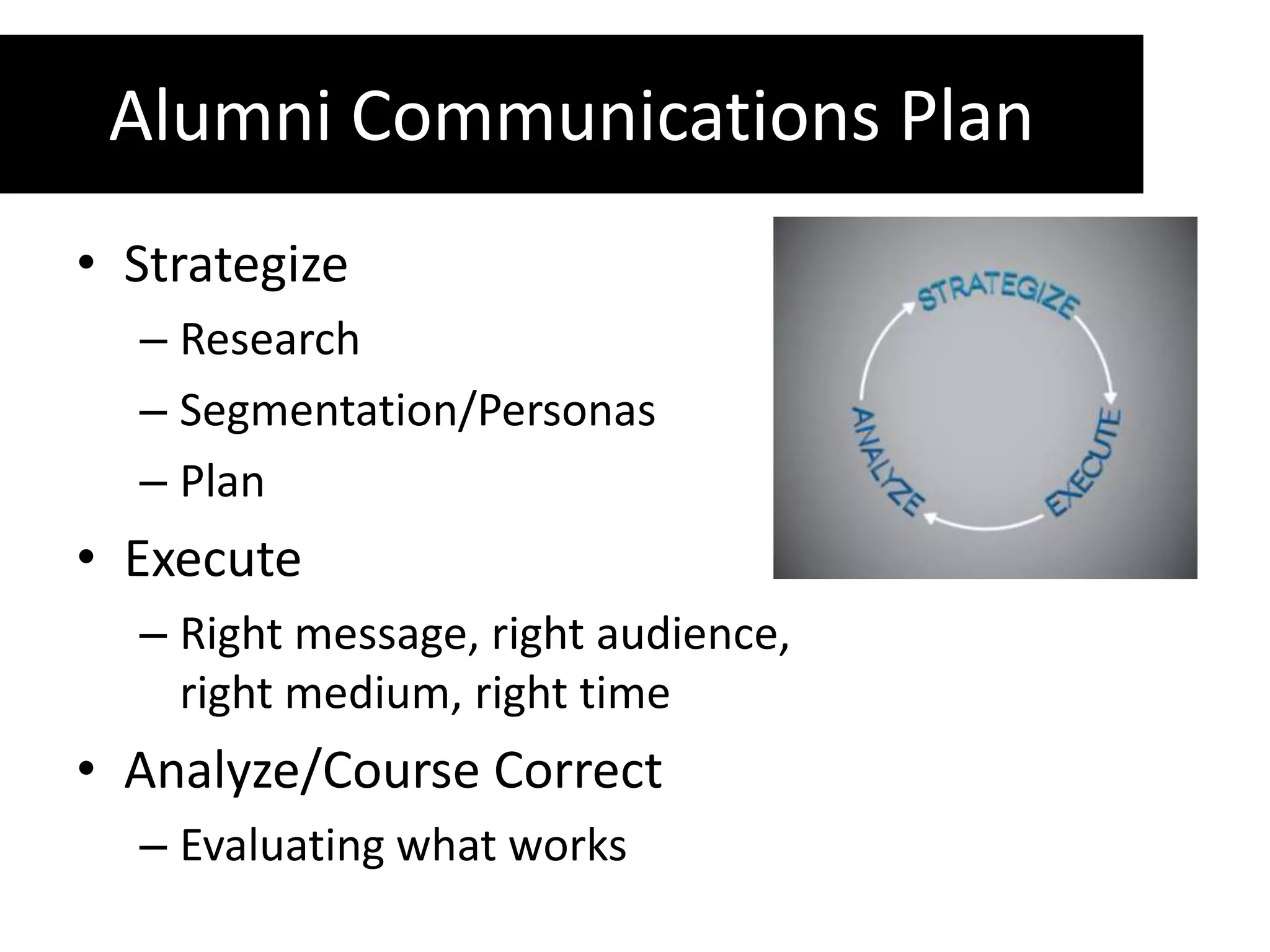
Alumni Communications Plan
• Strategize
  – Research
  – Segmentation/Personas
  – Plan
• Execute
  – Right message, right audience,
    right medium, right time
• Analyze/Course Correct
  – Evaluating what works
Research

• National benchmark
  research
  – Wealth Engine, PEG, CASE
• Alumni research
  (quantitative/qualitative)
• Social Media
  Listening/Monitoring
What Motivates Your Alumni?


   Who are your alumni?
What do you know about them?
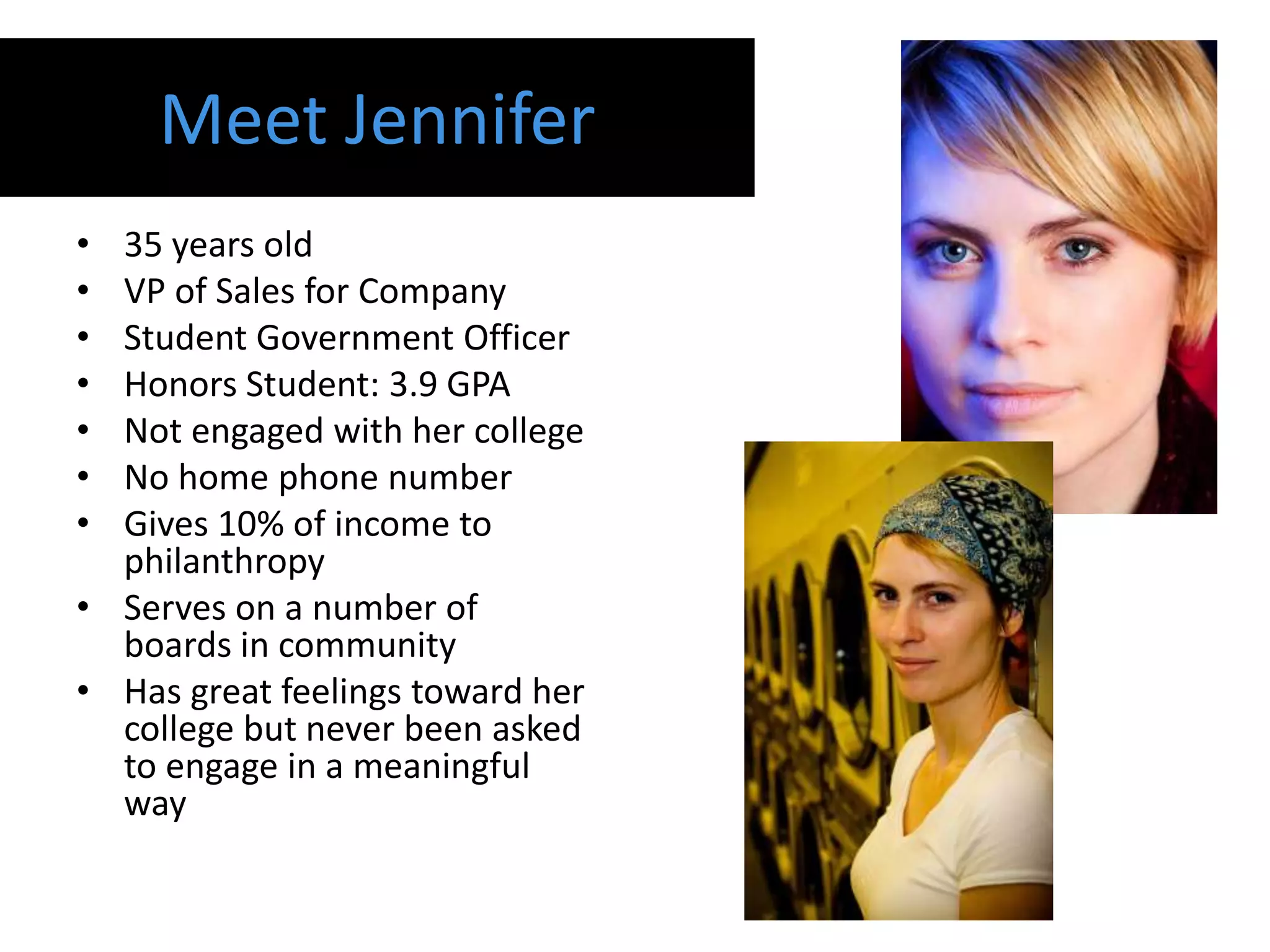
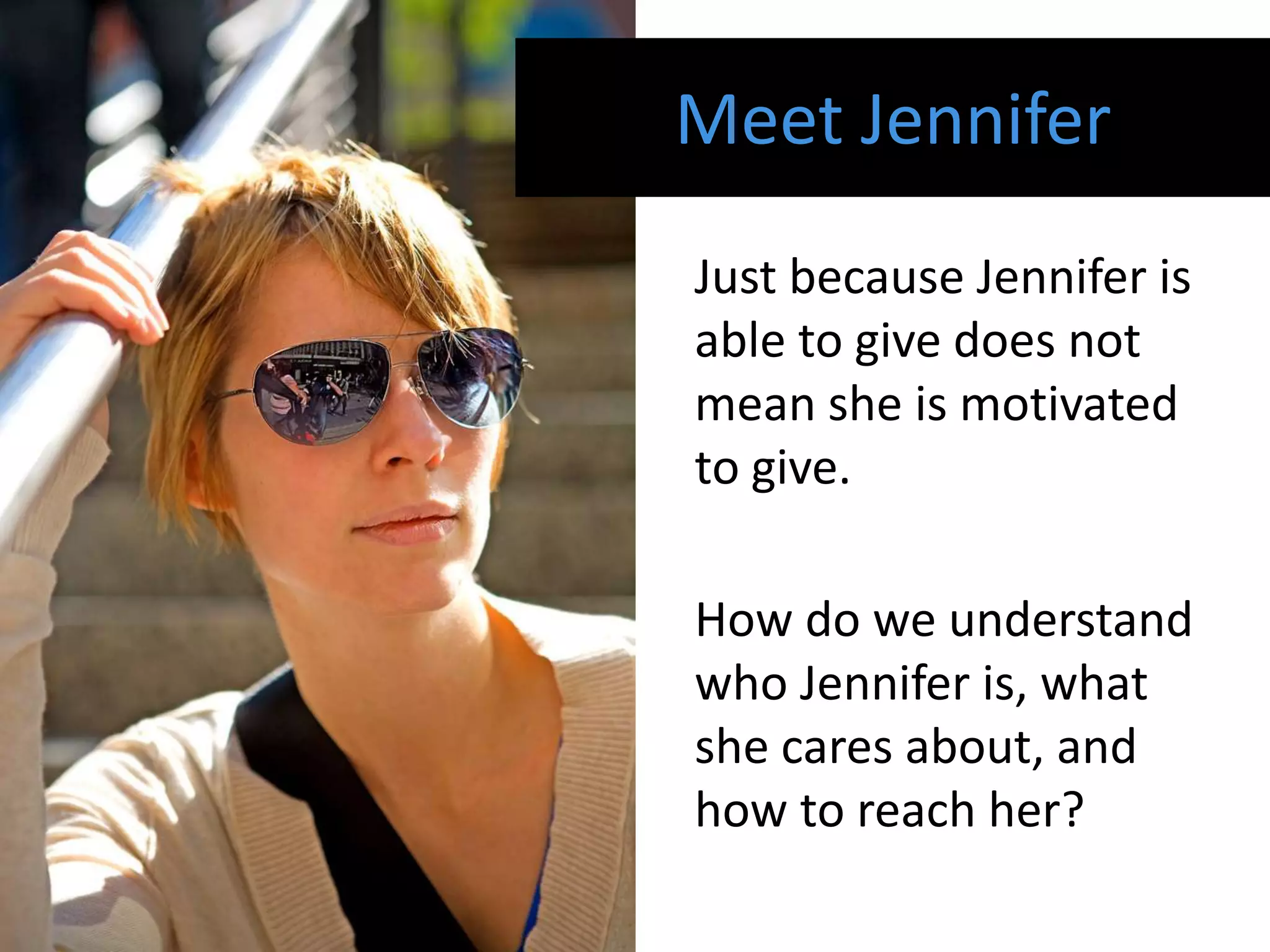
Meet Jennifer
• 35 years old
• VP of Sales for Company
• Student Government Officer
• Honors Student: 3.9 GPA
• Not engaged with her college
• No home phone number
• Gives 10% of income to
  philanthropy
• Serves on a number of
  boards in community
• Has great feelings toward her
  college but never been asked
  to engage in a meaningful
  way
Meet Jennifer
Just because Jennifer is
able to give does not
mean she is motivated
to give.

How do we understand
who Jennifer is, what
she cares about, and
how to reach her?
Research Objectives


•   Develop a motivationally-based
    segmentation model
•   Uncover the motivations that drive the
    different types of relationships
•   Prioritize which alumni segments provide
    the best opportunities for colleges
•   Provide recommendations regarding how
    these different alumni segments should be
    managed to optimize their individual
    likelihood of donating
•   Develop a predictive model and applied
    tool to classify alumni into segments
    based on a minimum number of questions
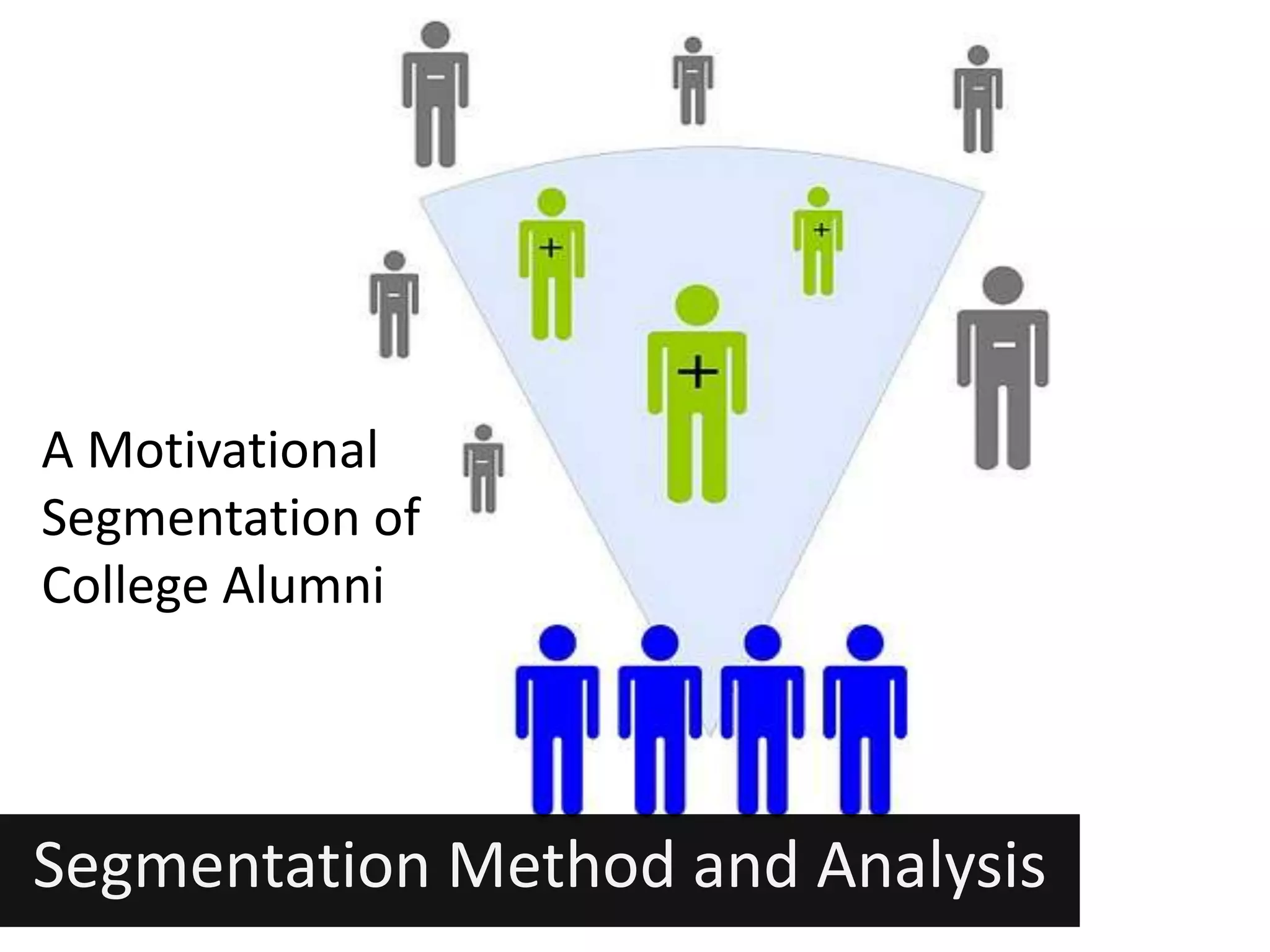
A Motivational
Segmentation of
College Alumni


Segmentation Method and Analysis
Questionnaire Development


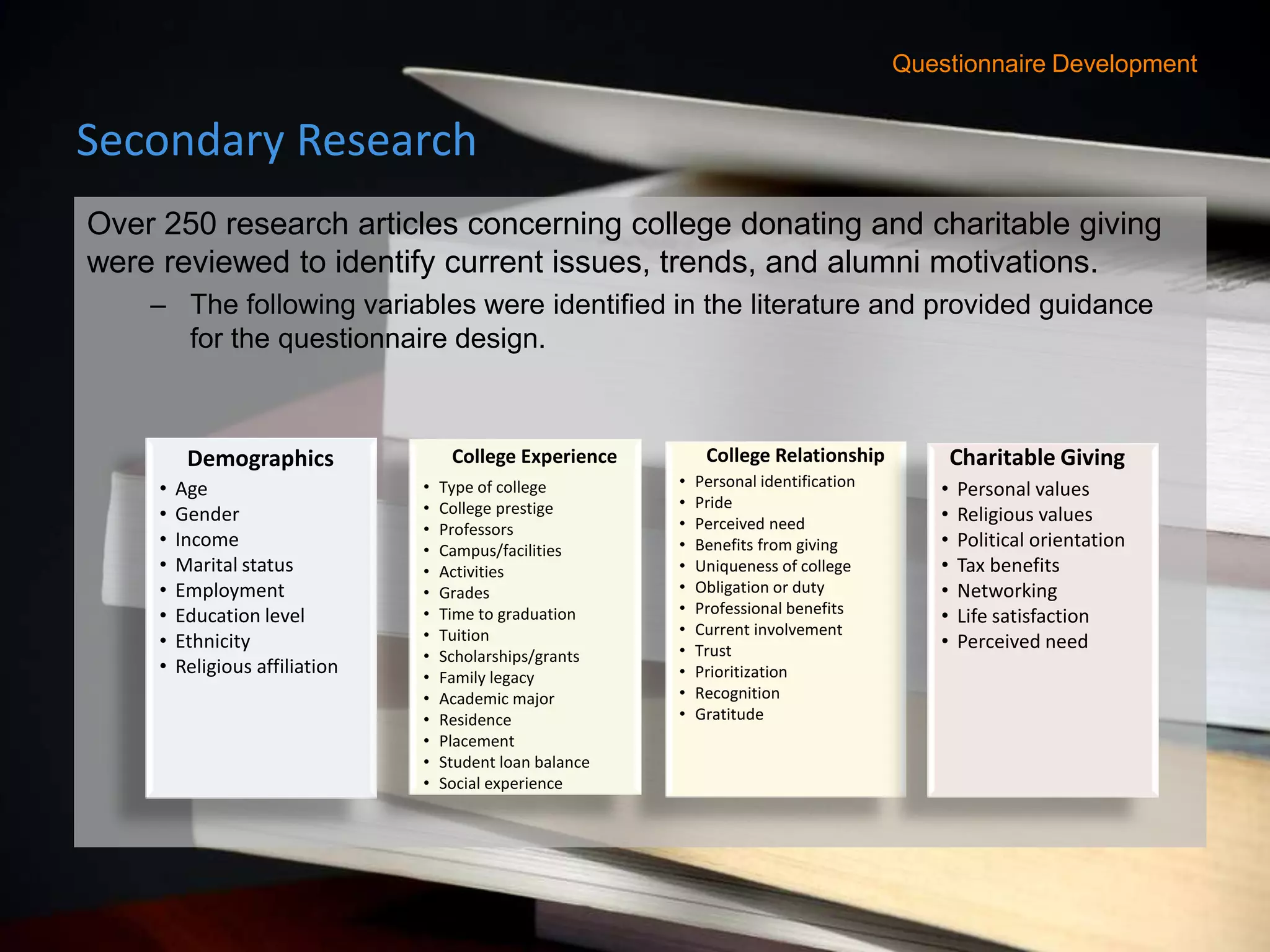
Secondary Research
Over 250 research articles concerning college donating and charitable giving
were reviewed to identify current issues, trends, and alumni motivations.
    – The following variables were identified in the literature and provided guidance
      for the questionnaire design.


          Demographics                College Experience         College Relationship             Charitable Giving
     •   Age                     •   Type of college        •   Personal identification       •   Personal values
                                 •   College prestige       •   Pride
     •   Gender                                             •   Perceived need                •   Religious values
                                 •   Professors
     •   Income                  •   Campus/facilities      •   Benefits from giving          •   Political orientation
     •   Marital status          •   Activities             •   Uniqueness of college         •   Tax benefits
     •   Employment              •   Grades                 •   Obligation or duty            •   Networking
     •   Education level         •   Time to graduation     •   Professional benefits         •   Life satisfaction
                                 •   Tuition                •   Current involvement
     •   Ethnicity                                          •   Trust                         •   Perceived need
                                 •   Scholarships/grants
     •   Religious affiliation   •   Family legacy          •   Prioritization
                                 •   Academic major         •   Recognition
                                 •   Residence              •   Gratitude
                                 •   Placement
                                 •   Student loan balance
                                 •   Social experience
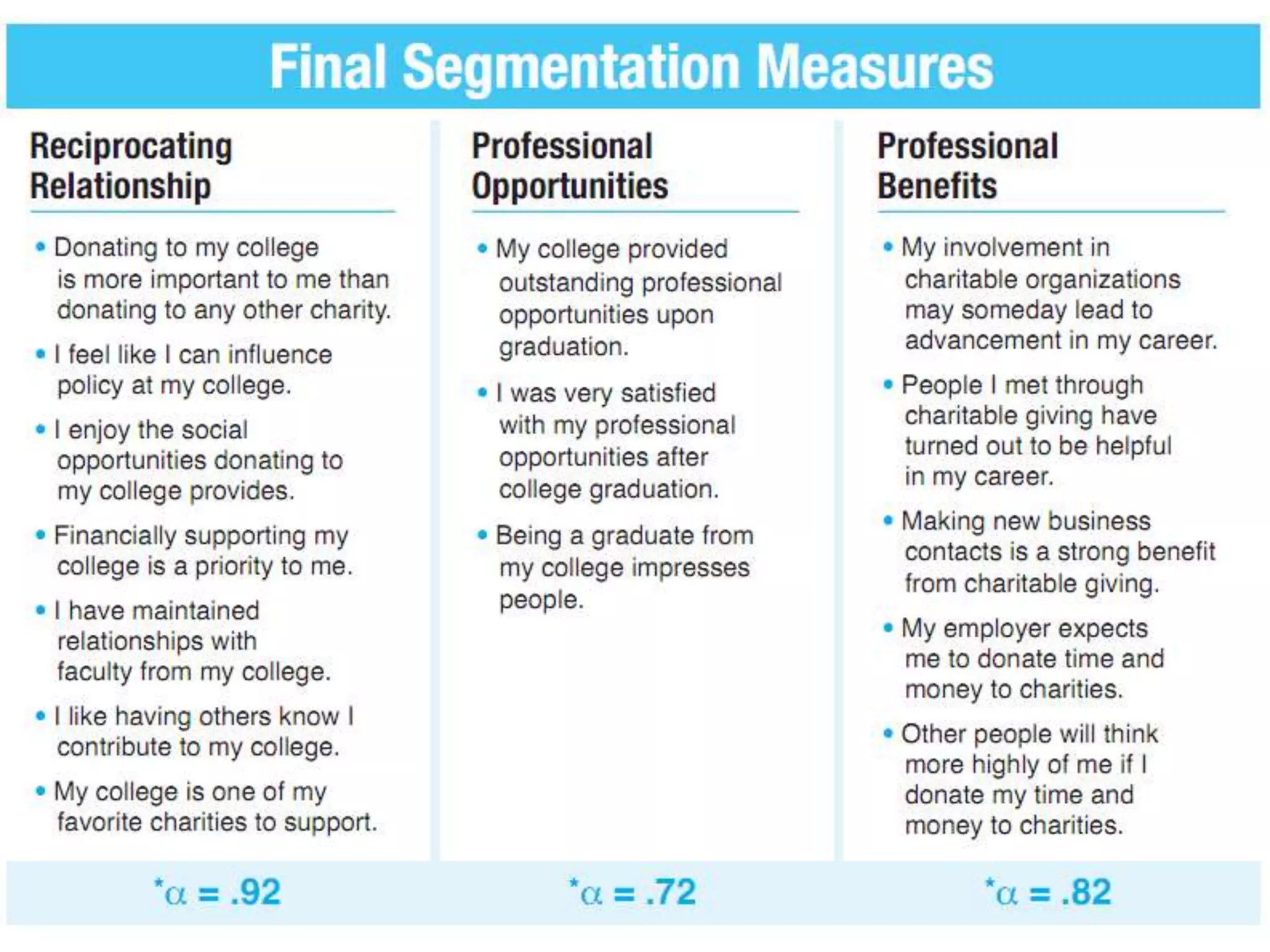
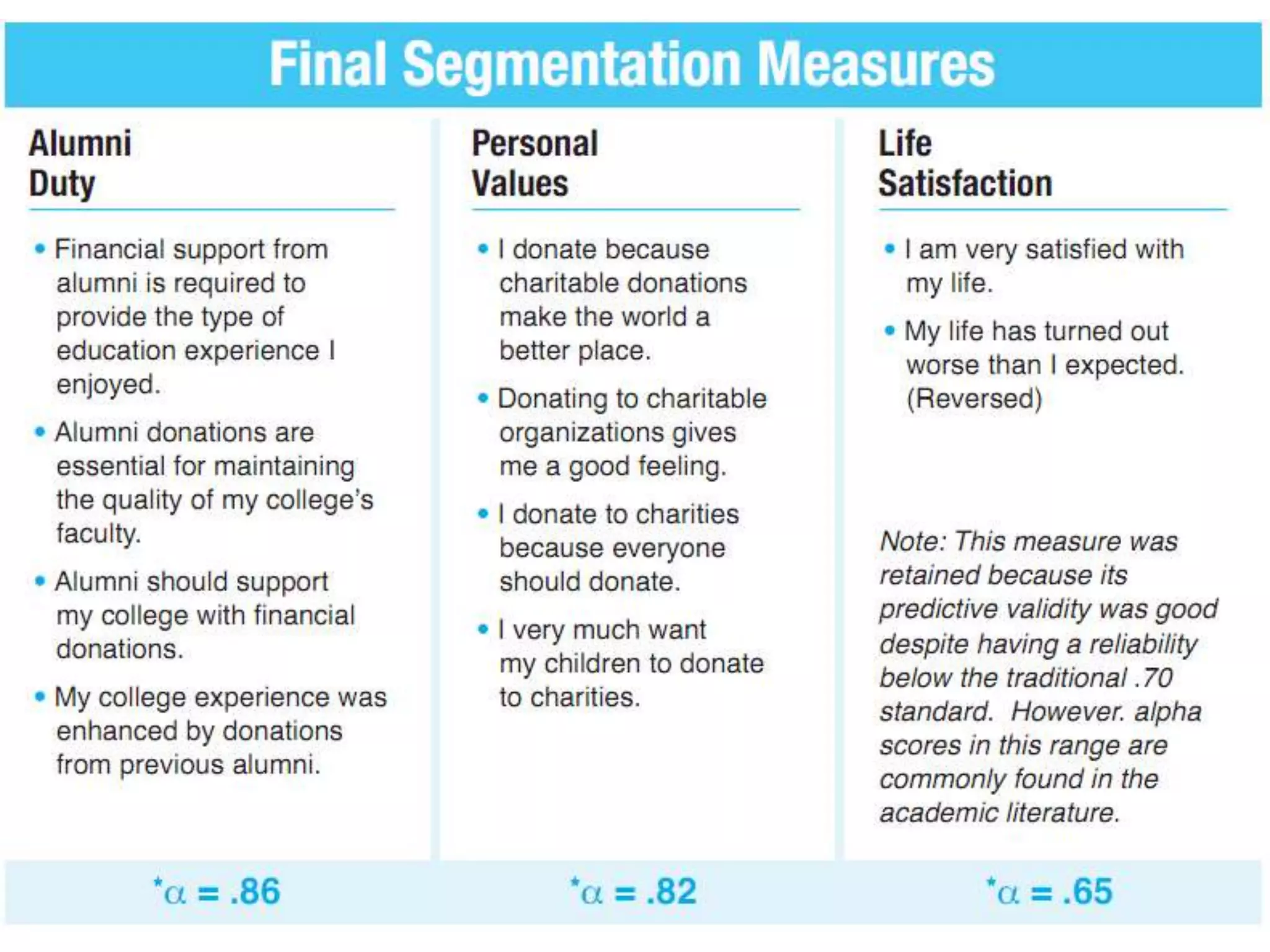
• Insert slide from page 3 of white paper
  segmentation measures
• Insert slide from page 4 of white paper graph
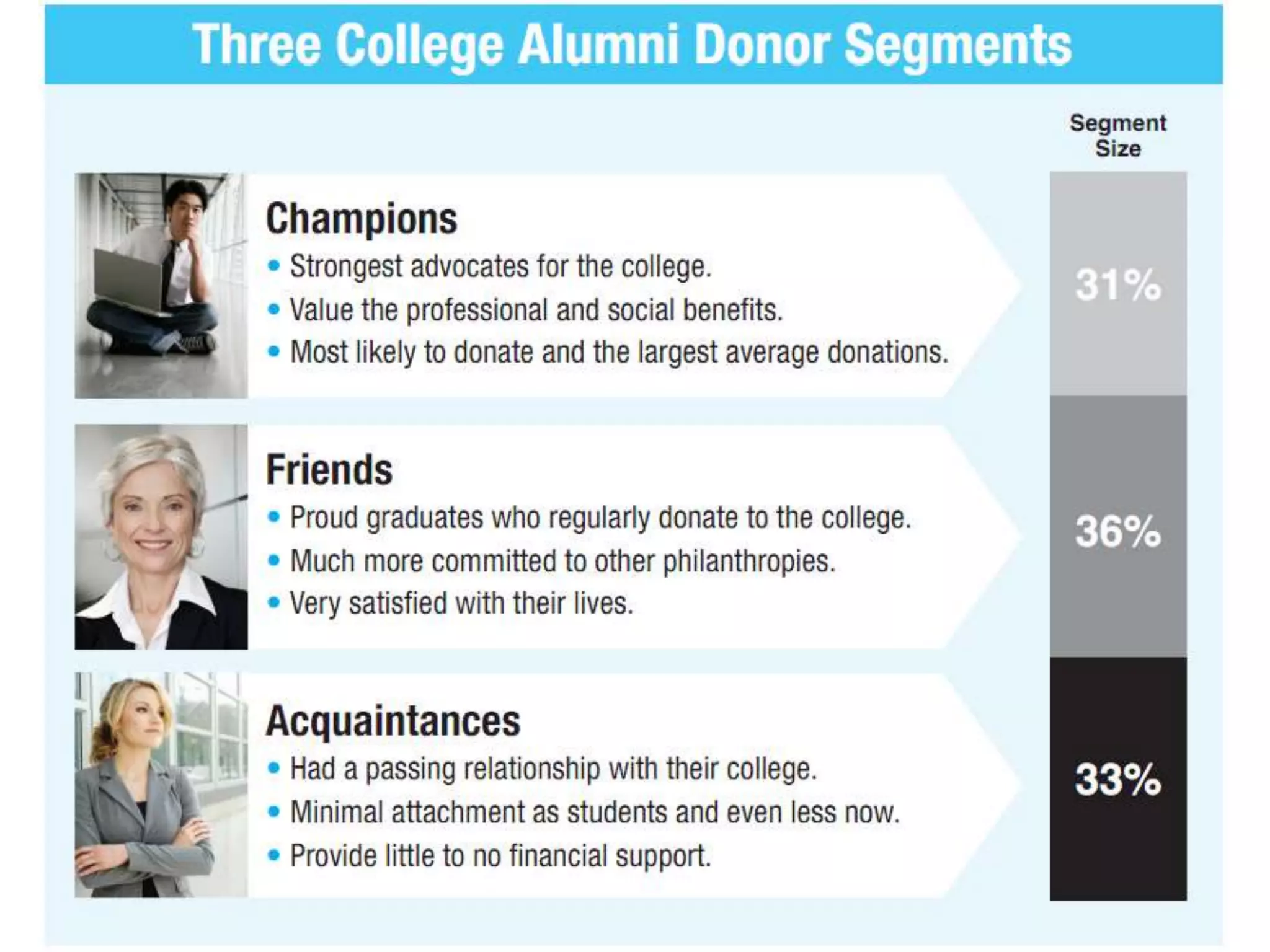
Persona Development
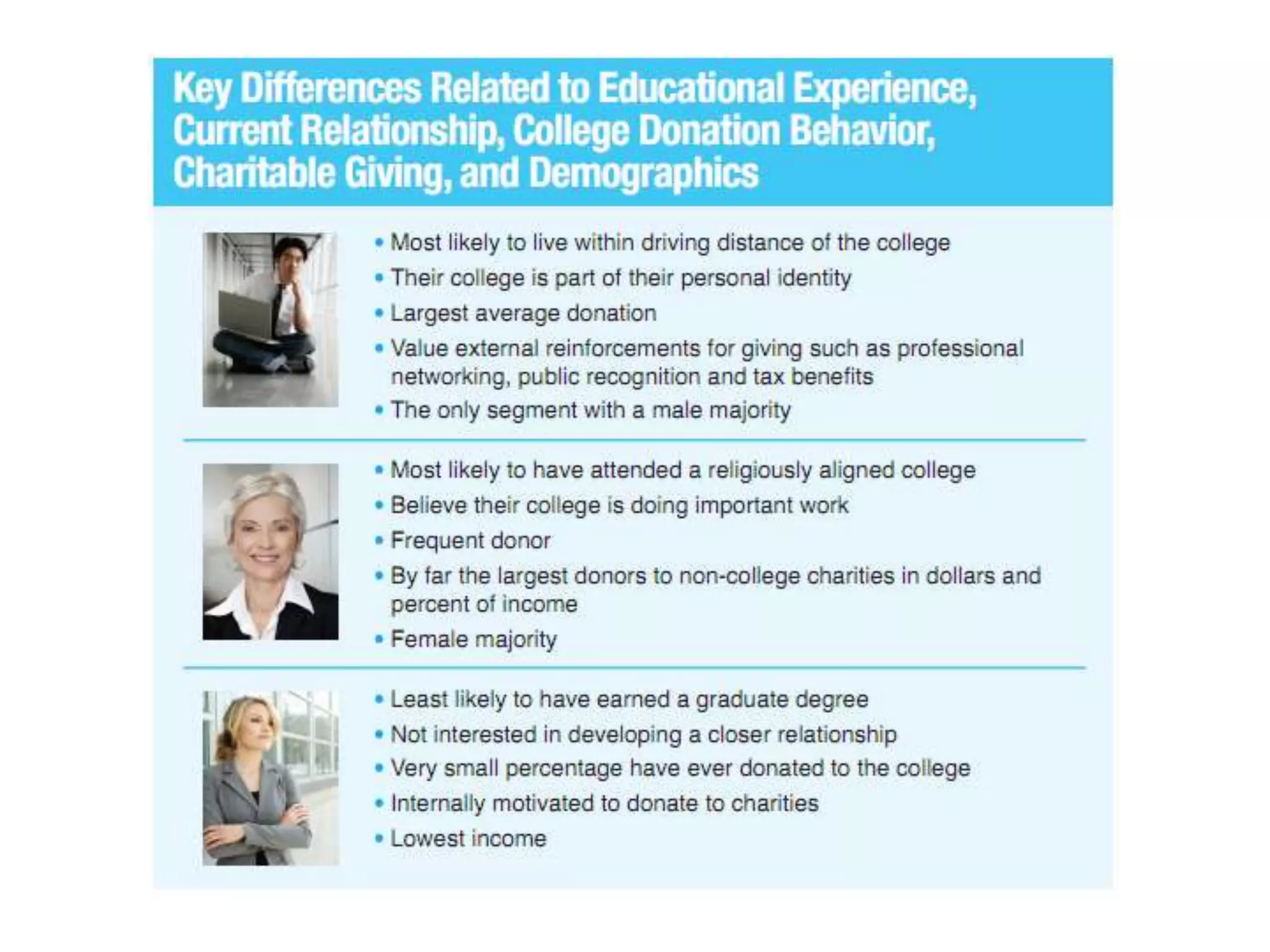
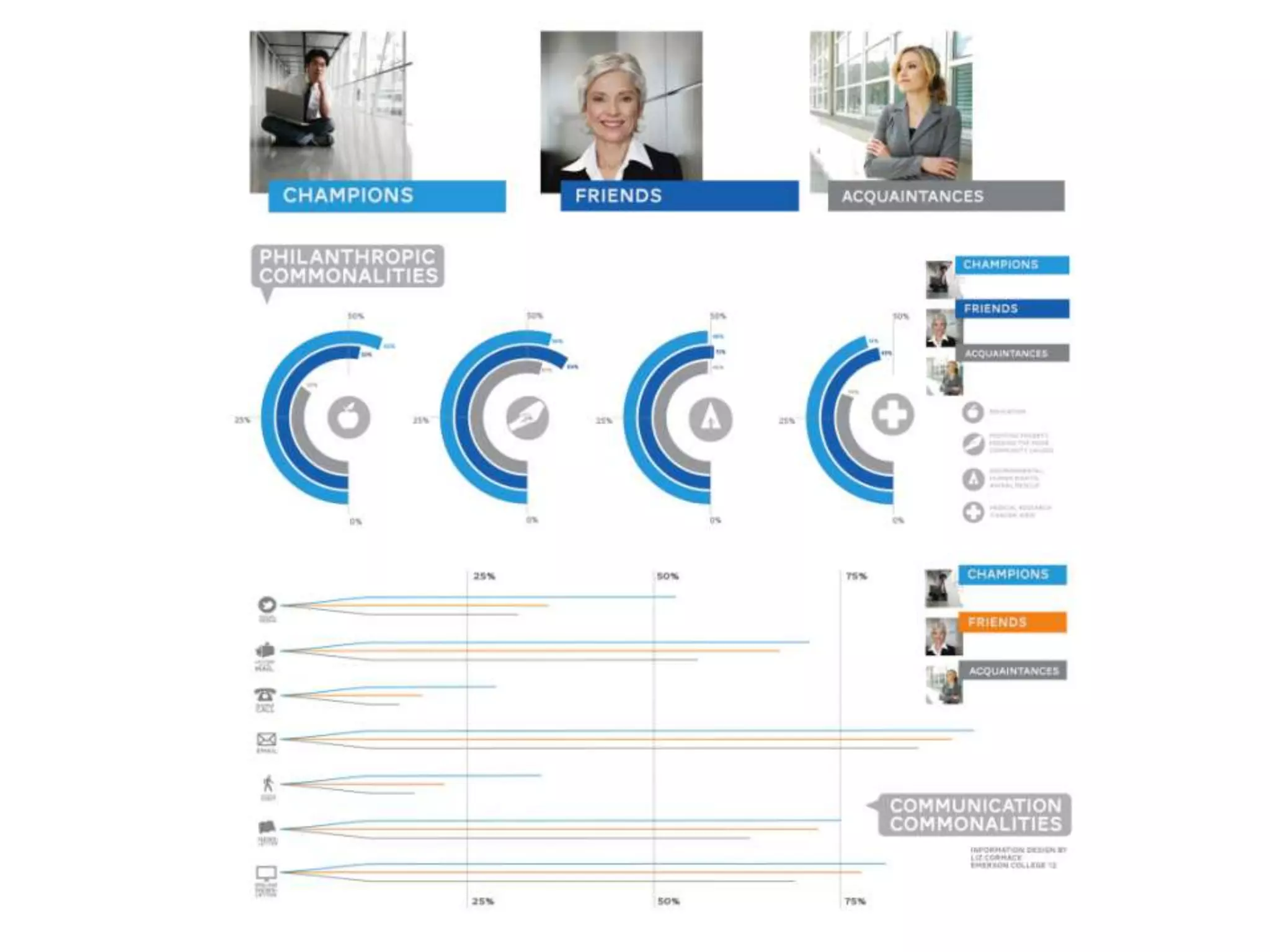
The national study identified three segments of
alumni respondents that vary significantly in
terms of their attitudes and motivations
associated with giving to their alma maters:
• Champions
• Friends
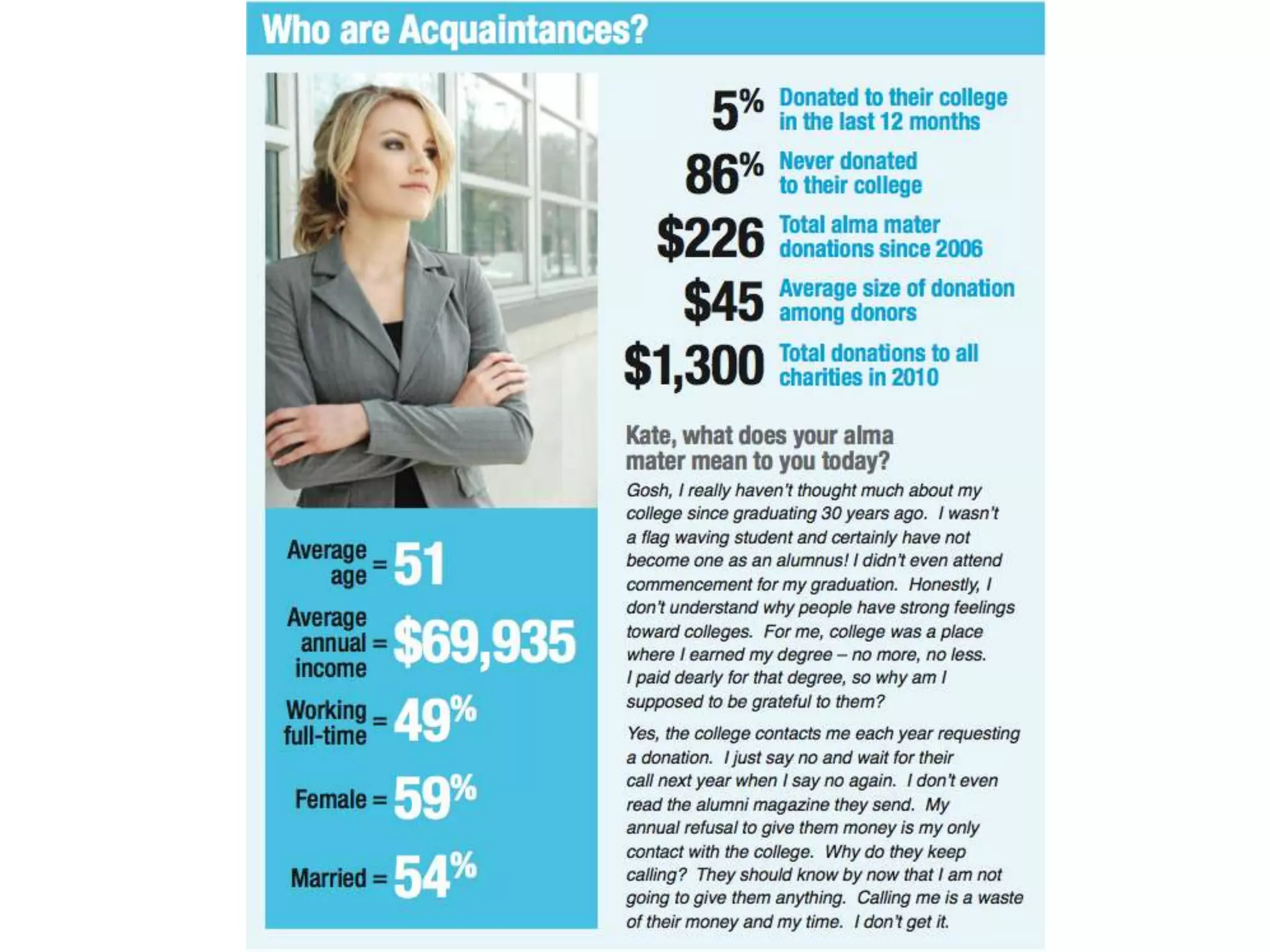
• Acquaintances
Pull image from page 5 of the white
               paper
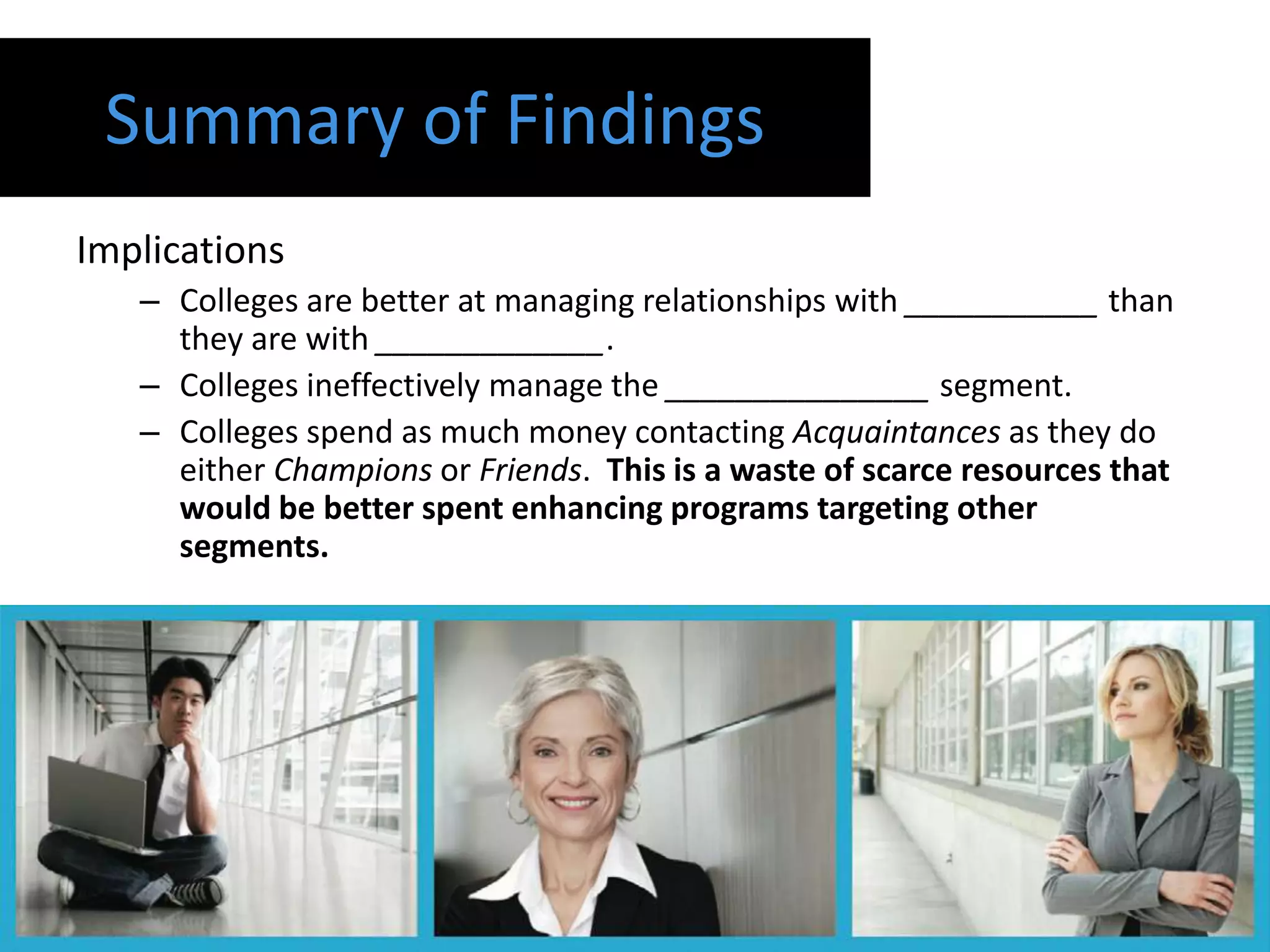
Summary of Findings
Implications
   – Colleges are better at managing relationships with ___________ than
     they are with _____________.
   – Colleges ineffectively manage the _______________ segment.
   – Colleges spend as much money contacting Acquaintances as they do
     either Champions or Friends. This is a waste of scarce resources that
     would be better spent enhancing programs targeting other
     segments.
Strategy

DISCUSSION
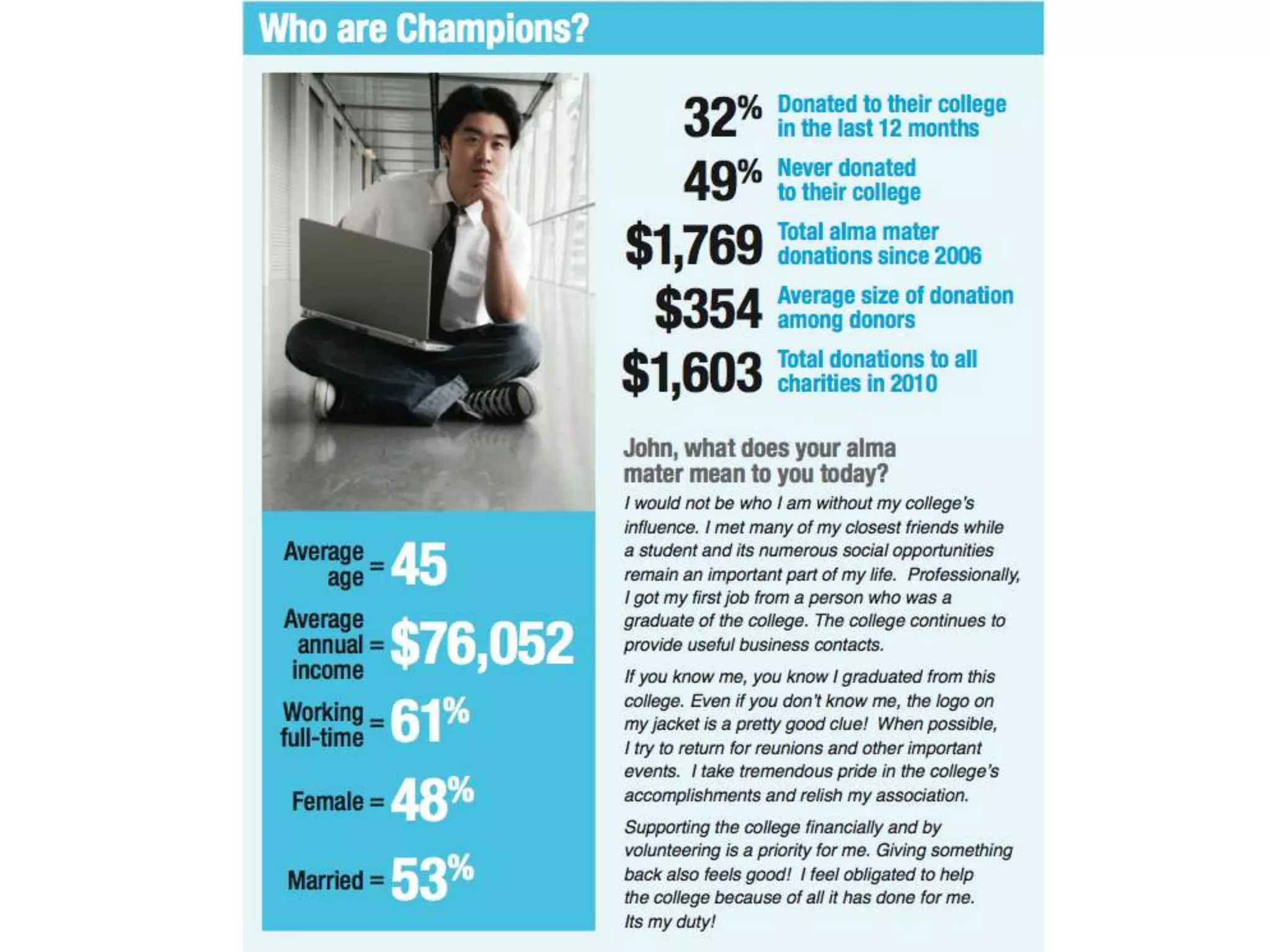
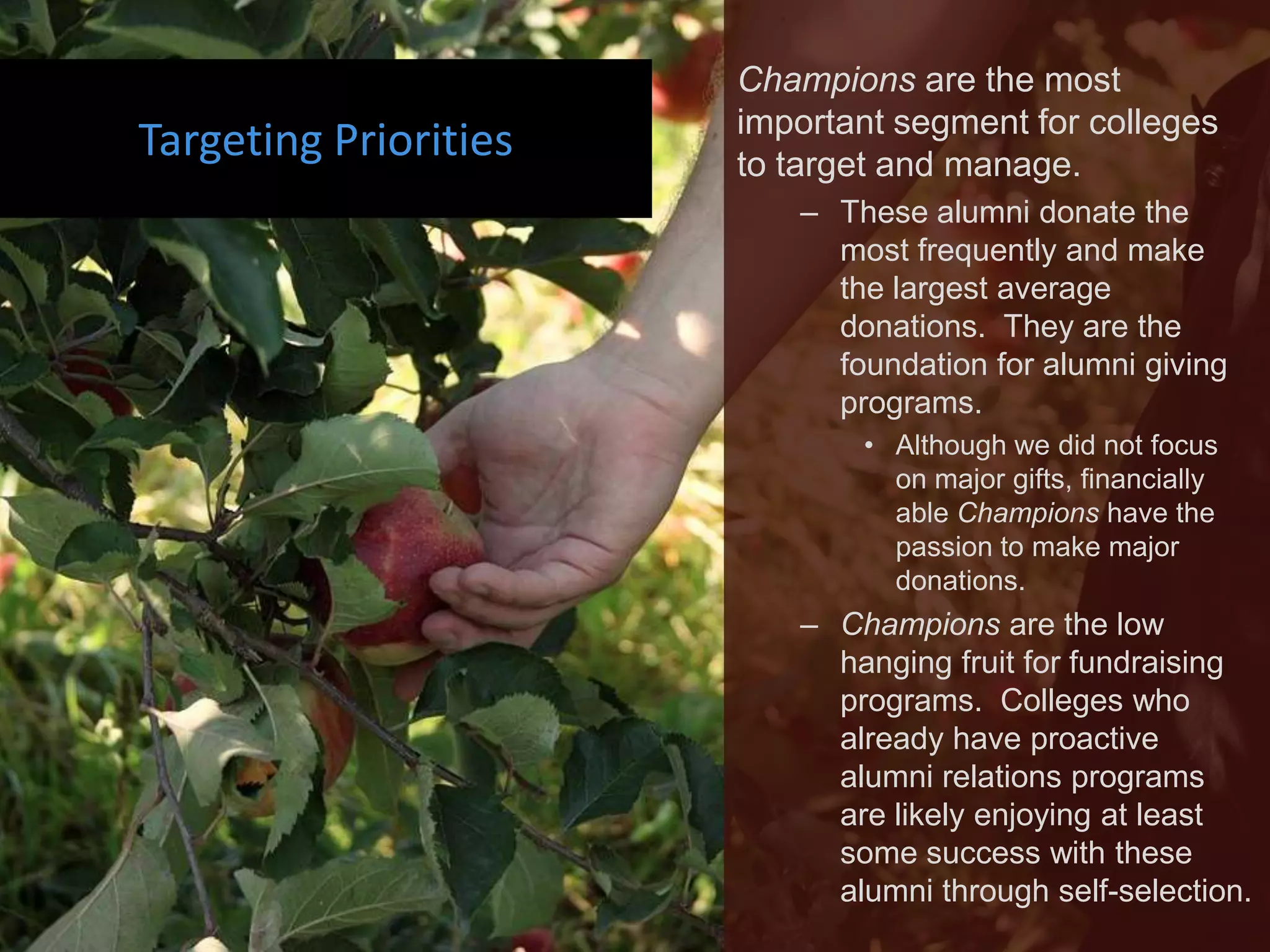
Champions are the most
                       important segment for colleges
Targeting Priorities   to target and manage.
                          – These alumni donate the
                            most frequently and make
                            the largest average
                            donations. They are the
                            foundation for alumni giving
                            programs.
                              • Although we did not focus
                                on major gifts, financially
                                able Champions have the
                                passion to make major
                                donations.
                          – Champions are the low
                            hanging fruit for fundraising
                            programs. Colleges who
                            already have proactive
                            alumni relations programs
                            are likely enjoying at least
                            some success with these
                            alumni through self-selection.
Champion Comments


Sometime I don't hear about all the events so post on
Facebook and email more often! I really enjoyed the Bowl
tour, the flight was great, loved the football buses, all the
events were amazing including the paddleboat, tour and
best of all the fabulous tailgate party and big win at the
Bowl. I plan on donating more and being more active after
meeting all of you. Thank you so much!
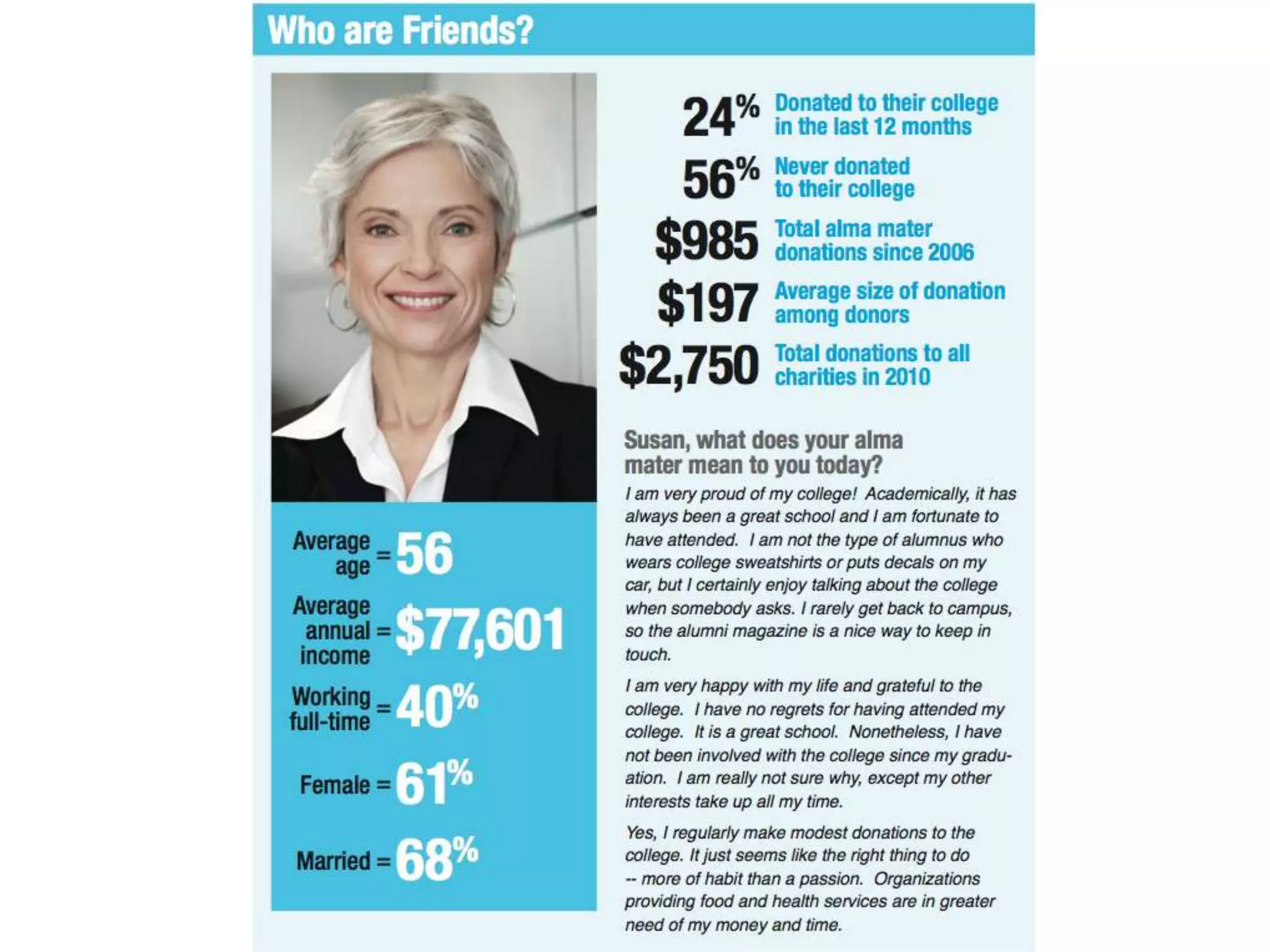
Friends are the second most important target
                       for colleges.
Targeting Priorities        – Like Champions, Friends donate
                                frequently. But their average donation is
                                much smaller.
                       Friends provide outstanding opportunities for
                       revenue growth.
                            – Friends donate much more to charities
                                than any other segment, but only
                                devote7% of their charitable giving
                                budget to their college .
                            – Even small increases in the proportion
                                of Friends charitable budget being
                                allocated to their alma mater would
                                provide substantial rewards.
                       Friends are already in the habit of giving to their
                       college and other charities.
                            – Colleges need to do a better job
                                persuading Friends that their college
                                deserves more of their support relative
                                to other charities.
Feedback from a Friend
          Friend

From a Friend: I am a Head of School for an
independent school in ---------, --, and therefore
have quite a bit of experience in fundraising, just
having raised $21 million for our capital campaign.
I am retiring in June 2012 and will be returning to -
------, where I have a home close to. After taking
some time off I intend to get more involved with
the institutions I attended in the area. You may
contact me after June 2012 here is my e-mail and
phone number
Messaging


  – Low cost ways in
    which to keep
    updated and a way in
    which to engage
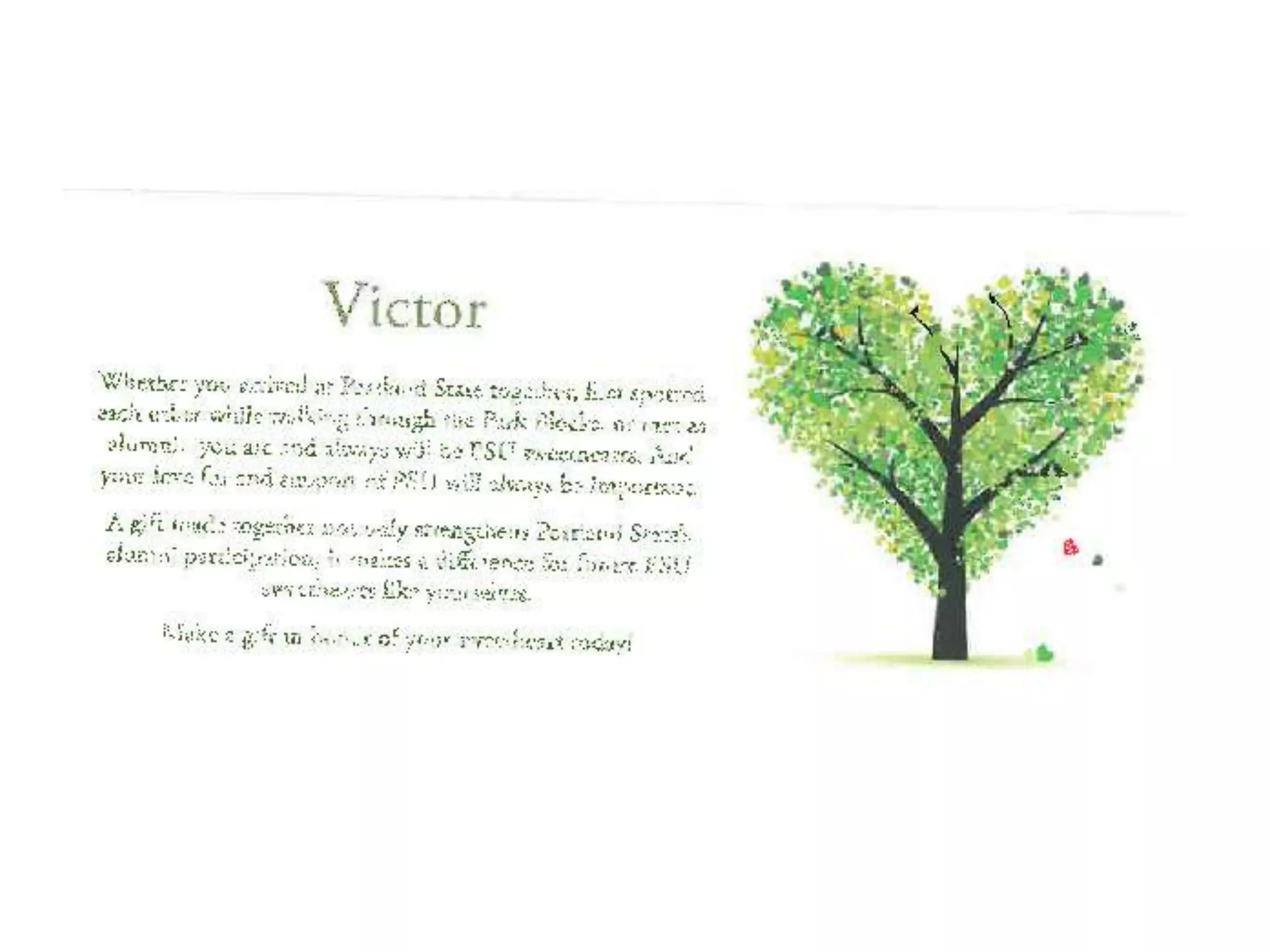
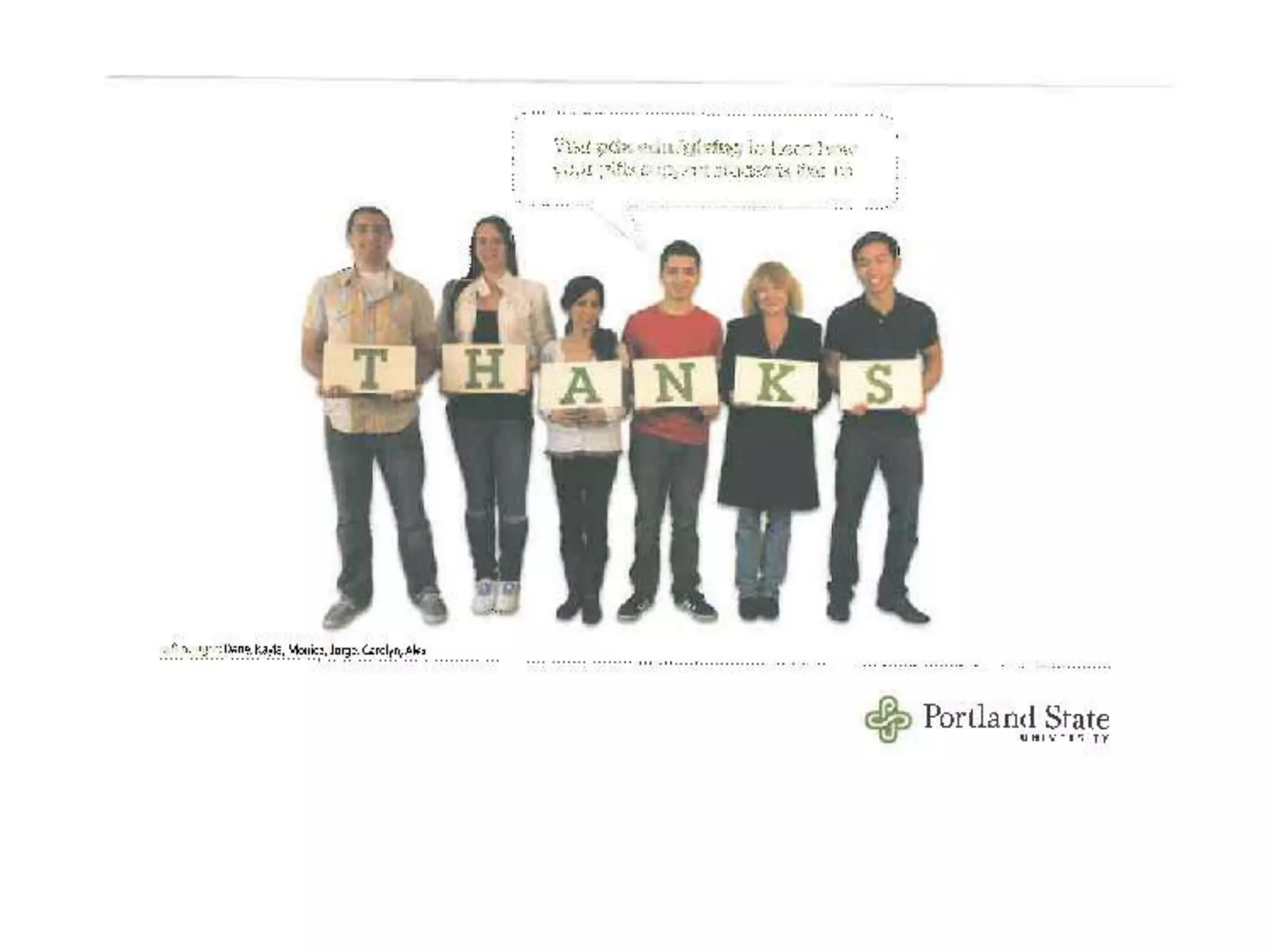
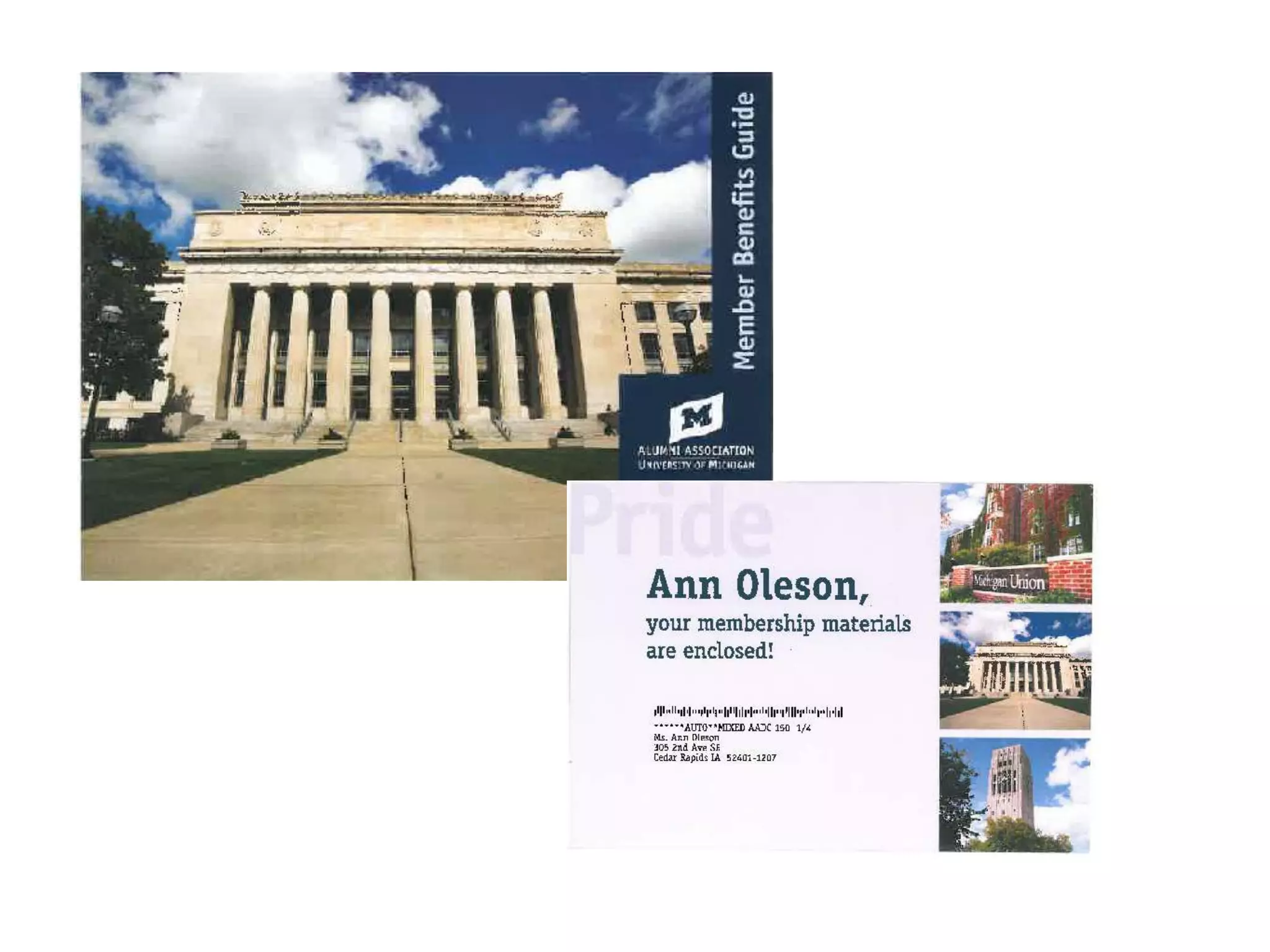
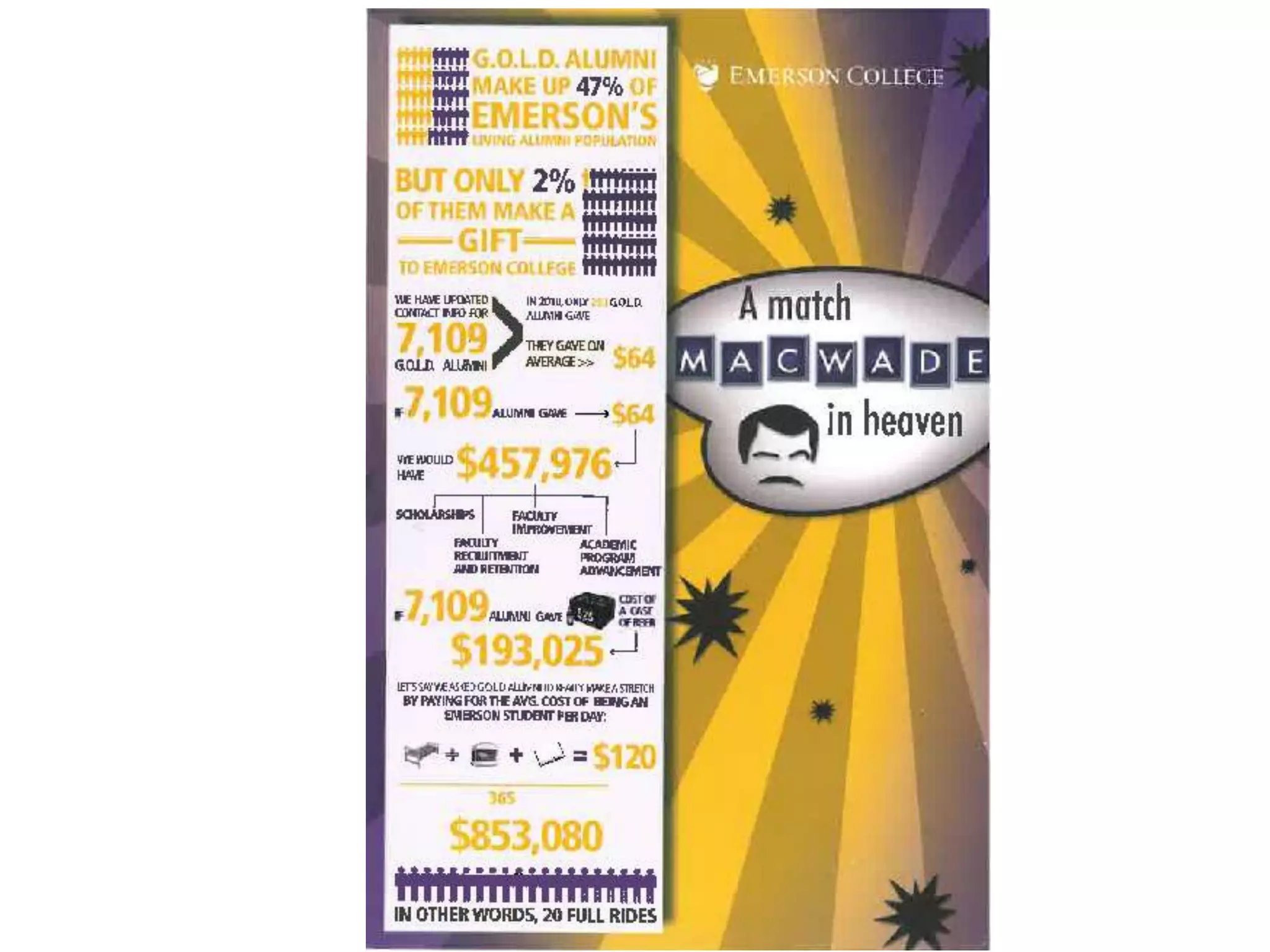
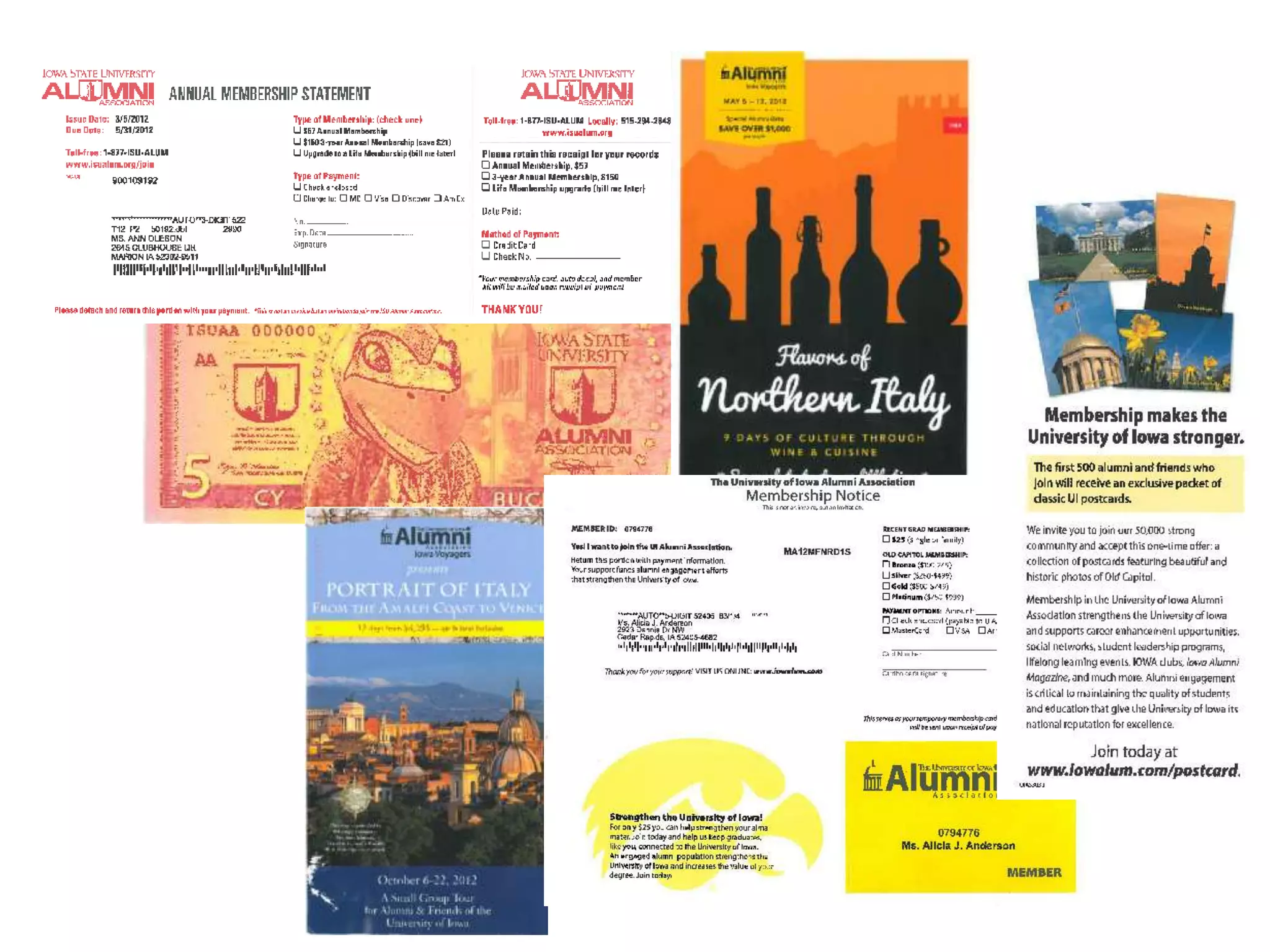
Effective Communications
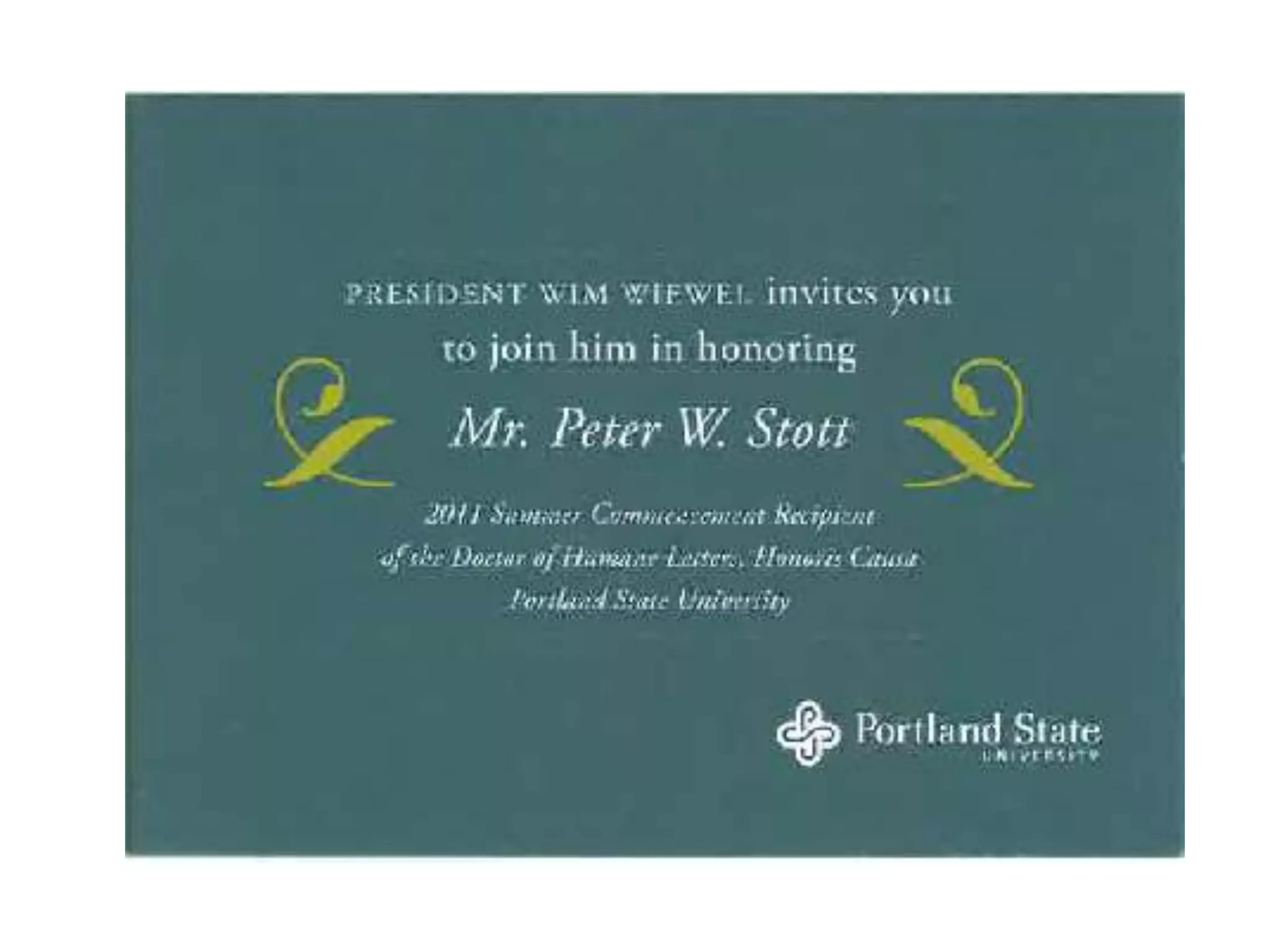
A GREAT EXAMPLE OF
SEGMENTED/TARGETED
COMMUNICATIONS
The More You Know…

I work for a non-profit organization in Cambodia
and fundraising is also part of my responsibility.
I've found that knowing a little bit about my
donors and customizing the message is important
to be effective due to the overwhelming amount
of requests people receive. That would be
difficult with a donor/alumni base as large as
XXX's but information gleaned from social media
and online surveys could be helpful. Good luck!
Christina
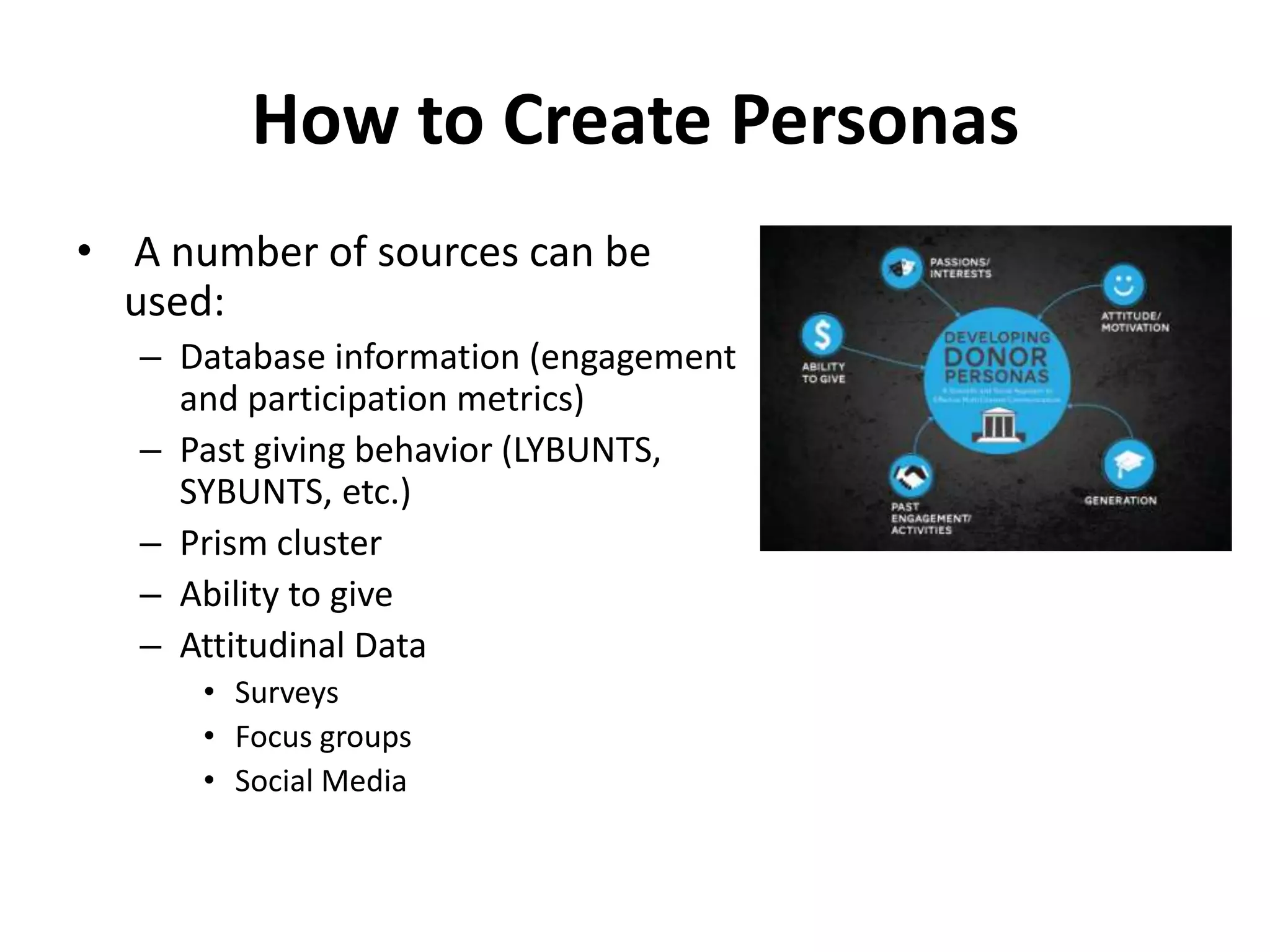
How to Create Personas
• A number of sources can be
  used:
   – Database information (engagement
     and participation metrics)
   – Past giving behavior (LYBUNTS,
     SYBUNTS, etc.)
   – Prism cluster
   – Ability to give
   – Attitudinal Data
      • Surveys
      • Focus groups
      • Social Media
President Hennessy, “I have more in common
with someone who is a young alum living in Los
Angeles than I do with someone living in my
neighborhood.”

We need to develop personas based on what
people care about and how they want to be
engaged.
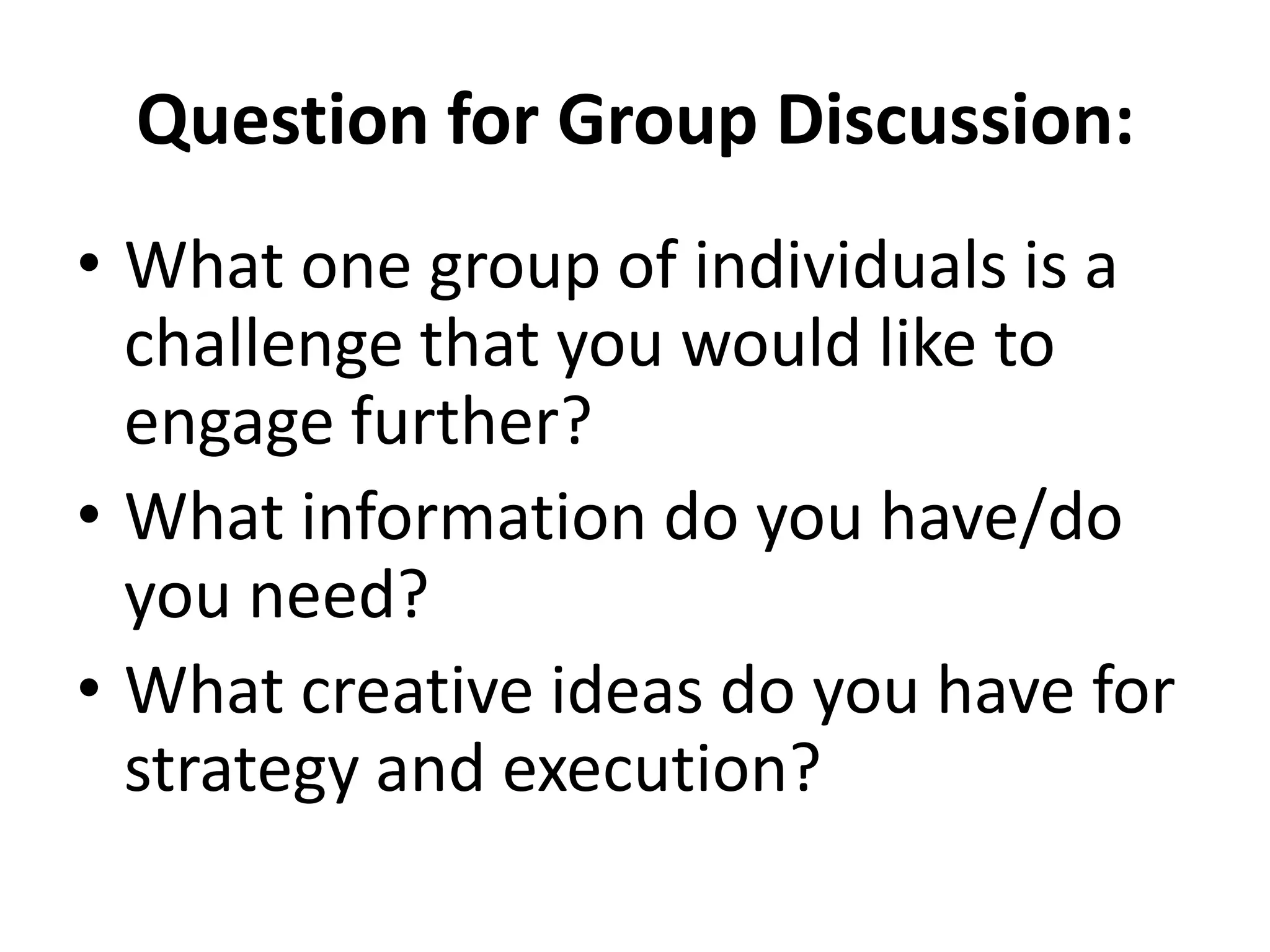
Question for Group Discussion:
• What one group of individuals is a
  challenge that you would like to
  engage further?
• What information do you have/do
  you need?
• What creative ideas do you have for
  strategy and execution?
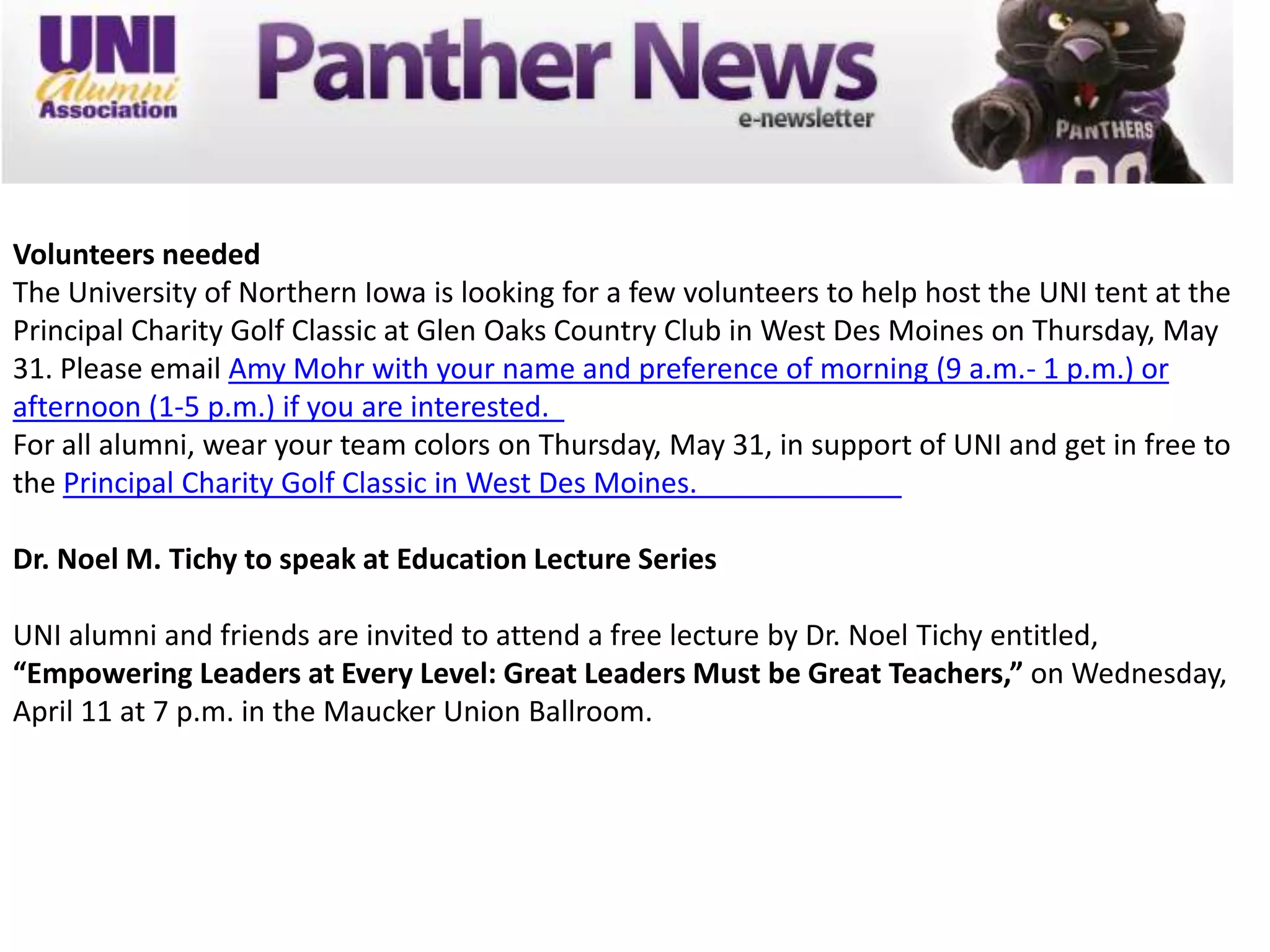
Volunteers needed
The University of Northern Iowa is looking for a few volunteers to help host the UNI tent at the
Principal Charity Golf Classic at Glen Oaks Country Club in West Des Moines on Thursday, May
31. Please email Amy Mohr with your name and preference of morning (9 a.m.- 1 p.m.) or
afternoon (1-5 p.m.) if you are interested.
For all alumni, wear your team colors on Thursday, May 31, in support of UNI and get in free to
the Principal Charity Golf Classic in West Des Moines.

Dr. Noel M. Tichy to speak at Education Lecture Series

UNI alumni and friends are invited to attend a free lecture by Dr. Noel Tichy entitled,
“Empowering Leaders at Every Level: Great Leaders Must be Great Teachers,” on Wednesday,
April 11 at 7 p.m. in the Maucker Union Ballroom.
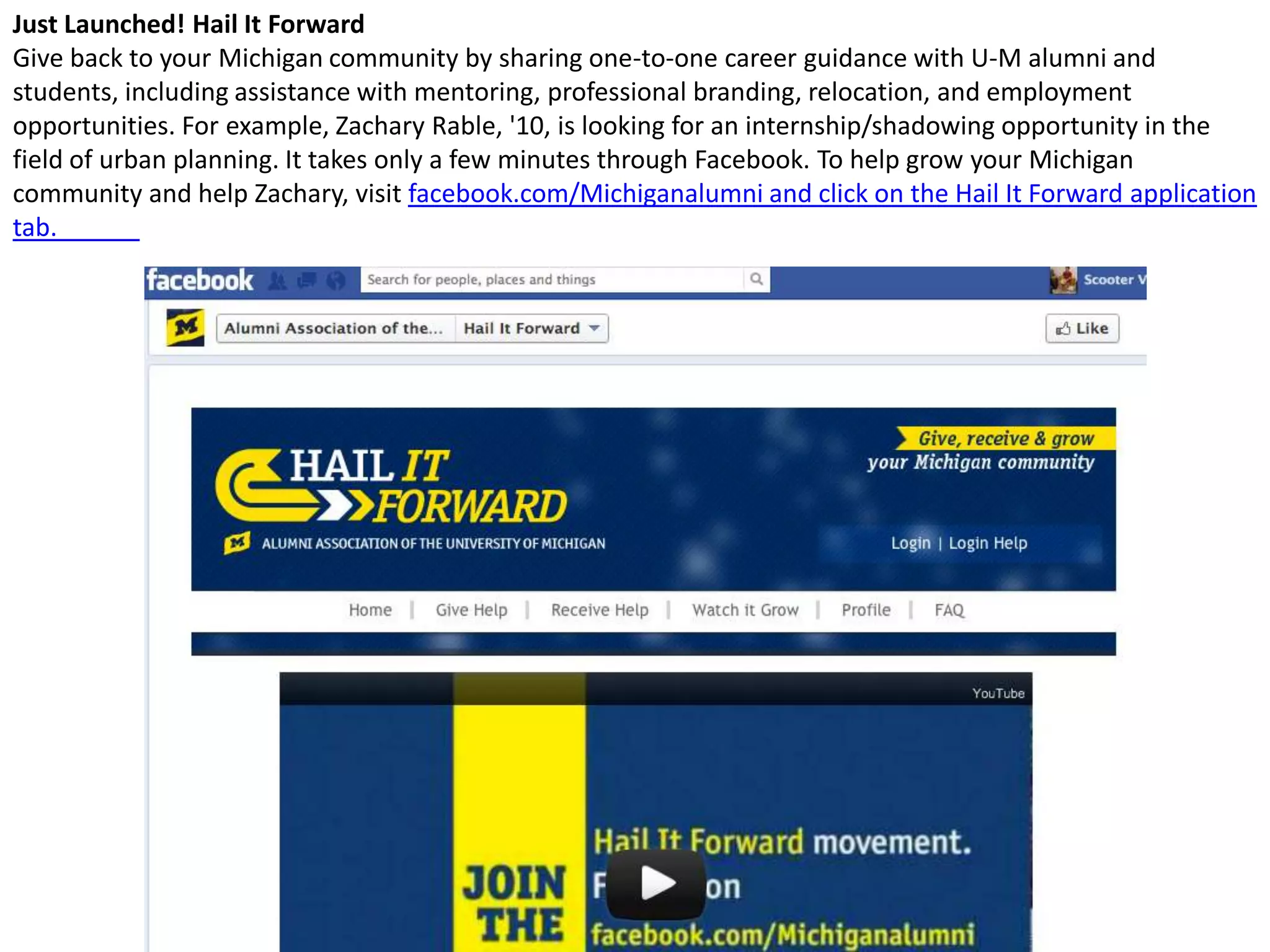
Just Launched! Hail It Forward
Give back to your Michigan community by sharing one-to-one career guidance with U-M alumni and
students, including assistance with mentoring, professional branding, relocation, and employment
opportunities. For example, Zachary Rable, '10, is looking for an internship/shadowing opportunity in the
field of urban planning. It takes only a few minutes through Facebook. To help grow your Michigan
community and help Zachary, visit facebook.com/Michiganalumni and click on the Hail It Forward application
tab.
Examples from Audience


How are you using information about
your alumni to segment the
communications that they receive?
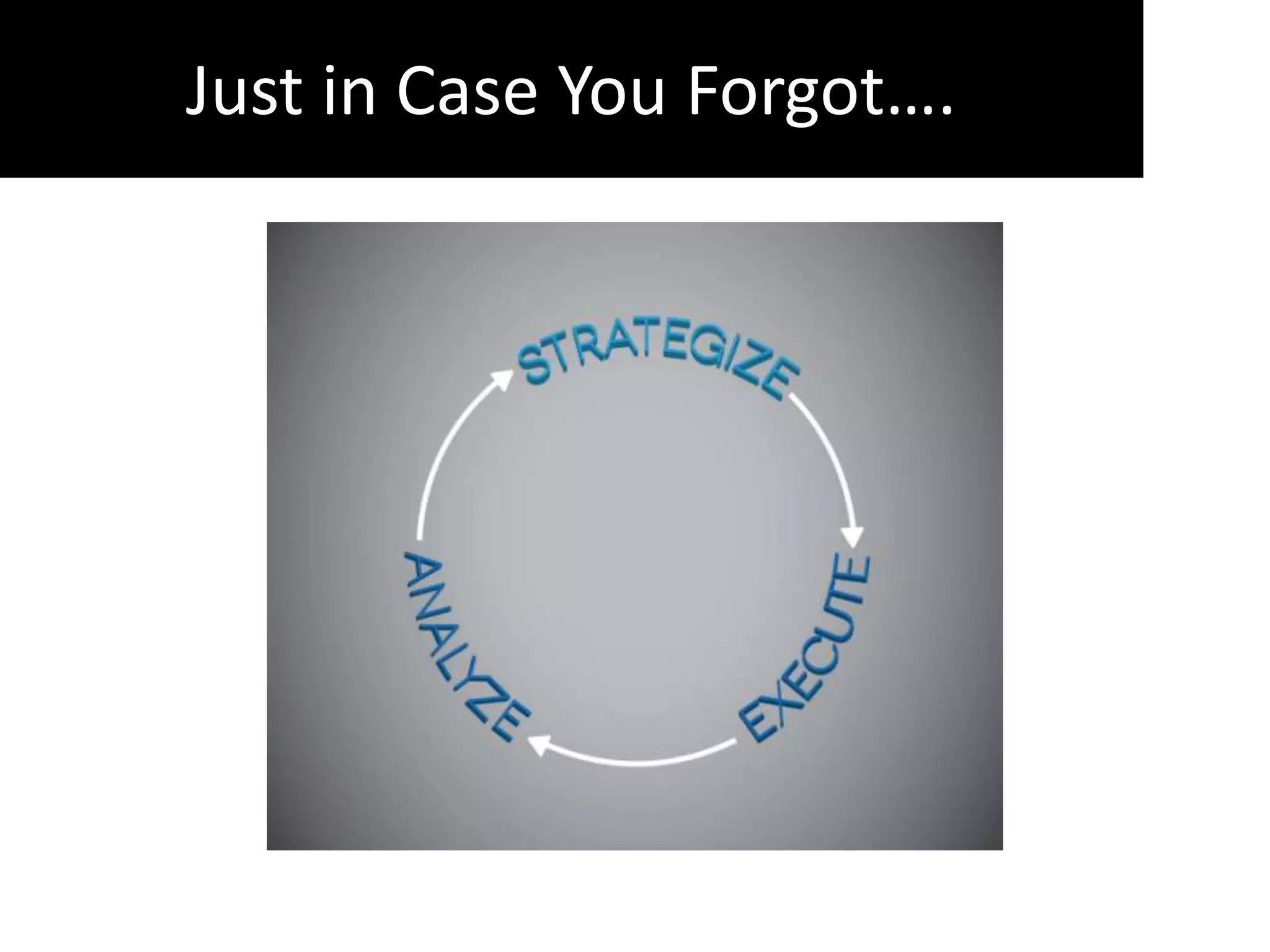
Just in Case You Forgot….

    Add infographic strategize, implement, analyze
Applications and Analysis
• Not a static process
• Communicating to three groups
  break into segments
• Campaign codes
• Sub-segment college of education
  response rate 1/3 of everybody else
• Market testing before you send out
  50,000
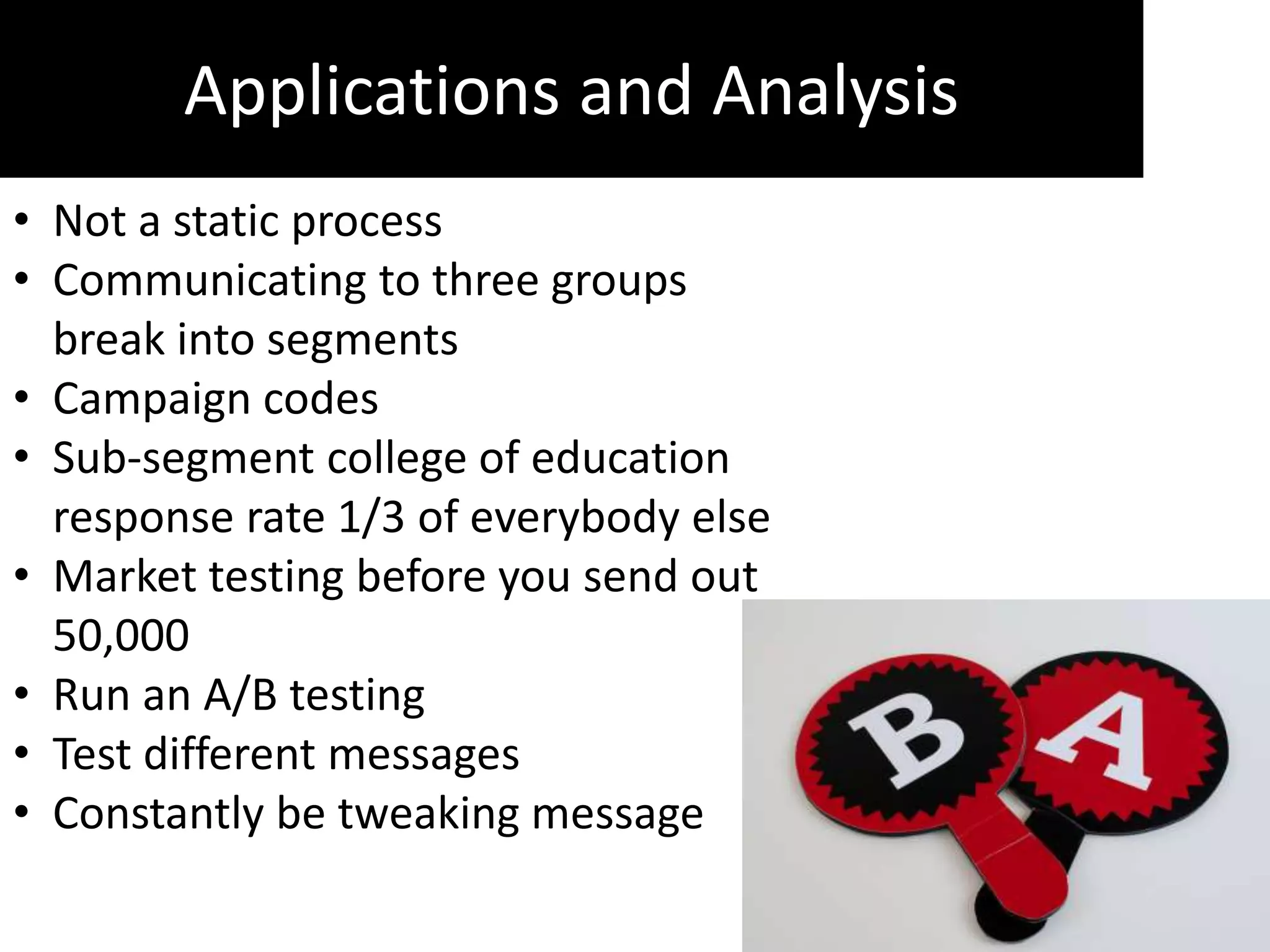
• Run an A/B testing
• Test different messages
• Constantly be tweaking message
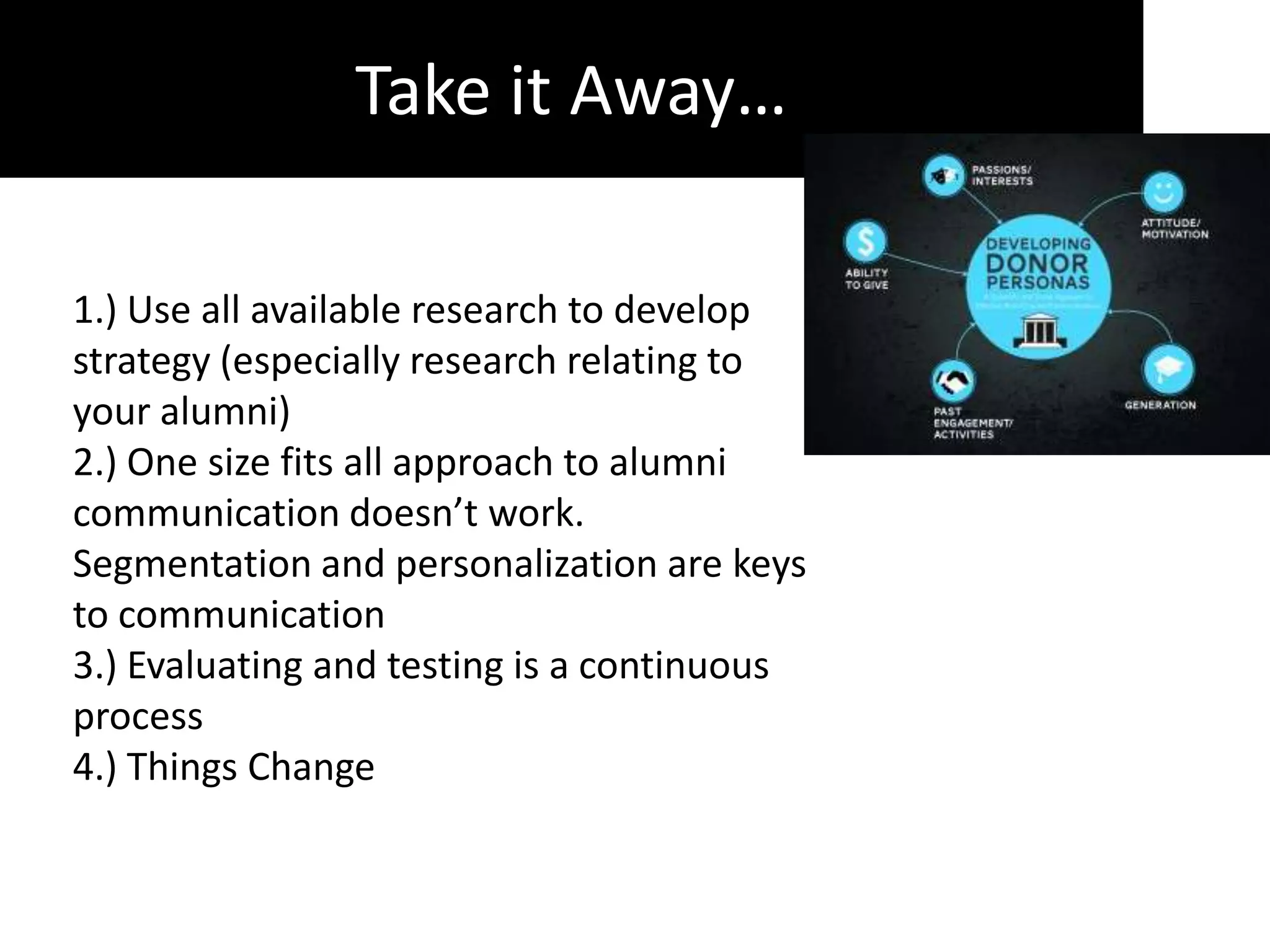
Take it Away…

1.) Use all available research to develop
strategy (especially research relating to
your alumni)
2.) One size fits all approach to alumni
communication doesn’t work.
Segmentation and personalization are keys
to communication
3.) Evaluating and testing is a continuous
process
4.) Things Change
Questions?
To Continue the Discussion
@AnnCOleson

White Paper

Webinars

ann@convergeconsulting.org
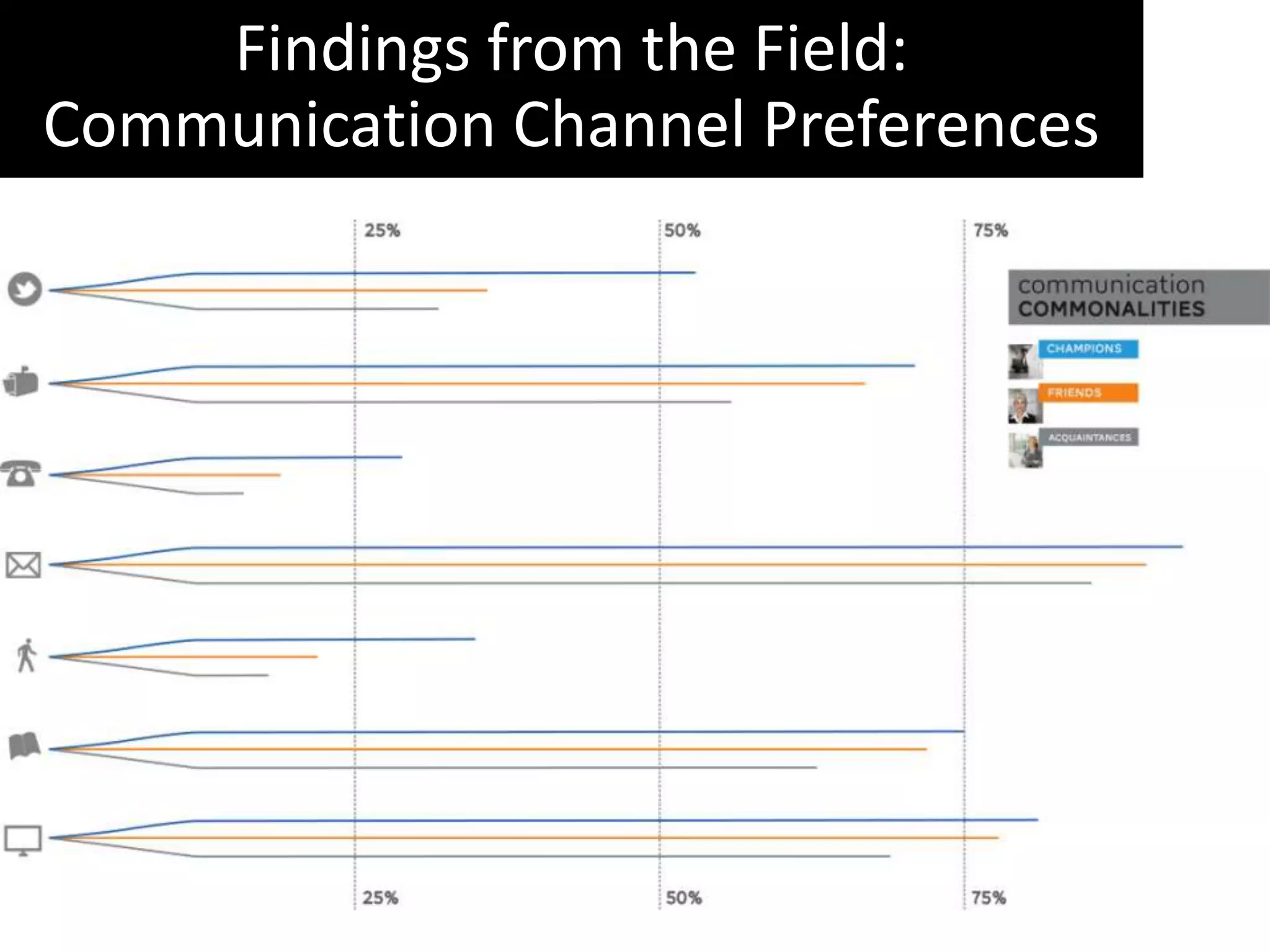
Findings from the Field:
Communication Channel Preferences
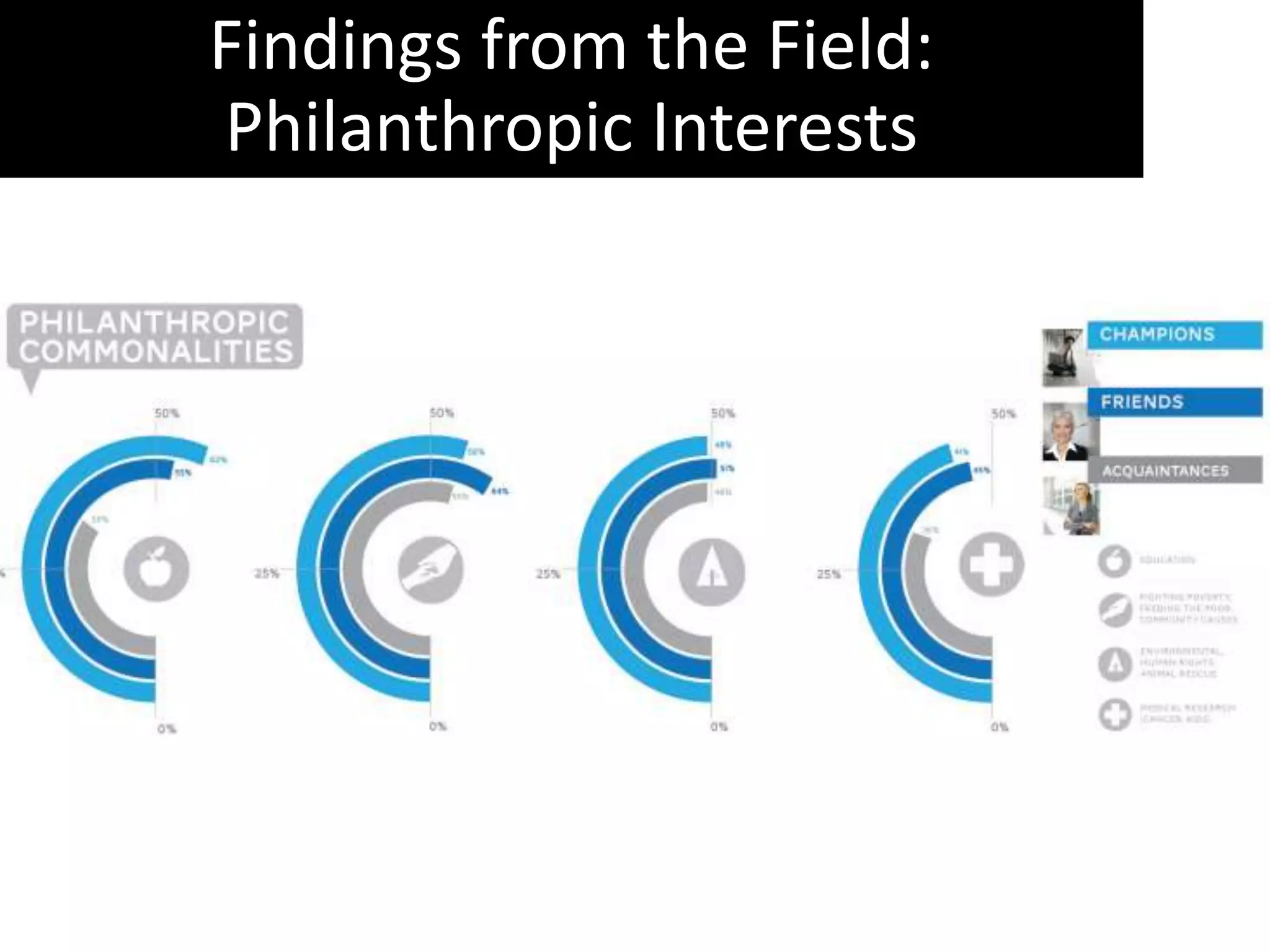
Findings from the Field:
Philanthropic Interests
The Power of Words

http://www.youtube.com/watchv=Hzgzim5m7oU

Developing Donor Personas: A Scientific and Social Approach to Effective Multi-Channel Communications

  • 1.
    Developing Donor Personas: AScientific and Social Approach to Effective Multi-Channel Communications Presented by Ann Oleson, Founder Converge Consulting
  • 2.
  • 4.
    Our Time Together •The top findings from the donor motivation study • A model for crafting effective communications/personas • Examples of relevant communications • Application of findings to your alumni/donor communications
  • 5.
  • 6.
    Alumni Communications Plan •Strategize – Research – Segmentation/Personas – Plan • Execute – Right message, right audience, right medium, right time • Analyze/Course Correct – Evaluating what works
  • 7.
    Research • National benchmark research – Wealth Engine, PEG, CASE • Alumni research (quantitative/qualitative) • Social Media Listening/Monitoring
  • 8.
    What Motivates YourAlumni? Who are your alumni? What do you know about them?
  • 9.
    Meet Jennifer • 35years old • VP of Sales for Company • Student Government Officer • Honors Student: 3.9 GPA • Not engaged with her college • No home phone number • Gives 10% of income to philanthropy • Serves on a number of boards in community • Has great feelings toward her college but never been asked to engage in a meaningful way
  • 10.
    Meet Jennifer Just becauseJennifer is able to give does not mean she is motivated to give. How do we understand who Jennifer is, what she cares about, and how to reach her?
  • 12.
    Research Objectives • Develop a motivationally-based segmentation model • Uncover the motivations that drive the different types of relationships • Prioritize which alumni segments provide the best opportunities for colleges • Provide recommendations regarding how these different alumni segments should be managed to optimize their individual likelihood of donating • Develop a predictive model and applied tool to classify alumni into segments based on a minimum number of questions
  • 14.
    A Motivational Segmentation of CollegeAlumni Segmentation Method and Analysis
  • 15.
    Questionnaire Development Secondary Research Over250 research articles concerning college donating and charitable giving were reviewed to identify current issues, trends, and alumni motivations. – The following variables were identified in the literature and provided guidance for the questionnaire design. Demographics College Experience College Relationship Charitable Giving • Age • Type of college • Personal identification • Personal values • College prestige • Pride • Gender • Perceived need • Religious values • Professors • Income • Campus/facilities • Benefits from giving • Political orientation • Marital status • Activities • Uniqueness of college • Tax benefits • Employment • Grades • Obligation or duty • Networking • Education level • Time to graduation • Professional benefits • Life satisfaction • Tuition • Current involvement • Ethnicity • Trust • Perceived need • Scholarships/grants • Religious affiliation • Family legacy • Prioritization • Academic major • Recognition • Residence • Gratitude • Placement • Student loan balance • Social experience
  • 16.
    • Insert slidefrom page 3 of white paper segmentation measures
  • 17.
    • Insert slidefrom page 4 of white paper graph
  • 18.
    Persona Development The nationalstudy identified three segments of alumni respondents that vary significantly in terms of their attitudes and motivations associated with giving to their alma maters: • Champions • Friends • Acquaintances
  • 19.
    Pull image frompage 5 of the white paper
  • 24.
    Summary of Findings Implications – Colleges are better at managing relationships with ___________ than they are with _____________. – Colleges ineffectively manage the _______________ segment. – Colleges spend as much money contacting Acquaintances as they do either Champions or Friends. This is a waste of scarce resources that would be better spent enhancing programs targeting other segments.
  • 25.
  • 26.
    Champions are themost important segment for colleges Targeting Priorities to target and manage. – These alumni donate the most frequently and make the largest average donations. They are the foundation for alumni giving programs. • Although we did not focus on major gifts, financially able Champions have the passion to make major donations. – Champions are the low hanging fruit for fundraising programs. Colleges who already have proactive alumni relations programs are likely enjoying at least some success with these alumni through self-selection.
  • 27.
    Champion Comments Sometime Idon't hear about all the events so post on Facebook and email more often! I really enjoyed the Bowl tour, the flight was great, loved the football buses, all the events were amazing including the paddleboat, tour and best of all the fabulous tailgate party and big win at the Bowl. I plan on donating more and being more active after meeting all of you. Thank you so much!
  • 28.
    Friends are thesecond most important target for colleges. Targeting Priorities – Like Champions, Friends donate frequently. But their average donation is much smaller. Friends provide outstanding opportunities for revenue growth. – Friends donate much more to charities than any other segment, but only devote7% of their charitable giving budget to their college . – Even small increases in the proportion of Friends charitable budget being allocated to their alma mater would provide substantial rewards. Friends are already in the habit of giving to their college and other charities. – Colleges need to do a better job persuading Friends that their college deserves more of their support relative to other charities.
  • 29.
    Feedback from aFriend Friend From a Friend: I am a Head of School for an independent school in ---------, --, and therefore have quite a bit of experience in fundraising, just having raised $21 million for our capital campaign. I am retiring in June 2012 and will be returning to - ------, where I have a home close to. After taking some time off I intend to get more involved with the institutions I attended in the area. You may contact me after June 2012 here is my e-mail and phone number
  • 30.
    Messaging –Low cost ways in which to keep updated and a way in which to engage
  • 31.
  • 32.
    A GREAT EXAMPLEOF SEGMENTED/TARGETED COMMUNICATIONS
  • 38.
    The More YouKnow… I work for a non-profit organization in Cambodia and fundraising is also part of my responsibility. I've found that knowing a little bit about my donors and customizing the message is important to be effective due to the overwhelming amount of requests people receive. That would be difficult with a donor/alumni base as large as XXX's but information gleaned from social media and online surveys could be helpful. Good luck! Christina
  • 40.
    How to CreatePersonas • A number of sources can be used: – Database information (engagement and participation metrics) – Past giving behavior (LYBUNTS, SYBUNTS, etc.) – Prism cluster – Ability to give – Attitudinal Data • Surveys • Focus groups • Social Media
  • 41.
    President Hennessy, “Ihave more in common with someone who is a young alum living in Los Angeles than I do with someone living in my neighborhood.” We need to develop personas based on what people care about and how they want to be engaged.
  • 42.
    Question for GroupDiscussion: • What one group of individuals is a challenge that you would like to engage further? • What information do you have/do you need? • What creative ideas do you have for strategy and execution?
  • 45.
    Volunteers needed The Universityof Northern Iowa is looking for a few volunteers to help host the UNI tent at the Principal Charity Golf Classic at Glen Oaks Country Club in West Des Moines on Thursday, May 31. Please email Amy Mohr with your name and preference of morning (9 a.m.- 1 p.m.) or afternoon (1-5 p.m.) if you are interested. For all alumni, wear your team colors on Thursday, May 31, in support of UNI and get in free to the Principal Charity Golf Classic in West Des Moines. Dr. Noel M. Tichy to speak at Education Lecture Series UNI alumni and friends are invited to attend a free lecture by Dr. Noel Tichy entitled, “Empowering Leaders at Every Level: Great Leaders Must be Great Teachers,” on Wednesday, April 11 at 7 p.m. in the Maucker Union Ballroom.
  • 47.
    Just Launched! HailIt Forward Give back to your Michigan community by sharing one-to-one career guidance with U-M alumni and students, including assistance with mentoring, professional branding, relocation, and employment opportunities. For example, Zachary Rable, '10, is looking for an internship/shadowing opportunity in the field of urban planning. It takes only a few minutes through Facebook. To help grow your Michigan community and help Zachary, visit facebook.com/Michiganalumni and click on the Hail It Forward application tab.
  • 50.
    Examples from Audience Howare you using information about your alumni to segment the communications that they receive?
  • 51.
    Just in CaseYou Forgot…. Add infographic strategize, implement, analyze
  • 52.
    Applications and Analysis •Not a static process • Communicating to three groups break into segments • Campaign codes • Sub-segment college of education response rate 1/3 of everybody else • Market testing before you send out 50,000 • Run an A/B testing • Test different messages • Constantly be tweaking message
  • 53.
    Take it Away… 1.)Use all available research to develop strategy (especially research relating to your alumni) 2.) One size fits all approach to alumni communication doesn’t work. Segmentation and personalization are keys to communication 3.) Evaluating and testing is a continuous process 4.) Things Change
  • 54.
  • 55.
    To Continue theDiscussion @AnnCOleson White Paper Webinars ann@convergeconsulting.org
  • 57.
    Findings from theField: Communication Channel Preferences
  • 58.
    Findings from theField: Philanthropic Interests
  • 59.
    The Power ofWords http://www.youtube.com/watchv=Hzgzim5m7oU

Editor's Notes

  • #4 http://www.flickr.com/photos/polkadotcreations/4639752002/sizes/l/in/photostream/
  • #5 http://www.flickr.com/photos/haynephotography/3987572784/sizes/l/in/photostream/
  • #8 PEG Study- study own alumni population- all culture’s are different, their institutionsMelissa’s research she didMembership research for dues paying different Application to your specific situation based on available data
  • #9 Missed the boat in relation to attitudinal, demographic, lifestyle data gathering, have the capacity for it
  • #10 Gathering this information and can provide it, alumni population and overall and personas- also building database
  • #11 http://www.flickr.com/photos/fensterbme/224764169/sizes/l/in/photostream/
  • #13 http://www.flickr.com/photos/kwerfeldein/4834127423/sizes/l/in/photostream/
  • #15 Melissa’s research attitudinal and demographic My findings and how they overlap with yours
  • #16 Single institution study mirrored findings One micro and one macro approachAll institutions are different
  • #19 http://www.flickr.com/photos/11223807@N04/3631220407/sizes/o/in/photostream/
  • #25 Friends and acquaintances not voluntarily providing feedback/information
  • #26 http://www.flickr.com/photos/28481088@N00/4082889318/sizes/l/in/photostream/
  • #27 Surprising how many fundraisers don’t work to identify
  • #28 Added last bullet here per team request in presentation
  • #29 http://www.flickr.com/photos/blackbutterfly/3082335820/sizes/l/in/photostream/
  • #31 http://www.flickr.com/photos/ndm007/171398958/sizes/l/in/photostream/
  • #56 http://www.flickr.com/photos/polkadotcreations/4639752002/sizes/l/in/photostream/
  • #57 Way in which we engage alumni through communications - CHANNEL