Young Alumni:
Understanding Your Next
Generation of Donors
PRESENTED BY MARY KATHRYN DEMPSEY AND
JENNY COOKE SMITH
Young Alums: Slacktivists or
Future donors? You decide!
#bbcon
2 #bbcon
Tweet this now
Session Topics
1. Who are young alumni?
2. Why is it so important to engage this
audience?
3. What should you be doing in front and behind
the scenes?
4. Trends in young alumni giving
5. Metrics you need to evaluate
6. Trendsetters in the space
• Statistics are powered by donorCentrics service
• Target Analytics FY2013 Report on Alumni Annual Giving
• Private College Consortium Benchmarking Group (Undergraduate Alumni)
• Large Summit Benchmarking Group (Undergraduate Alumni)
• Sustainer Benchmarking
• All metrics are based on transactional “hard credit” giving data
Background on Data
4
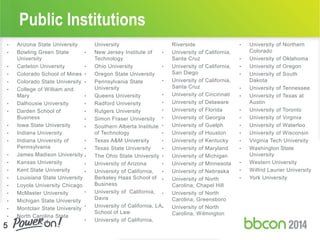
• Arizona State University
• Bowling Green State
University
• Carleton University
• Colorado School of Mines
• Colorado State University
• College of William and
Mary
• Dalhousie University
• Darden School of
Business
• Iowa State University
• Indiana University
• Indiana University of
Pennsylvania
• James Madison University
• Kansas University
• Kent State University
• Louisiana State University
• Loyola University Chicago
• McMaster University
• Michigan State University
• Montclair State University
• North Carolina State
University
• New Jersey Institute of
Technology
• Ohio University
• Oregon State University
• Pennsylvania State
University
• Queens University
• Radford University
• Rutgers University
• Simon Fraser University
• Southern Alberta Institute
of Technology
• Texas A&M University
• Texas State University
• The Ohio State University
• University of Arizona
• University of California,
Berkeley Haas School of
Business
• University of California,
Davis
• University of California, LA
School of Law
• University of California,
Riverside
• University of California,
Santa Cruz
• University of California,
San Diego
• University of California,
Santa Cruz
• University of Cincinnati
• University of Delaware
• University of Florida
• University of Georgia
• University of Guelph
• University of Houston
• University of Kentucky
• University of Maryland
• University of Michigan
• University of Minnesota
• University of Nebraska
• University of North
Carolina, Chapel Hill
• University of North
Carolina, Greensboro
• University of North
Carolina, Wilmington
• University of Northern
Colorado
• University of Oklahoma
• University of Oregon
• University of South
Dakota
• University of Tennessee
• University of Texas at
Austin
• University of Toronto
• University of Virginia
• University of Waterloo
• University of Wisconsin
• Virginia Tech University
• Washington State
University
• Western University
• Wilfrid Laurier University
• York University
Public Institutions
5
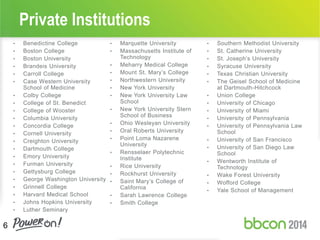
• Benedictine College
• Boston College
• Boston University
• Brandeis University
• Carroll College
• Case Western University
School of Medicine
• Colby College
• College of St. Benedict
• College of Wooster
• Columbia University
• Concordia College
• Cornell University
• Creighton University
• Dartmouth College
• Emory University
• Furman University
• Gettysburg College
• George Washington University
• Grinnell College
• Harvard Medical School
• Johns Hopkins University
• Luther Seminary
• Marquette University
• Massachusetts Institute of
Technology
• Meharry Medical College
• Mount St. Mary’s College
• Northwestern University
• New York University
• New York University Law
School
• New York University Stern
School of Business
• Ohio Wesleyan University
• Oral Roberts University
• Point Loma Nazarene
University
• Rensselaer Polytechnic
Institute
• Rice University
• Rockhurst University
• Saint Mary’s College of
California
• Sarah Lawrence College
• Smith College
• Southern Methodist University
• St. Catherine University
• St. Joseph’s University
• Syracuse University
• Texas Christian University
• The Geisel School of Medicine
at Dartmouth-Hitchcock
• Union College
• University of Chicago
• University of Miami
• University of Pennsylvania
• University of Pennsylvania Law
School
• University of San Francisco
• University of San Diego Law
School
• Wentworth Institute of
Technology
• Wake Forest University
• Wofford College
• Yale School of Management
Private Institutions
6
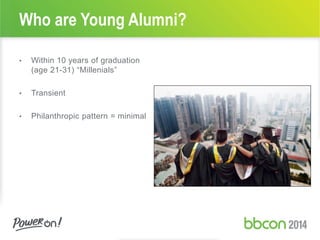
• Within 10 years of graduation
(age 21-31) “Millenials”
• Transient
• Philanthropic pattern = minimal
Who are Young Alumni?
Education, Engagement and
tracking your data
8 #bbcon
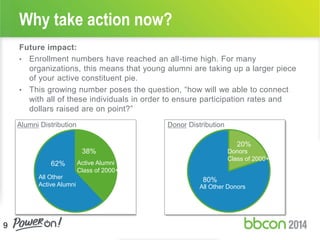
Future impact:
• Enrollment numbers have reached an all-time high. For many
organizations, this means that young alumni are taking up a larger piece
of your active constituent pie.
• This growing number poses the question, “how will we able to connect
with all of these individuals in order to ensure participation rates and
dollars raised are on point?”
Why take action now?
9
38%
62% Active Alumni
Class of 2000+
All Other
Active Alumni
Alumni Distribution
80%
20%
Donor Distribution
Donors
Class of 2000+
All Other Donors
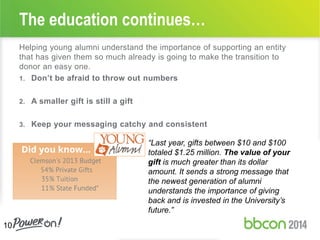
Helping young alumni understand the importance of supporting an entity
that has given them so much already is going to make the transition to
donor an easy one.
1. Don’t be afraid to throw out numbers
2. A smaller gift is still a gift
3. Keep your messaging catchy and consistent
The education continues…
10
“Last year, gifts between $10 and $100
totaled $1.25 million. The value of your
gift is much greater than its dollar
amount. It sends a strong message that
the newest generation of alumni
understands the importance of giving
back and is invested in the University’s
future.”
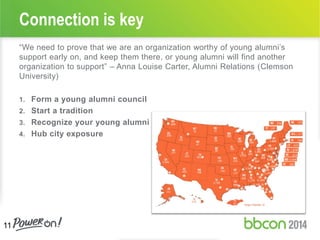
“We need to prove that we are an organization worthy of young alumni’s
support early on, and keep them there, or young alumni will find another
organization to support” – Anna Louise Carter, Alumni Relations (Clemson
University)
1. Form a young alumni council
2. Start a tradition
3. Recognize your young alumni
4. Hub city exposure
Connection is key
11
Gathering :
• email addresses
• employment information
• social influencers
• wealth indicators
Tracking:
• legacy
• student involvement
• post-graduate involvement
Use data analytics in house or from a vendor to build engagement models.
Having good data will only help your efforts!
What should you be thinking about?
12
Young Alumni Giving Trends
13 #bbcon
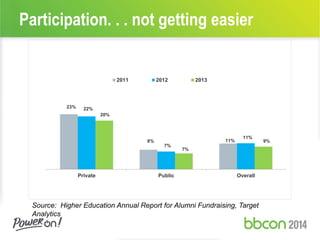
Participation. . . not getting easier
Source: Higher Education Annual Report for Alumni Fundraising, Target
Analytics
23%
8% 11%
22%
7%
11%
20%
7%
9%
Private Public Overall
2011 2012 2013
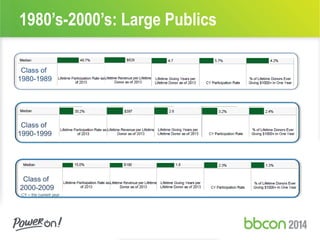
1980’s-2000’s: Large Publics
Class of
1980-1989
Class of
1990-1999
Class of
2000-2009
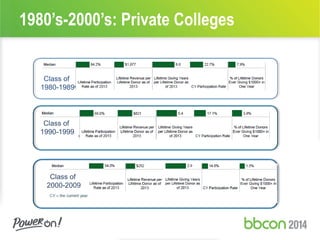
1980’s-2000’s: Private Colleges
Class of
2000-2009
Class of
1990-1999
Class of
1980-1989
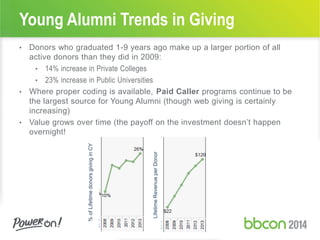
Young Alumni Trends in Giving
• Donors who graduated 1-9 years ago make up a larger portion of all
active donors than they did in 2009:
• 14% increase in Private Colleges
• 23% increase in Public Universities
• Where proper coding is available, Paid Caller programs continue to be
the largest source for Young Alumni (though web giving is certainly
increasing)
• Value grows over time (the payoff on the investment doesn’t happen
overnight!
%ofLifetimedonorsgivinginCY
LifetimeRevenueperDonor
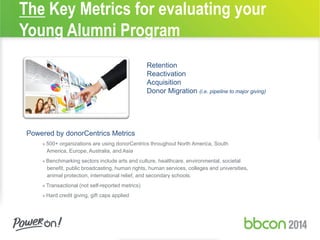
The Key Metrics for evaluating your
Young Alumni Program
Retention
Reactivation
Acquisition
Donor Migration (i.e. pipeline to major giving)
Powered by donorCentrics Metrics
» 500+ organizations are using donorCentrics throughout North America, South
America, Europe, Australia, and Asia
» Benchmarking sectors include arts and culture, healthcare, environmental, societal
benefit, public broadcasting, human rights, human services, colleges and universities,
animal protection, international relief, and secondary schools.
» Transactional (not self-reported metrics)
» Hard credit giving, gift caps applied
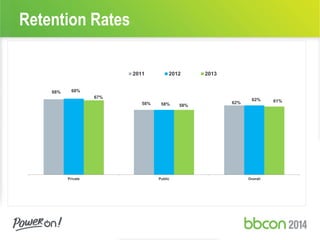
Retention Rates
68%
58% 62%
68%
58%
62%
67%
58%
61%
Private Public Overall
2011 2012 2013
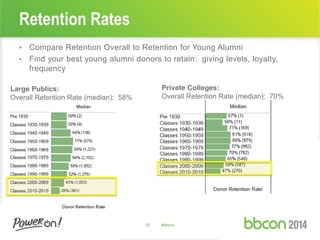
Retention Rates
• Compare Retention Overall to Retention for Young Alumni
• Find your best young alumni donors to retain: giving levels, loyalty,
frequency
20 #bbcon
Large Publics:
Overall Retention Rate (median): 58%
Private Colleges:
Overall Retention Rate (median): 70%
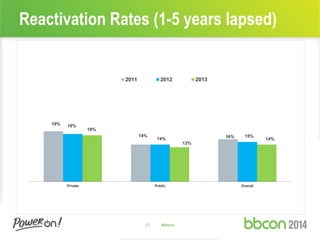
Reactivation Rates (1-5 years lapsed)
21 #bbcon
19%
14% 16%
18%
14%
15%
18%
13%
14%
Private Public Overall
2011 2012 2013
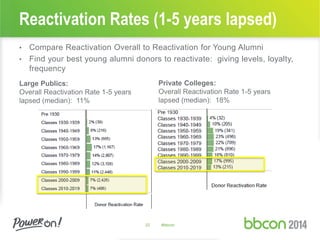
Reactivation Rates (1-5 years lapsed)
• Compare Reactivation Overall to Reactivation for Young Alumni
• Find your best young alumni donors to reactivate: giving levels, loyalty,
frequency
22 #bbcon
Large Publics:
Overall Reactivation Rate 1-5 years
lapsed (median): 11%
Private Colleges:
Overall Reactivation Rate 1-5 years
lapsed (median): 18%
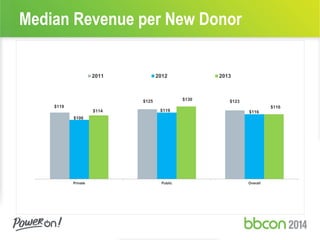
Median Revenue per New Donor
$119
$125 $123
$106
$119 $116$114
$130
$116
Private Public Overall
2011 2012 2013
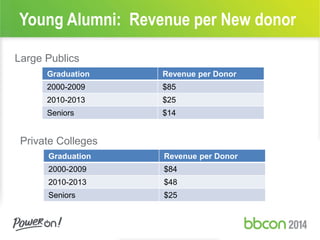
Young Alumni: Revenue per New donor
Graduation Revenue per Donor
2000-2009 $85
2010-2013 $25
Seniors $14
Large Publics
Private Colleges
Graduation Revenue per Donor
2000-2009 $84
2010-2013 $48
Seniors $25
Trendsetters
25 #bbcon
Case Study: University of Chicago
• 5 years ago implemented program:
• Specific branding and short bursts of activity for young alumni
• Found cell phone numbers
• Executed more digital solicitations overall for young alums and utilized more
challenges.
• Young alumni branding was more casual, graphic, and goal oriented.
• Added in a strong student philanthropy program
• Expanding the program: so successful with Young Alumni that the
definition is changing.
• Found that when alumni moved from 10 years out to 11, there were precipitous
drop-offs of participation—more than would have been expected from post-reunion
drop off.
• Attributed this to changing them from a mostly digital program to a mostly mail
program that was now addressing them as “Mr/Mrs” etc.
• Expanded the young alumni to 20 years out and have now seen significantly
renewed giving amongst those in the 11-20 year out range.
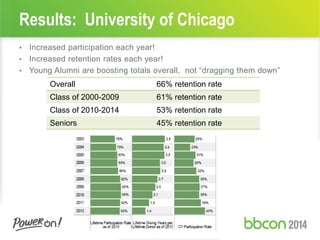
Results: University of Chicago
• Increased participation each year!
• Increased retention rates each year!
• Young Alumni are boosting totals overall, not “dragging them down”
Overall 66% retention rate
Class of 2000-2009 61% retention rate
Class of 2010-2014 53% retention rate
Seniors 45% retention rate
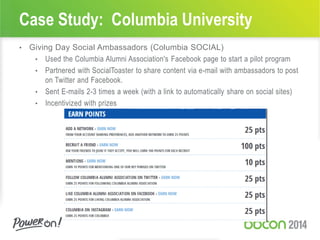
Case Study: Columbia University
• Giving Day Social Ambassadors (Columbia SOCIAL)
• Used the Columbia Alumni Association's Facebook page to start a pilot program
• Partnered with SocialToaster to share content via e-mail with ambassadors to post
on Twitter and Facebook.
• Sent E-mails 2-3 times a week (with a link to automatically share on social sites)
• Incentivized with prizes
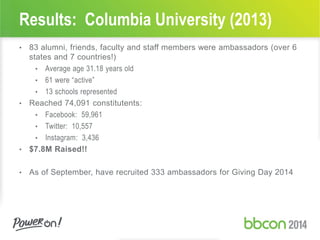
Results: Columbia University (2013)
• 83 alumni, friends, faculty and staff members were ambassadors (over 6
states and 7 countries!)
• Average age 31.18 years old
• 61 were “active”
• 13 schools represented
• Reached 74,091 constitutents:
• Facebook: 59,961
• Twitter: 10,557
• Instagram: 3,436
• $7.8M Raised!!
• As of September, have recruited 333 ambassadors for Giving Day 2014
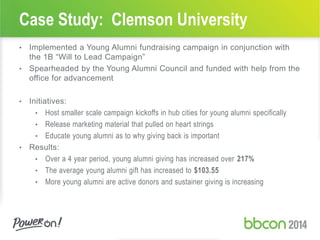
Case Study: Clemson University
• Implemented a Young Alumni fundraising campaign in conjunction with
the 1B “Will to Lead Campaign”
• Spearheaded by the Young Alumni Council and funded with help from the
office for advancement
• Initiatives:
• Host smaller scale campaign kickoffs in hub cities for young alumni specifically
• Release marketing material that pulled on heart strings
• Educate young alumni as to why giving back is important
• Results:
• Over a 4 year period, young alumni giving has increased over 217%
• The average young alumni gift has increased to $103.55
• More young alumni are active donors and sustainer giving is increasing
What is your reason to give back?
“The future of alumni engagement is fueled by young alumni, so I want to
help my alma mater stay cutting edge in its engagement efforts by relaying
the thoughts of a young alumni” – Harrison Trammel, Lawyer (Clemson,
UNC)
“I want to acknowledge the great experience I had during undergrad. The 4,
make that 5, years at UGA determined the steps I took in the next stage of
life. If every alum can make some type of gift or volunteer for their alma
matter it will drastically improve the experience for future students” – David
Seifert, Director of Sales (UGA, Citadel)
“I want to remain connected. For me, it's important to know that I am still a
part of Duke's current operations, even if it's just in a small way. Duke sends
me magazines, emails, and keeps me in the loop - it is my way of holding up
my end of the "keeping in touch" relationship” – Caroline Mix Stapleton,
Lawyer (Duke)
32 #bbcon
Don’t forget to complete
a session survey!
Each completed survey enters you into a drawing to win a
complimentary registration to bbcon 2015 in Austin, Texas*.
*Blackbaud reserves the right to change or withdraw this promotion at any time, without advance notice. Promotion has no cash value and may not be
exchanged, applied to, or combined with any other offer.
Did this session leave you feeling electrified?

Understanding Young Alumni

  • 1.
    Young Alumni: Understanding YourNext Generation of Donors PRESENTED BY MARY KATHRYN DEMPSEY AND JENNY COOKE SMITH
  • 2.
    Young Alums: Slacktivistsor Future donors? You decide! #bbcon 2 #bbcon Tweet this now
  • 3.
    Session Topics 1. Whoare young alumni? 2. Why is it so important to engage this audience? 3. What should you be doing in front and behind the scenes? 4. Trends in young alumni giving 5. Metrics you need to evaluate 6. Trendsetters in the space
  • 4.
    • Statistics arepowered by donorCentrics service • Target Analytics FY2013 Report on Alumni Annual Giving • Private College Consortium Benchmarking Group (Undergraduate Alumni) • Large Summit Benchmarking Group (Undergraduate Alumni) • Sustainer Benchmarking • All metrics are based on transactional “hard credit” giving data Background on Data 4
  • 5.
    • Arizona StateUniversity • Bowling Green State University • Carleton University • Colorado School of Mines • Colorado State University • College of William and Mary • Dalhousie University • Darden School of Business • Iowa State University • Indiana University • Indiana University of Pennsylvania • James Madison University • Kansas University • Kent State University • Louisiana State University • Loyola University Chicago • McMaster University • Michigan State University • Montclair State University • North Carolina State University • New Jersey Institute of Technology • Ohio University • Oregon State University • Pennsylvania State University • Queens University • Radford University • Rutgers University • Simon Fraser University • Southern Alberta Institute of Technology • Texas A&M University • Texas State University • The Ohio State University • University of Arizona • University of California, Berkeley Haas School of Business • University of California, Davis • University of California, LA School of Law • University of California, Riverside • University of California, Santa Cruz • University of California, San Diego • University of California, Santa Cruz • University of Cincinnati • University of Delaware • University of Florida • University of Georgia • University of Guelph • University of Houston • University of Kentucky • University of Maryland • University of Michigan • University of Minnesota • University of Nebraska • University of North Carolina, Chapel Hill • University of North Carolina, Greensboro • University of North Carolina, Wilmington • University of Northern Colorado • University of Oklahoma • University of Oregon • University of South Dakota • University of Tennessee • University of Texas at Austin • University of Toronto • University of Virginia • University of Waterloo • University of Wisconsin • Virginia Tech University • Washington State University • Western University • Wilfrid Laurier University • York University Public Institutions 5
  • 6.
    • Benedictine College •Boston College • Boston University • Brandeis University • Carroll College • Case Western University School of Medicine • Colby College • College of St. Benedict • College of Wooster • Columbia University • Concordia College • Cornell University • Creighton University • Dartmouth College • Emory University • Furman University • Gettysburg College • George Washington University • Grinnell College • Harvard Medical School • Johns Hopkins University • Luther Seminary • Marquette University • Massachusetts Institute of Technology • Meharry Medical College • Mount St. Mary’s College • Northwestern University • New York University • New York University Law School • New York University Stern School of Business • Ohio Wesleyan University • Oral Roberts University • Point Loma Nazarene University • Rensselaer Polytechnic Institute • Rice University • Rockhurst University • Saint Mary’s College of California • Sarah Lawrence College • Smith College • Southern Methodist University • St. Catherine University • St. Joseph’s University • Syracuse University • Texas Christian University • The Geisel School of Medicine at Dartmouth-Hitchcock • Union College • University of Chicago • University of Miami • University of Pennsylvania • University of Pennsylvania Law School • University of San Francisco • University of San Diego Law School • Wentworth Institute of Technology • Wake Forest University • Wofford College • Yale School of Management Private Institutions 6
  • 7.
    • Within 10years of graduation (age 21-31) “Millenials” • Transient • Philanthropic pattern = minimal Who are Young Alumni?
  • 8.
  • 9.
    Future impact: • Enrollmentnumbers have reached an all-time high. For many organizations, this means that young alumni are taking up a larger piece of your active constituent pie. • This growing number poses the question, “how will we able to connect with all of these individuals in order to ensure participation rates and dollars raised are on point?” Why take action now? 9 38% 62% Active Alumni Class of 2000+ All Other Active Alumni Alumni Distribution 80% 20% Donor Distribution Donors Class of 2000+ All Other Donors
  • 10.
    Helping young alumniunderstand the importance of supporting an entity that has given them so much already is going to make the transition to donor an easy one. 1. Don’t be afraid to throw out numbers 2. A smaller gift is still a gift 3. Keep your messaging catchy and consistent The education continues… 10 “Last year, gifts between $10 and $100 totaled $1.25 million. The value of your gift is much greater than its dollar amount. It sends a strong message that the newest generation of alumni understands the importance of giving back and is invested in the University’s future.”
  • 11.
    “We need toprove that we are an organization worthy of young alumni’s support early on, and keep them there, or young alumni will find another organization to support” – Anna Louise Carter, Alumni Relations (Clemson University) 1. Form a young alumni council 2. Start a tradition 3. Recognize your young alumni 4. Hub city exposure Connection is key 11
  • 12.
    Gathering : • emailaddresses • employment information • social influencers • wealth indicators Tracking: • legacy • student involvement • post-graduate involvement Use data analytics in house or from a vendor to build engagement models. Having good data will only help your efforts! What should you be thinking about? 12
  • 13.
    Young Alumni GivingTrends 13 #bbcon
  • 14.
    Participation. . .not getting easier Source: Higher Education Annual Report for Alumni Fundraising, Target Analytics 23% 8% 11% 22% 7% 11% 20% 7% 9% Private Public Overall 2011 2012 2013
  • 15.
    1980’s-2000’s: Large Publics Classof 1980-1989 Class of 1990-1999 Class of 2000-2009
  • 16.
    1980’s-2000’s: Private Colleges Classof 2000-2009 Class of 1990-1999 Class of 1980-1989
  • 17.
    Young Alumni Trendsin Giving • Donors who graduated 1-9 years ago make up a larger portion of all active donors than they did in 2009: • 14% increase in Private Colleges • 23% increase in Public Universities • Where proper coding is available, Paid Caller programs continue to be the largest source for Young Alumni (though web giving is certainly increasing) • Value grows over time (the payoff on the investment doesn’t happen overnight! %ofLifetimedonorsgivinginCY LifetimeRevenueperDonor
  • 18.
    The Key Metricsfor evaluating your Young Alumni Program Retention Reactivation Acquisition Donor Migration (i.e. pipeline to major giving) Powered by donorCentrics Metrics » 500+ organizations are using donorCentrics throughout North America, South America, Europe, Australia, and Asia » Benchmarking sectors include arts and culture, healthcare, environmental, societal benefit, public broadcasting, human rights, human services, colleges and universities, animal protection, international relief, and secondary schools. » Transactional (not self-reported metrics) » Hard credit giving, gift caps applied
  • 19.
  • 20.
    Retention Rates • CompareRetention Overall to Retention for Young Alumni • Find your best young alumni donors to retain: giving levels, loyalty, frequency 20 #bbcon Large Publics: Overall Retention Rate (median): 58% Private Colleges: Overall Retention Rate (median): 70%
  • 21.
    Reactivation Rates (1-5years lapsed) 21 #bbcon 19% 14% 16% 18% 14% 15% 18% 13% 14% Private Public Overall 2011 2012 2013
  • 22.
    Reactivation Rates (1-5years lapsed) • Compare Reactivation Overall to Reactivation for Young Alumni • Find your best young alumni donors to reactivate: giving levels, loyalty, frequency 22 #bbcon Large Publics: Overall Reactivation Rate 1-5 years lapsed (median): 11% Private Colleges: Overall Reactivation Rate 1-5 years lapsed (median): 18%
  • 23.
    Median Revenue perNew Donor $119 $125 $123 $106 $119 $116$114 $130 $116 Private Public Overall 2011 2012 2013
  • 24.
    Young Alumni: Revenueper New donor Graduation Revenue per Donor 2000-2009 $85 2010-2013 $25 Seniors $14 Large Publics Private Colleges Graduation Revenue per Donor 2000-2009 $84 2010-2013 $48 Seniors $25
  • 25.
  • 26.
    Case Study: Universityof Chicago • 5 years ago implemented program: • Specific branding and short bursts of activity for young alumni • Found cell phone numbers • Executed more digital solicitations overall for young alums and utilized more challenges. • Young alumni branding was more casual, graphic, and goal oriented. • Added in a strong student philanthropy program • Expanding the program: so successful with Young Alumni that the definition is changing. • Found that when alumni moved from 10 years out to 11, there were precipitous drop-offs of participation—more than would have been expected from post-reunion drop off. • Attributed this to changing them from a mostly digital program to a mostly mail program that was now addressing them as “Mr/Mrs” etc. • Expanded the young alumni to 20 years out and have now seen significantly renewed giving amongst those in the 11-20 year out range.
  • 27.
    Results: University ofChicago • Increased participation each year! • Increased retention rates each year! • Young Alumni are boosting totals overall, not “dragging them down” Overall 66% retention rate Class of 2000-2009 61% retention rate Class of 2010-2014 53% retention rate Seniors 45% retention rate
  • 28.
    Case Study: ColumbiaUniversity • Giving Day Social Ambassadors (Columbia SOCIAL) • Used the Columbia Alumni Association's Facebook page to start a pilot program • Partnered with SocialToaster to share content via e-mail with ambassadors to post on Twitter and Facebook. • Sent E-mails 2-3 times a week (with a link to automatically share on social sites) • Incentivized with prizes
  • 29.
    Results: Columbia University(2013) • 83 alumni, friends, faculty and staff members were ambassadors (over 6 states and 7 countries!) • Average age 31.18 years old • 61 were “active” • 13 schools represented • Reached 74,091 constitutents: • Facebook: 59,961 • Twitter: 10,557 • Instagram: 3,436 • $7.8M Raised!! • As of September, have recruited 333 ambassadors for Giving Day 2014
  • 30.
    Case Study: ClemsonUniversity • Implemented a Young Alumni fundraising campaign in conjunction with the 1B “Will to Lead Campaign” • Spearheaded by the Young Alumni Council and funded with help from the office for advancement • Initiatives: • Host smaller scale campaign kickoffs in hub cities for young alumni specifically • Release marketing material that pulled on heart strings • Educate young alumni as to why giving back is important • Results: • Over a 4 year period, young alumni giving has increased over 217% • The average young alumni gift has increased to $103.55 • More young alumni are active donors and sustainer giving is increasing
  • 31.
    What is yourreason to give back? “The future of alumni engagement is fueled by young alumni, so I want to help my alma mater stay cutting edge in its engagement efforts by relaying the thoughts of a young alumni” – Harrison Trammel, Lawyer (Clemson, UNC) “I want to acknowledge the great experience I had during undergrad. The 4, make that 5, years at UGA determined the steps I took in the next stage of life. If every alum can make some type of gift or volunteer for their alma matter it will drastically improve the experience for future students” – David Seifert, Director of Sales (UGA, Citadel) “I want to remain connected. For me, it's important to know that I am still a part of Duke's current operations, even if it's just in a small way. Duke sends me magazines, emails, and keeps me in the loop - it is my way of holding up my end of the "keeping in touch" relationship” – Caroline Mix Stapleton, Lawyer (Duke)
  • 32.
    32 #bbcon Don’t forgetto complete a session survey! Each completed survey enters you into a drawing to win a complimentary registration to bbcon 2015 in Austin, Texas*. *Blackbaud reserves the right to change or withdraw this promotion at any time, without advance notice. Promotion has no cash value and may not be exchanged, applied to, or combined with any other offer. Did this session leave you feeling electrified?