Cloud Services & the Development
of ISO/IEC 27018
Adding “privacy” to information security
Alan Shipman
a.shipman@group5.co.uk
Data Privacy, June 2015
Processing your personal data in the cloud
• If you have personal data to process you are probably a data controller and
subject to the ‘Data Privacy Law’ 2010. This presentation is about adding
governance for processing personal data (PII, personal information, etc.) to
baseline information security
• Data Privacy legislation does require adequate security (e.g. ISO/IEC 27001
for the management system process and for the controls covering
confidentiality, integrity and availability) but it also demands more
• There are two main scenarios to address:
• process your personal data yourself in a private cloud; or
• outsource that processing to a public cloud acting as a data processor
• This presentation places both scenarios into context but concentrates on
solving some issues raised by processing personal data in a public cloud
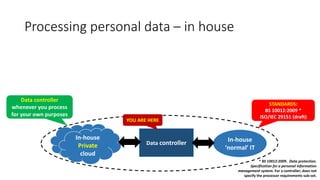
Processing personal data – in house
Data controller
In-house
Private
cloud
In-house
‘normal’ IT
STANDARDS:
BS 10012:2009 *
ISO/IEC 29151 (draft)
Data controller
whenever you process
for your own purposes
YOU ARE HERE
* BS 10012:2009. Data protection.
Specification for a personal information
management system. For a controller; does not
specify the processor requirements sub-set.
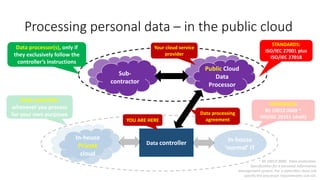
Processing personal data – in the public cloud
Data controller
In-house
Private
cloud
Sub-
contractor
Public Cloud
Data
Processor
In-house
‘normal’ IT
STANDARDS:
BS 10012:2009 *
ISO/IEC 29151 (draft)
STANDARDS:
ISO/IEC 27001 plus
ISO/IEC 27018
Data processor(s), only if
they exclusively follow the
controller’s instructions
Data controller
whenever you process
for your own purposes Data processing
agreementYOU ARE HERE
Your cloud service
provider
* BS 10012:2009. Data protection.
Specification for a personal information
management system. For a controller; does not
specify the processor requirements sub-set.
Processing personal data in the cloud: how
does this work?
• Data protection obligations remain with a data controller even if
processing is outsourced to a cloud data processor.
• If you want to have your personal data processed by a cloud service
provider, acting solely according to your instructions, then you have to:
• choose a data processor providing sufficient guarantees in respect of the technical
and organisational security measures governing the processing to be carried out
• take reasonable steps to ensure compliance with those measures
• Standards cannot replace the requirements of law but for one good route
towards obtaining the required guarantees, a data controller could:
• select a cloud service provider which complies with ISO/IEC 27001 for security and
also implements all of the data protection controls in ISO/IEC 27018 as part of that
compliance; and
• get a regularly audited commitment to the above from the cloud service provider
(and make that a part of the data processing agreement).
How does ISO/IEC 27018 help a data controller
to process personal data in the cloud?
• Select a well-governed cloud data processor: A well-governed cloud data
processor should have independently audited and certified compliance to
ISO/IEC 27001 as extended with all of the controls from ISO/IEC 27018.
• What your cloud data processor should tell you: The implementation
guidance and some of the controls from ISO/IEC 27018 provide information
on what your cloud data processor needs to tell you as a cloud service
customer before you enter into a data processing agreement.
• What you should agree with your cloud data processor: The
implementation guidance and some of the controls from ISO/IEC 27018
provide information on what you and your cloud data processor need to
agree on about matters such as the distribution of responsibilities.
What’s in ISO/IEC 27018 (selected)?
• Title: Information technology — Security techniques — Code of
practice for protection of personally identifiable information (PII) in
public clouds acting as PII processors
• Controls: Cloud data processor (CDP) shows that it is a data processor (not a
controller) by processing data only to implement customer instructions
• Controls: CDP knows where data is stored and is sure where it is sending it
• Controls: CDP ensures its sub-contractors also implement relevant security
and data protection measures, and discloses changes in sub-contracting
• Controls: CDP implements the means to cooperate with its customer to allow
the customer to meet obligations to data subjects
• Guidance: issues a CDP should disclose to a prospective customer before
entering into the contract to process personal data
• Guidance: issues where CDP and the customer should agree on the split of
responsibilities
How is ISO/IEC 27018 constructed & used?
France
Germany
Spain
UK
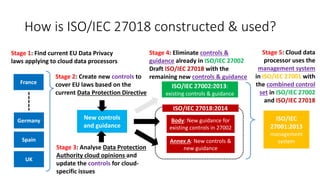
Stage 1: Find current EU Data Privacy
laws applying to cloud data processors
ISO/IEC 27002:2013:
existing controls & guidance
Annex A: New controls &
new guidance
Body: New guidance for
existing controls in 27002
Stage 2: Create new controls to
cover EU laws based on the
current Data Protection Directive
Stage 4: Eliminate controls &
guidance already in ISO/IEC 27002
Draft ISO/IEC 27018 with the
remaining new controls & guidance
New controls
and guidance
Stage 3: Analyse Data Protection
Authority cloud opinions and
update the controls for cloud-
specific issues
ISO/IEC 27018:2014
ISO/IEC
27001:2013
management
system
Stage 5: Cloud data
processor uses the
management system
in ISO/IEC 27001 with
the combined control
set in ISO/IEC 27002
and ISO/IEC 27018
In summary
• Voluntary standards cannot replace the requirements of law. ISO/IEC
27018 is not a destination. It’s a first step in a journey towards good
governance of personal data processing in the cloud. However …
• For the public cloud data processor:
• ISO/IEC 27018 shows how to add “privacy” to an existing ISO/IEC 27001
certification so that customers who have personal data to process can more
confidently use the service.
• For the cloud service customer with personal data to process:
• Certified ISO/IEC 27001 compliance by a public cloud data processor with
ISO/IEC 27002 controls extended with all of the controls in ISO/IEC 27018
provides a good baseline for doing the essential due diligence; and
• ISO/IEC 27018 also addresses matters a public cloud data processor should be
disclosing to its customers and matters that may need to be addressed in a
data processing agreement.

Cloud Services & the Development of ISO/IEC 27018

  • 1.
    Cloud Services &the Development of ISO/IEC 27018 Adding “privacy” to information security Alan Shipman a.shipman@group5.co.uk Data Privacy, June 2015
  • 2.
    Processing your personaldata in the cloud • If you have personal data to process you are probably a data controller and subject to the ‘Data Privacy Law’ 2010. This presentation is about adding governance for processing personal data (PII, personal information, etc.) to baseline information security • Data Privacy legislation does require adequate security (e.g. ISO/IEC 27001 for the management system process and for the controls covering confidentiality, integrity and availability) but it also demands more • There are two main scenarios to address: • process your personal data yourself in a private cloud; or • outsource that processing to a public cloud acting as a data processor • This presentation places both scenarios into context but concentrates on solving some issues raised by processing personal data in a public cloud
  • 3.
    Processing personal data– in house Data controller In-house Private cloud In-house ‘normal’ IT STANDARDS: BS 10012:2009 * ISO/IEC 29151 (draft) Data controller whenever you process for your own purposes YOU ARE HERE * BS 10012:2009. Data protection. Specification for a personal information management system. For a controller; does not specify the processor requirements sub-set.
  • 4.
    Processing personal data– in the public cloud Data controller In-house Private cloud Sub- contractor Public Cloud Data Processor In-house ‘normal’ IT STANDARDS: BS 10012:2009 * ISO/IEC 29151 (draft) STANDARDS: ISO/IEC 27001 plus ISO/IEC 27018 Data processor(s), only if they exclusively follow the controller’s instructions Data controller whenever you process for your own purposes Data processing agreementYOU ARE HERE Your cloud service provider * BS 10012:2009. Data protection. Specification for a personal information management system. For a controller; does not specify the processor requirements sub-set.
  • 5.
    Processing personal datain the cloud: how does this work? • Data protection obligations remain with a data controller even if processing is outsourced to a cloud data processor. • If you want to have your personal data processed by a cloud service provider, acting solely according to your instructions, then you have to: • choose a data processor providing sufficient guarantees in respect of the technical and organisational security measures governing the processing to be carried out • take reasonable steps to ensure compliance with those measures • Standards cannot replace the requirements of law but for one good route towards obtaining the required guarantees, a data controller could: • select a cloud service provider which complies with ISO/IEC 27001 for security and also implements all of the data protection controls in ISO/IEC 27018 as part of that compliance; and • get a regularly audited commitment to the above from the cloud service provider (and make that a part of the data processing agreement).
  • 6.
    How does ISO/IEC27018 help a data controller to process personal data in the cloud? • Select a well-governed cloud data processor: A well-governed cloud data processor should have independently audited and certified compliance to ISO/IEC 27001 as extended with all of the controls from ISO/IEC 27018. • What your cloud data processor should tell you: The implementation guidance and some of the controls from ISO/IEC 27018 provide information on what your cloud data processor needs to tell you as a cloud service customer before you enter into a data processing agreement. • What you should agree with your cloud data processor: The implementation guidance and some of the controls from ISO/IEC 27018 provide information on what you and your cloud data processor need to agree on about matters such as the distribution of responsibilities.
  • 7.
    What’s in ISO/IEC27018 (selected)? • Title: Information technology — Security techniques — Code of practice for protection of personally identifiable information (PII) in public clouds acting as PII processors • Controls: Cloud data processor (CDP) shows that it is a data processor (not a controller) by processing data only to implement customer instructions • Controls: CDP knows where data is stored and is sure where it is sending it • Controls: CDP ensures its sub-contractors also implement relevant security and data protection measures, and discloses changes in sub-contracting • Controls: CDP implements the means to cooperate with its customer to allow the customer to meet obligations to data subjects • Guidance: issues a CDP should disclose to a prospective customer before entering into the contract to process personal data • Guidance: issues where CDP and the customer should agree on the split of responsibilities
  • 8.
    How is ISO/IEC27018 constructed & used? France Germany Spain UK Stage 1: Find current EU Data Privacy laws applying to cloud data processors ISO/IEC 27002:2013: existing controls & guidance Annex A: New controls & new guidance Body: New guidance for existing controls in 27002 Stage 2: Create new controls to cover EU laws based on the current Data Protection Directive Stage 4: Eliminate controls & guidance already in ISO/IEC 27002 Draft ISO/IEC 27018 with the remaining new controls & guidance New controls and guidance Stage 3: Analyse Data Protection Authority cloud opinions and update the controls for cloud- specific issues ISO/IEC 27018:2014 ISO/IEC 27001:2013 management system Stage 5: Cloud data processor uses the management system in ISO/IEC 27001 with the combined control set in ISO/IEC 27002 and ISO/IEC 27018
  • 9.
    In summary • Voluntarystandards cannot replace the requirements of law. ISO/IEC 27018 is not a destination. It’s a first step in a journey towards good governance of personal data processing in the cloud. However … • For the public cloud data processor: • ISO/IEC 27018 shows how to add “privacy” to an existing ISO/IEC 27001 certification so that customers who have personal data to process can more confidently use the service. • For the cloud service customer with personal data to process: • Certified ISO/IEC 27001 compliance by a public cloud data processor with ISO/IEC 27002 controls extended with all of the controls in ISO/IEC 27018 provides a good baseline for doing the essential due diligence; and • ISO/IEC 27018 also addresses matters a public cloud data processor should be disclosing to its customers and matters that may need to be addressed in a data processing agreement.