OSC
Office of Scholarly CommunicationOffice of Scholarly Communication
Engaging Students with Research
Data Management
Claire Sewell
Research Support Skills Coordinator
Office of Scholarly Communication, Cambridge University
The Modular Approach
ces43@cam.ac.uk@ces43
OSC
• What is RDM?
• Teaching RDM at Cambridge
• Example module(s)
• Activity: Create your own workshop
• Group feedback
• Strategies for engagement
Workshop outline
OSC
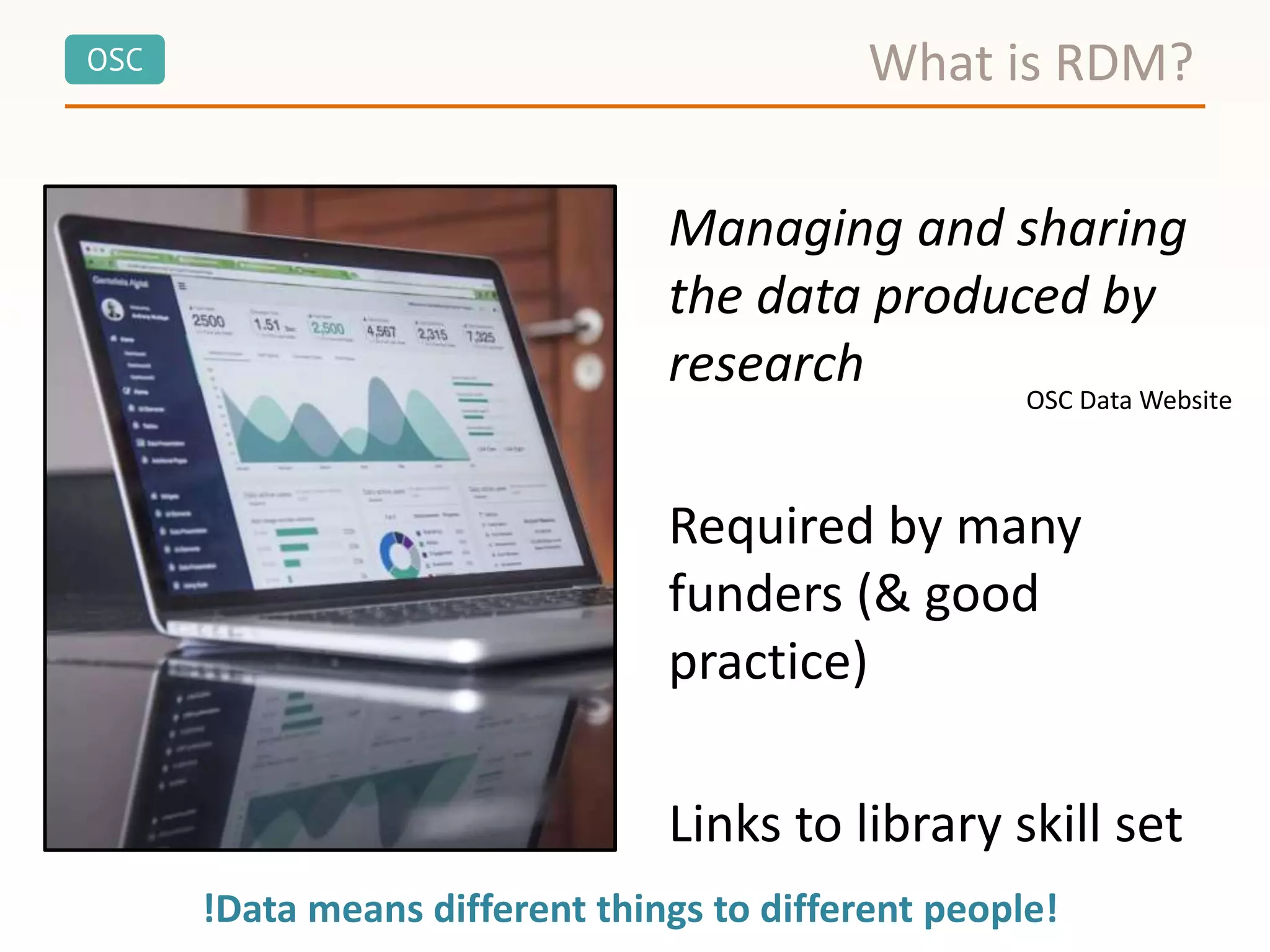
Managing and sharing
the data produced by
research
Required by many
funders (& good
practice)
Links to library skill set
What is RDM?
!Data means different things to different people!
OSC Data Website
OSC
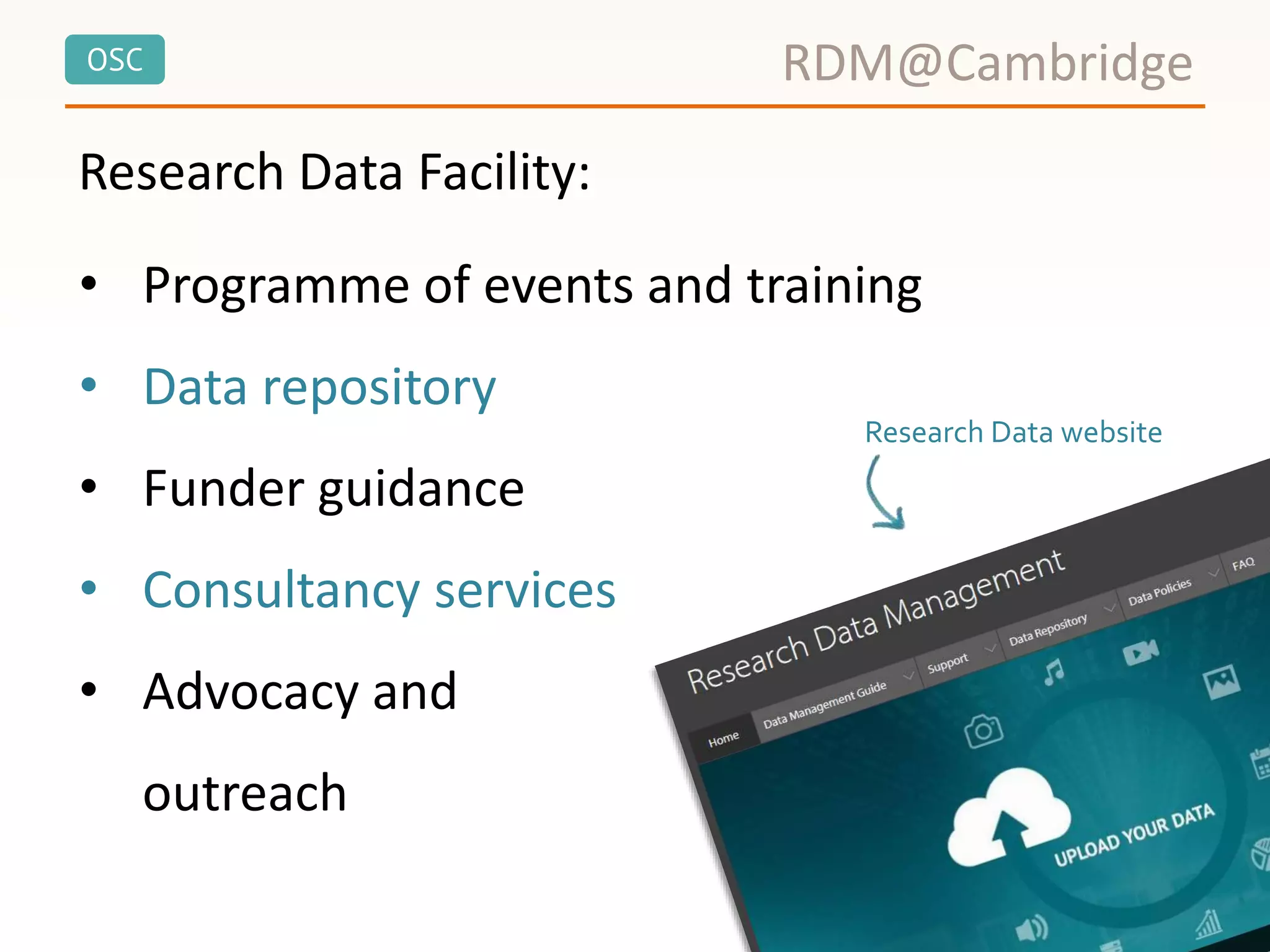
Research Data Facility:
RDM@Cambridge
• Programme of events and training
• Data repository
• Funder guidance
• Consultancy services
• Advocacy and
outreach
Research Data website
OSC Teaching RDM at Cambridge
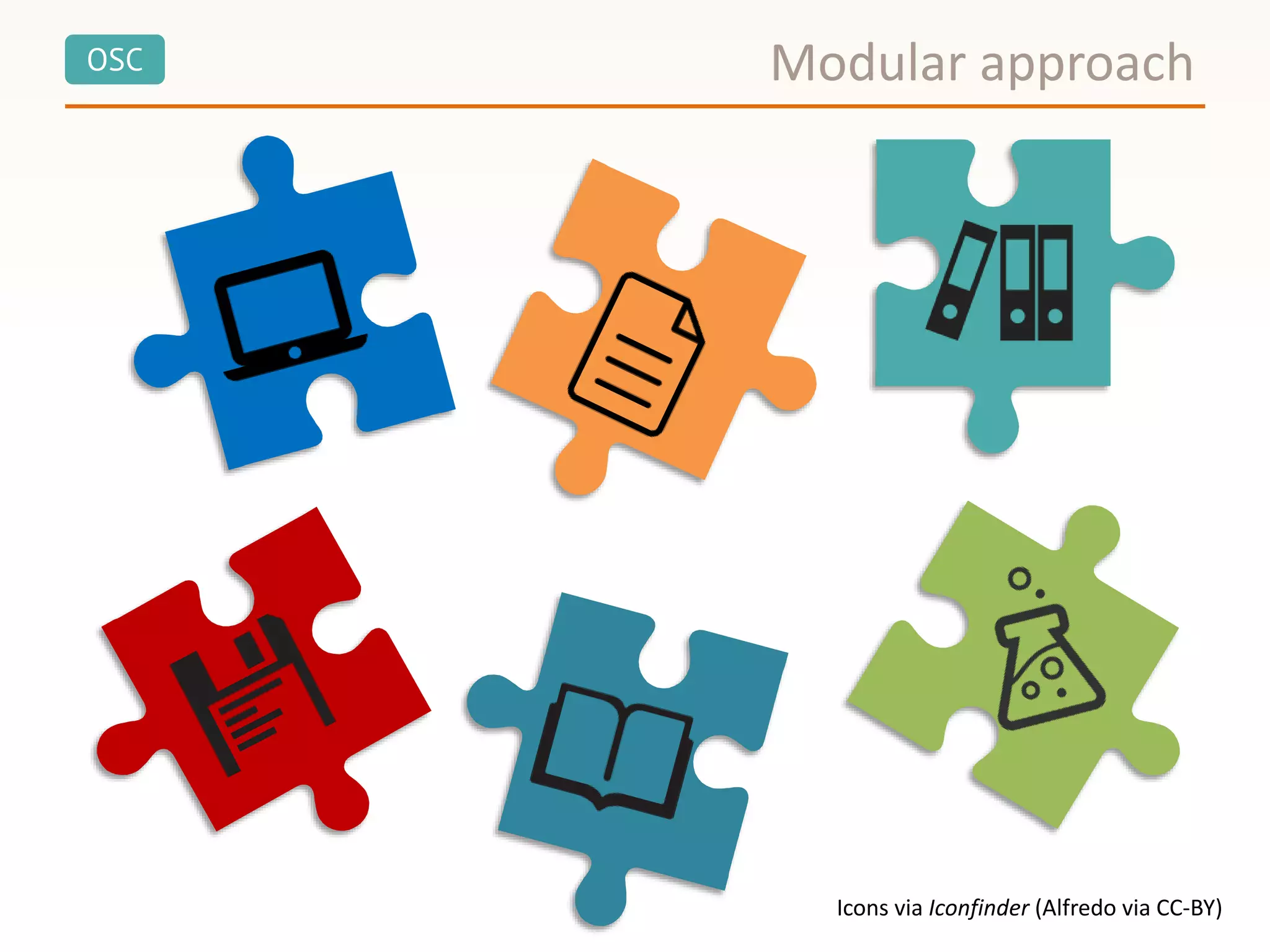
OSC Modular approach
Icons via Iconfinder (Alfredo via CC-BY)
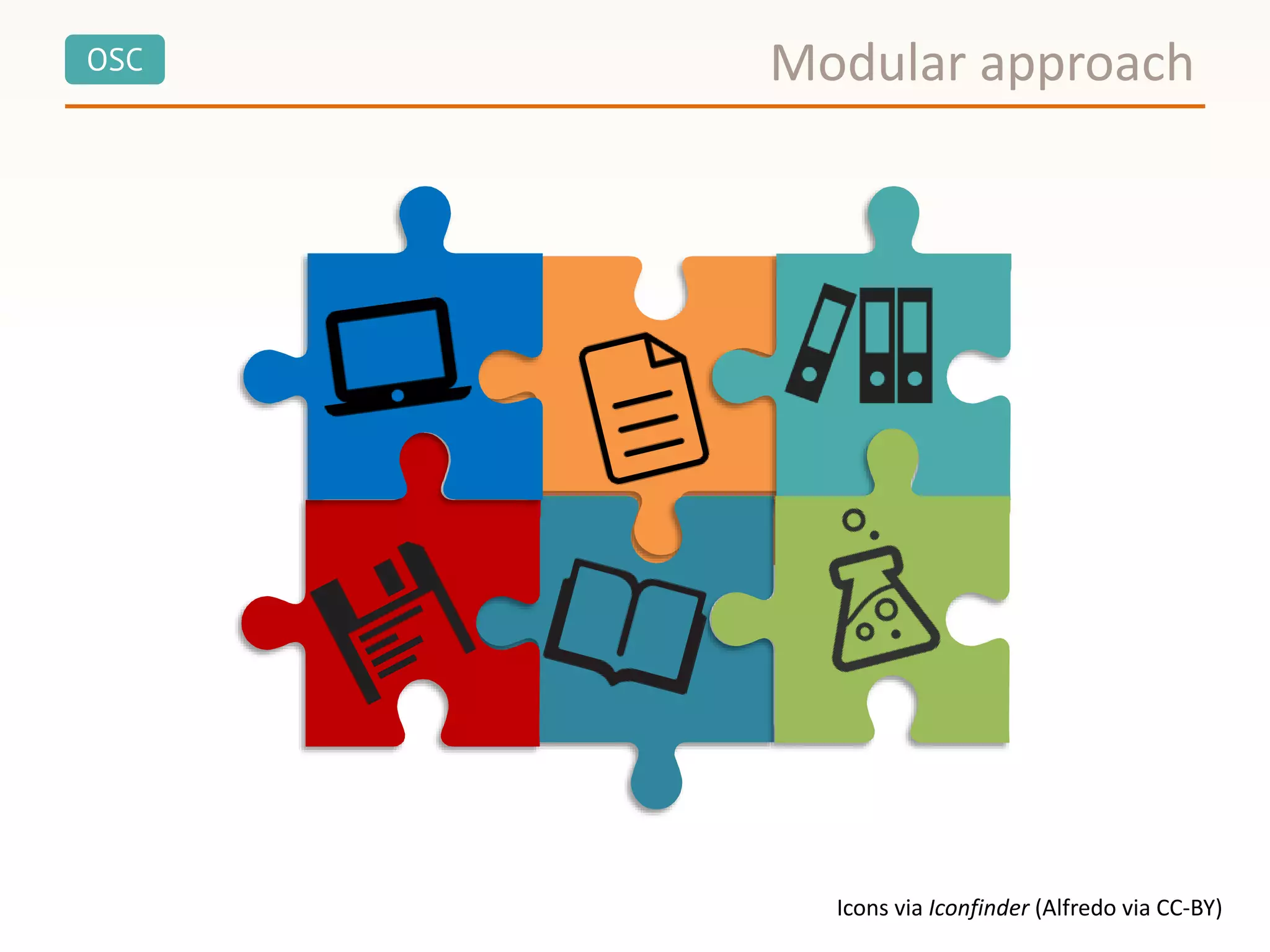
OSC Modular approach
Icons via Iconfinder (Alfredo via CC-BY)
OSC Example module
OSC
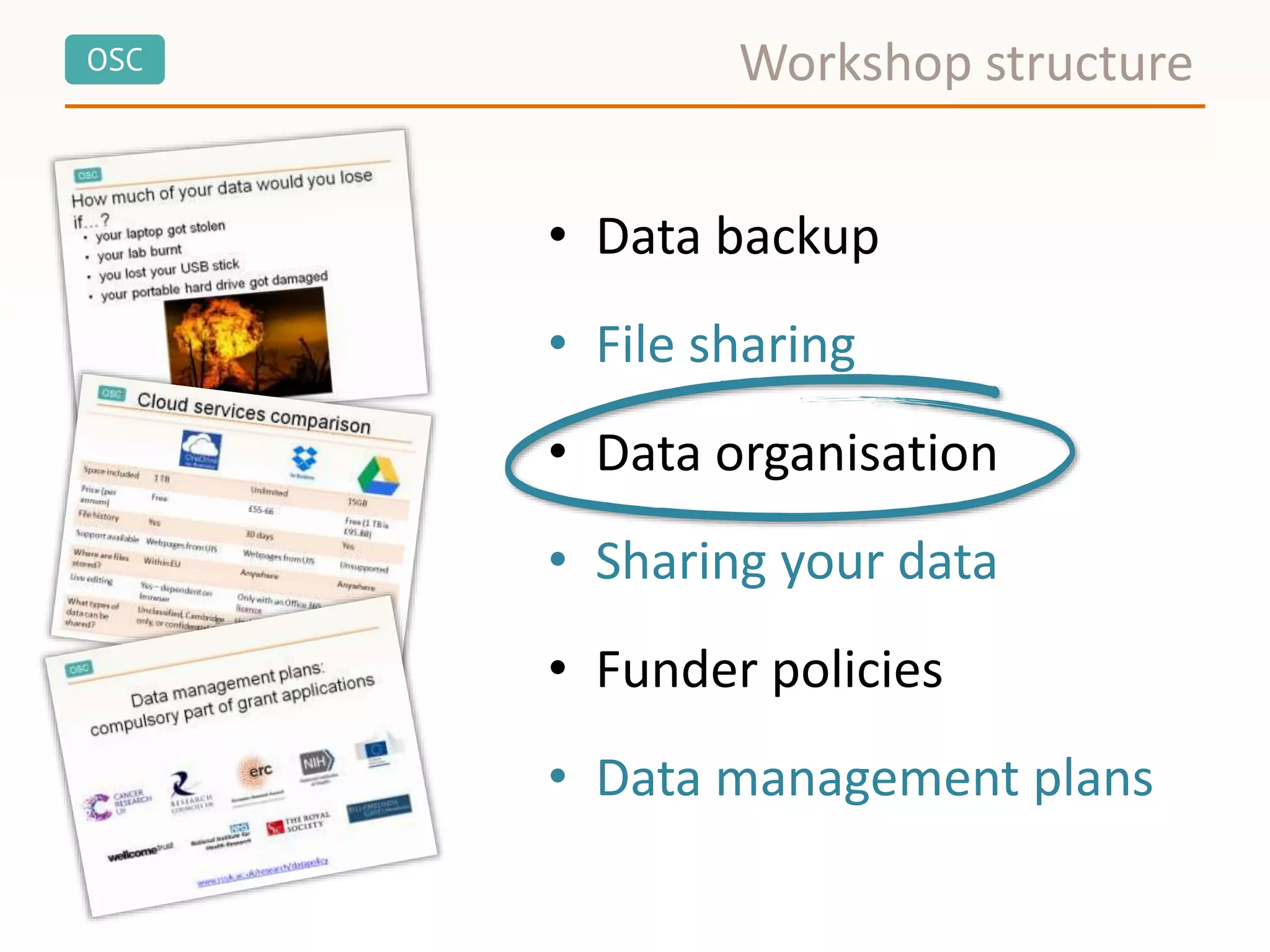
• Data backup
• File sharing
• Data organisation
• Sharing your data
• Funder policies
• Data management plans
Workshop structure
OSC Module example
Data Organisation
Science, Technology and
Engineering (STEM)
OSC
Organising your data
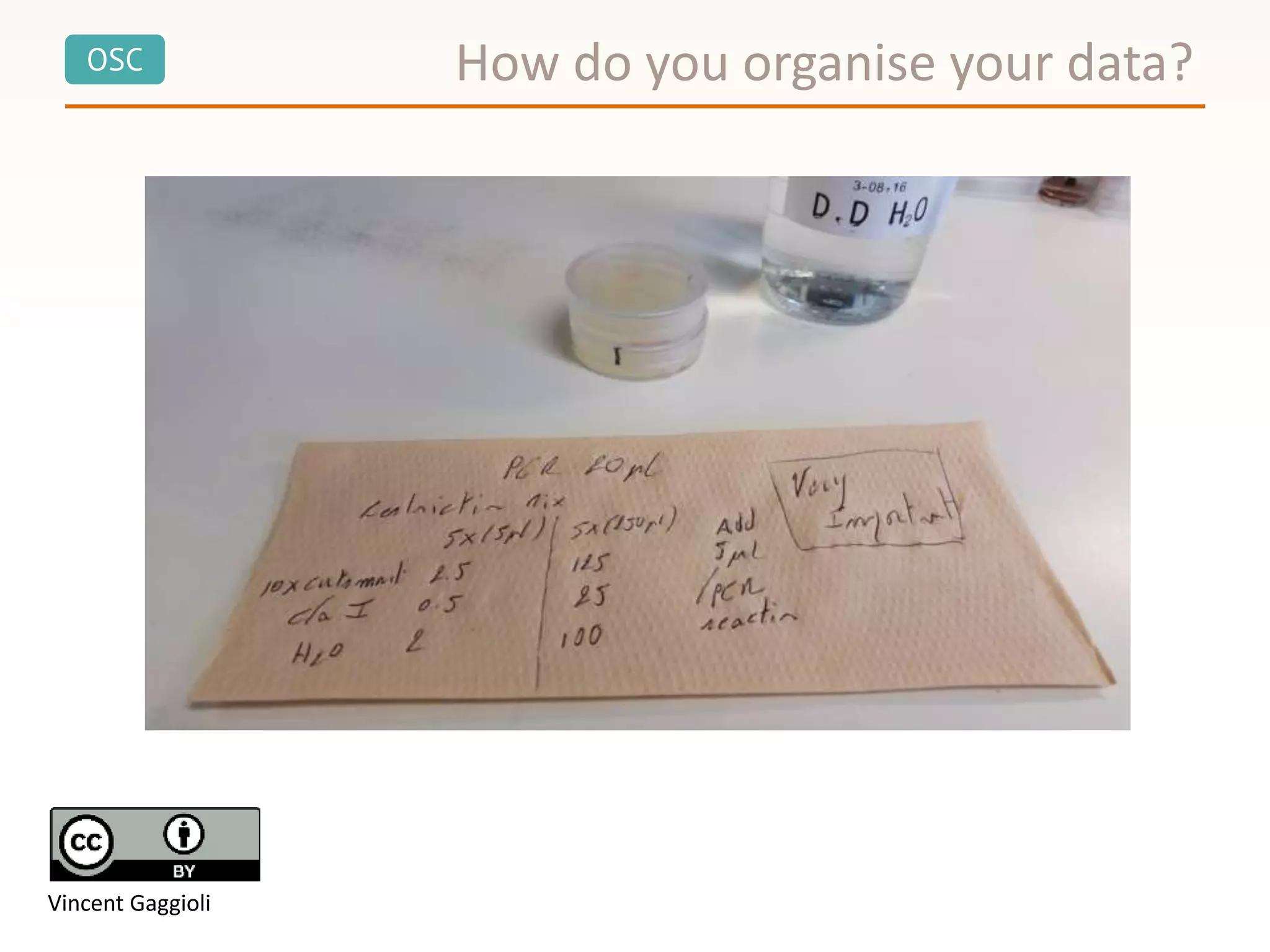
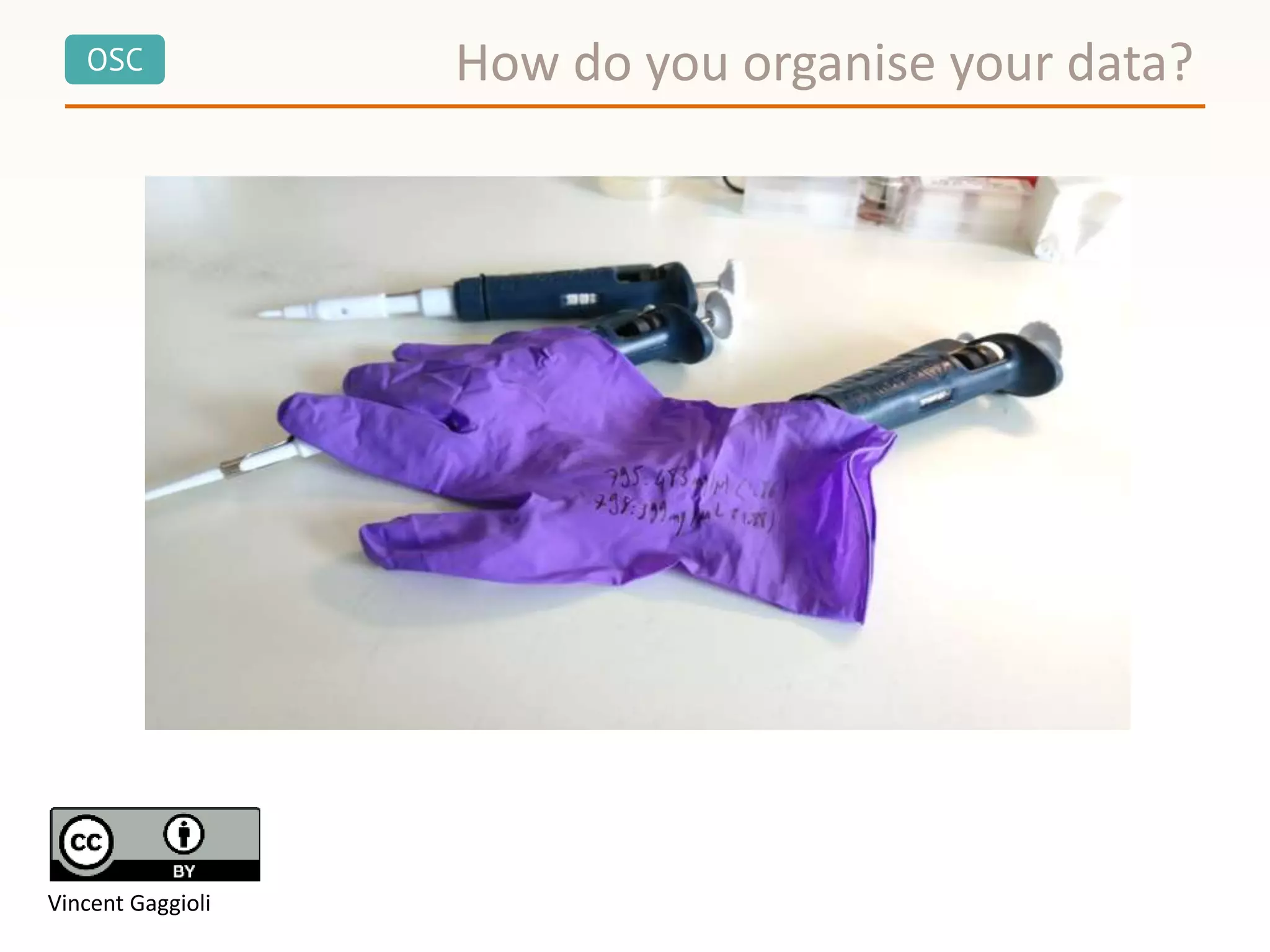
OSC How do you organise your data?
Vincent Gaggioli
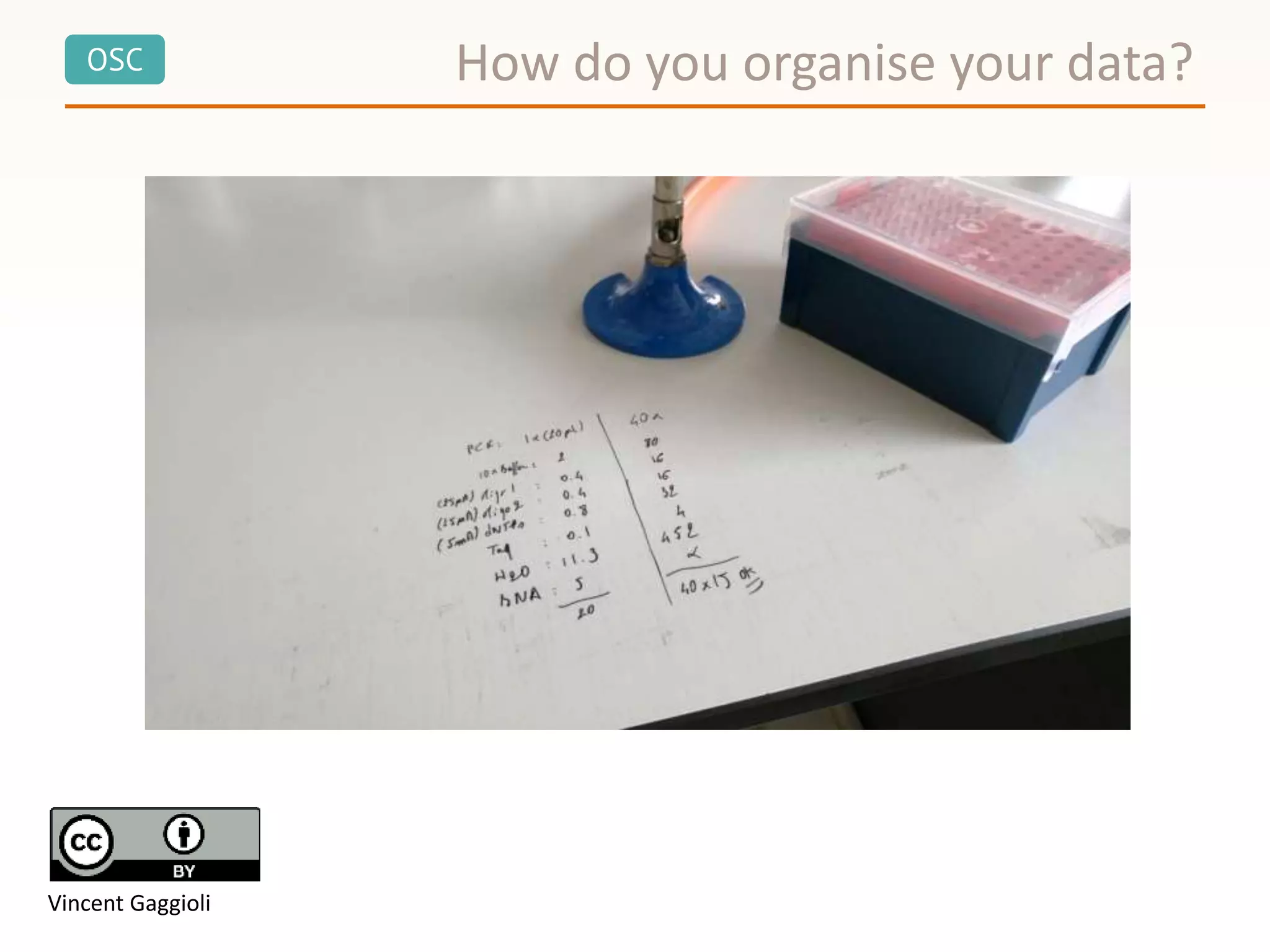
OSC How do you organise your data?
Vincent Gaggioli
OSC How do you organise your data?
Vincent Gaggioli
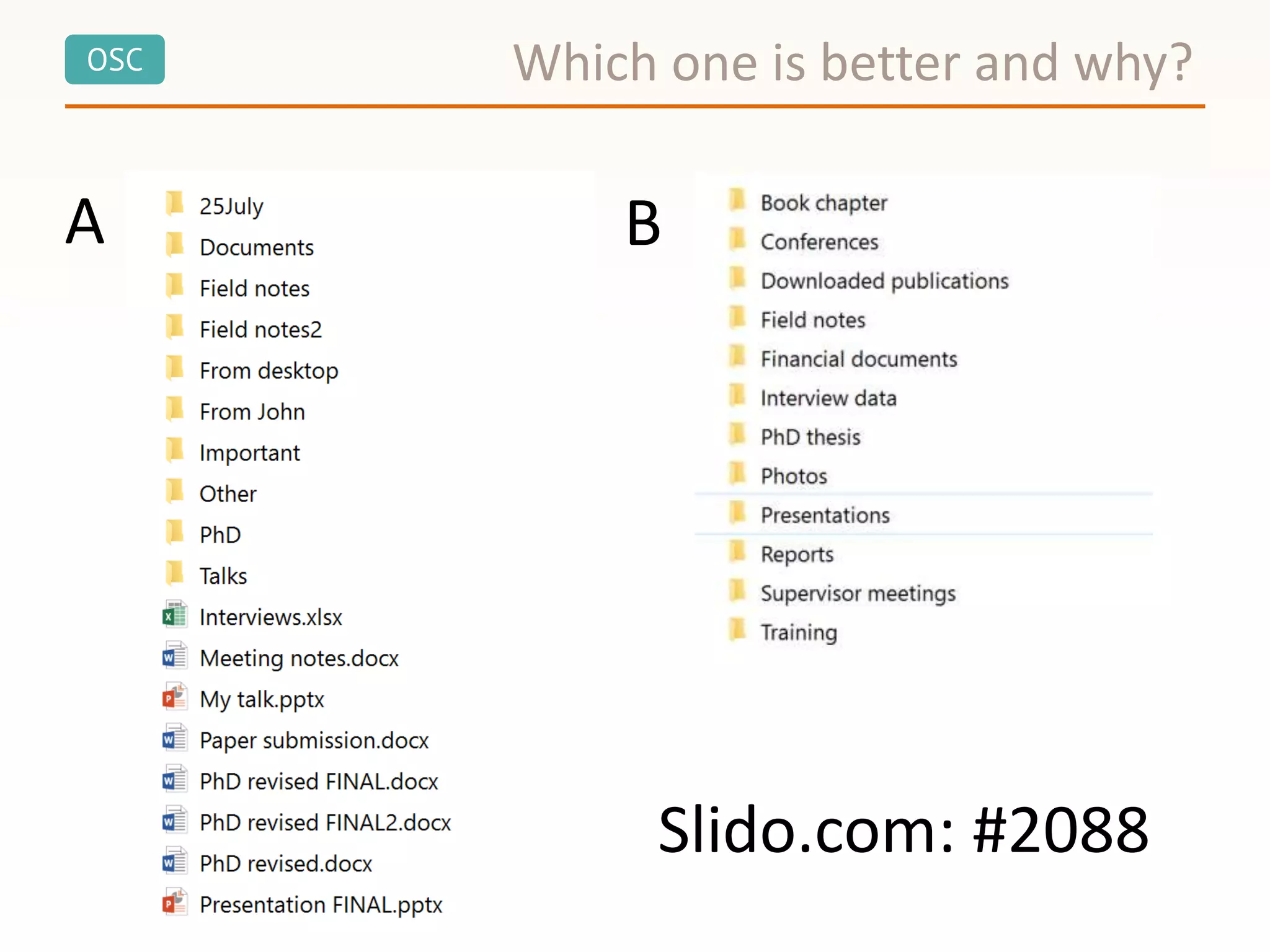
OSC Which one is better and why?
Slido.com: #2088
A B
OSC
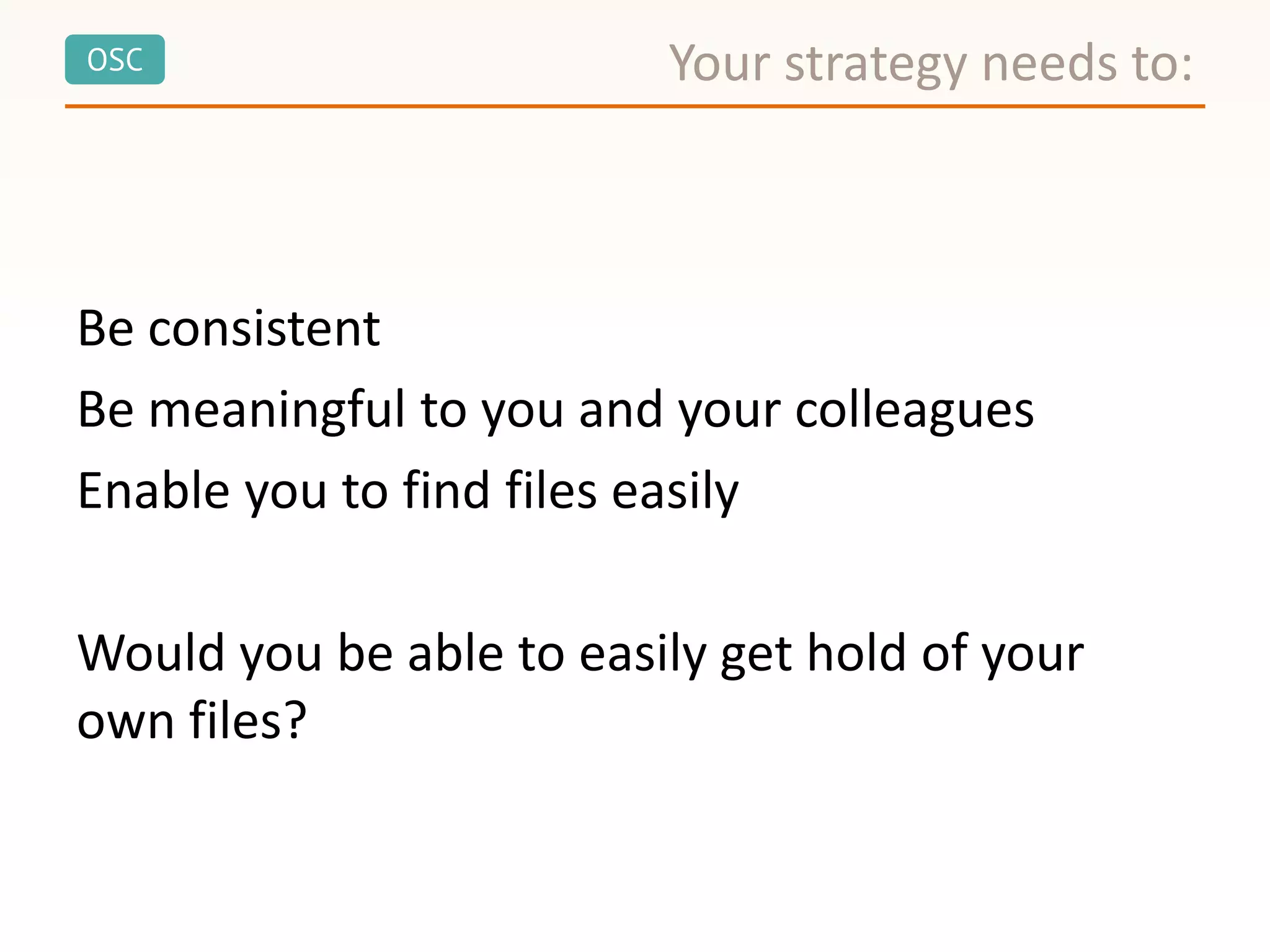
Be consistent
Be meaningful to you and your colleagues
Enable you to find files easily
Would you be able to easily get hold of your
own files?
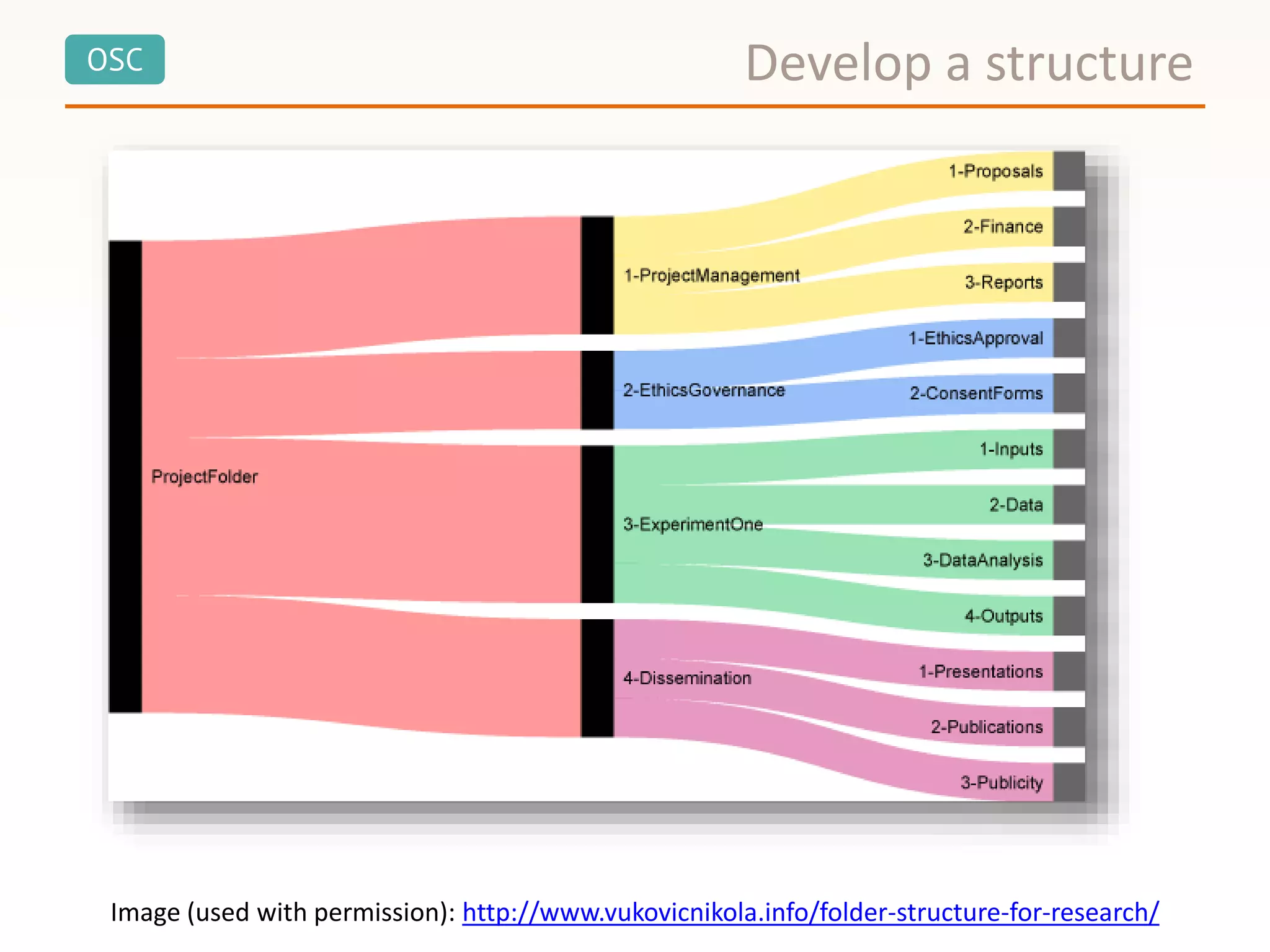
Your strategy needs to:
OSC
Image (used with permission): http://www.vukovicnikola.info/folder-structure-for-research/
Develop a structure
OSC
Physical samples
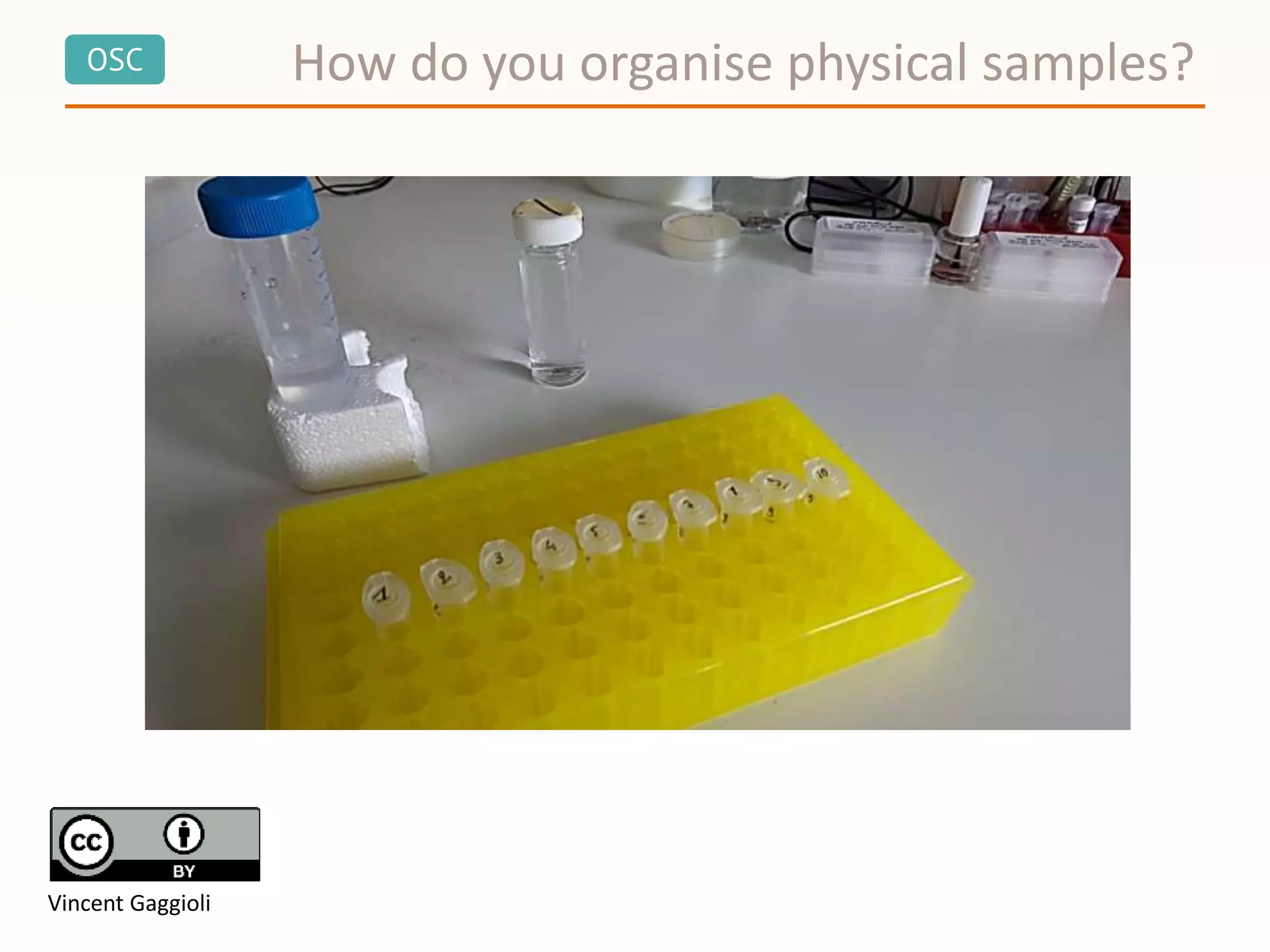
OSC How do you organise physical samples?
Vincent Gaggioli
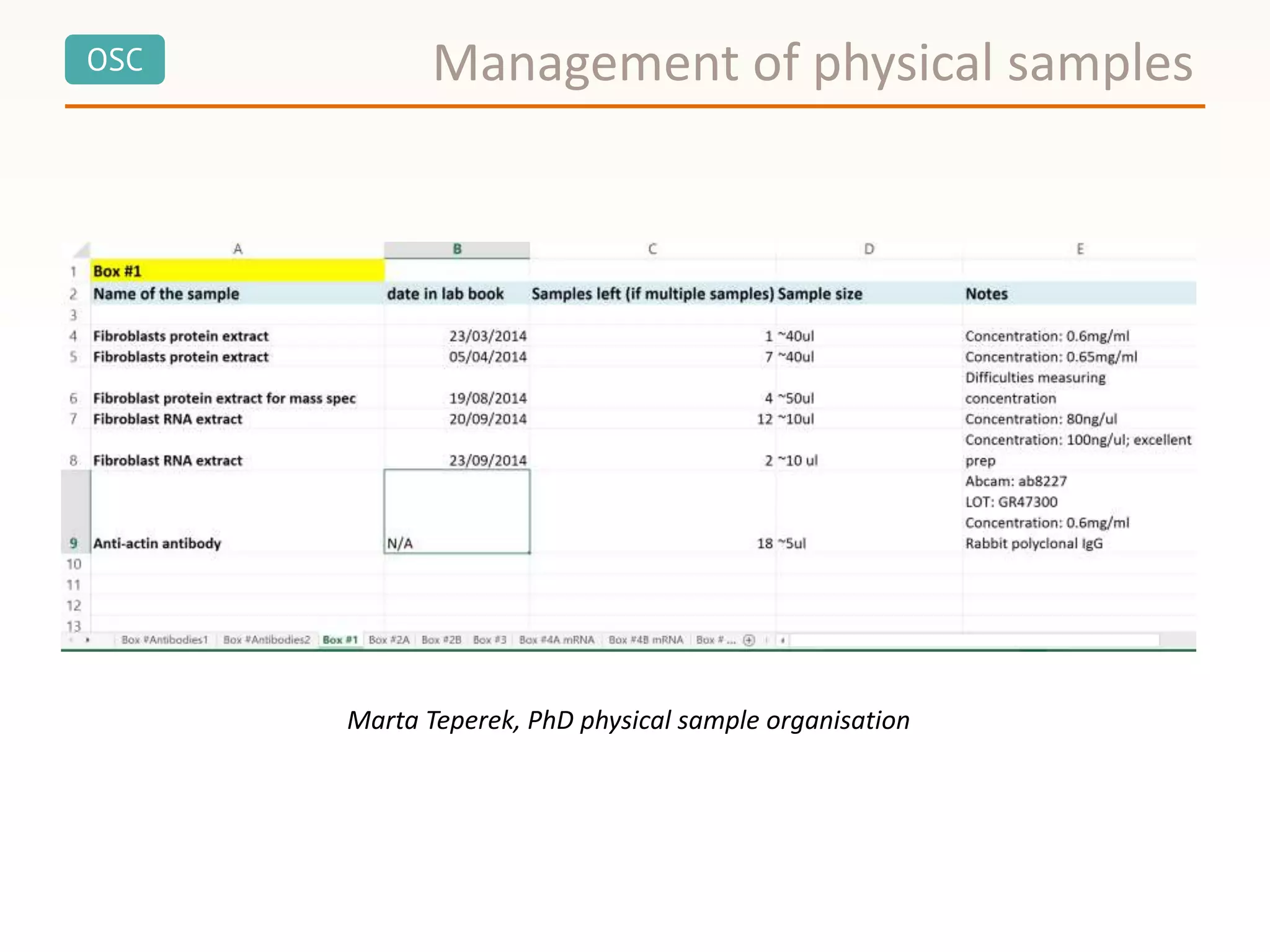
OSC Management of physical samples
Marta Teperek, PhD physical sample organisation
OSC
Create maps of your samples
• can be simple Excel spreadsheets
• and keep them up to date!
Reference your samples:
• dates in notebooks
• supplier’s name/code
Add any relevant notes
Management of physical samples
OSC
File naming strategies
OSC
Image (used with permission): http://10pm.com/
***
***
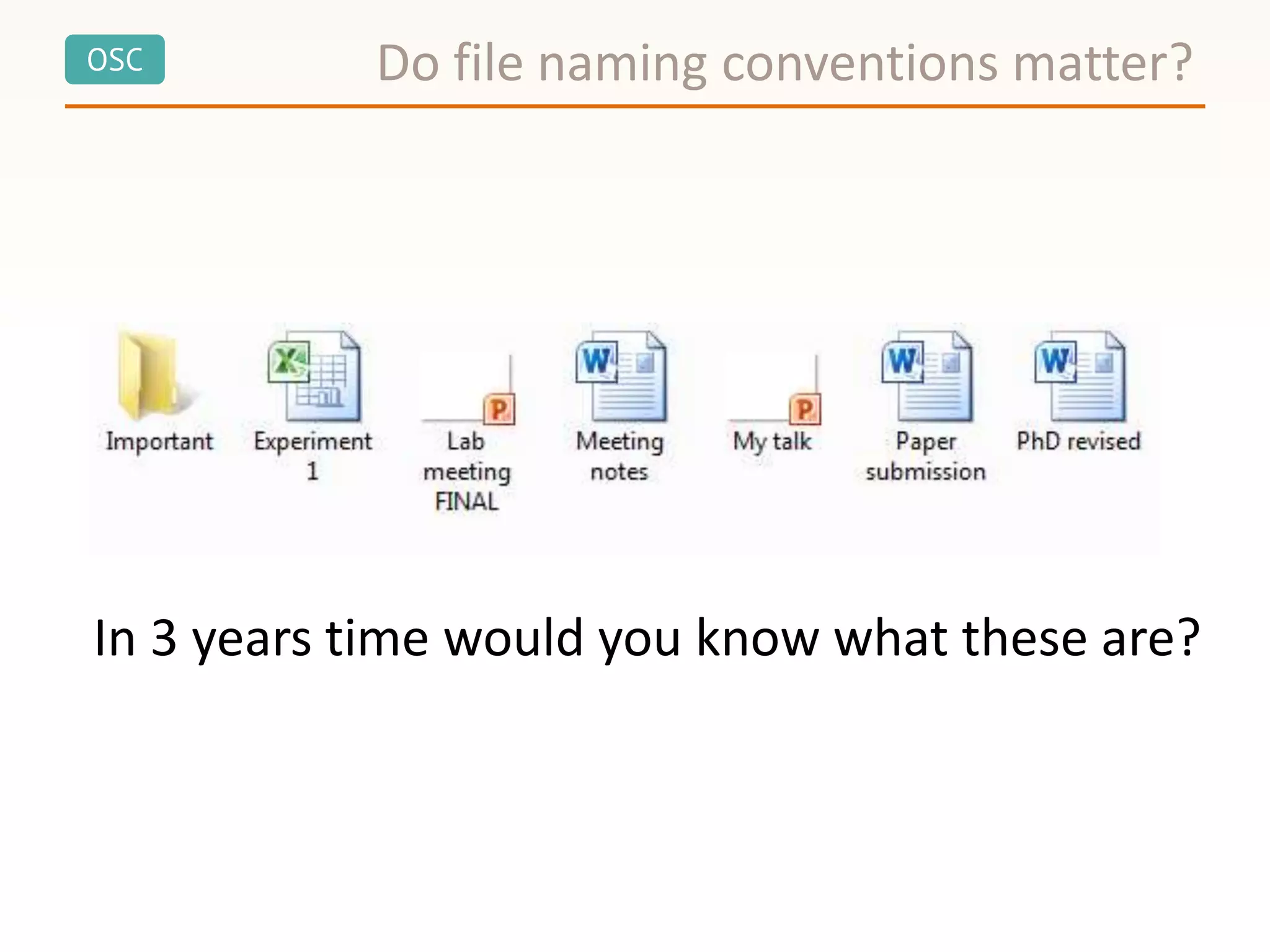
Do file naming conventions matter?
OSC Do file naming conventions matter?
In 3 years time would you know what these are?
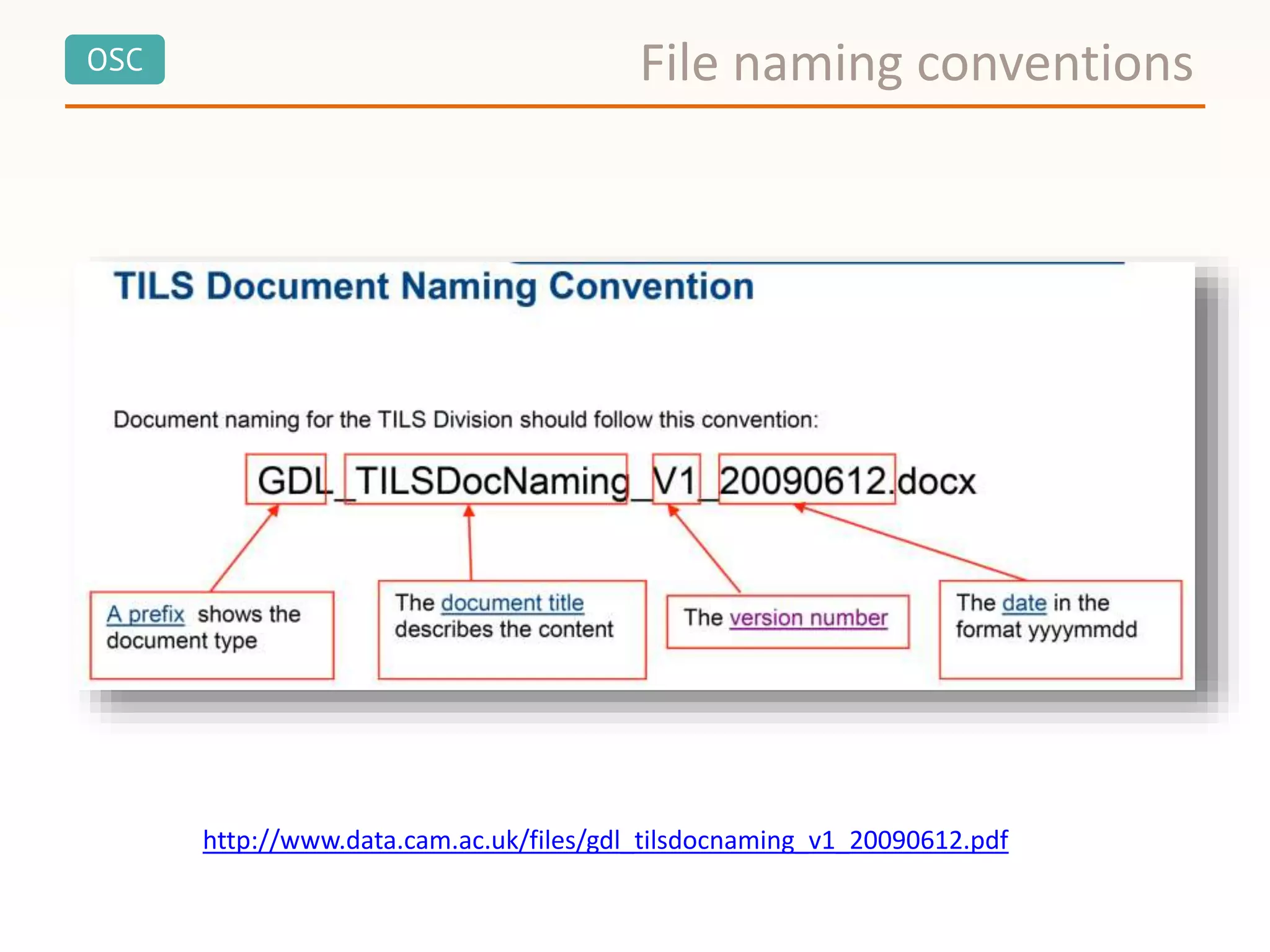
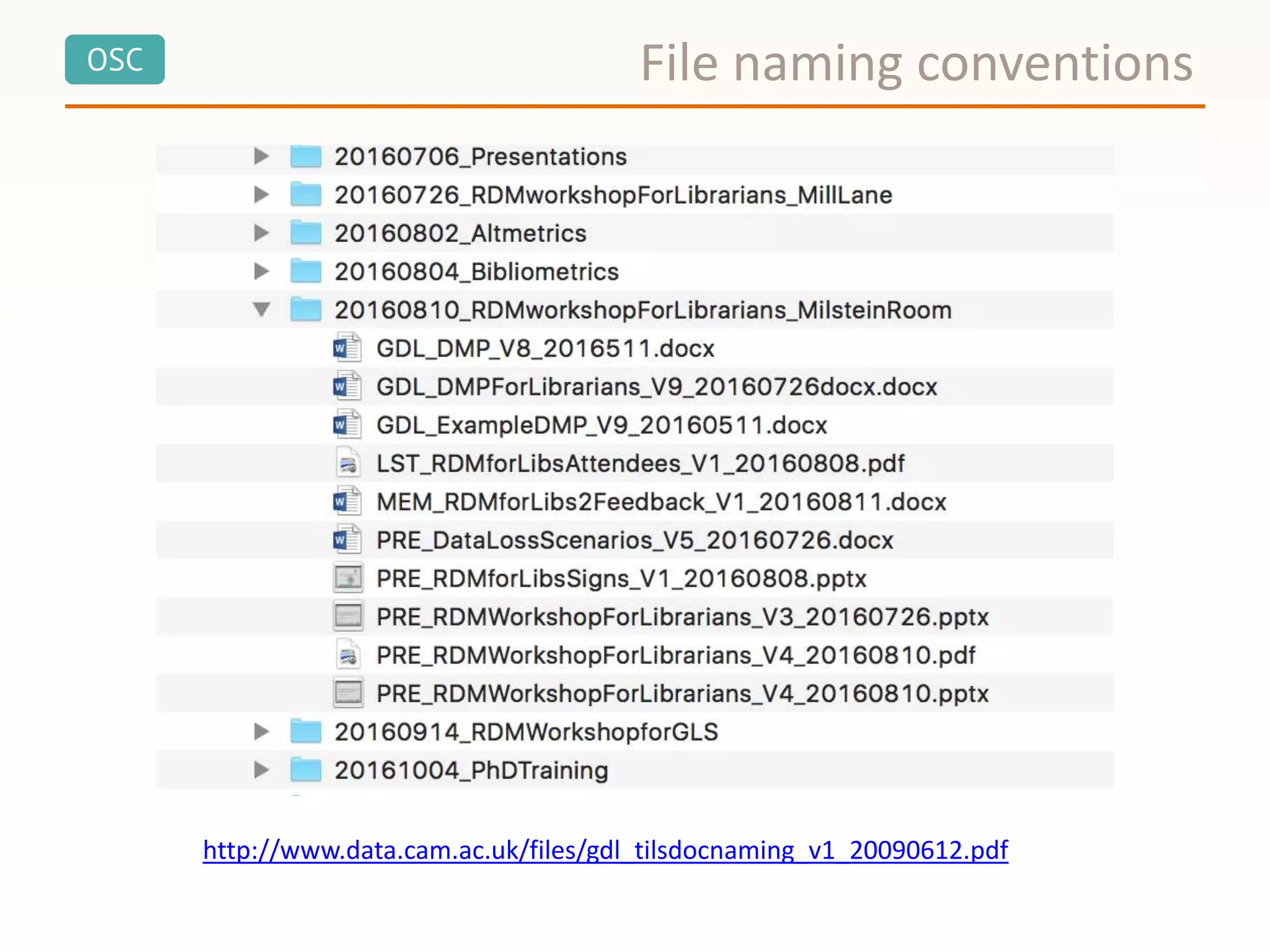
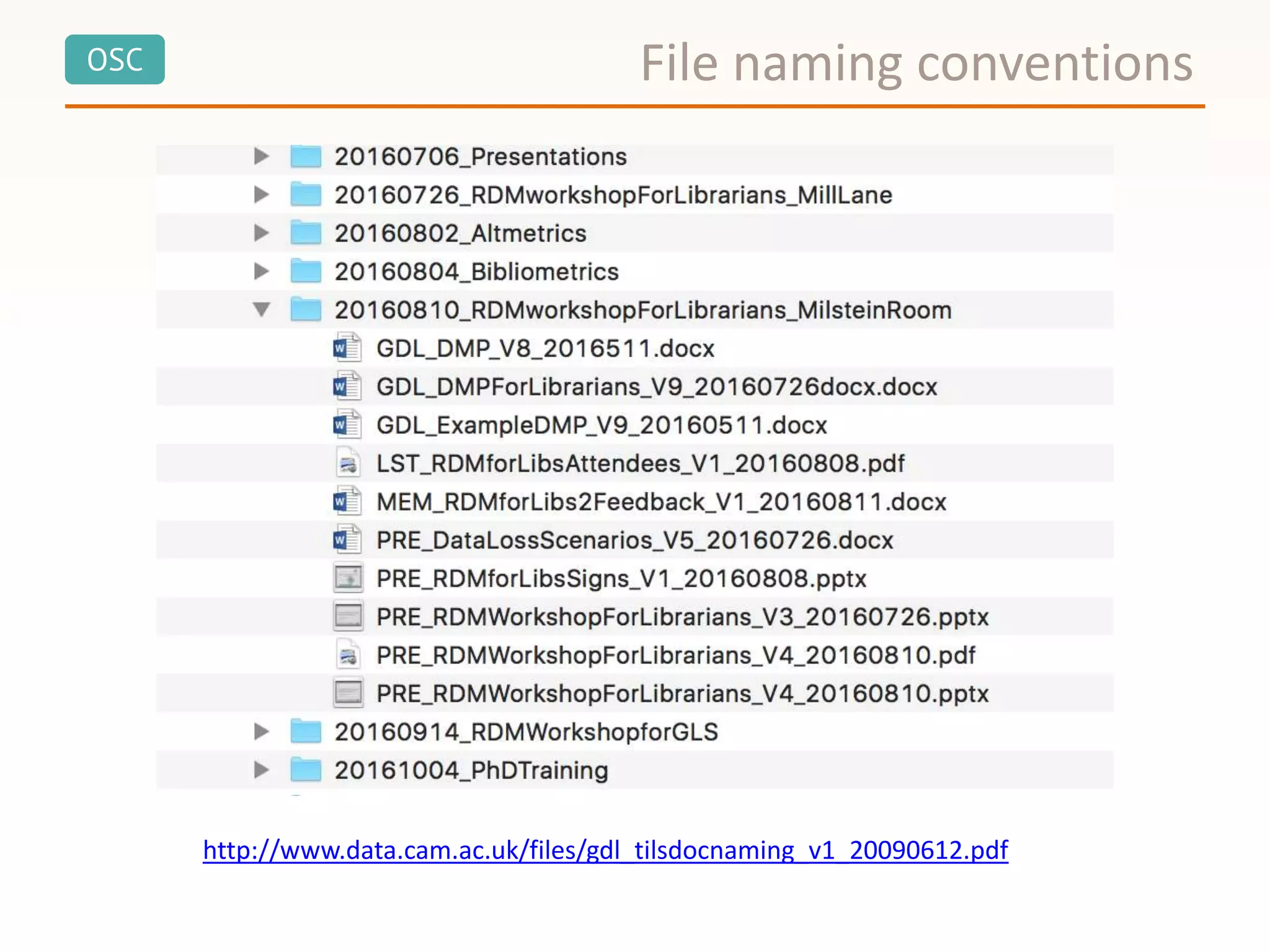
OSC File naming conventions
http://www.data.cam.ac.uk/files/gdl_tilsdocnaming_v1_20090612.pdf
OSC File naming conventions
http://www.data.cam.ac.uk/files/gdl_tilsdocnaming_v1_20090612.pdf
OSC Module example
How to Organise
Information
Humanities, Arts and Social
Sciences (HASS)
OSC
Organising your data
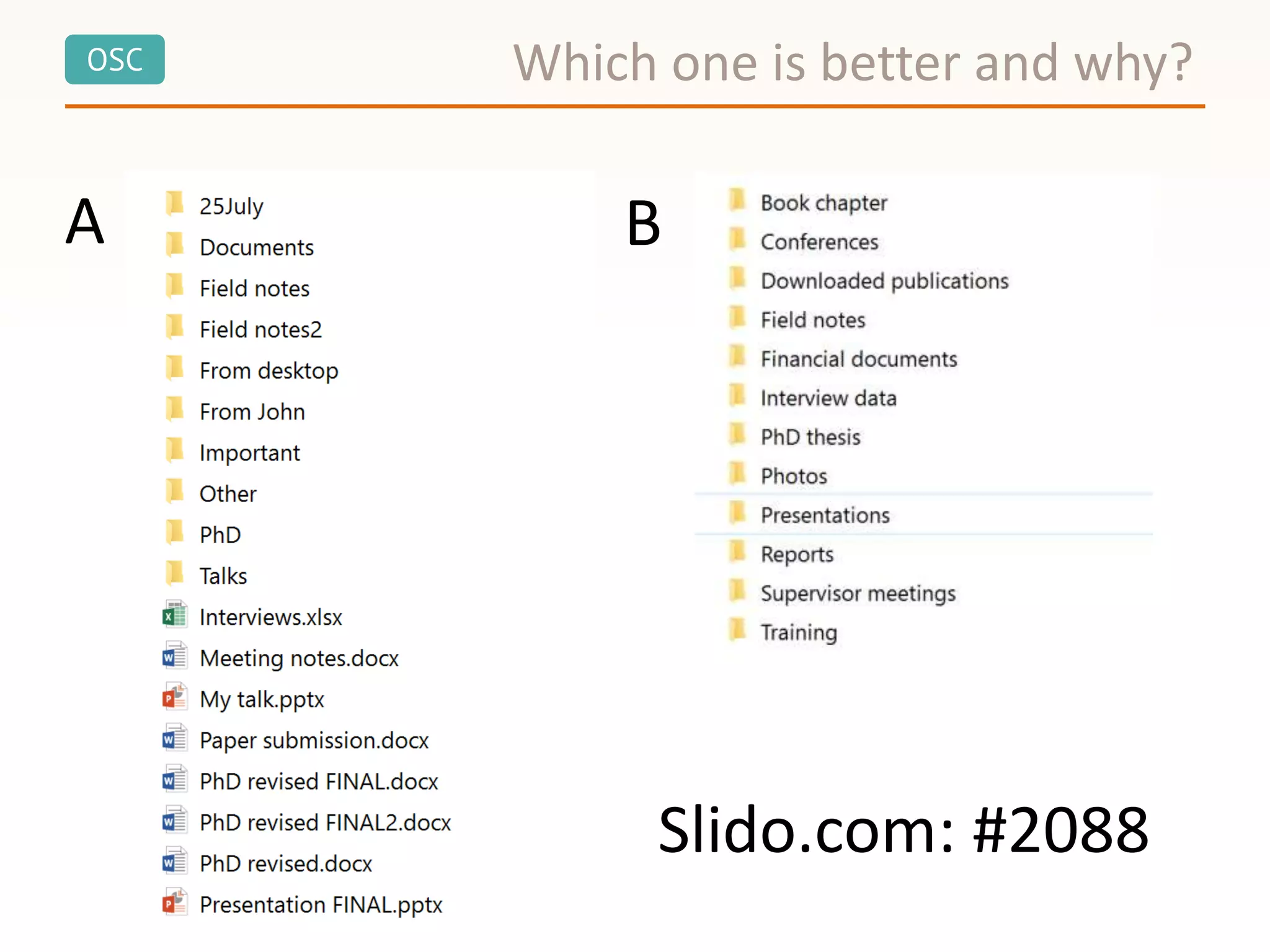
OSC Which one is better and why?
Slido.com: #2088
A B
OSC
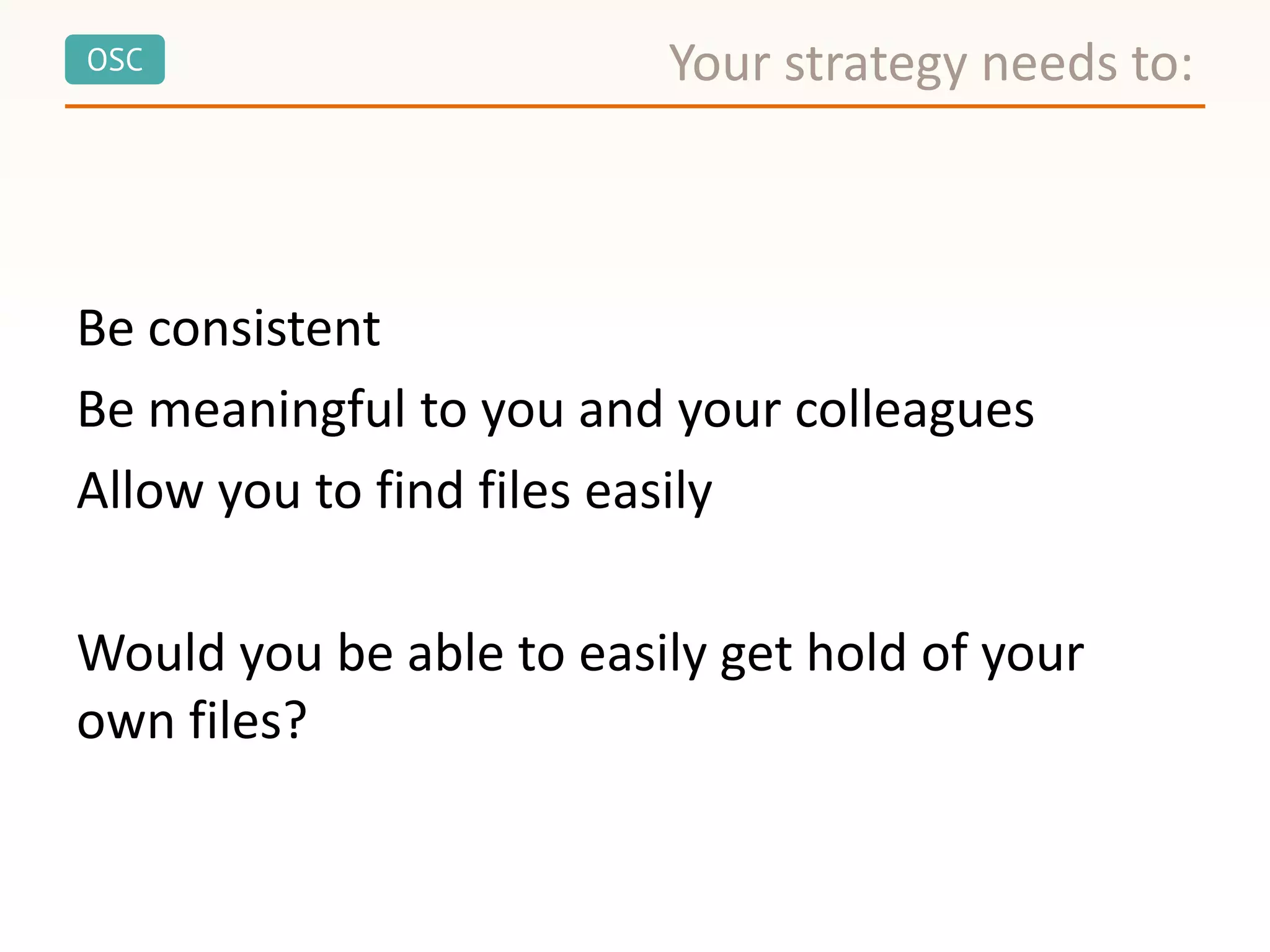
Be consistent
Be meaningful to you and your colleagues
Allow you to find files easily
Would you be able to easily get hold of your
own files?
Your strategy needs to:
OSC
Mendeley
Zotero
Training is available via
departmental libraries
Reference managers
OSC
File naming strategies
OSC
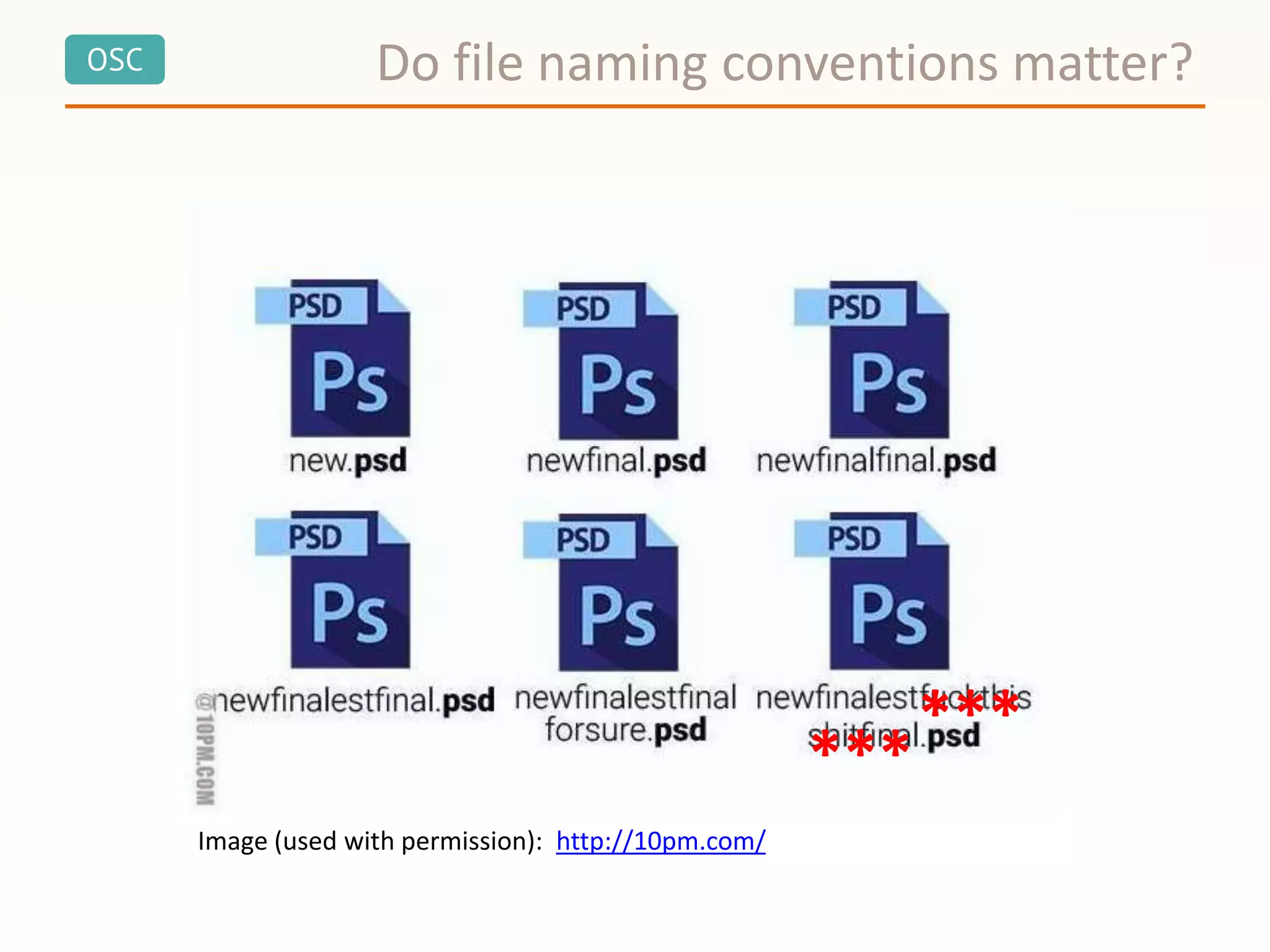
Image (used with permission): http://10pm.com/
***
***
Do file naming conventions matter?
OSC Do file naming conventions matter?
In 3 years time would you know what these are?
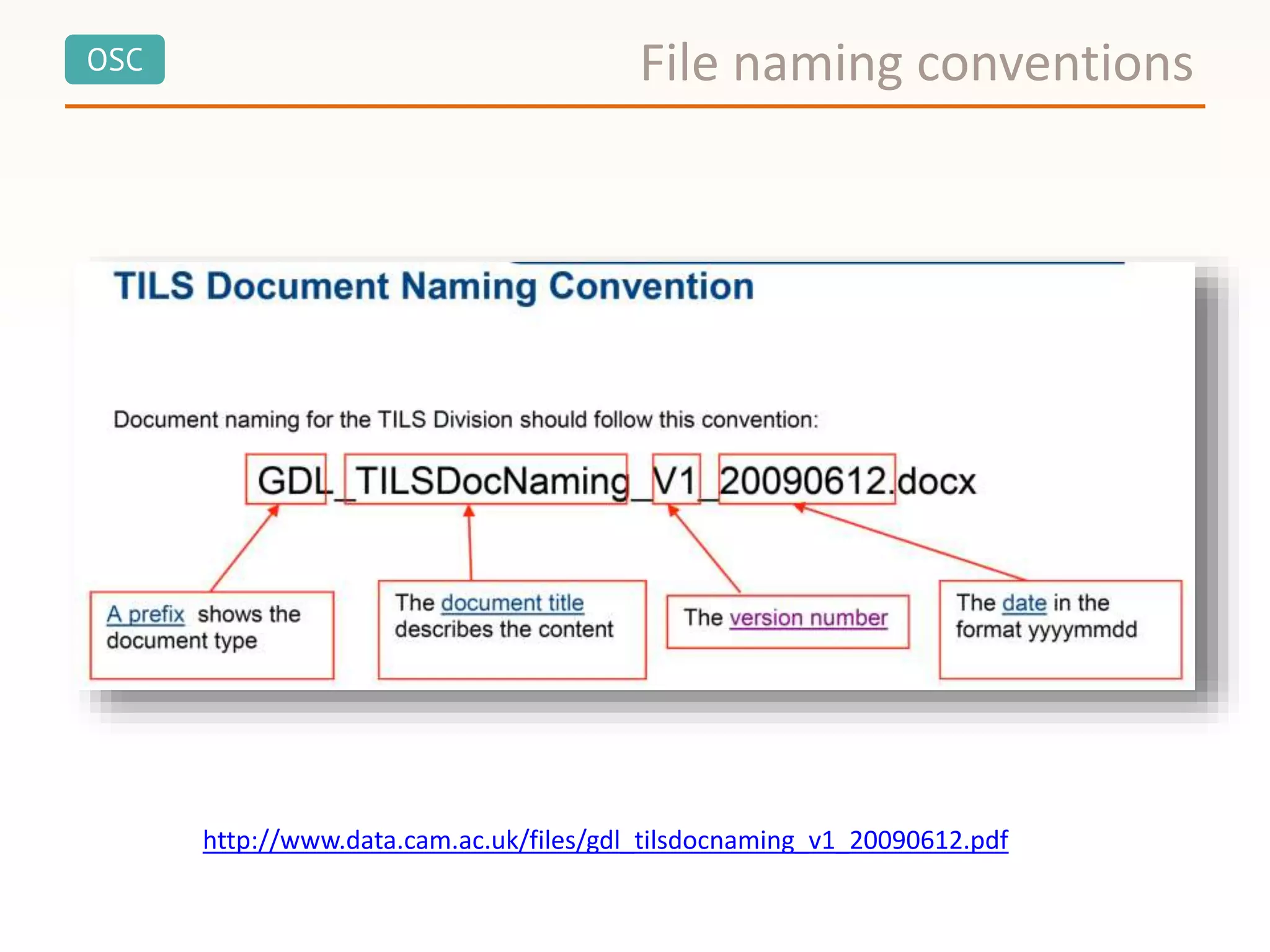
OSC File naming conventions
http://www.data.cam.ac.uk/files/gdl_tilsdocnaming_v1_20090612.pdf
OSC File naming conventions
http://www.data.cam.ac.uk/files/gdl_tilsdocnaming_v1_20090612.pdf
OSC
Describing your information
OSC
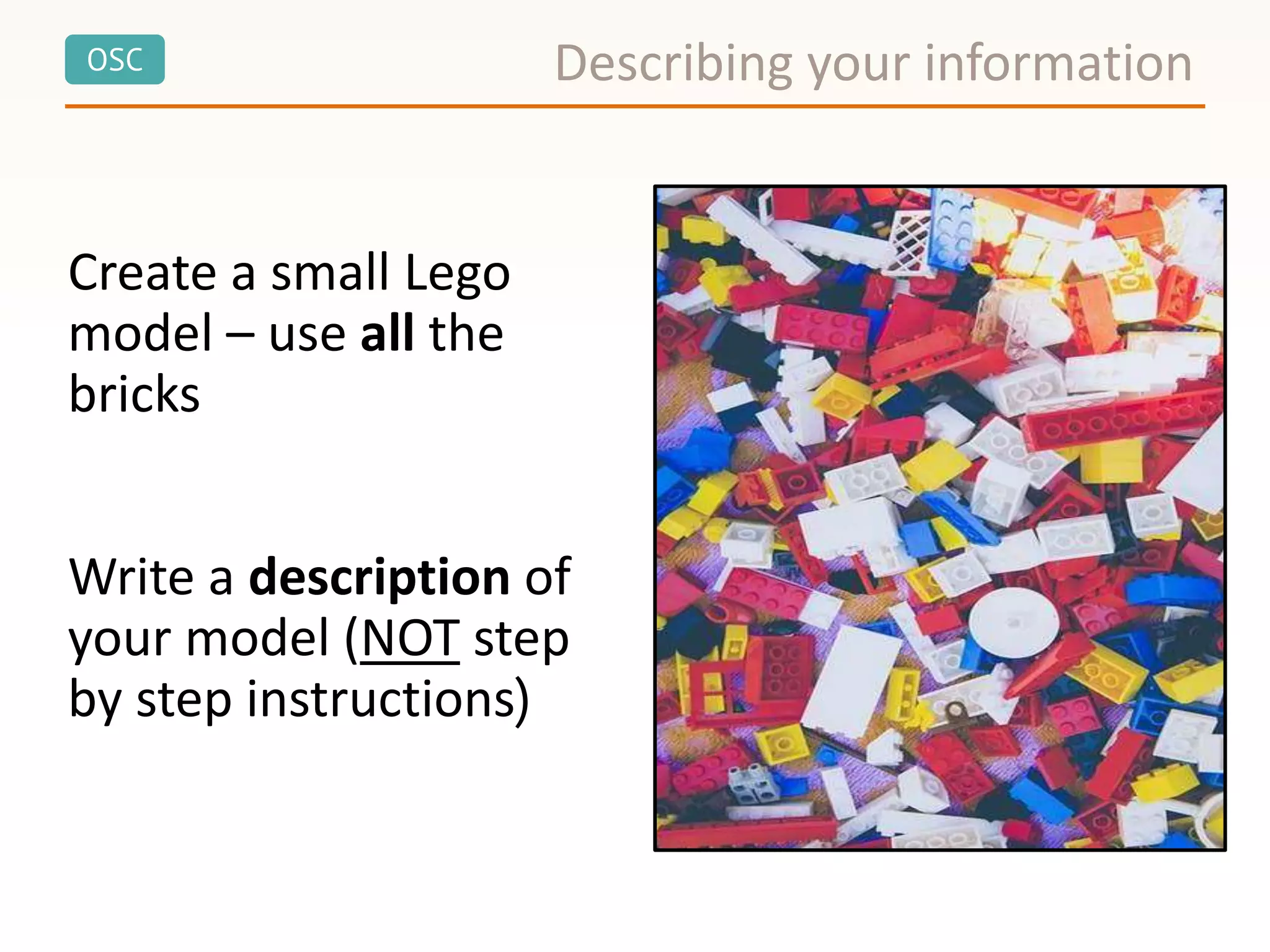
Create a small Lego
model – use all the
bricks
Write a description of
your model (NOT step
by step instructions)
Describing your information
OSC
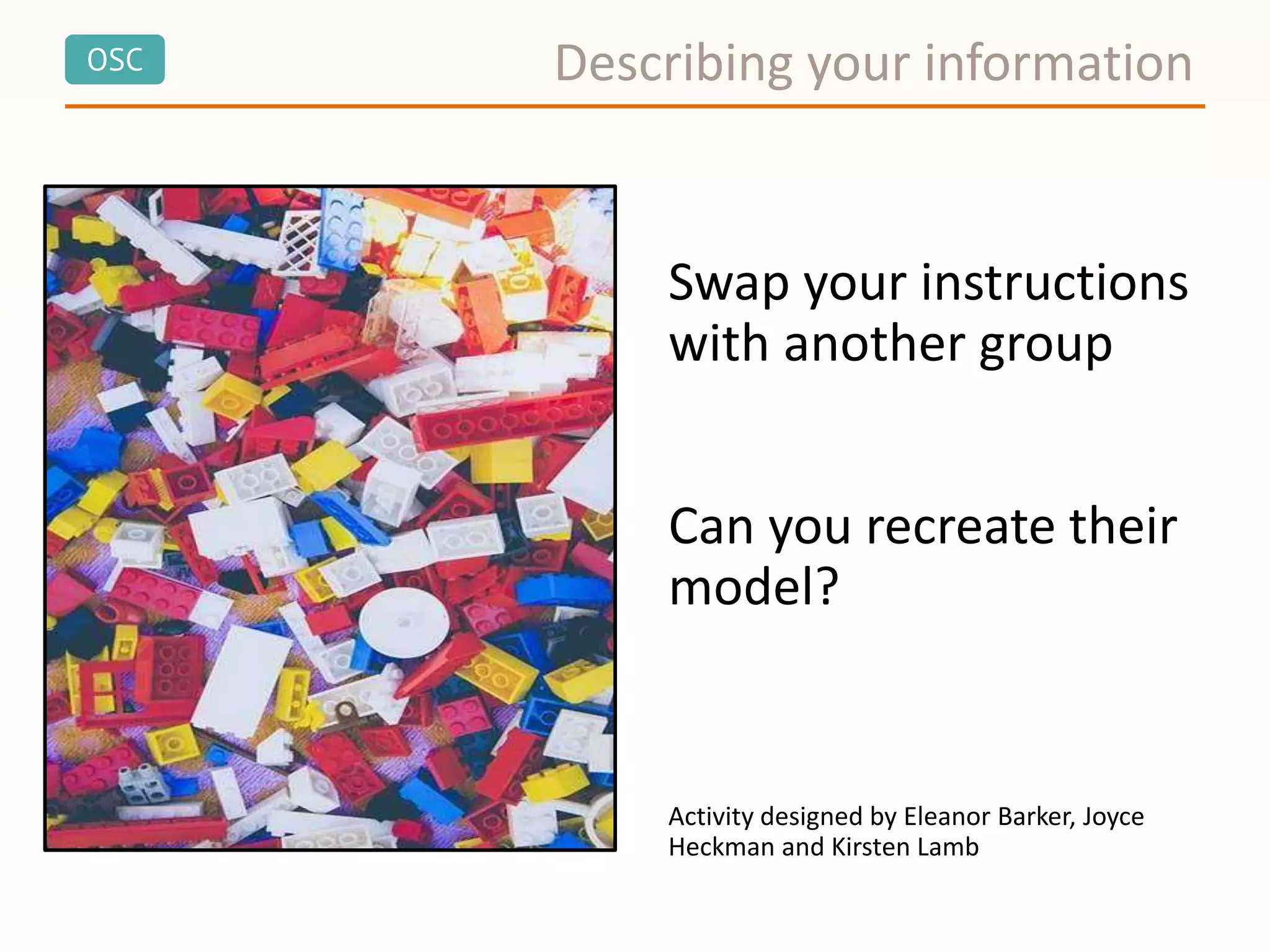
Swap your instructions
with another group
Can you recreate their
model?
Activity designed by Eleanor Barker, Joyce
Heckman and Kirsten Lamb
Describing your information
OSC
End of the module
OSC
• Same basic structure
• Changes in terminology
• Tailored examples
• Different activities for different disciplines
• Length of module
Things to note
OSC Activity: Create your own workshop
OSC
You have been asked
to develop an RDM
workshop for the
audience in your
packs
How will you use the
elements available to
create a bespoke
workshop?
Activity: Create your own workshop
OSC Feedback
OSC
• Talk to your audience about their needs
• Make the workshop meaningful
• Attainable level of learning
• Make learning a group activity
• Allow your audience to be an active
participant in shaping the workshop
• Make it fun!
Strategies
!One size DOES NOT fit all!
OSC Questions?
OSC Thank you!
OSC Image credits
Images via:
Pixabay
Pexels
Iconfinder
CC0 unless otherwise
noted

Engaging Students with Research Data Management: The Modular Approach

Editor's Notes

  • #4 Data can mean vastly different things to different people Managing and sharing the data produced by research Required by many funders
  • #5 Dedicated RD support service Offers training and information Support services such as data management plan consultation, funder guidance, bespoke consultancy services and a data repository Wider engagement beyond the Cambridge community Training and events Funder guidance Data management plan consultation Wider engagement beyond Cambridge
  • #6 What is RDM and why is it important
  • #7 How do you put all of these elements together to create a course that meets your user needs?
  • #8 How do you put all of these elements together to create a course that meets your user needs?
  • #10 Outline of workshop as a whole
  • #11 Explain the differences – majority have funders, used to talking about data
  • #13 Think about how you organise your data – these examples are taken from a presentation to STEM students so the examples used reflect that
  • #16 Online voting – link! Complete activity – looks really simple but gets people thinking about the various problems and issues that could happen
  • #20 Do you have physical samples? What do they look like?
  • #28 Even the title of the section is different Many are not funded by external bodies so aren’t concerned about funders, data is often a foreign and ‘scary’ concept for some. They don’t see their information as data which means you have to be careful about phrasing to ensure relevance
  • #30 Online voting – link! Complete activity – looks really simple but gets people thinking about the various problems and issues that could happen
  • #32 We send the slides to participants - links
  • #39 Metadata exercise Examples of description before have been looks like a snake, blue bricks on top of the red bricks with pink bricks either side, sausage dog, tower Create a model – can be anything. Use all the bricks in the envelope Write a short description (not instructions) of your model Take your model apart and put the bricks back in the envelope
  • #40 Complete activity – what is the point? Trying to show how accurate description can help others to recreate and build on your work. Showcase the importance of good metadata to make your work discoverable. Trying to illustrate the difference between data and metadata. Point is to show how finding data (whatever form that data may take) relies on useful descriptions. Good at working across disciplines.
  • #42 Things to note: Different terminology Different activities (although they could be used interchangeably) Length of module Throw this open to the audience – what differences and similarities can they spot?
  • #43 Now that you’ve experienced a module it’s time to try putting together your own version of the workshop Imagine you have been asked to put together a three hour workshop for the audience on your card. Which elements and activities would you use? Why would you pick those? Wildcards – something that changes the situation. How would you respond to this?
  • #44 Complete activity – what is the point? Trying to show how accurate description can help others to recreate and build on your work. Showcase the importance of good metadata to make your work discoverable. Trying to illustrate the difference between data and metadata. Point is to show how finding data (whatever form that data may take) relies on useful descriptions. Good at working across disciplines. You have been asked to develop a three hour workshop on RDM for the audience on your packs You have a set of ready made modules and activities – how will you put them together to best meet the needs of your audience? Things to consider: audience level, are you teaching them what they need to know now or are you aiming for longer term impact?  add to workshop pack? Consider: Your audience Instructions in pack – things to consider, wildcard
  • #45 Prompt questions – how easy was this, anything which surprised you, could you use this method to teach other complex subjects? Record on flipchart
  • #46 Strategies to ensure both student and faculty engagement with scholarly communication topics Lessons learnt through using the modular approach: Being able to respond to individual group needs Tailoring content to student experiences to keep the content fresh Talk to your audience about their specific needs How can you help them meet this need? Make it meaningful for them Create an attainable level of learning Make learning a group activity Allow your audience to be an active participant in shaping the course Make it fun! Strategies for staff and student engagement with these sessions Talk to them about their specific needs – the more people you talk to the better idea you will get of exactly what people are after. Can then tailor content at a higher level which helps to avoid work of creating individual courses for all disciplines within disciplines. Phrase your message in terms of ‘what can this do for you’? - they will see it more as you trying to do something for them rather than forcing something on them Make it meaningful for them – tailored content helps to sell the course to those who are used to generic offerings from outsiders. If you use examples they are familiar with they will immediately begin to see the relevance to their work. Create an attainable level of learning – don’t try to teach them too much. If all they need to know are the basics then teach them that. Don’t be tempted to just go straight for the most advanced level because that’s what they should be learning. This will help the audience to Make learning a group activity – it would be easy to teach people this by talking at them but by embedding activities and group discussions you can improve the experience and over time work to improve the workshop. You will pick up tips and tricks to use future runs of the course Allow your audience to be an active participant in forming the course – ask them what works and what doesn’t and act on this feedback. This will help your audience maintain a level of ownership over the material Make it fun! – this can be a dry topic and trying to include activities such as the Lego model building can help to liven things up and make the message stick in people’s minds One size doesn’t fit all!