BIOCHAR
Burn & Learn
Workshop
Biochar Workshop
Agenda
• What is Biochar?
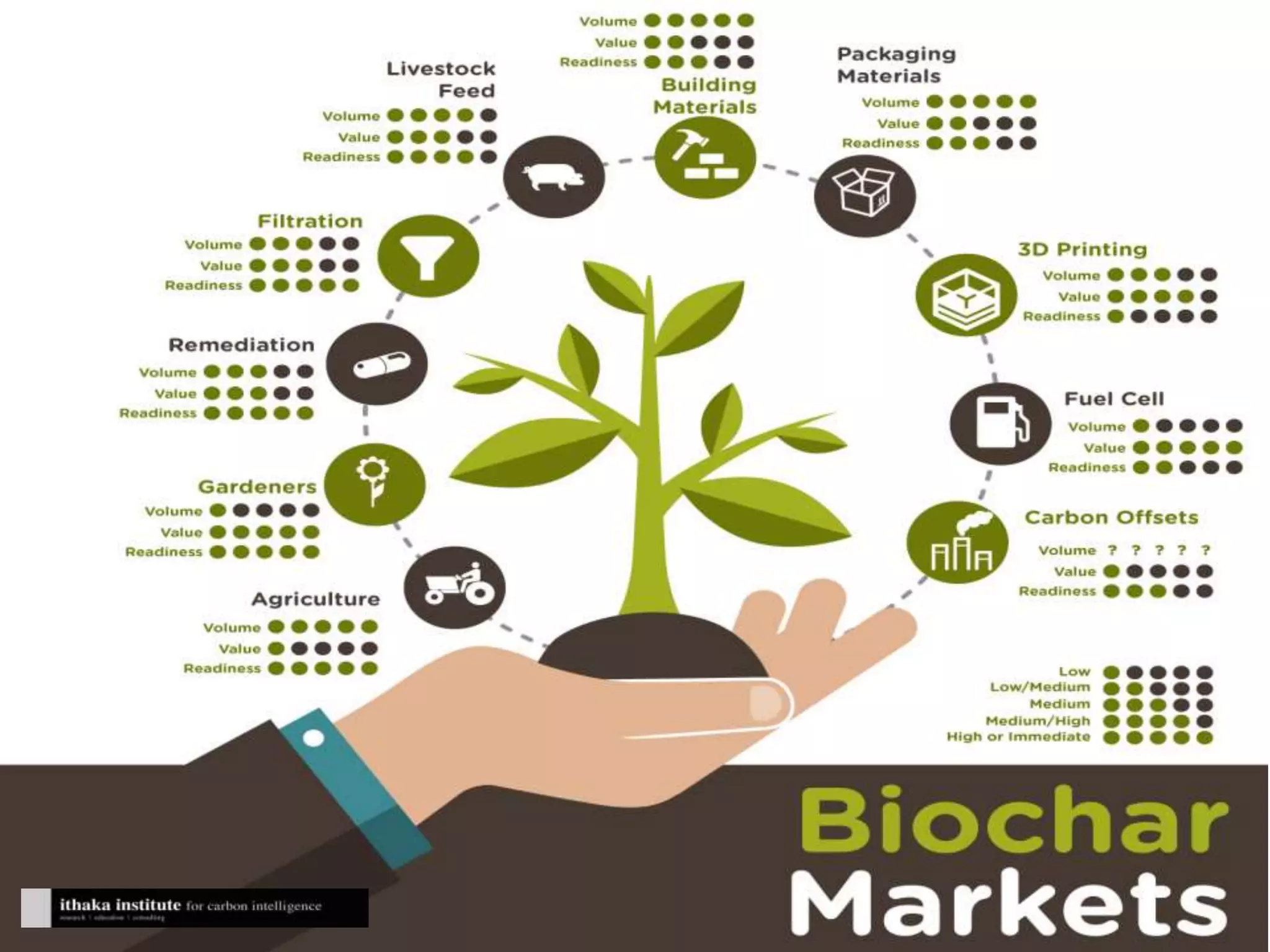
• Markets & Uses
• Biochar & Climate Change
• Characteristics & Benefits
• Comparison with other soil
amendments
• Triple Bottom Line
• Biochar Opportunities in NYS
• Feedstock
• Producing Biochar
• Application Methods
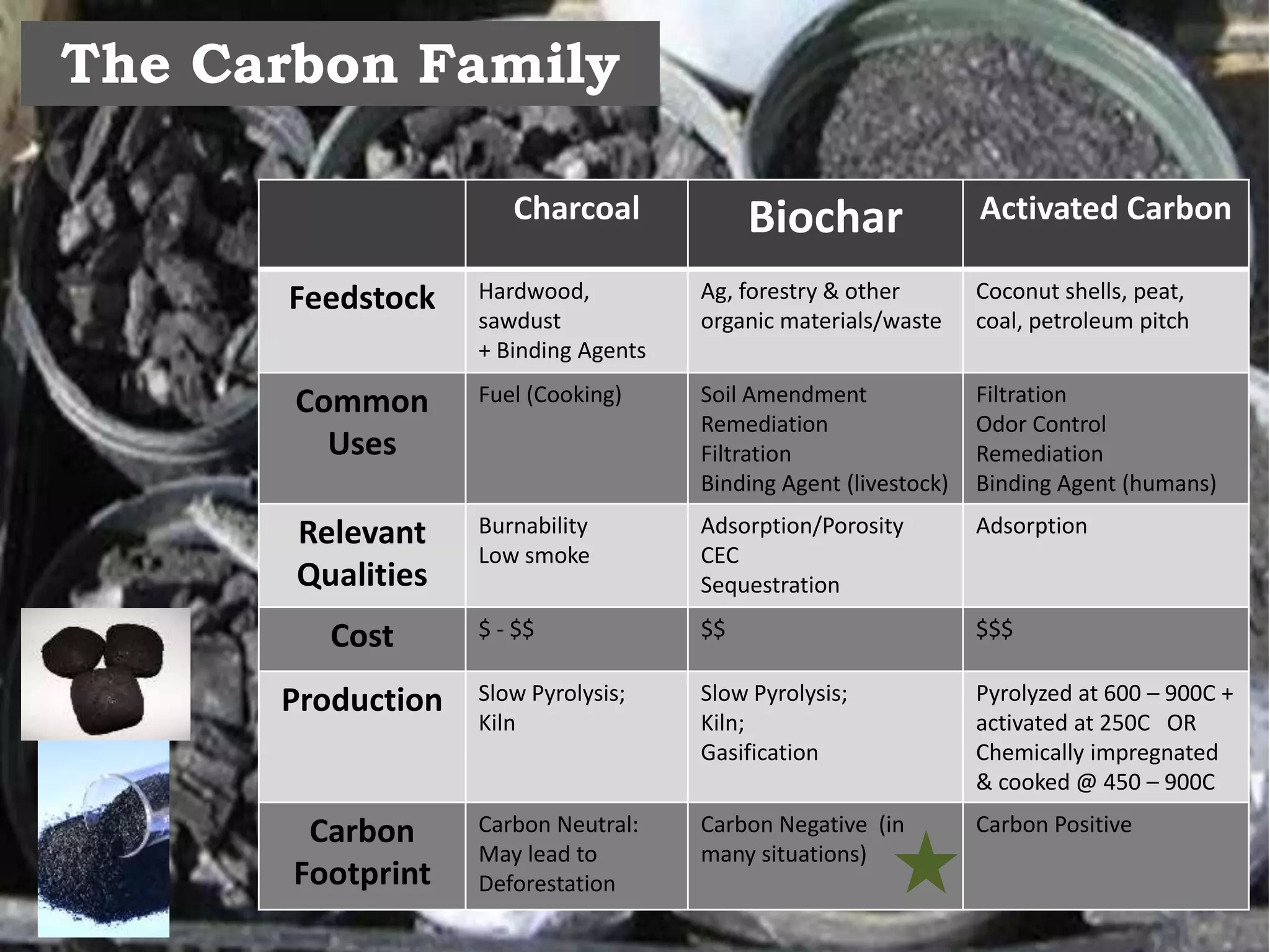
The Carbon Family
Charcoal Biochar Activated Carbon
Feedstock Hardwood,
sawdust
+ Binding Agents
Ag, forestry & other
organic materials/waste
Coconut shells, peat,
coal, petroleum pitch
Common
Uses
Fuel (Cooking) Soil Amendment
Remediation
Filtration
Binding Agent (livestock)
Filtration
Odor Control
Remediation
Binding Agent (humans)
Relevant
Qualities
Burnability
Low smoke
Adsorption/Porosity
CEC
Sequestration
Adsorption
Cost $ - $$ $$ $$$
Production Slow Pyrolysis;
Kiln
Slow Pyrolysis;
Kiln;
Gasification
Pyrolyzed at 600 – 900C +
activated at 250C OR
Chemically impregnated
& cooked @ 450 – 900C
Carbon
Footprint
Carbon Neutral:
May lead to
Deforestation
Carbon Negative (in
many situations)
Carbon Positive
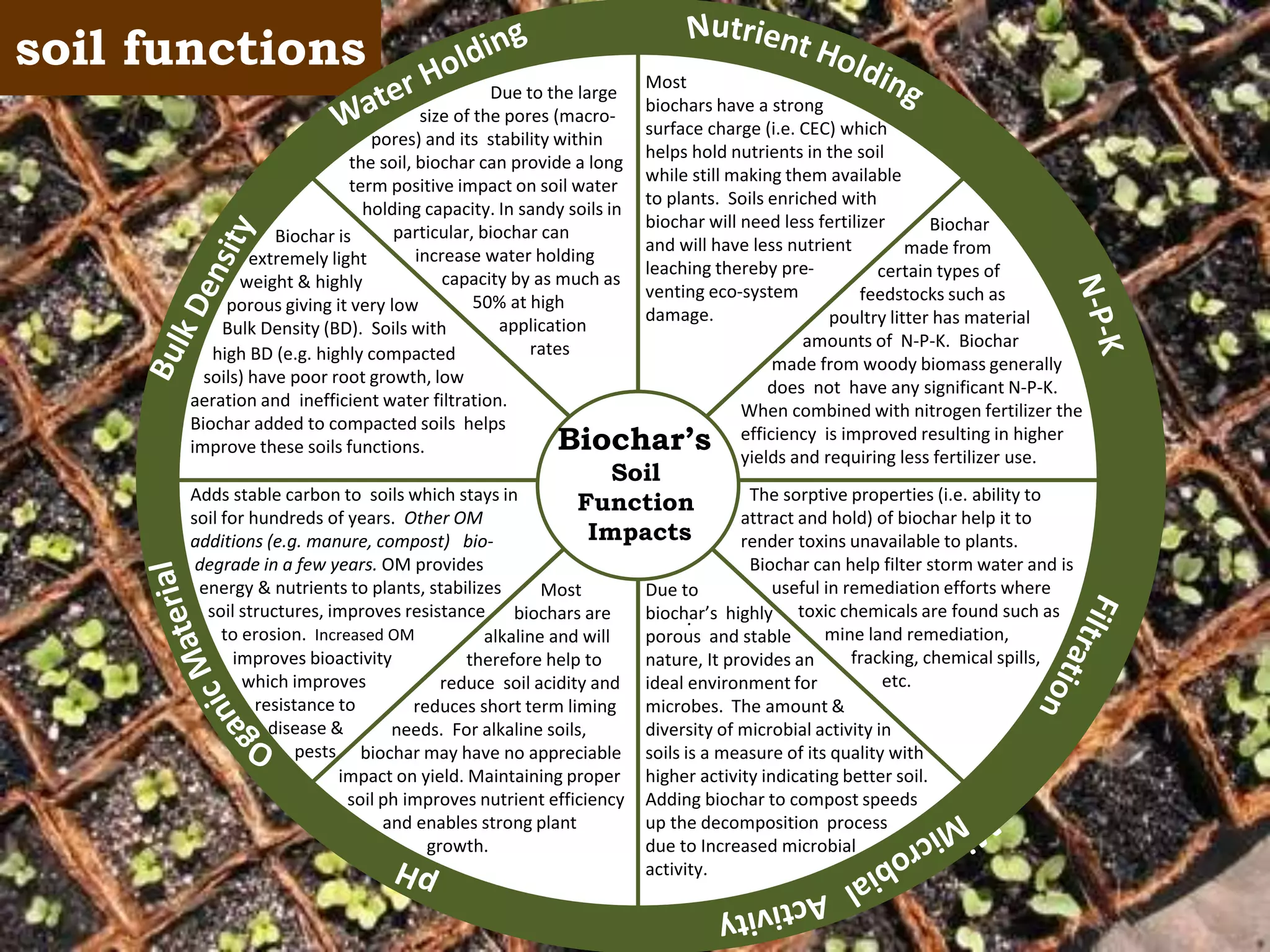
soil functions
Biochar’s
Soil
Function
Impacts
Adds stable carbon to soils which stays in
soil for hundreds of years. Other OM
additions (e.g. manure, compost) bio-
degrade in a few years. OM provides
energy & nutrients to plants, stabilizes
soil structures, improves resistance
to erosion. Increased OM
Most
biochars have a strong
surface charge (i.e. CEC) which
helps hold nutrients in the soil
while still making them available
to plants. Soils enriched with
biochar will need less fertilizer
and will have less nutrient
leaching thereby pre-
venting eco-system
damage.
extremely light
weight & highly
porous giving it very low
Bulk Density (BD). Soils with
high BD (e.g. highly compacted
soils) have poor root growth, low
aeration and inefficient water filtration.
Biochar added to compacted soils helps
improve these soils functions.
Biochar is
improves bioactivity
which improves
resistance to
disease &
pests
Due to
biochar’s highly
porous and stable
nature, It provides an
ideal environment for
microbes. The amount &
diversity of microbial activity in
soils is a measure of its quality with
higher activity indicating better soil.
Adding biochar to compost speeds
up the decomposition process
due to Increased microbial
activity.
Biochar
made from
certain types of
feedstocks such as
poultry litter has material
amounts of N-P-K. Biochar
made from woody biomass generally
does not have any significant N-P-K.
When combined with nitrogen fertilizer the
efficiency is improved resulting in higher
yields and requiring less fertilizer use.
Due to the large
size of the pores (macro-
pores) and its stability within
the soil, biochar can provide a long
term positive impact on soil water
holding capacity. In sandy soils in
particular, biochar can
increase water holding
capacity by as much as
50% at high
application
rates
The sorptive properties (i.e. ability to
attract and hold) of biochar help it to
render toxins unavailable to plants.
Biochar can help filter storm water and is
useful in remediation efforts where
toxic chemicals are found such as
mine land remediation,
fracking, chemical spills,
etc.
Most
biochars are
alkaline and will
therefore help to
reduce soil acidity and
reduces short term liming
needs. For alkaline soils,
biochar may have no appreciable
impact on yield. Maintaining proper
soil ph improves nutrient efficiency
and enables strong plant
growth.
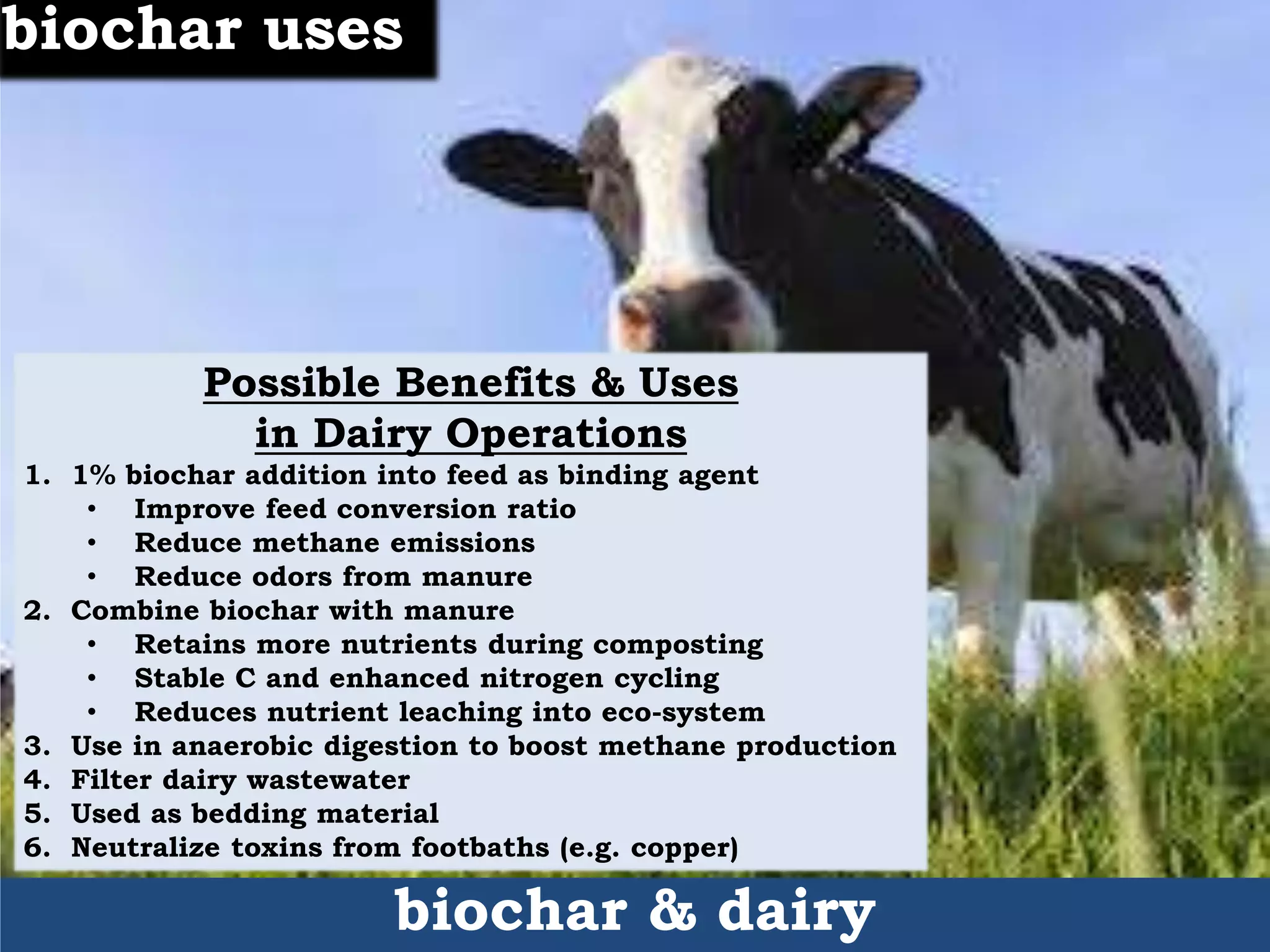
Possible Benefits & Uses
in Dairy Operations
1. 1% biochar addition into feed as binding agent
• Improve feed conversion ratio
• Reduce methane emissions
• Reduce odors from manure
2. Combine biochar with manure
• Retains more nutrients during composting
• Stable C and enhanced nitrogen cycling
• Reduces nutrient leaching into eco-system
3. Use in anaerobic digestion to boost methane production
4. Filter dairy wastewater
5. Used as bedding material
6. Neutralize toxins from footbaths (e.g. copper)
biochar & dairy
biochar uses
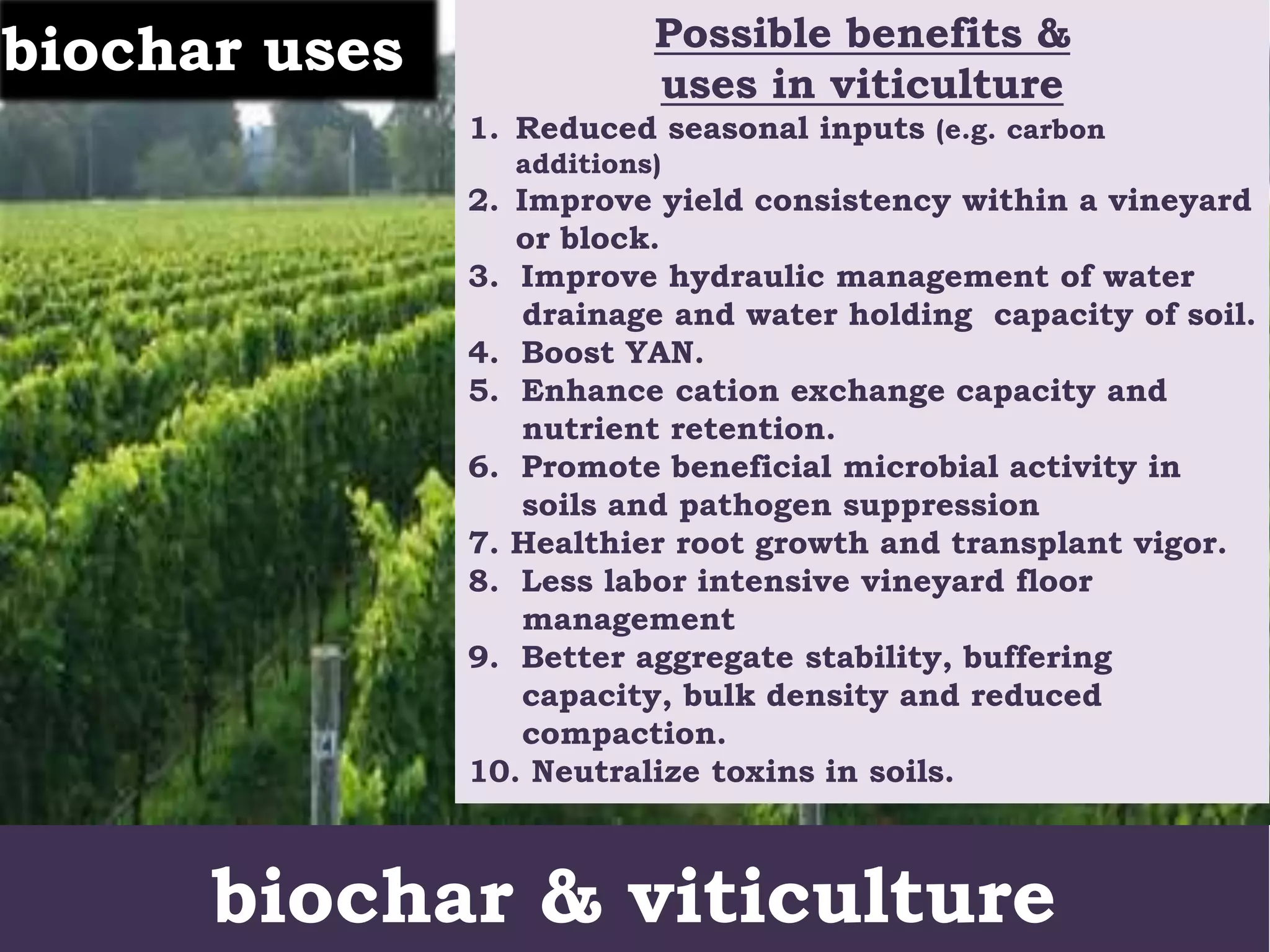
biochar & viticulture
Possible benefits &
uses in viticulture
1. Reduced seasonal inputs (e.g. carbon
additions)
2. Improve yield consistency within a vineyard
or block.
3. Improve hydraulic management of water
drainage and water holding capacity of soil.
4. Boost YAN.
5. Enhance cation exchange capacity and
nutrient retention.
6. Promote beneficial microbial activity in
soils and pathogen suppression
7. Healthier root growth and transplant vigor.
8. Less labor intensive vineyard floor
management
9. Better aggregate stability, buffering
capacity, bulk density and reduced
compaction.
10. Neutralize toxins in soils.
biochar uses
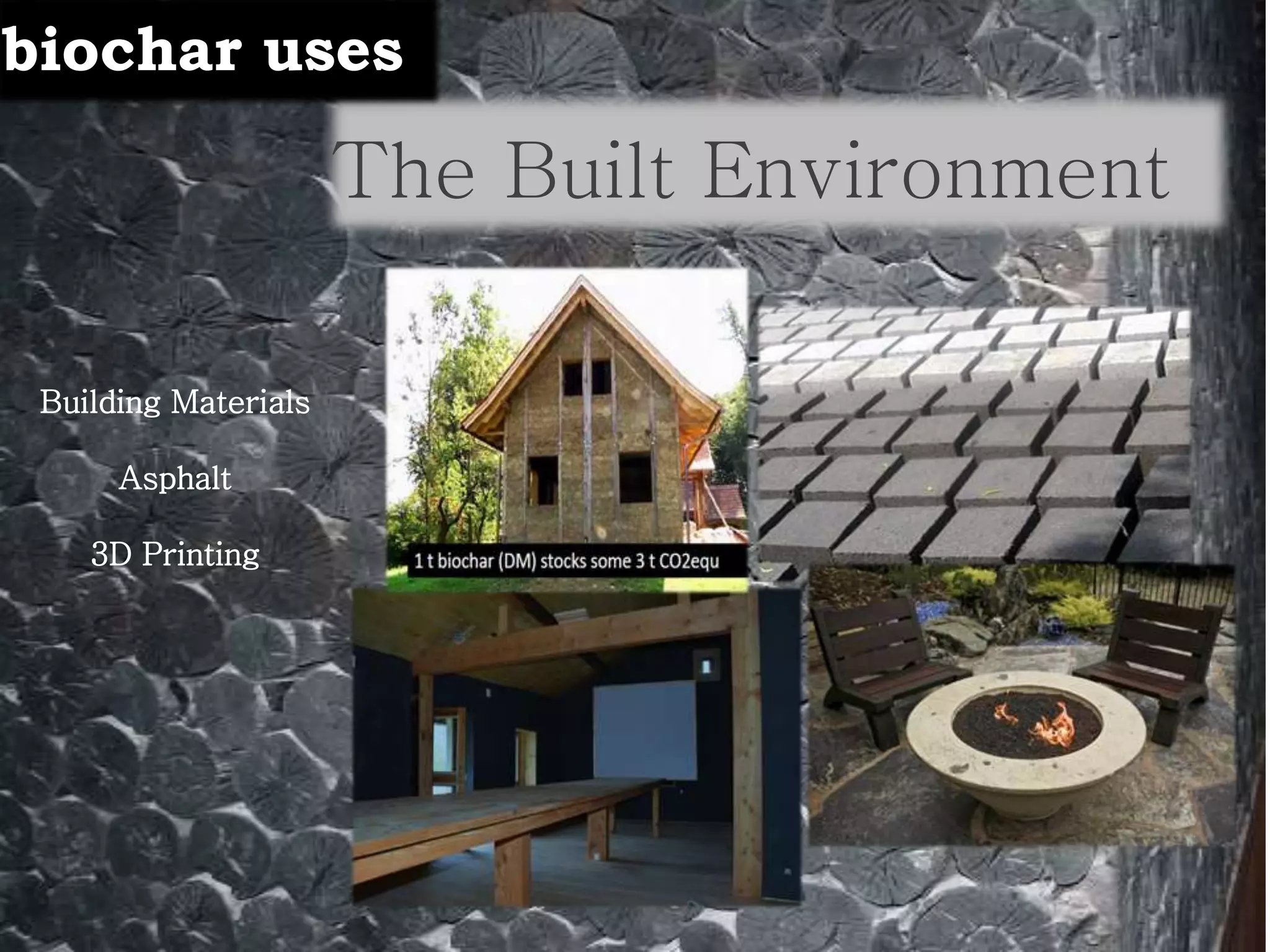
The Built Environment
Building Materials
Asphalt
3D Printing
biochar uses
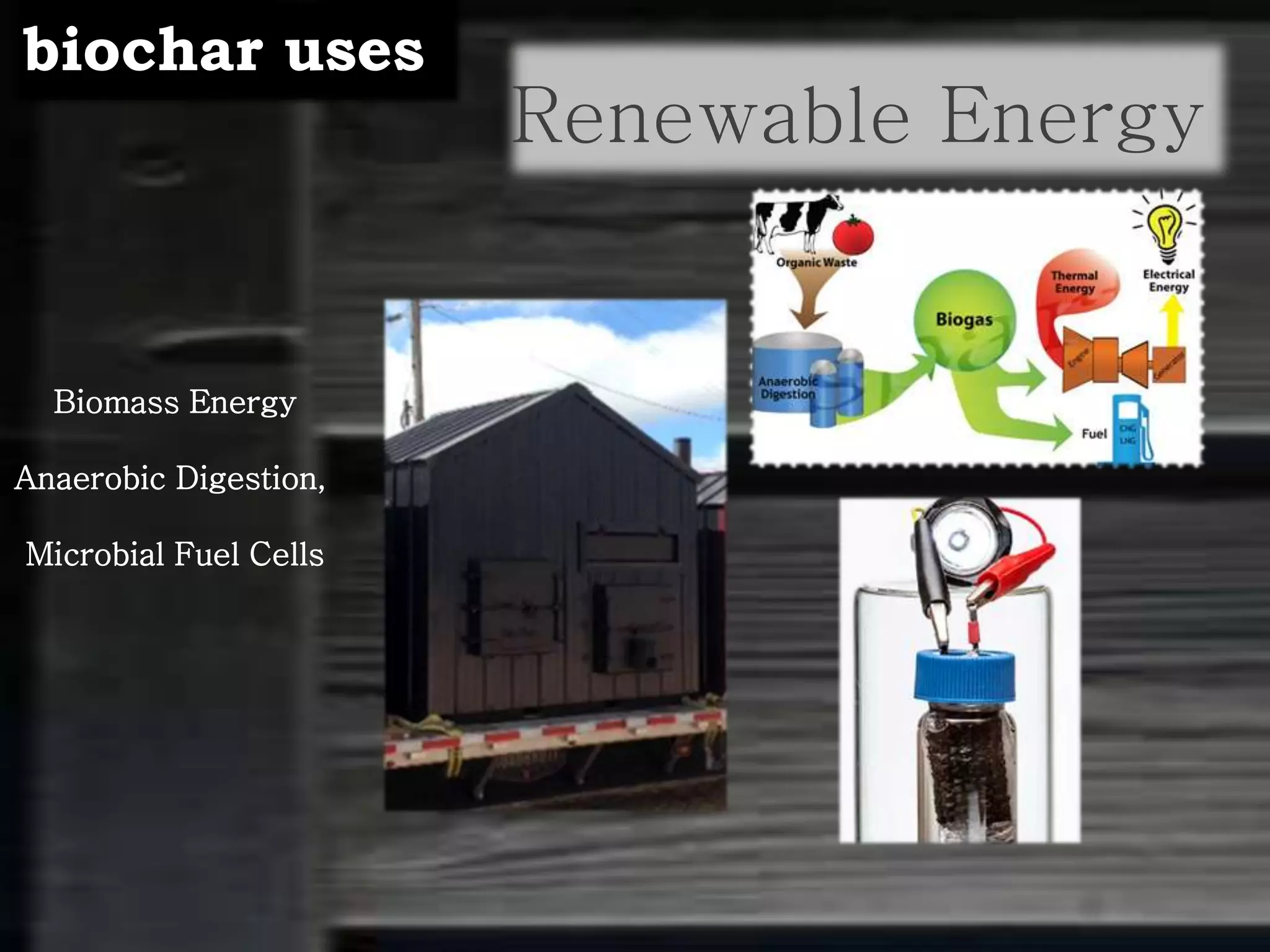
Renewable Energy
Biomass Energy
Anaerobic Digestion,
Microbial Fuel Cells
biochar uses
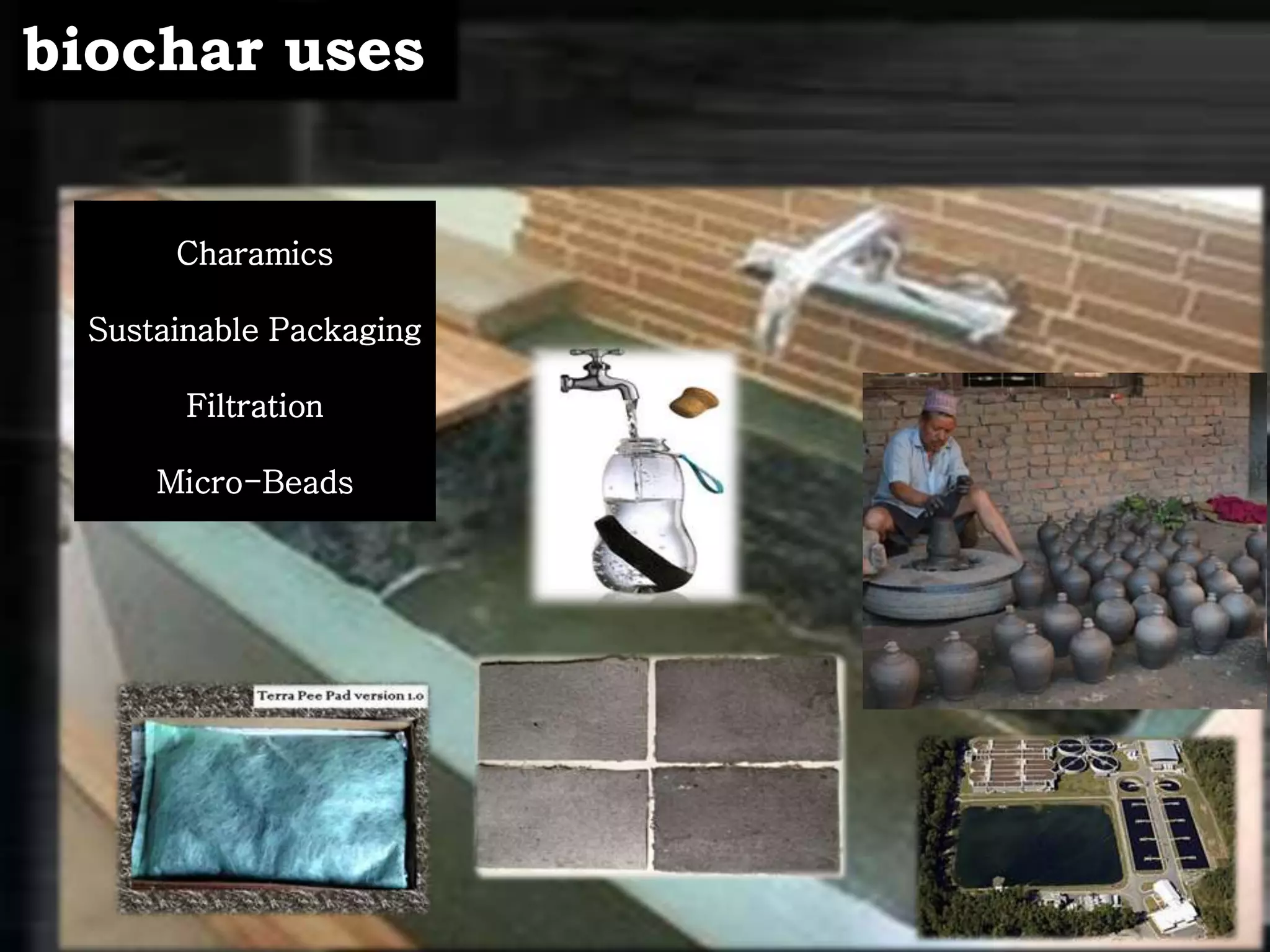
Charamics
Sustainable Packaging
Filtration
Micro-Beads
biochar uses
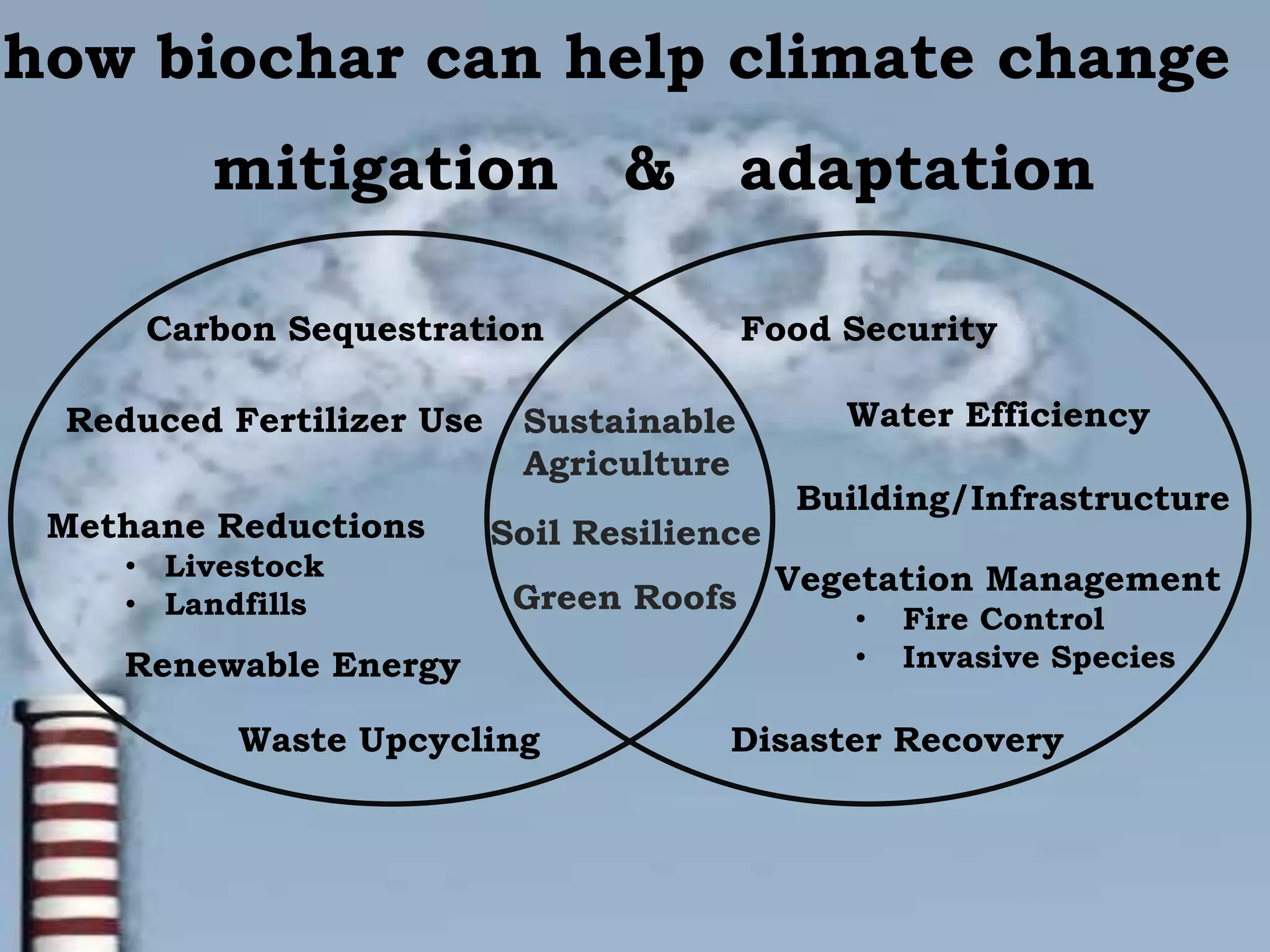
mitigation & adaptation
Carbon Sequestration
Renewable Energy
Methane Reductions
• Livestock
• Landfills
Reduced Fertilizer Use
Waste Upcycling
Soil Resilience
Green Roofs
Sustainable
Agriculture
Food Security
Water Efficiency
Disaster Recovery
Building/Infrastructure
Vegetation Management
• Fire Control
• Invasive Species
how biochar can help climate change
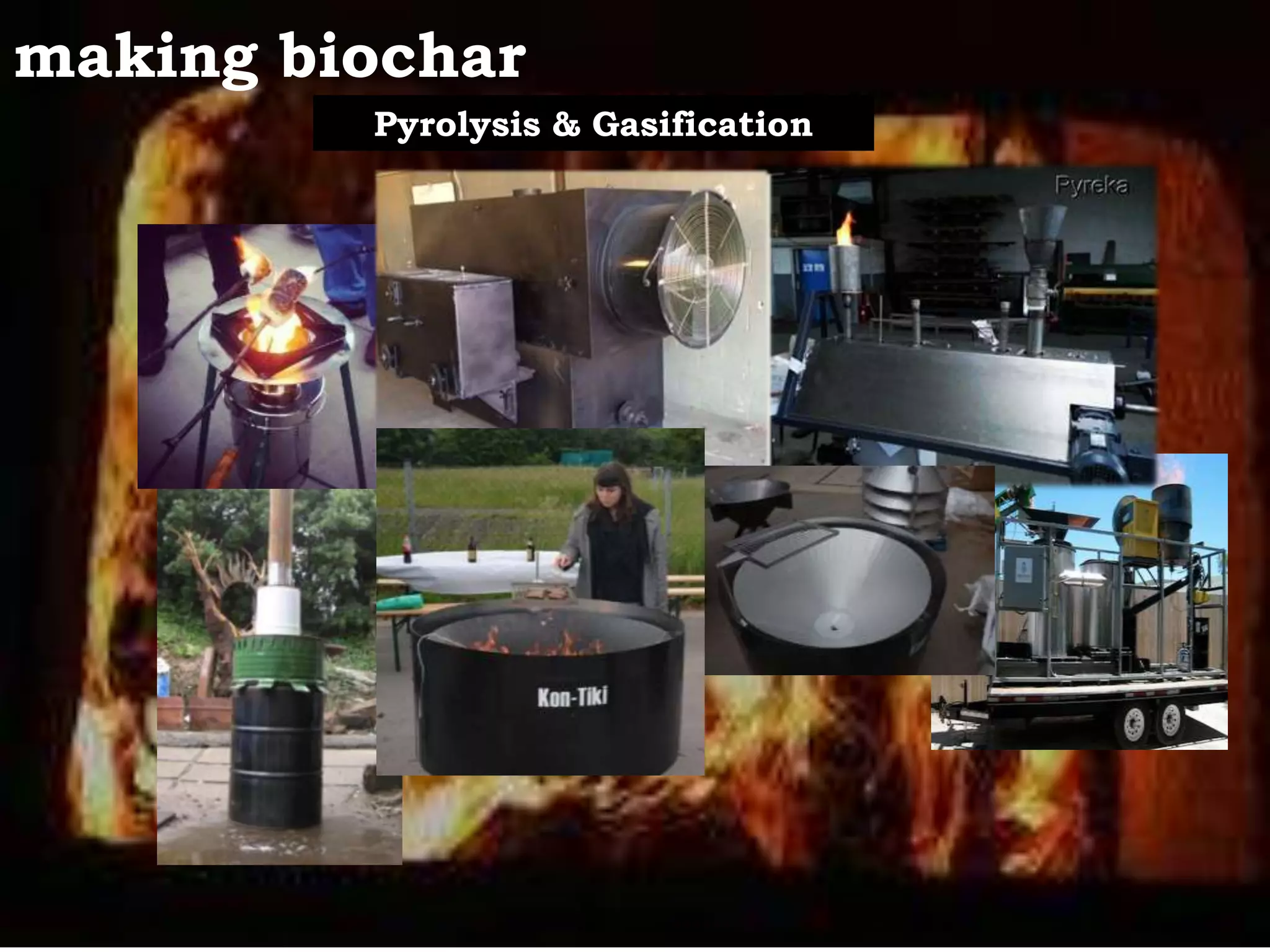
making biochar
Pyrolysis & Gasification
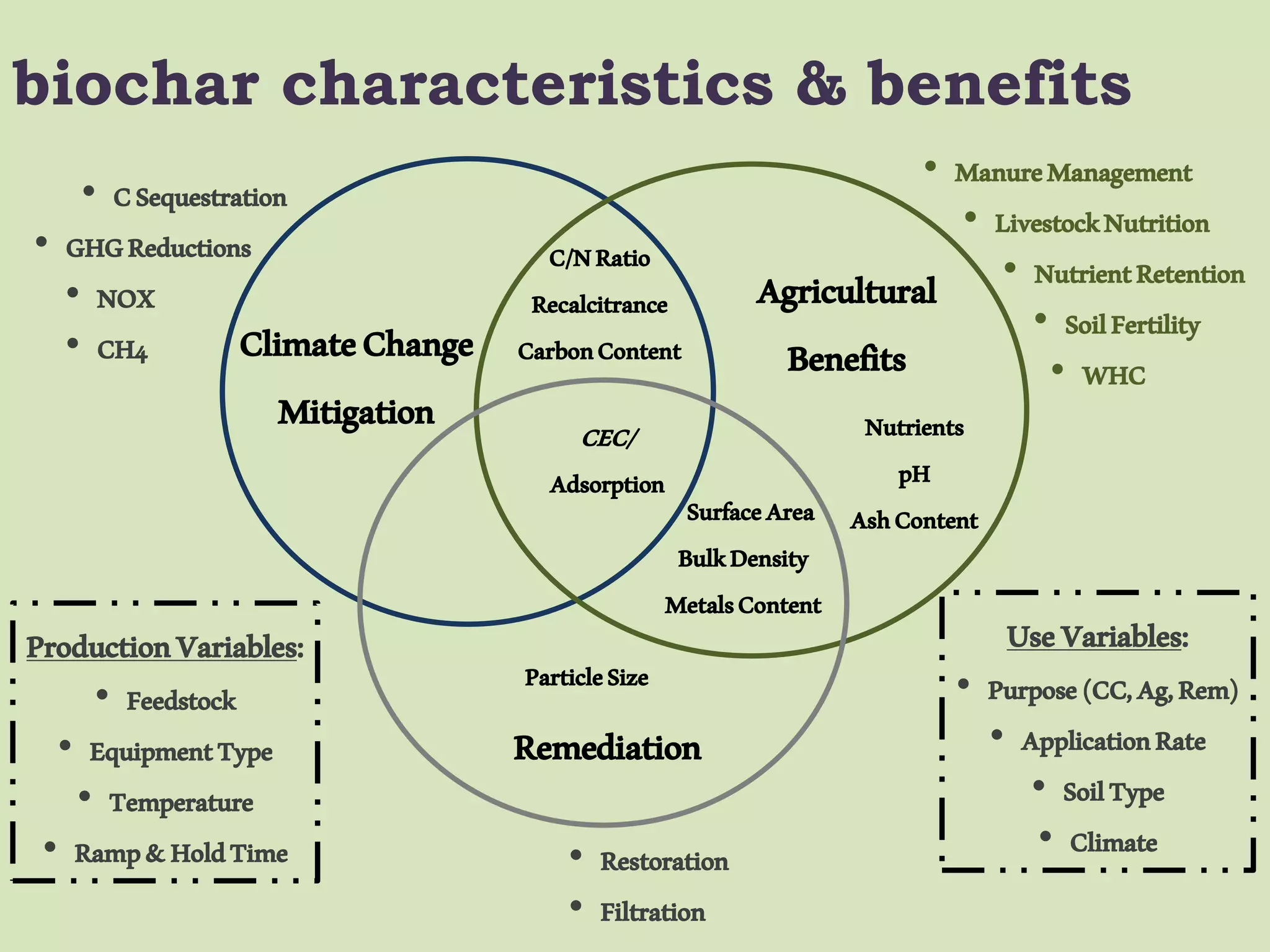
biochar characteristics & benefits
ClimateChange
Mitigation
Agricultural
Benefits
Remediation
C/NRatio
Recalcitrance
CarbonContent
Nutrients
pH
AshContentSurfaceArea
BulkDensity
MetalsContent
ParticleSize
CEC/
Adsorption
ProductionVariables:
• Feedstock
• EquipmentType
• Temperature
• Ramp&HoldTime
UseVariables:
• Purpose(CC,Ag,Rem)
• ApplicationRate
• SoilType
• Climate
• CSequestration
• GHGReductions
• NOX
• CH4
• ManureManagement
• LivestockNutrition
• NutrientRetention
• SoilFertility
• WHC
• Restoration
• Filtration
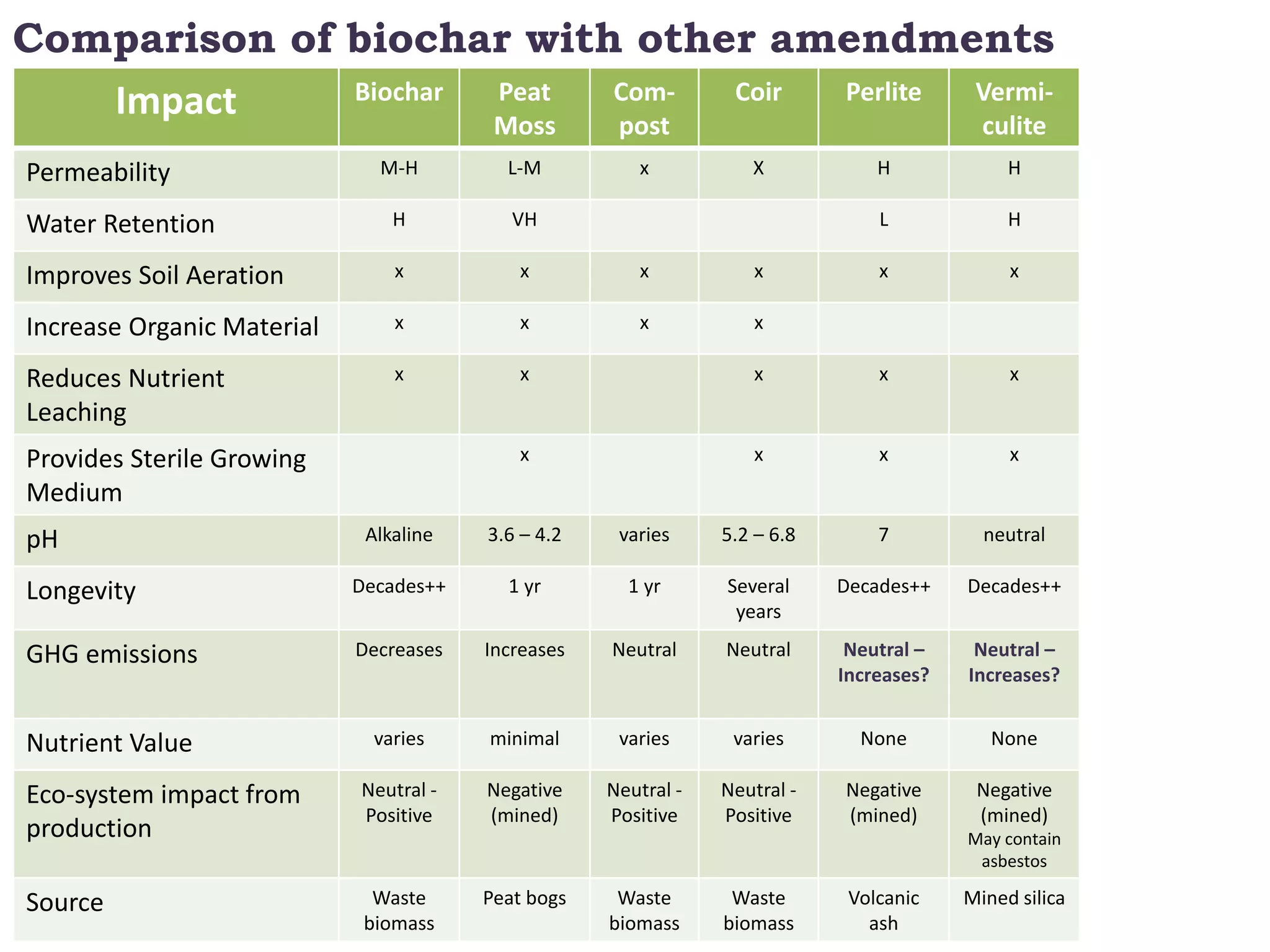
Impact Biochar Peat
Moss
Com-
post
Coir Perlite Vermi-
culite
Permeability M-H L-M x X H H
Water Retention H VH L H
Improves Soil Aeration x x x x x x
Increase Organic Material x x x x
Reduces Nutrient
Leaching
x x x x x
Provides Sterile Growing
Medium
x x x x
pH Alkaline 3.6 – 4.2 varies 5.2 – 6.8 7 neutral
Longevity Decades++ 1 yr 1 yr Several
years
Decades++ Decades++
GHG emissions Decreases Increases Neutral Neutral Neutral –
Increases?
Neutral –
Increases?
Nutrient Value varies minimal varies varies None None
Eco-system impact from
production
Neutral -
Positive
Negative
(mined)
Neutral -
Positive
Neutral -
Positive
Negative
(mined)
Negative
(mined)
May contain
asbestos
Source Waste
biomass
Peat bogs Waste
biomass
Waste
biomass
Volcanic
ash
Mined silica
Comparison of biochar with other amendments
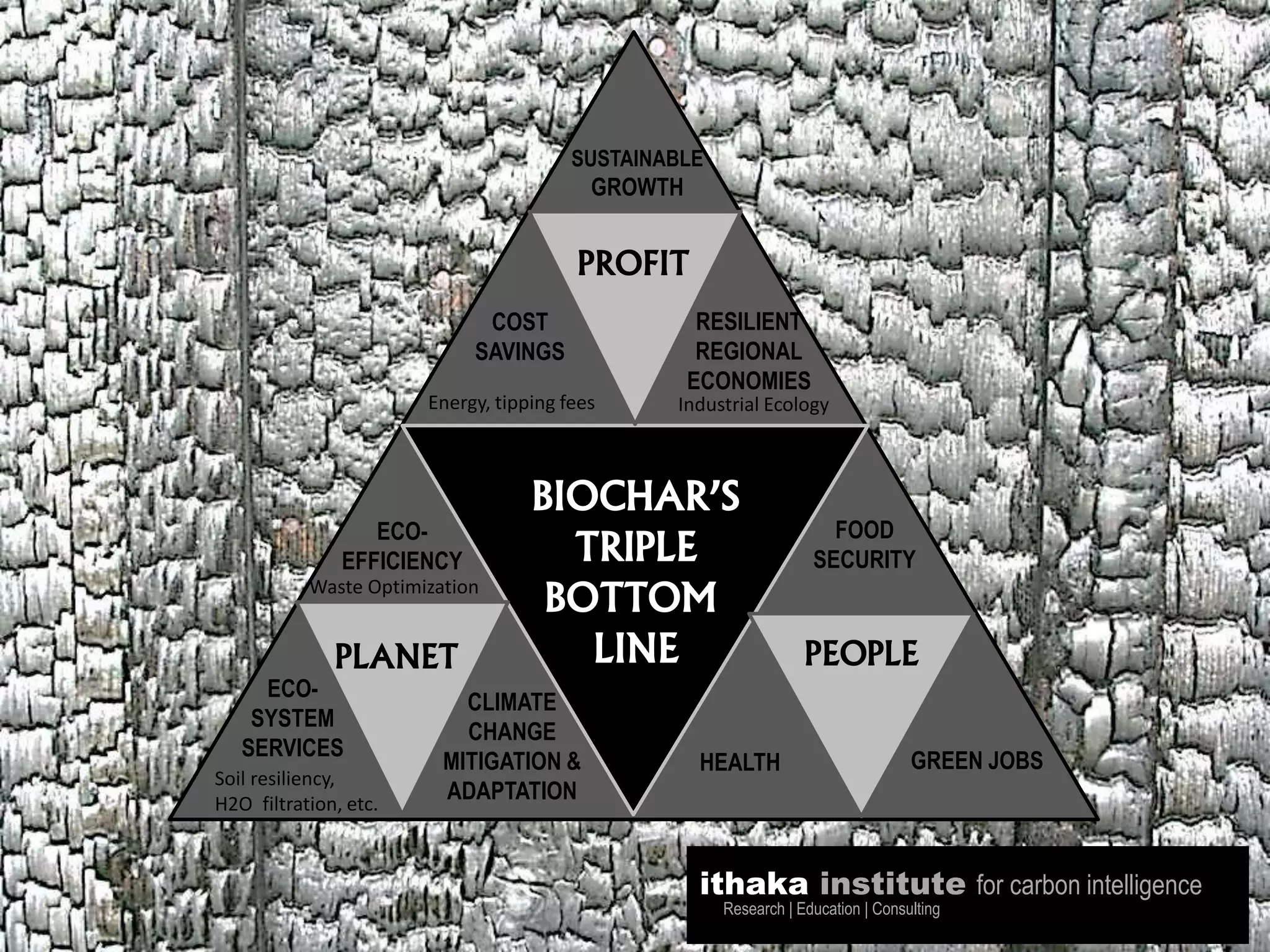
BIOCHAR’S
TRIPLE
BOTTOM
LINEPLANET PEOPLE
PROFIT
SUSTAINABLE
GROWTH
COST
SAVINGS
GREEN JOBS
ECO-
EFFICIENCY
FOOD
SECURITY
CLIMATE
CHANGE
MITIGATION &
ADAPTATION
ECO-
SYSTEM
SERVICES
HEALTH
Soil resiliency,
H2O filtration, etc.
Industrial Ecology
Waste Optimization
Energy, tipping fees
RESILIENT
REGIONAL
ECONOMIES
ithaka institute for carbon intelligence
Research | Education | Consulting
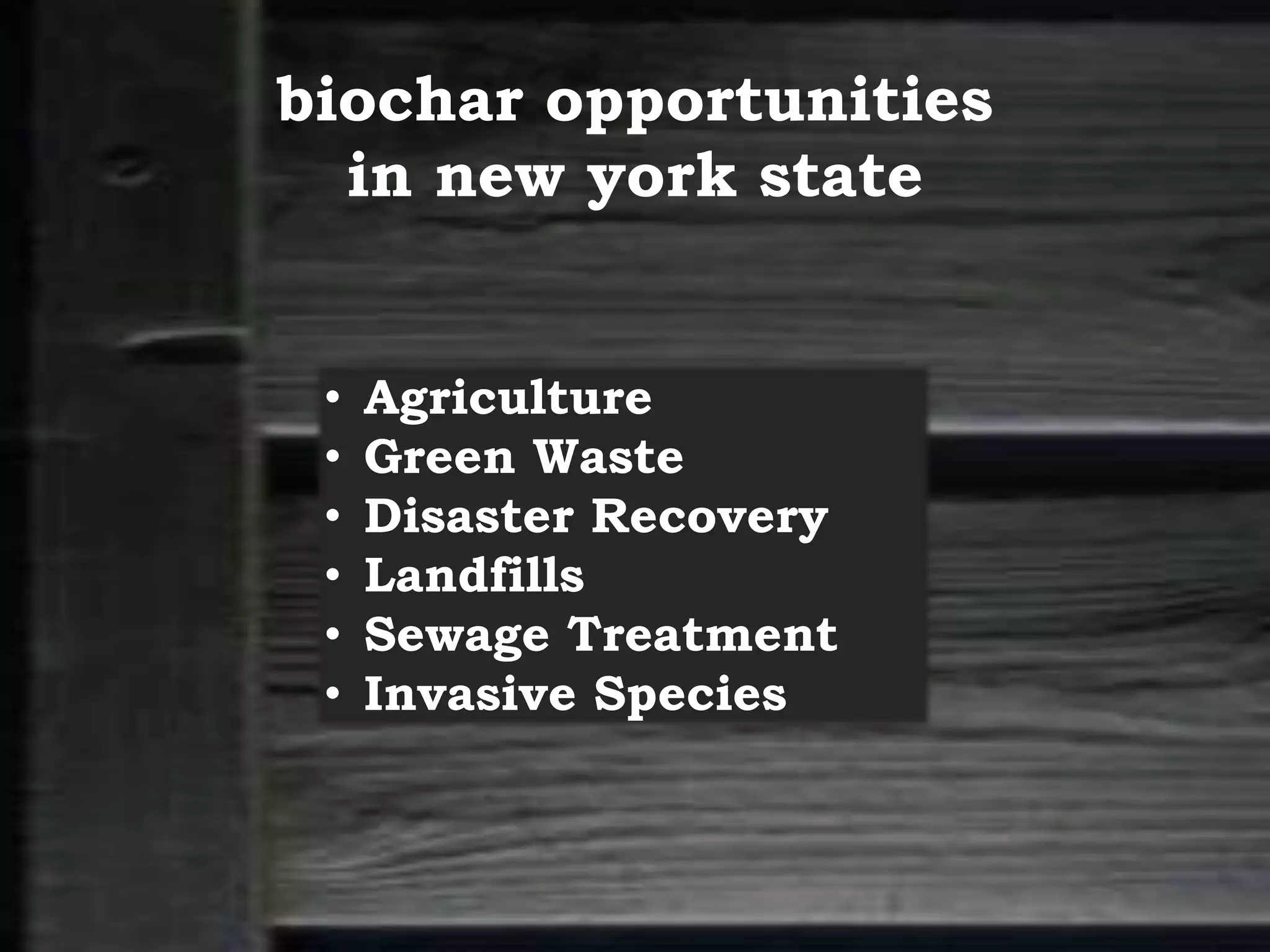
biochar opportunities
in new york state
• Agriculture
• Green Waste
• Disaster Recovery
• Landfills
• Sewage Treatment
• Invasive Species
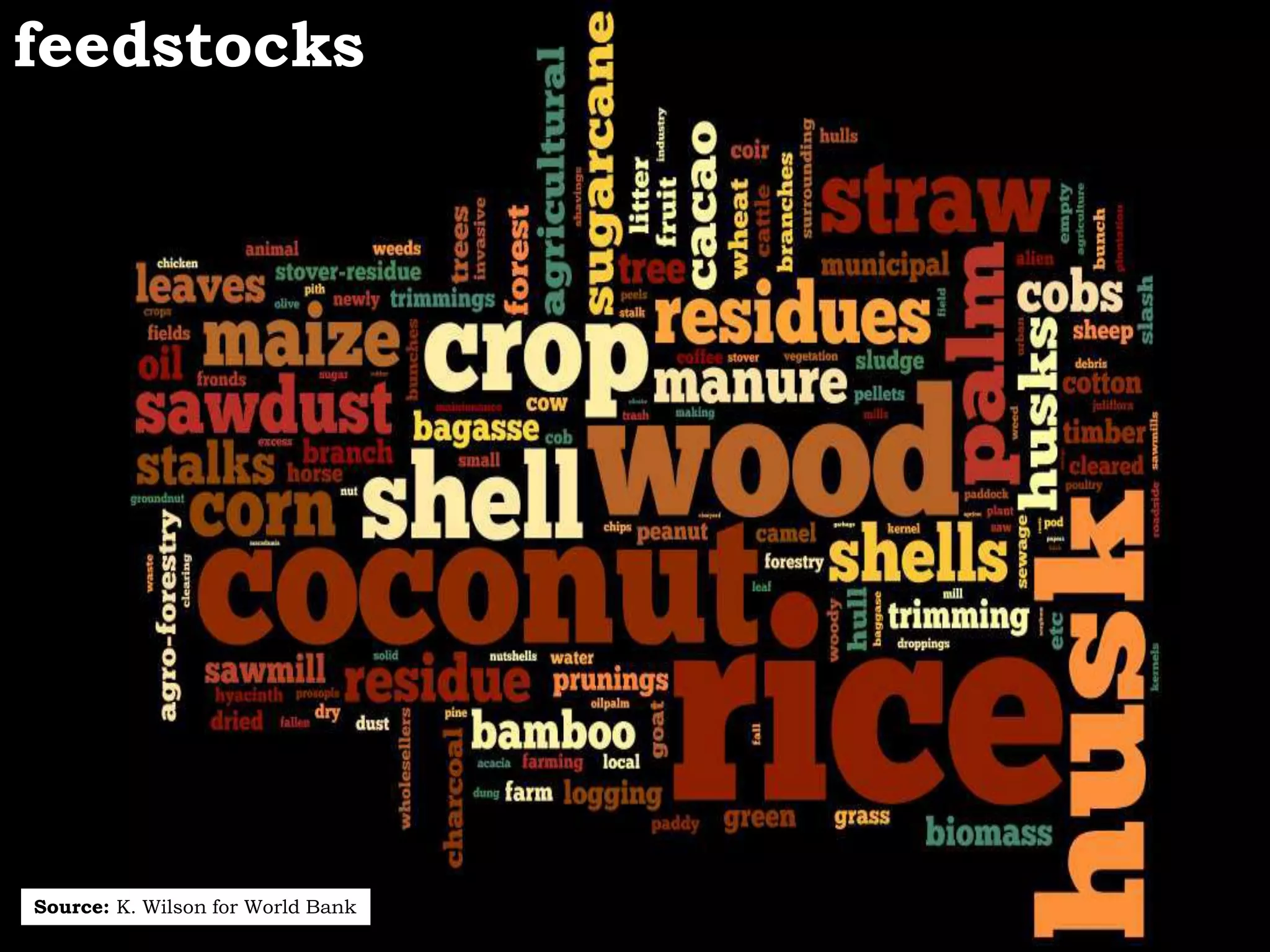
feedstocks
Source: K. Wilson for World Bank
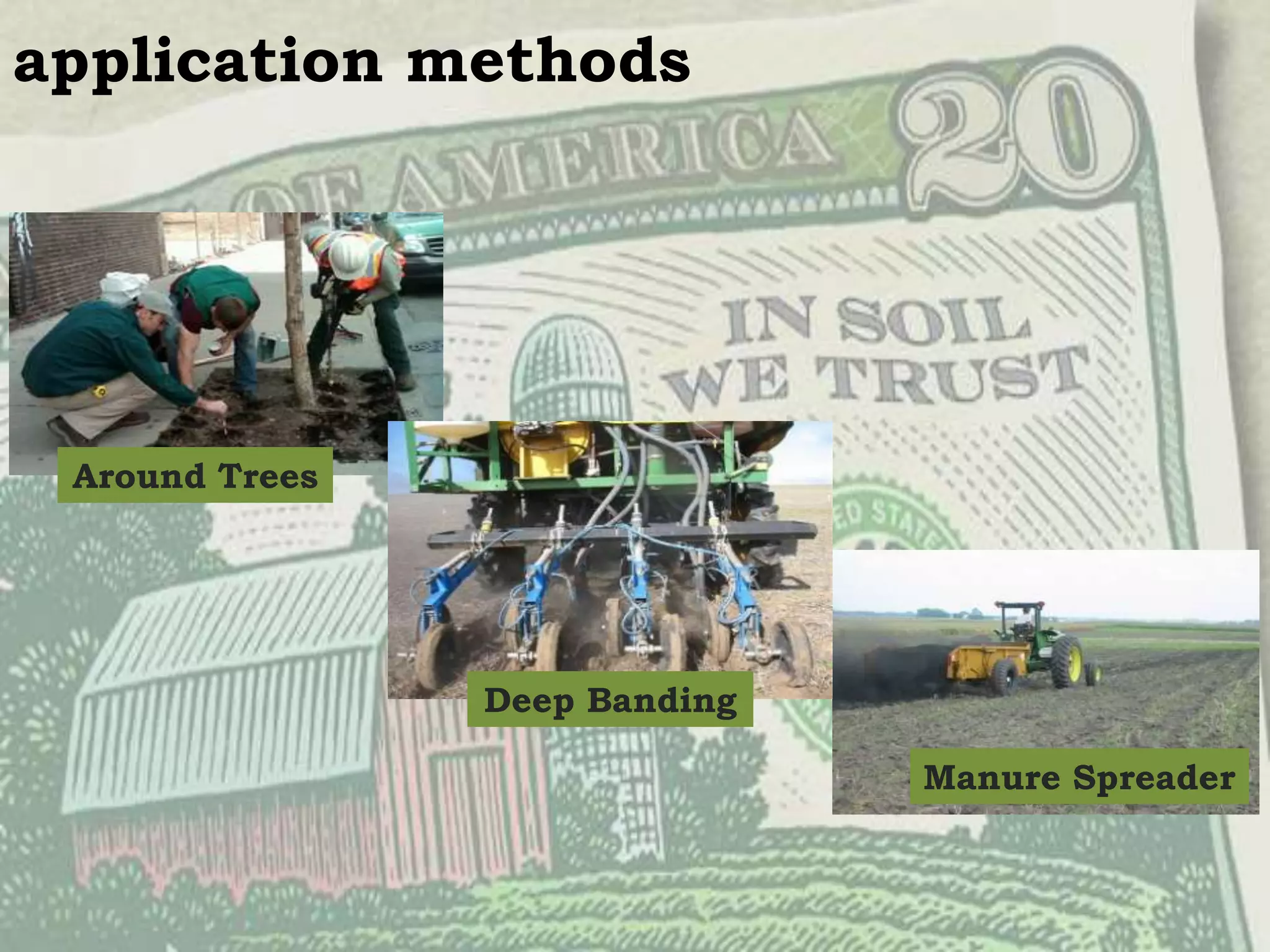
application methods
Manure Spreader
Around Trees
Deep Banding
any questions?

Burn & learn workshop

  • 1.
  • 2.
    Biochar Workshop Agenda • Whatis Biochar? • Markets & Uses • Biochar & Climate Change • Characteristics & Benefits • Comparison with other soil amendments • Triple Bottom Line • Biochar Opportunities in NYS • Feedstock • Producing Biochar • Application Methods
  • 3.
    The Carbon Family CharcoalBiochar Activated Carbon Feedstock Hardwood, sawdust + Binding Agents Ag, forestry & other organic materials/waste Coconut shells, peat, coal, petroleum pitch Common Uses Fuel (Cooking) Soil Amendment Remediation Filtration Binding Agent (livestock) Filtration Odor Control Remediation Binding Agent (humans) Relevant Qualities Burnability Low smoke Adsorption/Porosity CEC Sequestration Adsorption Cost $ - $$ $$ $$$ Production Slow Pyrolysis; Kiln Slow Pyrolysis; Kiln; Gasification Pyrolyzed at 600 – 900C + activated at 250C OR Chemically impregnated & cooked @ 450 – 900C Carbon Footprint Carbon Neutral: May lead to Deforestation Carbon Negative (in many situations) Carbon Positive
  • 5.
    soil functions Biochar’s Soil Function Impacts Adds stablecarbon to soils which stays in soil for hundreds of years. Other OM additions (e.g. manure, compost) bio- degrade in a few years. OM provides energy & nutrients to plants, stabilizes soil structures, improves resistance to erosion. Increased OM Most biochars have a strong surface charge (i.e. CEC) which helps hold nutrients in the soil while still making them available to plants. Soils enriched with biochar will need less fertilizer and will have less nutrient leaching thereby pre- venting eco-system damage. extremely light weight & highly porous giving it very low Bulk Density (BD). Soils with high BD (e.g. highly compacted soils) have poor root growth, low aeration and inefficient water filtration. Biochar added to compacted soils helps improve these soils functions. Biochar is improves bioactivity which improves resistance to disease & pests Due to biochar’s highly porous and stable nature, It provides an ideal environment for microbes. The amount & diversity of microbial activity in soils is a measure of its quality with higher activity indicating better soil. Adding biochar to compost speeds up the decomposition process due to Increased microbial activity. Biochar made from certain types of feedstocks such as poultry litter has material amounts of N-P-K. Biochar made from woody biomass generally does not have any significant N-P-K. When combined with nitrogen fertilizer the efficiency is improved resulting in higher yields and requiring less fertilizer use. Due to the large size of the pores (macro- pores) and its stability within the soil, biochar can provide a long term positive impact on soil water holding capacity. In sandy soils in particular, biochar can increase water holding capacity by as much as 50% at high application rates The sorptive properties (i.e. ability to attract and hold) of biochar help it to render toxins unavailable to plants. Biochar can help filter storm water and is useful in remediation efforts where toxic chemicals are found such as mine land remediation, fracking, chemical spills, etc. Most biochars are alkaline and will therefore help to reduce soil acidity and reduces short term liming needs. For alkaline soils, biochar may have no appreciable impact on yield. Maintaining proper soil ph improves nutrient efficiency and enables strong plant growth.
  • 6.
    Possible Benefits &Uses in Dairy Operations 1. 1% biochar addition into feed as binding agent • Improve feed conversion ratio • Reduce methane emissions • Reduce odors from manure 2. Combine biochar with manure • Retains more nutrients during composting • Stable C and enhanced nitrogen cycling • Reduces nutrient leaching into eco-system 3. Use in anaerobic digestion to boost methane production 4. Filter dairy wastewater 5. Used as bedding material 6. Neutralize toxins from footbaths (e.g. copper) biochar & dairy biochar uses
  • 7.
    biochar & viticulture Possiblebenefits & uses in viticulture 1. Reduced seasonal inputs (e.g. carbon additions) 2. Improve yield consistency within a vineyard or block. 3. Improve hydraulic management of water drainage and water holding capacity of soil. 4. Boost YAN. 5. Enhance cation exchange capacity and nutrient retention. 6. Promote beneficial microbial activity in soils and pathogen suppression 7. Healthier root growth and transplant vigor. 8. Less labor intensive vineyard floor management 9. Better aggregate stability, buffering capacity, bulk density and reduced compaction. 10. Neutralize toxins in soils. biochar uses
  • 8.
    The Built Environment BuildingMaterials Asphalt 3D Printing biochar uses
  • 9.
    Renewable Energy Biomass Energy AnaerobicDigestion, Microbial Fuel Cells biochar uses
  • 10.
  • 11.
    mitigation & adaptation CarbonSequestration Renewable Energy Methane Reductions • Livestock • Landfills Reduced Fertilizer Use Waste Upcycling Soil Resilience Green Roofs Sustainable Agriculture Food Security Water Efficiency Disaster Recovery Building/Infrastructure Vegetation Management • Fire Control • Invasive Species how biochar can help climate change
  • 12.
  • 13.
    biochar characteristics &benefits ClimateChange Mitigation Agricultural Benefits Remediation C/NRatio Recalcitrance CarbonContent Nutrients pH AshContentSurfaceArea BulkDensity MetalsContent ParticleSize CEC/ Adsorption ProductionVariables: • Feedstock • EquipmentType • Temperature • Ramp&HoldTime UseVariables: • Purpose(CC,Ag,Rem) • ApplicationRate • SoilType • Climate • CSequestration • GHGReductions • NOX • CH4 • ManureManagement • LivestockNutrition • NutrientRetention • SoilFertility • WHC • Restoration • Filtration
  • 14.
    Impact Biochar Peat Moss Com- post CoirPerlite Vermi- culite Permeability M-H L-M x X H H Water Retention H VH L H Improves Soil Aeration x x x x x x Increase Organic Material x x x x Reduces Nutrient Leaching x x x x x Provides Sterile Growing Medium x x x x pH Alkaline 3.6 – 4.2 varies 5.2 – 6.8 7 neutral Longevity Decades++ 1 yr 1 yr Several years Decades++ Decades++ GHG emissions Decreases Increases Neutral Neutral Neutral – Increases? Neutral – Increases? Nutrient Value varies minimal varies varies None None Eco-system impact from production Neutral - Positive Negative (mined) Neutral - Positive Neutral - Positive Negative (mined) Negative (mined) May contain asbestos Source Waste biomass Peat bogs Waste biomass Waste biomass Volcanic ash Mined silica Comparison of biochar with other amendments
  • 15.
    BIOCHAR’S TRIPLE BOTTOM LINEPLANET PEOPLE PROFIT SUSTAINABLE GROWTH COST SAVINGS GREEN JOBS ECO- EFFICIENCY FOOD SECURITY CLIMATE CHANGE MITIGATION& ADAPTATION ECO- SYSTEM SERVICES HEALTH Soil resiliency, H2O filtration, etc. Industrial Ecology Waste Optimization Energy, tipping fees RESILIENT REGIONAL ECONOMIES ithaka institute for carbon intelligence Research | Education | Consulting
  • 16.
    biochar opportunities in newyork state • Agriculture • Green Waste • Disaster Recovery • Landfills • Sewage Treatment • Invasive Species
  • 17.
  • 18.
  • 19.

Editor's Notes

  • #4 Before I dive into to how I think biochar can help improve sustainability in the food industry it might help to know what exactly biochar is. I’d like to quickly demystify what it is by introducing it in the context of its Carbon Family cousins: charcoal and activated carbon. All of these start with organic material which is heated in an oxygen limited environment – using varying temperatures and equipment – to dewater and carbonize biomass. One of the key differences between them all is the end use, but the carbon footprint is also vastly different. Charcoal is generally made from hardwoods or sawdust and is heated at relatively low temperatures (up to 450C). It is used, as you all know, mainly as a cooking fuel. The carbon footprint for charcoal production in the developing world is not good, and has been a cause of deforestation in some places. AC is heated at very high temperatures to bring about high surface area or porosity which provides it with characteristics that enable it to bind other organic materials or toxins to it. This is why it is used for remediation, filtration and odor reduction purposes. The Carbon Footprint of AC, like the cost is pretty high. Biochar can be produced from a much broader range of organic materials. I’ve brought a few samples with me if anyone would like to check them out later on. It is baked at temperatures ranging from 450 – 700C (generally), and the most common use for it at the moment is as a soil amendment although there are many areas of research going on right now to understand how it can be used as an AC substitute. The most interesting difference is the Carbon Footprint story….biochar can, in many cases, be considered Carbon Negative….talk about how this works
  • #7 Moving on to something that is a lot more familiar to this region which is Dairy farms. Dairy farms could benefit from biochar in a number of different ways… A growing area of concern in Western NY and I’m sure in VT has to do with an excess of manure. There are increasing regulatory controls being rolled out which restrict when and how manure can be applied to fields. One possible solution is to convert the manure and other bedding material into biochar. There are several different areas on a dairy farm where biochar could be used some of which have been outlined on this slide. http://www.sciencedaily.com/releases/2012/06/120605113723.htm http://www.ars.usda.gov/pandp/docs.htm?docid=10590&page=6
  • #15 14
  • #19 There are a number of different methods to apply biochar.