Telling, Selling, Compelling: Developing Community Engagement in Curriculum [email_address]   Rotorua New Zealand February 2009 learning@school  Shaping teaching and learning in the 21st century Ko te whenu hou te tau learning@school  Shaping teaching and learning in the 21st century Ko te whenu hou te tau
Is there anyone out there? http://www.flickr.com/photos/22406241@N00/786604087/
http://www.flickr.com/photos/10816734@N03/3029590673/
What do these two stories have in common? What is your experience?
New curriculum Old paradigm Isn’t it time we looked at doing things differently?
Lessons from Rwanda Look for the people who are making a difference and use them to act as amplifiers. Seth Godin - Tribes
http://www.educationcounts.govt.nz/publications/pasifika_education/5907 Effective Engagement of Pasifika According to Lareau (1989), teachers perceive parental involvement as including preparing children with school-ready skills such as alphabet and number knowledge; attending school events and fulfilling requests that teachers make of parents. Family involvement in school life has historically been prescriptive, with parents rarely invited to contribute to what the parent community-school partnership might look like (Valdes, 1996).
If you always do what you’ve always done…  Einstein’s definition of insanity - doing the same thing over and over again and expecting different results.  www.flickr.com/photos/26403449@N00/71661420
The Power of the NZC It gives schools greater flexibility to design and implement curriculum that is tailored to the learning needs of their students and the expectations of their communities. Full engagement with those who have an interest in the outcomes, including the students themselves
Collaborative Engagement - Engaging the Community Students learn anywhere, at any time, and from anyone. This has implications for school curriculum design. It means that, as well as teachers, students, families, whanau, and the wider community must be involved in the process of designing curriculum – The New Zealand Curriculum assumes that schools will seek out and listen to the ideas and concerns of these different groups.
Your culture? Halt - who goes there? Come if you’re called Welcome to our school… … ‘ wassup’ at your place…
Research… Family involvement ≠Family engagement Need to see that the community adds value -not just parents Trust is essential - both ways - it is an attitude thing - an invisible culture Understanding - empathy eg visiting  Parents self efficacy - they have an effect on their children’s education Help parents ask better questions of their children. Dr Steven M. Constantino  http://www.familyfriendlyschools.com/index.asp
Phase One: Leading participation in the design & review of the school’s curriculum What roles should our teachers, our students, our families, our whanau, and our wider community play in the design and review of the curriculum? What vital information can we set out to gather, and how can we use if for curriculum decision making?
Phase 2: Developing processes for involvement and feedback that can be sustained in the longer term What process can we use to stimulate interest in, and get feedback on, our curriculum, its impact, and its relevance? How will we assure students and the community that their feedback is valued and used?
Engaging the disengaged Reduce the chances of misinterpretations and misunderstandings. The best of what parents and teachers have to offer to students, to each other, and to their school community will not be fully realized until they learn to talk to each other . . . until they “L e arn each other.” Dr Steven Constantino - Engaging all families http://www.familyfriendlyschools.com/index.asp
What are the features of highly effective engagement?
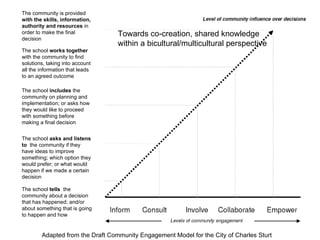
Community Engagement Community engagement is “any process that involves the public in  problem-solving  or  decision making  and uses the public input to make  more   informed decisions …Engaging the community is more than just consulting…[it] includes  informing, consulting with, involving, collaborating with  and  empowering  the community.” Draft Community Engagement Model for the City of Charles Sturt
http://voicethread.com/share/361503/ The five levels of engagement discussed on the following slides can be commented on at:
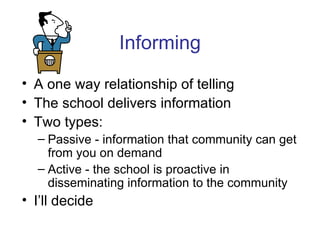
Informing A one way relationship of telling The school delivers information Two types: Passive - information that community can get from you on demand Active - the school is proactive in disseminating information to the community I’ll decide
Consulting A two way relationship - selling The community provides feedback to the school The school decides what it wants feedback on, gives information and receives information back from the community We’ll discuss - I’ll decide
www. wordle .com www.surveymonkey.com
Involving Community actively involved in the design of the school curriculum from the beginning Developing the new We’ll discuss - I’ll decide
http://www.islandbay.school.nz/ Thanks to Island Bay School
Collaborating A relationship based on partnership with the school Working together to find solutions We’ll discuss and we’ll decide
Knowledge Cafe Real outcome is what you take away in your head New connections with people A deeper understanding of the issue discussed A deeper understanding and insight into other people’s perspectives A better appreciation of your own point of view and how it is seen by others A better knowledge of what you know and don’t know and what others know and don’t know In a better position to make more informed decisions David Gurteen   gurteen.com
Use of Personas Gather information about your groups Create a persona for each of the groups Know that within this there will be multiple voices but it gives something to check against What would they think about education, what questions would they ask, what would be the best way to engage them? For further information go to www.designindustry.co.nz
Empowering A relationship based on trust between the school and community members Community provided with skills, information, authority and resources Community actively engaged in the design of the school curriculum We’ll discuss - you decide Tania’s story - Glenbervie School
The community is provided  with the skills, information, authority and resources  in order to make the final decision The school  works together  with the community to find solutions, taking into account all the information that leads to an agreed outcome The school  includes  the community on planning and implementation; or asks how they would like to proceed with something before making a final decision The school  asks and listens to  the community if they have ideas to improve something; which option they would prefer; or what would happen if we made a certain decision The school  tells  the community about a decision that has happened; and/or about something that is going to happen and how Adapted from the Draft Community Engagement Model for the City of Charles Sturt Towards co-creation, shared knowledge within a bicultural/multicultural perspective
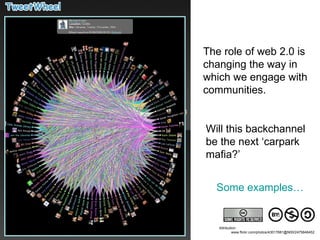
Attribution: www.flickr.com/photos/43017881@N00/2475846452 The role of web 2.0 is changing the way in which we engage with communities. Will this backchannel be the next ‘carpark mafia?’ Some examples…
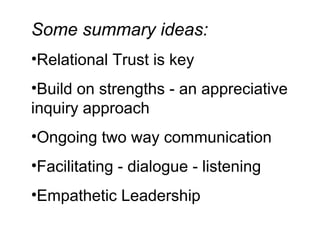
Some summary ideas: Relational Trust is key Build on strengths - an appreciative inquiry approach Ongoing two way communication  Facilitating - dialogue - listening Empathetic Leadership
Where can I find out more information? http://nzcurriculum.tki.org.nz/nzc_resource_bank  NZ Curriculum Online http://www.familyfriendlyschools.com/index.asp http://communityengagement.wetpaint.com/ (This wiki has been set up especially for these notes and ideas) www. thinkbeyond .co. nz  (you can also get to the wiki here - click on education tab - engagement
Examples provided… http://www. fendalton .school.nz/ http://www. paulsibson .com/ http: //fendaltonesol . wetpaint .com/ http: //albanyseniorhigh .school. nz/ http: //onceuponaschool .org/ http://aranui4leaders. wordpress .com/ If you know of any ex-pupils from Aranui High School please direct them to aranui4leaders

Community Engagement L@S

  • 1.
    Telling, Selling, Compelling:Developing Community Engagement in Curriculum [email_address] Rotorua New Zealand February 2009 learning@school Shaping teaching and learning in the 21st century Ko te whenu hou te tau learning@school Shaping teaching and learning in the 21st century Ko te whenu hou te tau
  • 2.
    Is there anyoneout there? http://www.flickr.com/photos/22406241@N00/786604087/
  • 3.
  • 4.
    What do thesetwo stories have in common? What is your experience?
  • 5.
    New curriculum Oldparadigm Isn’t it time we looked at doing things differently?
  • 6.
    Lessons from RwandaLook for the people who are making a difference and use them to act as amplifiers. Seth Godin - Tribes
  • 7.
    http://www.educationcounts.govt.nz/publications/pasifika_education/5907 Effective Engagementof Pasifika According to Lareau (1989), teachers perceive parental involvement as including preparing children with school-ready skills such as alphabet and number knowledge; attending school events and fulfilling requests that teachers make of parents. Family involvement in school life has historically been prescriptive, with parents rarely invited to contribute to what the parent community-school partnership might look like (Valdes, 1996).
  • 8.
    If you alwaysdo what you’ve always done… Einstein’s definition of insanity - doing the same thing over and over again and expecting different results. www.flickr.com/photos/26403449@N00/71661420
  • 9.
    The Power ofthe NZC It gives schools greater flexibility to design and implement curriculum that is tailored to the learning needs of their students and the expectations of their communities. Full engagement with those who have an interest in the outcomes, including the students themselves
  • 10.
    Collaborative Engagement -Engaging the Community Students learn anywhere, at any time, and from anyone. This has implications for school curriculum design. It means that, as well as teachers, students, families, whanau, and the wider community must be involved in the process of designing curriculum – The New Zealand Curriculum assumes that schools will seek out and listen to the ideas and concerns of these different groups.
  • 11.
    Your culture? Halt- who goes there? Come if you’re called Welcome to our school… … ‘ wassup’ at your place…
  • 12.
    Research… Family involvement≠Family engagement Need to see that the community adds value -not just parents Trust is essential - both ways - it is an attitude thing - an invisible culture Understanding - empathy eg visiting Parents self efficacy - they have an effect on their children’s education Help parents ask better questions of their children. Dr Steven M. Constantino http://www.familyfriendlyschools.com/index.asp
  • 13.
    Phase One: Leadingparticipation in the design & review of the school’s curriculum What roles should our teachers, our students, our families, our whanau, and our wider community play in the design and review of the curriculum? What vital information can we set out to gather, and how can we use if for curriculum decision making?
  • 14.
    Phase 2: Developingprocesses for involvement and feedback that can be sustained in the longer term What process can we use to stimulate interest in, and get feedback on, our curriculum, its impact, and its relevance? How will we assure students and the community that their feedback is valued and used?
  • 15.
    Engaging the disengagedReduce the chances of misinterpretations and misunderstandings. The best of what parents and teachers have to offer to students, to each other, and to their school community will not be fully realized until they learn to talk to each other . . . until they “L e arn each other.” Dr Steven Constantino - Engaging all families http://www.familyfriendlyschools.com/index.asp
  • 16.
    What are thefeatures of highly effective engagement?
  • 17.
    Community Engagement Communityengagement is “any process that involves the public in problem-solving or decision making and uses the public input to make more informed decisions …Engaging the community is more than just consulting…[it] includes informing, consulting with, involving, collaborating with and empowering the community.” Draft Community Engagement Model for the City of Charles Sturt
  • 18.
    http://voicethread.com/share/361503/ The fivelevels of engagement discussed on the following slides can be commented on at:
  • 19.
    Informing A oneway relationship of telling The school delivers information Two types: Passive - information that community can get from you on demand Active - the school is proactive in disseminating information to the community I’ll decide
  • 20.
    Consulting A twoway relationship - selling The community provides feedback to the school The school decides what it wants feedback on, gives information and receives information back from the community We’ll discuss - I’ll decide
  • 21.
    www. wordle .comwww.surveymonkey.com
  • 22.
    Involving Community activelyinvolved in the design of the school curriculum from the beginning Developing the new We’ll discuss - I’ll decide
  • 23.
  • 24.
    Collaborating A relationshipbased on partnership with the school Working together to find solutions We’ll discuss and we’ll decide
  • 25.
    Knowledge Cafe Realoutcome is what you take away in your head New connections with people A deeper understanding of the issue discussed A deeper understanding and insight into other people’s perspectives A better appreciation of your own point of view and how it is seen by others A better knowledge of what you know and don’t know and what others know and don’t know In a better position to make more informed decisions David Gurteen gurteen.com
  • 26.
    Use of PersonasGather information about your groups Create a persona for each of the groups Know that within this there will be multiple voices but it gives something to check against What would they think about education, what questions would they ask, what would be the best way to engage them? For further information go to www.designindustry.co.nz
  • 27.
    Empowering A relationshipbased on trust between the school and community members Community provided with skills, information, authority and resources Community actively engaged in the design of the school curriculum We’ll discuss - you decide Tania’s story - Glenbervie School
  • 28.
    The community isprovided with the skills, information, authority and resources in order to make the final decision The school works together with the community to find solutions, taking into account all the information that leads to an agreed outcome The school includes the community on planning and implementation; or asks how they would like to proceed with something before making a final decision The school asks and listens to the community if they have ideas to improve something; which option they would prefer; or what would happen if we made a certain decision The school tells the community about a decision that has happened; and/or about something that is going to happen and how Adapted from the Draft Community Engagement Model for the City of Charles Sturt Towards co-creation, shared knowledge within a bicultural/multicultural perspective
  • 29.
    Attribution: www.flickr.com/photos/43017881@N00/2475846452 Therole of web 2.0 is changing the way in which we engage with communities. Will this backchannel be the next ‘carpark mafia?’ Some examples…
  • 30.
    Some summary ideas:Relational Trust is key Build on strengths - an appreciative inquiry approach Ongoing two way communication Facilitating - dialogue - listening Empathetic Leadership
  • 31.
    Where can Ifind out more information? http://nzcurriculum.tki.org.nz/nzc_resource_bank NZ Curriculum Online http://www.familyfriendlyschools.com/index.asp http://communityengagement.wetpaint.com/ (This wiki has been set up especially for these notes and ideas) www. thinkbeyond .co. nz (you can also get to the wiki here - click on education tab - engagement
  • 32.
    Examples provided… http://www.fendalton .school.nz/ http://www. paulsibson .com/ http: //fendaltonesol . wetpaint .com/ http: //albanyseniorhigh .school. nz/ http: //onceuponaschool .org/ http://aranui4leaders. wordpress .com/ If you know of any ex-pupils from Aranui High School please direct them to aranui4leaders

Editor's Notes

  • #2 Part 1 will provide some information about community engagement - Here’s what Part 2 - will give some examples of the so what Part 3 will ask you to reflect on the so what - making connections It is easy to say that wouldn’t apply to our school. There is no one way… "gripping", "compelling", "riveting", and "absorbing” as different from forcing. More about irresistibly or keenly interesting, attractive, etc.; captivating This is Tribes