The views expressed in this presentation are the views of the author/s and do not necessarily reflect the views or policies of the Asian
Development Bank, or its Board of Governors, or the governments they represent. ADB does not guarantee the accuracy of the data included
in this presentation and accepts no responsibility for any consequence of their use. The countries listed in this presentation do not imply any
view on ADB's part as to sovereignty or independent status or necessarily conform to ADB's terminology.
A Guide to Political Economy
Analysis
Olivier Serrat
2013
Define:Political Economy
Economics—the social science that
deals with the production, distribution,
and consumption of material wealth
and with the theory and management
of economic systems—was once called
political economy. This conveyed the
belief that political considerations—
and the interest groups that drive
them—determine influence and thus
economic outcomes at (almost) any
level of investigation.
With the division of
economics and
political science into
distinct disciplines
from the 1890s,
neoclassical
economists turned
from analyses of
power and authority
to models that,
inherently, remove
much complexity.
Define:Political Economy
Obviously, power and
authority come to the
fore when
heterogeneity of
interest leads to
conflict among actors
and does not
necessarily lead to
optimal use of scarce
resources.
Today, political economists study
interrelationships between political
and economic institutions (or forces)
and processes. They appreciate politics
as the sum of activities—involving
cooperation, conflict, and
negotiation—that shape decisions
touching the production, consumption,
and transfer of scarce resources,
irrespective of whether the activities
are formal or informal, public or
private, or a combination thereof.
Define:Political Economy
Explicitly, political economy is founded on the predicament of
economic choices in a society comprising heterogeneous agents.
Its focus differs from that of welfare economics: the issue is not
the technical problem of what implications different welfare
weights might have but the political problem of how weights are
ascribed and the processes associated with that.
Define:Political Economy
I claim that
human mind or
human society
is not divided
into watertight
compartments
called social,
political, and
religious. All act
and react upon
one another.—
Mohandas K.
Gandhi
It is only the novice in political economy who
thinks it is the duty of government to make
its citizens happy.—Government has no such
office. To protect the weak and the minority
from the impositions of the strong and the
majority—to prevent anyone from positively
working to render the people unhappy, (if we
may so express it,) to do the labor not of an
officious inter-meddler in the affairs of men,
but of a prudent watchman who prevents
outrage—these are rather the proper duties
of a government.—Walt Whitman
On Political Economy Analysis
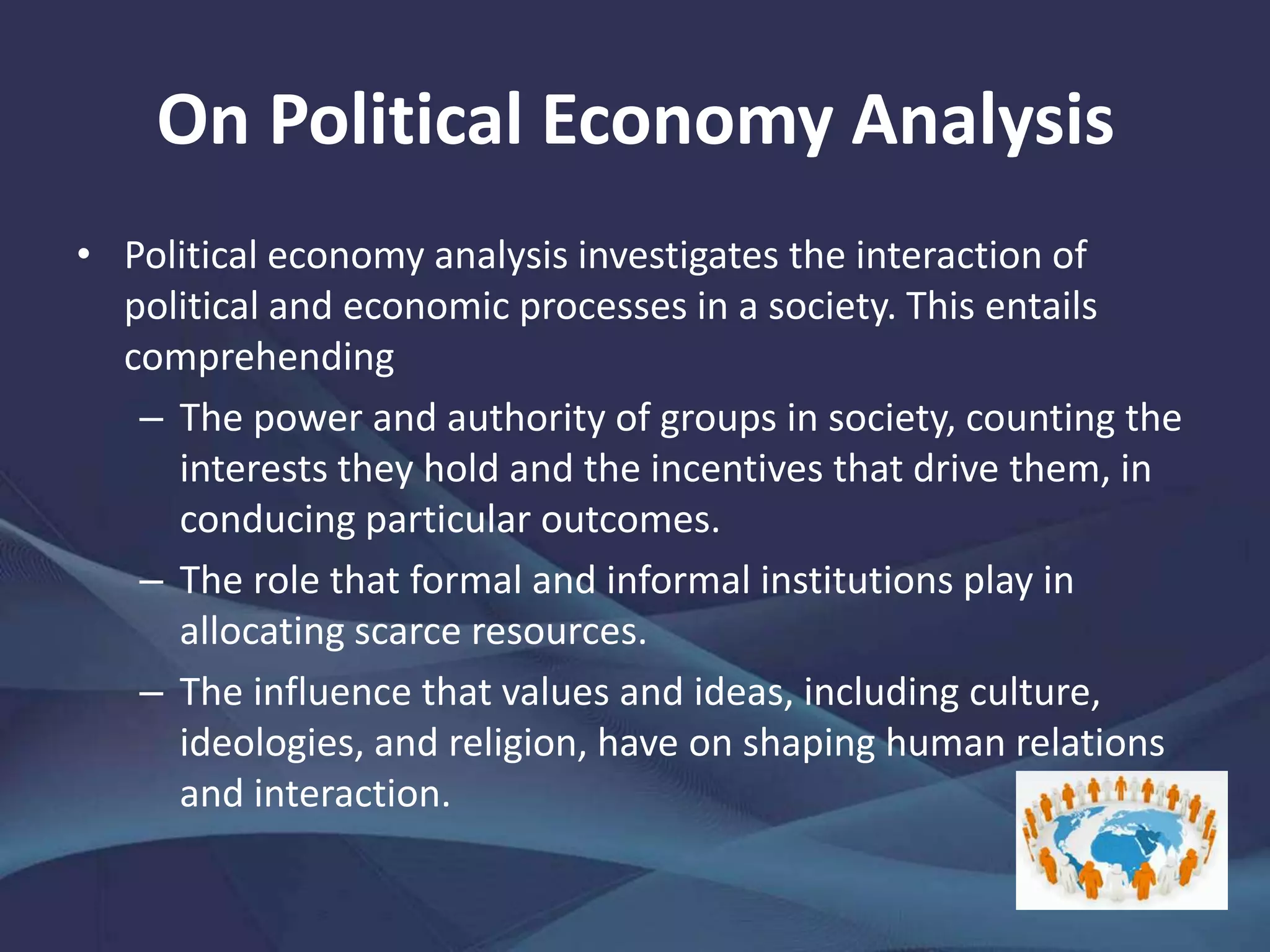
Political economy analysis investigates the interaction of political
and economic processes in a society. This entails comprehending
• The power and authority of groups in society, counting the
interests they hold and the incentives that drive them, in
conducing particular outcomes.
• The role that formal and informal institutions play in allocating
scarce resources.
• The influence that values and ideas, including culture,
ideologies, and religion, have on shaping human relations and
interaction.
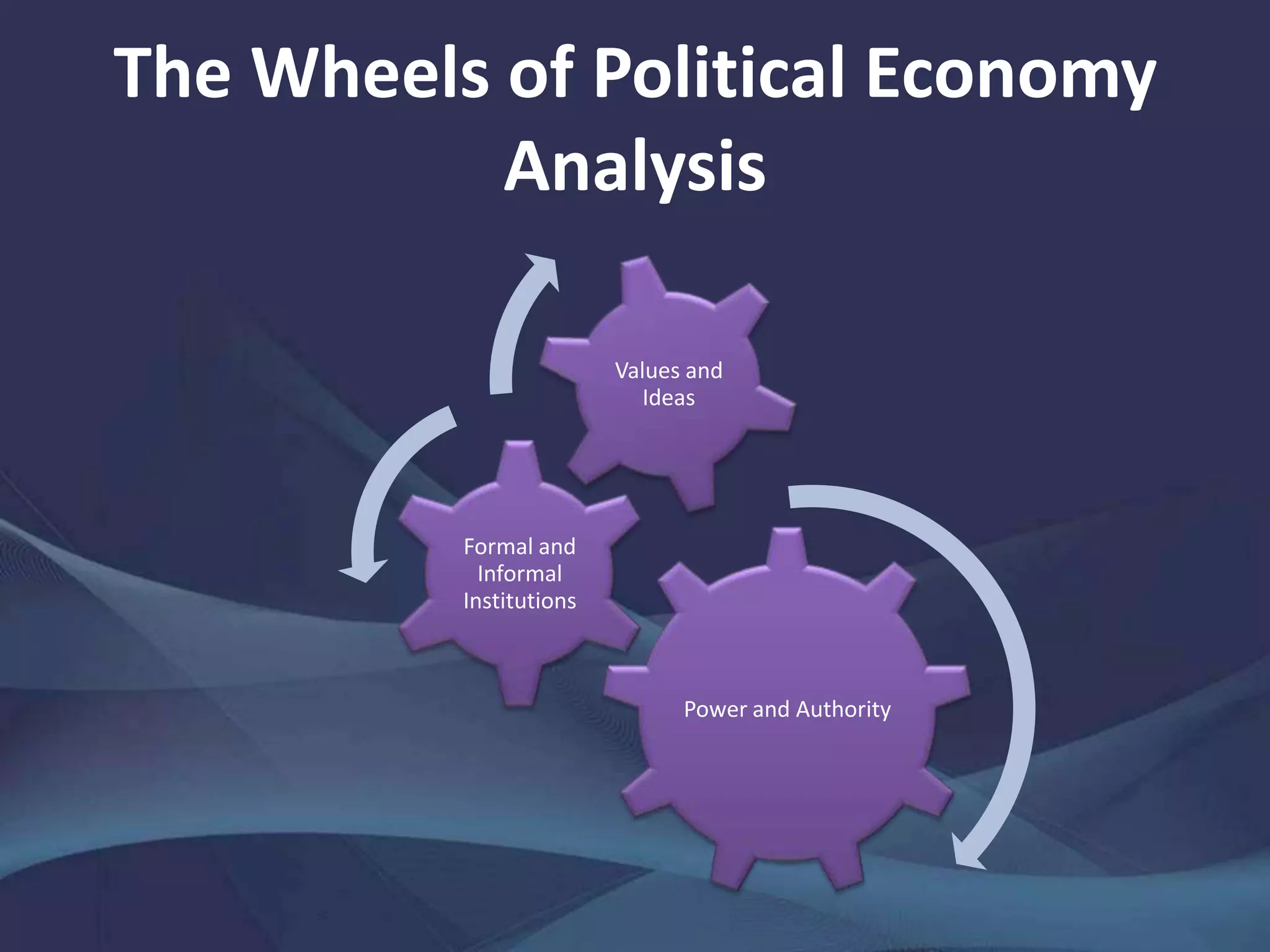
The Wheels of Political Economy
Analysis
Power and
Authority
Formal and
Informal
Institutions
Values and
Ideas
Political Economy Analysis for
Development Effectiveness
Naturally, bilateral and multilateral development agencies seek
to maximize the quality and impact of the assistance they
extend. For this, since development is not a technocratic process
but fundamentally political, they must gain a "real-world" sense
of what is achievable; only then can they with knowledge
expand the feasible space for reform, engage, and help actors
surmount what might otherwise be impossible.
Political Economy Analysis for
Development Effectiveness
Problem-driven, dynamic, and actionable political economy
analysis can
• Contribute to deeper understanding of political context and how it affects
pro-poor development assistance.
• Lead to more politically astute—and therefore more realistic and
effective—country partnership strategies and related programs, including
the selection of lending and nonlending modalities, through the
identification of pragmatic solutions to challenges.
• Support scenario planning and risk management by helping identify critical
factors apt to drive or obstruct positive change.
• Broaden the scope for quality dialogue among and engagement by clients,
audiences, and partners around key political challenges and opportunities.
• Foster coherence across joint goals through a common analysis of the
underlying political and economic processes shaping development.
• Build coalitions for innovative or "good enough" change.
Further Reading
• ADB. 2008. The Sustainable Livelihoods Approach.
www.adb.org/publications/sustainable-livelihoods-approach
• ——. 2008. Culture Theory. Manila.
www.adb.org/publications/culture-theory
• ——. 2009. Building Institutional Capacity for Development.
Manila. www.adb.org/publications/building-institutional-
capacity-development
• ——. 2009. Understanding Complexity. Manila.
www.adb.org/publications/understanding-complexity
• ——. 2010. Enriching Policy with Research. Manila.
www.adb.org/publications/enriching-policy-research
Further Reading
• ADB. 2011. Political Economy Analysis for Development
Effectiveness. Manila. www.adb.org/publications/political-
economy-analysis-development-effectiveness
• Department for International Development. 2009. Political
Economy Analysis: How-To Note.
www.odi.org.uk/events/documents/1929-dfid-note-political-
economy-analysis.pdf
Quick Response Codes
@ADB
@ADB Sustainable
Development Timeline
@Academia.edu
@LinkedIn
@ResearchGate
@Scholar
@SlideShare
@Twitter

A Guide to Political Economy Analysis

  • 1.
    The views expressedin this presentation are the views of the author/s and do not necessarily reflect the views or policies of the Asian Development Bank, or its Board of Governors, or the governments they represent. ADB does not guarantee the accuracy of the data included in this presentation and accepts no responsibility for any consequence of their use. The countries listed in this presentation do not imply any view on ADB's part as to sovereignty or independent status or necessarily conform to ADB's terminology. A Guide to Political Economy Analysis Olivier Serrat 2013
  • 2.
    Define:Political Economy Economics—the socialscience that deals with the production, distribution, and consumption of material wealth and with the theory and management of economic systems—was once called political economy. This conveyed the belief that political considerations— and the interest groups that drive them—determine influence and thus economic outcomes at (almost) any level of investigation. With the division of economics and political science into distinct disciplines from the 1890s, neoclassical economists turned from analyses of power and authority to models that, inherently, remove much complexity.
  • 3.
    Define:Political Economy Obviously, powerand authority come to the fore when heterogeneity of interest leads to conflict among actors and does not necessarily lead to optimal use of scarce resources. Today, political economists study interrelationships between political and economic institutions (or forces) and processes. They appreciate politics as the sum of activities—involving cooperation, conflict, and negotiation—that shape decisions touching the production, consumption, and transfer of scarce resources, irrespective of whether the activities are formal or informal, public or private, or a combination thereof.
  • 4.
    Define:Political Economy Explicitly, politicaleconomy is founded on the predicament of economic choices in a society comprising heterogeneous agents. Its focus differs from that of welfare economics: the issue is not the technical problem of what implications different welfare weights might have but the political problem of how weights are ascribed and the processes associated with that.
  • 5.
    Define:Political Economy I claimthat human mind or human society is not divided into watertight compartments called social, political, and religious. All act and react upon one another.— Mohandas K. Gandhi It is only the novice in political economy who thinks it is the duty of government to make its citizens happy.—Government has no such office. To protect the weak and the minority from the impositions of the strong and the majority—to prevent anyone from positively working to render the people unhappy, (if we may so express it,) to do the labor not of an officious inter-meddler in the affairs of men, but of a prudent watchman who prevents outrage—these are rather the proper duties of a government.—Walt Whitman
  • 6.
    On Political EconomyAnalysis Political economy analysis investigates the interaction of political and economic processes in a society. This entails comprehending • The power and authority of groups in society, counting the interests they hold and the incentives that drive them, in conducing particular outcomes. • The role that formal and informal institutions play in allocating scarce resources. • The influence that values and ideas, including culture, ideologies, and religion, have on shaping human relations and interaction.
  • 7.
    The Wheels ofPolitical Economy Analysis Power and Authority Formal and Informal Institutions Values and Ideas
  • 8.
    Political Economy Analysisfor Development Effectiveness Naturally, bilateral and multilateral development agencies seek to maximize the quality and impact of the assistance they extend. For this, since development is not a technocratic process but fundamentally political, they must gain a "real-world" sense of what is achievable; only then can they with knowledge expand the feasible space for reform, engage, and help actors surmount what might otherwise be impossible.
  • 9.
    Political Economy Analysisfor Development Effectiveness Problem-driven, dynamic, and actionable political economy analysis can • Contribute to deeper understanding of political context and how it affects pro-poor development assistance. • Lead to more politically astute—and therefore more realistic and effective—country partnership strategies and related programs, including the selection of lending and nonlending modalities, through the identification of pragmatic solutions to challenges. • Support scenario planning and risk management by helping identify critical factors apt to drive or obstruct positive change. • Broaden the scope for quality dialogue among and engagement by clients, audiences, and partners around key political challenges and opportunities. • Foster coherence across joint goals through a common analysis of the underlying political and economic processes shaping development. • Build coalitions for innovative or "good enough" change.
  • 10.
    Further Reading • ADB.2008. The Sustainable Livelihoods Approach. www.adb.org/publications/sustainable-livelihoods-approach • ——. 2008. Culture Theory. Manila. www.adb.org/publications/culture-theory • ——. 2009. Building Institutional Capacity for Development. Manila. www.adb.org/publications/building-institutional- capacity-development • ——. 2009. Understanding Complexity. Manila. www.adb.org/publications/understanding-complexity • ——. 2010. Enriching Policy with Research. Manila. www.adb.org/publications/enriching-policy-research
  • 11.
    Further Reading • ADB.2011. Political Economy Analysis for Development Effectiveness. Manila. www.adb.org/publications/political- economy-analysis-development-effectiveness • Department for International Development. 2009. Political Economy Analysis: How-To Note. www.odi.org.uk/events/documents/1929-dfid-note-political- economy-analysis.pdf
  • 12.
    Quick Response Codes @ADB @ADBSustainable Development Timeline @Academia.edu @LinkedIn @ResearchGate @Scholar @SlideShare @Twitter