Rights and
Resources
Initiative
• Securing forest tenure
• For – justice, social-
economic development,
conservation, climate
change, etc.
• Strategic analysis,
investments, networks
• Catalyzing solutions
THE TENURE FACILITY
Scaling-up Investments to Secure Community
Land and Forest Rights
London 10 June 2015
Alain Frechette
Director, The Tenure Facility
WHY A NEW INSTRUMENT?
Contested, insecure land rights are pervasive
• Source of conflicts, violence, risks – to all
• Undermines cultures, Peoples, livelihoods, investments
• Facilitates deforestation, constrains restoration
Some investment, many gaps
• Financing, thematic, geographic gaps (Indufor 2014)
• Inadequate investment in IPs & local community projects
• Lack of strategic, responsive, source of funds
• Need for an independent, third party
3
ADDRESSING THE GAPS
International Land and Forest Tenure Facility
• Strong global demand for solutions– from
private
• Many opportunities for impact – short-term
• Demand for a dedicated instrument – focused on
collective land
• A low cost opportunity to secure forests, carbon,
ecosystem services, natural infrastructure
4
PURPOSE & OBJECTIVES
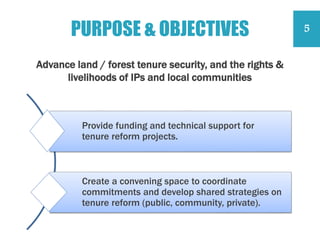
Advance land / forest tenure security, and the rights &
livelihoods of IPs and local communities
Provide funding and technical support for
tenure reform projects.
Create a convening space to coordinate
commitments and develop shared strategies on
tenure reform (public, community, private).
5
HOW IS IT DIFFERENT?
1. Focused on securing collective rights to land and forests
2. Strategic, responsive, nimble: ($ 0.2 – 2 M)
3. Direct funding to Indigenous Peoples and local CSOs
4. Independent – and complementary to existing initiatives
5. Multi-stakeholder governance: IPs, communities, international
institutions, companies, and investors (public and private)
6. Intentionally engaged with companies, investors
6
DEVELOPMENT PROCESS:
AN OVERVIEW
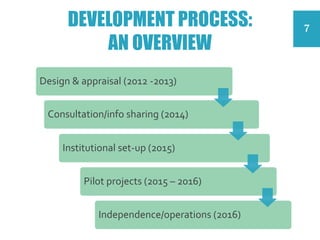
Design & appraisal (2012 -2013)
Consultation/info sharing (2014)
Institutional set-up (2015)
Pilot projects (2015 – 2016)
Independence/operations (2016)
7
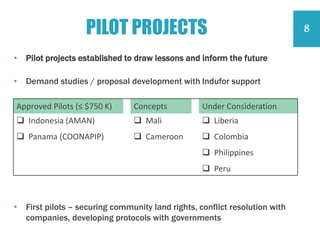
PILOT PROJECTS
Approved Pilots (≤ $750 K) Concepts Under Consideration
 Indonesia (AMAN)
 Panama (COONAPIP)
 Mali
 Cameroon
 Liberia
 Colombia
 Philippines
 Peru
• Pilot projects established to draw lessons and inform the future
• Demand studies / proposal development with Indufor support
• First pilots – securing community land rights, conflict resolution with
companies, developing protocols with governments
8
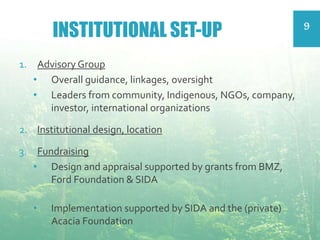
INSTITUTIONAL SET-UP 9
1. Advisory Group
• Overall guidance, linkages, oversight
• Leaders from community, Indigenous, NGOs, company,
investor, international organizations
2. Institutional design, location
3. Fundraising
• Design and appraisal supported by grants from BMZ,
Ford Foundation & SIDA
• Implementation supported by SIDA and the (private)
Acacia Foundation
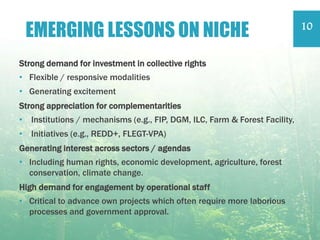
Strong demand for investment in collective rights
• Flexible / responsive modalities
• Generating excitement
Strong appreciation for complementarities
• Institutions / mechanisms (e.g., FIP, DGM, ILC, Farm & Forest Facility,
• Initiatives (e.g., REDD+, FLEGT-VPA)
Generating interest across sectors / agendas
• Including human rights, economic development, agriculture, forest
conservation, climate change.
High demand for engagement by operational staff
• Critical to advance own projects which often require more laborious
processes and government approval.
EMERGING LESSONS ON NICHE 10
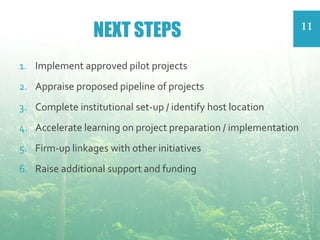
NEXT STEPS
1. Implement approved pilot projects
2. Appraise proposed pipeline of projects
3. Complete institutional set-up / identify host location
4. Accelerate learning on project preparation / implementation
5. Firm-up linkages with other initiatives
6. Raise additional support and funding
11
THANK YOU!
Alain Frechette
afrechette@rightsandresources.org
www.TheTenureFacility.org
12

Scaling up Investments to Secure Community Land and Forest Rights – Alain Frechette, The Tenure Facility Rights and Resources Initiative

  • 1.
    Rights and Resources Initiative • Securingforest tenure • For – justice, social- economic development, conservation, climate change, etc. • Strategic analysis, investments, networks • Catalyzing solutions
  • 2.
    THE TENURE FACILITY Scaling-upInvestments to Secure Community Land and Forest Rights London 10 June 2015 Alain Frechette Director, The Tenure Facility
  • 3.
    WHY A NEWINSTRUMENT? Contested, insecure land rights are pervasive • Source of conflicts, violence, risks – to all • Undermines cultures, Peoples, livelihoods, investments • Facilitates deforestation, constrains restoration Some investment, many gaps • Financing, thematic, geographic gaps (Indufor 2014) • Inadequate investment in IPs & local community projects • Lack of strategic, responsive, source of funds • Need for an independent, third party 3
  • 4.
    ADDRESSING THE GAPS InternationalLand and Forest Tenure Facility • Strong global demand for solutions– from private • Many opportunities for impact – short-term • Demand for a dedicated instrument – focused on collective land • A low cost opportunity to secure forests, carbon, ecosystem services, natural infrastructure 4
  • 5.
    PURPOSE & OBJECTIVES Advanceland / forest tenure security, and the rights & livelihoods of IPs and local communities Provide funding and technical support for tenure reform projects. Create a convening space to coordinate commitments and develop shared strategies on tenure reform (public, community, private). 5
  • 6.
    HOW IS ITDIFFERENT? 1. Focused on securing collective rights to land and forests 2. Strategic, responsive, nimble: ($ 0.2 – 2 M) 3. Direct funding to Indigenous Peoples and local CSOs 4. Independent – and complementary to existing initiatives 5. Multi-stakeholder governance: IPs, communities, international institutions, companies, and investors (public and private) 6. Intentionally engaged with companies, investors 6
  • 7.
    DEVELOPMENT PROCESS: AN OVERVIEW Design& appraisal (2012 -2013) Consultation/info sharing (2014) Institutional set-up (2015) Pilot projects (2015 – 2016) Independence/operations (2016) 7
  • 8.
    PILOT PROJECTS Approved Pilots(≤ $750 K) Concepts Under Consideration  Indonesia (AMAN)  Panama (COONAPIP)  Mali  Cameroon  Liberia  Colombia  Philippines  Peru • Pilot projects established to draw lessons and inform the future • Demand studies / proposal development with Indufor support • First pilots – securing community land rights, conflict resolution with companies, developing protocols with governments 8
  • 9.
    INSTITUTIONAL SET-UP 9 1.Advisory Group • Overall guidance, linkages, oversight • Leaders from community, Indigenous, NGOs, company, investor, international organizations 2. Institutional design, location 3. Fundraising • Design and appraisal supported by grants from BMZ, Ford Foundation & SIDA • Implementation supported by SIDA and the (private) Acacia Foundation
  • 10.
    Strong demand forinvestment in collective rights • Flexible / responsive modalities • Generating excitement Strong appreciation for complementarities • Institutions / mechanisms (e.g., FIP, DGM, ILC, Farm & Forest Facility, • Initiatives (e.g., REDD+, FLEGT-VPA) Generating interest across sectors / agendas • Including human rights, economic development, agriculture, forest conservation, climate change. High demand for engagement by operational staff • Critical to advance own projects which often require more laborious processes and government approval. EMERGING LESSONS ON NICHE 10
  • 11.
    NEXT STEPS 1. Implementapproved pilot projects 2. Appraise proposed pipeline of projects 3. Complete institutional set-up / identify host location 4. Accelerate learning on project preparation / implementation 5. Firm-up linkages with other initiatives 6. Raise additional support and funding 11
  • 12.