Algorithmic and
technological
transparency
ABOUT ME
Bozhidar Bozhanov
Software engineer
Former e-gov advisor
Founder @ LogSentinel.com
2
“Technology is now
everywhere”
(favourite cliche)
4
Technology affects our lives
and our societies
▪ Opaque technologies
▪ Algorithms, optimized for goals that are non-obvious
for the users
▪ Confirming prejudices and inequalities
▪ Information security risks
THE PROBLEM?
5
6
Technology is everywhere around us…
And we have no idea what it does
▪ Decisions in critical situations
▫ Trolley problem
▪ Supported “terrains”
▪ Tracking
▪ Information security
▫ Jeep CAN bus
▪ We have no idea what our car can do
SELF-DRIVING CARS
7
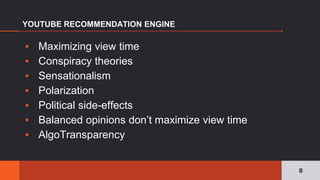
▪ Maximizing view time
▪ Conspiracy theories
▪ Sensationalism
▪ Polarization
▪ Political side-effects
▪ Balanced opinions don’t maximize view time
▪ AlgoTransparency
YOUTUBE RECOMMENDATION ENGINE
8
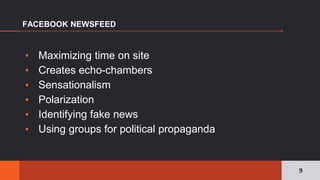
▪ Maximizing time on site
▪ Creates echo-chambers
▪ Sensationalism
▪ Polarization
▪ Identifying fake news
▪ Using groups for political propaganda
FACEBOOK NEWSFEED
9
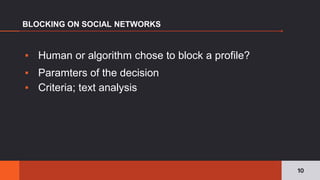
▪ Human or algorithm chose to block a profile?
▪ Paramters of the decision
▪ Criteria; text analysis
BLOCKING ON SOCIAL NETWORKS
10
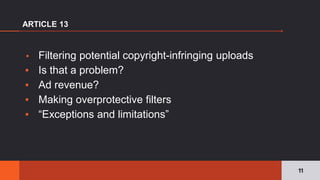
▪ Filtering potential copyright-infringing uploads
▪ Is that a problem?
▪ Ad revenue?
▪ Making overprotective filters
▪ “Exceptions and limitations”
ARTICLE 13
11
▪ Risk analysis based on historical data
▪ Judges have access to the results
▪ Confirming social prejudices
▪ Next: Minority report?
ASSISTING CONVICTIONS
12
▪ Routers, cameras, etc. connected device
▪ Low security that people don’t know about
▪ Participation in DDoS
▫ Mirai
▪ “Internet of Shit”
IoT
13
▪ Random assignment of court cases
▪ Automatic welfare decisions
▫ Bug in the Colorado welfare system
▪ Access to data?
▪ Fraud-detection
▪ Information security
PUBLIC SECTOR SYSTEMS
14
15
Companies often deny wrongdoing
...until someone finds out or
information is leaked
▪ Decision making
▪ Content recommendation
▪ Information security
THREE PROBLEMATIC ASPECTS
16
17
“Man is a hackable animal [..]
Computers are hacked through pre-
existing faulty code lines. Humans
are hacked through pre-existing
fears, hatreds, biases and cravings”
Yuval Harari
18
Algorithms can make us extremist,
help us meet other extremists,
convict us and then crash us on the
highway…
And we’ll have no idea why…
19
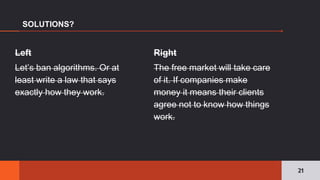
Right
The free market will take care
of it. If companies make
money it means their clients
agree not to know how things
work.
SOLUTIONS?
Left
Let’s ban algorithms. Or at
least write a law that says
exactly how they work.
20
Right
The free market will take care
of it. If companies make
money it means their clients
agree not to know how things
work.
SOLUTIONS?
Left
Let’s ban algorithms. Or at
least write a law that says
exactly how they work.
21
22
We need more algorithmic and
technological transparency
23
“...who made it, what was the thinking behind
it, what human oversight sits atop the
algorithmic decisions, what are the
assumptions underlying the algorithms, are
there hard-coded rules...”
(Expert X)
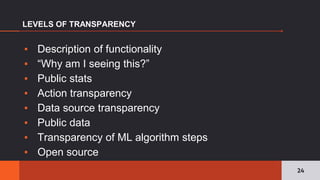
▪ Description of functionality
▪ “Why am I seeing this?”
▪ Public stats
▪ Action transparency
▪ Data source transparency
▪ Public data
▪ Transparency of ML algorithm steps
▪ Open source
LEVELS OF TRANSPARENCY
24
▪ Blogposts
▪ Interviews
▪ Pop-up descriptions
▪ Is there human interaction?
▪ Usually regulations get to this point
DESCRIPTION OF FUNCTIONALITY
25
▪ Why am I seeing this ad?
▪ Why am I seeing this video?
▪ Why am I seeing this comment?
▪ UX
“WHY AM I SEETING THIS?”
26
▪ Data on the operation of algorithms
▪ Examples:
▫ Takedowns by ContentID, % disputed takedowns
▫ % false positives
▫ Confidence intervals
▫ A/B data, human vs algorithm
PUBLIC STATS
27
▪ Every action can leave a trace
▫ Who had access to our data in government systems?
▫ Which bank employee has been looking at our bank account?
▫ Which system administrator had access to our car?
▪ Public verifiability of the audit trail
▫ Merkle trees
ACTION TRANSPARENCY
28
▪ Publishing intermediate steps
▫ ML algorithms usually work in iterations
▫ Neural networks – weights, values in hidden layers
▪ Public verifiability of steps
▫ Merkle trees
▫ Blockchain?
TRANSPARENCY OF ML ALGORITHM STEPS
29
▪ Data sources – how was data collected, with what
rules
▫ Example: Facebook collects location data via GPS, WiFi, … maybe
Bluetooth?
▪ Publish (partial) training sets
▫ Example: training with historical conviction data
▫ Example: training with US highway system (and using it in countries
with worse infrastructure)
PUBLIC DATA
30
▪ Opening critical components
▫ CAN bus
▫ Communication modules in cars
▫ Rules for decision-making
▫ Password-storing components
▪ Bug bounties
OPEN SOURCE
31
▪ ...rarely
▪ Transparency doesn’t mean leaking company secrets
▪ Transparency doesn’t mean yielding one’s
competitive advantage
▪ Transparency may be beneficial for reputation
DOESN’T THIS HARM BUSIENSS?
32
▪ Best practices
▪ Industrial codes
▪ Standards
▪ Regulation for critical industries
▪ General regulations (nuclear option)
HOW?
33
We don’t have the right
to let technology remain a black box
35
THANK YOU!
Contacts
▪ @bozhobg
▪ techblog.bozho.net
▪ https://news.vice.com/en_us/article/d3w9ja/how-youtubes-algorithm-prioritizes-conspiracy-theories
▪ https://sci-hub.tw/10.1080/21670811.2016.1208053
▪ https://www.theguardian.com/technology/2018/feb/02/youtube-algorithm-election-clinton-trump-
guillaume-chaslot
▪ https://techblog.bozho.net/self-driving-cars-open-source/
▪ https://www.propublica.org/article/machine-bias-risk-assessments-in-criminal-sentencing
▪ http://www.austlii.edu.au/au/journals/FedJSchol/2014/17.html
▪ https://www.bellingcat.com/news/americas/2018/10/11/memes-infowars-75-fascist-activists-red-
pilled/
SOURCES
36

Algorithmic and technological transparency

  • 1.
  • 2.
    ABOUT ME Bozhidar Bozhanov Softwareengineer Former e-gov advisor Founder @ LogSentinel.com 2
  • 3.
  • 4.
    4 Technology affects ourlives and our societies
  • 5.
    ▪ Opaque technologies ▪Algorithms, optimized for goals that are non-obvious for the users ▪ Confirming prejudices and inequalities ▪ Information security risks THE PROBLEM? 5
  • 6.
    6 Technology is everywherearound us… And we have no idea what it does
  • 7.
    ▪ Decisions incritical situations ▫ Trolley problem ▪ Supported “terrains” ▪ Tracking ▪ Information security ▫ Jeep CAN bus ▪ We have no idea what our car can do SELF-DRIVING CARS 7
  • 8.
    ▪ Maximizing viewtime ▪ Conspiracy theories ▪ Sensationalism ▪ Polarization ▪ Political side-effects ▪ Balanced opinions don’t maximize view time ▪ AlgoTransparency YOUTUBE RECOMMENDATION ENGINE 8
  • 9.
    ▪ Maximizing timeon site ▪ Creates echo-chambers ▪ Sensationalism ▪ Polarization ▪ Identifying fake news ▪ Using groups for political propaganda FACEBOOK NEWSFEED 9
  • 10.
    ▪ Human oralgorithm chose to block a profile? ▪ Paramters of the decision ▪ Criteria; text analysis BLOCKING ON SOCIAL NETWORKS 10
  • 11.
    ▪ Filtering potentialcopyright-infringing uploads ▪ Is that a problem? ▪ Ad revenue? ▪ Making overprotective filters ▪ “Exceptions and limitations” ARTICLE 13 11
  • 12.
    ▪ Risk analysisbased on historical data ▪ Judges have access to the results ▪ Confirming social prejudices ▪ Next: Minority report? ASSISTING CONVICTIONS 12
  • 13.
    ▪ Routers, cameras,etc. connected device ▪ Low security that people don’t know about ▪ Participation in DDoS ▫ Mirai ▪ “Internet of Shit” IoT 13
  • 14.
    ▪ Random assignmentof court cases ▪ Automatic welfare decisions ▫ Bug in the Colorado welfare system ▪ Access to data? ▪ Fraud-detection ▪ Information security PUBLIC SECTOR SYSTEMS 14
  • 15.
    15 Companies often denywrongdoing ...until someone finds out or information is leaked
  • 16.
    ▪ Decision making ▪Content recommendation ▪ Information security THREE PROBLEMATIC ASPECTS 16
  • 17.
    17 “Man is ahackable animal [..] Computers are hacked through pre- existing faulty code lines. Humans are hacked through pre-existing fears, hatreds, biases and cravings” Yuval Harari
  • 18.
    18 Algorithms can makeus extremist, help us meet other extremists, convict us and then crash us on the highway… And we’ll have no idea why…
  • 19.
  • 20.
    Right The free marketwill take care of it. If companies make money it means their clients agree not to know how things work. SOLUTIONS? Left Let’s ban algorithms. Or at least write a law that says exactly how they work. 20
  • 21.
    Right The free marketwill take care of it. If companies make money it means their clients agree not to know how things work. SOLUTIONS? Left Let’s ban algorithms. Or at least write a law that says exactly how they work. 21
  • 22.
    22 We need morealgorithmic and technological transparency
  • 23.
    23 “...who made it,what was the thinking behind it, what human oversight sits atop the algorithmic decisions, what are the assumptions underlying the algorithms, are there hard-coded rules...” (Expert X)
  • 24.
    ▪ Description offunctionality ▪ “Why am I seeing this?” ▪ Public stats ▪ Action transparency ▪ Data source transparency ▪ Public data ▪ Transparency of ML algorithm steps ▪ Open source LEVELS OF TRANSPARENCY 24
  • 25.
    ▪ Blogposts ▪ Interviews ▪Pop-up descriptions ▪ Is there human interaction? ▪ Usually regulations get to this point DESCRIPTION OF FUNCTIONALITY 25
  • 26.
    ▪ Why amI seeing this ad? ▪ Why am I seeing this video? ▪ Why am I seeing this comment? ▪ UX “WHY AM I SEETING THIS?” 26
  • 27.
    ▪ Data onthe operation of algorithms ▪ Examples: ▫ Takedowns by ContentID, % disputed takedowns ▫ % false positives ▫ Confidence intervals ▫ A/B data, human vs algorithm PUBLIC STATS 27
  • 28.
    ▪ Every actioncan leave a trace ▫ Who had access to our data in government systems? ▫ Which bank employee has been looking at our bank account? ▫ Which system administrator had access to our car? ▪ Public verifiability of the audit trail ▫ Merkle trees ACTION TRANSPARENCY 28
  • 29.
    ▪ Publishing intermediatesteps ▫ ML algorithms usually work in iterations ▫ Neural networks – weights, values in hidden layers ▪ Public verifiability of steps ▫ Merkle trees ▫ Blockchain? TRANSPARENCY OF ML ALGORITHM STEPS 29
  • 30.
    ▪ Data sources– how was data collected, with what rules ▫ Example: Facebook collects location data via GPS, WiFi, … maybe Bluetooth? ▪ Publish (partial) training sets ▫ Example: training with historical conviction data ▫ Example: training with US highway system (and using it in countries with worse infrastructure) PUBLIC DATA 30
  • 31.
    ▪ Opening criticalcomponents ▫ CAN bus ▫ Communication modules in cars ▫ Rules for decision-making ▫ Password-storing components ▪ Bug bounties OPEN SOURCE 31
  • 32.
    ▪ ...rarely ▪ Transparencydoesn’t mean leaking company secrets ▪ Transparency doesn’t mean yielding one’s competitive advantage ▪ Transparency may be beneficial for reputation DOESN’T THIS HARM BUSIENSS? 32
  • 33.
    ▪ Best practices ▪Industrial codes ▪ Standards ▪ Regulation for critical industries ▪ General regulations (nuclear option) HOW? 33
  • 34.
    We don’t havethe right to let technology remain a black box
  • 35.
  • 36.
    ▪ https://news.vice.com/en_us/article/d3w9ja/how-youtubes-algorithm-prioritizes-conspiracy-theories ▪ https://sci-hub.tw/10.1080/21670811.2016.1208053 ▪https://www.theguardian.com/technology/2018/feb/02/youtube-algorithm-election-clinton-trump- guillaume-chaslot ▪ https://techblog.bozho.net/self-driving-cars-open-source/ ▪ https://www.propublica.org/article/machine-bias-risk-assessments-in-criminal-sentencing ▪ http://www.austlii.edu.au/au/journals/FedJSchol/2014/17.html ▪ https://www.bellingcat.com/news/americas/2018/10/11/memes-infowars-75-fascist-activists-red- pilled/ SOURCES 36