ARTIFICIAL INTELLIGENCE:
BALANCING
TRANSPARENCY, TRUST &
REGULATION
Goal
To find the equillibrium between transaparency, trust and regulation
in AI algorithmic systems
Content
• Transparency in AI developernt
• Trust in AI Systems
• Ethical AI
• Regulatory Perspective
Introduction
• AI is machines learning from data to mimic human
cognition.
• AI algorithms are everywhere today :- Augmenting
humans in virtually every aspect of life.
• Big Question: Where do we draw the line for AI as
developers, & Regulators.
AI Generated Image: Adobe firefly
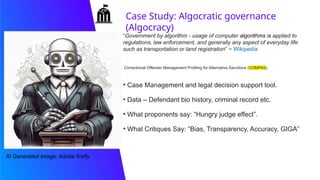
Case Study: Algocratic governance
(Algocracy)
• Case Management and legal decision support tool.
• Data – Defendant bio history, criminal record etc.
• What proponents say: “Hungry judge effect”.
• What Critiques Say: “Bias, Transparency, Accuracy, GIGA”
“Government by algorithm - usage of computer algorithms is applied to
regulations, law enforcement, and generally any aspect of everyday life
such as transportation or land registration” ~ Wikipedia
AI Generated Image: Adobe firefly
Correctional Offender Management Profiling for Alternative Sanctions (COMPAS).
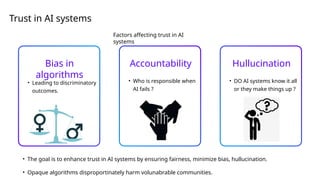
Bias in
algorithms
• Leading to discriminatory
outcomes.
Accountability
• Who is responsible when
AI fails ?
Hullucination
• DO AI systems know it all
or they make things up ?
Trust in AI systems
Factors affecting trust in AI
systems
• The goal is to enhance trust in AI systems by ensuring fairness, minimize bias, hullucination.
• Opaque algorithms disproportinately harm volunabrable communities.
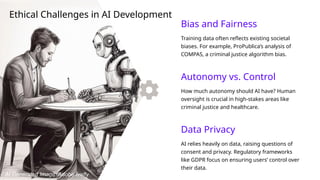
Autonomy vs. Control
How much autonomy should AI have? Human
oversight is crucial in high-stakes areas like
criminal justice and healthcare.
Data Privacy
AI relies heavily on data, raising questions of
consent and privacy. Regulatory frameworks
like GDPR focus on ensuring users’ control over
their data.
Bias and Fairness
Training data often reflects existing societal
biases. For example, ProPublica’s analysis of
COMPAS, a criminal justice algorithm bias.
Ethical Challenges in AI Development
AI Generated Image: Adobe firefly
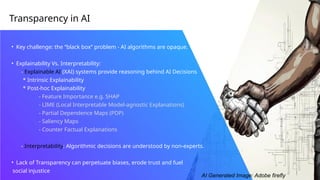
Transparency in AI
• Key challenge: the “black box” problem - AI algorithms are opaque.
• Explainability Vs. Interpretability:
- Explainable AI (XAI) systems provide reasoning behind AI Decisions
* Intrinsic Explainability
* Post-hoc Explainability
- Feature Importance e.g. SHAP
- LIME (Local Interpretable Model-agnostic Explanations)
- Partial Dependence Maps (PDP)
- Saliency Maps
- Counter Factual Explanations
- Interpretability: Algorithmic decisions are understood by non-experts.
• Lack of Transparency can perpetuate biases, erode trust and fuel
social injustice
AI Generated Image: Adobe firefly
1.Open-Source Models
Make certain algorithms open-source to allow
public scrutiny, contribution and analysis e.g
Hugging Face models.
4. Explainable AI (XAI)
Embed explainability features so users
understand why an AI system made certain
decisions (e.g., Microsoft’s LIME framework).
Transparency Strategies for AI Developers
2. Data Transparency
• Data Provenance: Document the source,
collection methods and quality of data used
in AI models.
• Data Privacy: Robust data privacy measures
to protect user data, comply with
regulations.
3. Model Transparency
• Model Documentation: Document model architecture,
training process and evaluation metrics.
• Model Interpretability: Techniques like saliency maps,
feature importance to help users decipher model
decisions.
• Model Auditing: conduct model audits for re-assuarance
Human-in-the-Loop
Ensure human oversight in critical decision-making
systems (e.g., autonomous driving, criminal
sentencing algorithms).
Communication and Education
• Public Engagement: Train, Engage stakeholders including
policymakers and the public to build trust and address
concerns.
• Transparency Reporting: Regularly report on AI
development efforts, including progress, challenges, and
Algorithmic
Accountability
• Algorithmic Impact Assessments
• Data Protection and breach notification.
• Bias Mitigation
• Algorithm Audits
Consumer Protection
• Explainable AI for users to make right
decision.
• Consumer rights to be informed and
challenge AI decisions.
• Prohibit Algorithmic Discrimination
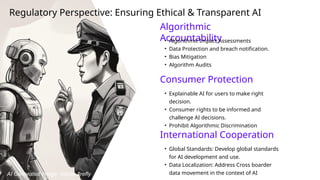
Regulatory Perspective: Ensuring Ethical & Transparent AI
International Cooperation
• Global Standards: Develop global standards
for AI development and use.
• Data Localization: Address Cross boarder
data movement in the context of AI
AI Generated Image: Adobe firefly
“The real risk with AI isn’t that it
will become super-intelligent and
overthrow us, but that it will be
programmed with goals
misaligned with ours.”
Conclusion
Stuart Russell, Human Compatible: Artificial Intelligence and the Problem of
Control
THANK
YOU
ANY QUESTIONS ?

ArtificialIntelligence_presentation.pptx

  • 1.
  • 2.
    Goal To find theequillibrium between transaparency, trust and regulation in AI algorithmic systems Content • Transparency in AI developernt • Trust in AI Systems • Ethical AI • Regulatory Perspective
  • 3.
    Introduction • AI ismachines learning from data to mimic human cognition. • AI algorithms are everywhere today :- Augmenting humans in virtually every aspect of life. • Big Question: Where do we draw the line for AI as developers, & Regulators. AI Generated Image: Adobe firefly
  • 4.
    Case Study: Algocraticgovernance (Algocracy) • Case Management and legal decision support tool. • Data – Defendant bio history, criminal record etc. • What proponents say: “Hungry judge effect”. • What Critiques Say: “Bias, Transparency, Accuracy, GIGA” “Government by algorithm - usage of computer algorithms is applied to regulations, law enforcement, and generally any aspect of everyday life such as transportation or land registration” ~ Wikipedia AI Generated Image: Adobe firefly Correctional Offender Management Profiling for Alternative Sanctions (COMPAS).
  • 5.
    Bias in algorithms • Leadingto discriminatory outcomes. Accountability • Who is responsible when AI fails ? Hullucination • DO AI systems know it all or they make things up ? Trust in AI systems Factors affecting trust in AI systems • The goal is to enhance trust in AI systems by ensuring fairness, minimize bias, hullucination. • Opaque algorithms disproportinately harm volunabrable communities.
  • 6.
    Autonomy vs. Control Howmuch autonomy should AI have? Human oversight is crucial in high-stakes areas like criminal justice and healthcare. Data Privacy AI relies heavily on data, raising questions of consent and privacy. Regulatory frameworks like GDPR focus on ensuring users’ control over their data. Bias and Fairness Training data often reflects existing societal biases. For example, ProPublica’s analysis of COMPAS, a criminal justice algorithm bias. Ethical Challenges in AI Development AI Generated Image: Adobe firefly
  • 7.
    Transparency in AI •Key challenge: the “black box” problem - AI algorithms are opaque. • Explainability Vs. Interpretability: - Explainable AI (XAI) systems provide reasoning behind AI Decisions * Intrinsic Explainability * Post-hoc Explainability - Feature Importance e.g. SHAP - LIME (Local Interpretable Model-agnostic Explanations) - Partial Dependence Maps (PDP) - Saliency Maps - Counter Factual Explanations - Interpretability: Algorithmic decisions are understood by non-experts. • Lack of Transparency can perpetuate biases, erode trust and fuel social injustice AI Generated Image: Adobe firefly
  • 8.
    1.Open-Source Models Make certainalgorithms open-source to allow public scrutiny, contribution and analysis e.g Hugging Face models. 4. Explainable AI (XAI) Embed explainability features so users understand why an AI system made certain decisions (e.g., Microsoft’s LIME framework). Transparency Strategies for AI Developers 2. Data Transparency • Data Provenance: Document the source, collection methods and quality of data used in AI models. • Data Privacy: Robust data privacy measures to protect user data, comply with regulations. 3. Model Transparency • Model Documentation: Document model architecture, training process and evaluation metrics. • Model Interpretability: Techniques like saliency maps, feature importance to help users decipher model decisions. • Model Auditing: conduct model audits for re-assuarance
  • 9.
    Human-in-the-Loop Ensure human oversightin critical decision-making systems (e.g., autonomous driving, criminal sentencing algorithms). Communication and Education • Public Engagement: Train, Engage stakeholders including policymakers and the public to build trust and address concerns. • Transparency Reporting: Regularly report on AI development efforts, including progress, challenges, and
  • 10.
    Algorithmic Accountability • Algorithmic ImpactAssessments • Data Protection and breach notification. • Bias Mitigation • Algorithm Audits Consumer Protection • Explainable AI for users to make right decision. • Consumer rights to be informed and challenge AI decisions. • Prohibit Algorithmic Discrimination Regulatory Perspective: Ensuring Ethical & Transparent AI International Cooperation • Global Standards: Develop global standards for AI development and use. • Data Localization: Address Cross boarder data movement in the context of AI AI Generated Image: Adobe firefly
  • 11.
    “The real riskwith AI isn’t that it will become super-intelligent and overthrow us, but that it will be programmed with goals misaligned with ours.” Conclusion Stuart Russell, Human Compatible: Artificial Intelligence and the Problem of Control
  • 12.