Open source - accelerating e-government:
the Bulgarian electronic governance act
Bozhidar Bozhanov
Adviser to the political cabinet of the deputy prime minister for coalition policy and
public administration and minister of interior
● Senior software engineer and architect
● http://techblog.bozho.net
● Adviser to the deputy primer minister of Bulgaria about e-
government, open data & technology
● Realistic idealist
About me
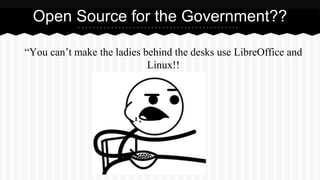
“You can’t make the ladies behind the desks use LibreOffice and
Linux!!
Open Source for the Government??
You can, but that’s a different story...
It’s not about Linux...
● The government is constantly procuring both specific and generic
software
● The government ignores the “rule”
o if the problem is widespread - use open source software
o if the problem is rare - use an existing commercial solution
o if the problem is unique - order a new piece of software
● The government doesn’t have the personnel to adapt and implement even
ready-to-use open source projects.
Custom software
● Vendor lock-in
● Abandonware
● Low-quality software
● Bugs and security holes
o egov.bg
o (forest) logging registry (?the_wife_of_my_cousin=1)
o ...who knows what else?
● Most of that software is owned by the government
o ...and sits on CDs in basements
● Even projects using WordPress, Drupal, Joomla are de-facto closed source
● Questionable, opaque spending
Status quo
● Websites of ministries/agencies/municipalities/programmes
● Registries
● General clerk software
● Specific information systems
● Accountancy software
● egov - middleware, registries, portal, e-services
Types of government software
● what’s the relation between “government software” and “electronic
governance”?
● The problems of electronic governance
o Lacl of coordination
o Lack of quality
o Lack of vision
Electronic governance
(almost) all new projects must be open-sourced
A solution?
We proposed article 58a, which mandates:
• All new custom-built software to be open source
• Developed in a public repository from day 1
The electronic governance act
● Reusability
● Higher quality
● Easier extension and support
o from a government “system integrator”
o from other companies
o from NGOs and even citizens
● Transparency
o What did the government spend the money on
o “but...nobody will be watching those projects!” - there are people that
will be watching them, don’t worry :)
Why?
● UK- http://github.com/alphagov (330 projects)
● US - http://www.govcode.org/ (2000 projects); Federal source code policy
● Estonia - e-voting, egov, X-Road
o “All our key projects become open source, including the systems for health care, police, business portals and document
exchange” Siim Sikkut, ICT Policy Adviser
● Switzerland
● The European Commission
● European Parliament called for “the systematic replacement of proprietary
software by auditable and verifiable open-source software in all the EU
institutions, and for the introduction of a mandatory open-source-selection
criterion in all future ICT procurement procedures”
Experience around the world
● Every company, implementing software ordered by the government uses a
public repo
o must use it actively (and not just synchronize an internal repo with it)
o git or mercurial
● Public documentation
● Stable master
● The licence used must be approved by FSF or OSI
o EUPL by default. Allowed: GPLv3, AGPL, Apache, MIT, etc.
Procedure
● no difference for the company writing the software - even now the product
is owned by the government in most cases
● no difference for the government - 10 lines more in the technical
specification.
o and we prepared a template for that
● total cost of ownership is the same in the worst case
● new business models
Why would that work?
“Are you listening to yourself, the government can’t open their
systems?!”
● Only the source is publicly available; not the server passwords
● A small portion of the government software is highly critical; a small
portion even have a publically-facing interface.
o The law doesn’t apply to systems regarding national security and
classified information
● WordPress is more secure than any website that any company will build.
● Open-source software is more secure
o ...except for openssl, bash and small, unpopular projects … :)
Security
● not applicable to existing closed-sourced software
● good code != good software
● not every project can be monitored carefully by society
● won’t solve the problems of e-governance, coordination, corruption
● can see opposition in the face of malicious companies
No silver bullet...
● Proprietary components?
o Allowed
● Entire proprietary systems or proprietary base?
o Allowed, but must prove TCO will be lower
● Does it mean the database can’t be Oracle / MS SQL Server?
o No.
● Will we switch to Linux and LibreOffice
o No – a lot of migration required – desktop software, ActiveDirectory,
trainings
o But we will switch to ODF
Typical questions
● The amendments to to the electronic governance acts passed and are in
force!
● We have set up an agency to oversee the process
● We have prepared templates and answers to regular questions
● http://github.com/governmentbg
o Soon – an on-premise system, mirrored to GitHub
● EU programs explicitly require open source
So far...
● Administration not knowing they should do it
o We already have tenders that do not conform with the law
o We have prepared templates and answers to regular questions
● No responsible body for enforcement
o We have set up an agency to oversee the process, not yet operational
● Companies may develop “privately” and push at the end
o http://github.com/governmentbg , soon – an on-premise system,
mirrored to GitHub
● It can be ignored
o “No open source – no funding” works (EU programs explicitly
require open source)
Potential issues
● Put it in the law
● Be explicit that it applies to all projects (websites, registers, information
systems)
o “It does not apply to us” phenomenon
● Find or create a responsible body
● Also put it as a prerequisite for funding
● Talk
● Answer questions
Advice
● Too early to say
● Depends on willingness to enforce
● I will share our experience within a year
Will it work?
Open and transparent projects should bring better
quality and lower TCO
(image taken from http://exequiel09.github.io/symposium-presentation/)
Questions?

Opensource government

  • 1.
    Open source -accelerating e-government: the Bulgarian electronic governance act Bozhidar Bozhanov Adviser to the political cabinet of the deputy prime minister for coalition policy and public administration and minister of interior
  • 2.
    ● Senior softwareengineer and architect ● http://techblog.bozho.net ● Adviser to the deputy primer minister of Bulgaria about e- government, open data & technology ● Realistic idealist About me
  • 3.
    “You can’t makethe ladies behind the desks use LibreOffice and Linux!! Open Source for the Government??
  • 4.
    You can, butthat’s a different story... It’s not about Linux...
  • 5.
    ● The governmentis constantly procuring both specific and generic software ● The government ignores the “rule” o if the problem is widespread - use open source software o if the problem is rare - use an existing commercial solution o if the problem is unique - order a new piece of software ● The government doesn’t have the personnel to adapt and implement even ready-to-use open source projects. Custom software
  • 6.
    ● Vendor lock-in ●Abandonware ● Low-quality software ● Bugs and security holes o egov.bg o (forest) logging registry (?the_wife_of_my_cousin=1) o ...who knows what else? ● Most of that software is owned by the government o ...and sits on CDs in basements ● Even projects using WordPress, Drupal, Joomla are de-facto closed source ● Questionable, opaque spending Status quo
  • 7.
    ● Websites ofministries/agencies/municipalities/programmes ● Registries ● General clerk software ● Specific information systems ● Accountancy software ● egov - middleware, registries, portal, e-services Types of government software
  • 8.
    ● what’s therelation between “government software” and “electronic governance”? ● The problems of electronic governance o Lacl of coordination o Lack of quality o Lack of vision Electronic governance
  • 9.
    (almost) all newprojects must be open-sourced A solution?
  • 10.
    We proposed article58a, which mandates: • All new custom-built software to be open source • Developed in a public repository from day 1 The electronic governance act
  • 11.
    ● Reusability ● Higherquality ● Easier extension and support o from a government “system integrator” o from other companies o from NGOs and even citizens ● Transparency o What did the government spend the money on o “but...nobody will be watching those projects!” - there are people that will be watching them, don’t worry :) Why?
  • 12.
    ● UK- http://github.com/alphagov(330 projects) ● US - http://www.govcode.org/ (2000 projects); Federal source code policy ● Estonia - e-voting, egov, X-Road o “All our key projects become open source, including the systems for health care, police, business portals and document exchange” Siim Sikkut, ICT Policy Adviser ● Switzerland ● The European Commission ● European Parliament called for “the systematic replacement of proprietary software by auditable and verifiable open-source software in all the EU institutions, and for the introduction of a mandatory open-source-selection criterion in all future ICT procurement procedures” Experience around the world
  • 13.
    ● Every company,implementing software ordered by the government uses a public repo o must use it actively (and not just synchronize an internal repo with it) o git or mercurial ● Public documentation ● Stable master ● The licence used must be approved by FSF or OSI o EUPL by default. Allowed: GPLv3, AGPL, Apache, MIT, etc. Procedure
  • 14.
    ● no differencefor the company writing the software - even now the product is owned by the government in most cases ● no difference for the government - 10 lines more in the technical specification. o and we prepared a template for that ● total cost of ownership is the same in the worst case ● new business models Why would that work?
  • 15.
    “Are you listeningto yourself, the government can’t open their systems?!”
  • 16.
    ● Only thesource is publicly available; not the server passwords ● A small portion of the government software is highly critical; a small portion even have a publically-facing interface. o The law doesn’t apply to systems regarding national security and classified information ● WordPress is more secure than any website that any company will build. ● Open-source software is more secure o ...except for openssl, bash and small, unpopular projects … :) Security
  • 17.
    ● not applicableto existing closed-sourced software ● good code != good software ● not every project can be monitored carefully by society ● won’t solve the problems of e-governance, coordination, corruption ● can see opposition in the face of malicious companies No silver bullet...
  • 18.
    ● Proprietary components? oAllowed ● Entire proprietary systems or proprietary base? o Allowed, but must prove TCO will be lower ● Does it mean the database can’t be Oracle / MS SQL Server? o No. ● Will we switch to Linux and LibreOffice o No – a lot of migration required – desktop software, ActiveDirectory, trainings o But we will switch to ODF Typical questions
  • 19.
    ● The amendmentsto to the electronic governance acts passed and are in force! ● We have set up an agency to oversee the process ● We have prepared templates and answers to regular questions ● http://github.com/governmentbg o Soon – an on-premise system, mirrored to GitHub ● EU programs explicitly require open source So far...
  • 20.
    ● Administration notknowing they should do it o We already have tenders that do not conform with the law o We have prepared templates and answers to regular questions ● No responsible body for enforcement o We have set up an agency to oversee the process, not yet operational ● Companies may develop “privately” and push at the end o http://github.com/governmentbg , soon – an on-premise system, mirrored to GitHub ● It can be ignored o “No open source – no funding” works (EU programs explicitly require open source) Potential issues
  • 21.
    ● Put itin the law ● Be explicit that it applies to all projects (websites, registers, information systems) o “It does not apply to us” phenomenon ● Find or create a responsible body ● Also put it as a prerequisite for funding ● Talk ● Answer questions Advice
  • 22.
    ● Too earlyto say ● Depends on willingness to enforce ● I will share our experience within a year Will it work?
  • 23.
    Open and transparentprojects should bring better quality and lower TCO
  • 24.
    (image taken fromhttp://exequiel09.github.io/symposium-presentation/) Questions?