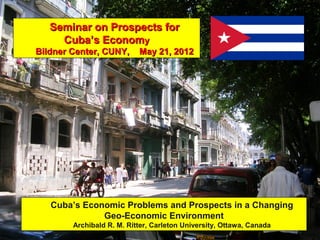
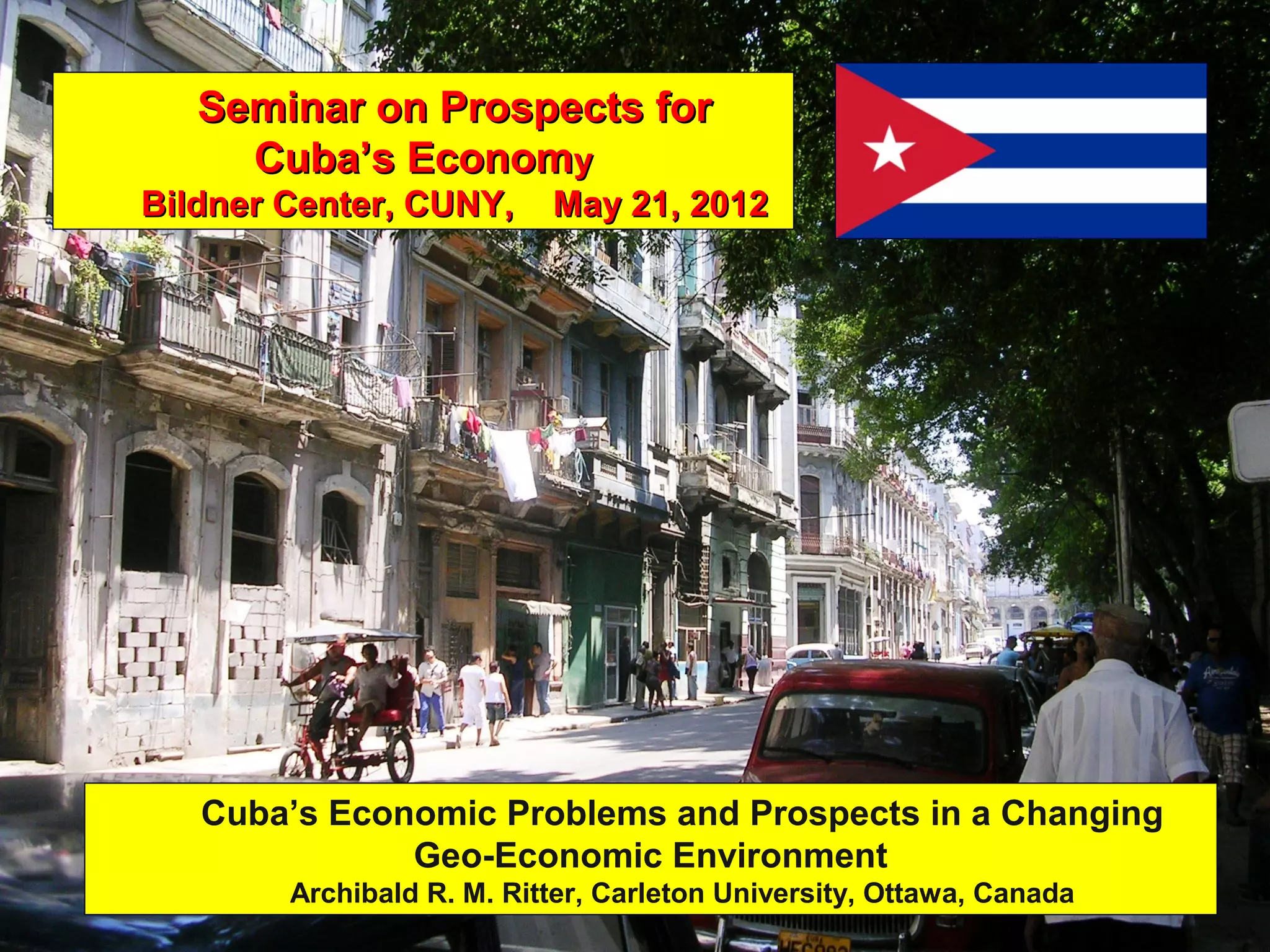
Seminar oonn PPrroossppeeccttss ffoorr 
CCuubbaa’’ss EEccoonnoommyy 
BBiillddnneerr CCeenntteerr,, CCUUNNYY,, MMaayy 2211,, 22001122 
Cuba’s Economic Problems and Prospects in a Changing 
Geo-Economic Environment 
Archibald R. M. Ritter, Carleton University, Ottawa, Canada
OObbjjeeccttiivveess:: 
– To review Cuba’s current economic situation; 
– To outline and evaluate the policy approach of the 
Government of Raul Castro; 
– To explore implications of the changing geo-political 
setting for Cuba’s economy; 
– To outline a number of possible future scenarios 
Main Argument: 
– Current economic situation is difficult; 
– Strategic economic re-orientation: 
right direction; modest; slow implementation; 
– Prospects are positive, with major downside risks 
– Major economic uncertainties and risks in the near 
future
Outline: 
II.. CCuubbaa’’ss CCuurrrreenntt EEccoonnoommiicc SSiittuuaattiioonn: 
II. The Reform Approach so far: 
III. Economic Performance, 2011-2012 
IV. Implications of the Changing Geo- 
Political Context 
V. Some Scenarios for Cuba’s 
Economic Future
II.. CCoonntteexxtt ffoorr tthhee RReeffoorrmmss ooff 22001100--1122 
1. General economic performance 
during the “Special Period”, 1990- 
2011: 
–Human development has been positive; 
–Some success: growth and 
recuperation; 
–Some “Islands of Prosperity” (e.g. 
Tourism sector, Old Havana, mixed 
corporations
II.. CCoonntteexxtt ffoorr tthhee RReeffoorrmmss ooff 22001100--1122 
But: 
–Real Income per person has not risen 
in pace with economic growth; 
–Production of Goods – as opposed to 
services – has not improved; 
–A range of problems continues
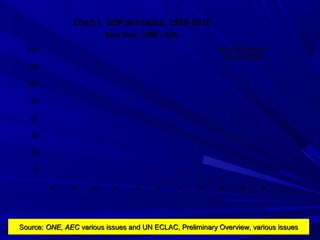
140 
120 
100 
80 
60 
40 
20 
0 
1989 
Chart 1 GDP per capita, 1989-2010 
191 
193 
Base Year: 1989 = 100. 
195 
197 
19 
201 
203 
New GDP Measure 
Adopted, 2004 
205 
207 
209 
SSoouurrccee:: OONNEE,, AAEECC vvaarriioouuss iissssuueess aanndd UUNN EECCLLAACC,, PPrreelliimmiinnaarryy OOvveerrvviieeww,, vvaarriioouuss iissssuueess
But: Cuba’s GDP statistics are dubious: 
– The Oficina Nacional de Estadísticas (ONE) adopted a 
new approach to measuring GDP (ONE 2006, Table 2.1.2.30). 
– Increased the value of “government consumption” by 
76.6 percent—for health, mainly – thereby raising Cuba’s 
GDP per capita and increasing its growth rate; 
Although the Cuban economy surpassed the 
levels of 1990, the real value of wages in 
Cuba remained at around 40 percent of 
the 1989 level (see Chart 2). 
Actual economic performance: weak
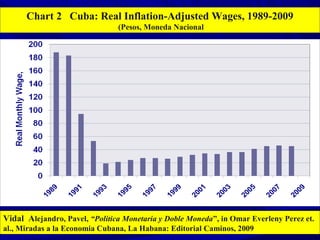
Chart 2 Cuba: Real Inflation-Adjusted Wages, 1989-2009 
(Pesos, Moneda Nacional 
Vidal Alejandro, Pavel, “Politica Monetaria y Doble Moneda”, in Omar Everleny Perez et. 
al., Miradas a la Economia Cubana, La Habana: Editorial Caminos, 2009
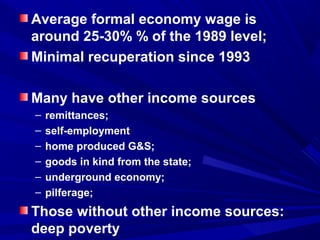
Average formal economy wage is 
around 25-30% % of the 1989 level; 
Minimal recuperation since 1993 
Many have other income sources 
– remittances; 
– self-employment 
– home produced G&S; 
– goods in kind from the state; 
– underground economy; 
– pilferage; 
Those without other income sources: 
deep poverty
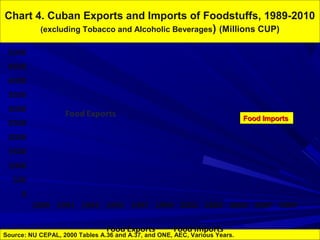
Chart 4. Cuban Exports and Imports of Foodstuffs, 1989-2010 
(excluding Tobacco and Alcoholic Beverages) (Millions CUP) 
5000 
4500 
4000 
3500 
3000 
2500 
2000 
1500 
1000 
500 
0 
Food Exports 
1989 1991 1993 1995 1997 1999 2001 2003 2005 2007 2009 
Food Exports Food Imports 
Source: NU CEPAL, 2000 Tables A.36 and A.37, and ONE, AEC, Various Years. 
FFoooodd IImmppoorrttss
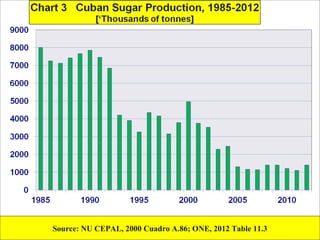
Source: NU CEPAL, 2000 Cuadro A.86; ONE, 2012 Table 11.3
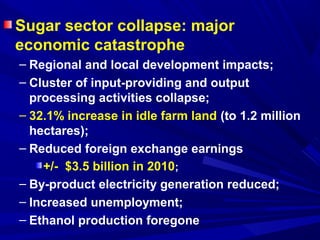
Sugar sector collapse: major 
economic catastrophe 
– Regional and local development impacts; 
– Cluster of input-providing and output 
processing activities collapse; 
– 32.1% increase in idle farm land (to 1.2 million 
hectares); 
– Reduced foreign exchange earnings 
+/- $3.5 billion in 2010; 
– By-product electricity generation reduced; 
– Increased unemployment; 
– Ethanol production foregone
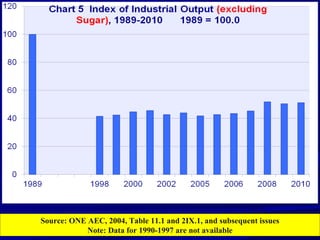
Source: ONE AEC, 2004, Table 11.1 and 2IX.1, and subsequent issues 
Note: Data for 1990-1997 are not available
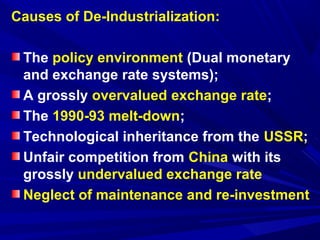
Causes of De-Industrialization: 
The policy environment (Dual monetary 
and exchange rate systems); 
A grossly overvalued exchange rate; 
The 1990-93 melt-down; 
Technological inheritance from the USSR; 
Unfair competition from China with its 
grossly undervalued exchange rate 
Neglect of maintenance and re-investment
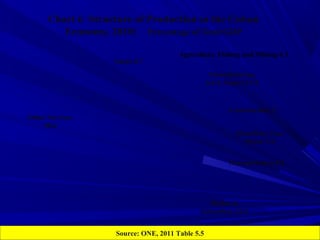
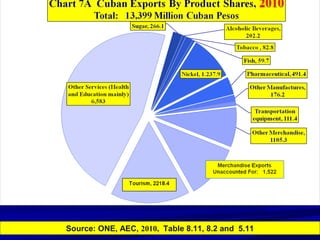
Chart 6 Structure of Production in the Cuban 
Economy, 2010; Percentage of Total GDP 
Source: ONE, 2011 Table 5.5 
Manufacturing 
(excl. Sugar) 13.4 
Construction, 5 
Electricity, Gas, 
Water, 1.6 
Transportation 8.8 
Health & 
Education, 24.9 
Other Services, 
40.2 
Sugar, 0.7 
Agriculture, Fishing and Mining 4.3
Source: ONE, AEC, 2010, Table 8.11, 8.2 and 5.11
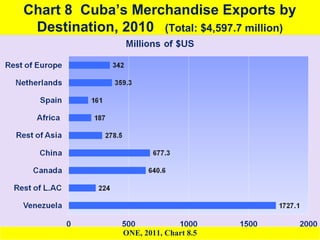
Chart 8 Cuba’s Merchandise Exports by 
Destination, 2010 (Total: $4,597.7 million) 
ONE, 2011, Chart 8.5
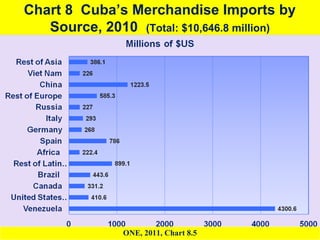
Chart 8 Cuba’s Merchandise Imports by 
Source, 2010 (Total: $10,646.8 million) 
ONE, 2011, Chart 8.5
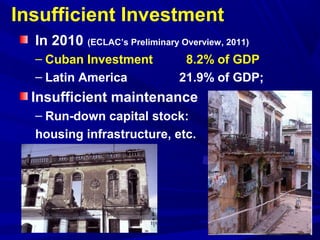
Insufficient Investment 
In 2010 (ECLAC’s Preliminary Overview, 2011) 
– Cuban Investment 8.2% of GDP 
– Latin America 21.9% of GDP; 
Insufficient maintenance 
– Run-down capital stock: 
housing infrastructure, etc.
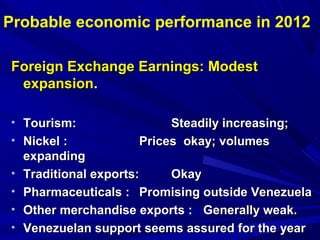
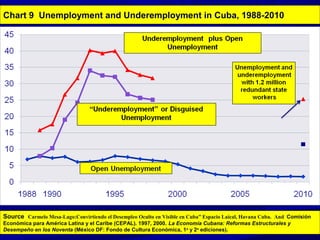
Chart 9 Unemployment and Underemployment in Cuba, 1988-2010 
Source: Carmelo Mesa-Lago:Convirtiendo el Desempleo Oculto en Visible en Cuba” Espacio Laical, Havana Cuba. And Comisión 
Económica para América Latina y el Caribe (CEPAL). 1997, 2000. La Economía Cubana: Reformas Estructurales y 
Desempeño en los Noventa (México DF: Fondo de Cultura Económica, 1a y 2a ediciones).
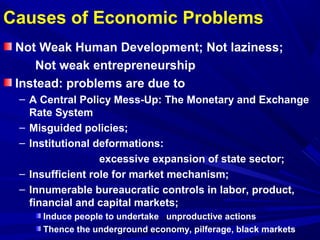
Causes of Economic Problems 
Not Weak Human Development; Not laziness; 
Not weak entrepreneurship 
Instead: problems are due to 
– A Central Policy Mess-Up: The Monetary and Exchange 
Rate System 
– Misguided policies; 
– Institutional deformations: 
excessive expansion of state sector; 
– Insufficient role for market mechanism; 
– Innumerable bureaucratic controls in labor, product, 
financial and capital markets; 
Induce people to undertake unproductive actions 
Thence the underground economy, pilferage, black markets
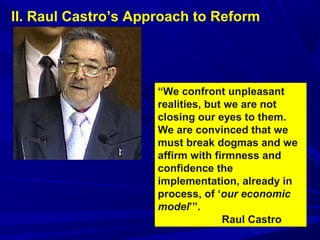
II. Raul Castro’s Approach to Reform 
“We confront unpleasant 
realities, but we are not 
closing our eyes to them. 
We are convinced that we 
must break dogmas and we 
affirm with firmness and 
confidence the 
implementation, already in 
process, of ‘our economic 
model’”. 
Raul Castro
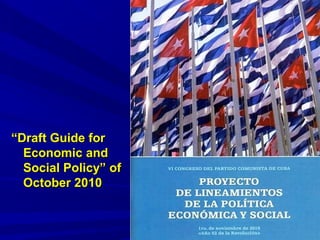
““DDrraafftt GGuuiiddee ffoorr 
EEccoonnoommiicc aanndd 
SSoocciiaall PPoolliiccyy”” ooff 
OOccttoobbeerr 22001100
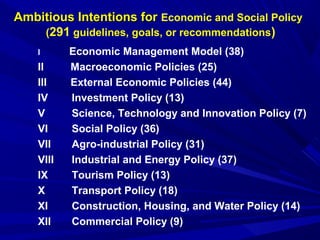
Ambitious IInntteennttiioonnss ffoorr Economic and Social Policy 
(291 guidelines, goals, or recommendations) 
I Economic Management Model (38) 
II Macroeconomic Policies (25) 
III External Economic Policies (44) 
IV Investment Policy (13) 
V Science, Technology and Innovation Policy (7) 
VI Social Policy (36) 
VII Agro-industrial Policy (31) 
VIII Industrial and Energy Policy (37) 
IX Tourism Policy (13) 
X Transport Policy (18) 
XI Construction, Housing, and Water Policy (14) 
XII Commercial Policy (9)
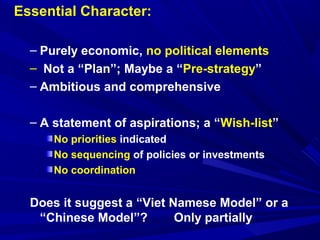
Essential Character: 
– Purely economic, no political elements 
– Not a “Plan”; Maybe a “Pre-strategy” 
– Ambitious and comprehensive 
– A statement of aspirations; a “Wish-list” 
No priorities indicated 
No sequencing of policies or investments 
No coordination 
Does it suggest a “Viet Namese Model” or a 
“Chinese Model”? Only partially
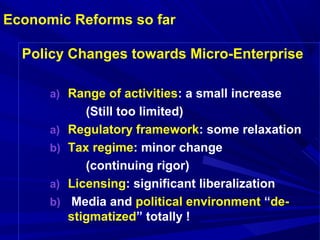
Economic Reforms so far 
Policy Changes towards Micro-Enterprise 
a) Range of activities: a small increase 
(Still too limited) 
a) Regulatory framework: some relaxation 
b) Tax regime: minor change 
(continuing rigor) 
a) Licensing: significant liberalization 
b) Media and political environment “de-stigmatized” 
totally !
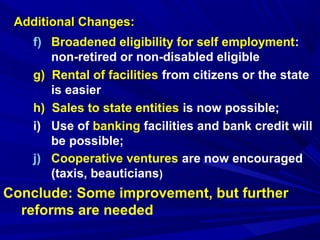
AAddddiittiioonnaall CChhaannggeess:: 
f) Broadened eligibility for self employment: 
non-retired or non-disabled eligible 
g) Rental of facilities from citizens or the state 
is easier 
h) Sales to state entities is now possible; 
i) Use of banking facilities and bank credit will 
be possible; 
j) Cooperative ventures are now encouraged 
(taxis, beauticians) 
Conclude: Some improvement, but further 
reforms are needed
IIIIII.. RReessuullttss?? 
Expansion of Small Enterprise and job 
creation has been too slow to absorb 500,000 
by March 1, 2011, or 1.2 million by December 
2012 
• 171,000 new licenses by March 10, 2011 
Proposed shock therapy re employment 
was too brutal to be implemented: 
Firing of workers decelerated.
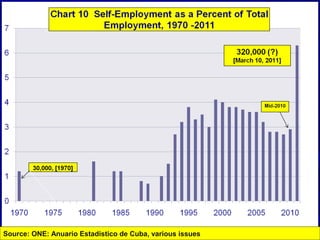
Source: ONE: Anuario Estadistico de Cuba, various issues
Other Policy Initiatives: July 2006-May 2012 
22000066 
Permission for Cuban citizens to use tourist hotel facilities 
Permission to acquire personal cellular phone contracts 
Permission to rent cars previously reserved for foreigners 
Relaxation of rules regarding purchase of computers, DVD 
players, etc. 
“Resolution on Regulations for Labor Discipline” 
2007 
Legalization of hard‐currency salary supplements to Cuban 
employees of foreign joint ventures 
2008 
Decree-Law No. 259: ten-year leases of unused 
state land to small farmers 
Decree Law No. 260, Financial incentives to attract teachers back 
to their profession
2009 
Replacement of Fidel Castro’s economic team and resignation of 
the President of the Central Bank 
Proposal to reduce subsidization of rationed products 
Replacement of worker’s dining facilities with an income increase 
2010 
Relaxation of restrictions on private taxis 
Experiment with cooperative beauty and barber shops 
Markets for inputs for small farmers 
Raising of retirement ages from 55 to 60 for women 
and from 60 to 65 for men 
Liberalization of sale of building materials to citizens 
Legalization of 99-year leasing of land to foreign 
tourist companies (August 13, 2010) 
Announcement of Lay-offs of 500,000 state sector workers to be 
incorporated into self-employment. (September 1)
2011 
Direct conversion of state properties to private activities 
(preferably cooperatives) 
Home Ownership: direct citizen-to-citizen sales at 
market determined prices probable 
Establishment of an open market for vehicles 
An emphasis on cooperative-types of organization; details in 
process 
Modification of Educational System: 
Reducing University enrolment ; 
Reversing Fidel’s University in Every Municipality approach
Is the Reform Process Sustainable? 
Yes 
 The “Fidelista Model” is discredited 
 Fidel is irrelevant and discredited; 
 “Fidelistas” are also discredited 
 By current realities, 
 By the “Proyecto de Linamientos…” 
 By Raul’s statements and speeches regarding the 
need for a new economic approach 
 By publicity re the need for a new approach 
Fidelista Ministers have been replaced by 
Raulistas; 
Virtually no criticism from the left inside 
or outside Cuba
– Raul’s military colleagues have moved into 
management throughout the economy 
Raul and the military: pragmatic since the 1990s 
But management militarization is also problematic; 
– Raul appears to have emerged from the shadow 
of his elder brother; 
Raul seems to want his own economic model; 
Raul seems to want his own legacy
Could the Reform Process Accelerate?? 
Improbable as long as Raul is in Charge 
– Cautious but deliberate; 
– Original Revolutionary generation still in 
command; 
– Fear of Russian style melt-down; 
– Fear of loss of political control & Party 
monopoly; 
– Political pressures from heightened 
expectations ?
Under what conditions might the 
reform process accelerate? 
– If “Generational Change” occurs soon 
and the gerontocrats leave the scene; 
– If Venezuelan support stopped, 
generating recession; 
– If no off-shore petroleum is found; 
– If other factors led to renewed 
recession; 
– If expectations were further heightened 
but unrealized
Might the Reform Process Decelerate? 
– Maybe, if Cuba becomes a “petro-power” 
increasing foreign exchange 
earnings dramatically 
– Will Cuba experience the “Resource 
Curse” phenomenon ?? 
– Maybe, as long as Chavez remains in 
power 
– Maybe, if other factors lead to renewed 
economic prosperity
Probable economic performance in 2012 
Foreign EExxcchhaannggee EEaarrnniinnggss:: MMooddeesstt 
eexxppaannssiioonn.. 
• TToouurriissmm:: SStteeaaddiillyy iinnccrreeaassiinngg;; 
• NNiicckkeell :: PPrriicceess ookkaayy;; vvoolluummeess 
eexxppaannddiinngg 
• TTrraaddiittiioonnaall eexxppoorrttss:: OOkkaayy 
• PPhhaarrmmaacceeuuttiiccaallss :: PPrroommiissiinngg oouuttssiiddee VVeenneezzuueellaa 
• OOtthheerr mmeerrcchhaannddiissee eexxppoorrttss :: GGeenneerraallllyy wweeaakk.. 
• VVeenneezzuueellaann ssuuppppoorrtt sseeeemmss aassssuurreedd ffoorr tthhee yyeeaarr
Investment Levels: 
Domestic investment volumes weak 
But micro-enterprise investments are increasing 
and bear fruit fast; 
Significant positive impacts on daily material life 
for citizens 
Foreign Investment modestly positive: 
Mariel Port Development now; 
Sherritt International Nickel expansion; 
Off-Shore Petroleum exploration on-going; 
Hotel / golf expansions delayed; 
Possible Brazilian Investment in Sugar/Ethanol ? 
Possible Chinese investments ??
TThhee CChhaannggiinngg GGeeoo--EEccoonnoommiicc 
EEnnvviirroonnmmeenntt 
VVeenneezzuueellaa,, 
CChhiinnaa,, 
BBrraazziill,, aanndd 
UUSSAA
TThhee CChhaannggiinngg GGeeoo--EEccoonnoommiicc EEnnvviirroonnmmeenntt 
Special Relationship with Venezuela: 
Merchandise Exports to Ven. (2010): $1.727 million or 37.7% of Total 
Merchandise Imports from Ven. $4,300 million or 40.4& of Total 
(ONE, AEC, 2011) 
Oil Import Subsidy: (1% interest, 25 year repayment, 40% of imports) 
My estimate for 2010 +/- $1,168 million 
Cuba’s Service Exports to Venezuela.: up to $ 6,000 million 
Cuba’s Total Export of Pharmaceuticals to Ven. in 2010: $164 Million
Direct Subsidization in 2010 : $ 1.2 to 2 Billion; 
Special Trade Deals 
(Doctors, etc. at politically determined prices) 
Unclear, perhaps exceeding $ 6 Billion 
Sustainability ? 
Unsustainable in long run due to their political 
character; 
Doctor’s services: too valuable to be cut quickly, but 
also unsustainable in the long run.
Emerging Relationship with China 
Second major trading partner in 2010; 
Cuba’s Imports: $1,223,5 million 
The major source of low-cost manufactures 
Cuba’s Exports: $ 677.3 million (nickel mainly) 
Possible future investment 
Off-Shore Petroleum and refining; 
Manufacturing; 
Hotels 
Prospects: Promising 
Ideological affinity; 
Nickel and agriculture are of interest to China 
Downside: Is China also “de-industrializing” Cuba?
RReellaattiioonnsshhiipp wwiitthh BBrraazziill:: 
Trade: Major expansion of Cuba’s imports from 
Brazil to +/- $ 450 million 
Brazilian Investment: 
Mariel port project: +/- $ 960 million 
Sugar/ethanol investment appears probable; 
Off-shore petroleum exploration dormant 
Some small investment activities; 
Some technical assistance 
Cuba: a useful medium for Brazilian diplomatic 
ambitions in the region
Relations with the United States: 
Normalization would be positive for Cuba 
(and for the United States) 
• Tourism bonanza for Cuba 
(Curiosity, sun/sea/sand, ”snow-bird”, retiree, convention, 
“March-Breaker” tourism would all “break loose”) 
• Access to a major new export market; 
• Major Investment potential, esp. from Cuban- 
American community; 
• Major Technological transfers would be promoted 
• Promotion of numerous types of financial flows 
(informal; NGOs micro-credits; supplier’s credits; 
bank loans; portfolio investments, IDB loans etc.) ; 
Normalization would help Cuba become a 
“normal “ country
PPoossssiibbllee FFuuttuurree SScceennaarriiooss:: 
11.. CCoonnttiinnuuiinngg MMooddeerraattee RReeffoorrmm 
22.. PPeettrroo--PPoowweerr PPaarrttyy PPaattrroonnaaggee RReeggiimmee 
33.. TThhee ““CChhiinneessee MMooddeell”” 
44.. MMoovvee ttoo ““NNoorrmmaall”” MMiixxeedd MMaarrkkeett 
EEccoonnoommyy
22.. PPeettrroo--PPoowweerr PPaarrttyy PPaattrroonnaaggee RReeggiimmee:: 
MMooddeerraattee rreeffoorrmmss,, pplluuss aa PPeettrroolleeuumm BBoonnaannzzaa 
Assumptions: 
– Successful off-shore oil development; 
– Three to 8 year Time Horizon 
– Political Status Quo: Communist Party 
dominance continues; 
– Venezuela support may or may not continue 
– China orientation continues 
– No US-Cuba Normalization
Consequences: 
Possibility AA.. MMooddeerraattee BBooPP SSuuppppoorrtt;; 
– EEnnccoouurraaggiinngg ddiivveerrssiiffiieedd eexxppaannssiioonn 
– PPrroommoottiinngg ggrroowwtthh aanndd pprroossppeerriittyy 
PPoossssiibbiilliittyy BB.. TThhee ““CCuurrssee ooff RReessoouurrccee WWeeaalltthh””?? 
– EEccoonnoommyy ddrriivveenn bbaacckk ttoo ““mmoonnoo--eexxppoorrttaattiioonn”” vviiaa 
eexxcchhaannggee rraattee iimmppaacctt ((lliikkee SSaauuddii AArraabbiiaa,, VVeenneezzuueellaa 
eettcc..)) 
– RReeccaallll tthhee ssuuggaarr bboonnaannzzaa:: ““DDaannccee ooff tthhee MMiilllliioonnss”” 
PPoolliittiiccaall IImmpplliiccaattiioonnss iinn eeaacchh ccaassee:: 
– WWiinndd--ffaallll OOiill RReevveennuueess ffeeeedd tthhee PPaarrttyy PPaattrroonnaaggee 
mmaacchhiinnee;; ssttrreennggtthheenn cceennttrraall ppoolliittiiccaall ccoonnttrrooll;; 
– AAmmpplliiffiieedd ppootteennttiiaall ffoorr ccoorrrruuppttiioonn oovveerr aanndd aabboovvee tthhee 
ppeerrvvaassiivvee PPaarrttyy ppaattrroonnaaggee
3. Possible “Chinese” Model 
Assumptions: 
– Political Status Quo: Communist Party 
monopoly continues 
– Major Apertura to Foreign Investment 
– More effective domestic “Marketization” 
– Effective macro-economic management (re 
monetary policy and the exchange rate) 
– With or without Chavez support 
– Successful Export-Orientation 
– Time-Horizon: from Year 2 to Year 15
Probable Consequences: 
– SSttrreennggtthheenneedd PPaarrttyy CCoonnttrrooll 
– NNoo AAuutthheennttiicc DDeemmooccrraattiizzaattiioonn oorr HHuummaann 
RRiigghhttss IImmpprroovveemmeennttss 
– CCoonnttiinnuuiinngg PPoolliittiiccaall RReepprreessssiioonn,, 
– GGrreeaatteerr EEccoonnoommiicc PPrroossppeerriittyy 
– IImmpprroovviinngg EEccoonnoommiicc LLiibbeerrttiieess ((ttrraavveell,, 
ttoouurriissmm,, ttrraaddee,, eenntteerrpprriissee))
44.. RRaappiidd MMoovvee ttoo ““NNoorrmmaall”” MMiixxeedd MMaarrkkeett 
EEccoonnoommyy 
Cuba as a “Normal Country”: Characteristics: 
o Further Internal Economic Liberalization 
o Enhanced Economic Apertura 
(re DFI, Trade, Financial Flows, IFIs) 
o Productive Relations with Exile Diaspora 
o Transition to Political Pluralism and Human 
Rights 
o Normalization with the United States
Main Economic Consequences: 
– Accelerated and more complete 
technological transfer to all areas of 
economy; 
– Stimulation of economic growth 
– Cuba becomes an economic Gateway 
to Latin America from North America; 
from Latin America to North America
PPrreeccoonnddiittiioonnss:: 
–EEmmeerrggeennccee ooff RReeffoorrmmiisstt LLeeaaddeerrsshhiipp;; 
–SShhiifftt ttoo ggeennuuiinnee ppoolliittiiccaall pplluurraalliissmm 
–NNoorrmmaalliizzaattiioonn wwiitthh tthhee UUnniitteedd SSttaatteess 
PPrroobbaabbiilliittyy:: 
– SShhoorrtt rruunn,, 22000099--22001144:: 55%% 
– LLoonnggeerr TTeerrmm,, 22002211--22002266:: 7700%%
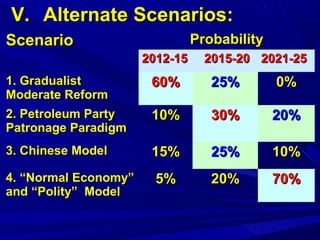
VV.. AAlltteerrnnaattee SScceennaarriiooss:: 
SScceennaarriioo PPrroobbaabbiilliittyy 
22001122--1155 22001155--2200 22002211--2255 
11.. GGrraadduuaalliisstt 
MMooddeerraattee RReeffoorrmm 
6600%% 2255%% 00%% 
22.. PPeettrroolleeuumm PPaarrttyy 
PPaattrroonnaaggee PPaarraaddiiggmm 
1100%% 3300%% 2200%% 
33.. CChhiinneessee MMooddeell 1155%% 2255%% 1100%% 
44.. ““NNoorrmmaall EEccoonnoommyy”” 
55%% 2200%% 7700%% 
aanndd ““PPoolliittyy”” MMooddeell
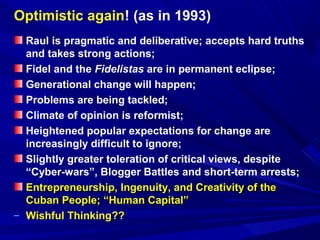
Optimistic again! (as in 1993) 
Raul is pragmatic and deliberative; accepts hard truths 
and takes strong actions; 
Fidel and the Fidelistas are in permanent eclipse; 
Generational change will happen; 
Problems are being tackled; 
Climate of opinion is reformist; 
Heightened popular expectations for change are 
increasingly difficult to ignore; 
Slightly greater toleration of critical views, despite 
“Cyber-wars”, Blogger Battles and short-term arrests; 
Entrepreneurship, Ingenuity, and CCrreeaattiivviittyy ooff tthhee 
CCuubbaann PPeeooppllee;; ““HHuummaann CCaappiittaall”” 
– WWiisshhffuull TThhiinnkkiinngg????
To Conclude: 
Economic situation is difficult; 
Policy changes are in the right direction 
but reforms so far are timid; 
Major uncertainties re Chavez support and 
petroleum; 
A dynamic towards further gradual reform 
is in motion and will continue;
Thank You Very Much

Seminar on prospects for Cuba's Economy

  • 1.
    Seminar oonn PPrroossppeeccttssffoorr CCuubbaa’’ss EEccoonnoommyy BBiillddnneerr CCeenntteerr,, CCUUNNYY,, MMaayy 2211,, 22001122 Cuba’s Economic Problems and Prospects in a Changing Geo-Economic Environment Archibald R. M. Ritter, Carleton University, Ottawa, Canada
  • 2.
    OObbjjeeccttiivveess:: – Toreview Cuba’s current economic situation; – To outline and evaluate the policy approach of the Government of Raul Castro; – To explore implications of the changing geo-political setting for Cuba’s economy; – To outline a number of possible future scenarios Main Argument: – Current economic situation is difficult; – Strategic economic re-orientation: right direction; modest; slow implementation; – Prospects are positive, with major downside risks – Major economic uncertainties and risks in the near future
  • 3.
    Outline: II.. CCuubbaa’’ssCCuurrrreenntt EEccoonnoommiicc SSiittuuaattiioonn: II. The Reform Approach so far: III. Economic Performance, 2011-2012 IV. Implications of the Changing Geo- Political Context V. Some Scenarios for Cuba’s Economic Future
  • 4.
    II.. CCoonntteexxtt ffoorrtthhee RReeffoorrmmss ooff 22001100--1122 1. General economic performance during the “Special Period”, 1990- 2011: –Human development has been positive; –Some success: growth and recuperation; –Some “Islands of Prosperity” (e.g. Tourism sector, Old Havana, mixed corporations
  • 5.
    II.. CCoonntteexxtt ffoorrtthhee RReeffoorrmmss ooff 22001100--1122 But: –Real Income per person has not risen in pace with economic growth; –Production of Goods – as opposed to services – has not improved; –A range of problems continues
  • 6.
    140 120 100 80 60 40 20 0 1989 Chart 1 GDP per capita, 1989-2010 191 193 Base Year: 1989 = 100. 195 197 19 201 203 New GDP Measure Adopted, 2004 205 207 209 SSoouurrccee:: OONNEE,, AAEECC vvaarriioouuss iissssuueess aanndd UUNN EECCLLAACC,, PPrreelliimmiinnaarryy OOvveerrvviieeww,, vvaarriioouuss iissssuueess
  • 7.
    But: Cuba’s GDPstatistics are dubious: – The Oficina Nacional de Estadísticas (ONE) adopted a new approach to measuring GDP (ONE 2006, Table 2.1.2.30). – Increased the value of “government consumption” by 76.6 percent—for health, mainly – thereby raising Cuba’s GDP per capita and increasing its growth rate; Although the Cuban economy surpassed the levels of 1990, the real value of wages in Cuba remained at around 40 percent of the 1989 level (see Chart 2). Actual economic performance: weak
  • 8.
    Chart 2 Cuba:Real Inflation-Adjusted Wages, 1989-2009 (Pesos, Moneda Nacional Vidal Alejandro, Pavel, “Politica Monetaria y Doble Moneda”, in Omar Everleny Perez et. al., Miradas a la Economia Cubana, La Habana: Editorial Caminos, 2009
  • 9.
    Average formal economywage is around 25-30% % of the 1989 level; Minimal recuperation since 1993 Many have other income sources – remittances; – self-employment – home produced G&S; – goods in kind from the state; – underground economy; – pilferage; Those without other income sources: deep poverty
  • 10.
    Chart 4. CubanExports and Imports of Foodstuffs, 1989-2010 (excluding Tobacco and Alcoholic Beverages) (Millions CUP) 5000 4500 4000 3500 3000 2500 2000 1500 1000 500 0 Food Exports 1989 1991 1993 1995 1997 1999 2001 2003 2005 2007 2009 Food Exports Food Imports Source: NU CEPAL, 2000 Tables A.36 and A.37, and ONE, AEC, Various Years. FFoooodd IImmppoorrttss
  • 11.
    Source: NU CEPAL,2000 Cuadro A.86; ONE, 2012 Table 11.3
  • 12.
    Sugar sector collapse:major economic catastrophe – Regional and local development impacts; – Cluster of input-providing and output processing activities collapse; – 32.1% increase in idle farm land (to 1.2 million hectares); – Reduced foreign exchange earnings +/- $3.5 billion in 2010; – By-product electricity generation reduced; – Increased unemployment; – Ethanol production foregone
  • 13.
    Source: ONE AEC,2004, Table 11.1 and 2IX.1, and subsequent issues Note: Data for 1990-1997 are not available
  • 14.
    Causes of De-Industrialization: The policy environment (Dual monetary and exchange rate systems); A grossly overvalued exchange rate; The 1990-93 melt-down; Technological inheritance from the USSR; Unfair competition from China with its grossly undervalued exchange rate Neglect of maintenance and re-investment
  • 15.
    Chart 6 Structureof Production in the Cuban Economy, 2010; Percentage of Total GDP Source: ONE, 2011 Table 5.5 Manufacturing (excl. Sugar) 13.4 Construction, 5 Electricity, Gas, Water, 1.6 Transportation 8.8 Health & Education, 24.9 Other Services, 40.2 Sugar, 0.7 Agriculture, Fishing and Mining 4.3
  • 16.
    Source: ONE, AEC,2010, Table 8.11, 8.2 and 5.11
  • 17.
    Chart 8 Cuba’sMerchandise Exports by Destination, 2010 (Total: $4,597.7 million) ONE, 2011, Chart 8.5
  • 18.
    Chart 8 Cuba’sMerchandise Imports by Source, 2010 (Total: $10,646.8 million) ONE, 2011, Chart 8.5
  • 19.
    Insufficient Investment In2010 (ECLAC’s Preliminary Overview, 2011) – Cuban Investment 8.2% of GDP – Latin America 21.9% of GDP; Insufficient maintenance – Run-down capital stock: housing infrastructure, etc.
  • 20.
    Chart 9 Unemploymentand Underemployment in Cuba, 1988-2010 Source: Carmelo Mesa-Lago:Convirtiendo el Desempleo Oculto en Visible en Cuba” Espacio Laical, Havana Cuba. And Comisión Económica para América Latina y el Caribe (CEPAL). 1997, 2000. La Economía Cubana: Reformas Estructurales y Desempeño en los Noventa (México DF: Fondo de Cultura Económica, 1a y 2a ediciones).
  • 21.
    Causes of EconomicProblems Not Weak Human Development; Not laziness; Not weak entrepreneurship Instead: problems are due to – A Central Policy Mess-Up: The Monetary and Exchange Rate System – Misguided policies; – Institutional deformations: excessive expansion of state sector; – Insufficient role for market mechanism; – Innumerable bureaucratic controls in labor, product, financial and capital markets; Induce people to undertake unproductive actions Thence the underground economy, pilferage, black markets
  • 22.
    II. Raul Castro’sApproach to Reform “We confront unpleasant realities, but we are not closing our eyes to them. We are convinced that we must break dogmas and we affirm with firmness and confidence the implementation, already in process, of ‘our economic model’”. Raul Castro
  • 23.
    ““DDrraafftt GGuuiiddee ffoorr EEccoonnoommiicc aanndd SSoocciiaall PPoolliiccyy”” ooff OOccttoobbeerr 22001100
  • 24.
    Ambitious IInntteennttiioonnss ffoorrEconomic and Social Policy (291 guidelines, goals, or recommendations) I Economic Management Model (38) II Macroeconomic Policies (25) III External Economic Policies (44) IV Investment Policy (13) V Science, Technology and Innovation Policy (7) VI Social Policy (36) VII Agro-industrial Policy (31) VIII Industrial and Energy Policy (37) IX Tourism Policy (13) X Transport Policy (18) XI Construction, Housing, and Water Policy (14) XII Commercial Policy (9)
  • 25.
    Essential Character: –Purely economic, no political elements – Not a “Plan”; Maybe a “Pre-strategy” – Ambitious and comprehensive – A statement of aspirations; a “Wish-list” No priorities indicated No sequencing of policies or investments No coordination Does it suggest a “Viet Namese Model” or a “Chinese Model”? Only partially
  • 26.
    Economic Reforms sofar Policy Changes towards Micro-Enterprise a) Range of activities: a small increase (Still too limited) a) Regulatory framework: some relaxation b) Tax regime: minor change (continuing rigor) a) Licensing: significant liberalization b) Media and political environment “de-stigmatized” totally !
  • 27.
    AAddddiittiioonnaall CChhaannggeess:: f)Broadened eligibility for self employment: non-retired or non-disabled eligible g) Rental of facilities from citizens or the state is easier h) Sales to state entities is now possible; i) Use of banking facilities and bank credit will be possible; j) Cooperative ventures are now encouraged (taxis, beauticians) Conclude: Some improvement, but further reforms are needed
  • 28.
    IIIIII.. RReessuullttss?? Expansionof Small Enterprise and job creation has been too slow to absorb 500,000 by March 1, 2011, or 1.2 million by December 2012 • 171,000 new licenses by March 10, 2011 Proposed shock therapy re employment was too brutal to be implemented: Firing of workers decelerated.
  • 29.
    Source: ONE: AnuarioEstadistico de Cuba, various issues
  • 30.
    Other Policy Initiatives:July 2006-May 2012 22000066 Permission for Cuban citizens to use tourist hotel facilities Permission to acquire personal cellular phone contracts Permission to rent cars previously reserved for foreigners Relaxation of rules regarding purchase of computers, DVD players, etc. “Resolution on Regulations for Labor Discipline” 2007 Legalization of hard‐currency salary supplements to Cuban employees of foreign joint ventures 2008 Decree-Law No. 259: ten-year leases of unused state land to small farmers Decree Law No. 260, Financial incentives to attract teachers back to their profession
  • 31.
    2009 Replacement ofFidel Castro’s economic team and resignation of the President of the Central Bank Proposal to reduce subsidization of rationed products Replacement of worker’s dining facilities with an income increase 2010 Relaxation of restrictions on private taxis Experiment with cooperative beauty and barber shops Markets for inputs for small farmers Raising of retirement ages from 55 to 60 for women and from 60 to 65 for men Liberalization of sale of building materials to citizens Legalization of 99-year leasing of land to foreign tourist companies (August 13, 2010) Announcement of Lay-offs of 500,000 state sector workers to be incorporated into self-employment. (September 1)
  • 32.
    2011 Direct conversionof state properties to private activities (preferably cooperatives) Home Ownership: direct citizen-to-citizen sales at market determined prices probable Establishment of an open market for vehicles An emphasis on cooperative-types of organization; details in process Modification of Educational System: Reducing University enrolment ; Reversing Fidel’s University in Every Municipality approach
  • 33.
    Is the ReformProcess Sustainable? Yes  The “Fidelista Model” is discredited  Fidel is irrelevant and discredited;  “Fidelistas” are also discredited  By current realities,  By the “Proyecto de Linamientos…”  By Raul’s statements and speeches regarding the need for a new economic approach  By publicity re the need for a new approach Fidelista Ministers have been replaced by Raulistas; Virtually no criticism from the left inside or outside Cuba
  • 34.
    – Raul’s militarycolleagues have moved into management throughout the economy Raul and the military: pragmatic since the 1990s But management militarization is also problematic; – Raul appears to have emerged from the shadow of his elder brother; Raul seems to want his own economic model; Raul seems to want his own legacy
  • 35.
    Could the ReformProcess Accelerate?? Improbable as long as Raul is in Charge – Cautious but deliberate; – Original Revolutionary generation still in command; – Fear of Russian style melt-down; – Fear of loss of political control & Party monopoly; – Political pressures from heightened expectations ?
  • 36.
    Under what conditionsmight the reform process accelerate? – If “Generational Change” occurs soon and the gerontocrats leave the scene; – If Venezuelan support stopped, generating recession; – If no off-shore petroleum is found; – If other factors led to renewed recession; – If expectations were further heightened but unrealized
  • 37.
    Might the ReformProcess Decelerate? – Maybe, if Cuba becomes a “petro-power” increasing foreign exchange earnings dramatically – Will Cuba experience the “Resource Curse” phenomenon ?? – Maybe, as long as Chavez remains in power – Maybe, if other factors lead to renewed economic prosperity
  • 38.
    Probable economic performancein 2012 Foreign EExxcchhaannggee EEaarrnniinnggss:: MMooddeesstt eexxppaannssiioonn.. • TToouurriissmm:: SStteeaaddiillyy iinnccrreeaassiinngg;; • NNiicckkeell :: PPrriicceess ookkaayy;; vvoolluummeess eexxppaannddiinngg • TTrraaddiittiioonnaall eexxppoorrttss:: OOkkaayy • PPhhaarrmmaacceeuuttiiccaallss :: PPrroommiissiinngg oouuttssiiddee VVeenneezzuueellaa • OOtthheerr mmeerrcchhaannddiissee eexxppoorrttss :: GGeenneerraallllyy wweeaakk.. • VVeenneezzuueellaann ssuuppppoorrtt sseeeemmss aassssuurreedd ffoorr tthhee yyeeaarr
  • 39.
    Investment Levels: Domesticinvestment volumes weak But micro-enterprise investments are increasing and bear fruit fast; Significant positive impacts on daily material life for citizens Foreign Investment modestly positive: Mariel Port Development now; Sherritt International Nickel expansion; Off-Shore Petroleum exploration on-going; Hotel / golf expansions delayed; Possible Brazilian Investment in Sugar/Ethanol ? Possible Chinese investments ??
  • 40.
    TThhee CChhaannggiinngg GGeeoo--EEccoonnoommiicc EEnnvviirroonnmmeenntt VVeenneezzuueellaa,, CChhiinnaa,, BBrraazziill,, aanndd UUSSAA
  • 41.
    TThhee CChhaannggiinngg GGeeoo--EEccoonnoommiiccEEnnvviirroonnmmeenntt Special Relationship with Venezuela: Merchandise Exports to Ven. (2010): $1.727 million or 37.7% of Total Merchandise Imports from Ven. $4,300 million or 40.4& of Total (ONE, AEC, 2011) Oil Import Subsidy: (1% interest, 25 year repayment, 40% of imports) My estimate for 2010 +/- $1,168 million Cuba’s Service Exports to Venezuela.: up to $ 6,000 million Cuba’s Total Export of Pharmaceuticals to Ven. in 2010: $164 Million
  • 42.
    Direct Subsidization in2010 : $ 1.2 to 2 Billion; Special Trade Deals (Doctors, etc. at politically determined prices) Unclear, perhaps exceeding $ 6 Billion Sustainability ? Unsustainable in long run due to their political character; Doctor’s services: too valuable to be cut quickly, but also unsustainable in the long run.
  • 43.
    Emerging Relationship withChina Second major trading partner in 2010; Cuba’s Imports: $1,223,5 million The major source of low-cost manufactures Cuba’s Exports: $ 677.3 million (nickel mainly) Possible future investment Off-Shore Petroleum and refining; Manufacturing; Hotels Prospects: Promising Ideological affinity; Nickel and agriculture are of interest to China Downside: Is China also “de-industrializing” Cuba?
  • 44.
    RReellaattiioonnsshhiipp wwiitthh BBrraazziill:: Trade: Major expansion of Cuba’s imports from Brazil to +/- $ 450 million Brazilian Investment: Mariel port project: +/- $ 960 million Sugar/ethanol investment appears probable; Off-shore petroleum exploration dormant Some small investment activities; Some technical assistance Cuba: a useful medium for Brazilian diplomatic ambitions in the region
  • 45.
    Relations with theUnited States: Normalization would be positive for Cuba (and for the United States) • Tourism bonanza for Cuba (Curiosity, sun/sea/sand, ”snow-bird”, retiree, convention, “March-Breaker” tourism would all “break loose”) • Access to a major new export market; • Major Investment potential, esp. from Cuban- American community; • Major Technological transfers would be promoted • Promotion of numerous types of financial flows (informal; NGOs micro-credits; supplier’s credits; bank loans; portfolio investments, IDB loans etc.) ; Normalization would help Cuba become a “normal “ country
  • 46.
    PPoossssiibbllee FFuuttuurree SScceennaarriiooss:: 11.. CCoonnttiinnuuiinngg MMooddeerraattee RReeffoorrmm 22.. PPeettrroo--PPoowweerr PPaarrttyy PPaattrroonnaaggee RReeggiimmee 33.. TThhee ““CChhiinneessee MMooddeell”” 44.. MMoovvee ttoo ““NNoorrmmaall”” MMiixxeedd MMaarrkkeett EEccoonnoommyy
  • 47.
    22.. PPeettrroo--PPoowweerr PPaarrttyyPPaattrroonnaaggee RReeggiimmee:: MMooddeerraattee rreeffoorrmmss,, pplluuss aa PPeettrroolleeuumm BBoonnaannzzaa Assumptions: – Successful off-shore oil development; – Three to 8 year Time Horizon – Political Status Quo: Communist Party dominance continues; – Venezuela support may or may not continue – China orientation continues – No US-Cuba Normalization
  • 48.
    Consequences: Possibility AA..MMooddeerraattee BBooPP SSuuppppoorrtt;; – EEnnccoouurraaggiinngg ddiivveerrssiiffiieedd eexxppaannssiioonn – PPrroommoottiinngg ggrroowwtthh aanndd pprroossppeerriittyy PPoossssiibbiilliittyy BB.. TThhee ““CCuurrssee ooff RReessoouurrccee WWeeaalltthh””?? – EEccoonnoommyy ddrriivveenn bbaacckk ttoo ““mmoonnoo--eexxppoorrttaattiioonn”” vviiaa eexxcchhaannggee rraattee iimmppaacctt ((lliikkee SSaauuddii AArraabbiiaa,, VVeenneezzuueellaa eettcc..)) – RReeccaallll tthhee ssuuggaarr bboonnaannzzaa:: ““DDaannccee ooff tthhee MMiilllliioonnss”” PPoolliittiiccaall IImmpplliiccaattiioonnss iinn eeaacchh ccaassee:: – WWiinndd--ffaallll OOiill RReevveennuueess ffeeeedd tthhee PPaarrttyy PPaattrroonnaaggee mmaacchhiinnee;; ssttrreennggtthheenn cceennttrraall ppoolliittiiccaall ccoonnttrrooll;; – AAmmpplliiffiieedd ppootteennttiiaall ffoorr ccoorrrruuppttiioonn oovveerr aanndd aabboovvee tthhee ppeerrvvaassiivvee PPaarrttyy ppaattrroonnaaggee
  • 49.
    3. Possible “Chinese”Model Assumptions: – Political Status Quo: Communist Party monopoly continues – Major Apertura to Foreign Investment – More effective domestic “Marketization” – Effective macro-economic management (re monetary policy and the exchange rate) – With or without Chavez support – Successful Export-Orientation – Time-Horizon: from Year 2 to Year 15
  • 50.
    Probable Consequences: –SSttrreennggtthheenneedd PPaarrttyy CCoonnttrrooll – NNoo AAuutthheennttiicc DDeemmooccrraattiizzaattiioonn oorr HHuummaann RRiigghhttss IImmpprroovveemmeennttss – CCoonnttiinnuuiinngg PPoolliittiiccaall RReepprreessssiioonn,, – GGrreeaatteerr EEccoonnoommiicc PPrroossppeerriittyy – IImmpprroovviinngg EEccoonnoommiicc LLiibbeerrttiieess ((ttrraavveell,, ttoouurriissmm,, ttrraaddee,, eenntteerrpprriissee))
  • 51.
    44.. RRaappiidd MMoovveettoo ““NNoorrmmaall”” MMiixxeedd MMaarrkkeett EEccoonnoommyy Cuba as a “Normal Country”: Characteristics: o Further Internal Economic Liberalization o Enhanced Economic Apertura (re DFI, Trade, Financial Flows, IFIs) o Productive Relations with Exile Diaspora o Transition to Political Pluralism and Human Rights o Normalization with the United States
  • 52.
    Main Economic Consequences: – Accelerated and more complete technological transfer to all areas of economy; – Stimulation of economic growth – Cuba becomes an economic Gateway to Latin America from North America; from Latin America to North America
  • 53.
    PPrreeccoonnddiittiioonnss:: –EEmmeerrggeennccee ooffRReeffoorrmmiisstt LLeeaaddeerrsshhiipp;; –SShhiifftt ttoo ggeennuuiinnee ppoolliittiiccaall pplluurraalliissmm –NNoorrmmaalliizzaattiioonn wwiitthh tthhee UUnniitteedd SSttaatteess PPrroobbaabbiilliittyy:: – SShhoorrtt rruunn,, 22000099--22001144:: 55%% – LLoonnggeerr TTeerrmm,, 22002211--22002266:: 7700%%
  • 54.
    VV.. AAlltteerrnnaattee SScceennaarriiooss:: SScceennaarriioo PPrroobbaabbiilliittyy 22001122--1155 22001155--2200 22002211--2255 11.. GGrraadduuaalliisstt MMooddeerraattee RReeffoorrmm 6600%% 2255%% 00%% 22.. PPeettrroolleeuumm PPaarrttyy PPaattrroonnaaggee PPaarraaddiiggmm 1100%% 3300%% 2200%% 33.. CChhiinneessee MMooddeell 1155%% 2255%% 1100%% 44.. ““NNoorrmmaall EEccoonnoommyy”” 55%% 2200%% 7700%% aanndd ““PPoolliittyy”” MMooddeell
  • 55.
    Optimistic again! (asin 1993) Raul is pragmatic and deliberative; accepts hard truths and takes strong actions; Fidel and the Fidelistas are in permanent eclipse; Generational change will happen; Problems are being tackled; Climate of opinion is reformist; Heightened popular expectations for change are increasingly difficult to ignore; Slightly greater toleration of critical views, despite “Cyber-wars”, Blogger Battles and short-term arrests; Entrepreneurship, Ingenuity, and CCrreeaattiivviittyy ooff tthhee CCuubbaann PPeeooppllee;; ““HHuummaann CCaappiittaall”” – WWiisshhffuull TThhiinnkkiinngg????
  • 56.
    To Conclude: Economicsituation is difficult; Policy changes are in the right direction but reforms so far are timid; Major uncertainties re Chavez support and petroleum; A dynamic towards further gradual reform is in motion and will continue;
  • 57.