Know – How
about Plastic Injection Moulding
1Bhushan L. Gadilohar
Cell : 9890475326
Email : bhushanlohar2009@gmail.com
Plastics
What does the word ‘Plastic’ mean?
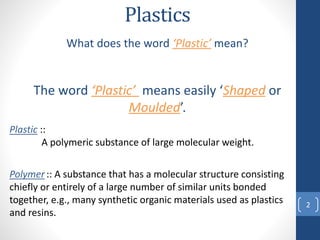
The word ‘Plastic’ means easily ‘Shaped or
Moulded’.
2
Plastic ::
A polymeric substance of large molecular weight.
Polymer :: A substance that has a molecular structure consisting
chiefly or entirely of a large number of similar units bonded
together, e.g., many synthetic organic materials used as plastics
and resins.
3
Why do we use plastics?
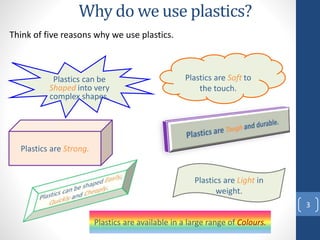
Think of five reasons why we use plastics.
Plastics can be
Shaped into very
complex shapes.
Plastics are Soft to
the touch.
Plastics are available in a large range of Colours.
Plastics are Light in
weight.
Plastics are Strong.
4
“Plastics playa very importantrolein ourlivesand the
productsweuse everyday.”
Plastics
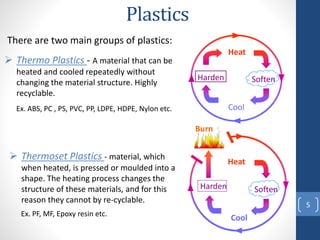
 Thermoset Plastics - material, which
when heated, is pressed or moulded into a
shape. The heating process changes the
structure of these materials, and for this
reason they cannot by re-cyclable.
There are two main groups of plastics:
5
 Thermo Plastics - A material that can be
heated and cooled repeatedly without
changing the material structure. Highly
recyclable.
Heat
Cool
Harden Soften
Heat
Cool
Harden Soften
Burn
Ex. ABS, PC , PS, PVC, PP, LDPE, HDPE, Nylon etc.
Ex. PF, MF, Epoxy resin etc.
Types of Moulding
6
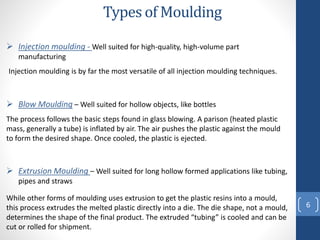
 Injection moulding - Well suited for high-quality, high-volume part
manufacturing
Injection moulding is by far the most versatile of all injection moulding techniques.
 Blow Moulding – Well suited for hollow objects, like bottles
The process follows the basic steps found in glass blowing. A parison (heated plastic
mass, generally a tube) is inflated by air. The air pushes the plastic against the mould
to form the desired shape. Once cooled, the plastic is ejected.
 Extrusion Moulding – Well suited for long hollow formed applications like tubing,
pipes and straws
While other forms of moulding uses extrusion to get the plastic resins into a mould,
this process extrudes the melted plastic directly into a die. The die shape, not a mould,
determines the shape of the final product. The extruded “tubing” is cooled and can be
cut or rolled for shipment.
Types of Moulding
7
 Rotational Moulding – Well suited for large, hollow, one-piece parts like Water
tanks.
This process uses high temperatures and rotational movement to coat the inside of
the mould and form the part. The constant rotation of the mold creates centrifugal
force forming even-walled products. Because it is ideally suited to large hollow
containers, such as tanks, it is not a fast moving process.
 Compression Moulding – Well suited for larger objects like auto parts
The name of this moulding method says everything. A heated plastic material is placed
in a heated mould and is then compressed into shape. The plastic can be in bulk but
often comes in sheets. The heating process, called curing, insures the final part will

maintain its integrity. This method of moulding is very suitable to high-strength
compounds like thermosetting resins as well as fiberglass and reinforced plastics.
Plastic Injection Moulding
8
 Injection moulding :: A manufacturing process in which
melted plastic is injected into a mould to form a part.
 The first injection moulding machine was invented and
patented by brothers John and Isaiah Hyatt in 1872.
 Today, the process is more complicated although, the basic
principle of plastic being injected into a waiting mould is still the
same.
 One of the biggest advancements has come by way of the
materials used, and there are now thousands of different
formulations available for making ‘Plastic’ Raw materials used in
the plastic injection moulding process,
Plastic Injection Moulding
9
Injection moulding machines are fairly simple and
straightforward, consisting of a hopper where raw material is
placed, a heating cylinder and an injection plunger. Moulds are
typically made from steel or aluminium. Major advantages to
using plastic injection moulding for the manufacture of parts
include:
• Ability to complete high-production rates
• Repeatability of high tolerances
• Minimal finishing
• Wide range of materials available for specific applications
• Minimal material loss
Injection moulding is the most common plastic moulding process and
is used to create a huge variety of complex parts of different size and
shape.
Basics of an Injection Moulding Machine
10
First, let’s take a quick look at how plastic injection moulding presses
are rated or classified.
Often plastic injection companies will provide a moulding equipment list. It
may look something like this:
• 50 Ton Injection Moulding Presses
• 100 Ton Injection Moulding Presses
• 150 154 Ton Injection Moulding Presses
• 200 Ton Injection Moulding Presses
• 250 Ton Injection Moulding Presses
• 400 Ton Injection Moulding Presses
So, what does this mean?
Plastic injection moulding presses are classified or rated based on tonnage,
or more specifically, the clamping pressure or force. Presses can run in size
from less than 5 tons of clamping pressure to over 6000 tons. The higher the
press ton rating, the larger the machine.
11
Second, let’s figure out how much clamping force or pressure is
required.
Basics of an Injection Moulding Machine
There are many factors that are taken into consideration when determining
the size of the press. The size of the part, the polymer being used and
something called the safety factor. The safety factor is an additional numerical
percentage buffer that is added to the calculation to help avoid defects in the
final part. Some recommend adding 10% to allow for the safety factor. As
mentioned earlier, the MFI (Melt Flow Index) of the plastic compound will
also impact the pressure needed to produce the part. Many calculations
include the platen size as well as the mould and part size, however, to get an
estimate of the press size your project will need, we have simplified it even
further.
A machine rated for 60 tons can deliver 60 tons of clamping pressure. This
pressure keeps the mould closed during the injection process. Too much or
too little pressure can cause quality issues. Too much or too little pressure can
also cause flashing, where excess material appears on the part edge.
12
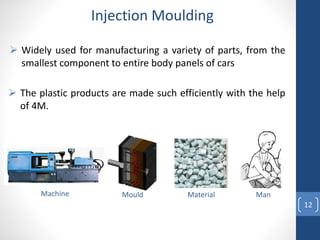
Injection Moulding
 The plastic products are made such efficiently with the help
of 4M.
ManMachine MaterialMould
 Widely used for manufacturing a variety of parts, from the
smallest component to entire body panels of cars
13
Applications of Injection Moulded Parts
•Automotive components
•FMCG Components
•Aerospace components
•Cable assemblies
•Computer electronics Components
•Mobile/Telephone Components
•Electronics components
•Instrument
•Medical & dental products
•Medical laboratories Equipment's
• Toys, hobby
14
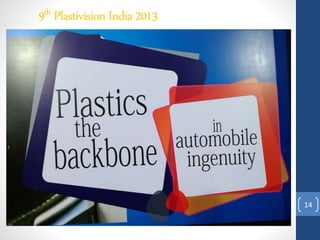
9th PlastivisionIndia 2013
15
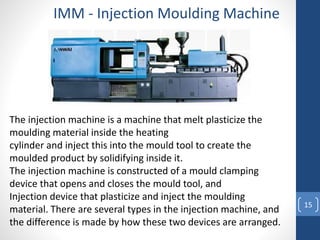
The injection machine is a machine that melt plasticize the
moulding material inside the heating
cylinder and inject this into the mould tool to create the
moulded product by solidifying inside it.
The injection machine is constructed of a mould clamping
device that opens and closes the mould tool, and
Injection device that plasticize and inject the moulding
material. There are several types in the injection machine, and
the difference is made by how these two devices are arranged.
IMM - Injection Moulding Machine
16
IMM - Injection Moulding Machine
Clamping Unit Injection Unit
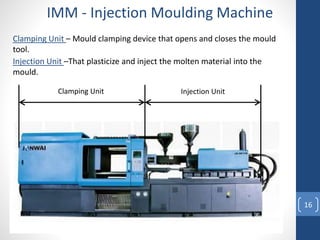
Clamping Unit – Mould clamping device that opens and closes the mould
tool.
Injection Unit –That plasticize and inject the molten material into the
mould.
17
Injection Moulding Machine
18
Injection Moulding– Mould/Tool
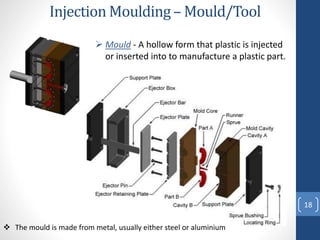
 The mould is made from metal, usually either steel or aluminium
 Mould - A hollow form that plastic is injected
or inserted into to manufacture a plastic part.
19
“Injectionmoulds represent the
greatest expense in upfront productioncosts.”
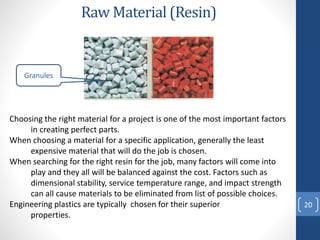
Raw Material (Resin)
20
Choosing the right material for a project is one of the most important factors
in creating perfect parts.
When choosing a material for a specific application, generally the least
expensive material that will do the job is chosen.
When searching for the right resin for the job, many factors will come into
play and they all will be balanced against the cost. Factors such as
dimensional stability, service temperature range, and impact strength
can all cause materials to be eliminated from list of possible choices.
Engineering plastics are typically chosen for their superior
properties.
Granules
21
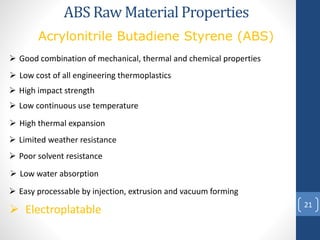
ABS Raw Material Properties
 Good combination of mechanical, thermal and chemical properties
 Easy processable by injection, extrusion and vacuum forming
 Low cost of all engineering thermoplastics
 Low continuous use temperature
 High impact strength
 High thermal expansion
 Limited weather resistance
 Poor solvent resistance
 Low water absorption
Acrylonitrile Butadiene Styrene (ABS)
 Electroplatable
22
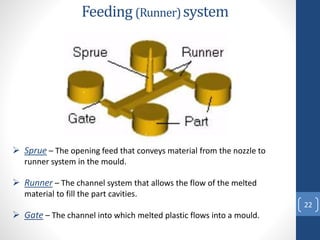
Feeding (Runner)system
 Runner – The channel system that allows the flow of the melted
material to fill the part cavities.
 Sprue – The opening feed that conveys material from the nozzle to
runner system in the mould.
 Gate – The channel into which melted plastic flows into a mould.
23
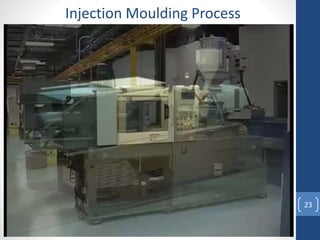
Injection Moulding Process
24
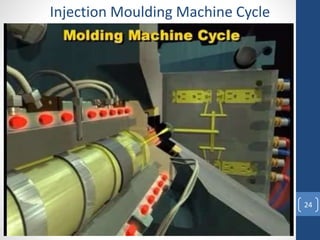
Injection Moulding Machine Cycle
25
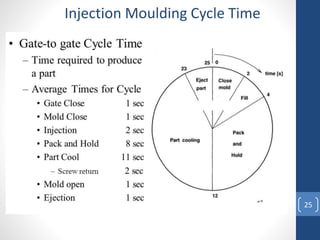
Injection Moulding Cycle Time
26
“When producinginjectionmoulded parts, it is
important to understand the commonproblems
and defects that impactproduct quality.”
27
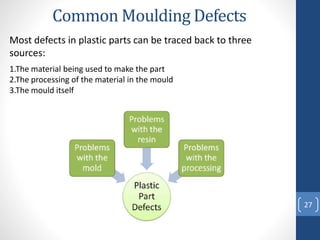
Common Moulding Defects
Most defects in plastic parts can be traced back to three
sources:
1.The material being used to make the part
2.The processing of the material in the mould
3.The mould itself
28
Moulding Defect
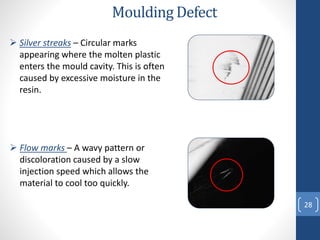
 Silver streaks – Circular marks
appearing where the molten plastic
enters the mould cavity. This is often
caused by excessive moisture in the
resin.
 Flow marks – A wavy pattern or
discoloration caused by a slow
injection speed which allows the
material to cool too quickly.
29
Moulding Defect
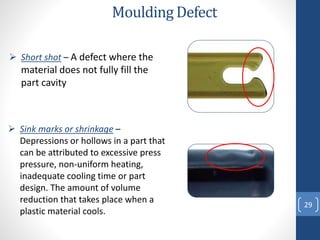
 Sink marks or shrinkage –
Depressions or hollows in a part that
can be attributed to excessive press
pressure, non-uniform heating,
inadequate cooling time or part
design. The amount of volume
reduction that takes place when a
plastic material cools.
 Short shot – A defect where the
material does not fully fill the
part cavity
30
Moulding Defect
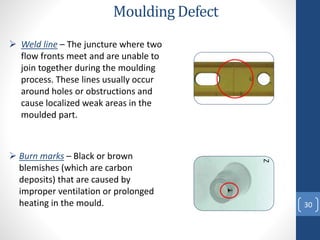
 Burn marks – Black or brown
blemishes (which are carbon
deposits) that are caused by
improper ventilation or prolonged
heating in the mould.
Z
 Weld line – The juncture where two
flow fronts meet and are unable to
join together during the moulding
process. These lines usually occur
around holes or obstructions and
cause localized weak areas in the
moulded part.
31
Moulding Defect
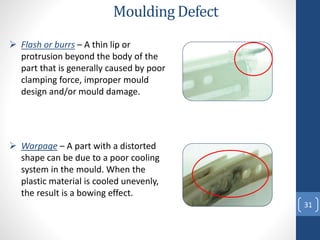
 Flash or burrs – A thin lip or
protrusion beyond the body of the
part that is generally caused by poor
clamping force, improper mould
design and/or mould damage.
 Warpage – A part with a distorted
shape can be due to a poor cooling
system in the mould. When the
plastic material is cooled unevenly,
the result is a bowing effect.
32
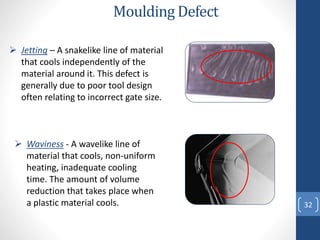
 Jetting – A snakelike line of material
that cools independently of the
material around it. This defect is
generally due to poor tool design
often relating to incorrect gate size.
Moulding Defect
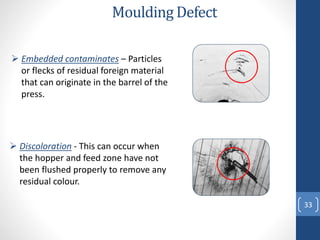
 Waviness - A wavelike line of
material that cools, non-uniform
heating, inadequate cooling
time. The amount of volume
reduction that takes place when
a plastic material cools.
33
Moulding Defect
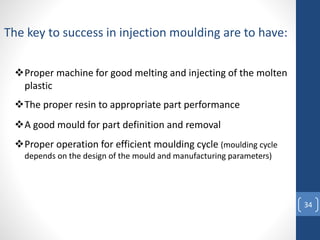
 Embedded contaminates – Particles
or flecks of residual foreign material
that can originate in the barrel of the
press.
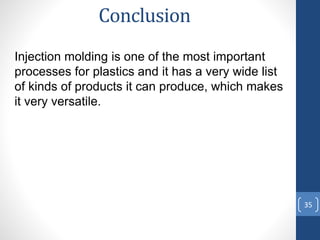
 Discoloration - This can occur when
the hopper and feed zone have not
been flushed properly to remove any
residual colour.
34
Proper machine for good melting and injecting of the molten
plastic
The key to success in injection moulding are to have:
The proper resin to appropriate part performance
A good mould for part definition and removal
Proper operation for efficient moulding cycle (moulding cycle
depends on the design of the mould and manufacturing parameters)
35
Conclusion
Injection molding is one of the most important
processes for plastics and it has a very wide list
of kinds of products it can produce, which makes
it very versatile.
Bhushan L. Gadilohar
Cell : 9890475326
Email : bhushanlohar2009@gmail.com
Thank you !!
36

Know about injection moulding copy

  • 1.
    Know – How aboutPlastic Injection Moulding 1Bhushan L. Gadilohar Cell : 9890475326 Email : bhushanlohar2009@gmail.com
  • 2.
    Plastics What does theword ‘Plastic’ mean? The word ‘Plastic’ means easily ‘Shaped or Moulded’. 2 Plastic :: A polymeric substance of large molecular weight. Polymer :: A substance that has a molecular structure consisting chiefly or entirely of a large number of similar units bonded together, e.g., many synthetic organic materials used as plastics and resins.
  • 3.
    3 Why do weuse plastics? Think of five reasons why we use plastics. Plastics can be Shaped into very complex shapes. Plastics are Soft to the touch. Plastics are available in a large range of Colours. Plastics are Light in weight. Plastics are Strong.
  • 4.
    4 “Plastics playa veryimportantrolein ourlivesand the productsweuse everyday.”
  • 5.
    Plastics  Thermoset Plastics- material, which when heated, is pressed or moulded into a shape. The heating process changes the structure of these materials, and for this reason they cannot by re-cyclable. There are two main groups of plastics: 5  Thermo Plastics - A material that can be heated and cooled repeatedly without changing the material structure. Highly recyclable. Heat Cool Harden Soften Heat Cool Harden Soften Burn Ex. ABS, PC , PS, PVC, PP, LDPE, HDPE, Nylon etc. Ex. PF, MF, Epoxy resin etc.
  • 6.
    Types of Moulding 6 Injection moulding - Well suited for high-quality, high-volume part manufacturing Injection moulding is by far the most versatile of all injection moulding techniques.  Blow Moulding – Well suited for hollow objects, like bottles The process follows the basic steps found in glass blowing. A parison (heated plastic mass, generally a tube) is inflated by air. The air pushes the plastic against the mould to form the desired shape. Once cooled, the plastic is ejected.  Extrusion Moulding – Well suited for long hollow formed applications like tubing, pipes and straws While other forms of moulding uses extrusion to get the plastic resins into a mould, this process extrudes the melted plastic directly into a die. The die shape, not a mould, determines the shape of the final product. The extruded “tubing” is cooled and can be cut or rolled for shipment.
  • 7.
    Types of Moulding 7 Rotational Moulding – Well suited for large, hollow, one-piece parts like Water tanks. This process uses high temperatures and rotational movement to coat the inside of the mould and form the part. The constant rotation of the mold creates centrifugal force forming even-walled products. Because it is ideally suited to large hollow containers, such as tanks, it is not a fast moving process.  Compression Moulding – Well suited for larger objects like auto parts The name of this moulding method says everything. A heated plastic material is placed in a heated mould and is then compressed into shape. The plastic can be in bulk but often comes in sheets. The heating process, called curing, insures the final part will maintain its integrity. This method of moulding is very suitable to high-strength compounds like thermosetting resins as well as fiberglass and reinforced plastics.
  • 8.
    Plastic Injection Moulding 8 Injection moulding :: A manufacturing process in which melted plastic is injected into a mould to form a part.  The first injection moulding machine was invented and patented by brothers John and Isaiah Hyatt in 1872.  Today, the process is more complicated although, the basic principle of plastic being injected into a waiting mould is still the same.  One of the biggest advancements has come by way of the materials used, and there are now thousands of different formulations available for making ‘Plastic’ Raw materials used in the plastic injection moulding process,
  • 9.
    Plastic Injection Moulding 9 Injectionmoulding machines are fairly simple and straightforward, consisting of a hopper where raw material is placed, a heating cylinder and an injection plunger. Moulds are typically made from steel or aluminium. Major advantages to using plastic injection moulding for the manufacture of parts include: • Ability to complete high-production rates • Repeatability of high tolerances • Minimal finishing • Wide range of materials available for specific applications • Minimal material loss Injection moulding is the most common plastic moulding process and is used to create a huge variety of complex parts of different size and shape.
  • 10.
    Basics of anInjection Moulding Machine 10 First, let’s take a quick look at how plastic injection moulding presses are rated or classified. Often plastic injection companies will provide a moulding equipment list. It may look something like this: • 50 Ton Injection Moulding Presses • 100 Ton Injection Moulding Presses • 150 154 Ton Injection Moulding Presses • 200 Ton Injection Moulding Presses • 250 Ton Injection Moulding Presses • 400 Ton Injection Moulding Presses So, what does this mean? Plastic injection moulding presses are classified or rated based on tonnage, or more specifically, the clamping pressure or force. Presses can run in size from less than 5 tons of clamping pressure to over 6000 tons. The higher the press ton rating, the larger the machine.
  • 11.
    11 Second, let’s figureout how much clamping force or pressure is required. Basics of an Injection Moulding Machine There are many factors that are taken into consideration when determining the size of the press. The size of the part, the polymer being used and something called the safety factor. The safety factor is an additional numerical percentage buffer that is added to the calculation to help avoid defects in the final part. Some recommend adding 10% to allow for the safety factor. As mentioned earlier, the MFI (Melt Flow Index) of the plastic compound will also impact the pressure needed to produce the part. Many calculations include the platen size as well as the mould and part size, however, to get an estimate of the press size your project will need, we have simplified it even further. A machine rated for 60 tons can deliver 60 tons of clamping pressure. This pressure keeps the mould closed during the injection process. Too much or too little pressure can cause quality issues. Too much or too little pressure can also cause flashing, where excess material appears on the part edge.
  • 12.
    12 Injection Moulding  Theplastic products are made such efficiently with the help of 4M. ManMachine MaterialMould  Widely used for manufacturing a variety of parts, from the smallest component to entire body panels of cars
  • 13.
    13 Applications of InjectionMoulded Parts •Automotive components •FMCG Components •Aerospace components •Cable assemblies •Computer electronics Components •Mobile/Telephone Components •Electronics components •Instrument •Medical & dental products •Medical laboratories Equipment's • Toys, hobby
  • 14.
  • 15.
    15 The injection machineis a machine that melt plasticize the moulding material inside the heating cylinder and inject this into the mould tool to create the moulded product by solidifying inside it. The injection machine is constructed of a mould clamping device that opens and closes the mould tool, and Injection device that plasticize and inject the moulding material. There are several types in the injection machine, and the difference is made by how these two devices are arranged. IMM - Injection Moulding Machine
  • 16.
    16 IMM - InjectionMoulding Machine Clamping Unit Injection Unit Clamping Unit – Mould clamping device that opens and closes the mould tool. Injection Unit –That plasticize and inject the molten material into the mould.
  • 17.
  • 18.
    18 Injection Moulding– Mould/Tool The mould is made from metal, usually either steel or aluminium  Mould - A hollow form that plastic is injected or inserted into to manufacture a plastic part.
  • 19.
    19 “Injectionmoulds represent the greatestexpense in upfront productioncosts.”
  • 20.
    Raw Material (Resin) 20 Choosingthe right material for a project is one of the most important factors in creating perfect parts. When choosing a material for a specific application, generally the least expensive material that will do the job is chosen. When searching for the right resin for the job, many factors will come into play and they all will be balanced against the cost. Factors such as dimensional stability, service temperature range, and impact strength can all cause materials to be eliminated from list of possible choices. Engineering plastics are typically chosen for their superior properties. Granules
  • 21.
    21 ABS Raw MaterialProperties  Good combination of mechanical, thermal and chemical properties  Easy processable by injection, extrusion and vacuum forming  Low cost of all engineering thermoplastics  Low continuous use temperature  High impact strength  High thermal expansion  Limited weather resistance  Poor solvent resistance  Low water absorption Acrylonitrile Butadiene Styrene (ABS)  Electroplatable
  • 22.
    22 Feeding (Runner)system  Runner– The channel system that allows the flow of the melted material to fill the part cavities.  Sprue – The opening feed that conveys material from the nozzle to runner system in the mould.  Gate – The channel into which melted plastic flows into a mould.
  • 23.
  • 24.
  • 25.
  • 26.
    26 “When producinginjectionmoulded parts,it is important to understand the commonproblems and defects that impactproduct quality.”
  • 27.
    27 Common Moulding Defects Mostdefects in plastic parts can be traced back to three sources: 1.The material being used to make the part 2.The processing of the material in the mould 3.The mould itself
  • 28.
    28 Moulding Defect  Silverstreaks – Circular marks appearing where the molten plastic enters the mould cavity. This is often caused by excessive moisture in the resin.  Flow marks – A wavy pattern or discoloration caused by a slow injection speed which allows the material to cool too quickly.
  • 29.
    29 Moulding Defect  Sinkmarks or shrinkage – Depressions or hollows in a part that can be attributed to excessive press pressure, non-uniform heating, inadequate cooling time or part design. The amount of volume reduction that takes place when a plastic material cools.  Short shot – A defect where the material does not fully fill the part cavity
  • 30.
    30 Moulding Defect  Burnmarks – Black or brown blemishes (which are carbon deposits) that are caused by improper ventilation or prolonged heating in the mould. Z  Weld line – The juncture where two flow fronts meet and are unable to join together during the moulding process. These lines usually occur around holes or obstructions and cause localized weak areas in the moulded part.
  • 31.
    31 Moulding Defect  Flashor burrs – A thin lip or protrusion beyond the body of the part that is generally caused by poor clamping force, improper mould design and/or mould damage.  Warpage – A part with a distorted shape can be due to a poor cooling system in the mould. When the plastic material is cooled unevenly, the result is a bowing effect.
  • 32.
    32  Jetting –A snakelike line of material that cools independently of the material around it. This defect is generally due to poor tool design often relating to incorrect gate size. Moulding Defect  Waviness - A wavelike line of material that cools, non-uniform heating, inadequate cooling time. The amount of volume reduction that takes place when a plastic material cools.
  • 33.
    33 Moulding Defect  Embeddedcontaminates – Particles or flecks of residual foreign material that can originate in the barrel of the press.  Discoloration - This can occur when the hopper and feed zone have not been flushed properly to remove any residual colour.
  • 34.
    34 Proper machine forgood melting and injecting of the molten plastic The key to success in injection moulding are to have: The proper resin to appropriate part performance A good mould for part definition and removal Proper operation for efficient moulding cycle (moulding cycle depends on the design of the mould and manufacturing parameters)
  • 35.
    35 Conclusion Injection molding isone of the most important processes for plastics and it has a very wide list of kinds of products it can produce, which makes it very versatile.
  • 36.
    Bhushan L. Gadilohar Cell: 9890475326 Email : bhushanlohar2009@gmail.com Thank you !! 36