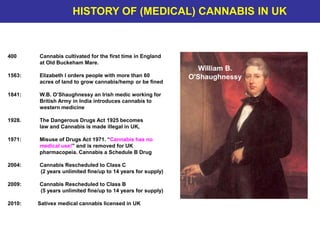
William B.
O'Shaughnessy
400 Cannabis cultivated for the first time in England
at Old Buckeham Mare.
1563: Elizabeth I orders people with more than 60
acres of land to grow cannabis/hemp or be fined
1841: W.B. O’Shaughnessy an Irish medic working for
British Army in India introduces cannabis to
western medicine
1928. The Dangerous Drugs Act 1925 becomes
law and Cannabis is made illegal in UK,
1971: Misuse of Drugs Act 1971. “Cannabis has no
medical use!” and is removed for UK
pharmacopeia. Cannabis a Schedule B Drug
2004: Cannabis Rescheduled to Class C
(2 years unlimited fine/up to 14 years for supply)
2009: Cannabis Rescheduled to Class B
(5 years unlimited fine/up to 14 years for supply)
2010: Sativex medical cannabis licensed in UK
HISTORY OF (MEDICAL) CANNABIS IN UK
MEDICAL CANNABIS
PwMS Tell us that Cannabis Helps
Alleviate Symptoms (Pain
& Spasticity) of Multiple Sclerosis:
Evidence from Understanding the
Biology of Cannabis and the Disease
2. BIOLOGY
1. ANECDOTE
Why should we think about using
Cannabis to treat Multiple Sclerosis?
UCL-INSTITUTE OF NEUROLOGY
Queen Square BIOLOGY OF MULTIPLE SCLEROSIS
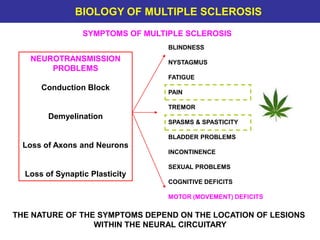
SYMPTOMS OF MULTIPLE SCLEROSIS
BLINDNESS
NYSTAGMUS
FATIGUE
PAIN
TREMOR
SPASMS & SPASTICITY
BLADDER PROBLEMS
INCONTINENCE
SEXUAL PROBLEMS
COGNITIVE DEFICITS
MOTOR (MOVEMENT) DEFICITS
NEUROTRANSMISSION
PROBLEMS
Conduction Block
Demyelination
Loss of Axons and Neurons
Loss of Synaptic Plasticity
THE NATURE OF THE SYMPTOMS DEPEND ON THE LOCATION OF LESIONS
WITHIN THE NEURAL CIRCUITARY
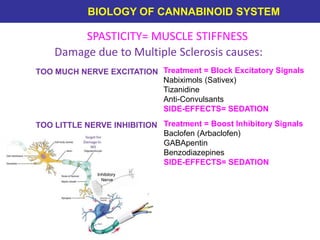
TOO MUCH NERVE EXCITATION
TOO LITTLE NERVE INHIBITION
SPASTICITY= MUSCLE STIFFNESS
Damage due to Multiple Sclerosis causes:
Treatment = Boost Inhibitory Signals
Baclofen (Arbaclofen)
GABApentin
Benzodiazepines
SIDE-EFFECTS= SEDATION
Treatment = Block Excitatory Signals
Nabiximols (Sativex)
Tizanidine
Anti-Convulsants
SIDE-EFFECTS= SEDATION
Inhibitory
Nerve
Red = abundant CB1 receptors Black = moderately abundant CB1 receptorsBIOLOGY OF CANNABINOID SYSTEM
BaclofenDantrolene
Corticospinal
Tract
Benzodiazepine
TizanidineInhibitory Interneuron
Muscle
CONTROL
Of SPASMS
Action Potential
GABA
α2
α2
Motor
Neuron
AMPA
GABA A
GABA B
UCL-INSTITUTE OF NEUROLOGY
Queen Square BIOLOGY OF MULTIPLE SCLEROSIS
CANNABIS (Cannabis sativa)
Some varieties (HEMP) used for making: rope, paper, cloth (canvas) & oil
Other varieties (described as dope, marijuana, weed, grass, hashish,
resin) used as a medical and more importantly a recreational drug.
Cannabis Sativa
MALE
Cannabis Sativa
FEMALE
Bract
Glandular
BIOLOGY OF CANNABINOID SYSTEM
Cannabinol
(CBN)
Cannabigerol (CBG)
Cannabidiol
(CBD)
Epidiolex
Tetrahydrocannabinol
(THC)
Cannabis plant can contains
over 113 cannabinoid chemicals
Major Psychoactive
Ingredient
Major Non-Psychoactive
Ingredient
BIOLOGY OF CANNABINOID SYSTEM
E
LL
M
*
CB1 Receptor
CB2 Receptor
Immune System
PMN B cells Monocytes
Spleen Tonsils
CB2CB1
Brain Adipose
Tissue
Muscle Liver GI
Tract
Pancreas
Nervous System
OH
O
THC
Plant Cannabinoids
N
H
OH
O
Anandamide:
Endocannabinoids
BIOLOGY OF CANNABINOID SYSTEM
O
OH
O
2-Arachidonoyl Glycerol
Red = abundant CB1 receptors Black = moderately abundant CB1 receptors
The Function of the Brain Area where the Cannabis Receptor is located
Will Determine the Effect That occurs Following Cannabis Use
BIOLOGY OF CANNABINOID SYSTEM
CB1R Imaging
Hippocampus
Learning, Memory
Amygdala
Emotion, Fear
Cerebellum
Movement
Striatum
Globus Pallidus
Substantia Nigra
Caudate Nucleus
Putamen
Balance & Movement
Cerebral Cortex
Cognitive Functions
Cannabinoid control of Nerve Impulse Transmission
Glu=Glutamate Ca2+ = calcium Ion
MS
Health
Synapse
Red = abundant CB1 receptors Black = moderately abundant CB1 receptorsBIOLOGY OF CANNABINOID SYSTEM
Time Post-Injection (Min)
0 10 20 30 40 50 60 70 80 90 100 110 120
ChangeinHindlimbStiffness(%)±SEM
-50
-40
-30
-20
-10
0
10
20
Sativex
Vehicle
CB RECEPTOR STIMULATION CAN
INHIBIT TREMOR & SPASTICITY IN
MODEL OF MS
Cannabis +
THC +
CB1R Stimulators +
THC-free Cannabis -
CB BLOCKADE TRANSIENTLY
WORSENS SPASTICITY
Stimulators of +
Endocannabinoids
Sativex® Biological Drug Substances
inhibits Experimental Spasticity
P<0.001 compared to baseline
BIOLOGY OF CANNABINOIDS
CHANGES OF SPASTICITY SCORES
-0.4
-0.2
0
0.2
0.4
0.6
0.8
W
eek
0
W
eek
1
W
eek
2
W
eek
3
W
eek
4
W
eek
5
W
eek
6
W
eek
7
W
eek
8
W
eek
9
W
eek
10
W
eek
11W
eek
12
LO
C
F
Sativex
Placebo
P<0.0002
DeteriorationinSpasticityScore
Placebo
Sativex
CANNABINOIDS IN THE CLINIC
Novotna et al. 2011
CANNABINOIDS IN THE CLINIC
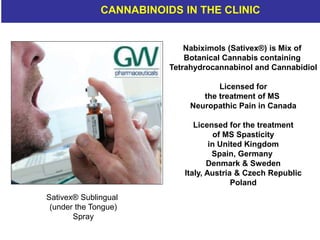
Nabiximols (Sativex®) is Mix of
Botanical Cannabis containing
Tetrahydrocannabinol and Cannabidiol
Licensed for
the treatment of MS
Neuropathic Pain in Canada
Licensed for the treatment
of MS Spasticity
in United Kingdom
Spain, Germany
Denmark & Sweden
Italy, Austria & Czech Republic
Poland
Sativex® Sublingual
(under the Tongue)
Spray
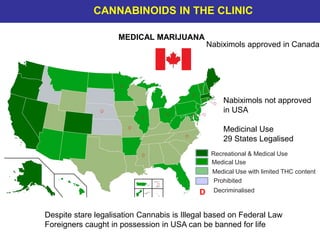
Prohibited
Nabiximols not approved
in USA
Medicinal Use
29 States Legalised
D
Nabiximols approved in Canada
Recreational & Medical Use
Medical Use
Medical Use with limited THC content
Decriminalised
MEDICAL MARIJUANA
CANNABINOIDS IN THE CLINIC
Despite stare legalisation Cannabis is Illegal based on Federal Law
Foreigners caught in possession in USA can be banned for life
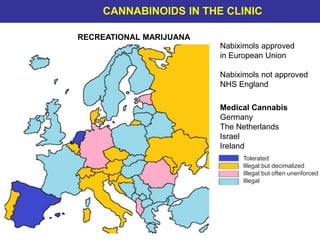
Tolerated
Illegal but decimalized
Illegal but often unenforced
Illegal
Nabiximols approved
in European Union
Nabiximols not approved
NHS England
RECREATIONAL MARIJUANA
Medical Cannabis
Germany
The Netherlands
Israel
Ireland
CANNABINOIDS IN THE CLINIC
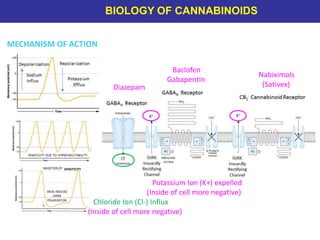
Diazepam
Baclofen
Gabapentin
Nabiximols
(Sativex)
Potassium Ion (K+) expelled
(Inside of cell more negative)
MECHANISM OF ACTION
SPASTICITY
BIOLOGY OF CANNABINOIDS
Chloride Ion (Cl-) Influx
(Inside of cell more negative)
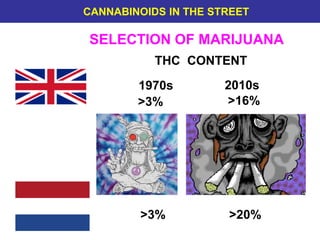
SELECTION OF MARIJUANA
>3%
THC CONTENT
1970s
>3%
2010s
>16%
>20%
CANNABINOIDS IN THE STREET
Price $8-$12/g
MEDICAL MARIJUANA OR STONER FOOD
SELECTION OF MARIJUANA
CANNABINOIDS IN THE STREET
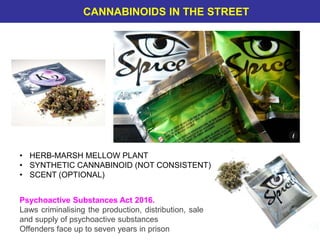
• HERB-MARSH MELLOW PLANT
• SYNTHETIC CANNABINOID (NOT CONSISTENT)
• SCENT (OPTIONAL)
• NOT FOR HUMAN CONSUMPTION LABEL
Psychoactive Substances Act 2016.
Laws criminalising the production, distribution, sale
and supply of psychoactive substances
Offenders face up to seven years in prison
CANNABINOIDS IN THE STREET
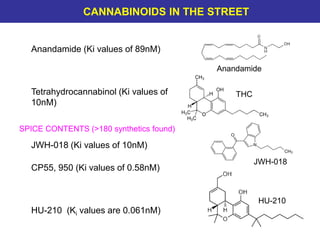
Anandamide (Ki values of 89nM)
Tetrahydrocannabinol (Ki values of
10nM)
JWH-018 (Ki values of 10nM)
CP55, 950 (Ki values of 0.58nM)
HU-210 (Ki values are 0.061nM)
Anandamide
JWH-018
HU-210
THC
SPICE CONTENTS (>180 synthetics found)
CANNABINOIDS IN THE STREET
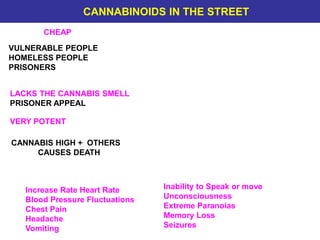
LACKS THE CANNABIS SMELL
PRISONER APPEAL
VULNERABLE PEOPLE
HOMELESS PEOPLE
PRISONERS
VERY POTENT
CANNABIS HIGH + OTHERS
CAUSES DEATH
CHEAP
Increase Rate Heart Rate
Blood Pressure Fluctuations
Chest Pain
Headache
Vomiting
Inability to Speak or move
Unconsciousness
Extreme Paranoias
Memory Loss
Seizures
CANNABINOIDS IN THE STREET
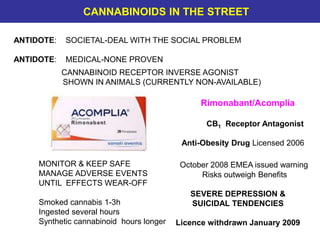
ANTIDOTE: SOCIETAL-DEAL WITH THE SOCIAL PROBLEM
ANTIDOTE: MEDICAL-NONE PROVEN
MONITOR & KEEP SAFE
MANAGE ADVERSE EVENTS
UNTIL EFFECTS WEAR-OFF
Smoked cannabis 1-3h
Ingested several hours
Synthetic cannabinoid hours longer
CANNABINOID RECEPTOR INVERSE AGONIST
SHOWN IN ANIMALS (CURRENTLY NON-AVAILABLE)
Rimonabant/Acomplia
CB1 Receptor Antagonist
Anti-Obesity Drug Licensed 2006
October 2008 EMEA issued warning
Risks outweigh Benefits
SEVERE DEPRESSION &
SUICIDAL TENDENCIES
Licence withdrawn January 2009
CANNABINOIDS IN THE STREET

Cannabis

  • 1.
    William B. O'Shaughnessy 400 Cannabiscultivated for the first time in England at Old Buckeham Mare. 1563: Elizabeth I orders people with more than 60 acres of land to grow cannabis/hemp or be fined 1841: W.B. O’Shaughnessy an Irish medic working for British Army in India introduces cannabis to western medicine 1928. The Dangerous Drugs Act 1925 becomes law and Cannabis is made illegal in UK, 1971: Misuse of Drugs Act 1971. “Cannabis has no medical use!” and is removed for UK pharmacopeia. Cannabis a Schedule B Drug 2004: Cannabis Rescheduled to Class C (2 years unlimited fine/up to 14 years for supply) 2009: Cannabis Rescheduled to Class B (5 years unlimited fine/up to 14 years for supply) 2010: Sativex medical cannabis licensed in UK HISTORY OF (MEDICAL) CANNABIS IN UK
  • 2.
    MEDICAL CANNABIS PwMS Tellus that Cannabis Helps Alleviate Symptoms (Pain & Spasticity) of Multiple Sclerosis: Evidence from Understanding the Biology of Cannabis and the Disease 2. BIOLOGY 1. ANECDOTE Why should we think about using Cannabis to treat Multiple Sclerosis?
  • 3.
    UCL-INSTITUTE OF NEUROLOGY QueenSquare BIOLOGY OF MULTIPLE SCLEROSIS SYMPTOMS OF MULTIPLE SCLEROSIS BLINDNESS NYSTAGMUS FATIGUE PAIN TREMOR SPASMS & SPASTICITY BLADDER PROBLEMS INCONTINENCE SEXUAL PROBLEMS COGNITIVE DEFICITS MOTOR (MOVEMENT) DEFICITS NEUROTRANSMISSION PROBLEMS Conduction Block Demyelination Loss of Axons and Neurons Loss of Synaptic Plasticity THE NATURE OF THE SYMPTOMS DEPEND ON THE LOCATION OF LESIONS WITHIN THE NEURAL CIRCUITARY
  • 4.
    TOO MUCH NERVEEXCITATION TOO LITTLE NERVE INHIBITION SPASTICITY= MUSCLE STIFFNESS Damage due to Multiple Sclerosis causes: Treatment = Boost Inhibitory Signals Baclofen (Arbaclofen) GABApentin Benzodiazepines SIDE-EFFECTS= SEDATION Treatment = Block Excitatory Signals Nabiximols (Sativex) Tizanidine Anti-Convulsants SIDE-EFFECTS= SEDATION Inhibitory Nerve Red = abundant CB1 receptors Black = moderately abundant CB1 receptorsBIOLOGY OF CANNABINOID SYSTEM
  • 5.
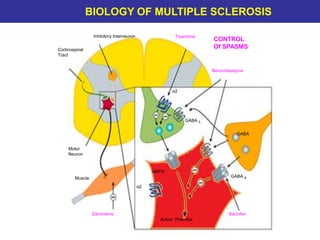
    BaclofenDantrolene Corticospinal Tract Benzodiazepine TizanidineInhibitory Interneuron Muscle CONTROL Of SPASMS ActionPotential GABA α2 α2 Motor Neuron AMPA GABA A GABA B UCL-INSTITUTE OF NEUROLOGY Queen Square BIOLOGY OF MULTIPLE SCLEROSIS
  • 6.
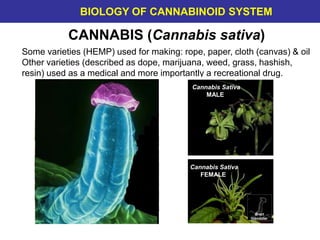
    CANNABIS (Cannabis sativa) Somevarieties (HEMP) used for making: rope, paper, cloth (canvas) & oil Other varieties (described as dope, marijuana, weed, grass, hashish, resin) used as a medical and more importantly a recreational drug. Cannabis Sativa MALE Cannabis Sativa FEMALE Bract Glandular BIOLOGY OF CANNABINOID SYSTEM
  • 7.
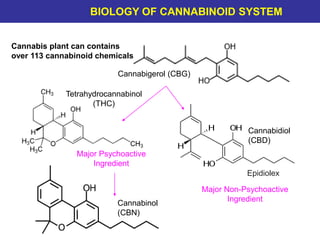
    Cannabinol (CBN) Cannabigerol (CBG) Cannabidiol (CBD) Epidiolex Tetrahydrocannabinol (THC) Cannabis plantcan contains over 113 cannabinoid chemicals Major Psychoactive Ingredient Major Non-Psychoactive Ingredient BIOLOGY OF CANNABINOID SYSTEM
  • 8.
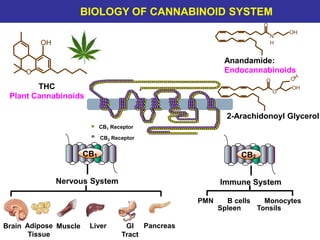
    E LL M * CB1 Receptor CB2 Receptor ImmuneSystem PMN B cells Monocytes Spleen Tonsils CB2CB1 Brain Adipose Tissue Muscle Liver GI Tract Pancreas Nervous System OH O THC Plant Cannabinoids N H OH O Anandamide: Endocannabinoids BIOLOGY OF CANNABINOID SYSTEM O OH O 2-Arachidonoyl Glycerol
  • 9.
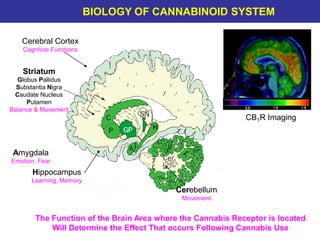
    Red = abundantCB1 receptors Black = moderately abundant CB1 receptors The Function of the Brain Area where the Cannabis Receptor is located Will Determine the Effect That occurs Following Cannabis Use BIOLOGY OF CANNABINOID SYSTEM CB1R Imaging Hippocampus Learning, Memory Amygdala Emotion, Fear Cerebellum Movement Striatum Globus Pallidus Substantia Nigra Caudate Nucleus Putamen Balance & Movement Cerebral Cortex Cognitive Functions
  • 10.
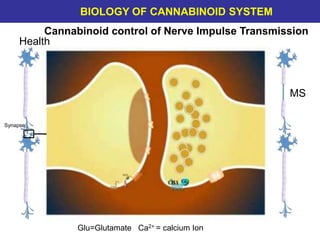
    Cannabinoid control ofNerve Impulse Transmission Glu=Glutamate Ca2+ = calcium Ion MS Health Synapse Red = abundant CB1 receptors Black = moderately abundant CB1 receptorsBIOLOGY OF CANNABINOID SYSTEM
  • 11.
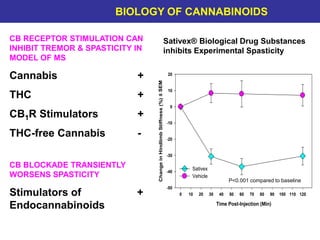
    Time Post-Injection (Min) 010 20 30 40 50 60 70 80 90 100 110 120 ChangeinHindlimbStiffness(%)±SEM -50 -40 -30 -20 -10 0 10 20 Sativex Vehicle CB RECEPTOR STIMULATION CAN INHIBIT TREMOR & SPASTICITY IN MODEL OF MS Cannabis + THC + CB1R Stimulators + THC-free Cannabis - CB BLOCKADE TRANSIENTLY WORSENS SPASTICITY Stimulators of + Endocannabinoids Sativex® Biological Drug Substances inhibits Experimental Spasticity P<0.001 compared to baseline BIOLOGY OF CANNABINOIDS
  • 12.
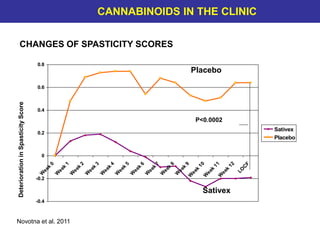
    CHANGES OF SPASTICITYSCORES -0.4 -0.2 0 0.2 0.4 0.6 0.8 W eek 0 W eek 1 W eek 2 W eek 3 W eek 4 W eek 5 W eek 6 W eek 7 W eek 8 W eek 9 W eek 10 W eek 11W eek 12 LO C F Sativex Placebo P<0.0002 DeteriorationinSpasticityScore Placebo Sativex CANNABINOIDS IN THE CLINIC Novotna et al. 2011
  • 13.
    CANNABINOIDS IN THECLINIC Nabiximols (Sativex®) is Mix of Botanical Cannabis containing Tetrahydrocannabinol and Cannabidiol Licensed for the treatment of MS Neuropathic Pain in Canada Licensed for the treatment of MS Spasticity in United Kingdom Spain, Germany Denmark & Sweden Italy, Austria & Czech Republic Poland Sativex® Sublingual (under the Tongue) Spray
  • 14.
    Prohibited Nabiximols not approved inUSA Medicinal Use 29 States Legalised D Nabiximols approved in Canada Recreational & Medical Use Medical Use Medical Use with limited THC content Decriminalised MEDICAL MARIJUANA CANNABINOIDS IN THE CLINIC Despite stare legalisation Cannabis is Illegal based on Federal Law Foreigners caught in possession in USA can be banned for life
  • 15.
    Tolerated Illegal but decimalized Illegalbut often unenforced Illegal Nabiximols approved in European Union Nabiximols not approved NHS England RECREATIONAL MARIJUANA Medical Cannabis Germany The Netherlands Israel Ireland CANNABINOIDS IN THE CLINIC
  • 16.
    Diazepam Baclofen Gabapentin Nabiximols (Sativex) Potassium Ion (K+)expelled (Inside of cell more negative) MECHANISM OF ACTION SPASTICITY BIOLOGY OF CANNABINOIDS Chloride Ion (Cl-) Influx (Inside of cell more negative)
  • 17.
    SELECTION OF MARIJUANA >3% THCCONTENT 1970s >3% 2010s >16% >20% CANNABINOIDS IN THE STREET
  • 18.
    Price $8-$12/g MEDICAL MARIJUANAOR STONER FOOD SELECTION OF MARIJUANA CANNABINOIDS IN THE STREET
  • 19.
    • HERB-MARSH MELLOWPLANT • SYNTHETIC CANNABINOID (NOT CONSISTENT) • SCENT (OPTIONAL) • NOT FOR HUMAN CONSUMPTION LABEL Psychoactive Substances Act 2016. Laws criminalising the production, distribution, sale and supply of psychoactive substances Offenders face up to seven years in prison CANNABINOIDS IN THE STREET
  • 20.
    Anandamide (Ki valuesof 89nM) Tetrahydrocannabinol (Ki values of 10nM) JWH-018 (Ki values of 10nM) CP55, 950 (Ki values of 0.58nM) HU-210 (Ki values are 0.061nM) Anandamide JWH-018 HU-210 THC SPICE CONTENTS (>180 synthetics found) CANNABINOIDS IN THE STREET
  • 21.
    LACKS THE CANNABISSMELL PRISONER APPEAL VULNERABLE PEOPLE HOMELESS PEOPLE PRISONERS VERY POTENT CANNABIS HIGH + OTHERS CAUSES DEATH CHEAP Increase Rate Heart Rate Blood Pressure Fluctuations Chest Pain Headache Vomiting Inability to Speak or move Unconsciousness Extreme Paranoias Memory Loss Seizures CANNABINOIDS IN THE STREET
  • 22.
    ANTIDOTE: SOCIETAL-DEAL WITHTHE SOCIAL PROBLEM ANTIDOTE: MEDICAL-NONE PROVEN MONITOR & KEEP SAFE MANAGE ADVERSE EVENTS UNTIL EFFECTS WEAR-OFF Smoked cannabis 1-3h Ingested several hours Synthetic cannabinoid hours longer CANNABINOID RECEPTOR INVERSE AGONIST SHOWN IN ANIMALS (CURRENTLY NON-AVAILABLE) Rimonabant/Acomplia CB1 Receptor Antagonist Anti-Obesity Drug Licensed 2006 October 2008 EMEA issued warning Risks outweigh Benefits SEVERE DEPRESSION & SUICIDAL TENDENCIES Licence withdrawn January 2009 CANNABINOIDS IN THE STREET