MEDICAL MARIJUANA: A NEW
VISION TOWARDS CURE
PRESENTED BY
ABHIRUP DUTTA
29.12.2017
MEDICAL MARIJUANA: A NEW
VISION TOWARDS CURE
BY ABHIRUP DUTTA
WHAT IS MARIJUANA?
• Marijuana is a green, brown or gray mixture of dried, shredded
leaves, stems, seeds and flowers of the hemp plant Cannabis sativa.
• Marijuana is used as a psychoactive (i.e. mind altering) recreational
drug, for certain medical ailments and for religious and spiritual
purposes.
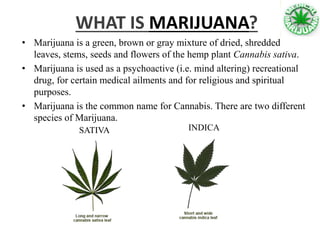
• Marijuana is the common name for Cannabis. There are two different
species of Marijuana.
SATIVA INDICA
Burning Questions…
Medical
Marijuana?
Is it legal?
Is it beneficial?
SAFE?
How does it
work?
Drug
interactions?
Monitor?
How do I talk to patients about it?
MARIJUANA LEGAL HISTORY
1500BC-1000BC
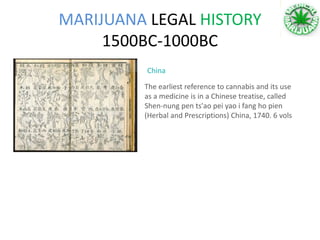
The earliest reference to cannabis and its use
as a medicine is in a Chinese treatise, called
Shen-nung pen ts'ao pei yao i fang ho pien
(Herbal and Prescriptions) China, 1740. 6 vols
China
MARIJUANA LEGAL HISTORY
1500BC-1000BC
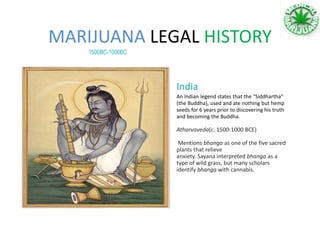
An Indian legend states that the “Siddhartha”
(the Buddha), used and ate nothing but hemp
seeds for 6 years prior to discovering his truth
and becoming the Buddha.
Atharvaveda(c. 1500-1000 BCE)
Mentions bhanga as one of the five sacred
plants that relieve
anxiety. Sayana interpreted bhanga as a
type of wild grass, but many scholars
identify bhanga with cannabis.
India
MARIJUANA LEGAL HISTORY
1500BC-1000BC
Bhang is still being made in India
today and consumed during
Hindu religious ceremonies.
Bhang
About Medical Marijuana
• Medical cannabis, or medical marijuana,
is cannabis and cannabinoids that are
prescribed by doctors for their patients.
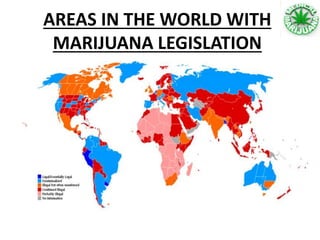
Areas in Areas in the world with marijuana
legislatthe world with marijuana legislation
AREAS IN THE WORLD WITH
MARIJUANA LEGISLATION
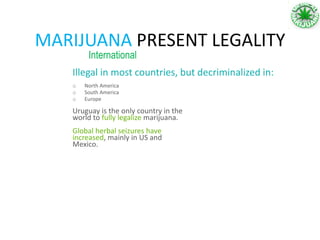
MARIJUANA PRESENT LEGALITY
International
o North America
o South America
o Europe
Illegal in most countries, but decriminalized in:
Uruguay is the only country in the
world to fully legalize marijuana.
Global herbal seizures have
increased, mainly in US and
Mexico.
Legalize Marijuana
• More deaths and health risks associated with
legal substances (cigarettes and alcohol) than
marijuana use.
• If the government legalized marijuana, it
would be better regulated, and taxes could be
gathered from its sale.
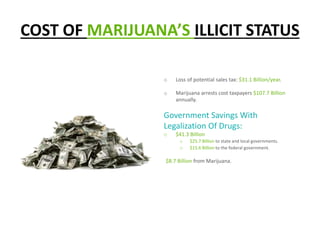
COST OF MARIJUANA’S ILLICIT STATUS
o Loss of potential sales tax: $31.1 Billion/year.
o Marijuana arrests cost taxpayers $107.7 Billion
annually.
Government Savings With
Legalization Of Drugs:
o $41.3 Billion
o $25.7 Billion to state and local governments.
o $15.6 Billion to the federal government.
$8.7 Billion from Marijuana.
Definitions
Legalization vs. Decriminalization
Legalization:- The product would be sold legally
and taxed in a well-regulated market (like
buying alcohol at the liquor store which is
controlled by the state).
Decriminalization:- It would no longer be
considered a punishable crime to possess, but
sale would still be a punishable offense.
How and When This Controversy
Started???
• Use of marijuana became a problem in the
1930s in the U.S.
• 1937: Laws passed making it a crime to
possess or sell marijuana.
• This was the same era as PROHIBITION.
Continuing Controversy
• Alcohol is now legal for adults over age 21.
• People argue about the risks to both one’s
health and community associated with
marijuana vs. other legal and illegal drugs.
• Use of marijuana continues even though it is
illegal.
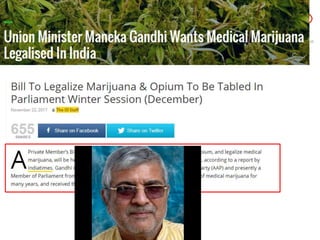
Current Situation In India
Narcotic Drugs and Psychotropic
Substances Act (India);1985
The possession and smoking of
Marijuana are both illegal in India.
MEDICINAL COMPOUNDS IN MARIJUANA
Cannabis contains almost 500 compounds, of which about 80 are used
for medicine and science.
Five of these compounds are used frequently in medicine:
• Tetrahydrocannabinol (THC) is the chemical in marijuana that produces its
psychoactive effects.
• Cannabidiol (CBD) is one of the primary compounds extracted for medical
marijuana. CBD has been provent to relieve convulsion, inflammation, anxiety,
cough, congestion, and nausea, and it inhibits cancer cell growth.
• Cannabinol (CBN) is thought to inhibit the spread of cancer cells.
• β-caryophyllene is used to reduce inflammation.
• Cannabigerol relieves intraocular pressure of the eye, so it’s used in the
treatment of glaucoma.
Cannabis has existed for >3000 years…
and yet we still don’t fully understand how it works or
everything it does.
HOW DOES IT WORK?
• 400 different chemicals in typical marijuana
plant/bud including THC (9 tetrahydrocannabinol)
and CBD (cannabidiol).
• Endocannabinoid (EC) receptors (Rc) are found on
cell membranes and related to G-proteins. All are
lipophilic. Discovered in the 1990s.
Endo-cannabinoid (EC)
Physiology
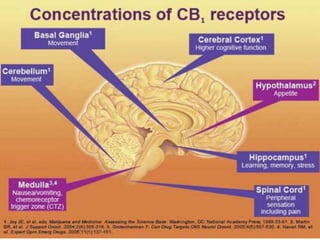
• CB1: mainly expressed in the brain/CNS. But also
found in the lung, liver, kidneys and peripheral
nerves.
• CB2: mainly expressed in the immune system and
hematopoietic cells, and found in smaller amounts
as CB1.
• Perhaps non-CB1/non-CB2 expressed in the brain.
• No CB Rc’s are found in the brainstem or heart.
Two Types of EC Receptors
Cannabinergic system
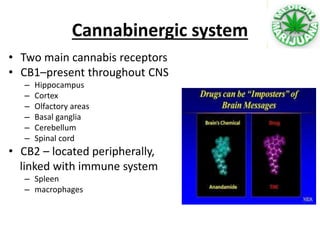
• Two main cannabis receptors
• CB1–present throughout CNS
– Hippocampus
– Cortex
– Olfactory areas
– Basal ganglia
– Cerebellum
– Spinal cord
• CB2 – located peripherally,
linked with immune system
– Spleen
– macrophages
• Neuroprotective
• Through vanilloid activity-capsaicin like effect
• Increases uptake of anandimide and decreases its
breakdown
• Antioxidant
• Nonsedating
• Anti-convulsant/anxiety/emetic
• Decreases IOP and anorexia
• Blocks 17-OH of THC (degradation)
• Cytotoxic to cancer cells
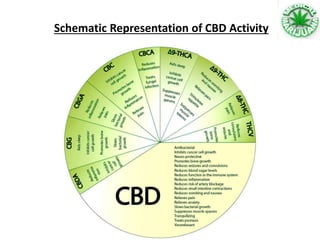
Cannabidiol (CBD) Activity In Brief
• CBD: reduces mitochondrial superoxide activity, iNOS,
NFkappa B activation and transdermal migration of
monocytes.
• CBD counteracts undesireable effects of THC.
( sedation, psychotropic effects, tachycardia)
(Burstein SH, etal. Cannabinoids, endocannabinoids and related agents in inflammation. AAPS
Journal. Vol 11, no 1, March 2009.109-119)
CBD Activity
Schematic Representation of CBD Activity
Numerous Functions of CBD
• 1. Anti-Inflammatory Properties
CBD oil treatment can reverse and prevent those symptoms by reducing
inflammation at the source.(Cannabinoids as novel anti-inflammatory
drugs by Prakash Nagarkatti, Rupal Pandey,and Mitzi Nagarkatti).
• 2. Acne Treatment and Prevention
• A lesser known benefit of CBD is its ability to treat and prevent acne. Did
you know acne vulgaris is the most common human skin disease in the
world?
• A study of the effects of CBD on acne was published in the Journal of
Clinical Investigation in 2014 and showed that CBD inhibits lipid synthesis,
especially over production of it, like is the case with acne vulgaris. This can
nip the acne in the bud.
• Transdermal patch containing CBD oil can easily prevent acne.
• 3. Veterinary CBD
• Pot for pets? All of the CBD benefits for humans affect household pets like
dogs and cats the same way. This is great for pets suffering from seizures,
separation anxiety, cancer, injuries and more.
• 4. Cigarette Addiction Treatment
• CBD may have a valuable purpose in fighting nicotine withdrawal showed by
the Clinical Psychopharmacology Unit at University College of London.
• 5. Fibromyalgia Treatment
• Fibromyalgia is characterized by difficult to treat chronic pain and tiredness.
Many prescription treatments have minimal results and unpleasant side
effects.
• CBD oil treatment may help sufferers of fibromyalgia by reducing
inflammation.
• 6. PTSD (post traumatic stress disorder) Management
• CBD provides anxiety relief and calming effects for many of its users.
• Unlike smoking marijuana with THC, which can cause paranoia and worsen
PTSD symptoms, CBD can soothe the user.
• 7. Anxiety Disorders and Stress Management
• CBD oil treatment reduces the body’s natural response to fearful
circumstances such as public speaking.
• CBD can actually offset the psychoactive properties of THC by de-stimulating
the CB1 receptors in the brain.
• Pay attention to the percentage of each of these cannabinoids and aim for an
appropriate CBD content to mute the paranoia or other negative effects of
THC.
• 8. Schizophrenia Treatment
• CBD can benefit patients with schizophrenia because of its neuroprotective
traits.
• That’s because CBD may reduce symptoms of schizophrenia by stabilizing
disrupted NMDA receptors in the brain.
• 9.Crohn’s Disease Treatment
• Studies suggest that CBD oil treatment can reduce the permeability of
intestinal cells.
• This is great news for people with inflammatory bowel diseases such as
Crohn’s disease because the cannabis oil helps the body block the
absorption of harmful intestinal bacteria.
LIMITATIONS
• The use of cannabis as a medicine has not been rigorously tested
due to production restrictions and other governmental regulations.
• Short-term use increases the risk of both minor and major adverse
effects.
• Common side effects include dizziness, feeling tired, vomiting, and
hallucinations. Long-term effects of cannabis are not clear.
• Concerns include memory and cognition problems, risk of
addiction, schizophrenia in young people, and the risk of children
taking it by accident.
• The use of medical cannabis is controversial. A number of medical
organizations have requested removal from the list of Schedule I
controlled substances followed by regulatory and scientific
review. Others such as the American Academy of Pediatrics in 2015
opposed the legalization of medical cannabis.
No High
• Many people who would find relief from THC products
avoid using them because they want to avoid the
euphoric sensation associated associated with
marijuana.
• CBD hemp oil is incapable of generating that high, and
it will not interfere with motor skills or psychological
functioning the way that higher-THC compounds might.
• Because CBD oil does not contain THC.
• While it is true that CBD oil is also effective for pain
relief and muscle relaxation.
• It can actually exacerbate psychological
disorders ranging from low-level anxiety to more
serious forms of psychosis, like schizophrenia.
RAYS OF HOPE
• The Cannabis plant has a history of medicinal use
dating back thousands of years across many cultures.
• ElSohly—the director of the University of
Mississippi’s Marijuana Project showed that there
are many indications for which CBD would be a
good medicine if you have the right formulations
and dosing.
MARIJUANA IS REMERKABLY NON-TOXIC
• Certainly there are legal medicines that have greater risks
than marijuana.
• A commercial for Cymbalta—a common anti-
depressant—and roughly half of the nearly 90 seconds
are drug warnings, one of which warns antidepressants
may increase the risk of suicidal thoughts in children,
teens, and young adults.
• Marijuana is not only non-toxic—but remarkably non-
toxic. If you look in the literature, you’ll be hard pressed
to find a death caused by marijuana.
FINDING THE RIGHT STRAIN
• In deciding on a strain, a knowledge of THC and CBD
and the difference between the two is the most
important thing, so that’s what we’ll go into first.
• THC is the primary psychoactive cannabinoid of
cannabis – responsible for the high as well as being
anti-inflammatory, neuroprotective, and antiemetic.
• Cannabidiol (CBD) is another major component of the
plant and the one accountable for many of the
medicinal properties.
• Scientists say that CBD modulates electrical and
chemical activity thereby quieting the excessive
activity in the brain that causes seizures.
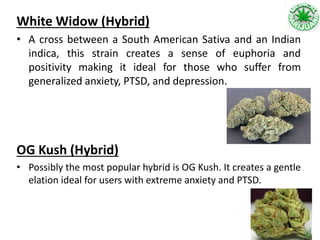
White Widow (Hybrid)
• A cross between a South American Sativa and an Indian
indica, this strain creates a sense of euphoria and
positivity making it ideal for those who suffer from
generalized anxiety, PTSD, and depression.
OG Kush (Hybrid)
• Possibly the most popular hybrid is OG Kush. It creates a gentle
elation ideal for users with extreme anxiety and PTSD.
Different Routes Of CBD
Administration
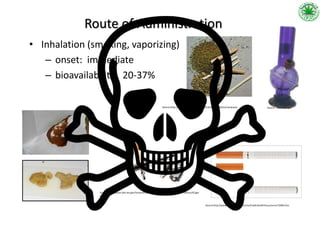
• Inhalation (smoking, vaporizing)
– onset: immediate
– bioavailability: 20-37%
Route of Administration
Source:http://www.fda.gov/NewsEvents/PublicHealthFocus/ucm172906.htm
Source:http://www.doh.wa.gov/YouandYourFamily/Tobacco/OtherTobaccoProducts/ECigar
ettes
Source:http://www.drugabuse.gov/publications/drugfacts/marijuana Source: www.dea.gov
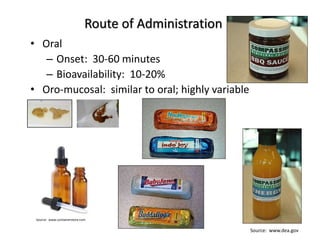
• Oral
– Onset: 30-60 minutes
– Bioavailability: 10-20%
• Oro-mucosal: similar to oral; highly variable
Route of Administration
Source: www.containerstore.com
Source: www.dea.gov
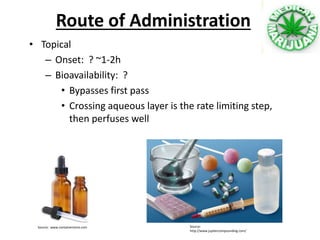
• Topical
– Onset: ? ~1-2h
– Bioavailability: ?
• Bypasses first pass
• Crossing aqueous layer is the rate limiting step,
then perfuses well
Route of Administration
Source: www.containerstore.com Source:
http://www.jupitercompounding.com/
Procedure of Making CBD Oil
• CBD oil can be made through these following steps:-
• CANNABIS extraction by using ethanol:-
• Ingredients:- 60% pure alcohal, Cannabis, Lighter, Filter
Coffee Machine, Bowls of different shapes, Sieve, Filter
papers etc.
• Procedure:-
• The cannabis was put into the bowl and it was covered
with 60% alcohol.
• It was then steered for 3 minutes with a plastic spoon.
• Alcohol was then filtered from cannabis for several
times.
• The remaining alcohol in the extract was heated for 24
hours and the pure CBD oil was retained.
ADVANTAGES
• Easy to make.
• Cost-effective.
As Bioavailability Of CBD Oil
Is Less Transdermal Patches Can Be
Used…
My Hypothesis
• CBD gel can be produced in the same way as
we produce CBD oil.
• Apply the CBD gel to your body through
Transdermal Patch.
Transdermal Patch
• Transdermal delivery is a self-contained, discrete dosage form which, when
applied to intact skin, deliver the drug(s) through the skin at a controlled rate
into systemic circulation. It comes in the form of a patch or a gel that is applied
directly to the skin.
• Most Important thing
The rate at which the dose is administered is consistent and reliable happening
gradually over a set time course.
• ADVANTAGES:-
• The dose is pre-loaded and is hidden from view – no smell, no ritual, easy to
use.
• Bioavailability: medium
• Dose accuracy: very high
• Time to onset: 1.25hrs +/- 0.5 hrs.
• Duration of effect: 6-8 hrs.
• Quality and consistency of effect: light, high-functioning “high”; high degree of
consistency.
Transdermal Patch
At A Glimpse…..
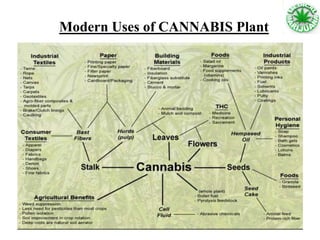
Modern Uses of CANNABIS Plant
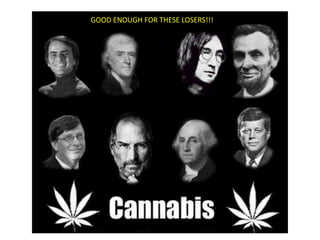
GOOD ENOUGH FOR THESE LOSERS!!!
JUST DO IT

Medical marijuana

  • 1.
    MEDICAL MARIJUANA: ANEW VISION TOWARDS CURE PRESENTED BY ABHIRUP DUTTA 29.12.2017
  • 2.
    MEDICAL MARIJUANA: ANEW VISION TOWARDS CURE BY ABHIRUP DUTTA
  • 4.
    WHAT IS MARIJUANA? •Marijuana is a green, brown or gray mixture of dried, shredded leaves, stems, seeds and flowers of the hemp plant Cannabis sativa. • Marijuana is used as a psychoactive (i.e. mind altering) recreational drug, for certain medical ailments and for religious and spiritual purposes. • Marijuana is the common name for Cannabis. There are two different species of Marijuana. SATIVA INDICA
  • 5.
    Burning Questions… Medical Marijuana? Is itlegal? Is it beneficial? SAFE? How does it work? Drug interactions? Monitor? How do I talk to patients about it?
  • 6.
    MARIJUANA LEGAL HISTORY 1500BC-1000BC Theearliest reference to cannabis and its use as a medicine is in a Chinese treatise, called Shen-nung pen ts'ao pei yao i fang ho pien (Herbal and Prescriptions) China, 1740. 6 vols China
  • 7.
    MARIJUANA LEGAL HISTORY 1500BC-1000BC AnIndian legend states that the “Siddhartha” (the Buddha), used and ate nothing but hemp seeds for 6 years prior to discovering his truth and becoming the Buddha. Atharvaveda(c. 1500-1000 BCE) Mentions bhanga as one of the five sacred plants that relieve anxiety. Sayana interpreted bhanga as a type of wild grass, but many scholars identify bhanga with cannabis. India
  • 8.
    MARIJUANA LEGAL HISTORY 1500BC-1000BC Bhangis still being made in India today and consumed during Hindu religious ceremonies. Bhang
  • 9.
    About Medical Marijuana •Medical cannabis, or medical marijuana, is cannabis and cannabinoids that are prescribed by doctors for their patients.
  • 10.
    Areas in Areasin the world with marijuana legislatthe world with marijuana legislation AREAS IN THE WORLD WITH MARIJUANA LEGISLATION
  • 11.
    MARIJUANA PRESENT LEGALITY International oNorth America o South America o Europe Illegal in most countries, but decriminalized in: Uruguay is the only country in the world to fully legalize marijuana. Global herbal seizures have increased, mainly in US and Mexico.
  • 12.
    Legalize Marijuana • Moredeaths and health risks associated with legal substances (cigarettes and alcohol) than marijuana use. • If the government legalized marijuana, it would be better regulated, and taxes could be gathered from its sale.
  • 13.
    COST OF MARIJUANA’SILLICIT STATUS o Loss of potential sales tax: $31.1 Billion/year. o Marijuana arrests cost taxpayers $107.7 Billion annually. Government Savings With Legalization Of Drugs: o $41.3 Billion o $25.7 Billion to state and local governments. o $15.6 Billion to the federal government. $8.7 Billion from Marijuana.
  • 14.
    Definitions Legalization vs. Decriminalization Legalization:-The product would be sold legally and taxed in a well-regulated market (like buying alcohol at the liquor store which is controlled by the state). Decriminalization:- It would no longer be considered a punishable crime to possess, but sale would still be a punishable offense.
  • 15.
    How and WhenThis Controversy Started??? • Use of marijuana became a problem in the 1930s in the U.S. • 1937: Laws passed making it a crime to possess or sell marijuana. • This was the same era as PROHIBITION.
  • 16.
    Continuing Controversy • Alcoholis now legal for adults over age 21. • People argue about the risks to both one’s health and community associated with marijuana vs. other legal and illegal drugs. • Use of marijuana continues even though it is illegal.
  • 17.
  • 18.
    Narcotic Drugs andPsychotropic Substances Act (India);1985 The possession and smoking of Marijuana are both illegal in India.
  • 20.
    MEDICINAL COMPOUNDS INMARIJUANA Cannabis contains almost 500 compounds, of which about 80 are used for medicine and science. Five of these compounds are used frequently in medicine: • Tetrahydrocannabinol (THC) is the chemical in marijuana that produces its psychoactive effects. • Cannabidiol (CBD) is one of the primary compounds extracted for medical marijuana. CBD has been provent to relieve convulsion, inflammation, anxiety, cough, congestion, and nausea, and it inhibits cancer cell growth. • Cannabinol (CBN) is thought to inhibit the spread of cancer cells. • β-caryophyllene is used to reduce inflammation. • Cannabigerol relieves intraocular pressure of the eye, so it’s used in the treatment of glaucoma.

  • 21.
    Cannabis has existedfor >3000 years… and yet we still don’t fully understand how it works or everything it does. HOW DOES IT WORK?
  • 22.
    • 400 differentchemicals in typical marijuana plant/bud including THC (9 tetrahydrocannabinol) and CBD (cannabidiol). • Endocannabinoid (EC) receptors (Rc) are found on cell membranes and related to G-proteins. All are lipophilic. Discovered in the 1990s. Endo-cannabinoid (EC) Physiology
  • 23.
    • CB1: mainlyexpressed in the brain/CNS. But also found in the lung, liver, kidneys and peripheral nerves. • CB2: mainly expressed in the immune system and hematopoietic cells, and found in smaller amounts as CB1. • Perhaps non-CB1/non-CB2 expressed in the brain. • No CB Rc’s are found in the brainstem or heart. Two Types of EC Receptors
  • 24.
    Cannabinergic system • Twomain cannabis receptors • CB1–present throughout CNS – Hippocampus – Cortex – Olfactory areas – Basal ganglia – Cerebellum – Spinal cord • CB2 – located peripherally, linked with immune system – Spleen – macrophages
  • 26.
    • Neuroprotective • Throughvanilloid activity-capsaicin like effect • Increases uptake of anandimide and decreases its breakdown • Antioxidant • Nonsedating • Anti-convulsant/anxiety/emetic • Decreases IOP and anorexia • Blocks 17-OH of THC (degradation) • Cytotoxic to cancer cells Cannabidiol (CBD) Activity In Brief
  • 27.
    • CBD: reducesmitochondrial superoxide activity, iNOS, NFkappa B activation and transdermal migration of monocytes. • CBD counteracts undesireable effects of THC. ( sedation, psychotropic effects, tachycardia) (Burstein SH, etal. Cannabinoids, endocannabinoids and related agents in inflammation. AAPS Journal. Vol 11, no 1, March 2009.109-119) CBD Activity
  • 28.
  • 29.
    Numerous Functions ofCBD • 1. Anti-Inflammatory Properties CBD oil treatment can reverse and prevent those symptoms by reducing inflammation at the source.(Cannabinoids as novel anti-inflammatory drugs by Prakash Nagarkatti, Rupal Pandey,and Mitzi Nagarkatti). • 2. Acne Treatment and Prevention • A lesser known benefit of CBD is its ability to treat and prevent acne. Did you know acne vulgaris is the most common human skin disease in the world? • A study of the effects of CBD on acne was published in the Journal of Clinical Investigation in 2014 and showed that CBD inhibits lipid synthesis, especially over production of it, like is the case with acne vulgaris. This can nip the acne in the bud. • Transdermal patch containing CBD oil can easily prevent acne.
  • 30.
    • 3. VeterinaryCBD • Pot for pets? All of the CBD benefits for humans affect household pets like dogs and cats the same way. This is great for pets suffering from seizures, separation anxiety, cancer, injuries and more. • 4. Cigarette Addiction Treatment • CBD may have a valuable purpose in fighting nicotine withdrawal showed by the Clinical Psychopharmacology Unit at University College of London. • 5. Fibromyalgia Treatment • Fibromyalgia is characterized by difficult to treat chronic pain and tiredness. Many prescription treatments have minimal results and unpleasant side effects. • CBD oil treatment may help sufferers of fibromyalgia by reducing inflammation. • 6. PTSD (post traumatic stress disorder) Management • CBD provides anxiety relief and calming effects for many of its users. • Unlike smoking marijuana with THC, which can cause paranoia and worsen PTSD symptoms, CBD can soothe the user.
  • 31.
    • 7. AnxietyDisorders and Stress Management • CBD oil treatment reduces the body’s natural response to fearful circumstances such as public speaking. • CBD can actually offset the psychoactive properties of THC by de-stimulating the CB1 receptors in the brain. • Pay attention to the percentage of each of these cannabinoids and aim for an appropriate CBD content to mute the paranoia or other negative effects of THC. • 8. Schizophrenia Treatment • CBD can benefit patients with schizophrenia because of its neuroprotective traits. • That’s because CBD may reduce symptoms of schizophrenia by stabilizing disrupted NMDA receptors in the brain. • 9.Crohn’s Disease Treatment • Studies suggest that CBD oil treatment can reduce the permeability of intestinal cells. • This is great news for people with inflammatory bowel diseases such as Crohn’s disease because the cannabis oil helps the body block the absorption of harmful intestinal bacteria.
  • 32.
    LIMITATIONS • The useof cannabis as a medicine has not been rigorously tested due to production restrictions and other governmental regulations. • Short-term use increases the risk of both minor and major adverse effects. • Common side effects include dizziness, feeling tired, vomiting, and hallucinations. Long-term effects of cannabis are not clear. • Concerns include memory and cognition problems, risk of addiction, schizophrenia in young people, and the risk of children taking it by accident. • The use of medical cannabis is controversial. A number of medical organizations have requested removal from the list of Schedule I controlled substances followed by regulatory and scientific review. Others such as the American Academy of Pediatrics in 2015 opposed the legalization of medical cannabis.
  • 33.
    No High • Manypeople who would find relief from THC products avoid using them because they want to avoid the euphoric sensation associated associated with marijuana. • CBD hemp oil is incapable of generating that high, and it will not interfere with motor skills or psychological functioning the way that higher-THC compounds might. • Because CBD oil does not contain THC. • While it is true that CBD oil is also effective for pain relief and muscle relaxation. • It can actually exacerbate psychological disorders ranging from low-level anxiety to more serious forms of psychosis, like schizophrenia.
  • 34.
    RAYS OF HOPE •The Cannabis plant has a history of medicinal use dating back thousands of years across many cultures. • ElSohly—the director of the University of Mississippi’s Marijuana Project showed that there are many indications for which CBD would be a good medicine if you have the right formulations and dosing.
  • 35.
    MARIJUANA IS REMERKABLYNON-TOXIC • Certainly there are legal medicines that have greater risks than marijuana. • A commercial for Cymbalta—a common anti- depressant—and roughly half of the nearly 90 seconds are drug warnings, one of which warns antidepressants may increase the risk of suicidal thoughts in children, teens, and young adults. • Marijuana is not only non-toxic—but remarkably non- toxic. If you look in the literature, you’ll be hard pressed to find a death caused by marijuana.
  • 36.
    FINDING THE RIGHTSTRAIN • In deciding on a strain, a knowledge of THC and CBD and the difference between the two is the most important thing, so that’s what we’ll go into first. • THC is the primary psychoactive cannabinoid of cannabis – responsible for the high as well as being anti-inflammatory, neuroprotective, and antiemetic. • Cannabidiol (CBD) is another major component of the plant and the one accountable for many of the medicinal properties. • Scientists say that CBD modulates electrical and chemical activity thereby quieting the excessive activity in the brain that causes seizures.
  • 37.
    White Widow (Hybrid) •A cross between a South American Sativa and an Indian indica, this strain creates a sense of euphoria and positivity making it ideal for those who suffer from generalized anxiety, PTSD, and depression. OG Kush (Hybrid) • Possibly the most popular hybrid is OG Kush. It creates a gentle elation ideal for users with extreme anxiety and PTSD.
  • 38.
    Different Routes OfCBD Administration
  • 39.
    • Inhalation (smoking,vaporizing) – onset: immediate – bioavailability: 20-37% Route of Administration Source:http://www.fda.gov/NewsEvents/PublicHealthFocus/ucm172906.htm Source:http://www.doh.wa.gov/YouandYourFamily/Tobacco/OtherTobaccoProducts/ECigar ettes Source:http://www.drugabuse.gov/publications/drugfacts/marijuana Source: www.dea.gov
  • 40.
    • Oral – Onset:30-60 minutes – Bioavailability: 10-20% • Oro-mucosal: similar to oral; highly variable Route of Administration Source: www.containerstore.com Source: www.dea.gov
  • 41.
    • Topical – Onset:? ~1-2h – Bioavailability: ? • Bypasses first pass • Crossing aqueous layer is the rate limiting step, then perfuses well Route of Administration Source: www.containerstore.com Source: http://www.jupitercompounding.com/
  • 42.
    Procedure of MakingCBD Oil • CBD oil can be made through these following steps:- • CANNABIS extraction by using ethanol:- • Ingredients:- 60% pure alcohal, Cannabis, Lighter, Filter Coffee Machine, Bowls of different shapes, Sieve, Filter papers etc. • Procedure:- • The cannabis was put into the bowl and it was covered with 60% alcohol. • It was then steered for 3 minutes with a plastic spoon. • Alcohol was then filtered from cannabis for several times. • The remaining alcohol in the extract was heated for 24 hours and the pure CBD oil was retained.
  • 43.
    ADVANTAGES • Easy tomake. • Cost-effective.
  • 44.
    As Bioavailability OfCBD Oil Is Less Transdermal Patches Can Be Used…
  • 45.
    My Hypothesis • CBDgel can be produced in the same way as we produce CBD oil. • Apply the CBD gel to your body through Transdermal Patch.
  • 46.
    Transdermal Patch • Transdermaldelivery is a self-contained, discrete dosage form which, when applied to intact skin, deliver the drug(s) through the skin at a controlled rate into systemic circulation. It comes in the form of a patch or a gel that is applied directly to the skin. • Most Important thing The rate at which the dose is administered is consistent and reliable happening gradually over a set time course. • ADVANTAGES:- • The dose is pre-loaded and is hidden from view – no smell, no ritual, easy to use. • Bioavailability: medium • Dose accuracy: very high • Time to onset: 1.25hrs +/- 0.5 hrs. • Duration of effect: 6-8 hrs. • Quality and consistency of effect: light, high-functioning “high”; high degree of consistency.
  • 47.
  • 48.
  • 49.
    Modern Uses ofCANNABIS Plant
  • 50.
    GOOD ENOUGH FORTHESE LOSERS!!!
  • 51.