Download as PDF, PPTX







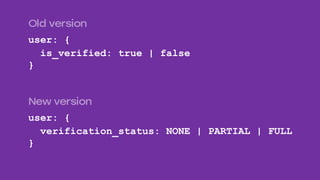
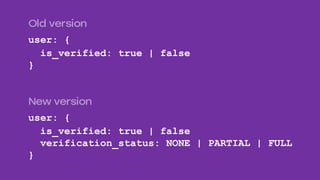
![user_request: { // like GraphQL
fields: [verification_status]
}
user: {
verification_status: NONE | PARTIAL | FULL
}](https://image.slidesharecdn.com/badoo-versioning-161111085440/85/Versioning-strategy-for-a-complex-internal-API-20-320.jpg)
![user_request: { // like GraphQL
fields: [is_verified]
}
user: {
is_verified: true | false
}](https://image.slidesharecdn.com/badoo-versioning-161111085440/85/Versioning-strategy-for-a-complex-internal-API-21-320.jpg)



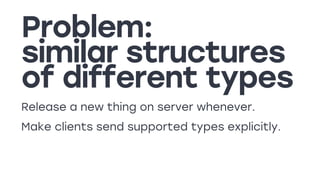
![banner: {
header: "Get extra…",
pictures: [<pics>],
text: "Make it easy…",
buttons: [<button>]
}](https://image.slidesharecdn.com/badoo-versioning-161111085440/85/Versioning-strategy-for-a-complex-internal-API-25-320.jpg)


![banner: {
header: "Get extra…",
pictures: [<pics>],
text: "Make it easy…",
buttons: [<button>],
type: "EXTRA_SHOWS"
}](https://image.slidesharecdn.com/badoo-versioning-161111085440/85/Versioning-strategy-for-a-complex-internal-API-28-320.jpg)
![user_list_request: {
fields: [banners]
}
user_list: {
banners: [<unknown banner>]
}](https://image.slidesharecdn.com/badoo-versioning-161111085440/85/Versioning-strategy-for-a-complex-internal-API-29-320.jpg)
![user_list_request: {
fields: [banners_v24]
}
user_list: {
banners_v24: [<banner>]
}](https://image.slidesharecdn.com/badoo-versioning-161111085440/85/Versioning-strategy-for-a-complex-internal-API-30-320.jpg)
![user_list_request: {
fields: [banners],
supported_banners: [EXTRA_SHOWS]
}
user_list: {
banners: [<extra shows banner>]
}](https://image.slidesharecdn.com/badoo-versioning-161111085440/85/Versioning-strategy-for-a-complex-internal-API-31-320.jpg)



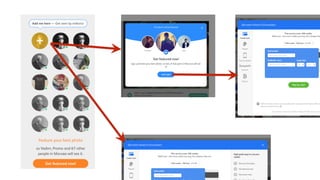
![user_request: {
fields: [photos]
}
user: {
photos: [ <photo 1>, <photo 2>]
}](https://image.slidesharecdn.com/badoo-versioning-161111085440/85/Versioning-strategy-for-a-complex-internal-API-36-320.jpg)

![user_request: {
fields: [photos],
supported_changes: [VIDEOS_IN_PHOTOS]
}
user: {
photos: [ <photo 1>, <video 1>, <photo 2>, …]
}](https://image.slidesharecdn.com/badoo-versioning-161111085440/85/Versioning-strategy-for-a-complex-internal-API-38-320.jpg)
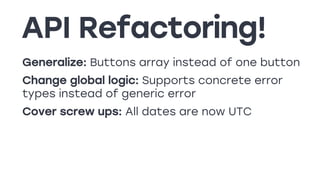



![startup_request: {
supported_features: [VIDEO_CALLS, GIFS]
}
startup: {
allowed_features: [GIFS] // client will turn
// video calls off
}](https://image.slidesharecdn.com/badoo-versioning-161111085440/85/Versioning-strategy-for-a-complex-internal-API-45-320.jpg)
![startup_request: {
supported_features: [VIDEO_CALLS, GIFS]
}
startup: {
allowed_features: [GIFS, VIDEO_CALLS]
// feature released
}](https://image.slidesharecdn.com/badoo-versioning-161111085440/85/Versioning-strategy-for-a-complex-internal-API-46-320.jpg)

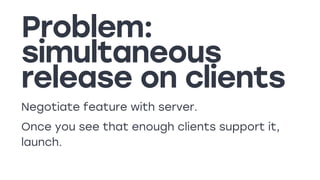



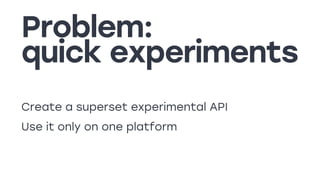
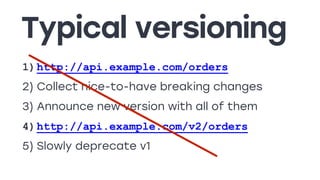
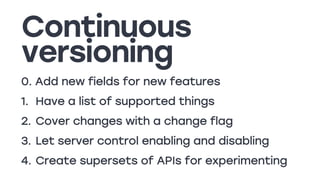


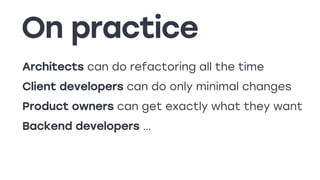



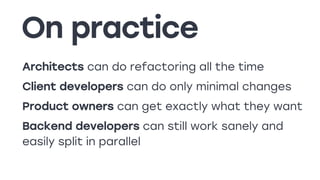


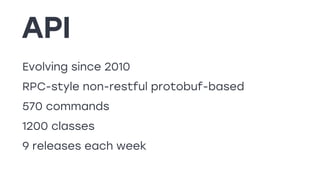
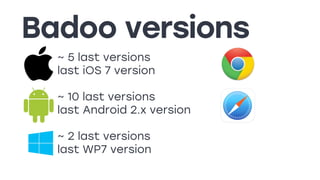
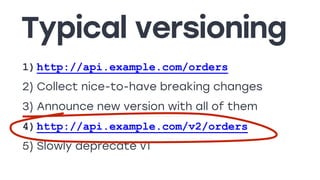
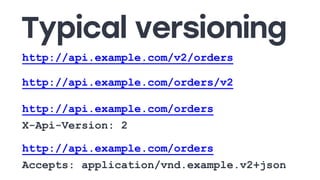
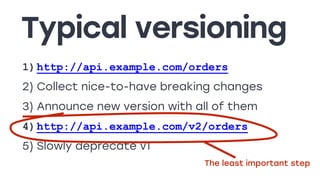
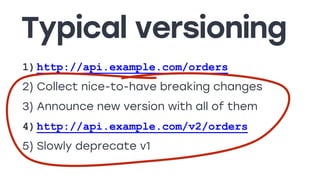
The document discusses strategies for versioning a complex internal API for an application with many clients. It proposes negotiating feature support with clients and using feature flags to control enabling and disabling of changes, rather than distinct numbered versions. This allows continuous development while minimizing required client updates.


![Getting Started with Apache Spark: Big Data Made Simple [Free Meetup]](https://cdn.slidesharecdn.com/ss_thumbnails/apachesparkgettingstarted-260203175547-8361bcc3-thumbnail.jpg?width=640&height=640&fit=bounds)


